→ Elements canbe classified as metals and non-metals
on the basis of their properties.
• Examples of some metals are: Iron (Fe), Aluminium
(Al), Silver (Ag), Copper (Cu)
• Examples of some non-metals are: Hydrogen (H),
Nitrogen (N), Sulphur (S), Oxygen (O)
3.
Metals are theelements that conduct heat and
electricity and are malleable and ductile.
Examples are Iron (Fe), Aluminium (Al), Silver
(Ag), Copper (Cu), Gold (Au), Platinum (Pt), Lead
(Pb), Potassium (K), Sodium (Na), Calcium (Ca)
and Magnesium (Mg) etc.
Metals are the elements which form positive
ions by losing electrons. Thus, metals are known
as Electropositive Elements. (cation)
4.
Physical Properties ofMetals
•Hardness: Most of the metals are hard, except alkali metals, such as
sodium, potassium, lithium, etc. are very soft metals. These can be cut
by using a knife.
•Strength: Most of the metals are strong and have high tensile strength.
Because of this, big structures are made using metals, such as copper
(Cu) and iron (Fe). (Except Sodium (Na) and potassium (K) which are
soft metals).
•State: Metals are solid at room temperature except for mercury (Hg).
•Sound: Metals produce ringing sound, so, metals are called Sonorous.
Sound of metals is also known as Metallic sound. This is the cause that
metal wires are used in making musical instruments.
5.
•Conduction: Metals area good conductor of heat and electricity. This
is the cause that electric wires are made of metals like copper and
aluminium.
•Malleability: Metals are malleable. This means metals can be beaten
into a thin sheet. Because of this property, iron is used in making big
ships.
•Ductility: Metals are ductile. This means metals can be drawn into thin
wire. Because of this property, a wire is made of metals.
•Melting and Boiling Point: Metals have generally high melting and
boiling points. (Except sodium and potassium metals which have low
melting and boiling point.)
•Density: Most of the metals have a high density.
•Colour: Most of the metals are grey in colour. But gold and copper are
exceptions.
6.
Chemical Properties ofMetals
1. Reaction with oxygen: Most of the metals form
respective metal oxides when reacting with oxygen.
Metal + Oxygen → Metal Oxide
Examples:
Reaction of Potassium with Oxygen: Potassium metal forms
potassium oxide when reacts with oxygen.
7.
Reaction of Sodiumwith Oxygen: Sodium metal forms sodium
oxide when reacts with oxygen.
Lithium, potassium, sodium, etc. are known as Alkali-metals. Alkali
metals react vigorously with oxygen.
Reaction of Copper metal with Oxygen: Copper does not react with
oxygen at room temperature but when burnt in air, it gives oxide.
Silver, gold and platinum do not combine with the oxygen of air even at
high temperature. They are the least reactive.
8.
2. Reaction ofmetals with water: Metals form respective
hydroxide and hydrogen gas when reacting with water.
Metal + Water → Metal hydroxide + Hydrogen
Most of the metals do not react with water. However, alkali metals
react vigorously with water.
Reaction of Sodium metal with Water: Sodium metal forms
sodium hydroxide and liberates hydrogen gas along with lot of
heat when reacting with water.
9.
Reaction of Calciummetal with Water: Calcium forms calcium
hydroxide along with hydrogen gas and heat when react with
water.
Reaction of Magnesium metal with Water: Magnesium metal reacts with
water slowly and forms magnesium hydroxide and hydrogen gas.
When steam is passed over magnesium metal, magnesium oxide and
hydrogen gas are formed.
10.
Reaction of Aluminiummetal with Water: Reaction of aluminium metal with
cold water is too slow to come into notice. But when steam is passed over
aluminium metal, aluminium oxide and hydrogen gas are produced.
2Al + 3H2O → Al2O3 + 2H2
Reaction of Zinc metal with Water: Zinc metal produces zinc oxide and
hydrogen gas when steam is passed over it. Zinc does not react with cold
water.
Reaction of Iron with Water: Reaction of iron with cold water is very slow
and comes into notice after a long time. Iron forms rust (iron oxide) when
reacts with moisture present in the atmosphere. Iron oxide and hydrogen
gas are formed by passing of steam over iron metal.
11.
Both calcium (Ca)and magnesium (Mg) are heavier than
water but still float over it: Both calcium and magnesium float
over water surface because hydrogen gas is evolved when
these metals react with water. It is in the form of bubbles
which stick on the metal surface. Therefore, they float over it.
Other metals usually do not react with water or react very
slowly. Lead, copper, silver and gold do not react with steam.
Thus, the order of reactivity of different metals towards water
may be written as :
K > Na > Ca > Mg > Al > Zn > Fe > Pb > Cu > Ag > Au
12.
3. Reaction ofmetals with dilute acid: Metals form respective
salts when reacting with dilute acid.
Metal + dil. acid → Metal salt + Hydrogen
Reaction of Sodium metal with dilute hydrochloric acid: Sodium
metal gives sodium chloride and hydrogen gas when react with
dilute hydrochloric acid.
13.
Reaction of Magnesiummetal with dilute
hydrochloric acid: Magnesium chloride and
hydrogen gas are formed when magnesium reacts
with dilute hydrochloric acid.
Reaction of Zinc with dilute sulphuric acid: Zinc sulphate
and hydrogen gas are formed when zinc reacts with dilute
sulphuric acid. This method is used in the laboratory to
produce hydrogen gas.
14.
Hydrogen (H2) gasis not evolved when metal is treated with
nitric acid (HNO3):
Nitric acid is strong oxidising agent and it oxidises the hydrogen
gas (H2) liberated into water (H2O) and itself get reduced to some
oxide of nitrogen like nitrous oxide (N2O)3 nitric oxide (NO) and
nitrogen dioxide (NO2).
Copper, gold, silver are known as noble metals. These do not
react with water or dilute acids.
The order of reactivity of metal towards dilute hydrochloric acid
or sulphuric acid is in the order;
K > Na > Ca > Mg > Al > Zn > Fe > Cu > Hg > Ag
15.
Metal Oxides
Chemical Properties:Metal oxides are basic in nature. The
aqueous solution of metal oxides turns red litmus blue.
Reaction of Metal oxides with Water: Most of the metal oxides are
insoluble in water. Alkali metal oxides are soluble in water. Alkali
metal oxides give strong base when dissolved in water.
Reaction of Sodium oxide with Water: Sodium oxide gives sodium
hydroxide when reacts with water.
16.
Reaction of Potassiumoxide with Water: Potassium
oxide gives potassium hydroxide when reacts with water.
Reaction of Zinc oxide and Aluminium oxide: Aluminium oxide and
zinc oxide are insoluble in water. Aluminium oxide and zinc oxide are
amphoteric in nature. An amphoteric substance shows both acidic
and basic characters. It reacts with base like acid and reacts with an
acid like a base.
When zinc oxide reacts with sodium hydroxide, it behaves like an acid.
In this reaction, sodium zincate and water are formed.
17.
Zinc oxide behaveslike a base when reacts with acid. Zinc oxide
gives zinc chloride and water on reaction with hydrochloric acid.
In a similar way, aluminium oxide behaves like a base when
reacts with acid and behaves like acid when reacts with a base.
Aluminium oxide gives sodium aluminate along with water when
reacts with sodium hydroxide.
18.
Aluminium oxide givesaluminium chloride along
with water when it reacts with hydrochloric acid.
19.
Reactivity Series ofMetals: The order of intensity or reactivity of metal is
known as Reactivity Series. Reactivity of elements decreases on moving
from top to bottom in the given reactivity series.
In the reactivity series, copper, gold, and silver are at the bottom and
hence, least reactive. These metals are known as Noble metals.
Potassium is at the top of the series and hence, most reactive.
Reactivity of some metals are given in descending order :
K > Na > Ca > Mg > Al > Zn > Fe > Pb > Cu
20.
4. Reaction ofmetals with solution of other metal
salts: Reaction of metals with the solution of other metal salt is
displacement reaction. In this reaction, more reactive metal
displaces the less reactive metal from its salt.
Metal A + Salt of metal B → Salt of metal A + Metal B
Examples :
Iron displaces copper from copper sulphate solution.
21.
Similarly, aluminium andzinc displace copper from the
solution of copper sulphate
In all the above examples, iron, aluminium and zinc are more
reactive than copper. This is why they displace copper from its
salt solution.
When copper is dipped in the solution of silver nitrate, it
displaces silver and forms copper nitrate.
22.
Non-Metals:
Non-metals are theelements that do not conduct
electricity and are neither malleable nor ductile.
Examples: Carbon (C), Sulphur (S), Phosphorous (P), Silicon
(Si), Hydrogen (H), Oxygen (O), Nitrogen (N), Chlorine (Cl),
Bromine (Br), Neon (Ne) and Argon (Ar) etc.
Non-metals are the elements which form negative ions by
gaining an electron. Thus, non¬metals are also known as
Electronegative Elements. (anion)
23.
Physical properties ofnon-metals
Hardness: Non-metals are not hard rather they are
generally soft. But the diamond is an exception; it is the
hardest naturally occurring substance.
State: Non-metals may be solid, liquid or gas.
Lustre: Non-metals have a dull appearance. Diamond
and iodine are exceptions.
Sonority: Non-metals are not sonorous, i.e., they do not
produce a typical sound on being hit.
24.
Conduction: Non-metals area bad conductor of heat and
electricity. Graphite which is allotrope of carbon is a good
conductor of electricity and is an exception.
Malleability and ductility: Non-metals are brittle.
Melting and boiling point: Non-metals have generally
low melting and boiling points.
Density: Most of the non-metals have low density.
Colour: Non-metals are in many colours.
25.
• Carbon inthe form of graphite is non-metal which
conduct electricity.
• Iodine is non-metal which is lustrous having a shining
surface.
• Carbon in the form of diamond is a non-metal which is
extremely hard.
• Diamond is a non-metal which has a very high melting
point and boiling point.
26.
Chemical properties ofNon-metals
1. Reaction of Non-metals with Oxygen: Non-metals form
respective oxide when reacting with oxygen.
Non-metal + Oxygen → Non-metallic oxide
When carbon reacts with oxygen, carbon dioxide is formed along
with the production of heat
27.
When carbon isburnt in an insufficient supply of air, it forms carbon
monoxide. Carbon monoxide is a toxic substance. Inhaling of carbon
monoxide may prove fatal.
Sulphur gives sulphur dioxide when reacting with oxygen.
Sulphur catches fire when exposed to air.
When hydrogen reacts with oxygen it gives water.
28.
Non-metallic Oxide: Non-metallicoxides are acidic in nature. The
solution of non-metal oxides turns blue litmus red.
Carbon dioxide gives carbonic acid when dissolved in water.
Sulphur dioxide gives sulphurous acid when dissolved
in water
2. Reaction ofNon-metal with Chlorine: Non-metal gives
respective chloride when they react with chlorine gas.
Non-metal + Chlorine → Non-metal chloride
Hydrogen gives hydrogen chloride and phosphorous gives
phosphorous trichloride when reacting with chlorine.
31.
3. Reaction ofNon-metals with Hydrogen: Non-metals reactive
with hydrogen to form covalent hydrides.
Non-metal + Hydrogen → Covalent Hydride
Sulphur combines with hydrogen to form a covalent hydride is
called Hydrogen sulphide.
Nitrogen combines with hydrogen in presence of an iron
catalyst to form covalent hydride ammonia.
32.
Non-metals do notreact with water (or
steam) to evolve Hydrogen gas.
Non-metals do not react with dilute
acids.
33.
4. Reaction ofMetal and Non-metal: Many metals form
ionic bonds when they react with non-metals.
Compounds so formed are known as Ionic Compounds.
Ions: Positive or negative charged atoms are known as
ions. Ions are formed because of loss or gain of
electrons. Atoms form ions obtain by the electronic
configuration of the nearest noble gas.
Positive ion: A positive ion is formed because of the loss
of electrons by an atom.
34.
Following are someexamples of positive ions:
Sodium forms sodium ion because of the loss of one
electron. Because of the loss of one electron, one
positive charge comes over sodium.
Magnesium forms positive ion because of the loss of two
electrons. Two positive charges come over magnesium
because of loss of two electrons.
35.
Negative ion: Anegative ion is formed because of the gain of an
electron.
Some examples are given below :
Chlorine gains one electron in order to achieve a stable
configuration. After the loss of one electron, chlorine gets one
negative charge over it forming chlorine ion.
36.
Ionic Bonds:
Ionic bondsare formed because of transfer of electrons
from metal to non¬metal. In this course, metals get
positive charge because of transfer of electrons and non-
metal gets negative charge because of acceptance of
electrons.
In other words, bond formed between positive and
negative ion is called Ionic Bond.
Since, a compound is electrically neutral, so to form an
ionic compound, negative and positive both ions must be
combined.
37.
Some examples aregiven below:
Formation of Sodium Chloride (NaCl): In sodium chloride, sodium
is a metal (alkali metal) and chlorine is a non-metal.
Atomic number of sodium = 11
Electronic configuration of sodium : 2, 8, 1
Number of electrons in outermost orbit = 1
Valence electrons = Electrons in outermost orbit = 1
Atomic number of chlorine = 17
Electronic configuration of chlorine : 2, 8, 7
Electrons in outermost orbit = 7
Therefore, valence electrons = 1
38.
Sodium has onevalence electron and chlorine has seven
valence electrons. Sodium requires losing one electron to
obtain stable configuration and chlorine requires gaining
one electron in order to obtain stable electronic
configuration. Thus, in order to obtain stable
configuration, sodium transfers one electron to chlorine.
After loss of one electron, sodium gets one positive
charge (+) and chlorine gets one negative charge after
gain of one electron. Sodium chloride is formed because
of transfer of electrons. Thus, ionic bond is formed
between sodium and chlorine. Since, sodium chloride is
formed because of ionic bond, thus, it is called Ionic
compound. In similar way, potassium chloride (KCl) is
formed.
39.
Properties of Ioniccompound
•Ionic compounds are solid. Ionic bond has a
greater force of attraction because of which ions
attract each other strongly. This makes ionic
compounds solid.
•Ionic compounds are brittle.
•Ionic compounds have high melting and boiling
points because force of attraction between ions of
ionic compounds is very strong.
40.
•Ionic compounds generallydissolve in water.
•Ionic compounds are generally insoluble in
organic solvents; like kerosene, petrol, etc.
•Ionic compounds do not conduct electricity in the
solid state.
•The solution of ionic compounds in water
conduct electricity. This happens because ions
present in the solution of ionic compound
facilitate the passage of electricity by moving
towards opposite electrodes.
•Ionic compounds conduct electricity in the
molten state.
41.
Occurrence and Extractionof Metals:
Source of metal: Metals occur in Earth’s crust and in seawater; in
the form of ores. Earth’s crust is the major source of metal.
Seawater contains many salts such as sodium chloride,
magnesium chloride, etc.
Mineral: Minerals are naturally occurring substances which have
a uniform composition.
Ores: The minerals from which a metal can be profitably
extracted are called Ores.
Metals found at the bottom of reactivity series are least reactive
and they are often found in nature in free-state; such as gold,
silver, copper, etc. Copper and silver are also found in the form of
sulphide and oxide ores.
42.
Metals found inthe middle of reactivity series, such as
Zn, Fe, Pb, etc. are usually found in the form of oxides,
sulphides or carbonates.
Metals found at the top of the reactivity series are never
found in free-state as they are very reactive, example; K,
Na, Ca, Mg and Al, etc.
Many metals are found in the form of oxides because
oxygen is abundant in nature and is very reactive.
43.
Extraction of Metals:
Metalscan be categorised into three parts on
the basis of their reactivity: Most reactive,
medium reactive and least reactive.
The three major steps involved in the extraction
of a metal from its ore are
•Concentration or enrichment of ores.
•Conversion of concentrated ore into crude
metal and,
•Refining of impure or crude metal.
45.
1. Concentration ofOres: Removal of impurities, such
as soil, sand, stone, silicates, etc. from mines ore is
known as Concentration of Ores.
Ores which are mined often contain many
impurities. These impurities are called gangue. First
of all, concentration is done to remove impurities
from ores. The concentration of ores is also known
as enrichment of ores. Process of concentration
depends upon physical and chemical properties of
ores. Gravity separation, electromagnetic
separation, froth flotation process, etc. are some
examples of the processes which are applied for
concentration of ores.
46.
2. Conversion ofConcentrated Ore into Crude
Metal
Conversion of metals ores into oxides: It is easy
to obtain metals from their oxides. So, ores found
in the form of sulphide and carbonates are first
converted to their oxides by the process of
roasting and calcination. Oxides of metals so
obtained are converted into metals by the
process of reduction.
47.
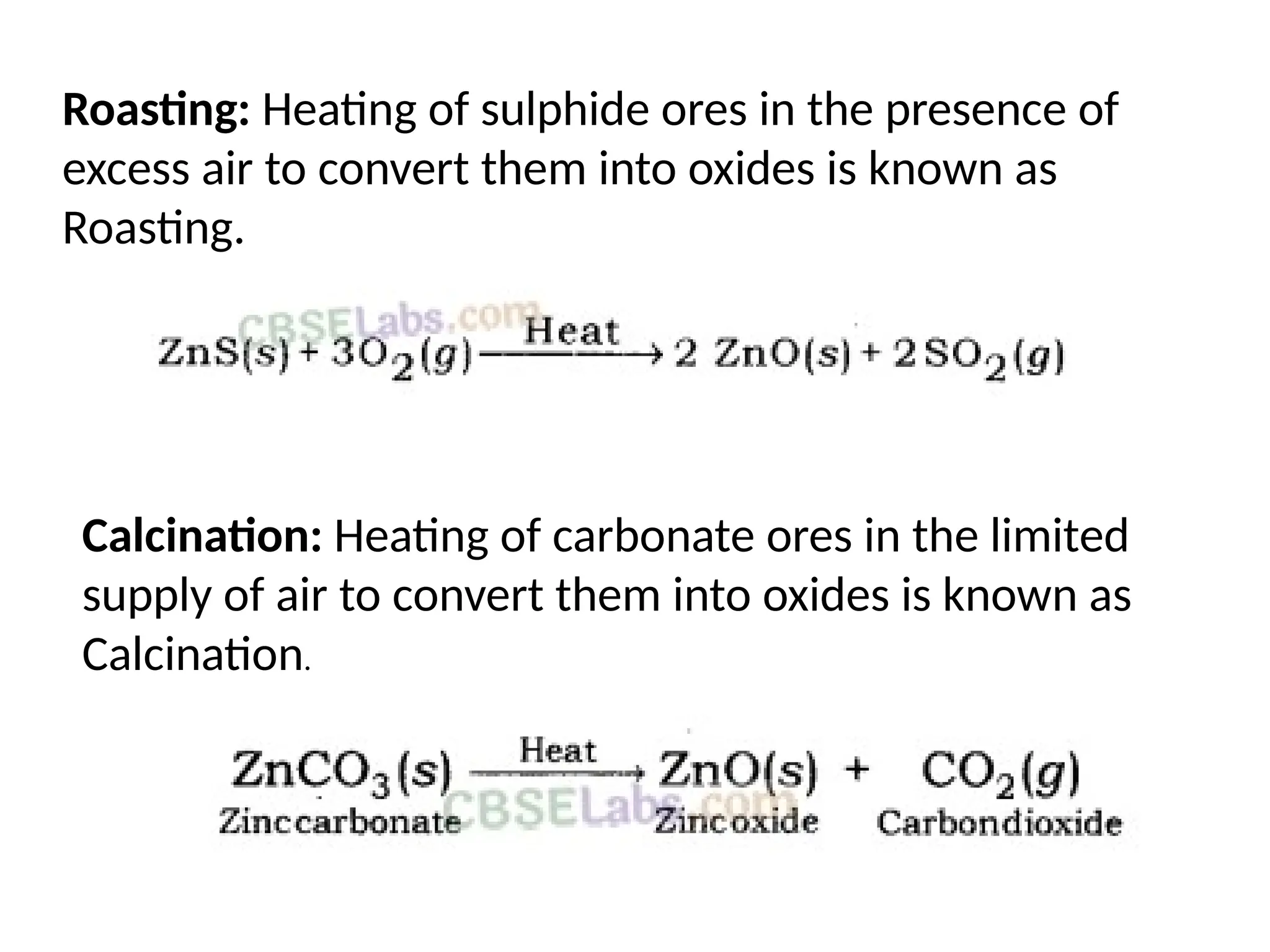
Roasting: Heating ofsulphide ores in the presence of
excess air to convert them into oxides is known as
Roasting.
Calcination: Heating of carbonate ores in the limited
supply of air to convert them into oxides is known as
Calcination.
49.
3. Reduction: Heatingof oxides of metals to turn them into
metal is known as Reduction.
(i) Extraction of Metals of Least Reactivity: Mercury and copper,
which belong to the least reactivity series, are often found in the
form of their sulphide ores. Cinnabar (HgS) is the ore of mercury.
Copper glance (Cu2S) is the ore of copper.
Extraction of Mercury Metal: Cinnabar (HgS) is first heated in air.
This turns HgS (mercury sulphide or cinnabar) into HgO (mercury
oxide) by liberation of sulphur dioxide. Mercury oxide so
obtained is again heated strongly. This reduces mercury oxide to
mercury metal.
50.
Extraction of CopperMetal: Copper glance (Cu2S) is
roasted in the presence of air. Roasting turns copper
glance (ore of copper) into copper (l) oxide. Copper oxide
is then heated in the absence of air. This reduces copper
(l) oxide into copper metal.
51.
(ii) Extraction ofMetals of Middle Reactivity: Iron, zinc, lead, etc.
are found in the form of carbonate or sulphide ores. Carbonate or
sulphide ores of metals are first converted into respective oxides
and then oxides are reduced to respective metals.
Extraction of Zinc: Zinc blende (ZnS: zinc sulphide) and
smithsonite or zinc spar or calamine (ZnCO3: zinc carbonate)
are ores of zinc. Zinc blende is roasted to be converted into
zinc oxide. Zinc spar is put under calcination to be converted
into zinc oxide.
52.
Zinc oxide soobtained is reduced to zinc metal by heating
with carbon (a reducing agent).
Extraction of Iron from Haematite (Fe2O3): Haematite ore is heated with
carbon to be reduced to iron metal.
Extraction of Lead from Lead oxide: Lead oxide is heated with carbon to
be reduced to lead metal
53.
Reduction of Metaloxide by Heating with
Aluminium: Metal oxides are heated with aluminium (a
reducing agent) to be reduced to metal. Following is an
example: Manganese dioxide and copper oxide are
reduced to respective metals when heated with
aluminium.
54.
Thermite Reaction: Ferricoxide; when heated with
aluminium; is reduced to iron metal. In this reaction, a
lot of heat is produced. The thermite reaction is used in
the welding of electric conductors, iron joints, etc. such
as joints in railway tracks. This is also known as Thermite
Welding (TW).
55.
(iii) Extraction ofMetals of High Reactivity: Metals of high reactivity;
such as sodium, calcium, magnesium, aluminium, etc. are extracted
from their ores by electrolytic reduction. These metals cannot be
reduced using carbon because carbon is less reactive than them.
Electrolytic Reduction: Electric current is passed through the molten
state of metal ores. Metal being positively charged is deposited over
the cathode.
Example: When an electric current is passed through molten state or
solution of sodium chloride, sodium metal gets deposited over the
cathode.
Metals obtained from the process
of electrolytic reduction are pure
in form
56.
4. Refining orpurification of metals: Metals
extracted from various methods contains some
impurities, thus, they are required to be refined.
Most of the metals are refined using electrolytic
refining.
57.
Electrolytic Refining: Inthe process of
electrolytic refining, a lump of impure metal and
a thin strip of pure metal are dipped in the salt
solution of metal to be refined. When an electric
current is passed through the solution, pure
metal is deposited over a thin strip of pure metal
58.
Electrolytic Refining ofCopper: A lump of impure copper
metal and a thin strip of pure copper are dipped in the
solution of copper sulphate. Impure lump of metal is
connected with the positive pole and thin strip of pure metal
is connected with negative pole. When electric current is
passed through the solution, pure metal from anode moves
towards cathode and is deposited over it. Impurities present in
metal are settled near the bottom of anode in the solution.
Settled impurities in the solution are called Anode Mud.
59.
5. Corrosion:
Most ofthe metals keep on reacting with the atmospheric
air. This leads to the formation of a layer over the metal. In
the long run, the underlying layer of metal keeps on
getting lost due to conversion into oxides or sulphides or
carbonate, etc. As a result, the metal gets eaten up. The
process is called Corrosion.
60.
Rusting of Iron:
Rustingof iron is the most common form of corrosion.
When iron articles like the gate, grill, fencing, etc.
come in contact with moisture present in the air, the
upper layer of iron turns into iron oxide. Iron oxide is
brown-red in colour and is known as Rust. The
phenomenon is called Rusting of Iron.
If rusting is not prevented in time, the whole iron
article would turn into iron oxide. This is also known as
Corrosion of Iron. Rusting of iron gives a huge loss
every year.
61.
Prevention of Rusting:For rusting, iron must
come in contact with oxygen and water.
Rusting is prevented by preventing the
reaction between atmospheric moisture and
the iron article. This can be done by:
•Painting
•Greasing
•Galvanization
•Electroplating
•Alloying
62.
6. Alloys: Thehomogeneous mixture of two or more
metals, or a metal and a non-metal is called Alloy.
Types of alloys :
•Ferrous alloys: An alloy in which iron (Fe) is present. For
example : manganese steel (Fe = 86% ; Mn = 13% ; C =
1%) and Nickle steel (Fe = 98% ; Ni = 2%).
•Non-ferrous alloys: An alloy does not contain iron. For
example : Brass (Cu = 80% ; Zn = 20%), and Bronze (Cu =
90% ; Sn = 10%).
•Amalgams: An alloy in which mercury (Hg) is present.
For example Sodium amalgams [Na(Hg)] and Zinc
amalgams [Zn(Hg)].
63.
Properties of anAlloy
•Alloys are stronger than the metal from which they are
obtained.
•It is harder than the constituent metals.
•More resistance to corrosion.
•The melting point of alloys is lower than the
constituent metals.
Example: Solder [Sn(80%) + Pb(50%)] has lower m. p.
than Pb and Sn.
•The electrical conductivity of alloys is lower than the
constituent metals






![6. Alloys: The homogeneous mixture of two or more
metals, or a metal and a non-metal is called Alloy.
Types of alloys :
•Ferrous alloys: An alloy in which iron (Fe) is present. For
example : manganese steel (Fe = 86% ; Mn = 13% ; C =
1%) and Nickle steel (Fe = 98% ; Ni = 2%).
•Non-ferrous alloys: An alloy does not contain iron. For
example : Brass (Cu = 80% ; Zn = 20%), and Bronze (Cu =
90% ; Sn = 10%).
•Amalgams: An alloy in which mercury (Hg) is present.
For example Sodium amalgams [Na(Hg)] and Zinc
amalgams [Zn(Hg)].](https://image.slidesharecdn.com/metalsandnon-metals-250221160715-4ff1fbe8/75/METALS-AND-NON-METALS-pptx-class-10-cbse-62-2048.jpg)
![Properties of an Alloy
•Alloys are stronger than the metal from which they are
obtained.
•It is harder than the constituent metals.
•More resistance to corrosion.
•The melting point of alloys is lower than the
constituent metals.
Example: Solder [Sn(80%) + Pb(50%)] has lower m. p.
than Pb and Sn.
•The electrical conductivity of alloys is lower than the
constituent metals](https://image.slidesharecdn.com/metalsandnon-metals-250221160715-4ff1fbe8/75/METALS-AND-NON-METALS-pptx-class-10-cbse-63-2048.jpg)


![METALS_AND_NON-METALS.ppt[1nnnnnnnnnnnnnnnnnnnnnnnnnnnn].pptx](https://cdn.slidesharecdn.com/ss_thumbnails/metalsandnon-metals-250826070520-45623e05-thumbnail.jpg?width=640&height=640&fit=bounds)


