13.1
Copyright © The McGraw-Hill Companies, Inc. Permission required for reproduction or display.
Chapter 13
Digital Signature
13.2
Objectives
 To define a digital signature
 To define security services provided by a digital
signature
 To define attacks on digital signatures
 To discuss some digital signature schemes, including
RSA, ElGamal,
 Schnorr, DSS, and elliptic curve
 To describe some applications of digital signatures
Chapter 13
13.3
13-113-1 COMPARISON
Let us begin by looking at the differences betweenLet us begin by looking at the differences between
conventional signatures and digital signatures.conventional signatures and digital signatures.
13.1.1 Inclusion
13.1.2 Verification Method 390
13.1.3 Relationship
13.1.4 Duplicity
Topics discussed in this section:Topics discussed in this section:
13.4
A conventional signature is included in the document; it
is part of the document. But when we sign a document
digitally, we send the signature as a separate document.
13.1.1 Inclusion
13.5
For a conventional signature, when the recipient receives
a document, she compares the signature on the document
with the signature on file. For a digital signature, the
recipient receives the message and the signature. The
recipient needs to apply a verification technique to the
combination of the message and the signature to verify
the authenticity.
13.1.2 Verification Method
13.6
For a conventional signature, there is normally a one-to-
many relationship between a signature and documents.
For a digital signature, there is a one-to-one relationship
between a signature and a message.
13.1.3 Relationship
13.7
In conventional signature, a copy of the signed document
can be distinguished from the original one on file. In
digital signature, there is no such distinction unless there
is a factor of time on the document.
13.1.4 Duplicity
13.8
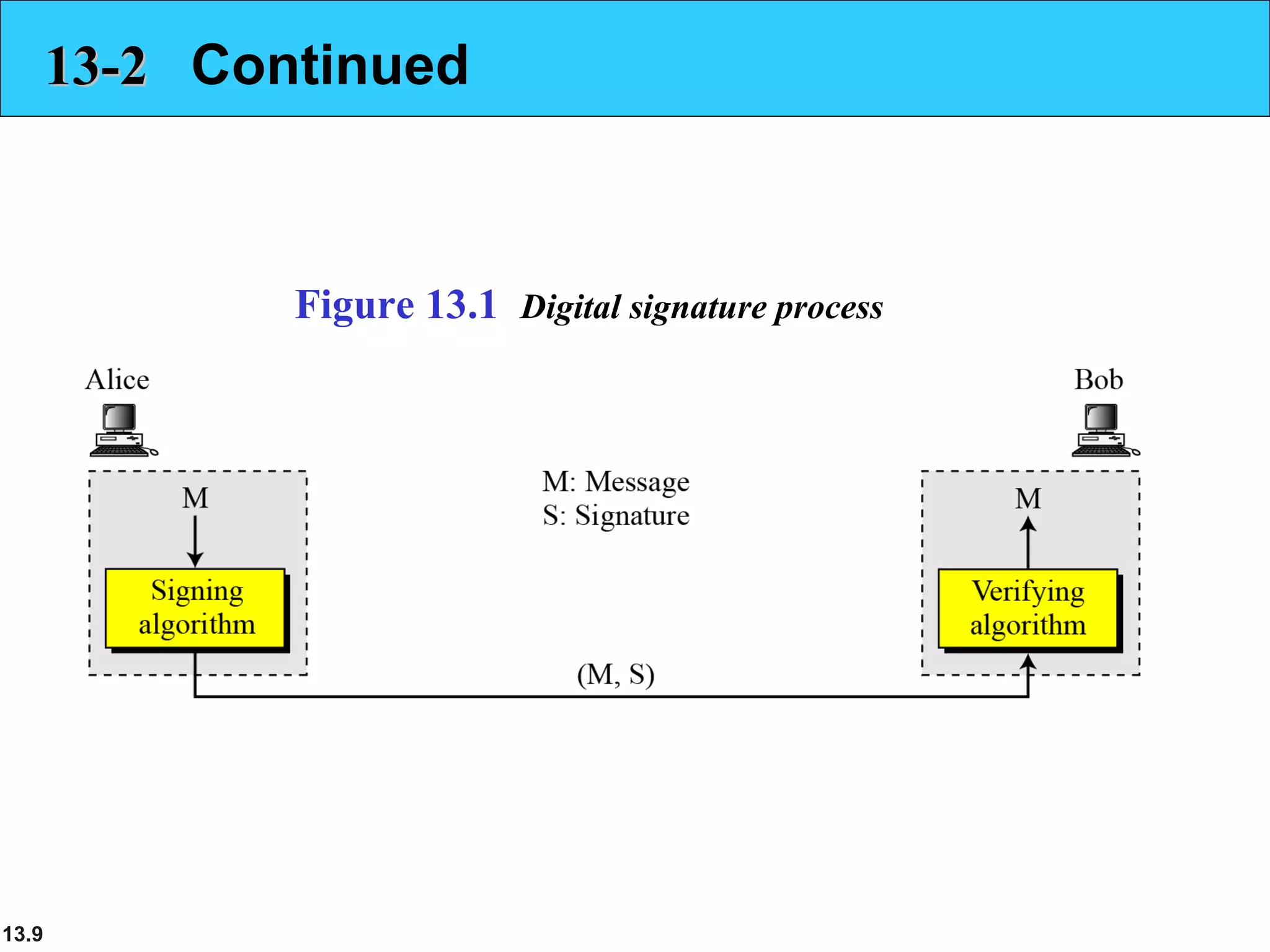
13-213-2 PROCESS
Figure 13.1 shows the digital signature process. TheFigure 13.1 shows the digital signature process. The
sender uses a signing algorithm to sign the message.sender uses a signing algorithm to sign the message.
The message and the signature are sent to the receiver.The message and the signature are sent to the receiver.
The receiver receives the message and the signatureThe receiver receives the message and the signature
and applies the verifying algorithm to theand applies the verifying algorithm to the
combination. If the result is true, the message iscombination. If the result is true, the message is
accepted; otherwise, it is rejected.accepted; otherwise, it is rejected.
13.2.1 Need for Keys
13.2.2 Signing the Digest
Topics discussed in this section:Topics discussed in this section:
13.9
13-213-2 Continued
Figure 13.1 Digital signature process
13.10
13.2.1 Need for Keys
Figure 13.2 Adding key to the digital signature process
A digital signature needs a public-key system.
The signer signs with her private key; the verifier
verifies with the signer’s public key.
Note
13.11
13.2.1 Continued
A cryptosystem uses the private and public keys of
the receiver: a digital signature uses
the private and public keys of the sender.
Note
13.12
13.2.2 Signing the Digest
Figure 13.3 Signing the digest
13.13
13-313-3 SERVICES
We discussed several security services in Chapter 1We discussed several security services in Chapter 1
including message confidentiality,including message confidentiality, messagemessage
authenticationauthentication, message integrity, and, message integrity, and nonrepudiationnonrepudiation..
A digital signature can directly provide the last three;A digital signature can directly provide the last three;
for message confidentiality we still needfor message confidentiality we still need
encryption/decryption.encryption/decryption.
13.3.1 Message Authentication
13.3.2 Message Integrity
13.3.3 Nonrepudiation
13.3.4 Confidentiality
Topics discussed in this section:Topics discussed in this section:
13.14
A secure digital signature scheme, like a secure
conventional signature can provide message
authentication.
13.3.1 Message Authentication
A digital signature provides message
authentication.
Note
13.15
The integrity of the message is preserved even if we sign
the whole message because we cannot get the same
signature if the message is changed.
13.3.2 Message Integrity
A digital signature provides message integrity.
Note
13.16
13.3.3 Nonrepudiation
Figure 13.4 Using a trusted center for nonrepudiation
Nonrepudiation can be provided using a trusted
party.
Note
13.17
13.3.4 Confidentiality
A digital signature does not provide privacy.
If there is a need for privacy, another layer of
encryption/decryption must be applied.
Figure 13.5 Adding confidentiality to a digital signature scheme
Note
13.18
13-413-4 ATTACKS ON DIGITAL SIGNATURE
This section describes some attacks on digitalThis section describes some attacks on digital
signatures and defines the types of forgery.signatures and defines the types of forgery.
13.4.1 Attack Types
13.4.2 Forgery Types
Topics discussed in this section:Topics discussed in this section:
13.19
13.4.1 Attack Types
Key-Only Attack
Known-Message Attack
Chosen-Message Attack
the attacker first learns signatures on arbitrary messages of the attacker's
choice.
the attacker is given valid signatures for a variety of messages known by
the attacker but not chosen by the attacker.
the attacker is only given the public verification key.
13.20
13.4.2 Forgery Types
Existential Forgery
Selective Forgery
Existential forgery is the creation (by an adversary) of
any message/signature pair (m,σ), where σ was not
produced by the legitimate signer.
Selective forgery is the creation (by an adversary) of
a message/signature pair (m,σ) where m has been
chosen by the adversary prior to the attack.
13.21
13-513-5 DIGITAL SIGNATURE SCHEMES
Several digital signature schemes have evolved duringSeveral digital signature schemes have evolved during
the last few decades. Some of them have beenthe last few decades. Some of them have been
implemented.implemented.
13.5.1 RSA Digital Signature Scheme
13.5.2 ElGamal Digital Signature Scheme
13.5.3 Schnorr Digital Signature Scheme
13.5.4 Digital Signature Standard (DSS)
13.5.5 Elliptic Curve Digital Signature Scheme
Topics discussed in this section:Topics discussed in this section:
13.22
Key Generation
Key generation in the RSA digital signature scheme is
exactly the same as key generation in the RSA
13.5.1 Continued
In the RSA digital signature scheme, d is private;
e and n are public.
Note
13.23
Signing and Verifying
13.5.1 Continued
Figure 13.7 RSA digital signature scheme
13.24
13.5.1 Continued
As a trivial example, suppose that Alice chooses p = 823 and q =
953, and calculates n = 784319. The value of φ(n) is 782544. Now
she chooses e = 313 and calculates d = 160009. At this point key
generation is complete. Now imagine that Alice wants to send a
message with the value of M = 19070 to Bob. She uses her private
exponent, 160009, to sign the message:
Example 13.1
Alice sends the message and the signature to Bob. Bob receives the
message and the signature. He calculates
Bob accepts the message because he has verified Alice’s signature.
13.25
RSA Signature on the Message Digest
13.5.1 Continued
Figure 13.8 The RSA signature on the message digest
13.26
13.5.1 Continued
When the digest is signed instead of the message
itself, the susceptibility of the RSA digital signature
scheme depends on the strength of the hash
algorithm.
Note
13.27
13.5.2 ElGamal Digital Signature Scheme
Figure 13.9 General idea behind the ElGamal digital signature scheme
13.28
Key Generation
The key generation procedure here is exactly the same as
the one used in the cryptosystem.
13.5.2 Continued
In ElGamal digital signature scheme, (e1, e2, p) is
Alice’s public key; d is her private key.
Note
13.29
Verifying and Signing
13.5.2 Continued
Figure 13.10 ElGamal digital signature scheme
13.30
13.5.3 Schnorr Digital Signature Scheme
Figure 13.11 General idea behind the Schnorr digital signature scheme
13.31
13.5.4 Digital Signature Standard (DSS)
Figure 13.13 General idea behind DSS scheme
13.32
DSS Versus RSA
Computation of DSS signatures is faster than
computation of RSA signatures when using the same p.
DSS Versus ElGamal
DSS signatures are smaller than ElGamal signatures
because q is smaller than p.
13.5.4 Continued
13.33
13.5.5 Elliptic Curve Digital Signature Scheme
Figure 13.15 General idea behind the ECDSS scheme
13.34
13-613-6 VARIATIONS AND APPLICATIONS
This section briefly discusses variations andThis section briefly discusses variations and
applications for digital signatures.applications for digital signatures.
13.6.1 Variations
13.6.2 Applications
Topics discussed in this section:Topics discussed in this section:
13.35
13.6.1 Variations
Time Stamped Signatures
Sometimes a signed document needs to be time stamped to
prevent it from being replayed by an adversary. This is
called time-stamped digital signature scheme.
Blind Signatures
Sometimes we have a document that we want to get
signed without revealing the contents of the document to
the signer.

C08 crypto-digital signature13

  • 1.
    13.1 Copyright © TheMcGraw-Hill Companies, Inc. Permission required for reproduction or display. Chapter 13 Digital Signature
  • 2.
    13.2 Objectives  To definea digital signature  To define security services provided by a digital signature  To define attacks on digital signatures  To discuss some digital signature schemes, including RSA, ElGamal,  Schnorr, DSS, and elliptic curve  To describe some applications of digital signatures Chapter 13
  • 3.
    13.3 13-113-1 COMPARISON Let usbegin by looking at the differences betweenLet us begin by looking at the differences between conventional signatures and digital signatures.conventional signatures and digital signatures. 13.1.1 Inclusion 13.1.2 Verification Method 390 13.1.3 Relationship 13.1.4 Duplicity Topics discussed in this section:Topics discussed in this section:
  • 4.
    13.4 A conventional signatureis included in the document; it is part of the document. But when we sign a document digitally, we send the signature as a separate document. 13.1.1 Inclusion
  • 5.
    13.5 For a conventionalsignature, when the recipient receives a document, she compares the signature on the document with the signature on file. For a digital signature, the recipient receives the message and the signature. The recipient needs to apply a verification technique to the combination of the message and the signature to verify the authenticity. 13.1.2 Verification Method
  • 6.
    13.6 For a conventionalsignature, there is normally a one-to- many relationship between a signature and documents. For a digital signature, there is a one-to-one relationship between a signature and a message. 13.1.3 Relationship
  • 7.
    13.7 In conventional signature,a copy of the signed document can be distinguished from the original one on file. In digital signature, there is no such distinction unless there is a factor of time on the document. 13.1.4 Duplicity
  • 8.
    13.8 13-213-2 PROCESS Figure 13.1shows the digital signature process. TheFigure 13.1 shows the digital signature process. The sender uses a signing algorithm to sign the message.sender uses a signing algorithm to sign the message. The message and the signature are sent to the receiver.The message and the signature are sent to the receiver. The receiver receives the message and the signatureThe receiver receives the message and the signature and applies the verifying algorithm to theand applies the verifying algorithm to the combination. If the result is true, the message iscombination. If the result is true, the message is accepted; otherwise, it is rejected.accepted; otherwise, it is rejected. 13.2.1 Need for Keys 13.2.2 Signing the Digest Topics discussed in this section:Topics discussed in this section:
  • 9.
    13.9 13-213-2 Continued Figure 13.1Digital signature process
  • 10.
    13.10 13.2.1 Need forKeys Figure 13.2 Adding key to the digital signature process A digital signature needs a public-key system. The signer signs with her private key; the verifier verifies with the signer’s public key. Note
  • 11.
    13.11 13.2.1 Continued A cryptosystemuses the private and public keys of the receiver: a digital signature uses the private and public keys of the sender. Note
  • 12.
    13.12 13.2.2 Signing theDigest Figure 13.3 Signing the digest
  • 13.
    13.13 13-313-3 SERVICES We discussedseveral security services in Chapter 1We discussed several security services in Chapter 1 including message confidentiality,including message confidentiality, messagemessage authenticationauthentication, message integrity, and, message integrity, and nonrepudiationnonrepudiation.. A digital signature can directly provide the last three;A digital signature can directly provide the last three; for message confidentiality we still needfor message confidentiality we still need encryption/decryption.encryption/decryption. 13.3.1 Message Authentication 13.3.2 Message Integrity 13.3.3 Nonrepudiation 13.3.4 Confidentiality Topics discussed in this section:Topics discussed in this section:
  • 14.
    13.14 A secure digitalsignature scheme, like a secure conventional signature can provide message authentication. 13.3.1 Message Authentication A digital signature provides message authentication. Note
  • 15.
    13.15 The integrity ofthe message is preserved even if we sign the whole message because we cannot get the same signature if the message is changed. 13.3.2 Message Integrity A digital signature provides message integrity. Note
  • 16.
    13.16 13.3.3 Nonrepudiation Figure 13.4Using a trusted center for nonrepudiation Nonrepudiation can be provided using a trusted party. Note
  • 17.
    13.17 13.3.4 Confidentiality A digitalsignature does not provide privacy. If there is a need for privacy, another layer of encryption/decryption must be applied. Figure 13.5 Adding confidentiality to a digital signature scheme Note
  • 18.
    13.18 13-413-4 ATTACKS ONDIGITAL SIGNATURE This section describes some attacks on digitalThis section describes some attacks on digital signatures and defines the types of forgery.signatures and defines the types of forgery. 13.4.1 Attack Types 13.4.2 Forgery Types Topics discussed in this section:Topics discussed in this section:
  • 19.
    13.19 13.4.1 Attack Types Key-OnlyAttack Known-Message Attack Chosen-Message Attack the attacker first learns signatures on arbitrary messages of the attacker's choice. the attacker is given valid signatures for a variety of messages known by the attacker but not chosen by the attacker. the attacker is only given the public verification key.
  • 20.
    13.20 13.4.2 Forgery Types ExistentialForgery Selective Forgery Existential forgery is the creation (by an adversary) of any message/signature pair (m,σ), where σ was not produced by the legitimate signer. Selective forgery is the creation (by an adversary) of a message/signature pair (m,σ) where m has been chosen by the adversary prior to the attack.
  • 21.
    13.21 13-513-5 DIGITAL SIGNATURESCHEMES Several digital signature schemes have evolved duringSeveral digital signature schemes have evolved during the last few decades. Some of them have beenthe last few decades. Some of them have been implemented.implemented. 13.5.1 RSA Digital Signature Scheme 13.5.2 ElGamal Digital Signature Scheme 13.5.3 Schnorr Digital Signature Scheme 13.5.4 Digital Signature Standard (DSS) 13.5.5 Elliptic Curve Digital Signature Scheme Topics discussed in this section:Topics discussed in this section:
  • 22.
    13.22 Key Generation Key generationin the RSA digital signature scheme is exactly the same as key generation in the RSA 13.5.1 Continued In the RSA digital signature scheme, d is private; e and n are public. Note
  • 23.
    13.23 Signing and Verifying 13.5.1Continued Figure 13.7 RSA digital signature scheme
  • 24.
    13.24 13.5.1 Continued As atrivial example, suppose that Alice chooses p = 823 and q = 953, and calculates n = 784319. The value of φ(n) is 782544. Now she chooses e = 313 and calculates d = 160009. At this point key generation is complete. Now imagine that Alice wants to send a message with the value of M = 19070 to Bob. She uses her private exponent, 160009, to sign the message: Example 13.1 Alice sends the message and the signature to Bob. Bob receives the message and the signature. He calculates Bob accepts the message because he has verified Alice’s signature.
  • 25.
    13.25 RSA Signature onthe Message Digest 13.5.1 Continued Figure 13.8 The RSA signature on the message digest
  • 26.
    13.26 13.5.1 Continued When thedigest is signed instead of the message itself, the susceptibility of the RSA digital signature scheme depends on the strength of the hash algorithm. Note
  • 27.
    13.27 13.5.2 ElGamal DigitalSignature Scheme Figure 13.9 General idea behind the ElGamal digital signature scheme
  • 28.
    13.28 Key Generation The keygeneration procedure here is exactly the same as the one used in the cryptosystem. 13.5.2 Continued In ElGamal digital signature scheme, (e1, e2, p) is Alice’s public key; d is her private key. Note
  • 29.
    13.29 Verifying and Signing 13.5.2Continued Figure 13.10 ElGamal digital signature scheme
  • 30.
    13.30 13.5.3 Schnorr DigitalSignature Scheme Figure 13.11 General idea behind the Schnorr digital signature scheme
  • 31.
    13.31 13.5.4 Digital SignatureStandard (DSS) Figure 13.13 General idea behind DSS scheme
  • 32.
    13.32 DSS Versus RSA Computationof DSS signatures is faster than computation of RSA signatures when using the same p. DSS Versus ElGamal DSS signatures are smaller than ElGamal signatures because q is smaller than p. 13.5.4 Continued
  • 33.
    13.33 13.5.5 Elliptic CurveDigital Signature Scheme Figure 13.15 General idea behind the ECDSS scheme
  • 34.
    13.34 13-613-6 VARIATIONS ANDAPPLICATIONS This section briefly discusses variations andThis section briefly discusses variations and applications for digital signatures.applications for digital signatures. 13.6.1 Variations 13.6.2 Applications Topics discussed in this section:Topics discussed in this section:
  • 35.
    13.35 13.6.1 Variations Time StampedSignatures Sometimes a signed document needs to be time stamped to prevent it from being replayed by an adversary. This is called time-stamped digital signature scheme. Blind Signatures Sometimes we have a document that we want to get signed without revealing the contents of the document to the signer.