13.1
Copyright © The McGraw-Hill Companies, Inc. Permission required for reproduction or display.
Digital Signature
13.2
13-2 PROCESS
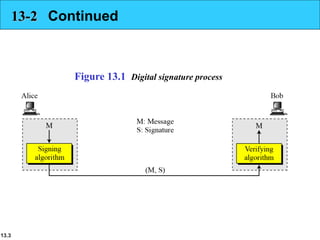
Figure 13.1 shows the digital signature process. The
sender uses a signing algorithm to sign the message.
The message and the signature are sent to the receiver.
The receiver receives the message and the signature
and applies the verifying algorithm to the
combination. If the result is true, the message is
accepted; otherwise, it is rejected.
13.2.1 Need for Keys
13.2.2 Signing the Digest
Topics discussed in this section:
13.3
13-2 Continued
Figure 13.1 Digital signature process
13.4
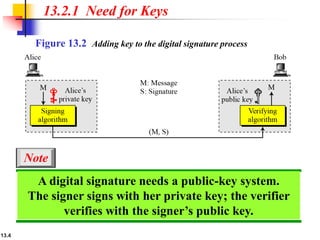
13.2.1 Need for Keys
Figure 13.2 Adding key to the digital signature process
A digital signature needs a public-key system.
The signer signs with her private key; the verifier
verifies with the signer’s public key.
Note
13.5
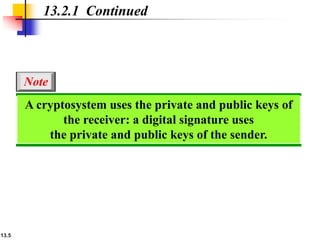
13.2.1 Continued
A cryptosystem uses the private and public keys of
the receiver: a digital signature uses
the private and public keys of the sender.
Note
13.6
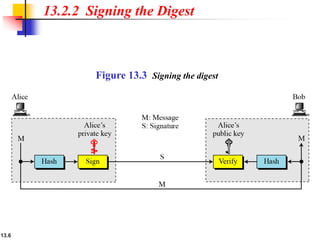
13.2.2 Signing the Digest
Figure 13.3 Signing the digest
13.7
13-3 SERVICES
We discussed several security services in Chapter 1
including message confidentiality, message
authentication, message integrity, and nonrepudiation.
A digital signature can directly provide the last three;
for message confidentiality we still need
encryption/decryption.
13.3.1 Message Authentication
13.3.2 Message Integrity
13.3.3 Nonrepudiation
13.3.4 Confidentiality
Topics discussed in this section:
13.8
A secure digital signature scheme, like a secure
conventional signature can provide message
authentication.
13.3.1 Message Authentication
A digital signature provides message authentication.
Note
13.9
The integrity of the message is preserved even if we sign
the whole message because we cannot get the same
signature if the message is changed.
13.3.2 Message Integrity
A digital signature provides message integrity.
Note
13.10
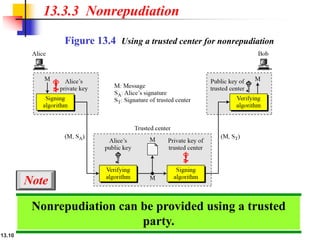
13.3.3 Nonrepudiation
Figure 13.4 Using a trusted center for nonrepudiation
Nonrepudiation can be provided using a trusted
party.
Note
13.11
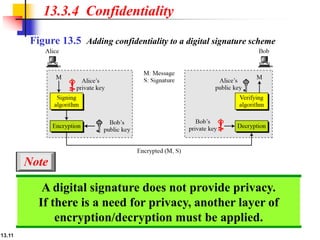
13.3.4 Confidentiality
A digital signature does not provide privacy.
If there is a need for privacy, another layer of
encryption/decryption must be applied.
Figure 13.5 Adding confidentiality to a digital signature scheme
Note
13.12
13-5 DIGITAL SIGNATURE SCHEMES
Several digital signature schemes have evolved during
the last few decades. Some of them have been
implemented.
13.5.1 RSA Digital Signature Scheme
13.5.4 Digital Signature Standard (DSS)
Topics discussed in this section:
13.13
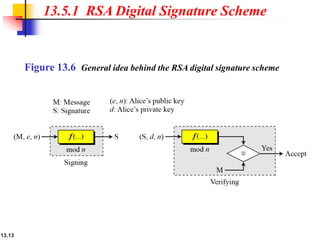
13.5.1 RSA Digital Signature Scheme
Figure 13.6 General idea behind the RSA digital signature scheme
13.14
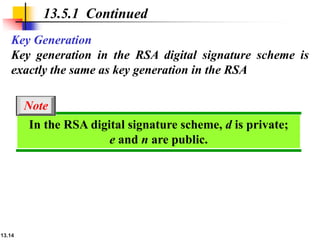
Key Generation
Key generation in the RSA digital signature scheme is
exactly the same as key generation in the RSA
13.5.1 Continued
In the RSA digital signature scheme, d is private;
e and n are public.
Note
13.15
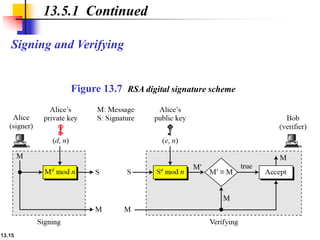
Signing and Verifying
13.5.1 Continued
Figure 13.7 RSA digital signature scheme
13.16
13.5.1 Continued
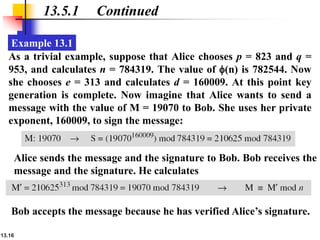
As a trivial example, suppose that Alice chooses p = 823 and q =
953, and calculates n = 784319. The value of f(n) is 782544. Now
she chooses e = 313 and calculates d = 160009. At this point key
generation is complete. Now imagine that Alice wants to send a
message with the value of M = 19070 to Bob. She uses her private
exponent, 160009, to sign the message:
Example 13.1
Alice sends the message and the signature to Bob. Bob receives the
message and the signature. He calculates
Bob accepts the message because he has verified Alice’s signature.
13.17
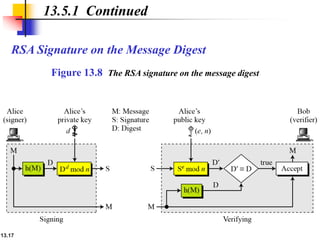
RSA Signature on the Message Digest
13.5.1 Continued
Figure 13.8 The RSA signature on the message digest
13.18
13.5.1 Continued
When the digest is signed instead of the message
itself, the susceptibility of the RSA digital signature
scheme depends on the strength of the hash
algorithm.
Note
13.19
13.5.4 Digital Signature Standard (DSS)
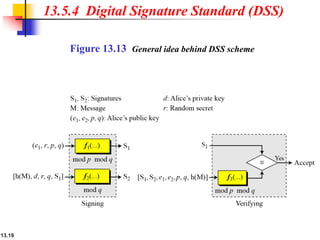
Figure 13.13 General idea behind DSS scheme
13.20
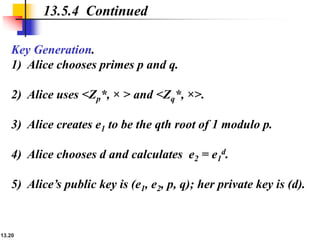
Key Generation.
1) Alice chooses primes p and q.
2) Alice uses <Zp*, × > and <Zq*, ×>.
3) Alice creates e1 to be the qth root of 1 modulo p.
4) Alice chooses d and calculates e2 = e1
d.
5) Alice’s public key is (e1, e2, p, q); her private key is (d).
13.5.4 Continued
13.21
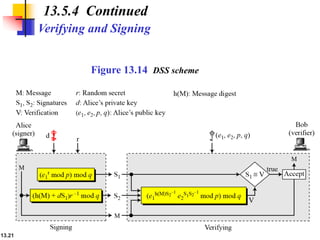
Verifying and Signing
13.5.4 Continued
Figure 13.14 DSS scheme
13.22
13.5.1 Continued
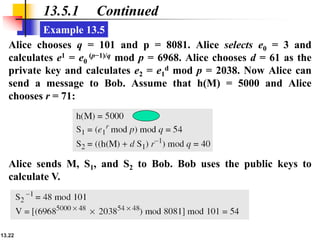
Alice chooses q = 101 and p = 8081. Alice selects e0 = 3 and
calculates e1 = e0
(p−1)/q mod p = 6968. Alice chooses d = 61 as the
private key and calculates e2 = e1
d mod p = 2038. Now Alice can
send a message to Bob. Assume that h(M) = 5000 and Alice
chooses r = 71:
Example 13.5
Alice sends M, S1, and S2 to Bob. Bob uses the public keys to
calculate V.
13.23
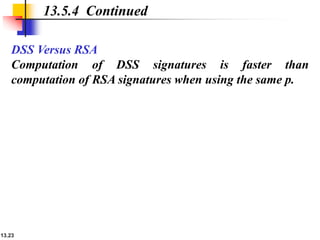
DSS Versus RSA
Computation of DSS signatures is faster than
computation of RSA signatures when using the same p.
13.5.4 Continued

Digital Signatures RSA DSS Algorithm Explained

  • 1.
    13.1 Copyright © TheMcGraw-Hill Companies, Inc. Permission required for reproduction or display. Digital Signature
  • 2.
    13.2 13-2 PROCESS Figure 13.1shows the digital signature process. The sender uses a signing algorithm to sign the message. The message and the signature are sent to the receiver. The receiver receives the message and the signature and applies the verifying algorithm to the combination. If the result is true, the message is accepted; otherwise, it is rejected. 13.2.1 Need for Keys 13.2.2 Signing the Digest Topics discussed in this section:
  • 3.
    13.3 13-2 Continued Figure 13.1Digital signature process
  • 4.
    13.4 13.2.1 Need forKeys Figure 13.2 Adding key to the digital signature process A digital signature needs a public-key system. The signer signs with her private key; the verifier verifies with the signer’s public key. Note
  • 5.
    13.5 13.2.1 Continued A cryptosystemuses the private and public keys of the receiver: a digital signature uses the private and public keys of the sender. Note
  • 6.
    13.6 13.2.2 Signing theDigest Figure 13.3 Signing the digest
  • 7.
    13.7 13-3 SERVICES We discussedseveral security services in Chapter 1 including message confidentiality, message authentication, message integrity, and nonrepudiation. A digital signature can directly provide the last three; for message confidentiality we still need encryption/decryption. 13.3.1 Message Authentication 13.3.2 Message Integrity 13.3.3 Nonrepudiation 13.3.4 Confidentiality Topics discussed in this section:
  • 8.
    13.8 A secure digitalsignature scheme, like a secure conventional signature can provide message authentication. 13.3.1 Message Authentication A digital signature provides message authentication. Note
  • 9.
    13.9 The integrity ofthe message is preserved even if we sign the whole message because we cannot get the same signature if the message is changed. 13.3.2 Message Integrity A digital signature provides message integrity. Note
  • 10.
    13.10 13.3.3 Nonrepudiation Figure 13.4Using a trusted center for nonrepudiation Nonrepudiation can be provided using a trusted party. Note
  • 11.
    13.11 13.3.4 Confidentiality A digitalsignature does not provide privacy. If there is a need for privacy, another layer of encryption/decryption must be applied. Figure 13.5 Adding confidentiality to a digital signature scheme Note
  • 12.
    13.12 13-5 DIGITAL SIGNATURESCHEMES Several digital signature schemes have evolved during the last few decades. Some of them have been implemented. 13.5.1 RSA Digital Signature Scheme 13.5.4 Digital Signature Standard (DSS) Topics discussed in this section:
  • 13.
    13.13 13.5.1 RSA DigitalSignature Scheme Figure 13.6 General idea behind the RSA digital signature scheme
  • 14.
    13.14 Key Generation Key generationin the RSA digital signature scheme is exactly the same as key generation in the RSA 13.5.1 Continued In the RSA digital signature scheme, d is private; e and n are public. Note
  • 15.
    13.15 Signing and Verifying 13.5.1Continued Figure 13.7 RSA digital signature scheme
  • 16.
    13.16 13.5.1 Continued As atrivial example, suppose that Alice chooses p = 823 and q = 953, and calculates n = 784319. The value of f(n) is 782544. Now she chooses e = 313 and calculates d = 160009. At this point key generation is complete. Now imagine that Alice wants to send a message with the value of M = 19070 to Bob. She uses her private exponent, 160009, to sign the message: Example 13.1 Alice sends the message and the signature to Bob. Bob receives the message and the signature. He calculates Bob accepts the message because he has verified Alice’s signature.
  • 17.
    13.17 RSA Signature onthe Message Digest 13.5.1 Continued Figure 13.8 The RSA signature on the message digest
  • 18.
    13.18 13.5.1 Continued When thedigest is signed instead of the message itself, the susceptibility of the RSA digital signature scheme depends on the strength of the hash algorithm. Note
  • 19.
    13.19 13.5.4 Digital SignatureStandard (DSS) Figure 13.13 General idea behind DSS scheme
  • 20.
    13.20 Key Generation. 1) Alicechooses primes p and q. 2) Alice uses <Zp*, × > and <Zq*, ×>. 3) Alice creates e1 to be the qth root of 1 modulo p. 4) Alice chooses d and calculates e2 = e1 d. 5) Alice’s public key is (e1, e2, p, q); her private key is (d). 13.5.4 Continued
  • 21.
    13.21 Verifying and Signing 13.5.4Continued Figure 13.14 DSS scheme
  • 22.
    13.22 13.5.1 Continued Alice choosesq = 101 and p = 8081. Alice selects e0 = 3 and calculates e1 = e0 (p−1)/q mod p = 6968. Alice chooses d = 61 as the private key and calculates e2 = e1 d mod p = 2038. Now Alice can send a message to Bob. Assume that h(M) = 5000 and Alice chooses r = 71: Example 13.5 Alice sends M, S1, and S2 to Bob. Bob uses the public keys to calculate V.
  • 23.
    13.23 DSS Versus RSA Computationof DSS signatures is faster than computation of RSA signatures when using the same p. 13.5.4 Continued