IOSR Journal of Mechanical and Civil Engineering (IOSR-JMCE)
e-ISSN: 2278-1684,p-ISSN: 2320-334X, Volume 12, Issue 6 Ver. IV (Nov. - Dec. 2015), PP 18-21
www.iosrjournals.org
DOI: 10.9790/1684-12641821 www.iosrjournals.org 18 | Page
Optimization of Weld Bead Geometry in Submerged Arc Welds
Deposited On En24 Steel Alloy Using Taguchi Method
Shivam Bhardwaj1
Simranjeet Singh1
Sahil Barry1
Manish Saini1
ER.Ajay Sharma2
ER.Harpreet Singh2
1
(Mechanical department GNI-Mullana/Kurukshetra university, Kurukshetra, Haryana, India)
2
(Astt. Professor, Mechanical deptt.GNI-Mullana/Kurukshetra University, Kurukshetra, Haryana, India)
Abstract: Submerged arc welding (SAW) process is an important component in many industrial operations.
The research on controlling metal transfer modes in SAW process is essential to high quality welding
procedures. The experimentation work details the application of Taguchi techniques for optimization of weld
bead geometry on EN24(low steel alloy)using submerged arc welding (SAW).The planned experiment work
conducted in the semi automatic submerged arc welding machine and signal to noise ratio has been computed.
The contribution of each factor has been calculated by Analysis of Variance (ANOVA) method. The
result of the present experiment shows that the welding voltage is the highly dominating factor and most
significant parameter that controls the bead penetration as compared to the other parameters.
Keywords: submerged arc welding, Taguchi method, ANOVA, EN-24, EN-8, Current, Voltage, Travel speed.
I. Introduction
Welding is an efficient, economical method for joining of metals. The advantages of welding, as a
joining process, include high joint efficiency, good set up, flexibility and low fabrication costs. Due to its good
reliability, deep penetration, smooth finish and high productivity, submerged arc welding (SAW) has become a
natural choice in industries for fabrication. It is widely recognized as very productive welding process from
single wire approach to more productive variants as twin wire, tandem ad metal power addition. EN24 is a high
quality, high tensile, alloy steel and combines high tensile strength, shock resistance, good ductility and
resistance to wear. EN24 is most suitable for the manufacture of parts such as heavy-duty axles and shafts,
gears, bolts and studs. EN24 is capable of retaining good impact values at low temperatures. En24 steel is a
difficult-to-machine material because of its high hardness, low specific heat and tendency to get strain hardened.
The life of the cutting tool is shortened due to the tendency of the work material to carry the carbide particles
with the outgoing chip at elevated temperature.En24 steel finds its typical applications in the manufacturing of
automobile and machine tool parts. Because of its wide application En24 steel has been selected as the work
material in this work.
b) Chemical composition of EN 24ALLOY:
C
%
Mn
%
P
%
S
%
Si
%
Cu
%
Ni
%
Cr
%
V
%
Mo
%
0.3795 0.5717 0.04650 0.04961 0.2357 0.1104 1.26 1.066 0.0198 0.2177
II. Taguchi Method:
Taguchi method is a powerful tool for the design of high quality systems. It provides simple, efficient
and systematic approach to optimize designs for performance, quality and cost. Optimization of process
parameters is the key step in Taguchi method to achieving high quality without increasing cost. This is because
optimization of process parameters can improve quality characteristics and optimal process parameters obtained
from Taguchi method are insensitive to the variation of environmental conditions and other noise factors.
Classical process parameters design is complex and not an easy task. To solve this task the Taguchi method uses
a special design of orthogonal arrays to study the entire process parameter space with a small number of
experiments only.
III. Method Of Experiment
A.Selection Of Material
Selection of material depends upon the desire weld ability qualities which must rely on basic properties
of the material, such as strength, corrosion or erosion resistance, ductility, and toughness. The properties of the
various metallurgical characteristics associated with the thermal cycles encountered in the welding operation
must also be included in the design process.
Optimization Of Weld Bead Geometry In Submerged Arc Welds Deposited On En24 Steel Alloy…
DOI: 10.9790/1684-12641821 www.iosrjournals.org 19 | Page
a) Experimental setup:
The experiment was conducted at Maharishi Markandeshwar University Mullana with the following
experimental set up the equipment used was submerged arc welding equipment (TORNADO M-800) having
electrode Cu wire, 3.2 mm diameter. The Work Piece used EN24 ALLOY STEEL of 400*80*20 mm size. Flux
used for the SAW welding EN8 with Electrode to work angle 900
. Parameters used for the experiment were
voltage, welding current and travel speed as shown in the table3.1
TABLE 3.1 Process parameters with their values at three levels.
Parameter Level 1 Level 2 Level 3 Output parameter
Arc Voltage(volts) 30 35 40 Weld penetration shape
factorWelding Current (amp.) 300 400 500
Travel speed(m/hr) 20 25 30
Taguchi method was used for the experiment with design of experiment L9 orthogonal array. Table
3.2 shows the DOE L-9 orthogonal array.
TABLE3.2 Actual values of process parameters.
S. No. Design of Experiment (L9 orthogonal array)
Voltage(volts) Current (amp.) Travel speed (m/hr.)
1 30 300 20
2 30 400 25
3 30 500 30
4 35 300 25
5 35 400 30
6 35 500 20
7 40 300 30
8 40 400 20
9 40 500 25
IV. Result And Discussion:
Taguchi recommends analyzing data using the S/N ratio that will offer two advantages; it provides
guidance for selection the optimum level based on least variation around on the average value, which closest to
target, and also it offers objective comparison of two sets of experimental data with respect to deviation of the
average from the target. The experimental results are analyzed to investigate the main effects. According to
Taguchi method, S/N ratio is the ratio of “Signal” representing desirable value, i.e. mean of output
characteristics and the “noise” representing the undesirable value i.e., squared deviation of the output
characteristics. It is denoted by η and the unit is dB. The S/N ratio is used to measure quality characteristic and
it is also used to measure significant welding parameters.
Figure 4.1: Cross section of ideal weld bead
The above figure 4.1 is the schematic representation of the bead on plate from Submerged Arc
Welding. In this figure [P] represents the PENETRATION, [R] represents the REINFORCEMENT and [W]
represents the WIDTH of the bead.
TABLE 4.1 Experimental data and S/N ratio.
Voltage Current Travel
speed
P R W WPSF SNRA1 MEAN1
30 300 20 3.0 3 17 5.66667 15.0666 5.66667
30 400 25 4.8 3 21 4.37500 12.8196 4.37500
30 500 30 4.0 3 21 5.25000 14.4032 5.25000
35 300 25 5.0 3 20 4.00000 12.0412 4.00000
35 400 30 6.0 2 24 4.00000 12.0412 4.00000
35 500 20 6.0 2 23 3.83333 11.6715 3.83333
40 300 30 4.8 3 19 3.95833 11.9502 3.95833
40 400 20 9.0 2 33 3.66667 11.2854 3.66667
40 500 25 8.8 2 30 3.40909 10.6528 3.40909
Optimization Of Weld Bead Geometry In Submerged Arc Welds Deposited On En24 Steel Alloy…
DOI: 10.9790/1684-12641821 www.iosrjournals.org 20 | Page
TABLE 4.2 Response Table for Signal to Noise Ratio.
LARGER IS BETTER.
LEVEL VOLTAGE CURRENT TRAVELL SPEED
1 14.10 13.02 12.67
2 11.92 12.05 11.84
3 11.30 12.24 12.80
Delta 2.80 0.97 0.96
Rank 1 2 3
TABLE 4.3 Response Table for Means.
LEVEL VOLTAGE CURRENT TRAVELL SPEED
1 5.097 4.542 4.389
2 3.944 4.014 3.928
3 3.678 4.164 4.403
Delta 1.419 0.528 0.475
Rank 1 2 3
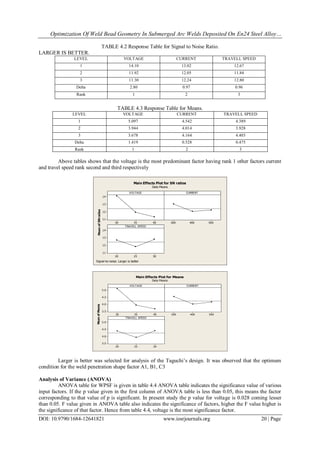
Above tables shows that the voltage is the most predominant factor having rank 1 other factors current
and travel speed rank second and third respectively
403530
14
13
12
11
500400300
302520
14
13
12
11
VOLTAGE
MeanofSNratios
CURRENT
TRAVELL SPEED
Main Effects Plot for SN ratios
Data Means
Signal-to-noise: Larger is better
403530
5.0
4.5
4.0
3.5
500400300
302520
5.0
4.5
4.0
3.5
VOLTAGE
MeanofMeans
CURRENT
TRAVELL SPEED
Main Effects Plot for Means
Data Means
Larger is better was selected for analysis of the Taguchi’s design. It was observed that the optimum
condition for the weld penetration shape factor A1, B1, C3
Analysis of Variance (ANOVA)
ANOVA table for WPSF is given in table 4.4 ANOVA table indicates the significance value of various
input factors. If the p value given in the first column of ANOVA table is less than 0.05, this means the factor
corresponding to that value of p is significant. In present study the p value for voltage is 0.028 coming lesser
than 0.05. F value given in ANOVA table also indicates the significance of factors, higher the F value higher is
the significance of that factor. Hence from table 4.4, voltage is the most significance factor.
Optimization Of Weld Bead Geometry In Submerged Arc Welds Deposited On En24 Steel Alloy…
DOI: 10.9790/1684-12641821 www.iosrjournals.org 21 | Page
TABLE 4.4 Analysis of Variance for SNRA1.
Source DF Seq SS Adj SS Adj MS F P
VOLTAGE 2 12.9739 12.9739 6.4870 34.33 0.028
CURRENT 2 1.5831 1.5831 0.7915 4.19 0.193
TRAVELL
SPEED
2 1.6376 1.6376 0.8188 4.33 0.188
Error 2 0.3779 0.3779 0.1890
Total 8 16.5726
S=0.434700 R-Sq=97.72% R-Sq=90.88%
V. Conclusion
 The results shows penetration will be at maximum value when welding arc voltage and welding current
are at their maximum possible value and welding speed is at its minimum value.
 Arc voltage is main factor influence the Weld penetration shape factor (WPSF). It increases with arc
voltage and current and decreases, with welding speed.
 Optimal parameters setting for larger depth is, current = 300 amp, voltage = 30 V, Speed= 30 m/hr.
References
[1]. J Tusek, M.Suban, [High productivity multiple wire submerged arc welding and cladding with metal powder addition] journal of
material processing technology 2003; 133:207-213.
[2]. RS Chandel, HP Seow, FL Cheong, [Effect of increasing deposition rate on the bead geometry of submerged arc welds] journal of
material processing technology1997; 72:124-128.
[3]. RA.Mottaram, J.WoolMan, [The mechanical and physical properties of the British standard EN steels] 1st edition, vol.2, EN-21-EN-
39, 1966, P: 72.
[4]. Hari Singh, [Optimizing tool life of carbide inserts for turned. Parts using Taguchi,
s design of experiments approach] vol: 2
PIMCECS, 2008, HONGKONG.
[5]. Pandey AK,Khan MI, Moeed KM [investigation of the effect of current on the tensile strength and nugget diameter of spot weld
made on AiSi-1008 steel sheets]IJTRA,2013.
[6]. S Kumanan, J Edwin Raja Dhas & k Gowthaman [determination of submerged arc welding process parameters using Taguchi
method and regression analysis] Indian Journal of Engg. & material sciences, vol: 14, 2007.
[7]. Meenu Sharma, Dr.MI Khan [optimization of weld bead geometrical parameters for bead on plate submerged arc welds deposited
on IS-2062 STEEL using Taguchi method] IJTRA,2014.

C012641821

  • 1.
    IOSR Journal ofMechanical and Civil Engineering (IOSR-JMCE) e-ISSN: 2278-1684,p-ISSN: 2320-334X, Volume 12, Issue 6 Ver. IV (Nov. - Dec. 2015), PP 18-21 www.iosrjournals.org DOI: 10.9790/1684-12641821 www.iosrjournals.org 18 | Page Optimization of Weld Bead Geometry in Submerged Arc Welds Deposited On En24 Steel Alloy Using Taguchi Method Shivam Bhardwaj1 Simranjeet Singh1 Sahil Barry1 Manish Saini1 ER.Ajay Sharma2 ER.Harpreet Singh2 1 (Mechanical department GNI-Mullana/Kurukshetra university, Kurukshetra, Haryana, India) 2 (Astt. Professor, Mechanical deptt.GNI-Mullana/Kurukshetra University, Kurukshetra, Haryana, India) Abstract: Submerged arc welding (SAW) process is an important component in many industrial operations. The research on controlling metal transfer modes in SAW process is essential to high quality welding procedures. The experimentation work details the application of Taguchi techniques for optimization of weld bead geometry on EN24(low steel alloy)using submerged arc welding (SAW).The planned experiment work conducted in the semi automatic submerged arc welding machine and signal to noise ratio has been computed. The contribution of each factor has been calculated by Analysis of Variance (ANOVA) method. The result of the present experiment shows that the welding voltage is the highly dominating factor and most significant parameter that controls the bead penetration as compared to the other parameters. Keywords: submerged arc welding, Taguchi method, ANOVA, EN-24, EN-8, Current, Voltage, Travel speed. I. Introduction Welding is an efficient, economical method for joining of metals. The advantages of welding, as a joining process, include high joint efficiency, good set up, flexibility and low fabrication costs. Due to its good reliability, deep penetration, smooth finish and high productivity, submerged arc welding (SAW) has become a natural choice in industries for fabrication. It is widely recognized as very productive welding process from single wire approach to more productive variants as twin wire, tandem ad metal power addition. EN24 is a high quality, high tensile, alloy steel and combines high tensile strength, shock resistance, good ductility and resistance to wear. EN24 is most suitable for the manufacture of parts such as heavy-duty axles and shafts, gears, bolts and studs. EN24 is capable of retaining good impact values at low temperatures. En24 steel is a difficult-to-machine material because of its high hardness, low specific heat and tendency to get strain hardened. The life of the cutting tool is shortened due to the tendency of the work material to carry the carbide particles with the outgoing chip at elevated temperature.En24 steel finds its typical applications in the manufacturing of automobile and machine tool parts. Because of its wide application En24 steel has been selected as the work material in this work. b) Chemical composition of EN 24ALLOY: C % Mn % P % S % Si % Cu % Ni % Cr % V % Mo % 0.3795 0.5717 0.04650 0.04961 0.2357 0.1104 1.26 1.066 0.0198 0.2177 II. Taguchi Method: Taguchi method is a powerful tool for the design of high quality systems. It provides simple, efficient and systematic approach to optimize designs for performance, quality and cost. Optimization of process parameters is the key step in Taguchi method to achieving high quality without increasing cost. This is because optimization of process parameters can improve quality characteristics and optimal process parameters obtained from Taguchi method are insensitive to the variation of environmental conditions and other noise factors. Classical process parameters design is complex and not an easy task. To solve this task the Taguchi method uses a special design of orthogonal arrays to study the entire process parameter space with a small number of experiments only. III. Method Of Experiment A.Selection Of Material Selection of material depends upon the desire weld ability qualities which must rely on basic properties of the material, such as strength, corrosion or erosion resistance, ductility, and toughness. The properties of the various metallurgical characteristics associated with the thermal cycles encountered in the welding operation must also be included in the design process.
  • 2.
    Optimization Of WeldBead Geometry In Submerged Arc Welds Deposited On En24 Steel Alloy… DOI: 10.9790/1684-12641821 www.iosrjournals.org 19 | Page a) Experimental setup: The experiment was conducted at Maharishi Markandeshwar University Mullana with the following experimental set up the equipment used was submerged arc welding equipment (TORNADO M-800) having electrode Cu wire, 3.2 mm diameter. The Work Piece used EN24 ALLOY STEEL of 400*80*20 mm size. Flux used for the SAW welding EN8 with Electrode to work angle 900 . Parameters used for the experiment were voltage, welding current and travel speed as shown in the table3.1 TABLE 3.1 Process parameters with their values at three levels. Parameter Level 1 Level 2 Level 3 Output parameter Arc Voltage(volts) 30 35 40 Weld penetration shape factorWelding Current (amp.) 300 400 500 Travel speed(m/hr) 20 25 30 Taguchi method was used for the experiment with design of experiment L9 orthogonal array. Table 3.2 shows the DOE L-9 orthogonal array. TABLE3.2 Actual values of process parameters. S. No. Design of Experiment (L9 orthogonal array) Voltage(volts) Current (amp.) Travel speed (m/hr.) 1 30 300 20 2 30 400 25 3 30 500 30 4 35 300 25 5 35 400 30 6 35 500 20 7 40 300 30 8 40 400 20 9 40 500 25 IV. Result And Discussion: Taguchi recommends analyzing data using the S/N ratio that will offer two advantages; it provides guidance for selection the optimum level based on least variation around on the average value, which closest to target, and also it offers objective comparison of two sets of experimental data with respect to deviation of the average from the target. The experimental results are analyzed to investigate the main effects. According to Taguchi method, S/N ratio is the ratio of “Signal” representing desirable value, i.e. mean of output characteristics and the “noise” representing the undesirable value i.e., squared deviation of the output characteristics. It is denoted by η and the unit is dB. The S/N ratio is used to measure quality characteristic and it is also used to measure significant welding parameters. Figure 4.1: Cross section of ideal weld bead The above figure 4.1 is the schematic representation of the bead on plate from Submerged Arc Welding. In this figure [P] represents the PENETRATION, [R] represents the REINFORCEMENT and [W] represents the WIDTH of the bead. TABLE 4.1 Experimental data and S/N ratio. Voltage Current Travel speed P R W WPSF SNRA1 MEAN1 30 300 20 3.0 3 17 5.66667 15.0666 5.66667 30 400 25 4.8 3 21 4.37500 12.8196 4.37500 30 500 30 4.0 3 21 5.25000 14.4032 5.25000 35 300 25 5.0 3 20 4.00000 12.0412 4.00000 35 400 30 6.0 2 24 4.00000 12.0412 4.00000 35 500 20 6.0 2 23 3.83333 11.6715 3.83333 40 300 30 4.8 3 19 3.95833 11.9502 3.95833 40 400 20 9.0 2 33 3.66667 11.2854 3.66667 40 500 25 8.8 2 30 3.40909 10.6528 3.40909
  • 3.
    Optimization Of WeldBead Geometry In Submerged Arc Welds Deposited On En24 Steel Alloy… DOI: 10.9790/1684-12641821 www.iosrjournals.org 20 | Page TABLE 4.2 Response Table for Signal to Noise Ratio. LARGER IS BETTER. LEVEL VOLTAGE CURRENT TRAVELL SPEED 1 14.10 13.02 12.67 2 11.92 12.05 11.84 3 11.30 12.24 12.80 Delta 2.80 0.97 0.96 Rank 1 2 3 TABLE 4.3 Response Table for Means. LEVEL VOLTAGE CURRENT TRAVELL SPEED 1 5.097 4.542 4.389 2 3.944 4.014 3.928 3 3.678 4.164 4.403 Delta 1.419 0.528 0.475 Rank 1 2 3 Above tables shows that the voltage is the most predominant factor having rank 1 other factors current and travel speed rank second and third respectively 403530 14 13 12 11 500400300 302520 14 13 12 11 VOLTAGE MeanofSNratios CURRENT TRAVELL SPEED Main Effects Plot for SN ratios Data Means Signal-to-noise: Larger is better 403530 5.0 4.5 4.0 3.5 500400300 302520 5.0 4.5 4.0 3.5 VOLTAGE MeanofMeans CURRENT TRAVELL SPEED Main Effects Plot for Means Data Means Larger is better was selected for analysis of the Taguchi’s design. It was observed that the optimum condition for the weld penetration shape factor A1, B1, C3 Analysis of Variance (ANOVA) ANOVA table for WPSF is given in table 4.4 ANOVA table indicates the significance value of various input factors. If the p value given in the first column of ANOVA table is less than 0.05, this means the factor corresponding to that value of p is significant. In present study the p value for voltage is 0.028 coming lesser than 0.05. F value given in ANOVA table also indicates the significance of factors, higher the F value higher is the significance of that factor. Hence from table 4.4, voltage is the most significance factor.
  • 4.
    Optimization Of WeldBead Geometry In Submerged Arc Welds Deposited On En24 Steel Alloy… DOI: 10.9790/1684-12641821 www.iosrjournals.org 21 | Page TABLE 4.4 Analysis of Variance for SNRA1. Source DF Seq SS Adj SS Adj MS F P VOLTAGE 2 12.9739 12.9739 6.4870 34.33 0.028 CURRENT 2 1.5831 1.5831 0.7915 4.19 0.193 TRAVELL SPEED 2 1.6376 1.6376 0.8188 4.33 0.188 Error 2 0.3779 0.3779 0.1890 Total 8 16.5726 S=0.434700 R-Sq=97.72% R-Sq=90.88% V. Conclusion  The results shows penetration will be at maximum value when welding arc voltage and welding current are at their maximum possible value and welding speed is at its minimum value.  Arc voltage is main factor influence the Weld penetration shape factor (WPSF). It increases with arc voltage and current and decreases, with welding speed.  Optimal parameters setting for larger depth is, current = 300 amp, voltage = 30 V, Speed= 30 m/hr. References [1]. J Tusek, M.Suban, [High productivity multiple wire submerged arc welding and cladding with metal powder addition] journal of material processing technology 2003; 133:207-213. [2]. RS Chandel, HP Seow, FL Cheong, [Effect of increasing deposition rate on the bead geometry of submerged arc welds] journal of material processing technology1997; 72:124-128. [3]. RA.Mottaram, J.WoolMan, [The mechanical and physical properties of the British standard EN steels] 1st edition, vol.2, EN-21-EN- 39, 1966, P: 72. [4]. Hari Singh, [Optimizing tool life of carbide inserts for turned. Parts using Taguchi, s design of experiments approach] vol: 2 PIMCECS, 2008, HONGKONG. [5]. Pandey AK,Khan MI, Moeed KM [investigation of the effect of current on the tensile strength and nugget diameter of spot weld made on AiSi-1008 steel sheets]IJTRA,2013. [6]. S Kumanan, J Edwin Raja Dhas & k Gowthaman [determination of submerged arc welding process parameters using Taguchi method and regression analysis] Indian Journal of Engg. & material sciences, vol: 14, 2007. [7]. Meenu Sharma, Dr.MI Khan [optimization of weld bead geometrical parameters for bead on plate submerged arc welds deposited on IS-2062 STEEL using Taguchi method] IJTRA,2014.