INTERNATIONAL JOURNAL OF MECHANICAL ENGINEERING 
International Journal of Mechanical Engineering and Technology (IJMET), ISSN 0976 – 6340(Print), 
ISSN 0976 – 6359(Online), Volume 5, Issue 6, June (2014), pp. 101-109 © IAEME 
AND TECHNOLOGY (IJMET) 
ISSN 0976 – 6340 (Print) 
ISSN 0976 – 6359 (Online) 
Volume 5, Issue 6, June (2014), pp. 101-109 
© IAEME: www.iaeme.com/IJMET.asp 
Journal Impact Factor (2014): 7.5377 (Calculated by GISI) 
www.jifactor.com 
101 
 
IJMET 
© I A E M E 
EFFECT OF EDM PARAMETERS IN OBTAINING MAXIMUM MRR AND 
MINIMUM EWR BY MACHINING SS 316 USING COPPER ELECTRODE 
Abhishek Gaikwad1, Amit Tiwari2, Amit Kumar3, Dhananjay Singh4 
Assistant Professor1, Scholars2, 3, 4 
(Department of Mechanical Engineering, SSET, SHIATS, Naini Allahabad Uttar Pradesh, India 
ABSTRACT 
EDM machining is used for very hard and complex cutting of conducting materials with 
higher surface finish and close dimensions. EDM process parameters are affected by both electrical 
and non electrical parameters. In this paper, cutting of hard material Stainless steel 316 is done on 
electro discharge machine with copper as cutting tool electrode. This paper presents the effect of 
control factors (i.e., current, pulse on time, pulse off time, fluid pressure) for maximum material 
removal rate (MRR) and minimum electrode wear rate (EWR) for die sinking Electric Discharge 
Machine. In this paper both the electrical factors and non electrical factors has been focused which 
governs MRR and EWR. Paper is based on Design of experiment and optimization of EDM process 
parameters. The technique used is Taguchi technique which is a statistical decision making tool helps 
in minimizing the number of experiments and the error associated with it. The research showed that 
the Pulse off time, Current has significant effect on material removal rate and electrode wear rate 
respectively. 
Keywords: Electro Discharge Machine, Electrode Wear Rate, Material Removal Rate, SS 316, 
Taguchi Technique. 
1. INTRODUCTION 
Electrical Discharge Machining (EDM) is a process of material removal using an accurately 
controlled electrical discharge (spark) through a small gap (approximately 10 to 50 microns) filled 
with dielectric fluid between an electrode and a workpiece. The technique allows machining high-strength 
and wear-resistance materials such as high-strength alloys, polycrystalline diamond and
International Journal of Mechanical Engineering and Technology (IJMET), ISSN 0976 – 6340(Print), 
ISSN 0976 – 6359(Online), Volume 5, Issue 6, June (2014), pp. 101-109 © IAEME 
ceramic (ultra-hard conductive material) since the hardness of the workpiece has no effect on the 
process. Unlike the traditional cutting and grinding processes, which depends on the force generated 
by a harder tool to remove the softer material workpiece, the EDM process is free from contact force 
and chatter vibration. Furthermore, EDM permits the machining to be done even after the hardening 
process. The EDM process has been used in high precision machining of metals, and to date, there 
are several different types of EDM systems that have been developed for a particular industrial 
application. EDM is widely used for making mold and dies and finishing parts for automotive 
industry, aerospace and surgical components [1]. Two principle types of EDM processes are the die 
sinking and the wire cut EDM process. Die sinking type EDM machine requires an electrode to 
machine the workpiece. Wire cut EDM machine uses a continuous wire as the electrode to cut the 
workpiece. Rajurkar [2] explained some future trends study in EDM such as machining advanced 
materials, mirror surface finish using powder additives, ultrasonic-assisted EDM, control and 
automation. 
102 
 
One of the field interests is to study the optimal selection of process parameters which will 
increase production rate considerably by reducing the machining time. An optimum selection of 
machining parameters for the best process performance is still uncertain since EDM process is a 
complex and stochastic process. 
The objective of the present work is to investigate MRR of SS 316 and EWR of copper by 
using die sinking EDM and to optimize these performance characteristics for obtaining maximum 
MRR and minimum EWR. 
2. EXPERIMENTAL DETAILS 
2.1. Experimental Materials 
Stainless steel 316 is chosen as the work piece material and copper EC-99 as the tool 
electrode material. 
Table 1: Chemical composition of stainless steel 316. 
Fe C Cr Ni Mo Mn Si P S 
remaining 0.03% 16-18.5% 10-14% 2-3% 2% 1% 0.045% 0.03% 
Fig 1: SS 316 used for experiment
International Journal of Mechanical Engineering and Technology (IJMET), ISSN 0976 – 6340(Print), 
ISSN 0976 – 6359(Online), Volume 5, Issue 6, June (2014), pp. 101-109 © IAEME 
103 
 
Table 2: Physical properties of SS 316 
Physical Properties Value 
Melting point 1375-1400°C 
Density 8000 kg/m3 
Tensile strength 515 MPa 
Yield strength 205 MPa 
Elastic modulus 193 GPa 
Hardness (HRB) 95 
Electric resistivity 740 n.m 
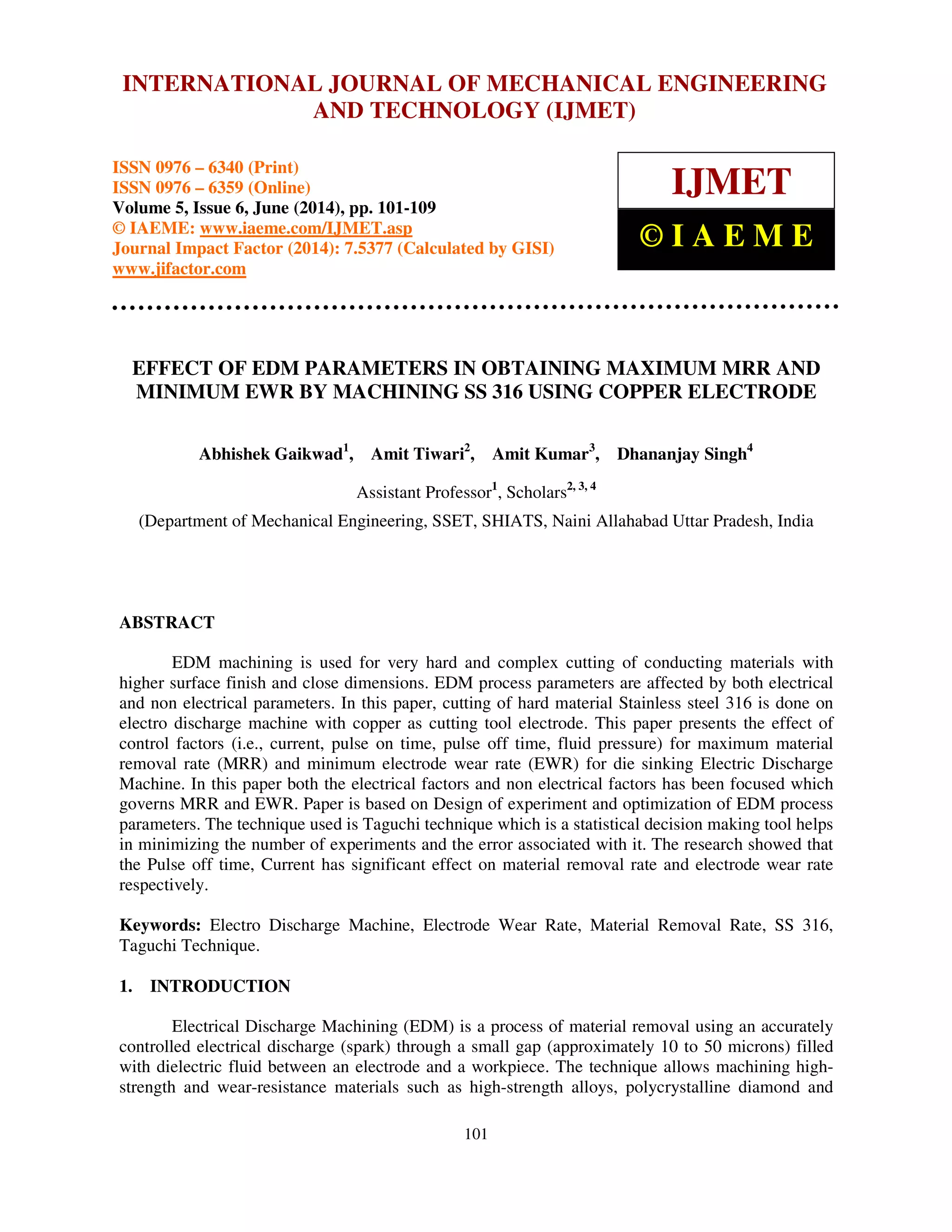
Fig 2: Copper electrode used for experiment 
Table 3: Copper electrode EC-99 specification 
Specifications Value 
Purity (%) 99.9 
Average particle size  5 micron 
Strength (psi) 
Bending 16500 
Compressive 30000 
Density (g/ cm3 ) 67.05 
Hardness (shore) 67 
Electrical resistance 120 μin 
2.2. Experimental Method 
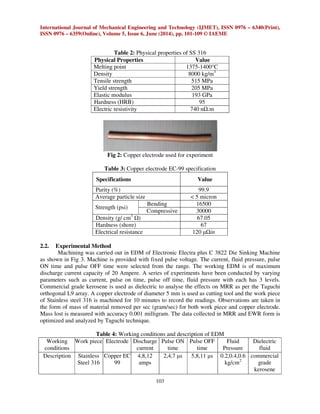
Machining was carried out in EDM of Electronic Electra plus C 3822 Die Sinking Machine 
as shown in Fig 3. Machine is provided with fixed pulse voltage. The current, fluid pressure, pulse 
ON time and pulse OFF time were selected from the range. The working EDM is of maximum 
discharge current capacity of 20 Ampere. A series of experiments have been conducted by varying 
parameters such as current, pulse on time, pulse off time, fluid pressure with each has 3 levels. 
Commercial grade kerosene is used as dielectric to analyse the effects on MRR as per the Taguchi 
orthogonal L9 array. A copper electrode of diameter 5 mm is used as cutting tool and the work piece 
of Stainless steel 316 is machined for 10 minutes to record the readings. Observations are taken in 
the form of mass of material removed per sec (gram/sec) for both work piece and copper electrode. 
Mass lost is measured with accuracy 0.001 milligram. The data collected in MRR and EWR form is 
optimized and analyzed by Taguchi technique. 
Table 4: Working conditions and description of EDM 
Working 
conditions 
Work piece Electrode Discharge 
current 
Pulse ON 
time 
Pulse OFF 
time 
Fluid 
Pressure 
Dielectric 
fluid 
Description Stainless 
Steel 316 
Copper EC 
99 
4,8,12 
amps 
2,4,7 μs 5,8,11 μs 0.2,0.4,0.6 
kg/cm2 
commercial 
grade 
kerosene
International Journal of Mechanical Engineering and Technology (IJMET), ISSN 0976 – 6340(Print), 
ISSN 0976 – 6359(Online), Volume 5, Issue 6, June (2014), pp. 101-109 © IAEME 
104 
 
Fig 3: EDM machine 
Table 5: Response parameters and control parameters with their levels 
Response 
Parameters 
Material Removal Rate (gm /min.) 
Electrode Wear Rate (gm /min.) 
Control Parameters 
Levels 
1 2 3 
Pulse ON time (μs) 2 4 7 
Pulse OFF time (μs) 5 8 11 
Discharge current (A) 4 8 12 
Fluid Pressure ( kg/cm2 ) 0.2 0.4 0.6 
3. DESIGN OF EXPERIMENT AND DATA ANALYSIS: 
Taguchi is an optimization technique in design of experiment which is combination of 
mathematical model (curve fit) and statistical analysis. For 4 controlling variables and 3 level of each 
we can draw a L9 orthogonal array. 
Table 6: Design Matrix of L9 Orthogonal Array 
Exp. No. A B C D 
1 1 1 1 1 
2 1 2 2 2 
3 1 3 3 3 
4 2 1 2 3 
5 2 2 3 1 
6 2 3 1 2 
7 3 1 3 2 
8 3 2 1 3 
9 3 3 2 1
International Journal of Mechanical Engineering and Technology (IJMET), ISSN 0976 – 6340(Print), 
ISSN 0976 – 6359(Online), Volume 5, Issue 6, June (2014), pp. 101-109 © IAEME 
105 
3.1 Material removal rate 
 
The material removal rate of the work piece is the volume of the material removed per 
minute. It can be calculated using the following relation. 
The electrode wear rate (EWR) of the electrode is the amount of the tool wear per minute. It 
can be calculated using the following equation. 
The experiments were conducted based on varying the process parameters, which affects the 
machining process to obtain the required quality characteristics. There are 64 such quality 
characteristics. The most commonly used are Larger the better, Smaller the better, Nominal the best, 
classified attribute and Signed target 
In case of MRR, larger the better is taken as it states that the output must be as large as possible, 
therefore the S/N Ratio will be given as: 
S/N Ratio= -10× Log10 (sum (1/y2)/n) 
In case of EWR, smaller the better is opted as it states that the output must be as low as possible, 
therefore the S/N Ratio will be given as: 
S/N Ratio= -10× Log10 (sum (y2)/n) 
Table 7: Design Matrix of L9 Orthogonal Array 
Exp. 
No. 
Pulse on 
Time 
(μ Sec) 
Pulse off 
Time 
(μ Sec) 
Current 
(A) 
Fluid 
Pressure 
(Kg/cm3) 
M.R.R 
gm/min 
E.W.R 
gm/min 
S/N Ratio 
(MRR) 
S/N Ratio 
(EWR) 
1 2 5 4 0.2 0.006 0.0015 -44.4370 56.4782 
2 2 8 8 0.4 0.012 0.004 -38.4164 47.9588 
3 2 11 12 0.6 0.033 0.0015 -29.6297 56.4782 
4 4 5 8 0.6 0.007 0.003 -43.0980 50.4576 
5 4 8 12 0.2 0.023 0.009 -32.7654 40.9151 
6 4 11 4 0.4 0.019 0.001 -34.4249 60.0000 
7 7 5 12 0.4 0.040 0.002 -27.9588 53.9794 
8 7 8 4 0.6 0.021 0.001 -33.5556 50.0000 
9 7 11 8 0.2 0.035 0.002 -29.1186 53.9794 
Table 8: S/N Ratio Table for EWR 
LEVEL PULSE ON PULSE OFF CURRENT FLUID PRESSURE 
1 53.64 53.64 58.83 50.46 
2 50.46 49.62 50.80 53.98 
3 55.99 56.82 50.46 55.65 
DELTA 5.53 7.19 8.37 5.19 
RANK 3 2 1 4
International Journal of Mechanical Engineering and Technology (IJMET), ISSN 0976 – 6340(Print), 
ISSN 0976 – 6359(Online), Volume 5, Issue 6, June (2014), pp. 101-109 © IAEME 
Main Effects Plot for SN ratios 
Data Means 
106 
 
Table 9: Response Mean Table for EWR 
LEVEL PULSE ON PULSE OFF CURRENT FLUID PRESSURE 
1 0.002333 0.002167 0.001167 0.004167 
2 0.004333 0.004667 0.003000 0.002333 
3 0.001667 0.001500 0.004167 0.001833 
DELTA 0.002667 0.003167 0.003000 0.002333 
Table 10: S/N Ratio Table for MRR 
LEVEL PULSE ON PULSE OFF CURRENT FLUID PRESSURE 
1 -37.49 -38.50 -37.47 -35.44 
2 -36.76 -34.91 -36.88 -33.60 
3 -30.21 -31.06 -30.12 -35.43 
DELTA 7.28 7.44 7.35 1.84 
RANK 3 1 2 4 
Table 11: Response Mean Table for MRR 
LEVEL PULSE ON PULSE OFF CURRENT FLUID PRESSURE 
1 0.01700 0.01767 0.01533 0.02133 
2 0.01633 0.01867 0.01800 0.02367 
3 0.03200 0.02900 0.03200 0.02033 
DELTA 0.01567 0.01133 0.01667 0.00333 
4. RESULTS AND DISCUSSIONS 
2 4 7 
-30 
-31 
-32 
-33 
-34 
-35 
-36 
-37 
-38 
-39 
5 8 11 4 8 12 0.2 0.4 0.6 
pulse on 
Mean of SN ratios 
pulse off current fluid pressure 
Signal-to-noise: Larger is better 
Fig 4: Mean of SN Ratio of MRR
International Journal of Mechanical Engineering and Technology (IJMET), ISSN 0976 – 6340(Print), 
ISSN 0976 – 6359(Online), Volume 5, Issue 6, June (2014), pp. 101-109 © IAEME 
Main Effects Plot for Means 
Data Means 
Main Effects Plot for SN ratios 
Data Means 
107 
 
2 4 7 
0.0325 
0.0300 
0.0275 
0.0250 
0.0225 
0.0200 
0.0175 
0.0150 
5 8 11 4 8 12 0.2 0.4 0.6 
pulse on 
Mean of Means 
pulse off current fluid pressure 
Fig 5: Mean of Means of MRR 
2 4 7 
59 
58 
57 
56 
55 
54 
53 
52 
51 
50 
5 8 11 4 8 12 0.2 0.4 0.6 
pulse on 
Mean of SN ratios 
pulse off current fluid pressure 
Signal-to-noise: Smaller is better 
Fig 6: Mean of SN Ratio of EWR
International Journal of Mechanical Engineering and Technology (IJMET), ISSN 0976 – 6340(Print), 
ISSN 0976 – 6359(Online), Volume 5, Issue 6, June (2014), pp. 101-109 © IAEME 
Main Effects Plot for Means 
Data Means 
108 
 
2 4 7 
0.005 
0.004 
0.003 
0.002 
0.001 
5 8 11 4 8 12 0.2 0.4 0.6 
pulse on 
Mean of Means 
pulse off current fluid pressure 
Fig 7: Mean of Means of EWR 
5. CONCLUSIONS 
Material removal rate 
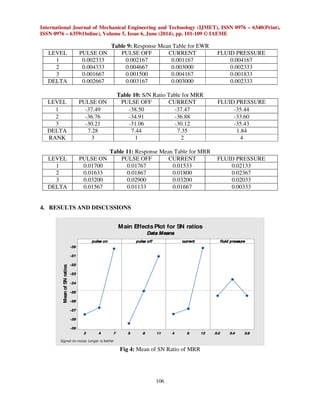
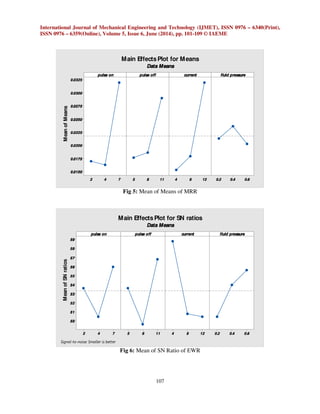
• Material removal rate is mainly affected by pulse off time followed by current and MRR is 
least affected by fluid pressure. 
• Pulse off time contribution is major for MRR. MRR increases with increasing pulse off time. 
Optimal setting for MRR in the experiment level is as 
Current = 12Amp 
Pulse on time = 7 μ sec 
Pulse off time = 11 μ sec 
Fluid Pressure = 0.4 kg/cm2 
Electrode wear rate 
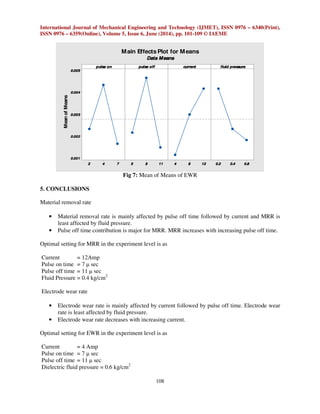
• Electrode wear rate is mainly affected by current followed by pulse off time. Electrode wear 
rate is least affected by fluid pressure. 
• Electrode wear rate decreases with increasing current. 
Optimal setting for EWR in the experiment level is as 
Current = 4 Amp 
Pulse on time = 7 μ sec 
Pulse off time = 11 μ sec 
Dielectric fluid pressure = 0.6 kg/cm2
International Journal of Mechanical Engineering and Technology (IJMET), ISSN 0976 – 6340(Print), 
ISSN 0976 – 6359(Online), Volume 5, Issue 6, June (2014), pp. 101-109 © IAEME 
109 
REFERENCES 
 
[1] K.H. Ho, S.T. Newman, State of the art electrical discharge machining (EDM), International 
Journal of Machine Tools  Manufacture 43 (2003) 1287-1300. 
[2] K.P. Rajurkar, Nontraditional manufacturing processes, in: R.C. Dorf, A. Kusiak (Eds.), 
Handbook of Design, Manufacturing and Automation, John Wiley  Sons Inc., USA, 1994. 
[3] S. Kuriakose, M.S. Shunmugam, Multi objective optimization of wire-electro discharge 
machining process by genetic algorithm, J. Mater. Process Technol. 170 (2005) 133-141. 
[4] K. Wang, H.L. Gelgele, Y. Wang, Q. Yuan, M. Fang, A hybrid intelligent method for 
modelling the EDM process, Int. J. Machine Tools Manuf. 43 (2003) 995-999. 
[5] C.L. Lin, J.L. Lin, T.C. Ko, Optimization of the EDM process based on the orthogonal 
array with fuzzy logic and grey relational analysis method, International J. Adv. Manuf. 
Technol. 19 (2002) 271-277. 
[6] J.L. Lin, C.L. Lin, The use of grey-fuzzy logic for the optimization of the manufacturing 
process, J. Mater. Process. Technol. 160 (2005) 9-14. 
[7] J.C. Su, J.Y. Kao, Y.S. Tarng, Optimization of the electrical discharge machining process 
using a GA-based neural network, Int. J. Advance Manufacturing Technology 24 (2004) 
81-90. 
[8] C. Fenggou, Y. Dayong, The study of high efficiency and intelligent optimization system in 
EDM sinking process, J. Mater. Process. Technol. 149 (2004) 83-87. 
[9] A. Yahya, C.D. Manning, Determination of material removal rate of an electro-discharge 
machine using dimensional analysis, Journal of Physics D: Applied Physics 37 (2004) 
1467-1471. 
[10] A. Yahya, Digital control of an electro discharge Machining (EDM) system, Ph.D. Thesis, 
Loughborough University, 2005. 
[11] Lin, J.L., Lin, C.L., The use of the orthogonal array with grey relational analysis to optimize 
the electrical discharge machining process with multiple performance characteristics, 
International Journal of Machine Tools  Manufacture, Vol. 44, pp.237-244 2002. 
[12] S. Dhanabalan, K. Sivakumar Optimization of EDM Process Parameters with Multiple 
Performance Characteristics for Titanium Grades European Journal of Scientific Research. 
[13] A. Parshuramulu, K. Buschaiah, P. Laxminarayana, “A Study on Influence of Polarity on 
the Machining Characteristics o Sinker EDM”, International Journal of Advanced Research 
in Engineering  Technology (IJARET), Volume 4, Issue 3, 2013, pp. 158 - 162, ISSN Print: 
0976-6480, ISSN Online: 0976-6499. 
[14] K.L.Uday Kiran, R.Rajendra, G.Chandramohan Reddy, A.M.K Prasad, “Comparative 
Study on Variation of Process Characteristics on Al and Die Steel Components in Sink EDM 
Process”, International Journal of Advanced Research in Engineering  Technology 
(IJARET), Volume 4, Issue 3, 2013, pp. 170 - 177, ISSN Print: 0976-6480, ISSN Online: 
0976-6499. 
[15] S. K. Sahu, Saipad Sahu, “A Comparative Study on Material Removal Rate by 
Experimental Method and Finite Element Modelling in Electrical Discharge Machining”, 
International Journal of Mechanical Engineering  Technology (IJMET), Volume 4, Issue 5, 
2013, pp. 173 - 181, ISSN Print: 0976 – 6340, ISSN Online: 0976 – 6359.

30120140506011 2

  • 1.
    INTERNATIONAL JOURNAL OFMECHANICAL ENGINEERING International Journal of Mechanical Engineering and Technology (IJMET), ISSN 0976 – 6340(Print), ISSN 0976 – 6359(Online), Volume 5, Issue 6, June (2014), pp. 101-109 © IAEME AND TECHNOLOGY (IJMET) ISSN 0976 – 6340 (Print) ISSN 0976 – 6359 (Online) Volume 5, Issue 6, June (2014), pp. 101-109 © IAEME: www.iaeme.com/IJMET.asp Journal Impact Factor (2014): 7.5377 (Calculated by GISI) www.jifactor.com 101 IJMET © I A E M E EFFECT OF EDM PARAMETERS IN OBTAINING MAXIMUM MRR AND MINIMUM EWR BY MACHINING SS 316 USING COPPER ELECTRODE Abhishek Gaikwad1, Amit Tiwari2, Amit Kumar3, Dhananjay Singh4 Assistant Professor1, Scholars2, 3, 4 (Department of Mechanical Engineering, SSET, SHIATS, Naini Allahabad Uttar Pradesh, India ABSTRACT EDM machining is used for very hard and complex cutting of conducting materials with higher surface finish and close dimensions. EDM process parameters are affected by both electrical and non electrical parameters. In this paper, cutting of hard material Stainless steel 316 is done on electro discharge machine with copper as cutting tool electrode. This paper presents the effect of control factors (i.e., current, pulse on time, pulse off time, fluid pressure) for maximum material removal rate (MRR) and minimum electrode wear rate (EWR) for die sinking Electric Discharge Machine. In this paper both the electrical factors and non electrical factors has been focused which governs MRR and EWR. Paper is based on Design of experiment and optimization of EDM process parameters. The technique used is Taguchi technique which is a statistical decision making tool helps in minimizing the number of experiments and the error associated with it. The research showed that the Pulse off time, Current has significant effect on material removal rate and electrode wear rate respectively. Keywords: Electro Discharge Machine, Electrode Wear Rate, Material Removal Rate, SS 316, Taguchi Technique. 1. INTRODUCTION Electrical Discharge Machining (EDM) is a process of material removal using an accurately controlled electrical discharge (spark) through a small gap (approximately 10 to 50 microns) filled with dielectric fluid between an electrode and a workpiece. The technique allows machining high-strength and wear-resistance materials such as high-strength alloys, polycrystalline diamond and
  • 2.
    International Journal ofMechanical Engineering and Technology (IJMET), ISSN 0976 – 6340(Print), ISSN 0976 – 6359(Online), Volume 5, Issue 6, June (2014), pp. 101-109 © IAEME ceramic (ultra-hard conductive material) since the hardness of the workpiece has no effect on the process. Unlike the traditional cutting and grinding processes, which depends on the force generated by a harder tool to remove the softer material workpiece, the EDM process is free from contact force and chatter vibration. Furthermore, EDM permits the machining to be done even after the hardening process. The EDM process has been used in high precision machining of metals, and to date, there are several different types of EDM systems that have been developed for a particular industrial application. EDM is widely used for making mold and dies and finishing parts for automotive industry, aerospace and surgical components [1]. Two principle types of EDM processes are the die sinking and the wire cut EDM process. Die sinking type EDM machine requires an electrode to machine the workpiece. Wire cut EDM machine uses a continuous wire as the electrode to cut the workpiece. Rajurkar [2] explained some future trends study in EDM such as machining advanced materials, mirror surface finish using powder additives, ultrasonic-assisted EDM, control and automation. 102 One of the field interests is to study the optimal selection of process parameters which will increase production rate considerably by reducing the machining time. An optimum selection of machining parameters for the best process performance is still uncertain since EDM process is a complex and stochastic process. The objective of the present work is to investigate MRR of SS 316 and EWR of copper by using die sinking EDM and to optimize these performance characteristics for obtaining maximum MRR and minimum EWR. 2. EXPERIMENTAL DETAILS 2.1. Experimental Materials Stainless steel 316 is chosen as the work piece material and copper EC-99 as the tool electrode material. Table 1: Chemical composition of stainless steel 316. Fe C Cr Ni Mo Mn Si P S remaining 0.03% 16-18.5% 10-14% 2-3% 2% 1% 0.045% 0.03% Fig 1: SS 316 used for experiment
  • 3.
    International Journal ofMechanical Engineering and Technology (IJMET), ISSN 0976 – 6340(Print), ISSN 0976 – 6359(Online), Volume 5, Issue 6, June (2014), pp. 101-109 © IAEME 103 Table 2: Physical properties of SS 316 Physical Properties Value Melting point 1375-1400°C Density 8000 kg/m3 Tensile strength 515 MPa Yield strength 205 MPa Elastic modulus 193 GPa Hardness (HRB) 95 Electric resistivity 740 n.m Fig 2: Copper electrode used for experiment Table 3: Copper electrode EC-99 specification Specifications Value Purity (%) 99.9 Average particle size 5 micron Strength (psi) Bending 16500 Compressive 30000 Density (g/ cm3 ) 67.05 Hardness (shore) 67 Electrical resistance 120 μin 2.2. Experimental Method Machining was carried out in EDM of Electronic Electra plus C 3822 Die Sinking Machine as shown in Fig 3. Machine is provided with fixed pulse voltage. The current, fluid pressure, pulse ON time and pulse OFF time were selected from the range. The working EDM is of maximum discharge current capacity of 20 Ampere. A series of experiments have been conducted by varying parameters such as current, pulse on time, pulse off time, fluid pressure with each has 3 levels. Commercial grade kerosene is used as dielectric to analyse the effects on MRR as per the Taguchi orthogonal L9 array. A copper electrode of diameter 5 mm is used as cutting tool and the work piece of Stainless steel 316 is machined for 10 minutes to record the readings. Observations are taken in the form of mass of material removed per sec (gram/sec) for both work piece and copper electrode. Mass lost is measured with accuracy 0.001 milligram. The data collected in MRR and EWR form is optimized and analyzed by Taguchi technique. Table 4: Working conditions and description of EDM Working conditions Work piece Electrode Discharge current Pulse ON time Pulse OFF time Fluid Pressure Dielectric fluid Description Stainless Steel 316 Copper EC 99 4,8,12 amps 2,4,7 μs 5,8,11 μs 0.2,0.4,0.6 kg/cm2 commercial grade kerosene
  • 4.
    International Journal ofMechanical Engineering and Technology (IJMET), ISSN 0976 – 6340(Print), ISSN 0976 – 6359(Online), Volume 5, Issue 6, June (2014), pp. 101-109 © IAEME 104 Fig 3: EDM machine Table 5: Response parameters and control parameters with their levels Response Parameters Material Removal Rate (gm /min.) Electrode Wear Rate (gm /min.) Control Parameters Levels 1 2 3 Pulse ON time (μs) 2 4 7 Pulse OFF time (μs) 5 8 11 Discharge current (A) 4 8 12 Fluid Pressure ( kg/cm2 ) 0.2 0.4 0.6 3. DESIGN OF EXPERIMENT AND DATA ANALYSIS: Taguchi is an optimization technique in design of experiment which is combination of mathematical model (curve fit) and statistical analysis. For 4 controlling variables and 3 level of each we can draw a L9 orthogonal array. Table 6: Design Matrix of L9 Orthogonal Array Exp. No. A B C D 1 1 1 1 1 2 1 2 2 2 3 1 3 3 3 4 2 1 2 3 5 2 2 3 1 6 2 3 1 2 7 3 1 3 2 8 3 2 1 3 9 3 3 2 1
  • 5.
    International Journal ofMechanical Engineering and Technology (IJMET), ISSN 0976 – 6340(Print), ISSN 0976 – 6359(Online), Volume 5, Issue 6, June (2014), pp. 101-109 © IAEME 105 3.1 Material removal rate The material removal rate of the work piece is the volume of the material removed per minute. It can be calculated using the following relation. The electrode wear rate (EWR) of the electrode is the amount of the tool wear per minute. It can be calculated using the following equation. The experiments were conducted based on varying the process parameters, which affects the machining process to obtain the required quality characteristics. There are 64 such quality characteristics. The most commonly used are Larger the better, Smaller the better, Nominal the best, classified attribute and Signed target In case of MRR, larger the better is taken as it states that the output must be as large as possible, therefore the S/N Ratio will be given as: S/N Ratio= -10× Log10 (sum (1/y2)/n) In case of EWR, smaller the better is opted as it states that the output must be as low as possible, therefore the S/N Ratio will be given as: S/N Ratio= -10× Log10 (sum (y2)/n) Table 7: Design Matrix of L9 Orthogonal Array Exp. No. Pulse on Time (μ Sec) Pulse off Time (μ Sec) Current (A) Fluid Pressure (Kg/cm3) M.R.R gm/min E.W.R gm/min S/N Ratio (MRR) S/N Ratio (EWR) 1 2 5 4 0.2 0.006 0.0015 -44.4370 56.4782 2 2 8 8 0.4 0.012 0.004 -38.4164 47.9588 3 2 11 12 0.6 0.033 0.0015 -29.6297 56.4782 4 4 5 8 0.6 0.007 0.003 -43.0980 50.4576 5 4 8 12 0.2 0.023 0.009 -32.7654 40.9151 6 4 11 4 0.4 0.019 0.001 -34.4249 60.0000 7 7 5 12 0.4 0.040 0.002 -27.9588 53.9794 8 7 8 4 0.6 0.021 0.001 -33.5556 50.0000 9 7 11 8 0.2 0.035 0.002 -29.1186 53.9794 Table 8: S/N Ratio Table for EWR LEVEL PULSE ON PULSE OFF CURRENT FLUID PRESSURE 1 53.64 53.64 58.83 50.46 2 50.46 49.62 50.80 53.98 3 55.99 56.82 50.46 55.65 DELTA 5.53 7.19 8.37 5.19 RANK 3 2 1 4
  • 6.
    International Journal ofMechanical Engineering and Technology (IJMET), ISSN 0976 – 6340(Print), ISSN 0976 – 6359(Online), Volume 5, Issue 6, June (2014), pp. 101-109 © IAEME Main Effects Plot for SN ratios Data Means 106 Table 9: Response Mean Table for EWR LEVEL PULSE ON PULSE OFF CURRENT FLUID PRESSURE 1 0.002333 0.002167 0.001167 0.004167 2 0.004333 0.004667 0.003000 0.002333 3 0.001667 0.001500 0.004167 0.001833 DELTA 0.002667 0.003167 0.003000 0.002333 Table 10: S/N Ratio Table for MRR LEVEL PULSE ON PULSE OFF CURRENT FLUID PRESSURE 1 -37.49 -38.50 -37.47 -35.44 2 -36.76 -34.91 -36.88 -33.60 3 -30.21 -31.06 -30.12 -35.43 DELTA 7.28 7.44 7.35 1.84 RANK 3 1 2 4 Table 11: Response Mean Table for MRR LEVEL PULSE ON PULSE OFF CURRENT FLUID PRESSURE 1 0.01700 0.01767 0.01533 0.02133 2 0.01633 0.01867 0.01800 0.02367 3 0.03200 0.02900 0.03200 0.02033 DELTA 0.01567 0.01133 0.01667 0.00333 4. RESULTS AND DISCUSSIONS 2 4 7 -30 -31 -32 -33 -34 -35 -36 -37 -38 -39 5 8 11 4 8 12 0.2 0.4 0.6 pulse on Mean of SN ratios pulse off current fluid pressure Signal-to-noise: Larger is better Fig 4: Mean of SN Ratio of MRR
  • 7.
    International Journal ofMechanical Engineering and Technology (IJMET), ISSN 0976 – 6340(Print), ISSN 0976 – 6359(Online), Volume 5, Issue 6, June (2014), pp. 101-109 © IAEME Main Effects Plot for Means Data Means Main Effects Plot for SN ratios Data Means 107 2 4 7 0.0325 0.0300 0.0275 0.0250 0.0225 0.0200 0.0175 0.0150 5 8 11 4 8 12 0.2 0.4 0.6 pulse on Mean of Means pulse off current fluid pressure Fig 5: Mean of Means of MRR 2 4 7 59 58 57 56 55 54 53 52 51 50 5 8 11 4 8 12 0.2 0.4 0.6 pulse on Mean of SN ratios pulse off current fluid pressure Signal-to-noise: Smaller is better Fig 6: Mean of SN Ratio of EWR
  • 8.
    International Journal ofMechanical Engineering and Technology (IJMET), ISSN 0976 – 6340(Print), ISSN 0976 – 6359(Online), Volume 5, Issue 6, June (2014), pp. 101-109 © IAEME Main Effects Plot for Means Data Means 108 2 4 7 0.005 0.004 0.003 0.002 0.001 5 8 11 4 8 12 0.2 0.4 0.6 pulse on Mean of Means pulse off current fluid pressure Fig 7: Mean of Means of EWR 5. CONCLUSIONS Material removal rate • Material removal rate is mainly affected by pulse off time followed by current and MRR is least affected by fluid pressure. • Pulse off time contribution is major for MRR. MRR increases with increasing pulse off time. Optimal setting for MRR in the experiment level is as Current = 12Amp Pulse on time = 7 μ sec Pulse off time = 11 μ sec Fluid Pressure = 0.4 kg/cm2 Electrode wear rate • Electrode wear rate is mainly affected by current followed by pulse off time. Electrode wear rate is least affected by fluid pressure. • Electrode wear rate decreases with increasing current. Optimal setting for EWR in the experiment level is as Current = 4 Amp Pulse on time = 7 μ sec Pulse off time = 11 μ sec Dielectric fluid pressure = 0.6 kg/cm2
  • 9.
    International Journal ofMechanical Engineering and Technology (IJMET), ISSN 0976 – 6340(Print), ISSN 0976 – 6359(Online), Volume 5, Issue 6, June (2014), pp. 101-109 © IAEME 109 REFERENCES [1] K.H. Ho, S.T. Newman, State of the art electrical discharge machining (EDM), International Journal of Machine Tools Manufacture 43 (2003) 1287-1300. [2] K.P. Rajurkar, Nontraditional manufacturing processes, in: R.C. Dorf, A. Kusiak (Eds.), Handbook of Design, Manufacturing and Automation, John Wiley Sons Inc., USA, 1994. [3] S. Kuriakose, M.S. Shunmugam, Multi objective optimization of wire-electro discharge machining process by genetic algorithm, J. Mater. Process Technol. 170 (2005) 133-141. [4] K. Wang, H.L. Gelgele, Y. Wang, Q. Yuan, M. Fang, A hybrid intelligent method for modelling the EDM process, Int. J. Machine Tools Manuf. 43 (2003) 995-999. [5] C.L. Lin, J.L. Lin, T.C. Ko, Optimization of the EDM process based on the orthogonal array with fuzzy logic and grey relational analysis method, International J. Adv. Manuf. Technol. 19 (2002) 271-277. [6] J.L. Lin, C.L. Lin, The use of grey-fuzzy logic for the optimization of the manufacturing process, J. Mater. Process. Technol. 160 (2005) 9-14. [7] J.C. Su, J.Y. Kao, Y.S. Tarng, Optimization of the electrical discharge machining process using a GA-based neural network, Int. J. Advance Manufacturing Technology 24 (2004) 81-90. [8] C. Fenggou, Y. Dayong, The study of high efficiency and intelligent optimization system in EDM sinking process, J. Mater. Process. Technol. 149 (2004) 83-87. [9] A. Yahya, C.D. Manning, Determination of material removal rate of an electro-discharge machine using dimensional analysis, Journal of Physics D: Applied Physics 37 (2004) 1467-1471. [10] A. Yahya, Digital control of an electro discharge Machining (EDM) system, Ph.D. Thesis, Loughborough University, 2005. [11] Lin, J.L., Lin, C.L., The use of the orthogonal array with grey relational analysis to optimize the electrical discharge machining process with multiple performance characteristics, International Journal of Machine Tools Manufacture, Vol. 44, pp.237-244 2002. [12] S. Dhanabalan, K. Sivakumar Optimization of EDM Process Parameters with Multiple Performance Characteristics for Titanium Grades European Journal of Scientific Research. [13] A. Parshuramulu, K. Buschaiah, P. Laxminarayana, “A Study on Influence of Polarity on the Machining Characteristics o Sinker EDM”, International Journal of Advanced Research in Engineering Technology (IJARET), Volume 4, Issue 3, 2013, pp. 158 - 162, ISSN Print: 0976-6480, ISSN Online: 0976-6499. [14] K.L.Uday Kiran, R.Rajendra, G.Chandramohan Reddy, A.M.K Prasad, “Comparative Study on Variation of Process Characteristics on Al and Die Steel Components in Sink EDM Process”, International Journal of Advanced Research in Engineering Technology (IJARET), Volume 4, Issue 3, 2013, pp. 170 - 177, ISSN Print: 0976-6480, ISSN Online: 0976-6499. [15] S. K. Sahu, Saipad Sahu, “A Comparative Study on Material Removal Rate by Experimental Method and Finite Element Modelling in Electrical Discharge Machining”, International Journal of Mechanical Engineering Technology (IJMET), Volume 4, Issue 5, 2013, pp. 173 - 181, ISSN Print: 0976 – 6340, ISSN Online: 0976 – 6359.