IOSR Journal of Mathematics (IOSR-JM)
e-ISSN: 2278-5728,p-ISSN: 2319-765X, Volume 7, Issue 5 (Jul. - Aug. 2013), PP 01-05
www.iosrjournals.org
www.iosrjournals.org 1 | Page
On Boundedness and Compositions of the Operator
𝑮 𝝆,𝜼,𝜸,𝝎;𝒂+𝜳 𝒙 and the Inversion Formula
Harish Nagar, Naresh Menaria and A. K. Tripathi
Department of Mathematics, Mewar University Chittorgarh,Rajasthan,India
Abstract: In this paper we established Boundedness and Compositions of the Operator 𝐺𝜌 ,𝜂,𝛾,𝜔;𝑎+𝛹 (𝑥) and
the Inversion Formulae on the space L(a,b) and C[a,b] , given by Hartely and Lorenzo[5]
Key words -𝐺𝜌,𝜂,𝑟[𝑎, 𝑧] function, Riemann liouville fractional integral, Riemann liouville fractional
derivative , beta-integral.
I. Introduction and preliminaries
The Riemann-Liouville fractional integral 𝐼𝑎+
𝛼
and fractional derivative 𝐷𝑎+
𝛼
[2], [4] of order 𝛼 > 0 are
given by 𝐼𝑎+
𝛼
𝐹 𝑥 =
1
𝛤(𝛼)
𝐹 𝑡
𝑥−𝑡 1−𝛼
𝑑𝑡
𝑥
0
1.1
where 𝛼 𝜖 C , Re 𝛼 > 0 and
𝐷𝑎+
𝛼
𝐹 𝑥 =
𝑑
𝑑𝑥
𝑛
𝐼𝑎+
𝛼−𝑛
𝐹 𝑥 1.2
where 𝛼 𝜖 C , Re α > 0 (n= Re 𝛼 + 1).
G function introduced by Lorenzo and Hartley[1],[5]
Gρ,η,r[a, z] = zrρ−η−1 (r)n (azρ)n
Γ(ρn+ρr−η)n!
∞
n=0 1.3
where (𝑟) 𝑛 is the Pochhammer symbol and Re(ρr − η)
where q, γ,δ 𝜖 C, Re (𝑞 > 0) and Re (γ > 0) , Re (q𝛾 − δ) > 0
Properties of function  zaG ,,, 
For         0Re,Re,Re,Re,,,,,,,   qCq and Nn there hold the
following properties for the special function  zaG ,,, 
defined in (1.3) are given by H.Nagar et al.[3]
Property-1     zGzG
dz
d
n
n
,, ,,,,   




 1.4
Property-2       xGdttGtxG q
x
q ,,, ,,
0
,,,,    1.5
Property-3          axaxGxatGIa   ,,, ,,,,  
 1.6
Property-4           axaxGxatGDa   ,,, ,,,,  
 1.7
The fractional Integral operators a
G ;,,, 
          
x
a
a
axdtttxGxG ,,,,;,,,
 
1.8
where     0Re,Re,,,,   C
II. Boundedness of Operator 𝐆 𝛒,𝛈,𝛄,𝛚;𝐚+𝚿 𝐱
In the following theorems we prove the boundedness on the space L(a,b) and C[a,b] of the operator
Gρ,η,γ,ω;a+Ψ x defined in (1.8).
On Boundedness and Compositions of the Operator 𝐺𝜌,𝜂,𝛾,𝜔;𝑎+𝛹 𝑥 and the Inversion
www.iosrjournals.org 2 | Page
Theorem-1 Let     0Re,Re,,,,   C and ab  then the operator aG ;,,,  is bounded
on  baL , and 11;,,,
*
 BG a 
2.1
Where      
     
        







0
Re
ReRe
!ReRe
*
k
k
k
kkk
ab
abB

 

2.2
Theorem-2 Let     0Re,Re,,,,   C and ab  then the operator aG ;,,,  is
bounded on  baC , and CCa BG 
*
;,,, 
where
*
B is given in (2.2)
Proof of Theorems-1, 2
To prove Theorem-1, we denote its left hand side by 4 i.e. .
1;,,,4   aG Now using
the definition of operator aG ;,,,  in (1.8) and definition of the function   txG ,,,  in (1.3) and
then on interchanging the order of integration by the Dirichlet formula we have,
 
    
 
   






b
a
x
a k
k
k
dxdtt
kk
tx
tx
0
1
4
!


 

           
 
   






b
a
b
t k
kk
k
dxdtt
kk
tx
tx
0
Re
1ReRe
!


 
 , ;, bxat 
which on putting utx  takes the following form :
      
 
   
 




b
a
tb
k
k
kk
dttdu
kk
u 


0 0
1ReRe
4
!
 
 
    
   












0 0
1ReRe
!k
b
a
ab
k
k
k
dttduu
kk


  , at  .
Now interpreting the inner integral using term-by-term integration and taking into account (2.2), we at
once arrive at the desired result in (2.1).
To prove Theorem-2, we know that the integral operator Gρ,η,γ,ω;a+ is bounded on L(a,b) by Theorem-1,
so it is also bounded in the space C[a,b] of continuous function g on L(a,b) with a finite norm
 xgg
bxaC 
 max
Using this concept and definition of integral operator aG ;,,,  in (1.8) and in view of (1.3) we have for any
 bax , and  baC , ,
          
 
  dtt
kk
tx
txxG
x
a k
k
k
a   













 






0
1
;,,,
!
       
  
 




ab
k
k
kk
C
kk
duu
0 0
1ReRe
! 

  .
The integral on the right hand side is less than or equal to
*
B , which is defined in (2.2).
This completes the proof of Theorem-2.
III. Compositions of the Operator 𝐆 𝛒,𝛈,𝛄,𝛚;𝐚+𝚿 𝐱 and the Inversion Formula
Let         0Re,Re,Re,Re,,,,,,,,   qCq then the following
results hold for  baL , .
Result-1         axGxatG a  

 ,,,
1
;,,,  


3.1
Result-2  


  aaaaa IGGGI ;,,,;,,,;,,, 3.2
Result-3  

  aaa GGD ;,,,;,,, 3.3
holds for any continuous function  baC , .
On Boundedness and Compositions of the Operator 𝐺𝜌,𝜂,𝛾,𝜔;𝑎+𝛹 𝑥 and the Inversion
www.iosrjournals.org 3 | Page
Result-4     aqaqa GGG ;,,,;,,,;,,, 3.4
Result-5
 
 

q
aaqa IGG 
 ;,,,;,,, 3.5
Result-6 Let aG ;,,,  is invertible in the space  baL , and for  ,, baL
     bxaxfxG a  ,;,,,  3.6
Then      
  xfGDxfG aq
q
aa 



  ;,,
1
;,,, 

 3.7
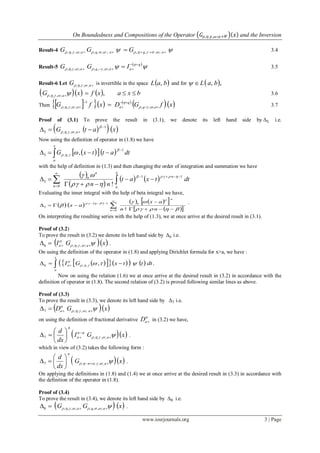
Proof of (3.1) To prove the result in (3.1), we denote its left hand side by Δ5 i.e.
   xatG a
1
;,,,5

 


Now using the definition of operator in (1.8) we have
   


x
a
dtattxG
1
,,5 ,

 
with the help of definition in (1.3) and then changing the order of integration and summation we have
 
 
    






0
11
5
!n
x
a
n
n
n
dttxat
nn



Evaluating the inner integral with the help of beta integral we have,
          
  






0
1
5
!n
n
n
nn
ax
ax




 .
On interpreting the resulting series with the help of (1.3), we at once arrive at the desired result in (3.1).
Proof of (3.2)
To prove the result in (3.2) we denote its left hand side by Δ6 i.e.
  xGI aa 

 ;,,,6 .
On using the definition of the operator in (1.8) and applying Dirichlet formula for x>a, we have :
         
x
a
a dtttxGI .,,,6 

Now on using the relation (1.6) we at once arrive at the desired result in (3.2) in accordance with the
definition of operator in (1.8). The second relation of (3.2) is proved following similar lines as above.
Proof of (3.3)
To prove the result in (3.3), we denote its left hand side by Δ7 i.e.
  xGD aa 

 ;,,,7
on using the definition of fractional derivative

aD in (3.2) we have,
  xGI
dx
d
a
n
a
n










 ;,,,7 .
which in view of (3.2) takes the following form :
  xG
dx
d
an
n
 





 ;,,,7 .
On applying the definitions in (1.8) and (1.4) we at once arrive at the desired result in (3.3) in accordance with
the definition of the operator in (1.8).
Proof of (3.4)
To prove the result in (3.4), we denote its left hand side by Δ8 i.e.
   xGG aqa   ;,,,;,,,8 .
On Boundedness and Compositions of the Operator 𝐺𝜌,𝜂,𝛾,𝜔;𝑎+𝛹 𝑥 and the Inversion
www.iosrjournals.org 4 | Page
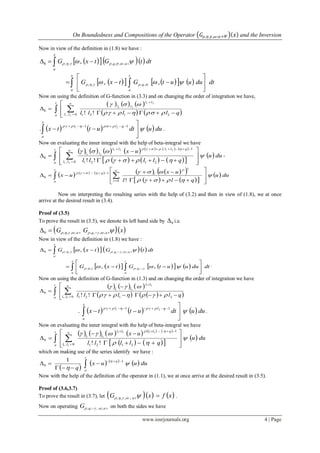
Now in view of the definition in (1.8) we have :
     
x
a
aq dttGtxG   ;,,,,,8 ,
         






x
a
t
a
q dtduuutGtxG   ,, ,,,,
Now on using the definition of G-function in (3.3) and on changing the order of integration we have,
     
    








t
a ll
ll
ll
qllll0, 2121
8
21
21
21
!! 

      duudtuttx
x
a
qll





 11 21
. .
Now on evaluating the inner integral with the help of beta-integral we have
             
      
  













t
a ll
qllll
ll
duu
qllll
ux


 
0, 2121
1
8
21
2121
21
!!
,
          
    
   













t
a l
l
lq
duu
qll
ux
ux 

 

0
1
8
!
Now on interpreting the resulting series with the help of (3.2) and then in view of (1.8), we at once
arrive at the desired result in (3.4).
Proof of (3.5)
To prove the result in (3.5), we denote its left hand side by 9 i.e.
  xGG aqa   ;,,,;,,,9
Now in view of the definition in (1.8) we have :
     
x
a
aq dttGtxG   ;,,,,,9 ,
         





 
x
a
t
a
q dtduuutGtxG   ,, ,,,,
.
Now on using the definition of G-function in (1.3) and on changing the order of integration we have
     
     









t
a ll
ll
ll
qllll0, 2121
9
21
21
21
!! 

     duudtuttx
x
a
qll





 11 21
. .
Now on evaluating the inner integral with the help of beta-integral we have
           
    
  duu
qllll
uxt
a ll
qllll
ll


 
 














0, 2121
1
9
21
2121
21
!!
which on making use of the series identify we have :
 
   
 




t
a
q
duuux
q


 1
9
1
Now with the help of the definition of the operator in (1.1), we at once arrive at the desired result in (3.5).
Proof of (3.6,3.7)
To prove the result in (3.7), let     xfxG a  ;,,, .
Now on operating  aqG ;,,,  on both the sides we have
On Boundedness and Compositions of the Operator 𝐺𝜌,𝜂,𝛾,𝜔;𝑎+𝛹 𝑥 and the Inversion
www.iosrjournals.org 5 | Page
      xfGxGG aqaaq   ;,,,;,,,;,,,  
which in view of (3.5) gives
 
       xfGxI aq
q
a 

  ;,,, 

 .
Now on operating
 q
aD 


on both the sides it gives :
   
    
   xfGDxID aq
q
a
q
a
q
a 





  ;,,, 


   
   xfGDx aq
q
a 

 ;,,, 


which is the result in (3.7).
Now let      
   xfGDxfG aq
q
aa 



  ;,,,
1
;,,, 


on operating aG ;,,,  both the sides, we have
      xfGG aa 

 ;,,,
1
;,,, 
 
   xfGGD aaq
q
a 

 ;,,,;,,, 

which in view of (3.5) gives
          
 xfIDxfGG q
a
q
aaa





  
 ;,,,
1
;,,,
References
[1]. Carl F. Lorenzo, Tom T. Hartley: Generalized Functions for the Fractional Calculus, NASA/TP—1999-209424/REV1(1999)
[2]. Erdelyi, A., Magnus, W., Oberhettinger, F. and Tricomi, F.G. : Tables of Integral Transforms, Vol.-II, McGraw-Hill, New York
Toronto & London (1954).
[3]. H.Nagar and A.K.Menaria, J. Comp. & Math. Sci. Vol.3 (5), 536-541 (2012)
[4]. Kober, H.: On fractional integrals and derivatives. Quart. J. Math. Oxford 11,193(1940)
[5]. Lorenzo, C.F. and Hartely, T.T. : R-function relationships for application in the fractional calculus, NASA Tech. Mem. 210361, 1-22,
(2000)

A0750105

  • 1.
    IOSR Journal ofMathematics (IOSR-JM) e-ISSN: 2278-5728,p-ISSN: 2319-765X, Volume 7, Issue 5 (Jul. - Aug. 2013), PP 01-05 www.iosrjournals.org www.iosrjournals.org 1 | Page On Boundedness and Compositions of the Operator 𝑮 𝝆,𝜼,𝜸,𝝎;𝒂+𝜳 𝒙 and the Inversion Formula Harish Nagar, Naresh Menaria and A. K. Tripathi Department of Mathematics, Mewar University Chittorgarh,Rajasthan,India Abstract: In this paper we established Boundedness and Compositions of the Operator 𝐺𝜌 ,𝜂,𝛾,𝜔;𝑎+𝛹 (𝑥) and the Inversion Formulae on the space L(a,b) and C[a,b] , given by Hartely and Lorenzo[5] Key words -𝐺𝜌,𝜂,𝑟[𝑎, 𝑧] function, Riemann liouville fractional integral, Riemann liouville fractional derivative , beta-integral. I. Introduction and preliminaries The Riemann-Liouville fractional integral 𝐼𝑎+ 𝛼 and fractional derivative 𝐷𝑎+ 𝛼 [2], [4] of order 𝛼 > 0 are given by 𝐼𝑎+ 𝛼 𝐹 𝑥 = 1 𝛤(𝛼) 𝐹 𝑡 𝑥−𝑡 1−𝛼 𝑑𝑡 𝑥 0 1.1 where 𝛼 𝜖 C , Re 𝛼 > 0 and 𝐷𝑎+ 𝛼 𝐹 𝑥 = 𝑑 𝑑𝑥 𝑛 𝐼𝑎+ 𝛼−𝑛 𝐹 𝑥 1.2 where 𝛼 𝜖 C , Re α > 0 (n= Re 𝛼 + 1). G function introduced by Lorenzo and Hartley[1],[5] Gρ,η,r[a, z] = zrρ−η−1 (r)n (azρ)n Γ(ρn+ρr−η)n! ∞ n=0 1.3 where (𝑟) 𝑛 is the Pochhammer symbol and Re(ρr − η) where q, γ,δ 𝜖 C, Re (𝑞 > 0) and Re (γ > 0) , Re (q𝛾 − δ) > 0 Properties of function  zaG ,,,  For         0Re,Re,Re,Re,,,,,,,   qCq and Nn there hold the following properties for the special function  zaG ,,,  defined in (1.3) are given by H.Nagar et al.[3] Property-1     zGzG dz d n n ,, ,,,,         1.4 Property-2       xGdttGtxG q x q ,,, ,, 0 ,,,,    1.5 Property-3          axaxGxatGIa   ,,, ,,,,    1.6 Property-4           axaxGxatGDa   ,,, ,,,,    1.7 The fractional Integral operators a G ;,,,             x a a axdtttxGxG ,,,,;,,,   1.8 where     0Re,Re,,,,   C II. Boundedness of Operator 𝐆 𝛒,𝛈,𝛄,𝛚;𝐚+𝚿 𝐱 In the following theorems we prove the boundedness on the space L(a,b) and C[a,b] of the operator Gρ,η,γ,ω;a+Ψ x defined in (1.8).
  • 2.
    On Boundedness andCompositions of the Operator 𝐺𝜌,𝜂,𝛾,𝜔;𝑎+𝛹 𝑥 and the Inversion www.iosrjournals.org 2 | Page Theorem-1 Let     0Re,Re,,,,   C and ab  then the operator aG ;,,,  is bounded on  baL , and 11;,,, *  BG a  2.1 Where                             0 Re ReRe !ReRe * k k k kkk ab abB     2.2 Theorem-2 Let     0Re,Re,,,,   C and ab  then the operator aG ;,,,  is bounded on  baC , and CCa BG  * ;,,,  where * B is given in (2.2) Proof of Theorems-1, 2 To prove Theorem-1, we denote its left hand side by 4 i.e. . 1;,,,4   aG Now using the definition of operator aG ;,,,  in (1.8) and definition of the function   txG ,,,  in (1.3) and then on interchanging the order of integration by the Dirichlet formula we have,                    b a x a k k k dxdtt kk tx tx 0 1 4 !                              b a b t k kk k dxdtt kk tx tx 0 Re 1ReRe !      , ;, bxat  which on putting utx  takes the following form :                    b a tb k k kk dttdu kk u    0 0 1ReRe 4 !                          0 0 1ReRe !k b a ab k k k dttduu kk     , at  . Now interpreting the inner integral using term-by-term integration and taking into account (2.2), we at once arrive at the desired result in (2.1). To prove Theorem-2, we know that the integral operator Gρ,η,γ,ω;a+ is bounded on L(a,b) by Theorem-1, so it is also bounded in the space C[a,b] of continuous function g on L(a,b) with a finite norm  xgg bxaC   max Using this concept and definition of integral operator aG ;,,,  in (1.8) and in view of (1.3) we have for any  bax , and  baC , ,                dtt kk tx txxG x a k k k a                         0 1 ;,,, !                  ab k k kk C kk duu 0 0 1ReRe !     . The integral on the right hand side is less than or equal to * B , which is defined in (2.2). This completes the proof of Theorem-2. III. Compositions of the Operator 𝐆 𝛒,𝛈,𝛄,𝛚;𝐚+𝚿 𝐱 and the Inversion Formula Let         0Re,Re,Re,Re,,,,,,,,   qCq then the following results hold for  baL , . Result-1         axGxatG a     ,,, 1 ;,,,     3.1 Result-2       aaaaa IGGGI ;,,,;,,,;,,, 3.2 Result-3      aaa GGD ;,,,;,,, 3.3 holds for any continuous function  baC , .
  • 3.
    On Boundedness andCompositions of the Operator 𝐺𝜌,𝜂,𝛾,𝜔;𝑎+𝛹 𝑥 and the Inversion www.iosrjournals.org 3 | Page Result-4     aqaqa GGG ;,,,;,,,;,,, 3.4 Result-5      q aaqa IGG   ;,,,;,,, 3.5 Result-6 Let aG ;,,,  is invertible in the space  baL , and for  ,, baL      bxaxfxG a  ,;,,,  3.6 Then         xfGDxfG aq q aa       ;,, 1 ;,,,    3.7 Proof of (3.1) To prove the result in (3.1), we denote its left hand side by Δ5 i.e.    xatG a 1 ;,,,5      Now using the definition of operator in (1.8) we have       x a dtattxG 1 ,,5 ,    with the help of definition in (1.3) and then changing the order of integration and summation we have                0 11 5 !n x a n n n dttxat nn    Evaluating the inner integral with the help of beta integral we have,                     0 1 5 !n n n nn ax ax      . On interpreting the resulting series with the help of (1.3), we at once arrive at the desired result in (3.1). Proof of (3.2) To prove the result in (3.2) we denote its left hand side by Δ6 i.e.   xGI aa    ;,,,6 . On using the definition of the operator in (1.8) and applying Dirichlet formula for x>a, we have :           x a a dtttxGI .,,,6   Now on using the relation (1.6) we at once arrive at the desired result in (3.2) in accordance with the definition of operator in (1.8). The second relation of (3.2) is proved following similar lines as above. Proof of (3.3) To prove the result in (3.3), we denote its left hand side by Δ7 i.e.   xGD aa    ;,,,7 on using the definition of fractional derivative  aD in (3.2) we have,   xGI dx d a n a n            ;,,,7 . which in view of (3.2) takes the following form :   xG dx d an n         ;,,,7 . On applying the definitions in (1.8) and (1.4) we at once arrive at the desired result in (3.3) in accordance with the definition of the operator in (1.8). Proof of (3.4) To prove the result in (3.4), we denote its left hand side by Δ8 i.e.    xGG aqa   ;,,,;,,,8 .
  • 4.
    On Boundedness andCompositions of the Operator 𝐺𝜌,𝜂,𝛾,𝜔;𝑎+𝛹 𝑥 and the Inversion www.iosrjournals.org 4 | Page Now in view of the definition in (1.8) we have :       x a aq dttGtxG   ;,,,,,8 ,                 x a t a q dtduuutGtxG   ,, ,,,, Now on using the definition of G-function in (3.3) and on changing the order of integration we have,                    t a ll ll ll qllll0, 2121 8 21 21 21 !!         duudtuttx x a qll       11 21 . . Now on evaluating the inner integral with the help of beta-integral we have                                      t a ll qllll ll duu qllll ux     0, 2121 1 8 21 2121 21 !! ,                                  t a l l lq duu qll ux ux      0 1 8 ! Now on interpreting the resulting series with the help of (3.2) and then in view of (1.8), we at once arrive at the desired result in (3.4). Proof of (3.5) To prove the result in (3.5), we denote its left hand side by 9 i.e.   xGG aqa   ;,,,;,,,9 Now in view of the definition in (1.8) we have :       x a aq dttGtxG   ;,,,,,9 ,                  x a t a q dtduuutGtxG   ,, ,,,, . Now on using the definition of G-function in (1.3) and on changing the order of integration we have                      t a ll ll ll qllll0, 2121 9 21 21 21 !!        duudtuttx x a qll       11 21 . . Now on evaluating the inner integral with the help of beta-integral we have                    duu qllll uxt a ll qllll ll                     0, 2121 1 9 21 2121 21 !! which on making use of the series identify we have :             t a q duuux q    1 9 1 Now with the help of the definition of the operator in (1.1), we at once arrive at the desired result in (3.5). Proof of (3.6,3.7) To prove the result in (3.7), let     xfxG a  ;,,, . Now on operating  aqG ;,,,  on both the sides we have
  • 5.
    On Boundedness andCompositions of the Operator 𝐺𝜌,𝜂,𝛾,𝜔;𝑎+𝛹 𝑥 and the Inversion www.iosrjournals.org 5 | Page       xfGxGG aqaaq   ;,,,;,,,;,,,   which in view of (3.5) gives          xfGxI aq q a     ;,,,    . Now on operating  q aD    on both the sides it gives :             xfGDxID aq q a q a q a         ;,,,           xfGDx aq q a    ;,,,    which is the result in (3.7). Now let          xfGDxfG aq q aa       ;,,, 1 ;,,,    on operating aG ;,,,  both the sides, we have       xfGG aa    ;,,, 1 ;,,,       xfGGD aaq q a    ;,,,;,,,   which in view of (3.5) gives             xfIDxfGG q a q aaa          ;,,, 1 ;,,, References [1]. Carl F. Lorenzo, Tom T. Hartley: Generalized Functions for the Fractional Calculus, NASA/TP—1999-209424/REV1(1999) [2]. Erdelyi, A., Magnus, W., Oberhettinger, F. and Tricomi, F.G. : Tables of Integral Transforms, Vol.-II, McGraw-Hill, New York Toronto & London (1954). [3]. H.Nagar and A.K.Menaria, J. Comp. & Math. Sci. Vol.3 (5), 536-541 (2012) [4]. Kober, H.: On fractional integrals and derivatives. Quart. J. Math. Oxford 11,193(1940) [5]. Lorenzo, C.F. and Hartely, T.T. : R-function relationships for application in the fractional calculus, NASA Tech. Mem. 210361, 1-22, (2000)