
Binu Bhasuran
Microsoft MVP Visual C#
Blog http://proxdev.com/
simple, modern, object-oriented, and type-safe
programming language
unified type system
versioning
A block permits multiple statements to be
written in contexts where a single statement is
allowed. A block consists of a list of statements
written between the delimiters { and }.
Declaration statements are used to declare
local variables and constants.
Expression statements are used to evaluate
expressions. Expressions that can be used as
statements include method invocations, object
allocations using the new operator, assignments
using = and the compound assignment
operators, increment and decrement operations
using the ++ and -- operators and await
expressions.
Selection statements are used to select one of a
number of possible statements for execution
based on the value of some expression. In this
group are the if and switch statements.
Iteration statements are used to repeatedly
execute an embedded statement. In this group
are the while, do, for, and foreach statements.
Jump statements are used to transfer control. In
this group are the break, continue, goto, throw,
return, and yield statements.
The try...catch statement is used to catch
exceptions that occur during execution of a
block, and the try...finally statement is used to
specify finalization code that is always executed,
whether an exception occurred or not.
The checked and unchecked statements are
used to control the overflow checking context
for integral-type arithmetic operations and
conversions.
The lock statement is used to obtain the
mutual-exclusion lock for a given object,
execute a statement, and then release the lock.
The using statement is used to obtain a
resource, execute a statement, and then
dispose of that resource.
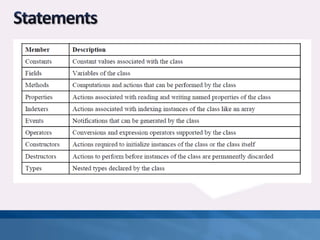
Classes are the most fundamental of C#’s types.
A class is a data structure that combines state
(fields) and actions (methods and other
function members) in a single unit .
The members of a class are either static
members or instance members. Static members
belong to classes, and instance members belong
to objects (instances of classes).
C# Basics
C# Basics
C# Basics
C# Basics
C# Basics

C# Basics

  • 1.
    Binu Bhasuran Microsoft MVPVisual C# Blog http://proxdev.com/
  • 2.
    simple, modern, object-oriented,and type-safe programming language unified type system versioning
  • 10.
    A block permitsmultiple statements to be written in contexts where a single statement is allowed. A block consists of a list of statements written between the delimiters { and }.
  • 11.
    Declaration statements areused to declare local variables and constants.
  • 12.
    Expression statements areused to evaluate expressions. Expressions that can be used as statements include method invocations, object allocations using the new operator, assignments using = and the compound assignment operators, increment and decrement operations using the ++ and -- operators and await expressions.
  • 13.
    Selection statements areused to select one of a number of possible statements for execution based on the value of some expression. In this group are the if and switch statements.
  • 14.
    Iteration statements areused to repeatedly execute an embedded statement. In this group are the while, do, for, and foreach statements.
  • 15.
    Jump statements areused to transfer control. In this group are the break, continue, goto, throw, return, and yield statements.
  • 16.
    The try...catch statementis used to catch exceptions that occur during execution of a block, and the try...finally statement is used to specify finalization code that is always executed, whether an exception occurred or not.
  • 17.
    The checked andunchecked statements are used to control the overflow checking context for integral-type arithmetic operations and conversions.
  • 18.
    The lock statementis used to obtain the mutual-exclusion lock for a given object, execute a statement, and then release the lock. The using statement is used to obtain a resource, execute a statement, and then dispose of that resource.
  • 19.
    Classes are themost fundamental of C#’s types. A class is a data structure that combines state (fields) and actions (methods and other function members) in a single unit . The members of a class are either static members or instance members. Static members belong to classes, and instance members belong to objects (instances of classes).