Chapter 4
Writing Classes
– Part 3
Java Software Solutions
Foundations of Program Design
9th Edition
John Lewis
William Loftus
Outline
Anatomy of a Class
Encapsulation
Anatomy of a Method
Encapsulation
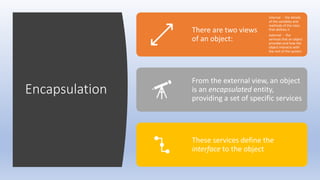
There are two views
of an object:
internal - the details
of the variables and
methods of the class
that defines it
external - the
services that an object
provides and how the
object interacts with
the rest of the system
From the external view, an object
is an encapsulated entity,
providing a set of specific services
These services define the
interface to the object
Encapsulation
One object (called the client) may use another object
for the services it provides
The client of an object may request its services (call its
methods), but it should not have to be aware of how
those services are accomplished
Any changes to the object's state (its variables) should
be made by that object's methods
We should make it difficult, if not impossible, for a
client to access an object’s variables directly
That is, an object should be self-governing
Encapsulation
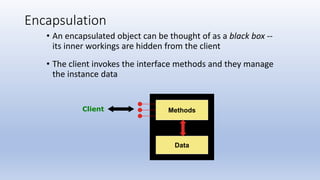
• An encapsulated object can be thought of as a black box --
its inner workings are hidden from the client
• The client invokes the interface methods and they manage
the instance data
Methods
Data
Client
Key Concept
Instance variables should be
declared with private visibility
to promote encapsulation.
Visibility
Modifiers
In Java, we accomplish encapsulation through the
appropriate use of visibility modifiers
A modifier is a Java reserved word that specifies
particular characteristics of a method or data
We've used the final modifier to define constants
Java has three visibility modifiers: public, protected,
and private
The protected modifier involves inheritance, which
we will discuss later
Visibility
Modifiers
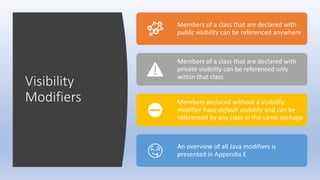
Members of a class that are declared with
public visibility can be referenced anywhere
Members of a class that are declared with
private visibility can be referenced only
within that class
Members declared without a visibility
modifier have default visibility and can be
referenced by any class in the same package
An overview of all Java modifiers is
presented in Appendix E
Visibility
Modifiers
Public variables violate
encapsulation because they
allow the client to modify the
values directly
Therefore instance variables
should not be declared with
public visibility
It is acceptable to give a
constant public visibility, which
allows it to be used outside of
the class
Public constants do not violate
encapsulation because,
although the client can access
it, its value cannot be changed
Visibility
Modifiers
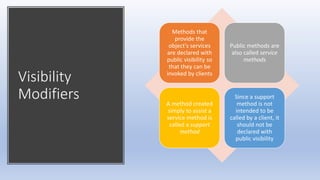
Methods that
provide the
object's services
are declared with
public visibility so
that they can be
invoked by clients
Public methods are
also called service
methods
A method created
simply to assist a
service method is
called a support
method
Since a support
method is not
intended to be
called by a client, it
should not be
declared with
public visibility
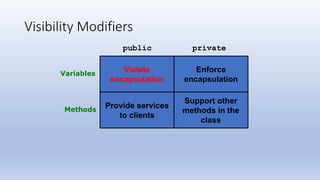
Visibility Modifiers
public private
Variables
Methods
Provide services
to clients
Support other
methods in the
class
Enforce
encapsulation
Violate
encapsulation
Key Concept
• Most objects contain
accessor and mutator
methods to allow the client
to manage data in a
controlled manner.
Accessors and
Mutators
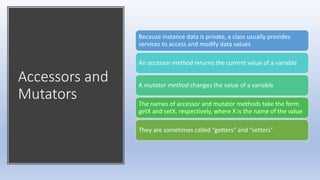
Because instance data is private, a class usually provides
services to access and modify data values
An accessor method returns the current value of a variable
A mutator method changes the value of a variable
The names of accessor and mutator methods take the form
getX and setX, respectively, where X is the name of the value
They are sometimes called “getters” and “setters”
Mutator
Restrictions
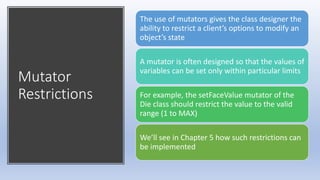
The use of mutators gives the class designer the
ability to restrict a client’s options to modify an
object’s state
A mutator is often designed so that the values of
variables can be set only within particular limits
For example, the setFaceValue mutator of the
Die class should restrict the value to the valid
range (1 to MAX)
We’ll see in Chapter 5 how such restrictions can
be implemented

Java Chapter 04 - Writing Classes: part 3

  • 1.
    Chapter 4 Writing Classes –Part 3 Java Software Solutions Foundations of Program Design 9th Edition John Lewis William Loftus
  • 2.
    Outline Anatomy of aClass Encapsulation Anatomy of a Method
  • 3.
    Encapsulation There are twoviews of an object: internal - the details of the variables and methods of the class that defines it external - the services that an object provides and how the object interacts with the rest of the system From the external view, an object is an encapsulated entity, providing a set of specific services These services define the interface to the object
  • 4.
    Encapsulation One object (calledthe client) may use another object for the services it provides The client of an object may request its services (call its methods), but it should not have to be aware of how those services are accomplished Any changes to the object's state (its variables) should be made by that object's methods We should make it difficult, if not impossible, for a client to access an object’s variables directly That is, an object should be self-governing
  • 5.
    Encapsulation • An encapsulatedobject can be thought of as a black box -- its inner workings are hidden from the client • The client invokes the interface methods and they manage the instance data Methods Data Client
  • 6.
    Key Concept Instance variablesshould be declared with private visibility to promote encapsulation.
  • 7.
    Visibility Modifiers In Java, weaccomplish encapsulation through the appropriate use of visibility modifiers A modifier is a Java reserved word that specifies particular characteristics of a method or data We've used the final modifier to define constants Java has three visibility modifiers: public, protected, and private The protected modifier involves inheritance, which we will discuss later
  • 8.
    Visibility Modifiers Members of aclass that are declared with public visibility can be referenced anywhere Members of a class that are declared with private visibility can be referenced only within that class Members declared without a visibility modifier have default visibility and can be referenced by any class in the same package An overview of all Java modifiers is presented in Appendix E
  • 9.
    Visibility Modifiers Public variables violate encapsulationbecause they allow the client to modify the values directly Therefore instance variables should not be declared with public visibility It is acceptable to give a constant public visibility, which allows it to be used outside of the class Public constants do not violate encapsulation because, although the client can access it, its value cannot be changed
  • 10.
    Visibility Modifiers Methods that provide the object'sservices are declared with public visibility so that they can be invoked by clients Public methods are also called service methods A method created simply to assist a service method is called a support method Since a support method is not intended to be called by a client, it should not be declared with public visibility
  • 11.
    Visibility Modifiers public private Variables Methods Provideservices to clients Support other methods in the class Enforce encapsulation Violate encapsulation
  • 12.
    Key Concept • Mostobjects contain accessor and mutator methods to allow the client to manage data in a controlled manner.
  • 13.
    Accessors and Mutators Because instancedata is private, a class usually provides services to access and modify data values An accessor method returns the current value of a variable A mutator method changes the value of a variable The names of accessor and mutator methods take the form getX and setX, respectively, where X is the name of the value They are sometimes called “getters” and “setters”
  • 14.
    Mutator Restrictions The use ofmutators gives the class designer the ability to restrict a client’s options to modify an object’s state A mutator is often designed so that the values of variables can be set only within particular limits For example, the setFaceValue mutator of the Die class should restrict the value to the valid range (1 to MAX) We’ll see in Chapter 5 how such restrictions can be implemented