Binu Bhasuran
Microsoft MVP Visual C#
Facebook http://facebook.com/codeno47
Blog http://proxdev.com/
• Its been time in windows environment where
used different techniques for inter-process
communication.
• With .NET framework , we can extend this
techniques further using WCF services. WCF
service can use in local machine ( Inter process
communication) and remotely ( over
LAN/WAN/public network) ..
A WCF Service is a program that exposes a
collection of Endpoints.
Each Endpoint is a portal for communicating with
the world.
A Client is a program that exchanges messages with
one or more Endpoints.
A Client may also expose an Endpoint to receive
Messages from a Service in a duplex message
exchange pattern.
WCF is for enabling .NET Framework applications to exchange
messages with other software entities.
SOAP is used by default, but the messages can be in any
format, and conveyed by using any transport protocol.
The structure of the messages can be defined using an XML
Schema, and there are various options for serializing the
messages to and from .NET Framework objects.
WCF can automatically generate metadata to describe
applications built using the technology in WSDL, and it also
provides a tool for generating clients for those applications
from the WSDL.
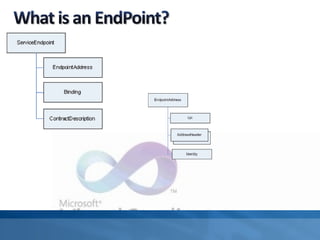
A Service Endpoint has an Address, a Binding,
and a Contract.
The Endpoint’s Address is a network
addresswhere the Endpoint resides. The
EndpointAddress class represents a WCF
Endpoint Address.
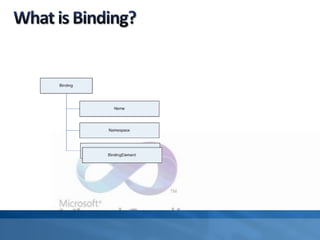
A Binding has a name, a namespace, and a
collection of composable binding elements
Binding’s name and namespace uniquely
identify it in the service’s metadata.
Each binding element describes an aspect
ofhow the Endpoint communicates with the
world.
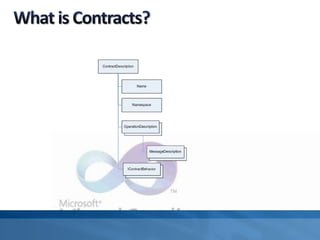
A WCF Contract is a collection of Operations
that specifies what the Endpoint communicates
to the outside world. Each operation is a simple
message exchange, for example one-way or
request/reply message exchange.
WCF application development usually also begins with
the definition of complex types. WCF can be made to use
the same .NET Framework types as ASP.NET Web
services.
The
WCF DataContractAttribute and DataMemberAttribute
can be added to .NET Framework types to indicate that
instances of the type are to be serialized into XML, and
which particular fields or properties of the type are to be
serialized, as shown in the following sample code.
//Example One:
[DataContract]
public class LineItem
{
[DataMember]
public string ItemNumber;
[DataMember]
public decimal Quantity;
[DataMember]
public decimal UnitPrice;
}
The DataContractAttribute signifies that zero or
more of a type’s fields or properties are to be
serialized.
The DataContractAttribute can be applied to a
class or structure.
Instances of types that have
theDataContractAttribute applied to them are
referred to as data contracts in WCF. They are
serialized into XML using DataContractSerializer.
The DataMemberAttribute indicates that a
particular field or property is to be serialized.
The DataMemberAttribute can be applied to a
field or a property, and the fields and properties
to which the attribute is applied can be either
public or private.
The XmlSerializer and the attributes of
the System.Xml.Serialization namespace are designed to
allow you to map .NET Framework types to any valid type
defined in XML Schema, and so they provide for very
precise control over how a type is represented in XML.
The DataContractSerializer,DataContractAttribute and
DataMemberAttribute provide very little control over
how a type is represented in XML. You can only specify
the namespaces and names used to represent the type
and its fields or properties in the XML, and the sequence
in which the fields and properties appear in the XML:
By not permitting much control over how a type is to be represented in XML,
the serialization process becomes highly predictable for
theDataContractSerializer, and, thereby, easier to optimize. A practical
benefit of the design of the DataContractSerializer is better performance,
approximately 10% better performance.
The attributes for use with the XmlSerializer do not indicate which fields or
properties of the type are serialized into XML, whereas
theDataMemberAttribute for use with the DataContractSerializer shows
explicitly which fields or properties are serialized. Therefore, data contracts
are explicit contracts about the structure of the data that an application is to
send and receive.
The XmlSerializer can only translate the public members of a .NET object into
XML, the DataContractSerializer can translate the members of objects into
XML regardless of the access modifiers of those members.
As a consequence of being able to serialize the non-public members of types
into XML, the DataContractSerializer has fewer restrictions on the variety of
.NET types that it can serialize into XML. In particular, it can translate into
XML types like Hashtable that implement the IDictionary interface.
TheDataContractSerializer is much more likely to be able to serialize the
instances of any pre-existing .NET type into XML without having to either
modify the definition of the type or develop a wrapper for it.
Another consequence of the DataContractSerializer being able to access the
non-public members of a type is that it requires full trust, whereas
theXmlSerializer does not. The Full Trust code access permission give
complete access to all resources on a machine that can be access using the
credentials under which the code is executing. This options should be used
with care as fully trusted code accesses all resources on your machine.
The DataContractSerializer incorporates some support for versioning:
The DataMemberAttribute has an IsRequired property that can be
assigned a value of false for members that are added to new versions
of a data contract that were not present in earlier versions, thereby
allowing applications with the newer version of the contract to be able
to process earlier versions.
By having a data contract implement
the IExtensibleDataObject interface, one can allow
the DataContractSerializer to pass members defined in newer
versions of a data contract through applications with earlier versions
of the contract.
The service contract defines the operations that the service can
perform.
The service contract is usually defined first, by
adding ServiceContractAttribute and OperationContractAttribute to an
interface
[ServiceContract]
public interface IEcho
{
[OperationContract]
string Echo(string input);
}
The ServiceContractAttribute specifies that the
interface defines a WCF service contract, and
the OperationContractAttribute indicates
which, if any, of the methods of the interface
define operations of the service contract.
Once a service contract has been defined, it is
implemented in a class, by having the class
implement the interface by which the service
contract is defined:
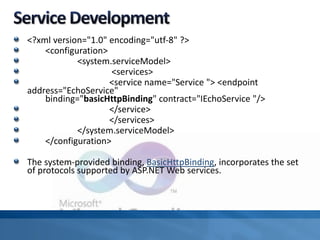
<?xml version="1.0" encoding="utf-8" ?>
<configuration>
<system.serviceModel>
<services>
<service name="Service "> <endpoint
address="EchoService"
binding="basicHttpBinding" contract="IEchoService "/>
</service>
</services>
</system.serviceModel>
</configuration>
The system-provided binding, BasicHttpBinding, incorporates the set
of protocols supported by ASP.NET Web services.
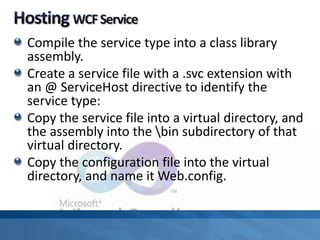
Compile the service type into a class library
assembly.
Create a service file with a .svc extension with
an @ ServiceHost directive to identify the
service type:
Copy the service file into a virtual directory, and
the assembly into the bin subdirectory of that
virtual directory.
Copy the configuration file into the virtual
directory, and name it Web.config.
string httpBaseAddress = "http://www.contoso.com:8000/";
string tcpBaseAddress = "net.tcp://www.contoso.com:8080/";
Uri httpBaseAddressUri = new Uri(httpBaseAddress);
Uri tcpBaseAddressUri = new Uri(tcpBaseAddress);
Uri[] baseAdresses = new Uri[] {
httpBaseAddressUri,
tcpBaseAddressUri};
using(ServiceHost host = new ServiceHost(
typeof(Service), //”Service” is the name of the service type baseAdresses))
{
host.Open();
[…] //Wait to receive messages
host.Close();
}
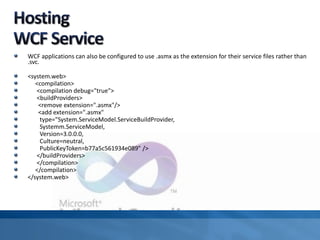
WCF applications can also be configured to use .asmx as the extension for their service files rather than
.svc.
<system.web>
<compilation>
<compilation debug="true">
<buildProviders>
<remove extension=".asmx"/>
<add extension=".asmx"
type="System.ServiceModel.ServiceBuildProvider,
Systemm.ServiceModel,
Version=3.0.0.0,
Culture=neutral,
PublicKeyToken=b77a5c561934e089" />
</buildProviders>
</compilation>
</compilation>
</system.web>
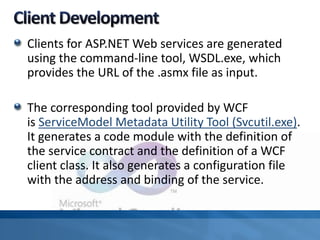
Clients for ASP.NET Web services are generated
using the command-line tool, WSDL.exe, which
provides the URL of the .asmx file as input.
The corresponding tool provided by WCF
is ServiceModel Metadata Utility Tool (Svcutil.exe).
It generates a code module with the definition of
the service contract and the definition of a WCF
client class. It also generates a configuration file
with the address and binding of the service.
In programming a client of a remote service it is
generally advisable to program according to an
asynchronous pattern. The code generated by the
WSDL.exe tool always provides for both a
synchronous and an asynchronous pattern by
default.
The code generated by the ServiceModel Metadata
Utility Tool (Svcutil.exe) can provide for either
pattern. It provides for the synchronous pattern by
default. If the tool is executed with
the /async switch, then the generated code
provides for the asynchronous pattern
The WCF provides the attributes,
MessageContractAttribute,
MessageHeaderAttribute, and
MessageBodyMemberAttribute to describe the
structure of the SOAP messages sent and
received by a service.
[DataContract]
public class SomeProtocol
{
[DataMember]
public long CurrentValue;
[DataMember]
public long Total;
}
[DataContract]
public class Item
{
[DataMember]
public string ItemNumber;
[DataMember]
public decimal Quantity;
[DataMember]
public decimal UnitPrice;
}
[MessageContract]
public class ItemMesage
{
[MessageHeader]
public SomeProtocol ProtocolHeader;
[MessageBody]
public Item Content;
}
[ServiceContract]
public interface IItemService
{
[OperationContract]
public void DeliverItem(ItemMessage itemMessage);
}
In ASP.NET Web services, unhandled exceptions are returned
to clients as SOAP faults. You can also explicitly throw
instances of the SoapException class and have more control
over the content of the SOAP fault that gets transmitted to
the client.
In WCF services, unhandled exceptions are not returned to
clients as SOAP faults to prevent sensitive information being
inadvertently exposed through the exceptions. A
configuration setting is provided to have unhandled
exceptions returned to clients for the purpose of debugging.
To return SOAP faults to clients, you can throw instances of
the generic type, FaultException, using the data contract type
as the generic type. You can also
addFaultContractAttribute attributes to operations to specify
the faults that an operation might yield.
[DataContract]
public class MathFault
{
[DataMember]
public string operation;
[DataMember]
public string problemType;
}
[ServiceContract]
public interface ICalculator
{
[OperationContract]
[FaultContract(typeof(MathFault))]
int Divide(int n1, int n2);
}
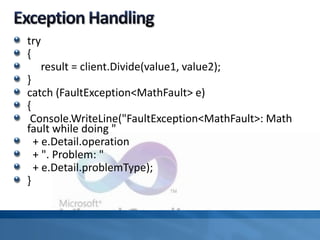
try
{
result = client.Divide(value1, value2);
}
catch (FaultException<MathFault> e)
{
Console.WriteLine("FaultException<MathFault>: Math
fault while doing "
+ e.Detail.operation
+ ". Problem: "
+ e.Detail.problemType);
}
http://msdn.microsoft.com/en-
us/library/ms730214.aspx
Beginning with wcf service

Beginning with wcf service

  • 1.
    Binu Bhasuran Microsoft MVPVisual C# Facebook http://facebook.com/codeno47 Blog http://proxdev.com/
  • 2.
    • Its beentime in windows environment where used different techniques for inter-process communication. • With .NET framework , we can extend this techniques further using WCF services. WCF service can use in local machine ( Inter process communication) and remotely ( over LAN/WAN/public network) ..
  • 3.
    A WCF Serviceis a program that exposes a collection of Endpoints. Each Endpoint is a portal for communicating with the world. A Client is a program that exchanges messages with one or more Endpoints. A Client may also expose an Endpoint to receive Messages from a Service in a duplex message exchange pattern.
  • 4.
    WCF is forenabling .NET Framework applications to exchange messages with other software entities. SOAP is used by default, but the messages can be in any format, and conveyed by using any transport protocol. The structure of the messages can be defined using an XML Schema, and there are various options for serializing the messages to and from .NET Framework objects. WCF can automatically generate metadata to describe applications built using the technology in WSDL, and it also provides a tool for generating clients for those applications from the WSDL.
  • 6.
    A Service Endpointhas an Address, a Binding, and a Contract. The Endpoint’s Address is a network addresswhere the Endpoint resides. The EndpointAddress class represents a WCF Endpoint Address.
  • 8.
    A Binding hasa name, a namespace, and a collection of composable binding elements Binding’s name and namespace uniquely identify it in the service’s metadata. Each binding element describes an aspect ofhow the Endpoint communicates with the world.
  • 10.
    A WCF Contractis a collection of Operations that specifies what the Endpoint communicates to the outside world. Each operation is a simple message exchange, for example one-way or request/reply message exchange.
  • 12.
    WCF application developmentusually also begins with the definition of complex types. WCF can be made to use the same .NET Framework types as ASP.NET Web services. The WCF DataContractAttribute and DataMemberAttribute can be added to .NET Framework types to indicate that instances of the type are to be serialized into XML, and which particular fields or properties of the type are to be serialized, as shown in the following sample code.
  • 13.
    //Example One: [DataContract] public classLineItem { [DataMember] public string ItemNumber; [DataMember] public decimal Quantity; [DataMember] public decimal UnitPrice; }
  • 14.
    The DataContractAttribute signifiesthat zero or more of a type’s fields or properties are to be serialized. The DataContractAttribute can be applied to a class or structure. Instances of types that have theDataContractAttribute applied to them are referred to as data contracts in WCF. They are serialized into XML using DataContractSerializer.
  • 15.
    The DataMemberAttribute indicatesthat a particular field or property is to be serialized. The DataMemberAttribute can be applied to a field or a property, and the fields and properties to which the attribute is applied can be either public or private.
  • 16.
    The XmlSerializer andthe attributes of the System.Xml.Serialization namespace are designed to allow you to map .NET Framework types to any valid type defined in XML Schema, and so they provide for very precise control over how a type is represented in XML. The DataContractSerializer,DataContractAttribute and DataMemberAttribute provide very little control over how a type is represented in XML. You can only specify the namespaces and names used to represent the type and its fields or properties in the XML, and the sequence in which the fields and properties appear in the XML:
  • 17.
    By not permittingmuch control over how a type is to be represented in XML, the serialization process becomes highly predictable for theDataContractSerializer, and, thereby, easier to optimize. A practical benefit of the design of the DataContractSerializer is better performance, approximately 10% better performance. The attributes for use with the XmlSerializer do not indicate which fields or properties of the type are serialized into XML, whereas theDataMemberAttribute for use with the DataContractSerializer shows explicitly which fields or properties are serialized. Therefore, data contracts are explicit contracts about the structure of the data that an application is to send and receive. The XmlSerializer can only translate the public members of a .NET object into XML, the DataContractSerializer can translate the members of objects into XML regardless of the access modifiers of those members.
  • 18.
    As a consequenceof being able to serialize the non-public members of types into XML, the DataContractSerializer has fewer restrictions on the variety of .NET types that it can serialize into XML. In particular, it can translate into XML types like Hashtable that implement the IDictionary interface. TheDataContractSerializer is much more likely to be able to serialize the instances of any pre-existing .NET type into XML without having to either modify the definition of the type or develop a wrapper for it. Another consequence of the DataContractSerializer being able to access the non-public members of a type is that it requires full trust, whereas theXmlSerializer does not. The Full Trust code access permission give complete access to all resources on a machine that can be access using the credentials under which the code is executing. This options should be used with care as fully trusted code accesses all resources on your machine.
  • 19.
    The DataContractSerializer incorporatessome support for versioning: The DataMemberAttribute has an IsRequired property that can be assigned a value of false for members that are added to new versions of a data contract that were not present in earlier versions, thereby allowing applications with the newer version of the contract to be able to process earlier versions. By having a data contract implement the IExtensibleDataObject interface, one can allow the DataContractSerializer to pass members defined in newer versions of a data contract through applications with earlier versions of the contract.
  • 20.
    The service contractdefines the operations that the service can perform. The service contract is usually defined first, by adding ServiceContractAttribute and OperationContractAttribute to an interface [ServiceContract] public interface IEcho { [OperationContract] string Echo(string input); }
  • 21.
    The ServiceContractAttribute specifiesthat the interface defines a WCF service contract, and the OperationContractAttribute indicates which, if any, of the methods of the interface define operations of the service contract. Once a service contract has been defined, it is implemented in a class, by having the class implement the interface by which the service contract is defined:
  • 22.
    <?xml version="1.0" encoding="utf-8"?> <configuration> <system.serviceModel> <services> <service name="Service "> <endpoint address="EchoService" binding="basicHttpBinding" contract="IEchoService "/> </service> </services> </system.serviceModel> </configuration> The system-provided binding, BasicHttpBinding, incorporates the set of protocols supported by ASP.NET Web services.
  • 23.
    Compile the servicetype into a class library assembly. Create a service file with a .svc extension with an @ ServiceHost directive to identify the service type: Copy the service file into a virtual directory, and the assembly into the bin subdirectory of that virtual directory. Copy the configuration file into the virtual directory, and name it Web.config.
  • 24.
    string httpBaseAddress ="http://www.contoso.com:8000/"; string tcpBaseAddress = "net.tcp://www.contoso.com:8080/"; Uri httpBaseAddressUri = new Uri(httpBaseAddress); Uri tcpBaseAddressUri = new Uri(tcpBaseAddress); Uri[] baseAdresses = new Uri[] { httpBaseAddressUri, tcpBaseAddressUri}; using(ServiceHost host = new ServiceHost( typeof(Service), //”Service” is the name of the service type baseAdresses)) { host.Open(); […] //Wait to receive messages host.Close(); }
  • 25.
    WCF applications canalso be configured to use .asmx as the extension for their service files rather than .svc. <system.web> <compilation> <compilation debug="true"> <buildProviders> <remove extension=".asmx"/> <add extension=".asmx" type="System.ServiceModel.ServiceBuildProvider, Systemm.ServiceModel, Version=3.0.0.0, Culture=neutral, PublicKeyToken=b77a5c561934e089" /> </buildProviders> </compilation> </compilation> </system.web>
  • 26.
    Clients for ASP.NETWeb services are generated using the command-line tool, WSDL.exe, which provides the URL of the .asmx file as input. The corresponding tool provided by WCF is ServiceModel Metadata Utility Tool (Svcutil.exe). It generates a code module with the definition of the service contract and the definition of a WCF client class. It also generates a configuration file with the address and binding of the service.
  • 27.
    In programming aclient of a remote service it is generally advisable to program according to an asynchronous pattern. The code generated by the WSDL.exe tool always provides for both a synchronous and an asynchronous pattern by default. The code generated by the ServiceModel Metadata Utility Tool (Svcutil.exe) can provide for either pattern. It provides for the synchronous pattern by default. If the tool is executed with the /async switch, then the generated code provides for the asynchronous pattern
  • 28.
    The WCF providesthe attributes, MessageContractAttribute, MessageHeaderAttribute, and MessageBodyMemberAttribute to describe the structure of the SOAP messages sent and received by a service.
  • 29.
    [DataContract] public class SomeProtocol { [DataMember] publiclong CurrentValue; [DataMember] public long Total; } [DataContract] public class Item { [DataMember] public string ItemNumber; [DataMember] public decimal Quantity; [DataMember] public decimal UnitPrice; } [MessageContract] public class ItemMesage { [MessageHeader] public SomeProtocol ProtocolHeader; [MessageBody] public Item Content; } [ServiceContract] public interface IItemService { [OperationContract] public void DeliverItem(ItemMessage itemMessage); }
  • 30.
    In ASP.NET Webservices, unhandled exceptions are returned to clients as SOAP faults. You can also explicitly throw instances of the SoapException class and have more control over the content of the SOAP fault that gets transmitted to the client. In WCF services, unhandled exceptions are not returned to clients as SOAP faults to prevent sensitive information being inadvertently exposed through the exceptions. A configuration setting is provided to have unhandled exceptions returned to clients for the purpose of debugging. To return SOAP faults to clients, you can throw instances of the generic type, FaultException, using the data contract type as the generic type. You can also addFaultContractAttribute attributes to operations to specify the faults that an operation might yield.
  • 31.
    [DataContract] public class MathFault { [DataMember] publicstring operation; [DataMember] public string problemType; } [ServiceContract] public interface ICalculator { [OperationContract] [FaultContract(typeof(MathFault))] int Divide(int n1, int n2); }
  • 32.
    try { result = client.Divide(value1,value2); } catch (FaultException<MathFault> e) { Console.WriteLine("FaultException<MathFault>: Math fault while doing " + e.Detail.operation + ". Problem: " + e.Detail.problemType); }
  • 34.