
Monasticism
 Professor Will Adams
   Valencia College
       Fall 2011
Monasticism

 The word comes from the Greek word
 monos, meaning alone.
 The earliest monks were men who left their
 homes to be alone in remote places.
Origins
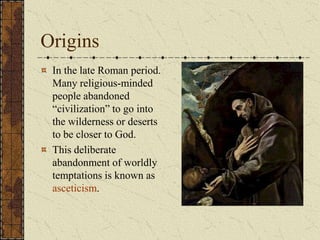
 In the late Roman period.
 Many religious-minded
 people abandoned
 “civilization” to go into
 the wilderness or deserts
 to be closer to God.
 This deliberate
 abandonment of worldly
 temptations is known as
 asceticism.
Origins
 As individuals and as
 small groups, these
 monks often sought
 out remote locations.
 They did this to be
 away from the
 temptations of the
 world and away from
 marauding German
 tribes.

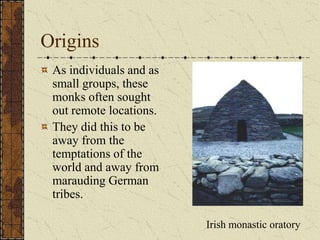
                         Irish monastic oratory
Origins

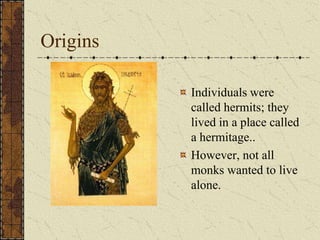
          Individuals were
          called hermits; they
          lived in a place called
          a hermitage..
          However, not all
          monks wanted to live
          alone.
Origins


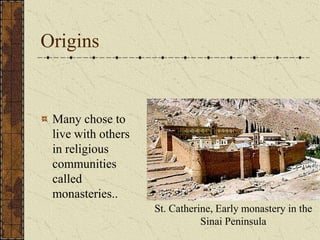
 Many chose to
 live with others
 in religious
 communities
 called
 monasteries..
                    St. Catherine, Early monastery in the
                               Sinai Peninsula
Origins
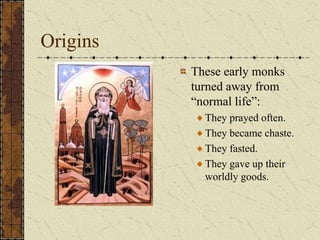
          These early monks
          turned away from
          “normal life”:
            They prayed often.
            They became chaste.
            They fasted.
            They gave up their
            worldly goods.
Origins

 Saint Anthony the
 Great was the first to
 organize a monastery.
 Soon there were many
 monasteries in Egypt.
Origins

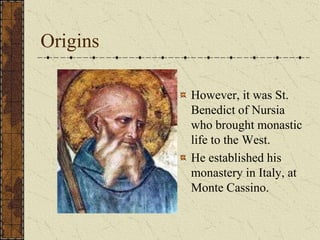
          However, it was St.
          Benedict of Nursia
          who brought monastic
          life to the West.
          He established his
          monastery in Italy, at
          Monte Cassino.
Origins

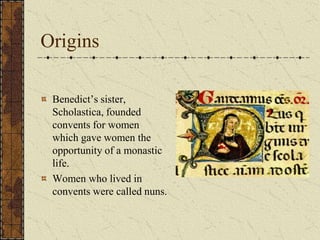
 Benedict’s sister,
 Scholastica, founded
 convents for women
 which gave women the
 opportunity of a monastic
 life.
 Women who lived in
 convents were called nuns.
Spreading the Faith
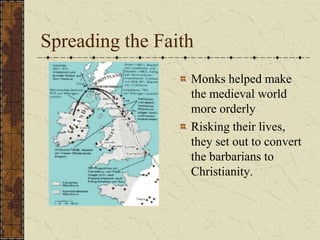
                  Monks helped make
                  the medieval world
                  more orderly
                  Risking their lives,
                  they set out to convert
                  the barbarians to
                  Christianity.
Spreading the Faith

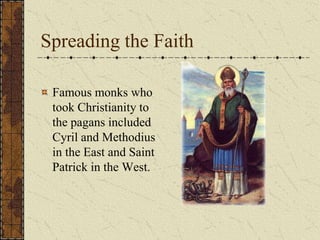
 Famous monks who
 took Christianity to
 the pagans included
 Cyril and Methodius
 in the East and Saint
 Patrick in the West.
Rule of St. Benedict

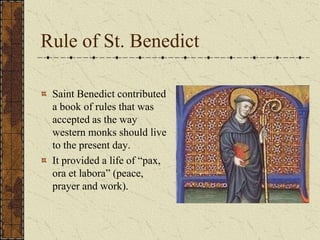
 Saint Benedict contributed
 a book of rules that was
 accepted as the way
 western monks should live
 to the present day.
 It provided a life of “pax,
 ora et labora” (peace,
 prayer and work).
Rule of St. Benedict
 The rule saw monastic life as a family.
   The abott was seen as the father.
   The monks were brothers.
 Each day was divided into units of:
   Group prayer
   Private prayer
   Sleep
   Ritual reading
   Manual labour
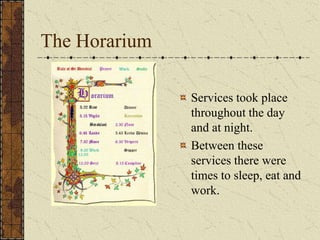
The Horarium

               Services took place
               throughout the day
               and at night.
               Between these
               services there were
               times to sleep, eat and
               work.
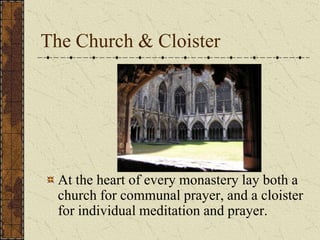
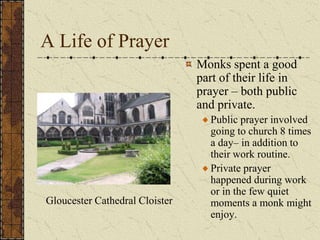
The Church & Cloister


  At the heart of every monastery lay both a
  church for communal prayer, and a cloister
  for individual meditation and prayer.
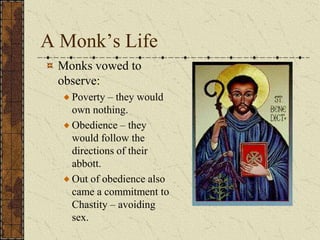
A Monk’s Life
 Monks vowed to
 observe:
   Poverty – they would
   own nothing.
   Obedience – they
   would follow the
   directions of their
   abbott.
   Out of obedience also
   came a commitment to
   Chastity – avoiding
   sex.
A Life of Prayer
                                Monks spent a good
                                part of their life in
                                prayer – both public
                                and private.
                                  Public prayer involved
                                  going to church 8 times
                                  a day– in addition to
                                  their work routine.
                                  Private prayer
                                  happened during work
                                  or in the few quiet
Gloucester Cathedral Cloister     moments a monk might
                                  enjoy.
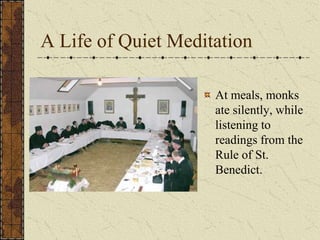
A Life of Quiet Meditation

                     At meals, monks
                     ate silently, while
                     listening to
                     readings from the
                     Rule of St.
                     Benedict.
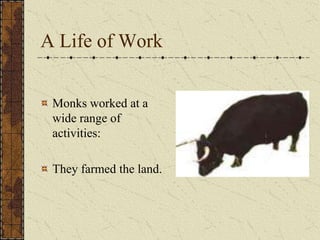
A Life of Work


 Monks worked at a
 wide range of
 activities:

 They farmed the land.
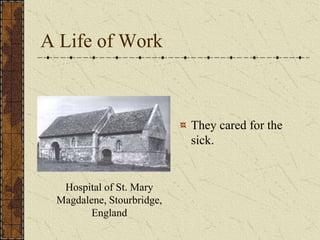
A Life of Work


                           They cared for the
                           sick.


  Hospital of St. Mary
 Magdalene, Stourbridge,
        England
A Life of Work


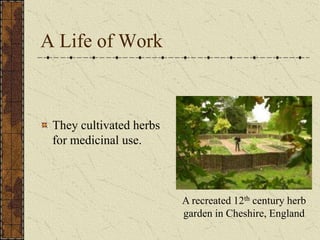
 They cultivated herbs
 for medicinal use.


                         A recreated 12th century herb
                         garden in Cheshire, England
A Life of Work


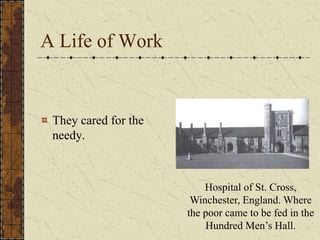
 They cared for the
 needy.


                          Hospital of St. Cross,
                       Winchester, England. Where
                      the poor came to be fed in the
                          Hundred Men’s Hall.
A Life of Work
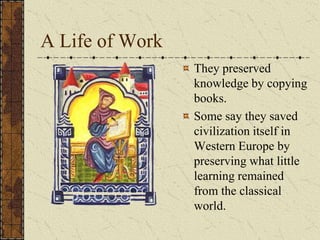
                 They preserved
                 knowledge by copying
                 books.
                 Some say they saved
                 civilization itself in
                 Western Europe by
                 preserving what little
                 learning remained
                 from the classical
                 world.
A Life of Work

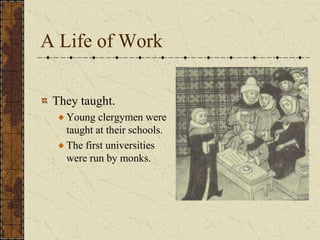
 They taught.
   Young clergymen were
   taught at their schools.
   The first universities
   were run by monks.
A Life of Work

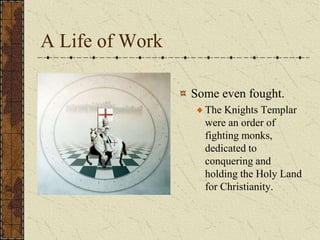
                 Some even fought.
                   The Knights Templar
                   were an order of
                   fighting monks,
                   dedicated to
                   conquering and
                   holding the Holy Land
                   for Christianity.
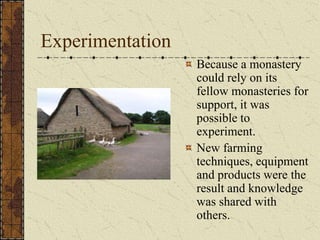
Experimentation
                  Because a monastery
                  could rely on its
                  fellow monasteries for
                  support, it was
                  possible to
                  experiment.
                  New farming
                  techniques, equipment
                  and products were the
                  result and knowledge
                  was shared with
                  others.
Experimentation

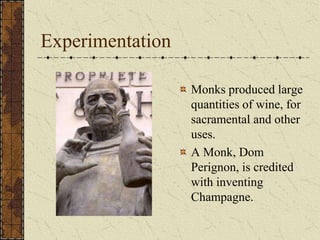
                  Monks produced large
                  quantities of wine, for
                  sacramental and other
                  uses.
                  A Monk, Dom
                  Perignon, is credited
                  with inventing
                  Champagne.
Crop Rotation
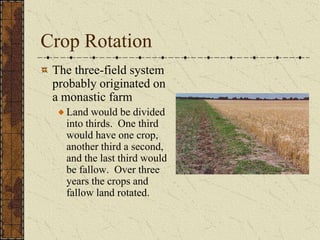
 The three-field system
 probably originated on
 a monastic farm
   Land would be divided
   into thirds. One third
   would have one crop,
   another third a second,
   and the last third would
   be fallow. Over three
   years the crops and
   fallow land rotated.
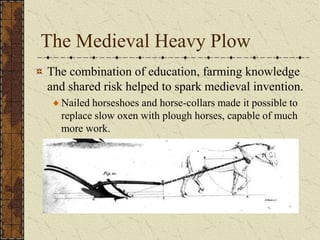
The Medieval Heavy Plow
The combination of education, farming knowledge
and shared risk helped to spark medieval invention.
  Nailed horseshoes and horse-collars made it possible to
  replace slow oxen with plough horses, capable of much
  more work.
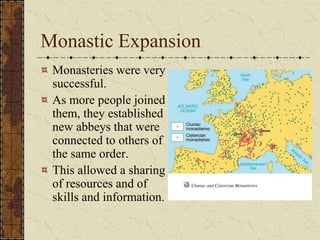
Monastic Expansion
 Monasteries were very
 successful.
 As more people joined
 them, they established
 new abbeys that were
 connected to others of
 the same order.
 This allowed a sharing
 of resources and of
 skills and information.
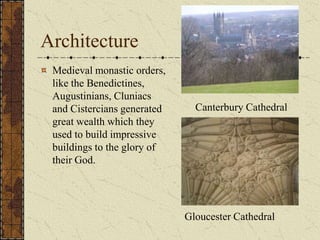
Architecture
 Medieval monastic orders,
 like the Benedictines,
 Augustinians, Cluniacs
 and Cistercians generated     Canterbury Cathedral
 great wealth which they
 used to build impressive
 buildings to the glory of
 their God.


                             Gloucester Cathedral
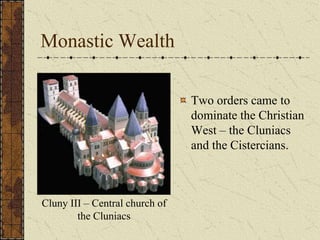
Monastic Wealth

                                Two orders came to
                                dominate the Christian
                                West – the Cluniacs
                                and the Cistercians.


Cluny III – Central church of
        the Cluniacs
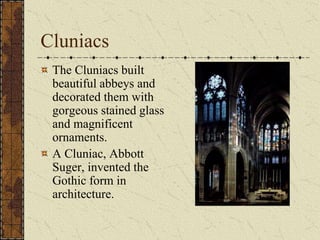
Cluniacs
 The Cluniacs built
 beautiful abbeys and
 decorated them with
 gorgeous stained glass
 and magnificent
 ornaments.
 A Cluniac, Abbott
 Suger, invented the
 Gothic form in
 architecture.
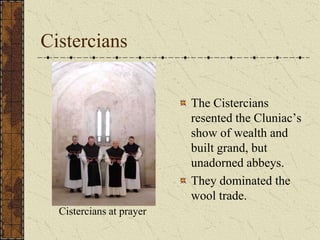
Cistercians


                          The Cistercians
                          resented the Cluniac’s
                          show of wealth and
                          built grand, but
                          unadorned abbeys.
                          They dominated the
                          wool trade.
  Cistercians at prayer
Other Monastic Orders
               New monastic orders assumed
               new roles. In Britain alone,
               there were 11 groups operating.
                  Augustinians
                  Benedictines
                  Carmelites
                  Carthusians
                  Cistercians
                  Cluniacs
                  Dominicans
                  Franciscans
                  Gilbertines
                  Premonstratensians
                  Tironensians
               All follow the Rule of St.
               Benedict.
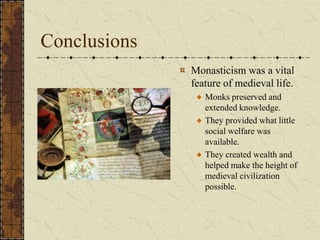
Conclusions
              Monasticism was a vital
              feature of medieval life.
                 Monks preserved and
                 extended knowledge.
                 They provided what little
                 social welfare was
                 available.
                 They created wealth and
                 helped make the height of
                 medieval civilization
                 possible.

Hum1020 1030 monasticism

  • 1.
    Monasticism Professor WillAdams Valencia College Fall 2011
  • 2.
    Monasticism The wordcomes from the Greek word monos, meaning alone. The earliest monks were men who left their homes to be alone in remote places.
  • 3.
    Origins In thelate Roman period. Many religious-minded people abandoned “civilization” to go into the wilderness or deserts to be closer to God. This deliberate abandonment of worldly temptations is known as asceticism.
  • 4.
    Origins As individualsand as small groups, these monks often sought out remote locations. They did this to be away from the temptations of the world and away from marauding German tribes. Irish monastic oratory
  • 5.
    Origins Individuals were called hermits; they lived in a place called a hermitage.. However, not all monks wanted to live alone.
  • 6.
    Origins Many choseto live with others in religious communities called monasteries.. St. Catherine, Early monastery in the Sinai Peninsula
  • 7.
    Origins These early monks turned away from “normal life”: They prayed often. They became chaste. They fasted. They gave up their worldly goods.
  • 8.
    Origins Saint Anthonythe Great was the first to organize a monastery. Soon there were many monasteries in Egypt.
  • 9.
    Origins However, it was St. Benedict of Nursia who brought monastic life to the West. He established his monastery in Italy, at Monte Cassino.
  • 10.
    Origins Benedict’s sister, Scholastica, founded convents for women which gave women the opportunity of a monastic life. Women who lived in convents were called nuns.
  • 11.
    Spreading the Faith Monks helped make the medieval world more orderly Risking their lives, they set out to convert the barbarians to Christianity.
  • 12.
    Spreading the Faith Famous monks who took Christianity to the pagans included Cyril and Methodius in the East and Saint Patrick in the West.
  • 13.
    Rule of St.Benedict Saint Benedict contributed a book of rules that was accepted as the way western monks should live to the present day. It provided a life of “pax, ora et labora” (peace, prayer and work).
  • 14.
    Rule of St.Benedict The rule saw monastic life as a family. The abott was seen as the father. The monks were brothers. Each day was divided into units of: Group prayer Private prayer Sleep Ritual reading Manual labour
  • 15.
    The Horarium Services took place throughout the day and at night. Between these services there were times to sleep, eat and work.
  • 16.
    The Church &Cloister At the heart of every monastery lay both a church for communal prayer, and a cloister for individual meditation and prayer.
  • 17.
    A Monk’s Life Monks vowed to observe: Poverty – they would own nothing. Obedience – they would follow the directions of their abbott. Out of obedience also came a commitment to Chastity – avoiding sex.
  • 18.
    A Life ofPrayer Monks spent a good part of their life in prayer – both public and private. Public prayer involved going to church 8 times a day– in addition to their work routine. Private prayer happened during work or in the few quiet Gloucester Cathedral Cloister moments a monk might enjoy.
  • 19.
    A Life ofQuiet Meditation At meals, monks ate silently, while listening to readings from the Rule of St. Benedict.
  • 20.
    A Life ofWork Monks worked at a wide range of activities: They farmed the land.
  • 21.
    A Life ofWork They cared for the sick. Hospital of St. Mary Magdalene, Stourbridge, England
  • 22.
    A Life ofWork They cultivated herbs for medicinal use. A recreated 12th century herb garden in Cheshire, England
  • 23.
    A Life ofWork They cared for the needy. Hospital of St. Cross, Winchester, England. Where the poor came to be fed in the Hundred Men’s Hall.
  • 24.
    A Life ofWork They preserved knowledge by copying books. Some say they saved civilization itself in Western Europe by preserving what little learning remained from the classical world.
  • 25.
    A Life ofWork They taught. Young clergymen were taught at their schools. The first universities were run by monks.
  • 26.
    A Life ofWork Some even fought. The Knights Templar were an order of fighting monks, dedicated to conquering and holding the Holy Land for Christianity.
  • 27.
    Experimentation Because a monastery could rely on its fellow monasteries for support, it was possible to experiment. New farming techniques, equipment and products were the result and knowledge was shared with others.
  • 28.
    Experimentation Monks produced large quantities of wine, for sacramental and other uses. A Monk, Dom Perignon, is credited with inventing Champagne.
  • 29.
    Crop Rotation Thethree-field system probably originated on a monastic farm Land would be divided into thirds. One third would have one crop, another third a second, and the last third would be fallow. Over three years the crops and fallow land rotated.
  • 30.
    The Medieval HeavyPlow The combination of education, farming knowledge and shared risk helped to spark medieval invention. Nailed horseshoes and horse-collars made it possible to replace slow oxen with plough horses, capable of much more work.
  • 31.
    Monastic Expansion Monasterieswere very successful. As more people joined them, they established new abbeys that were connected to others of the same order. This allowed a sharing of resources and of skills and information.
  • 32.
    Architecture Medieval monasticorders, like the Benedictines, Augustinians, Cluniacs and Cistercians generated Canterbury Cathedral great wealth which they used to build impressive buildings to the glory of their God. Gloucester Cathedral
  • 33.
    Monastic Wealth Two orders came to dominate the Christian West – the Cluniacs and the Cistercians. Cluny III – Central church of the Cluniacs
  • 34.
    Cluniacs The Cluniacsbuilt beautiful abbeys and decorated them with gorgeous stained glass and magnificent ornaments. A Cluniac, Abbott Suger, invented the Gothic form in architecture.
  • 35.
    Cistercians The Cistercians resented the Cluniac’s show of wealth and built grand, but unadorned abbeys. They dominated the wool trade. Cistercians at prayer
  • 36.
    Other Monastic Orders New monastic orders assumed new roles. In Britain alone, there were 11 groups operating. Augustinians Benedictines Carmelites Carthusians Cistercians Cluniacs Dominicans Franciscans Gilbertines Premonstratensians Tironensians All follow the Rule of St. Benedict.
  • 37.
    Conclusions Monasticism was a vital feature of medieval life. Monks preserved and extended knowledge. They provided what little social welfare was available. They created wealth and helped make the height of medieval civilization possible.