Welcome to
Marketing for
Hospitality and Tourism
The Buyer Decision Process
Rina Suprina, M.Hum, M.SiPar
Ivan Prasetya M.Par
[ ]
stages in the buyer
decision process5
The Buyer
Decision
Process
Need
Recognition •Internal stimuli
•External stimuli
Need recognition occurs when the
buyer recognizes a problem or need
triggered by:
Information
Search
Information search is the amount of
information needed in the buying process and
depends on the strength of the drive, the amount of
information you start with, the ease of obtaining the
information, the value placed on the additional
information, and the satisfaction from searching
Information
Search
Sources of information:
Personal sources—family and friends
Commercial sources—advertising, Internet
Public sources—mass media, consumer organizations
Experiential sources—handling, examining,using the
product
Evaluation of
Alternatives
Evaluation of alternatives is how the
consumer processes information to
arrive at brand choices
Purchase
Decision
The purchase decision is the act by the
consumer to buy the most preferred brand
The purchase decision can be affected by:
•Attitudesof others
•Unexpected situational factors
Post-
Purchase
Decision
The post-purchase decision is the
satisfaction or dissatisfaction the consumer
feels about the purchase
Relationship between:
•Consumer’s expectations
•Product’s perceivedperformance
Post-
Purchase
Decision
The larger the gap between
expectation and performance, the
greater the consumer’s dissatisfaction
Cognitive dissonance is the discomfort
caused by a post-purchase conflict
Post-
Purchase
Decision
Customer satisfaction is a key to
building profitable relationships with
consumers—to keeping and growing
consumers and reaping their
customer lifetime value
The Buyer Decision
Process for
5-46
New Product
New product
is a good, service, or idea that is perceived by some
potential customers as new
Adoption process is the mental process an individual
goes through from first learning about an innovation to final
regular use
Stages in the
Adoption
Process
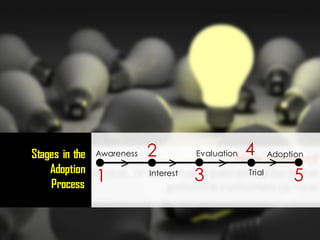
Awareness
Interest
Evaluation
Trial
Adoption
1
2
3
4
5
> > >>
Awareness is when the consumer becomes
aware of the new product but lacks information
Interest is when the consumer seeks information
about the new product
Stages in the
Adoption
Process
Evaluation is when the consumer considers whether trying
the new product makes sense
Trial is when the consumer tries the new product to improve
his or her estimate of value
Stages in the
Adoption
Process
Adoption is when the consumer decides
to make full and regular use of the
product
Stages in the
Adoption
Process
Individual Differences in Innovation
Early majority are deliberate and adopt
new ideas before the average person
Late majority
are skeptical
and adopt new
ideas only after
the majority of
people have
tried it
Laggards
are
suspicious of
changes
and adopt
new ideas
only when
they
become
tradition
Relative advantage is the degree to which an
innovation appears to be superior to existing
products
Compatibility is the degree to which an
innovation fits the values and experiences of
potentialconsumers
Influence of Product
Characteristics
on Rate of Adoption
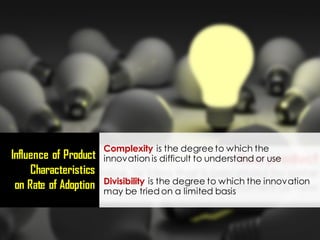
Complexity is the degree to which the
innovation is difficult to understand or use
Divisibility is the degree to which the innovation
may be tried on a limited basis
Influence of Product
Characteristics
on Rate of Adoption
Consumer Behavior Across
International Borders
Differences can include:
• Values
• Attitudes
• Behaviors
The question for marketers is whether to adapt or
standardize the marketing

Buyer desicion proces