TOP 10 Learning Questions for Chapter 6 Analyzing Consumer Markets Valderas, Cristina Krastle December 15, 2011
1. ____ is the study of how individuals select, buy, use and dispose of goods and services to satisfy their needs and wants. Consumer Behaviourism Consumer Attitude Consumer Market Market Research Market Demand
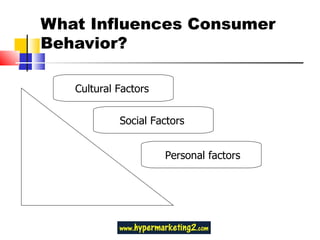
What Influences Consumer Behavior? Cultural Factors Social Factors Personal factors
Consumer Behaviourism -  the study of how individuals, groups, and organizations select, buy, use and dispose of goods, services, ideas, or experience to satisfy their needs and wants.
1. ____ is the study of how individuals select, buy, use and dispose of goods and services to satisfy their needs and wants. Consumer Behaviourism Consumer Attitude Consumer Market Market Research Market Demand
2. ____ the process by which we select, organize and interpret information inputs. Motivation Perception Learning Decision Process Selection
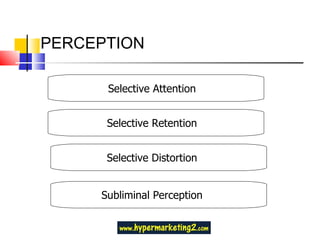
PERCEPTION Selective Attention Selective Retention Selective Distortion Subliminal Perception
Perception is the process by which we select, organize, and interpret information inputs to create  meaningful picture of the world. It not only depend on the physical stimuli, but also its relationship to the surrounding.
2. ____ the process by which we select, organize and interpret information inputs. Motivation Perception Learning Decision Process Selection
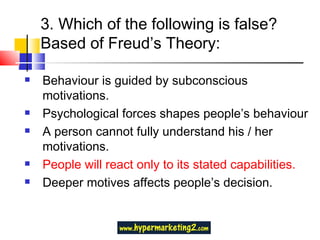
3. Which of the following is false? Based of Freud’s Theory: Behaviour is guided by subconscious motivations. Psychological forces shapes people’s behaviour A person cannot fully understand his / her motivations.  People will react only to its stated capabilities. Deeper motives affects people’s decision.
Motivation Freud’s Theory Behavior is guided by subconscious motivations. Maslow’s Hierarchy of Needs Behavior is driven by lowest, unmet need Herzberg’s Tow-Factor Theory Behavior is guided by motivating and hygiene factors
Based on Kotler and Keller: Freud’s Theory states that consumer decisions are being affected not just by the stated capabilities of the product but also by the psychological motives of the person.
3. Which of the following is false? Based of Freud’s Theory: Behaviour is guided by subconscious motivations. Psychological forces shapes people’s behaviour A person cannot fully understand his / her motivations.  People will react only to its stated capabilities. Deeper motives affects people’s decision.
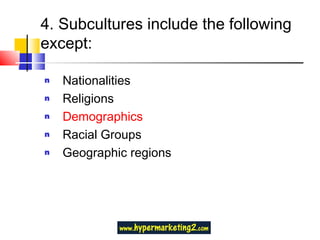
4. Subcultures include the following except: Nationalities Religions Demographics Racial Groups Geographic regions
SUBCULTURES Nationalities Religions Racial Groups Geographic Groups
Subcultures are factors that can affect or influence the buying behaviour of consumers. Demographic relates to the balance of a population in regards to density and capacity for expansion or decline.
4. Subcultures include the following except: Nationalities Religions Demographics Racial Groups Geographic regions
5. Which of the following statements are true? Paying attention to the information will give us stronger association in memory. Memory is just a constructive process. We integrate new information which depends on the structure and complexity. The presence of other product will not interfere with another. Memory can often be a reconstructive process.
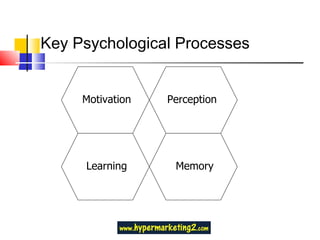
Key Psychological Processes Motivation Perception Learning Memory
Memory is a constructive process because we don’t remember information completely and accurately.  It will undergo in the process of memory encoding and memory retrieval. Often, it can be reconstructive due to intervening factors or events.
5. Which of the following statements are true? Paying attention to the information will give us stronger association in memory. Memory is just a constructive process. We integrate new information which depends on the structure and complexity. The presence of other product will not interfere with another. Memory can often be a reconstructive process.
6. Self – development and realization is an example of: Maslow’s Hierarchy of Needs Freud’s Theory Herzberg’s Theory Purchase Decision Selective Attention
Motivation Freud’s Theory Behavior is guided by subconscious motivations. Maslow’s Hierarchy of Needs Behavior is driven by lowest, unmet need Herzberg’s Tow-Factor Theory Behavior is guided by motivating and hygiene factors
Self actualization needs is the highest among Maslow’s Hierarchy of Needs. His theory explains people will satisfy their basic needs before moving to the next – important need.
6. Self – development and realization is an example of: Maslow’s Hierarchy of Needs Freud’s Theory Herzberg’s Theory Purchase Decision Selective Attention
7. Appliance warranty is an example of: Maslow’s Hierarchy of Needs Freud’s Theory Herzberg’s Theory Purchase Decision Selective Attention
Motivation Freud’s Theory Behavior is guided by subconscious motivations. Maslow’s Hierarchy of Needs Behavior is driven by lowest, unmet need Herzberg’s Tow-Factor Theory Behavior is guided by motivating and hygiene factors
Herzberg’s Two-Factor Theory involved dissatisfiers (factors that cause dissatisfaction) and satisfiers (causes satisfaction). Without the dissatisfiers, it will not be enough to motivate satisfiers.
7. Appliance warranty is an example of: Maslow’s Hierarchy of Needs Freud’s Theory Herzberg’s Theory Purchase Decision Selective Attention
8. Wanting to buy a new house is part of: Problem Recognition Information Search Evaluation Purchase Decision Post purchase Decision
Consumer Buying Process Problem Recognition Information Search Evaluation Purchase Decision Postpurchase Behavior
Problem recognition starts when the buyer recognizes a problem or a need triggered by internal or external stimuli.
8. Wanting to buy a new house is part of: Problem Recognition Information Search Evaluation Purchase Decision Post purchase Decision
9. Packaging is an example of: Evaluation Problem Recognition Post purchase Decision Information Search Purchase Decision
Consumer Buying Process Problem Recognition Information Search Evaluation Purchase Decision Postpurchase Behavior
Information Sources is divided into four groups: Personal – family, friends, neighbors, etc. Commercial – advertising, display, packaging Public – mass media, consumer – rating organizations Experiential – handling, examining and use of the product
9. Packaging is an example of: Evaluation Problem Recognition Post purchase Decision Information Search Purchase Decision
10. Location is part of: Evaluation Problem Recognition Post purchase Decision Information Search Purchase Decision
Consumer Buying Process Problem Recognition Information Search Evaluation Purchase Decision Postpurchase Behavior
Evaluation of Alternatives Consumers consider different factors before making a decision or a choice. First, if it will meet their needs, the benefit they will get from the product and its attributes.
10. Location is part of: Evaluation Problem Recognition Post purchase Decision Information Search Purchase Decision
TOP 10 Learning Questions for Chapter 6 Analyzing Consumer Markets Valderas, Cristina Krastle December 15, 2011

Chapter 6 Analyzing Consumer Market

  • 1.
    TOP 10 LearningQuestions for Chapter 6 Analyzing Consumer Markets Valderas, Cristina Krastle December 15, 2011
  • 2.
    1. ____ isthe study of how individuals select, buy, use and dispose of goods and services to satisfy their needs and wants. Consumer Behaviourism Consumer Attitude Consumer Market Market Research Market Demand
  • 3.
    What Influences ConsumerBehavior? Cultural Factors Social Factors Personal factors
  • 4.
    Consumer Behaviourism - the study of how individuals, groups, and organizations select, buy, use and dispose of goods, services, ideas, or experience to satisfy their needs and wants.
  • 5.
    1. ____ isthe study of how individuals select, buy, use and dispose of goods and services to satisfy their needs and wants. Consumer Behaviourism Consumer Attitude Consumer Market Market Research Market Demand
  • 6.
    2. ____ theprocess by which we select, organize and interpret information inputs. Motivation Perception Learning Decision Process Selection
  • 7.
    PERCEPTION Selective AttentionSelective Retention Selective Distortion Subliminal Perception
  • 8.
    Perception is theprocess by which we select, organize, and interpret information inputs to create meaningful picture of the world. It not only depend on the physical stimuli, but also its relationship to the surrounding.
  • 9.
    2. ____ theprocess by which we select, organize and interpret information inputs. Motivation Perception Learning Decision Process Selection
  • 10.
    3. Which ofthe following is false? Based of Freud’s Theory: Behaviour is guided by subconscious motivations. Psychological forces shapes people’s behaviour A person cannot fully understand his / her motivations. People will react only to its stated capabilities. Deeper motives affects people’s decision.
  • 11.
    Motivation Freud’s TheoryBehavior is guided by subconscious motivations. Maslow’s Hierarchy of Needs Behavior is driven by lowest, unmet need Herzberg’s Tow-Factor Theory Behavior is guided by motivating and hygiene factors
  • 12.
    Based on Kotlerand Keller: Freud’s Theory states that consumer decisions are being affected not just by the stated capabilities of the product but also by the psychological motives of the person.
  • 13.
    3. Which ofthe following is false? Based of Freud’s Theory: Behaviour is guided by subconscious motivations. Psychological forces shapes people’s behaviour A person cannot fully understand his / her motivations. People will react only to its stated capabilities. Deeper motives affects people’s decision.
  • 14.
    4. Subcultures includethe following except: Nationalities Religions Demographics Racial Groups Geographic regions
  • 15.
    SUBCULTURES Nationalities ReligionsRacial Groups Geographic Groups
  • 16.
    Subcultures are factorsthat can affect or influence the buying behaviour of consumers. Demographic relates to the balance of a population in regards to density and capacity for expansion or decline.
  • 17.
    4. Subcultures includethe following except: Nationalities Religions Demographics Racial Groups Geographic regions
  • 18.
    5. Which ofthe following statements are true? Paying attention to the information will give us stronger association in memory. Memory is just a constructive process. We integrate new information which depends on the structure and complexity. The presence of other product will not interfere with another. Memory can often be a reconstructive process.
  • 19.
    Key Psychological ProcessesMotivation Perception Learning Memory
  • 20.
    Memory is aconstructive process because we don’t remember information completely and accurately. It will undergo in the process of memory encoding and memory retrieval. Often, it can be reconstructive due to intervening factors or events.
  • 21.
    5. Which ofthe following statements are true? Paying attention to the information will give us stronger association in memory. Memory is just a constructive process. We integrate new information which depends on the structure and complexity. The presence of other product will not interfere with another. Memory can often be a reconstructive process.
  • 22.
    6. Self –development and realization is an example of: Maslow’s Hierarchy of Needs Freud’s Theory Herzberg’s Theory Purchase Decision Selective Attention
  • 23.
    Motivation Freud’s TheoryBehavior is guided by subconscious motivations. Maslow’s Hierarchy of Needs Behavior is driven by lowest, unmet need Herzberg’s Tow-Factor Theory Behavior is guided by motivating and hygiene factors
  • 24.
    Self actualization needsis the highest among Maslow’s Hierarchy of Needs. His theory explains people will satisfy their basic needs before moving to the next – important need.
  • 25.
    6. Self –development and realization is an example of: Maslow’s Hierarchy of Needs Freud’s Theory Herzberg’s Theory Purchase Decision Selective Attention
  • 26.
    7. Appliance warrantyis an example of: Maslow’s Hierarchy of Needs Freud’s Theory Herzberg’s Theory Purchase Decision Selective Attention
  • 27.
    Motivation Freud’s TheoryBehavior is guided by subconscious motivations. Maslow’s Hierarchy of Needs Behavior is driven by lowest, unmet need Herzberg’s Tow-Factor Theory Behavior is guided by motivating and hygiene factors
  • 28.
    Herzberg’s Two-Factor Theoryinvolved dissatisfiers (factors that cause dissatisfaction) and satisfiers (causes satisfaction). Without the dissatisfiers, it will not be enough to motivate satisfiers.
  • 29.
    7. Appliance warrantyis an example of: Maslow’s Hierarchy of Needs Freud’s Theory Herzberg’s Theory Purchase Decision Selective Attention
  • 30.
    8. Wanting tobuy a new house is part of: Problem Recognition Information Search Evaluation Purchase Decision Post purchase Decision
  • 31.
    Consumer Buying ProcessProblem Recognition Information Search Evaluation Purchase Decision Postpurchase Behavior
  • 32.
    Problem recognition startswhen the buyer recognizes a problem or a need triggered by internal or external stimuli.
  • 33.
    8. Wanting tobuy a new house is part of: Problem Recognition Information Search Evaluation Purchase Decision Post purchase Decision
  • 34.
    9. Packaging isan example of: Evaluation Problem Recognition Post purchase Decision Information Search Purchase Decision
  • 35.
    Consumer Buying ProcessProblem Recognition Information Search Evaluation Purchase Decision Postpurchase Behavior
  • 36.
    Information Sources isdivided into four groups: Personal – family, friends, neighbors, etc. Commercial – advertising, display, packaging Public – mass media, consumer – rating organizations Experiential – handling, examining and use of the product
  • 37.
    9. Packaging isan example of: Evaluation Problem Recognition Post purchase Decision Information Search Purchase Decision
  • 38.
    10. Location ispart of: Evaluation Problem Recognition Post purchase Decision Information Search Purchase Decision
  • 39.
    Consumer Buying ProcessProblem Recognition Information Search Evaluation Purchase Decision Postpurchase Behavior
  • 40.
    Evaluation of AlternativesConsumers consider different factors before making a decision or a choice. First, if it will meet their needs, the benefit they will get from the product and its attributes.
  • 41.
    10. Location ispart of: Evaluation Problem Recognition Post purchase Decision Information Search Purchase Decision
  • 42.
    TOP 10 LearningQuestions for Chapter 6 Analyzing Consumer Markets Valderas, Cristina Krastle December 15, 2011