CHAPTER 5
PRODUCT STRATEGIES
Product Life Cycle & Its Strategies
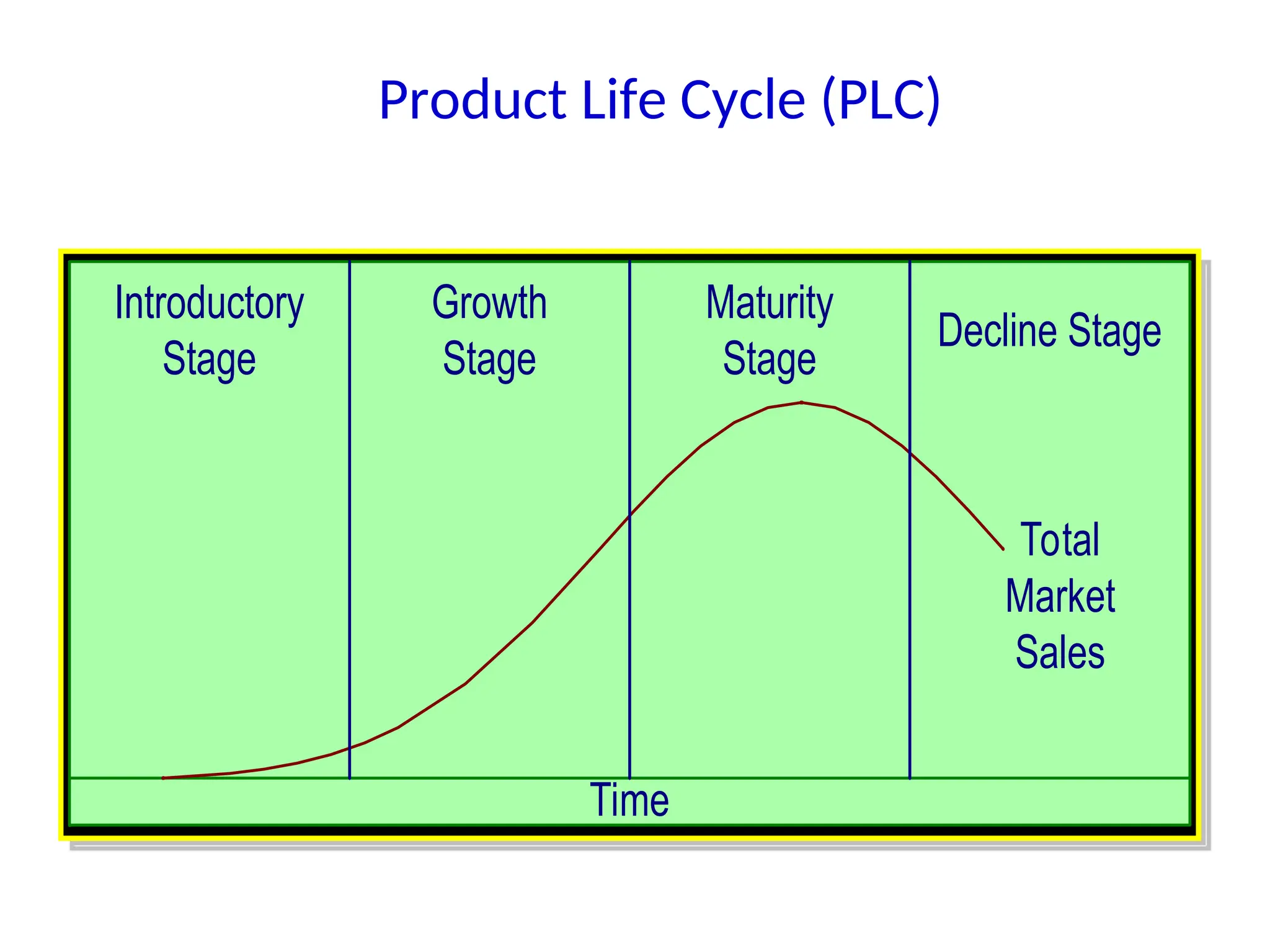
Introductory
Stage
Growth
Stage
Maturity
Stage
Decline Stage
Total
Market
Sales
Time
Product Life Cycle (PLC)
PLC Stages & Characteristics
Sales
Costs
Profits
Marketing Objectives
Product
Price
Low sales
High cost per customer
Negative
Offer a basic product
Use cost-plus
Distribution Build selective distribution
Advertising Build product awareness among early
adopters and dealers
Create product awareness
and trial
Marketing Strategies at Introduction Stage
Sales
Costs
Profits
Marketing Objectives
Product
Price
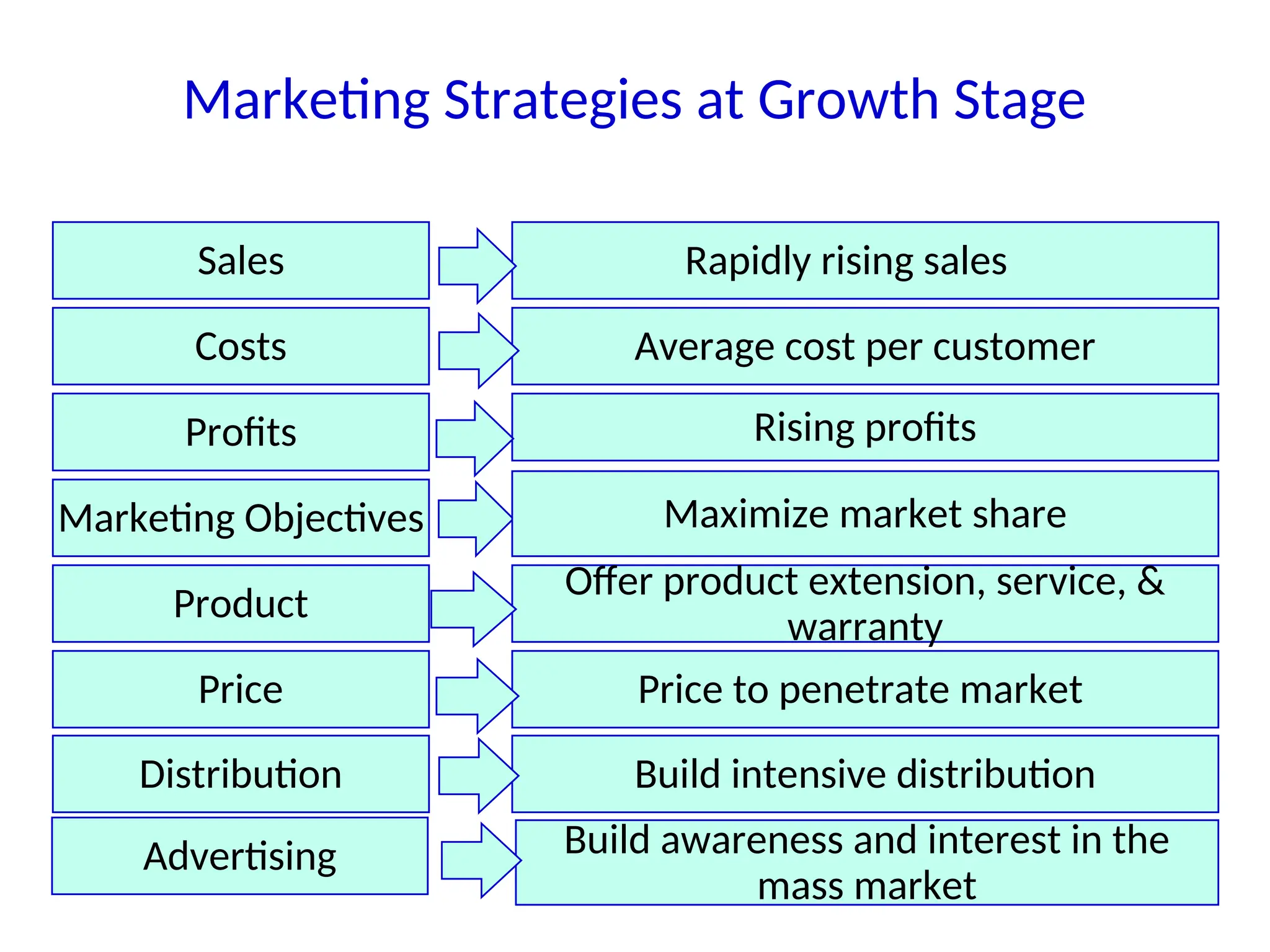
Rapidly rising sales
Average cost per customer
Rising profits
Offer product extension, service, &
warranty
Price to penetrate market
Build intensive distribution
Build awareness and interest in the
mass market
Maximize market share
Marketing Strategies at Growth Stage
Distribution
Advertising
Sales
Costs
Profits
Marketing Objectives
Product
Price
Peak sales
Low cost per customer
High profit
Diversify brands and introduce models
Price to match or beat competitors
Distribution Build more intensive distribution
Advertising Stress brand differences and benefits
Maximize profit while defending
market share
Marketing Strategies at Maturity Stage
Sales
Costs
Profits
Marketing Objectives
Product
Price
Falling sales
Low cost per customer
Declining profits
Phase out weak items
Cut price
Distribution
Go selective; Phase-out unprofitable
outlets
Advertising Reduce promotional expenditure
Reduce expenditure and milk the
brand
Marketing Strategies at Decline Stage
New-Product Development
Process
New-Product Development Process
There are eight steps in developing a new product:
1. Idea generation: Organizations get their ideas for new product
development from market research, Employees, Consultants,
Competitors, Customers, Distributors, and Suppliers.
2. Idea screening : This process involves shifting through the ideas
generated above and selecting ones which are feasible and
workable to develop.
3. Concept development and testing: The organization may have
come across what they believe to be a feasible idea, however, the
idea needs to be taken to the target audience. What do they think
about the idea? Will it be practical and feasible? Will it offer the
benefit that the organization hopes it will? or have they overlooked
certain issues? Note that, the idea taken to the target audience is
not a working prototype at this stage, it is just a concept.
4. Marketing strategy development: How will the product idea be
launched within the market? A proposed marketing strategy will be
written laying out the marketing mix strategy of the product, the
segmentation, targeting and positioning strategy, sales and profits
that are expected.
5. Business analysis: The company has a great idea, the marketing
strategy seems feasible, but will the product be financially worth
while in the long run? The business analysis stage looks more
deeply into the cash flow the product could generate, what the cost
will be, how much market shares the product may achieve and the
expected life of the product.
6. Product development: At this stage the prototype is produced. The
prototype will clearly run through all the desired tests, and
presented to a selection of people made up of the target market
segment to see if changes need to be made.
7. Market testing: Test marketing means testing the product within a
specific area. The product will be launched within a particular
region so that the marketing mix strategy can be monitored and if
needed modified before national launch.
8. Commercialization: If the test marketing stage has been successful
the product will go for national launch. There are certain factors
that need to be taken into account before a product is launched
nationally. These include: timing of the launch, how the product
will be launched, where the product will be launched, will there be
a national roll out or will it be region by region?
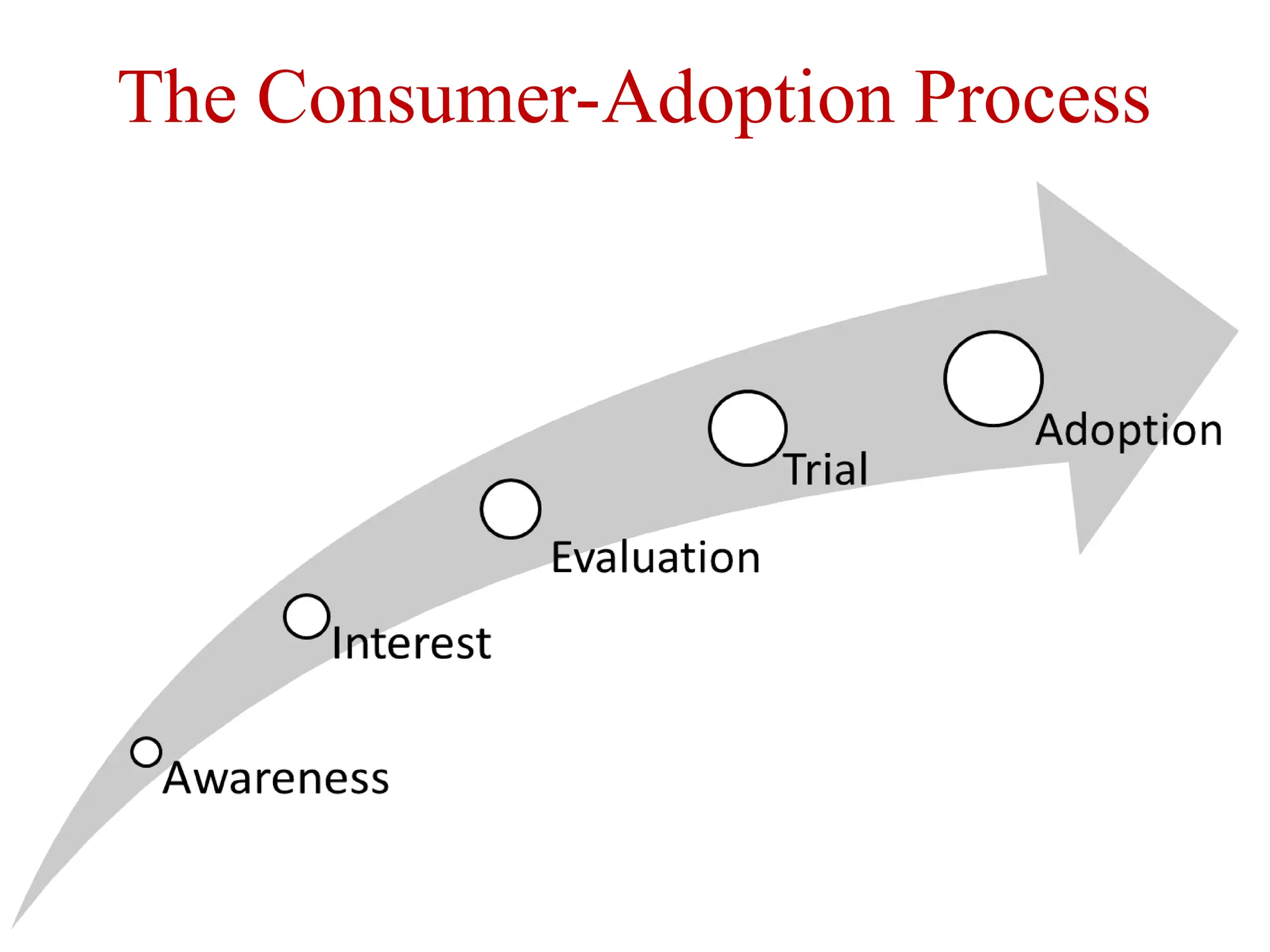
The Consumer-Adoption Process
Adoption is an individual’s decision to become a regular user of a
product and is followed by the consumer-loyalty process. New-
product marketers typically aim at early adopters and use the
theory of innovation diffusion and consumer adoption to identify
them.
The consumer-adoption process is the mental steps through which an
individual passes from first hearing about an innovation to final
adoption.
Adoption of new products moves through five stages:
1. Awareness: The consumer becomes aware of the innovation but lacks
information about it.
2. Interest: The consumer is stimulated to seek information about the
innovation.
3. Evaluation: The consumer considers whether to try the innovation.
4. Trial: The consumer tries the innovation to improve his or her estimate of its
value.
5. Adoption: The consumer decides to make full and regular use of the
innovation.
The Diffusion of Innovation
Diffusion:
The process by which an innovation (new idea) is
communicated through certain channels over time
among the members of a social system
The Diffusion Process
Influencer
C
o
n
s
u
m
e
r
Organization
Reject
Accept
Demise of
Innovation
Diffusion of
Innovation
Consumer decision process
Diffusion of Information and
Communication
(X number of people)
Factors Affecting Diffusion
Communication (how consumers learn about new
products and communicate findings)
Time (how long it takes for a person to move from
product awareness to product purchase or rejection)
Social system (groups or segments to which individuals
belong affect adoption or rejection)
Rogers Model of Innovation Decision Process
Implemen-
tation
Decision
Knowledge Confirmation
Persuasion
Communication Channels
Knowledge: Consumers develop knowledge when they receive physical
or social stimuli that give exposure and attention to the new product
and how it works. How a person receives and interprets the knowledge
is affected by their personal characteristics.
Persuasion: It refers to the formation of favorable or unfavorable
attitudes toward the innovation. Persuasiveness is related to the
perceived risks and consequences of adopting and using the new
product.
Decision: Decision involves a choice between adopting or rejecting the
innovation.
Implementation: Implementation occurs when the consumer puts an
innovation to use.
Confirmation: During the stage of confirmation, consumers seek
reinforcement for their innovation decision.
Rogers Model of Innovation Decision Process
A B C D E
A= Innovators (2.5%)
B= Early Adopters (13.5%)
C= Early Majority (34%)
D= Late Majority (34%)
E= Laggards (16%)
Adopter Classes
Innovators: the first consumer group to adopt products.
Early adopters: opinion leaders and role models for others, with good
social skills and respect within larger social systems.
Early majority: consumers who deliberate extensively before buying
new products, yet adopt them just before the average time it takes the
target population as a whole.
Late majority: tends to be cautious when evaluating innovations, taking
more time than average to adopt them, and often at the pressure of
peers.
Laggards: the last groups that tend to be anchored in the past, are
suspicious of the new, and exhibit the lowest level of innovativeness
among adopters
Adopter Classes
Levels of A Product
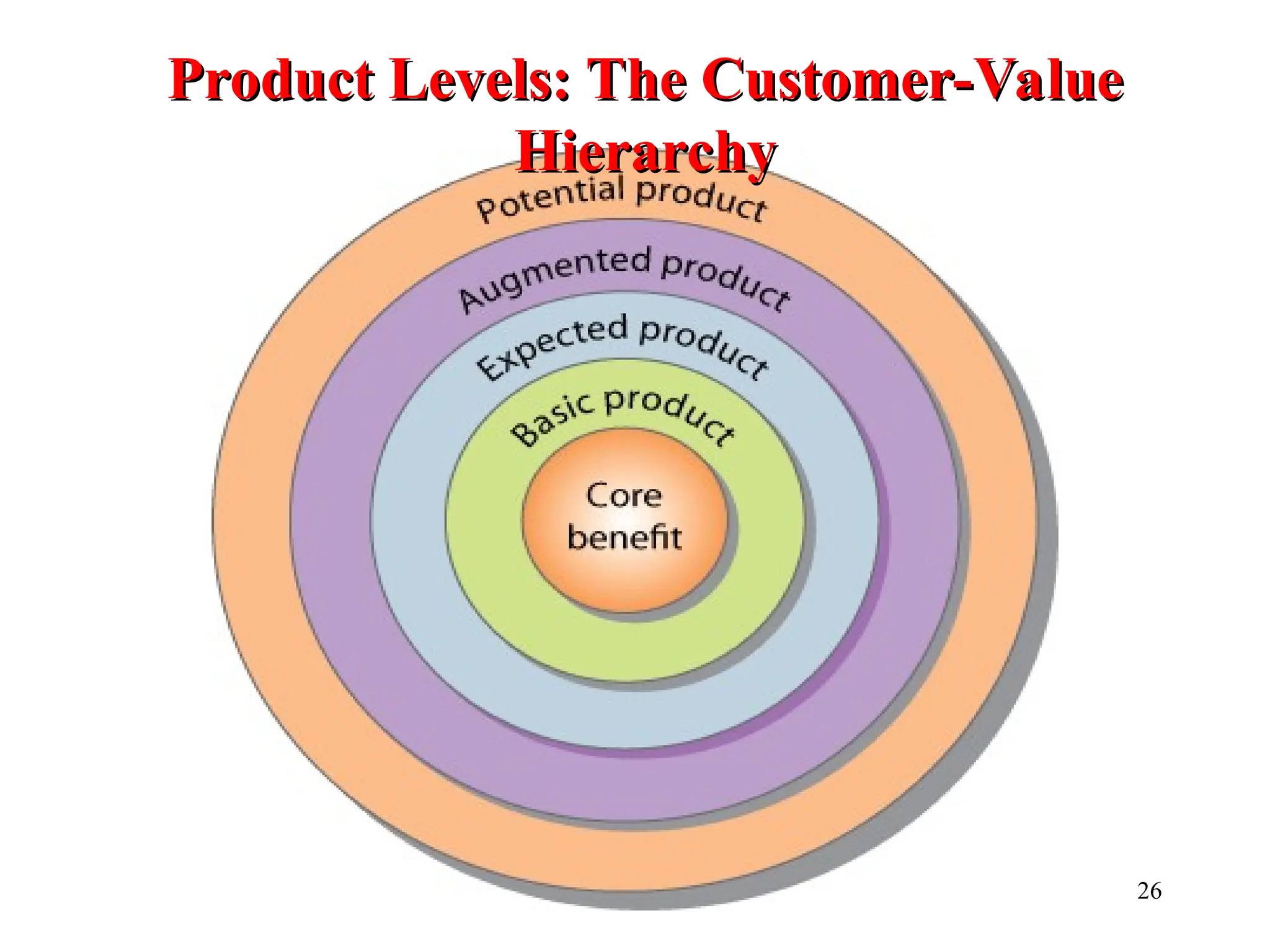
Product Levels: The Customer-Value
Hierarchy
Hierarchy
26
…
…Product Levels: The Customer-Value
Product Levels: The Customer-Value
Hierarchy
Hierarchy
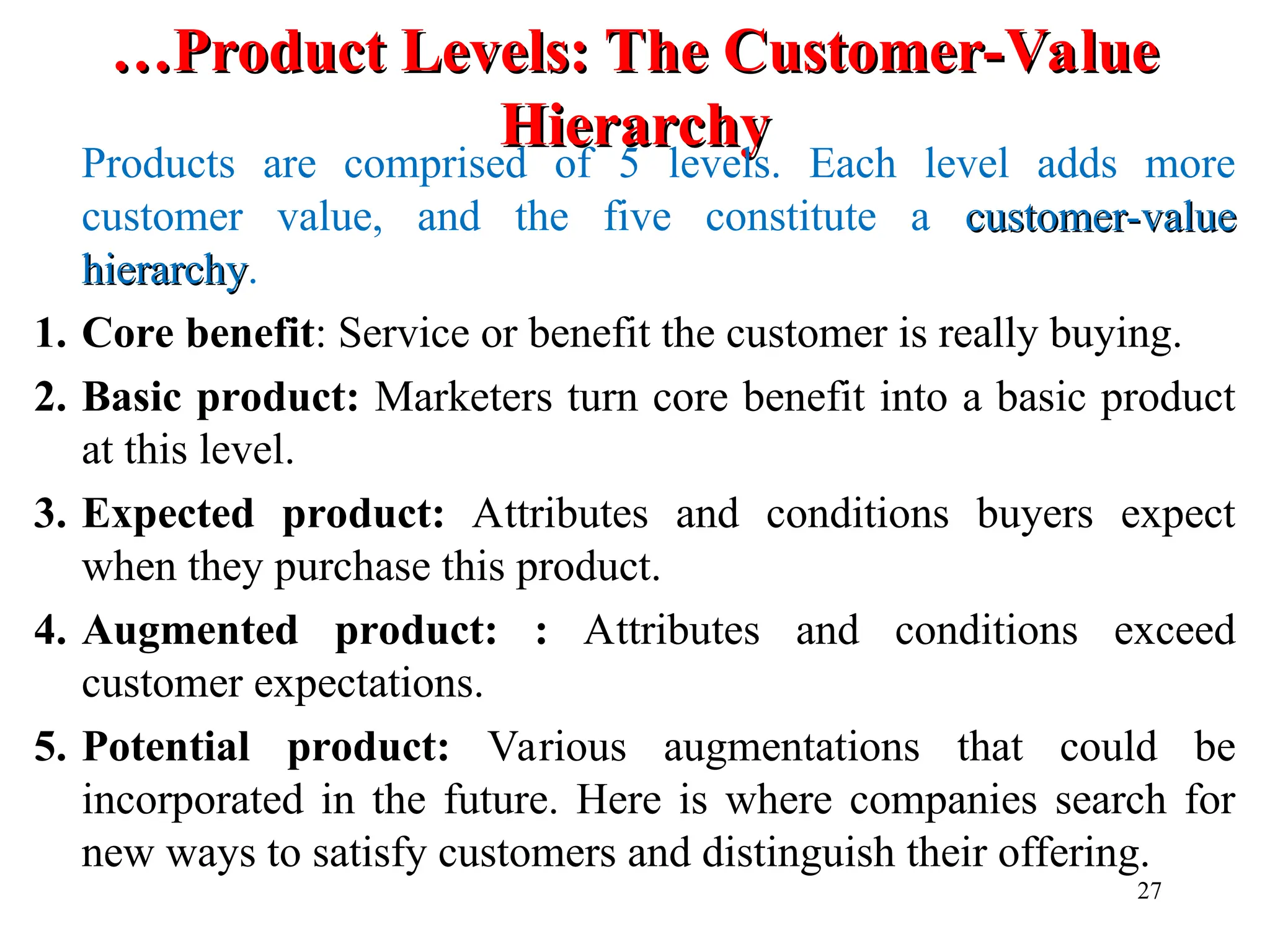
Products are comprised of 5 levels. Each level adds more
customer value, and the five constitute a customer-value
customer-value
hierarchy
hierarchy.
1. Core benefit: Service or benefit the customer is really buying.
2. Basic product: Marketers turn core benefit into a basic product
at this level.
3. Expected product: Attributes and conditions buyers expect
when they purchase this product.
4. Augmented product: : Attributes and conditions exceed
customer expectations.
5. Potential product: Various augmentations that could be
incorporated in the future. Here is where companies search for
new ways to satisfy customers and distinguish their offering.
27
…
…Product Levels: The Customer-Value
Product Levels: The Customer-Value
Hierarchy
Hierarchy
Customer-
value
Hierarchy
Potential Product
(Future augmentations)
Core Benefit
(Rest and sleep)
Basic Product
(Bed, bathroom, towels)
Expected Product
(Clean bed, fresh towels)
Augmented Product
(Free Internet; free
breakfast)
A Hotel
28
Product Mix & Product Line Decisions
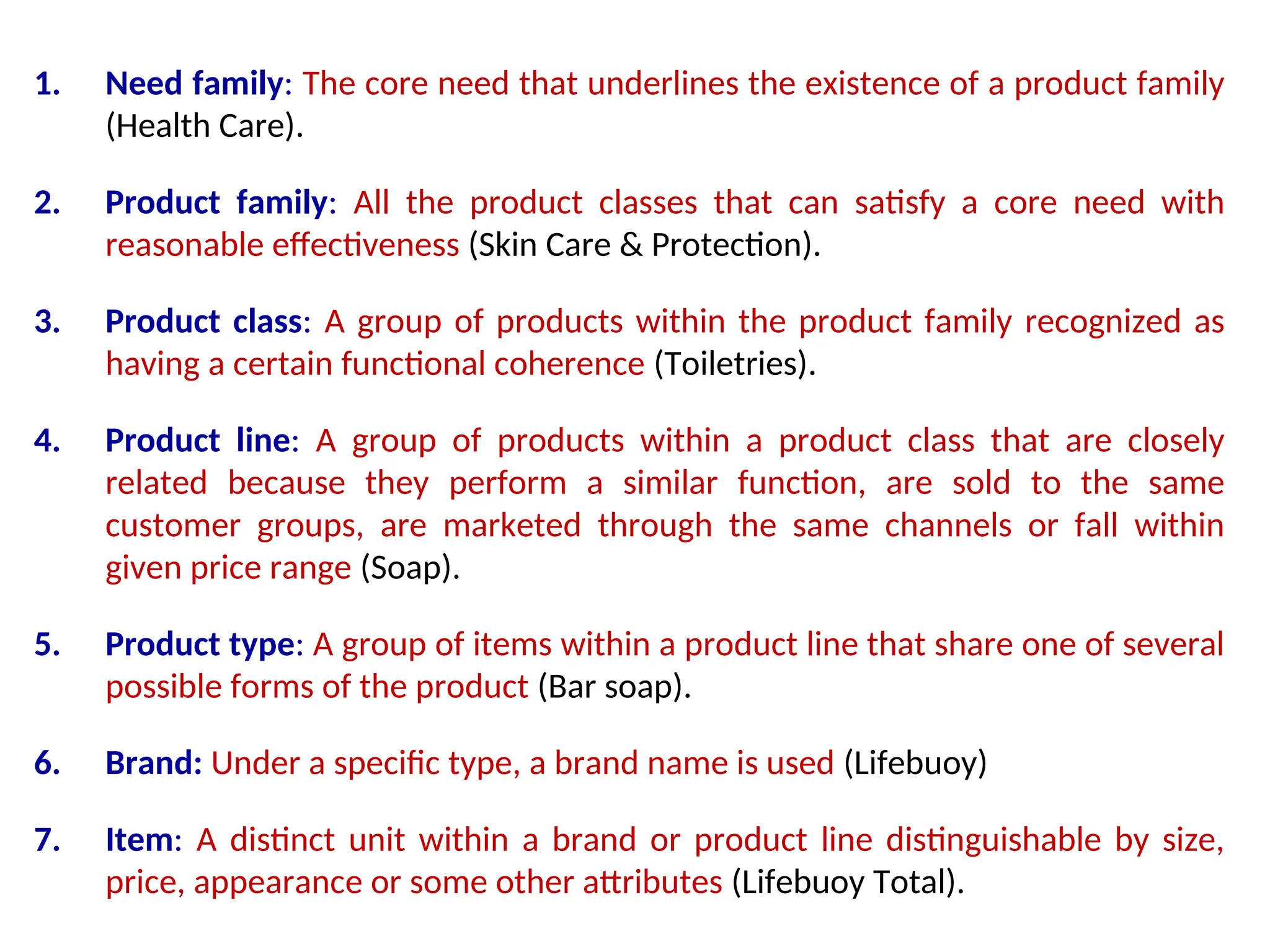
The Product Hierarchy
Need family Health Care
Product family Skin care
Product class Toiletries & Cosmetics
Product line Soap
Product type Bar soap
Brand Lifebuoy
Item Lifebuoy Total
1. Need family: The core need that underlines the existence of a product family
(Health Care).
2. Product family: All the product classes that can satisfy a core need with
reasonable effectiveness (Skin Care & Protection).
3. Product class: A group of products within the product family recognized as
having a certain functional coherence (Toiletries).
4. Product line: A group of products within a product class that are closely
related because they perform a similar function, are sold to the same
customer groups, are marketed through the same channels or fall within
given price range (Soap).
5. Product type: A group of items within a product line that share one of several
possible forms of the product (Bar soap).
6. Brand: Under a specific type, a brand name is used (Lifebuoy)
7. Item: A distinct unit within a brand or product line distinguishable by size,
price, appearance or some other attributes (Lifebuoy Total).
Product Mix
Consistency
A product mix is the set of all products and items a particular
seller offers for sale. A company’s product mix has a certain
width, length, depth, and consistency.
• Product-line length Number of items in the product line
• Product-mix width Number of lines the company
carries
• Product-mix depth No. of combinations & variants of
each item in the line
• Product-mix consistency It indicates consistency of the
product lines in respect of
customers, supply chain, price,
Proctor & Gamble Product Mix
Detergents Toothpaste Bar Soap
Disposabl
e Diapers
Paper
Products
Ivory Snow Gleem Ivory Pampers Charmin
Dreft Crest Camay Luvs Puffs
Tide Zest Bounty
Cheer Safeguard
Dash Oil of Olay
Bold
Gain
Era
Product Mix Width
Produ
ct
Line
Lengt
h
Product Line Decisions
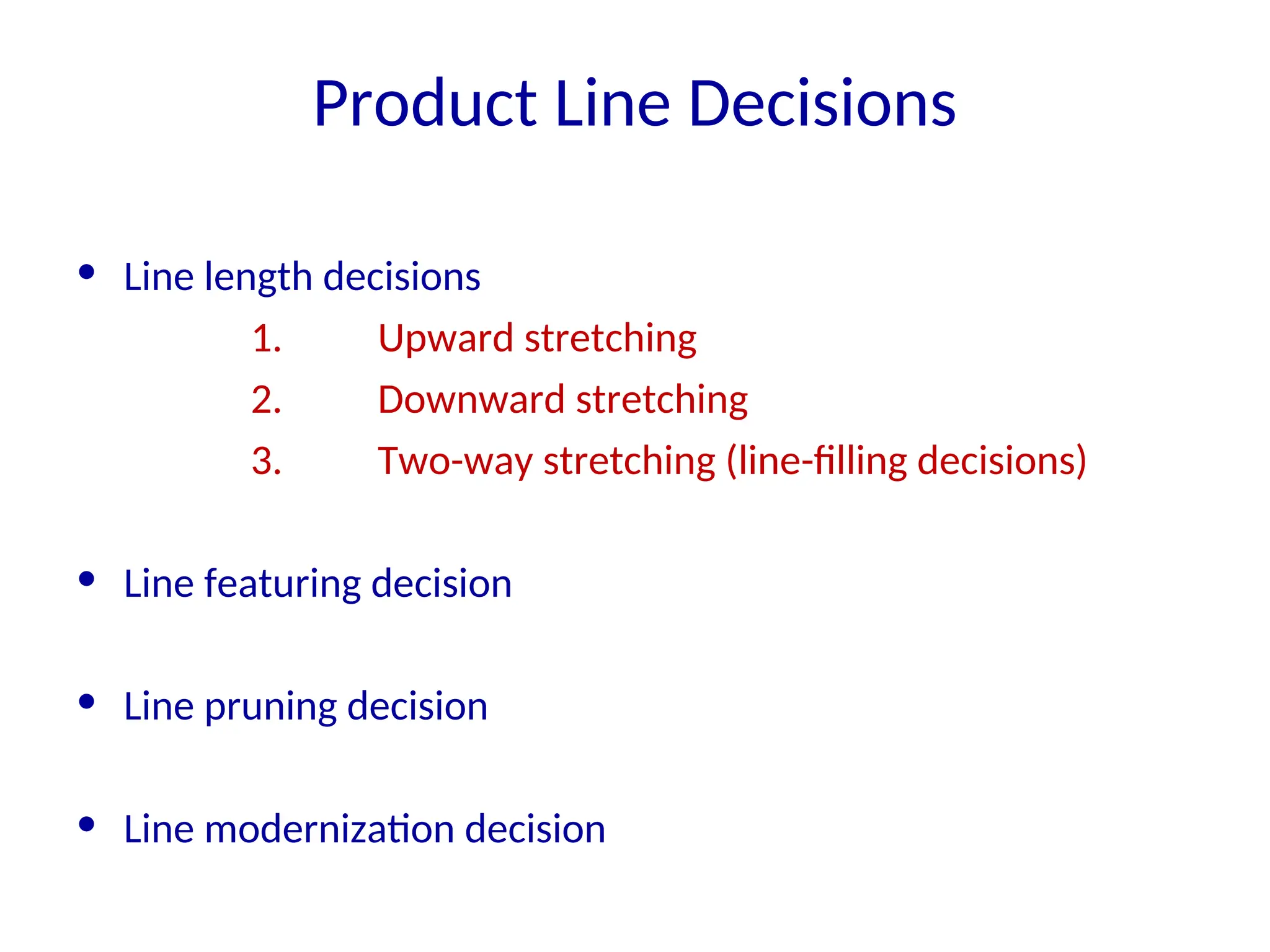
• Line length decisions
1. Upward stretching
2. Downward stretching
3. Two-way stretching (line-filling decisions)
• Line featuring decision
• Line pruning decision
• Line modernization decision
• Line stretching – company lengthens its product line beyond its
current range.
• Line filling – company lengthens its product line by adding more
items within the present range.
• Line modernization, featuring, and pruning – Companies
continuous modernize product lines to encourage customer
migration to higher-valued, higher-priced items; boost demand
for certain product lines by featuring them; and optimize their
brand portfolios by focusing on core brand growth and
concentrating resources on the biggest and most established
brands.
THANK YOU

Marketing management: Product strategies

  • 1.
  • 2.
    Product Life Cycle& Its Strategies
  • 3.
  • 4.
    PLC Stages &Characteristics
  • 5.
    Sales Costs Profits Marketing Objectives Product Price Low sales Highcost per customer Negative Offer a basic product Use cost-plus Distribution Build selective distribution Advertising Build product awareness among early adopters and dealers Create product awareness and trial Marketing Strategies at Introduction Stage
  • 6.
    Sales Costs Profits Marketing Objectives Product Price Rapidly risingsales Average cost per customer Rising profits Offer product extension, service, & warranty Price to penetrate market Build intensive distribution Build awareness and interest in the mass market Maximize market share Marketing Strategies at Growth Stage Distribution Advertising
  • 7.
    Sales Costs Profits Marketing Objectives Product Price Peak sales Lowcost per customer High profit Diversify brands and introduce models Price to match or beat competitors Distribution Build more intensive distribution Advertising Stress brand differences and benefits Maximize profit while defending market share Marketing Strategies at Maturity Stage
  • 8.
    Sales Costs Profits Marketing Objectives Product Price Falling sales Lowcost per customer Declining profits Phase out weak items Cut price Distribution Go selective; Phase-out unprofitable outlets Advertising Reduce promotional expenditure Reduce expenditure and milk the brand Marketing Strategies at Decline Stage
  • 9.
  • 10.
  • 11.
    There are eightsteps in developing a new product: 1. Idea generation: Organizations get their ideas for new product development from market research, Employees, Consultants, Competitors, Customers, Distributors, and Suppliers. 2. Idea screening : This process involves shifting through the ideas generated above and selecting ones which are feasible and workable to develop. 3. Concept development and testing: The organization may have come across what they believe to be a feasible idea, however, the idea needs to be taken to the target audience. What do they think about the idea? Will it be practical and feasible? Will it offer the benefit that the organization hopes it will? or have they overlooked certain issues? Note that, the idea taken to the target audience is not a working prototype at this stage, it is just a concept.
  • 12.
    4. Marketing strategydevelopment: How will the product idea be launched within the market? A proposed marketing strategy will be written laying out the marketing mix strategy of the product, the segmentation, targeting and positioning strategy, sales and profits that are expected. 5. Business analysis: The company has a great idea, the marketing strategy seems feasible, but will the product be financially worth while in the long run? The business analysis stage looks more deeply into the cash flow the product could generate, what the cost will be, how much market shares the product may achieve and the expected life of the product. 6. Product development: At this stage the prototype is produced. The prototype will clearly run through all the desired tests, and presented to a selection of people made up of the target market segment to see if changes need to be made.
  • 13.
    7. Market testing:Test marketing means testing the product within a specific area. The product will be launched within a particular region so that the marketing mix strategy can be monitored and if needed modified before national launch. 8. Commercialization: If the test marketing stage has been successful the product will go for national launch. There are certain factors that need to be taken into account before a product is launched nationally. These include: timing of the launch, how the product will be launched, where the product will be launched, will there be a national roll out or will it be region by region?
  • 14.
  • 15.
  • 16.
    Adoption is anindividual’s decision to become a regular user of a product and is followed by the consumer-loyalty process. New- product marketers typically aim at early adopters and use the theory of innovation diffusion and consumer adoption to identify them. The consumer-adoption process is the mental steps through which an individual passes from first hearing about an innovation to final adoption. Adoption of new products moves through five stages: 1. Awareness: The consumer becomes aware of the innovation but lacks information about it. 2. Interest: The consumer is stimulated to seek information about the innovation. 3. Evaluation: The consumer considers whether to try the innovation. 4. Trial: The consumer tries the innovation to improve his or her estimate of its value. 5. Adoption: The consumer decides to make full and regular use of the innovation.
  • 17.
    The Diffusion ofInnovation
  • 18.
    The Diffusion ofInnovation Diffusion: The process by which an innovation (new idea) is communicated through certain channels over time among the members of a social system
  • 19.
    The Diffusion Process Influencer C o n s u m e r Organization Reject Accept Demiseof Innovation Diffusion of Innovation Consumer decision process Diffusion of Information and Communication (X number of people)
  • 20.
    Factors Affecting Diffusion Communication(how consumers learn about new products and communicate findings) Time (how long it takes for a person to move from product awareness to product purchase or rejection) Social system (groups or segments to which individuals belong affect adoption or rejection)
  • 21.
    Rogers Model ofInnovation Decision Process Implemen- tation Decision Knowledge Confirmation Persuasion Communication Channels
  • 22.
    Knowledge: Consumers developknowledge when they receive physical or social stimuli that give exposure and attention to the new product and how it works. How a person receives and interprets the knowledge is affected by their personal characteristics. Persuasion: It refers to the formation of favorable or unfavorable attitudes toward the innovation. Persuasiveness is related to the perceived risks and consequences of adopting and using the new product. Decision: Decision involves a choice between adopting or rejecting the innovation. Implementation: Implementation occurs when the consumer puts an innovation to use. Confirmation: During the stage of confirmation, consumers seek reinforcement for their innovation decision. Rogers Model of Innovation Decision Process
  • 23.
    A B CD E A= Innovators (2.5%) B= Early Adopters (13.5%) C= Early Majority (34%) D= Late Majority (34%) E= Laggards (16%) Adopter Classes
  • 24.
    Innovators: the firstconsumer group to adopt products. Early adopters: opinion leaders and role models for others, with good social skills and respect within larger social systems. Early majority: consumers who deliberate extensively before buying new products, yet adopt them just before the average time it takes the target population as a whole. Late majority: tends to be cautious when evaluating innovations, taking more time than average to adopt them, and often at the pressure of peers. Laggards: the last groups that tend to be anchored in the past, are suspicious of the new, and exhibit the lowest level of innovativeness among adopters Adopter Classes
  • 25.
    Levels of AProduct
  • 26.
    Product Levels: TheCustomer-Value Product Levels: The Customer-Value Hierarchy Hierarchy 26
  • 27.
    … …Product Levels: TheCustomer-Value Product Levels: The Customer-Value Hierarchy Hierarchy Products are comprised of 5 levels. Each level adds more customer value, and the five constitute a customer-value customer-value hierarchy hierarchy. 1. Core benefit: Service or benefit the customer is really buying. 2. Basic product: Marketers turn core benefit into a basic product at this level. 3. Expected product: Attributes and conditions buyers expect when they purchase this product. 4. Augmented product: : Attributes and conditions exceed customer expectations. 5. Potential product: Various augmentations that could be incorporated in the future. Here is where companies search for new ways to satisfy customers and distinguish their offering. 27
  • 28.
    … …Product Levels: TheCustomer-Value Product Levels: The Customer-Value Hierarchy Hierarchy Customer- value Hierarchy Potential Product (Future augmentations) Core Benefit (Rest and sleep) Basic Product (Bed, bathroom, towels) Expected Product (Clean bed, fresh towels) Augmented Product (Free Internet; free breakfast) A Hotel 28
  • 29.
    Product Mix &Product Line Decisions
  • 30.
    The Product Hierarchy Needfamily Health Care Product family Skin care Product class Toiletries & Cosmetics Product line Soap Product type Bar soap Brand Lifebuoy Item Lifebuoy Total
  • 31.
    1. Need family:The core need that underlines the existence of a product family (Health Care). 2. Product family: All the product classes that can satisfy a core need with reasonable effectiveness (Skin Care & Protection). 3. Product class: A group of products within the product family recognized as having a certain functional coherence (Toiletries). 4. Product line: A group of products within a product class that are closely related because they perform a similar function, are sold to the same customer groups, are marketed through the same channels or fall within given price range (Soap). 5. Product type: A group of items within a product line that share one of several possible forms of the product (Bar soap). 6. Brand: Under a specific type, a brand name is used (Lifebuoy) 7. Item: A distinct unit within a brand or product line distinguishable by size, price, appearance or some other attributes (Lifebuoy Total).
  • 32.
  • 33.
    A product mixis the set of all products and items a particular seller offers for sale. A company’s product mix has a certain width, length, depth, and consistency. • Product-line length Number of items in the product line • Product-mix width Number of lines the company carries • Product-mix depth No. of combinations & variants of each item in the line • Product-mix consistency It indicates consistency of the product lines in respect of customers, supply chain, price,
  • 34.
    Proctor & GambleProduct Mix Detergents Toothpaste Bar Soap Disposabl e Diapers Paper Products Ivory Snow Gleem Ivory Pampers Charmin Dreft Crest Camay Luvs Puffs Tide Zest Bounty Cheer Safeguard Dash Oil of Olay Bold Gain Era Product Mix Width Produ ct Line Lengt h
  • 35.
    Product Line Decisions •Line length decisions 1. Upward stretching 2. Downward stretching 3. Two-way stretching (line-filling decisions) • Line featuring decision • Line pruning decision • Line modernization decision
  • 36.
    • Line stretching– company lengthens its product line beyond its current range. • Line filling – company lengthens its product line by adding more items within the present range. • Line modernization, featuring, and pruning – Companies continuous modernize product lines to encourage customer migration to higher-valued, higher-priced items; boost demand for certain product lines by featuring them; and optimize their brand portfolios by focusing on core brand growth and concentrating resources on the biggest and most established brands.
  • 37.