This paper compares three optimization approaches—Artificial Bee Colony (ABC) algorithm, Shuffled Frog Leaping (SFL) algorithm, and Neuro-Fuzzy Network (FNN)—for designing PID controllers for a Gryphon robot. The goal is to minimize performance metrics such as settling time, rise time, and steady-state error. Simulation results indicate that while FNN excels in reducing settling and rise times, SFL performs better on steady-state error, and ABC is effective in decreasing overshoot.

![Computer Science & Information Technology (CS & IT)
328
1. INTRODUCTION
PID controller (proportional-integral-derivative controller) benefiting from major advantages
such as simple structure and wide-domain performance, is one of the most frequently used
controllers. There are three parameters, on the basis of which, the PID controller is defined, i.e.
proportional gain Kp, integral gain Ki, and derivative gain Kd. The traditional procedure to assign
these parameters is a sophisticated and time-consuming try and error process. Thus several new
methods are recommended to reduce the complexity of tuning PIDs. These methods, having the
biological or social inspiration as a common theme, are accomplished within evolutionary
algorithms such as Binary and Continuous Genetic algorithms [1], Ant Colony Optimization [2],
Continuous and Discrete Particle Swarm Optimization [3],[4] and different types of Honey Bee
Colony Algorithms [5],[6].
In this approach, working on Gryphon robot which includes 5 joints, we must design five PID
controllers; each for one joint. Thus we must first verify the dynamic equations for Gryphon
robot. Then we will formulate the PID controller designation problem as an optimization problem
with an objective function which is supposed to be minimized by adjusting the four performance
indexes, i.e. the maximum overshoot, the rise time, the settling time and the integral absolute
error of step response. And finally we will minimize the defined objective function for each joint
by applying Shuffled Frog Leaping (SFL) algorithm, Artificial Bee Colony (ABC) algorithm and
Nero-Fuzzy System (FNN).
The paper is organized in 6 sections to illustrate the case. Section 2 includes a brief description of
the system under-investigate and presents the verification of the dynamic equations of the robot.
Section 3 reviews the utilized intelligent algorithms and FNN and in section 4 the problem
formulation is explained. Section 5 presents the simulation results and analyses them and section
6 concludes the paper.
2. A BRIEF DESCRIPTION OF THE SYSTEM
As shown in Figure 1, Gryphon is a robot with 5 revolute joints. Thus this robot benefits from 5
degrees of freedom. The first three joints which are called shoulder elbow and wrist respectively,
are supposed to determine the position of the end-effecter while the last two joints are responsible
for the orientation of the end-effecter. Fast and smooth movement while maintaining the high
precision is one of the major characteristics of this robot. This robot is controlled by four microprocessors, one of which is to determine the position of the axis, and two are motor controllers
and the last one is supposed to support the others and communicate with the host computer. Each
joint is moved by a stepper motor while there is feedback on the corresponding encoder to realize
the closed-loop control. In this robot the utilized gear ratio is high enough to assume all joints
independent from one another.
We obtained the dynamic equations of all five joints. Table 1 shows transfer functions of all five
joints that are obtained from the so-called dynamic equations, adding the process of obtaining
which sounds to need a vast space for complicated equations and that is why we have avoided
them here. In the transfer functions in Table 1, α stands for the amount of disturbance exerted on
the system. For an undisturbed system α is set to zero.](https://image.slidesharecdn.com/comparisonbetweenartificialbee-131113204206-phpapp02/85/COMPARISON-BETWEEN-ARTIFICIAL-BEE-COLONY-ALGORITHM-SHUFFLED-FROG-LEAPING-ALGORITHM-AND-NERO-FUZZY-SYSTEM-IN-DESIGN-OF-OPTIMAL-PID-CONTROLLERS-2-320.jpg)
![329
Computer Science & Information Technology (CS & IT)
Figure 1. Joint model for Gryphon
3. THE UTILIZED INTELLIGENT ALGORITHMS
3.1 The Shuffled Frog Leaping Algorithm (SFL)
In the SFL, the population consists of a set of frogs (solutions) that is partitioned into subsets
referred to as memeplexes. The different memeplexes are considered as different cultures of
frogs, each performing a local search. Within each memeplex, the individual frogs hold ideas, that
can be influenced by the ideas of other frogs, and evolve through a process of memetic evolution.
After a defined number of memetic evolution steps, ideas are passed among memeplexes in a
shuffling process [7]. The local search and the shuffling processes continue until defined
convergence criteria are satisfied [8].
Table 1. Transfer Functions of Gryphon Joints
An initial population of P frogs is created randomly. For S-dimensional problems (S variables), a
frog i is represented as Xi = (Xi1,Xi2,.......,Xis). Afterwards, the frogs are sorted in a scending
order according to their fitness. Then, the entire population is divided into m memeplexes, each
containing n frogs (i.e. P = m x n). In this process, the first frog goes to the first memeplex, the
second frog goes to the second memeplex, frog (m) goes to the mthmemeplex, and frog (m+1)
goes back to the first memeplex, etc.
Within each memeplex, the frogs with the best and the worst fitnesses are identified as Xb and
Xw, respectively. Also, the frog with the global best fitness is identified as Xg. Then, a process is
applied to improve only the frog with the worst fitness (not all frogs) in each cycle. Accordingly,
the position of the frog with the worst fitness is adjusted as follows:](https://image.slidesharecdn.com/comparisonbetweenartificialbee-131113204206-phpapp02/85/COMPARISON-BETWEEN-ARTIFICIAL-BEE-COLONY-ALGORITHM-SHUFFLED-FROG-LEAPING-ALGORITHM-AND-NERO-FUZZY-SYSTEM-IN-DESIGN-OF-OPTIMAL-PID-CONTROLLERS-3-320.jpg)
![Computer Science & Information Technology (CS & IT)
330
Where rand is a random number between 0 and 1; and Dmax is the maximum allowed change in a
frog’s position.
If this process produces a better solution, it replaces the worst frog. Otherwise, the calculations in
Eqs (1) and (2) are repeated but with respect to the global best frog (i.e.Xg replaces Xb). If no
improvement becomes possible in this case, then a new solution is randomly generated to replace
that frog. The calculations then continue for a specific number of iterations [8]. Accordingly, the
main parameters of SFL are: number of frogs P; number of memeplexes; number of generation
for each memeplex before shuffling; number of shuffling iterations; and maximum step size.
3.2 The Artificial Bee Colony Algorithm (ABC)
Karaboga analyzes the foraging behavior of honey bee swarm and proposes a new algorithm
simulating this behavior for solving multi-dimensional and multi-modal optimization problems,
called Artificial Bee Colony (ABC) [5]. The main steps of the algorithm are:
1) send the employed bees onto the food sources and determine their nectar amounts;
2) calculate the probability value of the sources with which they are preferred by the
onlooker bees;
3) stop the exploitation process of the sources abandoned by the bees;
4) send the scouts into the search area for discovering new food sources, randomly;
5) memorize the best food source found so far.
In the algorithm, an artificial bee colony consists of three groups of bees: employed bees,
onlookers and scouts. Employed bees are associated with a particular food source which they are
currently exploiting. They carry the information about this particular source and share this
information with a certain probability by waggle dance. Unemployed bees seek a food source to
exploit. There are two types of unemployed bees: scouts and onlookers. Scouts search the
environment for new food sources without any guidance. Occasionally, the scouts can
accidentally discover rich, entirely unknown food sources. On the other hand onlookers observe
the waggle dance and so are placed on the food sources by using a probability based selection
process. As the nectar amount of a food source increases, the probability value with which the
food source is preferred by onlookers increases, too. In the ABC algorithm the first half of the
colony consists of the employed bees and the second half includes the onlookers. For every food
source, there is only one employed bee. Another issue that is considered in the algorithm is that
the employed bee whose food source has been exhausted by the bees becomes a scout. In other
words, if a solution representing a food source is not improved by a predetermined number of
trials, then the food source is abandoned by its employed bee and the employed bee is converted
to a scout.](https://image.slidesharecdn.com/comparisonbetweenartificialbee-131113204206-phpapp02/85/COMPARISON-BETWEEN-ARTIFICIAL-BEE-COLONY-ALGORITHM-SHUFFLED-FROG-LEAPING-ALGORITHM-AND-NERO-FUZZY-SYSTEM-IN-DESIGN-OF-OPTIMAL-PID-CONTROLLERS-4-320.jpg)
![Computer Science & Information Technology (CS & IT)
332
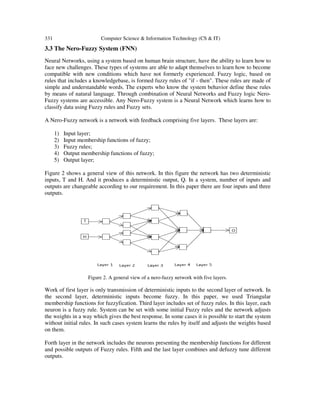
FNN method simulate by ANFIS, train data for ANFIS obtain from several hand tuning of PID
parameters. Train data upload by ANFIS and use for FNN learning. After learning, by uploading
of ANFIS to simulation environment it will set the PID parameters.
4. PROBLEM FORMULATION TO DESIGN PID CONTROLLERS
The transfer function of the PID controller is considered as follows.
Where Kp, Ki and Kd are proportional, integral and derivative gains respectively. In the time
domain the characteristics of step response such as rise time tr, overshoot Mp, settling time ts and
steady state error Ess are considered as a performance criterion for PID controller. We use a
function of these indexes as the objective function which is illustrated by Equation (4).[9]
Where K is a vector whose elements are the PID controller gains. With which the step response
of the system is simulated and the values of Mp, Ess, ts and tr are obtained to evaluate f(k).
And β is a weighting factor whose value effects the four indexes. This value, if set to be smaller
than 0.7, results in reduction of tr and ts. Otherwise, if set to values larger than 0.7, end in a
decrease in Ess and Mp while setting β=0.7 will cause the four parameters to effect similarly on
objective function.
On both of the compared algorithms, the vector K is defined as a member of population. The
algorithms start from a random population. During each iteration of the algorithm, the elements of
each member of population are substituted in the controller transfer function Gc(s) and the step
response is calculated for each member of the population, on the basis of which, tr, ts, Ess and Mp
are calculated and substituted in the defined objective function. The goal of all the algorithms is
to minimize the objective function through the strategies illustrated above.
5. SIMULATION RESULTS
5.1. Parameter Evaluation on the Algorithms
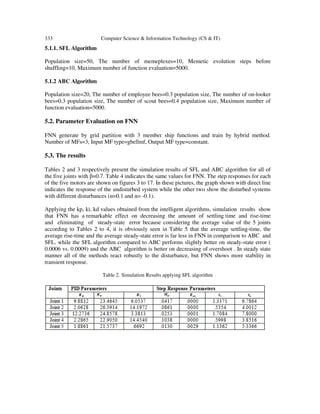
On both of the algorithms, all of the controller parameters, are restricted to the interval [0, 30].
For both of the algorithms, 30 runs , with 5000 function evaluations included in each run, have
been carried out to have the average answer which is more reliable. To determine the robustness
of the system, all simulations have been run under the effect of a disturbance factor. The
parameter evaluation for each utilized algorithm is as follows.](https://image.slidesharecdn.com/comparisonbetweenartificialbee-131113204206-phpapp02/85/COMPARISON-BETWEEN-ARTIFICIAL-BEE-COLONY-ALGORITHM-SHUFFLED-FROG-LEAPING-ALGORITHM-AND-NERO-FUZZY-SYSTEM-IN-DESIGN-OF-OPTIMAL-PID-CONTROLLERS-6-320.jpg)
![Computer Science & Information Technology (CS & IT)
338
5. CONCLUSION, DISCUSSION AND FUTURE WORKS
This research begins by introducing the Grypon robot as case-study. Then three methods were
applied to design an intelligent PID controller which, unfortunately, is not fast enough to be
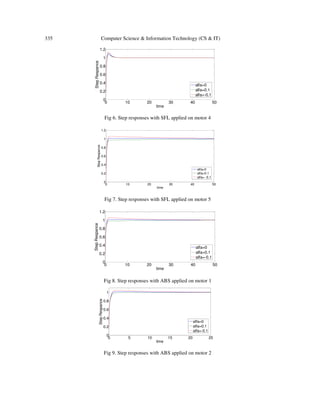
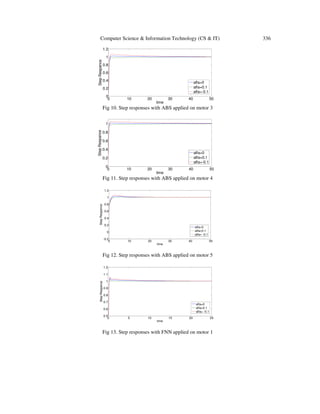
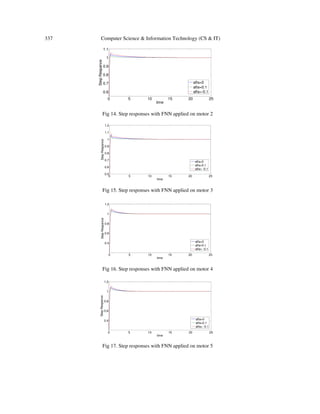
utilized in on-line applications. The results of applied simulations are reported in the included
tables and figures.
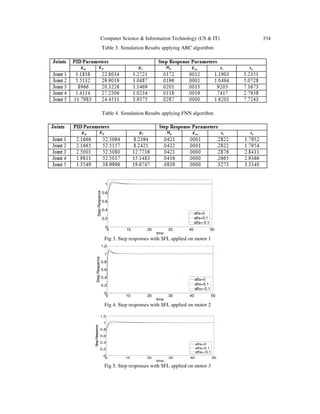
Comparing the contents of tables and figures leads to introducing the FNN strong enough in
elimination of the steady state error and reduction of the settling time and rise time. On the other
hand the ABC algorithm acts better on decreasing the overshoot. Also the act of SFL algorithm is
good in elimination of the steady state error.
From the robustness point of view, while applying the disturbance factor, the SFL algorithm and
FNN perform stronger in the transient part, however all of the methods detect the main graph in
the steady-state manner.
Designing PID controllers with other intelligent algorithms and changing the present controller to
an on-line one may be our future field study.
REFERENCES
[1]
[2]
[3]
R.L. Haupt, S.E. Haupt, Practical Genetic Algorithms, John Wiley, 2004.
M. Dorigo and T. Stützle, “Ant Colony Optimization”, MIT Press, Cambridge, 2004.
R.C. Eberhart and Y. Shi, “Particle Swarm Optimization: Developments, Applications and
Resources”, IEEE Trans, 2001.
[4] J. Kennedy, and R.C. Eberhart, “A Discrete Binary Version ofthe Particle Swarm Algorithm”, IEEE
International Conference on Systems, Man and Cybernetics, 'Computational Cybernetics and
Simulation', vol.5,pp.4104–4108, 1997 .
[5] D. Karaboga, B. Basturk, A powerful and efficient algorithm for numerical function
optimization:artificial bee colony, Journal of Global Optimization, Volume 39, Issue 3, PP. 459 –
471, 2007
[6] D. Karoboga, B. Basturk, On the Performance of Artificial Bee Colony (ABC) Algorithm, Applied
Soft Computing, pp:687- 697, Vol. 8, Issue 1, 2008.
[7] Liong S-Y, Atiquzzaman Md. Optimal design of water distribution network using shuffled complex
evolution. J Inst Eng, Singapore 2004;44(1):93–107.
[8] Eusuff MM, Lansey KE. Optimization of water distribution network design using the shuffled frog
leaping algorithm J Water Resour Plan Manage 2003;129(3):210–25.
[9] L. Gaing, A Paticle Swarm Optimization Approch For Optimum Design of PID Controller in AVR
System, IEEE International Conference on Energy conversion, pp. 384-391, Vol.19, Issue2, 2004.
[10] E. Elbeltagi, T. Hegazy, and D. Grierson, “Comparison among Five Evolutionary-Based Optimization
Algorithms,” Advanced Engineering Informatics, vol. 19, no. 1, pp. 43–53, 2005.
[11] Mark W. Spong, Seth Hutchinson, M. Vidyasagar, "Robot Modeling and Control". ISBN: 978-0-47164990-8.
[12] I. Hassanzadeh, H. Jabbari, “Open Architecture of Gryphon Robot for Visual Servo and Teleoperation Tasks”, Proceeding of the 4th t International Symposium on Mechatronics and its
Applications (ISMA07), Sharjah, U.A.E. March 26-29, 2007](https://image.slidesharecdn.com/comparisonbetweenartificialbee-131113204206-phpapp02/85/COMPARISON-BETWEEN-ARTIFICIAL-BEE-COLONY-ALGORITHM-SHUFFLED-FROG-LEAPING-ALGORITHM-AND-NERO-FUZZY-SYSTEM-IN-DESIGN-OF-OPTIMAL-PID-CONTROLLERS-12-320.jpg)


