Solving Quadratic Assignment Problems (QAP)
using Ant Colony System
Ajay S. Bidyarthy , Vivek Gupta
09012305 , 09010367
April 15, 2013
Ajay S. Bidyarthy , Vivek Gupta 09012305 , 09010367 Solving Quadratic Assignment Problems (QAP) using Ant Colo
Aim and Motivation
Aim:
Solution to Quadratic Assignment Problems (QAP) using Ant
Colony System
Motivation
The quadratic assignment problem (QAP) is one of the most
difficult problems in NP-hard class.
It has applications in several areas such as:
Opearional Research
Parallel and Distributed Computing and
Combinatorial data Analysis
Some famous combinatorial optimization problems such as
TSP, maximal clique, isomorphism and graph partitioning can
be formulated as a QAP.
In this project, we use a well known heuristic algorithm, the
ant colony system, to solve some of the real applicable QAP.
Ajay S. Bidyarthy , Vivek Gupta 09012305 , 09010367 Solving Quadratic Assignment Problems (QAP) using Ant Colo
Survey for the quadratic assignment problem in the
existing literature
The QAP was introduced by Koopmans and Beckmann in
1957 as a mathematical model for the location of indivisible
economical activities
In 1972, Dickey and Hopkins used QAP for assignment of
buildings in University campus.
In 1974, Francis and White used QAP to develop a decision
framework for assigning new facilities.
In 1976, Geoffrion and Graves used QAP for solving
scheduling problems.
In 1978, krarup and Pruzan used QAP in archeology.
In 1987, Bokhari used QAP in parallel and distrubuted
computing.
In 2003, Rabak and Sichman used QAP in placement of
electronic components.
Ajay S. Bidyarthy , Vivek Gupta 09012305 , 09010367 Solving Quadratic Assignment Problems (QAP) using Ant Colo
Problem formulation and research work
Identifying a permutation matrix X of dimension n × n (whose
elements Xij are 1 if activity j is assigned to location i and 0
in the other cases) such that:
min z =
n
i,j=1
n
h,k=1
dihfjkXij Xhk
Subject to
n
i=1
Xij = 1 for j = 1, 2, 3, ..., n
n
j=1
Xij = 1 for i = 1, 2, 3, ..., n
Xij ∈ (0, 1) for i, j = 1, 2, 3, ..., n (1)
Where dih ∈ D distance matrix and fjk ∈ F flow matrix.
Ajay S. Bidyarthy , Vivek Gupta 09012305 , 09010367 Solving Quadratic Assignment Problems (QAP) using Ant Colo
Problem formulation and research work
ACS have been applied to various combinatorial optimization
problems.
ACS is competitve with other nature inspired algorithms such
as particle swarm optimization, simulated annealing and
evolutionary computation algorithms.
The running time of ACS is O(mn2k), which is much better
for big graphs than the recursive solution O(n!)3 where n is
the number of cities that may be visited by m ants for k
cycles.
Ajay S. Bidyarthy , Vivek Gupta 09012305 , 09010367 Solving Quadratic Assignment Problems (QAP) using Ant Colo
Problem formulation and research work
ACS have been applied to various combinatorial optimization
problems.
ACS is competitve with other nature inspired algorithms such
as particle swarm optimization, simulated annealing and
evolutionary computation algorithms.
The running time of ACS is O(mn2k), which is much better
for big graphs than the recursive solution O(n!)3 where n is
the number of cities that may be visited by m ants for k
cycles.
Ajay S. Bidyarthy , Vivek Gupta 09012305 , 09010367 Solving Quadratic Assignment Problems (QAP) using Ant Colo
QAP to SBRP Formulation
School Bus Routing Problem (SBRP)
QAP to SBRP
SBRP objectve
Implementation assumptions
Ajay S. Bidyarthy , Vivek Gupta 09012305 , 09010367 Solving Quadratic Assignment Problems (QAP) using Ant Colo
Ant Colony System Algorithm
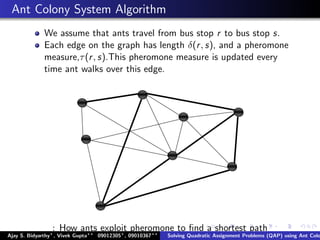
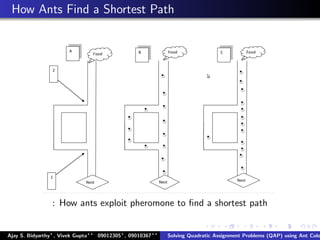
We assume that ants travel from bus stop r to bus stop s.
Each edge on the graph has length δ(r, s), and a pheromone
measure,τ(r, s).This pheromone measure is updated every
time ant walks over this edge.
: How ants exploit pheromone to find a shortest path
Ajay S. Bidyarthy , Vivek Gupta 09012305 , 09010367 Solving Quadratic Assignment Problems (QAP) using Ant Colo
Ant Colony System Algorithm continue...
Transition Rule
s =
arg maxu∈Jk (r) {[τ(r, u)]µ[η(r, u)]β} if q < q0
pk(r, s) otherwise
(2)
Where
Jk(r) is the set of cities that remain to be visited by ant k
positioned in city r and η(r, u) = 1/δ(r, u)
[µ, β] are parameters that set the relative importance of
pheromone vs. distance
q0 is a constant parameter, defined by the range (0 < q0 < 1),
which is selected to establish the exploitation vs. exploration.
q = is a random number defined by the range (0 < q < 1)
Ajay S. Bidyarthy , Vivek Gupta 09012305 , 09010367 Solving Quadratic Assignment Problems (QAP) using Ant Colo
Ant Colony System Algorithm continue...
pk(r, s) =



[τ(r,s)]µ[η(r,s)]β
u∈Jk (r)[τ(r,u)]µ[η(r,u)]β if s ∈ Jk(r)
0 otherwise
(3)
Where
Pk(r, s) is the chance of city s to be chosen by ant k
positioned in bus stop r
Since the pheromone on the edge is multiplied by η, which
depends on δ, better odds are given to shorter edges with
more pheromone.
Ajay S. Bidyarthy , Vivek Gupta 09012305 , 09010367 Solving Quadratic Assignment Problems (QAP) using Ant Colo
Ant Colony System Algorithm continue...
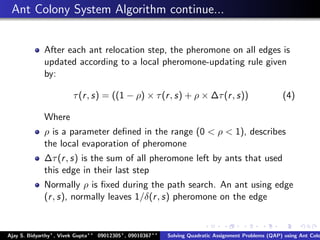
After each ant relocation step, the pheromone on all edges is
updated according to a local pheromone-updating rule given
by:
τ(r, s) = ((1 − ρ) × τ(r, s) + ρ × ∆τ(r, s)) (4)
Where
ρ is a parameter defined in the range (0 < ρ < 1), describes
the local evaporation of pheromone
∆τ(r, s) is the sum of all pheromone left by ants that used
this edge in their last step
Normally ρ is fixed during the path search. An ant using edge
(r, s), normally leaves 1/δ(r, s) pheromone on the edge
Ajay S. Bidyarthy , Vivek Gupta 09012305 , 09010367 Solving Quadratic Assignment Problems (QAP) using Ant Colo
Ant Colony System Algorithm continue...
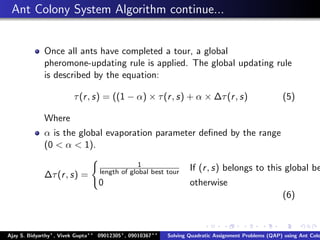
Once all ants have completed a tour, a global
pheromone-updating rule is applied. The global updating rule
is described by the equation:
τ(r, s) = ((1 − α) × τ(r, s) + α × ∆τ(r, s) (5)
Where
α is the global evaporation parameter defined by the range
(0 < α < 1).
∆τ(r, s) =
1
length of global best tour If (r, s) belongs to this global be
0 otherwise
(6)
Ajay S. Bidyarthy , Vivek Gupta 09012305 , 09010367 Solving Quadratic Assignment Problems (QAP) using Ant Colo
ACO for SBRP Implementation
Show code
Dummy input data
output
Ajay S. Bidyarthy , Vivek Gupta 09012305 , 09010367 Solving Quadratic Assignment Problems (QAP) using Ant Colo
Benchmark Algorithm and Problems
Algorithms
Genetic Algorithm
Particle Swarm Optimization
Evolutionary Algorithm
Simulated Annealing
Problems
Travelling Salesman Problem
Vehicle Routing problems
Time tabling problem
Campus designing problem
Scheduling problems
Elevator Problem
Ajay S. Bidyarthy , Vivek Gupta 09012305 , 09010367 Solving Quadratic Assignment Problems (QAP) using Ant Colo
How Ants Find a Shortest Path
: How ants exploit pheromone to find a shortest path
Ajay S. Bidyarthy , Vivek Gupta 09012305 , 09010367 Solving Quadratic Assignment Problems (QAP) using Ant Colo
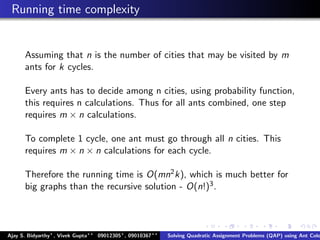
Running time complexity
Assuming that n is the number of cities that may be visited by m
ants for k cycles.
Every ants has to decide among n cities, using probability function,
this requires n calculations. Thus for all ants combined, one step
requires m × n calculations.
To complete 1 cycle, one ant must go through all n cities. This
requires m × n × n calculations for each cycle.
Therefore the running time is O(mn2k), which is much better for
big graphs than the recursive solution - O(n!)3.
Ajay S. Bidyarthy , Vivek Gupta 09012305 , 09010367 Solving Quadratic Assignment Problems (QAP) using Ant Colo
ACO for QAP
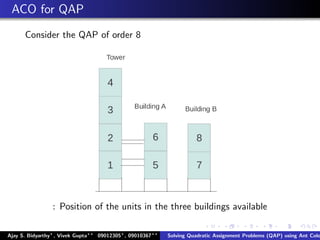
Consider the QAP of order 8
: Position of the units in the three buildings available
Ajay S. Bidyarthy , Vivek Gupta 09012305 , 09010367 Solving Quadratic Assignment Problems (QAP) using Ant Colo
Distance Flow Matrix
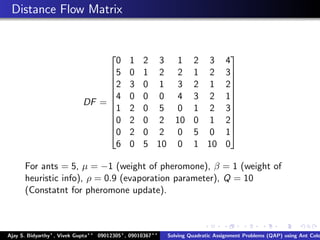
DF =












0 1 2 3 1 2 3 4
5 0 1 2 2 1 2 3
2 3 0 1 3 2 1 2
4 0 0 0 4 3 2 1
1 2 0 5 0 1 2 3
0 2 0 2 10 0 1 2
0 2 0 2 0 5 0 1
6 0 5 10 0 1 10 0












For ants = 5, µ = −1 (weight of pheromone), β = 1 (weight of
heuristic info), ρ = 0.9 (evaporation parameter), Q = 10
(Constatnt for pheromone update).
Ajay S. Bidyarthy , Vivek Gupta 09012305 , 09010367 Solving Quadratic Assignment Problems (QAP) using Ant Colo
Iteration to Solution
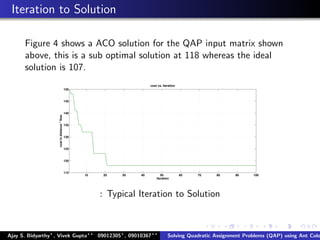
Figure 4 shows a ACO solution for the QAP input matrix shown
above, this is a sub optimal solution at 118 whereas the ideal
solution is 107.
10 20 30 40 50 60 70 80 90 100
115
120
125
130
135
140
145
150
cost vs. iteration
costindistance*flow
iteration
: Typical Iteration to Solution
Ajay S. Bidyarthy , Vivek Gupta 09012305 , 09010367 Solving Quadratic Assignment Problems (QAP) using Ant Colo
Demonstration of local and global optimization
0 20 40 60 80 100 120 140 160 180 200
105
110
115
120
125
130
200 trial comparision
costindistance/flow
trial
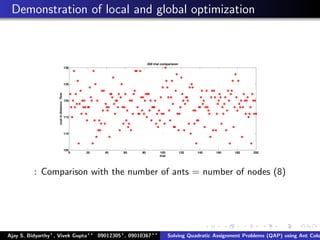
: Comparison with the number of ants = number of nodes (8)
Ajay S. Bidyarthy , Vivek Gupta 09012305 , 09010367 Solving Quadratic Assignment Problems (QAP) using Ant Colo
Demonstration of local and global optimization
0 20 40 60 80 100 120 140 160 180 200
105
110
115
120
125
130
200 trial comparisioncostindistance/flow
trial
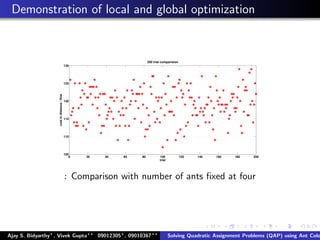
: Comparison with number of ants fixed at four
Ajay S. Bidyarthy , Vivek Gupta 09012305 , 09010367 Solving Quadratic Assignment Problems (QAP) using Ant Colo
Results for QAP
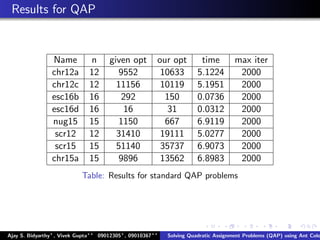
Name n given opt our opt time max iter
chr12a 12 9552 10633 5.1224 2000
chr12c 12 11156 10119 5.1951 2000
esc16b 16 292 150 0.0736 2000
esc16d 16 16 31 0.0312 2000
nug15 15 1150 667 6.9119 2000
scr12 12 31410 19111 5.0277 2000
scr15 15 51140 35737 6.9073 2000
chr15a 15 9896 13562 6.8983 2000
Table: Results for standard QAP problems
Ajay S. Bidyarthy , Vivek Gupta 09012305 , 09010367 Solving Quadratic Assignment Problems (QAP) using Ant Colo
ACO for SBRP
Radial input
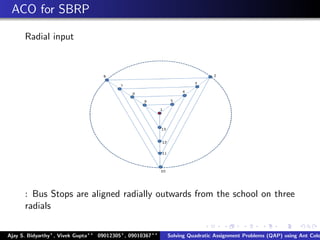
: Bus Stops are aligned radially outwards from the school on three
radials
Ajay S. Bidyarthy , Vivek Gupta 09012305 , 09010367 Solving Quadratic Assignment Problems (QAP) using Ant Colo
ACO for SBRP
Radial input
school_id(down)/bus_s
top_id(right)
2 3 4 5 6 7 8 9 10 11 12 13
1 4 4 4 4 4 4 4 4 4 4 4 4
Bus stop Vs. students matrix
1 2 3 4 5 6 7 8 9 10 11 12 13
1 0 10 7.5 5 2.5 10 7.5 5 2.5 10 7.5 5 2.5
2 10 0 2.5 5 7.5 10 10 10 10 10 10 10 10
3 7.5 2.5 0 2.5 5 10 7.5 7.5 7.5 10 7.5 7.5 7.5
4 5 5 2.5 0 2.5 10 7.5 5 5 10 7.5 5 5
5 2.5 7.5 5 2.5 0 10 7.5 5 2.5 10 7.5 5 2.5
6 10 10 10 10 10 0 2.5 5 7.5 10 10 10 10
7 7.5 10 7.5 7.5 7.5 2.5 0 2.5 5 10 7.5 7.5 7.5
8 5 10 7.5 5 5 5 2.5 0 2.5 10 7.5 5 5
9 2.5 10 7.5 5 2.5 7.5 5 2.5 0 10 7.5 5 2.5
10 10 10 10 10 10 10 10 10 10 0 2.5 5 7.5
11 7.5 10 7.5 7.5 7.5 10 7.5 7.5 7.5 2.5 0 2.5 5
12 5 10 7.5 5 5 10 7.5 5 5 5 2.5 0 2.5
13 2.5 10 7.5 5 2.5 10 7.5 5 2.5 7.5 5 2.5 0
Distance Matrix of Bus Stops
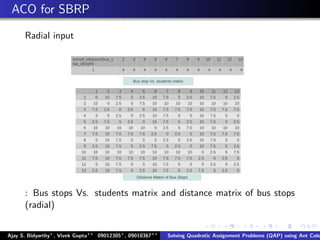
: Bus stops Vs. students matrix and distance matrix of bus stops
(radial)
Ajay S. Bidyarthy , Vivek Gupta 09012305 , 09010367 Solving Quadratic Assignment Problems (QAP) using Ant Colo
ACO for SBRP
Radial output
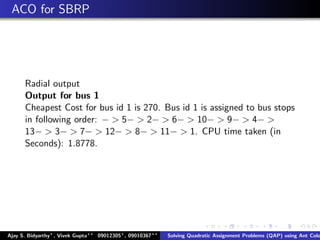
Output for bus 1
Cheapest Cost for bus id 1 is 270. Bus id 1 is assigned to bus stops
in following order: − > 5− > 2− > 6− > 10− > 9− > 4− >
13− > 3− > 7− > 12− > 8− > 11− > 1. CPU time taken (in
Seconds): 1.8778.
Ajay S. Bidyarthy , Vivek Gupta 09012305 , 09010367 Solving Quadratic Assignment Problems (QAP) using Ant Colo
ACO for SBRP
Radial output
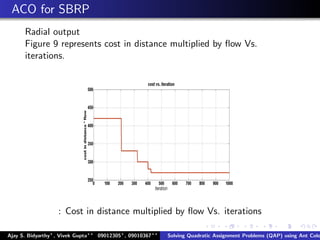
Figure 9 represents cost in distance multiplied by flow Vs.
iterations.
: Cost in distance multiplied by flow Vs. iterations
Ajay S. Bidyarthy , Vivek Gupta 09012305 , 09010367 Solving Quadratic Assignment Problems (QAP) using Ant Colo
ACO for SBRP
Clustered input
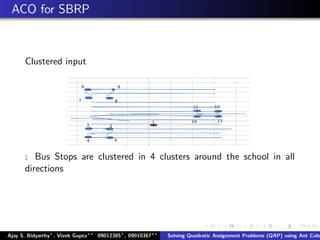
: Bus Stops are clustered in 4 clusters around the school in all
directions
Ajay S. Bidyarthy , Vivek Gupta 09012305 , 09010367 Solving Quadratic Assignment Problems (QAP) using Ant Colo
ACO for SBRP
Clustered input
school_id(down)/bus_s
top_id(right)
2 3 4 5 6 7 8 9 10 11 12 13
1 4 4 4 4 4 4 4 4 4 4 4 4
Bus stop Vs. students matrix
Distance Matrix of Bus Stops
1 2 3 4 5 6 7 8 9 10 11 12 13
1 0 3 4 6 5 11 9 8 10 4 5 6 5
2 3 0 1 3 2 10 8 7 9 7 8 9 8
3 4 1 0 2 3 9 7 8 10 8 9 10 9
4 6 3 2 0 1 11 9 10 12 10 11 12 11
5 5 2 3 1 0 12 10 9 11 9 10 11 10
6 11 10 9 11 12 0 2 3 1 11 10 11 12
7 9 8 7 9 10 2 0 1 3 9 8 9 10
8 8 7 8 10 9 3 1 0 2 9 8 9 10
9 10 9 10 12 11 1 3 2 0 11 10 11 12
10 4 7 8 10 9 11 9 9 11 0 1 2 1
11 5 8 9 11 10 10 8 8 10 1 0 1 2
12 6 9 10 12 11 11 9 9 11 2 1 0 1
13 5 8 9 11 10 12 10 10 12 1 2 1 0
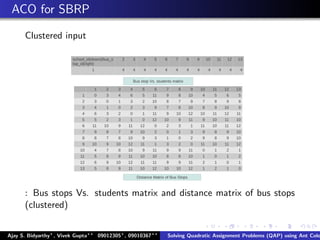
: Bus stops Vs. students matrix and distance matrix of bus stops
(clustered)
Ajay S. Bidyarthy , Vivek Gupta 09012305 , 09010367 Solving Quadratic Assignment Problems (QAP) using Ant Colo
ACO for SBRP
Clustered output
Output for bus 1
Cheapest Cost for bus id 1 is 300. Bus id 1 is assigned to bus stops
in following order: − > 2− > 6− > 9− > 4− > 5− > 12− >
13− > 11− > 10− > 7− > 8− > 3− > 1. CPU time taken (in
Seconds): 1.9089.
Ajay S. Bidyarthy , Vivek Gupta 09012305 , 09010367 Solving Quadratic Assignment Problems (QAP) using Ant Colo
ACO for SBRP
clustered output
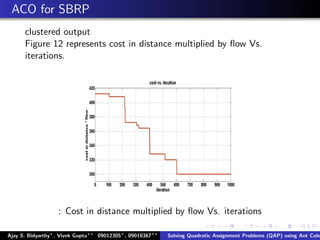
Figure 12 represents cost in distance multiplied by flow Vs.
iterations.
: Cost in distance multiplied by flow Vs. iterations
Ajay S. Bidyarthy , Vivek Gupta 09012305 , 09010367 Solving Quadratic Assignment Problems (QAP) using Ant Colo
Summary and Future Work
Summary
Successfully applied the Ant colony System to the Quadratic
Assignment Problem (QAP) and School Bus Routing Problem
(SBRP).
The results obtained using ACO are better than the results
obtained using standard QAP approach in some cases.
For SBRP, three test cases were considered i.e. radial ,
clustered and random arrangement of bus stops.
For radial arrangement of bus stops, the optimal route
obtained are radial, whereas for clustered arrangement of bus
stops, the optimal routes are clustered.
Future Work
As future work ACO can be applied to distributed environment
to further increase the efficiency of the algorithm.
Ajay S. Bidyarthy , Vivek Gupta 09012305 , 09010367 Solving Quadratic Assignment Problems (QAP) using Ant Colo
Koopmans, T.C. and Beckmann, M.J. (1957). Assignment
problems and the location of economic activities.
Econometrica, 25, 53-76.
Francis, R.L. and White, J.A. (1974). Facility layout and
location: An analytical approach. Prentice-Hall, Englewood
Cliffs, New Jersey
Krarup, J. and Pruzan, P.M. (1978). Computer-aided layout
design. Mathematical Programming Study, 9, 75-94.
Hubert, L. and Schulz, J. (1976). Quadratic assignment as a
general data analysis strategy.British Journal of Mathematical
Psychology, 29, 190-241.
Dickey, J.W. and Hopkins, J.W. (1972). Campus building
arrangement using topaz. Transportation Research, 6, 59-68.
Rabak, C.S., Sichman, J.S. (2003). Using A-Teams to
optimize automatic insertion of electronic components,
Advanced Engineering Informatics, 17. (2), 95-106.
Ajay S. Bidyarthy , Vivek Gupta 09012305 , 09010367 Solving Quadratic Assignment Problems (QAP) using Ant Colo

Solving Quadratic Assignment Problems (QAP) using Ant Colony System

  • 1.
    Solving Quadratic AssignmentProblems (QAP) using Ant Colony System Ajay S. Bidyarthy , Vivek Gupta 09012305 , 09010367 April 15, 2013 Ajay S. Bidyarthy , Vivek Gupta 09012305 , 09010367 Solving Quadratic Assignment Problems (QAP) using Ant Colo
  • 2.
    Aim and Motivation Aim: Solutionto Quadratic Assignment Problems (QAP) using Ant Colony System Motivation The quadratic assignment problem (QAP) is one of the most difficult problems in NP-hard class. It has applications in several areas such as: Opearional Research Parallel and Distributed Computing and Combinatorial data Analysis Some famous combinatorial optimization problems such as TSP, maximal clique, isomorphism and graph partitioning can be formulated as a QAP. In this project, we use a well known heuristic algorithm, the ant colony system, to solve some of the real applicable QAP. Ajay S. Bidyarthy , Vivek Gupta 09012305 , 09010367 Solving Quadratic Assignment Problems (QAP) using Ant Colo
  • 3.
    Survey for thequadratic assignment problem in the existing literature The QAP was introduced by Koopmans and Beckmann in 1957 as a mathematical model for the location of indivisible economical activities In 1972, Dickey and Hopkins used QAP for assignment of buildings in University campus. In 1974, Francis and White used QAP to develop a decision framework for assigning new facilities. In 1976, Geoffrion and Graves used QAP for solving scheduling problems. In 1978, krarup and Pruzan used QAP in archeology. In 1987, Bokhari used QAP in parallel and distrubuted computing. In 2003, Rabak and Sichman used QAP in placement of electronic components. Ajay S. Bidyarthy , Vivek Gupta 09012305 , 09010367 Solving Quadratic Assignment Problems (QAP) using Ant Colo
  • 4.
    Problem formulation andresearch work Identifying a permutation matrix X of dimension n × n (whose elements Xij are 1 if activity j is assigned to location i and 0 in the other cases) such that: min z = n i,j=1 n h,k=1 dihfjkXij Xhk Subject to n i=1 Xij = 1 for j = 1, 2, 3, ..., n n j=1 Xij = 1 for i = 1, 2, 3, ..., n Xij ∈ (0, 1) for i, j = 1, 2, 3, ..., n (1) Where dih ∈ D distance matrix and fjk ∈ F flow matrix. Ajay S. Bidyarthy , Vivek Gupta 09012305 , 09010367 Solving Quadratic Assignment Problems (QAP) using Ant Colo
  • 5.
    Problem formulation andresearch work ACS have been applied to various combinatorial optimization problems. ACS is competitve with other nature inspired algorithms such as particle swarm optimization, simulated annealing and evolutionary computation algorithms. The running time of ACS is O(mn2k), which is much better for big graphs than the recursive solution O(n!)3 where n is the number of cities that may be visited by m ants for k cycles. Ajay S. Bidyarthy , Vivek Gupta 09012305 , 09010367 Solving Quadratic Assignment Problems (QAP) using Ant Colo
  • 6.
    Problem formulation andresearch work ACS have been applied to various combinatorial optimization problems. ACS is competitve with other nature inspired algorithms such as particle swarm optimization, simulated annealing and evolutionary computation algorithms. The running time of ACS is O(mn2k), which is much better for big graphs than the recursive solution O(n!)3 where n is the number of cities that may be visited by m ants for k cycles. Ajay S. Bidyarthy , Vivek Gupta 09012305 , 09010367 Solving Quadratic Assignment Problems (QAP) using Ant Colo
  • 7.
    QAP to SBRPFormulation School Bus Routing Problem (SBRP) QAP to SBRP SBRP objectve Implementation assumptions Ajay S. Bidyarthy , Vivek Gupta 09012305 , 09010367 Solving Quadratic Assignment Problems (QAP) using Ant Colo
  • 8.
    Ant Colony SystemAlgorithm We assume that ants travel from bus stop r to bus stop s. Each edge on the graph has length δ(r, s), and a pheromone measure,τ(r, s).This pheromone measure is updated every time ant walks over this edge. : How ants exploit pheromone to find a shortest path Ajay S. Bidyarthy , Vivek Gupta 09012305 , 09010367 Solving Quadratic Assignment Problems (QAP) using Ant Colo
  • 9.
    Ant Colony SystemAlgorithm continue... Transition Rule s = arg maxu∈Jk (r) {[τ(r, u)]µ[η(r, u)]β} if q < q0 pk(r, s) otherwise (2) Where Jk(r) is the set of cities that remain to be visited by ant k positioned in city r and η(r, u) = 1/δ(r, u) [µ, β] are parameters that set the relative importance of pheromone vs. distance q0 is a constant parameter, defined by the range (0 < q0 < 1), which is selected to establish the exploitation vs. exploration. q = is a random number defined by the range (0 < q < 1) Ajay S. Bidyarthy , Vivek Gupta 09012305 , 09010367 Solving Quadratic Assignment Problems (QAP) using Ant Colo
  • 10.
    Ant Colony SystemAlgorithm continue... pk(r, s) =    [τ(r,s)]µ[η(r,s)]β u∈Jk (r)[τ(r,u)]µ[η(r,u)]β if s ∈ Jk(r) 0 otherwise (3) Where Pk(r, s) is the chance of city s to be chosen by ant k positioned in bus stop r Since the pheromone on the edge is multiplied by η, which depends on δ, better odds are given to shorter edges with more pheromone. Ajay S. Bidyarthy , Vivek Gupta 09012305 , 09010367 Solving Quadratic Assignment Problems (QAP) using Ant Colo
  • 11.
    Ant Colony SystemAlgorithm continue... After each ant relocation step, the pheromone on all edges is updated according to a local pheromone-updating rule given by: τ(r, s) = ((1 − ρ) × τ(r, s) + ρ × ∆τ(r, s)) (4) Where ρ is a parameter defined in the range (0 < ρ < 1), describes the local evaporation of pheromone ∆τ(r, s) is the sum of all pheromone left by ants that used this edge in their last step Normally ρ is fixed during the path search. An ant using edge (r, s), normally leaves 1/δ(r, s) pheromone on the edge Ajay S. Bidyarthy , Vivek Gupta 09012305 , 09010367 Solving Quadratic Assignment Problems (QAP) using Ant Colo
  • 12.
    Ant Colony SystemAlgorithm continue... Once all ants have completed a tour, a global pheromone-updating rule is applied. The global updating rule is described by the equation: τ(r, s) = ((1 − α) × τ(r, s) + α × ∆τ(r, s) (5) Where α is the global evaporation parameter defined by the range (0 < α < 1). ∆τ(r, s) = 1 length of global best tour If (r, s) belongs to this global be 0 otherwise (6) Ajay S. Bidyarthy , Vivek Gupta 09012305 , 09010367 Solving Quadratic Assignment Problems (QAP) using Ant Colo
  • 13.
    ACO for SBRPImplementation Show code Dummy input data output Ajay S. Bidyarthy , Vivek Gupta 09012305 , 09010367 Solving Quadratic Assignment Problems (QAP) using Ant Colo
  • 14.
    Benchmark Algorithm andProblems Algorithms Genetic Algorithm Particle Swarm Optimization Evolutionary Algorithm Simulated Annealing Problems Travelling Salesman Problem Vehicle Routing problems Time tabling problem Campus designing problem Scheduling problems Elevator Problem Ajay S. Bidyarthy , Vivek Gupta 09012305 , 09010367 Solving Quadratic Assignment Problems (QAP) using Ant Colo
  • 15.
    How Ants Finda Shortest Path : How ants exploit pheromone to find a shortest path Ajay S. Bidyarthy , Vivek Gupta 09012305 , 09010367 Solving Quadratic Assignment Problems (QAP) using Ant Colo
  • 16.
    Running time complexity Assumingthat n is the number of cities that may be visited by m ants for k cycles. Every ants has to decide among n cities, using probability function, this requires n calculations. Thus for all ants combined, one step requires m × n calculations. To complete 1 cycle, one ant must go through all n cities. This requires m × n × n calculations for each cycle. Therefore the running time is O(mn2k), which is much better for big graphs than the recursive solution - O(n!)3. Ajay S. Bidyarthy , Vivek Gupta 09012305 , 09010367 Solving Quadratic Assignment Problems (QAP) using Ant Colo
  • 17.
    ACO for QAP Considerthe QAP of order 8 : Position of the units in the three buildings available Ajay S. Bidyarthy , Vivek Gupta 09012305 , 09010367 Solving Quadratic Assignment Problems (QAP) using Ant Colo
  • 18.
    Distance Flow Matrix DF=             0 1 2 3 1 2 3 4 5 0 1 2 2 1 2 3 2 3 0 1 3 2 1 2 4 0 0 0 4 3 2 1 1 2 0 5 0 1 2 3 0 2 0 2 10 0 1 2 0 2 0 2 0 5 0 1 6 0 5 10 0 1 10 0             For ants = 5, µ = −1 (weight of pheromone), β = 1 (weight of heuristic info), ρ = 0.9 (evaporation parameter), Q = 10 (Constatnt for pheromone update). Ajay S. Bidyarthy , Vivek Gupta 09012305 , 09010367 Solving Quadratic Assignment Problems (QAP) using Ant Colo
  • 19.
    Iteration to Solution Figure4 shows a ACO solution for the QAP input matrix shown above, this is a sub optimal solution at 118 whereas the ideal solution is 107. 10 20 30 40 50 60 70 80 90 100 115 120 125 130 135 140 145 150 cost vs. iteration costindistance*flow iteration : Typical Iteration to Solution Ajay S. Bidyarthy , Vivek Gupta 09012305 , 09010367 Solving Quadratic Assignment Problems (QAP) using Ant Colo
  • 20.
    Demonstration of localand global optimization 0 20 40 60 80 100 120 140 160 180 200 105 110 115 120 125 130 200 trial comparision costindistance/flow trial : Comparison with the number of ants = number of nodes (8) Ajay S. Bidyarthy , Vivek Gupta 09012305 , 09010367 Solving Quadratic Assignment Problems (QAP) using Ant Colo
  • 21.
    Demonstration of localand global optimization 0 20 40 60 80 100 120 140 160 180 200 105 110 115 120 125 130 200 trial comparisioncostindistance/flow trial : Comparison with number of ants fixed at four Ajay S. Bidyarthy , Vivek Gupta 09012305 , 09010367 Solving Quadratic Assignment Problems (QAP) using Ant Colo
  • 22.
    Results for QAP Namen given opt our opt time max iter chr12a 12 9552 10633 5.1224 2000 chr12c 12 11156 10119 5.1951 2000 esc16b 16 292 150 0.0736 2000 esc16d 16 16 31 0.0312 2000 nug15 15 1150 667 6.9119 2000 scr12 12 31410 19111 5.0277 2000 scr15 15 51140 35737 6.9073 2000 chr15a 15 9896 13562 6.8983 2000 Table: Results for standard QAP problems Ajay S. Bidyarthy , Vivek Gupta 09012305 , 09010367 Solving Quadratic Assignment Problems (QAP) using Ant Colo
  • 23.
    ACO for SBRP Radialinput : Bus Stops are aligned radially outwards from the school on three radials Ajay S. Bidyarthy , Vivek Gupta 09012305 , 09010367 Solving Quadratic Assignment Problems (QAP) using Ant Colo
  • 24.
    ACO for SBRP Radialinput school_id(down)/bus_s top_id(right) 2 3 4 5 6 7 8 9 10 11 12 13 1 4 4 4 4 4 4 4 4 4 4 4 4 Bus stop Vs. students matrix 1 2 3 4 5 6 7 8 9 10 11 12 13 1 0 10 7.5 5 2.5 10 7.5 5 2.5 10 7.5 5 2.5 2 10 0 2.5 5 7.5 10 10 10 10 10 10 10 10 3 7.5 2.5 0 2.5 5 10 7.5 7.5 7.5 10 7.5 7.5 7.5 4 5 5 2.5 0 2.5 10 7.5 5 5 10 7.5 5 5 5 2.5 7.5 5 2.5 0 10 7.5 5 2.5 10 7.5 5 2.5 6 10 10 10 10 10 0 2.5 5 7.5 10 10 10 10 7 7.5 10 7.5 7.5 7.5 2.5 0 2.5 5 10 7.5 7.5 7.5 8 5 10 7.5 5 5 5 2.5 0 2.5 10 7.5 5 5 9 2.5 10 7.5 5 2.5 7.5 5 2.5 0 10 7.5 5 2.5 10 10 10 10 10 10 10 10 10 10 0 2.5 5 7.5 11 7.5 10 7.5 7.5 7.5 10 7.5 7.5 7.5 2.5 0 2.5 5 12 5 10 7.5 5 5 10 7.5 5 5 5 2.5 0 2.5 13 2.5 10 7.5 5 2.5 10 7.5 5 2.5 7.5 5 2.5 0 Distance Matrix of Bus Stops : Bus stops Vs. students matrix and distance matrix of bus stops (radial) Ajay S. Bidyarthy , Vivek Gupta 09012305 , 09010367 Solving Quadratic Assignment Problems (QAP) using Ant Colo
  • 25.
    ACO for SBRP Radialoutput Output for bus 1 Cheapest Cost for bus id 1 is 270. Bus id 1 is assigned to bus stops in following order: − > 5− > 2− > 6− > 10− > 9− > 4− > 13− > 3− > 7− > 12− > 8− > 11− > 1. CPU time taken (in Seconds): 1.8778. Ajay S. Bidyarthy , Vivek Gupta 09012305 , 09010367 Solving Quadratic Assignment Problems (QAP) using Ant Colo
  • 26.
    ACO for SBRP Radialoutput Figure 9 represents cost in distance multiplied by flow Vs. iterations. : Cost in distance multiplied by flow Vs. iterations Ajay S. Bidyarthy , Vivek Gupta 09012305 , 09010367 Solving Quadratic Assignment Problems (QAP) using Ant Colo
  • 27.
    ACO for SBRP Clusteredinput : Bus Stops are clustered in 4 clusters around the school in all directions Ajay S. Bidyarthy , Vivek Gupta 09012305 , 09010367 Solving Quadratic Assignment Problems (QAP) using Ant Colo
  • 28.
    ACO for SBRP Clusteredinput school_id(down)/bus_s top_id(right) 2 3 4 5 6 7 8 9 10 11 12 13 1 4 4 4 4 4 4 4 4 4 4 4 4 Bus stop Vs. students matrix Distance Matrix of Bus Stops 1 2 3 4 5 6 7 8 9 10 11 12 13 1 0 3 4 6 5 11 9 8 10 4 5 6 5 2 3 0 1 3 2 10 8 7 9 7 8 9 8 3 4 1 0 2 3 9 7 8 10 8 9 10 9 4 6 3 2 0 1 11 9 10 12 10 11 12 11 5 5 2 3 1 0 12 10 9 11 9 10 11 10 6 11 10 9 11 12 0 2 3 1 11 10 11 12 7 9 8 7 9 10 2 0 1 3 9 8 9 10 8 8 7 8 10 9 3 1 0 2 9 8 9 10 9 10 9 10 12 11 1 3 2 0 11 10 11 12 10 4 7 8 10 9 11 9 9 11 0 1 2 1 11 5 8 9 11 10 10 8 8 10 1 0 1 2 12 6 9 10 12 11 11 9 9 11 2 1 0 1 13 5 8 9 11 10 12 10 10 12 1 2 1 0 : Bus stops Vs. students matrix and distance matrix of bus stops (clustered) Ajay S. Bidyarthy , Vivek Gupta 09012305 , 09010367 Solving Quadratic Assignment Problems (QAP) using Ant Colo
  • 29.
    ACO for SBRP Clusteredoutput Output for bus 1 Cheapest Cost for bus id 1 is 300. Bus id 1 is assigned to bus stops in following order: − > 2− > 6− > 9− > 4− > 5− > 12− > 13− > 11− > 10− > 7− > 8− > 3− > 1. CPU time taken (in Seconds): 1.9089. Ajay S. Bidyarthy , Vivek Gupta 09012305 , 09010367 Solving Quadratic Assignment Problems (QAP) using Ant Colo
  • 30.
    ACO for SBRP clusteredoutput Figure 12 represents cost in distance multiplied by flow Vs. iterations. : Cost in distance multiplied by flow Vs. iterations Ajay S. Bidyarthy , Vivek Gupta 09012305 , 09010367 Solving Quadratic Assignment Problems (QAP) using Ant Colo
  • 31.
    Summary and FutureWork Summary Successfully applied the Ant colony System to the Quadratic Assignment Problem (QAP) and School Bus Routing Problem (SBRP). The results obtained using ACO are better than the results obtained using standard QAP approach in some cases. For SBRP, three test cases were considered i.e. radial , clustered and random arrangement of bus stops. For radial arrangement of bus stops, the optimal route obtained are radial, whereas for clustered arrangement of bus stops, the optimal routes are clustered. Future Work As future work ACO can be applied to distributed environment to further increase the efficiency of the algorithm. Ajay S. Bidyarthy , Vivek Gupta 09012305 , 09010367 Solving Quadratic Assignment Problems (QAP) using Ant Colo
  • 32.
    Koopmans, T.C. andBeckmann, M.J. (1957). Assignment problems and the location of economic activities. Econometrica, 25, 53-76. Francis, R.L. and White, J.A. (1974). Facility layout and location: An analytical approach. Prentice-Hall, Englewood Cliffs, New Jersey Krarup, J. and Pruzan, P.M. (1978). Computer-aided layout design. Mathematical Programming Study, 9, 75-94. Hubert, L. and Schulz, J. (1976). Quadratic assignment as a general data analysis strategy.British Journal of Mathematical Psychology, 29, 190-241. Dickey, J.W. and Hopkins, J.W. (1972). Campus building arrangement using topaz. Transportation Research, 6, 59-68. Rabak, C.S., Sichman, J.S. (2003). Using A-Teams to optimize automatic insertion of electronic components, Advanced Engineering Informatics, 17. (2), 95-106. Ajay S. Bidyarthy , Vivek Gupta 09012305 , 09010367 Solving Quadratic Assignment Problems (QAP) using Ant Colo