Rule Design Guidelines and Best Practices 
1 
Keshav Deshpande 
Software Developer 
kdeshpande1@verizon.net
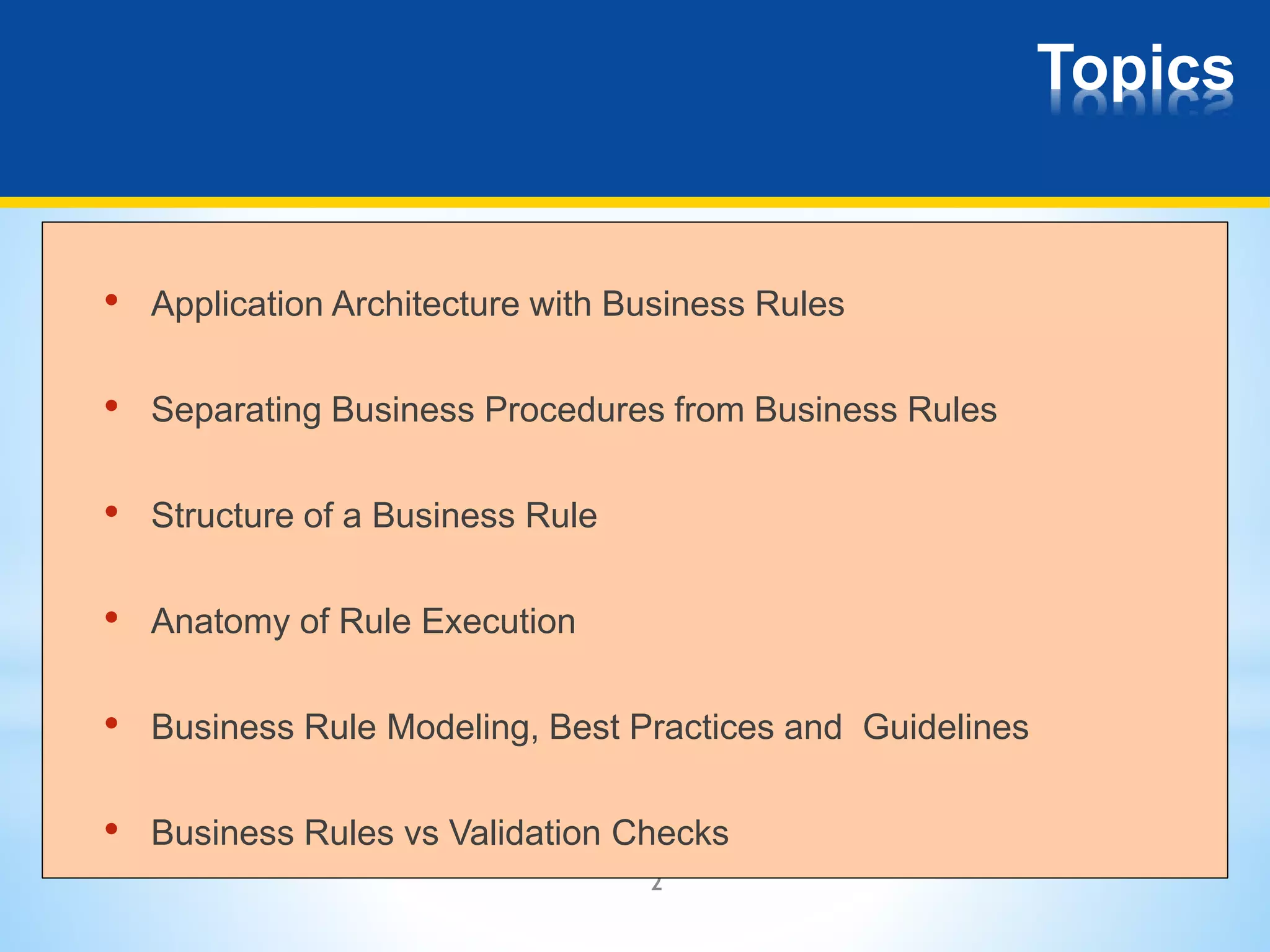
• Application Architecture with Business Rules 
• Separating Business Procedures from Business Rules 
2 
• Structure of a Business Rule 
• Anatomy of Rule Execution 
• Business Rule Modeling, Best Practices and Guidelines 
• Business Rules vs Validation Checks 
Topics
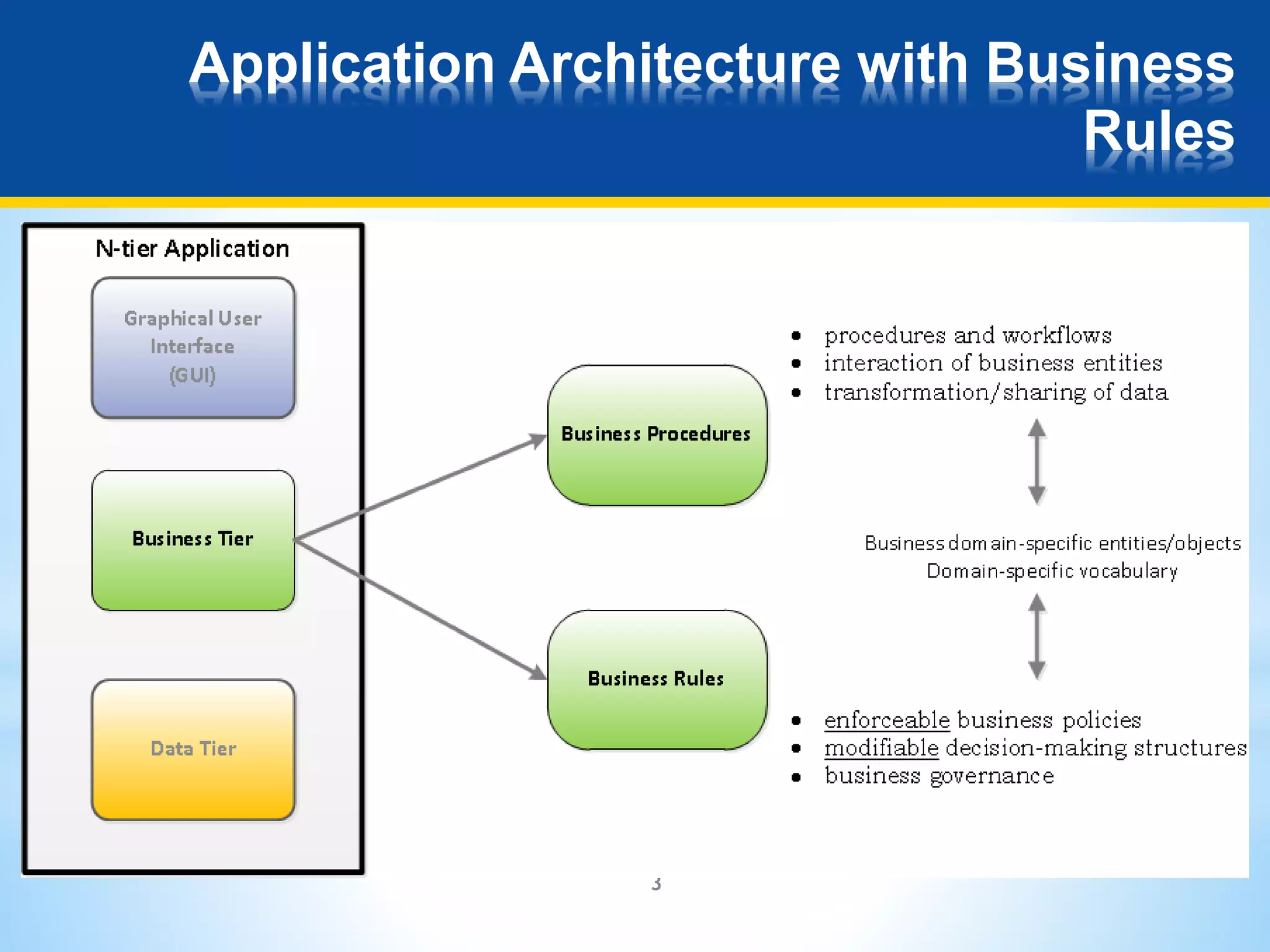
Application Architecture with Business 
3 
Rules
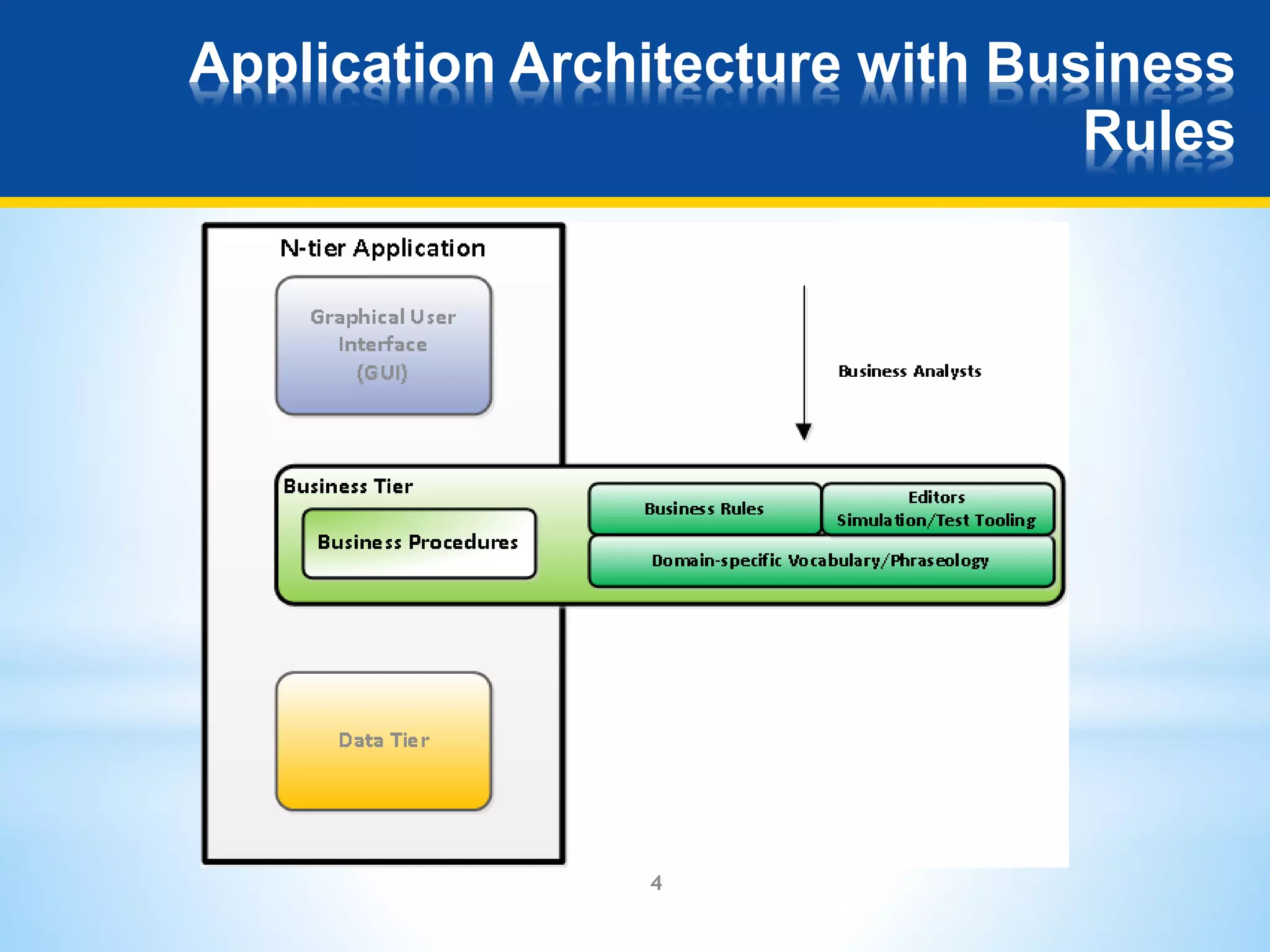
Application Architecture with Business 
4 
Rules
Application Architecture with Business 
5 
Rules 
• Business procedure/workflow distinct from Business Rules 
• Business Rules hosted and executed within rules engine 
Implications 
 Separation of concerns 
• generally accepted as good application design pattern 
 Business rules can be independently modified 
• Modifications done outside of application code 
 Business Analysts can access/simulate/run/test Business 
Rules 
• in isolation from application
Business Procedure Vs Business Rules 
6 
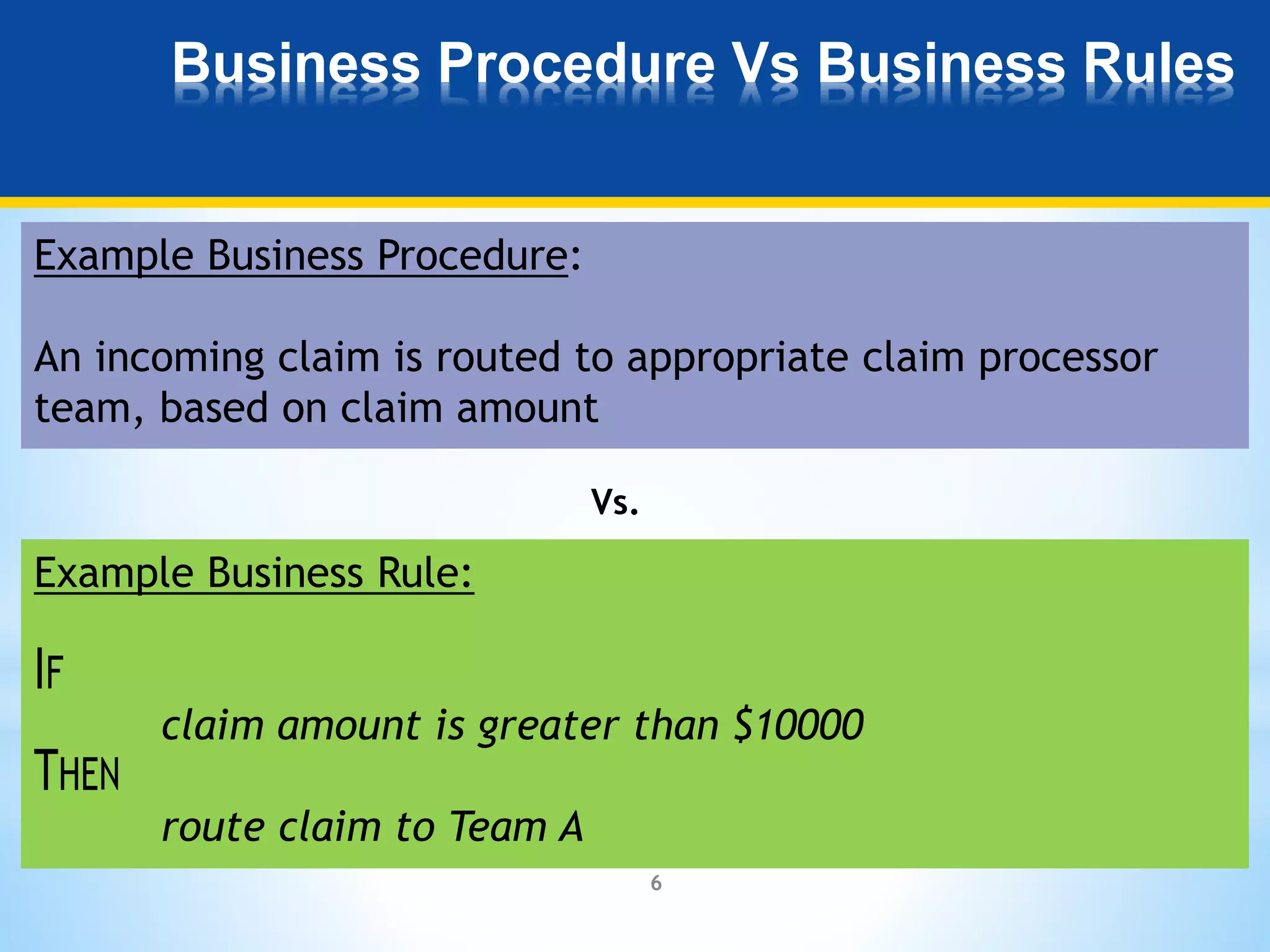
Example Business Procedure: 
An incoming claim is routed to appropriate claim processor 
team, based on claim amount 
Example Business Rule: 
claim amount is greater than $10000 
route claim to Team A 
Vs.
Structure of a Business Rule 
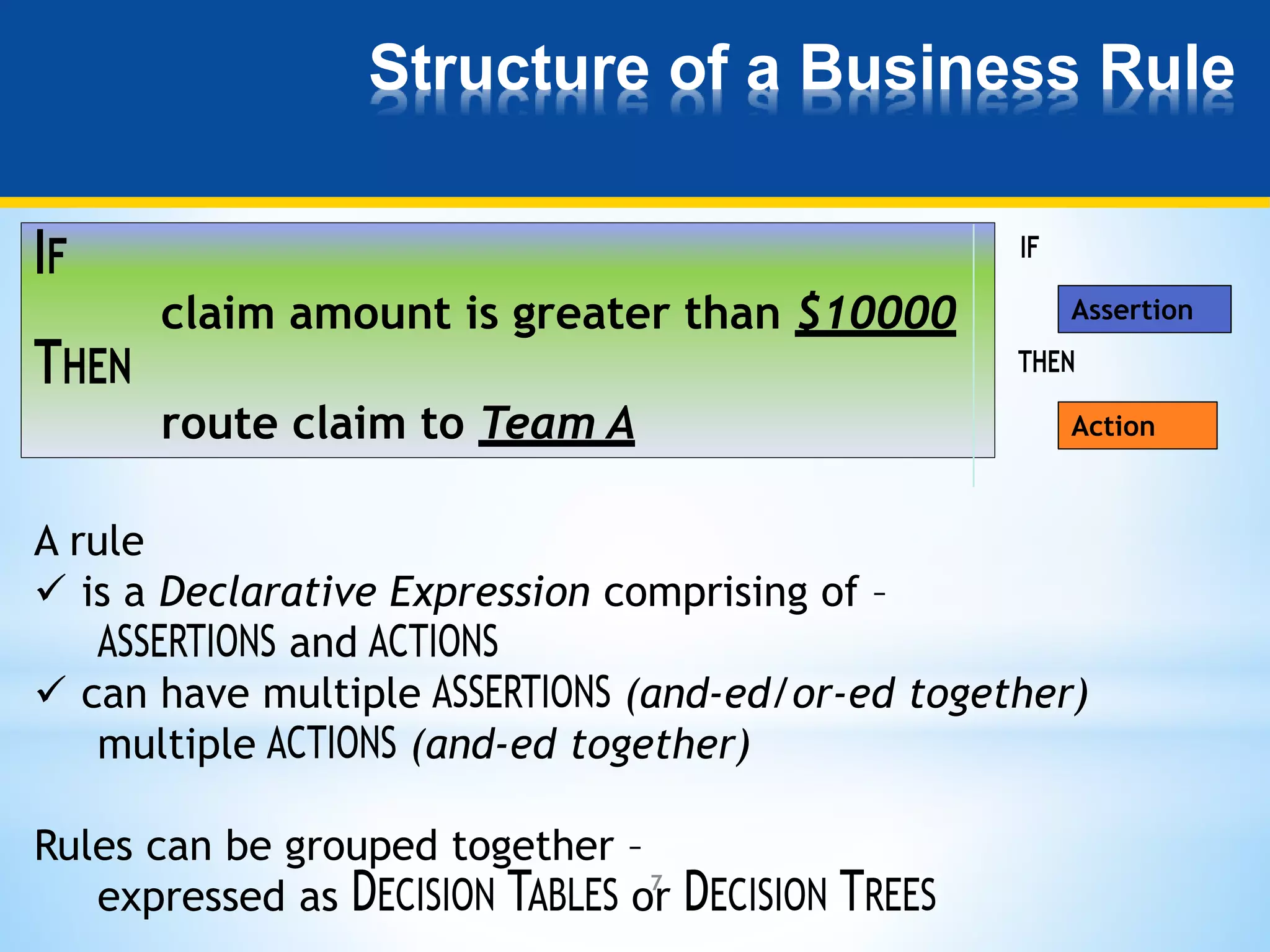
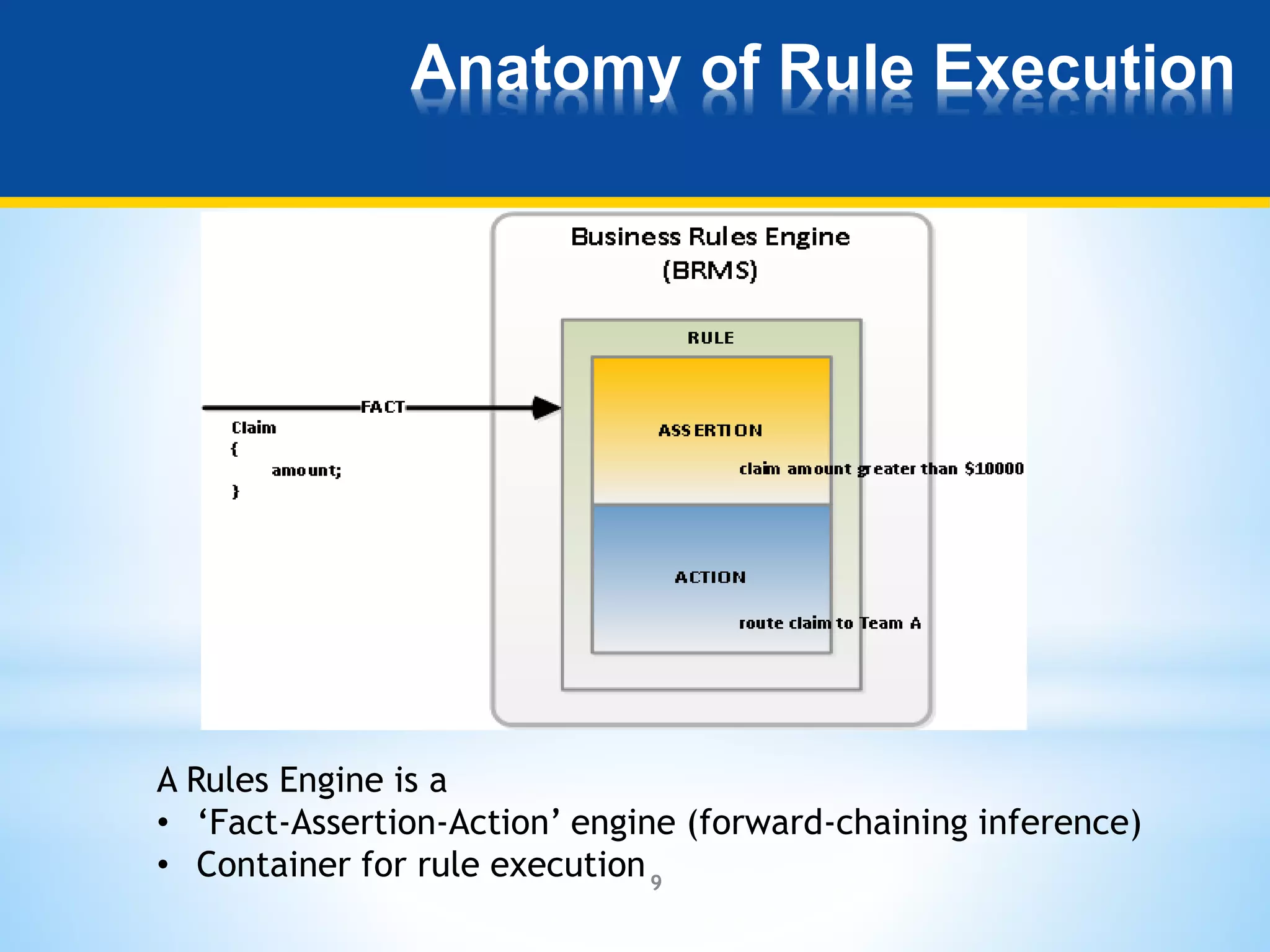
claim amount is greater than $10000 
7 
route claim to Team A 
A rule 
 is a Declarative Expression comprising of – 
and 
 can have multiple (and-ed/or-ed together) 
multiple (and-ed together) 
Rules can be grouped together – 
expressed as or 
Assertion 
Action
Anatomy of Rule Execution 
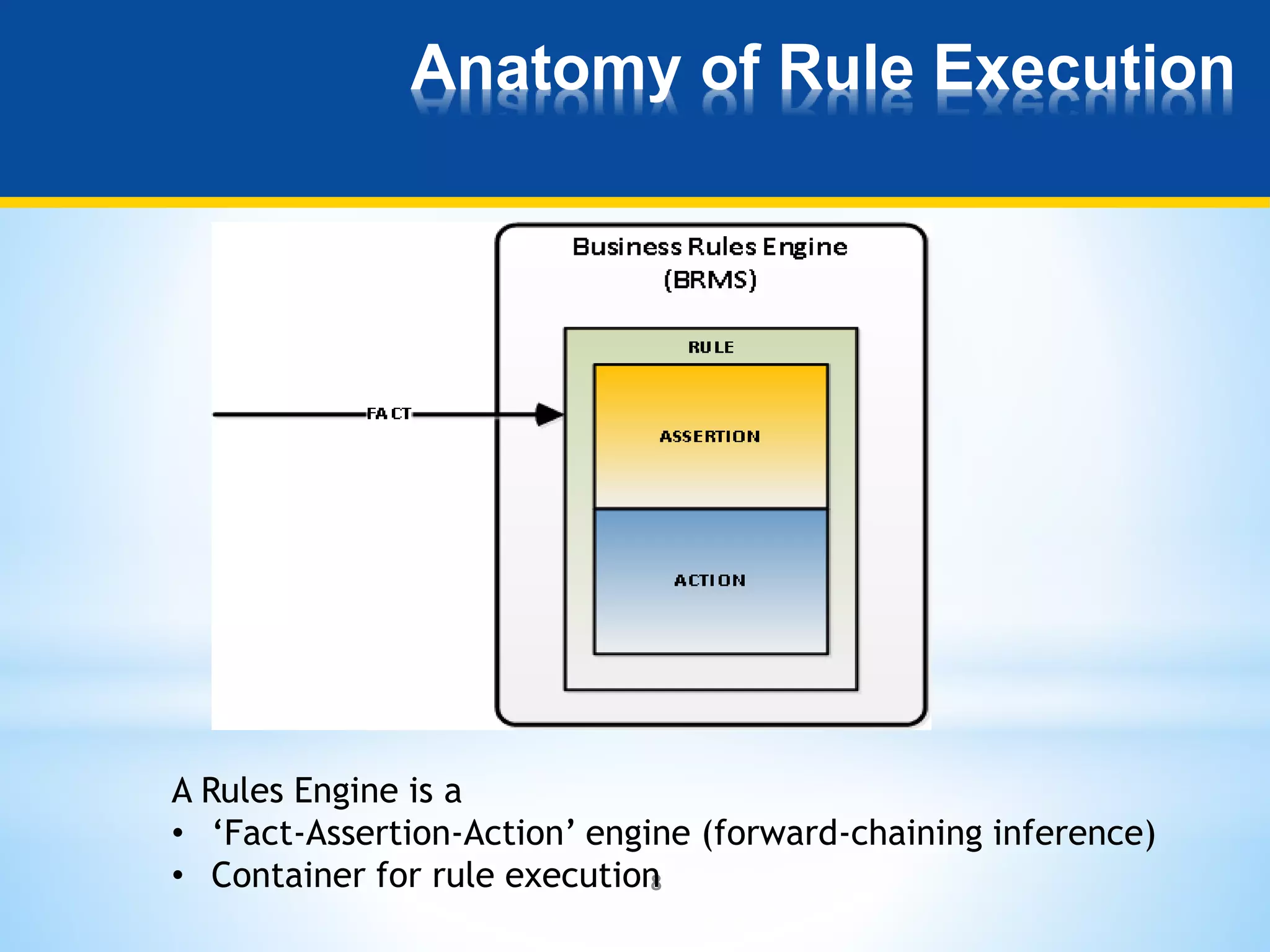
A Rules Engine is a 
• ‘Fact-Assertion-Action’ engine (forward-chaining inference) 
• Container for rule execution 
8
Anatomy of Rule Execution 
A Rules Engine is a 
• ‘Fact-Assertion-Action’ engine (forward-chaining inference) 
• Container for rule execution 
9
Business Rule Modeling 
 Mining Business Tier for Business Rules 
• Harvesting Business Rules – highly analytical, cross-functional 
team undertaking 
 Segregate Business Procedures from Business Rules 
 A Business Rule exists to facilitate Business Operational 
Decisioning 
• imperative - frequent modifiability 
 Business Rules provide control and governance 
• “way-we-do-business” 
• influence behavior of business 
10
Business Rule Modeling 
Frequently encountered question: 
What about validation check “rules”? 
Examples: 
• social security number validation 
• telephone number validation 
Can I implement validation check routines as “business rules”? 
You can, but should you? 
11
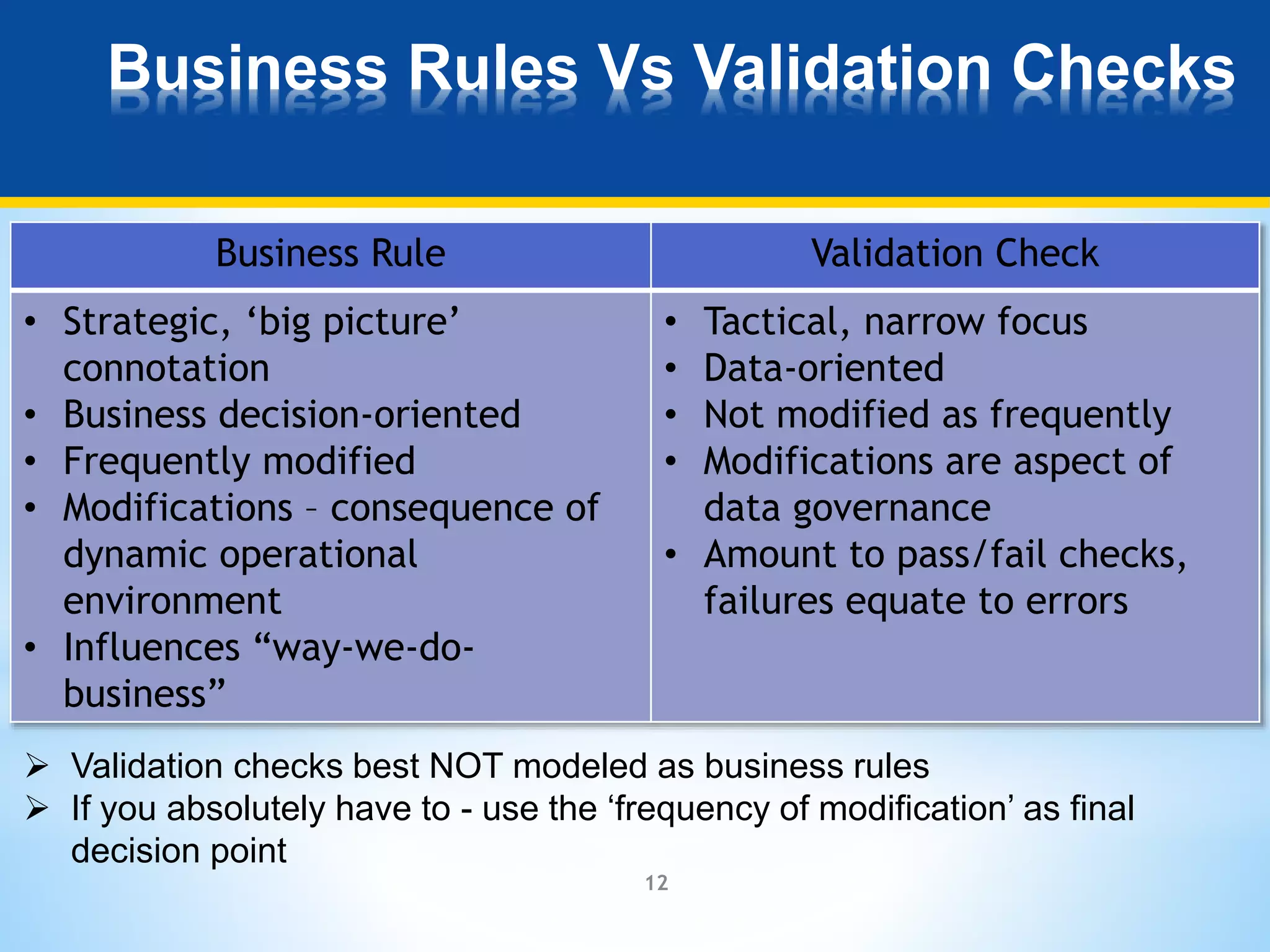
Business Rules Vs Validation Checks 
Business Rule Validation Check 
• Strategic, ‘big picture’ 
connotation 
• Business decision-oriented 
• Frequently modified 
• Modifications – consequence of 
dynamic operational 
environment 
• Influences “way-we-do-business” 
 Validation checks best NOT modeled as business rules 
 If you absolutely have to - use the ‘frequency of modification’ as final 
12 
decision point 
• Tactical, narrow focus 
• Data-oriented 
• Not modified as frequently 
• Modifications are aspect of 
data governance 
• Amount to pass/fail checks, 
failures equate to errors
Business Rule Modeling 
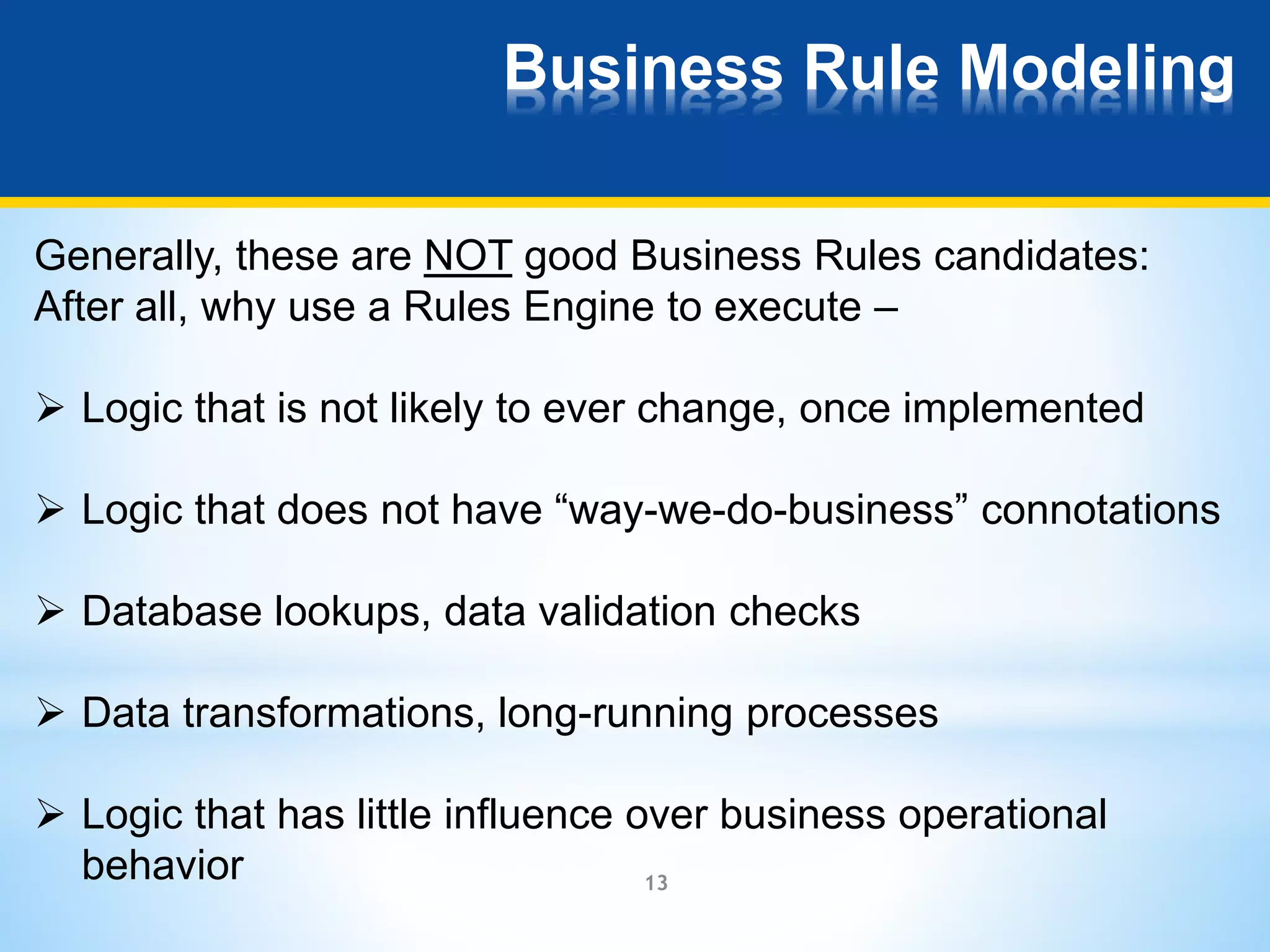
Generally, these are NOT good Business Rules candidates: 
After all, why use a Rules Engine to execute – 
 Logic that is not likely to ever change, once implemented 
 Logic that does not have “way-we-do-business” connotations 
 Database lookups, data validation checks 
 Data transformations, long-running processes 
 Logic that has little influence over business operational 
13 
behavior
14 
Thanks! 
Please stay in touch at - kdeshpande1@verizon.net

Business Rules - Design and Modeling Guidelines

  • 1.
    Rule Design Guidelinesand Best Practices 1 Keshav Deshpande Software Developer kdeshpande1@verizon.net
  • 2.
    • Application Architecturewith Business Rules • Separating Business Procedures from Business Rules 2 • Structure of a Business Rule • Anatomy of Rule Execution • Business Rule Modeling, Best Practices and Guidelines • Business Rules vs Validation Checks Topics
  • 3.
  • 4.
  • 5.
    Application Architecture withBusiness 5 Rules • Business procedure/workflow distinct from Business Rules • Business Rules hosted and executed within rules engine Implications  Separation of concerns • generally accepted as good application design pattern  Business rules can be independently modified • Modifications done outside of application code  Business Analysts can access/simulate/run/test Business Rules • in isolation from application
  • 6.
    Business Procedure VsBusiness Rules 6 Example Business Procedure: An incoming claim is routed to appropriate claim processor team, based on claim amount Example Business Rule: claim amount is greater than $10000 route claim to Team A Vs.
  • 7.
    Structure of aBusiness Rule claim amount is greater than $10000 7 route claim to Team A A rule  is a Declarative Expression comprising of – and  can have multiple (and-ed/or-ed together) multiple (and-ed together) Rules can be grouped together – expressed as or Assertion Action
  • 8.
    Anatomy of RuleExecution A Rules Engine is a • ‘Fact-Assertion-Action’ engine (forward-chaining inference) • Container for rule execution 8
  • 9.
    Anatomy of RuleExecution A Rules Engine is a • ‘Fact-Assertion-Action’ engine (forward-chaining inference) • Container for rule execution 9
  • 10.
    Business Rule Modeling  Mining Business Tier for Business Rules • Harvesting Business Rules – highly analytical, cross-functional team undertaking  Segregate Business Procedures from Business Rules  A Business Rule exists to facilitate Business Operational Decisioning • imperative - frequent modifiability  Business Rules provide control and governance • “way-we-do-business” • influence behavior of business 10
  • 11.
    Business Rule Modeling Frequently encountered question: What about validation check “rules”? Examples: • social security number validation • telephone number validation Can I implement validation check routines as “business rules”? You can, but should you? 11
  • 12.
    Business Rules VsValidation Checks Business Rule Validation Check • Strategic, ‘big picture’ connotation • Business decision-oriented • Frequently modified • Modifications – consequence of dynamic operational environment • Influences “way-we-do-business”  Validation checks best NOT modeled as business rules  If you absolutely have to - use the ‘frequency of modification’ as final 12 decision point • Tactical, narrow focus • Data-oriented • Not modified as frequently • Modifications are aspect of data governance • Amount to pass/fail checks, failures equate to errors
  • 13.
    Business Rule Modeling Generally, these are NOT good Business Rules candidates: After all, why use a Rules Engine to execute –  Logic that is not likely to ever change, once implemented  Logic that does not have “way-we-do-business” connotations  Database lookups, data validation checks  Data transformations, long-running processes  Logic that has little influence over business operational 13 behavior
  • 14.
    14 Thanks! Pleasestay in touch at - kdeshpande1@verizon.net