Business Rules
• Business Rules encapsulates the policies and decisions that control
business processes
• These policies may be formally defined in procedure manuals, contracts,
or agreements.
• These policies are dynamic and subject to change over time due to
changes in business plans, regulations or other reasons.
• Enable non-programmers to participate in creation and maintenance of
business policies.
Why Rules?
• There are 3 key reasons to use Business Rules in business process:
• Decouple Business logic from Application code
• Allow Business Analysts to have more control over business logic
management
• Changes to business logic go to production faster
Vocabulary
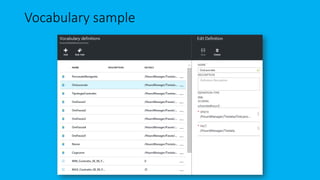
• A vocabulary is a collection of definitions consisting of friendly names
for the computing objects used in rule conditions and actions.
• Vocabulary definitions make the rules easier to read, understand, and
share by people in a particular business domain.
• Vocabularies are designed to bridge the gap between business semantics
and implementation.
An example … a data binding for an approval status might point to a certain column in a certain row in a certain
database, represented as an SQL query.
Vocabulary sample
Rules
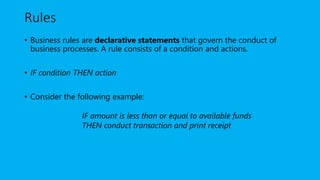
• Business rules are declarative statements that govern the conduct of
business processes. A rule consists of a condition and actions.
• IF condition THEN action
• Consider the following example:
IF amount is less than or equal to available funds
THEN conduct transaction and print receipt
Policy
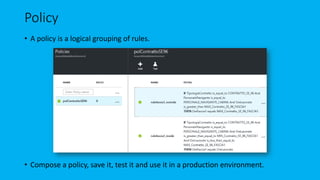
• A policy is a logical grouping of rules.
• Compose a policy, save it, test it and use it in a production environment.
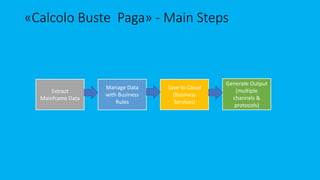
«Calcolo Buste Paga» - Main Steps
Extract
Mainframe Data
Manage Data
with Business
Rules
Save to Cloud
(Business
Services)
Generate Output
(multiple
channels &
protocols)
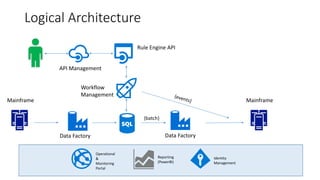
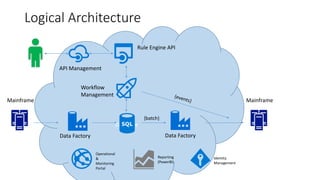
Logical Architecture
Mainframe
Database
Data Factory
Reporting
(PowerBI)
Operational
&
Monitoring
Portal
Data Factory
{batch}
Rule Engine API
Identity
Management
Mainframe
API Management
Workflow
Management
Logical Architecture
Mainframe
Database
Data Factory
Reporting
(PowerBI)
Operational
&
Monitoring
Portal
Data Factory
{batch}
Rule Engine API
Identity
Management
Mainframe
API Management
Workflow
Management
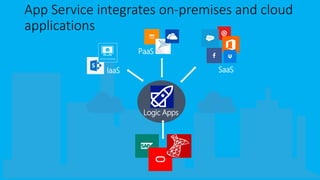
App Service integrates on-premises and cloud
applications
IaaS SaaS
PaaS
Logic Apps
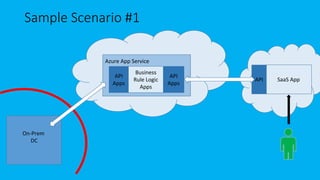
Sample Scenario #1
Azure App Service
Business
Rule Logic
Apps
API
Apps
API
Apps
SaaS AppAPI
On-Prem
DC
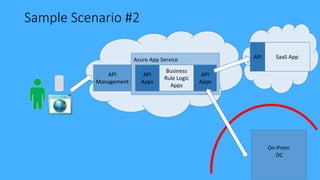
Sample Scenario #2
Azure App Service
Business
Rule Logic
Apps
API
Apps
API
Apps
On-Prem
DC
SaaS AppAPI
API
Management
Benefits
• Highly Scalable Rule Execution with Microsoft Azure
• More organizations are turning to Microsoft Azure to reduce costs and
provide scalability for mission critical applications.
• Reduce Total Cost of Ownership, Increase Adaptability
• Integrate with applications deployed in Microsoft Azure, reducing total
cost of ownership and increasing the adaptability of decision-making
applications.
• Reduce operating costs by eliminating server farms sized for peak
usage
• Scale out rule engine instances on demand
Azure Business rules v0.3

Azure Business rules v0.3

  • 3.
    Business Rules • BusinessRules encapsulates the policies and decisions that control business processes • These policies may be formally defined in procedure manuals, contracts, or agreements. • These policies are dynamic and subject to change over time due to changes in business plans, regulations or other reasons. • Enable non-programmers to participate in creation and maintenance of business policies.
  • 5.
    Why Rules? • Thereare 3 key reasons to use Business Rules in business process: • Decouple Business logic from Application code • Allow Business Analysts to have more control over business logic management • Changes to business logic go to production faster
  • 7.
    Vocabulary • A vocabularyis a collection of definitions consisting of friendly names for the computing objects used in rule conditions and actions. • Vocabulary definitions make the rules easier to read, understand, and share by people in a particular business domain. • Vocabularies are designed to bridge the gap between business semantics and implementation. An example … a data binding for an approval status might point to a certain column in a certain row in a certain database, represented as an SQL query.
  • 8.
  • 9.
    Rules • Business rulesare declarative statements that govern the conduct of business processes. A rule consists of a condition and actions. • IF condition THEN action • Consider the following example: IF amount is less than or equal to available funds THEN conduct transaction and print receipt
  • 10.
    Policy • A policyis a logical grouping of rules. • Compose a policy, save it, test it and use it in a production environment.
  • 12.
    «Calcolo Buste Paga»- Main Steps Extract Mainframe Data Manage Data with Business Rules Save to Cloud (Business Services) Generate Output (multiple channels & protocols)
  • 13.
    Logical Architecture Mainframe Database Data Factory Reporting (PowerBI) Operational & Monitoring Portal DataFactory {batch} Rule Engine API Identity Management Mainframe API Management Workflow Management
  • 14.
    Logical Architecture Mainframe Database Data Factory Reporting (PowerBI) Operational & Monitoring Portal DataFactory {batch} Rule Engine API Identity Management Mainframe API Management Workflow Management
  • 15.
    App Service integrateson-premises and cloud applications IaaS SaaS PaaS Logic Apps
  • 16.
    Sample Scenario #1 AzureApp Service Business Rule Logic Apps API Apps API Apps SaaS AppAPI On-Prem DC
  • 17.
    Sample Scenario #2 AzureApp Service Business Rule Logic Apps API Apps API Apps On-Prem DC SaaS AppAPI API Management
  • 18.
    Benefits • Highly ScalableRule Execution with Microsoft Azure • More organizations are turning to Microsoft Azure to reduce costs and provide scalability for mission critical applications. • Reduce Total Cost of Ownership, Increase Adaptability • Integrate with applications deployed in Microsoft Azure, reducing total cost of ownership and increasing the adaptability of decision-making applications. • Reduce operating costs by eliminating server farms sized for peak usage • Scale out rule engine instances on demand