Doing Enterprise Business with
      Processes & Rules
       Srinath Perera, Ph.D.
      Senior Software Architect
             WSO2 Inc.
Next 45 Minutes
●   Leave you with the Big picture
       – Why Rules and Business Processes?
       – For both: What? How does it work?
          What can I do with it? When to and not
          to use it?
       – Rules and Business Processes in real
          world
What is the Secret of
 Success for Organiza-
        tions?
 How to survive fierce competi-
             tion?
War and Business are two primary com-
     petitions we know in history!
     Many parallels between war and Business
      Art of War is thought in Business school
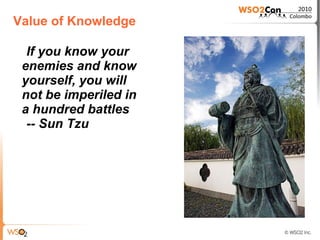
Value of Knowledge

  If you know your
 enemies and know
 yourself, you will
 not be imperiled in
 a hundred battles
  -- Sun Tzu
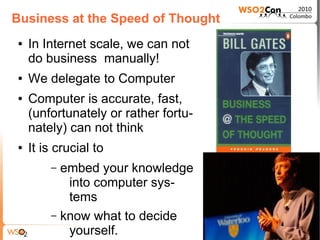
Business at the Speed of Thought
●   In Internet scale, we can not
    do business manually!
●   We delegate to Computer
●   Computer is accurate, fast,
    (unfortunately or rather fortu-
    nately) can not think
●   It is crucial to
        – embed your knowledge
           into computer sys-
           tems
        – know what to decide
           yourself.
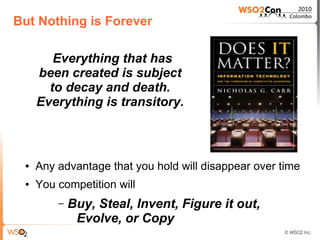
But Nothing is Forever

        Everything that has
     been created is subject
       to decay and death.
     Everything is transitory.


 ●   Any advantage that you hold will disappear over time
 ●   You competition will
         –   Buy, Steal, Invent, Figure it out,
              Evolve, or Copy
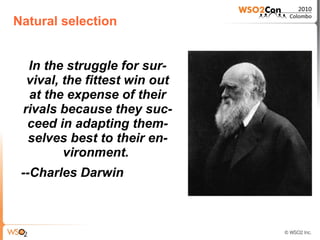
Natural selection


  In the struggle for sur-
  vival, the fittest win out
  at the expense of their
 rivals because they suc-
  ceed in adapting them-
  selves best to their en-
         vironment.
 --Charles Darwin
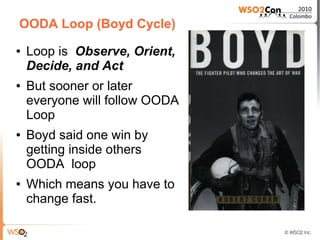
OODA Loop (Boyd Cycle)
●   Loop is Observe, Orient,
    Decide, and Act
●   But sooner or later
    everyone will follow OODA
    Loop
●   Boyd said one win by
    getting inside others
    OODA loop
●   Which means you have to
    change fast.
Adaptation
 An organization's abil-
 ity to learn, and trans-
 late that learning into
 action rapidly, is the
 ultimate competitive
 advantage.
       --Jack Welch
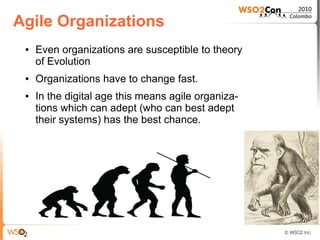
Agile Organizations
 ●   Even organizations are susceptible to theory
     of Evolution
 ●   Organizations have to change fast.
 ●   In the digital age this means agile organiza-
     tions which can adept (who can best adept
     their systems) has the best chance.
Point Is
 ●   Knowledge (how we should act) is the greatest
     assert of an organization
 ●   Agile organizations who can understand and
     best adopt themselves (knowledge) has best
     chance of survival
 ●   In the digital age

  To change fast, you have to be able to
  to quickly change knowledge embed-
        ded within your systems!
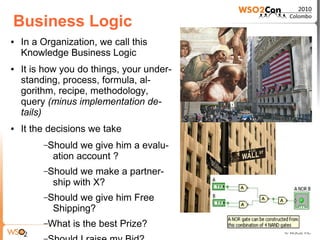
Business Logic
●   In a Organization, we call this
    Knowledge Business Logic
●   It is how you do things, your under-
    standing, process, formula, al-
    gorithm, recipe, methodology,
    query (minus implementation de-
    tails)
●   It the decisions we take
         –Should  we give him a evalu-
           ation account ?
         –Should we make a partner-
           ship with X?
         –Should we give him Free
           Shipping?
         –What   is the best Prize?
Business Logic Separation
●   Business logic changes much faster than rest
    of the system
●   If your code and logic are mesh together, it is a
    nightmare to change them.


  We need to sep-
arate the Business
 logic from code
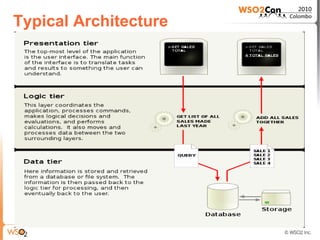
Typical Architecture
 ●   Mash all together architecture
 ●   3 tire architecture
 ●   Even with 3 tier architecture still logic is buried in the code
     within services
 ●   Good luck in locating and changing them.
What do we need?
 ●   Separated Business logic
 ●   Store and manage (edit, share, delete) them in a one
     place and through one User Interface.
 ●   If possible in easy to understandable form
 ●   Edit them Visually when possible.

 Let's discuss two ways
to implement this separ-
          ation:
    Rules and Business
        Process
Business Rules
What are Rules?
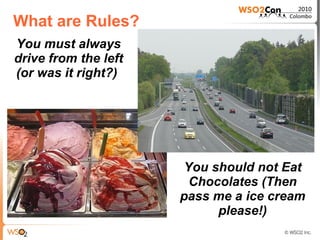
You must always
drive from the left
(or was it right?)


                      You should not Eat
                       Chocolates (Then
                      pass me a ice cream
                           please!)
What are Rules? (Contd.)
●   It is a knowledge representation. (usually partial
    knowledge)
●   Four types
        1)Derivation or Deduction Rules – Each rule
           express if some statements are true, another
           statement must be true. Called logical
           implication. E.g. Prolog
        2)Transformation Rules- transform between
           knowledge bases, e.g. theorem proving
        3)Integrity Constraints – verification rules
        4)Reaction or Event-Condition-Action (ECA) Rules
           – includes an actions in addition to inference.
           e.g. Drools
How do Rules work?
    ●   Data represented as Facts
    ●   Knowledge represented as Rules
    ●   A Rule engine evaluates Facts against Rules, and optionally
        carry out specified actions. (e.g Drools, JESS)


    Two types of Rules Engines:
●   Forward Chaining – starts with
    facts/data and trigger actions or
    output conclusions (Drools)
●   Backward chaining – starts with
    goals and search how to satisfy
    them (e.g. Prolog)
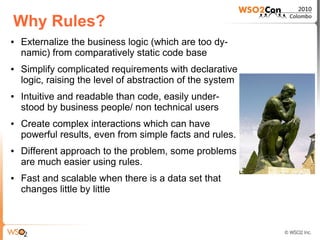
Why Rules?
●   Externalize the business logic (which are too dy-
    namic) from comparatively static code base
●   Simplify complicated requirements with declarative
    logic, raising the level of abstraction of the system
●   Intuitive and readable than code, easily under-
    stood by business people/ non technical users
●   Create complex interactions which can have
    powerful results, even from simple facts and rules.
●   Different approach to the problem, some problems
    are much easier using rules.
●   Fast and scalable when there is a data set that
    changes little by little
When to use Rules?
●   To separate code and business lo-
    gic
●   When the logic changes often
●   When Domain experts are none
    technical.
●   When all else failed! (When there is
    no satisfactory traditional program-
    ming approach to solve the prob-
    lem! Rules are good in solving prob-
    lems that are not fully understood).
When NOT to use Rules?
 ●   It is slower than usual code most of the time, so unless there
     are obvious benefits
 ●   Complexity of logic is hard to tackle, and one mistake could
     change the results drastically and in unexpected ways (e.g.
     recursive rules)
 ●   More effort for testing and debugging is required, so if results
     are hard to be verified, it should not be used.
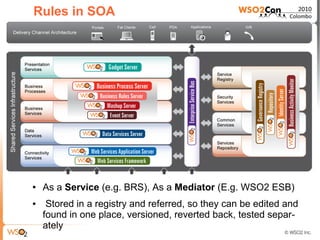
Rules in SOA


●   As a Service (e.g. BRS), As a Mediator (E.g. WSO2 ESB)
●    Stored in a registry and referred, so they can be edited and
    found in one place, versioned, reverted back, tested separ-
    ately
Rules in Action?
 ●   Decision tables – in a bidding system, map the bidding rules
     to a Decision table implemented with a Excel file. Business
     analysts can change the Excel file and change Business logic
     of the system.
 ●   A Domain Specific Language that interfaces with rules are
     used to describe when free shipping offers should be given to
     the user. Business analysts change the DSL scripts stored in
     the registry, and Business logic of the system changes.
 ●   Rules are used to route documents between several de-
     partments to increase the processing efficiency. When a new
     pattern is observed, it can be easily added.
 ●   Rules are used to detect error conditions in a complex de-
     ployment and it is easy to add new error conditions by adding
     new rules.
Business Processes
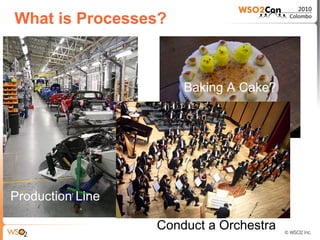
What is Processes?


                      Baking A Cake?


Production Line

                  Conduct a Orchestra
What are Processes?
 ●   Process captures a set of activities designed to
     achieve a specific goal.
 ●   It is a formula, or algorithm, recipe etc.
 ●   Unlike rules, activities in a process are very well con-
     nected with each other (a clear flow).
 ●   Examples
         –   Adding a new employee: Sign the contract, create an
               account, assign to a team, give permissions, assign
               a seat, order hadrware etc.
         –   Release a Product: Design, develop, test, market, ..
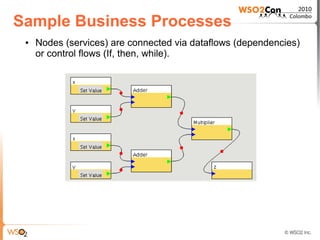
Sample Business Processes
 ●   Nodes (services) are connected via dataflows (dependencies)
     or control flows (If, then, while).
How do Business Processes Work?
    ●   Business process is described using a Workflow language
        (e.g. BPEL, BPMN, Python, Java Script)
    ●   Just like a java script runtime executes java scripts, a workflow
        engine executes the workflow description.
             –   e.g. Apache ODE, WSO2 BPS, MS Workflow Founda-
                   tion, Dryad by MSR etc.

●   It is a programming language:
●   Support messaging, asyn-
    chronous invocations etc. as
    first class
    Real difference lies in the
                                            Curiosity is good,
●


    level of abstraction.
                                           unless you are a cat
Why Processes?
●   Abstract out the business logic
●   A different level of abstraction to
    manage the logic

    ●   Special features
             –   Can be visualized, analyzed, and verified
             –   Execution can be monitored
             –   Execution can be hibernated and resumed
             –   Failed workflows can be recovered
             –   Can visually composed
             –   Workfows can be manipulated at runtime
When to use Processes?
●   To abstract out the Business Logic
●   When there are many reusable com-
    ponents (services) that can be com-
    posed together (Mathlab like environ-
    ments)
●   Easy way to evolve the logic (edit)
●   For long running processes where
    monitoring, recovery, hibernation are
    expected.
●   When we want to track how business
    process evolution took place (through
    provenance)
When NOT to use Processes?
  ●   Workflows are often slower than normal code
  ●   Add dependency to new tools (workflow engine), complex to
      setup and harder to debug.
  ●   When logic is too complex (consider implementing complex
      parts as services)
  ●   Do not use unless there are clear benefits
Business Process Execution
 Language (BPEL)
 ●   A programming abstraction that allows developers
     to compose multiple synchronous and asynchronous
     Web services into an end-to-end business flow
 ●   Constructs:
         –   Messaging: invoke, receive, reply, assign,
         –   Structured: sequence, flow, if, while, repeatUntil
         –   Exception handling: fault Handlers (throw catch)
         –   Event processing: onMessage, onAlarm
 ●   Human Task extensions: Let workflows interact with
     humans
 ●   BPMN (Business Process Modeling Notation)
         –   a visual notation for workflows.
Processes in Action
 ●   A Service composition Environment: Expose
     a set of tools as services and use workflows to create
     an environment where users can compose (mash)
     them to create interesting processes.
         –   E.g. Science toolkit
 ●   Governance workflows: Workflows to capture
     processes associated with services in a registry dev-
     >test->production environment
 ●   Modeling Internal process of an organiza-
     tion as Workflows
 ●   Long running business processes: (ability to
     hibernate, recover, and monitor executions)
         –   e.g. Long running scientific worklflows.
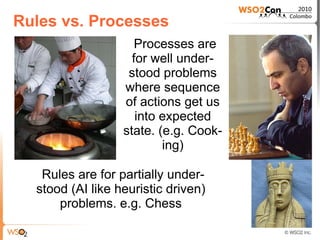
Rules vs. Processes
                     Processes are
                    for well under-
        ●
                   stood problems
        ●         where sequence
                  of actions get us
                     into expected
                  state. (e.g. Cook-
                          ing)

   Rules are for partially under-
  stood (AI like heuristic driven)
      problems. e.g. Chess
Conclusion
 ●   Knowledge (Business Logic) is the greatest
     assert to a organizations
 ●   Organizations that can adept themselves to
     change have the best chance of survival
 ●   Separating the Business logic from the code
     enables Business logic to evolve and man-
     aged separately
 ●   Business Rules and Business processes are
     two ways to extract out business logic.
 ●   We discussed them and their applications with-
     in Enterprise Architecture.
Questions?

Doing Enterprise Business with Processes & Rules

  • 1.
    Doing Enterprise Businesswith Processes & Rules Srinath Perera, Ph.D. Senior Software Architect WSO2 Inc.
  • 2.
    Next 45 Minutes ● Leave you with the Big picture – Why Rules and Business Processes? – For both: What? How does it work? What can I do with it? When to and not to use it? – Rules and Business Processes in real world
  • 3.
    What is theSecret of Success for Organiza- tions? How to survive fierce competi- tion? War and Business are two primary com- petitions we know in history! Many parallels between war and Business Art of War is thought in Business school
  • 4.
    Value of Knowledge If you know your enemies and know yourself, you will not be imperiled in a hundred battles -- Sun Tzu
  • 5.
    Business at theSpeed of Thought ● In Internet scale, we can not do business manually! ● We delegate to Computer ● Computer is accurate, fast, (unfortunately or rather fortu- nately) can not think ● It is crucial to – embed your knowledge into computer sys- tems – know what to decide yourself.
  • 6.
    But Nothing isForever Everything that has been created is subject to decay and death. Everything is transitory. ● Any advantage that you hold will disappear over time ● You competition will – Buy, Steal, Invent, Figure it out, Evolve, or Copy
  • 7.
    Natural selection In the struggle for sur- vival, the fittest win out at the expense of their rivals because they suc- ceed in adapting them- selves best to their en- vironment. --Charles Darwin
  • 8.
    OODA Loop (BoydCycle) ● Loop is Observe, Orient, Decide, and Act ● But sooner or later everyone will follow OODA Loop ● Boyd said one win by getting inside others OODA loop ● Which means you have to change fast.
  • 9.
    Adaptation An organization'sabil- ity to learn, and trans- late that learning into action rapidly, is the ultimate competitive advantage. --Jack Welch
  • 10.
    Agile Organizations ● Even organizations are susceptible to theory of Evolution ● Organizations have to change fast. ● In the digital age this means agile organiza- tions which can adept (who can best adept their systems) has the best chance.
  • 11.
    Point Is ● Knowledge (how we should act) is the greatest assert of an organization ● Agile organizations who can understand and best adopt themselves (knowledge) has best chance of survival ● In the digital age To change fast, you have to be able to to quickly change knowledge embed- ded within your systems!
  • 12.
    Business Logic ● In a Organization, we call this Knowledge Business Logic ● It is how you do things, your under- standing, process, formula, al- gorithm, recipe, methodology, query (minus implementation de- tails) ● It the decisions we take –Should we give him a evalu- ation account ? –Should we make a partner- ship with X? –Should we give him Free Shipping? –What is the best Prize?
  • 13.
    Business Logic Separation ● Business logic changes much faster than rest of the system ● If your code and logic are mesh together, it is a nightmare to change them. We need to sep- arate the Business logic from code
  • 14.
    Typical Architecture ● Mash all together architecture ● 3 tire architecture ● Even with 3 tier architecture still logic is buried in the code within services ● Good luck in locating and changing them.
  • 15.
    What do weneed? ● Separated Business logic ● Store and manage (edit, share, delete) them in a one place and through one User Interface. ● If possible in easy to understandable form ● Edit them Visually when possible. Let's discuss two ways to implement this separ- ation: Rules and Business Process
  • 16.
  • 17.
    What are Rules? Youmust always drive from the left (or was it right?) You should not Eat Chocolates (Then pass me a ice cream please!)
  • 18.
    What are Rules?(Contd.) ● It is a knowledge representation. (usually partial knowledge) ● Four types 1)Derivation or Deduction Rules – Each rule express if some statements are true, another statement must be true. Called logical implication. E.g. Prolog 2)Transformation Rules- transform between knowledge bases, e.g. theorem proving 3)Integrity Constraints – verification rules 4)Reaction or Event-Condition-Action (ECA) Rules – includes an actions in addition to inference. e.g. Drools
  • 19.
    How do Ruleswork? ● Data represented as Facts ● Knowledge represented as Rules ● A Rule engine evaluates Facts against Rules, and optionally carry out specified actions. (e.g Drools, JESS) Two types of Rules Engines: ● Forward Chaining – starts with facts/data and trigger actions or output conclusions (Drools) ● Backward chaining – starts with goals and search how to satisfy them (e.g. Prolog)
  • 20.
    Why Rules? ● Externalize the business logic (which are too dy- namic) from comparatively static code base ● Simplify complicated requirements with declarative logic, raising the level of abstraction of the system ● Intuitive and readable than code, easily under- stood by business people/ non technical users ● Create complex interactions which can have powerful results, even from simple facts and rules. ● Different approach to the problem, some problems are much easier using rules. ● Fast and scalable when there is a data set that changes little by little
  • 21.
    When to useRules? ● To separate code and business lo- gic ● When the logic changes often ● When Domain experts are none technical. ● When all else failed! (When there is no satisfactory traditional program- ming approach to solve the prob- lem! Rules are good in solving prob- lems that are not fully understood).
  • 22.
    When NOT touse Rules? ● It is slower than usual code most of the time, so unless there are obvious benefits ● Complexity of logic is hard to tackle, and one mistake could change the results drastically and in unexpected ways (e.g. recursive rules) ● More effort for testing and debugging is required, so if results are hard to be verified, it should not be used.
  • 23.
    Rules in SOA ● As a Service (e.g. BRS), As a Mediator (E.g. WSO2 ESB) ● Stored in a registry and referred, so they can be edited and found in one place, versioned, reverted back, tested separ- ately
  • 24.
    Rules in Action? ● Decision tables – in a bidding system, map the bidding rules to a Decision table implemented with a Excel file. Business analysts can change the Excel file and change Business logic of the system. ● A Domain Specific Language that interfaces with rules are used to describe when free shipping offers should be given to the user. Business analysts change the DSL scripts stored in the registry, and Business logic of the system changes. ● Rules are used to route documents between several de- partments to increase the processing efficiency. When a new pattern is observed, it can be easily added. ● Rules are used to detect error conditions in a complex de- ployment and it is easy to add new error conditions by adding new rules.
  • 25.
  • 26.
    What is Processes? Baking A Cake? Production Line Conduct a Orchestra
  • 27.
    What are Processes? ● Process captures a set of activities designed to achieve a specific goal. ● It is a formula, or algorithm, recipe etc. ● Unlike rules, activities in a process are very well con- nected with each other (a clear flow). ● Examples – Adding a new employee: Sign the contract, create an account, assign to a team, give permissions, assign a seat, order hadrware etc. – Release a Product: Design, develop, test, market, ..
  • 28.
    Sample Business Processes ● Nodes (services) are connected via dataflows (dependencies) or control flows (If, then, while).
  • 29.
    How do BusinessProcesses Work? ● Business process is described using a Workflow language (e.g. BPEL, BPMN, Python, Java Script) ● Just like a java script runtime executes java scripts, a workflow engine executes the workflow description. – e.g. Apache ODE, WSO2 BPS, MS Workflow Founda- tion, Dryad by MSR etc. ● It is a programming language: ● Support messaging, asyn- chronous invocations etc. as first class Real difference lies in the Curiosity is good, ● level of abstraction. unless you are a cat
  • 30.
    Why Processes? ● Abstract out the business logic ● A different level of abstraction to manage the logic ● Special features – Can be visualized, analyzed, and verified – Execution can be monitored – Execution can be hibernated and resumed – Failed workflows can be recovered – Can visually composed – Workfows can be manipulated at runtime
  • 31.
    When to useProcesses? ● To abstract out the Business Logic ● When there are many reusable com- ponents (services) that can be com- posed together (Mathlab like environ- ments) ● Easy way to evolve the logic (edit) ● For long running processes where monitoring, recovery, hibernation are expected. ● When we want to track how business process evolution took place (through provenance)
  • 32.
    When NOT touse Processes? ● Workflows are often slower than normal code ● Add dependency to new tools (workflow engine), complex to setup and harder to debug. ● When logic is too complex (consider implementing complex parts as services) ● Do not use unless there are clear benefits
  • 33.
    Business Process Execution Language (BPEL) ● A programming abstraction that allows developers to compose multiple synchronous and asynchronous Web services into an end-to-end business flow ● Constructs: – Messaging: invoke, receive, reply, assign, – Structured: sequence, flow, if, while, repeatUntil – Exception handling: fault Handlers (throw catch) – Event processing: onMessage, onAlarm ● Human Task extensions: Let workflows interact with humans ● BPMN (Business Process Modeling Notation) – a visual notation for workflows.
  • 34.
    Processes in Action ● A Service composition Environment: Expose a set of tools as services and use workflows to create an environment where users can compose (mash) them to create interesting processes. – E.g. Science toolkit ● Governance workflows: Workflows to capture processes associated with services in a registry dev- >test->production environment ● Modeling Internal process of an organiza- tion as Workflows ● Long running business processes: (ability to hibernate, recover, and monitor executions) – e.g. Long running scientific worklflows.
  • 35.
    Rules vs. Processes Processes are for well under- ● stood problems ● where sequence of actions get us into expected state. (e.g. Cook- ing) Rules are for partially under- stood (AI like heuristic driven) problems. e.g. Chess
  • 36.
    Conclusion ● Knowledge (Business Logic) is the greatest assert to a organizations ● Organizations that can adept themselves to change have the best chance of survival ● Separating the Business logic from the code enables Business logic to evolve and man- aged separately ● Business Rules and Business processes are two ways to extract out business logic. ● We discussed them and their applications with- in Enterprise Architecture.
  • 37.