MANAGING ERP SECURITY
Introduction
 To mange the risk regarding ERP
implementation and ERP project is much
larger issue and need to be seen as a whole to
ensure that ERP system is implemented and
operated successfully during the life cycle
TYPES OF ERP SECURITY ISSUES
 Network Security :
 Selected customers and suppliers with whom a
company need collaboration should be allowed
within company’s FIREWALL and should be able
to see only relevant data.
 Secured network to avoid hackers
TYPES OF ERP SECURITY ISSUES
 SystemAccess Security – Role &
Authorisation
 Valid authorization and authentication for each
employee in the organization
 “For example the person creating purchase order
should not be allowed to release payment”
TYPES OF ERP SECURITY ISSUES
 Data Security
 During ERP implementation company’s sensitive
data are visible to the implementation team
members.
 Security of the data are more important to the
companies like bank,defence,credit card etc…
SYSTEM BASED SECURITY- AUTHORISATIONS
Depending upon the roles and responsibly of
the employees two types of authorization
strategies are supported by ERPs
(I) Activity based authorization
(II) Role based authorization
Activity Based Authorizations
Steps:
1. Indentify the activities of the particular
process may involve
2. Prepare set of transaction code for each
activity
3. Prepare authorization role for each
transaction
4. Assign the user the specific role
For Example – Leave Approval Process
(I) Identify the activities
(I) View Leave Balances
(II) Execute and approve workflow for leave request
(II) Prepare set of code
(I) View Leave Balances - XX
(II) Execute and approve workflow –YY
(III) Prepare authorization role
Z:HR_APPROVE_LEAVES will consists XX and
YY.
Advantage and Disadvantage
Advantage of activity based is Flexibility in
assigning various combination of transaction
sets.
Disadvantage isTransaction code should be
carefully created to avoid duplication
Role Based Authorization
Instead of focusing on individual activity here
authorization is created for a “Role” for example
“Procurement Role”.
Steps:
(I) Identify the transaction codes that each role in
organization require
(II) Prepare authorization role for list of transaction
(III) Assign role to the user.
Advantage and Disadvantage
Advantage of role based is authorization role
becomes specific to identified role in a
function, therefore future modification can
be managed easily.
Disadvantage : This method requires careful
standardization of roles.
Different Types of
Authorization
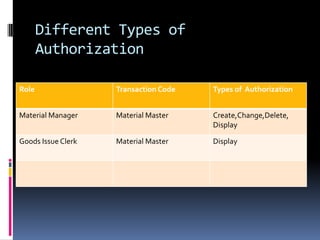
Role Transaction Code Types of Authorization
Material Manager Material Master Create,Change,Delete,
Display
Goods Issue Clerk Material Master Display
Data Security and Technology
For Managing DATA
Data Masking:
The Process of concealing sensitive data in
development, test or training environment so
that developers or testers do not get exposed
to this data.
Benefits:
1. It meets regulatory compliance
requirement
2. It enhance data security for outsourcing
application
Data Masking Algorithms
1. Shuffling / Reorder
2. RandomValue
3. Hashing
4. Date aging
5. NumericAlternation
6. Custom
7. Substitution with a random value
 IBM optim is popular data masking tool

Erp security1

  • 1.
  • 2.
    Introduction  To mangethe risk regarding ERP implementation and ERP project is much larger issue and need to be seen as a whole to ensure that ERP system is implemented and operated successfully during the life cycle
  • 3.
    TYPES OF ERPSECURITY ISSUES  Network Security :  Selected customers and suppliers with whom a company need collaboration should be allowed within company’s FIREWALL and should be able to see only relevant data.  Secured network to avoid hackers
  • 4.
    TYPES OF ERPSECURITY ISSUES  SystemAccess Security – Role & Authorisation  Valid authorization and authentication for each employee in the organization  “For example the person creating purchase order should not be allowed to release payment”
  • 5.
    TYPES OF ERPSECURITY ISSUES  Data Security  During ERP implementation company’s sensitive data are visible to the implementation team members.  Security of the data are more important to the companies like bank,defence,credit card etc…
  • 6.
    SYSTEM BASED SECURITY-AUTHORISATIONS Depending upon the roles and responsibly of the employees two types of authorization strategies are supported by ERPs (I) Activity based authorization (II) Role based authorization
  • 7.
    Activity Based Authorizations Steps: 1.Indentify the activities of the particular process may involve 2. Prepare set of transaction code for each activity 3. Prepare authorization role for each transaction 4. Assign the user the specific role
  • 8.
    For Example –Leave Approval Process (I) Identify the activities (I) View Leave Balances (II) Execute and approve workflow for leave request (II) Prepare set of code (I) View Leave Balances - XX (II) Execute and approve workflow –YY (III) Prepare authorization role Z:HR_APPROVE_LEAVES will consists XX and YY.
  • 9.
    Advantage and Disadvantage Advantageof activity based is Flexibility in assigning various combination of transaction sets. Disadvantage isTransaction code should be carefully created to avoid duplication
  • 10.
    Role Based Authorization Insteadof focusing on individual activity here authorization is created for a “Role” for example “Procurement Role”. Steps: (I) Identify the transaction codes that each role in organization require (II) Prepare authorization role for list of transaction (III) Assign role to the user.
  • 11.
    Advantage and Disadvantage Advantageof role based is authorization role becomes specific to identified role in a function, therefore future modification can be managed easily. Disadvantage : This method requires careful standardization of roles.
  • 12.
    Different Types of Authorization RoleTransaction Code Types of Authorization Material Manager Material Master Create,Change,Delete, Display Goods Issue Clerk Material Master Display
  • 13.
    Data Security andTechnology For Managing DATA Data Masking: The Process of concealing sensitive data in development, test or training environment so that developers or testers do not get exposed to this data. Benefits: 1. It meets regulatory compliance requirement 2. It enhance data security for outsourcing application
  • 14.
    Data Masking Algorithms 1.Shuffling / Reorder 2. RandomValue 3. Hashing 4. Date aging 5. NumericAlternation 6. Custom 7. Substitution with a random value  IBM optim is popular data masking tool