The Emerald Research Register for this journal is available at            The current issue and full text archive of this journal is available at
   www.emeraldinsight.com/researchregister                                   www.emeraldinsight.com/1741-0398.htm


JEIM
18,4                                      Factors affecting ERP system
                                                    adoption
                                        A comparative analysis between SMEs and
384                                                 large companies
                                                   G. Buonanno, P. Faverio, F. Pigni, A. Ravarini,
                                                           D. Sciuto and M. Tagliavini
                                                                   `
                                                    CETIC Universita Cattaneo – LIUC, Castellanza, Italy

                                     Abstract
                                     Purpose – Proposes providing an insight about enterprise resource planning (ERP) adoption,
                                     highlighting contact points and significant differences between the way small to medium-sized
                                     enterprises (SMEs) and large companies approach such a task.
                                     Design/methodology/approach – The research is based on a wide literature review, focused on the
                                     identification of a taxonomy of business and organizational factors influencing ERP adoption. The
                                     deriving research model was incorporated in a questionnaire that was preliminarily tested and finally
                                     provided to a sample of 366 companies of any size. Responses were collected through personal
                                     interviews made by a dedicated team to a top manager.
                                     Findings – The analysis of the empirical data shows that business complexity, as a composed factor,
                                     is a weak predictor of ERP adoption, whereas just company size turns out to be a very good one. In
                                     other words, companies seem to be disregarding ERP systems as an answer to their business
                                     complexity. Unexpectedly, SMEs disregard financial constraints as the main cause for ERP system
                                     non-adoption, suggesting structural and organizational reasons as major ones. This pattern is
                                     partially different from what was observed in large organizations where the first reason for not
                                     adopting an ERP system is organizational. Moreover, the decision process regarding the adoption of
                                     ERP systems within SMEs is still more affected by exogenous reasons or “opportunity of the moment”
                                     than business-related factors, contrary to large companies that are more interested in managing
                                     process integration and data redundancy/inconsistency through ERP implementation.
                                     Research limitations/implications – The research model is based on the assumption that
                                     business complexity and organizational change are the most relevant variables influencing ERP
                                     adoption, and such variables are explained through a set of factors inherently limited by the results of
                                     the literature review.
                                     Practical implications – The results of the empirical research provide indication to SMEs willing
                                     to take into consideration the adoption of an ERP system. The same outcomes could be incorporated
                                     into the development strategies of ERP software houses.
                                     Originality/value – This paper contributes to enhancing the understanding of the factors
                                     influencing the evolution of information systems within SMEs with respect to large companies.
                                     Keywords Manufacturing resource planning, Small to medium-sized enterprises, Organizational change
                                     Paper type Research paper


Journal of Enterprise Information    Introduction
Management                           The capability of enterprise resource planning (ERP) systems to manage a company’s
Vol. 18 No. 4, 2005
pp. 384-426                          resources efficiently and effectively by providing a total, integrated solution for its
q Emerald Group Publishing Limited
1741-0398
                                     information processing needs (Fui Hoon Nah et al., 2001) has persuaded both
DOI 10.1108/17410390510609572        practitioners and managers of the importance of integrated systems, not only for large
multinational organizations, but also for small and medium-sized firms (Van                     Factors affecting
Everdingen et al., 2000).                                                                          ERP system
    The evaluation of the contribution of ERP systems in terms of both value creation and
economic returns is a difficult task, because of the extent of the organizational changes               adoption
(Lozinsky, 1999; Shtub, 1999; Willcocks and Lacity, 1998) to which their implementation
leads, as well as the difficulties in predicting the return on investment (Mabert et al.,
2001). The competences required to manage properly the organizational change                               385
determined by an ERP system implementation is still a debated issue. The most qualified
literature has always stressed the importance of change and project management
competences as critical success factors for ERP implementation (Davenport, 2000;
Mandal and Gunasekaran, 2003; Motwani et al., 2002), hereby indirectly raising the issue
of small to medium-sized enterprises’s (SMEs’s) lack of organizational preparation. Such
a situation is mainly caused by the low extent of formalization of people’s roles and
responsibilities that is expressed by with their continuous re-shuffle (Dutta and Evrard,
1999). This structural condition makes the identification of ERP implementation’s main
figures, such as the process owner and the key user (Davenport, 2000), extremely difficult
to achieve. Beside this, SMEs generally suffer from a widespread lack of culture, as to the
concept of business process: it is not by chance that the reinforcement of the concept of
business process is often claimed among the critical success factors in ERP
implementation (Beretta, 2002). In particular, the business process concept helps
promoting co-operation and convergence of efforts among managers (i.e. managerial
integration), versus the internal competition induced by the functionally-oriented
organizational models which is typical of SMEs.
    One of the most misleading legacies of traditional software project management is
that the company expects to gain value from the use of the software application as soon
as it is installed (Al-Mashari et al., 2003). Since the adoption of an ERP system requires
extensive efforts, both for the technological and business aspects of the
implementation, neither information technology (IT) practitioners nor researchers
have developed a deterministic method to evaluate the related impacts (Al-Mashari,
2002). In spite of the benefits potentially offered by ERP systems (Banker et al., 1998;
Davenport, 1998; Gable, 1998; Hicks and Stecke, 1998; Minahan, 1998) the evaluation
issue plays an essential role regardless the company size; during the planning phase it
is critical for companies to figure out whether a specific ERP system fits their business
practices. When the features of the software application do not correctly fit the
business requirements two possible strategies can be identified:
    (1) Change the business processes to fit the software with minimal customization. On
         one hand, fewer modifications to the software application should reduce errors
         and help to take advantage of newer versions and releases (Fui Hoon Nah et al.,
         2001). On the other hand, this choice could mean changes in long-established
         ways of doing business (that often provide competitive advantage), and could
         shake up important people roles and responsibilities (Dewett and Jones, 2001;
         Koch et al., 1999).
    (2) Modify the software to fit the processes. This choice would slow down the
         project, could affect the stability and correctness of the software application and
         could increase the difficulty of managing future releases, because the
         customizations could need to be torn apart and rewritten to work with the
         newer version (Koch et al., 1999). Conversely, it implies less organizational
JEIM          changes, because it does not require dramatically changing the company best
              practices, and therefore the way people work.
18,4
       Although ERP vendors are concentrating on the customization process needed to match
       the ERP system modules with the actual features of existing processes in a number of
       different industries, several studies show that configuring and implementing ERP
386    systems is a complex and expensive task (Van Everdingen et al., 2000; Mabert et al., 2000).
          Several aspects related to this twofold approach towards ERP adoption and
       implementation become even more critical, for their known specificities, within SMEs
       (Ravarini et al., 2000; Van Everdingen et al., 2000). Although the effective use of
       business information is a strategic goal for companies of any size, nowadays most of
       the ERP systems available on the market are too expensive for the financial
       capabilities of smaller companies (Chau, 1995; Gartner Group and Dataquest, 1998,
       1999). SMEs differ from large companies in important ways affecting their
       information-seeking practices (Lang et al., 1997). These differences include the:
           .
              lack of (or substantially less sophisticated) information system management
              (Kagan et al., 1990);
           .
              frequent concentration of information-gathering responsibilities into one or two
              individuals, rather than the specialization of scanning activities among top
              executives (Hambrick, 1981);
           .
              lower levels of resource available for information-gathering; and
           .
              quantity and quality of available environmental information (Pearce et al., 1982).

       Chan (1999) asserts that many SMEs either do not have sufficient resources or are not
       willing to commit a huge fraction of their resources due to the long implementation
       times and high fees associated with ERP implementation. The resource scarcity, the
       lack of strategic planning of information systems (IS) (Cragg and Zinatelli, 1995; Levy
       and Powell, 2000; Zinatelli et al., 1996), the limited expertise in IT (Levy and Powell,
       2000) and also the opportunity to adopt a process-oriented view of the business are
       among the factors that strongly influence, either positively or negatively, ERP
       adoption by SMEs. Thus it is necessary to find out alternative solutions providing the
       ERP capabilities at an affordable price, including implementation costs (Rao, 2000).
       Some ERP vendors have taken up the gauntlet and have been moving their attention
       toward SMEs (Gable and Stewart, 1999) by offering simplified and cheaper solutions
       (Kirchmer, 1998) from both the organizational and technological points of view,
       pre-configured systems based on best-practices at a fraction of the cost originally
       required and promising implementation times of 60 days. In spite of such promises,
       there is not a general agreement on the effectiveness of such systems. As a result, the
       current ERP systems adoption rate in SMEs is still low. Furthermore, even if ERP
       implementation differences between large and small organizations are recognized in
       literature (Bernroider and Koch, 2001), their focus is on the decision-making process.
       Hence, other issues need to be further explored: To what extent SMEs informational
       needs are different with respect to large companies? Are SME peculiarities a real
       obstacle to ERP adoption? Is it possible to identify a relationship between
       organizational change and ERP adoption in companies of different size?
           This paper studies the factors influencing ERP systems adoption, and discusses to
       what extent the differences between SMEs and larger firms affect such factors,
contributing to the increasing literature on ERP adoption in small businesses. Through          Factors affecting
a detailed literature review, a set of indicators are identified as variables which could            ERP system
influence the ERP adoption process. These indicators have been tested on the field
through an empirical study carried out on a sample of 366 companies.                                    adoption

Conceptual framework
The literature provides different definitions of ERP systems: Rosemann (1999) defines an                      387
ERP system as a customizable, standard application software which includes integrated
business solutions for the core processes (e.g. production planning and control,
warehouse management) and the main administrative functions (e.g. accounting, human
resource management) of an enterprise. Gable (1998) defines it as a comprehensive
package software solution that seeks to integrate the complete range of business
processes and functions in order to present an holistic view of the business from a single
information and IT architecture. Watson and Schneider (1999) define ERP as an
integrated, customized, packaged software-based system that handles the majority of an
enterprise’s system requirements in all functional areas such as finance, human
resources, manufacturing, sales, and marketing. It has a software architecture that
facilitates the flow of information among all functions within an enterprise. It is built on a
common database and is supported by a single development environment. Previous
research works (Gibson et al., 1999; Ryan, 1999) suggested how ERP adoption and
implementation could be an highly complex task in which strong managerial and
strategic competences are required to achieve the best fit between the business
peculiarities and the system itself and to deal with the unavoidable organizational
impact induced by an ERP implementation. Other studies outlined different adoption
patterns depending on company size and also observed that smaller companies face only
subset of the needs and opportunities of larger organizations (Markus and Tanis, 2000).
Furthermore, for a long time ERP adoption reasons within SMEs were explained only by
contingency or exogenous factors (Tagliavini et al., 2002). To investigate these
differences further, the research model presented in this paper explores to what extent
the business complexity (measured from a set of business factors) and the awareness of
the organizational requirements (measured by the extent of organizational change) affect
the extent of ERP adoption. Such an effort seems, in fact, feasible for organizations
experiencing high business complexity and information needs, and expecting, or even
planning, significant organizational changes.
   The methodology contribution of this paper is experimentally proved by testing the
relationship between business complexity, organizational change and ERP adoption on
300 SMEs through direct, survey-based, interviews. Such an approach, based on a
statistical analysis on a high number of respondents, implies that its findings are not
easily comparable to other previous research works that are often based on case
studies on a very small set of companies.
   The following sections will detail the two main components of the conceptual
framework: the business factors and the organizational change.

Business factors
Although the organizational structure of larger firms could be very different from SMEs,
it is reasonable to assume that companies of any size, characterized by high
organizational complexity (or “business complexity”), also show a critical need for
JEIM   coordination and control of business activities which, in turn, is related to the complexity
18,4   of the information system (Grinyer et al., 1986; Lorange, 1980; Vancil and Lorange, 1975).
       Since ERP systems have been very often advocated by researchers and practitioners as
       “the answer” to manage the complexity of information flows more effectively, this last
       interpretation of business complexity, will be used in the research model to investigate if
       the “the condition” of being a complex organizations (which is measured by a set of
388    business factors) and a greater extent of ERP adoption are straight related factors. Hence,
       the model approaches ERP systems as a sort of “black box” and thus their undeniable
       inner complexity (expressed by implementation and technological issues for instance) is
       taken for granted, and are therefore considered only an exogenous factor embedded into
       the ERP concept itself. In particular, the several issues related to ERP system chartering,
       development and maintenance (i.e. project and change management issues or cultural
       and organizational un-readiness) are typical of the “critical success factors” stream of
       research (Davenport, 2000; Mandal and Gunasekaran, 2003; Motwani et al., 2002) and
       generally refer more to the success of the implementation than to the reasons that bring
       companies to evaluate the opportunity of implementing an ERP system. Therefore, is
       business complexity the possible explanation?
           The assessment of the complexity measures is partially based on previous works
       (Grinyer et al., 1986; Yasai-Ardekani and Haug, 1997) that have developed and
       proposed metrics essentially based on size, diversification, and divisionalization. This
       paper neither proposes any new measure nor tests their reliability; instead it studies
       their occurrence in ERP adoption. Since the consistency of these indicators is essential
       for the theoretical validity of the whole framework, a detailed analysis of the IS
       literature has been performed in order to identify a set of additional business factors:
           .
              Company size (micro, small, medium, large). Existing literature confirms the
              existence of a mutual dependence between size and organizational complexity.
              Kimberly (1976) stressed the necessity of applying a different approach
              depending on the industry the company belongs to: for the services industry the
              number of employees has a better fit, while for manufacturing companies the
              turnover seems to be a better match. In any case, literature emphasizes size as
              one of the issues increasing the need for co-ordination and control of
              organizational activities (Howard and Hine, 1997; Yasai-Ardekani and Haug,
              1997). Apart from any organizational or strategic remark, other research works
              (IDC, 1999) simply suggest a direct relationship between the size of organizations
              and the percentage of organizations where ERP has been implemented.
           .
              The market area (local, regional, national, international). Working on a wider
              market area requires the management of more differentiated legal and cultural
              issues, thus introducing a higher level of complexity (Davenport, 1998; Hamel
              and Prahalad, 1994; Prahalad, 1990; Sanders and Carpenter, 1998), as well as the
              facing of competitive pressures characterizing the international markets (Bartlett
              and Ghoshal, 1989; Roth and O’Donnell, 1996; Rumelt, 1974). In addition, as
              companies become more global and develop international supply chains, the
              limitations of MRPII have become apparent. Literature has identified the
              attempts being made by many organizations to expand their IS infrastructure
              beyond their organizational boundaries through the development of
              inter-organizational business systems. Consequently, this has resulted in the
              widespread adoption of ERP solutions (Irani, 2002).
.
       The membership an industrial group (either as the holding or as a controlled firm).     Factors affecting
       This variable seems to be strongly related to the co-ordination of dispersed               ERP system
       business units, in terms of alignment of processes and procedures both between
       the holding and the controlled companies and among controlled companies                        adoption
       themselves. However, if the imposition of common operating processes on all
       units could lead to a tight coordination between the controlled companies, in a
       multiregional context strict process uniformity could be counterproductive in                      389
       terms of flexibility (Davenport, 1998).
   .
       The presence of branch offices (localization and number of branches). The
       management of information flows is a crucial issue for companies with branch
       offices which need to be remotely controlled. In larger organizations the
       development of intranets is often characterized by a lack of coordination and
       supervision (Horgan, 1997). SMEs face different issues (i.e. the cultural and
       technological levels of the entrepreneur): this is one of the aspects that must be
       considered to comprehend fully the fall-outs in terms of management complexity,
       organizational impact and required competencies.
   .
       The level of diversification (in terms of products, markets, technologies).
       Operating in different product-market combinations introduces another level of
       complexity (Yasai-Ardekani and Haug, 1997). In related-diversified firms, an
       increase in the number of businesses adds information-processing demands by
       increasing business-unit interdependencies (Hill and Hoskisson, 1987; Kerr, 1985;
       Michel and Hambrick, 1992; Pitts and Hopkins, 1982). In unrelated-diversifiers,
       as the number of businesses increases, the information-processing requirements
       associated with maintaining efficient internal capital markets also increase
       (Jones and Hill, 1988). Moreover, because of the greater need for co-ordination
       and control of activities, complex organizations will tend to have specialized
       planning departments, employ a larger number of planners and consequently
       devote a substantially larger amount of financial resources to strategic planning
       (Grinyer et al., 1986; Kukalis, 1989).
   .
       The degree of functional extension (number of activities carried out internally).
       Many companies prefer to outsource those activities that are not directly related to
       the business strategies (non-core processes). The degree of functional extension
       refers to the number of strategic functions directly managed within the company,
       which should be related to the amount of information to be managed (Price, 1997).
In the light of the identified business factors, it is therefore necessary to verify the
association between these factors and the use of ERP systems by testing the following
six main hypotheses:
   H1. The company size affects the adoption of ERP systems.
   H2. The market area affects the adoption of ERP systems.
   H3. The membership of a group affects the adoption of ERP systems.
   H4. The presence of branch offices affects the adoption of ERP systems.
   H5. The level of diversification affects the adoption of ERP systems.
   H6. The degree of functional extension affects the adoption of ERP systems.
JEIM                        Organizational change factors
18,4                        Even though business factors play an important role in determining business complexity
                            they are not considered sufficient to assure the feasibility of ERP adoption. Another issue
                            that deserves consideration is the organizational impact of ERP systems as they tend to
                            impose their own logic on company strategy, organization and culture (Davenport, 1998).
                            Thus, the ERP adoption decision affects most of the company business functions and
390                         directly involves a significant number of people. The project team responsible for ERP
                            implementation will be challenged to either match the functionality of the application to
                            business practice or find ways to adapt or change current processes and procedures,
                            while the project team could face organizational resistance to changing the status quo
                            (Laughlin, 1999). By providing universal, real-time access to operating and financial
                            data, ERP systems allow companies to streamline their management structures, creating
                            flatter, more flexible, and more democratic organizations. On the other hand, they also
                            involve the centralization of control over information and the standardization of
                            processes, which are qualities more consistent with hierarchical, command-and-control
                            organizations with uniform cultures (Davenport, 1998). Are the organizations aware of
                            such a change and then ready to bear and manage it? Is the alignment between the
                            desired organizational change and the complexity of the IT solution verified? These
                            remarks highlight a possible relationship between the extent of organizational change
                            and the rate of ERP system adoption.
                               The extent of organizational change represents the degree of company
                            transformation that the entrepreneur plans as a consequence of a technological
                            innovation. This measure depends on the evaluation of the organizational and
                            economic impacts, such as the competence of the internal staff or their expected
                            resistance to change to the adoption of a new technology. In order to analyze the factors
                            influencing the adoption of ERP systems, we assume that ERP systems could generate
                            larger benefits if implemented when a high level of organizational change is planned.
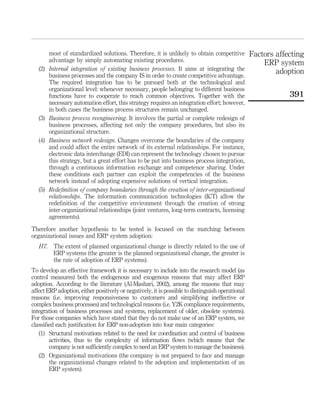
                            Venkatraman (1994) classifies five main levels of transformation (Figure 1):
                               (1) Local automation of existing procedures. This strategy is pursued only for
                                    automation of local, independent procedures. It requires minimal efforts and the
                                    corresponding expected results are enhancements in business process
                                    performance. Benefits coming from this strategy are easily duplicable, as


Figure 1.
Levels of business
transformation related to
technological innovation
most of standardized solutions. Therefore, it is unlikely to obtain competitive          Factors affecting
         advantage by simply automating existing procedures.                                          ERP system
   (2)   Internal integration of existing business processes. It aims at integrating the                  adoption
         business processes and the company IS in order to create competitive advantage.
         The required integration has to be pursued both at the technological and
         organizational level: whenever necessary, people belonging to different business
         functions have to cooperate to reach common objectives. Together with the                            391
         necessary automation effort, this strategy requires an integration effort; however,
         in both cases the business process structures remain unchanged.
   (3)   Business process reengineering. It involves the partial or complete redesign of
         business processes, affecting not only the company procedures, but also its
         organizational structure.
   (4)   Business network redesign. Changes overcome the boundaries of the company
         and could affect the entire network of its external relationships. For instance,
         electronic data interchange (EDI) can represent the technology chosen to pursue
         this strategy, but a great effort has to be put into business process integration,
         through a continuous information exchange and competence sharing. Under
         these conditions each partner can exploit the competencies of the business
         network instead of adopting expensive solutions of vertical integration.
   (5)   Redefinition of company boundaries through the creation of inter-organizational
         relationships. The information communication technologies (ICT) allow the
         redefinition of the competitive environment through the creation of strong
         inter-organizational relationships (joint ventures, long-term contracts, licensing
         agreements).

Therefore another hypothesis to be tested is focused on the matching between
organizational issues and ERP system adoption:
   H7. The extent of planned organizational change is directly related to the use of
       ERP systems (the greater is the planned organizational change, the greater is
       the rate of adoption of ERP systems).
To develop an effective framework it is necessary to include into the research model (as
control measures) both the endogenous and exogenous reasons that may affect ERP
adoption. According to the literature (Al-Mashari, 2002), among the reasons that may
affect ERP adoption, either positively or negatively, it is possible to distinguish operational
reasons (i.e. improving responsiveness to customers and simplifying ineffective or
complex business processes) and technological reasons (i.e. Y2K compliance requirements,
integration of business processes and systems, replacement of older, obsolete systems).
For those companies which have stated that they do not make use of an ERP system, we
classified each justification for ERP non-adoption into four main categories:
   (1) Structural motivations related to the need for coordination and control of business
        activities, thus to the complexity of information flows (which means that the
        company is not sufficiently complex to need an ERP system to manage the business).
   (2) Organizational motivations (the company is not prepared to face and manage
        the organizational changes related to the adoption and implementation of an
        ERP system).
JEIM                       (3) Economic motivations (ERP system adoption and implementation would be too
18,4                           costly for the company).
                           (4) Other reasons.

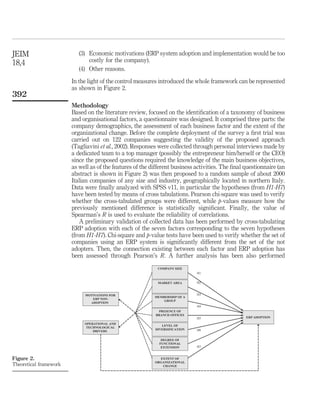
                        In the light of the control measures introduced the whole framework can be represented
                        as shown in Figure 2.
392
                        Methodology
                        Based on the literature review, focused on the identification of a taxonomy of business
                        and organisational factors, a questionnaire was designed. It comprised three parts: the
                        company demographics, the assessment of each business factor and the extent of the
                        organizational change. Before the complete deployment of the survey a first trial was
                        carried out on 122 companies suggesting the validity of the proposed approach
                        (Tagliavini et al., 2002). Responses were collected through personal interviews made by
                        a dedicated team to a top manager (possibly the entrepreneur him/herself or the CEO)
                        since the proposed questions required the knowledge of the main business objectives,
                        as well as of the features of the different business activities. The final questionnaire (an
                        abstract is shown in Figure 2) was then proposed to a random sample of about 2000
                        Italian companies of any size and industry, geographically located in northern Italy.
                        Data were finally analyzed with SPSS v11, in particular the hypotheses (from H1-H7)
                        have been tested by means of cross tabulations. Pearson chi-square was used to verify
                        whether the cross-tabulated groups were different, while p-values measure how the
                        previously mentioned difference is statistically significant. Finally, the value of
                        Spearman’s R is used to evaluate the reliability of correlations.
                            A preliminary validation of collected data has been performed by cross-tabulating
                        ERP adoption with each of the seven factors corresponding to the seven hypotheses
                        (from H1-H7). Chi-square and p-value tests have been used to verify whether the set of
                        companies using an ERP system is significantly different from the set of the not
                        adopters. Then, the connection existing between each factor and ERP adoption has
                        been assessed through Pearson’s R. A further analysis has been also performed


Figure 2.
Theoretical framework
separating SMEs from large companies to highlight possible differences between the         Factors affecting
two subsets.                                                                                   ERP system
                                                                                                   adoption
Variable measurement
According to the theoretical framework, the following sets of variables were measured:
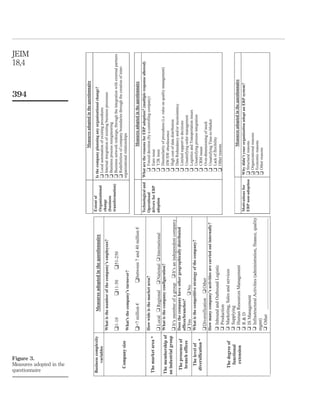
  (1) The business complexity factors have been evaluated through six indicators                       393
      detailed in the Figure 3. Respondents were asked to qualitatively assess each
      variable of the set. More specifically:
      .
         Diversification has been measured as a synthetic index of business strategy
         by offering only two possible responses: diversification and other strategies
         (including cost-based and differentiation strategies).
      .
         Degree of functional extension, i.e. the number of activities carried out
         internally, has been assessed with respect to a set of typical business
         activities. The classical representation of the value chain (Porter and Millar,
         1985) has been integrated with a more recent measure used to assess the
         impact of BPR on manufacturing firms (Guimaraes and Bond, 1996). This
         measure has been already adopted in author’s previous research (Tagliavini
         et al., 2002).
  (2) The extent of organizational change which aims at evaluating the level of
      organizational change the company is prepared to face in order to achieve
      competitive advantage through the use of IT, has been assessed through a
      question suggesting Venkatraman five levels of organizational change. Due to
      the academic formulation which undoubtedly characterizes the question in the
      survey, all the organizational implications and characteristics related to each
      level of the Venkatraman’s model have been thoroughly explained by the
      interviewers to respondents, to clearly point out any organizational-related
      issue.
  (3) The technological and operational drivers have been assessed using the model
      proposed by Al-Mashari (2002) integrated with other drivers which have been
      identified in a previous research (Chau, 1995). Multiple responses were allowed.
  (4) The motivations for ERP non-adoption have been assessed by asking
      respondents to select items from a check-list (also in this case multiple
      responses were allowed).

Research findings
Of the 2,000 contacted companies only 370 accepted to be interviewed yielding a
response rate of 18.5 percent. Data from this sample were collected and filtered to
resolve inconsistencies and correct anomalies, resulting in 366 valid questionnaires.
The choice of the direct interviews to collect data is accountable for the low rate of
rejected questionnaires: only four questionnaires were discarded.

Demographic data
The first part of the questionnaire dealt with companies’ demographics. Firm size
(number of employees and turnover) was investigated according to the current
definition provided by the European Union (see Table I).
JEIM
18,4


394


Figure 3.
Measures adopted in the
questionnaire
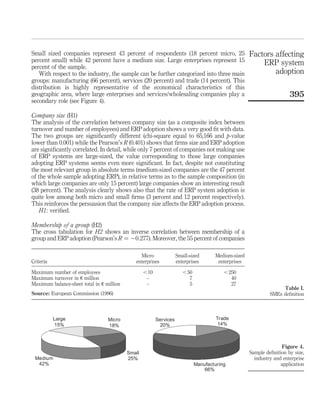
Small sized companies represent 43 percent of respondents (18 percent micro, 25            Factors affecting
percent small) while 42 percent have a medium size. Large enterprises represent 15             ERP system
percent of the sample.
   With respect to the industry, the sample can be further categorized into three main             adoption
groups: manufacturing (66 percent), services (20 percent) and trade (14 percent). This
distribution is highly representative of the economical characteristics of this
geographic area, where large enterprises and services/wholesaling companies play a                           395
secondary role (see Figure 4).

Company size (H1)
The analysis of the correlation between company size (as a composite index between
turnover and number of employees) and ERP adoption shows a very good fit with data.
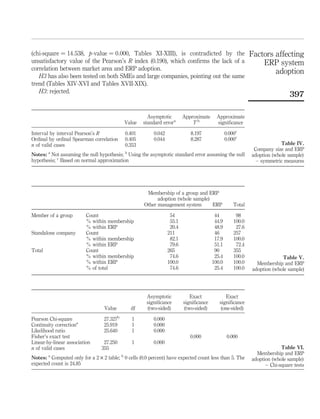
The two groups are significantly different (chi-square equal to 65,166 and p-value
lower than 0.001) while the Pearson’s R (0.401) shows that firms size and ERP adoption
are significantly correlated. In detail, while only 7 percent of companies not making use
of ERP systems are large-sized, the value corresponding to those large companies
adopting ERP systems seems even more significant. In fact, despite not constituting
the most relevant group in absolute terms (medium-sized companies are the 47 percent
of the whole sample adopting ERP), in relative terms as to the sample composition (in
which large companies are only 15 percent) large companies show an interesting result
(38 percent). The analysis clearly shows also that the rate of ERP system adoption is
quite low among both micro and small firms (3 percent and 12 percent respectively).
This reinforces the persuasion that the company size affects the ERP adoption process.
   H1: verified.

Membership of a group (H2)
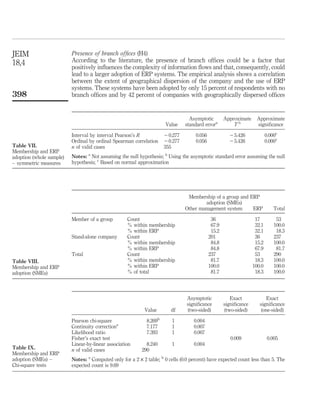
The cross tabulation for H2 shows an inverse correlation between membership of a
group and ERP adoption (Pearson’s R ¼ 20:277). Moreover, the 55 percent of companies

                                             Micro         Small-sized     Medium-sized
Criteria                                   enterprises     enterprises      enterprises

Maximum number of employees                   ,10             ,50              ,250
Maximum turnover in e million                  –                7                40
Maximum balance-sheet total in e million       –                5                27
                                                                                                         Table I.
Source: European Commission (1996)                                                                  SMEs definition


                                                                                                         Figure 4.
                                                                                           Sample definition by size,
                                                                                             industry and enterprise
                                                                                                         application
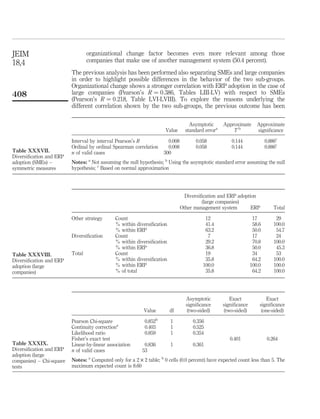
JEIM                      belonging to a group prefer other management systems rather than ERP (Tables II-IV).
                          A correct interpretation of such result requires considering that distribution of the
18,4                      sample according to this factor as unbalanced (237 firms in a standalone configuration
                          compared to 53 belonging to an industrial group). Nonetheless, it is reasonable to
                          conclude that, despite what suggested in the existing literature, the membership of a
                          group seems not to be directly related to the use of ERP systems.
396                          The Pearson’s R index of correlation computed on SMEs (2 0.169, Tables V-VII) and
                          large enterprises (0.060, Tables VIII-X) did not show consistent results.
                             H2: rejected.

                          Market area (H3)
                          At a first glance, a wider market area of a company seems to be related to the use of
                          ERP systems. Only a small subset of companies with a limited market area make use of
                          ERP systems, while this value is higher for companies with a national market area (22
                          percent) and even more for those companies acting on international markets (74
                          percent, see cross-tabulation in Tables XI-XIII). Nevertheless, the high percentage of
                          companies with an international market area which do not use ERP systems (68
                          percent) clearly shows that the ERP system is far from being the only solution adopted
                          as stated in H3. The significant difference between the cross-tabulated groups,

                                                                        Company size and ERP adoption
                                                                               (whole sample)
                          Size                                      Other management system          ERP               Total

                          Micro             Count                              62                         3             65
                                            % within size                      95.4                       4.6          100.0
                                            % within ERP                       23.6                       3.3           18.4
                          Small             Count                              77                        11             88
                                            % within size                      87.5                      12.5          100.0
                                            % within ERP                       29.3                      12.2           24.9
                          Medium            Count                             105                        42            147
                                            % within size                      71.4                      28.6          100.0
                                            % within ERP                       39.9                      46.7           41.6
                          Large             Count                              19                        34             53
                                            % within size                      35.8                      64.2          100.0
                                            % within ERP                        7.2                      37.8           15.0
                          Total             Count                             263                        90            353
Table II.                                   % within size                      74.5                      25.5          100.0
Company size and ERP                        % within ERP                      100.0                     100.0          100.0
adoption (whole sample)                     % of total                         74.5                      25.5          100.0


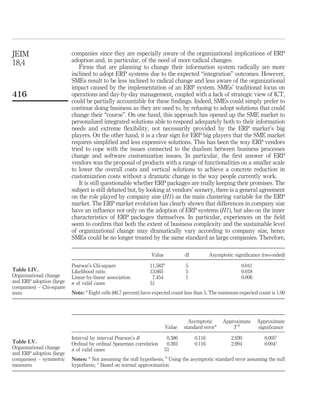
                                                               Value          df         Asymptotic significance (two-sided)
                                                                       a
                          Pearson chi-square                  65.166           3                        0.000
                          Likelihood ratio                    65.121           3                        0.000
Table III.                Linear-by-linear association        56.552           1                        0.000
Company size and ERP      n of valid cases                   353
adoption (whole sample)
– Chi-square tests        Note: a 0 cells (0.0 percent) have expected count less than 5. The minimum expected count is 13.51
(chi-square ¼ 14:538, p-value ¼ 0:000, Tables XI-XIII), is contradicted by the                               Factors affecting
unsatisfactory value of the Pearson’s R index (0.190), which confirms the lack of a                               ERP system
correlation between market area and ERP adoption.
                                                                                                                     adoption
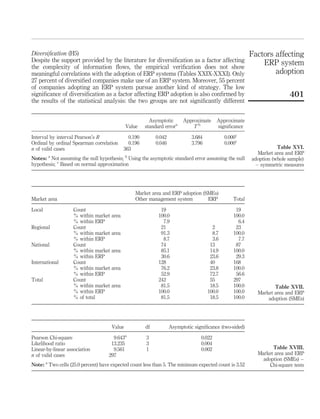
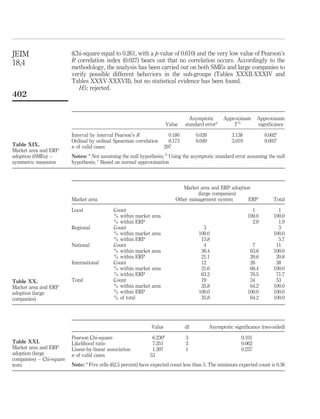
   H3 has also been tested on both SMEs and large companies, pointing out the same
trend (Tables XIV-XVI and Tables XVII-XIX).
   H3: rejected.
                                                                                                                              397

                                                         Asymptotic        Approximate     Approximate
                                               Value   standard errora         Tb          significance

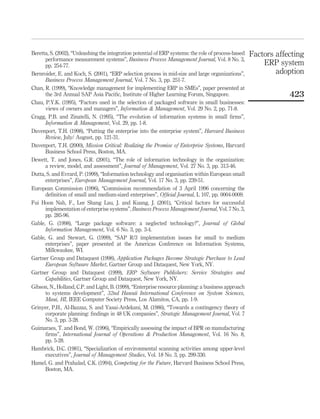
Interval by interval Pearson’s R               0.401       0.042              8.197              0.000c
Ordinal by ordinal Spearman correlation        0.405       0.044              8.287              0.000c
n of valid cases                               0.353                                                                      Table IV.
                                                                                                              Company size and ERP
Notes: a Not assuming the null hypothesis; b Using the asymptotic standard error assuming the null           adoption (whole sample)
hypothesis; c Based on normal approximation                                                                    – symmetric measures


                                                        Membership of a group and ERP
                                                             adoption (whole sample)
                                                       Other management system       ERP             Total

Member of a group         Count                                     54                    44          98
                          % within membership                       55.1                  44.9       100.0
                          % within ERP                              20.4                  48.9        27.6
Standalone company        Count                                    211                    46         257
                          % within membership                       82.1                  17.9       100.0
                          % within ERP                              79.6                  51.1        72.4
Total                     Count                                    265                    90         355
                          % within membership                       74.6                  25.4       100.0                Table V.
                          % within ERP                             100.0                 100.0       100.0     Membership and ERP
                          % of total                                74.6                  25.4       100.0   adoption (whole sample)


                                                        Asymptotic            Exact             Exact
                                                        significance        significance      significance
                                 Value           df     (two-sided)        (two-sided)       (one-sided)

Pearson Chi-square               27.327b          1        0.000
Continuity correctiona           25.919           1        0.000
Likelihood ratio                 25.640           1        0.000
Fisher’s exact test                                                           0.000               0.000
Linear-by-linear association     27.250           1        0.000
n of valid cases                355                                                                                       Table VI.
        a                                  b
                                                                                                               Membership and ERP
Notes: Computed only for a 2 £ 2 table; 0 cells (0.0 percent) have expected count less than 5. The           adoption (whole sample)
expected count is 24.85                                                                                            – Chi-square tests
JEIM                      Presence of branch offices (H4)
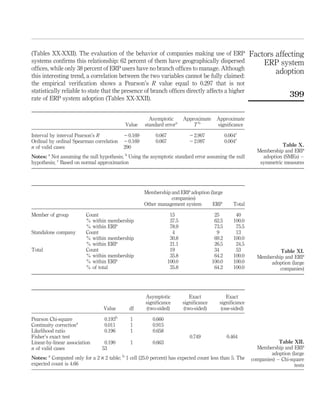
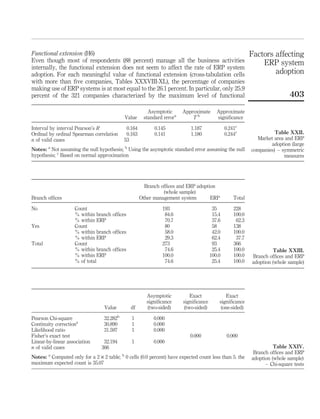
18,4                      According to the literature, the presence of branch offices could be a factor that
                          positively influences the complexity of information flows and that, consequently, could
                          lead to a larger adoption of ERP systems. The empirical analysis shows a correlation
                          between the extent of geographical dispersion of the company and the use of ERP
                          systems. These systems have been adopted by only 15 percent of respondents with no
398                       branch offices and by 42 percent of companies with geographically dispersed offices


                                                                                    Asymptotic        Approximate     Approximate
                                                                         Value    standard errora         Tb          significance

                          Interval by interval Pearson’s R               20.277       0.056             2 5.426             0.000c
                          Ordinal by ordinal Spearman correlation        20.277       0.056             2 5.426             0.000c
Table VII.                n of valid cases                               355
Membership and ERP
adoption (whole sample)   Notes: a Not assuming the null hypothesis; b Using the asymptotic standard error assuming the null
– symmetric measures      hypothesis; c Based on normal approximation


                                                                                   Membership of a group and ERP
                                                                                           adoption (SMEs)
                                                                                  Other management system     ERP               Total

                          Member of a group         Count                                      36                    17          53
                                                    % within membership                        67.9                  32.1       100.0
                                                    % within ERP                               15.2                  32.1        18.3
                          Stand-alone company       Count                                     201                    36         237
                                                    % within membership                        84.8                  15.2       100.0
                                                    % within ERP                               84.8                  67.9        81.7
                          Total                     Count                                     237                    53         290
Table VIII.                                         % within membership                        81.7                  18.3       100.0
Membership and ERP                                  % within ERP                              100.0                 100.0       100.0
adoption (SMEs)                                     % of total                                 81.7                  18.3       100.0


                                                                                  Asymptotic             Exact             Exact
                                                                                  significance         significance      significance
                                                            Value          df     (two-sided)         (two-sided)       (one-sided)
                                                                     b
                          Pearson chi-square                 8.269          1         0.004
                          Continuity correctiona             7.177          1         0.007
                          Likelihood ratio                   7.393          1         0.007
                          Fisher’s exact test                                                            0.009               0.005
                          Linear-by-linear association       8.240          1         0.004
Table IX.                 n of valid cases                 290
Membership and ERP
adoption (SMEs) –         Notes: a Computed only for a 2 £ 2 table; b 0 cells (0.0 percent) have expected count less than 5. The
Chi-square tests          expected count is 9.69
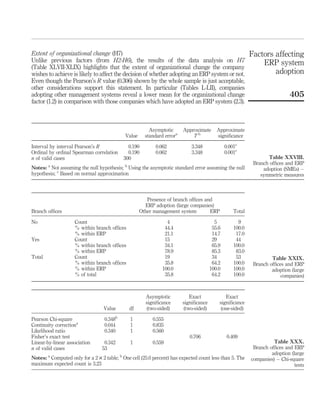
(Tables XX-XXII). The evaluation of the behavior of companies making use of ERP                             Factors affecting
systems confirms this relationship: 62 percent of them have geographically dispersed                             ERP system
offices, while only 38 percent of ERP users have no branch offices to manage. Although
                                                                                                                    adoption
this interesting trend, a correlation between the two variables cannot be fully claimed:
the empirical verification shows a Pearson’s R value equal to 0.297 that is not
statistically reliable to state that the presence of branch offices directly affects a higher
rate of ERP system adoption (Tables XX-XXII).
                                                                                                                             399

                                                       Asymptotic         Approximate     Approximate
                                            Value    standard errora          Tb          significance

Interval by interval Pearson’s R           20.169         0.067             2 2.907             0.004c
Ordinal by ordinal Spearman correlation    20.169         0.067             2 2.097             0.004c
n of valid cases                           290                                                                          Table X.
                                                                                                              Membership and ERP
Notes: a Not assuming the null hypothesis; b Using the asymptotic standard error assuming the null              adoption (SMEs) –
hypothesis; c Based on normal approximation                                                                    symmetric measures


                                                     Membership and ERP adoption (large
                                                                companies)
                                                     Other management system      ERP               Total

Member of group           Count                                    15                    25          40
                          % within membership                      37.5                  62.5       100.0
                          % within ERP                             78.9                  73.5        75.5
Standalone company        Count                                     4                     9          13
                          % within membership                      30.8                  69.2       100.0
                          % within ERP                             21.1                  26.5        24.5
Total                     Count                                    19                    34          53                Table XI.
                          % within membership                      35.8                  64.2       100.0     Membership and ERP
                          % within ERP                            100.0                 100.0       100.0          adoption (large
                          % of total                               35.8                  64.2       100.0              companies)


                                                      Asymptotic             Exact             Exact
                                                      significance         significance      significance
                                  Value       df      (two-sided)         (two-sided)       (one-sided)

Pearson Chi-square                0.193b      1          0.660
Continuity correctiona            0.011       1          0.915
Likelihood ratio                  0.196       1          0.658
Fisher’s exact test                                                          0.749               0.464
Linear-by-linear association      0.190       1          0.663                                                          Table XII.
n of valid cases                 53                                                                           Membership and ERP
                                                                                                                    adoption (large
Notes: a Computed only for a 2 £ 2 table; b 1 cell (25.0 percent) has expected count less than 5. The       companies) – Chi-square
expected count is 4.66                                                                                                         tests
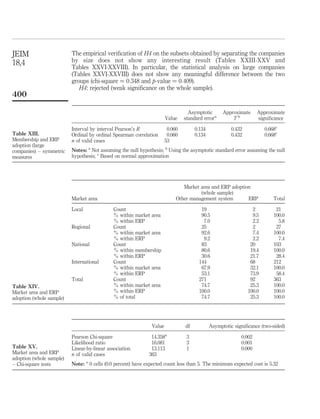
JEIM                      The empirical verification of H4 on the subsets obtained by separating the companies
18,4                      by size does not show any interesting result (Tables XXIII-XXV and
                          Tables XXVI-XXVIII). In particular, the statistical analysis on large companies
                          (Tables XXVI-XXVIII) does not show any meaningful difference between the two
                          groups (chi-square ¼ 0:348 and p-value ¼ 0:409).
                             H4: rejected (weak significance on the whole sample).
400

                                                                                  Asymptotic       Approximate     Approximate
                                                                       Value    standard errora        Tb          significance

                          Interval by interval Pearson’s R              0.060        0.134            0.432           0.668c
Table XIII.               Ordinal by ordinal Spearman correlation       0.060        0.134            0.432           0.668c
Membership and ERP        n of valid cases                             53
adoption (large
companies) – symmetric    Notes: a Not assuming the null hypothesis; b Using the asymptotic standard error assuming the null
measures                  hypothesis; c Based on normal approximation


                                                                               Market area and ERP adoption
                                                                                      (whole sample)
                          Market area                                       Other management system       ERP             Total

                          Local              Count                                      19                      2          21
                                             % within market area                       90.5                    9.5       100.0
                                             % within ERP                                7.0                    2.2         5.8
                          Regional           Count                                      25                      2          27
                                             % within market area                       92.6                    7.4       100.0
                                             % within ERP                                9.2                    2.2         7.4
                          National           Count                                      83                     20         103
                                             % within membership                        80.6                   19.4       100.0
                                             % within ERP                               30.6                   21.7        28.4
                          International      Count                                     144                     68         212
                                             % within market area                       67.9                   32.1       100.0
                                             % within ERP                               53.1                   73.9        58.4
                          Total              Count                                     271                     92         363
Table XIV.                                   % within market area                       74.7                   25.3       100.0
Market area and ERP                          % within ERP                              100.0                  100.0       100.0
adoption (whole sample)                      % of total                                 74.7                   25.3       100.0


                                                               Value            df           Asymptotic significance (two-sided)

                          Pearson Chi-square                   14.358a           3                         0.002
                          Likelihood ratio                     16.081            3                         0.001
Table XV.                 Linear-by-linear association         13.113            1                         0.000
Market area and ERP       n of valid cases                    363
adoption (whole sample)
– Chi-square tests        Note: a 0 cells (0.0 percent) have expected count less than 5. The minimum expected cost is 5.32
Diversification (H5)                                                                                       Factors affecting
Despite the support provided by the literature for diversification as a factor affecting                       ERP system
the complexity of information flows, the empirical verification does not show
meaningful correlations with the adoption of ERP systems (Tables XXIX-XXXI). Only                                 adoption
27 percent of diversified companies make use of an ERP system. Moreover, 55 percent
of companies adopting an ERP system pursue another kind of strategy. The low
significance of diversification as a factor affecting ERP adoption is also confirmed by                                      401
the results of the statistical analysis: the two groups are not significantly different


                                                         Asymptotic       Approximate     Approximate
                                              Value    standard errora        Tb          significance

Interval by interval Pearson’s R               0.190        0.042             3.684           0.000c
Ordinal by ordinal Spearman correlation        0.196        0.046             3.796           0.000c
n of valid cases                             363                                                                     Table XVI.
                                                                                                             Market area and ERP
Notes: a Not assuming the null hypothesis; b Using the asymptotic standard error assuming the null        adoption (whole sample)
hypothesis; c Based on normal approximation                                                                 – symmetric measures


                                                  Market area and ERP adoption (SMEs)
Market area                                       Other management system        ERP              Total

Local               Count                                     19                                   19
                    % within market   area                   100.0                                100.0
                    % within ERP                               7.9                                  6.4
Regional            Count                                     21                        2          23
                    % within market   area                    91.3                      8.7       100.0
                    % within ERP                               8.7                      3.6         7.7
National            Count                                     74                       13          87
                    % within market   area                    85.1                     14.9       100.0
                    % within ERP                              30.6                     23.6        29.3
International       Count                                    128                       40         168
                    % within market   area                    76.2                     23.8       100.0
                    % within ERP                              52.9                     72.7        56.6
Total               Count                                    242                       55         297
                    % within market   area                    81.5                     18.5       100.0            Table XVII.
                    % within ERP                             100.0                    100.0       100.0     Market area and ERP
                    % of total                                81.5                     18.5       100.0         adoption (SMEs)


                                      Value            df           Asymptotic significance (two-sided)
                                              a
Pearson Chi-square                    9.643            3                          0.022
Likelihood ratio                     13.235            3                          0.004
Linear-by-linear association          9.561            1                          0.002                           Table XVIII.
n of valid cases                    297                                                                     Market area and ERP
                                                                                                              adoption (SMEs) –
Note: a Two cells (25.0 percent) have expected count less than 5. The minimum expected count is 3.52             Chi-square tests
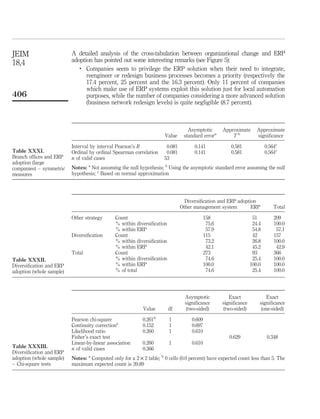
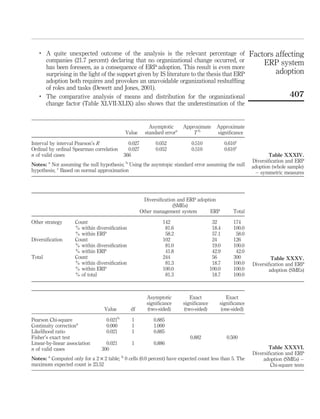
JEIM                      (Chi-square equal to 0.261, with a p-value of 0.610) and the very low value of Pearson’s
18,4                      R correlation index (0.027) bears out that no correlation occurs. Accordingly to the
                          methodology, the analysis has been carried out on both SMEs and large companies to
                          verify possible different behaviors in the sub-groups (Tables XXXII-XXXIV and
                          Tables XXXV-XXXVII), but no statistical evidence has been found.
                             H5: rejected.
402

                                                                                      Asymptotic       Approximate     Approximate
                                                                            Value   standard errora        Tb          significance

                          Interval by interval Pearson’s R                0.180          0.039             3.138           0.002c
                          Ordinal by ordinal Spearman correlation         0.173          0.049             3.019           0.003c
Table XIX.                n of valid cases                              297
Market area and ERP
adoption (SMEs) –         Notes: a Not assuming the null hypothesis; b Using the asymptotic standard error assuming the null
symmetric measures        hypothesis; c Based on normal approximation


                                                                                   Market area and ERP adoption
                                                                                         (large companies)
                          Market area                                           Other management system       ERP              Total

                          Local               Count                                                                  1           1
                                              % within market   area                                               100.0       100.0
                                              % within ERP                                                           2.9         1.9
                          Regional            Count                                         3                                    3
                                              % within market   area                      100.0                                100.0
                                              % within ERP                                 15.8                                  5.7
                          National            Count                                         4                        7          11
                                              % within market   area                       36.4                     63.6       100.0
                                              % within ERP                                 21.1                     20.6        20.8
                          International       Count                                        12                       26          38
                                              % within market   area                       31.6                     68.4       100.0
                                              % within ERP                                 63.2                     76.5        71.7
Table XX.                 Total               Count                                        19                       34          53
Market area and ERP                           % within market   area                       35.8                     64.2       100.0
adoption (large                               % within ERP                                100.0                    100.0       100.0
companies)                                    % of total                                   35.8                     64.2       100.0


                                                                Value               df           Asymptotic significance (two-sided)
                                                                        a
                          Pearson Chi-square                    6.230               3                          0.101
Table XXI.                Likelihood ratio                      7.351               3                          0.062
Market area and ERP       Linear-by-linear association          1.397               1                          0.237
adoption (large           n of valid cases                     53
companies) – Chi-square
tests                     Note: a Five cells (62.5 percent) have expected count less than 5. The minimum expected count is 0.36
Functional extension (H6)                                                                                      Factors affecting
Even though most of respondents (88 percent) manage all the business activities                                    ERP system
internally, the functional extension does not seem to affect the rate of ERP system
adoption. For each meaningful value of functional extension (cross-tabulation cells                                    adoption
with more than five companies, Tables XXXVIII-XL), the percentage of companies
making use of ERP systems is at most equal to the 26.1 percent. In particular, only 25.9
percent of the 321 companies characterized by the maximum level of functional                                                   403

                                                             Asymptotic      Approximate      Approximate
                                                  Value    standard errora       Tb           significance

Interval by interval Pearson’s R               0.164            0.145           1.187              0.241c
Ordinal by ordinal Spearman correlation        0.163            0.141           1.180              0.244c                Table XXII.
n of valid cases                              53                                                                 Market area and ERP
                                                                                                                       adoption (large
Notes: a Not assuming the null hypothesis; b Using the asymptotic standard error assuming the null             companies) – symmetric
hypothesis; c Based on normal approximation                                                                                  measures


                                                            Branch offices and ERP adoption
                                                                    (whole sample)
Branch offices                                             Other management system       ERP            Total

No                  Count                                          193                      35         228
                    % within branch offices                          84.6                    15.4       100.0
                    % within ERP                                    70.7                    37.6        62.3
Yes                 Count                                           80                      58         138
                    % within branch offices                          58.0                    42.0       100.0
                    % within ERP                                    29.3                    62.4        37.7
Total               Count                                          273                      93         366
                    % within branch offices                          74.6                    25.4       100.0            Table XXIII.
                    % within ERP                                   100.0                   100.0       100.0   Branch offices and ERP
                    % of total                                      74.6                    25.4       100.0   adoption (whole sample)


                                                             Asymptotic         Exact              Exact
                                                             significance     significance       significance
                                 Value              df       (two-sided)     (two-sided)        (one-sided)
                                          b
Pearson Chi-square               32.282             1           0.000
Continuity correctiona           30.890             1           0.000
Likelihood ratio                 31.597             1           0.000
Fisher’s exact test                                                             0.000               0.000
Linear-by-linear association     32.194             1           0.000
n of valid cases                366                                                                                      Table XXIV.
        a                                     b
                                                                                                                Branch offices and ERP
Notes: Computed only for a 2 £ 2 table; 0 cells (0.0 percent) have expected count less than 5. the             adoption (whole sample)
maximum expected count is 35.07                                                                                      – Chi-square tests
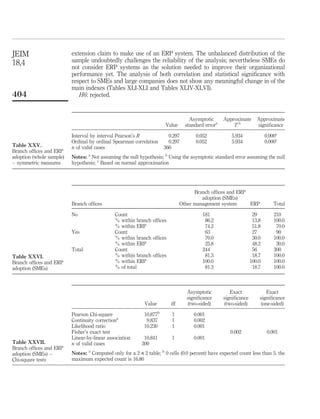
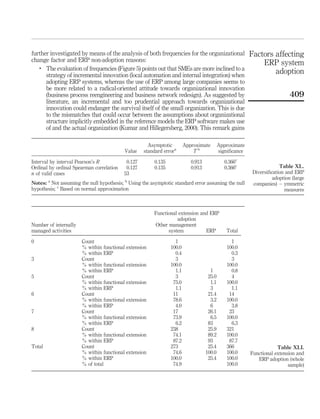
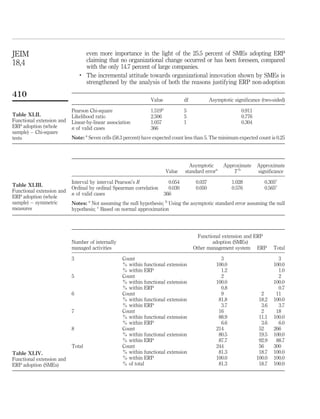
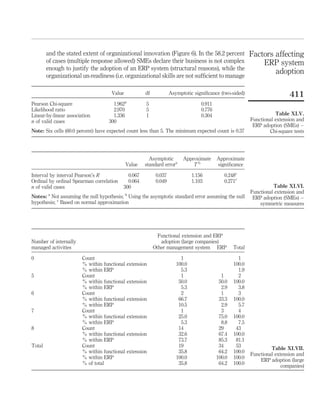
JEIM                      extension claim to make use of an ERP system. The unbalanced distribution of the
18,4                      sample undoubtedly challenges the reliability of the analysis; nevertheless SMEs do
                          not consider ERP systems as the solution needed to improve their organizational
                          performance yet. The analysis of both correlation and statistical significance with
                          respect to SMEs and large companies does not show any meaningful change in of the
                          main indexes (Tables XLI-XLI and Tables XLIV-XLVI).
404                          H6: rejected.


                                                                                  Asymptotic      Approximate      Approximate
                                                                      Value     standard errora       Tb           significance

                          Interval by interval Pearson’s R              0.297        0.052            5.934             0.000c
                          Ordinal by ordinal Spearman correlation       0.297        0.052            5.934             0.000c
Table XXV.                n of valid cases                            366
Branch offices and ERP
adoption (whole sample)   Notes: a Not assuming the null hypothesis; b Using the asymptotic standard error assuming the null
– symmetric measures      hypothesis; c Based on normal approximation


                                                                                    Branch offices and ERP
                                                                                       adoption (SMEs)
                          Branch offices                                       Other management system     ERP               Total

                          No                  Count                                     181                      29         210
                                              % within branch offices                     86.2                    13.8       100.0
                                              % within ERP                               74.2                    51.8        70.0
                          Yes                 Count                                      63                      27          90
                                              % within branch offices                     70.0                    30.0       100.0
                                              % within ERP                               25.8                    48.2        30.0
                          Total               Count                                     244                      56         300
Table XXVI.                                   % within branch offices                     81.3                    18.7       100.0
Branch offices and ERP                         % within ERP                              100.0                   100.0       100.0
adoption (SMEs)                               % of total                                 81.3                    18.7       100.0


                                                                                 Asymptotic          Exact              Exact
                                                                                 significance      significance       significance
                                                            Value        df      (two-sided)      (two-sided)        (one-sided)

                          Pearson Chi-square                10.877b       1         0.001
                          Continuity correctiona             9.837        1         0.002
                          Likelihood ratio                  10.230        1         0.001
                          Fisher’s exact test                                                        0.002               0.001
                          Linear-by-linear association      10.841        1         0.001
Table XXVII.              n of valid cases                 300
Branch offices and ERP
adoption (SMEs) –         Notes: a Computed only for a 2 £ 2 table; b 0 cells (0.0 percent) have expected count less than 5. the
Chi-square tests          maximum expected count is 16.80
Extent of organizational change (H7)                                                                        Factors affecting
Unlike previous factors (from H2-H6), the results of the data analysis on H7                                    ERP system
(Table XLVII-XLIX) highlights that the extent of organizational change the company
wishes to achieve is likely to affect the decision of whether adopting an ERP system or not.                        adoption
Even though the Pearson’s R value (0.306) shown by the whole sample is just acceptable,
other considerations support this statement. In particular (Tables L-LII), companies
adopting other management systems reveal a lower mean for the organizational change                                           405
factor (1.2) in comparison with those companies which have adopted an ERP system (2.3).


                                                          Asymptotic      Approximate      Approximate
                                             Value      standard errora       Tb           significance

Interval by interval Pearson’s R              0.190         0.062            3.348              0.001c
Ordinal by ordinal Spearman correlation       0.190         0.062            3.348              0.001c
n of valid cases                            300                                                                    Table XXVIII.
        a                                    b
                                                                                                             Branch offices and ERP
Notes: Not assuming the null hypothesis; Using the asymptotic standard error assuming the null                   adoption (SMEs) –
hypothesis; c Based on normal approximation                                                                     symmetric measures


                                                         Presence of branch offices and
                                                        ERP adoption (large companies)
Branch offices                                         Other management system        ERP            Total

No                  Count                                         4                       5           9
                    % within branch offices                       44.4                    55.6       100.0
                    % within ERP                                 21.1                    14.7        17.0
Yes                 Count                                        15                      29          44
                    % within branch offices                       34.1                    65.9       100.0
                    % within ERP                                 78.9                    85.3        83.0
Total               Count                                        19                      34          53              Table XXIX.
                    % within branch offices                       35.8                    64.2       100.0    Branch offices and ERP
                    % within ERP                                100.0                   100.0       100.0            adoption (large
                    % of total                                   35.8                    64.2       100.0                companies)


                                                        Asymptotic           Exact              Exact
                                                        significance       significance       significance
                                  Value          df     (two-sided)       (two-sided)        (one-sided)

Pearson Chi-square                 0.348b        1         0.555
Continuity correctiona             0.044         1         0.835
Likelihood ratio                   0.340         1         0.560
Fisher’s exact test                                                          0.706               0.409
Linear-by-linear association       0.342         1         0.559                                                      Table XXX.
n of valid cases                  53                                                                         Branch offices and ERP
                                                                                                                     adoption (large
Notes: a Computed only for a 2 £ 2 table; b One cell (25.0 percent) has expected count less than 5. The     companies) – Chi-square
maximum expected count is 3.23                                                                                                  tests
JEIM                      A detailed analysis of the cross-tabulation between organizational change and ERP
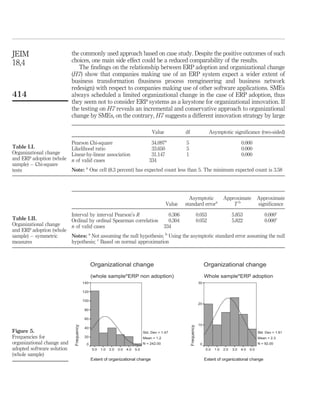
                          adoption has pointed out some interesting remarks (see Figure 5):
18,4
                             .  Companies seem to privilege the ERP solution when their need to integrate,
                                reengineer or redesign business processes becomes a priority (respectively the
                                17.4 percent, 25 percent and the 16.3 percent). Only 11 percent of companies
                                which make use of ERP systems exploit this solution just for local automation
406                             purposes, while the number of companies considering a more advanced solution
                                (business network redesign levels) is quite negligible (8.7 percent).


                                                                                  Asymptotic        Approximate      Approximate
                                                                      Value     standard errora         Tb           significance

                          Interval by interval Pearson’s R             0.081         0.141             0.581              0.564c
Table XXXI.               Ordinal by ordinal Spearman correlation      0.081         0.141             0.581              0.564c
Branch offices and ERP     n of valid cases                            53
adoption (large
companies) – symmetric    Notes: a Not assuming the null hypothesis; b Using the asymptotic standard error assuming the null
measures                  hypothesis; c Based on normal approximation


                                                                                 Diversification and ERP adoption
                                                                               Other management system        ERP             Total

                          Other strategy      Count                                         158                    51         209
                                              % within diversification                        75.6                  24.4       100.0
                                              % within ERP                                   57.9                  54.8        57.1
                          Diversification      Count                                         115                    42         157
                                              % within diversification                        73.2                  26.8       100.0
                                              % within ERP                                   42.1                  45.2        42.9
                          Total               Count                                         273                    93         366
Table XXXII.                                  % within diversification                        74.6                  25.4       100.0
Diversification and ERP                        % within ERP                                  100.0                 100.0       100.0
adoption (whole sample)                       % of total                                     74.6                  25.4       100.0


                                                                                 Asymptotic            Exact              Exact
                                                                                 significance        significance       significance
                                                            Value       df       (two-sided)        (two-sided)        (one-sided)

                          Pearson chi-square                0.261b      1           0.609
                          Continuity correctiona            0.152       1           0.697
                          Likelihood ratio                  0.260       1           0.610
                          Fisher’s exact test                                                          0.629               0.348
                          Linear-by-linear association      0.260       1           0.610
Table XXXIII.             n of valid cases                  0.366
Diversification and ERP
adoption (whole sample)   Notes: a Computed only for a 2 £ 2 table; b 0 cells (0.0 percent) have expected count less than 5. The
– Chi-square tests        maximum expected count is 39.89
.
        A quite unexpected outcome of the analysis is the relevant percentage of                               Factors affecting
        companies (21.7 percent) declaring that no organizational change occurred, or                              ERP system
        has been foreseen, as a consequence of ERP adoption. This result is even more
        surprising in the light of the support given by IS literature to the thesis that ERP                           adoption
        adoption both requires and provokes an unavoidable organizational reshuffling
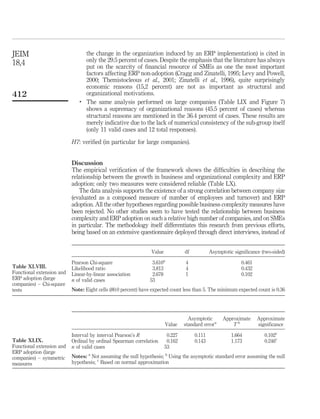
        of roles and tasks (Dewett and Jones, 2001).
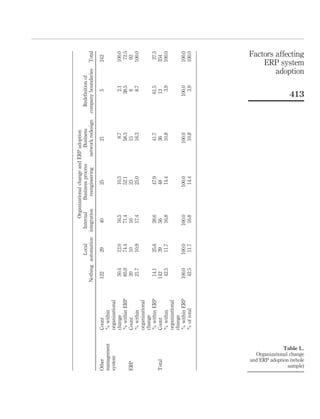
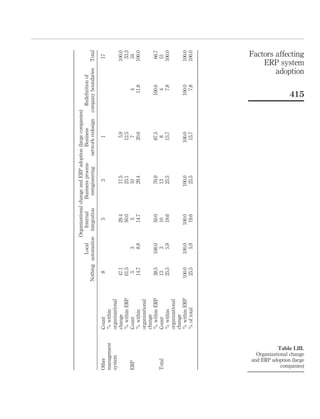
   .
        The comparative analysis of means and distribution for the organizational                                                407
        change factor (Table XLVII-XLIX) also shows that the underestimation of the


                                                             Asymptotic      Approximate      Approximate
                                               Value       standard errora       Tb           significance

Interval by interval Pearson’s R                 0.027         0.052            0.510              0.610c
Ordinal by ordinal Spearman correlation          0.027         0.052            0.510              0.610c
n of valid cases                               366                                                                    Table XXXIV.
        a                                      b                                                               Diversification and ERP
Notes: Not assuming the null hypothesis; Using the asymtopic standard error assuming the null                  adoption (whole sample)
hypothesis; c Based on normal approximation                                                                      – symmetric measures


                                                           Diversification and ERP adoption
                                                                        (SMEs)
                                                         Other management system        ERP            Total

Other strategy      Count                                          142                      32         174
                    % within diversification                         81.6                    18.4       100.0
                    % within ERP                                    58.2                    57.1        58.0
Diversification      Count                                          102                      24         126
                    % within diversification                         81.0                    19.0       100.0
                    % within ERP                                    41.8                    42.9        42.0
Total               Count                                          244                      56         300              Table XXXV.
                    % within diversification                         81.3                    18.7       100.0    Diversification and ERP
                    % within ERP                                   100.0                   100.0       100.0           adoption (SMEs)
                    % of total                                      81.3                    18.7       100.0


                                                           Asymptotic           Exact              Exact
                                                           significance       significance       significance
                                  Value            df      (two-sided)       (two-sided)        (one-sided)
                                           b
Pearson Chi-square                 0.021           1           0.885
Continuity correctiona             0.000           1           1.000
Likelihood ratio                   0.021           1           0.885
Fisher’s exact test                                                             0.882               0.500
Linear-by-linear association       0.021           1           0.886
n of valid cases                 300                                                                                   Table XXXVI.
                                                                                                                Diversification and ERP
Notes: a Computed only for a 2 £ 2 table; b 0 cells (0.0 percent) have expected count less than 5. The               adoption (SMEs) –
maximum expected count is 23.52                                                                                         Chi-square tests
JEIM                              organizational change factor becomes even more relevant among those
18,4                              companies that make use of another management system (50.4 percent).
                          The previous analysis has been performed also separating SMEs and large companies
                          in order to highlight possible differences in the behavior of the two sub-groups.
                          Organizational change shows a stronger correlation with ERP adoption in the case of
408                       large companies (Pearson’s R ¼ 0:386, Tables LIII-LV) with respect to SMEs
                          (Pearson’s R ¼ 0:218, Table LVI-LVIII). To explore the reasons underlying the
                          different correlation shown by the two sub-groups, the previous outcome has been

                                                                                    Asymptotic      Approximate      Approximate
                                                                      Value       standard errora       Tb           significance

                          Interval by interval Pearson’s R              0.008         0.058            0.144              0.886c
                          Ordinal by ordinal Spearman correlation       0.008         0.058            0.144              0.886c
Table XXXVII.             n of valid cases                            300
Diversification and ERP
adoption (SMEs) –         Notes: a Not assuming the null hypothesis; b Using the asymptotic standard error assuming the null
symmetric measures        hypothesis; c Based on normal approximation


                                                                                  Diversification and ERP adoption
                                                                                          (large companies)
                                                                                Other management system        ERP            Total

                          Other strategy      Count                                        12                      17          29
                                              % within diversification                      41.4                    58.6       100.0
                                              % within ERP                                 63.2                    50.0        54.7
                          Diversification      Count                                         7                      17          24
                                              % within diversification                      29.2                    70.8       100.0
                                              % within ERP                                 36.8                    50.0        45.3
Table XXXVIII.            Total               Count                                        19                      34          53
Diversification and ERP                        % within diversification                      35.8                    64.2       100.0
adoption (large                               % within ERP                                100.0                   100.0       100.0
companies)                                    % of total                                   35.8                    64.2       100.0


                                                                                  Asymptotic           Exact              Exact
                                                                                  significance       significance       significance
                                                            Value       df        (two-sided)       (two-sided)        (one-sided)

                          Pearson Chi-square                0.852b       1           0.356
                          Continuity correctiona            0.403        1           0.525
                          Likelihood ratio                  0.859        1           0.354
                          Fisher’s exact test                                                          0.401               0.264
Table XXXIX.              Linear-by-linear association      0.836        1           0.361
Diversification and ERP    n of valid cases                 53
adoption (large
companies) – Chi-square   Notes: a Computed only for a 2 £ 2 table; b 0 cells (0.0 percent) have expected count less than 5. The
tests                     maximum expected count is 8.60
further investigated by means of the analysis of both frequencies for the organizational                  Factors affecting
change factor and ERP non-adoption reasons:
                                                                                                              ERP system
   .
      The evaluation of frequencies (Figure 5) points out that SMEs are more inclined to a
      strategy of incremental innovation (local automation and internal integration) when
                                                                                                                  adoption
      adopting ERP systems, whereas the use of ERP among large companies seems to
      be more related to a radical-oriented attitude towards organizational innovation
      (business process reengineering and business network redesign). As suggested by                                       409
      literature, an incremental and too prudential approach towards organizational
      innovation could endanger the survival itself of the small organization. This is due
      to the mismatches that could occur between the assumptions about organizational
      structure implicitly embedded in the reference models the ERP software makes use
      of and the actual organization (Kumar and Hillegersberg, 2000). This remark gains

                                                       Asymptotic        Approximate        Approximate
                                             Value   standard errora         Tb             significance

Interval by interval Pearson’s R           0.127         0.135              0.913              0.366c
Ordinal by ordinal Spearman correlation    0.127         0.135              0.913              0.366c                  Table XL.
n of valid cases                          53                                                               Diversification and ERP
                                                                                                                    adoption (large
Notes: a Not assuming the null hypothesis; b Using the asymptotic standard error assuming the null         companies) – ymmetric
hypothesis; c Based on normal approximation                                                                              measures


                                                         Functional extension and ERP
                                                                   adoption
Number of internally                                     Other management
managed activities                                             system           ERP             Total

0                      Count                                       1                              1
                       % within functional   extension           100.0                          100.0
                       % within ERP                                0.4                            0.3
3                      Count                                       3                              3
                       % within functional   extension           100.0                          100.0
                       % within ERP                                1.1                1           0.8
5                      Count                                       3                 25.0         4
                       % within functional   extension            75.0                1.1       100.0
                       % within ERP                                1.1                3           1.1
6                      Count                                      11                 21.4        14
                       % within functional   extension            78.6                3.2       100.0
                       % within ERP                                4.0                6           3.8
7                      Count                                      17                 26.1        23
                       % within functional   extension            73.9                6.5       100.0
                       % within ERP                                6.2               83           6.3
8                      Count                                     238                 25.9       321
                       % within functional   extension            74.1               89.2       100.0
                       % within ERP                               87.2               93          87.7
Total                  Count                                     273                 25.4       366                   Table XLI.
                       % within functional   extension            74.6              100.0       100.0     Functional extension and
                       % within ERP                              100.0               25.4       100.0        ERP adoption (whole
                       % of total                                 74.9                          100.0                      sample)
JEIM                               even more importance in the light of the 25.5 percent of SMEs adopting ERP
                                   claiming that no organizational change occurred or has been foreseen, compared
18,4                               with the only 14.7 percent of large companies.
                               .
                                   The incremental attitude towards organizational innovation shown by SMEs is
                                   strengthened by the analysis of both the reasons justifying ERP non-adoption

410
                                                                Value                 df            Asymptotic significance (two-sided)
                                                                        a
                           Pearson Chi-square                   1.519                 5                            0.911
Table XLII.                Likelihood ratio                     2.506                 5                            0.776
Functional extension and   Linear-by-linear association         1.057                 1                            0.304
ERP adoption (whole        n of valid cases                     366
sample) – Chi-square
tests                      Note: a Seven cells (58.3 percent) have expected count less than 5. The minimum expected count is 0.25


                                                                                        Asymptotic        Approximate      Approximate
                                                                            Value     standard errora         Tb           significance

                           Interval by interval Pearson’s R                   0.054         0.037              1.028          0.305c
Table XLIII.
                           Ordinal by ordinal Spearman correlation            0.030         0.050              0.576          0.565c
Functional extension and
                           n of valid cases                                 366
ERP adoption (whole
sample) – symmetric        Notes: a Not assuming the null hypothesis; b Using the asymptotic standard error assuming the null
measures                   hypothesis; c Based on normal approximation


                                                                                             Functional extension and ERP
                           Number of internally                                                    adoption (SMEs)
                           managed activities                                              Other management system ERP             Total

                           3                       Count                                                 3                           3
                                                   % within functional       extension                 100.0                       100.0
                                                   % within ERP                                          1.2                         1.0
                           5                       Count                                                 2                           2
                                                   % within functional       extension                 100.0                       100.0
                                                   % within ERP                                          0.8                         0.7
                           6                       Count                                                 9                   2      11
                                                   % within functional       extension                  81.8                18.2   100.0
                                                   % within ERP                                          3.7                 3.6     3.7
                           7                       Count                                                16                   2      18
                                                   % within functional       extension                  88.9                11.1   100.0
                                                   % within ERP                                          6.6                 3.6     6.0
                           8                       Count                                               214                  52     266
                                                   % within functional       extension                  80.5                19.5   100.0
                                                   % within ERP                                         87.7                92.9    88.7
                           Total                   Count                                               244                  56     300
Table XLIV.                                        % within functional       extension                  81.3                18.7   100.0
Functional extension and                           % within ERP                                        100.0               100.0   100.0
ERP adoption (SMEs)                                % of total                                           81.3                18.7   100.0
and the stated extent of organizational innovation (Figure 6). In the 58.2 percent                    Factors affecting
        of cases (multiple response allowed) SMEs declare their business is not complex                           ERP system
        enough to justify the adoption of an ERP system (structural reasons), while the
        organizational un-readiness (i.e. organizational skills are not sufficient to manage
                                                                                                                      adoption

                                     Value               df            Asymptotic significance (two-sided)                      411
                                             a
Pearson Chi-square                   1.962               5                            0.911
Likelihood ratio                     2.970               5                            0.776
Linear-by-linear association         1.336               1                            0.304                              Table XLV.
n of valid cases                   300                                                                        Functional extension and
                                                                                                               ERP adoption (SMEs) –
Note: Six cells (60.0 percent) have expected count less than 5. The minimum expected count is 0.37                    Chi-square tests


                                                           Asymptotic        Approximate      Approximate
                                              Value      standard errora         Tb           significance

Interval by interval Pearson’s R            0.067              0.037              1.156          0.248c
Ordinal by ordinal Spearman correlation     0.064              0.049              1.103          0.271c
n of valid cases                          300                                                                           Table XLVI.
        a                                    b
                                                                                                              Functional extension and
Notes: Not assuming the null hypothesis; Using the asymptotic standard error assuming the null                 ERP adoption (SMEs) –
hypothesis; c Based on normal approximation                                                                       symmetric measures


                                                                Functional extension and ERP
Number of internally                                             adoption (large companies)
managed activities                                            Other management system ERP             Total

0                       Count                                               1                           1
                        % within functional      extension                100.0                       100.0
                        % within ERP                                        5.3                         1.9
5                       Count                                               1                   1       2
                        % within functional      extension                 50.0                50.0   100.0
                        % within ERP                                        5.3                 2.9     3.8
6                       Count                                               2                   1       3
                        % within functional      extension                 66.7                33.3   100.0
                        % within ERP                                       10.5                 2.9     5.7
7                       Count                                               1                   3       4
                        % within functional      extension                 25.0                75.0   100.0
                        % within ERP                                        5.3                 8.8     7.5
8                       Count                                              14                  29      43
                        % within functional      extension                 32.6                67.4   100.0
                        % within ERP                                       73.7                85.3    81.1
Total                   Count                                              19                  34      53
                                                                                                                       Table XLVII.
                        % within functional      extension                 35.8                64.2   100.0
                                                                                                              Functional extension and
                        % within ERP                                      100.0               100.0   100.0
                                                                                                                  ERP adoption (large
                        % of total                                         35.8                64.2   100.0
                                                                                                                            companies)
JEIM                              the change in the organization induced by an ERP implementation) is cited in
                                  only the 29.5 percent of cases. Despite the emphasis that the literature has always
18,4                              put on the scarcity of financial resource of SMEs as one the most important
                                  factors affecting ERP non-adoption (Cragg and Zinatelli, 1995; Levy and Powell,
                                  2000; Themistocleous et al., 2001; Zinatelli et al., 1996), quite surprisingly
                                  economic reasons (15,2 percent) are not as important as structural and
412                               organizational motivations.
                              .
                                  The same analysis performed on large companies (Table LIX and Figure 7)
                                  shows a supremacy of organizational reasons (45.5 percent of cases) whereas
                                  structural reasons are mentioned in the 36.4 percent of cases. These results are
                                  merely indicative due to the lack of numerical consistency of the sub-group itself
                                  (only 11 valid cases and 12 total responses).

                           H7: verified (in particular for large companies).


                           Discussion
                           The empirical verification of the framework shows the difficulties in describing the
                           relationship between the growth in business and organizational complexity and ERP
                           adoption: only two measures were considered reliable (Table LX).
                              The data analysis supports the existence of a strong correlation between company size
                           (evaluated as a composed measure of number of employees and turnover) and ERP
                           adoption. All the other hypotheses regarding possible business complexity measures have
                           been rejected. No other studies seem to have tested the relationship between business
                           complexity and ERP adoption on such a relative high number of companies, and on SMEs
                           in particular. The methodology itself differentiates this research from previous efforts,
                           being based on an extensive questionnaire deployed through direct interviews, instead of


                                                                Value            df           Asymptotic significance (two-sided)

                           Pearson Chi-square                   3.610a           4                          0.461
Table XLVIII.              Likelihood ratio                     3.813            4                          0.432
Functional extension and   Linear-by-linear association         2.678            1                          0.102
ERP adoption (large        n of valid cases                    53
companies) – Chi-square
tests                      Note: Eight cells (80.0 percent) have expected count less than 5. The minimum expected count is 0.36


                                                                                   Asymptotic       Approximate     Approximate
                                                                        Value    standard errora        Tb          significance

                           Interval by interval Pearson’s R              0.227        0.111            1.664           0.102c
Table XLIX.                Ordinal by ordinal Spearman correlation       0.162        0.143            1.173           0.246c
Functional extension and   n of valid cases                             53
ERP adoption (large
companies) – symmetric     Notes: a Not assuming the null hypothesis; b Using the asymptotic standard error assuming the null
measures                   hypothesis; c Based on normal approximation
Organizational change and ERP adoption
                                                      Local       Internal     Business process       Business         Redefinition of
                                           Nothing automation   integration      reengineering    network redesign   company boundaries     Total

Other                     Count             122       29           40               25                  21                   5               242
management                % within
system                    organizational
                          change             50.4     12.0         16.5             10.3                 8.7                 2.1             100.0
                          % within ERP       85.9     74.4         71.4             52.1                58.3                38.5              72.5
ERP                       Count              20       10           16               23                  15                   8                92
                          % within           21.7     10.9         17.4             25.0                16.3                 8.7             100.0
                          organizational
                          change
                          % within ERP       14.1     25.6         28.6             47.9                41.7                61.5              27.5
Total                     Count             142       39           56               48                  36                  13               334
                          % within           42.5     11.7         16.8             14.4                10.8                 3.9             100.0
                          organizational
                          change
                          % within ERP      100.0    100.0        100.0            100.0               100.0               100.0             100.0
                          % of total         42.5     11.7         16.8             14.4                10.8                 3.9             100.0
                                                                                                                                            adoption
                                                                                                                                    Factors affecting


                sample)
and ERP adoption (whole
  Organizational change
                                                                                                                                        ERP system


              Table L.
                                                                                                                           413
JEIM                        the commonly used approach based on case study. Despite the positive outcomes of such
18,4                        choices, one main side effect could be a reduced comparability of the results.
                               The findings on the relationship between ERP adoption and organizational change
                            (H7) show that companies making use of an ERP system expect a wider extent of
                            business transformation (business process reengineering and business network
                            redesign) with respect to companies making use of other software applications. SMEs
414                         always scheduled a limited organizational change in the case of ERP adoption, thus
                            they seem not to consider ERP systems as a keystone for organizational innovation. If
                            the testing on H7 reveals an incremental and conservative approach to organizational
                            change by SMEs, on the contrary, H7 suggests a different innovation strategy by large

                                                                Value            df           Asymptotic significance (two-sided)
                                                                         a
                            Pearson Chi-square                  34.097           5                          0.000
Table LI.                   Likelihood ratio                    33.650           5                          0.000
Organizational change       Linear-by-linear association        31.147           1                          0.000
and ERP adoption (whole     n of valid cases                   334
sample) – Chi-square
tests                       Note: a One cell (8.3 percent) has expected count less than 5. The minimum expected count is 3.58


                                                                                   Asymptotic       Approximate     Approximate
                                                                         Value   standard errora        Tb          significance

                            Interval by interval Pearson’s R            0.306         0.053             5.853          0.000c
Table LII.                  Ordinal by ordinal Spearman correlation     0.304         0.052             5.822          0.000c
Organizational change       n of valid cases                          334
and ERP adoption (whole
sample) – symmetric         Notes: a Not assuming the null hypothesis; b Using the asymptotic standard error assuming the null
measures                    hypothesis; c Based on normal approximation


Figure 5.
Frequencies for
organizational change and
adopted software solution
(whole sample)
Organizational change and ERP adoption (large companies)
                                                      Local     Internal      Business process      Business          Redefinition of
                                           Nothing automation integration      reengineering    network redesign company boundaries       Total

Other                     Count               8                     5               3                 1                                     17
management                % within
system                    organizational
                          change             47.1                  29.4            17.5               5.9                                 100.0
                          % within ERP       61.5                  50.0            23.1              12.5                                  33.3
ERP                       Count               5         3           5              10                 7                   4                34
                          % within           14.7       8.8        14.7            29.4              20.6                11.8             100.0
                          organizational
                          change
                          % within ERP       38.5     100.0        50.0            76.9              87.5               100.0              66.7
Total                     Count              13         3          10              13                 8                   4                51
                          % within           25.5       5.9        19.6            25.5              15.7                 7.8             100.0
                          organizational
                          change
                          % within ERP      100.0     100.0       100.0           100.0             100.0               100.0             100.0
                          % of total         25.5       5.9        19.6            25.5              15.7                 7.8             100.0


             companies)
                                                                                                                                         adoption
                                                                                                                                 Factors affecting


  Organizational change
and ERP adoption (large
           Table LIII.
                                                                                                                                     ERP system


                                                                                                                       415
JEIM                      companies since they are especially aware of the organizational implications of ERP
18,4                      adoption and, in particular, of the need of more radical changes.
                              Firms that are planning to change their information system radically are more
                          inclined to adopt ERP systems due to the expected “integration” outcomes. However,
                          SMEs result to be less inclined to radical change and less aware of the organizational
                          impact caused by the implementation of an ERP system. SMEs’ traditional focus on
416                       operations and day-by-day management, coupled with a lack of strategic view of ICT,
                          could be partially accountable for these findings. Indeed, SMEs could simply prefer to
                          continue doing business as they are used to, by refusing to adopt solutions that could
                          change their “course”. On one hand, this approach has opened up the SME market to
                          personalized integrated solutions able to respond adequately both to their information
                          needs and extreme flexibility, not necessarily provided by the ERP market’s big
                          players. On the other hand, it is a clear sign for ERP big players that the SME market
                          requires simplified and less expensive solutions. This has been the way ERP vendors
                          tried to cope with the issues connected to the dualism between business processes
                          change and software customization issues. In particular, the first answer of ERP
                          vendors was the proposal of products with a range of functionalities on a smaller scale
                          to lower the overall costs and vertical solutions to achieve a concrete reduction in
                          customization costs without a dramatic change in the way people currently work.
                              It is still questionable whether ERP packages are really keeping their promises. The
                          subject is still debated but, by looking at vendors’ scenery, there is a general agreement
                          on the role played by company size (H1) as the main clustering variable for the ERP
                          market. The ERP market evolution has clearly shown that differences in company size
                          have an influence not only on the adoption of ERP systems (H1), but also on the inner
                          characteristics of ERP packages themselves. In particular, experiences on the field
                          seem to confirm that both the extent of business complexity and the sustainable level
                          of organizational change may dramatically vary according to company size, hence
                          SMEs could be no longer treated by the same standard as large companies. Therefore,

                                                                Value            df           Asymptotic significance (two-sided)
                                                                        a
                          Pearson’s Chi-square                 11.582            5                          0.041
Table LIV.                Likelihood ratio                     13.665            5                          0.018
Organizational change     Linear-by-linear association          7.454            1                          0.006
and ERP adoption (large   n of valid cases                     51
companies) – Chi-square
tests                     Note: a Eight cells (66.7 percent) have expected count less than 5. The minimum expected count is 1.00


                                                                                   Asymptotic       Approximate     Approximate
                                                                        Value    standard errora        Tb          significance

                          Interval by interval Pearson’s R               0.386        0.116            2.930           0.005c
Table LV.                 Ordinal by ordinal Spearman correlation        0.393        0.116            2.994           0.004c
Organizational change     n of valid cases                              51
and ERP adoption (large
companies) – symmetric    Notes: a Not assuming the null hypothesis; b Using the asymptotic standard error assuming the null
measures                  hypothesis; c Based on normal approximation
Organizational change and ERP adoption (SMEs)
                                                    Local       Internal     Business process      Business         Redefinition of
                                         Nothing automation   integration     reengineering    network redesign   company boundaries      Total

Other                   Count             108        29          34               21                 19                      5            216
management              % within
system                  organizational
                        change             50.0      13.4        15.7              9.7                8.8                 2.3             100.0
                        % within ERP       88.5      80.6        75.6             63.6               70.4                62.5              79.7
ERP                     Count              14         7          11               12                  8                   3                55
                        % within           25.5      12.7        20.0             21.8               14.5                 5.5             100.0
                        organizational
                        change
                        % within ERP       11.5      19.4        24.4             36.4               29.6                37.5              20.3
Total                   Count             122        36          45               33                 27                   8               271
                        % within           45.0      13.3        16.6             12.2               10.0                 3.0             100.0
                        organizational
                        change
                        % within ERP      100.0     100.0       100.0            100.0              100.0               100.0             100.0
                        % of total         45.0      13.3        16.6             12.2               10.0                 3.0             100.0
                                                                                                                                         adoption
                                                                                                                                 Factors affecting


               (SMEs)
   and ERP adoption
Organizational change
         Table LVI.
                                                                                                                                     ERP system


                                                                                                                       417
JEIM                        a first wave in the ERP market segmentation occurred: for example, SAP AG
18,4                        introduced Business One, a solution for small firms, by keeping R/3 for the medium
                            and large companies. This was only the first wave in the vendors’ strategy: some
                            intrinsic characteristics of medium companies, such as organizational flexibility,
                            availability of financial resources and dynamism, make them a specific and hybrid
                            economic subject which has to face the typical issues of both large and small
418                         businesses. The characteristics of medium companies led to a second wave in the
                            evolution of the ERP systems. Software packages such as mySAP All-in-One should be
                            able to minimize customization costs through an enhanced availability of vertical
                            solutions, relying on the same technology platform of the traditional ERP systems
                            (such as mySAP Business Suite or Peoplesoft EnterpriseOne) to ensure the scaling up
                            of the ERP package.


                                                                Value             df           Asymptotic significance (two-sided)
                                                                         a
                            Pearson’s Chi-square                14.547            5                          0.012
                            Likelihood ratio                    14.291            5                          0.014
                            Linear-by-linear association        12.849            1                          0.000
                            n of valid cases                   271
Table LVII.
Chi-square tests            Note: a One cell (8.3 percent) has expected count less than 5. The minimum expected count is 1.62


                                                                                   Asymptotic        Approximate     Approximate
                                                                        Value    standard errora         Tb          significance

                            Interval by interval Pearson’s R             0.218         0.061            3.666           0.000c
Table LVIII.                Ordinal by ordinal Spearman correlation      0.222         0.059            3.741           0.000c
Organizational change       n of valid cases                             0.271
and ERP adoption
(SMEs) – symmetric          Notes: a Not assuming the null hypothesis; b Using the asymptotic standard error assuming the null
measures                    hypothesis; c Based on normal approximation


Figure 6.
Frequencies for
organizational change and
adopted software solution
(SMEs vs large
companies)
Count               Percentage of responses    Percentage of cases
                                                                                                         Factors affecting
                                                                                                             ERP system
Economic reasons                          26                      15.2                     17.8
Structural reasons                        85                      49.7                     58.2                  adoption
Organizational reasons                    43                      25.1                     29.5
Other reasons                             17                       9.9                     11.6
Total responses                          171                     100                      117.1
98 missing cases; 146 valid cases
                                                                                                                           419
Economic reasons                           1                       8.3                      9.1
Structural reasons                         4                      33.3                     36.4
Organizational reasons                     5                      41.7                     45.5                     Table LIX.
Other reasons                              2                      16.7                     18.2                 Reasons for ERP
Total responses                           12                     100                      109.1          non-adoption (SMEs and
8 missing cases; 11 valid cases                                                                                 large companies)


                                                                                                                       Figure 7.
                                                                                                          Extent of organizational
                                                                                                                           change


Hypothesis                                     Result        Remarks

Company size (H1)                              Verified       Extremely significant for the whole sample
Membership of an industrial group (H2)         Rejected
Market area (H3)                               Rejected
Presence of branch offices (H4)                 Rejected      Some significance for the whole sample
Level of diversification (H5)                   Rejected                                                               Table LX.
Degree of functional extension (H6)            Rejected                                                          Outcomes of the
Extent of organizational change (H7)           Verified       Extremely significant for the whole sample       empirical verification


On the other hand, the urgent need for integrating ERP systems with the existing
legacy systems could not only br met by offering vertical and lighter ERP solutions.
Thus, a third wave in the ERP vendor’s strategy has taken place, by offering
component-based solutions allowing SMEs gradually to acquire and assemble a lower
cost ERP systems, by gradually integrating components that are reasonably
JEIM   customized to their specific needs. This would help reducing the problem of mismatch
18,4   between organizational requirements and ERP solutions and finally migrations should
       become more gradual as outdated components are upgraded individually instead of the
       whole system (Kumar and Hillegersberg, 2000). The same component strategy marks
       the ERP systems for large companies and is based on the composition of large systems
       from largely independent components that are assembled to meet situation-specific
420    requirements (e.g. mySAP Business Suite, Peoplesoft Enterprise and Oracle Business
       Suite includes the Customer Relationship Management, Supplier Relationship
       Management, Business Intelligence and Product Lifecycle Management modules
       among others).
          The adequacy of the behaviour of ERP big players seems to find a confirmation in
       the findings related to company size (H1), organizational change (H7) and ERP
       adoption. After a period in which ERP packages were generally planned with a great
       emphasis on the reduction of the organizational-related costs through vertical and less
       expensive solutions, now vendors seem to have understood that the deployment of
       independent business modules could address the same issues in a different way. The
       role of ERP modules has gradually shifted from the automation of specific processes
       (invoicing and billing, HR management) to a view in which ERP modules manage the
       “stakeholders-centric” requirements of the company also through the so-called
       enterprise portals. In particular, ERPII (or “second generation” ERP) systems are built
       in a modular way, thus allowing companies the possibility of acquiring only the
       business modules needed (instead of a monolithic package) and to ensure also the
       presence of the technological platforms (e.g. SAP NetWeaver or Oracle Data Hub)
       which are needed to achieve an effective interaction between the ERP and the existing
       legacy systems.


       Impact of technological and operational drivers on ERP adoption
       One of the most interesting outcomes of the analysis on H7 is that SMEs are less
       inclined to evaluate and plan the organizational change when implementing an ERP
       system than large companies. Yet, the differences in the approach towards ERP
       adoption are confirmed by the outcome of the analysis which has been performed on
       the technological and operational drivers that affect ERP adoption in 90 of the 366
       companies the whole sample is made of. The results (Table LXI) show that SMEs still
       consider contingency factors such as the millennium bug (Y2K, 30.4 percent), the
       introduction of the Euro (30.4 percent), hardware or software obsolescence (44 percent)
       as the prevailing reasons leading to ERP adoption, whereas strategic and
       organizational drivers (i.e. limited support to decisions, dissimilarity of procedures)
       are stated as less important. The unsatisfying process integration (30.4 percent) is the
       only exception to this trend.
          The same analysis has been carried out on large companies and results point out a
       greater balance between exogenous and endogenous reasons. Large companies seem to
       devote more attention to endogenous reasons as motivating factors for ERP adoption:
       the unsatisfying process integration is claimed to be the most relevant factor (44.1
       percent of cases in comparison with the 30.4 percent claimed by SMEs), while the high
       relevance of data redundancy/inconsistency and dissimilarity of procedures (29.4
       percent and 23.5 percent respectively) seems to highlight a greater attention by large
companies to both the process management issues and the related information flows in              Factors affecting
comparison to SMEs (19.6 and only 1.8 percent respectively).                                         ERP system
   Despite the greater awareness of organizational and information-related issues if
compared to SMEs, also among large companies the decision regarding the ERP                              adoption
system adoption is strongly affected by exogenous reasons. 38.2 percent of large
companies declare that the ERP system adoption has been imposed by the controlling
company. In accordance with the outcomes of other studies on the same topic, Euro and                               421
Y2K issues turn out to be important drivers also for large companies (26.5 percent and
29.4 percent respectively).
   A further proof of how differently the two sub-groups managed exogenous reasons
(such as Y2K and Euro) is given by the analysis of ERP adoption curves for both SMEs
and large companies. Figure 8 clearly points out how large companies’ strategy seem to
anticipate ERP adoption with respect to the occurrence of external events: in detail, the
adoption curve for large companies in years 1999 (Y2K issue) and 2001 (Euro issue)
shows a greater gradient in comparison with SMEs’ curve, whereas the rate of
adoption is constantly lower than SMEs upon the occurrence of the external event. It is
also interesting to notice that the ERP adoption curve of large companies is flattening
showing the difficulties for ERP vendors to penetrate large companies’ market further,
while in the last two years SMEs’ market has been showing a steady growth.

Conclusions and further research
This research has attempted to study the relationship between business complexity,
organizational change and ERP adoption. The analysis of the empirical data clearly
shows that business complexity, as a composed factor, is a weak predictor of ERP
implementation, whereas just company size results to be a very good one. In other
words, companies seem to be disregarding ERP systems as an answer to their business
complexity. This outcome could depend both on the validity of this index or the

                                                     Percentage of cases   Percentage of cases
Drivers                                                    (SMEs)           (large companies)

HW/SW obsolescence                                           44.6                  26.5
Euro issue                                                   30.4                  26.5
Y2K issue                                                    30.4                  29.4
Unsatisfying process integration                             30.4                  44.1
Unsatisfying order management                                26.8                   8.8
Data redundancy and/or inconsistency                         19.6                  29.4
Limited support to decisions                                 19.6                  26.5
Lack of flexibility                                           17.9                  23.5
Forced decision (by a controlling company)                   16.1                  38.2
Logistics and transportation issues                          16.1                  14.7
High cost of data distribution                               14.3                   8.8
Other reasons                                                14.3                  11.8
Over-dimensioning of stock                                   12.5                   5.9                       Table LXI.
CRM issues                                                    8.9                  14.7                 Technological and
Unsatisfying time-to-market                                   3.6                   8.8             operational drivers (90
Dissimilarity of procedures (i.e. rules on quality                                                         SMEs and large
management)                                                   1.8                  23.5          enterprises adopting ERP
Total responses                                             307.1                 341.2                           systems)
JEIM
18,4


422


Figure 8.
ERP adoption curves
(SMEs and large
companies)


                      erroneous perception of SMEs of their business complexity: the reason they cite most
                      for discounting ERP systems. However, no large differences in terms of complexity
                      were found among these two groups. Unexpectedly, SMEs disregard financial
                      constraints as the main cause for ERP system non-adoption, suggesting structural and
                      organizational reasons as major ones. This pattern is partially different from what
                      observed in large organizations where the first reason for not adopting ERP system is
                      organizational. These results could imply that SMEs structural peculiarities are a real
                      obstacle to ERP diffusion if and adequate strategy by vendors lacks. Moreover, the
                      decision process regarding the adoption of ERP systems within SMEs is still more
                      affected by exogenous reasons or “opportunity of the moment” rather than on
                      business-related factors contrary to large companies that are more interested in
                      managing process integration and data redundancy/inconsistency through ERP
                      implementation. This paper investigates whether business complexity could influence,
                      and somehow explain, the different extent to which companies of any size adopt ERP
                      systems. The focus has been largely appointed to a comparative analysis of the
                      business characteristics of the companies themselves, intentionally leaving out of
                      consideration a closer investigation of ERP packages. Accordingly to the previous
                      section remarks, a further research could consider a sort of reverse engineering of this
                      approach. In particular, it could be interesting to analyze how vendors interpret the
                      concepts of “business complexity” and “organizational change” by exploring in detail
                      the characteristics of the ERP systems they currently offer.

                      References
                      Al-Mashari, M. (2002), “Enterprise resource planning (ERP) systems: a research agenda”,
                            Industrial Management & Data Systems, Vol. 103 No. 1, pp. 165-70.
                      Al-Mashari, M., Al-Mudimigh, A. and Zairi, M. (2003), “Enterprise resource planning: a taxonomy
                            of critical factors”, European Journal of Operational Research, No. 146, pp. 352-64.
                      Banker, R.D., Davis, G.B. and Slaughter, S.A. (1998), “Development practices, software
                            complexity, and software maintenance performance: a field study”, Management Science,
                            Vol. 44 No. 4, pp. 433-50.
                      Bartlett, C. and Ghoshal, S. (Eds) (1989), Managing across Borders, Harvard Business School
                            Press, Boston, MA.
Beretta, S. (2002), “Unleashing the integration potential of ERP systems: the role of process-based   Factors affecting
      performance measurement systems”, Business Process Management Journal, Vol. 8 No. 3,
      pp. 254-77.                                                                                         ERP system
Bernroider, E. and Koch, S. (2001), “ERP selection process in mid-size and large organizations”,              adoption
      Business Process Management Journal, Vol. 7 No. 3, pp. 251-7.
Chan, R. (1999), “Knowledge management for implementing ERP in SMEs”, paper presented at
      the 3rd Annual SAP Asia Pacific, Institute of Higher Learning Forum, Singapore.                              423
Chau, P.Y.K. (1995), “Factors used in the selection of packaged software in small businesses:
      views of owners and managers”, Information & Management, Vol. 29 No. 2, pp. 71-8.
Cragg, P.B. and Zinatelli, N. (1995), “The evolution of information systems in small firms”,
      Information & Management, Vol. 29, pp. 1-8.
Davenport, T.H. (1998), “Putting the enterprise into the enterprise system”, Harvard Business
      Review, July/ August, pp. 121-31.
Davenport, T.H. (2000), Mission Critical: Realizing the Promise of Enterprise Systems, Harvard
      Business School Press, Boston, MA.
Dewett, T. and Jones, G.R. (2001), “The role of information technology in the organization:
      a review, model, and assessment”, Journal of Management, Vol. 27 No. 3, pp. 313-46.
Dutta, S. and Evrard, P. (1999), “Information technology and organisation within European small
      enterprises”, European Management Journal, Vol. 17 No. 3, pp. 239-51.
European Commission (1996), “Commission recommendation of 3 April 1996 concerning the
      definition of small and medium-sized enterprises”, Official Journal, L 107, pp. 0004-0009.
Fui Hoon Nah, F., Lee Shang Lau, J. and Kuang, J. (2001), “Critical factors for successful
      implementation of enterprise systems”, Business Process Management Journal, Vol. 7 No. 3,
      pp. 285-96.
Gable, G. (1998), “Large package software: a neglected technology?”, Journal of Global
      Information Management, Vol. 6 No. 3, pp. 3-4.
Gable, G. and Stewart, G. (1999), “SAP R/3 implementation issues for small to medium
      enterprises”, paper presented at the Americas Conference on Information Systems,
      Milkwaukee, WI.
Gartner Group and Dataquest (1998), Application Packages Become Strategic Purchase to Lead
      European Software Market, Gartner Group and Dataquest, New York, NY.
Gartner Group and Dataquest (1999), ERP Software Publishers: Service Strategies and
      Capabilities, Gartner Group and Dataquest, New York, NY.
Gibson, N., Holland, C.P. and Light, B. (1999), “Enterprise resource planning: a business approach
      to systems development”, 32nd Hawaii International Conference on System Sciences,
      Maui, HI, IEEE Computer Society Press, Los Alamitos, CA, pp. 1-9.
Grinyer, P.H., Al-Bazzaz, S. and Yasai-Ardekani, M. (1986), “Towards a contingency theory of
      corporate planning: findings in 48 UK companies”, Strategic Management Journal, Vol. 7
      No. 3, pp. 3-28.
Guimaraes, T. and Bond, W. (1996), “Empirically assessing the impact of BPR on manufacturing
      firms”, International Journal of Operations & Production Management, Vol. 16 No. 8,
      pp. 5-28.
Hambrick, D.C. (1981), “Specialization of environmental scanning activities among upper-level
      executives”, Journal of Management Studies, Vol. 18 No. 3, pp. 299-330.
Hamel, G. and Prahalad, C.K. (1994), Competing for the Future, Harvard Business School Press,
      Boston, MA.
JEIM   Hicks, D.A. and Stecke, K.E. (1998), “The ERP maze: enterprise resource planning and other
             production and inventory control software”, IEEE Solutions, Vol. 27 No. 8, pp. 12-16.
18,4
       Hill, C.W. and Hoskisson, R.E. (1987), “Strategy and structure in the multiproduct firm”,
              Academy of Management Review, No. 12, pp. 331-41.
       Horgan, T. (1997), “Where to begin”, CIO Web Business Magazine, October 1.
       Howard, D. and Hine, D. (1997), “The population of organizations life cycle (POLC): implications
424         for small business assistance programs”, International Small Business Journal, Vol. 15
            No. 3, pp. 30-41.
       IDC (1999), “India: corporate growth driving ERP adoption”, Business Line, p. 1.
       Irani, Z. (2002), “Information systems evaluation: navigating through the problem domain”,
              Information & Management, Vol. 40 No. 1, pp. 11-24.
       Jones, G.R. and Hill, C.W. (1988), “Transaction cost analysis of strategy-structure choice”,
             Strategic Management Journal, Vol. 9 No. 2, pp. 159-72.
       Kagan, A., Lau, K. and Nusgart, K.R. (1990), “Information system usage within small business
            firms”, Entrepreneurship: Theory and Practice, Vol. 14 No. 3, pp. 25-37.
       Kerr, J.L. (1985), “Diversification strategies and managerial rewards: an empirical study”,
             Academy of Management Journal, Vol. 28, pp. 125-43.
       Kimberly, J.R. (1976), “Organizational size and the structural perspective: a review, critique and
            proposal”, Administrative Science Quarterly, Vol. 21, pp. 571-97.
       Kirchmer, M. (1998), Business Process-Oriented Implementation of Standard Software: How to
            Achieve Competitive Advantage Quickly and Efficiently, Springer, New York, NY.
       Koch, C., Slater, D. and Baatz, E. (1999), “The ABCs of ERP”, CIO Magazine, December 22.
       Kukalis, S. (1989), “Determinants of strategic planning systems in large organizations:
            a contingency approach”, Academy of Management Journal, Vol. 23, pp. 385-404.
       Kumar, K. and Hillegersberg, J.V. (2000), “ERP experiences and evolution”, Communications of
           the ACM, Vol. 43 No. 4, pp. 23-6.
       Lang, J.R., Calantone, R.J. and Gudmundson, D. (1997), “Small firm information seeking as a
             response to environmental threats and opportunities”, Journal of Small Business
             Management, Vol. 35 No. 1, p. 11.
       Laughlin, S.P. (1999), “An ERP game plan”, Journal of Business Strategy, Vol. 20 No. 1, p. 32.
       Levy, M. and Powell, P. (2000), “Information systems strategy for small- medium-sized
            enterprises: an organizational perspective”, Journal of Strategic Information Systems,
            Vol. 9 No. 1, pp. 63-84.
       Lorange, P. (1980), Corporate Planning: An Executive Viewpoint, Prentice-Hall, Englewood Cliffs,
            NJ.
       Lozinsky, S. (1999), Enterprise-wide Software Solutions: Integration Strategies and Practices,
             Addison-Wesley Professional, Reading, MA.
       Mabert, V.A., Soni, A. and Venkataramanan, M.A. (2000), “Enterprise resource-planning survey
            of US manufacturing firms”, Production & Inventory Management Journal, Vol. 41 No. 2,
            p. 52.
       Mabert, V.A., Soni, A. and Venkataramanan, M.A. (2001), “Enterprise resource planning:
            common myths versus evolving reality”, Business Horizons, Vol. 44 No. 3, p. 69.
       Mandal, P. and Gunasekaran, A. (2003), “Issues in implementing ERP: a case study”, European
           Journal of Operational Research, Vol. 146, pp. 274-83.
Markus, M.L. and Tanis, C. (2000), “The enterprise system experience – from adoption to               Factors affecting
     success”, in Price, M.F. (Ed.), Framing the Domains of IT Management: Projecting the
     Future through the Past, Pinnaflex Educational Resources, Cincinnati, OH, pp. 173-207.                ERP system
Michel, J.G. and Hambrick, D.C. (1992), “Diversification posture and top management team                       adoption
     characteristics”, Academy of Management Journal, Vol. 35, pp. 9-37.
Minahan, T. (1998), “Enterprise resource planning: strategies not included”, Purchasing, Vol. 125
     No. 1, pp. 112-27.                                                                                           425
Motwani, J., Mirchandani, D., Mandal, M. and Gunasekaran, A. (2002), “Successful
    implementation of ERP projects: evidence from two case studies”, International Journal
    of Production Economics, Vol. 75, special issue, Information technology/information
    systems in 21st century manufacturing, pp. 83-96.
Pearce, J.A., Chapman, B.L. and David, F.R. (1982), “Environmental scanning for small and
      growing firms”, Journal of Small Business Management, July, pp. 27-34.
Pitts, R.A. and Hopkins, H.D. (1982), “Firm diversity: conceptualization and measurement”,
       Academy of Management Review, Vol. 7, pp. 620-9.
Porter, M.E. and Millar, V.E. (1985), “How information gives you competitive advantage”,
      Harvard Business Review, Vol. 64 No. 4, pp. 149-60.
Prahalad, C.K. (1990), “Globalization – the intellectual and managerial challenges”, Human
      Resource Management, Vol. 29, Spring, pp. 27-38.
Price, J.L. (1997), “Handbook of organizational measurement”, International Journal of
      Manpower, Vol. 18 No. 456, pp. 305-558.
Rao, S.S. (2000), “Enterprise resource planning: business needs and technologies”, Industrial
      Management & Data Systems, Vol. 100 No. 2, pp. 81-8.
Ravarini, A., Tagliavini, M., Pigni, F. and Sciuto, D. (2000), “A framework for evaluating ERP
     acquisition within SMEs”, Proceeedings of AIM International Conference, Montpellier,
     pp. 1-11.
Rosemann, M. (1999), “ERP software characteristics and consequences”, Proceedings of the 7th
     European Conference on Information Systems, Copenhagen.
Roth, K. and O’Donnell, S. (1996), “Foreign subsidiary compensation strategy: an agent theory
      perspective”, Academy of Management Journal, Vol. 39, pp. 678-703.
Rumelt, R. (Ed.) (1974), Strategy, Structure, and Economic Performance, Harvard University
     Press, Cambridge, MA.
Ryan, H.W. (1999), “Managing development in the era of large complex systems”, Information
      Systems Management, Spring, pp. 89-91.
Sanders, G.W. and Carpenter, M.A. (1998), “Internationalization and firm governance: the roles of
     CEO compensation, top team composition, and board structure. (Special research forum on
     managerial compensation and firm performance)”, Academy of Management Journal,
     Vol. 41 No. 2, p. 158.
Shtub, A. (1999), Enterprise Resource Planning (ERP): The Dynamics of Operations
     Management, Springer, New York, NY.
Tagliavini, M., Faverio, P., Ravarini, A., Pigni, F. and Buonanno, G. (2002), “Exploring the use of
      ERP systems by SMEs”, in Callaos, N. (Ed.), SCI 2002: 6th World Multiconference on
      Systemics, Cybernetics and Informatics, Orlando, FL.
Themistocleous, M., Irani, Z. and O’Keefe, R.M. (2001), “ERP and application integration:
     exploratory survey”, Business Process Management Journal, Vol. 7 No. 3, pp. 195-204.
JEIM   Van Everdingen, Y., van Hillegersberg, J. and Waarts, E. (2000), “ERP adoption by European
             mid-size companies”, Communications of the ACM, Vol. 43 No. 4, pp. 27-31.
18,4   Vancil, R.F. and Lorange, P. (1975), “Strategic planning in diversified companies”, Harvard
             Business Review, Vol. 56 No. 1, pp. 81-90.
       Venkatraman, N. (1994), “IT-enabled business transformation: from automation to business
             scope redefinition”, Sloan Management Review, Winter.
426    Watson, E.E. and Schneider, H. (1999), “Using ERP systems in education”, Communications of
             the Association for Information Systems, Vol. 1, February, pp. 2-44.
       Willcocks, L.P. and Lacity, M.C. (1998), Strategic Sourcing of Information Systems: Perspectives
             and Practices, Wiley, Chichester.
       Yasai-Ardekani, M. and Haug, R.S. (1997), “Contextual determinants of strategic planning
             processes”, Academy of Management Studies, Vol. 34 No. 5, pp. 729-68.
       Zinatelli, N., Cragg, P.B. and Cavaye, A.L.M. (1996), “End user computing sophistication and
             success in small firms”, European Journal of Information Systems, Vol. 5 No. 3, pp. 172-81.

9. Factors Affecting Erp System Adoption

  • 1.
    The Emerald ResearchRegister for this journal is available at The current issue and full text archive of this journal is available at www.emeraldinsight.com/researchregister www.emeraldinsight.com/1741-0398.htm JEIM 18,4 Factors affecting ERP system adoption A comparative analysis between SMEs and 384 large companies G. Buonanno, P. Faverio, F. Pigni, A. Ravarini, D. Sciuto and M. Tagliavini ` CETIC Universita Cattaneo – LIUC, Castellanza, Italy Abstract Purpose – Proposes providing an insight about enterprise resource planning (ERP) adoption, highlighting contact points and significant differences between the way small to medium-sized enterprises (SMEs) and large companies approach such a task. Design/methodology/approach – The research is based on a wide literature review, focused on the identification of a taxonomy of business and organizational factors influencing ERP adoption. The deriving research model was incorporated in a questionnaire that was preliminarily tested and finally provided to a sample of 366 companies of any size. Responses were collected through personal interviews made by a dedicated team to a top manager. Findings – The analysis of the empirical data shows that business complexity, as a composed factor, is a weak predictor of ERP adoption, whereas just company size turns out to be a very good one. In other words, companies seem to be disregarding ERP systems as an answer to their business complexity. Unexpectedly, SMEs disregard financial constraints as the main cause for ERP system non-adoption, suggesting structural and organizational reasons as major ones. This pattern is partially different from what was observed in large organizations where the first reason for not adopting an ERP system is organizational. Moreover, the decision process regarding the adoption of ERP systems within SMEs is still more affected by exogenous reasons or “opportunity of the moment” than business-related factors, contrary to large companies that are more interested in managing process integration and data redundancy/inconsistency through ERP implementation. Research limitations/implications – The research model is based on the assumption that business complexity and organizational change are the most relevant variables influencing ERP adoption, and such variables are explained through a set of factors inherently limited by the results of the literature review. Practical implications – The results of the empirical research provide indication to SMEs willing to take into consideration the adoption of an ERP system. The same outcomes could be incorporated into the development strategies of ERP software houses. Originality/value – This paper contributes to enhancing the understanding of the factors influencing the evolution of information systems within SMEs with respect to large companies. Keywords Manufacturing resource planning, Small to medium-sized enterprises, Organizational change Paper type Research paper Journal of Enterprise Information Introduction Management The capability of enterprise resource planning (ERP) systems to manage a company’s Vol. 18 No. 4, 2005 pp. 384-426 resources efficiently and effectively by providing a total, integrated solution for its q Emerald Group Publishing Limited 1741-0398 information processing needs (Fui Hoon Nah et al., 2001) has persuaded both DOI 10.1108/17410390510609572 practitioners and managers of the importance of integrated systems, not only for large
  • 2.
    multinational organizations, butalso for small and medium-sized firms (Van Factors affecting Everdingen et al., 2000). ERP system The evaluation of the contribution of ERP systems in terms of both value creation and economic returns is a difficult task, because of the extent of the organizational changes adoption (Lozinsky, 1999; Shtub, 1999; Willcocks and Lacity, 1998) to which their implementation leads, as well as the difficulties in predicting the return on investment (Mabert et al., 2001). The competences required to manage properly the organizational change 385 determined by an ERP system implementation is still a debated issue. The most qualified literature has always stressed the importance of change and project management competences as critical success factors for ERP implementation (Davenport, 2000; Mandal and Gunasekaran, 2003; Motwani et al., 2002), hereby indirectly raising the issue of small to medium-sized enterprises’s (SMEs’s) lack of organizational preparation. Such a situation is mainly caused by the low extent of formalization of people’s roles and responsibilities that is expressed by with their continuous re-shuffle (Dutta and Evrard, 1999). This structural condition makes the identification of ERP implementation’s main figures, such as the process owner and the key user (Davenport, 2000), extremely difficult to achieve. Beside this, SMEs generally suffer from a widespread lack of culture, as to the concept of business process: it is not by chance that the reinforcement of the concept of business process is often claimed among the critical success factors in ERP implementation (Beretta, 2002). In particular, the business process concept helps promoting co-operation and convergence of efforts among managers (i.e. managerial integration), versus the internal competition induced by the functionally-oriented organizational models which is typical of SMEs. One of the most misleading legacies of traditional software project management is that the company expects to gain value from the use of the software application as soon as it is installed (Al-Mashari et al., 2003). Since the adoption of an ERP system requires extensive efforts, both for the technological and business aspects of the implementation, neither information technology (IT) practitioners nor researchers have developed a deterministic method to evaluate the related impacts (Al-Mashari, 2002). In spite of the benefits potentially offered by ERP systems (Banker et al., 1998; Davenport, 1998; Gable, 1998; Hicks and Stecke, 1998; Minahan, 1998) the evaluation issue plays an essential role regardless the company size; during the planning phase it is critical for companies to figure out whether a specific ERP system fits their business practices. When the features of the software application do not correctly fit the business requirements two possible strategies can be identified: (1) Change the business processes to fit the software with minimal customization. On one hand, fewer modifications to the software application should reduce errors and help to take advantage of newer versions and releases (Fui Hoon Nah et al., 2001). On the other hand, this choice could mean changes in long-established ways of doing business (that often provide competitive advantage), and could shake up important people roles and responsibilities (Dewett and Jones, 2001; Koch et al., 1999). (2) Modify the software to fit the processes. This choice would slow down the project, could affect the stability and correctness of the software application and could increase the difficulty of managing future releases, because the customizations could need to be torn apart and rewritten to work with the newer version (Koch et al., 1999). Conversely, it implies less organizational
  • 3.
    JEIM changes, because it does not require dramatically changing the company best practices, and therefore the way people work. 18,4 Although ERP vendors are concentrating on the customization process needed to match the ERP system modules with the actual features of existing processes in a number of different industries, several studies show that configuring and implementing ERP 386 systems is a complex and expensive task (Van Everdingen et al., 2000; Mabert et al., 2000). Several aspects related to this twofold approach towards ERP adoption and implementation become even more critical, for their known specificities, within SMEs (Ravarini et al., 2000; Van Everdingen et al., 2000). Although the effective use of business information is a strategic goal for companies of any size, nowadays most of the ERP systems available on the market are too expensive for the financial capabilities of smaller companies (Chau, 1995; Gartner Group and Dataquest, 1998, 1999). SMEs differ from large companies in important ways affecting their information-seeking practices (Lang et al., 1997). These differences include the: . lack of (or substantially less sophisticated) information system management (Kagan et al., 1990); . frequent concentration of information-gathering responsibilities into one or two individuals, rather than the specialization of scanning activities among top executives (Hambrick, 1981); . lower levels of resource available for information-gathering; and . quantity and quality of available environmental information (Pearce et al., 1982). Chan (1999) asserts that many SMEs either do not have sufficient resources or are not willing to commit a huge fraction of their resources due to the long implementation times and high fees associated with ERP implementation. The resource scarcity, the lack of strategic planning of information systems (IS) (Cragg and Zinatelli, 1995; Levy and Powell, 2000; Zinatelli et al., 1996), the limited expertise in IT (Levy and Powell, 2000) and also the opportunity to adopt a process-oriented view of the business are among the factors that strongly influence, either positively or negatively, ERP adoption by SMEs. Thus it is necessary to find out alternative solutions providing the ERP capabilities at an affordable price, including implementation costs (Rao, 2000). Some ERP vendors have taken up the gauntlet and have been moving their attention toward SMEs (Gable and Stewart, 1999) by offering simplified and cheaper solutions (Kirchmer, 1998) from both the organizational and technological points of view, pre-configured systems based on best-practices at a fraction of the cost originally required and promising implementation times of 60 days. In spite of such promises, there is not a general agreement on the effectiveness of such systems. As a result, the current ERP systems adoption rate in SMEs is still low. Furthermore, even if ERP implementation differences between large and small organizations are recognized in literature (Bernroider and Koch, 2001), their focus is on the decision-making process. Hence, other issues need to be further explored: To what extent SMEs informational needs are different with respect to large companies? Are SME peculiarities a real obstacle to ERP adoption? Is it possible to identify a relationship between organizational change and ERP adoption in companies of different size? This paper studies the factors influencing ERP systems adoption, and discusses to what extent the differences between SMEs and larger firms affect such factors,
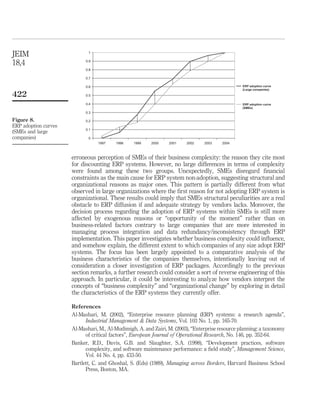
  • 4.
    contributing to theincreasing literature on ERP adoption in small businesses. Through Factors affecting a detailed literature review, a set of indicators are identified as variables which could ERP system influence the ERP adoption process. These indicators have been tested on the field through an empirical study carried out on a sample of 366 companies. adoption Conceptual framework The literature provides different definitions of ERP systems: Rosemann (1999) defines an 387 ERP system as a customizable, standard application software which includes integrated business solutions for the core processes (e.g. production planning and control, warehouse management) and the main administrative functions (e.g. accounting, human resource management) of an enterprise. Gable (1998) defines it as a comprehensive package software solution that seeks to integrate the complete range of business processes and functions in order to present an holistic view of the business from a single information and IT architecture. Watson and Schneider (1999) define ERP as an integrated, customized, packaged software-based system that handles the majority of an enterprise’s system requirements in all functional areas such as finance, human resources, manufacturing, sales, and marketing. It has a software architecture that facilitates the flow of information among all functions within an enterprise. It is built on a common database and is supported by a single development environment. Previous research works (Gibson et al., 1999; Ryan, 1999) suggested how ERP adoption and implementation could be an highly complex task in which strong managerial and strategic competences are required to achieve the best fit between the business peculiarities and the system itself and to deal with the unavoidable organizational impact induced by an ERP implementation. Other studies outlined different adoption patterns depending on company size and also observed that smaller companies face only subset of the needs and opportunities of larger organizations (Markus and Tanis, 2000). Furthermore, for a long time ERP adoption reasons within SMEs were explained only by contingency or exogenous factors (Tagliavini et al., 2002). To investigate these differences further, the research model presented in this paper explores to what extent the business complexity (measured from a set of business factors) and the awareness of the organizational requirements (measured by the extent of organizational change) affect the extent of ERP adoption. Such an effort seems, in fact, feasible for organizations experiencing high business complexity and information needs, and expecting, or even planning, significant organizational changes. The methodology contribution of this paper is experimentally proved by testing the relationship between business complexity, organizational change and ERP adoption on 300 SMEs through direct, survey-based, interviews. Such an approach, based on a statistical analysis on a high number of respondents, implies that its findings are not easily comparable to other previous research works that are often based on case studies on a very small set of companies. The following sections will detail the two main components of the conceptual framework: the business factors and the organizational change. Business factors Although the organizational structure of larger firms could be very different from SMEs, it is reasonable to assume that companies of any size, characterized by high organizational complexity (or “business complexity”), also show a critical need for
  • 5.
    JEIM coordination and control of business activities which, in turn, is related to the complexity 18,4 of the information system (Grinyer et al., 1986; Lorange, 1980; Vancil and Lorange, 1975). Since ERP systems have been very often advocated by researchers and practitioners as “the answer” to manage the complexity of information flows more effectively, this last interpretation of business complexity, will be used in the research model to investigate if the “the condition” of being a complex organizations (which is measured by a set of 388 business factors) and a greater extent of ERP adoption are straight related factors. Hence, the model approaches ERP systems as a sort of “black box” and thus their undeniable inner complexity (expressed by implementation and technological issues for instance) is taken for granted, and are therefore considered only an exogenous factor embedded into the ERP concept itself. In particular, the several issues related to ERP system chartering, development and maintenance (i.e. project and change management issues or cultural and organizational un-readiness) are typical of the “critical success factors” stream of research (Davenport, 2000; Mandal and Gunasekaran, 2003; Motwani et al., 2002) and generally refer more to the success of the implementation than to the reasons that bring companies to evaluate the opportunity of implementing an ERP system. Therefore, is business complexity the possible explanation? The assessment of the complexity measures is partially based on previous works (Grinyer et al., 1986; Yasai-Ardekani and Haug, 1997) that have developed and proposed metrics essentially based on size, diversification, and divisionalization. This paper neither proposes any new measure nor tests their reliability; instead it studies their occurrence in ERP adoption. Since the consistency of these indicators is essential for the theoretical validity of the whole framework, a detailed analysis of the IS literature has been performed in order to identify a set of additional business factors: . Company size (micro, small, medium, large). Existing literature confirms the existence of a mutual dependence between size and organizational complexity. Kimberly (1976) stressed the necessity of applying a different approach depending on the industry the company belongs to: for the services industry the number of employees has a better fit, while for manufacturing companies the turnover seems to be a better match. In any case, literature emphasizes size as one of the issues increasing the need for co-ordination and control of organizational activities (Howard and Hine, 1997; Yasai-Ardekani and Haug, 1997). Apart from any organizational or strategic remark, other research works (IDC, 1999) simply suggest a direct relationship between the size of organizations and the percentage of organizations where ERP has been implemented. . The market area (local, regional, national, international). Working on a wider market area requires the management of more differentiated legal and cultural issues, thus introducing a higher level of complexity (Davenport, 1998; Hamel and Prahalad, 1994; Prahalad, 1990; Sanders and Carpenter, 1998), as well as the facing of competitive pressures characterizing the international markets (Bartlett and Ghoshal, 1989; Roth and O’Donnell, 1996; Rumelt, 1974). In addition, as companies become more global and develop international supply chains, the limitations of MRPII have become apparent. Literature has identified the attempts being made by many organizations to expand their IS infrastructure beyond their organizational boundaries through the development of inter-organizational business systems. Consequently, this has resulted in the widespread adoption of ERP solutions (Irani, 2002).
  • 6.
    . The membership an industrial group (either as the holding or as a controlled firm). Factors affecting This variable seems to be strongly related to the co-ordination of dispersed ERP system business units, in terms of alignment of processes and procedures both between the holding and the controlled companies and among controlled companies adoption themselves. However, if the imposition of common operating processes on all units could lead to a tight coordination between the controlled companies, in a multiregional context strict process uniformity could be counterproductive in 389 terms of flexibility (Davenport, 1998). . The presence of branch offices (localization and number of branches). The management of information flows is a crucial issue for companies with branch offices which need to be remotely controlled. In larger organizations the development of intranets is often characterized by a lack of coordination and supervision (Horgan, 1997). SMEs face different issues (i.e. the cultural and technological levels of the entrepreneur): this is one of the aspects that must be considered to comprehend fully the fall-outs in terms of management complexity, organizational impact and required competencies. . The level of diversification (in terms of products, markets, technologies). Operating in different product-market combinations introduces another level of complexity (Yasai-Ardekani and Haug, 1997). In related-diversified firms, an increase in the number of businesses adds information-processing demands by increasing business-unit interdependencies (Hill and Hoskisson, 1987; Kerr, 1985; Michel and Hambrick, 1992; Pitts and Hopkins, 1982). In unrelated-diversifiers, as the number of businesses increases, the information-processing requirements associated with maintaining efficient internal capital markets also increase (Jones and Hill, 1988). Moreover, because of the greater need for co-ordination and control of activities, complex organizations will tend to have specialized planning departments, employ a larger number of planners and consequently devote a substantially larger amount of financial resources to strategic planning (Grinyer et al., 1986; Kukalis, 1989). . The degree of functional extension (number of activities carried out internally). Many companies prefer to outsource those activities that are not directly related to the business strategies (non-core processes). The degree of functional extension refers to the number of strategic functions directly managed within the company, which should be related to the amount of information to be managed (Price, 1997). In the light of the identified business factors, it is therefore necessary to verify the association between these factors and the use of ERP systems by testing the following six main hypotheses: H1. The company size affects the adoption of ERP systems. H2. The market area affects the adoption of ERP systems. H3. The membership of a group affects the adoption of ERP systems. H4. The presence of branch offices affects the adoption of ERP systems. H5. The level of diversification affects the adoption of ERP systems. H6. The degree of functional extension affects the adoption of ERP systems.
  • 7.
    JEIM Organizational change factors 18,4 Even though business factors play an important role in determining business complexity they are not considered sufficient to assure the feasibility of ERP adoption. Another issue that deserves consideration is the organizational impact of ERP systems as they tend to impose their own logic on company strategy, organization and culture (Davenport, 1998). Thus, the ERP adoption decision affects most of the company business functions and 390 directly involves a significant number of people. The project team responsible for ERP implementation will be challenged to either match the functionality of the application to business practice or find ways to adapt or change current processes and procedures, while the project team could face organizational resistance to changing the status quo (Laughlin, 1999). By providing universal, real-time access to operating and financial data, ERP systems allow companies to streamline their management structures, creating flatter, more flexible, and more democratic organizations. On the other hand, they also involve the centralization of control over information and the standardization of processes, which are qualities more consistent with hierarchical, command-and-control organizations with uniform cultures (Davenport, 1998). Are the organizations aware of such a change and then ready to bear and manage it? Is the alignment between the desired organizational change and the complexity of the IT solution verified? These remarks highlight a possible relationship between the extent of organizational change and the rate of ERP system adoption. The extent of organizational change represents the degree of company transformation that the entrepreneur plans as a consequence of a technological innovation. This measure depends on the evaluation of the organizational and economic impacts, such as the competence of the internal staff or their expected resistance to change to the adoption of a new technology. In order to analyze the factors influencing the adoption of ERP systems, we assume that ERP systems could generate larger benefits if implemented when a high level of organizational change is planned. Venkatraman (1994) classifies five main levels of transformation (Figure 1): (1) Local automation of existing procedures. This strategy is pursued only for automation of local, independent procedures. It requires minimal efforts and the corresponding expected results are enhancements in business process performance. Benefits coming from this strategy are easily duplicable, as Figure 1. Levels of business transformation related to technological innovation
  • 8.
    most of standardizedsolutions. Therefore, it is unlikely to obtain competitive Factors affecting advantage by simply automating existing procedures. ERP system (2) Internal integration of existing business processes. It aims at integrating the adoption business processes and the company IS in order to create competitive advantage. The required integration has to be pursued both at the technological and organizational level: whenever necessary, people belonging to different business functions have to cooperate to reach common objectives. Together with the 391 necessary automation effort, this strategy requires an integration effort; however, in both cases the business process structures remain unchanged. (3) Business process reengineering. It involves the partial or complete redesign of business processes, affecting not only the company procedures, but also its organizational structure. (4) Business network redesign. Changes overcome the boundaries of the company and could affect the entire network of its external relationships. For instance, electronic data interchange (EDI) can represent the technology chosen to pursue this strategy, but a great effort has to be put into business process integration, through a continuous information exchange and competence sharing. Under these conditions each partner can exploit the competencies of the business network instead of adopting expensive solutions of vertical integration. (5) Redefinition of company boundaries through the creation of inter-organizational relationships. The information communication technologies (ICT) allow the redefinition of the competitive environment through the creation of strong inter-organizational relationships (joint ventures, long-term contracts, licensing agreements). Therefore another hypothesis to be tested is focused on the matching between organizational issues and ERP system adoption: H7. The extent of planned organizational change is directly related to the use of ERP systems (the greater is the planned organizational change, the greater is the rate of adoption of ERP systems). To develop an effective framework it is necessary to include into the research model (as control measures) both the endogenous and exogenous reasons that may affect ERP adoption. According to the literature (Al-Mashari, 2002), among the reasons that may affect ERP adoption, either positively or negatively, it is possible to distinguish operational reasons (i.e. improving responsiveness to customers and simplifying ineffective or complex business processes) and technological reasons (i.e. Y2K compliance requirements, integration of business processes and systems, replacement of older, obsolete systems). For those companies which have stated that they do not make use of an ERP system, we classified each justification for ERP non-adoption into four main categories: (1) Structural motivations related to the need for coordination and control of business activities, thus to the complexity of information flows (which means that the company is not sufficiently complex to need an ERP system to manage the business). (2) Organizational motivations (the company is not prepared to face and manage the organizational changes related to the adoption and implementation of an ERP system).
  • 9.
    JEIM (3) Economic motivations (ERP system adoption and implementation would be too 18,4 costly for the company). (4) Other reasons. In the light of the control measures introduced the whole framework can be represented as shown in Figure 2. 392 Methodology Based on the literature review, focused on the identification of a taxonomy of business and organisational factors, a questionnaire was designed. It comprised three parts: the company demographics, the assessment of each business factor and the extent of the organizational change. Before the complete deployment of the survey a first trial was carried out on 122 companies suggesting the validity of the proposed approach (Tagliavini et al., 2002). Responses were collected through personal interviews made by a dedicated team to a top manager (possibly the entrepreneur him/herself or the CEO) since the proposed questions required the knowledge of the main business objectives, as well as of the features of the different business activities. The final questionnaire (an abstract is shown in Figure 2) was then proposed to a random sample of about 2000 Italian companies of any size and industry, geographically located in northern Italy. Data were finally analyzed with SPSS v11, in particular the hypotheses (from H1-H7) have been tested by means of cross tabulations. Pearson chi-square was used to verify whether the cross-tabulated groups were different, while p-values measure how the previously mentioned difference is statistically significant. Finally, the value of Spearman’s R is used to evaluate the reliability of correlations. A preliminary validation of collected data has been performed by cross-tabulating ERP adoption with each of the seven factors corresponding to the seven hypotheses (from H1-H7). Chi-square and p-value tests have been used to verify whether the set of companies using an ERP system is significantly different from the set of the not adopters. Then, the connection existing between each factor and ERP adoption has been assessed through Pearson’s R. A further analysis has been also performed Figure 2. Theoretical framework
  • 10.
    separating SMEs fromlarge companies to highlight possible differences between the Factors affecting two subsets. ERP system adoption Variable measurement According to the theoretical framework, the following sets of variables were measured: (1) The business complexity factors have been evaluated through six indicators 393 detailed in the Figure 3. Respondents were asked to qualitatively assess each variable of the set. More specifically: . Diversification has been measured as a synthetic index of business strategy by offering only two possible responses: diversification and other strategies (including cost-based and differentiation strategies). . Degree of functional extension, i.e. the number of activities carried out internally, has been assessed with respect to a set of typical business activities. The classical representation of the value chain (Porter and Millar, 1985) has been integrated with a more recent measure used to assess the impact of BPR on manufacturing firms (Guimaraes and Bond, 1996). This measure has been already adopted in author’s previous research (Tagliavini et al., 2002). (2) The extent of organizational change which aims at evaluating the level of organizational change the company is prepared to face in order to achieve competitive advantage through the use of IT, has been assessed through a question suggesting Venkatraman five levels of organizational change. Due to the academic formulation which undoubtedly characterizes the question in the survey, all the organizational implications and characteristics related to each level of the Venkatraman’s model have been thoroughly explained by the interviewers to respondents, to clearly point out any organizational-related issue. (3) The technological and operational drivers have been assessed using the model proposed by Al-Mashari (2002) integrated with other drivers which have been identified in a previous research (Chau, 1995). Multiple responses were allowed. (4) The motivations for ERP non-adoption have been assessed by asking respondents to select items from a check-list (also in this case multiple responses were allowed). Research findings Of the 2,000 contacted companies only 370 accepted to be interviewed yielding a response rate of 18.5 percent. Data from this sample were collected and filtered to resolve inconsistencies and correct anomalies, resulting in 366 valid questionnaires. The choice of the direct interviews to collect data is accountable for the low rate of rejected questionnaires: only four questionnaires were discarded. Demographic data The first part of the questionnaire dealt with companies’ demographics. Firm size (number of employees and turnover) was investigated according to the current definition provided by the European Union (see Table I).
  • 11.
  • 12.
    Small sized companiesrepresent 43 percent of respondents (18 percent micro, 25 Factors affecting percent small) while 42 percent have a medium size. Large enterprises represent 15 ERP system percent of the sample. With respect to the industry, the sample can be further categorized into three main adoption groups: manufacturing (66 percent), services (20 percent) and trade (14 percent). This distribution is highly representative of the economical characteristics of this geographic area, where large enterprises and services/wholesaling companies play a 395 secondary role (see Figure 4). Company size (H1) The analysis of the correlation between company size (as a composite index between turnover and number of employees) and ERP adoption shows a very good fit with data. The two groups are significantly different (chi-square equal to 65,166 and p-value lower than 0.001) while the Pearson’s R (0.401) shows that firms size and ERP adoption are significantly correlated. In detail, while only 7 percent of companies not making use of ERP systems are large-sized, the value corresponding to those large companies adopting ERP systems seems even more significant. In fact, despite not constituting the most relevant group in absolute terms (medium-sized companies are the 47 percent of the whole sample adopting ERP), in relative terms as to the sample composition (in which large companies are only 15 percent) large companies show an interesting result (38 percent). The analysis clearly shows also that the rate of ERP system adoption is quite low among both micro and small firms (3 percent and 12 percent respectively). This reinforces the persuasion that the company size affects the ERP adoption process. H1: verified. Membership of a group (H2) The cross tabulation for H2 shows an inverse correlation between membership of a group and ERP adoption (Pearson’s R ¼ 20:277). Moreover, the 55 percent of companies Micro Small-sized Medium-sized Criteria enterprises enterprises enterprises Maximum number of employees ,10 ,50 ,250 Maximum turnover in e million – 7 40 Maximum balance-sheet total in e million – 5 27 Table I. Source: European Commission (1996) SMEs definition Figure 4. Sample definition by size, industry and enterprise application
  • 13.
    JEIM belonging to a group prefer other management systems rather than ERP (Tables II-IV). A correct interpretation of such result requires considering that distribution of the 18,4 sample according to this factor as unbalanced (237 firms in a standalone configuration compared to 53 belonging to an industrial group). Nonetheless, it is reasonable to conclude that, despite what suggested in the existing literature, the membership of a group seems not to be directly related to the use of ERP systems. 396 The Pearson’s R index of correlation computed on SMEs (2 0.169, Tables V-VII) and large enterprises (0.060, Tables VIII-X) did not show consistent results. H2: rejected. Market area (H3) At a first glance, a wider market area of a company seems to be related to the use of ERP systems. Only a small subset of companies with a limited market area make use of ERP systems, while this value is higher for companies with a national market area (22 percent) and even more for those companies acting on international markets (74 percent, see cross-tabulation in Tables XI-XIII). Nevertheless, the high percentage of companies with an international market area which do not use ERP systems (68 percent) clearly shows that the ERP system is far from being the only solution adopted as stated in H3. The significant difference between the cross-tabulated groups, Company size and ERP adoption (whole sample) Size Other management system ERP Total Micro Count 62 3 65 % within size 95.4 4.6 100.0 % within ERP 23.6 3.3 18.4 Small Count 77 11 88 % within size 87.5 12.5 100.0 % within ERP 29.3 12.2 24.9 Medium Count 105 42 147 % within size 71.4 28.6 100.0 % within ERP 39.9 46.7 41.6 Large Count 19 34 53 % within size 35.8 64.2 100.0 % within ERP 7.2 37.8 15.0 Total Count 263 90 353 Table II. % within size 74.5 25.5 100.0 Company size and ERP % within ERP 100.0 100.0 100.0 adoption (whole sample) % of total 74.5 25.5 100.0 Value df Asymptotic significance (two-sided) a Pearson chi-square 65.166 3 0.000 Likelihood ratio 65.121 3 0.000 Table III. Linear-by-linear association 56.552 1 0.000 Company size and ERP n of valid cases 353 adoption (whole sample) – Chi-square tests Note: a 0 cells (0.0 percent) have expected count less than 5. The minimum expected count is 13.51
  • 14.
    (chi-square ¼ 14:538,p-value ¼ 0:000, Tables XI-XIII), is contradicted by the Factors affecting unsatisfactory value of the Pearson’s R index (0.190), which confirms the lack of a ERP system correlation between market area and ERP adoption. adoption H3 has also been tested on both SMEs and large companies, pointing out the same trend (Tables XIV-XVI and Tables XVII-XIX). H3: rejected. 397 Asymptotic Approximate Approximate Value standard errora Tb significance Interval by interval Pearson’s R 0.401 0.042 8.197 0.000c Ordinal by ordinal Spearman correlation 0.405 0.044 8.287 0.000c n of valid cases 0.353 Table IV. Company size and ERP Notes: a Not assuming the null hypothesis; b Using the asymptotic standard error assuming the null adoption (whole sample) hypothesis; c Based on normal approximation – symmetric measures Membership of a group and ERP adoption (whole sample) Other management system ERP Total Member of a group Count 54 44 98 % within membership 55.1 44.9 100.0 % within ERP 20.4 48.9 27.6 Standalone company Count 211 46 257 % within membership 82.1 17.9 100.0 % within ERP 79.6 51.1 72.4 Total Count 265 90 355 % within membership 74.6 25.4 100.0 Table V. % within ERP 100.0 100.0 100.0 Membership and ERP % of total 74.6 25.4 100.0 adoption (whole sample) Asymptotic Exact Exact significance significance significance Value df (two-sided) (two-sided) (one-sided) Pearson Chi-square 27.327b 1 0.000 Continuity correctiona 25.919 1 0.000 Likelihood ratio 25.640 1 0.000 Fisher’s exact test 0.000 0.000 Linear-by-linear association 27.250 1 0.000 n of valid cases 355 Table VI. a b Membership and ERP Notes: Computed only for a 2 £ 2 table; 0 cells (0.0 percent) have expected count less than 5. The adoption (whole sample) expected count is 24.85 – Chi-square tests
  • 15.
    JEIM Presence of branch offices (H4) 18,4 According to the literature, the presence of branch offices could be a factor that positively influences the complexity of information flows and that, consequently, could lead to a larger adoption of ERP systems. The empirical analysis shows a correlation between the extent of geographical dispersion of the company and the use of ERP systems. These systems have been adopted by only 15 percent of respondents with no 398 branch offices and by 42 percent of companies with geographically dispersed offices Asymptotic Approximate Approximate Value standard errora Tb significance Interval by interval Pearson’s R 20.277 0.056 2 5.426 0.000c Ordinal by ordinal Spearman correlation 20.277 0.056 2 5.426 0.000c Table VII. n of valid cases 355 Membership and ERP adoption (whole sample) Notes: a Not assuming the null hypothesis; b Using the asymptotic standard error assuming the null – symmetric measures hypothesis; c Based on normal approximation Membership of a group and ERP adoption (SMEs) Other management system ERP Total Member of a group Count 36 17 53 % within membership 67.9 32.1 100.0 % within ERP 15.2 32.1 18.3 Stand-alone company Count 201 36 237 % within membership 84.8 15.2 100.0 % within ERP 84.8 67.9 81.7 Total Count 237 53 290 Table VIII. % within membership 81.7 18.3 100.0 Membership and ERP % within ERP 100.0 100.0 100.0 adoption (SMEs) % of total 81.7 18.3 100.0 Asymptotic Exact Exact significance significance significance Value df (two-sided) (two-sided) (one-sided) b Pearson chi-square 8.269 1 0.004 Continuity correctiona 7.177 1 0.007 Likelihood ratio 7.393 1 0.007 Fisher’s exact test 0.009 0.005 Linear-by-linear association 8.240 1 0.004 Table IX. n of valid cases 290 Membership and ERP adoption (SMEs) – Notes: a Computed only for a 2 £ 2 table; b 0 cells (0.0 percent) have expected count less than 5. The Chi-square tests expected count is 9.69
  • 16.
    (Tables XX-XXII). Theevaluation of the behavior of companies making use of ERP Factors affecting systems confirms this relationship: 62 percent of them have geographically dispersed ERP system offices, while only 38 percent of ERP users have no branch offices to manage. Although adoption this interesting trend, a correlation between the two variables cannot be fully claimed: the empirical verification shows a Pearson’s R value equal to 0.297 that is not statistically reliable to state that the presence of branch offices directly affects a higher rate of ERP system adoption (Tables XX-XXII). 399 Asymptotic Approximate Approximate Value standard errora Tb significance Interval by interval Pearson’s R 20.169 0.067 2 2.907 0.004c Ordinal by ordinal Spearman correlation 20.169 0.067 2 2.097 0.004c n of valid cases 290 Table X. Membership and ERP Notes: a Not assuming the null hypothesis; b Using the asymptotic standard error assuming the null adoption (SMEs) – hypothesis; c Based on normal approximation symmetric measures Membership and ERP adoption (large companies) Other management system ERP Total Member of group Count 15 25 40 % within membership 37.5 62.5 100.0 % within ERP 78.9 73.5 75.5 Standalone company Count 4 9 13 % within membership 30.8 69.2 100.0 % within ERP 21.1 26.5 24.5 Total Count 19 34 53 Table XI. % within membership 35.8 64.2 100.0 Membership and ERP % within ERP 100.0 100.0 100.0 adoption (large % of total 35.8 64.2 100.0 companies) Asymptotic Exact Exact significance significance significance Value df (two-sided) (two-sided) (one-sided) Pearson Chi-square 0.193b 1 0.660 Continuity correctiona 0.011 1 0.915 Likelihood ratio 0.196 1 0.658 Fisher’s exact test 0.749 0.464 Linear-by-linear association 0.190 1 0.663 Table XII. n of valid cases 53 Membership and ERP adoption (large Notes: a Computed only for a 2 £ 2 table; b 1 cell (25.0 percent) has expected count less than 5. The companies) – Chi-square expected count is 4.66 tests
  • 17.
    JEIM The empirical verification of H4 on the subsets obtained by separating the companies 18,4 by size does not show any interesting result (Tables XXIII-XXV and Tables XXVI-XXVIII). In particular, the statistical analysis on large companies (Tables XXVI-XXVIII) does not show any meaningful difference between the two groups (chi-square ¼ 0:348 and p-value ¼ 0:409). H4: rejected (weak significance on the whole sample). 400 Asymptotic Approximate Approximate Value standard errora Tb significance Interval by interval Pearson’s R 0.060 0.134 0.432 0.668c Table XIII. Ordinal by ordinal Spearman correlation 0.060 0.134 0.432 0.668c Membership and ERP n of valid cases 53 adoption (large companies) – symmetric Notes: a Not assuming the null hypothesis; b Using the asymptotic standard error assuming the null measures hypothesis; c Based on normal approximation Market area and ERP adoption (whole sample) Market area Other management system ERP Total Local Count 19 2 21 % within market area 90.5 9.5 100.0 % within ERP 7.0 2.2 5.8 Regional Count 25 2 27 % within market area 92.6 7.4 100.0 % within ERP 9.2 2.2 7.4 National Count 83 20 103 % within membership 80.6 19.4 100.0 % within ERP 30.6 21.7 28.4 International Count 144 68 212 % within market area 67.9 32.1 100.0 % within ERP 53.1 73.9 58.4 Total Count 271 92 363 Table XIV. % within market area 74.7 25.3 100.0 Market area and ERP % within ERP 100.0 100.0 100.0 adoption (whole sample) % of total 74.7 25.3 100.0 Value df Asymptotic significance (two-sided) Pearson Chi-square 14.358a 3 0.002 Likelihood ratio 16.081 3 0.001 Table XV. Linear-by-linear association 13.113 1 0.000 Market area and ERP n of valid cases 363 adoption (whole sample) – Chi-square tests Note: a 0 cells (0.0 percent) have expected count less than 5. The minimum expected cost is 5.32
  • 18.
    Diversification (H5) Factors affecting Despite the support provided by the literature for diversification as a factor affecting ERP system the complexity of information flows, the empirical verification does not show meaningful correlations with the adoption of ERP systems (Tables XXIX-XXXI). Only adoption 27 percent of diversified companies make use of an ERP system. Moreover, 55 percent of companies adopting an ERP system pursue another kind of strategy. The low significance of diversification as a factor affecting ERP adoption is also confirmed by 401 the results of the statistical analysis: the two groups are not significantly different Asymptotic Approximate Approximate Value standard errora Tb significance Interval by interval Pearson’s R 0.190 0.042 3.684 0.000c Ordinal by ordinal Spearman correlation 0.196 0.046 3.796 0.000c n of valid cases 363 Table XVI. Market area and ERP Notes: a Not assuming the null hypothesis; b Using the asymptotic standard error assuming the null adoption (whole sample) hypothesis; c Based on normal approximation – symmetric measures Market area and ERP adoption (SMEs) Market area Other management system ERP Total Local Count 19 19 % within market area 100.0 100.0 % within ERP 7.9 6.4 Regional Count 21 2 23 % within market area 91.3 8.7 100.0 % within ERP 8.7 3.6 7.7 National Count 74 13 87 % within market area 85.1 14.9 100.0 % within ERP 30.6 23.6 29.3 International Count 128 40 168 % within market area 76.2 23.8 100.0 % within ERP 52.9 72.7 56.6 Total Count 242 55 297 % within market area 81.5 18.5 100.0 Table XVII. % within ERP 100.0 100.0 100.0 Market area and ERP % of total 81.5 18.5 100.0 adoption (SMEs) Value df Asymptotic significance (two-sided) a Pearson Chi-square 9.643 3 0.022 Likelihood ratio 13.235 3 0.004 Linear-by-linear association 9.561 1 0.002 Table XVIII. n of valid cases 297 Market area and ERP adoption (SMEs) – Note: a Two cells (25.0 percent) have expected count less than 5. The minimum expected count is 3.52 Chi-square tests
  • 19.
    JEIM (Chi-square equal to 0.261, with a p-value of 0.610) and the very low value of Pearson’s 18,4 R correlation index (0.027) bears out that no correlation occurs. Accordingly to the methodology, the analysis has been carried out on both SMEs and large companies to verify possible different behaviors in the sub-groups (Tables XXXII-XXXIV and Tables XXXV-XXXVII), but no statistical evidence has been found. H5: rejected. 402 Asymptotic Approximate Approximate Value standard errora Tb significance Interval by interval Pearson’s R 0.180 0.039 3.138 0.002c Ordinal by ordinal Spearman correlation 0.173 0.049 3.019 0.003c Table XIX. n of valid cases 297 Market area and ERP adoption (SMEs) – Notes: a Not assuming the null hypothesis; b Using the asymptotic standard error assuming the null symmetric measures hypothesis; c Based on normal approximation Market area and ERP adoption (large companies) Market area Other management system ERP Total Local Count 1 1 % within market area 100.0 100.0 % within ERP 2.9 1.9 Regional Count 3 3 % within market area 100.0 100.0 % within ERP 15.8 5.7 National Count 4 7 11 % within market area 36.4 63.6 100.0 % within ERP 21.1 20.6 20.8 International Count 12 26 38 % within market area 31.6 68.4 100.0 % within ERP 63.2 76.5 71.7 Table XX. Total Count 19 34 53 Market area and ERP % within market area 35.8 64.2 100.0 adoption (large % within ERP 100.0 100.0 100.0 companies) % of total 35.8 64.2 100.0 Value df Asymptotic significance (two-sided) a Pearson Chi-square 6.230 3 0.101 Table XXI. Likelihood ratio 7.351 3 0.062 Market area and ERP Linear-by-linear association 1.397 1 0.237 adoption (large n of valid cases 53 companies) – Chi-square tests Note: a Five cells (62.5 percent) have expected count less than 5. The minimum expected count is 0.36
  • 20.
    Functional extension (H6) Factors affecting Even though most of respondents (88 percent) manage all the business activities ERP system internally, the functional extension does not seem to affect the rate of ERP system adoption. For each meaningful value of functional extension (cross-tabulation cells adoption with more than five companies, Tables XXXVIII-XL), the percentage of companies making use of ERP systems is at most equal to the 26.1 percent. In particular, only 25.9 percent of the 321 companies characterized by the maximum level of functional 403 Asymptotic Approximate Approximate Value standard errora Tb significance Interval by interval Pearson’s R 0.164 0.145 1.187 0.241c Ordinal by ordinal Spearman correlation 0.163 0.141 1.180 0.244c Table XXII. n of valid cases 53 Market area and ERP adoption (large Notes: a Not assuming the null hypothesis; b Using the asymptotic standard error assuming the null companies) – symmetric hypothesis; c Based on normal approximation measures Branch offices and ERP adoption (whole sample) Branch offices Other management system ERP Total No Count 193 35 228 % within branch offices 84.6 15.4 100.0 % within ERP 70.7 37.6 62.3 Yes Count 80 58 138 % within branch offices 58.0 42.0 100.0 % within ERP 29.3 62.4 37.7 Total Count 273 93 366 % within branch offices 74.6 25.4 100.0 Table XXIII. % within ERP 100.0 100.0 100.0 Branch offices and ERP % of total 74.6 25.4 100.0 adoption (whole sample) Asymptotic Exact Exact significance significance significance Value df (two-sided) (two-sided) (one-sided) b Pearson Chi-square 32.282 1 0.000 Continuity correctiona 30.890 1 0.000 Likelihood ratio 31.597 1 0.000 Fisher’s exact test 0.000 0.000 Linear-by-linear association 32.194 1 0.000 n of valid cases 366 Table XXIV. a b Branch offices and ERP Notes: Computed only for a 2 £ 2 table; 0 cells (0.0 percent) have expected count less than 5. the adoption (whole sample) maximum expected count is 35.07 – Chi-square tests
  • 21.
    JEIM extension claim to make use of an ERP system. The unbalanced distribution of the 18,4 sample undoubtedly challenges the reliability of the analysis; nevertheless SMEs do not consider ERP systems as the solution needed to improve their organizational performance yet. The analysis of both correlation and statistical significance with respect to SMEs and large companies does not show any meaningful change in of the main indexes (Tables XLI-XLI and Tables XLIV-XLVI). 404 H6: rejected. Asymptotic Approximate Approximate Value standard errora Tb significance Interval by interval Pearson’s R 0.297 0.052 5.934 0.000c Ordinal by ordinal Spearman correlation 0.297 0.052 5.934 0.000c Table XXV. n of valid cases 366 Branch offices and ERP adoption (whole sample) Notes: a Not assuming the null hypothesis; b Using the asymptotic standard error assuming the null – symmetric measures hypothesis; c Based on normal approximation Branch offices and ERP adoption (SMEs) Branch offices Other management system ERP Total No Count 181 29 210 % within branch offices 86.2 13.8 100.0 % within ERP 74.2 51.8 70.0 Yes Count 63 27 90 % within branch offices 70.0 30.0 100.0 % within ERP 25.8 48.2 30.0 Total Count 244 56 300 Table XXVI. % within branch offices 81.3 18.7 100.0 Branch offices and ERP % within ERP 100.0 100.0 100.0 adoption (SMEs) % of total 81.3 18.7 100.0 Asymptotic Exact Exact significance significance significance Value df (two-sided) (two-sided) (one-sided) Pearson Chi-square 10.877b 1 0.001 Continuity correctiona 9.837 1 0.002 Likelihood ratio 10.230 1 0.001 Fisher’s exact test 0.002 0.001 Linear-by-linear association 10.841 1 0.001 Table XXVII. n of valid cases 300 Branch offices and ERP adoption (SMEs) – Notes: a Computed only for a 2 £ 2 table; b 0 cells (0.0 percent) have expected count less than 5. the Chi-square tests maximum expected count is 16.80
  • 22.
    Extent of organizationalchange (H7) Factors affecting Unlike previous factors (from H2-H6), the results of the data analysis on H7 ERP system (Table XLVII-XLIX) highlights that the extent of organizational change the company wishes to achieve is likely to affect the decision of whether adopting an ERP system or not. adoption Even though the Pearson’s R value (0.306) shown by the whole sample is just acceptable, other considerations support this statement. In particular (Tables L-LII), companies adopting other management systems reveal a lower mean for the organizational change 405 factor (1.2) in comparison with those companies which have adopted an ERP system (2.3). Asymptotic Approximate Approximate Value standard errora Tb significance Interval by interval Pearson’s R 0.190 0.062 3.348 0.001c Ordinal by ordinal Spearman correlation 0.190 0.062 3.348 0.001c n of valid cases 300 Table XXVIII. a b Branch offices and ERP Notes: Not assuming the null hypothesis; Using the asymptotic standard error assuming the null adoption (SMEs) – hypothesis; c Based on normal approximation symmetric measures Presence of branch offices and ERP adoption (large companies) Branch offices Other management system ERP Total No Count 4 5 9 % within branch offices 44.4 55.6 100.0 % within ERP 21.1 14.7 17.0 Yes Count 15 29 44 % within branch offices 34.1 65.9 100.0 % within ERP 78.9 85.3 83.0 Total Count 19 34 53 Table XXIX. % within branch offices 35.8 64.2 100.0 Branch offices and ERP % within ERP 100.0 100.0 100.0 adoption (large % of total 35.8 64.2 100.0 companies) Asymptotic Exact Exact significance significance significance Value df (two-sided) (two-sided) (one-sided) Pearson Chi-square 0.348b 1 0.555 Continuity correctiona 0.044 1 0.835 Likelihood ratio 0.340 1 0.560 Fisher’s exact test 0.706 0.409 Linear-by-linear association 0.342 1 0.559 Table XXX. n of valid cases 53 Branch offices and ERP adoption (large Notes: a Computed only for a 2 £ 2 table; b One cell (25.0 percent) has expected count less than 5. The companies) – Chi-square maximum expected count is 3.23 tests
  • 23.
    JEIM A detailed analysis of the cross-tabulation between organizational change and ERP adoption has pointed out some interesting remarks (see Figure 5): 18,4 . Companies seem to privilege the ERP solution when their need to integrate, reengineer or redesign business processes becomes a priority (respectively the 17.4 percent, 25 percent and the 16.3 percent). Only 11 percent of companies which make use of ERP systems exploit this solution just for local automation 406 purposes, while the number of companies considering a more advanced solution (business network redesign levels) is quite negligible (8.7 percent). Asymptotic Approximate Approximate Value standard errora Tb significance Interval by interval Pearson’s R 0.081 0.141 0.581 0.564c Table XXXI. Ordinal by ordinal Spearman correlation 0.081 0.141 0.581 0.564c Branch offices and ERP n of valid cases 53 adoption (large companies) – symmetric Notes: a Not assuming the null hypothesis; b Using the asymptotic standard error assuming the null measures hypothesis; c Based on normal approximation Diversification and ERP adoption Other management system ERP Total Other strategy Count 158 51 209 % within diversification 75.6 24.4 100.0 % within ERP 57.9 54.8 57.1 Diversification Count 115 42 157 % within diversification 73.2 26.8 100.0 % within ERP 42.1 45.2 42.9 Total Count 273 93 366 Table XXXII. % within diversification 74.6 25.4 100.0 Diversification and ERP % within ERP 100.0 100.0 100.0 adoption (whole sample) % of total 74.6 25.4 100.0 Asymptotic Exact Exact significance significance significance Value df (two-sided) (two-sided) (one-sided) Pearson chi-square 0.261b 1 0.609 Continuity correctiona 0.152 1 0.697 Likelihood ratio 0.260 1 0.610 Fisher’s exact test 0.629 0.348 Linear-by-linear association 0.260 1 0.610 Table XXXIII. n of valid cases 0.366 Diversification and ERP adoption (whole sample) Notes: a Computed only for a 2 £ 2 table; b 0 cells (0.0 percent) have expected count less than 5. The – Chi-square tests maximum expected count is 39.89
  • 24.
    . A quite unexpected outcome of the analysis is the relevant percentage of Factors affecting companies (21.7 percent) declaring that no organizational change occurred, or ERP system has been foreseen, as a consequence of ERP adoption. This result is even more surprising in the light of the support given by IS literature to the thesis that ERP adoption adoption both requires and provokes an unavoidable organizational reshuffling of roles and tasks (Dewett and Jones, 2001). . The comparative analysis of means and distribution for the organizational 407 change factor (Table XLVII-XLIX) also shows that the underestimation of the Asymptotic Approximate Approximate Value standard errora Tb significance Interval by interval Pearson’s R 0.027 0.052 0.510 0.610c Ordinal by ordinal Spearman correlation 0.027 0.052 0.510 0.610c n of valid cases 366 Table XXXIV. a b Diversification and ERP Notes: Not assuming the null hypothesis; Using the asymtopic standard error assuming the null adoption (whole sample) hypothesis; c Based on normal approximation – symmetric measures Diversification and ERP adoption (SMEs) Other management system ERP Total Other strategy Count 142 32 174 % within diversification 81.6 18.4 100.0 % within ERP 58.2 57.1 58.0 Diversification Count 102 24 126 % within diversification 81.0 19.0 100.0 % within ERP 41.8 42.9 42.0 Total Count 244 56 300 Table XXXV. % within diversification 81.3 18.7 100.0 Diversification and ERP % within ERP 100.0 100.0 100.0 adoption (SMEs) % of total 81.3 18.7 100.0 Asymptotic Exact Exact significance significance significance Value df (two-sided) (two-sided) (one-sided) b Pearson Chi-square 0.021 1 0.885 Continuity correctiona 0.000 1 1.000 Likelihood ratio 0.021 1 0.885 Fisher’s exact test 0.882 0.500 Linear-by-linear association 0.021 1 0.886 n of valid cases 300 Table XXXVI. Diversification and ERP Notes: a Computed only for a 2 £ 2 table; b 0 cells (0.0 percent) have expected count less than 5. The adoption (SMEs) – maximum expected count is 23.52 Chi-square tests
  • 25.
    JEIM organizational change factor becomes even more relevant among those 18,4 companies that make use of another management system (50.4 percent). The previous analysis has been performed also separating SMEs and large companies in order to highlight possible differences in the behavior of the two sub-groups. Organizational change shows a stronger correlation with ERP adoption in the case of 408 large companies (Pearson’s R ¼ 0:386, Tables LIII-LV) with respect to SMEs (Pearson’s R ¼ 0:218, Table LVI-LVIII). To explore the reasons underlying the different correlation shown by the two sub-groups, the previous outcome has been Asymptotic Approximate Approximate Value standard errora Tb significance Interval by interval Pearson’s R 0.008 0.058 0.144 0.886c Ordinal by ordinal Spearman correlation 0.008 0.058 0.144 0.886c Table XXXVII. n of valid cases 300 Diversification and ERP adoption (SMEs) – Notes: a Not assuming the null hypothesis; b Using the asymptotic standard error assuming the null symmetric measures hypothesis; c Based on normal approximation Diversification and ERP adoption (large companies) Other management system ERP Total Other strategy Count 12 17 29 % within diversification 41.4 58.6 100.0 % within ERP 63.2 50.0 54.7 Diversification Count 7 17 24 % within diversification 29.2 70.8 100.0 % within ERP 36.8 50.0 45.3 Table XXXVIII. Total Count 19 34 53 Diversification and ERP % within diversification 35.8 64.2 100.0 adoption (large % within ERP 100.0 100.0 100.0 companies) % of total 35.8 64.2 100.0 Asymptotic Exact Exact significance significance significance Value df (two-sided) (two-sided) (one-sided) Pearson Chi-square 0.852b 1 0.356 Continuity correctiona 0.403 1 0.525 Likelihood ratio 0.859 1 0.354 Fisher’s exact test 0.401 0.264 Table XXXIX. Linear-by-linear association 0.836 1 0.361 Diversification and ERP n of valid cases 53 adoption (large companies) – Chi-square Notes: a Computed only for a 2 £ 2 table; b 0 cells (0.0 percent) have expected count less than 5. The tests maximum expected count is 8.60
  • 26.
    further investigated bymeans of the analysis of both frequencies for the organizational Factors affecting change factor and ERP non-adoption reasons: ERP system . The evaluation of frequencies (Figure 5) points out that SMEs are more inclined to a strategy of incremental innovation (local automation and internal integration) when adoption adopting ERP systems, whereas the use of ERP among large companies seems to be more related to a radical-oriented attitude towards organizational innovation (business process reengineering and business network redesign). As suggested by 409 literature, an incremental and too prudential approach towards organizational innovation could endanger the survival itself of the small organization. This is due to the mismatches that could occur between the assumptions about organizational structure implicitly embedded in the reference models the ERP software makes use of and the actual organization (Kumar and Hillegersberg, 2000). This remark gains Asymptotic Approximate Approximate Value standard errora Tb significance Interval by interval Pearson’s R 0.127 0.135 0.913 0.366c Ordinal by ordinal Spearman correlation 0.127 0.135 0.913 0.366c Table XL. n of valid cases 53 Diversification and ERP adoption (large Notes: a Not assuming the null hypothesis; b Using the asymptotic standard error assuming the null companies) – ymmetric hypothesis; c Based on normal approximation measures Functional extension and ERP adoption Number of internally Other management managed activities system ERP Total 0 Count 1 1 % within functional extension 100.0 100.0 % within ERP 0.4 0.3 3 Count 3 3 % within functional extension 100.0 100.0 % within ERP 1.1 1 0.8 5 Count 3 25.0 4 % within functional extension 75.0 1.1 100.0 % within ERP 1.1 3 1.1 6 Count 11 21.4 14 % within functional extension 78.6 3.2 100.0 % within ERP 4.0 6 3.8 7 Count 17 26.1 23 % within functional extension 73.9 6.5 100.0 % within ERP 6.2 83 6.3 8 Count 238 25.9 321 % within functional extension 74.1 89.2 100.0 % within ERP 87.2 93 87.7 Total Count 273 25.4 366 Table XLI. % within functional extension 74.6 100.0 100.0 Functional extension and % within ERP 100.0 25.4 100.0 ERP adoption (whole % of total 74.9 100.0 sample)
  • 27.
    JEIM even more importance in the light of the 25.5 percent of SMEs adopting ERP claiming that no organizational change occurred or has been foreseen, compared 18,4 with the only 14.7 percent of large companies. . The incremental attitude towards organizational innovation shown by SMEs is strengthened by the analysis of both the reasons justifying ERP non-adoption 410 Value df Asymptotic significance (two-sided) a Pearson Chi-square 1.519 5 0.911 Table XLII. Likelihood ratio 2.506 5 0.776 Functional extension and Linear-by-linear association 1.057 1 0.304 ERP adoption (whole n of valid cases 366 sample) – Chi-square tests Note: a Seven cells (58.3 percent) have expected count less than 5. The minimum expected count is 0.25 Asymptotic Approximate Approximate Value standard errora Tb significance Interval by interval Pearson’s R 0.054 0.037 1.028 0.305c Table XLIII. Ordinal by ordinal Spearman correlation 0.030 0.050 0.576 0.565c Functional extension and n of valid cases 366 ERP adoption (whole sample) – symmetric Notes: a Not assuming the null hypothesis; b Using the asymptotic standard error assuming the null measures hypothesis; c Based on normal approximation Functional extension and ERP Number of internally adoption (SMEs) managed activities Other management system ERP Total 3 Count 3 3 % within functional extension 100.0 100.0 % within ERP 1.2 1.0 5 Count 2 2 % within functional extension 100.0 100.0 % within ERP 0.8 0.7 6 Count 9 2 11 % within functional extension 81.8 18.2 100.0 % within ERP 3.7 3.6 3.7 7 Count 16 2 18 % within functional extension 88.9 11.1 100.0 % within ERP 6.6 3.6 6.0 8 Count 214 52 266 % within functional extension 80.5 19.5 100.0 % within ERP 87.7 92.9 88.7 Total Count 244 56 300 Table XLIV. % within functional extension 81.3 18.7 100.0 Functional extension and % within ERP 100.0 100.0 100.0 ERP adoption (SMEs) % of total 81.3 18.7 100.0
  • 28.
    and the statedextent of organizational innovation (Figure 6). In the 58.2 percent Factors affecting of cases (multiple response allowed) SMEs declare their business is not complex ERP system enough to justify the adoption of an ERP system (structural reasons), while the organizational un-readiness (i.e. organizational skills are not sufficient to manage adoption Value df Asymptotic significance (two-sided) 411 a Pearson Chi-square 1.962 5 0.911 Likelihood ratio 2.970 5 0.776 Linear-by-linear association 1.336 1 0.304 Table XLV. n of valid cases 300 Functional extension and ERP adoption (SMEs) – Note: Six cells (60.0 percent) have expected count less than 5. The minimum expected count is 0.37 Chi-square tests Asymptotic Approximate Approximate Value standard errora Tb significance Interval by interval Pearson’s R 0.067 0.037 1.156 0.248c Ordinal by ordinal Spearman correlation 0.064 0.049 1.103 0.271c n of valid cases 300 Table XLVI. a b Functional extension and Notes: Not assuming the null hypothesis; Using the asymptotic standard error assuming the null ERP adoption (SMEs) – hypothesis; c Based on normal approximation symmetric measures Functional extension and ERP Number of internally adoption (large companies) managed activities Other management system ERP Total 0 Count 1 1 % within functional extension 100.0 100.0 % within ERP 5.3 1.9 5 Count 1 1 2 % within functional extension 50.0 50.0 100.0 % within ERP 5.3 2.9 3.8 6 Count 2 1 3 % within functional extension 66.7 33.3 100.0 % within ERP 10.5 2.9 5.7 7 Count 1 3 4 % within functional extension 25.0 75.0 100.0 % within ERP 5.3 8.8 7.5 8 Count 14 29 43 % within functional extension 32.6 67.4 100.0 % within ERP 73.7 85.3 81.1 Total Count 19 34 53 Table XLVII. % within functional extension 35.8 64.2 100.0 Functional extension and % within ERP 100.0 100.0 100.0 ERP adoption (large % of total 35.8 64.2 100.0 companies)
  • 29.
    JEIM the change in the organization induced by an ERP implementation) is cited in only the 29.5 percent of cases. Despite the emphasis that the literature has always 18,4 put on the scarcity of financial resource of SMEs as one the most important factors affecting ERP non-adoption (Cragg and Zinatelli, 1995; Levy and Powell, 2000; Themistocleous et al., 2001; Zinatelli et al., 1996), quite surprisingly economic reasons (15,2 percent) are not as important as structural and 412 organizational motivations. . The same analysis performed on large companies (Table LIX and Figure 7) shows a supremacy of organizational reasons (45.5 percent of cases) whereas structural reasons are mentioned in the 36.4 percent of cases. These results are merely indicative due to the lack of numerical consistency of the sub-group itself (only 11 valid cases and 12 total responses). H7: verified (in particular for large companies). Discussion The empirical verification of the framework shows the difficulties in describing the relationship between the growth in business and organizational complexity and ERP adoption: only two measures were considered reliable (Table LX). The data analysis supports the existence of a strong correlation between company size (evaluated as a composed measure of number of employees and turnover) and ERP adoption. All the other hypotheses regarding possible business complexity measures have been rejected. No other studies seem to have tested the relationship between business complexity and ERP adoption on such a relative high number of companies, and on SMEs in particular. The methodology itself differentiates this research from previous efforts, being based on an extensive questionnaire deployed through direct interviews, instead of Value df Asymptotic significance (two-sided) Pearson Chi-square 3.610a 4 0.461 Table XLVIII. Likelihood ratio 3.813 4 0.432 Functional extension and Linear-by-linear association 2.678 1 0.102 ERP adoption (large n of valid cases 53 companies) – Chi-square tests Note: Eight cells (80.0 percent) have expected count less than 5. The minimum expected count is 0.36 Asymptotic Approximate Approximate Value standard errora Tb significance Interval by interval Pearson’s R 0.227 0.111 1.664 0.102c Table XLIX. Ordinal by ordinal Spearman correlation 0.162 0.143 1.173 0.246c Functional extension and n of valid cases 53 ERP adoption (large companies) – symmetric Notes: a Not assuming the null hypothesis; b Using the asymptotic standard error assuming the null measures hypothesis; c Based on normal approximation
  • 30.
    Organizational change andERP adoption Local Internal Business process Business Redefinition of Nothing automation integration reengineering network redesign company boundaries Total Other Count 122 29 40 25 21 5 242 management % within system organizational change 50.4 12.0 16.5 10.3 8.7 2.1 100.0 % within ERP 85.9 74.4 71.4 52.1 58.3 38.5 72.5 ERP Count 20 10 16 23 15 8 92 % within 21.7 10.9 17.4 25.0 16.3 8.7 100.0 organizational change % within ERP 14.1 25.6 28.6 47.9 41.7 61.5 27.5 Total Count 142 39 56 48 36 13 334 % within 42.5 11.7 16.8 14.4 10.8 3.9 100.0 organizational change % within ERP 100.0 100.0 100.0 100.0 100.0 100.0 100.0 % of total 42.5 11.7 16.8 14.4 10.8 3.9 100.0 adoption Factors affecting sample) and ERP adoption (whole Organizational change ERP system Table L. 413
  • 31.
    JEIM the commonly used approach based on case study. Despite the positive outcomes of such 18,4 choices, one main side effect could be a reduced comparability of the results. The findings on the relationship between ERP adoption and organizational change (H7) show that companies making use of an ERP system expect a wider extent of business transformation (business process reengineering and business network redesign) with respect to companies making use of other software applications. SMEs 414 always scheduled a limited organizational change in the case of ERP adoption, thus they seem not to consider ERP systems as a keystone for organizational innovation. If the testing on H7 reveals an incremental and conservative approach to organizational change by SMEs, on the contrary, H7 suggests a different innovation strategy by large Value df Asymptotic significance (two-sided) a Pearson Chi-square 34.097 5 0.000 Table LI. Likelihood ratio 33.650 5 0.000 Organizational change Linear-by-linear association 31.147 1 0.000 and ERP adoption (whole n of valid cases 334 sample) – Chi-square tests Note: a One cell (8.3 percent) has expected count less than 5. The minimum expected count is 3.58 Asymptotic Approximate Approximate Value standard errora Tb significance Interval by interval Pearson’s R 0.306 0.053 5.853 0.000c Table LII. Ordinal by ordinal Spearman correlation 0.304 0.052 5.822 0.000c Organizational change n of valid cases 334 and ERP adoption (whole sample) – symmetric Notes: a Not assuming the null hypothesis; b Using the asymptotic standard error assuming the null measures hypothesis; c Based on normal approximation Figure 5. Frequencies for organizational change and adopted software solution (whole sample)
  • 32.
    Organizational change andERP adoption (large companies) Local Internal Business process Business Redefinition of Nothing automation integration reengineering network redesign company boundaries Total Other Count 8 5 3 1 17 management % within system organizational change 47.1 29.4 17.5 5.9 100.0 % within ERP 61.5 50.0 23.1 12.5 33.3 ERP Count 5 3 5 10 7 4 34 % within 14.7 8.8 14.7 29.4 20.6 11.8 100.0 organizational change % within ERP 38.5 100.0 50.0 76.9 87.5 100.0 66.7 Total Count 13 3 10 13 8 4 51 % within 25.5 5.9 19.6 25.5 15.7 7.8 100.0 organizational change % within ERP 100.0 100.0 100.0 100.0 100.0 100.0 100.0 % of total 25.5 5.9 19.6 25.5 15.7 7.8 100.0 companies) adoption Factors affecting Organizational change and ERP adoption (large Table LIII. ERP system 415
  • 33.
    JEIM companies since they are especially aware of the organizational implications of ERP 18,4 adoption and, in particular, of the need of more radical changes. Firms that are planning to change their information system radically are more inclined to adopt ERP systems due to the expected “integration” outcomes. However, SMEs result to be less inclined to radical change and less aware of the organizational impact caused by the implementation of an ERP system. SMEs’ traditional focus on 416 operations and day-by-day management, coupled with a lack of strategic view of ICT, could be partially accountable for these findings. Indeed, SMEs could simply prefer to continue doing business as they are used to, by refusing to adopt solutions that could change their “course”. On one hand, this approach has opened up the SME market to personalized integrated solutions able to respond adequately both to their information needs and extreme flexibility, not necessarily provided by the ERP market’s big players. On the other hand, it is a clear sign for ERP big players that the SME market requires simplified and less expensive solutions. This has been the way ERP vendors tried to cope with the issues connected to the dualism between business processes change and software customization issues. In particular, the first answer of ERP vendors was the proposal of products with a range of functionalities on a smaller scale to lower the overall costs and vertical solutions to achieve a concrete reduction in customization costs without a dramatic change in the way people currently work. It is still questionable whether ERP packages are really keeping their promises. The subject is still debated but, by looking at vendors’ scenery, there is a general agreement on the role played by company size (H1) as the main clustering variable for the ERP market. The ERP market evolution has clearly shown that differences in company size have an influence not only on the adoption of ERP systems (H1), but also on the inner characteristics of ERP packages themselves. In particular, experiences on the field seem to confirm that both the extent of business complexity and the sustainable level of organizational change may dramatically vary according to company size, hence SMEs could be no longer treated by the same standard as large companies. Therefore, Value df Asymptotic significance (two-sided) a Pearson’s Chi-square 11.582 5 0.041 Table LIV. Likelihood ratio 13.665 5 0.018 Organizational change Linear-by-linear association 7.454 1 0.006 and ERP adoption (large n of valid cases 51 companies) – Chi-square tests Note: a Eight cells (66.7 percent) have expected count less than 5. The minimum expected count is 1.00 Asymptotic Approximate Approximate Value standard errora Tb significance Interval by interval Pearson’s R 0.386 0.116 2.930 0.005c Table LV. Ordinal by ordinal Spearman correlation 0.393 0.116 2.994 0.004c Organizational change n of valid cases 51 and ERP adoption (large companies) – symmetric Notes: a Not assuming the null hypothesis; b Using the asymptotic standard error assuming the null measures hypothesis; c Based on normal approximation
  • 34.
    Organizational change andERP adoption (SMEs) Local Internal Business process Business Redefinition of Nothing automation integration reengineering network redesign company boundaries Total Other Count 108 29 34 21 19 5 216 management % within system organizational change 50.0 13.4 15.7 9.7 8.8 2.3 100.0 % within ERP 88.5 80.6 75.6 63.6 70.4 62.5 79.7 ERP Count 14 7 11 12 8 3 55 % within 25.5 12.7 20.0 21.8 14.5 5.5 100.0 organizational change % within ERP 11.5 19.4 24.4 36.4 29.6 37.5 20.3 Total Count 122 36 45 33 27 8 271 % within 45.0 13.3 16.6 12.2 10.0 3.0 100.0 organizational change % within ERP 100.0 100.0 100.0 100.0 100.0 100.0 100.0 % of total 45.0 13.3 16.6 12.2 10.0 3.0 100.0 adoption Factors affecting (SMEs) and ERP adoption Organizational change Table LVI. ERP system 417
  • 35.
    JEIM a first wave in the ERP market segmentation occurred: for example, SAP AG 18,4 introduced Business One, a solution for small firms, by keeping R/3 for the medium and large companies. This was only the first wave in the vendors’ strategy: some intrinsic characteristics of medium companies, such as organizational flexibility, availability of financial resources and dynamism, make them a specific and hybrid economic subject which has to face the typical issues of both large and small 418 businesses. The characteristics of medium companies led to a second wave in the evolution of the ERP systems. Software packages such as mySAP All-in-One should be able to minimize customization costs through an enhanced availability of vertical solutions, relying on the same technology platform of the traditional ERP systems (such as mySAP Business Suite or Peoplesoft EnterpriseOne) to ensure the scaling up of the ERP package. Value df Asymptotic significance (two-sided) a Pearson’s Chi-square 14.547 5 0.012 Likelihood ratio 14.291 5 0.014 Linear-by-linear association 12.849 1 0.000 n of valid cases 271 Table LVII. Chi-square tests Note: a One cell (8.3 percent) has expected count less than 5. The minimum expected count is 1.62 Asymptotic Approximate Approximate Value standard errora Tb significance Interval by interval Pearson’s R 0.218 0.061 3.666 0.000c Table LVIII. Ordinal by ordinal Spearman correlation 0.222 0.059 3.741 0.000c Organizational change n of valid cases 0.271 and ERP adoption (SMEs) – symmetric Notes: a Not assuming the null hypothesis; b Using the asymptotic standard error assuming the null measures hypothesis; c Based on normal approximation Figure 6. Frequencies for organizational change and adopted software solution (SMEs vs large companies)
  • 36.
    Count Percentage of responses Percentage of cases Factors affecting ERP system Economic reasons 26 15.2 17.8 Structural reasons 85 49.7 58.2 adoption Organizational reasons 43 25.1 29.5 Other reasons 17 9.9 11.6 Total responses 171 100 117.1 98 missing cases; 146 valid cases 419 Economic reasons 1 8.3 9.1 Structural reasons 4 33.3 36.4 Organizational reasons 5 41.7 45.5 Table LIX. Other reasons 2 16.7 18.2 Reasons for ERP Total responses 12 100 109.1 non-adoption (SMEs and 8 missing cases; 11 valid cases large companies) Figure 7. Extent of organizational change Hypothesis Result Remarks Company size (H1) Verified Extremely significant for the whole sample Membership of an industrial group (H2) Rejected Market area (H3) Rejected Presence of branch offices (H4) Rejected Some significance for the whole sample Level of diversification (H5) Rejected Table LX. Degree of functional extension (H6) Rejected Outcomes of the Extent of organizational change (H7) Verified Extremely significant for the whole sample empirical verification On the other hand, the urgent need for integrating ERP systems with the existing legacy systems could not only br met by offering vertical and lighter ERP solutions. Thus, a third wave in the ERP vendor’s strategy has taken place, by offering component-based solutions allowing SMEs gradually to acquire and assemble a lower cost ERP systems, by gradually integrating components that are reasonably
  • 37.
    JEIM customized to their specific needs. This would help reducing the problem of mismatch 18,4 between organizational requirements and ERP solutions and finally migrations should become more gradual as outdated components are upgraded individually instead of the whole system (Kumar and Hillegersberg, 2000). The same component strategy marks the ERP systems for large companies and is based on the composition of large systems from largely independent components that are assembled to meet situation-specific 420 requirements (e.g. mySAP Business Suite, Peoplesoft Enterprise and Oracle Business Suite includes the Customer Relationship Management, Supplier Relationship Management, Business Intelligence and Product Lifecycle Management modules among others). The adequacy of the behaviour of ERP big players seems to find a confirmation in the findings related to company size (H1), organizational change (H7) and ERP adoption. After a period in which ERP packages were generally planned with a great emphasis on the reduction of the organizational-related costs through vertical and less expensive solutions, now vendors seem to have understood that the deployment of independent business modules could address the same issues in a different way. The role of ERP modules has gradually shifted from the automation of specific processes (invoicing and billing, HR management) to a view in which ERP modules manage the “stakeholders-centric” requirements of the company also through the so-called enterprise portals. In particular, ERPII (or “second generation” ERP) systems are built in a modular way, thus allowing companies the possibility of acquiring only the business modules needed (instead of a monolithic package) and to ensure also the presence of the technological platforms (e.g. SAP NetWeaver or Oracle Data Hub) which are needed to achieve an effective interaction between the ERP and the existing legacy systems. Impact of technological and operational drivers on ERP adoption One of the most interesting outcomes of the analysis on H7 is that SMEs are less inclined to evaluate and plan the organizational change when implementing an ERP system than large companies. Yet, the differences in the approach towards ERP adoption are confirmed by the outcome of the analysis which has been performed on the technological and operational drivers that affect ERP adoption in 90 of the 366 companies the whole sample is made of. The results (Table LXI) show that SMEs still consider contingency factors such as the millennium bug (Y2K, 30.4 percent), the introduction of the Euro (30.4 percent), hardware or software obsolescence (44 percent) as the prevailing reasons leading to ERP adoption, whereas strategic and organizational drivers (i.e. limited support to decisions, dissimilarity of procedures) are stated as less important. The unsatisfying process integration (30.4 percent) is the only exception to this trend. The same analysis has been carried out on large companies and results point out a greater balance between exogenous and endogenous reasons. Large companies seem to devote more attention to endogenous reasons as motivating factors for ERP adoption: the unsatisfying process integration is claimed to be the most relevant factor (44.1 percent of cases in comparison with the 30.4 percent claimed by SMEs), while the high relevance of data redundancy/inconsistency and dissimilarity of procedures (29.4 percent and 23.5 percent respectively) seems to highlight a greater attention by large
  • 38.
    companies to boththe process management issues and the related information flows in Factors affecting comparison to SMEs (19.6 and only 1.8 percent respectively). ERP system Despite the greater awareness of organizational and information-related issues if compared to SMEs, also among large companies the decision regarding the ERP adoption system adoption is strongly affected by exogenous reasons. 38.2 percent of large companies declare that the ERP system adoption has been imposed by the controlling company. In accordance with the outcomes of other studies on the same topic, Euro and 421 Y2K issues turn out to be important drivers also for large companies (26.5 percent and 29.4 percent respectively). A further proof of how differently the two sub-groups managed exogenous reasons (such as Y2K and Euro) is given by the analysis of ERP adoption curves for both SMEs and large companies. Figure 8 clearly points out how large companies’ strategy seem to anticipate ERP adoption with respect to the occurrence of external events: in detail, the adoption curve for large companies in years 1999 (Y2K issue) and 2001 (Euro issue) shows a greater gradient in comparison with SMEs’ curve, whereas the rate of adoption is constantly lower than SMEs upon the occurrence of the external event. It is also interesting to notice that the ERP adoption curve of large companies is flattening showing the difficulties for ERP vendors to penetrate large companies’ market further, while in the last two years SMEs’ market has been showing a steady growth. Conclusions and further research This research has attempted to study the relationship between business complexity, organizational change and ERP adoption. The analysis of the empirical data clearly shows that business complexity, as a composed factor, is a weak predictor of ERP implementation, whereas just company size results to be a very good one. In other words, companies seem to be disregarding ERP systems as an answer to their business complexity. This outcome could depend both on the validity of this index or the Percentage of cases Percentage of cases Drivers (SMEs) (large companies) HW/SW obsolescence 44.6 26.5 Euro issue 30.4 26.5 Y2K issue 30.4 29.4 Unsatisfying process integration 30.4 44.1 Unsatisfying order management 26.8 8.8 Data redundancy and/or inconsistency 19.6 29.4 Limited support to decisions 19.6 26.5 Lack of flexibility 17.9 23.5 Forced decision (by a controlling company) 16.1 38.2 Logistics and transportation issues 16.1 14.7 High cost of data distribution 14.3 8.8 Other reasons 14.3 11.8 Over-dimensioning of stock 12.5 5.9 Table LXI. CRM issues 8.9 14.7 Technological and Unsatisfying time-to-market 3.6 8.8 operational drivers (90 Dissimilarity of procedures (i.e. rules on quality SMEs and large management) 1.8 23.5 enterprises adopting ERP Total responses 307.1 341.2 systems)
  • 39.
    JEIM 18,4 422 Figure 8. ERP adoptioncurves (SMEs and large companies) erroneous perception of SMEs of their business complexity: the reason they cite most for discounting ERP systems. However, no large differences in terms of complexity were found among these two groups. Unexpectedly, SMEs disregard financial constraints as the main cause for ERP system non-adoption, suggesting structural and organizational reasons as major ones. This pattern is partially different from what observed in large organizations where the first reason for not adopting ERP system is organizational. These results could imply that SMEs structural peculiarities are a real obstacle to ERP diffusion if and adequate strategy by vendors lacks. Moreover, the decision process regarding the adoption of ERP systems within SMEs is still more affected by exogenous reasons or “opportunity of the moment” rather than on business-related factors contrary to large companies that are more interested in managing process integration and data redundancy/inconsistency through ERP implementation. This paper investigates whether business complexity could influence, and somehow explain, the different extent to which companies of any size adopt ERP systems. The focus has been largely appointed to a comparative analysis of the business characteristics of the companies themselves, intentionally leaving out of consideration a closer investigation of ERP packages. Accordingly to the previous section remarks, a further research could consider a sort of reverse engineering of this approach. In particular, it could be interesting to analyze how vendors interpret the concepts of “business complexity” and “organizational change” by exploring in detail the characteristics of the ERP systems they currently offer. References Al-Mashari, M. (2002), “Enterprise resource planning (ERP) systems: a research agenda”, Industrial Management & Data Systems, Vol. 103 No. 1, pp. 165-70. Al-Mashari, M., Al-Mudimigh, A. and Zairi, M. (2003), “Enterprise resource planning: a taxonomy of critical factors”, European Journal of Operational Research, No. 146, pp. 352-64. Banker, R.D., Davis, G.B. and Slaughter, S.A. (1998), “Development practices, software complexity, and software maintenance performance: a field study”, Management Science, Vol. 44 No. 4, pp. 433-50. Bartlett, C. and Ghoshal, S. (Eds) (1989), Managing across Borders, Harvard Business School Press, Boston, MA.
  • 40.
    Beretta, S. (2002),“Unleashing the integration potential of ERP systems: the role of process-based Factors affecting performance measurement systems”, Business Process Management Journal, Vol. 8 No. 3, pp. 254-77. ERP system Bernroider, E. and Koch, S. (2001), “ERP selection process in mid-size and large organizations”, adoption Business Process Management Journal, Vol. 7 No. 3, pp. 251-7. Chan, R. (1999), “Knowledge management for implementing ERP in SMEs”, paper presented at the 3rd Annual SAP Asia Pacific, Institute of Higher Learning Forum, Singapore. 423 Chau, P.Y.K. (1995), “Factors used in the selection of packaged software in small businesses: views of owners and managers”, Information & Management, Vol. 29 No. 2, pp. 71-8. Cragg, P.B. and Zinatelli, N. (1995), “The evolution of information systems in small firms”, Information & Management, Vol. 29, pp. 1-8. Davenport, T.H. (1998), “Putting the enterprise into the enterprise system”, Harvard Business Review, July/ August, pp. 121-31. Davenport, T.H. (2000), Mission Critical: Realizing the Promise of Enterprise Systems, Harvard Business School Press, Boston, MA. Dewett, T. and Jones, G.R. (2001), “The role of information technology in the organization: a review, model, and assessment”, Journal of Management, Vol. 27 No. 3, pp. 313-46. Dutta, S. and Evrard, P. (1999), “Information technology and organisation within European small enterprises”, European Management Journal, Vol. 17 No. 3, pp. 239-51. European Commission (1996), “Commission recommendation of 3 April 1996 concerning the definition of small and medium-sized enterprises”, Official Journal, L 107, pp. 0004-0009. Fui Hoon Nah, F., Lee Shang Lau, J. and Kuang, J. (2001), “Critical factors for successful implementation of enterprise systems”, Business Process Management Journal, Vol. 7 No. 3, pp. 285-96. Gable, G. (1998), “Large package software: a neglected technology?”, Journal of Global Information Management, Vol. 6 No. 3, pp. 3-4. Gable, G. and Stewart, G. (1999), “SAP R/3 implementation issues for small to medium enterprises”, paper presented at the Americas Conference on Information Systems, Milkwaukee, WI. Gartner Group and Dataquest (1998), Application Packages Become Strategic Purchase to Lead European Software Market, Gartner Group and Dataquest, New York, NY. Gartner Group and Dataquest (1999), ERP Software Publishers: Service Strategies and Capabilities, Gartner Group and Dataquest, New York, NY. Gibson, N., Holland, C.P. and Light, B. (1999), “Enterprise resource planning: a business approach to systems development”, 32nd Hawaii International Conference on System Sciences, Maui, HI, IEEE Computer Society Press, Los Alamitos, CA, pp. 1-9. Grinyer, P.H., Al-Bazzaz, S. and Yasai-Ardekani, M. (1986), “Towards a contingency theory of corporate planning: findings in 48 UK companies”, Strategic Management Journal, Vol. 7 No. 3, pp. 3-28. Guimaraes, T. and Bond, W. (1996), “Empirically assessing the impact of BPR on manufacturing firms”, International Journal of Operations & Production Management, Vol. 16 No. 8, pp. 5-28. Hambrick, D.C. (1981), “Specialization of environmental scanning activities among upper-level executives”, Journal of Management Studies, Vol. 18 No. 3, pp. 299-330. Hamel, G. and Prahalad, C.K. (1994), Competing for the Future, Harvard Business School Press, Boston, MA.
  • 41.
    JEIM Hicks, D.A. and Stecke, K.E. (1998), “The ERP maze: enterprise resource planning and other production and inventory control software”, IEEE Solutions, Vol. 27 No. 8, pp. 12-16. 18,4 Hill, C.W. and Hoskisson, R.E. (1987), “Strategy and structure in the multiproduct firm”, Academy of Management Review, No. 12, pp. 331-41. Horgan, T. (1997), “Where to begin”, CIO Web Business Magazine, October 1. Howard, D. and Hine, D. (1997), “The population of organizations life cycle (POLC): implications 424 for small business assistance programs”, International Small Business Journal, Vol. 15 No. 3, pp. 30-41. IDC (1999), “India: corporate growth driving ERP adoption”, Business Line, p. 1. Irani, Z. (2002), “Information systems evaluation: navigating through the problem domain”, Information & Management, Vol. 40 No. 1, pp. 11-24. Jones, G.R. and Hill, C.W. (1988), “Transaction cost analysis of strategy-structure choice”, Strategic Management Journal, Vol. 9 No. 2, pp. 159-72. Kagan, A., Lau, K. and Nusgart, K.R. (1990), “Information system usage within small business firms”, Entrepreneurship: Theory and Practice, Vol. 14 No. 3, pp. 25-37. Kerr, J.L. (1985), “Diversification strategies and managerial rewards: an empirical study”, Academy of Management Journal, Vol. 28, pp. 125-43. Kimberly, J.R. (1976), “Organizational size and the structural perspective: a review, critique and proposal”, Administrative Science Quarterly, Vol. 21, pp. 571-97. Kirchmer, M. (1998), Business Process-Oriented Implementation of Standard Software: How to Achieve Competitive Advantage Quickly and Efficiently, Springer, New York, NY. Koch, C., Slater, D. and Baatz, E. (1999), “The ABCs of ERP”, CIO Magazine, December 22. Kukalis, S. (1989), “Determinants of strategic planning systems in large organizations: a contingency approach”, Academy of Management Journal, Vol. 23, pp. 385-404. Kumar, K. and Hillegersberg, J.V. (2000), “ERP experiences and evolution”, Communications of the ACM, Vol. 43 No. 4, pp. 23-6. Lang, J.R., Calantone, R.J. and Gudmundson, D. (1997), “Small firm information seeking as a response to environmental threats and opportunities”, Journal of Small Business Management, Vol. 35 No. 1, p. 11. Laughlin, S.P. (1999), “An ERP game plan”, Journal of Business Strategy, Vol. 20 No. 1, p. 32. Levy, M. and Powell, P. (2000), “Information systems strategy for small- medium-sized enterprises: an organizational perspective”, Journal of Strategic Information Systems, Vol. 9 No. 1, pp. 63-84. Lorange, P. (1980), Corporate Planning: An Executive Viewpoint, Prentice-Hall, Englewood Cliffs, NJ. Lozinsky, S. (1999), Enterprise-wide Software Solutions: Integration Strategies and Practices, Addison-Wesley Professional, Reading, MA. Mabert, V.A., Soni, A. and Venkataramanan, M.A. (2000), “Enterprise resource-planning survey of US manufacturing firms”, Production & Inventory Management Journal, Vol. 41 No. 2, p. 52. Mabert, V.A., Soni, A. and Venkataramanan, M.A. (2001), “Enterprise resource planning: common myths versus evolving reality”, Business Horizons, Vol. 44 No. 3, p. 69. Mandal, P. and Gunasekaran, A. (2003), “Issues in implementing ERP: a case study”, European Journal of Operational Research, Vol. 146, pp. 274-83.
  • 42.
    Markus, M.L. andTanis, C. (2000), “The enterprise system experience – from adoption to Factors affecting success”, in Price, M.F. (Ed.), Framing the Domains of IT Management: Projecting the Future through the Past, Pinnaflex Educational Resources, Cincinnati, OH, pp. 173-207. ERP system Michel, J.G. and Hambrick, D.C. (1992), “Diversification posture and top management team adoption characteristics”, Academy of Management Journal, Vol. 35, pp. 9-37. Minahan, T. (1998), “Enterprise resource planning: strategies not included”, Purchasing, Vol. 125 No. 1, pp. 112-27. 425 Motwani, J., Mirchandani, D., Mandal, M. and Gunasekaran, A. (2002), “Successful implementation of ERP projects: evidence from two case studies”, International Journal of Production Economics, Vol. 75, special issue, Information technology/information systems in 21st century manufacturing, pp. 83-96. Pearce, J.A., Chapman, B.L. and David, F.R. (1982), “Environmental scanning for small and growing firms”, Journal of Small Business Management, July, pp. 27-34. Pitts, R.A. and Hopkins, H.D. (1982), “Firm diversity: conceptualization and measurement”, Academy of Management Review, Vol. 7, pp. 620-9. Porter, M.E. and Millar, V.E. (1985), “How information gives you competitive advantage”, Harvard Business Review, Vol. 64 No. 4, pp. 149-60. Prahalad, C.K. (1990), “Globalization – the intellectual and managerial challenges”, Human Resource Management, Vol. 29, Spring, pp. 27-38. Price, J.L. (1997), “Handbook of organizational measurement”, International Journal of Manpower, Vol. 18 No. 456, pp. 305-558. Rao, S.S. (2000), “Enterprise resource planning: business needs and technologies”, Industrial Management & Data Systems, Vol. 100 No. 2, pp. 81-8. Ravarini, A., Tagliavini, M., Pigni, F. and Sciuto, D. (2000), “A framework for evaluating ERP acquisition within SMEs”, Proceeedings of AIM International Conference, Montpellier, pp. 1-11. Rosemann, M. (1999), “ERP software characteristics and consequences”, Proceedings of the 7th European Conference on Information Systems, Copenhagen. Roth, K. and O’Donnell, S. (1996), “Foreign subsidiary compensation strategy: an agent theory perspective”, Academy of Management Journal, Vol. 39, pp. 678-703. Rumelt, R. (Ed.) (1974), Strategy, Structure, and Economic Performance, Harvard University Press, Cambridge, MA. Ryan, H.W. (1999), “Managing development in the era of large complex systems”, Information Systems Management, Spring, pp. 89-91. Sanders, G.W. and Carpenter, M.A. (1998), “Internationalization and firm governance: the roles of CEO compensation, top team composition, and board structure. (Special research forum on managerial compensation and firm performance)”, Academy of Management Journal, Vol. 41 No. 2, p. 158. Shtub, A. (1999), Enterprise Resource Planning (ERP): The Dynamics of Operations Management, Springer, New York, NY. Tagliavini, M., Faverio, P., Ravarini, A., Pigni, F. and Buonanno, G. (2002), “Exploring the use of ERP systems by SMEs”, in Callaos, N. (Ed.), SCI 2002: 6th World Multiconference on Systemics, Cybernetics and Informatics, Orlando, FL. Themistocleous, M., Irani, Z. and O’Keefe, R.M. (2001), “ERP and application integration: exploratory survey”, Business Process Management Journal, Vol. 7 No. 3, pp. 195-204.
  • 43.
    JEIM Van Everdingen, Y., van Hillegersberg, J. and Waarts, E. (2000), “ERP adoption by European mid-size companies”, Communications of the ACM, Vol. 43 No. 4, pp. 27-31. 18,4 Vancil, R.F. and Lorange, P. (1975), “Strategic planning in diversified companies”, Harvard Business Review, Vol. 56 No. 1, pp. 81-90. Venkatraman, N. (1994), “IT-enabled business transformation: from automation to business scope redefinition”, Sloan Management Review, Winter. 426 Watson, E.E. and Schneider, H. (1999), “Using ERP systems in education”, Communications of the Association for Information Systems, Vol. 1, February, pp. 2-44. Willcocks, L.P. and Lacity, M.C. (1998), Strategic Sourcing of Information Systems: Perspectives and Practices, Wiley, Chichester. Yasai-Ardekani, M. and Haug, R.S. (1997), “Contextual determinants of strategic planning processes”, Academy of Management Studies, Vol. 34 No. 5, pp. 729-68. Zinatelli, N., Cragg, P.B. and Cavaye, A.L.M. (1996), “End user computing sophistication and success in small firms”, European Journal of Information Systems, Vol. 5 No. 3, pp. 172-81.