Lease Financing
Lease-Defined lease is a contractual arrangement  Using for equipment financing In exchange of payments
Essential Elements of Leasing  Parties to the contract  Asset according to lessee’s choice Lease rentals to compensate the lessor
Types of Leasing Finance lease and operating lease Sale and leaseback leasing Direct leasing Leveraged leasing
Financial Leasing (1/2) Lessor purchase the equipment and lease Title retained by lessor  Lessor transfer the risk and reward
Financial Leasing (2/2) Non cancelable in lease period  Approached the economic life of asset  Examples: Ships, Aircrafts etc.
Operating Leasing (1/2) Shorter termed then economic life Lessor provides service as well as maintenance The lease rental is the cost of service provided
Operating Leasing (2/2) Cancelable at any time by lessee Lessor depends on more than 2 lease Examples: Auto mobiles, computer, office  equip etc.
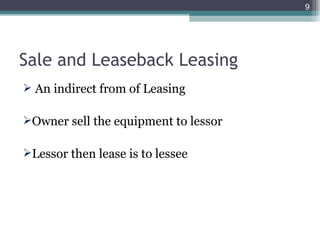
Sale and Leaseback Leasing An indirect from of Leasing  Owner sell the equipment to lessor Lessor then lease is to lessee
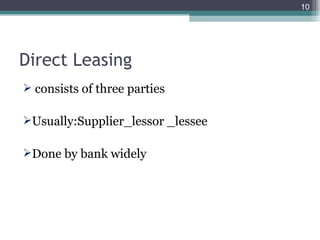
Direct Leasing consists of three parties Usually:Supplier_lessor _lessee  Done by bank widely
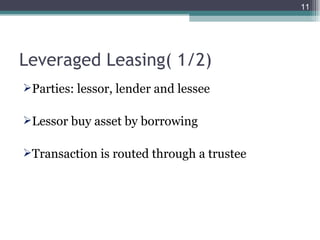
Leveraged Leasing( 1/2) Parties: lessor, lender and lessee Lessor buy asset by borrowing Transaction is routed through a trustee
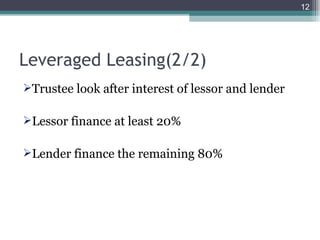
Leveraged Leasing(2/2) Trustee look after interest of lessor and lender Lessor finance at least 20% Lender finance the remaining 80%
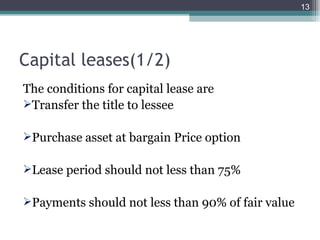
Capital leases(1/2) The conditions for capital lease are Transfer the title to lessee Purchase asset at bargain Price option Lease period should not less than 75% Payments should not less than 90% of fair value
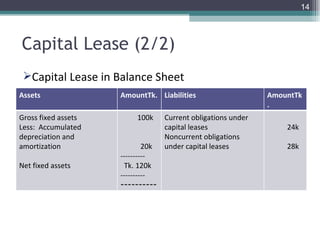
Capital Lease (2/2) Capital Lease in Balance Sheet Assets AmountTk.  Liabilities AmountTk.  Gross fixed assets Less:  Accumulated depreciation and amortization Net fixed assets 100k 20k ---------- Tk. 120k  ---------- ---------- Current obligations under capital leases Noncurrent obligations under capital leases 24k 28k
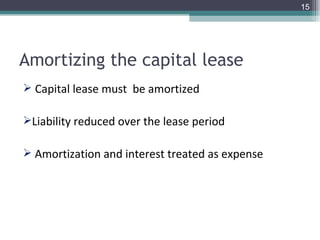
Amortizing the capital lease Capital lease must  be amortized Liability reduced over the lease period Amortization and interest treated as expense
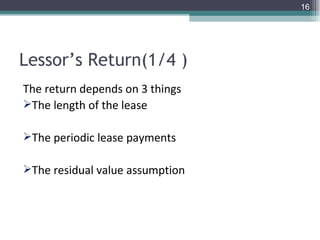
Lessor’s Return(1/4 ) The return depends on 3 things The length of the lease The periodic lease payments The residual value assumption
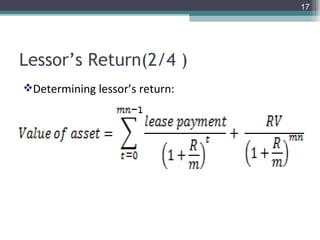
Lessor’s Return(2/4 ) Determining lessor’s return:
Lessor’s Return(3/4 ) Problem to determining lessor’s return: Z Company will lease a machine that costs Tk. 140,000 to purchase. The terms of the lease call for Tk. 6,500 quarterly payments payable in advance for 6 years. At the end of 6 years, Z Company will have a residual value of Tk. 40,000.
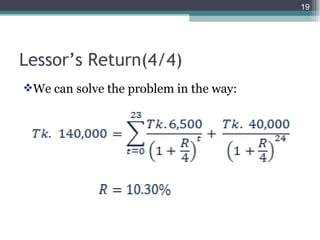
Lessor’s Return(4/4) We can solve the problem in the way:
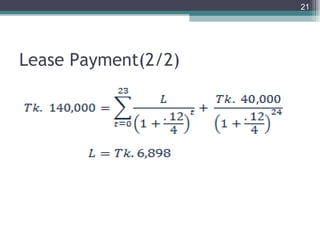
Lease payment(1/2) Problem to determining the lease payment: The lessor wanted a 12% return, and the cost of  the asset is Tk. 140,000 and a residual value of  Tk. 40,000 was expected.
Lease Payment(2/2)

Lease financing

  • 1.
  • 2.
    Lease-Defined lease isa contractual arrangement Using for equipment financing In exchange of payments
  • 3.
    Essential Elements ofLeasing Parties to the contract Asset according to lessee’s choice Lease rentals to compensate the lessor
  • 4.
    Types of LeasingFinance lease and operating lease Sale and leaseback leasing Direct leasing Leveraged leasing
  • 5.
    Financial Leasing (1/2)Lessor purchase the equipment and lease Title retained by lessor Lessor transfer the risk and reward
  • 6.
    Financial Leasing (2/2)Non cancelable in lease period Approached the economic life of asset Examples: Ships, Aircrafts etc.
  • 7.
    Operating Leasing (1/2)Shorter termed then economic life Lessor provides service as well as maintenance The lease rental is the cost of service provided
  • 8.
    Operating Leasing (2/2)Cancelable at any time by lessee Lessor depends on more than 2 lease Examples: Auto mobiles, computer, office equip etc.
  • 9.
    Sale and LeasebackLeasing An indirect from of Leasing Owner sell the equipment to lessor Lessor then lease is to lessee
  • 10.
    Direct Leasing consistsof three parties Usually:Supplier_lessor _lessee Done by bank widely
  • 11.
    Leveraged Leasing( 1/2)Parties: lessor, lender and lessee Lessor buy asset by borrowing Transaction is routed through a trustee
  • 12.
    Leveraged Leasing(2/2) Trusteelook after interest of lessor and lender Lessor finance at least 20% Lender finance the remaining 80%
  • 13.
    Capital leases(1/2) Theconditions for capital lease are Transfer the title to lessee Purchase asset at bargain Price option Lease period should not less than 75% Payments should not less than 90% of fair value
  • 14.
    Capital Lease (2/2)Capital Lease in Balance Sheet Assets AmountTk. Liabilities AmountTk. Gross fixed assets Less: Accumulated depreciation and amortization Net fixed assets 100k 20k ---------- Tk. 120k ---------- ---------- Current obligations under capital leases Noncurrent obligations under capital leases 24k 28k
  • 15.
    Amortizing the capitallease Capital lease must be amortized Liability reduced over the lease period Amortization and interest treated as expense
  • 16.
    Lessor’s Return(1/4 )The return depends on 3 things The length of the lease The periodic lease payments The residual value assumption
  • 17.
    Lessor’s Return(2/4 )Determining lessor’s return:
  • 18.
    Lessor’s Return(3/4 )Problem to determining lessor’s return: Z Company will lease a machine that costs Tk. 140,000 to purchase. The terms of the lease call for Tk. 6,500 quarterly payments payable in advance for 6 years. At the end of 6 years, Z Company will have a residual value of Tk. 40,000.
  • 19.
    Lessor’s Return(4/4) Wecan solve the problem in the way:
  • 20.
    Lease payment(1/2) Problemto determining the lease payment: The lessor wanted a 12% return, and the cost of the asset is Tk. 140,000 and a residual value of Tk. 40,000 was expected.
  • 21.

Editor's Notes