FINANCIAL RISK
MANAGEMENT
BERNARDINO M. PIMENTEL
Advance Corporate Finance, 2nd Trimester, 2023-2024
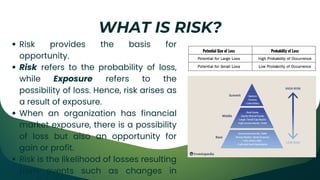
Risk provides the basis for
opportunity.
Risk refers to the probability of loss,
while Exposure refers to the
possibility of loss. Hence, risk arises as
a result of exposure.
When an organization has financial
market exposure, there is a possibility
of loss but also an opportunity for
gain or profit.
Risk is the likelihood of losses resulting
from events such as changes in
WHAT IS RISK?
Financial risk arises through countless transactions of a financial
nature, including sales and purchases, investments and loans, and
various other business activities.
It can arise as a result of legal transactions, new projects, mergers
and acquisitions, debt financing, the energy component of costs, or
through the activities of management, stakeholders, competitors,
foreign governments, or weather.
When financial prices change dramatically, it can increase costs,
reduce revenues, or otherwise adversely impact the profitability of an
organization
HOW DOES FINANCIAL RISK ARISE?
Financial risks arising from an organization’s exposure to changes in
market prices, such as interest rates, exchange rates, and commodity
prices
1.
Financial risks arising from the actions of, and transactions with,
other organizations such as vendors, customers, and counterparties
in derivatives transactions
2.
Financial risks resulting from internal actions or failures of the
organization, particularly people, processes, and systems
3.
3 MAIN SOURCES OF
FINANCIAL RISK
Risk can be referred to like the chances
of having an unexpected or negative
outcome. Any action or activity that
leads to loss of any type can be termed
as risk. There are different types of risks
that a firm might face and needs to
overcome
TYPES OF RISK:
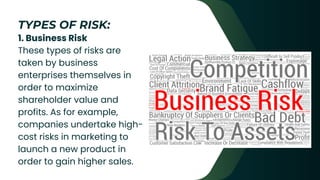
1. Business Risk
These types of risks are
taken by business
enterprises themselves in
order to maximize
shareholder value and
profits. As for example,
companies undertake high-
cost risks in marketing to
launch a new product in
order to gain higher sales.
TYPES OF RISK:
2. Non- Business Risk
These types of risks are not under the
control of firms.
Risks that arise out of political and
economic imbalances can be termed as
non-business risk.
TYPES OF RISK:
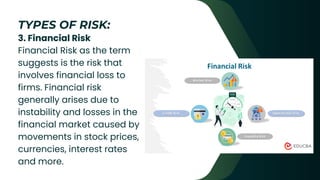
3. Financial Risk
Financial Risk as the term
suggests is the risk that
involves financial loss to
firms. Financial risk
generally arises due to
instability and losses in the
financial market caused by
movements in stock prices,
currencies, interest rates
and more.
TYPES OF RISK:
Financial risk refers to the likelihood of losing money on a business or
investment decision. Risks associated with finances can result in
capital losses for individuals and businesses. There are several
financial risks, such as credit, liquidity, and operational risks.
WHAT IS FINANCIAL RISK?
In other words, financial risk is a danger
that can translate into the loss of capital.
It relates to the odds of money loss.
In case of a financial risk, there is a
possibility that a company’s cash flow
might prove insufficient to satisfy its
obligations.
In government sectors, financial risk
implies the inability to control monetary
policy and or other debt issues
Individuals face financial risks in many
aspects of their lives:
Employment/Income Risk
Expense Risk
Asset/Investment Risk
Credit/Debt Risk
For corporations, there are additional/
alternative types of risks faced, such as:
Market Risk
Credit Risk
Liquidity Risk
Operational Risk
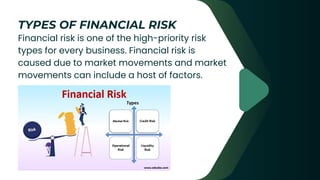
Financial risk is one of the high-priority risk
types for every business. Financial risk is
caused due to market movements and market
movements can include a host of factors.
TYPES OF FINANCIAL RISK
TYPES OF FINANCIAL RISK:
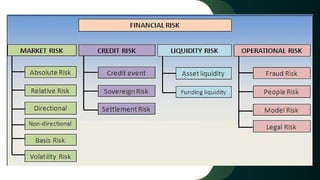
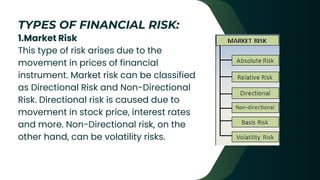
1.Market Risk
This type of risk arises due to the
movement in prices of financial
instrument. Market risk can be classified
as Directional Risk and Non-Directional
Risk. Directional risk is caused due to
movement in stock price, interest rates
and more. Non-Directional risk, on the
other hand, can be volatility risks.
TYPES OF FINANCIAL RISK:
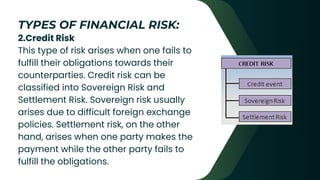
2.Credit Risk
This type of risk arises when one fails to
fulfill their obligations towards their
counterparties. Credit risk can be
classified into Sovereign Risk and
Settlement Risk. Sovereign risk usually
arises due to difficult foreign exchange
policies. Settlement risk, on the other
hand, arises when one party makes the
payment while the other party fails to
fulfill the obligations.
TYPES OF FINANCIAL RISK:
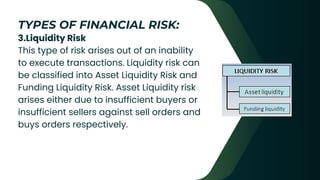
3.Liquidity Risk
This type of risk arises out of an inability
to execute transactions. Liquidity risk can
be classified into Asset Liquidity Risk and
Funding Liquidity Risk. Asset Liquidity risk
arises either due to insufficient buyers or
insufficient sellers against sell orders and
buys orders respectively.
TYPES OF FINANCIAL RISK:
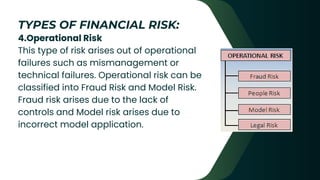
4.Operational Risk
This type of risk arises out of operational
failures such as mismanagement or
technical failures. Operational risk can be
classified into Fraud Risk and Model Risk.
Fraud risk arises due to the lack of
controls and Model risk arises due to
incorrect model application.
Financial risk management is a process to deal with the uncertainties
resulting from financial markets.
It involves assessing the financial risks facing an organization and
developing management strategies consistent with internal priorities
and policies.
Managing financial risk necessitates making organizational decisions
about risks that are acceptable versus those that are not.
Organizations manage financial risk using a variety of strategies and
products. It is important to understand how these products and
strategies work to reduce risk within the context of the organization’s
risk tolerance and objectives.
WHAT IS FINANCIAL
RISK MANAGEMENT?
Strategies for risk management often involve
derivatives. Derivatives are traded widely
among financial institutions and on
organized exchanges.
The value of derivatives contracts, such as
futures, forwards, options, and swaps, is
derived from the price of the underlying
asset.
Derivatives trade on interest rates, exchange
rates, commodities, equity and fixed income
securities, credit, and even weather.
WHAT IS FINANCIAL
RISK MANAGEMENT
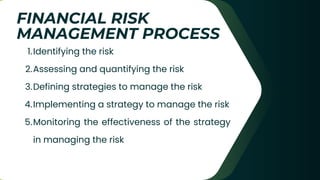
FINANCIAL RISK
MANAGEMENT PROCESS
Identifying the risk
1.
Assessing and quantifying the risk
2.
Defining strategies to manage the risk
3.
Implementing a strategy to manage the risk
4.
Monitoring the effectiveness of the strategy
in managing the risk
5.
IN SUMMARY... Financial risk management is not a
contemporary issue. Financial risk management
has been a challenge for as long as there have
been markets and price fluctuations.
Financial risks arise from an organization’s
exposure to financial markets, its transactions
with others, and its reliance on processes,
systems, and people.
To understand financial risks, it is useful to
consider the factors that affect financial prices
and rates, including interest rates, exchange
rates, and commodities prices.
Since financial decisions are made by humans,
a little financial history is useful in understanding
the nature of financial risk.
FIN.
THANK YOU!

Financial Risk Management Report (PhD Class)

  • 1.
    FINANCIAL RISK MANAGEMENT BERNARDINO M.PIMENTEL Advance Corporate Finance, 2nd Trimester, 2023-2024
  • 2.
    Risk provides thebasis for opportunity. Risk refers to the probability of loss, while Exposure refers to the possibility of loss. Hence, risk arises as a result of exposure. When an organization has financial market exposure, there is a possibility of loss but also an opportunity for gain or profit. Risk is the likelihood of losses resulting from events such as changes in WHAT IS RISK?
  • 3.
    Financial risk arisesthrough countless transactions of a financial nature, including sales and purchases, investments and loans, and various other business activities. It can arise as a result of legal transactions, new projects, mergers and acquisitions, debt financing, the energy component of costs, or through the activities of management, stakeholders, competitors, foreign governments, or weather. When financial prices change dramatically, it can increase costs, reduce revenues, or otherwise adversely impact the profitability of an organization HOW DOES FINANCIAL RISK ARISE?
  • 4.
    Financial risks arisingfrom an organization’s exposure to changes in market prices, such as interest rates, exchange rates, and commodity prices 1. Financial risks arising from the actions of, and transactions with, other organizations such as vendors, customers, and counterparties in derivatives transactions 2. Financial risks resulting from internal actions or failures of the organization, particularly people, processes, and systems 3. 3 MAIN SOURCES OF FINANCIAL RISK
  • 5.
    Risk can bereferred to like the chances of having an unexpected or negative outcome. Any action or activity that leads to loss of any type can be termed as risk. There are different types of risks that a firm might face and needs to overcome TYPES OF RISK:
  • 6.
    1. Business Risk Thesetypes of risks are taken by business enterprises themselves in order to maximize shareholder value and profits. As for example, companies undertake high- cost risks in marketing to launch a new product in order to gain higher sales. TYPES OF RISK:
  • 7.
    2. Non- BusinessRisk These types of risks are not under the control of firms. Risks that arise out of political and economic imbalances can be termed as non-business risk. TYPES OF RISK:
  • 8.
    3. Financial Risk FinancialRisk as the term suggests is the risk that involves financial loss to firms. Financial risk generally arises due to instability and losses in the financial market caused by movements in stock prices, currencies, interest rates and more. TYPES OF RISK:
  • 9.
    Financial risk refersto the likelihood of losing money on a business or investment decision. Risks associated with finances can result in capital losses for individuals and businesses. There are several financial risks, such as credit, liquidity, and operational risks. WHAT IS FINANCIAL RISK?
  • 10.
    In other words,financial risk is a danger that can translate into the loss of capital. It relates to the odds of money loss. In case of a financial risk, there is a possibility that a company’s cash flow might prove insufficient to satisfy its obligations. In government sectors, financial risk implies the inability to control monetary policy and or other debt issues
  • 11.
    Individuals face financialrisks in many aspects of their lives: Employment/Income Risk Expense Risk Asset/Investment Risk Credit/Debt Risk For corporations, there are additional/ alternative types of risks faced, such as: Market Risk Credit Risk Liquidity Risk Operational Risk
  • 12.
    Financial risk isone of the high-priority risk types for every business. Financial risk is caused due to market movements and market movements can include a host of factors. TYPES OF FINANCIAL RISK
  • 14.
    TYPES OF FINANCIALRISK: 1.Market Risk This type of risk arises due to the movement in prices of financial instrument. Market risk can be classified as Directional Risk and Non-Directional Risk. Directional risk is caused due to movement in stock price, interest rates and more. Non-Directional risk, on the other hand, can be volatility risks.
  • 15.
    TYPES OF FINANCIALRISK: 2.Credit Risk This type of risk arises when one fails to fulfill their obligations towards their counterparties. Credit risk can be classified into Sovereign Risk and Settlement Risk. Sovereign risk usually arises due to difficult foreign exchange policies. Settlement risk, on the other hand, arises when one party makes the payment while the other party fails to fulfill the obligations.
  • 16.
    TYPES OF FINANCIALRISK: 3.Liquidity Risk This type of risk arises out of an inability to execute transactions. Liquidity risk can be classified into Asset Liquidity Risk and Funding Liquidity Risk. Asset Liquidity risk arises either due to insufficient buyers or insufficient sellers against sell orders and buys orders respectively.
  • 17.
    TYPES OF FINANCIALRISK: 4.Operational Risk This type of risk arises out of operational failures such as mismanagement or technical failures. Operational risk can be classified into Fraud Risk and Model Risk. Fraud risk arises due to the lack of controls and Model risk arises due to incorrect model application.
  • 18.
    Financial risk managementis a process to deal with the uncertainties resulting from financial markets. It involves assessing the financial risks facing an organization and developing management strategies consistent with internal priorities and policies. Managing financial risk necessitates making organizational decisions about risks that are acceptable versus those that are not. Organizations manage financial risk using a variety of strategies and products. It is important to understand how these products and strategies work to reduce risk within the context of the organization’s risk tolerance and objectives. WHAT IS FINANCIAL RISK MANAGEMENT?
  • 19.
    Strategies for riskmanagement often involve derivatives. Derivatives are traded widely among financial institutions and on organized exchanges. The value of derivatives contracts, such as futures, forwards, options, and swaps, is derived from the price of the underlying asset. Derivatives trade on interest rates, exchange rates, commodities, equity and fixed income securities, credit, and even weather. WHAT IS FINANCIAL RISK MANAGEMENT
  • 20.
    FINANCIAL RISK MANAGEMENT PROCESS Identifyingthe risk 1. Assessing and quantifying the risk 2. Defining strategies to manage the risk 3. Implementing a strategy to manage the risk 4. Monitoring the effectiveness of the strategy in managing the risk 5.
  • 21.
    IN SUMMARY... Financialrisk management is not a contemporary issue. Financial risk management has been a challenge for as long as there have been markets and price fluctuations. Financial risks arise from an organization’s exposure to financial markets, its transactions with others, and its reliance on processes, systems, and people. To understand financial risks, it is useful to consider the factors that affect financial prices and rates, including interest rates, exchange rates, and commodities prices. Since financial decisions are made by humans, a little financial history is useful in understanding the nature of financial risk.
  • 22.