Business Research
Questionnaire Design
• Successful people ask better questions,
and as a result, they get better answers. -
Tony Robbins
Questionnaire
• A questionnaire is a data collection
instrument which consists of a formalized
set of questions for obtaining information
from respondents.
Objectives of Questionnaire
• Questionnaire provides standardization of data
collection across various collection sites
• A good questionnaire motivates and encourages
the respondent to become involved in the
interview, to cooperate, and to complete the
interview
• A questionnaire is developed keeping in mind
that the response error is minimized
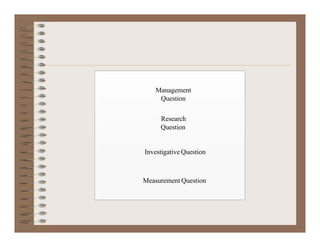
Management
Question
Research
Question
Investigative Question
Measurement Question
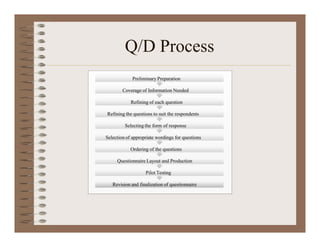
Q/D Process
Preliminary Preparation
Coverage of Information Needed
Refining of each question
Refining the questions to suit the respondents
Selecting the form of response
Selection of appropriate wordings for questions
Ordering of the questions
Questionnaire Layout and Production
Pilot Testing
Revision and finalization of questionnaire
Preliminary Preparation
• Preliminary preparation involves first
gathering of all the information required
for preparation of Questionnaire
Information Needed
• The next step is to ensure that all
information needed from the survey is
clearly presented. The information should
be converted to a set of questions.
Refining of each question
• The questions are then refined. First, each
piece of information required is studied
carefully to establish if the questions that
have been framed will provide the
information
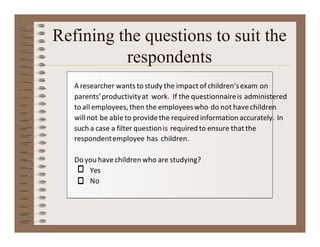
Refining the questions to suit the
respondents
Aresearcher wants to study the impact of children’sexam on
parents’productivityat work. If the questionnaireis administered
to all employees,then the employeeswho do not havechildren
willnot be ableto providethe required information accurately. In
such a case a filter questionis required to ensure thatthe
respondentemployee has children.
Do you havechildren who are studying?
Yes
No
Selecting the form of response
• Unstructured questions are open-ended
questions in which the respondents have
the freedom to reply in their own words.
• Structured questions have a specified the
set of response alternatives. These
questions have a standard response
format.
Selection of appropriate
wordings for questions
• Use simple words
Which factors are responsible for high attrition rate in a company? Select one or more
options.
• ____ Bad Leadership
• ____ Unpleasant work Environment
• ____ Unfair Appraisals
• ____ Low Salaries
•
Instead, a simpler worded question should be asked
What are the reasons due to which employees tend to leave a company? Select one or more
options.
• ____ Bad Leadership
• ____ Unpleasant work Environment
• ____ Unfair Appraisals
• ____ Low Salaries
Use unambiguous words
• How often do you go to beauty salon?
• ____Very Often
• ____Often
• ____Seldom
• ____Rarely
How often do you go to beauty salon?
• ____Twice a Week
• ____Once a Week
• ____Twice a month
• ____Once a month
Avoid Leading Questions
• Most people who have better oral hygiene
think brushing twice a day is good. Do you
think brushing twice a day is important?
Some questions can also be made biased by
adding emotional wordings. Such
questions are called loaded questions
Life is God’s gift. If we can’t give life to anyone, we have no right to take
away life from anyone, whatever the reasons may be. Do you think
taking away lives of criminals in form of capital punishment should
be practiced?
Avoid making implicit assumptions
• Do you prefer playing games on mobile?
Avoid Double-Barreled
Questions
• Do you like the freshness and taste of this
drink?
• ____Yes ____No
Avoid generalizations and
estimates
• How many units of detergent cake you sell
in a year?
• How many units of detergent cake you sell
in a week?
Ordering of the questions
• A funnel approach can also be used in
sequencing of questions in a questionnaire
where in the broader questions are asked
first.
Questionnaire Layout and
Production
• Short
• Coding
• Multiple Section
• Numbering
Pilot Testing
• Pilot testing means administering the
questionnaire to a small sample of
respondents to identify and eliminate the
potential issues in the questionnaire
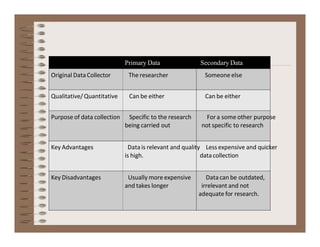
Primary Data Secondary Data
Original DataCollector The researcher Someone else
Qualitative/ Quantitative Can be either Can be either
Purpose of data collection Specific to the research For a some other purpose
being carried out not specific to research
Key Advantages Datais relevant and quality Less expensive and quicker
is high. datacollection
Key Disadvantages Usually more expensive Datacan be outdated,
and takes longer irrelevant and not
adequate for research.
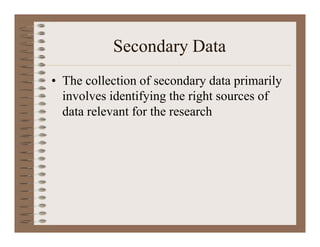
Secondary Data
• The collection of secondary data primarily
involves identifying the right sources of
data relevant for the research
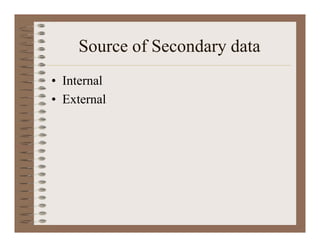
Source of Secondary data
• Internal
• External
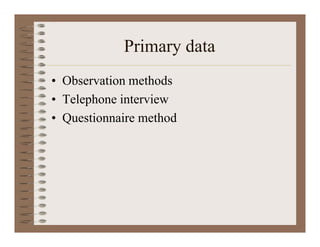
Primary data
• Observation methods
• Telephone interview

• Questionnaire method
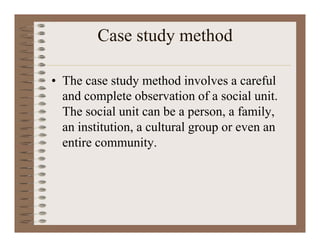
Case study method
• The case study method involves a careful
and complete observation of a social unit.
The social unit can be a person, a family,
an institution, a cultural group or even an
entire community.
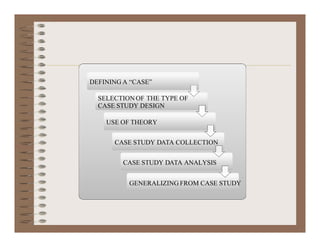
DEFINING A “CASE”
SELECTION OF THE TYPE OF
CASE STUDY DESIGN
USE OF THEORY
CASE STUDY DATA COLLECTION
CASE STUDY DATA ANALYSIS
GENERALIZING FROM CASE STUDY
Non-response in Primary Data
Collection
• Rejection by respondents
• Unavailability at home
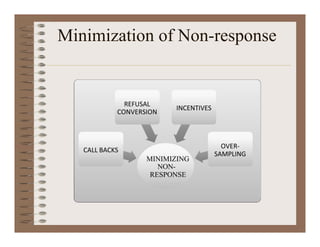
Minimization of Non-response
REFUSAL
CONVERSION
INCENTIVES
CALL BACKS
MINIMIZING
NON-
RESPONSE
OVER-
SAMPLING
Case Study
• A retail chain in the state of Gujarat had recently opened
its fifth store in one of the major cities of Gujarat. So far
they were only focusing on state of Gujarat. The head of
the company was thinking whether to expand the business
go about making a decision. Suggest the sources of data
that can be used to get insights in to this business
problem. Discuss how a secondary data research can help
in decision making.

Business research Questionnaire Design

  • 1.
  • 3.
    • Successful peopleask better questions, and as a result, they get better answers. - Tony Robbins
  • 5.
    Questionnaire • A questionnaireis a data collection instrument which consists of a formalized set of questions for obtaining information from respondents.
  • 7.
    Objectives of Questionnaire •Questionnaire provides standardization of data collection across various collection sites • A good questionnaire motivates and encourages the respondent to become involved in the interview, to cooperate, and to complete the interview • A questionnaire is developed keeping in mind that the response error is minimized
  • 9.
  • 11.
    Q/D Process Preliminary Preparation Coverageof Information Needed Refining of each question Refining the questions to suit the respondents Selecting the form of response Selection of appropriate wordings for questions Ordering of the questions Questionnaire Layout and Production Pilot Testing Revision and finalization of questionnaire
  • 13.
    Preliminary Preparation • Preliminarypreparation involves first gathering of all the information required for preparation of Questionnaire
  • 15.
    Information Needed • Thenext step is to ensure that all information needed from the survey is clearly presented. The information should be converted to a set of questions.
  • 17.
    Refining of eachquestion • The questions are then refined. First, each piece of information required is studied carefully to establish if the questions that have been framed will provide the information
  • 19.
    Refining the questionsto suit the respondents Aresearcher wants to study the impact of children’sexam on parents’productivityat work. If the questionnaireis administered to all employees,then the employeeswho do not havechildren willnot be ableto providethe required information accurately. In such a case a filter questionis required to ensure thatthe respondentemployee has children. Do you havechildren who are studying? Yes No
  • 21.
    Selecting the formof response • Unstructured questions are open-ended questions in which the respondents have the freedom to reply in their own words. • Structured questions have a specified the set of response alternatives. These questions have a standard response format.
  • 23.
    Selection of appropriate wordingsfor questions • Use simple words Which factors are responsible for high attrition rate in a company? Select one or more options. • ____ Bad Leadership • ____ Unpleasant work Environment • ____ Unfair Appraisals • ____ Low Salaries • Instead, a simpler worded question should be asked What are the reasons due to which employees tend to leave a company? Select one or more options. • ____ Bad Leadership • ____ Unpleasant work Environment • ____ Unfair Appraisals • ____ Low Salaries
  • 25.
    Use unambiguous words •How often do you go to beauty salon? • ____Very Often • ____Often • ____Seldom • ____Rarely How often do you go to beauty salon? • ____Twice a Week • ____Once a Week • ____Twice a month • ____Once a month
  • 27.
    Avoid Leading Questions •Most people who have better oral hygiene think brushing twice a day is good. Do you think brushing twice a day is important? Some questions can also be made biased by adding emotional wordings. Such questions are called loaded questions Life is God’s gift. If we can’t give life to anyone, we have no right to take away life from anyone, whatever the reasons may be. Do you think taking away lives of criminals in form of capital punishment should be practiced?
  • 29.
    Avoid making implicitassumptions • Do you prefer playing games on mobile?
  • 31.
    Avoid Double-Barreled Questions • Doyou like the freshness and taste of this drink? • ____Yes ____No
  • 33.
    Avoid generalizations and estimates •How many units of detergent cake you sell in a year? • How many units of detergent cake you sell in a week?
  • 35.
    Ordering of thequestions • A funnel approach can also be used in sequencing of questions in a questionnaire where in the broader questions are asked first.
  • 37.
    Questionnaire Layout and Production •Short • Coding • Multiple Section • Numbering
  • 39.
    Pilot Testing • Pilottesting means administering the questionnaire to a small sample of respondents to identify and eliminate the potential issues in the questionnaire
  • 41.
    Primary Data SecondaryData Original DataCollector The researcher Someone else Qualitative/ Quantitative Can be either Can be either Purpose of data collection Specific to the research For a some other purpose being carried out not specific to research Key Advantages Datais relevant and quality Less expensive and quicker is high. datacollection Key Disadvantages Usually more expensive Datacan be outdated, and takes longer irrelevant and not adequate for research.
  • 43.
    Secondary Data • Thecollection of secondary data primarily involves identifying the right sources of data relevant for the research
  • 44.
    Source of Secondarydata • Internal • External
  • 45.
    Primary data • Observationmethods • Telephone interview • Questionnaire method

  • 47.
    Case study method •The case study method involves a careful and complete observation of a social unit. The social unit can be a person, a family, an institution, a cultural group or even an entire community.
  • 49.
    DEFINING A “CASE” SELECTIONOF THE TYPE OF CASE STUDY DESIGN USE OF THEORY CASE STUDY DATA COLLECTION CASE STUDY DATA ANALYSIS GENERALIZING FROM CASE STUDY
  • 51.
    Non-response in PrimaryData Collection • Rejection by respondents • Unavailability at home
  • 53.
    Minimization of Non-response REFUSAL CONVERSION INCENTIVES CALLBACKS MINIMIZING NON- RESPONSE OVER- SAMPLING
  • 55.
    Case Study • Aretail chain in the state of Gujarat had recently opened its fifth store in one of the major cities of Gujarat. So far they were only focusing on state of Gujarat. The head of the company was thinking whether to expand the business go about making a decision. Suggest the sources of data that can be used to get insights in to this business problem. Discuss how a secondary data research can help in decision making.