1
Learning Concepts
In the previous lessons, you have learned that there are various kinds of reports
depending on the objective of the researcher. In each kind of report, there are
instruments used to gather data. One of the ways to gather data through a survey is by
using a survey questionnaire.
Have you experienced entering a restaurant or a café and you were asked to
answer a series of questions about your experience at that place or their service? There
are some places where all you need is to choose the type of smiley that speaks of how
you feel after your experience at their place. These are examples of simple survey
questionnaires.
A questionnaire is a structured series of questions designed to
collect primary data from respondents. A well-designed questionnaire
motivates respondents to provide accurate and complete information
which is very helpful in attaining the survey’s objective.
(QuickMBA.com, n.d.)
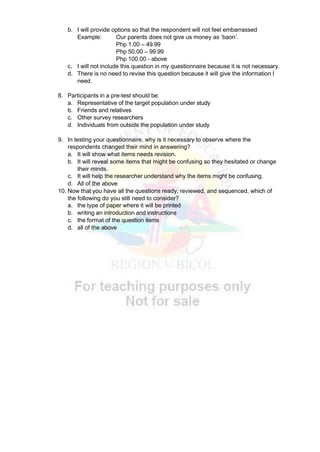
DESIGNING A QUESTIONNAIRE
Here are the suggested steps on how to develop a questionnaire:
(Adapted from QuickMBA.com)
2
Now that you know how to design the questionnaire, are you ready to form your
questions? Alright, let’s do this.
QUESTION WORDING BASIC
(Adapted from Filiberto, D. (2013) with some notes from Baxter, L. and Babbie, E. (2003))
1. Write short and simple questions
Respondents are often unwilling to study an item in order to understand it. Assume
that respondents will answer the questionnaire quickly. Therefore, provide clear,
short items that will not be misinterpreted.
Example:
Given the current trend of more hits, more home runs, longer games in general,
and more injuries in baseball today, do you think that steroid use should
continue to be banned even though it is not enforced?
*Problem: Long questions can be confusing
Better question:
Steroid use has both positive and negative effects on baseball. Do you think
that steroid use should be banned?"
2. Avoid leading questions, wording that influences respondents to consider a subject
in a weighted manner, or injects a preference or opinion.
Example:
Do you hate the president of the Philippines?”
Why is this leading? Because the question itself includes an opinion word.
Who do you think of when you hear COVID -19?
a. China b. Pres. Duterte c. Chinese d. Lockdown
Why is this leading? Because it forces the respondent to answer one of these
choices, even if none of them comes to mind.
What makes our product better than our competitors’ products?
3. Appropriately Open-Ended and Closed-Ended Questions
Use open-ended questions when responses need to be elaborated by the
respondents for exhaustive and comprehensive data gathering. They’re more suited
to exploratory research that looks to describe a subject based on trends and patterns.
3
Closed-Ended questions are popular because they provide greater uniformity
or responses and are easily processed compared to open-ended questions. However,
closed-ended questions the response categories should be exhaustive and mutually
exclusive. In other words, all possible options should be provided.
Example:
Why do you play sports?
1. Enjoyment 2. Health 3. Friends 4. Other-----
4. Questions must be non-threatening and attempt to evoke the truth.
Example:
Who do you think consume more cigarettes: you or your friends?
When a respondent is concerned about the consequences of answering a question in a
particular manner, there is a good possibility that the answer will not be truthful.
5. Question Clarity
Avoid ambiguities and vague words (e.g. usual, regular, normal)
Example:
What is your number of serving of eggs in a typical day?
Problem: How many eggs constitute a serving? What does ‘a typical day’
mean?
Better question:
On days you eat eggs, how many eggs do you usually consume?
Do you watch television regularly?
*Vague questions are difficult to answer (what is the meaning of "regularly"?)
Better question:
How often do you watch Television?"
Note: Questions should mean the same thing to all respondents. All the terms should
be understandable or defined, time periods specified, complex questions asked in
multiple stages.
6. Don’t use double-barrelled questions
Ask one question at a time. Avoid asking 2 questions, imposing unwarranted
assumptions, or hidden contingencies. Whenever you use ‘and’ on a question or a
statement, check if it is double-barrelled.
4
Example:
Do you find the classes you took during your first semester in SHS more demanding
and interesting than your JHS classes?
No
* How would someone respond if they felt their SHS classes were more demanding
but also more boring than their JHS classes? Or less demanding but more interesting?
Because the question combines “demanding” and “interesting,” there is no way to
respond yes to one criterion but no to the other.
Do you find the classes you took during your first semester in SHS more
demanding than your JHS classes?
7. Clearly define the response scale dimension or continuum.
When using a response scale, clearly define the dimension or continuum
respondents are to use in their rating task
Example:
Response categories - Make them logical and meaningful: NOT:
Many......Some.......A Few......Very Few.....None
DO a Bipolar or Unipolar rating scale: Bipolar measures both direction and intensity
of an attitude: Unipolar scale measures one concept with varying degrees of intensity.
8. Minimize presuppositions – an assumption about the world whose truth is taken for
granted.
Answering a question implies accepting its presuppositions, a respondent may be led
to provide an answer even if its presuppositions are false.
Example:
Are you a DDS or a Dilawan?
Problem: presupposes that one of the alternatives is true.
What are your usual hours of work?”
Problem: Does respondent have usual hours of work?
Better Question:
What are your usual hours of work, or do you not have usual hours?
Remember: Each question should have a specific purpose or should not be included
in the questionnaire.
Yes
5
TYPE OF QUESTIONS AND ITS USAGE
1. Open-Ended
Best Used for:
o Breaking the ice in an interview
o When respondent’s own words are important
o When the researcher does not know all the possible answers
Example:
What changes do you recommend for the school to do in order to help students perform
better?
2. Closed-Ended
Best Used for:
● Collecting rank ordered data
● When all response choices are known
● When quantitative statistical tool results are desired
Example:
In which of the following do you live?
o A house
o An apartment
o A condo unit
Other forms closed-ended questions:
a. Likert-Scale
Best Used for:
Assessing a person’s opinion and feelings about something
Example:
Please circle the way you feel about the following:
1 = Disagree 5 = Agree
6
Rank the following subjects in order of preference – 1 being your favorite and 5 being
your least favorite.
English
Math
Science
Filipino
Social Sciences
Music, Arts, PE and Health
TLE
Edukasyon sa Pagpapakatao
b. Multiple Choice
Best Used for:
● When there are finite number of options
Example:
c. Rating Scales
Best Used for:
● Rate things in relation to other things
Example:
d. Ranking Questions
Best Used for:
● Ordering answer choices by way of preference. This allows you to not only
understand how respondents feel about each answer option, but it also helps
you understand each one’s relative popularity.
Example:
So you now have your questions and you know which questions to use, let’s arrange
your questions! Are you ready?
Which of the following best describes your current civil status?
Single
Married
Widowed
Divorced
How likely would you recommend the current strand you are enrolled in to your friend?
7
ORDERING THE QUESTIONS
(Adapted from Contemporary Communication Research by Smith, M.J., 1988)
1. Adapt a general organizational pattern that complements a survey’s research
objectives.
Two general patterns:
o Funnel pattern – begins with broad questions followed by progressively
narrower or more specific ones
o Inverted pattern – narrowly focused questions are followed by more general
ones.
2. Topically related questions should be grouped together.
A researcher should group together questions pertinent to a single topic then
move to another topic. It is easier for the answer questions this way.
3. Easy-to-answer questions should be placed first.
Easy questions serve as motivation.
4. Questions should be ordered to avoid establishing a response bias.
*Response Bias – a tendency of a respondent to answer all closed-questions the
same way regardless of content.
Example: A respondent check “Somewhat agree” to all criteria.
Now that you have arranged your questions, the next thing to do is to make sure it
works. Remember, nobody’s perfect so don’t feel sad if you think your questionnaire
is no good. You can always revise it. Keep pushing!
TESTING AND REVISING THE QUESTIONNAIRE
Have you experienced asking a dressmaker or a tailor sew your school uniform? What
does a tailor or dressmaker usually do before finally giving you your sewn uniform? He or she
would let you fit it first, right? Why do you think so?
That is the same as the questionnaire. You are the tailor and the questionnaire is the
school uniform. You need to check if the questionnaire fits the respondents and your target
information. No matter how carefully you design a questionnaire, there is always the
POSSIBILITY of error. You are always certain to make some mistake. The surest protection
against such error is to PRE-TEST the questionnaire in full or in part. (Baxter, L. & Babbie, E.,
2003)
That is the last part of designing your questionnaire before finally administering and
distributing it to your respondents. There are no fixed steps on how to test your questionnaire
but here are some general guidelines that might be helpful. Keep in mind that you are aiming
for the questionnaire to be as effective as it can be.
8
Some Practical Tips on Testing a Questionnaire: (Adapted from tools4dev.org)
1. Find 5 to 10 people from your target group
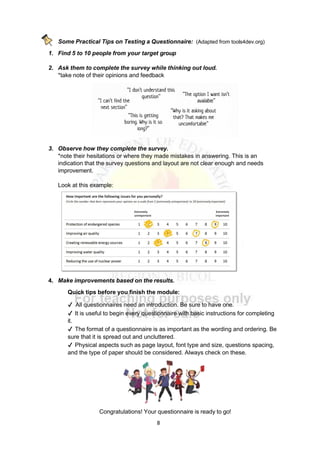
2. Ask them to complete the survey while thinking out loud.
*take note of their opinions and feedback
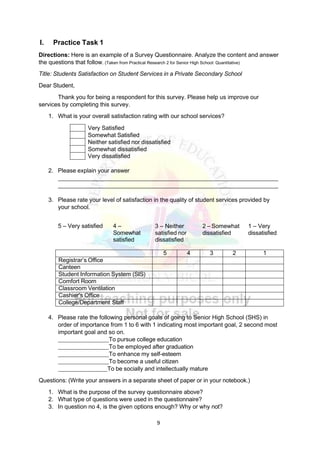
3. Observe how they complete the survey.
*note their hesitations or where they made mistakes in answering. This is an
indication that the survey questions and layout are not clear enough and needs
improvement.
Look at this example:
4. Make improvements based on the results.
Quick tips before you finish the module:
✔ All questionnaires need an introduction. Be sure to have one.
✔ It is useful to begin every questionnaire with basic instructions for completing
it.
✔ The format of a questionnaire is as important as the wording and ordering. Be
sure that it is spread out and uncluttered.
✔ Physical aspects such as page layout, font type and size, questions spacing,
and the type of paper should be considered. Always check on these.
Congratulations! Your questionnaire is ready to go!
9
I. Practice Task 1
Directions: Here is an example of a Survey Questionnaire. Analyze the content and answer
the questions that follow. (Taken from Practical Research 2 for Senior High School: Quantitative)
Title: Students Satisfaction on Student Services in a Private Secondary School
Dear Student,
Thank you for being a respondent for this survey. Please help us improve our
services by completing this survey.
1. What is your overall satisfaction rating with our school services?
Very Satisfied
Somewhat Satisfied
Neither satisfied nor dissatisfied
Somewhat dissatisfied
Very dissatisfied
2. Please explain your answer
3. Please rate your level of satisfaction in the quality of student services provided by
your school.
5 – Very satisfied 4 –
Somewhat
satisfied
3 – Neither
satisfied nor
dissatisfied
2 – Somewhat
dissatisfied
1 – Very
dissatisfied
5 4 3 2 1
Registrar’s Office
Canteen
Student Information System (SIS)
Comfort Room
Classroom Ventilation
Cashier’s Office
College/Department Staff
4. Please rate the following personal goals of going to Senior High School (SHS) in
order of importance from 1 to 6 with 1 indicating most important goal, 2 second most
important goal and so on.
To pursue college education
To be employed after graduation
To enhance my self-esteem
To become a useful citizen
To be socially and intellectually mature
Questions: (Write your answers in a separate sheet of paper or in your notebook.)
1. What is the purpose of the survey questionnaire above?
2. What type of questions were used in the questionnaire?
3. In question no 4, is the given options enough? Why or why not?
10
II. Practice Task 2
Directions: Here are some survey questions from a questionnaire. Examine them
closely and identify whether they are acceptable or not. Write A for acceptable. For any
non-acceptable question, revise the question to make it acceptable.Write your answers
on a separate sheet of paper or in your notebook.
Example: (for non-acceptable)
Question: Was the school facility not unclean?
Revision: How would you rate the cleanliness of the school facility?
1. How awesome is the service provided?
2. Where do you enjoy drinking milk tea?
3. How would you rate the preparedness and rescue mission?
4. What device do you usually use to check your email?
A. Computer | B. Mobile Phone | C. Tablet | D. iPad
5. How was our service today?
Okay | Good | Fantastic | Unforgettable | Mind-blowing
6.
A
Strongly
Agree
B
Somewhat
Agree
C
Somewhat
Disagree
D
Strongly
Agree
Students treat one another with
respect.
7. What Senior High School Track are you currently enrolled in?
a. Academic b. TVL c. Arts and Design d. Sports
8. Which of the following options best describes your employment status?
o Employed (Full-time)
o Employed (Part-time)
o Homemaker
o Retired
o Not currently employed
9. Who did you purchase the product for?
1. Self
2. Family member
3. Friend
4. Colleague
5. Others, please specify
10. Does Research contribute to your stress/anxiety level?
1 2 3 4
Not at all Absolutely
11
Directions: Read each question carefully and choose the correct answer. Write your
answers in a separate sheet of paper or in your notebook.
1. A questionnaire is defined by the following except:
a. to gather data from respondents
b. translates the research problem into questions that will answered by
respondents
c. wording, appearance and flow of questions fosters cooperation and motivate
the respondents to answer
d. a tool designed to control data for a survey
2. A well-designed questionnaire needs to be as short as possible.
a. True
b. False
3. What is the first step in designing a survey questionnaire?
a. Pre-testing
b. Identifying the respondents
c. Identifying the research problem
d. Identifying the type of questions to be used
4. Which of the following is considered a good questionnaire item?
a. How long does it take you to walk and run around the court?
b. If you were the President, what will you do to combat the COVID Pandemic?
c. How much did you enjoy the reading the new novel?
d. Rate your experience in the service provided.
5. Study the questionnaire item below and choose the correct statement that
describes the question.
a. The question assumes that the respondent gets stressed at work.
b. It is a double-barreled question since work and the park are two separate
places.
c. It is an open-ended question and will be hard to quantify.
d. There is nothing wrong with the question.
6. If you want to know how the students feel about the new rules and regulations set
by your organization, what type of questions will you most likely use?
a. Likert-Scale
b. Multiple Choice
c. Ranking
d. Open-ended
7. “How much is your ‘baon’ every day?”
If you were to revise this question, how should it be?
a. Do your parents give you ‘baon’? Yes No
Do you go to the park when you are stressed from work?
b. I will provide options so that the respondent will not feel embarrassed
Example: Our parents does not give us money as ‘baon’.
Php 1.00 – 49.99
Php 50.00 – 99.99
Php 100.00 - above
c. I will not include this question in my questionnaire because it is not necessary.
d. There is no need to revise this question because it will give the information I
need.
8. Participants in a pre-test should be:
a. Representative of the target population under study
b. Friends and relatives
c. Other survey researchers
d. Individuals from outside the population under study
9. In testing your questionnaire, why is it necessary to observe where the
respondents changed their mind in answering?
a. It will show what items needs revision.
b. It will reveal some items that might be confusing so they hesitated or change
their minds.
c. It will help the researcher understand why the items might be confusing.
d. All of the above
10. Now that you have all the questions ready, reviewed, and sequenced, which of
the following do you still need to consider?
a. the type of paper where it will be printed
b. writing an introduction and instructions
c. the format of the question items
d. all of the above
QUESTIONNAIRE IN TEACHING ................

  • 1.
    1 Learning Concepts In theprevious lessons, you have learned that there are various kinds of reports depending on the objective of the researcher. In each kind of report, there are instruments used to gather data. One of the ways to gather data through a survey is by using a survey questionnaire. Have you experienced entering a restaurant or a café and you were asked to answer a series of questions about your experience at that place or their service? There are some places where all you need is to choose the type of smiley that speaks of how you feel after your experience at their place. These are examples of simple survey questionnaires. A questionnaire is a structured series of questions designed to collect primary data from respondents. A well-designed questionnaire motivates respondents to provide accurate and complete information which is very helpful in attaining the survey’s objective. (QuickMBA.com, n.d.) DESIGNING A QUESTIONNAIRE Here are the suggested steps on how to develop a questionnaire: (Adapted from QuickMBA.com)
  • 2.
    2 Now that youknow how to design the questionnaire, are you ready to form your questions? Alright, let’s do this. QUESTION WORDING BASIC (Adapted from Filiberto, D. (2013) with some notes from Baxter, L. and Babbie, E. (2003)) 1. Write short and simple questions Respondents are often unwilling to study an item in order to understand it. Assume that respondents will answer the questionnaire quickly. Therefore, provide clear, short items that will not be misinterpreted. Example: Given the current trend of more hits, more home runs, longer games in general, and more injuries in baseball today, do you think that steroid use should continue to be banned even though it is not enforced? *Problem: Long questions can be confusing Better question: Steroid use has both positive and negative effects on baseball. Do you think that steroid use should be banned?" 2. Avoid leading questions, wording that influences respondents to consider a subject in a weighted manner, or injects a preference or opinion. Example: Do you hate the president of the Philippines?” Why is this leading? Because the question itself includes an opinion word. Who do you think of when you hear COVID -19? a. China b. Pres. Duterte c. Chinese d. Lockdown Why is this leading? Because it forces the respondent to answer one of these choices, even if none of them comes to mind. What makes our product better than our competitors’ products? 3. Appropriately Open-Ended and Closed-Ended Questions Use open-ended questions when responses need to be elaborated by the respondents for exhaustive and comprehensive data gathering. They’re more suited to exploratory research that looks to describe a subject based on trends and patterns.
  • 3.
    3 Closed-Ended questions arepopular because they provide greater uniformity or responses and are easily processed compared to open-ended questions. However, closed-ended questions the response categories should be exhaustive and mutually exclusive. In other words, all possible options should be provided. Example: Why do you play sports? 1. Enjoyment 2. Health 3. Friends 4. Other----- 4. Questions must be non-threatening and attempt to evoke the truth. Example: Who do you think consume more cigarettes: you or your friends? When a respondent is concerned about the consequences of answering a question in a particular manner, there is a good possibility that the answer will not be truthful. 5. Question Clarity Avoid ambiguities and vague words (e.g. usual, regular, normal) Example: What is your number of serving of eggs in a typical day? Problem: How many eggs constitute a serving? What does ‘a typical day’ mean? Better question: On days you eat eggs, how many eggs do you usually consume? Do you watch television regularly? *Vague questions are difficult to answer (what is the meaning of "regularly"?) Better question: How often do you watch Television?" Note: Questions should mean the same thing to all respondents. All the terms should be understandable or defined, time periods specified, complex questions asked in multiple stages. 6. Don’t use double-barrelled questions Ask one question at a time. Avoid asking 2 questions, imposing unwarranted assumptions, or hidden contingencies. Whenever you use ‘and’ on a question or a statement, check if it is double-barrelled.
  • 4.
    4 Example: Do you findthe classes you took during your first semester in SHS more demanding and interesting than your JHS classes? No * How would someone respond if they felt their SHS classes were more demanding but also more boring than their JHS classes? Or less demanding but more interesting? Because the question combines “demanding” and “interesting,” there is no way to respond yes to one criterion but no to the other. Do you find the classes you took during your first semester in SHS more demanding than your JHS classes? 7. Clearly define the response scale dimension or continuum. When using a response scale, clearly define the dimension or continuum respondents are to use in their rating task Example: Response categories - Make them logical and meaningful: NOT: Many......Some.......A Few......Very Few.....None DO a Bipolar or Unipolar rating scale: Bipolar measures both direction and intensity of an attitude: Unipolar scale measures one concept with varying degrees of intensity. 8. Minimize presuppositions – an assumption about the world whose truth is taken for granted. Answering a question implies accepting its presuppositions, a respondent may be led to provide an answer even if its presuppositions are false. Example: Are you a DDS or a Dilawan? Problem: presupposes that one of the alternatives is true. What are your usual hours of work?” Problem: Does respondent have usual hours of work? Better Question: What are your usual hours of work, or do you not have usual hours? Remember: Each question should have a specific purpose or should not be included in the questionnaire. Yes
  • 5.
    5 TYPE OF QUESTIONSAND ITS USAGE 1. Open-Ended Best Used for: o Breaking the ice in an interview o When respondent’s own words are important o When the researcher does not know all the possible answers Example: What changes do you recommend for the school to do in order to help students perform better? 2. Closed-Ended Best Used for: ● Collecting rank ordered data ● When all response choices are known ● When quantitative statistical tool results are desired Example: In which of the following do you live? o A house o An apartment o A condo unit Other forms closed-ended questions: a. Likert-Scale Best Used for: Assessing a person’s opinion and feelings about something Example: Please circle the way you feel about the following: 1 = Disagree 5 = Agree
  • 6.
    6 Rank the followingsubjects in order of preference – 1 being your favorite and 5 being your least favorite. English Math Science Filipino Social Sciences Music, Arts, PE and Health TLE Edukasyon sa Pagpapakatao b. Multiple Choice Best Used for: ● When there are finite number of options Example: c. Rating Scales Best Used for: ● Rate things in relation to other things Example: d. Ranking Questions Best Used for: ● Ordering answer choices by way of preference. This allows you to not only understand how respondents feel about each answer option, but it also helps you understand each one’s relative popularity. Example: So you now have your questions and you know which questions to use, let’s arrange your questions! Are you ready? Which of the following best describes your current civil status? Single Married Widowed Divorced How likely would you recommend the current strand you are enrolled in to your friend?
  • 7.
    7 ORDERING THE QUESTIONS (Adaptedfrom Contemporary Communication Research by Smith, M.J., 1988) 1. Adapt a general organizational pattern that complements a survey’s research objectives. Two general patterns: o Funnel pattern – begins with broad questions followed by progressively narrower or more specific ones o Inverted pattern – narrowly focused questions are followed by more general ones. 2. Topically related questions should be grouped together. A researcher should group together questions pertinent to a single topic then move to another topic. It is easier for the answer questions this way. 3. Easy-to-answer questions should be placed first. Easy questions serve as motivation. 4. Questions should be ordered to avoid establishing a response bias. *Response Bias – a tendency of a respondent to answer all closed-questions the same way regardless of content. Example: A respondent check “Somewhat agree” to all criteria. Now that you have arranged your questions, the next thing to do is to make sure it works. Remember, nobody’s perfect so don’t feel sad if you think your questionnaire is no good. You can always revise it. Keep pushing! TESTING AND REVISING THE QUESTIONNAIRE Have you experienced asking a dressmaker or a tailor sew your school uniform? What does a tailor or dressmaker usually do before finally giving you your sewn uniform? He or she would let you fit it first, right? Why do you think so? That is the same as the questionnaire. You are the tailor and the questionnaire is the school uniform. You need to check if the questionnaire fits the respondents and your target information. No matter how carefully you design a questionnaire, there is always the POSSIBILITY of error. You are always certain to make some mistake. The surest protection against such error is to PRE-TEST the questionnaire in full or in part. (Baxter, L. & Babbie, E., 2003) That is the last part of designing your questionnaire before finally administering and distributing it to your respondents. There are no fixed steps on how to test your questionnaire but here are some general guidelines that might be helpful. Keep in mind that you are aiming for the questionnaire to be as effective as it can be.
  • 8.
    8 Some Practical Tipson Testing a Questionnaire: (Adapted from tools4dev.org) 1. Find 5 to 10 people from your target group 2. Ask them to complete the survey while thinking out loud. *take note of their opinions and feedback 3. Observe how they complete the survey. *note their hesitations or where they made mistakes in answering. This is an indication that the survey questions and layout are not clear enough and needs improvement. Look at this example: 4. Make improvements based on the results. Quick tips before you finish the module: ✔ All questionnaires need an introduction. Be sure to have one. ✔ It is useful to begin every questionnaire with basic instructions for completing it. ✔ The format of a questionnaire is as important as the wording and ordering. Be sure that it is spread out and uncluttered. ✔ Physical aspects such as page layout, font type and size, questions spacing, and the type of paper should be considered. Always check on these. Congratulations! Your questionnaire is ready to go!
  • 9.
    9 I. Practice Task1 Directions: Here is an example of a Survey Questionnaire. Analyze the content and answer the questions that follow. (Taken from Practical Research 2 for Senior High School: Quantitative) Title: Students Satisfaction on Student Services in a Private Secondary School Dear Student, Thank you for being a respondent for this survey. Please help us improve our services by completing this survey. 1. What is your overall satisfaction rating with our school services? Very Satisfied Somewhat Satisfied Neither satisfied nor dissatisfied Somewhat dissatisfied Very dissatisfied 2. Please explain your answer 3. Please rate your level of satisfaction in the quality of student services provided by your school. 5 – Very satisfied 4 – Somewhat satisfied 3 – Neither satisfied nor dissatisfied 2 – Somewhat dissatisfied 1 – Very dissatisfied 5 4 3 2 1 Registrar’s Office Canteen Student Information System (SIS) Comfort Room Classroom Ventilation Cashier’s Office College/Department Staff 4. Please rate the following personal goals of going to Senior High School (SHS) in order of importance from 1 to 6 with 1 indicating most important goal, 2 second most important goal and so on. To pursue college education To be employed after graduation To enhance my self-esteem To become a useful citizen To be socially and intellectually mature Questions: (Write your answers in a separate sheet of paper or in your notebook.) 1. What is the purpose of the survey questionnaire above? 2. What type of questions were used in the questionnaire? 3. In question no 4, is the given options enough? Why or why not?
  • 10.
    10 II. Practice Task2 Directions: Here are some survey questions from a questionnaire. Examine them closely and identify whether they are acceptable or not. Write A for acceptable. For any non-acceptable question, revise the question to make it acceptable.Write your answers on a separate sheet of paper or in your notebook. Example: (for non-acceptable) Question: Was the school facility not unclean? Revision: How would you rate the cleanliness of the school facility? 1. How awesome is the service provided? 2. Where do you enjoy drinking milk tea? 3. How would you rate the preparedness and rescue mission? 4. What device do you usually use to check your email? A. Computer | B. Mobile Phone | C. Tablet | D. iPad 5. How was our service today? Okay | Good | Fantastic | Unforgettable | Mind-blowing 6. A Strongly Agree B Somewhat Agree C Somewhat Disagree D Strongly Agree Students treat one another with respect. 7. What Senior High School Track are you currently enrolled in? a. Academic b. TVL c. Arts and Design d. Sports 8. Which of the following options best describes your employment status? o Employed (Full-time) o Employed (Part-time) o Homemaker o Retired o Not currently employed 9. Who did you purchase the product for? 1. Self 2. Family member 3. Friend 4. Colleague 5. Others, please specify 10. Does Research contribute to your stress/anxiety level? 1 2 3 4 Not at all Absolutely
  • 11.
    11 Directions: Read eachquestion carefully and choose the correct answer. Write your answers in a separate sheet of paper or in your notebook. 1. A questionnaire is defined by the following except: a. to gather data from respondents b. translates the research problem into questions that will answered by respondents c. wording, appearance and flow of questions fosters cooperation and motivate the respondents to answer d. a tool designed to control data for a survey 2. A well-designed questionnaire needs to be as short as possible. a. True b. False 3. What is the first step in designing a survey questionnaire? a. Pre-testing b. Identifying the respondents c. Identifying the research problem d. Identifying the type of questions to be used 4. Which of the following is considered a good questionnaire item? a. How long does it take you to walk and run around the court? b. If you were the President, what will you do to combat the COVID Pandemic? c. How much did you enjoy the reading the new novel? d. Rate your experience in the service provided. 5. Study the questionnaire item below and choose the correct statement that describes the question. a. The question assumes that the respondent gets stressed at work. b. It is a double-barreled question since work and the park are two separate places. c. It is an open-ended question and will be hard to quantify. d. There is nothing wrong with the question. 6. If you want to know how the students feel about the new rules and regulations set by your organization, what type of questions will you most likely use? a. Likert-Scale b. Multiple Choice c. Ranking d. Open-ended 7. “How much is your ‘baon’ every day?” If you were to revise this question, how should it be? a. Do your parents give you ‘baon’? Yes No Do you go to the park when you are stressed from work?
  • 12.
    b. I willprovide options so that the respondent will not feel embarrassed Example: Our parents does not give us money as ‘baon’. Php 1.00 – 49.99 Php 50.00 – 99.99 Php 100.00 - above c. I will not include this question in my questionnaire because it is not necessary. d. There is no need to revise this question because it will give the information I need. 8. Participants in a pre-test should be: a. Representative of the target population under study b. Friends and relatives c. Other survey researchers d. Individuals from outside the population under study 9. In testing your questionnaire, why is it necessary to observe where the respondents changed their mind in answering? a. It will show what items needs revision. b. It will reveal some items that might be confusing so they hesitated or change their minds. c. It will help the researcher understand why the items might be confusing. d. All of the above 10. Now that you have all the questions ready, reviewed, and sequenced, which of the following do you still need to consider? a. the type of paper where it will be printed b. writing an introduction and instructions c. the format of the question items d. all of the above