Business Research
Data Collection
Primary and Secondary data
• The primary data are those which are
collected afresh and for the first time.
• Secondary data refers to the data collected
by someone other than the researcher
using the data.
Primary Data Secondary Data
Original DataCollector The researcher Someone else
Qualitative/ Quantitative Can be either Can be either
Purpose of data collection Specific to the research For a some other purpose
being carried out not specific to research
Key Advantages Datais relevant and quality Less expensive and quicker
is high. datacollection
Key Disadvantages Usually more expensive Datacan be outdated,
and takes longer irrelevant and not
adequate for research.
Secondary Data
• The collection of secondary data primarily
involves identifying the right sources of
data relevant for the research
Source of Secondary data
• Internal
• External
Primary data
• Observation methods
• Telephone interview
• Questionnaire method
Case study method
• The case study method involves a careful
and complete observation of a social unit.
The social unit can be a person, a family,
an institution, a cultural group or even an
entire community.
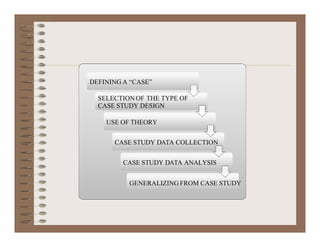
DEFINING A “CASE”
SELECTION OF THE TYPE OF
CASE STUDY DESIGN
USE OF THEORY
CASE STUDY DATA COLLECTION
CASE STUDY DATA ANALYSIS
GENERALIZING FROM CASE STUDY
Non-response in Primary Data
Collection
• Rejection by respondents
• Unavailability at home
Minimization of Non-response
REFUSAL
CONVERSION
INCENTIVES
CALL BACKS
MINIMIZING
NON-
RESPONSE
OVER-
SAMPLING
Case Study
• A retail chain in the state of Gujarat had recently opened
its fifth store in one of the major cities of Gujarat. So far
they were only focusing on state of Gujarat. The head of
the company was thinking whether to expand the business
go about making a decision. Suggest the sources of data
that can be used to get insights in to this business
problem. Discuss how a secondary data research can help
in decision making.

Business research data collection

  • 1.
  • 3.
    Primary and Secondarydata • The primary data are those which are collected afresh and for the first time. • Secondary data refers to the data collected by someone other than the researcher using the data.
  • 5.
    Primary Data SecondaryData Original DataCollector The researcher Someone else Qualitative/ Quantitative Can be either Can be either Purpose of data collection Specific to the research For a some other purpose being carried out not specific to research Key Advantages Datais relevant and quality Less expensive and quicker is high. datacollection Key Disadvantages Usually more expensive Datacan be outdated, and takes longer irrelevant and not adequate for research.
  • 7.
    Secondary Data • Thecollection of secondary data primarily involves identifying the right sources of data relevant for the research
  • 8.
    Source of Secondarydata • Internal • External
  • 9.
    Primary data • Observationmethods • Telephone interview • Questionnaire method
  • 11.
    Case study method •The case study method involves a careful and complete observation of a social unit. The social unit can be a person, a family, an institution, a cultural group or even an entire community.
  • 13.
    DEFINING A “CASE” SELECTIONOF THE TYPE OF CASE STUDY DESIGN USE OF THEORY CASE STUDY DATA COLLECTION CASE STUDY DATA ANALYSIS GENERALIZING FROM CASE STUDY
  • 15.
    Non-response in PrimaryData Collection • Rejection by respondents • Unavailability at home
  • 17.
    Minimization of Non-response REFUSAL CONVERSION INCENTIVES CALLBACKS MINIMIZING NON- RESPONSE OVER- SAMPLING
  • 19.
    Case Study • Aretail chain in the state of Gujarat had recently opened its fifth store in one of the major cities of Gujarat. So far they were only focusing on state of Gujarat. The head of the company was thinking whether to expand the business go about making a decision. Suggest the sources of data that can be used to get insights in to this business problem. Discuss how a secondary data research can help in decision making.