Designing Questionnaire
Monday, January 20, 2020
1
1
Questionnaire Definition and Objectives
Monday, January 20, 2020
2
 Definition
 A questionnaire is a formalized set of questions for
obtaining information from respondents.
 Objectives
 It must translate the information needed into a set of
specific questions that the respondents can and will
answer.
 A questionnaire must uplift, motivate, and encourage the
respondent to become involved in the interview, to
cooperate, and to complete the interview.
 A questionnaire should minimize response error.
STEPS IN QUESTIONNARE DESIGNING
Monday, January 20, 2020
3
 Despite much progress, designing questionnaire is still an art.
 Neither a basic theory nor even a fully systematised approach to
the problem has been developed.
 The extensive experience of many researchers and organised
experiments have led to a considerable understanding of the
problem and to along list of "dos and don'ts" and rules of thumb.
 Designing questionnaire requires lot of thinking and takes time
 Experts suggested a procedure for developing questionnaire in
steps.
 Typically this development involves some iteration and looping.
 Secondly, these steps should be taken as a guide. With
questionnaire "the proof of the pudding is very much in eating".
Monday, January 20, 2020
4
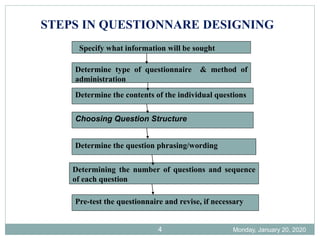
Specify what information will be sought
Determine type of questionnaire & method of
administration
Determine the contents of the individual questions
Choosing Question Structure
Determine the question phrasing/wording
Determining the number of questions and sequence
of each question
Pre-test the questionnaire and revise, if necessary
STEPS IN QUESTIONNARE DESIGNING
Step 1: Specify what information is needed
Monday, January 20, 2020
5
 Basically a questionnaire must Translate research
objectives into specific questions, and 2) Motivate
respondent to cooperate and furnish inf. correctly.
 Research objectives generally lead to the formulation of
hypotheses and hypotheses guide the questionnaire.
 Hypotheses not only guide what information is needed but
they also help in deciding the type of questions and form of
response.
 During the preparation of questionnaire additional
hypotheses may emerge.
 Therefore, if a new hypothesis is important and vital to the
understanding the problem, it should be included. On the
other hand, if any hypothesis is interesting but not vital to
the problem under consideration should be dropped.
 Lengthening questionnaire may cause problems in
administration and analysis and often increases
non-response.
Step 2: Type of Questionnaire and Method of
Administration
Monday, January 20, 2020
6
 After basic information, the next step is how it is to be
gathered.
 This is with respect to the structure/disguise and whether
mail, telephone, or personal interview will be used to
administer it.
 If a disguised unstructured questionnaire has to be employed
then this is not possible with telephone and also for mail.
 Mail administration is not recommended for unstructured
undisguised questionnaire with open ended questions.
 Type of data collected have important effect on these
questions.
 Example: the relationship between behaviour and
demographic, one may use either mail/personal/telephone
interview.
 If the researcher wants measuring attitudes through attitude
scale telephone interview will be out of question.
Step 3: Determine the Contents of Individual Questions
Monday, January 20, 2020
7
 The following points are in the nature of standards against
which to check possible questions.
 1) Is the question necessary?
 Extra questions add to the expense of the survey and increase
the non response
 Question should fulfils any objective then it should be
included
 2) Do the respondents have the necessary information?
 The respondents will be able to give a reliable answer.
 The answer will not require a great deal of time and effort
❑ Expl: "Which statement true of Metallic Metal Act?
Step 3: Contents of Individual Questions (Cont)
Monday, January 20, 2020
8
 3) Will Respondents Provide Information?
 Sometimes respondents have necessary information
but they do not provide it.
 They may not possess necessary communication skills
or they may simply not wish to convey this information.
➢ Hide the question in a group of questions.
➢ Phrasing the question in terms of others.
➢ Stating that is not unusual .
➢ Providing response in terms of a number of
categories.
Individual Question Content (Cont)
Monday, January 20, 2020
9
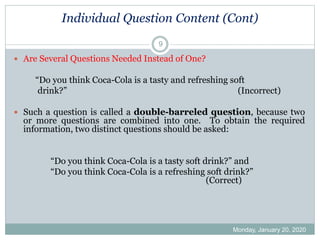
 Are Several Questions Needed Instead of One?
“Do you think Coca-Cola is a tasty and refreshing soft
drink?” (Incorrect)
 Such a question is called a double-barreled question, because two
or more questions are combined into one. To obtain the required
information, two distinct questions should be asked:
“Do you think Coca-Cola is a tasty soft drink?” and
“Do you think Coca-Cola is a refreshing soft drink?”
(Correct)
Overcoming Unwillingness To Answer
Monday, January 20, 2020
10
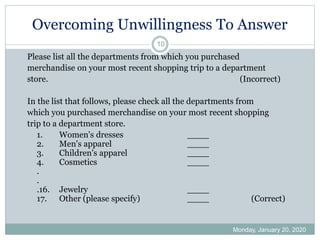
Please list all the departments from which you purchased
merchandise on your most recent shopping trip to a department
store. (Incorrect)
In the list that follows, please check all the departments from
which you purchased merchandise on your most recent shopping
trip to a department store.
1. Women's dresses ____
2. Men's apparel ____
3. Children's apparel ____
4. Cosmetics ____
.
.
.16. Jewelry ____
17. Other (please specify) ____ (Correct)
Overcoming Inability To Answer
Monday, January 20, 2020
11
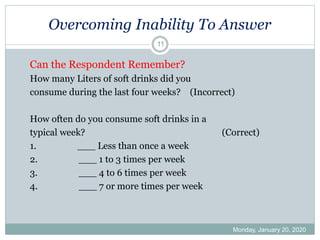
Can the Respondent Remember?
How many Liters of soft drinks did you
consume during the last four weeks? (Incorrect)
How often do you consume soft drinks in a
typical week? (Correct)
1. ___ Less than once a week
2. ___ 1 to 3 times per week
3. ___ 4 to 6 times per week
4. ___ 7 or more times per week
Step 4: Choosing Question Structure
Monday, January 20, 2020
12
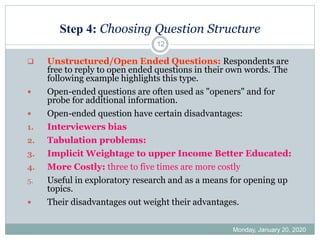
❑ Unstructured/Open Ended Questions: Respondents are
free to reply to open ended questions in their own words. The
following example highlights this type.
 Open-ended questions are often used as "openers" and for
probe for additional information.
 Open-ended question have certain disadvantages:
1. Interviewers bias
2. Tabulation problems:
3. Implicit Weightage to upper Income Better Educated:
4. More Costly: three to five times are more costly
5. Useful in exploratory research and as a means for opening up
topics.
 Their disadvantages out weight their advantages.
Choosing Question Structure
Monday, January 20, 2020
13
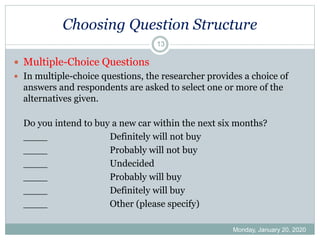
 Multiple-Choice Questions
 In multiple-choice questions, the researcher provides a choice of
answers and respondents are asked to select one or more of the
alternatives given.
Do you intend to buy a new car within the next six months?
____ Definitely will not buy
____ Probably will not buy
____ Undecided
____ Probably will buy
____ Definitely will buy
____ Other (please specify)
Choosing Question Structure
Monday, January 20, 2020
14
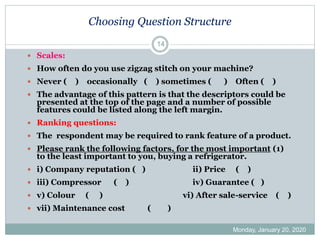
 Scales:
 How often do you use zigzag stitch on your machine?
 Never ( ) occasionally ( ) sometimes ( ) Often ( )
 The advantage of this pattern is that the descriptors could be
presented at the top of the page and a number of possible
features could be listed along the left margin.
 Ranking questions:
 The respondent may be required to rank feature of a product.
 Please rank the following factors, for the most important (1)
to the least important to you, buying a refrigerator.
 i) Company reputation ( ) ii) Price ( )
 iii) Compressor ( ) iv) Guarantee ( )
 v) Colour ( ) vi) After sale-service ( )
 vii) Maintenance cost ( )
Step 5 Choosing Question Wording/Phrasing
Monday, January 20, 2020
15
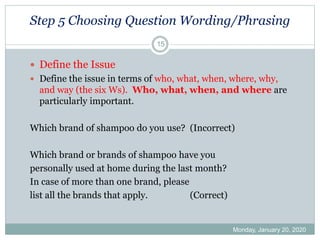
 Define the Issue
 Define the issue in terms of who, what, when, where, why,
and way (the six Ws). Who, what, when, and where are
particularly important.
Which brand of shampoo do you use? (Incorrect)
Which brand or brands of shampoo have you
personally used at home during the last month?
In case of more than one brand, please
list all the brands that apply. (Correct)
Choosing Question Wording
Monday, January 20, 2020
16
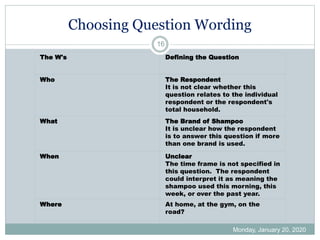
The W's Defining the Question
Who The Respondent
It is not clear whether this
question relates to the individual
respondent or the respondent's
total household.
What The Brand of Shampoo
It is unclear how the respondent
is to answer this question if more
than one brand is used.
When Unclear
The time frame is not specified in
this question. The respondent
could interpret it as meaning the
shampoo used this morning, this
week, or over the past year.
Where At home, at the gym, on the
road?
Choosing Question Wording
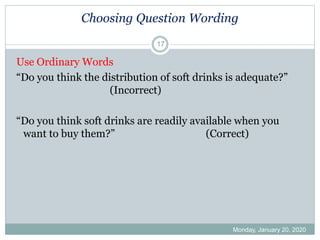
Use Ordinary Words
“Do you think the distribution of soft drinks is adequate?”
(Incorrect)
“Do you think soft drinks are readily available when you
want to buy them?” (Correct)
Monday, January 20, 2020
17
Choosing Question Wording
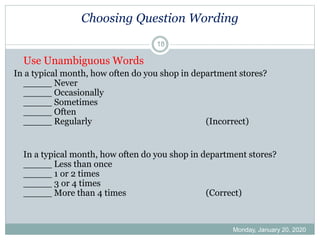
Use Unambiguous Words
In a typical month, how often do you shop in department stores?
_____ Never
_____ Occasionally
_____ Sometimes
_____ Often
_____ Regularly (Incorrect)
In a typical month, how often do you shop in department stores?
_____ Less than once
_____ 1 or 2 times
_____ 3 or 4 times
_____ More than 4 times (Correct)
Monday, January 20, 2020
18
Choosing Question Wording
Monday, January 20, 2020
19
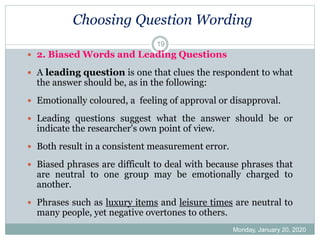
 2. Biased Words and Leading Questions
 A leading question is one that clues the respondent to what
the answer should be, as in the following:
 Emotionally coloured, a feeling of approval or disapproval.
 Leading questions suggest what the answer should be or
indicate the researcher's own point of view.
 Both result in a consistent measurement error.
 Biased phrases are difficult to deal with because phrases that
are neutral to one group may be emotionally charged to
another.
 Phrases such as luxury items and leisure times are neutral to
many people, yet negative overtones to others.
Choosing Question Wording
Monday, January 20, 2020
20
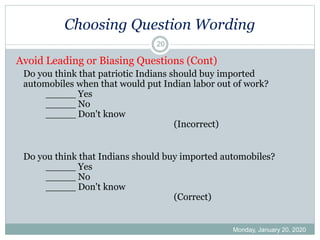
Avoid Leading or Biasing Questions (Cont)
Do you think that patriotic Indians should buy imported
automobiles when that would put Indian labor out of work?
_____ Yes
_____ No
_____ Don't know
(Incorrect)
Do you think that Indians should buy imported automobiles?
_____ Yes
_____ No
_____ Don't know
(Correct)
Choosing Question Wording
 Avoid Implicit Alternatives
 An alternative that is not explicitly expressed in the options
is an implicit alternative.
1. Do you like to fly when traveling short distances?
(Incorrect)
2. Do you like to fly when traveling short distances, or
would you rather drive?
(Correct)
Monday, January 20, 2020
21
Choosing Question Wording
Monday, January 20, 2020
22
 Avoid Implied Assumptions
 Questions are frequently asked in such a way that the
answer depends on assumptions about factors outside the
question itself.
 "Are you in favour of curtailment of amount of advertising
allowed on TV?”
 Will elicit differing responses, depending on the
respondents assumptions converting the effects this might
have on the quantity and quality of TV programming.
 A more effective way of wording the question would be
 "Are you in favour of curtailing the amount of advertising
allowed on TV if this would have an impact on TV
programming".
 Therefore, failure to state assumptions often produces
different responses.
Step 6: Number and Sequence of Questions
Monday, January 20, 2020
23
 Researcher is ready to putt all questions together.
 A very long questionnaire can appear quite imposing and may
deter the respondent from even reading the instructions.
 Questions sequence is also important. A typical questionnaire
contains two types of information:
 1) Basic information: Refers to the subject of the study for
example, intentions or attitude of respondents towards some
phenomenon.
 2) Classification information: Data collected to classify
respondent. These are basically the demographical
socio-economic characteristics of respondents.
 Therefore, a proper questionnaire sequence is for question
securing basic information to be presented first and those
seeking classification information to be presented last.
 The basic information is most critical, without it there is no
study. Thus, the researcher should not risk alienating the
respondent before getting to the body of the study.
Number and Sequence of Questions (Cont)
Monday, January 20, 2020
24
 The basic information itself can also present some sequence
problem. The early questions should not be sensitive ones.
 Opening questions should be designed to secure the respondents
interest and cooperation.
 These questions should be simple and if possible should arouse
curiosity enough so that they willing cooperate.
 The sensitive questions should be relegated to the body of the
questionnaire and intermixed and hidden among some not so
sensitive ones.
 The order in which the questions are presented can affects the
responses.
 For Example: "what improvements are needed in the companies'
service policy"? "How do you like the quality of service".
 Funnel Approach should be used
Step 7: Re-examination, Revision and Pre-testing the
Questionnaire
Monday, January 20, 2020
25
 Re-examination and revision are the order of
the day.
 Revision of each question should be done by the
researcher critically keeping in mind whether
the question is an ambiguous, confusing
potentially offensive.
 The real test how it performs under actual
conditions of data collection.
Pre-testing
Monday, January 20, 2020
26
Pretesting refers to the testing of the questionnaire on a small sample
of respondents to identify and eliminate potential problems.
 Therefore, data collection should never begin without an adequate
pre-test of questionnaire.
 The pre-test can be used to assess both individual questions and
their sequence.
 A pre-test must use respondents who are as similar as possible to the
target respondents.
 This typically involves drawing a sub sample from the larger sample.
The questionnaire should be administered in the some manner as the
final survey.
 All aspects of the questionnaire should be tested, including question
content, wording, sequence, form and layout, question difficulty, and
instructions.
 The respondents for the pretest and for the actual survey should be
drawn from the same population.
Pre-testing
Monday, January 20, 2020
27
 Pretests are best done by personal interviews, even if the actual
survey is to be conducted by mail, telephone, or electronic means,
because interviewers can observe respondents' reactions and
attitudes.
 After the necessary changes have been made, another pretest could
be conducted by mail, telephone, or electronic means if those
methods are to be used in the actual survey.
 A variety of interviewers should be used for pretests.
 The pretest sample size varies from 15 to 30 respondents for each
wave.
 Finally, the responses obtained from the pretest should be coded and
analyzed.
 Churchil: Researcher who avoids a pre-test is either naive or a fool.
 The pre-test is the most inexpensive insurance the researcher can
buy to assure the success of the questionnaire and the research
project.
Form and Layout
Monday, January 20, 2020
28
 Divide a questionnaire into several parts.
 The questions in each part should be numbered, particularly when
branching questions are used.
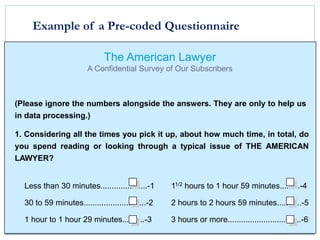
 The questionnaires should preferably be pre-coded.
 The questionnaires themselves should be numbered serially.
Monday, January 20, 2020
29
11/2 hours to 1 hour 59 minutes.........-4
2 hours to 2 hours 59 minutes...........-5
3 hours or more.................................-6
Less than 30 minutes.....................-1
30 to 59 minutes............................-2
1 hour to 1 hour 29 minutes..........-3
The American Lawyer
A Confidential Survey of Our Subscribers
(Please ignore the numbers alongside the answers. They are only to help us
in data processing.)
1. Considering all the times you pick it up, about how much time, in total, do
you spend reading or looking through a typical issue of THE AMERICAN
LAWYER?
Example of a Pre-coded Questionnaire
Reproduction of the Questionnaire
Monday, January 20, 2020
30
 The questionnaire should be reproduced on good-quality paper and have a
professional appearance.
 Questionnaires should take the form of a booklet rather than a number of
sheets of paper clipped or stapled together.
 Vertical response columns should be used for individual questions.
 Grids are useful when there are a number of related questions which use
the same set of response categories.
 The tendency to crowd questions together to make the questionnaire look
shorter should be avoided.
 Directions or instructions for individual questions should be placed as close
to the questions as possible.
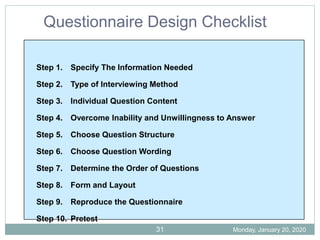
Step 1. Specify The Information Needed
Step 2. Type of Interviewing Method
Step 3. Individual Question Content
Step 4. Overcome Inability and Unwillingness to Answer
Step 5. Choose Question Structure
Step 6. Choose Question Wording
Step 7. Determine the Order of Questions
Step 8. Form and Layout
Step 9. Reproduce the Questionnaire
Step 10. Pretest
Questionnaire Design Checklist
Monday, January 20, 2020
31
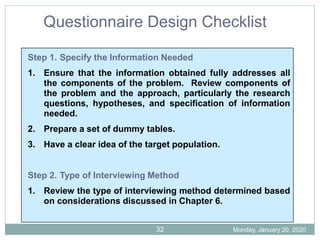
Step 1. Specify the Information Needed
1. Ensure that the information obtained fully addresses all
the components of the problem. Review components of
the problem and the approach, particularly the research
questions, hypotheses, and specification of information
needed.
2. Prepare a set of dummy tables.
3. Have a clear idea of the target population.
Step 2. Type of Interviewing Method
1. Review the type of interviewing method determined based
on considerations discussed in Chapter 6.
Questionnaire Design Checklist
Monday, January 20, 2020
32
Step 3. Individual Question Content
1. Is the question necessary?
2. Are several questions needed instead of one to obtain the
required information in an unambiguous manner?
3. Do not use double-barreled questions.
Questionnaire Design Checklist
Monday, January 20, 2020
33
Questionnaire Design Checklist
Step 4. Overcoming Inability and Unwillingness to Answer
1. Is the respondent informed?
2. If respondents are not likely to be informed, filter questions
that measure familiarity, product use, and past experience
should be asked before questions about the topics
themselves.
3. Can the respondent remember?
4. Avoid errors of omission, telescoping, and creation.
5. Questions which do not provide the respondent with cues can
underestimate the actual occurrence of an event.
6. Can the respondent articulate?
Monday, January 20, 2020
34
Step 4. Overcoming Inability and Unwillingness to Answer
7. Minimize the effort required of the respondents.
8. Is the context in which the questions are asked appropriate?
9. Make the request for information seem legitimate.
10. If the information is sensitive:
a. Place sensitive topics at the end of the questionnaire.
b. Preface the question with a statement that the behavior of interest is
common.
c. Ask the question using the third-person technique.
d. Hide the question in a group of other questions which respondents are
willing to answer.
e. Provide response categories rather than asking for specific figures.
f. Use randomized techniques, if appropriate.
Questionnaire Design Checklist
Monday, January 20, 2020
35
Step 5. Choosing Question Structure
1. Open-ended questions are useful in exploratory research and
as opening questions.
2. Use structured questions whenever possible.
3. In multiple-choice questions, the response alternatives
should include the set of all possible choices and should be
mutually exclusive.
4. In a dichotomous question, if a substantial proportion of the
respondents can be expected to be neutral, include a neutral
alternative.
5. Consider the use of the split ballot technique to reduce order
bias in dichotomous and multiple-choice questions.
6. If the response alternatives are numerous, consider using
more than one question to reduce the information processing
demands on the respondents.
Questionnaire Design Checklist
Monday, January 20, 2020
36
Questionnaire Design Checklist
Step 6. Choosing Question Wording
1. Define the issue in terms of who, what, when, where, why, and way
(the six Ws).
2. Use ordinary words. Words should match the vocabulary level of the
respondents.
3. Avoid ambiguous words: usually, normally, frequently, often,
regularly, occasionally, sometimes, etc.
4. Avoid leading questions that clue the respondent to what the answer
should be.
5. Avoid implicit alternatives that are not explicitly expressed in the
options.
6. Avoid implicit assumptions.
7. Respondent should not have to make generalizations or compute
estimates.
8. Use positive and negative statements.
Monday, January 20, 2020
37
Step 7. Determine the Order of Questions
1. The opening questions should be interesting, simple, and non-
threatening.
2. Qualifying questions should serve as the opening questions.
3. Basic information should be obtained first, followed by classification,
and, finally, identification information.
4. Difficult, sensitive, or complex questions should be placed late in the
sequence.
5. General questions should precede the specific questions.
6. Questions should be asked in a logical order.
7. Branching questions should be designed carefully to cover all possible
contingencies.
8. The question being branched should be placed as close as possible to
the question causing the branching, and (2) the branching questions
should be ordered so that the respondents cannot anticipate what
additional information will be required.
Questionnaire Design Checklist
Monday, January 20, 2020
38
Step 8. Form and Layout
1. Divide a questionnaire into several parts.
2. Questions in each part should be numbered.
3. The questionnaire should be pre-coded.
4. The questionnaires themselves should be numbered
serially.
Questionnaire Design Checklist
Monday, January 20, 2020
39
Questionnaire Design Checklist
Step 9. Reproduction of the Questionnaire
1. The questionnaire should have a professional appearance.
2. Booklet format should be used for long questionnaires.
3. Each question should be reproduced on a single page (or
double-page spread).
4. Vertical response columns should be used.
5. Grids are useful when there are a number of related
questions which use the same set of response categories.
6. The tendency to crowd questions to make the questionnaire
look shorter should be avoided.
7. Directions or instructions for individual questions should
be placed as close to the questions as possible.
Monday, January 20, 2020
40
Step 10. Pretesting
1. Pretesting should be done always.
2. All aspects of the questionnaire should be tested, including question content,
wording, sequence, form and layout, question difficulty, and instructions.
3. The respondents in the pretest should be similar to those who will be included in the
actual survey.
4. Begin the pretest by using personal interviews.
5. Pretest should also be conducted by mail or telephone if those methods are to be
used in the actual survey.
6. A variety of interviewers should be used for pretests.
7. The pretest sample size is small, varying from 15 to 30 respondents for the initial
testing.
8. Use protocol analysis and debriefing to identify problems.
9. After each significant revision of the questionnaire, another pretest should be
conducted, using a different sample of respondents.
10. The responses obtained from the pretest should be coded and analyzed.
Questionnaire Design Checklist
Monday, January 20, 2020
41

Shsjanss7. Questionnaire.pdfssssssddwadws

  • 1.
  • 2.
    Questionnaire Definition andObjectives Monday, January 20, 2020 2  Definition  A questionnaire is a formalized set of questions for obtaining information from respondents.  Objectives  It must translate the information needed into a set of specific questions that the respondents can and will answer.  A questionnaire must uplift, motivate, and encourage the respondent to become involved in the interview, to cooperate, and to complete the interview.  A questionnaire should minimize response error.
  • 3.
    STEPS IN QUESTIONNAREDESIGNING Monday, January 20, 2020 3  Despite much progress, designing questionnaire is still an art.  Neither a basic theory nor even a fully systematised approach to the problem has been developed.  The extensive experience of many researchers and organised experiments have led to a considerable understanding of the problem and to along list of "dos and don'ts" and rules of thumb.  Designing questionnaire requires lot of thinking and takes time  Experts suggested a procedure for developing questionnaire in steps.  Typically this development involves some iteration and looping.  Secondly, these steps should be taken as a guide. With questionnaire "the proof of the pudding is very much in eating".
  • 4.
    Monday, January 20,2020 4 Specify what information will be sought Determine type of questionnaire & method of administration Determine the contents of the individual questions Choosing Question Structure Determine the question phrasing/wording Determining the number of questions and sequence of each question Pre-test the questionnaire and revise, if necessary STEPS IN QUESTIONNARE DESIGNING
  • 5.
    Step 1: Specifywhat information is needed Monday, January 20, 2020 5  Basically a questionnaire must Translate research objectives into specific questions, and 2) Motivate respondent to cooperate and furnish inf. correctly.  Research objectives generally lead to the formulation of hypotheses and hypotheses guide the questionnaire.  Hypotheses not only guide what information is needed but they also help in deciding the type of questions and form of response.  During the preparation of questionnaire additional hypotheses may emerge.  Therefore, if a new hypothesis is important and vital to the understanding the problem, it should be included. On the other hand, if any hypothesis is interesting but not vital to the problem under consideration should be dropped.  Lengthening questionnaire may cause problems in administration and analysis and often increases non-response.
  • 6.
    Step 2: Typeof Questionnaire and Method of Administration Monday, January 20, 2020 6  After basic information, the next step is how it is to be gathered.  This is with respect to the structure/disguise and whether mail, telephone, or personal interview will be used to administer it.  If a disguised unstructured questionnaire has to be employed then this is not possible with telephone and also for mail.  Mail administration is not recommended for unstructured undisguised questionnaire with open ended questions.  Type of data collected have important effect on these questions.  Example: the relationship between behaviour and demographic, one may use either mail/personal/telephone interview.  If the researcher wants measuring attitudes through attitude scale telephone interview will be out of question.
  • 7.
    Step 3: Determinethe Contents of Individual Questions Monday, January 20, 2020 7  The following points are in the nature of standards against which to check possible questions.  1) Is the question necessary?  Extra questions add to the expense of the survey and increase the non response  Question should fulfils any objective then it should be included  2) Do the respondents have the necessary information?  The respondents will be able to give a reliable answer.  The answer will not require a great deal of time and effort ❑ Expl: "Which statement true of Metallic Metal Act?
  • 8.
    Step 3: Contentsof Individual Questions (Cont) Monday, January 20, 2020 8  3) Will Respondents Provide Information?  Sometimes respondents have necessary information but they do not provide it.  They may not possess necessary communication skills or they may simply not wish to convey this information. ➢ Hide the question in a group of questions. ➢ Phrasing the question in terms of others. ➢ Stating that is not unusual . ➢ Providing response in terms of a number of categories.
  • 9.
    Individual Question Content(Cont) Monday, January 20, 2020 9  Are Several Questions Needed Instead of One? “Do you think Coca-Cola is a tasty and refreshing soft drink?” (Incorrect)  Such a question is called a double-barreled question, because two or more questions are combined into one. To obtain the required information, two distinct questions should be asked: “Do you think Coca-Cola is a tasty soft drink?” and “Do you think Coca-Cola is a refreshing soft drink?” (Correct)
  • 10.
    Overcoming Unwillingness ToAnswer Monday, January 20, 2020 10 Please list all the departments from which you purchased merchandise on your most recent shopping trip to a department store. (Incorrect) In the list that follows, please check all the departments from which you purchased merchandise on your most recent shopping trip to a department store. 1. Women's dresses ____ 2. Men's apparel ____ 3. Children's apparel ____ 4. Cosmetics ____ . . .16. Jewelry ____ 17. Other (please specify) ____ (Correct)
  • 11.
    Overcoming Inability ToAnswer Monday, January 20, 2020 11 Can the Respondent Remember? How many Liters of soft drinks did you consume during the last four weeks? (Incorrect) How often do you consume soft drinks in a typical week? (Correct) 1. ___ Less than once a week 2. ___ 1 to 3 times per week 3. ___ 4 to 6 times per week 4. ___ 7 or more times per week
  • 12.
    Step 4: ChoosingQuestion Structure Monday, January 20, 2020 12 ❑ Unstructured/Open Ended Questions: Respondents are free to reply to open ended questions in their own words. The following example highlights this type.  Open-ended questions are often used as "openers" and for probe for additional information.  Open-ended question have certain disadvantages: 1. Interviewers bias 2. Tabulation problems: 3. Implicit Weightage to upper Income Better Educated: 4. More Costly: three to five times are more costly 5. Useful in exploratory research and as a means for opening up topics.  Their disadvantages out weight their advantages.
  • 13.
    Choosing Question Structure Monday,January 20, 2020 13  Multiple-Choice Questions  In multiple-choice questions, the researcher provides a choice of answers and respondents are asked to select one or more of the alternatives given. Do you intend to buy a new car within the next six months? ____ Definitely will not buy ____ Probably will not buy ____ Undecided ____ Probably will buy ____ Definitely will buy ____ Other (please specify)
  • 14.
    Choosing Question Structure Monday,January 20, 2020 14  Scales:  How often do you use zigzag stitch on your machine?  Never ( ) occasionally ( ) sometimes ( ) Often ( )  The advantage of this pattern is that the descriptors could be presented at the top of the page and a number of possible features could be listed along the left margin.  Ranking questions:  The respondent may be required to rank feature of a product.  Please rank the following factors, for the most important (1) to the least important to you, buying a refrigerator.  i) Company reputation ( ) ii) Price ( )  iii) Compressor ( ) iv) Guarantee ( )  v) Colour ( ) vi) After sale-service ( )  vii) Maintenance cost ( )
  • 15.
    Step 5 ChoosingQuestion Wording/Phrasing Monday, January 20, 2020 15  Define the Issue  Define the issue in terms of who, what, when, where, why, and way (the six Ws). Who, what, when, and where are particularly important. Which brand of shampoo do you use? (Incorrect) Which brand or brands of shampoo have you personally used at home during the last month? In case of more than one brand, please list all the brands that apply. (Correct)
  • 16.
    Choosing Question Wording Monday,January 20, 2020 16 The W's Defining the Question Who The Respondent It is not clear whether this question relates to the individual respondent or the respondent's total household. What The Brand of Shampoo It is unclear how the respondent is to answer this question if more than one brand is used. When Unclear The time frame is not specified in this question. The respondent could interpret it as meaning the shampoo used this morning, this week, or over the past year. Where At home, at the gym, on the road?
  • 17.
    Choosing Question Wording UseOrdinary Words “Do you think the distribution of soft drinks is adequate?” (Incorrect) “Do you think soft drinks are readily available when you want to buy them?” (Correct) Monday, January 20, 2020 17
  • 18.
    Choosing Question Wording UseUnambiguous Words In a typical month, how often do you shop in department stores? _____ Never _____ Occasionally _____ Sometimes _____ Often _____ Regularly (Incorrect) In a typical month, how often do you shop in department stores? _____ Less than once _____ 1 or 2 times _____ 3 or 4 times _____ More than 4 times (Correct) Monday, January 20, 2020 18
  • 19.
    Choosing Question Wording Monday,January 20, 2020 19  2. Biased Words and Leading Questions  A leading question is one that clues the respondent to what the answer should be, as in the following:  Emotionally coloured, a feeling of approval or disapproval.  Leading questions suggest what the answer should be or indicate the researcher's own point of view.  Both result in a consistent measurement error.  Biased phrases are difficult to deal with because phrases that are neutral to one group may be emotionally charged to another.  Phrases such as luxury items and leisure times are neutral to many people, yet negative overtones to others.
  • 20.
    Choosing Question Wording Monday,January 20, 2020 20 Avoid Leading or Biasing Questions (Cont) Do you think that patriotic Indians should buy imported automobiles when that would put Indian labor out of work? _____ Yes _____ No _____ Don't know (Incorrect) Do you think that Indians should buy imported automobiles? _____ Yes _____ No _____ Don't know (Correct)
  • 21.
    Choosing Question Wording Avoid Implicit Alternatives  An alternative that is not explicitly expressed in the options is an implicit alternative. 1. Do you like to fly when traveling short distances? (Incorrect) 2. Do you like to fly when traveling short distances, or would you rather drive? (Correct) Monday, January 20, 2020 21
  • 22.
    Choosing Question Wording Monday,January 20, 2020 22  Avoid Implied Assumptions  Questions are frequently asked in such a way that the answer depends on assumptions about factors outside the question itself.  "Are you in favour of curtailment of amount of advertising allowed on TV?”  Will elicit differing responses, depending on the respondents assumptions converting the effects this might have on the quantity and quality of TV programming.  A more effective way of wording the question would be  "Are you in favour of curtailing the amount of advertising allowed on TV if this would have an impact on TV programming".  Therefore, failure to state assumptions often produces different responses.
  • 23.
    Step 6: Numberand Sequence of Questions Monday, January 20, 2020 23  Researcher is ready to putt all questions together.  A very long questionnaire can appear quite imposing and may deter the respondent from even reading the instructions.  Questions sequence is also important. A typical questionnaire contains two types of information:  1) Basic information: Refers to the subject of the study for example, intentions or attitude of respondents towards some phenomenon.  2) Classification information: Data collected to classify respondent. These are basically the demographical socio-economic characteristics of respondents.  Therefore, a proper questionnaire sequence is for question securing basic information to be presented first and those seeking classification information to be presented last.  The basic information is most critical, without it there is no study. Thus, the researcher should not risk alienating the respondent before getting to the body of the study.
  • 24.
    Number and Sequenceof Questions (Cont) Monday, January 20, 2020 24  The basic information itself can also present some sequence problem. The early questions should not be sensitive ones.  Opening questions should be designed to secure the respondents interest and cooperation.  These questions should be simple and if possible should arouse curiosity enough so that they willing cooperate.  The sensitive questions should be relegated to the body of the questionnaire and intermixed and hidden among some not so sensitive ones.  The order in which the questions are presented can affects the responses.  For Example: "what improvements are needed in the companies' service policy"? "How do you like the quality of service".  Funnel Approach should be used
  • 25.
    Step 7: Re-examination,Revision and Pre-testing the Questionnaire Monday, January 20, 2020 25  Re-examination and revision are the order of the day.  Revision of each question should be done by the researcher critically keeping in mind whether the question is an ambiguous, confusing potentially offensive.  The real test how it performs under actual conditions of data collection.
  • 26.
    Pre-testing Monday, January 20,2020 26 Pretesting refers to the testing of the questionnaire on a small sample of respondents to identify and eliminate potential problems.  Therefore, data collection should never begin without an adequate pre-test of questionnaire.  The pre-test can be used to assess both individual questions and their sequence.  A pre-test must use respondents who are as similar as possible to the target respondents.  This typically involves drawing a sub sample from the larger sample. The questionnaire should be administered in the some manner as the final survey.  All aspects of the questionnaire should be tested, including question content, wording, sequence, form and layout, question difficulty, and instructions.  The respondents for the pretest and for the actual survey should be drawn from the same population.
  • 27.
    Pre-testing Monday, January 20,2020 27  Pretests are best done by personal interviews, even if the actual survey is to be conducted by mail, telephone, or electronic means, because interviewers can observe respondents' reactions and attitudes.  After the necessary changes have been made, another pretest could be conducted by mail, telephone, or electronic means if those methods are to be used in the actual survey.  A variety of interviewers should be used for pretests.  The pretest sample size varies from 15 to 30 respondents for each wave.  Finally, the responses obtained from the pretest should be coded and analyzed.  Churchil: Researcher who avoids a pre-test is either naive or a fool.  The pre-test is the most inexpensive insurance the researcher can buy to assure the success of the questionnaire and the research project.
  • 28.
    Form and Layout Monday,January 20, 2020 28  Divide a questionnaire into several parts.  The questions in each part should be numbered, particularly when branching questions are used.  The questionnaires should preferably be pre-coded.  The questionnaires themselves should be numbered serially.
  • 29.
    Monday, January 20,2020 29 11/2 hours to 1 hour 59 minutes.........-4 2 hours to 2 hours 59 minutes...........-5 3 hours or more.................................-6 Less than 30 minutes.....................-1 30 to 59 minutes............................-2 1 hour to 1 hour 29 minutes..........-3 The American Lawyer A Confidential Survey of Our Subscribers (Please ignore the numbers alongside the answers. They are only to help us in data processing.) 1. Considering all the times you pick it up, about how much time, in total, do you spend reading or looking through a typical issue of THE AMERICAN LAWYER? Example of a Pre-coded Questionnaire
  • 30.
    Reproduction of theQuestionnaire Monday, January 20, 2020 30  The questionnaire should be reproduced on good-quality paper and have a professional appearance.  Questionnaires should take the form of a booklet rather than a number of sheets of paper clipped or stapled together.  Vertical response columns should be used for individual questions.  Grids are useful when there are a number of related questions which use the same set of response categories.  The tendency to crowd questions together to make the questionnaire look shorter should be avoided.  Directions or instructions for individual questions should be placed as close to the questions as possible.
  • 31.
    Step 1. SpecifyThe Information Needed Step 2. Type of Interviewing Method Step 3. Individual Question Content Step 4. Overcome Inability and Unwillingness to Answer Step 5. Choose Question Structure Step 6. Choose Question Wording Step 7. Determine the Order of Questions Step 8. Form and Layout Step 9. Reproduce the Questionnaire Step 10. Pretest Questionnaire Design Checklist Monday, January 20, 2020 31
  • 32.
    Step 1. Specifythe Information Needed 1. Ensure that the information obtained fully addresses all the components of the problem. Review components of the problem and the approach, particularly the research questions, hypotheses, and specification of information needed. 2. Prepare a set of dummy tables. 3. Have a clear idea of the target population. Step 2. Type of Interviewing Method 1. Review the type of interviewing method determined based on considerations discussed in Chapter 6. Questionnaire Design Checklist Monday, January 20, 2020 32
  • 33.
    Step 3. IndividualQuestion Content 1. Is the question necessary? 2. Are several questions needed instead of one to obtain the required information in an unambiguous manner? 3. Do not use double-barreled questions. Questionnaire Design Checklist Monday, January 20, 2020 33
  • 34.
    Questionnaire Design Checklist Step4. Overcoming Inability and Unwillingness to Answer 1. Is the respondent informed? 2. If respondents are not likely to be informed, filter questions that measure familiarity, product use, and past experience should be asked before questions about the topics themselves. 3. Can the respondent remember? 4. Avoid errors of omission, telescoping, and creation. 5. Questions which do not provide the respondent with cues can underestimate the actual occurrence of an event. 6. Can the respondent articulate? Monday, January 20, 2020 34
  • 35.
    Step 4. OvercomingInability and Unwillingness to Answer 7. Minimize the effort required of the respondents. 8. Is the context in which the questions are asked appropriate? 9. Make the request for information seem legitimate. 10. If the information is sensitive: a. Place sensitive topics at the end of the questionnaire. b. Preface the question with a statement that the behavior of interest is common. c. Ask the question using the third-person technique. d. Hide the question in a group of other questions which respondents are willing to answer. e. Provide response categories rather than asking for specific figures. f. Use randomized techniques, if appropriate. Questionnaire Design Checklist Monday, January 20, 2020 35
  • 36.
    Step 5. ChoosingQuestion Structure 1. Open-ended questions are useful in exploratory research and as opening questions. 2. Use structured questions whenever possible. 3. In multiple-choice questions, the response alternatives should include the set of all possible choices and should be mutually exclusive. 4. In a dichotomous question, if a substantial proportion of the respondents can be expected to be neutral, include a neutral alternative. 5. Consider the use of the split ballot technique to reduce order bias in dichotomous and multiple-choice questions. 6. If the response alternatives are numerous, consider using more than one question to reduce the information processing demands on the respondents. Questionnaire Design Checklist Monday, January 20, 2020 36
  • 37.
    Questionnaire Design Checklist Step6. Choosing Question Wording 1. Define the issue in terms of who, what, when, where, why, and way (the six Ws). 2. Use ordinary words. Words should match the vocabulary level of the respondents. 3. Avoid ambiguous words: usually, normally, frequently, often, regularly, occasionally, sometimes, etc. 4. Avoid leading questions that clue the respondent to what the answer should be. 5. Avoid implicit alternatives that are not explicitly expressed in the options. 6. Avoid implicit assumptions. 7. Respondent should not have to make generalizations or compute estimates. 8. Use positive and negative statements. Monday, January 20, 2020 37
  • 38.
    Step 7. Determinethe Order of Questions 1. The opening questions should be interesting, simple, and non- threatening. 2. Qualifying questions should serve as the opening questions. 3. Basic information should be obtained first, followed by classification, and, finally, identification information. 4. Difficult, sensitive, or complex questions should be placed late in the sequence. 5. General questions should precede the specific questions. 6. Questions should be asked in a logical order. 7. Branching questions should be designed carefully to cover all possible contingencies. 8. The question being branched should be placed as close as possible to the question causing the branching, and (2) the branching questions should be ordered so that the respondents cannot anticipate what additional information will be required. Questionnaire Design Checklist Monday, January 20, 2020 38
  • 39.
    Step 8. Formand Layout 1. Divide a questionnaire into several parts. 2. Questions in each part should be numbered. 3. The questionnaire should be pre-coded. 4. The questionnaires themselves should be numbered serially. Questionnaire Design Checklist Monday, January 20, 2020 39
  • 40.
    Questionnaire Design Checklist Step9. Reproduction of the Questionnaire 1. The questionnaire should have a professional appearance. 2. Booklet format should be used for long questionnaires. 3. Each question should be reproduced on a single page (or double-page spread). 4. Vertical response columns should be used. 5. Grids are useful when there are a number of related questions which use the same set of response categories. 6. The tendency to crowd questions to make the questionnaire look shorter should be avoided. 7. Directions or instructions for individual questions should be placed as close to the questions as possible. Monday, January 20, 2020 40
  • 41.
    Step 10. Pretesting 1.Pretesting should be done always. 2. All aspects of the questionnaire should be tested, including question content, wording, sequence, form and layout, question difficulty, and instructions. 3. The respondents in the pretest should be similar to those who will be included in the actual survey. 4. Begin the pretest by using personal interviews. 5. Pretest should also be conducted by mail or telephone if those methods are to be used in the actual survey. 6. A variety of interviewers should be used for pretests. 7. The pretest sample size is small, varying from 15 to 30 respondents for the initial testing. 8. Use protocol analysis and debriefing to identify problems. 9. After each significant revision of the questionnaire, another pretest should be conducted, using a different sample of respondents. 10. The responses obtained from the pretest should be coded and analyzed. Questionnaire Design Checklist Monday, January 20, 2020 41