DATA
IN
RESEARCH
SOURCES:
PRIMARY & SECONDARY
DATA
– Source data is raw data (sometimes called atomic
data) that has not been processed for meaningful
use to become Information (WIKIPEDIA)
– With the raw data, nothing can be concluded.
– Data has to be processed in to a usable format
EXAMPLES OF DATA
– Address book
– Telephone directory
– Employees’ muster roll
– Balance sheet of a company
– Population data
– Literacy rate
– Share market trends of 10 years
– Number of firms registered under MSME
SOURCES OF DATA IN
RESEARCH
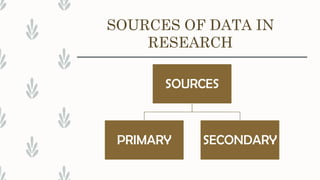
SOURCES
PRIMARY SECONDARY
PRIMARY DATA
– Primary data means ‘First-hand information’ collected by an
investigator.
– It is collected for the first time for a specific research purpose.
– It is original and more reliable.
– For example
– Population census conducted by the government of India after
every 10 years.
– Brand awareness among college girl students
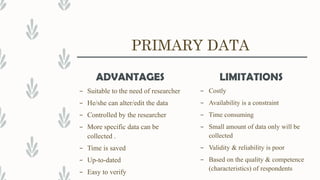
PRIMARY DATA
ADVANTAGES
– Suitable to the need of researcher
– He/she can alter/edit the data
– Controlled by the researcher
– More specific data can be
collected .
– Time is saved
– Up-to-dated
– Easy to verify
LIMITATIONS
– Costly
– Availability is a constraint
– Time consuming
– Small amount of data only will be
collected
– Validity & reliability is poor
– Based on the quality & competence
(characteristics) of respondents
SECONDARY DATA
– Secondary data refers to ‘Second-hand information’.
– These are not originally collected.
– Collected and processed by someone for some other reasons.
– Obtained from already published or unpublished sources.
For example
– Banking repo rate.
– Annual reports of RBI or any firms
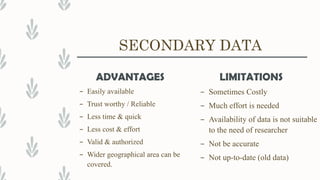
SECONDARY DATA
ADVANTAGES
– Easily available
– Trust worthy / Reliable
– Less time & quick
– Less cost & effort
– Valid & authorized
– Wider geographical area can be
covered.
LIMITATIONS
– Sometimes Costly
– Much effort is needed
– Availability of data is not suitable
to the need of researcher
– Not be accurate
– Not up-to-date (old data)
Is Survey
Primary / Secondary???
Is Google Map
Primary /
Secondary???
Is ENCYCLOPEDIA
Primary /
Secondary???
Is FIELD TRIP
Primary /
Secondary???
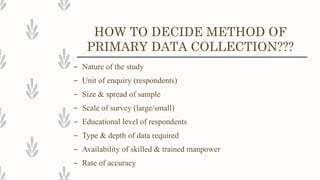
HOW TO DECIDE METHOD OF
PRIMARY DATA COLLECTION???
– Nature of the study
– Unit of enquiry (respondents)
– Size & spread of sample
– Scale of survey (large/small)
– Educational level of respondents
– Type & depth of data required
– Availability of skilled & trained manpower
– Rate of accuracy
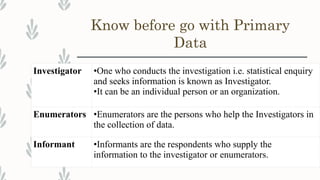
Know before go with Primary
Data
Investigator •One who conducts the investigation i.e. statistical enquiry
and seeks information is known as Investigator.
•It can be an individual person or an organization.
Enumerators •Enumerators are the persons who help the Investigators in
the collection of data.
Informant •Informants are the respondents who supply the
information to the investigator or enumerators.


DATA IN RESEARCH IN IN RESEARCH Methodology

  • 1.
  • 2.
    DATA – Source datais raw data (sometimes called atomic data) that has not been processed for meaningful use to become Information (WIKIPEDIA) – With the raw data, nothing can be concluded. – Data has to be processed in to a usable format
  • 3.
    EXAMPLES OF DATA –Address book – Telephone directory – Employees’ muster roll – Balance sheet of a company – Population data – Literacy rate – Share market trends of 10 years – Number of firms registered under MSME
  • 4.
    SOURCES OF DATAIN RESEARCH SOURCES PRIMARY SECONDARY
  • 5.
    PRIMARY DATA – Primarydata means ‘First-hand information’ collected by an investigator. – It is collected for the first time for a specific research purpose. – It is original and more reliable. – For example – Population census conducted by the government of India after every 10 years. – Brand awareness among college girl students
  • 6.
    PRIMARY DATA ADVANTAGES – Suitableto the need of researcher – He/she can alter/edit the data – Controlled by the researcher – More specific data can be collected . – Time is saved – Up-to-dated – Easy to verify LIMITATIONS – Costly – Availability is a constraint – Time consuming – Small amount of data only will be collected – Validity & reliability is poor – Based on the quality & competence (characteristics) of respondents
  • 7.
    SECONDARY DATA – Secondarydata refers to ‘Second-hand information’. – These are not originally collected. – Collected and processed by someone for some other reasons. – Obtained from already published or unpublished sources. For example – Banking repo rate. – Annual reports of RBI or any firms
  • 8.
    SECONDARY DATA ADVANTAGES – Easilyavailable – Trust worthy / Reliable – Less time & quick – Less cost & effort – Valid & authorized – Wider geographical area can be covered. LIMITATIONS – Sometimes Costly – Much effort is needed – Availability of data is not suitable to the need of researcher – Not be accurate – Not up-to-date (old data)
  • 9.
    Is Survey Primary /Secondary???
  • 10.
    Is Google Map Primary/ Secondary???
  • 11.
  • 12.
    Is FIELD TRIP Primary/ Secondary???
  • 13.
    HOW TO DECIDEMETHOD OF PRIMARY DATA COLLECTION??? – Nature of the study – Unit of enquiry (respondents) – Size & spread of sample – Scale of survey (large/small) – Educational level of respondents – Type & depth of data required – Availability of skilled & trained manpower – Rate of accuracy
  • 14.
    Know before gowith Primary Data Investigator •One who conducts the investigation i.e. statistical enquiry and seeks information is known as Investigator. •It can be an individual person or an organization. Enumerators •Enumerators are the persons who help the Investigators in the collection of data. Informant •Informants are the respondents who supply the information to the investigator or enumerators.