SECONDARY DATA
NAME-SEEMA KUMARI SUBMITTED TO – DR. SONIA SINGLA
MUR1900196
SUBJECT - RESARCH METHOLOGY
B.P.T.4TH YEAR
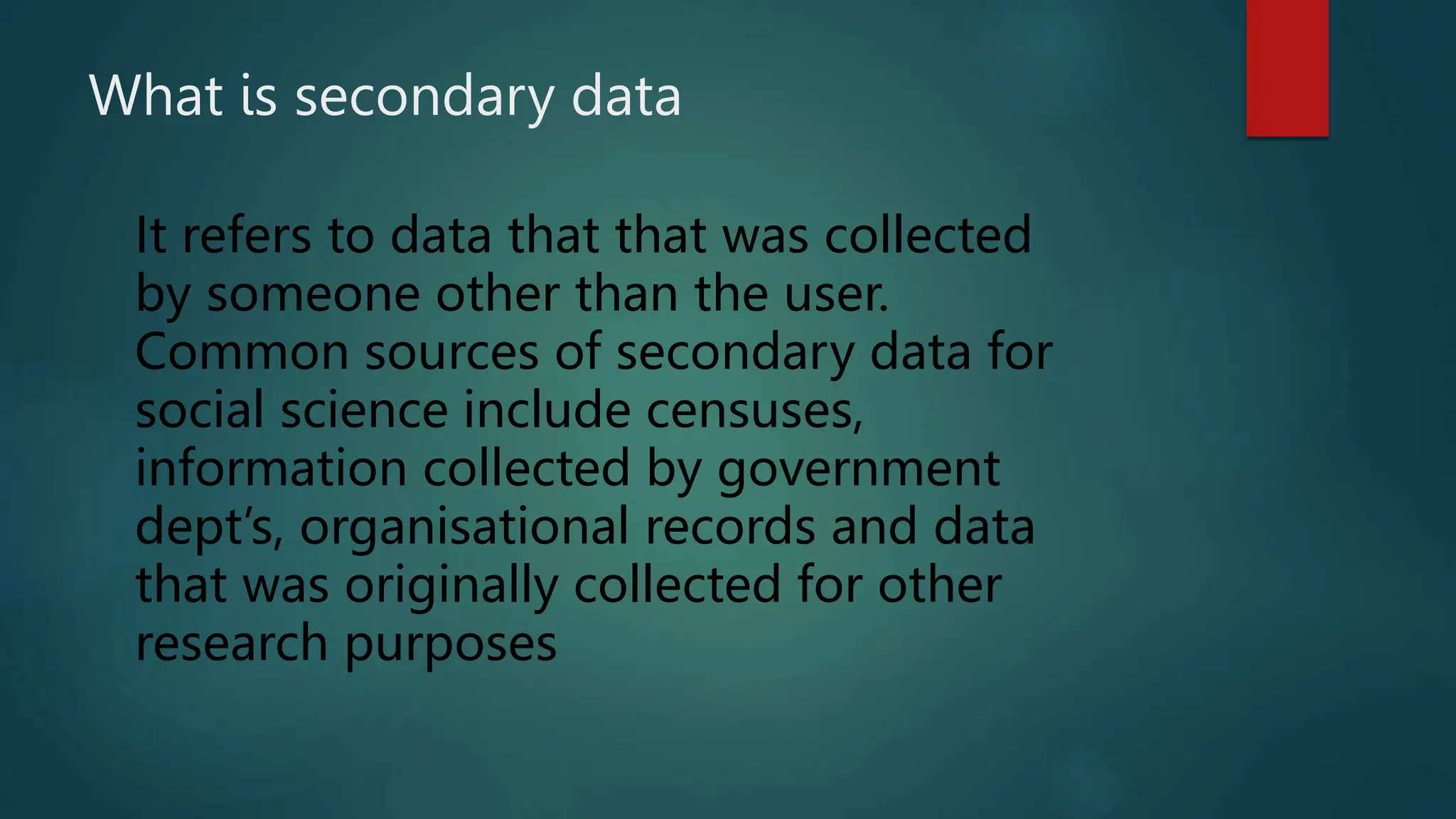
What is secondary data
It refers to data that that was collected
by someone other than the user.
Common sources of secondary data for
social science include censuses,
information collected by government
dept’s, organisational records and data
that was originally collected for other
research purposes
PURPOSE OF SECONDARYDATA
 •Extracting the relevant information from other sources, previous
studies.
 •Fact findings: descriptive information to support research
 •Model building: specifying relationship between two or more
variables
 •Data mining: exploring data through computer. Using computer
technology to go through volumes of data to discover trends about
an organisation’s sales customers and products
PURPOSE OF SECONDARY DATA
•Extracting the relevant information from other
sources, previous studies.
•Fact findings: descriptive information to support
research •Model building: specifying relationship
between two or more variables
•Data mining: exploring data through computer.
Using computer technology to go through
volumes of data to discover trends about an
organisation’s sales customers and products
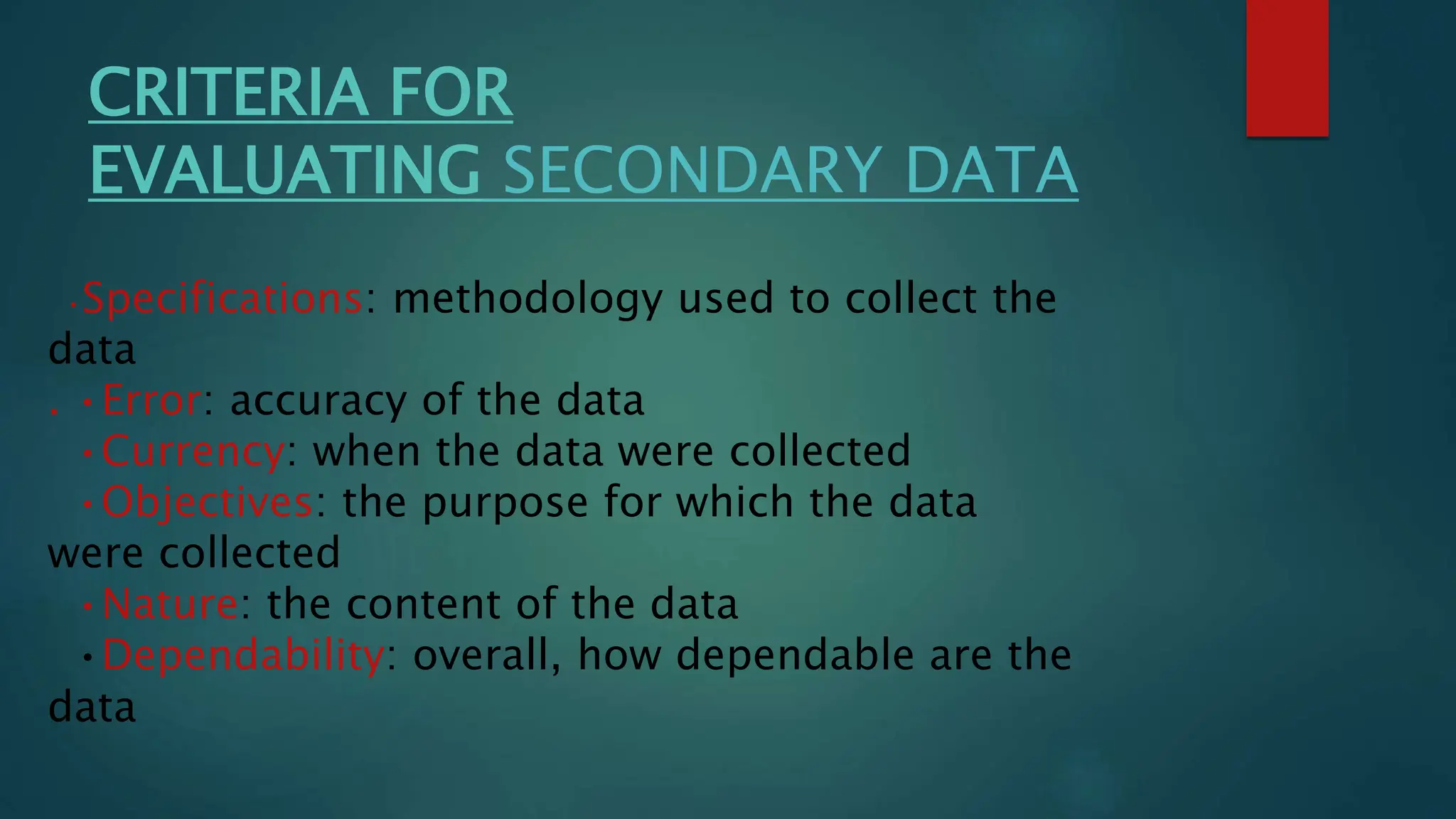
CRITERIA FOR
EVALUATING SECONDARY DATA
•Specifications: methodology used to collect the
data
. •Error: accuracy of the data
•Currency: when the data were collected
•Objectives: the purpose for which the data
were collected
•Nature: the content of the data
•Dependability: overall, how dependable are the
data
ADVANTGES OF SECONDARY DATA
It is economical. It saves efforts &
expenses.
It is time saving.
It helps to make primary data collection
more specific since with the help of
secondary data.
It helps to improve the understanding of
the problem.
It provides a basis for comparison for the
data that is collected by the researcher.
DISADVANTAGES OF
SECONDARY DATA
Secondary data is something that seldom fits
in the frame work of marketing research
factors. Reasons for its non fitting are- a) Unit
of secondary data collection- suppose you want
information on disposable income, but the data
is available on gross income. The information
may not be same as we require.
Accuracy of secondary data is not known
. Data may be outdated(one can only hope that
the data is of good quality)
USES OF SECONDARY DATA
•Identify the problem
•Better define the problem
•Develop an approach to the problem
•Formulate an appropriate research
design
•Answer certain research questions and
test some hypothesis
•Interpret primary data more insightfully
THANK
YOU

SEEMA KUMARI BPT 4th year secondary data.pptx

  • 1.
    SECONDARY DATA NAME-SEEMA KUMARISUBMITTED TO – DR. SONIA SINGLA MUR1900196 SUBJECT - RESARCH METHOLOGY B.P.T.4TH YEAR
  • 2.
    What is secondarydata It refers to data that that was collected by someone other than the user. Common sources of secondary data for social science include censuses, information collected by government dept’s, organisational records and data that was originally collected for other research purposes
  • 3.
    PURPOSE OF SECONDARYDATA •Extracting the relevant information from other sources, previous studies.  •Fact findings: descriptive information to support research  •Model building: specifying relationship between two or more variables  •Data mining: exploring data through computer. Using computer technology to go through volumes of data to discover trends about an organisation’s sales customers and products
  • 6.
    PURPOSE OF SECONDARYDATA •Extracting the relevant information from other sources, previous studies. •Fact findings: descriptive information to support research •Model building: specifying relationship between two or more variables •Data mining: exploring data through computer. Using computer technology to go through volumes of data to discover trends about an organisation’s sales customers and products
  • 7.
    CRITERIA FOR EVALUATING SECONDARYDATA •Specifications: methodology used to collect the data . •Error: accuracy of the data •Currency: when the data were collected •Objectives: the purpose for which the data were collected •Nature: the content of the data •Dependability: overall, how dependable are the data
  • 8.
    ADVANTGES OF SECONDARYDATA It is economical. It saves efforts & expenses. It is time saving. It helps to make primary data collection more specific since with the help of secondary data. It helps to improve the understanding of the problem. It provides a basis for comparison for the data that is collected by the researcher.
  • 9.
    DISADVANTAGES OF SECONDARY DATA Secondarydata is something that seldom fits in the frame work of marketing research factors. Reasons for its non fitting are- a) Unit of secondary data collection- suppose you want information on disposable income, but the data is available on gross income. The information may not be same as we require. Accuracy of secondary data is not known . Data may be outdated(one can only hope that the data is of good quality)
  • 10.
    USES OF SECONDARYDATA •Identify the problem •Better define the problem •Develop an approach to the problem •Formulate an appropriate research design •Answer certain research questions and test some hypothesis •Interpret primary data more insightfully
  • 11.