BUSINESS REPORT WITING
1
Contents
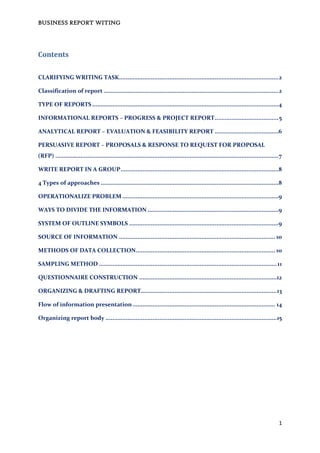
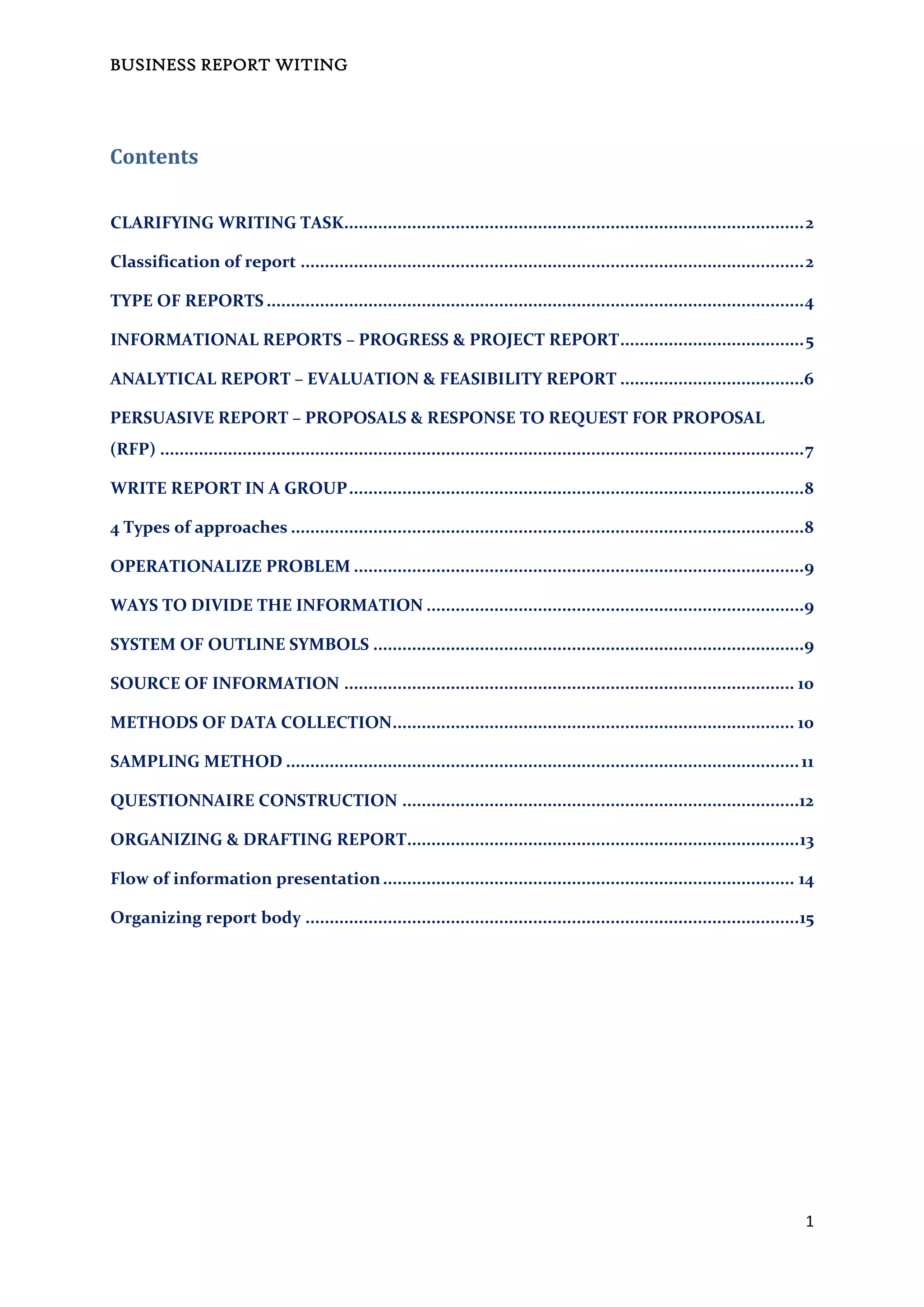
CLARIFYING WRITING TASK...............................................................................................2
Classification of report ........................................................................................................2
TYPE OF REPORTS ...............................................................................................................4
INFORMATIONAL REPORTS – PROGRESS & PROJECT REPORT......................................5
ANALYTICAL REPORT – EVALUATION & FEASIBILITY REPORT ......................................6
PERSUASIVE REPORT – PROPOSALS & RESPONSE TO REQUEST FOR PROPOSAL
(RFP) .....................................................................................................................................7
WRITE REPORT IN A GROUP..............................................................................................8
4 Types of approaches ..........................................................................................................8
OPERATIONALIZE PROBLEM .............................................................................................9
WAYS TO DIVIDE THE INFORMATION ..............................................................................9
SYSTEM OF OUTLINE SYMBOLS .........................................................................................9
SOURCE OF INFORMATION ............................................................................................. 10
METHODS OF DATA COLLECTION................................................................................... 10
SAMPLING METHOD ..........................................................................................................11
QUESTIONNAIRE CONSTRUCTION ..................................................................................12
ORGANIZING & DRAFTING REPORT.................................................................................13
Flow of information presentation..................................................................................... 14
Organizing report body ......................................................................................................15
BUSINESS REPORT WITING
2
CLARIFYING WRITING TASK
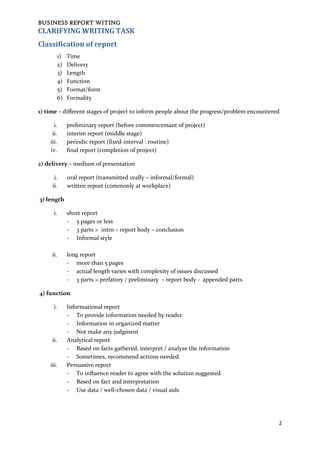
Classification of report
1) Time
2) Delivery
3) Length
4) Function
5) Format/form
6) Formality
1) time – different stages of project to inform people about the progress/problem encountered
i. preliminary report (before commencemant of project)
ii. interim report (middle stage)
iii. periodic report (fixed-interval : routine)
iv. final report (completion of project)
2) delivery – medium of presentation
i. oral report (transmitted orally – informal/formal)
ii. written report (commonly at workplace)
3) length
i. short report
- 5 pages or less
- 3 parts > intro – report body – conclusion
- Informal style
ii. long report
- more than 5 pages
- actual length varies with complexity of issues discussed
- 3 parts > prefatory / preliminary – report body - appended parts
4) function
i. Informational report
- To provide information needed by reader.
- Information in organized matter
- Not make any judgment
ii. Analytical report
- Based on facts gathered, interpret / analyze the information
- Sometimes, recommend actions needed.
iii. Persuasive report
- To influence reader to agree with the solution suggested.
- Based on fact and interpretation
- Use data / well-chosen data / visual aids
BUSINESS REPORT WITING
3
5) format / form
i. Form report
- Pre-printed forms
- Routine in nature
- E.g. : accidents report / daily sales report
ii. Memorandum report
- Use memo format
- Informal in language
- Brief
iii. Letter report
- Exactly like letter
- Have components necessary – address, salutation, etc
6) formality
i. Informal report
- Short
- Language – conversational in nature
- Matters less complex
- Memo / letter format
ii. Formal report
- Quite long
- Language -formal
- Fairly complex
- Long report format
BUSINESS REPORT WITING
4
TYPE OF REPORTS
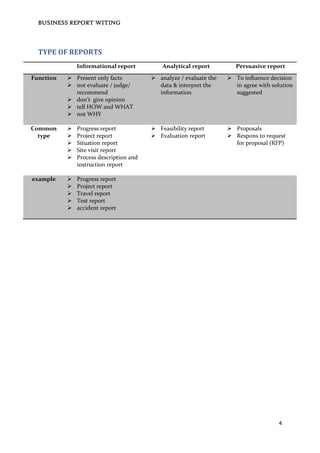
Informational report Analytical report Persuasive report
Function  Present only facts
 not evaluate / judge/
recommend
 don’t give opinion
 tell HOW and WHAT
 not WHY
 analyze / evaluate the
data & interpret the
information
 To influence decision
in agree with solution
suggested
Common
type
 Progress report
 Project report
 Situation report
 Site visit report
 Process description and
instruction report
 Feasibility report
 Evaluation report
 Proposals
 Respons to request
for proposal (RFP)
example  Progress report
 Project report
 Travel report
 Test report
 accident report
BUSINESS REPORT WITING
5
INFORMATIONAL REPORTS – PROGRESS & PROJECT REPORT
Progress report Project report
Function - compilation of all projects a person
undertook during a period of time
in the past (past week / month/
year)
- report on work done during
specific period & on the works
still needs to be done
generally - covers specific period of time
- deal with one’s person works
- deal with more than 1 task
- discuss tasks to be carried out
- cover work effort of team people
- deals only tasks related to 1
specific project
Content - focus on work done during specific
period covered by the report
- reader wants to know what has
been done, progress made &
continuing efforts
- provide : work done , work in
progress , work being planned
- include specific info (names, facts,
dates )
- what task have been completed ?
- what work currently being done ?
- how much work yet to be done ?
- project on schedule & within
budget ?
- any anticipated problem ?
Format - based on audience , amount &
detail of information , any policies
involved
o brief memos / letter
o informal / formal
- in the form of
o memo
o letter
o short informal report
o long formal report
Arrangement of
content
- priority order ( in descending
order of importance)
- chronological order (based on
way the tasks were carried out)
- status order (status of task )
o 3 parts ( work completed ,
work in progress , work left to
do )
- Task order (individual task)
o Reported individually
o Sub-tasks of each individual
task have 3 parts ( work
completed , work in progress ,
work left to do )
BUSINESS REPORT WITING
6
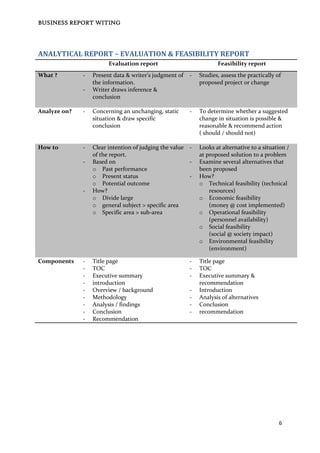
ANALYTICAL REPORT – EVALUATION & FEASIBILITY REPORT
Evaluation report Feasibility report
What ? - Present data & writer’s judgment of
the information.
- Writer draws inference &
conclusion
- Studies, assess the practically of
proposed project or change
Analyze on? - Concerning an unchanging, static
situation & draw specific
conclusion
- To determine whether a suggested
change in situation is possible &
reasonable & recommend action
( should / should not)
How to - Clear intention of judging the value
of the report.
- Based on
o Past performance
o Present status
o Potential outcome
- How?
o Divide large
o general subject > specific area
o Specific area > sub-area
- Looks at alternative to a situation /
at proposed solution to a problem
- Examine several alternatives that
been proposed
- How?
o Technical feasibility (technical
resources)
o Economic feasibility
(money @ cost implemented)
o Operational feasibility
(personnel availability)
o Social feasibility
(social @ society impact)
o Environmental feasibility
(environment)
Components - Title page
- TOC
- Executive summary
- introduction
- Overview / background
- Methodology
- Analysis / findings
- Conclusion
- Recommendation
- Title page
- TOC
- Executive summary &
recommendation
- Introduction
- Analysis of alternatives
- Conclusion
- recommendation
BUSINESS REPORT WITING
7
PERSUASIVE REPORT – PROPOSALS & RESPONSE TO REQUEST FOR
PROPOSAL (RFP)
proposal RFP
What - to recommend
change/solution/action
- well-chosen word/data/visual aids
- to convince reader to take action
- Request for proposal (RFP) is
document sent by clients who need
specific product/service; invite the
receiver to propose solution.
- Response to request for proposal is a
proposal that propose
solution/action that writer feels
meet the best needs stated in RFP
type - May be
o Solicited (request by someone)
o Unsolicited (self –initiated)
- Reader may be
o External (outside client)-
informal language
o Internal (within organization)-
formal language
o Response to non-negotiable RFP
- Condition are not changeable,
strictly adhered to
o Response to negotiable RFP
- Specification / condition may
be modified
How to write? - Write persuasively
- Stress on benefits
- Discuss possible –ve impact
- Use visual aids
- Response must depends on what
needed in RFP
- Include accurate information,
appropriate solution
Components - Transmittal letter
- Title page
- Executive summary
- Introduction
- Problem/current situation
- Solution/recommendation
(proposed action)
- Benefits
- Implementation (schedule of steps)
- Costs
- Conclusion (restate benefit &
immediate action)
- Transmittal letter
- Title page
- TOC
- Executive summary
- Introduction
- Problem/current situation
- Solution/recommendation
(proposed action)
- Benefits
- Implementation (schedule of steps)
- Costs
- Conclusion (restate benefit &
immediate action)
BUSINESS REPORT WITING
8
WRITE REPORT IN A GROUP
4 Types of approaches
1) horizontal approach
- team works independently
- each member complete separate section
- doing all things (drafting, revising, researching ) alone
2) sequential approach
- completed entirely by one team member
- reworked /edited by 2nd
team member
- repeated until all member have edited the report
3) stratified approach
- each member have specialized role
- 1st
– research
- 2nd
– graphics
- 3rd
– editing
4) free-form approach
- all member works together at one place
- perform all roles and finish the task together
Guidelines
i. all team member have clear understanding of the report
ii. decide what will done together / individually
iii. clearly define role each member
iv. schedule regular meetings
v. prepare Gantt chart
BUSINESS REPORT WITING
9
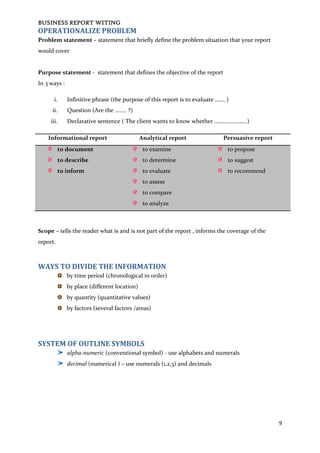
OPERATIONALIZE PROBLEM
Problem statement – statement that briefly define the problem situation that your report
would cover
Purpose statement - statement that defines the objective of the report
In 3 ways :
i. Infinitive phrase (the purpose of this report is to evaluate ……. )
ii. Question (Are the …….. ?)
iii. Declarative sentence ( The client wants to know whether …………………..)
Informational report Analytical report Persuasive report
to document
to describe
to inform
to examine
to determine
to evaluate
to assess
to compare
to analyze
to propose
to suggest
to recommend
Scope – tells the reader what is and is not part of the report , informs the coverage of the
report.
WAYS TO DIVIDE THE INFORMATION
by time period (chronological in order)
by place (different location)
by quantity (quantitative values)
by factors (several factors /areas)
SYSTEM OF OUTLINE SYMBOLS
alpha-numeric (conventional symbol) - use alphabets and numerals
decimal (numerical ) – use numerals (1,2,3) and decimals
BUSINESS REPORT WITING
10
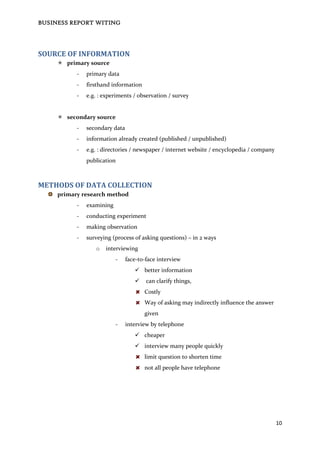
SOURCE OF INFORMATION
 primary source
- primary data
- firsthand information
- e.g. : experiments / observation / survey
 secondary source
- secondary data
- information already created (published / unpublished)
- e.g. : directories / newspaper / internet website / encyclopedia / company
publication
METHODS OF DATA COLLECTION
primary research method
- examining
- conducting experiment
- making observation
- surveying (process of asking questions) – in 2 ways
o interviewing
- face-to-face interview
 better information
 can clarify things,
Costly
Way of asking may indirectly influence the answer
given
- interview by telephone
 cheaper
 interview many people quickly
limit question to shorten time
not all people have telephone
BUSINESS REPORT WITING
11
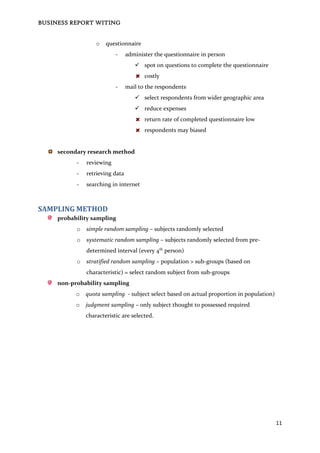
o questionnaire
- administer the questionnaire in person
 spot on questions to complete the questionnaire
costly
- mail to the respondents
 select respondents from wider geographic area
 reduce expenses
return rate of completed questionnaire low
respondents may biased
secondary research method
- reviewing
- retrieving data
- searching in internet
SAMPLING METHOD
probability sampling
o simple random sampling – subjects randomly selected
o systematic random sampling – subjects randomly selected from pre-
determined interval (every 4th
person)
o stratified random sampling – population > sub-groups (based on
characteristic) = select random subject from sub-groups
non-probability sampling
o quota sampling - subject select based on actual proportion in population)
o judgment sampling – only subject thought to possessed required
characteristic are selected.
BUSINESS REPORT WITING
12
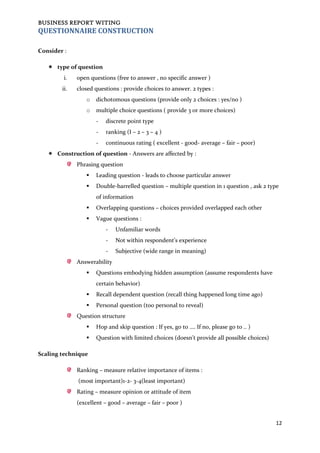
QUESTIONNAIRE CONSTRUCTION
Consider :
 type of question
i. open questions (free to answer , no specific answer )
ii. closed questions : provide choices to answer. 2 types :
o dichotomous questions (provide only 2 choices : yes/no )
o multiple choice questions ( provide 3 or more choices)
- discrete point type
- ranking (I – 2 – 3 – 4 )
- continuous rating ( excellent - good- average – fair – poor)
 Construction of question - Answers are affected by :
Phrasing question
 Leading question - leads to choose particular answer
 Double-barrelled question – multiple question in 1 question , ask 2 type
of information
 Overlapping questions – choices provided overlapped each other
 Vague questions :
- Unfamiliar words
- Not within respondent’s experience
- Subjective (wide range in meaning)
Answerability
 Questions embodying hidden assumption (assume respondents have
certain behavior)
 Recall dependent question (recall thing happened long time ago)
 Personal question (too personal to reveal)
Question structure
 Hop and skip question : If yes, go to …. If no, please go to .. )
 Question with limited choices (doesn’t provide all possible choices)
Scaling technique
Ranking – measure relative importance of items :
(most important)1-2- 3-4(least important)
Rating – measure opinion or attitude of item
(excellent – good – average – fair – poor )
BUSINESS REPORT WITING
13
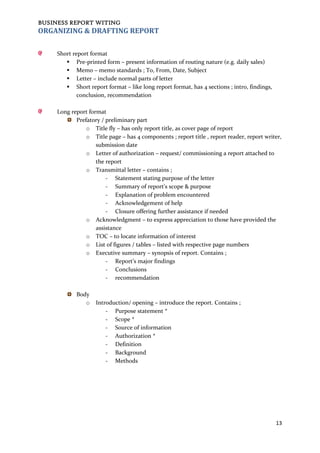
ORGANIZING & DRAFTING REPORT
Short report format
 Pre-printed form – present information of routing nature (e.g. daily sales)
 Memo – memo standards ; To, From, Date, Subject
 Letter – include normal parts of letter
 Short report format – like long report format, has 4 sections ; intro, findings,
conclusion, recommendation
Long report format
Prefatory / preliminary part
o Title fly – has only report title, as cover page of report
o Title page – has 4 components ; report title , report reader, report writer,
submission date
o Letter of authorization – request/ commissioning a report attached to
the report
o Transmittal letter – contains ;
- Statement stating purpose of the letter
- Summary of report’s scope & purpose
- Explanation of problem encountered
- Acknowledgement of help
- Closure offering further assistance if needed
o Acknowledgment – to express appreciation to those have provided the
assistance
o TOC – to locate information of interest
o List of figures / tables – listed with respective page numbers
o Executive summary – synopsis of report. Contains ;
- Report’s major findings
- Conclusions
- recommendation
Body
o Introduction/ opening – introduce the report. Contains ;
- Purpose statement *
- Scope *
- Source of information
- Authorization *
- Definition
- Background
- Methods
BUSINESS REPORT WITING
14
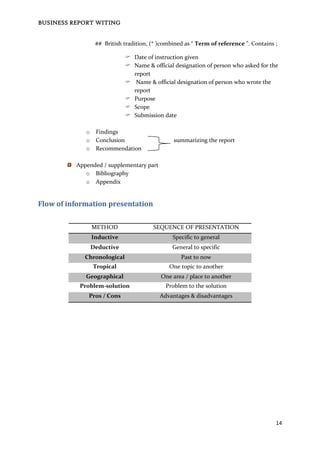
## British tradition, (* )combined as “ Term of reference ”. Contains ;
 Date of instruction given
 Name & official designation of person who asked for the
report
 Name & official designation of person who wrote the
report
 Purpose
 Scope
 Submission date
o Findings
o Conclusion summarizing the report
o Recommendation
Appended / supplementary part
o Bibliography
o Appendix
Flow of information presentation
METHOD SEQUENCE OF PRESENTATION
Inductive Specific to general
Deductive General to specific
Chronological Past to now
Tropical One topic to another
Geographical One area / place to another
Problem-solution Problem to the solution
Pros / Cons Advantages & disadvantages
BUSINESS REPORT WITING
15
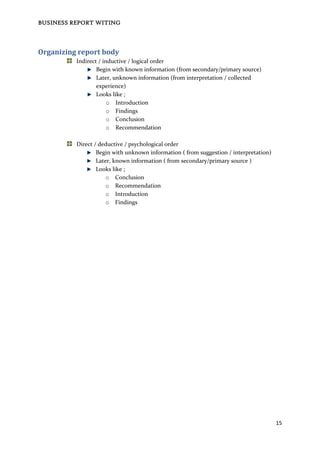
Organizing report body
Indirect / inductive / logical order
Begin with known information (from secondary/primary source)
Later, unknown information (from interpretation / collected
experience)
Looks like ;
o Introduction
o Findings
o Conclusion
o Recommendation
Direct / deductive / psychological order
Begin with unknown information ( from suggestion / interpretation)
Later, known information ( from secondary/primary source )
Looks like ;
o Conclusion
o Recommendation
o Introduction
o Findings

Business report writing notes

  • 1.
    BUSINESS REPORT WITING 1 Contents CLARIFYINGWRITING TASK...............................................................................................2 Classification of report ........................................................................................................2 TYPE OF REPORTS ...............................................................................................................4 INFORMATIONAL REPORTS – PROGRESS & PROJECT REPORT......................................5 ANALYTICAL REPORT – EVALUATION & FEASIBILITY REPORT ......................................6 PERSUASIVE REPORT – PROPOSALS & RESPONSE TO REQUEST FOR PROPOSAL (RFP) .....................................................................................................................................7 WRITE REPORT IN A GROUP..............................................................................................8 4 Types of approaches ..........................................................................................................8 OPERATIONALIZE PROBLEM .............................................................................................9 WAYS TO DIVIDE THE INFORMATION ..............................................................................9 SYSTEM OF OUTLINE SYMBOLS .........................................................................................9 SOURCE OF INFORMATION ............................................................................................. 10 METHODS OF DATA COLLECTION................................................................................... 10 SAMPLING METHOD ..........................................................................................................11 QUESTIONNAIRE CONSTRUCTION ..................................................................................12 ORGANIZING & DRAFTING REPORT.................................................................................13 Flow of information presentation..................................................................................... 14 Organizing report body ......................................................................................................15
  • 2.
    BUSINESS REPORT WITING 2 CLARIFYINGWRITING TASK Classification of report 1) Time 2) Delivery 3) Length 4) Function 5) Format/form 6) Formality 1) time – different stages of project to inform people about the progress/problem encountered i. preliminary report (before commencemant of project) ii. interim report (middle stage) iii. periodic report (fixed-interval : routine) iv. final report (completion of project) 2) delivery – medium of presentation i. oral report (transmitted orally – informal/formal) ii. written report (commonly at workplace) 3) length i. short report - 5 pages or less - 3 parts > intro – report body – conclusion - Informal style ii. long report - more than 5 pages - actual length varies with complexity of issues discussed - 3 parts > prefatory / preliminary – report body - appended parts 4) function i. Informational report - To provide information needed by reader. - Information in organized matter - Not make any judgment ii. Analytical report - Based on facts gathered, interpret / analyze the information - Sometimes, recommend actions needed. iii. Persuasive report - To influence reader to agree with the solution suggested. - Based on fact and interpretation - Use data / well-chosen data / visual aids
  • 3.
    BUSINESS REPORT WITING 3 5)format / form i. Form report - Pre-printed forms - Routine in nature - E.g. : accidents report / daily sales report ii. Memorandum report - Use memo format - Informal in language - Brief iii. Letter report - Exactly like letter - Have components necessary – address, salutation, etc 6) formality i. Informal report - Short - Language – conversational in nature - Matters less complex - Memo / letter format ii. Formal report - Quite long - Language -formal - Fairly complex - Long report format
  • 4.
    BUSINESS REPORT WITING 4 TYPEOF REPORTS Informational report Analytical report Persuasive report Function  Present only facts  not evaluate / judge/ recommend  don’t give opinion  tell HOW and WHAT  not WHY  analyze / evaluate the data & interpret the information  To influence decision in agree with solution suggested Common type  Progress report  Project report  Situation report  Site visit report  Process description and instruction report  Feasibility report  Evaluation report  Proposals  Respons to request for proposal (RFP) example  Progress report  Project report  Travel report  Test report  accident report
  • 5.
    BUSINESS REPORT WITING 5 INFORMATIONALREPORTS – PROGRESS & PROJECT REPORT Progress report Project report Function - compilation of all projects a person undertook during a period of time in the past (past week / month/ year) - report on work done during specific period & on the works still needs to be done generally - covers specific period of time - deal with one’s person works - deal with more than 1 task - discuss tasks to be carried out - cover work effort of team people - deals only tasks related to 1 specific project Content - focus on work done during specific period covered by the report - reader wants to know what has been done, progress made & continuing efforts - provide : work done , work in progress , work being planned - include specific info (names, facts, dates ) - what task have been completed ? - what work currently being done ? - how much work yet to be done ? - project on schedule & within budget ? - any anticipated problem ? Format - based on audience , amount & detail of information , any policies involved o brief memos / letter o informal / formal - in the form of o memo o letter o short informal report o long formal report Arrangement of content - priority order ( in descending order of importance) - chronological order (based on way the tasks were carried out) - status order (status of task ) o 3 parts ( work completed , work in progress , work left to do ) - Task order (individual task) o Reported individually o Sub-tasks of each individual task have 3 parts ( work completed , work in progress , work left to do )
  • 6.
    BUSINESS REPORT WITING 6 ANALYTICALREPORT – EVALUATION & FEASIBILITY REPORT Evaluation report Feasibility report What ? - Present data & writer’s judgment of the information. - Writer draws inference & conclusion - Studies, assess the practically of proposed project or change Analyze on? - Concerning an unchanging, static situation & draw specific conclusion - To determine whether a suggested change in situation is possible & reasonable & recommend action ( should / should not) How to - Clear intention of judging the value of the report. - Based on o Past performance o Present status o Potential outcome - How? o Divide large o general subject > specific area o Specific area > sub-area - Looks at alternative to a situation / at proposed solution to a problem - Examine several alternatives that been proposed - How? o Technical feasibility (technical resources) o Economic feasibility (money @ cost implemented) o Operational feasibility (personnel availability) o Social feasibility (social @ society impact) o Environmental feasibility (environment) Components - Title page - TOC - Executive summary - introduction - Overview / background - Methodology - Analysis / findings - Conclusion - Recommendation - Title page - TOC - Executive summary & recommendation - Introduction - Analysis of alternatives - Conclusion - recommendation
  • 7.
    BUSINESS REPORT WITING 7 PERSUASIVEREPORT – PROPOSALS & RESPONSE TO REQUEST FOR PROPOSAL (RFP) proposal RFP What - to recommend change/solution/action - well-chosen word/data/visual aids - to convince reader to take action - Request for proposal (RFP) is document sent by clients who need specific product/service; invite the receiver to propose solution. - Response to request for proposal is a proposal that propose solution/action that writer feels meet the best needs stated in RFP type - May be o Solicited (request by someone) o Unsolicited (self –initiated) - Reader may be o External (outside client)- informal language o Internal (within organization)- formal language o Response to non-negotiable RFP - Condition are not changeable, strictly adhered to o Response to negotiable RFP - Specification / condition may be modified How to write? - Write persuasively - Stress on benefits - Discuss possible –ve impact - Use visual aids - Response must depends on what needed in RFP - Include accurate information, appropriate solution Components - Transmittal letter - Title page - Executive summary - Introduction - Problem/current situation - Solution/recommendation (proposed action) - Benefits - Implementation (schedule of steps) - Costs - Conclusion (restate benefit & immediate action) - Transmittal letter - Title page - TOC - Executive summary - Introduction - Problem/current situation - Solution/recommendation (proposed action) - Benefits - Implementation (schedule of steps) - Costs - Conclusion (restate benefit & immediate action)
  • 8.
    BUSINESS REPORT WITING 8 WRITEREPORT IN A GROUP 4 Types of approaches 1) horizontal approach - team works independently - each member complete separate section - doing all things (drafting, revising, researching ) alone 2) sequential approach - completed entirely by one team member - reworked /edited by 2nd team member - repeated until all member have edited the report 3) stratified approach - each member have specialized role - 1st – research - 2nd – graphics - 3rd – editing 4) free-form approach - all member works together at one place - perform all roles and finish the task together Guidelines i. all team member have clear understanding of the report ii. decide what will done together / individually iii. clearly define role each member iv. schedule regular meetings v. prepare Gantt chart
  • 9.
    BUSINESS REPORT WITING 9 OPERATIONALIZEPROBLEM Problem statement – statement that briefly define the problem situation that your report would cover Purpose statement - statement that defines the objective of the report In 3 ways : i. Infinitive phrase (the purpose of this report is to evaluate ……. ) ii. Question (Are the …….. ?) iii. Declarative sentence ( The client wants to know whether …………………..) Informational report Analytical report Persuasive report to document to describe to inform to examine to determine to evaluate to assess to compare to analyze to propose to suggest to recommend Scope – tells the reader what is and is not part of the report , informs the coverage of the report. WAYS TO DIVIDE THE INFORMATION by time period (chronological in order) by place (different location) by quantity (quantitative values) by factors (several factors /areas) SYSTEM OF OUTLINE SYMBOLS alpha-numeric (conventional symbol) - use alphabets and numerals decimal (numerical ) – use numerals (1,2,3) and decimals
  • 10.
    BUSINESS REPORT WITING 10 SOURCEOF INFORMATION  primary source - primary data - firsthand information - e.g. : experiments / observation / survey  secondary source - secondary data - information already created (published / unpublished) - e.g. : directories / newspaper / internet website / encyclopedia / company publication METHODS OF DATA COLLECTION primary research method - examining - conducting experiment - making observation - surveying (process of asking questions) – in 2 ways o interviewing - face-to-face interview  better information  can clarify things, Costly Way of asking may indirectly influence the answer given - interview by telephone  cheaper  interview many people quickly limit question to shorten time not all people have telephone
  • 11.
    BUSINESS REPORT WITING 11 oquestionnaire - administer the questionnaire in person  spot on questions to complete the questionnaire costly - mail to the respondents  select respondents from wider geographic area  reduce expenses return rate of completed questionnaire low respondents may biased secondary research method - reviewing - retrieving data - searching in internet SAMPLING METHOD probability sampling o simple random sampling – subjects randomly selected o systematic random sampling – subjects randomly selected from pre- determined interval (every 4th person) o stratified random sampling – population > sub-groups (based on characteristic) = select random subject from sub-groups non-probability sampling o quota sampling - subject select based on actual proportion in population) o judgment sampling – only subject thought to possessed required characteristic are selected.
  • 12.
    BUSINESS REPORT WITING 12 QUESTIONNAIRECONSTRUCTION Consider :  type of question i. open questions (free to answer , no specific answer ) ii. closed questions : provide choices to answer. 2 types : o dichotomous questions (provide only 2 choices : yes/no ) o multiple choice questions ( provide 3 or more choices) - discrete point type - ranking (I – 2 – 3 – 4 ) - continuous rating ( excellent - good- average – fair – poor)  Construction of question - Answers are affected by : Phrasing question  Leading question - leads to choose particular answer  Double-barrelled question – multiple question in 1 question , ask 2 type of information  Overlapping questions – choices provided overlapped each other  Vague questions : - Unfamiliar words - Not within respondent’s experience - Subjective (wide range in meaning) Answerability  Questions embodying hidden assumption (assume respondents have certain behavior)  Recall dependent question (recall thing happened long time ago)  Personal question (too personal to reveal) Question structure  Hop and skip question : If yes, go to …. If no, please go to .. )  Question with limited choices (doesn’t provide all possible choices) Scaling technique Ranking – measure relative importance of items : (most important)1-2- 3-4(least important) Rating – measure opinion or attitude of item (excellent – good – average – fair – poor )
  • 13.
    BUSINESS REPORT WITING 13 ORGANIZING& DRAFTING REPORT Short report format  Pre-printed form – present information of routing nature (e.g. daily sales)  Memo – memo standards ; To, From, Date, Subject  Letter – include normal parts of letter  Short report format – like long report format, has 4 sections ; intro, findings, conclusion, recommendation Long report format Prefatory / preliminary part o Title fly – has only report title, as cover page of report o Title page – has 4 components ; report title , report reader, report writer, submission date o Letter of authorization – request/ commissioning a report attached to the report o Transmittal letter – contains ; - Statement stating purpose of the letter - Summary of report’s scope & purpose - Explanation of problem encountered - Acknowledgement of help - Closure offering further assistance if needed o Acknowledgment – to express appreciation to those have provided the assistance o TOC – to locate information of interest o List of figures / tables – listed with respective page numbers o Executive summary – synopsis of report. Contains ; - Report’s major findings - Conclusions - recommendation Body o Introduction/ opening – introduce the report. Contains ; - Purpose statement * - Scope * - Source of information - Authorization * - Definition - Background - Methods
  • 14.
    BUSINESS REPORT WITING 14 ##British tradition, (* )combined as “ Term of reference ”. Contains ;  Date of instruction given  Name & official designation of person who asked for the report  Name & official designation of person who wrote the report  Purpose  Scope  Submission date o Findings o Conclusion summarizing the report o Recommendation Appended / supplementary part o Bibliography o Appendix Flow of information presentation METHOD SEQUENCE OF PRESENTATION Inductive Specific to general Deductive General to specific Chronological Past to now Tropical One topic to another Geographical One area / place to another Problem-solution Problem to the solution Pros / Cons Advantages & disadvantages
  • 15.
    BUSINESS REPORT WITING 15 Organizingreport body Indirect / inductive / logical order Begin with known information (from secondary/primary source) Later, unknown information (from interpretation / collected experience) Looks like ; o Introduction o Findings o Conclusion o Recommendation Direct / deductive / psychological order Begin with unknown information ( from suggestion / interpretation) Later, known information ( from secondary/primary source ) Looks like ; o Conclusion o Recommendation o Introduction o Findings