This document introduces a progress report presentation given by five students to their professor. It begins by listing the presenting students and then outlines the topics to be covered, including a progress report and feasibility report. It proceeds to provide definitions and purposes of progress reports, discussing their typical contents, organization, language and formats. It then shifts to discussing the definition, importance, typical parts and sections of a feasibility report, including the executive summary, methodology, alternative options evaluation, conclusion and recommendation.
Team Members:
Presented To:
Prof.Mam ALEENA BUKHARI
Hafiz Muhammad Usama Akhtar (BSME-01153120)
Hafiz Shahreyar Raza Baig (BSME-01153115)
Affan Butt (BSME-01153118)
Alim Tanveer (BSME-01153139)
Asjad Ahmad Khan (BSME-01153143)
Progress Report
A reportthat you have to write to inform about the
proress you are making on your work.
What is a progress report?
Student writes to teacher
Employee writes to supervisor/manager
Who should write a progress report?
6.
Progress Report
To provideinformation about the way a project is
Developing
To convince your audience that you are making progress,
that it's the proper progress, and that you will finish on
time.
Purpose
7.
Progress Report
To explainproblems and to request assistance or
guidance
Force you to establish a work schedule so that you'll
complete the project on time.
Purpose
8.
Progress Report
Aprogress report writes to inform a supervisor,
associate, Instructor or customer about progress made
on a project over a certain period of time.
The project can be the design, construction, or repair of
something, the study or research of a problem or
question, or the gathering of information on a technical
subject.
Purpose
9.
Progress Report
Howmuch has been accomplished since the last report?
Is the project on schedule?
If not, what went wrong? How has the problem been
corrected? How long will it take to get back on schedule?
Progress report should include
Are there any unexpected problems (other than schedule
problems)?
When do you anticipate completion?
10.
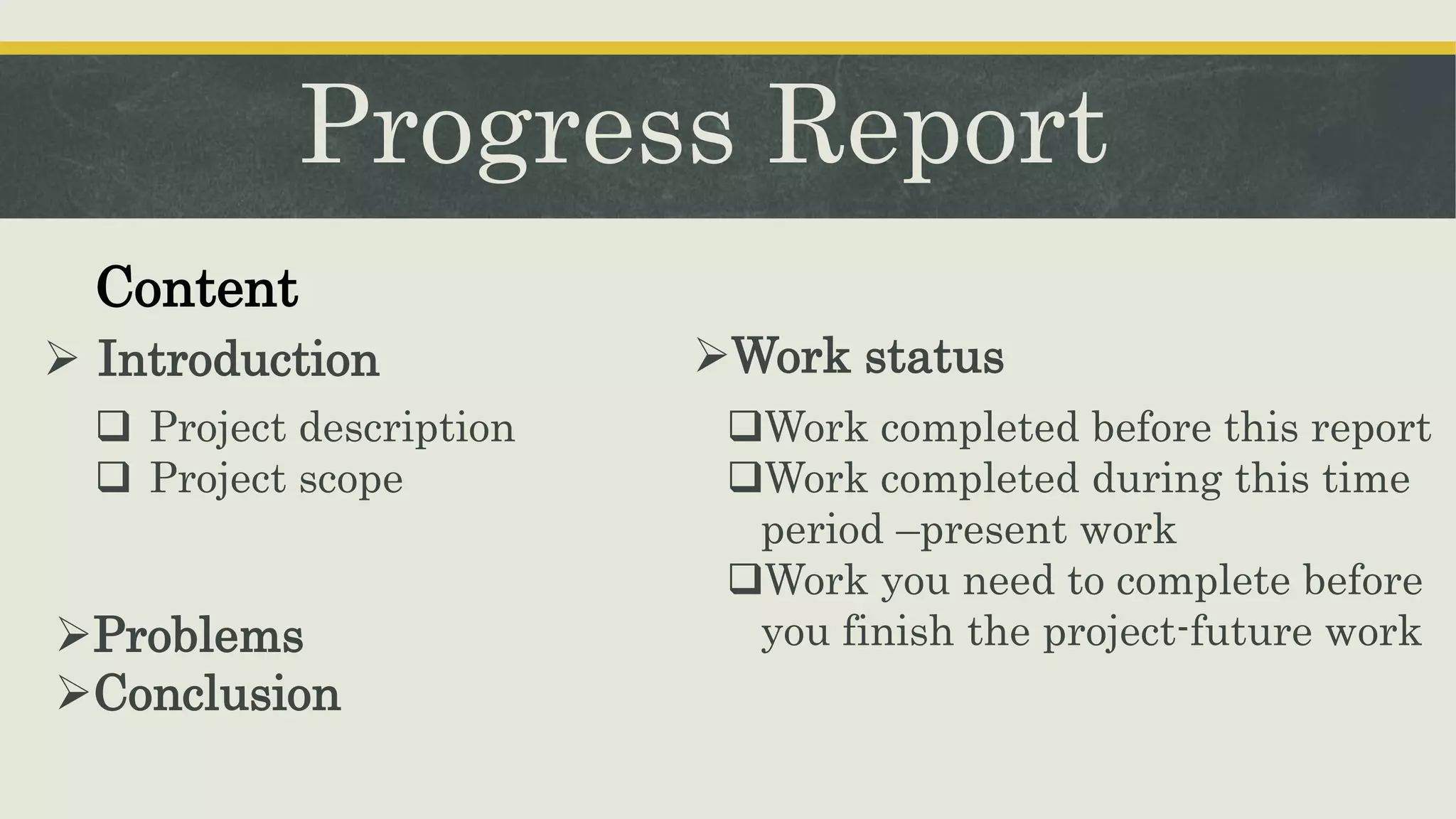
Progress Report
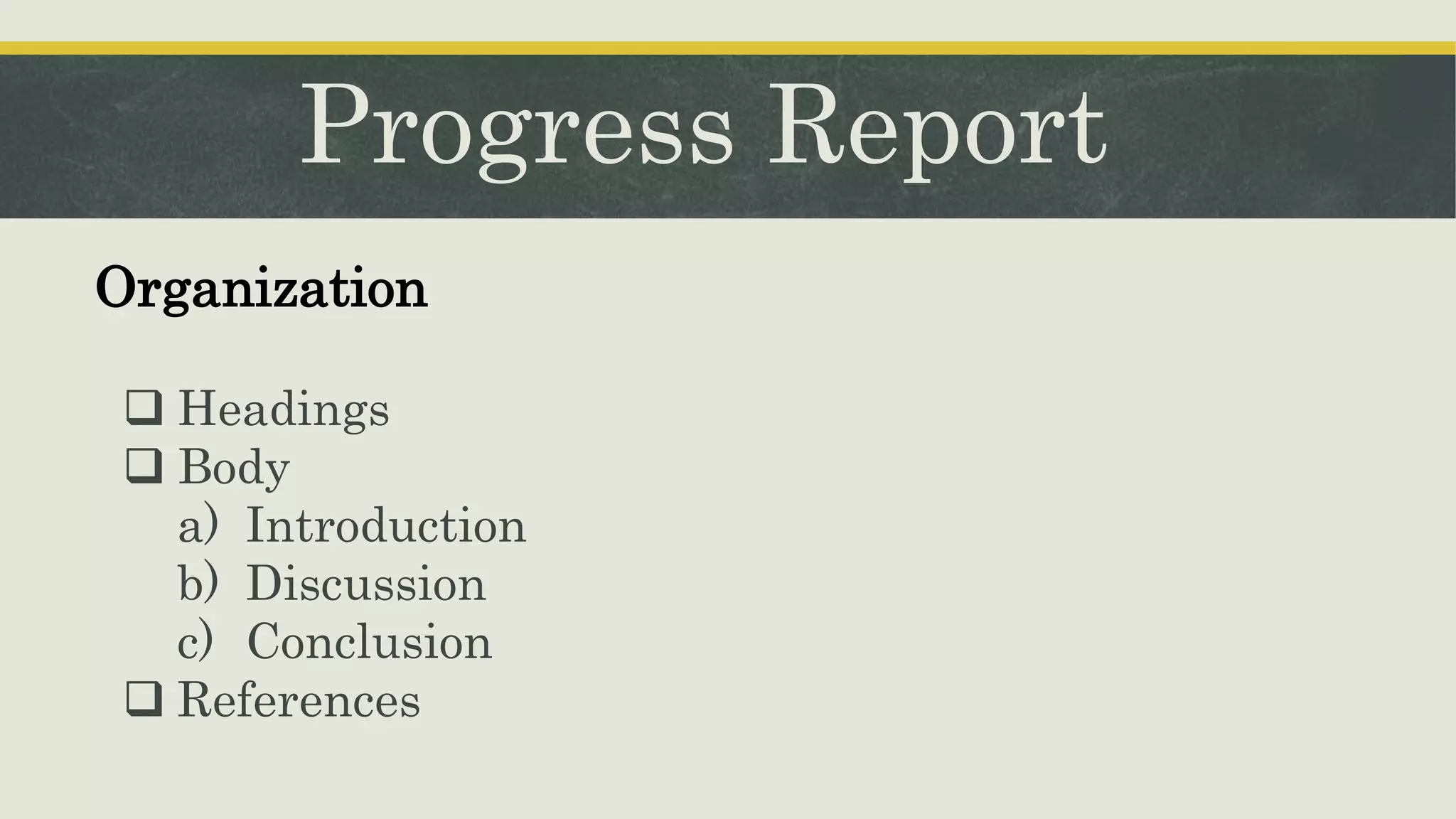
Introduction
Content
Project description
Project scope
Work completed before this report
Work completed during this time
period –present work
Work you need to complete before
you finish the project-future work
Work status
Problems
Conclusion
11.
Progress Report
Presenttense: covers most of the
documents, in particular –perfect
and progressive tenses
future tense-in the ‘future work’
Language
Complete sentences are required
using different types of tenses.
12.
Progress Report
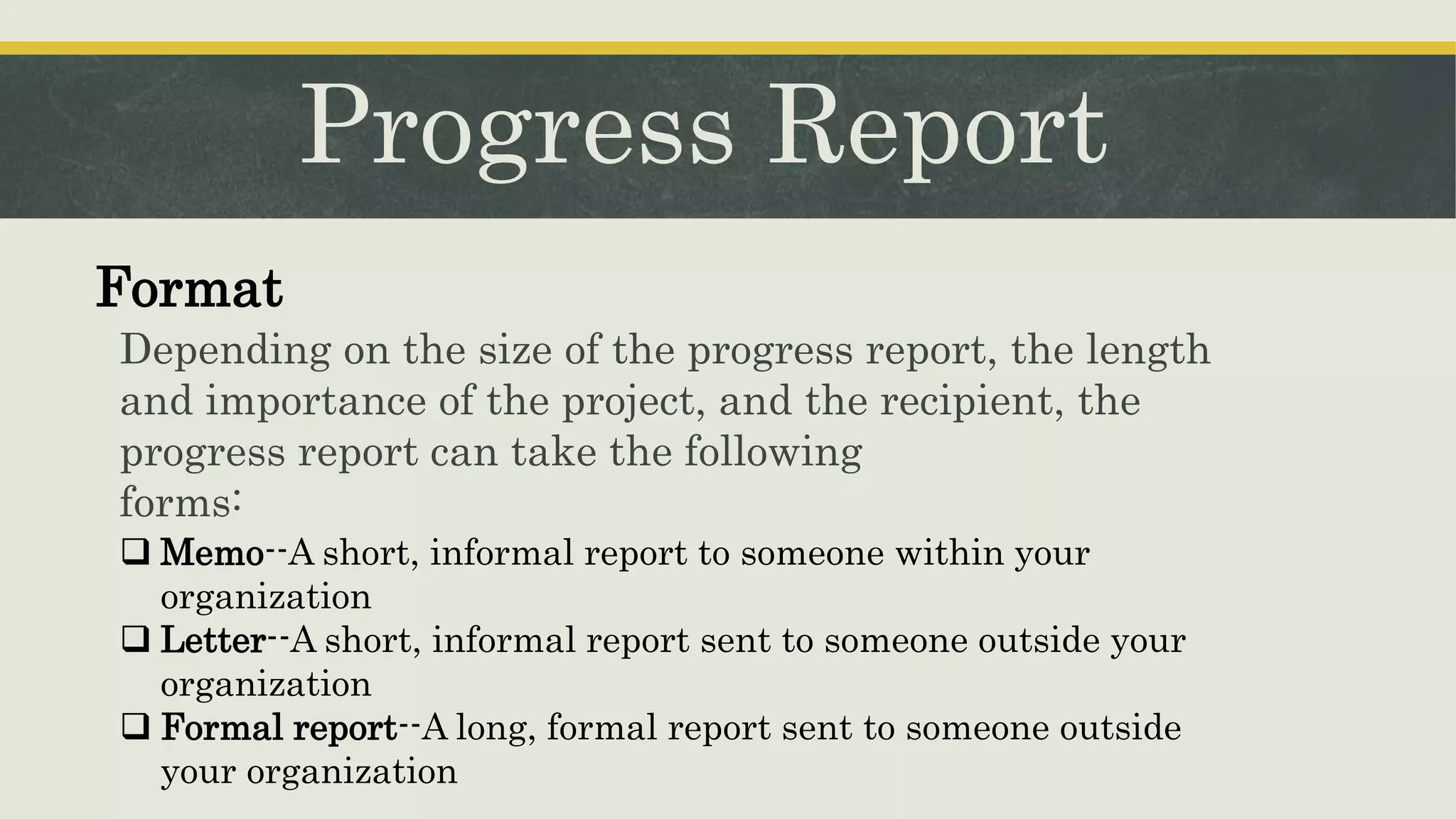
Depending onthe size of the progress report, the length
and importance of the project, and the recipient, the
progress report can take the following
forms:
Format
Memo--A short, informal report to someone within your
organization
Letter--A short, informal report sent to someone outside your
organization
Formal report--A long, formal report sent to someone outside
your organization
Progress Report
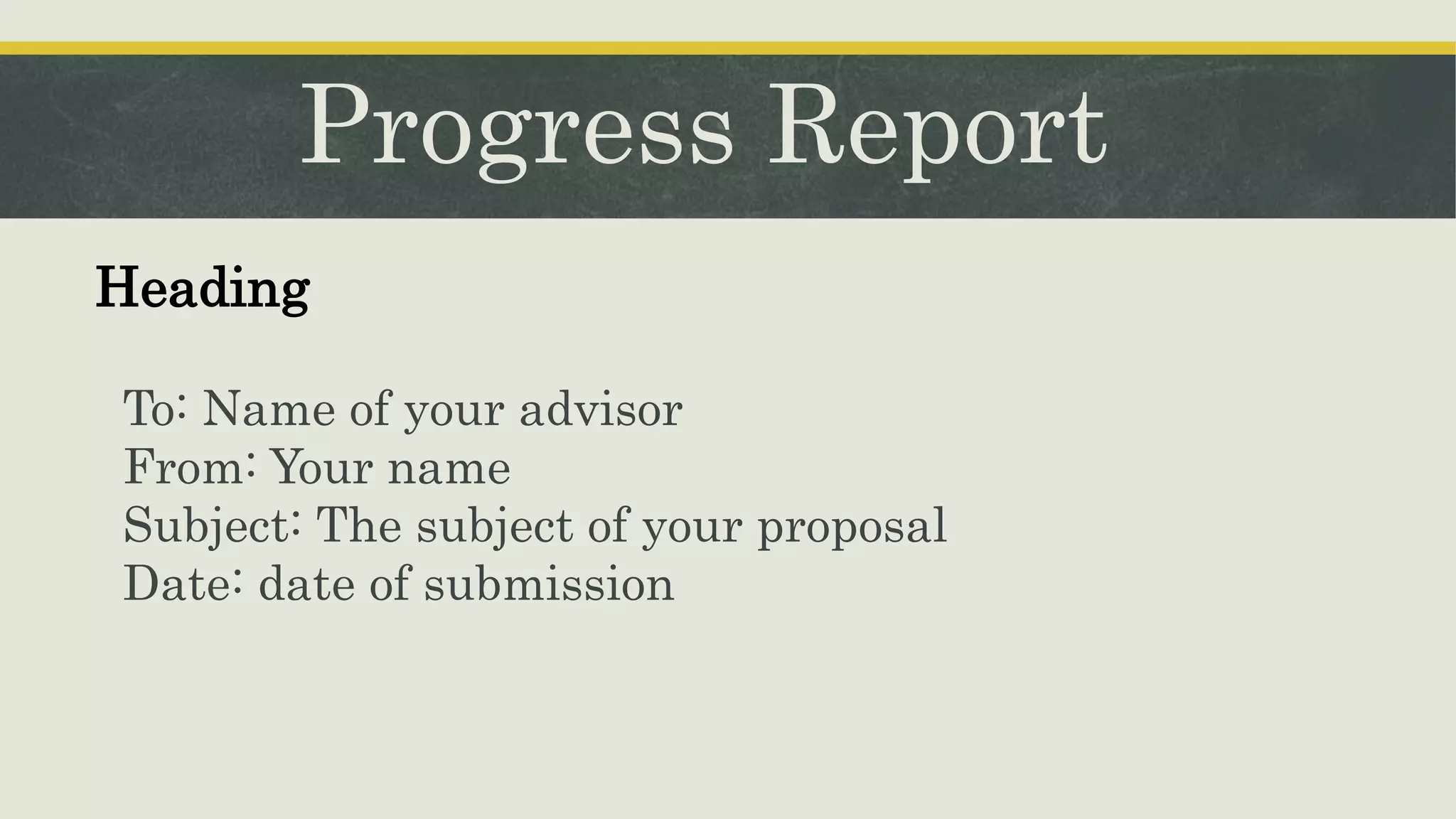
To: Nameof your advisor
From: Your name
Subject: The subject of your proposal
Date: date of submission
Heading
15.
Progress Report
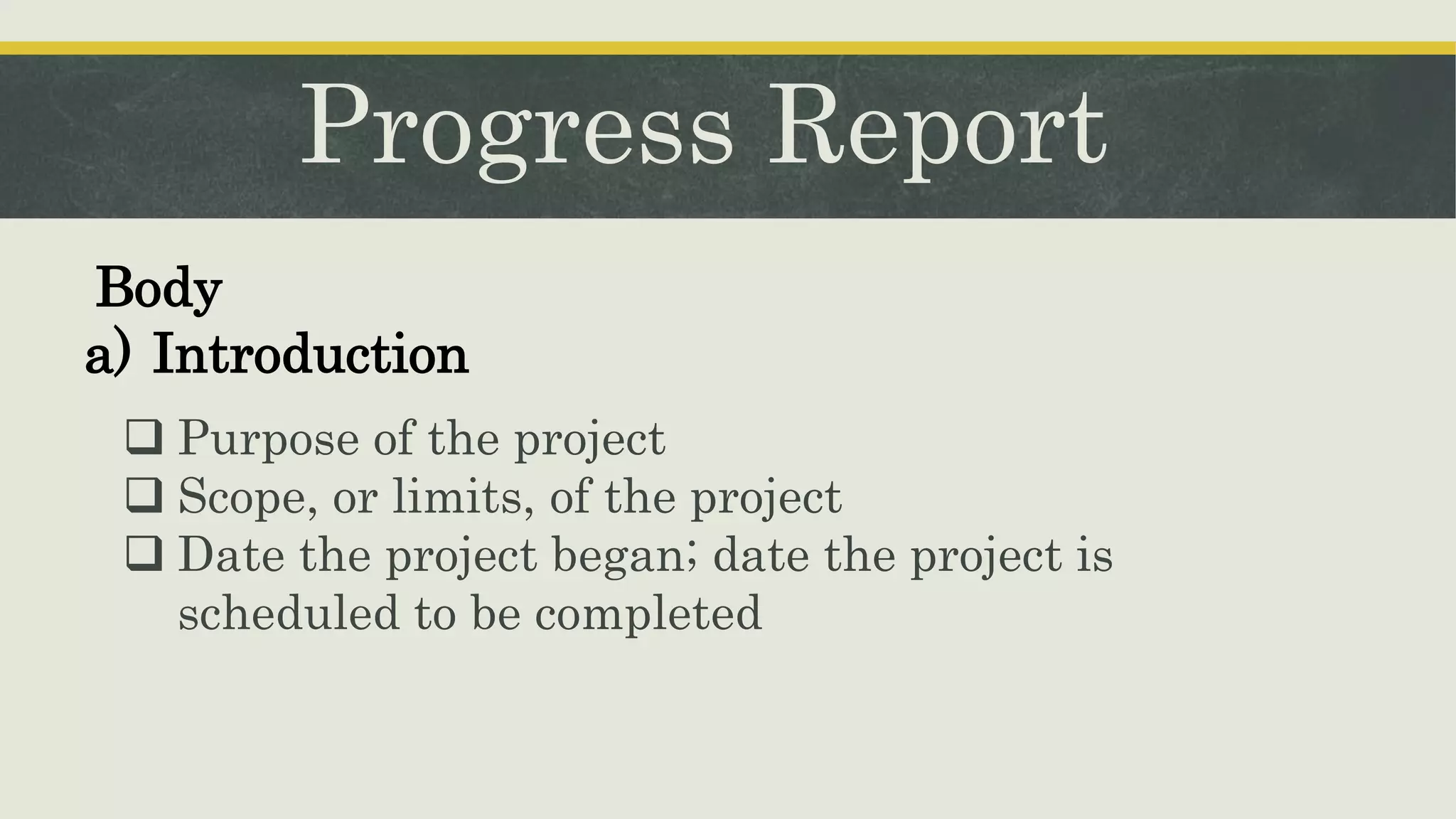
Body
a) Introduction
Purpose of the project
Scope, or limits, of the project
Date the project began; date the project is
scheduled to be completed
16.
Progress Report
Peopleor organization working on the project
People or organization for whom the project is
being done
Overview of the contents of the progress report
Body
a) Introduction
Progress Report
Brieflysummarize your progress.
Relate back to the originally proposed schedule and
deadline.
Reassure the reader that you are adhering to the
schedule and that the project will be completed on time.
Emphasize the benefits of the final report.
Body
c) Conclusion
Feasibility Report
Introduction
Feasibilityreport is the results
of a feasibility study.
Feasibility study is carried out
in order to assess the viability of
a new project
It is primary and most
important thing in development
of a project
21.
Feasibility Report
Introduction
Itdetails whether or not a
project should be undertaken
and the reasons for that
decision.
Feasibility reports are created to
persuade/help the decision
makers to choose between
available options
22.
Feasibility Report
Importance
Before investingtime and money
into a project, one needs to know
how successful the project will be
before investing. It is important
to understand the input costs, the
amount of research that will be
needed to be done, or even the
marketability of a project.
23.
Feasibility Report
Parts
Title Page
Introduction/ Executive Summary
Background*, Acknowledgement*,
Dedication*
Methodology / Method of analysis
Overview of Alternative Options
Evaluation
Conclusion
Recommendation
24.
Feasibility Report
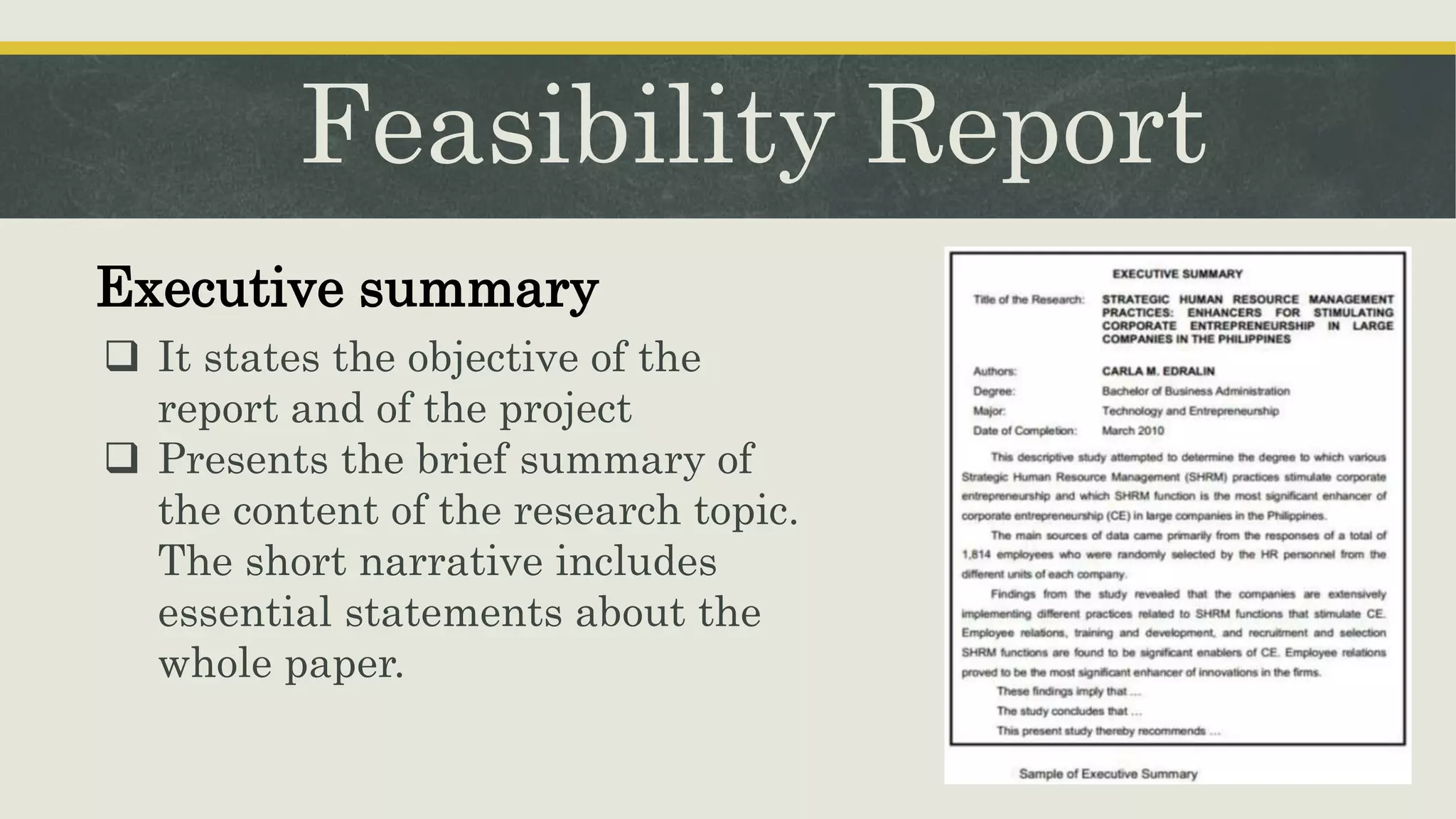
Executive summary
It states the objective of the
report and of the project
Presents the brief summary of
the content of the research topic.
The short narrative includes
essential statements about the
whole paper.
25.
Feasibility Report
Methodology
Itinvolves discussion on method of analysis
for feasibility stud
Should state the reliable sources you used and
what method they came from ( internet,
interview, book, etc.). Without a credible
research method or credible sources your
document itself will lack credibility.
26.
Feasibility Report
Overview ofAlternative Options
This part underlines the key features of each possible option.
Make sure they are easy to understand and presented in a
friendly layout. Keep in mind that the goal is to allow the
audience to make the best decision.
Classifies the different business processes for solving the
problems
This is where the advantages and disadvantages of the
alternatives are discussed.
The major possible alternatives should be discussed and
compared using clearly defined criteria.
27.
Feasibility Report
Evaluation
the“bulk” of the report. The author must
evaluate the options using the criteria he/she
created.
May include graphs, charts, etc. to show that
the options were studied, and have come up
with statistics that back up the reasons as to
why the alternative beats the competition.
28.
Feasibility Report
Conclusion
Discussesthe result of the comparisons of the
alternatives.
This is where the final conclusion is stated as
a result of a keen and careful evaluation.
The author will need to state the conclusion
he/she came up with
29.
Feasibility Report
Recommendation
Thefinal section of feasibility report
The recommendation section should echo the most
important conclusions leading to the
recommendation and then state the
recommendation emphatically.
One of the most important part of the Feasibility
Report. This is where the suggested solution is
intelligently laid.