




























Embed presentation
Downloaded 68 times


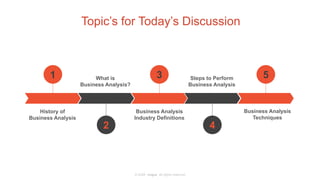
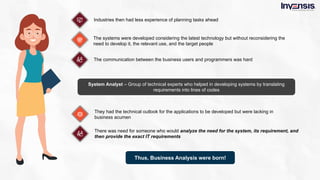
Business analysis has evolved over the last few decades from a technical role focused on system development into a core business function. It involves identifying business needs, problems, and opportunities in order to recommend relevant solutions. The field became prominent as businesses increasingly relied on technology but lacked experience planning IT projects. This led to costly, unusable systems. Business analysts bridge the gap between technical and business perspectives to define requirements that deliver value. The profession continues growing with demand for skills in process improvement, change management, and strategic planning.


Business Analysis has evolved into a core practice in the 21st century driven by IT needs. The role of business analysts emerged to enhance communication between users and programmers.
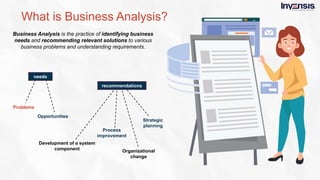
Business Analysis identifies needs and recommends solutions for business problems through analysis, logical thinking, and interpersonal skills.
Business Analysis is defined as enabling change by understanding needs and recommending solutions, per governing bodies like IIBA and PMI.
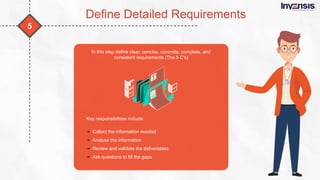
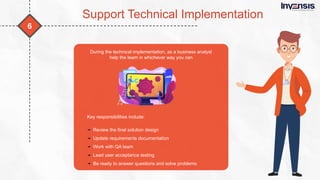
Detailed steps in Business Analysis include orientation, discovering objectives, defining scope, formulating plans, and implementation, ensuring clarity and stakeholder engagement.
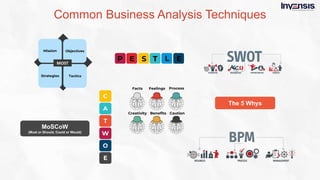
Common techniques in Business Analysis include MoSCoW prioritization and the 5 Whys method.
Growing demand for business analysts is evident with significant career opportunities available, supported by organizations like Invensis Learning.