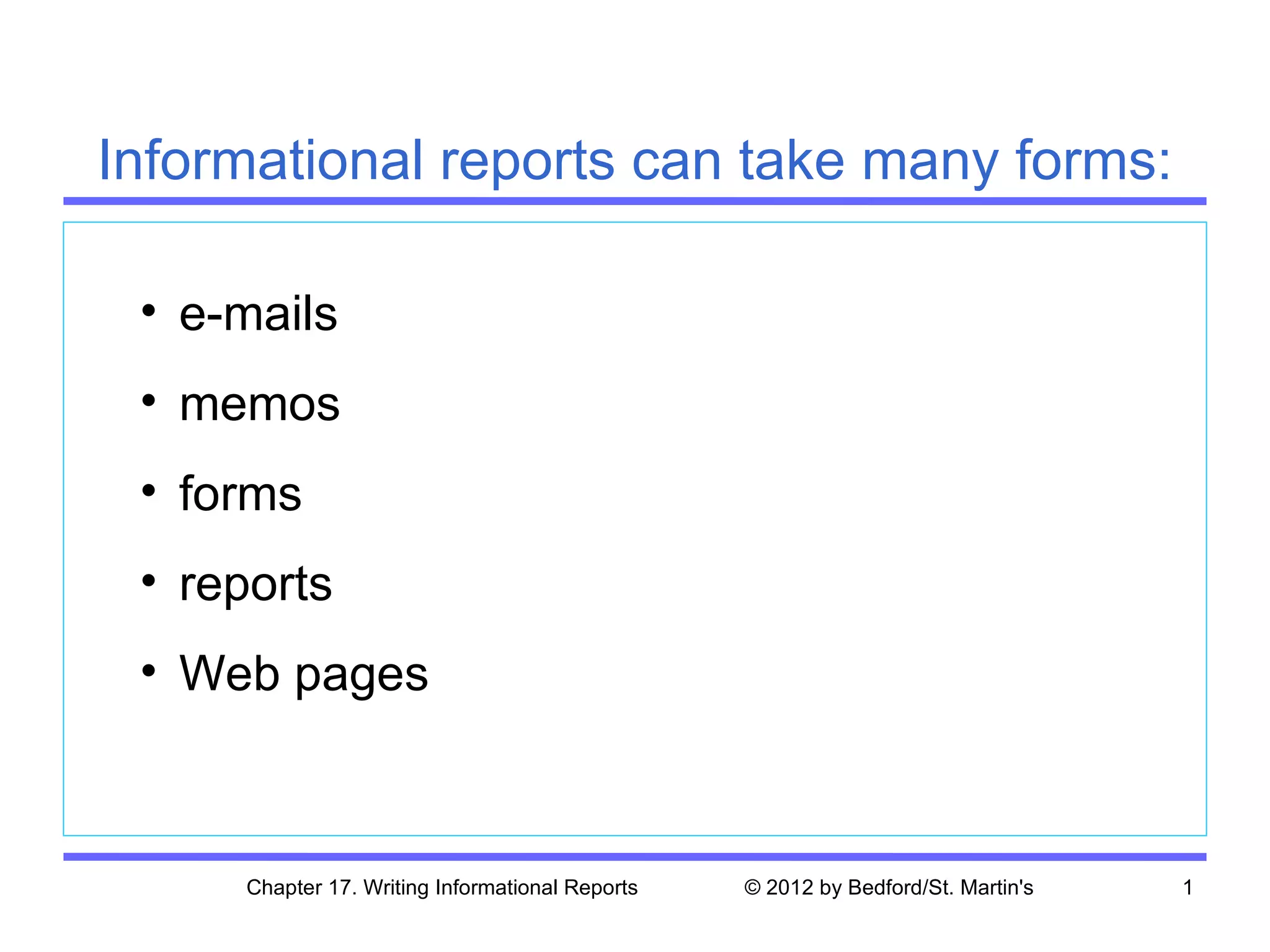
Informational reports can take many forms:

 • e-mails
 • memos
 • forms
 • reports
 • Web pages


     Chapter 17. Writing Informational Reports   © 2012 by Bedford/St. Martin's   1
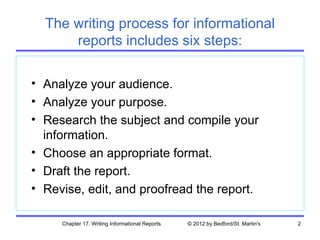
The writing process for informational
      reports includes six steps:

• Analyze your audience.
• Analyze your purpose.
• Research the subject and compile your
  information.
• Choose an appropriate format.
• Draft the report.
• Revise, edit, and proofread the report.

     Chapter 17. Writing Informational Reports   © 2012 by Bedford/St. Martin's   2
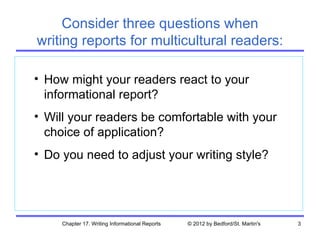
Consider three questions when
writing reports for multicultural readers:

• How might your readers react to your
  informational report?
• Will your readers be comfortable with your
  choice of application?
• Do you need to adjust your writing style?


     Chapter 17. Writing Informational Reports   © 2012 by Bedford/St. Martin's   3
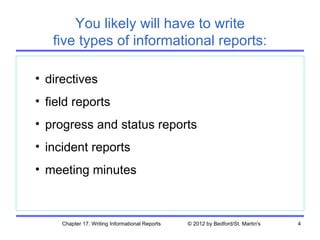
You likely will have to write
   five types of informational reports:

• directives
• field reports
• progress and status reports
• incident reports
• meeting minutes


     Chapter 17. Writing Informational Reports   © 2012 by Bedford/St. Martin's   4
Use this strategy when writing directives:
• Explain why the new policy is desirable or at
  least necessary.
• Present clear, compelling evidence.
• Consider opposing arguments effectively.
• Present yourself as cooperative, moderate,
  fair-minded, and modest.
• If appropriate, include arguments that appeal
  to readers’ broader goals of security, recogni-
  tion, professional growth, and connectedness.
     Chapter 17. Writing Informational Reports   © 2012 by Bedford/St. Martin's   5
Use this strategy when writing field reports:

 • Describe inspections, maintenance, and site
   studies.
 • Explain the problem, methods, results, and
   conclusions.
 • Deemphasize methods.
 • Include recommendations if needed.


      Chapter 17. Writing Informational Reports   © 2012 by Bedford/St. Martin's   6
Answer these six questions in a field report:

  • What is the purpose of the report?
  • What are the main points covered in the report?
  • What were the problems leading to the decision
    to perform the procedure?
  • What methods were used?
  • What were the results?
  • What do the results mean?

       Chapter 17. Writing Informational Reports   © 2012 by Bedford/St. Martin's   7
Understand the difference between
    a progress report and a status report:

• A progress report describes an ongoing project.
• A status report, or activity report, describes the
  entire range of operations of a department or
  division.


        Chapter 17. Writing Informational Reports   © 2012 by Bedford/St. Martin's   8
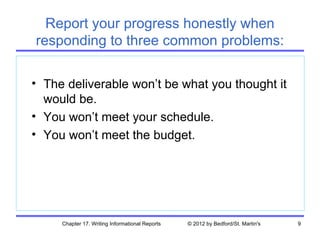
Report your progress honestly when
responding to three common problems:

• The deliverable won’t be what you thought it
  would be.
• You won’t meet your schedule.
• You won’t meet the budget.


     Chapter 17. Writing Informational Reports   © 2012 by Bedford/St. Martin's   9
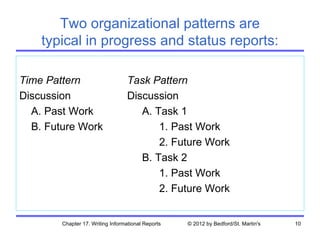
Two organizational patterns are
    typical in progress and status reports:

Time Pattern                       Task Pattern
Discussion                         Discussion
  A. Past Work                        A. Task 1
  B. Future Work                          1. Past Work
                                          2. Future Work
                                      B. Task 2
                                          1. Past Work
                                          2. Future Work


        Chapter 17. Writing Informational Reports   © 2012 by Bedford/St. Martin's   10
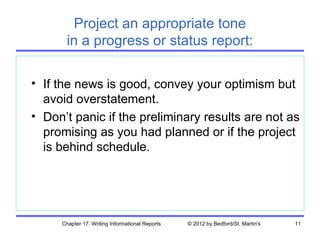
Project an appropriate tone
      in a progress or status report:

• If the news is good, convey your optimism but
  avoid overstatement.
• Don’t panic if the preliminary results are not as
  promising as you had planned or if the project
  is behind schedule.


     Chapter 17. Writing Informational Reports   © 2012 by Bedford/St. Martin's   11
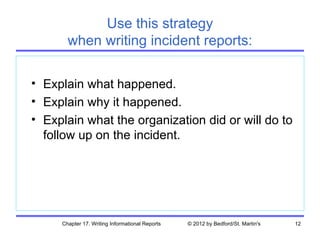
Use this strategy
       when writing incident reports:

• Explain what happened.
• Explain why it happened.
• Explain what the organization did or will do to
  follow up on the incident.


     Chapter 17. Writing Informational Reports   © 2012 by Bedford/St. Martin's   12
Use this strategy
     when writing meeting minutes:

• Be clear, comprehensive, objective, and
  diplomatic.
• Report the events of the meeting accurately.
• Do not record emotional exchanges between
  participants; the minutes should reflect
  positively on participants and the organization.


     Chapter 17. Writing Informational Reports   © 2012 by Bedford/St. Martin's   13

Ch17 slides

  • 1.
    Informational reports cantake many forms: • e-mails • memos • forms • reports • Web pages Chapter 17. Writing Informational Reports © 2012 by Bedford/St. Martin's 1
  • 2.
    The writing processfor informational reports includes six steps: • Analyze your audience. • Analyze your purpose. • Research the subject and compile your information. • Choose an appropriate format. • Draft the report. • Revise, edit, and proofread the report. Chapter 17. Writing Informational Reports © 2012 by Bedford/St. Martin's 2
  • 3.
    Consider three questionswhen writing reports for multicultural readers: • How might your readers react to your informational report? • Will your readers be comfortable with your choice of application? • Do you need to adjust your writing style? Chapter 17. Writing Informational Reports © 2012 by Bedford/St. Martin's 3
  • 4.
    You likely willhave to write five types of informational reports: • directives • field reports • progress and status reports • incident reports • meeting minutes Chapter 17. Writing Informational Reports © 2012 by Bedford/St. Martin's 4
  • 5.
    Use this strategywhen writing directives: • Explain why the new policy is desirable or at least necessary. • Present clear, compelling evidence. • Consider opposing arguments effectively. • Present yourself as cooperative, moderate, fair-minded, and modest. • If appropriate, include arguments that appeal to readers’ broader goals of security, recogni- tion, professional growth, and connectedness. Chapter 17. Writing Informational Reports © 2012 by Bedford/St. Martin's 5
  • 6.
    Use this strategywhen writing field reports: • Describe inspections, maintenance, and site studies. • Explain the problem, methods, results, and conclusions. • Deemphasize methods. • Include recommendations if needed. Chapter 17. Writing Informational Reports © 2012 by Bedford/St. Martin's 6
  • 7.
    Answer these sixquestions in a field report: • What is the purpose of the report? • What are the main points covered in the report? • What were the problems leading to the decision to perform the procedure? • What methods were used? • What were the results? • What do the results mean? Chapter 17. Writing Informational Reports © 2012 by Bedford/St. Martin's 7
  • 8.
    Understand the differencebetween a progress report and a status report: • A progress report describes an ongoing project. • A status report, or activity report, describes the entire range of operations of a department or division. Chapter 17. Writing Informational Reports © 2012 by Bedford/St. Martin's 8
  • 9.
    Report your progresshonestly when responding to three common problems: • The deliverable won’t be what you thought it would be. • You won’t meet your schedule. • You won’t meet the budget. Chapter 17. Writing Informational Reports © 2012 by Bedford/St. Martin's 9
  • 10.
    Two organizational patternsare typical in progress and status reports: Time Pattern Task Pattern Discussion Discussion A. Past Work A. Task 1 B. Future Work 1. Past Work 2. Future Work B. Task 2 1. Past Work 2. Future Work Chapter 17. Writing Informational Reports © 2012 by Bedford/St. Martin's 10
  • 11.
    Project an appropriatetone in a progress or status report: • If the news is good, convey your optimism but avoid overstatement. • Don’t panic if the preliminary results are not as promising as you had planned or if the project is behind schedule. Chapter 17. Writing Informational Reports © 2012 by Bedford/St. Martin's 11
  • 12.
    Use this strategy when writing incident reports: • Explain what happened. • Explain why it happened. • Explain what the organization did or will do to follow up on the incident. Chapter 17. Writing Informational Reports © 2012 by Bedford/St. Martin's 12
  • 13.
    Use this strategy when writing meeting minutes: • Be clear, comprehensive, objective, and diplomatic. • Report the events of the meeting accurately. • Do not record emotional exchanges between participants; the minutes should reflect positively on participants and the organization. Chapter 17. Writing Informational Reports © 2012 by Bedford/St. Martin's 13