Presnted BY;
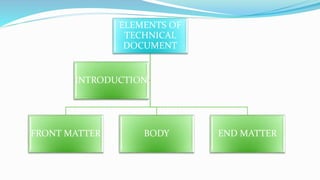
ELEMENTS OF
TECHNICAL
DOCUMENT
FRONT MATTER BODY END MATTER
INTRODUCTION
INTRODUCTION:
 Technical documentation is a generic term for the classes of information
created to describe (in technical language) the use, functionality or
architecture of a product, system or service.
 All technical documents are structured in a similar way. They consist of the same
elements that help technical writers organize their documents in a clear
manner.
 Technical documents include memos, graphics, letters, fliers, reports,
newsletters, presentations, web pages, brochures, proposals, instructions,
reviews, press releases, catalogs, advertisements, handbooks, business plans,
policies and procedures, specifications, instructions, style guides, agendas and
so forth.
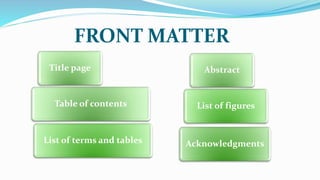
Acknowledgments
List of figures
Title page Abstract
List of terms and tables
Table of contents
FRONT MATTER
Front Matter
Front matter is the most important part of the technical document. It introduces readers into the title of
the document, its author, the topic described, the issue solved, the method used, and the overall purpose
of the document.
 Front Matter of any technical document must include the following elements:
 Title page
 It should include the title, the author and the date. Title should be both clear and detailed
enough, so that readers could easily grasp the idea of what is covered. For example, the title
“SOLAR SYSTEM CHARGING” fails to deliver the idea of what’s the document is going to be
about, how these two categories are interconnected, what is the problem to be solved. So the
improved version of this title could be “BEST WAY TO CHARGE SOALR PANEL”.
 Abstract
 is a summarizing statement. It should neither be too short, nor too long. About 70–150 words is
usually enough. Abstract should contain general information about the topic or issue, methods
used, main results, and conclusions of your document. Its content should be clear and
straightforward
 Table of contents is a list of the subject headings and subheadings of the
document.
It is usually provided in long documents such as reports, proposals, and other
administrative and research documents. Your table of contents should be
properly done, so that readers can easily navigate through the document.
 List of figures. Numerous research suggest that nowadays people prefer visual
content to a text because charts, pictures allow readers to quickly get the idea.
Visual content is important in technical documentation. Create a list of figures
in order to organize the visuals and make them easier to navigate.
 List of tables contains all tables of your document. Make sure not to mix tables
and figures in the same list.
 List of terms
 Every document contains terminology, acronyms and abbreviations
specific to the particular field of knowledge or topic described. Some of
these words may confuse even the most knowledgeable readers. That’s
why a list of terms is essential in any technical document.
 Acknowledgment
 This part of your document should include names of your colleagues,
other fellow technical writers and programmers who assisted the
development of the document.
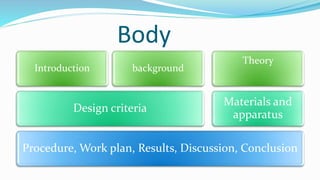
Body
Procedure, Work plan, Results, Discussion, Conclusion
Design criteria
Introduction background
Materials and
apparatus
Theory
Body
The body of a document consists of all material necessary for the document to fulfil
its explicit and implicit goals of informing or convincing the reader, establishing trust,
and documenting actions or procedures.
 Introduction
 Introduction presents the main goal and what to expect further in
document. Introduction shouldn’t be confused with abstract. Introduction contains the subject
of your document, the issue resolved, the purpose and its scope.
 Background
 Background information should be relevant. Usually, this part includes the
history of the problem, a summary of previous research and reasons why you decided to write
this document.
 Theory
 If the document is comparatively long, you should develop a separate section named
“theory” that describes all the formulae and techniques used.
 Design criteria.
 This section includes proposals, feasibility reports,
recommendation reports with the possible design of a product.
 Materials and apparatus.
 If your document explains, for example, some
sort of experiment, you should describe software and hardware used.
 Procedure.
 Describe all methods that you used for gathering data.
 Work plan.
 This part is usually includes personnel who participated in the
project, equipment, budget and so on.
 Result
 . Sum up the data of the whole project in this part. It can include charts
and figures to visualize your results in an effective manner.
 Discussion.
 The discussion section is about commenting results. In small
documents results and the discussion part can be combined into one section.
 Conclusion.
 Sometimes readers, particularly managers, don’t read the
whole document to save time. So you need to provide a summary of the main
results and other key points of the document.
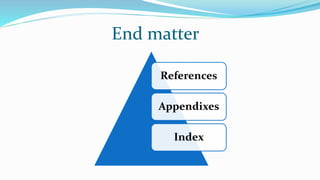
References
Appendixes
Index
End matter
End matter
end matter provides useful information and materials outside the main
body. This end part consists of:
References
 A list of sources that you’ve used.
 Appendixes
 usually include materials that are not essential parts of the text
like additional diagrams, tables, lists, etc.
 Index
 Develop an index wisely because it should be helpful for your audience. Add to
your index important subject, topics, proper names.

Important points to ponder
While writing, keep in mind that not everyone of the
potential readers may be familiar with the topic
described, so make sure to follow the structure and
keep your writing clear. Stick to the points above and
your document will be easy-to-interpret and, as a
result, helpful for the target audience.
Elements of technical document

Elements of technical document

  • 1.
  • 2.
    ELEMENTS OF TECHNICAL DOCUMENT FRONT MATTERBODY END MATTER INTRODUCTION
  • 3.
    INTRODUCTION:  Technical documentationis a generic term for the classes of information created to describe (in technical language) the use, functionality or architecture of a product, system or service.  All technical documents are structured in a similar way. They consist of the same elements that help technical writers organize their documents in a clear manner.  Technical documents include memos, graphics, letters, fliers, reports, newsletters, presentations, web pages, brochures, proposals, instructions, reviews, press releases, catalogs, advertisements, handbooks, business plans, policies and procedures, specifications, instructions, style guides, agendas and so forth.
  • 4.
    Acknowledgments List of figures Titlepage Abstract List of terms and tables Table of contents FRONT MATTER
  • 5.
    Front Matter Front matteris the most important part of the technical document. It introduces readers into the title of the document, its author, the topic described, the issue solved, the method used, and the overall purpose of the document.  Front Matter of any technical document must include the following elements:  Title page  It should include the title, the author and the date. Title should be both clear and detailed enough, so that readers could easily grasp the idea of what is covered. For example, the title “SOLAR SYSTEM CHARGING” fails to deliver the idea of what’s the document is going to be about, how these two categories are interconnected, what is the problem to be solved. So the improved version of this title could be “BEST WAY TO CHARGE SOALR PANEL”.  Abstract  is a summarizing statement. It should neither be too short, nor too long. About 70–150 words is usually enough. Abstract should contain general information about the topic or issue, methods used, main results, and conclusions of your document. Its content should be clear and straightforward
  • 6.
     Table ofcontents is a list of the subject headings and subheadings of the document. It is usually provided in long documents such as reports, proposals, and other administrative and research documents. Your table of contents should be properly done, so that readers can easily navigate through the document.  List of figures. Numerous research suggest that nowadays people prefer visual content to a text because charts, pictures allow readers to quickly get the idea. Visual content is important in technical documentation. Create a list of figures in order to organize the visuals and make them easier to navigate.  List of tables contains all tables of your document. Make sure not to mix tables and figures in the same list.
  • 7.
     List ofterms  Every document contains terminology, acronyms and abbreviations specific to the particular field of knowledge or topic described. Some of these words may confuse even the most knowledgeable readers. That’s why a list of terms is essential in any technical document.  Acknowledgment  This part of your document should include names of your colleagues, other fellow technical writers and programmers who assisted the development of the document.
  • 8.
    Body Procedure, Work plan,Results, Discussion, Conclusion Design criteria Introduction background Materials and apparatus Theory
  • 9.
    Body The body ofa document consists of all material necessary for the document to fulfil its explicit and implicit goals of informing or convincing the reader, establishing trust, and documenting actions or procedures.  Introduction  Introduction presents the main goal and what to expect further in document. Introduction shouldn’t be confused with abstract. Introduction contains the subject of your document, the issue resolved, the purpose and its scope.  Background  Background information should be relevant. Usually, this part includes the history of the problem, a summary of previous research and reasons why you decided to write this document.  Theory  If the document is comparatively long, you should develop a separate section named “theory” that describes all the formulae and techniques used.
  • 10.
     Design criteria. This section includes proposals, feasibility reports, recommendation reports with the possible design of a product.  Materials and apparatus.  If your document explains, for example, some sort of experiment, you should describe software and hardware used.  Procedure.  Describe all methods that you used for gathering data.  Work plan.  This part is usually includes personnel who participated in the project, equipment, budget and so on.
  • 11.
     Result  .Sum up the data of the whole project in this part. It can include charts and figures to visualize your results in an effective manner.  Discussion.  The discussion section is about commenting results. In small documents results and the discussion part can be combined into one section.  Conclusion.  Sometimes readers, particularly managers, don’t read the whole document to save time. So you need to provide a summary of the main results and other key points of the document.
  • 12.
  • 13.
    End matter end matterprovides useful information and materials outside the main body. This end part consists of: References  A list of sources that you’ve used.  Appendixes  usually include materials that are not essential parts of the text like additional diagrams, tables, lists, etc.  Index  Develop an index wisely because it should be helpful for your audience. Add to your index important subject, topics, proper names. 
  • 14.
    Important points toponder While writing, keep in mind that not everyone of the potential readers may be familiar with the topic described, so make sure to follow the structure and keep your writing clear. Stick to the points above and your document will be easy-to-interpret and, as a result, helpful for the target audience.