Shares
• Share means share in the share capital of the company
• Share is the interest of a shareholder in a company
• The capital of the company is divided into certain indivisible
units of a fixed amount, these units are share
• A share is evidenced by a share certificate (now
dematerialised shares). It is issued under its common seal, it
specifies the shares held by a member and prima facie
evidence of the title of the member to the shares
• Each share is distinguished by appropriate number
• It is movable property, transferable in the manner provided by
the articles of the company
Stock
• Stock is the aggregate of fully paid up shares, consolidated and
divided, for the purpose of convenient holding into different parts
• Difference between stock and shares
1) A share has a nominal value (per unit value), whereas stock
has no value
2) Stock is always fully paid shares, shares may not be so
3) Stock is transferable in small fractions while shares can be
transferred in round numbers
4) All shares have of equal denomination, stock may be of
unequal amounts
5) The fractions or parts of stock do not bear distinctive numbers
while shares always bear distinctive numbers
6) Shares can be issued directly issued to public but stock
cannot be directly issued to public. Only fully paid shares can
be converted to stock
Types of Share Capital
• Authorized Capital
• Issued capital
• Subscribed Capital
Types of Shares
• Two types of shares can be issued by a company
– Preference shares
– Equity shares
• Preference share are shares which has 2 characteristics
– Preferential rights to dividend during lifetime of the company
– Preferential rights to return of capital when company goes into
liquidation (closure)
• Equity shares means shares which are not preference shares
• ‘Sweat equity shares means equity shares issued at a
discount or for consideration other than cash, for providing
know-how or making available rights in the nature of
intellectual property rights or value additions
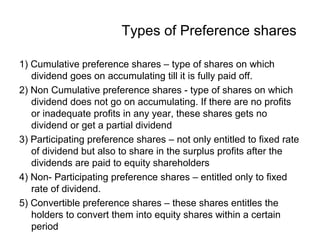
Types of Preference shares
1) Cumulative preference shares – type of shares on which
dividend goes on accumulating till it is fully paid off.
2) Non Cumulative preference shares - type of shares on which
dividend does not go on accumulating. If there are no profits
or inadequate profits in any year, these shares gets no
dividend or get a partial dividend
3) Participating preference shares – not only entitled to fixed rate
of dividend but also to share in the surplus profits after the
dividends are paid to equity shareholders
4) Non- Participating preference shares – entitled only to fixed
rate of dividend.
5) Convertible preference shares – these shares entitles the
holders to convert them into equity shares within a certain
period
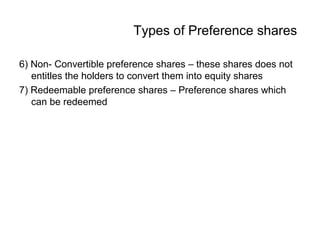
Types of Preference shares
6) Non- Convertible preference shares – these shares does not
entitles the holders to convert them into equity shares
7) Redeemable preference shares – Preference shares which
can be redeemed
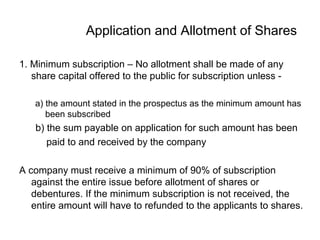
Application and Allotment of Shares
1. Minimum subscription – No allotment shall be made of any
share capital offered to the public for subscription unless -
a) the amount stated in the prospectus as the minimum amount has
been subscribed
b) the sum payable on application for such amount has been
paid to and received by the company
A company must receive a minimum of 90% of subscription
against the entire issue before allotment of shares or
debentures. If the minimum subscription is not received, the
entire amount will have to refunded to the applicants to shares.
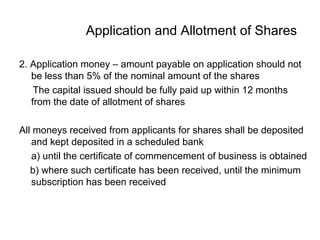
Application and Allotment of Shares
2. Application money – amount payable on application should not
be less than 5% of the nominal amount of the shares
The capital issued should be fully paid up within 12 months
from the date of allotment of shares
All moneys received from applicants for shares shall be deposited
and kept deposited in a scheduled bank
a) until the certificate of commencement of business is obtained
b) where such certificate has been received, until the minimum
subscription has been received
Transfer of Shares
Section 108 to 112 deals with transfer of shares, provisions are
given below
• Transfer not be registered except on production of transfer
deed
• Every transfer deed shall be in the prescribed form
• Period of delivery of transfer deed before the date on which
the register of members is closed
• Transfer by legal representative of deceased member is valid
• Application for registration of shares of a company may be
made either by the transferor or by the transferee
• Companies should give reasons before they refuse transfer of
shares
Forged Shares / Blank Transfer
• An instrument of shares on which the signature of the
transferor is forged is called a forged instrument and any
transfer happens on the forged instrument is forged transfer
• A forged transfer is a nullity. It does not pass any legal title to
the transferee
• Blank transfer is a transfer of shares which is executed
without the name of the transferee filled in the transfer form,
which a transferor hands over to a purchaser. The transferor
also hands over the share certificate to the buyer along with
the blank transfer form. The transferor fills in his name and
signs it.

Business law 15

  • 1.
    Shares • Share meansshare in the share capital of the company • Share is the interest of a shareholder in a company • The capital of the company is divided into certain indivisible units of a fixed amount, these units are share • A share is evidenced by a share certificate (now dematerialised shares). It is issued under its common seal, it specifies the shares held by a member and prima facie evidence of the title of the member to the shares • Each share is distinguished by appropriate number • It is movable property, transferable in the manner provided by the articles of the company
  • 2.
    Stock • Stock isthe aggregate of fully paid up shares, consolidated and divided, for the purpose of convenient holding into different parts • Difference between stock and shares 1) A share has a nominal value (per unit value), whereas stock has no value 2) Stock is always fully paid shares, shares may not be so 3) Stock is transferable in small fractions while shares can be transferred in round numbers 4) All shares have of equal denomination, stock may be of unequal amounts 5) The fractions or parts of stock do not bear distinctive numbers while shares always bear distinctive numbers 6) Shares can be issued directly issued to public but stock cannot be directly issued to public. Only fully paid shares can be converted to stock
  • 3.
    Types of ShareCapital • Authorized Capital • Issued capital • Subscribed Capital
  • 4.
    Types of Shares •Two types of shares can be issued by a company – Preference shares – Equity shares • Preference share are shares which has 2 characteristics – Preferential rights to dividend during lifetime of the company – Preferential rights to return of capital when company goes into liquidation (closure) • Equity shares means shares which are not preference shares • ‘Sweat equity shares means equity shares issued at a discount or for consideration other than cash, for providing know-how or making available rights in the nature of intellectual property rights or value additions
  • 5.
    Types of Preferenceshares 1) Cumulative preference shares – type of shares on which dividend goes on accumulating till it is fully paid off. 2) Non Cumulative preference shares - type of shares on which dividend does not go on accumulating. If there are no profits or inadequate profits in any year, these shares gets no dividend or get a partial dividend 3) Participating preference shares – not only entitled to fixed rate of dividend but also to share in the surplus profits after the dividends are paid to equity shareholders 4) Non- Participating preference shares – entitled only to fixed rate of dividend. 5) Convertible preference shares – these shares entitles the holders to convert them into equity shares within a certain period
  • 6.
    Types of Preferenceshares 6) Non- Convertible preference shares – these shares does not entitles the holders to convert them into equity shares 7) Redeemable preference shares – Preference shares which can be redeemed
  • 7.
    Application and Allotmentof Shares 1. Minimum subscription – No allotment shall be made of any share capital offered to the public for subscription unless - a) the amount stated in the prospectus as the minimum amount has been subscribed b) the sum payable on application for such amount has been paid to and received by the company A company must receive a minimum of 90% of subscription against the entire issue before allotment of shares or debentures. If the minimum subscription is not received, the entire amount will have to refunded to the applicants to shares.
  • 8.
    Application and Allotmentof Shares 2. Application money – amount payable on application should not be less than 5% of the nominal amount of the shares The capital issued should be fully paid up within 12 months from the date of allotment of shares All moneys received from applicants for shares shall be deposited and kept deposited in a scheduled bank a) until the certificate of commencement of business is obtained b) where such certificate has been received, until the minimum subscription has been received
  • 9.
    Transfer of Shares Section108 to 112 deals with transfer of shares, provisions are given below • Transfer not be registered except on production of transfer deed • Every transfer deed shall be in the prescribed form • Period of delivery of transfer deed before the date on which the register of members is closed • Transfer by legal representative of deceased member is valid • Application for registration of shares of a company may be made either by the transferor or by the transferee • Companies should give reasons before they refuse transfer of shares
  • 10.
    Forged Shares /Blank Transfer • An instrument of shares on which the signature of the transferor is forged is called a forged instrument and any transfer happens on the forged instrument is forged transfer • A forged transfer is a nullity. It does not pass any legal title to the transferee • Blank transfer is a transfer of shares which is executed without the name of the transferee filled in the transfer form, which a transferor hands over to a purchaser. The transferor also hands over the share certificate to the buyer along with the blank transfer form. The transferor fills in his name and signs it.