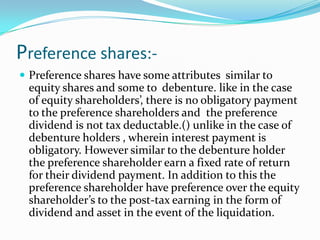
Preference shares:-Preference shares have some attributes  similar to equity shares and some to  debenture. like in the case of equity shareholders’, there is no obligatory payment to the preference shareholders and  the preference dividend is not tax deductable.() unlike in the case of debenture holders , wherein interest payment is obligatory. However similar to the debenture holder the preference shareholder earn a fixed rate of return for their dividend payment. In addition to this the preference shareholder have preference over the equity shareholder’s to the post-tax earning in the form of dividend and asset in the event of the liquidation.
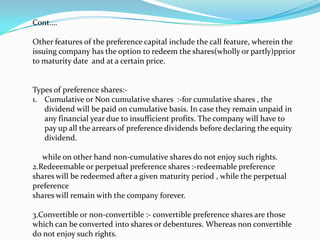
Cont….Other features of the preference capital include the call feature, wherein the issuing company has the option to redeem the shares(wholly or partly)pprior to maturity date  and at a certain price.Types of preference shares:-Cumulative or Non cumulative shares  :-for cumulative shares , the dividend will be paid on cumulative basis. In case they remain unpaid in any financial year due to insufficient profits. The company will have to pay up all the arrears of preference dividends before declaring the equity  dividend.     while on other hand non-cumulative shares do not enjoy such rights.2.Redeeemable or perpetual preference shares :-redeemable preference shares will be redeemed after a given maturity period , while the perpetual preference shares will remain with the company forever.3.Convertible or non-convertible :- convertible preference shares are those which can be converted into shares or debentures. Whereas non convertible do not enjoy such rights.
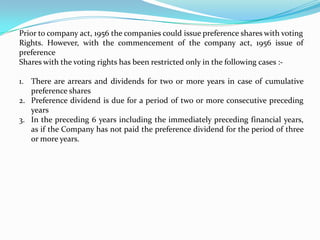
Prior to company act, 1956 the companies could issue preference shares with voting Rights. However, with the commencement of the company act, 1956 issue of preference Shares with the voting rights has been restricted only in the following cases :-There are arrears and dividends for two or more years in case of cumulative preference sharesPreference dividend is due for a period of two or more consecutive preceding years In the preceding 6 years including the immediately preceding financial years, as if the Company has not paid the preference dividend for the period of three or more years.
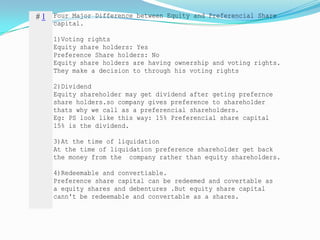
Preference+Shares

Preference+Shares

  • 1.
    Preference shares:-Preference shareshave some attributes similar to equity shares and some to debenture. like in the case of equity shareholders’, there is no obligatory payment to the preference shareholders and the preference dividend is not tax deductable.() unlike in the case of debenture holders , wherein interest payment is obligatory. However similar to the debenture holder the preference shareholder earn a fixed rate of return for their dividend payment. In addition to this the preference shareholder have preference over the equity shareholder’s to the post-tax earning in the form of dividend and asset in the event of the liquidation.
  • 2.
    Cont….Other features ofthe preference capital include the call feature, wherein the issuing company has the option to redeem the shares(wholly or partly)pprior to maturity date and at a certain price.Types of preference shares:-Cumulative or Non cumulative shares :-for cumulative shares , the dividend will be paid on cumulative basis. In case they remain unpaid in any financial year due to insufficient profits. The company will have to pay up all the arrears of preference dividends before declaring the equity dividend. while on other hand non-cumulative shares do not enjoy such rights.2.Redeeemable or perpetual preference shares :-redeemable preference shares will be redeemed after a given maturity period , while the perpetual preference shares will remain with the company forever.3.Convertible or non-convertible :- convertible preference shares are those which can be converted into shares or debentures. Whereas non convertible do not enjoy such rights.
  • 3.
    Prior to companyact, 1956 the companies could issue preference shares with voting Rights. However, with the commencement of the company act, 1956 issue of preference Shares with the voting rights has been restricted only in the following cases :-There are arrears and dividends for two or more years in case of cumulative preference sharesPreference dividend is due for a period of two or more consecutive preceding years In the preceding 6 years including the immediately preceding financial years, as if the Company has not paid the preference dividend for the period of three or more years.