Welcome
Classes of Shares;
Preference shares
Equity shares
A share is defined as, “a share in the share
capital of the company and includes stock”
 Share capital of the company is collected by issue
of shares.
 Share is one of the units into which total capital is
divided.
 The person who owns the share is called
shareholder.
 Preference Shares
1. It offers a fixed rate of dividend.
2. Right to get capital on winding up, before anything is
paid to equity shareholders.
 Equity or Ordinary Share
1. These shares have voting rights.
2. It doesn’t offer a fixed rate of return.
3. They are not entitled to get capital on winding up,
before paying to preference shareholders.
1. Cumulative Preference Shares
 Fixed rate of dividend is guaranteed.
 At the time of inadequate profit, they will not loss
anything.
 Arrear will get in subsequent years.
2. Non-Cumulative Preference Shares
 Fixed rate of dividend is guaranteed.
 At the time of inadequate profit, they will not get
anything.
3. Participating Preference Shares
 Fixed rate of dividend is guaranteed.
 Entitled to share the surplus profit.
4. Non-Participating Preference Shares
 Fixed rate of dividend is guaranteed.
 Does not share the surplus profit.
5. Redeemable Preference Shares
 Shares which a company may repay after a fixed
period of time or earlier.
6. Irredeemable Preference Shares
 It do not carry the arrangement for redemption.
 Shares are repayable only at winding up.
7. Convertible Preference Shares
 It can be converted into Equity shares within a
certain period.
8. Non-Convertible Preference Shares
 It cannot be converted into Equity shares.
It is a share, which is not a preference share
is called equity share.
 The whole of the profit of a company is entitled to
these shareholders, after paying a fixed dividend to
preference shareholders.
 They doesn't get a fixed rate of dividend.
 They will get back their capital only after paying
preference share holders.
 It is issued to employees or directors of a
company at discounted rate.
 Issued for consideration other than cash.
It must follow these conditions;
1. Authorised by special resolution in general meeting.
2. Number, price, consideration (if any) and classes
should be specified in the resolution.
3. The company must complete one year.
4. Equity shares of those company must be listed in
recognised stock exchange.
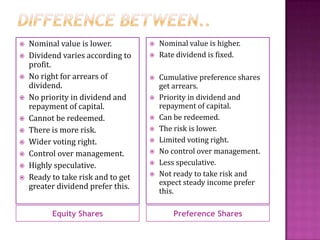
Equity Shares Preference Shares
 Nominal value is lower.
 Dividend varies according to
profit.
 No right for arrears of
dividend.
 No priority in dividend and
repayment of capital.
 Cannot be redeemed.
 There is more risk.
 Wider voting right.
 Control over management.
 Highly speculative.
 Ready to take risk and to get
greater dividend prefer this.
 Nominal value is higher.
 Rate dividend is fixed.
 Cumulative preference shares
get arrears.
 Priority in dividend and
repayment of capital.
 Can be redeemed.
 The risk is lower.
 Limited voting right.
 No control over management.
 Less speculative.
 Not ready to take risk and
expect steady income prefer
this.
Shares and its types

Shares and its types

  • 1.
  • 2.
    Classes of Shares; Preferenceshares Equity shares
  • 3.
    A share isdefined as, “a share in the share capital of the company and includes stock”  Share capital of the company is collected by issue of shares.  Share is one of the units into which total capital is divided.  The person who owns the share is called shareholder.
  • 4.
     Preference Shares 1.It offers a fixed rate of dividend. 2. Right to get capital on winding up, before anything is paid to equity shareholders.  Equity or Ordinary Share 1. These shares have voting rights. 2. It doesn’t offer a fixed rate of return. 3. They are not entitled to get capital on winding up, before paying to preference shareholders.
  • 5.
    1. Cumulative PreferenceShares  Fixed rate of dividend is guaranteed.  At the time of inadequate profit, they will not loss anything.  Arrear will get in subsequent years. 2. Non-Cumulative Preference Shares  Fixed rate of dividend is guaranteed.  At the time of inadequate profit, they will not get anything.
  • 6.
    3. Participating PreferenceShares  Fixed rate of dividend is guaranteed.  Entitled to share the surplus profit. 4. Non-Participating Preference Shares  Fixed rate of dividend is guaranteed.  Does not share the surplus profit. 5. Redeemable Preference Shares  Shares which a company may repay after a fixed period of time or earlier. 6. Irredeemable Preference Shares  It do not carry the arrangement for redemption.  Shares are repayable only at winding up.
  • 7.
    7. Convertible PreferenceShares  It can be converted into Equity shares within a certain period. 8. Non-Convertible Preference Shares  It cannot be converted into Equity shares.
  • 8.
    It is ashare, which is not a preference share is called equity share.  The whole of the profit of a company is entitled to these shareholders, after paying a fixed dividend to preference shareholders.  They doesn't get a fixed rate of dividend.  They will get back their capital only after paying preference share holders.
  • 9.
     It isissued to employees or directors of a company at discounted rate.  Issued for consideration other than cash. It must follow these conditions; 1. Authorised by special resolution in general meeting. 2. Number, price, consideration (if any) and classes should be specified in the resolution. 3. The company must complete one year. 4. Equity shares of those company must be listed in recognised stock exchange.
  • 10.
    Equity Shares PreferenceShares  Nominal value is lower.  Dividend varies according to profit.  No right for arrears of dividend.  No priority in dividend and repayment of capital.  Cannot be redeemed.  There is more risk.  Wider voting right.  Control over management.  Highly speculative.  Ready to take risk and to get greater dividend prefer this.  Nominal value is higher.  Rate dividend is fixed.  Cumulative preference shares get arrears.  Priority in dividend and repayment of capital.  Can be redeemed.  The risk is lower.  Limited voting right.  No control over management.  Less speculative.  Not ready to take risk and expect steady income prefer this.

Editor's Notes