







KEVAL GOYNI
 “Equity shareholder are owner of the business.
they enjoy the residual profit of company after
having paid the preference shareholders the
amount of preference dividend”
 Equity share also known as variable income
security.
 1. Right to income
 The equity income left after satisfying the claim of all other
investor belongs to the equity shareholders.

 The income of equity shareholders may be retained by the firm
or paid our as dividends.
 2 . Right to control
 As a owner of the firm so elect the board of directors & have
the right to vote on every resolution placed before the company.
 Hence equity shareholders exercise an indirect control over the
operation of firm.
 3 . Pre- Emptive Right
 The pre-emptive right enables existing shareholders to
maintain their proportional owner ship by purchasing the
additional equity shares issued by company.
 According to law, existing shareholders have first priority
to purchase additional share on pro rata basis before the
others.
 Ex: company -10,00,000 share
additional -300,000 share(30% share purchase
shareholders give first priority)
 4 . Right in liquidation
 As in case of income , equity shareholders have a residual
claim over assets of firm in the event of liquidation claim of
all other – debenture holders ;lenders, other creditors &
preference shareholders are prior to the claim of equity
shareholders.
 Merits:
1 . Permanent capital : it’s available as long as the company
goes , because equity shares are not redeemable.
2 . No obligation to pay dividend : equity share no obligation
on the company to pay a fixed dividend to the equity
shareholders. They get dividend if adequate profit are
available.
3 . No charge on property : company is able to procure capital
without creating charge on its property ,which remains free &
can be utilized when additional funds are required by the
company.
4 . Wide scope of marketability : equity shares are lower
denominations, hence they can be purchased by persons of
limited income also.
 Evaluation from the viewpoint of company:
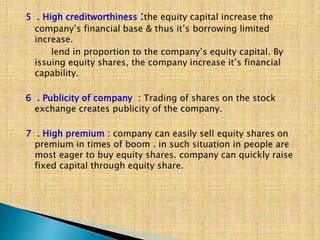
5 . High creditworthiness :the equity capital increase the
company’s financial base & thus it’s borrowing limited
increase.
lend in proportion to the company’s equity capital. By
issuing equity shares, the company increase it’s financial
capability.
6 . Publicity of company : Trading of shares on the stock
exchange creates publicity of the company.
7 . High premium : company can easily sell equity shares on
premium in times of boom . in such situation in people are
most eager to buy equity shares. company can quickly raise
fixed capital through equity share.
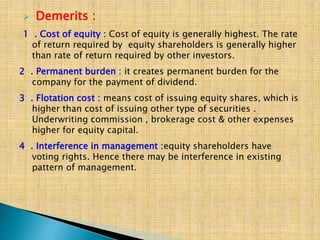
 Demerits :
1 . Cost of equity : Cost of equity is generally highest. The rate
of return required by equity shareholders is generally higher
than rate of return required by other investors.
2 . Permanent burden : it creates permanent burden for the
company for the payment of dividend.
3 . Flotation cost : means cost of issuing equity shares, which is
higher than cost of issuing other type of securities .
Underwriting commission , brokerage cost & other expenses
higher for equity capital.
4 . Interference in management :equity shareholders have
voting rights. Hence there may be interference in existing
pattern of management.
5 . Speculation : there are the higher chances of speculation
because it is traded in stock market.
6 . Dividend is not tax deductible :equity share dividend is not
tax deductible payment
7 . Dilution of control : Sale of equity shares to outsiders may
result in dilution of control of existing shareholders
 Evaluation from the view point of investor:
 Merits:
1 . Higher dividend : the equity shareholders earned more profit
compare to others during prosperous time.
2 . Voting right :shareholders can participate in management . they
can vote for election of director & auditor, approval of dividend
recommended by director.
3 . Right shares : an existing company has to offer the new issue of its
share to existing shareholders as right shares on priority basis.
4 . Capital appreciation : equity holders can earn capital gain by
selling shares when price of the share increases.
5 . Good liquidity position : The liquidity position of equity
shareholders is improved because these shares are freely traded in
all national level stock exchange.
 Demerits :
1 . Uncertain return : no fixed rate of dividend is to be paid to
equity shareholders. Only directors have the authority to
decide whether to declare dividend or not.
2 . Residual claim on income as well as assets : equity
shareholder have last priority on income as well as assets
after satisfying claim of other
3 . Low market value : when low dividend are declared or
postpone the dividend the market value of equity share
decline & investors suffer a capital loss.
4 . Risk investment : equity prices tend to fluctuate widely, so
making equity investment risky .
5 .Higher speculation : during boom phase of stock
market, equity shares may encourage too much
speculation.
6 . Dilution of control : the issue of new equity shares
may dilute the ownership & control of existing
shareholders while a preemptive right to retain their
proportionate ownership; they may not have funds to
invest in additional shares.
Equity share

Equity share

  • 1.
  • 3.
     “Equity shareholderare owner of the business. they enjoy the residual profit of company after having paid the preference shareholders the amount of preference dividend”  Equity share also known as variable income security.
  • 4.
     1. Rightto income  The equity income left after satisfying the claim of all other investor belongs to the equity shareholders.   The income of equity shareholders may be retained by the firm or paid our as dividends.  2 . Right to control  As a owner of the firm so elect the board of directors & have the right to vote on every resolution placed before the company.  Hence equity shareholders exercise an indirect control over the operation of firm.
  • 5.
     3 .Pre- Emptive Right  The pre-emptive right enables existing shareholders to maintain their proportional owner ship by purchasing the additional equity shares issued by company.  According to law, existing shareholders have first priority to purchase additional share on pro rata basis before the others.  Ex: company -10,00,000 share additional -300,000 share(30% share purchase shareholders give first priority)  4 . Right in liquidation  As in case of income , equity shareholders have a residual claim over assets of firm in the event of liquidation claim of all other – debenture holders ;lenders, other creditors & preference shareholders are prior to the claim of equity shareholders.
  • 6.
     Merits: 1 .Permanent capital : it’s available as long as the company goes , because equity shares are not redeemable. 2 . No obligation to pay dividend : equity share no obligation on the company to pay a fixed dividend to the equity shareholders. They get dividend if adequate profit are available. 3 . No charge on property : company is able to procure capital without creating charge on its property ,which remains free & can be utilized when additional funds are required by the company. 4 . Wide scope of marketability : equity shares are lower denominations, hence they can be purchased by persons of limited income also.  Evaluation from the viewpoint of company:
  • 7.
    5 . Highcreditworthiness :the equity capital increase the company’s financial base & thus it’s borrowing limited increase. lend in proportion to the company’s equity capital. By issuing equity shares, the company increase it’s financial capability. 6 . Publicity of company : Trading of shares on the stock exchange creates publicity of the company. 7 . High premium : company can easily sell equity shares on premium in times of boom . in such situation in people are most eager to buy equity shares. company can quickly raise fixed capital through equity share.
  • 8.
     Demerits : 1. Cost of equity : Cost of equity is generally highest. The rate of return required by equity shareholders is generally higher than rate of return required by other investors. 2 . Permanent burden : it creates permanent burden for the company for the payment of dividend. 3 . Flotation cost : means cost of issuing equity shares, which is higher than cost of issuing other type of securities . Underwriting commission , brokerage cost & other expenses higher for equity capital. 4 . Interference in management :equity shareholders have voting rights. Hence there may be interference in existing pattern of management.
  • 9.
    5 . Speculation: there are the higher chances of speculation because it is traded in stock market. 6 . Dividend is not tax deductible :equity share dividend is not tax deductible payment 7 . Dilution of control : Sale of equity shares to outsiders may result in dilution of control of existing shareholders
  • 10.
     Evaluation fromthe view point of investor:  Merits: 1 . Higher dividend : the equity shareholders earned more profit compare to others during prosperous time. 2 . Voting right :shareholders can participate in management . they can vote for election of director & auditor, approval of dividend recommended by director. 3 . Right shares : an existing company has to offer the new issue of its share to existing shareholders as right shares on priority basis. 4 . Capital appreciation : equity holders can earn capital gain by selling shares when price of the share increases. 5 . Good liquidity position : The liquidity position of equity shareholders is improved because these shares are freely traded in all national level stock exchange.
  • 11.
     Demerits : 1. Uncertain return : no fixed rate of dividend is to be paid to equity shareholders. Only directors have the authority to decide whether to declare dividend or not. 2 . Residual claim on income as well as assets : equity shareholder have last priority on income as well as assets after satisfying claim of other 3 . Low market value : when low dividend are declared or postpone the dividend the market value of equity share decline & investors suffer a capital loss. 4 . Risk investment : equity prices tend to fluctuate widely, so making equity investment risky .
  • 12.
    5 .Higher speculation: during boom phase of stock market, equity shares may encourage too much speculation. 6 . Dilution of control : the issue of new equity shares may dilute the ownership & control of existing shareholders while a preemptive right to retain their proportionate ownership; they may not have funds to invest in additional shares.