Ladiao, Nieva Rose A.               BSHRM-2A
July 04, 2012                       Business Math


Define the following briefly:
   1. Inventory
   2. Depreciation
   3. Principal
   4. Interest
   5. Commission
   6. Simple Interest
   7. Exact Time
   8. Approximate Time
   9. Compound Interest
   10. Percent


   1. Inventory – A company's merchandise, raw materials, and finished and
      unfinished products which have not yet been sold. These are considered liquid assets,
      since they can be converted into cash quite easily. There are various means of valuing
      these assets, but to be conservative the lowest value is usually used in financial
      statements.
   2. Depreciation - A method of allocating the cost of a tangible asset over its useful life.
      Businesses depreciate long-term assets for both tax and accounting purposes. Or a
      decrease in an asset’s value caused by unfavorable market conditions.
   3. Principal - The amount borrowed or the amount still owed on a loan, separate from
      interest. And it’s also the main party to a transaction, acting as either a buyer or seller
      for his/her own account and risk.
   4. Interest - The fee charged by a lender to a borrower for the use of borrowed money,
      usually expressed as an annual percentage of the principal; the rate is dependent upon
      the time value of money, the credit risk of the borrower, and the inflation rate. Here,
      interest per year divided by principal, expressed as a percentage. Also called interest
      rate. Or Partial or Total Ownership in an asset.
   5. Commission – The authority given to a person or organization to act as an agent to a
      principal in commercial transactions. And it also the fee allotted to an agent for services
      rendered.
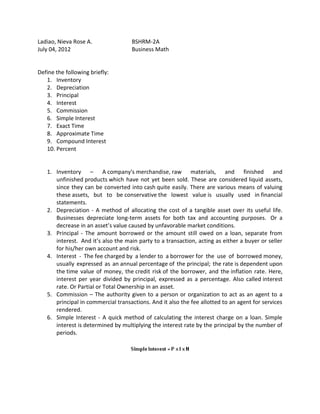
   6. Simple Interest - A quick method of calculating the interest charge on a loan. Simple
      interest is determined by multiplying the interest rate by the principal by the number of
      periods.
Where:
P- is the loan amount
I- is the interest rate
N -is the duration of the loan, using number of periods.

7. Exact Time - makes it possible to define allowed range of time in a relative-to-now plus-
    minus basis instead of exact time period.
8. Approximate Time - Almost exact or correct.
9. Compound Interest - Interest that accrues on the initial principal and the accumulated
    interest of a principal deposit, loan or debt. Compounding of interest allows a principal
    amount to grow at a faster rate than simple interest, which is calculated as a percentage
    of only the principal amount.
10. Percent - is as a ratio that shows a part of a whole. The technical name for the whole is
    base.

Business math

  • 1.
    Ladiao, Nieva RoseA. BSHRM-2A July 04, 2012 Business Math Define the following briefly: 1. Inventory 2. Depreciation 3. Principal 4. Interest 5. Commission 6. Simple Interest 7. Exact Time 8. Approximate Time 9. Compound Interest 10. Percent 1. Inventory – A company's merchandise, raw materials, and finished and unfinished products which have not yet been sold. These are considered liquid assets, since they can be converted into cash quite easily. There are various means of valuing these assets, but to be conservative the lowest value is usually used in financial statements. 2. Depreciation - A method of allocating the cost of a tangible asset over its useful life. Businesses depreciate long-term assets for both tax and accounting purposes. Or a decrease in an asset’s value caused by unfavorable market conditions. 3. Principal - The amount borrowed or the amount still owed on a loan, separate from interest. And it’s also the main party to a transaction, acting as either a buyer or seller for his/her own account and risk. 4. Interest - The fee charged by a lender to a borrower for the use of borrowed money, usually expressed as an annual percentage of the principal; the rate is dependent upon the time value of money, the credit risk of the borrower, and the inflation rate. Here, interest per year divided by principal, expressed as a percentage. Also called interest rate. Or Partial or Total Ownership in an asset. 5. Commission – The authority given to a person or organization to act as an agent to a principal in commercial transactions. And it also the fee allotted to an agent for services rendered. 6. Simple Interest - A quick method of calculating the interest charge on a loan. Simple interest is determined by multiplying the interest rate by the principal by the number of periods.
  • 2.
    Where: P- is theloan amount I- is the interest rate N -is the duration of the loan, using number of periods. 7. Exact Time - makes it possible to define allowed range of time in a relative-to-now plus- minus basis instead of exact time period. 8. Approximate Time - Almost exact or correct. 9. Compound Interest - Interest that accrues on the initial principal and the accumulated interest of a principal deposit, loan or debt. Compounding of interest allows a principal amount to grow at a faster rate than simple interest, which is calculated as a percentage of only the principal amount. 10. Percent - is as a ratio that shows a part of a whole. The technical name for the whole is base.