
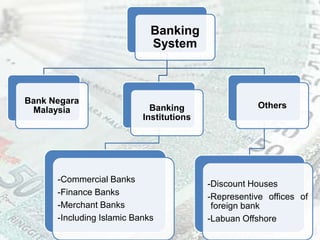













Banking
System
Bank Negara
Malaysia Banking
Institutions
-Commercial Banks
-Finance Banks
-Merchant Banks
-Including Islamic Banks
Others
-Discount Houses
-Representive offices of
foreign bank
-Labuan Offshore
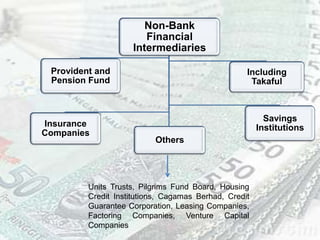
Non-Bank
Financial
Intermediaries
Provident and
Pension Fund
Insurance
Companies
Including
Takaful
Savings
Institutions
Others
Units Trusts, Pilgrims Fund Board, Housing
Credit Institutions, Cagamas Berhad, Credit
Guarantee Corporation, Leasing Companies,
Factoring Companies, Venture Capital
Companies
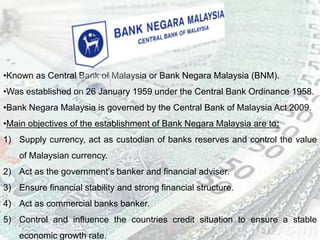
•Known as Central Bank of Malaysia or Bank Negara Malaysia (BNM).
•Was established on 26 January 1959 under the Central Bank Ordinance 1958.
•Bank Negara Malaysia is governed by the Central Bank of Malaysia Act 2009.
•Main objectives of the establishment of Bank Negara Malaysia are to:
1) Supply currency, act as custodian of banks reserves and control the value
of Malaysian currency.
2) Act as the government’s banker and financial adviser.
3) Ensure financial stability and strong financial structure.
4) Act as commercial banks banker.
5) Control and influence the countries credit situation to ensure a stable
economic growth rate.
 A financial institution that provides various financial services, such as
accepting deposits and issuing loans.
 Customers can take advantage of a range of investment products that
commercial banks offer like savings accounts and certificates of deposit.
 The loans in commercial bank issues can vary from business loans and auto
loans to mortgages.
 Businesses that involve are:
i. Accepting deposits for current accounts, deposit accounts, savings
accounts and other similar accounts.
ii. Making payment to or collect cheques written by or paid by the customers.
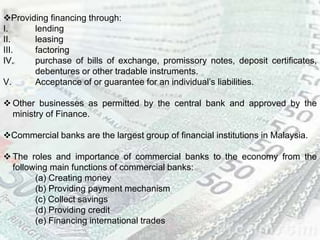
Providing financing through:
I. lending
II. leasing
III. factoring
IV. purchase of bills of exchange, promissory notes, deposit certificates,
debentures or other tradable instruments.
V. Acceptance of or guarantee for an individual’s liabilities.
 Other businesses as permitted by the central bank and approved by the
ministry of Finance.
Commercial banks are the largest group of financial institutions in Malaysia.
 The roles and importance of commercial banks to the economy from the
following main functions of commercial banks:
(a) Creating money
(b) Providing payment mechanism
(c) Collect savings
(d) Providing credit
(e) Financing international trades
 Commercial banks operating in accordance with Islamic law or Syariah Islam
which forbids the element of interest or usury.
 There are two Islamic banks in Malaysia; for example:
I. Bank Islam Malaysia Berhad (BIMB)
II. Bank Muamalat Malaysia Berhad (BMMB)
 BIMB was the first Islamic bank that operated under Islamic Bank Act, 1983,
followed by Bank Muamalat Malaysia Berhad (BMMB) which was established
in 2001.
 These two banks offer products and services similar to those offered by
ordinary commercial banks except that they follow the syariah law.
 Finance company as an institution that conducts finance company
businesses which in turn mean.
 Businesses that involve accepting deposits for deposit accounts or other
similar accounts.
Businesses that provide lending, leasing, hire-purchase facilities.
 An institution engaged in such specialized forms of financing as
purchasing accounts receivable, extending credit to retailers and
manufacturers, discounting installment co tracts, and granting loans
with goods as security.
 Other businesses permitted by Bank Negara Malaysia and approved by the
Ministry of Finance.
A bank dealing in commercial loans and investment.
Businesses that involve accepting deposits for deposit accounts and
providing financing.
Businesses that provide consultancy and advisory services related to
corporate and investment matters, and make or manage investments on
behalf of other parties.
Other businesses permitted by Bank Negara Malaysia and approved by the
Ministry of Finance.
 Financial intermediaries dealing specifically in short term funds for short term
investors and short term borrowers.
A company that buys and sells bills of exchange.
 They act as financial intermediaries that move funds from other financial
intermediaries.
Statutory bodies.
 Large corporations having large quantity of liquid funds in the form of short
term deposits such as overnight money, call money and deposits of 3-month
maturity or less.
 Central Bank Regulations require every discount house to invest at least 75%
of their deposit funds in Treasury Bills, Cagamas Bonds and other
Government securities of less than 5-year maturity.
 Commercial banks, finance companies and merchant banks often use the
service of discount houses to harmonies their respective liquidity positions.
An office established by a company to conduct marketing and other non-
transactional operations, generally in a foreign country where a
branch office or subsidiary is not warranted.
Required to appoint a Chief Representative to manage the representative
office on a full time basis.
If the proposed Chief Representative is a non-Malaysian citizen, the foreign
institution or the representative office is also required to complete Form
BNM/Expat and submit the completed form to Bank Negara Malaysia. This
form is to facilitate the issuance of a work permit by the Malaysian
Immigration Department.
 Was set up in Labuan to enable local as well as international companies and
investors to carry out investment and financial activities at international level.
 Commercial banks set up at Labuan International Offshore Financial Centre
(IOFC) under the Offshore Banking Act 1990.
 These activities include those related to banking, financing, corporate
restructuring, insurance and credit.
 Financial activities at IOFC are conducted in foreign currencies except for
Ringgit Malaysia.
 Banking services and facilities offered by offshore banks are as follow:
* Open current accounts for customers but no cheques will be issued.
* Payments and funds transfers are done via written instructions.
* Offer trade finance facilities such as letters of Credit, bankers acceptances,
and trust receipts. All facilities are in foreign currencies.
 Financial intermediaries that collect funds from workers and providing funds
during a workers old age.
 Every worker is required to contribute a portion of their respective salaries to
their funds.
 Employers also contribute to the funds for their workers.
 Some companies also provide additional pension funds for their retired
workers.
 These funds are aimed to help meet the workers cost of living during
retirement.
 Examples of provident and pension funds in Malaysia are:
* Kumpulan Wang Simpanan Pekerja (KWSP)
* Kumpulan Wang Simpanan Guru-Guru (KWSG)
 Insurance funds are funds collected in the form of insurance premiums paid
by insurance policy holders for protection against calamities such as loss of
working capability, illness, fire, accident and theft.
 Examples of insurance businesses:
→Life insurance- Life insurance is for the protection against risks related to
death, loss of working capability and major illness.
→General insurance- General insurance covers non-life insurance, i.e.
losses as a result of fire, accident or theft.
 Occasionally, insurance companies are unable to sell insurance against
certain risks when the risk is too high for them to bear.
 Islamic insurance business was introduced on 24 November 1984 by
Syarikat Takaful Malaysia Sdn. Bhd.
 This company offers:
→Takaful Keluarga (Life)
→Takaful Am (General).
 Islamic insurance is insurance business conducted in accordance with
Islamic principles.
 The word Takaful means joint guarantee.
 Objective: Cooperation and mutual help among the members of a defined
group.
 Based on the concepts:
I.Mudarabah
II.Tabarru
 Involvements of these two Islamic forms of business eliminate the elements
of Riba from insurance contract and convert Gharar into tolerable form.
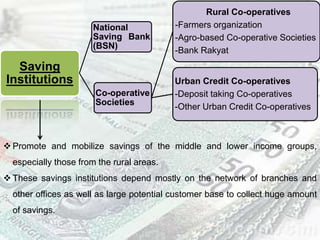
Saving
Institutions
Co-operative
Societies
Urban Credit Co-operatives
-Deposit taking Co-operatives
-Other Urban Credit Co-operatives
Rural Co-operatives
-Farmers organization
-Agro-based Co-operative Societies
-Bank Rakyat
National
Saving Bank
(BSN)
 Promote and mobilize savings of the middle and lower income groups,
especially those from the rural areas.
 These savings institutions depend mostly on the network of branches and
other offices as well as large potential customer base to collect huge amount
of savings.
 Established through reorganization of the post office system, is the main
savings institution in Malaysia.
 Set up mainly to promote the savings habit.
 To build up personal savings to finance the country’s economic development
programmes.
 It functioned as a civil debt holder.
 However, this function has weakened over time due to declining rate of
deposits growth at BSN, and competition from commercial banks and finance
companies.
 Savings deposited are guaranteed by the government.
 Not actual financial intermediaries.
 Many co-operative societies in Malaysia provide financial intermediary
services.
 Credit cooperatives such as Bank Rakyat, mobilize large quantity of funds
not only from its members, but from the public too, to finance the bankers
lending operation.
 A collective investment scheme that pools the savings of a large number of investors.
 Ownership provides the investors with advantages in terms of diversity, choices and
professional investment management.
 Generally unit trust involves three parties, professional trust fund manager, trustee
and unit holder.
 Money collected is invested by the fund manager in different types of stocks, bonds,
or other securities in various proportions depending upon the objective of the fund.
 Was established as a premiere economic based Islamic financial institution.
 The fund board was established in 1962 as a modest proposal to aid the
Malayan rural economy and to enable the Muslims to perform ‘Hajj’, one of
the tenets of their faith.
 Lembaga Urusan dan Tabung Haji was established in August 1969.
 Provide investment services and opportunities while managing pilgrimage
activities for the Malaysian Muslim community.
 Depositors’ money is invested in selected investment establishments spread
across a diverse range of investment portfolios based strictly on Syariah
principles to preserve the purity and integrity of profits derived which is free
from “riba” elements and to avoid trading in prohibited ‘haram’ products.
 Provide credit to buy house or known as housing loans.
 The government encourages house ownership by Malaysians, and ensures
that the public, especially those with low income, have the opportunity to
have their own houses.
 The government focuses its effort on providing low cost housing.
 Housing credit needs of middle and high income groups are catered to by
commercial banks, finance companies, housing cooperatives and two
housing credit institutions are:
I.Two housing credit institutions:
II.Malaysia Building Society Berhad (MBSB)
 BNM issues guidelines related to provision of housing loans every year.
 National Mortgage Corporation of Malaysia was established in 1986.
 An organization that purchases financial institutions loans at a discount.
 To promote the broader spread of house ownership and growth of the
secondary mortgage market in Malaysia.
 Its purchases of loans and debts through the issuance of Cagamas bonds.
 It issues corporate bonds and sukuk to finance the purchase of housing loans
from financial institutions and non-financial institutions.
 The provision of liquidity to financial institutions at a reasonable cost to the
primary lenders of housing loans encourages further expansion of financing
for houses at an affordable cost.
Assisting small enterprises to have ready access to credit from the commercial banks.
Jointly owned by the central bank and commercial bank.
It is provide guarantee cover to the commercial banks to designed loans extended to
small scale enterprises in agricultural, commercial and industrial sectors of the
economy.
The guarantee cover operates automatically once credit facilities under scheme are
provided by the commercial banks and can be involved as when loans extended are
non recoverable.
Leasing is an agreement between a lessor and a lessee.
→-Lessor is the owner of asset.
→-Lessee is the receiver of an asset or service.
Lessor agrees to let the lessee have the use of the asset and in return the lessee pays
rent to the lessor by installments.
At the end of the lease agreement, the asset concerned is still owned by the lessor
and the lessor can give the lessee the option to purchase the asset.
A company sells or surrenders the rights to its accounts receivable to a factoring
company, and in return the factoring company advances a percentage of the value of
the accounts to the company.
Provide management and administration services related to accounts receivable.
Functions:
→Receive Order
→Extend Credit
→Provide Credit Protection
→Sell Invoice
→Post Receivable
→Provide Financing
→Collect Receivables
→Remit Collected Funds
→Financial Reporting
 Involves financing of high risk investments or assets which
are normally not financed by banking institutions.
 Example of first Venture Company in Malaysia is:
→ Malaysian Ventures Berhad- marked the beginning of
the usage of this type of capital in the domestic
business world.
 This kind of financing usually focuses on high technology
fields such as biotechnology and robot industry.
 Venture capital companies also finance new products and
businesses such as those in the shipping industry.
 Main problem- to determine how much risk they can take
and whether the return corresponds to the risk they take.
Financial institutions

Financial institutions

  • 2.
    Banking System Bank Negara Malaysia Banking Institutions -CommercialBanks -Finance Banks -Merchant Banks -Including Islamic Banks Others -Discount Houses -Representive offices of foreign bank -Labuan Offshore
  • 3.
    Non-Bank Financial Intermediaries Provident and Pension Fund Insurance Companies Including Takaful Savings Institutions Others UnitsTrusts, Pilgrims Fund Board, Housing Credit Institutions, Cagamas Berhad, Credit Guarantee Corporation, Leasing Companies, Factoring Companies, Venture Capital Companies
  • 4.
    •Known as CentralBank of Malaysia or Bank Negara Malaysia (BNM). •Was established on 26 January 1959 under the Central Bank Ordinance 1958. •Bank Negara Malaysia is governed by the Central Bank of Malaysia Act 2009. •Main objectives of the establishment of Bank Negara Malaysia are to: 1) Supply currency, act as custodian of banks reserves and control the value of Malaysian currency. 2) Act as the government’s banker and financial adviser. 3) Ensure financial stability and strong financial structure. 4) Act as commercial banks banker. 5) Control and influence the countries credit situation to ensure a stable economic growth rate.
  • 5.
     A financialinstitution that provides various financial services, such as accepting deposits and issuing loans.  Customers can take advantage of a range of investment products that commercial banks offer like savings accounts and certificates of deposit.  The loans in commercial bank issues can vary from business loans and auto loans to mortgages.  Businesses that involve are: i. Accepting deposits for current accounts, deposit accounts, savings accounts and other similar accounts. ii. Making payment to or collect cheques written by or paid by the customers.
  • 6.
    Providing financing through: I.lending II. leasing III. factoring IV. purchase of bills of exchange, promissory notes, deposit certificates, debentures or other tradable instruments. V. Acceptance of or guarantee for an individual’s liabilities.  Other businesses as permitted by the central bank and approved by the ministry of Finance. Commercial banks are the largest group of financial institutions in Malaysia.  The roles and importance of commercial banks to the economy from the following main functions of commercial banks: (a) Creating money (b) Providing payment mechanism (c) Collect savings (d) Providing credit (e) Financing international trades
  • 7.
     Commercial banksoperating in accordance with Islamic law or Syariah Islam which forbids the element of interest or usury.  There are two Islamic banks in Malaysia; for example: I. Bank Islam Malaysia Berhad (BIMB) II. Bank Muamalat Malaysia Berhad (BMMB)  BIMB was the first Islamic bank that operated under Islamic Bank Act, 1983, followed by Bank Muamalat Malaysia Berhad (BMMB) which was established in 2001.  These two banks offer products and services similar to those offered by ordinary commercial banks except that they follow the syariah law.
  • 8.
     Finance companyas an institution that conducts finance company businesses which in turn mean.  Businesses that involve accepting deposits for deposit accounts or other similar accounts. Businesses that provide lending, leasing, hire-purchase facilities.  An institution engaged in such specialized forms of financing as purchasing accounts receivable, extending credit to retailers and manufacturers, discounting installment co tracts, and granting loans with goods as security.  Other businesses permitted by Bank Negara Malaysia and approved by the Ministry of Finance.
  • 9.
    A bank dealingin commercial loans and investment. Businesses that involve accepting deposits for deposit accounts and providing financing. Businesses that provide consultancy and advisory services related to corporate and investment matters, and make or manage investments on behalf of other parties. Other businesses permitted by Bank Negara Malaysia and approved by the Ministry of Finance.
  • 10.
     Financial intermediariesdealing specifically in short term funds for short term investors and short term borrowers. A company that buys and sells bills of exchange.  They act as financial intermediaries that move funds from other financial intermediaries. Statutory bodies.  Large corporations having large quantity of liquid funds in the form of short term deposits such as overnight money, call money and deposits of 3-month maturity or less.  Central Bank Regulations require every discount house to invest at least 75% of their deposit funds in Treasury Bills, Cagamas Bonds and other Government securities of less than 5-year maturity.  Commercial banks, finance companies and merchant banks often use the service of discount houses to harmonies their respective liquidity positions.
  • 11.
    An office establishedby a company to conduct marketing and other non- transactional operations, generally in a foreign country where a branch office or subsidiary is not warranted. Required to appoint a Chief Representative to manage the representative office on a full time basis. If the proposed Chief Representative is a non-Malaysian citizen, the foreign institution or the representative office is also required to complete Form BNM/Expat and submit the completed form to Bank Negara Malaysia. This form is to facilitate the issuance of a work permit by the Malaysian Immigration Department.
  • 12.
     Was setup in Labuan to enable local as well as international companies and investors to carry out investment and financial activities at international level.  Commercial banks set up at Labuan International Offshore Financial Centre (IOFC) under the Offshore Banking Act 1990.  These activities include those related to banking, financing, corporate restructuring, insurance and credit.  Financial activities at IOFC are conducted in foreign currencies except for Ringgit Malaysia.  Banking services and facilities offered by offshore banks are as follow: * Open current accounts for customers but no cheques will be issued. * Payments and funds transfers are done via written instructions. * Offer trade finance facilities such as letters of Credit, bankers acceptances, and trust receipts. All facilities are in foreign currencies.
  • 13.
     Financial intermediariesthat collect funds from workers and providing funds during a workers old age.  Every worker is required to contribute a portion of their respective salaries to their funds.  Employers also contribute to the funds for their workers.  Some companies also provide additional pension funds for their retired workers.  These funds are aimed to help meet the workers cost of living during retirement.  Examples of provident and pension funds in Malaysia are: * Kumpulan Wang Simpanan Pekerja (KWSP) * Kumpulan Wang Simpanan Guru-Guru (KWSG)
  • 14.
     Insurance fundsare funds collected in the form of insurance premiums paid by insurance policy holders for protection against calamities such as loss of working capability, illness, fire, accident and theft.  Examples of insurance businesses: →Life insurance- Life insurance is for the protection against risks related to death, loss of working capability and major illness. →General insurance- General insurance covers non-life insurance, i.e. losses as a result of fire, accident or theft.  Occasionally, insurance companies are unable to sell insurance against certain risks when the risk is too high for them to bear.
  • 15.
     Islamic insurancebusiness was introduced on 24 November 1984 by Syarikat Takaful Malaysia Sdn. Bhd.  This company offers: →Takaful Keluarga (Life) →Takaful Am (General).  Islamic insurance is insurance business conducted in accordance with Islamic principles.  The word Takaful means joint guarantee.  Objective: Cooperation and mutual help among the members of a defined group.  Based on the concepts: I.Mudarabah II.Tabarru  Involvements of these two Islamic forms of business eliminate the elements of Riba from insurance contract and convert Gharar into tolerable form.
  • 16.
    Saving Institutions Co-operative Societies Urban Credit Co-operatives -Deposittaking Co-operatives -Other Urban Credit Co-operatives Rural Co-operatives -Farmers organization -Agro-based Co-operative Societies -Bank Rakyat National Saving Bank (BSN)  Promote and mobilize savings of the middle and lower income groups, especially those from the rural areas.  These savings institutions depend mostly on the network of branches and other offices as well as large potential customer base to collect huge amount of savings.
  • 17.
     Established throughreorganization of the post office system, is the main savings institution in Malaysia.  Set up mainly to promote the savings habit.  To build up personal savings to finance the country’s economic development programmes.  It functioned as a civil debt holder.  However, this function has weakened over time due to declining rate of deposits growth at BSN, and competition from commercial banks and finance companies.  Savings deposited are guaranteed by the government.
  • 18.
     Not actualfinancial intermediaries.  Many co-operative societies in Malaysia provide financial intermediary services.  Credit cooperatives such as Bank Rakyat, mobilize large quantity of funds not only from its members, but from the public too, to finance the bankers lending operation.  A collective investment scheme that pools the savings of a large number of investors.  Ownership provides the investors with advantages in terms of diversity, choices and professional investment management.  Generally unit trust involves three parties, professional trust fund manager, trustee and unit holder.  Money collected is invested by the fund manager in different types of stocks, bonds, or other securities in various proportions depending upon the objective of the fund.
  • 19.
     Was establishedas a premiere economic based Islamic financial institution.  The fund board was established in 1962 as a modest proposal to aid the Malayan rural economy and to enable the Muslims to perform ‘Hajj’, one of the tenets of their faith.  Lembaga Urusan dan Tabung Haji was established in August 1969.  Provide investment services and opportunities while managing pilgrimage activities for the Malaysian Muslim community.  Depositors’ money is invested in selected investment establishments spread across a diverse range of investment portfolios based strictly on Syariah principles to preserve the purity and integrity of profits derived which is free from “riba” elements and to avoid trading in prohibited ‘haram’ products.
  • 20.
     Provide creditto buy house or known as housing loans.  The government encourages house ownership by Malaysians, and ensures that the public, especially those with low income, have the opportunity to have their own houses.  The government focuses its effort on providing low cost housing.  Housing credit needs of middle and high income groups are catered to by commercial banks, finance companies, housing cooperatives and two housing credit institutions are: I.Two housing credit institutions: II.Malaysia Building Society Berhad (MBSB)  BNM issues guidelines related to provision of housing loans every year.
  • 21.
     National MortgageCorporation of Malaysia was established in 1986.  An organization that purchases financial institutions loans at a discount.  To promote the broader spread of house ownership and growth of the secondary mortgage market in Malaysia.  Its purchases of loans and debts through the issuance of Cagamas bonds.  It issues corporate bonds and sukuk to finance the purchase of housing loans from financial institutions and non-financial institutions.  The provision of liquidity to financial institutions at a reasonable cost to the primary lenders of housing loans encourages further expansion of financing for houses at an affordable cost.
  • 22.
    Assisting small enterprisesto have ready access to credit from the commercial banks. Jointly owned by the central bank and commercial bank. It is provide guarantee cover to the commercial banks to designed loans extended to small scale enterprises in agricultural, commercial and industrial sectors of the economy. The guarantee cover operates automatically once credit facilities under scheme are provided by the commercial banks and can be involved as when loans extended are non recoverable. Leasing is an agreement between a lessor and a lessee. →-Lessor is the owner of asset. →-Lessee is the receiver of an asset or service. Lessor agrees to let the lessee have the use of the asset and in return the lessee pays rent to the lessor by installments. At the end of the lease agreement, the asset concerned is still owned by the lessor and the lessor can give the lessee the option to purchase the asset.
  • 23.
    A company sellsor surrenders the rights to its accounts receivable to a factoring company, and in return the factoring company advances a percentage of the value of the accounts to the company. Provide management and administration services related to accounts receivable. Functions: →Receive Order →Extend Credit →Provide Credit Protection →Sell Invoice →Post Receivable →Provide Financing →Collect Receivables →Remit Collected Funds →Financial Reporting  Involves financing of high risk investments or assets which are normally not financed by banking institutions.  Example of first Venture Company in Malaysia is: → Malaysian Ventures Berhad- marked the beginning of the usage of this type of capital in the domestic business world.  This kind of financing usually focuses on high technology fields such as biotechnology and robot industry.  Venture capital companies also finance new products and businesses such as those in the shipping industry.  Main problem- to determine how much risk they can take and whether the return corresponds to the risk they take.