Hemvati Nandan Bahuguna Garhwal University
Topic- Financial Environment
Submitted to : Submitted by :
Dr. Monika Kashyap
Km. Shiksha
Rohit kumar Upadhyay
Pinki Sinha
• Financial environment is an important part of an economy.
• Financial environment of a company refers to all the financial institutions and
financial market around the company that affects the working of the company
as a whole.
• The financial environment has a number of factors. It includes the financial
institutions, government, individuals and firms around the business.
• The financial environment in a country highlights the condition of the
financial markets as well as the economy of the country. Understanding the
monetary policy and fiscal policy help us in understanding the financial system
The complete system of financial environment comprises of
four important components. These include
(1)Financial managers
(2) Investors
(3) Financial markets
(4) Financial instruments.
Financial Manager
Financial managers are responsible for the financial
health of an organization. They create financial reports,
direct investment activities and develop plans for the
long-term financial goals of their organization.
Functions Of Financial Managers
1. Financial Forecasting and planning
2.Acquisition of fund
3. Investment of funds
4. Helping in valuation decisions
5. Maintain proper liquidity
Role of Financial Managers
Financial managers determine how to invest a firm’s funds to capitalize
on potential opportunities. They also determine how to obtain the funds
needed to finance their respective firms’investments.
Investors
Investors are individual or financial institutions that provide funds to
firms, government agencies or individuals who needs funds.
Types of Investors -
1. Angel Investors
2. Peer to peer lenders
3. Banks
4. Venture Capitalists
Role of Investors -
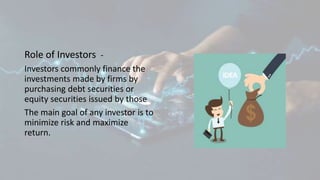
Investors commonly finance the
investments made by firms by
purchasing debt securities or
equity securities issued by those
The main goal of any investor is to
minimize risk and maximize
return.
Financial Assets/Instrument/Securities
• The products which are traded in the Financial Markets are called the
Financial Assets. Based on the different requirements and needs of
the credit seeker, the securities in the market also differ from each
other.
Some important Financial Assets have been discussed briefly
below:
● Call Money - When a loan is granted for one day and is repaid on the second day, it is called
call money. No collateral securities are required for this kind of transaction.
● Notice Money - When a loan is granted for more than a day and for less than 14 days, it is
called notice money. No collateral securities are required for this kind of transaction.
● Term Money - When the maturity period of a deposit is beyond 14 days, it is called term
money.
● Treasury Bills - Also known as T-Bills, These are Government bonds or debt securities with
maturity of less than a year. Buying a T-Bill menas lending money to the Government.
● Certificate of Deposits - It is a dematerialised form (Electronically generated) for funds
deposited in the bank for a specific period of time.
● Commercial Paper - It is an unsecured short-term debt instrument issued by corporations
Financial Markets
• The marketplace where buyers and sellers interact with each other
and participate in trading of money, bonds, shares and other assets is
called a financial market.
Types of the financial Market-
1. Money Market
2. Capital Market
3. Foreign Exchange Market
4. Derevetiv Market
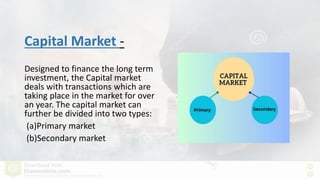
Capital Market -
Designed to finance the long term
investment, the Capital market
deals with transactions which are
taking place in the market for over
an year. The capital market can
further be divided into two types:
(a)Primary market
(b)Secondary market
• Long-term Investment
• Government Regulations
• The link Between the Investors or Savers and Borrowers
• Utilizes the services of Intermediaries
• Determinants of Capital Formation
Function of Capital Market :
• Helps in Mobilizing the funds and Savings
• Sytematic Investment of Funds
• Helps in Capital Formation
• Opens Up Opportunities for Investment
• Avaliability of Funds
Money Market -
Mostly dominated by Government, Banks and other Large Institutions,
the type of market is authorized for small term investments only. It is a
wholesale debt market which works on low-risk and highly liquid
instruments. The money market can further be divided into two types:
(a) Organized Money Market
(b) Unorganized Money Market
Features of Money Market :
• Money market purely for Short terms
• Maximum tenure usually 365 days
• High liquidity
• Low risk
• Low Earning
• Fixed return
• Regulated by RBI
Foreign exchange Market -
One of the most developed markets across the world, the Foreign
exchange market, deals with the requirements related to multi
currency. The transfer of funds in this market takes place based on the
foreign currency rate.
Derivative Market -
• The term 'Derivative' stands for a contract whose price is derived
from or is dependent upon an underlying asset.
• The underlying asset could be a financial asset such as currency, stock
and market index, an interest bearing security or a physical commodity.
• As Derivatives are merely contracts between two or more parties,
•

Financial environment .pptx

  • 1.
    Hemvati Nandan BahugunaGarhwal University Topic- Financial Environment Submitted to : Submitted by : Dr. Monika Kashyap Km. Shiksha Rohit kumar Upadhyay Pinki Sinha
  • 2.
    • Financial environmentis an important part of an economy. • Financial environment of a company refers to all the financial institutions and financial market around the company that affects the working of the company as a whole. • The financial environment has a number of factors. It includes the financial institutions, government, individuals and firms around the business. • The financial environment in a country highlights the condition of the financial markets as well as the economy of the country. Understanding the monetary policy and fiscal policy help us in understanding the financial system
  • 3.
    The complete systemof financial environment comprises of four important components. These include (1)Financial managers (2) Investors (3) Financial markets (4) Financial instruments.
  • 4.
    Financial Manager Financial managersare responsible for the financial health of an organization. They create financial reports, direct investment activities and develop plans for the long-term financial goals of their organization.
  • 5.
    Functions Of FinancialManagers 1. Financial Forecasting and planning 2.Acquisition of fund 3. Investment of funds 4. Helping in valuation decisions 5. Maintain proper liquidity
  • 6.
    Role of FinancialManagers Financial managers determine how to invest a firm’s funds to capitalize on potential opportunities. They also determine how to obtain the funds needed to finance their respective firms’investments.
  • 7.
    Investors Investors are individualor financial institutions that provide funds to firms, government agencies or individuals who needs funds. Types of Investors - 1. Angel Investors 2. Peer to peer lenders 3. Banks 4. Venture Capitalists
  • 8.
    Role of Investors- Investors commonly finance the investments made by firms by purchasing debt securities or equity securities issued by those The main goal of any investor is to minimize risk and maximize return.
  • 9.
    Financial Assets/Instrument/Securities • Theproducts which are traded in the Financial Markets are called the Financial Assets. Based on the different requirements and needs of the credit seeker, the securities in the market also differ from each other.
  • 10.
    Some important FinancialAssets have been discussed briefly below: ● Call Money - When a loan is granted for one day and is repaid on the second day, it is called call money. No collateral securities are required for this kind of transaction. ● Notice Money - When a loan is granted for more than a day and for less than 14 days, it is called notice money. No collateral securities are required for this kind of transaction. ● Term Money - When the maturity period of a deposit is beyond 14 days, it is called term money. ● Treasury Bills - Also known as T-Bills, These are Government bonds or debt securities with maturity of less than a year. Buying a T-Bill menas lending money to the Government. ● Certificate of Deposits - It is a dematerialised form (Electronically generated) for funds deposited in the bank for a specific period of time. ● Commercial Paper - It is an unsecured short-term debt instrument issued by corporations
  • 11.
    Financial Markets • Themarketplace where buyers and sellers interact with each other and participate in trading of money, bonds, shares and other assets is called a financial market. Types of the financial Market- 1. Money Market 2. Capital Market 3. Foreign Exchange Market 4. Derevetiv Market
  • 12.
    Capital Market - Designedto finance the long term investment, the Capital market deals with transactions which are taking place in the market for over an year. The capital market can further be divided into two types: (a)Primary market (b)Secondary market
  • 13.
    • Long-term Investment •Government Regulations • The link Between the Investors or Savers and Borrowers • Utilizes the services of Intermediaries • Determinants of Capital Formation
  • 14.
    Function of CapitalMarket : • Helps in Mobilizing the funds and Savings • Sytematic Investment of Funds • Helps in Capital Formation • Opens Up Opportunities for Investment • Avaliability of Funds
  • 15.
    Money Market - Mostlydominated by Government, Banks and other Large Institutions, the type of market is authorized for small term investments only. It is a wholesale debt market which works on low-risk and highly liquid instruments. The money market can further be divided into two types: (a) Organized Money Market (b) Unorganized Money Market
  • 16.
    Features of MoneyMarket : • Money market purely for Short terms • Maximum tenure usually 365 days • High liquidity • Low risk • Low Earning • Fixed return • Regulated by RBI
  • 17.
    Foreign exchange Market- One of the most developed markets across the world, the Foreign exchange market, deals with the requirements related to multi currency. The transfer of funds in this market takes place based on the foreign currency rate. Derivative Market - • The term 'Derivative' stands for a contract whose price is derived from or is dependent upon an underlying asset. • The underlying asset could be a financial asset such as currency, stock and market index, an interest bearing security or a physical commodity. • As Derivatives are merely contracts between two or more parties,
  • 18.