Business Etiquettes
Introductions
School of Business Management
Shoolini University
C-L-M


   Career Limiting Move
• Within 30 seconds               • Within 4 minutes
  people judge your                 people decide your
    •   Economic level             •   Trustworthiness
    •   Educational level          •   Compassion
    •   Social position            •   Reliability
    •   Level of sophistication    •   Intelligence
    •   Level of success           •   Capability
                                   •   Humility
                                   •   Friendliness
                                   •   Confidence


First Impressions                                          3
School of Business Management                            Rojhe
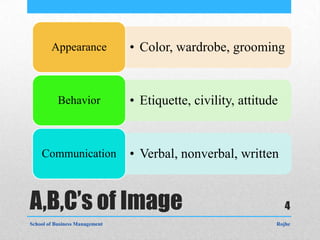
Appearance              • Color, wardrobe, grooming


           Behavior             • Etiquette, civility, attitude


    Communication               • Verbal, nonverbal, written


A,B,C’s of Image                                                  4
School of Business Management                                 Rojhe
Meet and Greet
 • First impressions are lasting, and it is sometimes the
   only opportunity you may have.

 • Therefore, a powerful and lasting introduction can give
   you the edge when meeting new people for the first time.


                                                              5
School of Business Management                               Rojhe
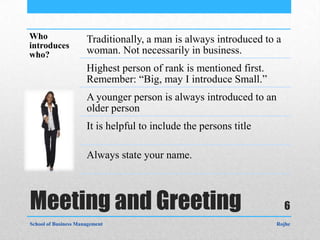
Who                   Traditionally, a man is always introduced to a
introduces
who?                  woman. Not necessarily in business.
                      Highest person of rank is mentioned first.
                      Remember: “Big, may I introduce Small.”
                      A younger person is always introduced to an
                      older person
                      It is helpful to include the persons title

                      Always state your name.


Meeting and Greeting                                                   6
School of Business Management                                      Rojhe
• In a business setting, always
  introduce people by saying their       • If the person you are
  title and full name first, and then      introducing has no title, you do
  follow with a brief interesting or
                                           not know their title, or it would
  relevant piece of information
  about the people you are
                                           seem too formal for a
  introducing.                             particular setting, you can offer
                                           their name first, but still
                                           followed with information
• Example: When introducing Sally
  Rider, one of your advertising and       about what they do:
  marketing managers, to Dr.             • Example: This is Margaret
  Jennifer Wilkins, a business client,     Dixon. She heads up the new
  you introduce Sally (a subordinate       software development team at
  employee) to the senior                  ABCDE, Inc.
  professional (in this case, the
  client):
                                                                    Ms.

Social Protocol for Introducing
People in a Business Situation                                             7
School of Business Management                                           Rojhe
• Business etiquette rules for introducing people in a business
  setting are not much different from the accepted customs of
  personal introductions in a social setting. Unfortunately, the
  rules of introduction are not so straightforward and simple as
  one might think, and who you introduce first does matter.

• For example, in most social settings in the U.S. (and in fact,
  world-wife) it is still considered customary and preferred for
  women to be introduced to men (instead of men being
  introduced to women). But as women achieve more equality
  this rule is changing, particularly in the U.S. business world.


The Art of Business
Introductions                                                       8
School of Business Management                                   Rojhe
Professional Etiquette—Handshake
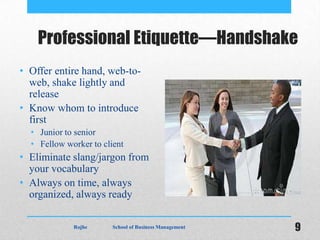
• Offer entire hand, web-to-
  web, shake lightly and
  release
• Know whom to introduce
  first
  • Junior to senior
  • Fellow worker to client
• Eliminate slang/jargon from
  your vocabulary
• Always on time, always
  organized, always ready

             Rojhe      School of Business Management   9
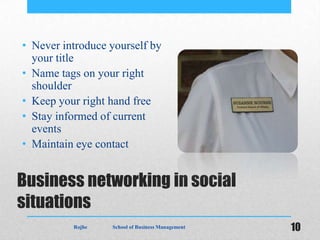
• Never introduce yourself by
  your title
• Name tags on your right
  shoulder
• Keep your right hand free
• Stay informed of current
  events
• Maintain eye contact


Business networking in social
situations
          Rojhe   School of Business Management   10
Always use last names with customers unless they are about
your age and rank
Don’t keep customers waiting

Escort clients out

When someone of higher rank or from outside the
organization enters, everyone in the office stands
Junior employees stand until seniors sit


Showing Respect                                          11
School of Business Management                          Rojhe
Repeat the person’s name a few times to yourself after
you’re introduced.

Use the person’s name immediately in the conversation
after an introduction.

Immediately introduce that new person to someone
else you know.

Jot down the person’s name


Tricks for remembering names 12
School of Business Management                       Rojhe
In both business and social situations, you should always introduce:

Younger people to older people;

Junior ranking professionals to senior ranking professionals;

Business contacts and staff to clients;

Personal acquaintances and family members to business professionals when
attending a business function; and
Guests to their hosts.


Situations Where Social and
Business Introduction Rules Are
the Same                                                                13
School of Business Management                                          Rojhe
• When you meet someone new & nobody else is to
  introduce you.
• If you are meeting new colleagues, associates or clients.
• To introduce yourself extend your hand and say,
• If you have previously been introduced to someone do
  not assume that they will remember you. Be prepared to
  reintroduce yourself should it be necessary
    • "Hello, I am __________. I am the from Company ABC.


Introducing Yourself                                         14
School of Business Management                               Rojhe
Always determine the order of precedence.
         Say the most distinguished person's first and last name or title
         and last name, first. Use appropriate names.
Choose appropriate introductions:
         Formal: "May I present...?"
         Business or social: "May I introduce...?" or "I would like to
         introduce...",
         Casual: "This is...", which may appear unsophisticated.
Always stand for introductions. It shows respect.
If you forget someone's name, admit it, apologize and ask for the correct
pronunciation.
Introduce yourself, when necessary.
Introduce and address people by their preferential name.
Responding to introductions:
         Formal: "How do you do?",
         Business or social: "How are you?",
         Casual: "Hello.".


When making introductions:                                             15
School of Business Management                                         Rojhe
When someone has just been introduced to you, your
 response should be genuine, short, and simple. You should
   also should repeat the person’s name at the end of your
                           greeting.


  Repeating the name of the person you       • Examples:
     were just introduced to serves two      • “It is so nice to meet you, Dr. Wilkins. I
  purposes: it shows polite respect and it     have followed your work for years with
    helps you to remember the person’s         much enthusiasm.”
      name. You can also add a brief         • ”It is wonderful to finally meet you, Dr.
   comment about the person (not about         Wilkins. I look forward to working with
                                               you.”
                  yourself):


How to Respond to an Introduction 16
School of Business Management                                                          Rojhe
• Simply add “Mr” in front of their last name. For
  example, if John Smith was introduced to you, an
  acceptable response might be, “It’s an honor to meet
  you, Mr. Smith.”


How to Respond to Being
Formally Introduced to
Business Men                                              17
School of Business Management                            Rojhe
• Always go with “Ms” if you do not know the marital status or
  title of a woman. Incorrectly using “Mrs” offends some
  women, whereas calling a woman “Ms” (even when
  incorrectly used) is not nearly as offensive.
    • Never address any woman as “Miss” unless she has specifically
      been introduced to you as “Miss.”
• When to Use Miss, Ms, or Mrs
• Introduction Etiquette Tip: Never respond to the initial
  introduction with a personal brag about yourself. For
  example, you would not respond to being introduced to Dr.
  Wilkins by saying, “It is nice to meet you – I always wanted to
  be a doctor!”


How to Respond to Being Formally
Introduced to Business Women 18
School of Business Management                                     Rojhe
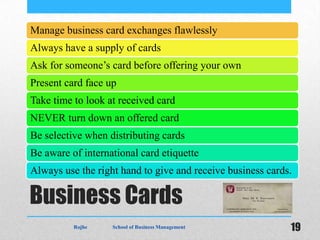
Manage business card exchanges flawlessly
Always have a supply of cards
Ask for someone’s card before offering your own
Present card face up
Take time to look at received card
NEVER turn down an offered card
Be selective when distributing cards
Be aware of international card etiquette
Always use the right hand to give and receive business cards.

Business Cards
          Rojhe    School of Business Management            19
Business cards are an internationally recognised means of presenting personal
contact details, so ensure you have a plentiful supply.

When travelling abroad for business it is advisable to have one side of your
business card translated into the appropriate language.

Business cards are generally exchanged at the beginning of or at the end of an
initial meeting.

Good business etiquette requires you present the card so the recipient’s
language is face up.

Make a point of studying any business card, commenting on it and clarifying
information before putting it away


Business Cards                                                                 20
School of Business Management                                                  Rojhe
Stir up some conversation when introduced


Art of conversation                        21
School of Business Management             Rojhe
Discussions                      22
School of Business Management   Rojhe

Business Etiquettes Introduction

  • 1.
    Business Etiquettes Introductions School ofBusiness Management Shoolini University
  • 2.
    C-L-M Career Limiting Move
  • 3.
    • Within 30seconds • Within 4 minutes people judge your people decide your • Economic level • Trustworthiness • Educational level • Compassion • Social position • Reliability • Level of sophistication • Intelligence • Level of success • Capability • Humility • Friendliness • Confidence First Impressions 3 School of Business Management Rojhe
  • 4.
    Appearance • Color, wardrobe, grooming Behavior • Etiquette, civility, attitude Communication • Verbal, nonverbal, written A,B,C’s of Image 4 School of Business Management Rojhe
  • 5.
    Meet and Greet • First impressions are lasting, and it is sometimes the only opportunity you may have. • Therefore, a powerful and lasting introduction can give you the edge when meeting new people for the first time. 5 School of Business Management Rojhe
  • 6.
    Who Traditionally, a man is always introduced to a introduces who? woman. Not necessarily in business. Highest person of rank is mentioned first. Remember: “Big, may I introduce Small.” A younger person is always introduced to an older person It is helpful to include the persons title Always state your name. Meeting and Greeting 6 School of Business Management Rojhe
  • 7.
    • In abusiness setting, always introduce people by saying their • If the person you are title and full name first, and then introducing has no title, you do follow with a brief interesting or not know their title, or it would relevant piece of information about the people you are seem too formal for a introducing. particular setting, you can offer their name first, but still followed with information • Example: When introducing Sally Rider, one of your advertising and about what they do: marketing managers, to Dr. • Example: This is Margaret Jennifer Wilkins, a business client, Dixon. She heads up the new you introduce Sally (a subordinate software development team at employee) to the senior ABCDE, Inc. professional (in this case, the client): Ms. Social Protocol for Introducing People in a Business Situation 7 School of Business Management Rojhe
  • 8.
    • Business etiquetterules for introducing people in a business setting are not much different from the accepted customs of personal introductions in a social setting. Unfortunately, the rules of introduction are not so straightforward and simple as one might think, and who you introduce first does matter. • For example, in most social settings in the U.S. (and in fact, world-wife) it is still considered customary and preferred for women to be introduced to men (instead of men being introduced to women). But as women achieve more equality this rule is changing, particularly in the U.S. business world. The Art of Business Introductions 8 School of Business Management Rojhe
  • 9.
    Professional Etiquette—Handshake • Offerentire hand, web-to- web, shake lightly and release • Know whom to introduce first • Junior to senior • Fellow worker to client • Eliminate slang/jargon from your vocabulary • Always on time, always organized, always ready Rojhe School of Business Management 9
  • 10.
    • Never introduceyourself by your title • Name tags on your right shoulder • Keep your right hand free • Stay informed of current events • Maintain eye contact Business networking in social situations Rojhe School of Business Management 10
  • 11.
    Always use lastnames with customers unless they are about your age and rank Don’t keep customers waiting Escort clients out When someone of higher rank or from outside the organization enters, everyone in the office stands Junior employees stand until seniors sit Showing Respect 11 School of Business Management Rojhe
  • 12.
    Repeat the person’sname a few times to yourself after you’re introduced. Use the person’s name immediately in the conversation after an introduction. Immediately introduce that new person to someone else you know. Jot down the person’s name Tricks for remembering names 12 School of Business Management Rojhe
  • 13.
    In both businessand social situations, you should always introduce: Younger people to older people; Junior ranking professionals to senior ranking professionals; Business contacts and staff to clients; Personal acquaintances and family members to business professionals when attending a business function; and Guests to their hosts. Situations Where Social and Business Introduction Rules Are the Same 13 School of Business Management Rojhe
  • 14.
    • When youmeet someone new & nobody else is to introduce you. • If you are meeting new colleagues, associates or clients. • To introduce yourself extend your hand and say, • If you have previously been introduced to someone do not assume that they will remember you. Be prepared to reintroduce yourself should it be necessary • "Hello, I am __________. I am the from Company ABC. Introducing Yourself 14 School of Business Management Rojhe
  • 15.
    Always determine theorder of precedence. Say the most distinguished person's first and last name or title and last name, first. Use appropriate names. Choose appropriate introductions: Formal: "May I present...?" Business or social: "May I introduce...?" or "I would like to introduce...", Casual: "This is...", which may appear unsophisticated. Always stand for introductions. It shows respect. If you forget someone's name, admit it, apologize and ask for the correct pronunciation. Introduce yourself, when necessary. Introduce and address people by their preferential name. Responding to introductions: Formal: "How do you do?", Business or social: "How are you?", Casual: "Hello.". When making introductions: 15 School of Business Management Rojhe
  • 16.
    When someone hasjust been introduced to you, your response should be genuine, short, and simple. You should also should repeat the person’s name at the end of your greeting. Repeating the name of the person you • Examples: were just introduced to serves two • “It is so nice to meet you, Dr. Wilkins. I purposes: it shows polite respect and it have followed your work for years with helps you to remember the person’s much enthusiasm.” name. You can also add a brief • ”It is wonderful to finally meet you, Dr. comment about the person (not about Wilkins. I look forward to working with you.” yourself): How to Respond to an Introduction 16 School of Business Management Rojhe
  • 17.
    • Simply add“Mr” in front of their last name. For example, if John Smith was introduced to you, an acceptable response might be, “It’s an honor to meet you, Mr. Smith.” How to Respond to Being Formally Introduced to Business Men 17 School of Business Management Rojhe
  • 18.
    • Always gowith “Ms” if you do not know the marital status or title of a woman. Incorrectly using “Mrs” offends some women, whereas calling a woman “Ms” (even when incorrectly used) is not nearly as offensive. • Never address any woman as “Miss” unless she has specifically been introduced to you as “Miss.” • When to Use Miss, Ms, or Mrs • Introduction Etiquette Tip: Never respond to the initial introduction with a personal brag about yourself. For example, you would not respond to being introduced to Dr. Wilkins by saying, “It is nice to meet you – I always wanted to be a doctor!” How to Respond to Being Formally Introduced to Business Women 18 School of Business Management Rojhe
  • 19.
    Manage business cardexchanges flawlessly Always have a supply of cards Ask for someone’s card before offering your own Present card face up Take time to look at received card NEVER turn down an offered card Be selective when distributing cards Be aware of international card etiquette Always use the right hand to give and receive business cards. Business Cards Rojhe School of Business Management 19
  • 20.
    Business cards arean internationally recognised means of presenting personal contact details, so ensure you have a plentiful supply. When travelling abroad for business it is advisable to have one side of your business card translated into the appropriate language. Business cards are generally exchanged at the beginning of or at the end of an initial meeting. Good business etiquette requires you present the card so the recipient’s language is face up. Make a point of studying any business card, commenting on it and clarifying information before putting it away Business Cards 20 School of Business Management Rojhe
  • 21.
    Stir up someconversation when introduced Art of conversation 21 School of Business Management Rojhe
  • 22.
    Discussions 22 School of Business Management Rojhe