Business Etiquette Lecture Four
Business Etiquette Test Your boss, Ms. Andrews, enters the room when you’re meeting with a client, Mr. Block. You rise and say “Ms. Andrews, I’d like you to meet Mr. Block, our Montreal client” You answer the phone for a peer who’s available, and ask “Who’s calling please?”
Business Etiquette Test In a restaurant, you drink thin soup served in a cup with no handles The male pays when he’s having a business meeting at a restaurant with a female colleague When you greet a visitor in your office, let him sit where he wishes
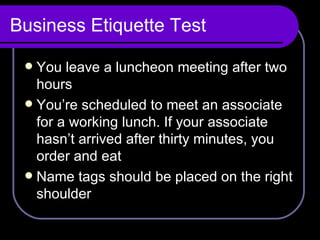
Business Etiquette Test You leave a luncheon meeting after two hours You’re scheduled to meet an associate for a working lunch. If your associate hasn’t arrived after thirty minutes, you order and eat Name tags should be placed on the right shoulder
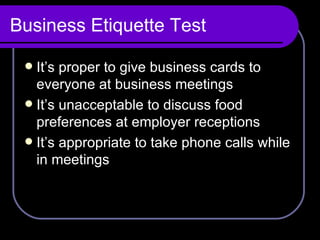
Business Etiquette Test It’s proper to give business cards to everyone at business meetings It’s unacceptable to discuss food preferences at employer receptions It’s appropriate to take phone calls while in meetings
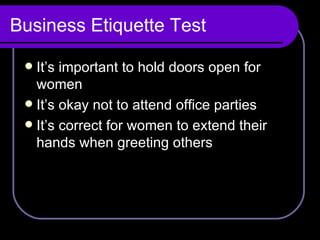
Business Etiquette Test It’s important to hold doors open for women It’s okay not to attend office parties It’s correct for women to extend their hands when greeting others
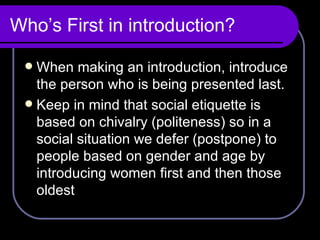
Who’s First in introduction? When making an introduction, introduce the person who is being presented last. Keep in mind that social etiquette is based on chivalry (politeness) so in a social situation we defer (postpone) to people based on gender and age by introducing women first and then those oldest
Who’s First in introduction? Business etiquette is different because it is based on hierarchy Gender and age play no role but rank and authority do The rule is that people of lesser authority are introduced to people of greater authority: “Mr./Ms. CEO, I would like to introduce Mr./Ms. Junior Executive
Who’s First in introduction? Remember eye contact Look and speak to the greater authority first; look at and speak to the lesser authority second
One Important Exception The “who’s first” general rule is that  no one,  not even the CEO of your company, is more important than your client.  A client is always more important than those in your company
One Important Exception The same goes for an elected official: “Mr. Muldoon, I would like to introduce Ms. Cooper, our chief executive officer. Mr. Muldoon is our client from Dublin.” And “State Representative Jones, I would like to introduce Ms. Cooper, our chief executive officer”
What Do You Say? Same as a regular introduction:  If someone introducing you mispronounces your name or gives you the wrong title….
You Say… “ Jim is not the first person to have trouble pronouncing my name. It’s…(give the correct pronunciation).” And: “I’m afraid Jim has given me a promotion (or demotion). Actually, I’m now (give current title) Humour always helps and shows that you are not making a big deal out of it
In a Business Atmosphere Avoid… Expressing negative attitudes.  If you are feeling and thinking negatively, your mindset will find expression in surliness (coldness), bad temper, and general unpleasantness Brown Paper Bag Analogy
In a Business Atmosphere Avoid… Wearing inappropriate clothing.  Although we like to think that we judge others by their behaviour and not their appearance, it remains true that we base our opinions of others, to a large degree, on what we see Club/Bar Clothes vs. Work Clothes Example: Steamwhistle Interview
In a Business Atmosphere Avoid… Failing to make introductions.  Allowing someone to stand around without introducing him or her can make everyone present feel uncomfortable Disregarding social courtesies.  Forgetting to say please, thank you, and excuse me, and failing to perform other common civilities makes colleagues and superiors doubt your judgment
In a Business Atmosphere Avoid… Criticizing others in public.  Generally, the criticizer comes off looking worse than the person being criticized  Taking messages carelessly. Making people wait. Pronouncing names wrong or forgetting names altogether.
In a Business Atmosphere Avoid… Using vulgar and inappropriate language. Giving someone the runaround,  which means things like ducking responsibility and giving vague or conflicting answers Example
Business Appointments and Functions Don’t scatter things around. Keep files on your lap. Put your briefcase or handbag on the floor or keep it on your lap. Don’t put things or touch things on the other person’s desk
Business Appointments and Functions Complimenting people on their appearance is perfectly correct if the compliment is sincere. At the office however, you’re best to compliment the work, not the clothes
Faux Pas Don’t give false compliments  Don’t tell polite lies to people at social functions
Faux Pas Example: “You look fabulous” can sound hollow when a person says it too often. “It’s been a long time since I’ve seen you” can be better than an insincere “It’s great to see you”  People will detect your insincerity, no matter how good of an actor you think you may be.
The Least You Need to Know Researchers say that people skills are more important than either technical skills or knowledge for advancement in the business world Gender plays a minor role in business relationships. Rank plays the major role 71-73 cents to a dollar
The Least You Need to Know When in doubt about how to dress, take your clues from the people who are running your company Before buying any piece of clothing, consider the position you hold and the specific business environment, as well as factors such as climate, geography and occasion
The Least You Need to Know When complimenting someone, make sure you are sincere. When accepting a compliment, graciously say thank you. Don’t argue the point.
Your Superiors Top management sets the tone of the workplace and the relationships within the workplace This includes how people dress and how they address each other This protocol probably won’t be written anywhere, you will have to learn by observing those around you
Your Superiors Address your superiors as Mr. or Ms., followed by the surname, not as sir or madam.  Don’t use first names unless and until you are specifically invited to do so.
Your Superiors Even then, be careful. Just because you have been invited to use the boss’s first name or have had lunch or a golf game with him or her, don’t assume that an intimate or even good ‘pal’ relationship exists between you…
Your Superiors Remember that relationships in the American business world are based on rank, and rank should always be observed and acknowledged.
Visitors When you receive a visitor in your office, remember that you are the host and act accordingly Greet your visitor cordially, which means that you or your secretary should go out to the reception area to meet the guest Shake hands, make whatever introductions are necessary and escort the visitor to the office
Visitors If you stay in your office to receive the visitor, be sure to come out from behind your desk to greet him or her, or better still, meet the person at the door, usher the visitor in, and show him/her where to sit
Visiting Don’t be late. If you happen to be, apologize and explain When you tell the receptionist your name and mission, also present your business card if you have one Ask where you can hang your coat if you have one
Visiting In the office, wait to be told where to sit. If there are a number of chairs, ask which one you should use Don’t remain standing if your host is seated Don’t lay papers or documents on the desk or the floor Put your briefcase or handbag on the floor beside you
Visiting Don’t fiddle with or touch anything on the desk Leave promptly when your business is completed Send a thank-you note for the meeting within 24 hours and try to make the thank-you note not look like a generic ‘cookie-cutter’ product
Thank you Note Example Dear Helen: Thank you for making time yesterday to help me out with the Andersons projections. Your insights are very much appreciated.  Best Regards, Tom Walker
Business Meeting Etiquette How to succeed in meetings: Be prepared! Do your homework! Do not be late! Arrive a little early if possible, and enter the room with confidence
Business Meeting Etiquette How to speak at meetings: Think before you speak, and concision is the key (be concise) Avoid confrontation. Use positive language. Never start a point with “This might be a bad idea, but…”
Business Meeting Etiquette Use “we” as much as possible, especially when discussing the work or your team or department Take credit for work when it is due to you, but only if you are also willing to take responsibility for mistakes Be organized! Have your notebooks, laptop, pens, agenda, etc. all ready to go when the meeting starts
Business Meeting Etiquette Keep briefcases and purses on the floor, behind your feet.  DO NOT  place them on the table or on an empty chair next to you Keep your dress jackets and ties on Don’t slouch, sit up straight Don’t cross your arms
Business Meeting Etiquette Don’t doodle with your pen, don’t play with paperclips, and maintain an appearance of high energy no matter how dull or boring the meeting is

Western etiquette. business etiquette.

  • 1.
  • 2.
    Business Etiquette TestYour boss, Ms. Andrews, enters the room when you’re meeting with a client, Mr. Block. You rise and say “Ms. Andrews, I’d like you to meet Mr. Block, our Montreal client” You answer the phone for a peer who’s available, and ask “Who’s calling please?”
  • 3.
    Business Etiquette TestIn a restaurant, you drink thin soup served in a cup with no handles The male pays when he’s having a business meeting at a restaurant with a female colleague When you greet a visitor in your office, let him sit where he wishes
  • 4.
    Business Etiquette TestYou leave a luncheon meeting after two hours You’re scheduled to meet an associate for a working lunch. If your associate hasn’t arrived after thirty minutes, you order and eat Name tags should be placed on the right shoulder
  • 5.
    Business Etiquette TestIt’s proper to give business cards to everyone at business meetings It’s unacceptable to discuss food preferences at employer receptions It’s appropriate to take phone calls while in meetings
  • 6.
    Business Etiquette TestIt’s important to hold doors open for women It’s okay not to attend office parties It’s correct for women to extend their hands when greeting others
  • 7.
    Who’s First inintroduction? When making an introduction, introduce the person who is being presented last. Keep in mind that social etiquette is based on chivalry (politeness) so in a social situation we defer (postpone) to people based on gender and age by introducing women first and then those oldest
  • 8.
    Who’s First inintroduction? Business etiquette is different because it is based on hierarchy Gender and age play no role but rank and authority do The rule is that people of lesser authority are introduced to people of greater authority: “Mr./Ms. CEO, I would like to introduce Mr./Ms. Junior Executive
  • 9.
    Who’s First inintroduction? Remember eye contact Look and speak to the greater authority first; look at and speak to the lesser authority second
  • 10.
    One Important ExceptionThe “who’s first” general rule is that no one, not even the CEO of your company, is more important than your client. A client is always more important than those in your company
  • 11.
    One Important ExceptionThe same goes for an elected official: “Mr. Muldoon, I would like to introduce Ms. Cooper, our chief executive officer. Mr. Muldoon is our client from Dublin.” And “State Representative Jones, I would like to introduce Ms. Cooper, our chief executive officer”
  • 12.
    What Do YouSay? Same as a regular introduction: If someone introducing you mispronounces your name or gives you the wrong title….
  • 13.
    You Say… “Jim is not the first person to have trouble pronouncing my name. It’s…(give the correct pronunciation).” And: “I’m afraid Jim has given me a promotion (or demotion). Actually, I’m now (give current title) Humour always helps and shows that you are not making a big deal out of it
  • 14.
    In a BusinessAtmosphere Avoid… Expressing negative attitudes. If you are feeling and thinking negatively, your mindset will find expression in surliness (coldness), bad temper, and general unpleasantness Brown Paper Bag Analogy
  • 15.
    In a BusinessAtmosphere Avoid… Wearing inappropriate clothing. Although we like to think that we judge others by their behaviour and not their appearance, it remains true that we base our opinions of others, to a large degree, on what we see Club/Bar Clothes vs. Work Clothes Example: Steamwhistle Interview
  • 16.
    In a BusinessAtmosphere Avoid… Failing to make introductions. Allowing someone to stand around without introducing him or her can make everyone present feel uncomfortable Disregarding social courtesies. Forgetting to say please, thank you, and excuse me, and failing to perform other common civilities makes colleagues and superiors doubt your judgment
  • 17.
    In a BusinessAtmosphere Avoid… Criticizing others in public. Generally, the criticizer comes off looking worse than the person being criticized Taking messages carelessly. Making people wait. Pronouncing names wrong or forgetting names altogether.
  • 18.
    In a BusinessAtmosphere Avoid… Using vulgar and inappropriate language. Giving someone the runaround, which means things like ducking responsibility and giving vague or conflicting answers Example
  • 19.
    Business Appointments andFunctions Don’t scatter things around. Keep files on your lap. Put your briefcase or handbag on the floor or keep it on your lap. Don’t put things or touch things on the other person’s desk
  • 20.
    Business Appointments andFunctions Complimenting people on their appearance is perfectly correct if the compliment is sincere. At the office however, you’re best to compliment the work, not the clothes
  • 21.
    Faux Pas Don’tgive false compliments Don’t tell polite lies to people at social functions
  • 22.
    Faux Pas Example:“You look fabulous” can sound hollow when a person says it too often. “It’s been a long time since I’ve seen you” can be better than an insincere “It’s great to see you” People will detect your insincerity, no matter how good of an actor you think you may be.
  • 23.
    The Least YouNeed to Know Researchers say that people skills are more important than either technical skills or knowledge for advancement in the business world Gender plays a minor role in business relationships. Rank plays the major role 71-73 cents to a dollar
  • 24.
    The Least YouNeed to Know When in doubt about how to dress, take your clues from the people who are running your company Before buying any piece of clothing, consider the position you hold and the specific business environment, as well as factors such as climate, geography and occasion
  • 25.
    The Least YouNeed to Know When complimenting someone, make sure you are sincere. When accepting a compliment, graciously say thank you. Don’t argue the point.
  • 26.
    Your Superiors Topmanagement sets the tone of the workplace and the relationships within the workplace This includes how people dress and how they address each other This protocol probably won’t be written anywhere, you will have to learn by observing those around you
  • 27.
    Your Superiors Addressyour superiors as Mr. or Ms., followed by the surname, not as sir or madam. Don’t use first names unless and until you are specifically invited to do so.
  • 28.
    Your Superiors Eventhen, be careful. Just because you have been invited to use the boss’s first name or have had lunch or a golf game with him or her, don’t assume that an intimate or even good ‘pal’ relationship exists between you…
  • 29.
    Your Superiors Rememberthat relationships in the American business world are based on rank, and rank should always be observed and acknowledged.
  • 30.
    Visitors When youreceive a visitor in your office, remember that you are the host and act accordingly Greet your visitor cordially, which means that you or your secretary should go out to the reception area to meet the guest Shake hands, make whatever introductions are necessary and escort the visitor to the office
  • 31.
    Visitors If youstay in your office to receive the visitor, be sure to come out from behind your desk to greet him or her, or better still, meet the person at the door, usher the visitor in, and show him/her where to sit
  • 32.
    Visiting Don’t belate. If you happen to be, apologize and explain When you tell the receptionist your name and mission, also present your business card if you have one Ask where you can hang your coat if you have one
  • 33.
    Visiting In theoffice, wait to be told where to sit. If there are a number of chairs, ask which one you should use Don’t remain standing if your host is seated Don’t lay papers or documents on the desk or the floor Put your briefcase or handbag on the floor beside you
  • 34.
    Visiting Don’t fiddlewith or touch anything on the desk Leave promptly when your business is completed Send a thank-you note for the meeting within 24 hours and try to make the thank-you note not look like a generic ‘cookie-cutter’ product
  • 35.
    Thank you NoteExample Dear Helen: Thank you for making time yesterday to help me out with the Andersons projections. Your insights are very much appreciated. Best Regards, Tom Walker
  • 36.
    Business Meeting EtiquetteHow to succeed in meetings: Be prepared! Do your homework! Do not be late! Arrive a little early if possible, and enter the room with confidence
  • 37.
    Business Meeting EtiquetteHow to speak at meetings: Think before you speak, and concision is the key (be concise) Avoid confrontation. Use positive language. Never start a point with “This might be a bad idea, but…”
  • 38.
    Business Meeting EtiquetteUse “we” as much as possible, especially when discussing the work or your team or department Take credit for work when it is due to you, but only if you are also willing to take responsibility for mistakes Be organized! Have your notebooks, laptop, pens, agenda, etc. all ready to go when the meeting starts
  • 39.
    Business Meeting EtiquetteKeep briefcases and purses on the floor, behind your feet. DO NOT place them on the table or on an empty chair next to you Keep your dress jackets and ties on Don’t slouch, sit up straight Don’t cross your arms
  • 40.
    Business Meeting EtiquetteDon’t doodle with your pen, don’t play with paperclips, and maintain an appearance of high energy no matter how dull or boring the meeting is