Navigating the Forces
Shaping the Future
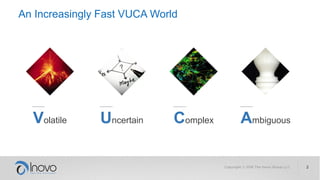
An Increasingly Fast VUCA World
Volatile Uncertain Complex Ambiguous
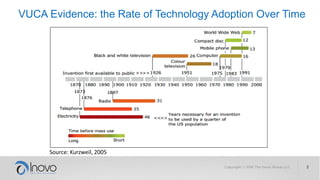
VUCA Evidence: the Rate of Technology Adoption Over Time
Source: Kurzweil, 2005
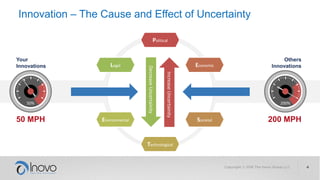
Innovation – The Cause and Effect of Uncertainty
Your
Innovations
Others
Innovations
50 MPH 200 MPH
Political
Technological
EconomicLegal
SocietalEnvironmental
DecreaseUncertainity
IncreaseUncertainity
50% 200%
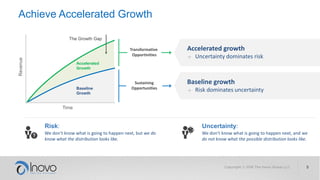
Achieve Accelerated Growth
The Growth Gap
Time
Revenue
Baseline
Growth
Accelerated
Growth
Sustaining
Opportunities
Transformative
Opportinities
Accelerated growth
→ Uncertainty dominates risk
Baseline growth
→ Risk dominates uncertainty
Uncertainty:
We don’t know what is going to happen next, and we
do not know what the possible distribution looks like.
Risk:
We don’t know what is going to happen next, but we do
know what the distribution looks like.
→ Intellectual Property
→ Competition
→ Business
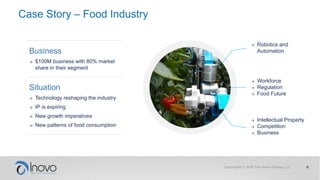
Case Story – Food Industry
→ Robotics and
Automation
→ Workforce
→ Regulation
→ Food Future
Business
→ $100M business with 80% market
share in their segment
Situation
→ Technology reshaping the industry
→ IP is expiring
→ New growth imperatives
→ New patterns of food consumption
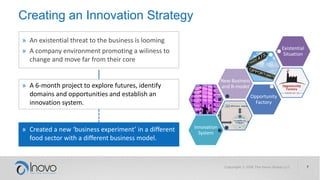
Creating an Innovation Strategy
» An existential threat to the business is looming
» A company environment promoting a wiliness to
change and move far from their core
» A 6-month project to explore futures, identify
domains and opportunities and establish an
innovation system.
» Created a new ‘business experiment’ in a different
food sector with a different business model.
Existential
Situation
New Business
and B-model
Opportunity
Factory
Innovation
System
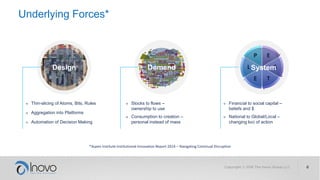
Underlying Forces*
*Aspen Institute Institutional Innovation Report 2014 – Navigating Continual Disruption
→ Thin-slicing of Atoms, Bits, Rules
→ Aggregation into Platforms
→ Automation of Decision Making
Design
→ Stocks to flows –
ownership to use
→ Consumption to creation –
personal instead of mass
Demand
→ Financial to social capital –
beliefs and $
→ National to Global/Local –
changing loci of action
System
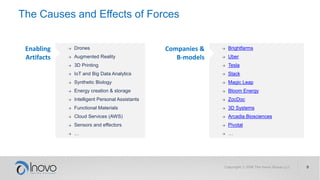
The Causes and Effects of Forces
→ Drones
→ Augmented Reality
→ 3D Printing
→ IoT and Big Data Analytics
→ Synthetic Biology
→ Energy creation & storage
→ Intelligent Personal Assistants
→ Functional Materials
→ Cloud Services (AWS)
→ Sensors and effectors
→ …
→ Brightfarms
→ Uber
→ Tesla
→ Slack
→ Magic Leap
→ Bloom Energy
→ ZocDoc
→ 3D Systems
→ Arcadia Biosciences
→ Pivotal
→ …
Enabling
Artifacts
Companies &
B-models
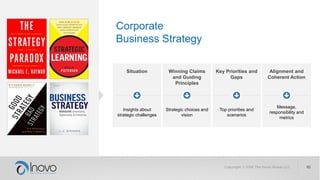
Corporate
Business Strategy
Situation
Insights about
strategic challenges
Winning Claims
and Guiding
Principles
Strategic choices and
vision
Key Priorities and
Gaps
Top priorities and
scenarios
Alignment and
Coherent Action
Message,
responsibility and
metrics
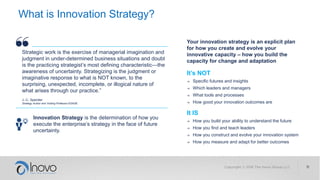
What is Innovation Strategy?
It’s NOT
→ Specific futures and insights
→ Which leaders and managers
→ What tools and processes
→ How good your innovation outcomes are
It IS
→ How you build your ability to understand the future
→ How you find and teach leaders
→ How you construct and evolve your innovation system
→ How you measure and adapt for better outcomes
Innovation Strategy is the determination of how you
execute the enterprise’s strategy in the face of future
uncertainty.
Your innovation strategy is an explicit plan
for how you create and evolve your
innovative capacity – how you build the
capacity for change and adaptation
Strategic work is the exercise of managerial imagination and
judgment in under-determined business situations and doubt
is the practicing strategist’s most defining characteristic—the
awareness of uncertainty. Strategizing is the judgment or
imaginative response to what is NOT known, to the
surprising, unexpected, incomplete, or illogical nature of
what arises through our practice.”
J.-C. Spender
Strategy Author and Visiting Professor ESADE
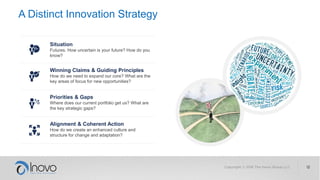
A Distinct Innovation Strategy
Situation
Futures. How uncertain is your future? How do you
know?
Winning Claims & Guiding Principles
How do we need to expand our core? What are the
key areas of focus for new opportunities?
Priorities & Gaps
Where does our current portfolio get us? What are
the key strategic gaps?
Alignment & Coherent Action
How do we create an enhanced culture and
structure for change and adaptation?
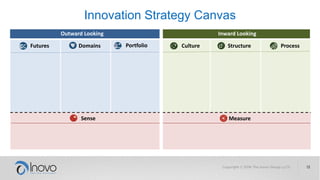
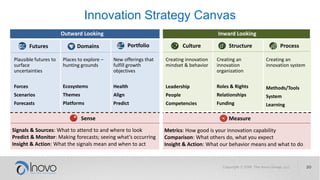
Innovation Strategy Canvas
Culture StructurePortfolioDomainsFutures
Outward Looking Inward Looking
Process
MeasureSense
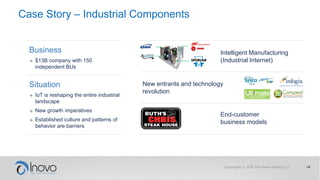
Case Story – Industrial Components
Intelligent Manufacturing
(Industrial Internet)
Business
→ $13B company with 150
independent BUs
Situation
→ IoT is reshaping the entire industrial
landscape
→ New growth imperatives
→ Established culture and patterns of
behavior are barriers
New entrants and technology
revolution
End-customer
business models
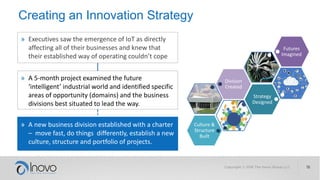
Creating an Innovation Strategy
» Executives saw the emergence of IoT as directly
affecting all of their businesses and knew that
their established way of operating couldn’t cope
» A 5-month project examined the future
‘intelligent’ industrial world and identified specific
areas of opportunity (domains) and the business
divisions best situated to lead the way.
» A new business division established with a charter
– move fast, do things differently, establish a new
culture, structure and portfolio of projects.
Futures
Imagined
Division
Created
Strategy
Designed
Culture &
Structure
Built
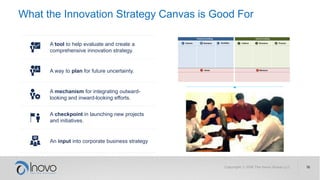
What the Innovation Strategy Canvas is Good For
A tool to help evaluate and create a
comprehensive innovation strategy.
A way to plan for future uncertainty.
A mechanism for integrating outward-
looking and inward-looking efforts.
A checkpoint in launching new projects
and initiatives.
An input into corporate business strategy
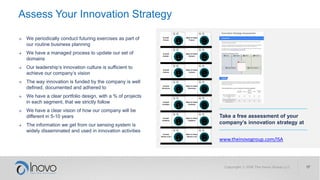
Assess Your Innovation Strategy
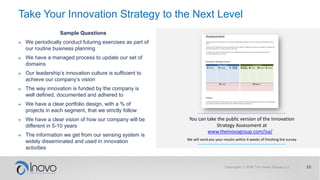
Take a free assessment of your
company’s innovation strategy at
www.theinovogroup.com/ISA
→ We periodically conduct futuring exercises as part of
our routine business planning
→ We have a managed process to update our set of
domains
→ Our leadership’s innovation culture is sufficient to
achieve our company’s vision
→ The way innovation is funded by the company is well
defined, documented and adhered to
→ We have a clear portfolio design, with a % of projects
in each segment, that we strictly follow
→ We have a clear vision of how our company will be
different in 5-10 years
→ The information we get from our sensing system is
widely disseminated and used in innovation activities
Some Innovation Strategy Readings
• Schmitt, L.; Innovation Strategy is About Managing
Future Uncertainty; The Inovo Group
• Pisano, G; You Need and Innovation Strategy; June
2015; Harvard Business review
• Payne, M.; Why Innovation Strategy is Horribly
Broken, and What to do About It; Farenheit 212
• Yakowicz, W.; What You Need to Know About
Innovation When Creating a Business Strategy; May,
2014; Inc.
• Kaplan, S.; 4 Innovation Strategies From Big
Companies That Act Like Startups; Oct. 2012;
co.design
• Koetzier, W. & Schorling, C.; 5 Key Points to Consider
when Developing an Innovation Strategy; Innovation
Management
• Baumgartner, J.; Define Your Strategic Vision and
Innovation Comes Naturally; Imagination and
Creativity Blog
• Power, D.; Innovation Strategy: 4 Key Tactics of Top
Growth; Harvard Division of Continuing Education
Blog
Strategy Component
Details
Innovation Strategy Canvas
Culture StructurePortfolioDomainsFutures
Outward Looking Inward Looking
Process
MeasureSense
Plausible futures to
surface
uncertainties
Forces
Scenarios
Forecasts
Places to explore –
hunting grounds
Ecosystems
Themes
Platforms
New offerings that
fulfill growth
objectives
Health
Align
Predict
Creating innovation
mindset & behavior
Leadership
People
Competencies
Creating an
innovation
organization
Roles & Rights
Relationships
Funding
Creating an
innovation system
Methods/Tools
System
Learning
Signals & Sources: What to attend to and where to look
Predict & Monitor: Making forecasts; seeing what’s occurring
Insight & Action: What the signals mean and when to act
Metrics: How good is your innovation capability
Comparison: What others do, what you expect
Insight & Action: What our behavior means and what to do
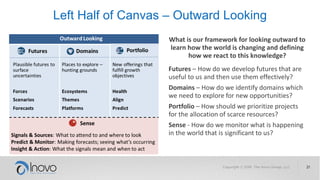
Left Half of Canvas – Outward Looking
What is our framework for looking outward to
learn how the world is changing and defining
how we react to this knowledge?
Futures – How do we develop futures that are
useful to us and then use them effectively?
Domains – How do we identify domains which
we need to explore for new opportunities?
Portfolio – How should we prioritize projects
for the allocation of scarce resources?
Sense - How do we monitor what is happening
in the world that is significant to us?
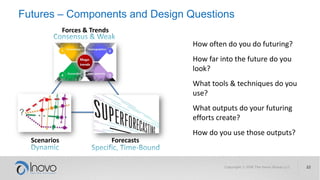
Futures – Components and Design Questions
Forces & Trends
Scenarios Forecasts
How often do you do futuring?
How far into the future do you
look?
What tools & techniques do you
use?
What outputs do your futuring
efforts create?
How do you use those outputs?
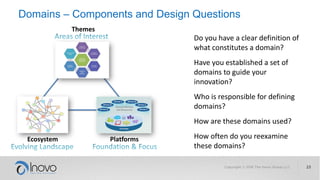
Domains – Components and Design Questions
Themes
Ecosystem Platforms
Do you have a clear definition of
what constitutes a domain?
Have you established a set of
domains to guide your
innovation?
Who is responsible for defining
domains?
How are these domains used?
How often do you reexamine
these domains?
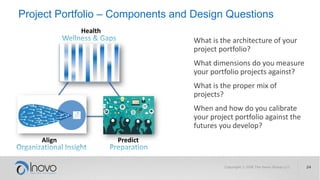
Project Portfolio – Components and Design Questions
Health
Align Predict
What is the architecture of your
project portfolio?
What dimensions do you measure
your portfolio projects against?
What is the proper mix of
projects?
When and how do you calibrate
your project portfolio against the
futures you develop?
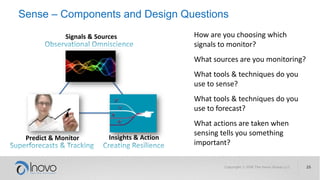
Sense – Components and Design Questions
Signals & Sources
Predict & Monitor Insights & Action
How are you choosing which
signals to monitor?
What sources are you monitoring?
What tools & techniques do you
use to sense?
What tools & techniques do you
use to forecast?
What actions are taken when
sensing tells you something
important?
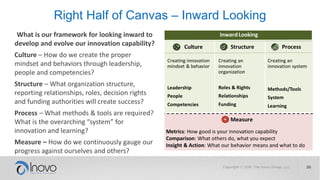
Right Half of Canvas – Inward Looking
What is our framework for looking inward to
develop and evolve our innovation capability?
Culture – How do we create the proper
mindset and behaviors through leadership,
people and competencies?
Structure – What organization structure,
reporting relationships, roles, decision rights
and funding authorities will create success?
Process – What methods & tools are required?
What is the overarching “system” for
innovation and learning?
Measure – How do we continuously gauge our
progress against ourselves and others?
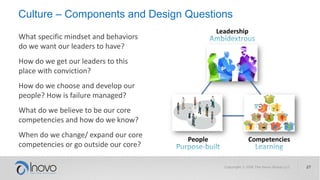
Culture – Components and Design Questions
Leadership
People Competencies
What specific mindset and behaviors
do we want our leaders to have?
How do we get our leaders to this
place with conviction?
How do we choose and develop our
people? How is failure managed?
What do we believe to be our core
competencies and how do we know?
When do we change/ expand our core
competencies or go outside our core?
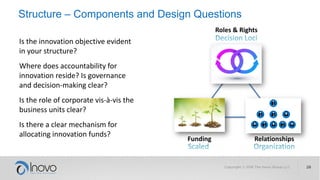
Structure – Components and Design Questions
Roles & Rights
Funding Relationships
Is the innovation objective evident
in your structure?
Where does accountability for
innovation reside? Is governance
and decision-making clear?
Is the role of corporate vis-à-vis the
business units clear?
Is there a clear mechanism for
allocating innovation funds?
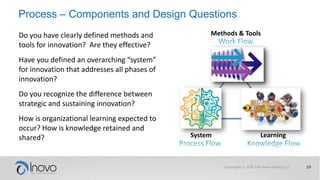
Process – Components and Design Questions
Methods & Tools
System Learning
Do you have clearly defined methods and
tools for innovation? Are they effective?
Have you defined an overarching “system”
for innovation that addresses all phases of
innovation?
Do you recognize the difference between
strategic and sustaining innovation?
How is organizational learning expected to
occur? How is knowledge retained and
shared?
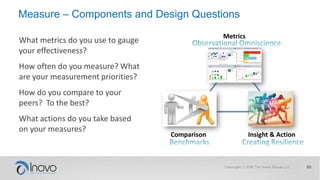
Measure – Components and Design Questions
What metrics do you use to gauge
your effectiveness?
How often do you measure? What
are your measurement priorities?
How do you compare to your
peers? To the best?
What actions do you take based
on your measures?
Metrics
Comparison Insight & Action
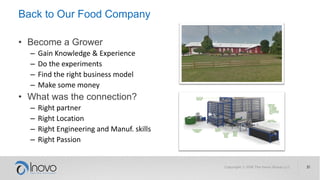
Back to Our Food Company
• Become a Grower
– Gain Knowledge & Experience
– Do the experiments
– Find the right business model
– Make some money
• What was the connection?
– Right partner
– Right Location
– Right Engineering and Manuf. skills
– Right Passion
The Defining Mindset
Existential
• If we don’t do something, we
will eventually cease to exit
• If we do something big, our
existence will be fantastic
How many of your projects fit
either one of these?
Permissive
• We need to do different things
than we are doing now.
• We need to do things differently
than we are doing now.
How permissive are you in
exploring new opportunities?
What made the difference?
Two key mindset attributes underpin a successful innovation strategy.
Take Your Innovation Strategy to the Next Level
Sample Questions
→ We periodically conduct futuring exercises as part of
our routine business planning
→ We have a managed process to update our set of
domains
→ Our leadership’s innovation culture is sufficient to
achieve our company’s vision
→ The way innovation is funded by the company is
well defined, documented and adhered to
→ We have a clear portfolio design, with a % of
projects in each segment, that we strictly follow
→ We have a clear vision of how our company will be
different in 5-10 years
→ The information we get from our sensing system is
widely disseminated and used in innovation
activities
www.theinovogroup.com/isa/
You can take the public version of the Innovation
Strategy Assessment at
We will send you your results within 4 weeks of finishing the survey
The Inovo Group
For more information, check out the innovation strategy
resources on our website, or send Larry an e-mail.
With Inovo as collaboration partner and
guide, clients transform their offerings,
cultures and innovation capabilities.
Larry Schmitt
Managing Partner and Co-founder
Ann Arbor, Michigan
P: +1 (734) 604-3887
E: lschmitt@TheInovoGroup.com

Innovation Strategy Deep Dive

  • 1.
  • 2.
    An Increasingly FastVUCA World Volatile Uncertain Complex Ambiguous
  • 3.
    VUCA Evidence: theRate of Technology Adoption Over Time Source: Kurzweil, 2005
  • 4.
    Innovation – TheCause and Effect of Uncertainty Your Innovations Others Innovations 50 MPH 200 MPH Political Technological EconomicLegal SocietalEnvironmental DecreaseUncertainity IncreaseUncertainity 50% 200%
  • 5.
    Achieve Accelerated Growth TheGrowth Gap Time Revenue Baseline Growth Accelerated Growth Sustaining Opportunities Transformative Opportinities Accelerated growth → Uncertainty dominates risk Baseline growth → Risk dominates uncertainty Uncertainty: We don’t know what is going to happen next, and we do not know what the possible distribution looks like. Risk: We don’t know what is going to happen next, but we do know what the distribution looks like.
  • 6.
    → Intellectual Property →Competition → Business Case Story – Food Industry → Robotics and Automation → Workforce → Regulation → Food Future Business → $100M business with 80% market share in their segment Situation → Technology reshaping the industry → IP is expiring → New growth imperatives → New patterns of food consumption
  • 7.
    Creating an InnovationStrategy » An existential threat to the business is looming » A company environment promoting a wiliness to change and move far from their core » A 6-month project to explore futures, identify domains and opportunities and establish an innovation system. » Created a new ‘business experiment’ in a different food sector with a different business model. Existential Situation New Business and B-model Opportunity Factory Innovation System
  • 8.
    Underlying Forces* *Aspen InstituteInstitutional Innovation Report 2014 – Navigating Continual Disruption → Thin-slicing of Atoms, Bits, Rules → Aggregation into Platforms → Automation of Decision Making Design → Stocks to flows – ownership to use → Consumption to creation – personal instead of mass Demand → Financial to social capital – beliefs and $ → National to Global/Local – changing loci of action System
  • 9.
    The Causes andEffects of Forces → Drones → Augmented Reality → 3D Printing → IoT and Big Data Analytics → Synthetic Biology → Energy creation & storage → Intelligent Personal Assistants → Functional Materials → Cloud Services (AWS) → Sensors and effectors → … → Brightfarms → Uber → Tesla → Slack → Magic Leap → Bloom Energy → ZocDoc → 3D Systems → Arcadia Biosciences → Pivotal → … Enabling Artifacts Companies & B-models
  • 10.
    Corporate Business Strategy Situation Insights about strategicchallenges Winning Claims and Guiding Principles Strategic choices and vision Key Priorities and Gaps Top priorities and scenarios Alignment and Coherent Action Message, responsibility and metrics
  • 11.
    What is InnovationStrategy? It’s NOT → Specific futures and insights → Which leaders and managers → What tools and processes → How good your innovation outcomes are It IS → How you build your ability to understand the future → How you find and teach leaders → How you construct and evolve your innovation system → How you measure and adapt for better outcomes Innovation Strategy is the determination of how you execute the enterprise’s strategy in the face of future uncertainty. Your innovation strategy is an explicit plan for how you create and evolve your innovative capacity – how you build the capacity for change and adaptation Strategic work is the exercise of managerial imagination and judgment in under-determined business situations and doubt is the practicing strategist’s most defining characteristic—the awareness of uncertainty. Strategizing is the judgment or imaginative response to what is NOT known, to the surprising, unexpected, incomplete, or illogical nature of what arises through our practice.” J.-C. Spender Strategy Author and Visiting Professor ESADE
  • 12.
    A Distinct InnovationStrategy Situation Futures. How uncertain is your future? How do you know? Winning Claims & Guiding Principles How do we need to expand our core? What are the key areas of focus for new opportunities? Priorities & Gaps Where does our current portfolio get us? What are the key strategic gaps? Alignment & Coherent Action How do we create an enhanced culture and structure for change and adaptation?
  • 13.
    Innovation Strategy Canvas CultureStructurePortfolioDomainsFutures Outward Looking Inward Looking Process MeasureSense
  • 14.
    Case Story –Industrial Components Intelligent Manufacturing (Industrial Internet) Business → $13B company with 150 independent BUs Situation → IoT is reshaping the entire industrial landscape → New growth imperatives → Established culture and patterns of behavior are barriers New entrants and technology revolution End-customer business models
  • 15.
    Creating an InnovationStrategy » Executives saw the emergence of IoT as directly affecting all of their businesses and knew that their established way of operating couldn’t cope » A 5-month project examined the future ‘intelligent’ industrial world and identified specific areas of opportunity (domains) and the business divisions best situated to lead the way. » A new business division established with a charter – move fast, do things differently, establish a new culture, structure and portfolio of projects. Futures Imagined Division Created Strategy Designed Culture & Structure Built
  • 16.
    What the InnovationStrategy Canvas is Good For A tool to help evaluate and create a comprehensive innovation strategy. A way to plan for future uncertainty. A mechanism for integrating outward- looking and inward-looking efforts. A checkpoint in launching new projects and initiatives. An input into corporate business strategy
  • 17.
    Assess Your InnovationStrategy Take a free assessment of your company’s innovation strategy at www.theinovogroup.com/ISA → We periodically conduct futuring exercises as part of our routine business planning → We have a managed process to update our set of domains → Our leadership’s innovation culture is sufficient to achieve our company’s vision → The way innovation is funded by the company is well defined, documented and adhered to → We have a clear portfolio design, with a % of projects in each segment, that we strictly follow → We have a clear vision of how our company will be different in 5-10 years → The information we get from our sensing system is widely disseminated and used in innovation activities
  • 18.
    Some Innovation StrategyReadings • Schmitt, L.; Innovation Strategy is About Managing Future Uncertainty; The Inovo Group • Pisano, G; You Need and Innovation Strategy; June 2015; Harvard Business review • Payne, M.; Why Innovation Strategy is Horribly Broken, and What to do About It; Farenheit 212 • Yakowicz, W.; What You Need to Know About Innovation When Creating a Business Strategy; May, 2014; Inc. • Kaplan, S.; 4 Innovation Strategies From Big Companies That Act Like Startups; Oct. 2012; co.design • Koetzier, W. & Schorling, C.; 5 Key Points to Consider when Developing an Innovation Strategy; Innovation Management • Baumgartner, J.; Define Your Strategic Vision and Innovation Comes Naturally; Imagination and Creativity Blog • Power, D.; Innovation Strategy: 4 Key Tactics of Top Growth; Harvard Division of Continuing Education Blog
  • 19.
  • 20.
    Innovation Strategy Canvas CultureStructurePortfolioDomainsFutures Outward Looking Inward Looking Process MeasureSense Plausible futures to surface uncertainties Forces Scenarios Forecasts Places to explore – hunting grounds Ecosystems Themes Platforms New offerings that fulfill growth objectives Health Align Predict Creating innovation mindset & behavior Leadership People Competencies Creating an innovation organization Roles & Rights Relationships Funding Creating an innovation system Methods/Tools System Learning Signals & Sources: What to attend to and where to look Predict & Monitor: Making forecasts; seeing what’s occurring Insight & Action: What the signals mean and when to act Metrics: How good is your innovation capability Comparison: What others do, what you expect Insight & Action: What our behavior means and what to do
  • 21.
    Left Half ofCanvas – Outward Looking What is our framework for looking outward to learn how the world is changing and defining how we react to this knowledge? Futures – How do we develop futures that are useful to us and then use them effectively? Domains – How do we identify domains which we need to explore for new opportunities? Portfolio – How should we prioritize projects for the allocation of scarce resources? Sense - How do we monitor what is happening in the world that is significant to us?
  • 22.
    Futures – Componentsand Design Questions Forces & Trends Scenarios Forecasts How often do you do futuring? How far into the future do you look? What tools & techniques do you use? What outputs do your futuring efforts create? How do you use those outputs?
  • 23.
    Domains – Componentsand Design Questions Themes Ecosystem Platforms Do you have a clear definition of what constitutes a domain? Have you established a set of domains to guide your innovation? Who is responsible for defining domains? How are these domains used? How often do you reexamine these domains?
  • 24.
    Project Portfolio –Components and Design Questions Health Align Predict What is the architecture of your project portfolio? What dimensions do you measure your portfolio projects against? What is the proper mix of projects? When and how do you calibrate your project portfolio against the futures you develop?
  • 25.
    Sense – Componentsand Design Questions Signals & Sources Predict & Monitor Insights & Action How are you choosing which signals to monitor? What sources are you monitoring? What tools & techniques do you use to sense? What tools & techniques do you use to forecast? What actions are taken when sensing tells you something important?
  • 26.
    Right Half ofCanvas – Inward Looking What is our framework for looking inward to develop and evolve our innovation capability? Culture – How do we create the proper mindset and behaviors through leadership, people and competencies? Structure – What organization structure, reporting relationships, roles, decision rights and funding authorities will create success? Process – What methods & tools are required? What is the overarching “system” for innovation and learning? Measure – How do we continuously gauge our progress against ourselves and others?
  • 27.
    Culture – Componentsand Design Questions Leadership People Competencies What specific mindset and behaviors do we want our leaders to have? How do we get our leaders to this place with conviction? How do we choose and develop our people? How is failure managed? What do we believe to be our core competencies and how do we know? When do we change/ expand our core competencies or go outside our core?
  • 28.
    Structure – Componentsand Design Questions Roles & Rights Funding Relationships Is the innovation objective evident in your structure? Where does accountability for innovation reside? Is governance and decision-making clear? Is the role of corporate vis-à-vis the business units clear? Is there a clear mechanism for allocating innovation funds?
  • 29.
    Process – Componentsand Design Questions Methods & Tools System Learning Do you have clearly defined methods and tools for innovation? Are they effective? Have you defined an overarching “system” for innovation that addresses all phases of innovation? Do you recognize the difference between strategic and sustaining innovation? How is organizational learning expected to occur? How is knowledge retained and shared?
  • 30.
    Measure – Componentsand Design Questions What metrics do you use to gauge your effectiveness? How often do you measure? What are your measurement priorities? How do you compare to your peers? To the best? What actions do you take based on your measures? Metrics Comparison Insight & Action
  • 31.
    Back to OurFood Company • Become a Grower – Gain Knowledge & Experience – Do the experiments – Find the right business model – Make some money • What was the connection? – Right partner – Right Location – Right Engineering and Manuf. skills – Right Passion
  • 32.
    The Defining Mindset Existential •If we don’t do something, we will eventually cease to exit • If we do something big, our existence will be fantastic How many of your projects fit either one of these? Permissive • We need to do different things than we are doing now. • We need to do things differently than we are doing now. How permissive are you in exploring new opportunities? What made the difference? Two key mindset attributes underpin a successful innovation strategy.
  • 33.
    Take Your InnovationStrategy to the Next Level Sample Questions → We periodically conduct futuring exercises as part of our routine business planning → We have a managed process to update our set of domains → Our leadership’s innovation culture is sufficient to achieve our company’s vision → The way innovation is funded by the company is well defined, documented and adhered to → We have a clear portfolio design, with a % of projects in each segment, that we strictly follow → We have a clear vision of how our company will be different in 5-10 years → The information we get from our sensing system is widely disseminated and used in innovation activities www.theinovogroup.com/isa/ You can take the public version of the Innovation Strategy Assessment at We will send you your results within 4 weeks of finishing the survey
  • 34.
    The Inovo Group Formore information, check out the innovation strategy resources on our website, or send Larry an e-mail. With Inovo as collaboration partner and guide, clients transform their offerings, cultures and innovation capabilities. Larry Schmitt Managing Partner and Co-founder Ann Arbor, Michigan P: +1 (734) 604-3887 E: lschmitt@TheInovoGroup.com