By
Jutharat Ahchawarattaworn, Ph.D.
17-18 Oct 2015
“Change” is…
“Any event that occurs when something passes
from one stage to another.”
 People:
 Attitudes
 Expectations
 Behaviors
 Structure:
 Organization’s structural components
 Structural design
 Technology:
 New equipment or process
 Automation & Computerization
 Internet
“Cultures are naturally resistant to change”
 Conditions that facilitate cultural change:
▪ The occurrence of a dramatic crisis
▪ Leadership changing hands
▪ A young, flexible, and small organization
▪ A weak organizational culture
 Constant..…yet.…Varies in degree and direction
 Uncertainty……yet……. Not Unpredictable
 Threats……and…..Opportunities
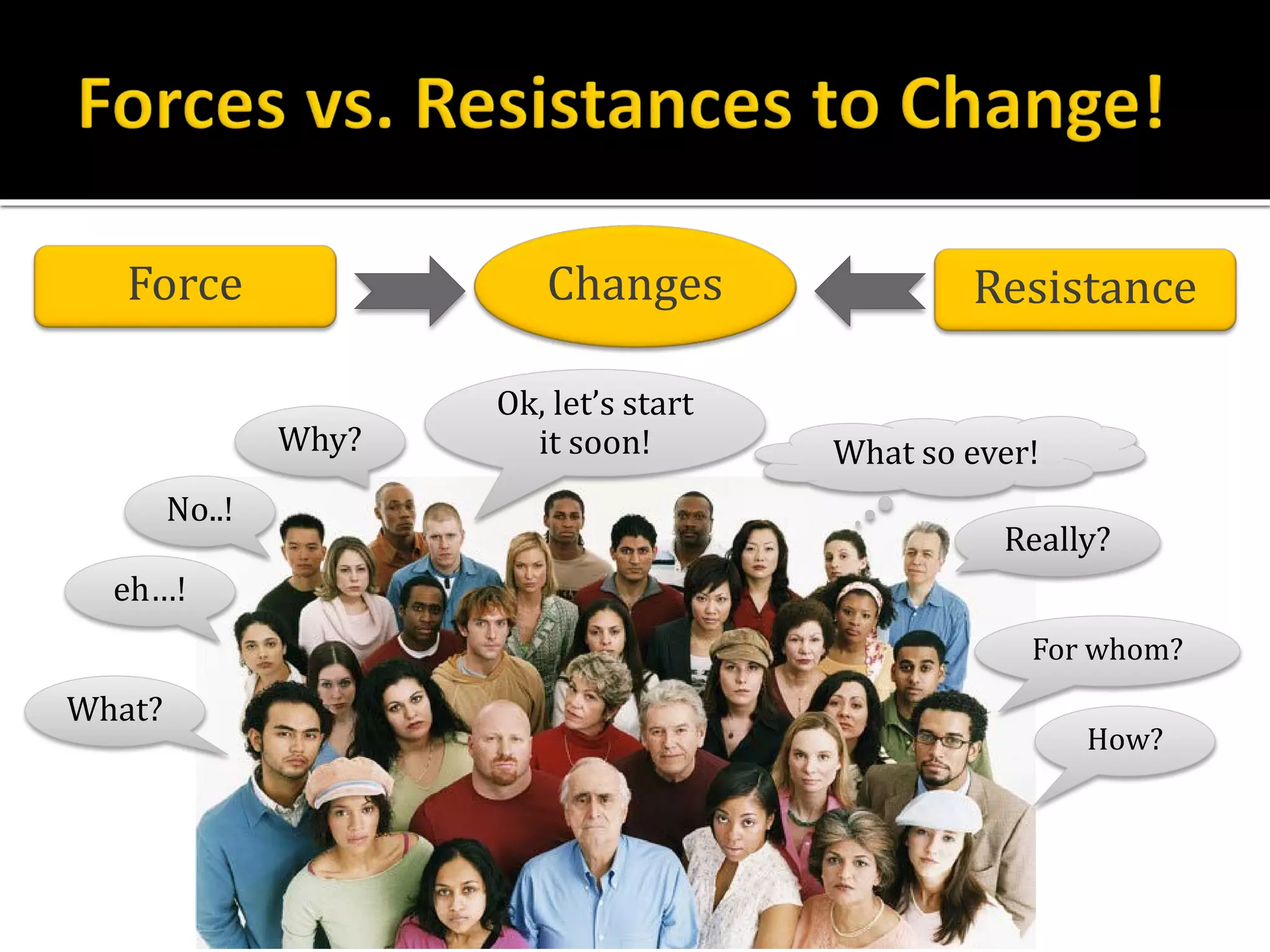
Force ResistanceChanges
Really?
Why?
For whom?
What so ever!
No..!
eh…!
What?
Ok, let’s start
it soon!
How?
Performance
Time
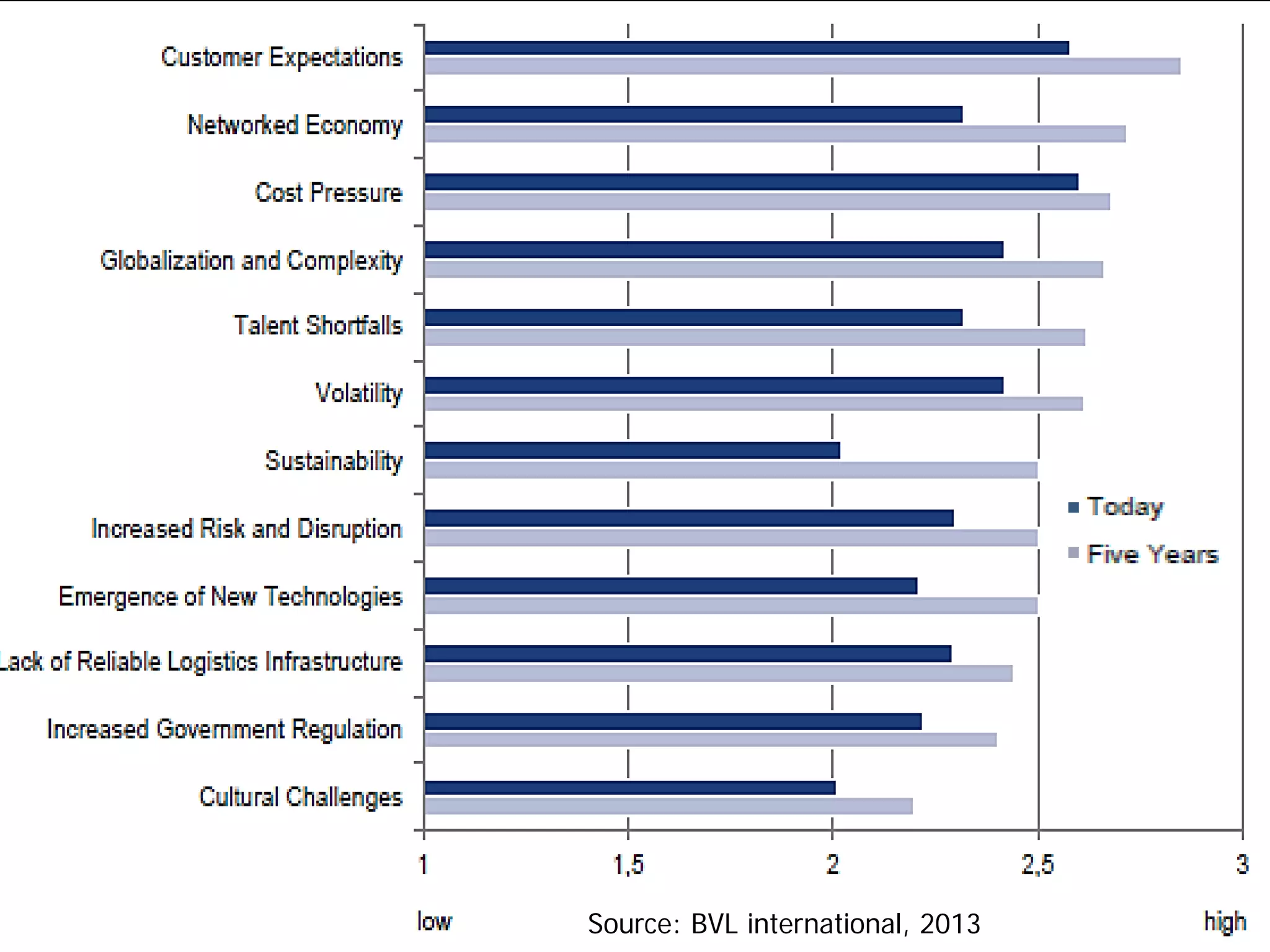
Consumerism
Sustainability
pressure
Risk and
Disruption
Globalization
Demographic
changes
Technology
Cost pressure
Volatility
Knowledge
based Economy
Network
Economic
Urbanization
Source: Adapted from BVL international, 2013
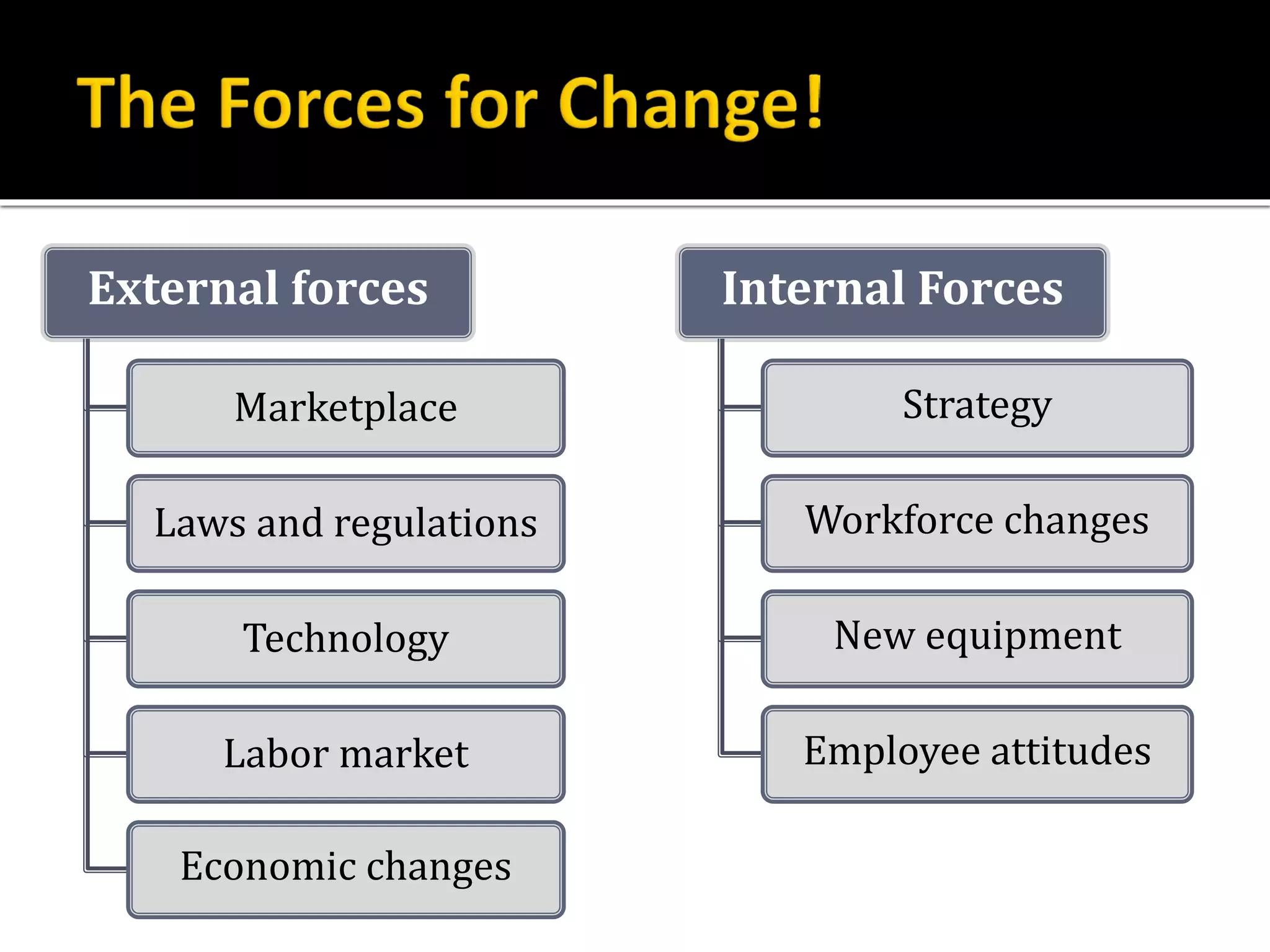
 External Forces
 Internal Forces
External forces
Marketplace
Laws and regulations
Technology
Labor market
Economic changes
Internal Forces
Strategy
Workforce changes
New equipment
Employee attitudes
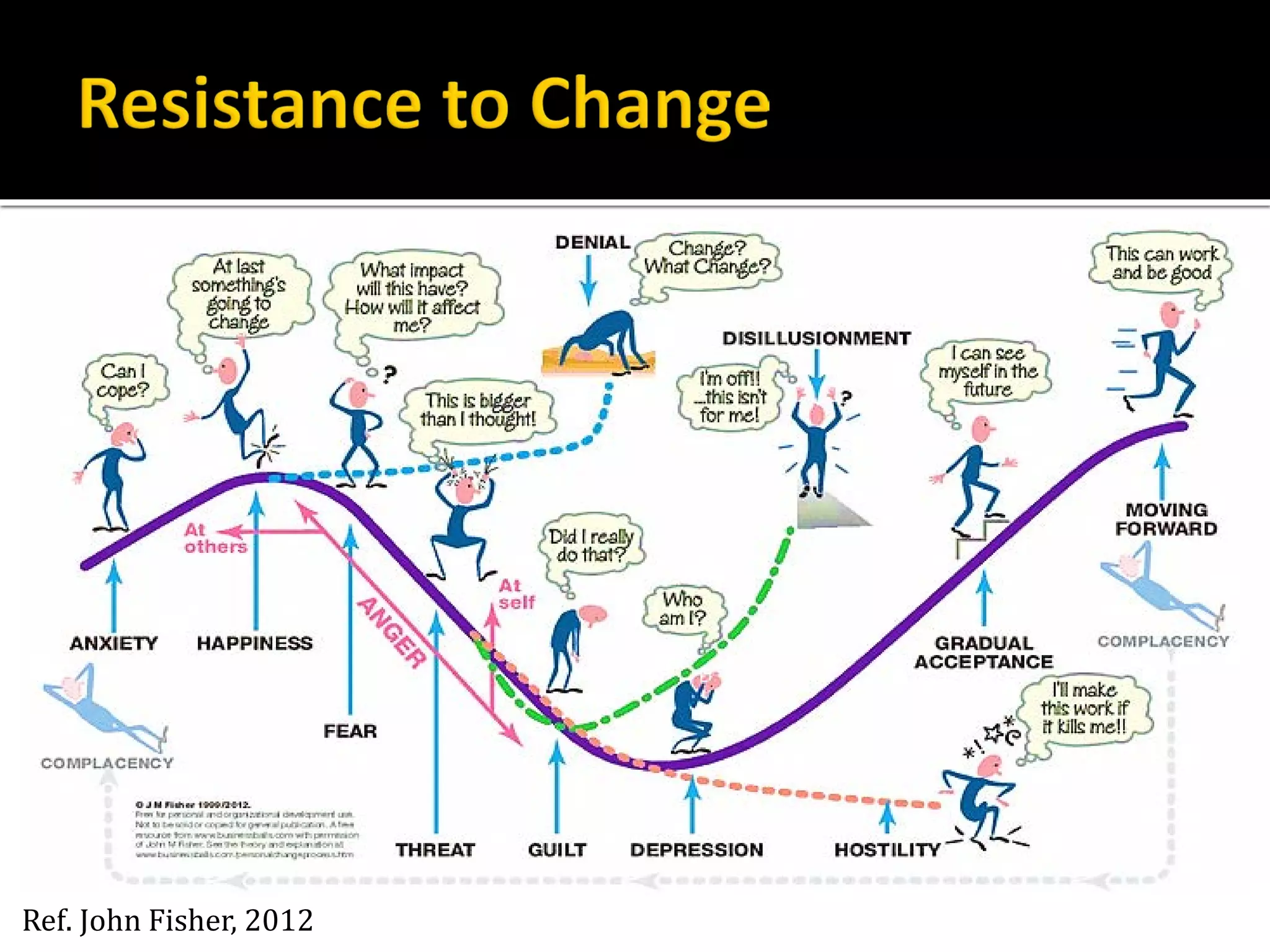
Ref. John Fisher, 2012
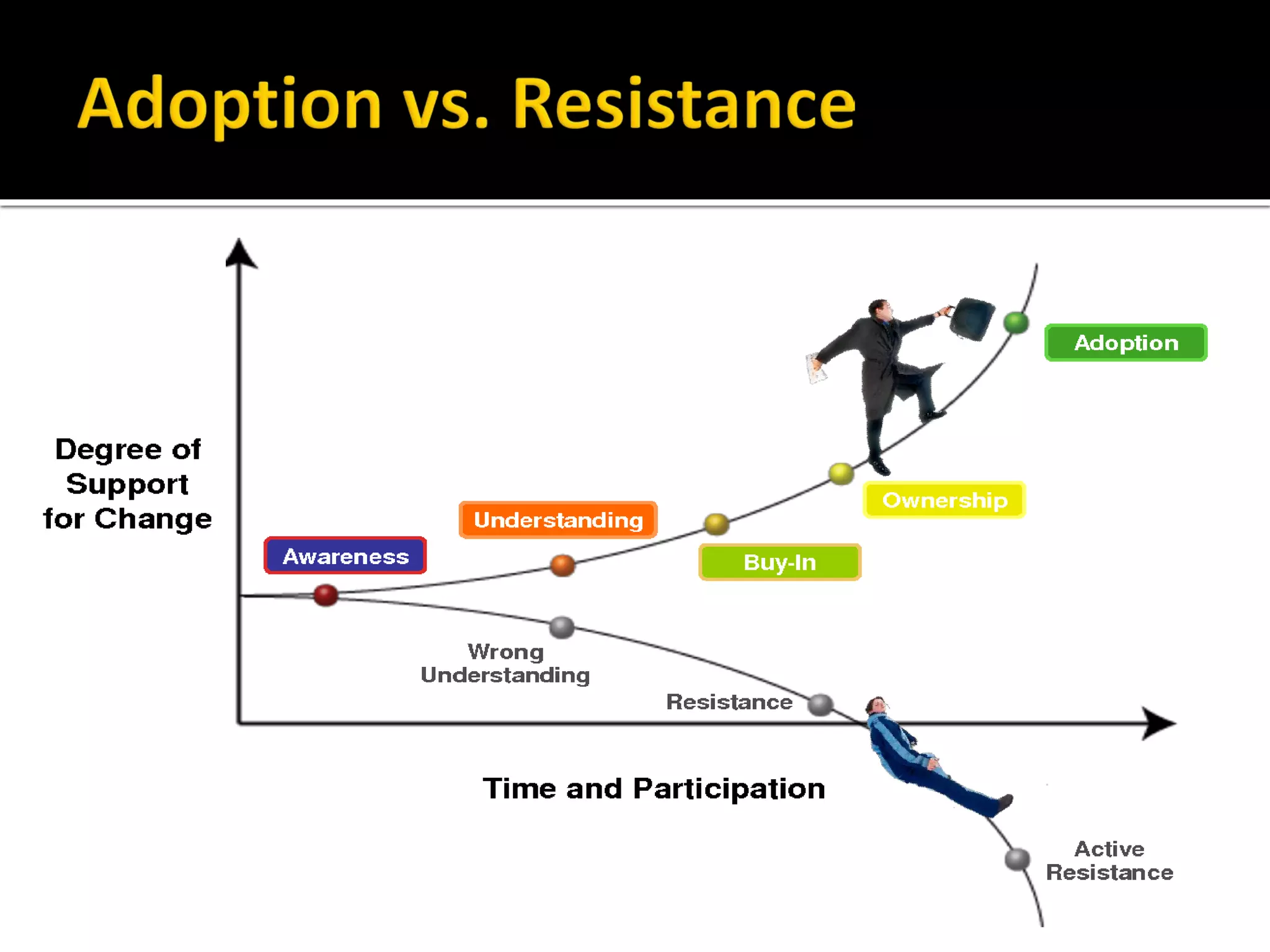
 The ambiguity and uncertainty that change introduces
 The comfort of old habits
 A concern over personal loss of status, money,
authority, friendships, and personal convenience
 The perception that change is incompatible with the
goals and interest of the organization
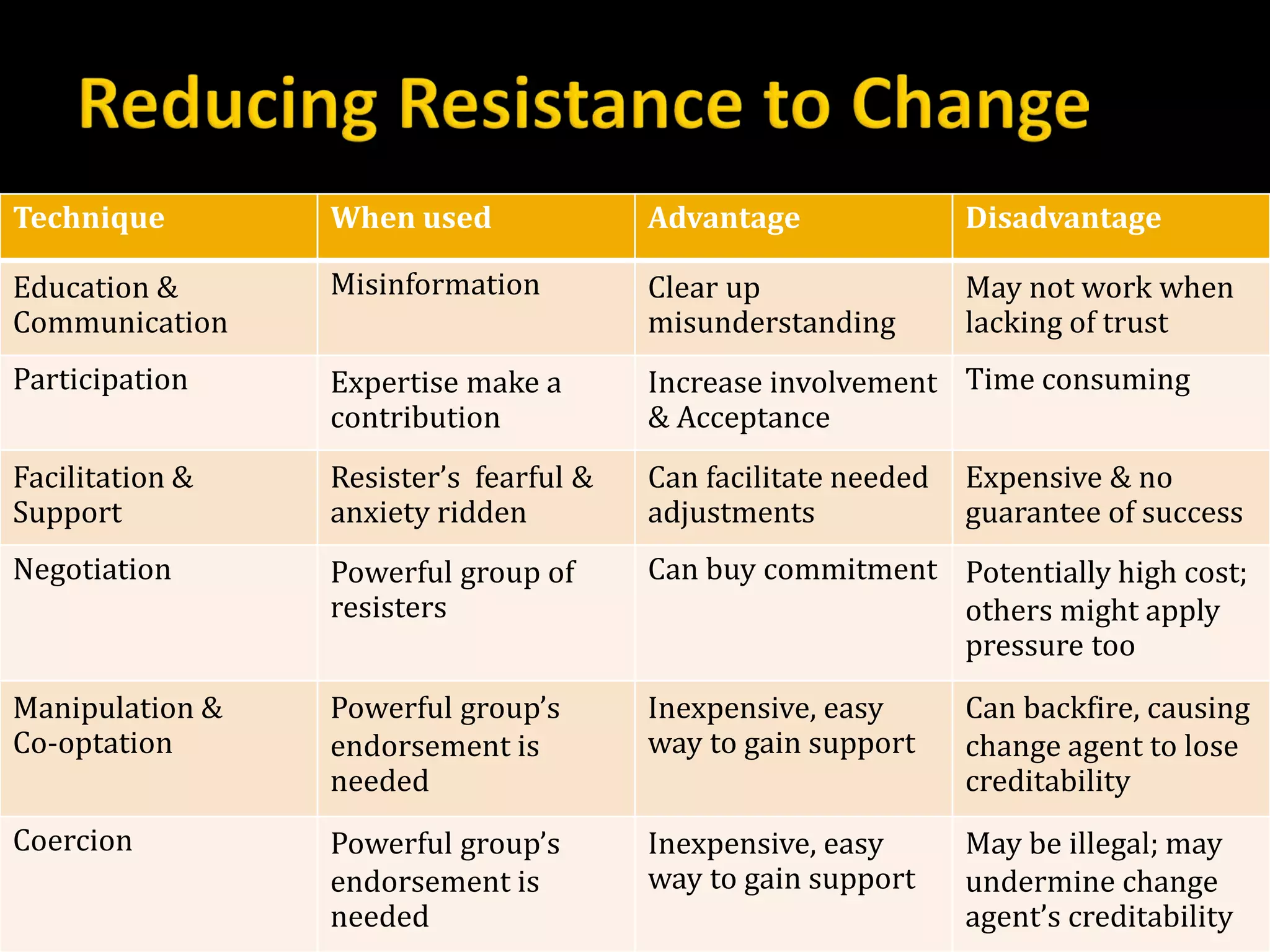
Technique When used Advantage Disadvantage
Education &
Communication
Misinformation Clear up
misunderstanding
May not work when
lacking of trust
Participation Expertise make a
contribution
Increase involvement
& Acceptance
Time consuming
Facilitation &
Support
Resister’s fearful &
anxiety ridden
Can facilitate needed
adjustments
Expensive & no
guarantee of success
Negotiation Powerful group of
resisters
Can buy commitment Potentially high cost;
others might apply
pressure too
Manipulation &
Co-optation
Powerful group’s
endorsement is
needed
Inexpensive, easy
way to gain support
Can backfire, causing
change agent to lose
creditability
Coercion Powerful group’s
endorsement is
needed
Inexpensive, easy
way to gain support
May be illegal; may
undermine change
agent’s creditability
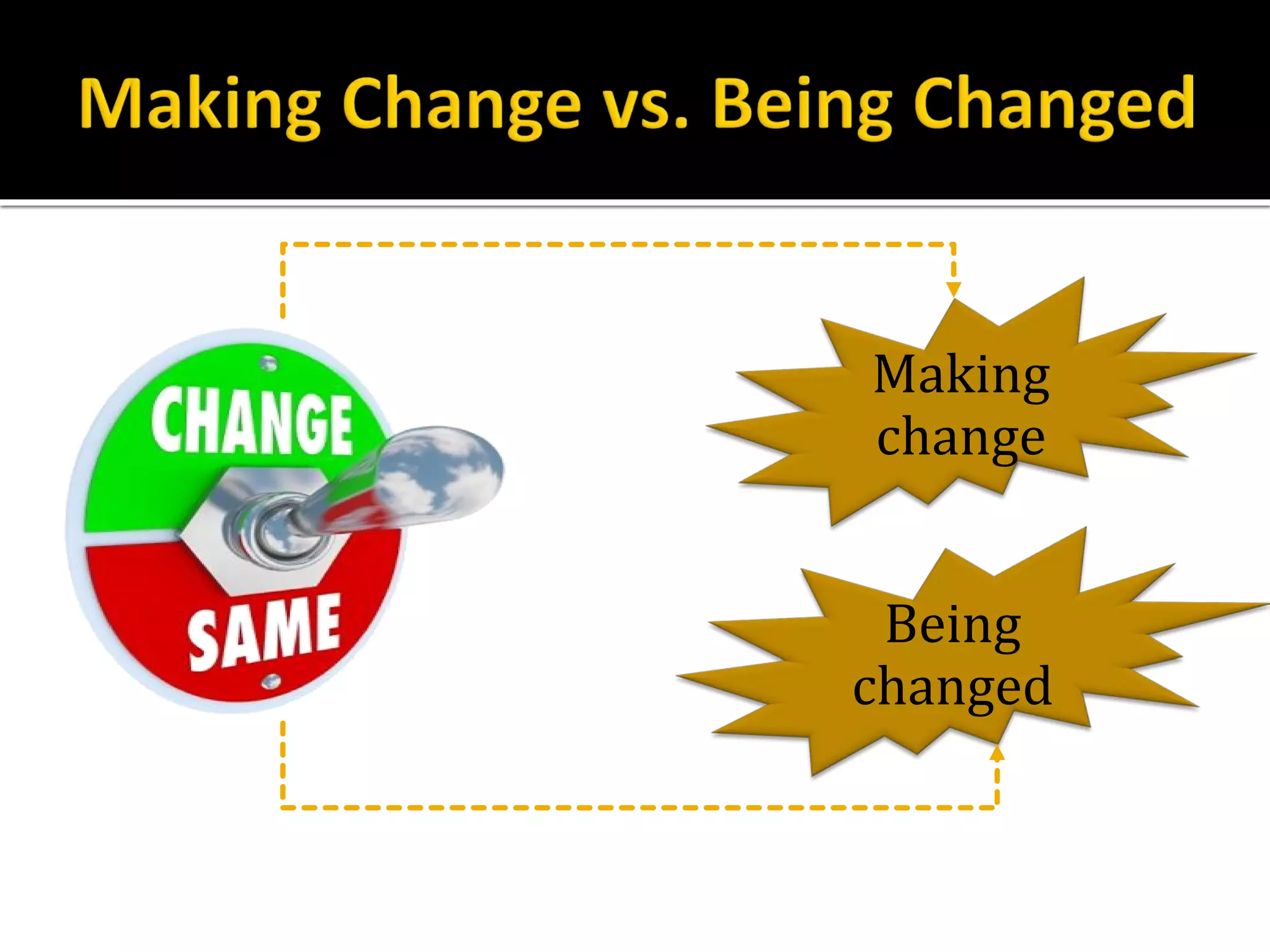
Making
change
Being
changed
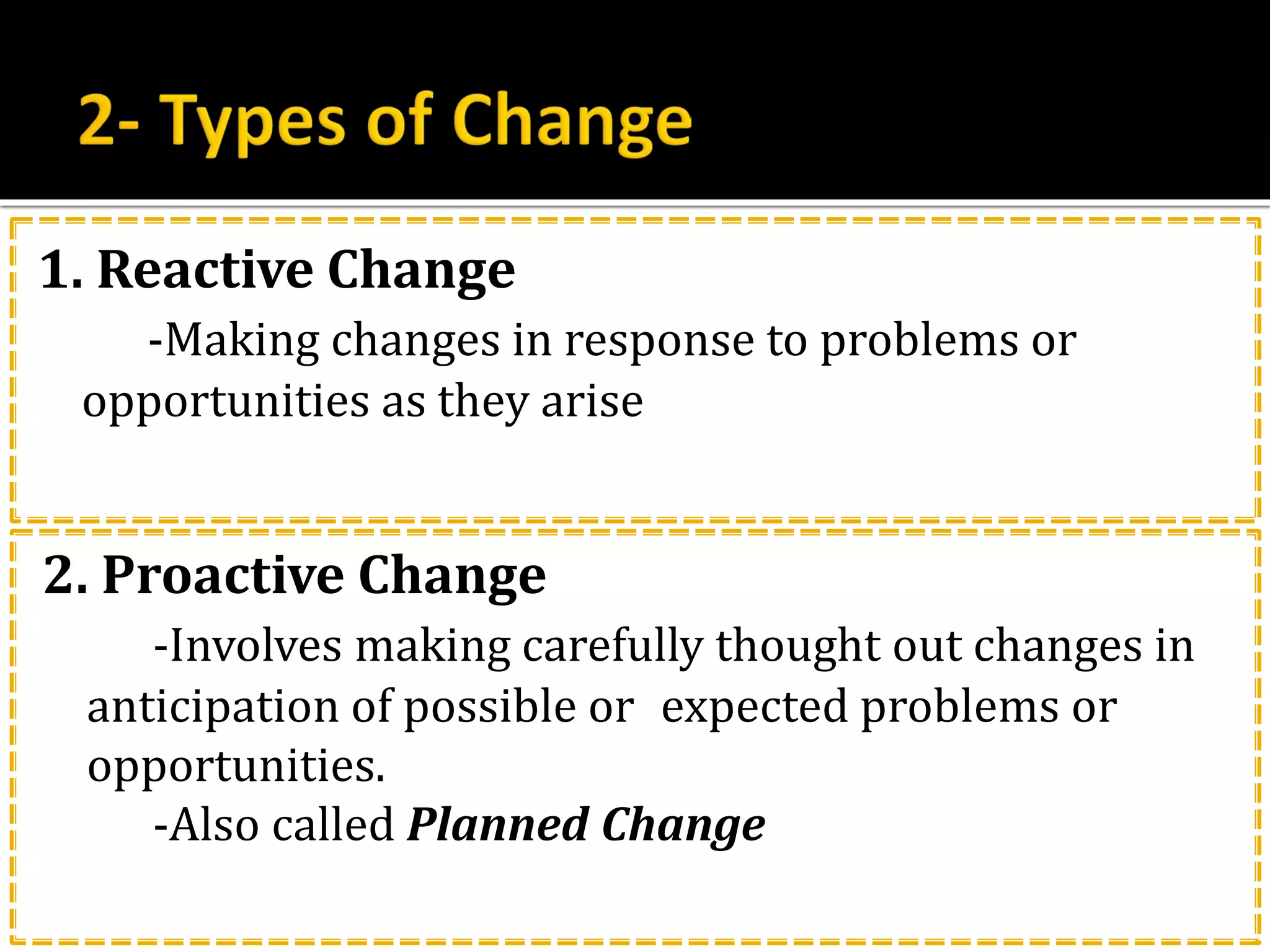
1. Reactive Change
-Making changes in response to problems or
opportunities as they arise
2. Proactive Change
-Involves making carefully thought out changes in
anticipation of possible or expected problems or
opportunities.
-Also called Planned Change
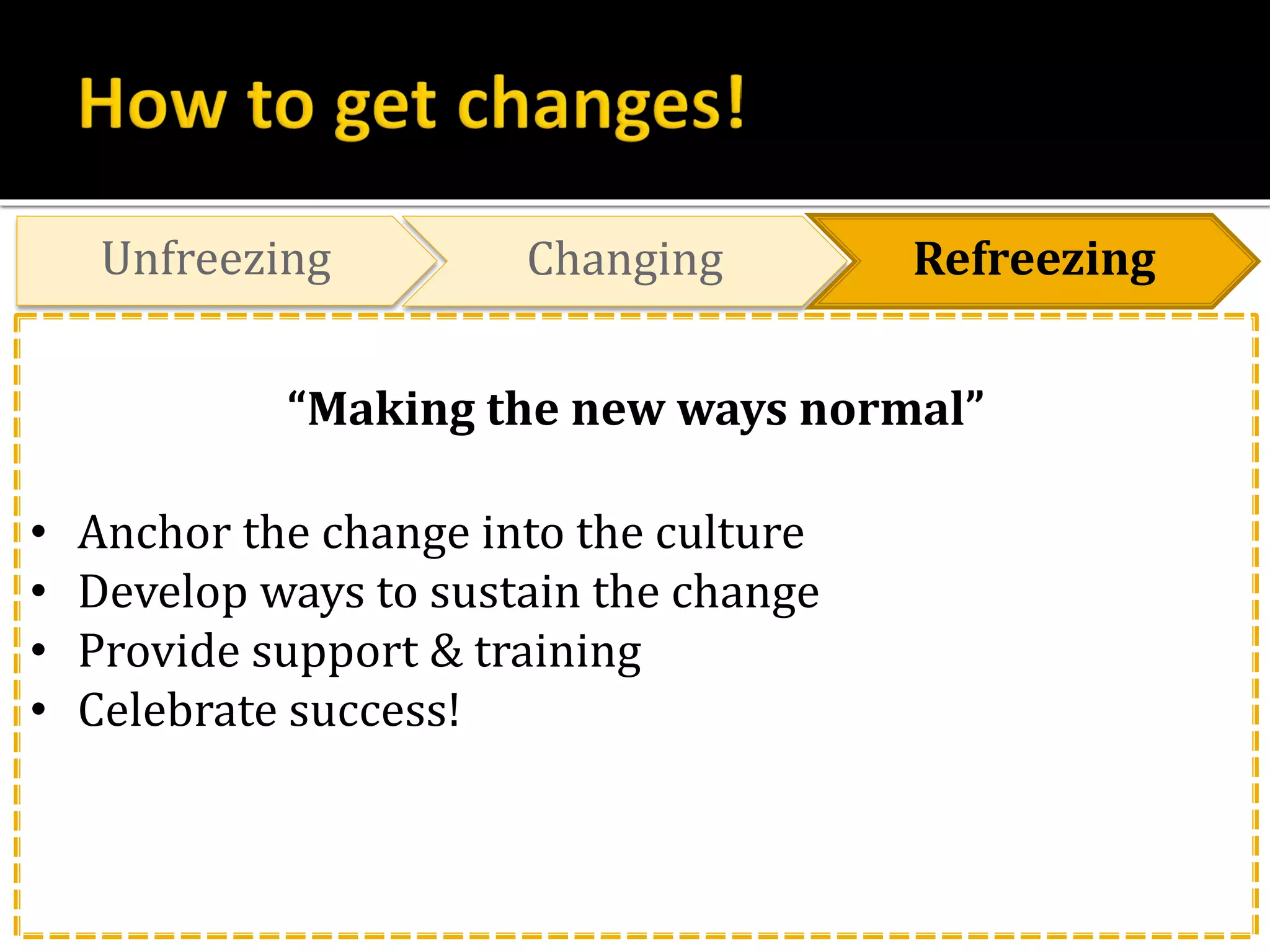
 Unfreezing
“Creating the
motivation to
Change”
 Changing
“Learning new
ways doing
things”
 Refreezing
“Making the
new ways
normal”
Unfreezing Changing Refreezing
“Creating the motivation to Change”
• What needs to change
• Get support
• Create the needs
• Manage & Understand the concerns
Unfreezing Changing Refreezing
“Learning new ways doing things”
• Communicate
• Dispel rumors
• Empower action
• Involve people in the process
Unfreezing Changing Refreezing
“Making the new ways normal”
• Anchor the change into the culture
• Develop ways to sustain the change
• Provide support & training
• Celebrate success!
Unfreezing Changing Refreezing
• Burning Platform:
“Create a crisis or hard data that is difficult to ignore.”
• Challenge: Inspire them to achieve remarkable things.
• Command: Just tell them to move!
• Education: Learn them to change.
• Management by Objectives: Tell them what to do, but not how.
• Restructuring: Redesign the organization to force changes.
• Rites of Passage: Hold a wake to help let go of the past.
• Whole-System Planning: Everyone planning together.
Unfreezing Changing Refreezing
• Boiling the Frog:
“Incremental changes may well not be noticed.”
• Facilitation : Use a facilitator to guide team meetings.
• First Steps or Quick Win: Make it easy to get going.
• Involvement: Give them an important role.
• Re-education: Train the people you have in new
knowledge.
• Shift-and-Sync: Change a bit then pause restabilize.
Unfreezing Changing Refreezing
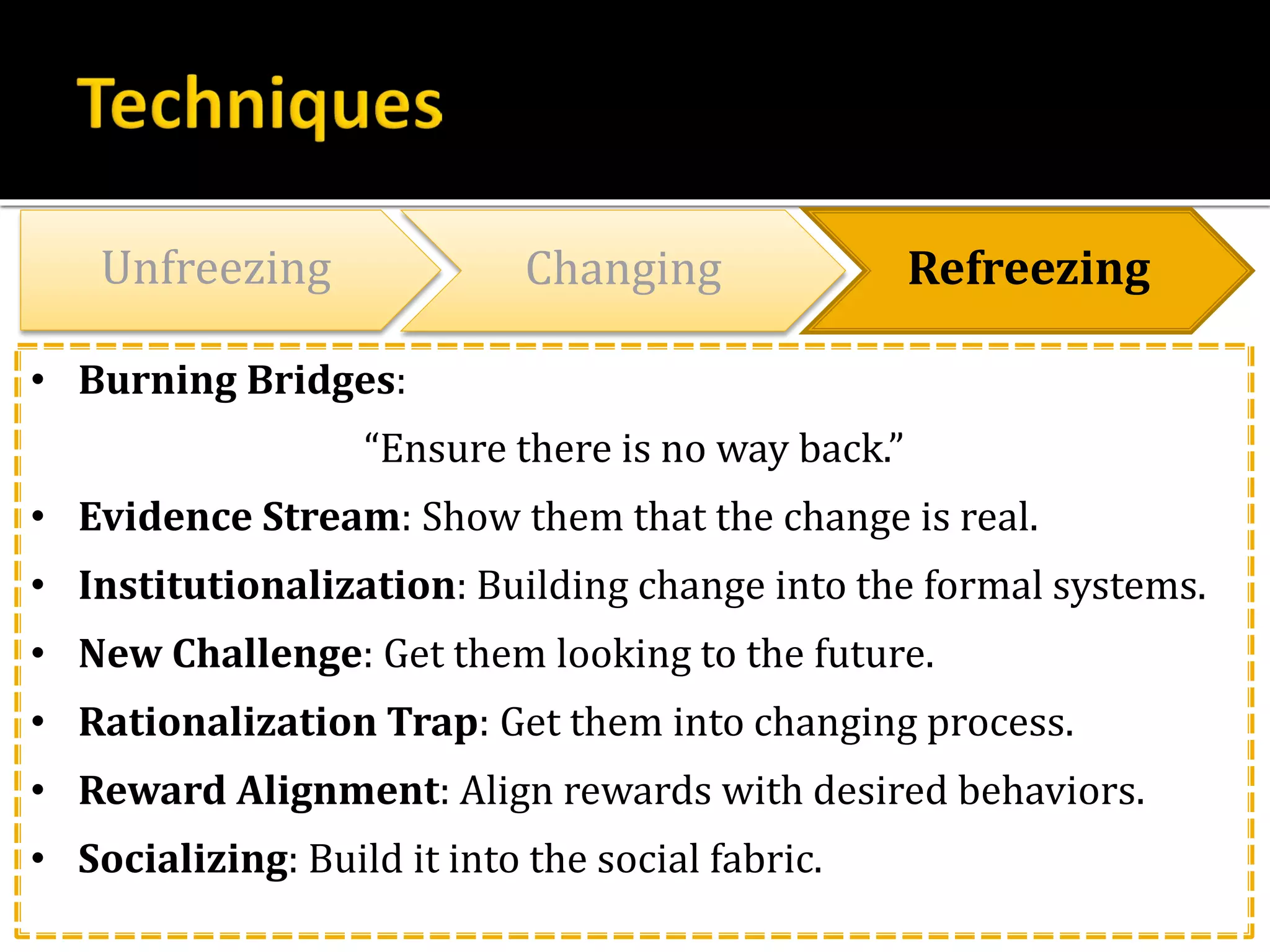
• Burning Bridges:
“Ensure there is no way back.”
• Evidence Stream: Show them that the change is real.
• Institutionalization: Building change into the formal systems.
• New Challenge: Get them looking to the future.
• Rationalization Trap: Get them into changing process.
• Reward Alignment: Align rewards with desired behaviors.
• Socializing: Build it into the social fabric.
Dr. Kotter observed that…
“The rate at which our world is changing is increasing,
But
Our Ability to keep up with it is not!”
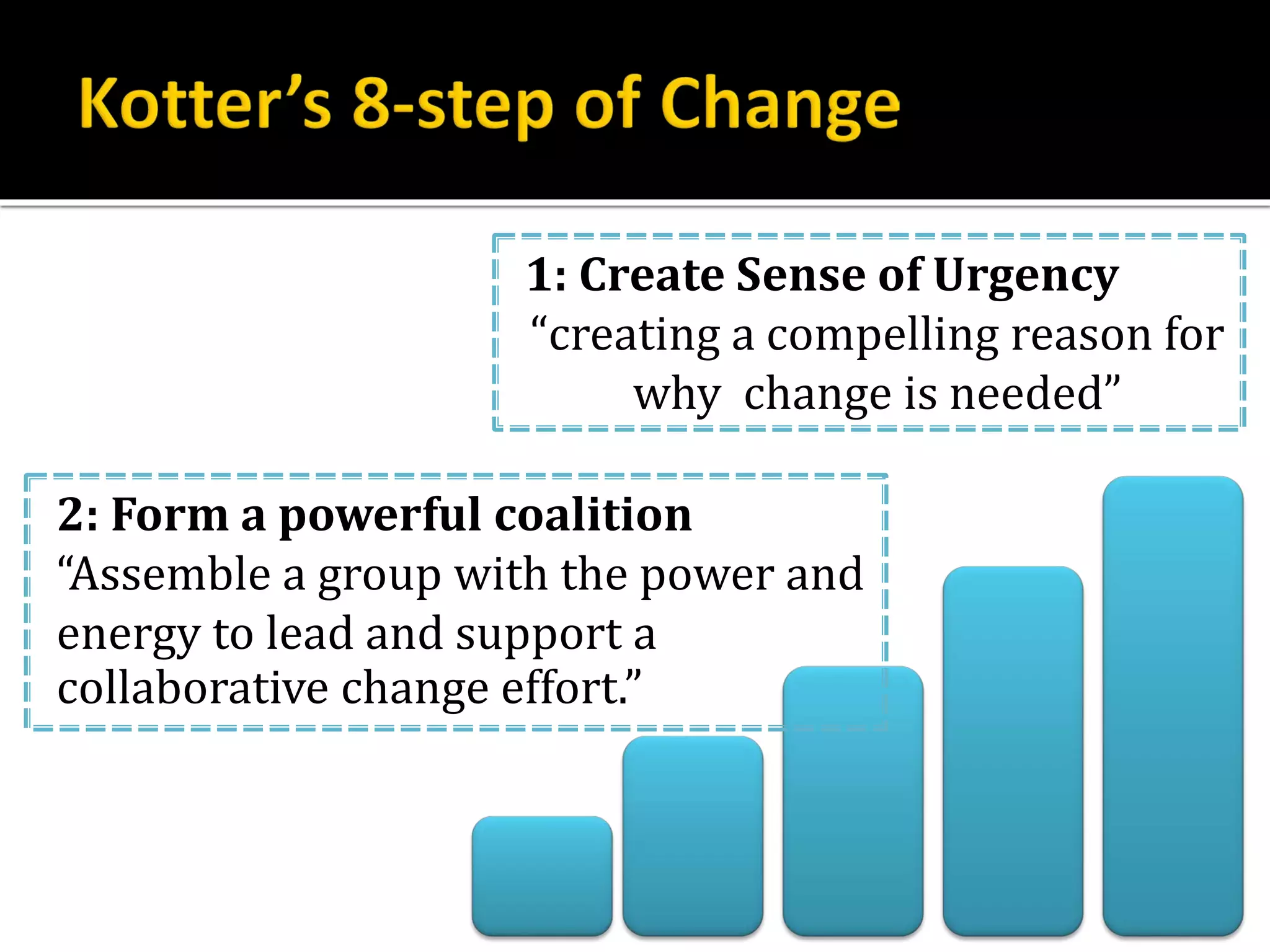
1: Create Sense of Urgency
“creating a compelling reason for
why change is needed”
2: Form a powerful coalition
“Assemble a group with the power and
energy to lead and support a
collaborative change effort.”
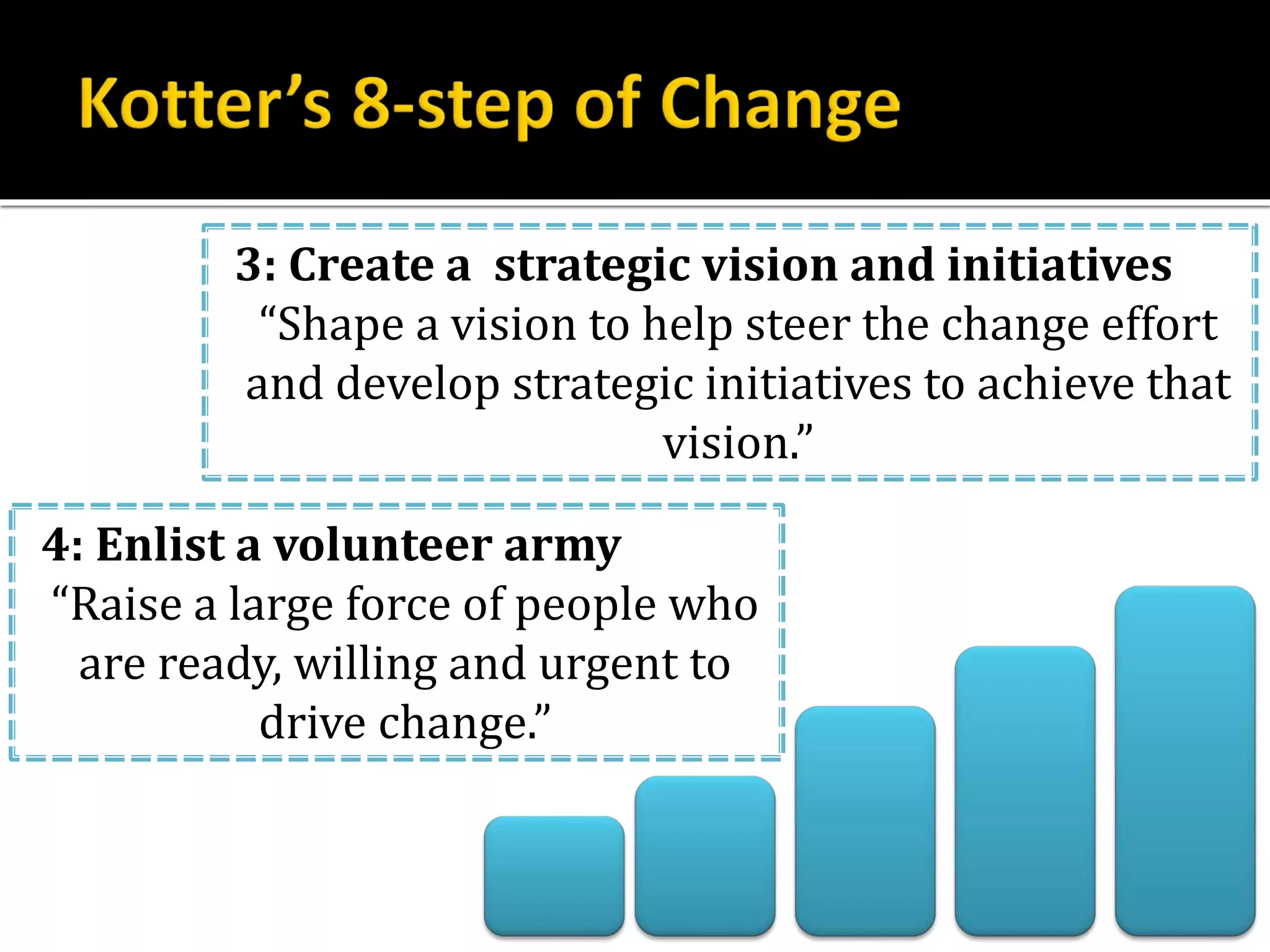
3: Create a strategic vision and initiatives
“Shape a vision to help steer the change effort
and develop strategic initiatives to achieve that
vision.”
4: Enlist a volunteer army
“Raise a large force of people who
are ready, willing and urgent to
drive change.”
5: Removing barriers
“Remove obstacles to
change.”
6: Generate short term win
“Consistently produce, track,
evaluate and celebrate volumes
of small and large
accomplishments.”
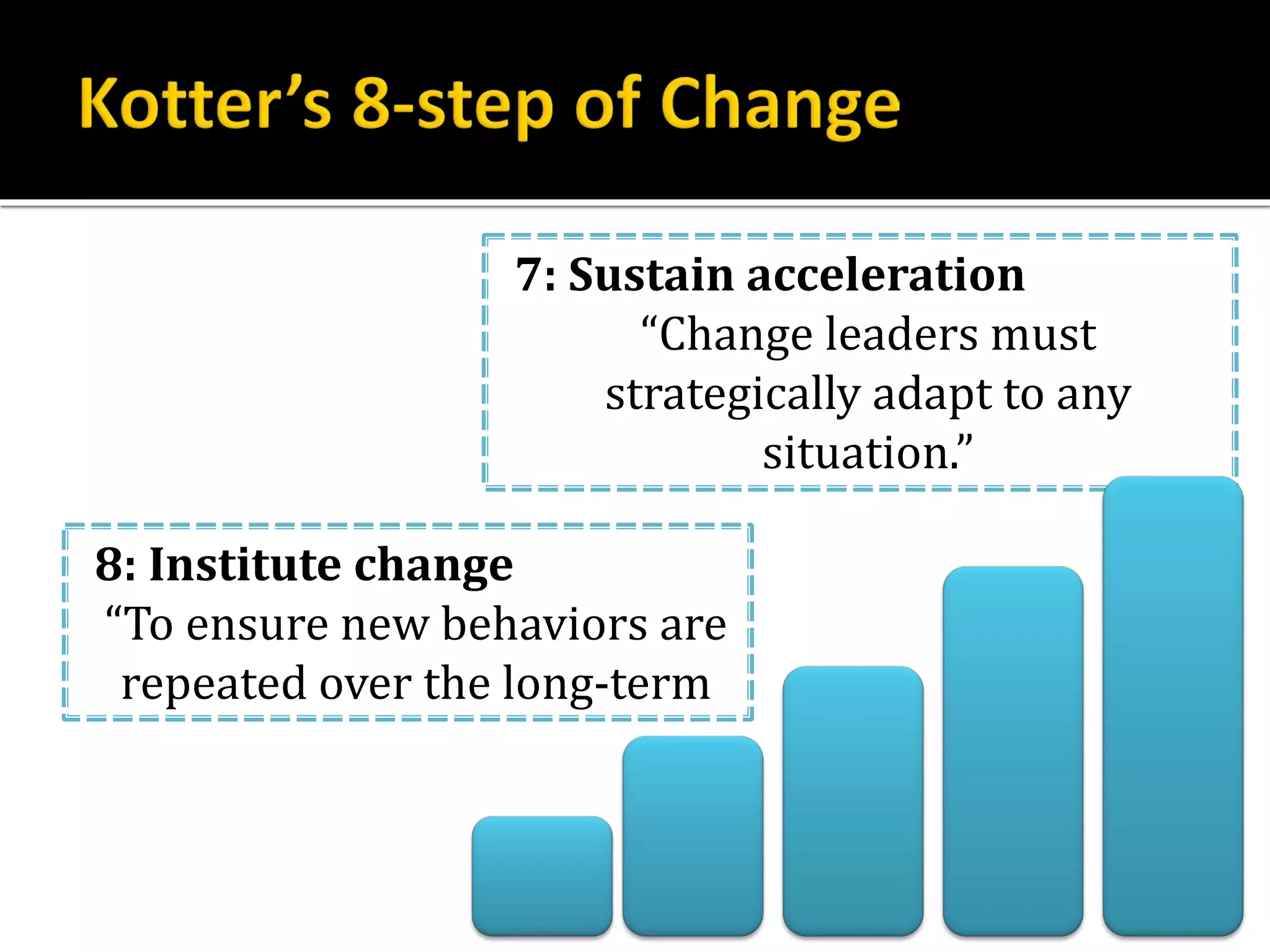
7: Sustain acceleration
“Change leaders must
strategically adapt to any
situation.”
8: Institute change
“To ensure new behaviors are
repeated over the long-term
• Planning
• Budgeting
• Organizing
• Staffing
• Problem solving
• Measuring
• Doing what we know
how to do
• Producing dependable
reliable results
• Establishing direction
• Aligning people
• Motivating
• Inspiring
• Mobilizing people to
achieve astonishing
results
• Propelling us to the
future
Management Leadership
1. Diagnosis
-What is the
Problem?
2. Intervention
-What should
we do about it?
3. Evaluation
- How well has
the intervention
worked?
4. Feedback
-How can the
diagnosis be
further refined?
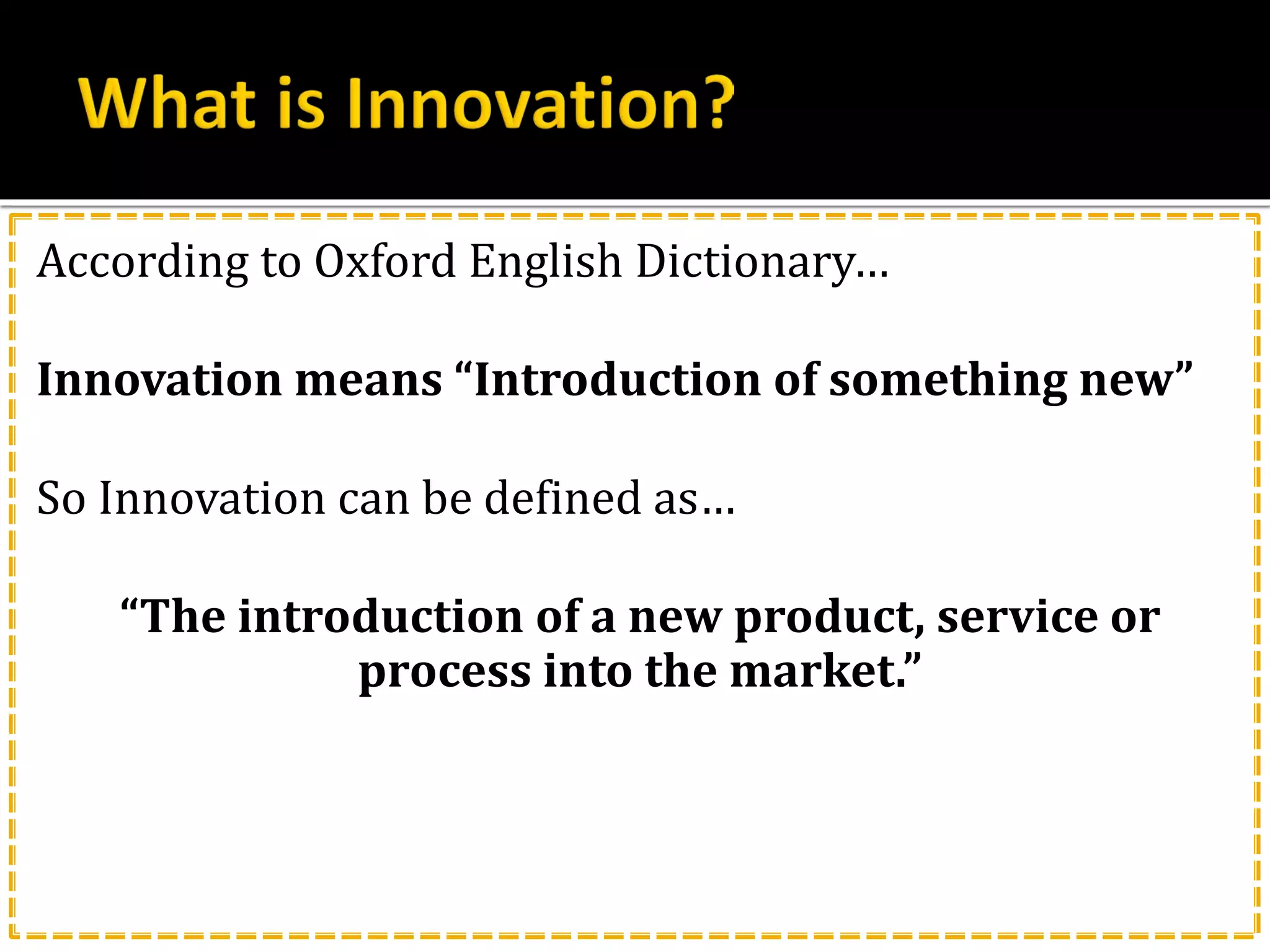
According to Oxford English Dictionary…
Innovation means “Introduction of something new”
So Innovation can be defined as…
“The introduction of a new product, service or
process into the market.”
Creativity - the ability to combine ideas in a unique way
or to make an unusual association.
Innovation - turning the outcomes of the creative
process into useful products, services, or work methods.
Idea Champions - individuals who actively and
enthusiastically support new ideas, overcome resistance,
and ensure that innovations are implemented.
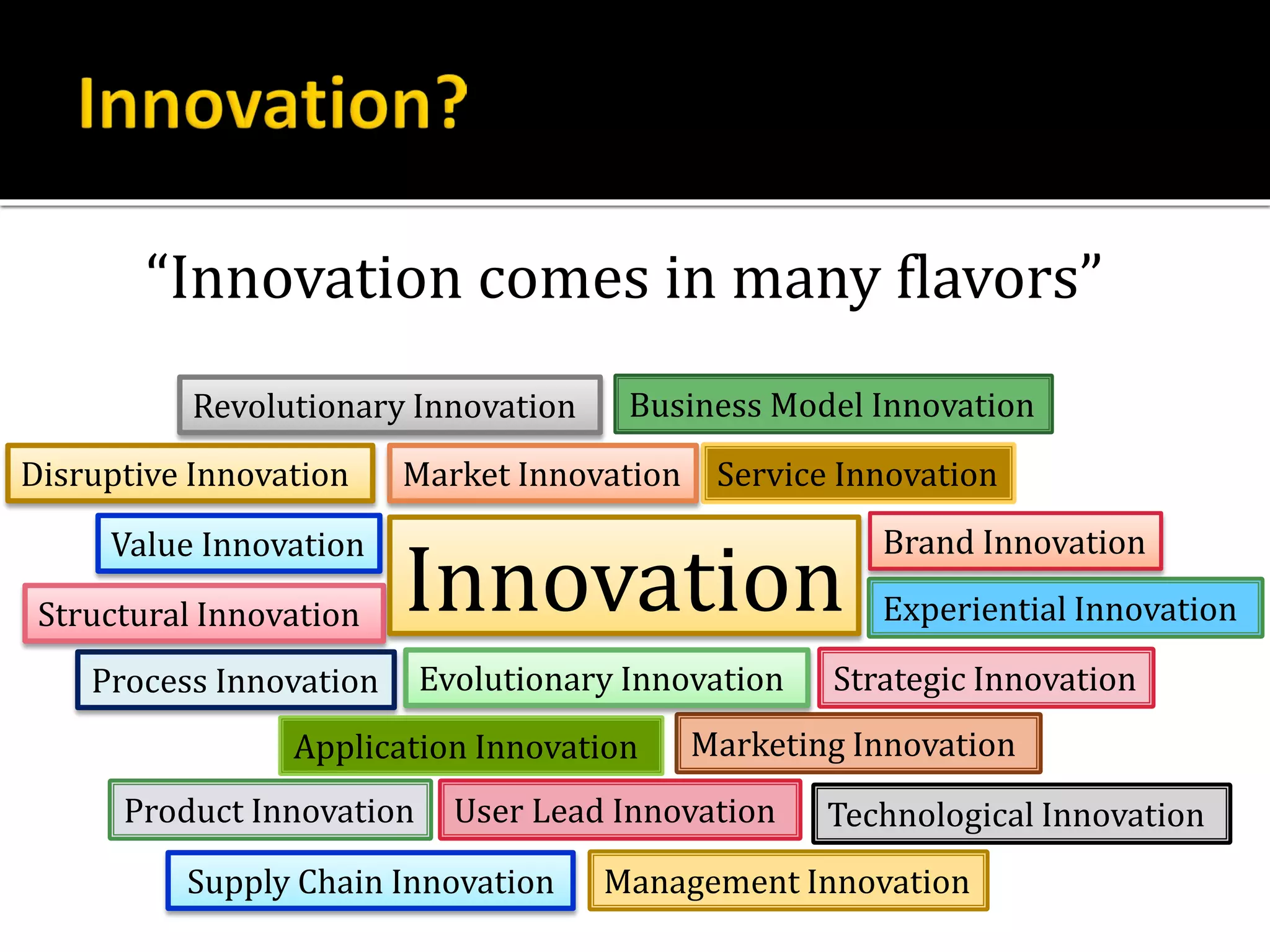
Management Innovation
Strategic Innovation
Business Model Innovation
Value Innovation
Product Innovation
Service InnovationMarket Innovation
Process Innovation
Technological Innovation
Disruptive Innovation
Application Innovation
Experiential Innovation
Marketing Innovation
Structural Innovation
Brand Innovation
User Lead Innovation
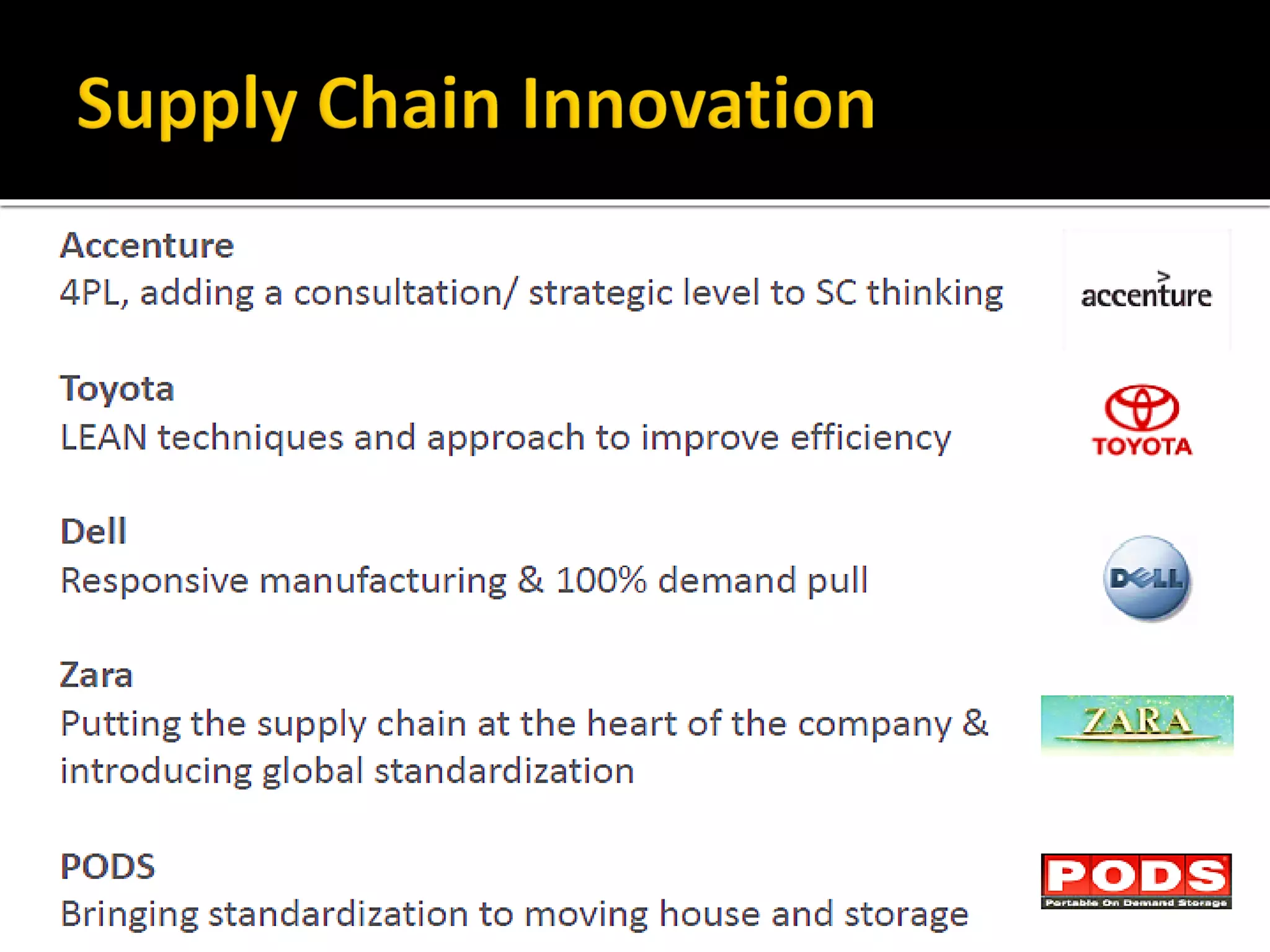
Supply Chain Innovation
Evolutionary Innovation
Revolutionary Innovation
Innovation
“Innovation comes in many flavors”
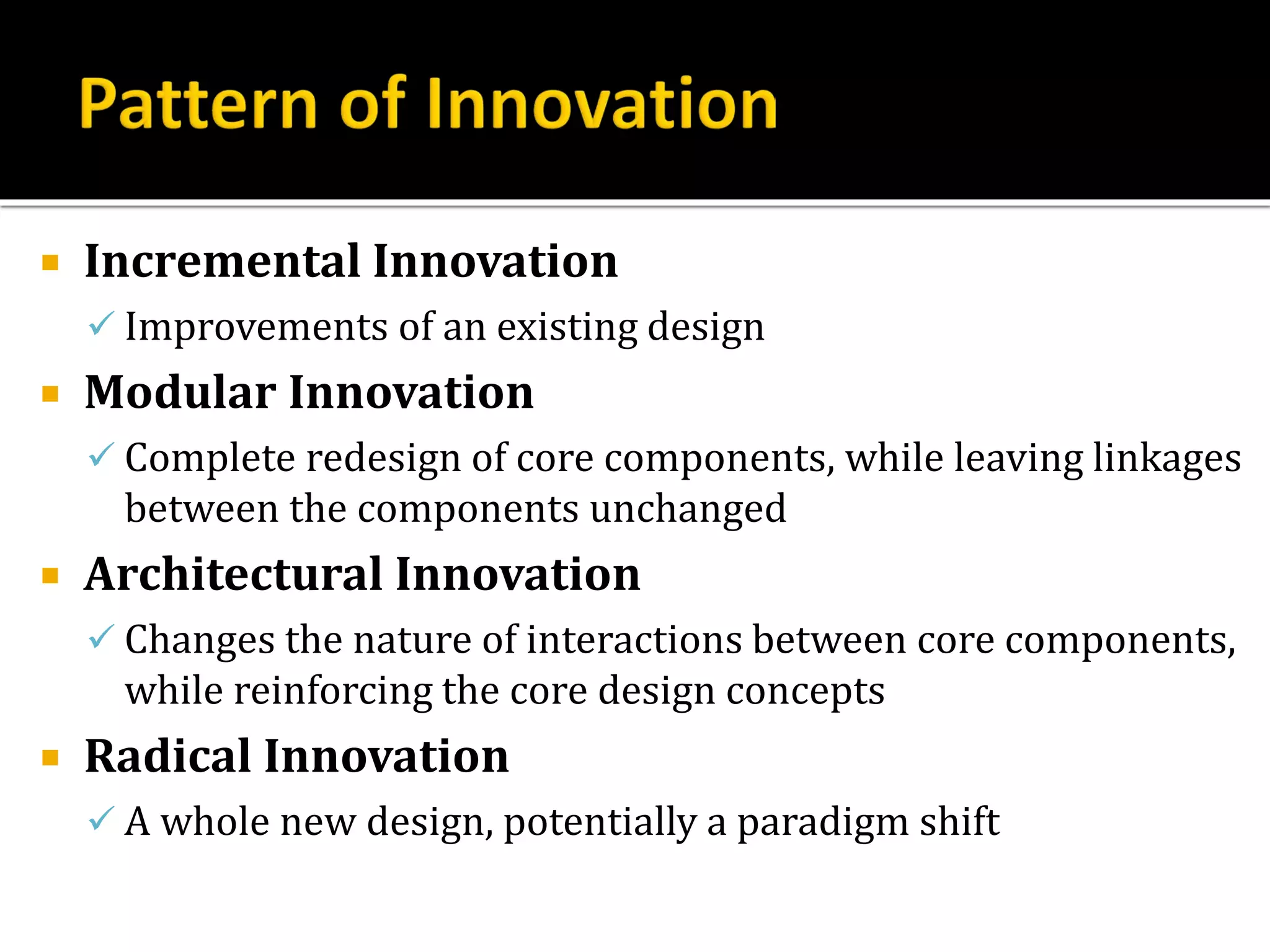
 Incremental Innovation
 Improvements of an existing design
 Modular Innovation
 Complete redesign of core components, while leaving linkages
between the components unchanged
 Architectural Innovation
 Changes the nature of interactions between core components,
while reinforcing the core design concepts
 Radical Innovation
 A whole new design, potentially a paradigm shift
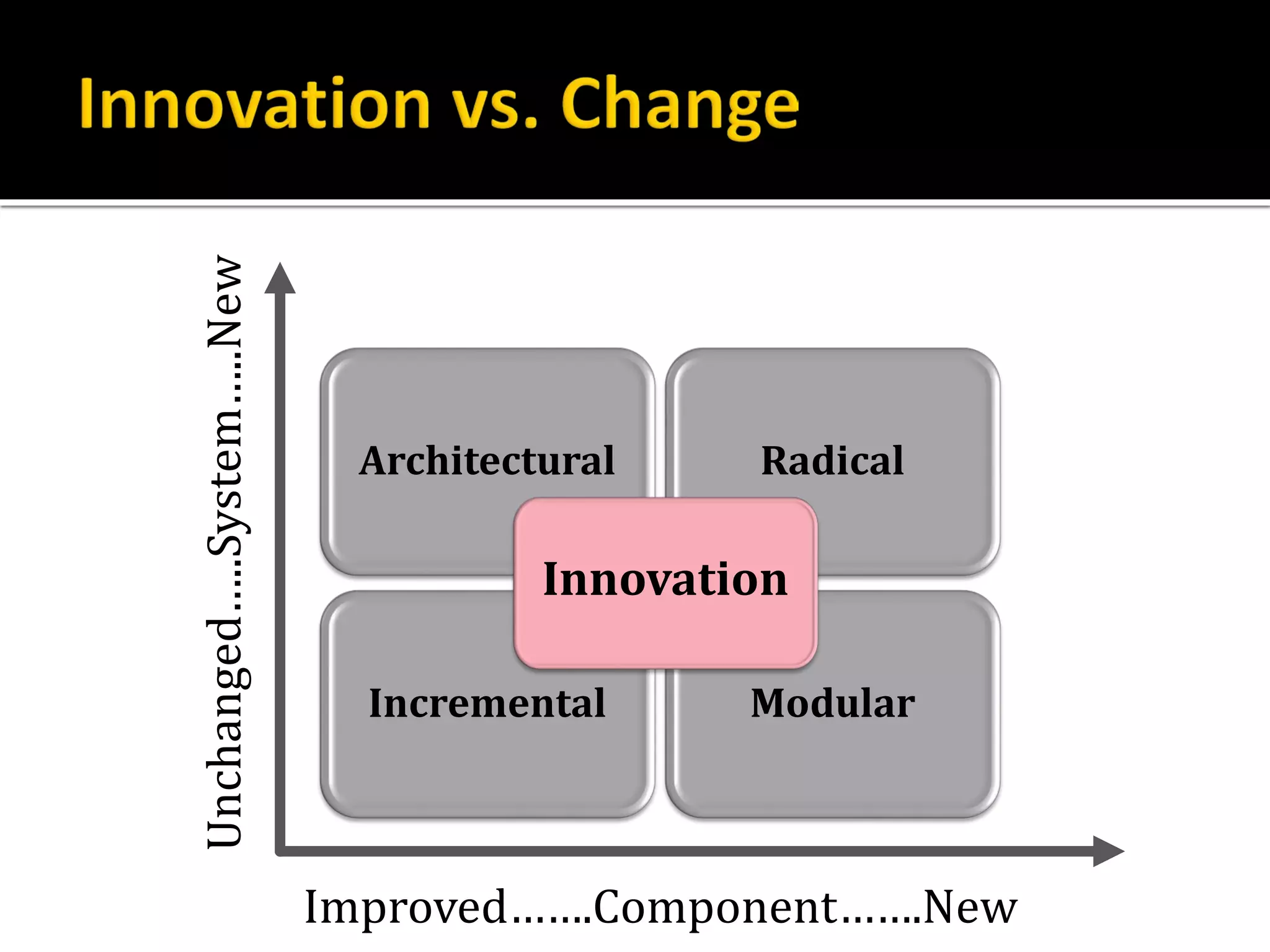
Architectural Radical
Incremental Modular
Innovation
Improved…….Component…….New
Unchanged…..System…..New
 Cassette-tape Sony Walkman sold an astonishing
186 million unit in its first 20 years of existence
 iPod, a digital music player weighed 6.5 ounces and
held 1000 songs with cost $400 (much more than
existing digital players)
 iPod skeptically might be acronym for “Idiots Price
Our Devices”
 1.4 million iPods have been sold (claimed No 1 in Jul
and Aug)
 it's harder to nail down whether the
key is what's inside it, the external appearance or even
the way these work together
Internal
External
DiscontinuousContinuous
Management
Innovation
Operational
Innovation
Product &
Service
Innovation
Strategic
Innovation
Internal
External
DiscontinuousContinuous
Management
Innovation
Operational
Innovation
Product &
Service
Innovation
Strategic
Innovation
Processes
Technological innovation
Disruptive Innovation
Blue Ocean Strategy
New offerings
Partner interfaces
Internal structures and processes
People Management
Channels
Brand
Networking
Supply Chain
Technological innovation
New markets
Innovation
Master Plan
Why?
“Strategy”
What?
“Portfolio”
How?
“Process”
Who?
“Culture”
Where?
“Infra-Str.”
www.innovationlab.com
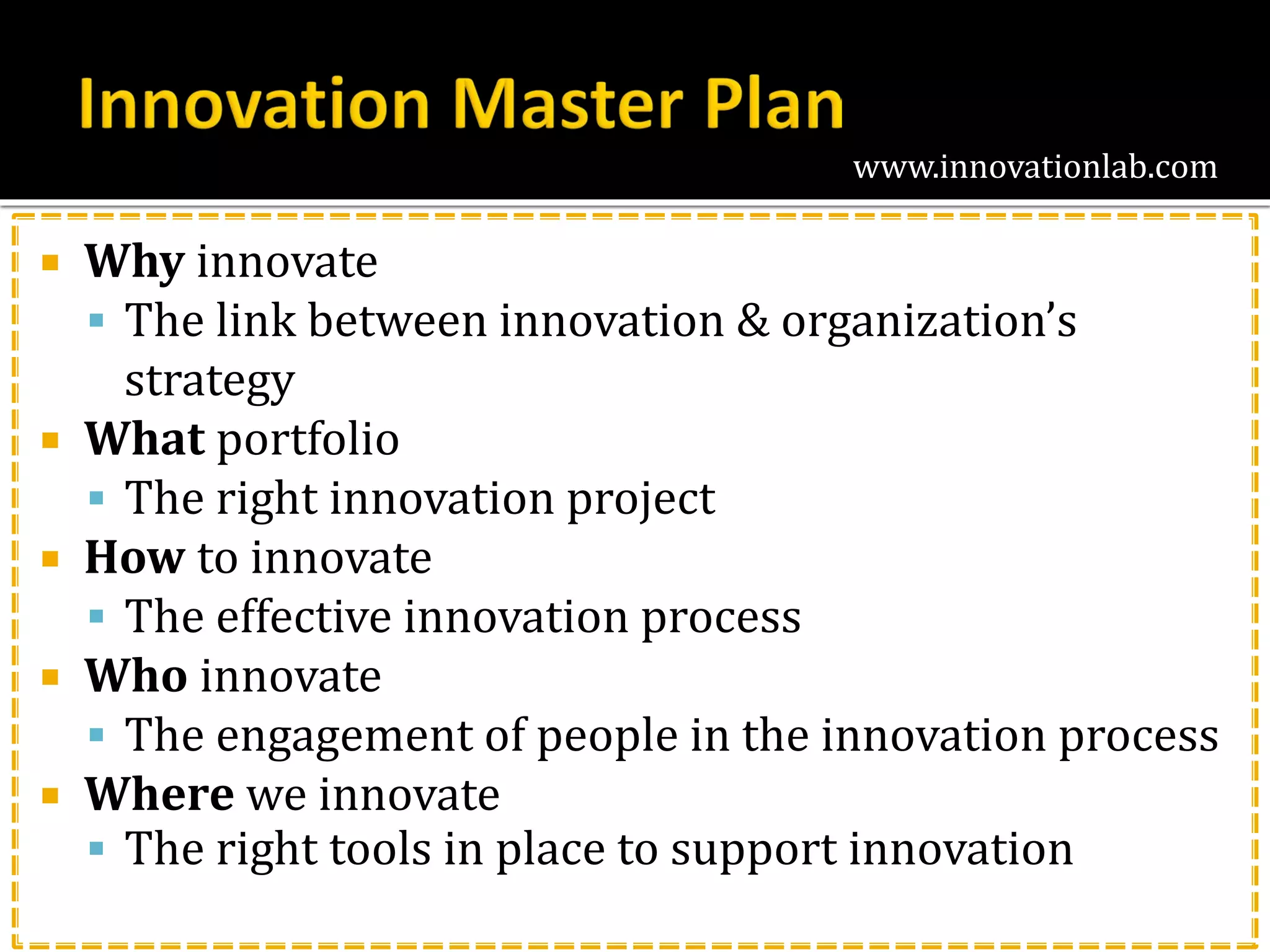
 Why innovate
 The link between innovation & organization’s
strategy
 What portfolio
 The right innovation project
 How to innovate
 The effective innovation process
 Who innovate
 The engagement of people in the innovation process
 Where we innovate
 The right tools in place to support innovation
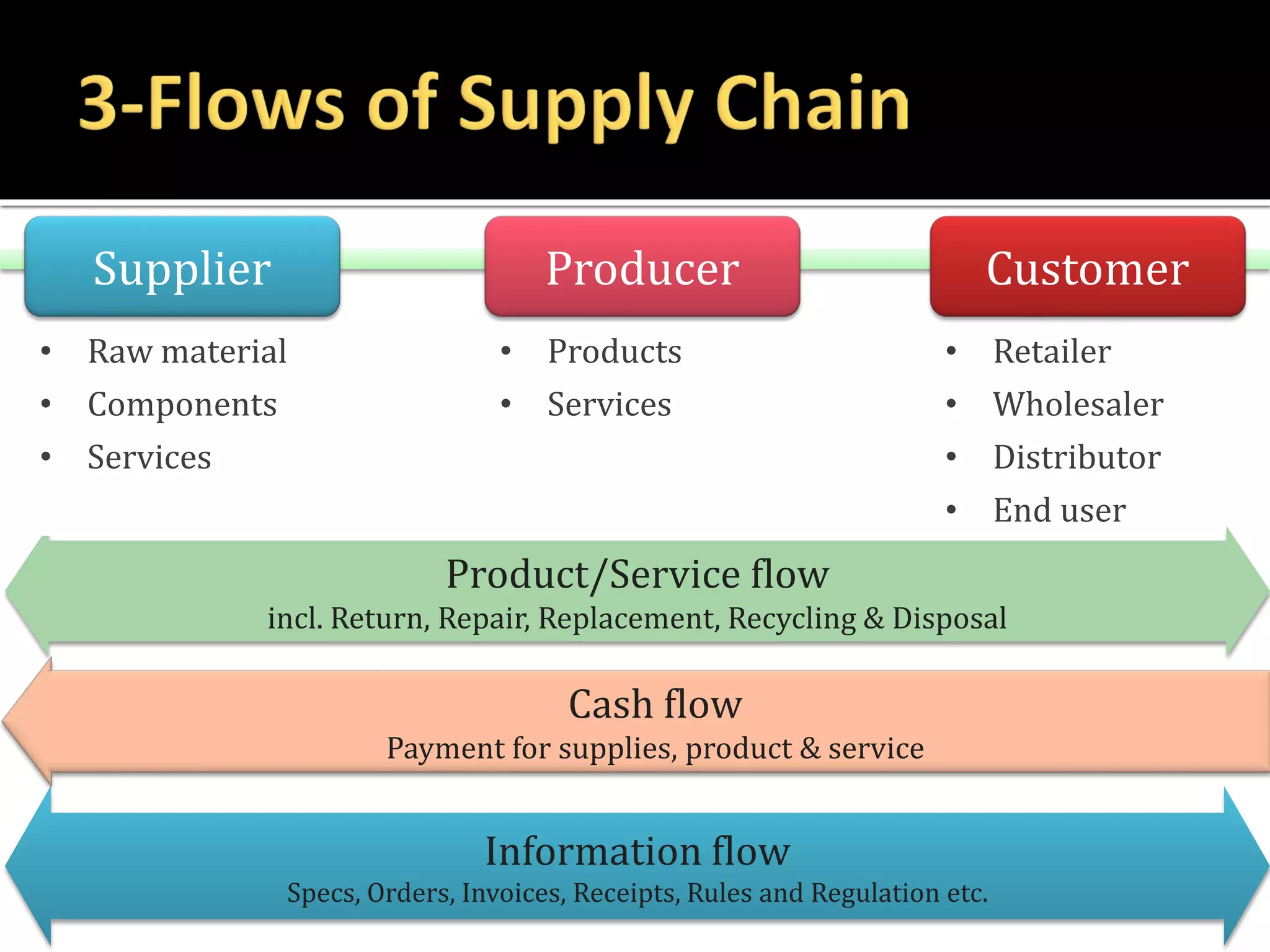
Supplier Producer Customer
• Raw material
• Components
• Services
• Products
• Services
• Retailer
• Wholesaler
• Distributor
• End user
Logistics and Supply Chain Management:
• To have the Right Product
• In the Right Quantity
• At the Right Place
• At the Right Time
• With the Right Cost
Quali
ty
Cost
Basic Supply Chain Structure
Information flow
Specs, Orders, Invoices, Receipts, Rules and Regulation etc.
Product/Service flow
incl. Return, Repair, Replacement, Recycling & Disposal
Cash flow
Payment for supplies, product & service
Supplier Producer Customer
• Raw material
• Components
• Services
• Products
• Services
• Retailer
• Wholesaler
• Distributor
• End user
Source: BVL international, 2013
Technology
Technology investment
Process
Control, Standard, Integrated
planning
Network
Vertical & Horizontal Cooperation
People
Talent mgt.
Rapid decision making
Raw Material
Consumer
Manufacturer
Disposal
Retailer
P
S D
P
S DM
P
S D
P
S D
P
S D
Excellent
Operations
Extended
Service
Advanced
Service
“Start from the fundamental & compulsory activities
with consistency, efficiency and seamless execution”
 Spend management: Targeting price and finance
 Direct contracting: Securing contracts for all spend
 Logistics services: Optimizing product flows
 Inventory management: Establishing efficient
inventory deployment
 Information management: Fully deploying IT
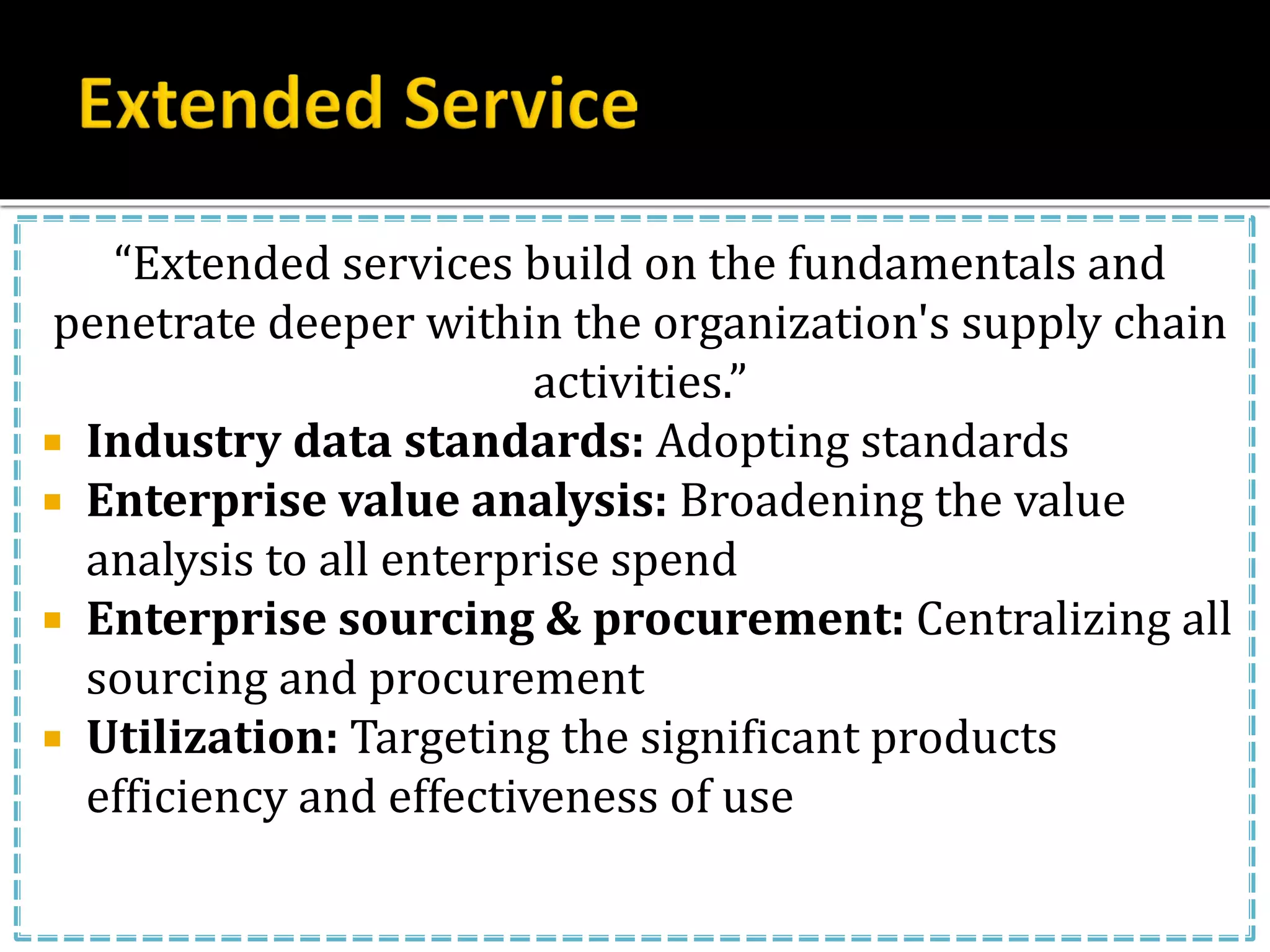
“Extended services build on the fundamentals and
penetrate deeper within the organization's supply chain
activities.”
 Industry data standards: Adopting standards
 Enterprise value analysis: Broadening the value
analysis to all enterprise spend
 Enterprise sourcing & procurement: Centralizing all
sourcing and procurement
 Utilization: Targeting the significant products
efficiency and effectiveness of use
“Continuing the advancement in providing supply chain
competencies”
 Supplier synchronization: Implementing strategic
programs to lower total cost for both parties
 Product assembly: Exploring the self-assembly
 Regional cooperatives: Affiliating with other entities
in supply chain
 Procure-to-pay: Consolidating the cycle management
from purchase order to payables
 Shared services: establishing a central operation for
all enterprise supply chain activities
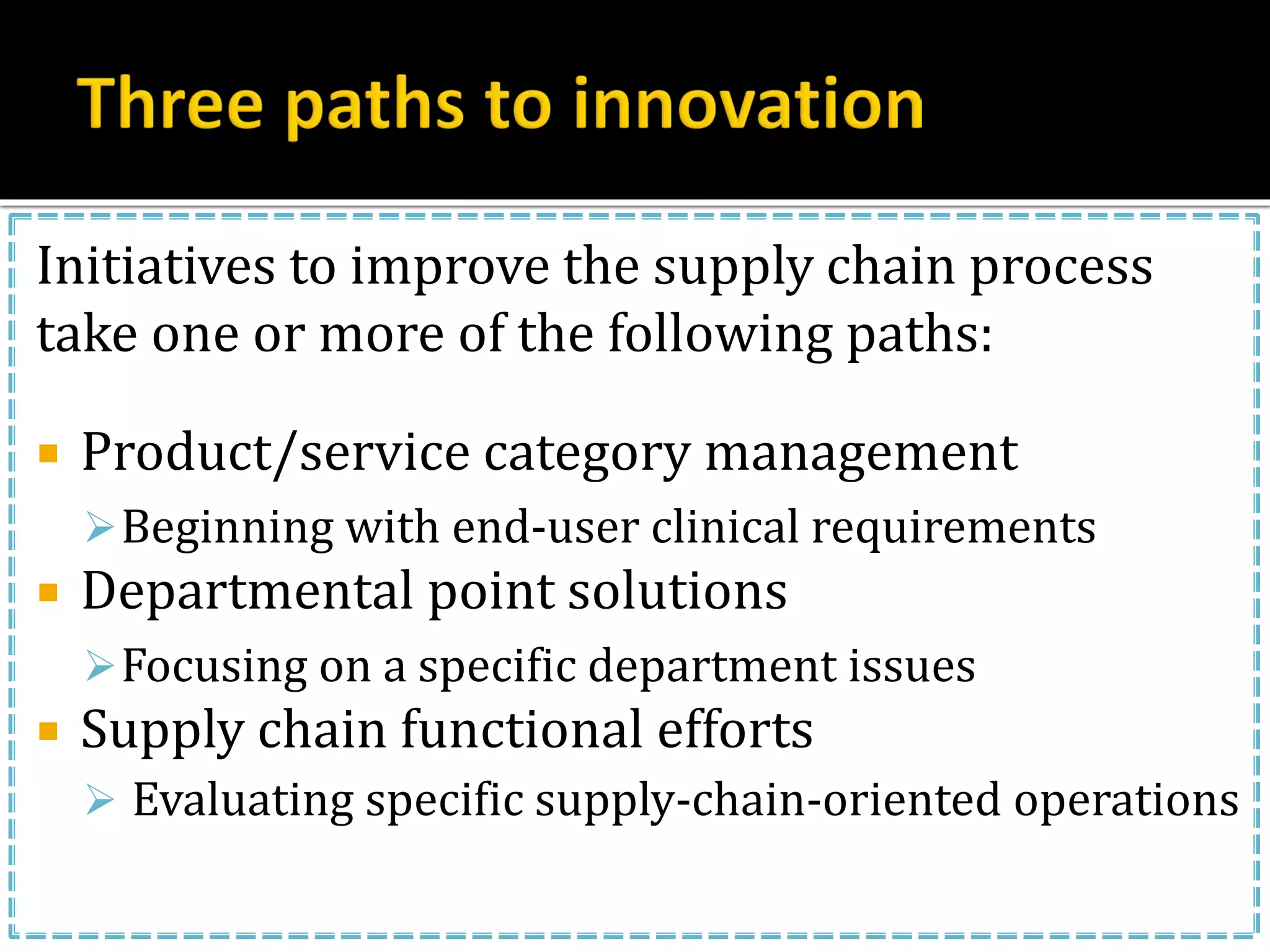
Initiatives to improve the supply chain process
take one or more of the following paths:
 Product/service category management
Beginning with end-user clinical requirements
 Departmental point solutions
Focusing on a specific department issues
 Supply chain functional efforts
 Evaluating specific supply-chain-oriented operations
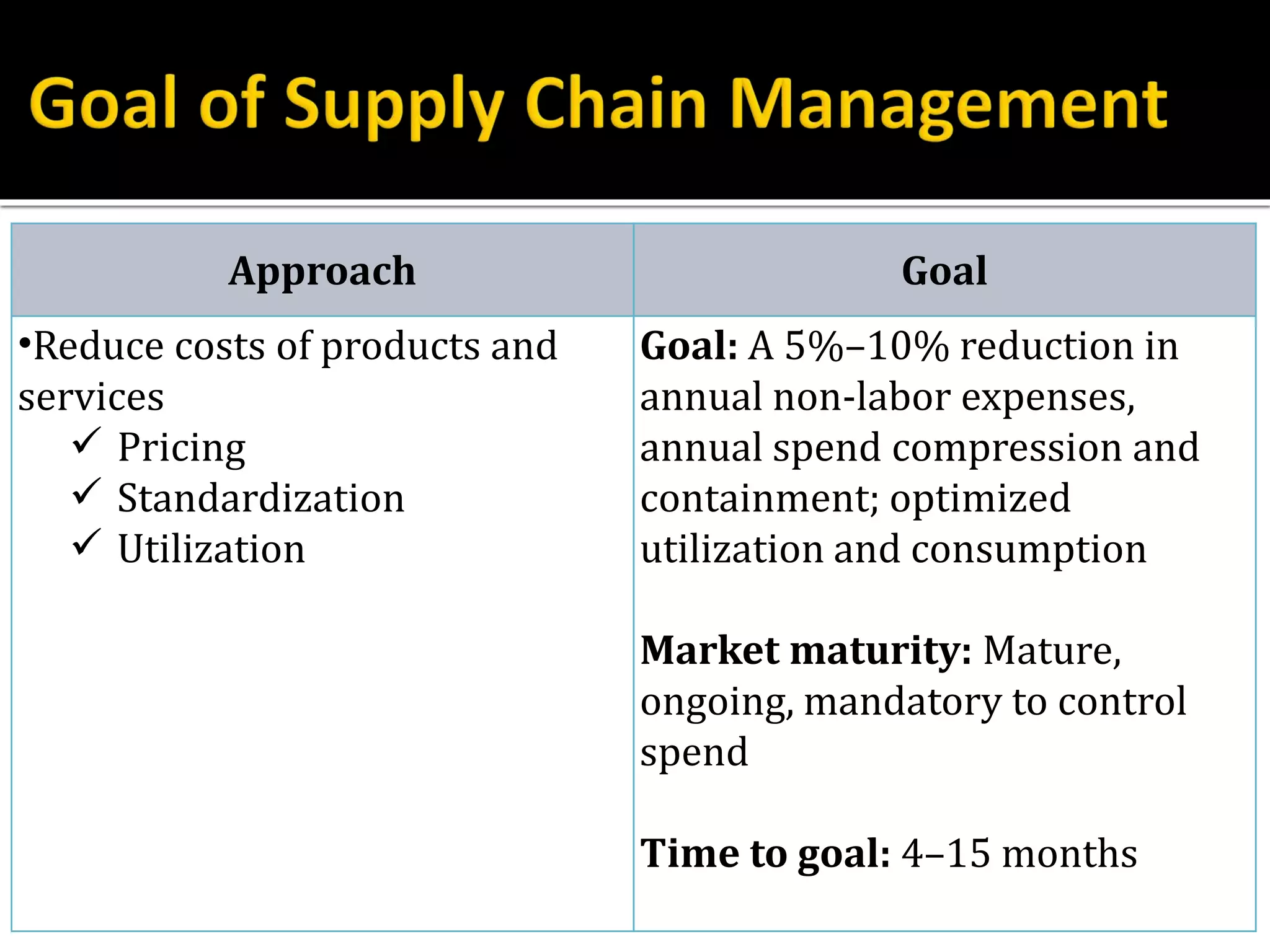
Approach Goal
•Reduce costs of products and
services
 Pricing
 Standardization
 Utilization
Goal: A 5%–10% reduction in
annual non-labor expenses,
annual spend compression and
containment; optimized
utilization and consumption
Market maturity: Mature,
ongoing, mandatory to control
spend
Time to goal: 4–15 months
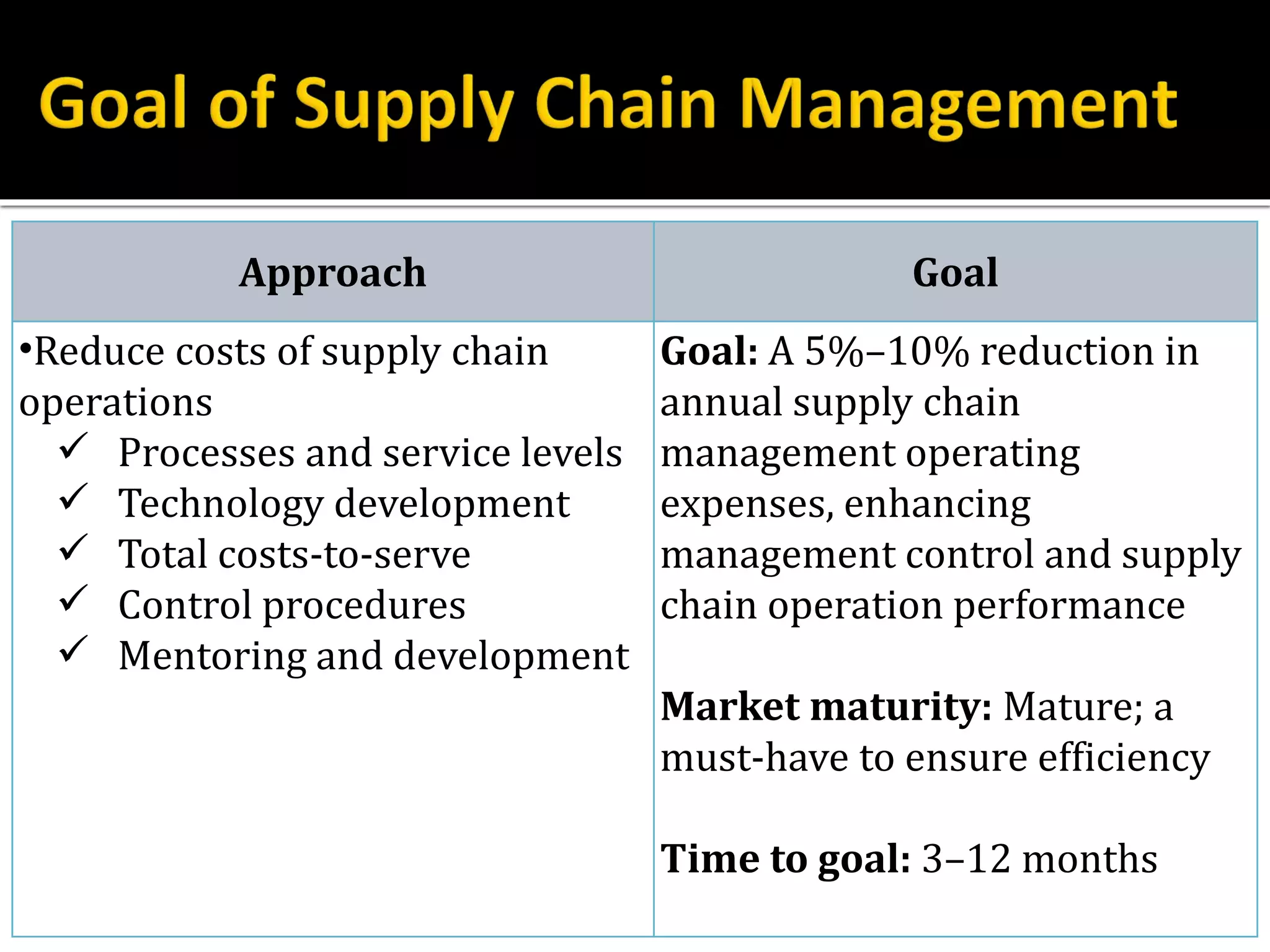
Approach Goal
•Reduce costs of supply chain
operations
 Processes and service levels
 Technology development
 Total costs-to-serve
 Control procedures
 Mentoring and development
Goal: A 5%–10% reduction in
annual supply chain
management operating
expenses, enhancing
management control and supply
chain operation performance
Market maturity: Mature; a
must-have to ensure efficiency
Time to goal: 3–12 months
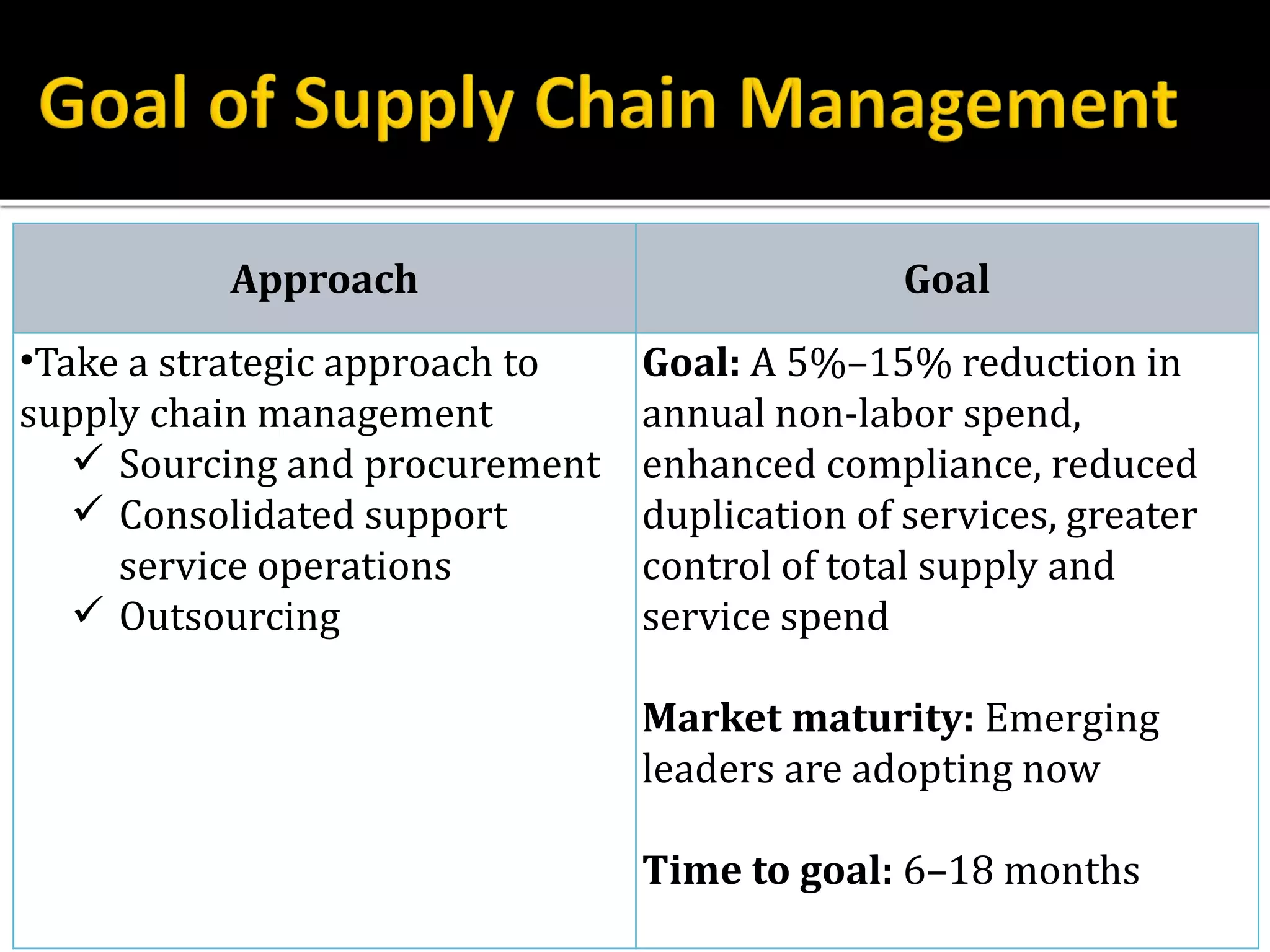
Approach Goal
•Take a strategic approach to
supply chain management
 Sourcing and procurement
 Consolidated support
service operations
 Outsourcing
Goal: A 5%–15% reduction in
annual non-labor spend,
enhanced compliance, reduced
duplication of services, greater
control of total supply and
service spend
Market maturity: Emerging
leaders are adopting now
Time to goal: 6–18 months
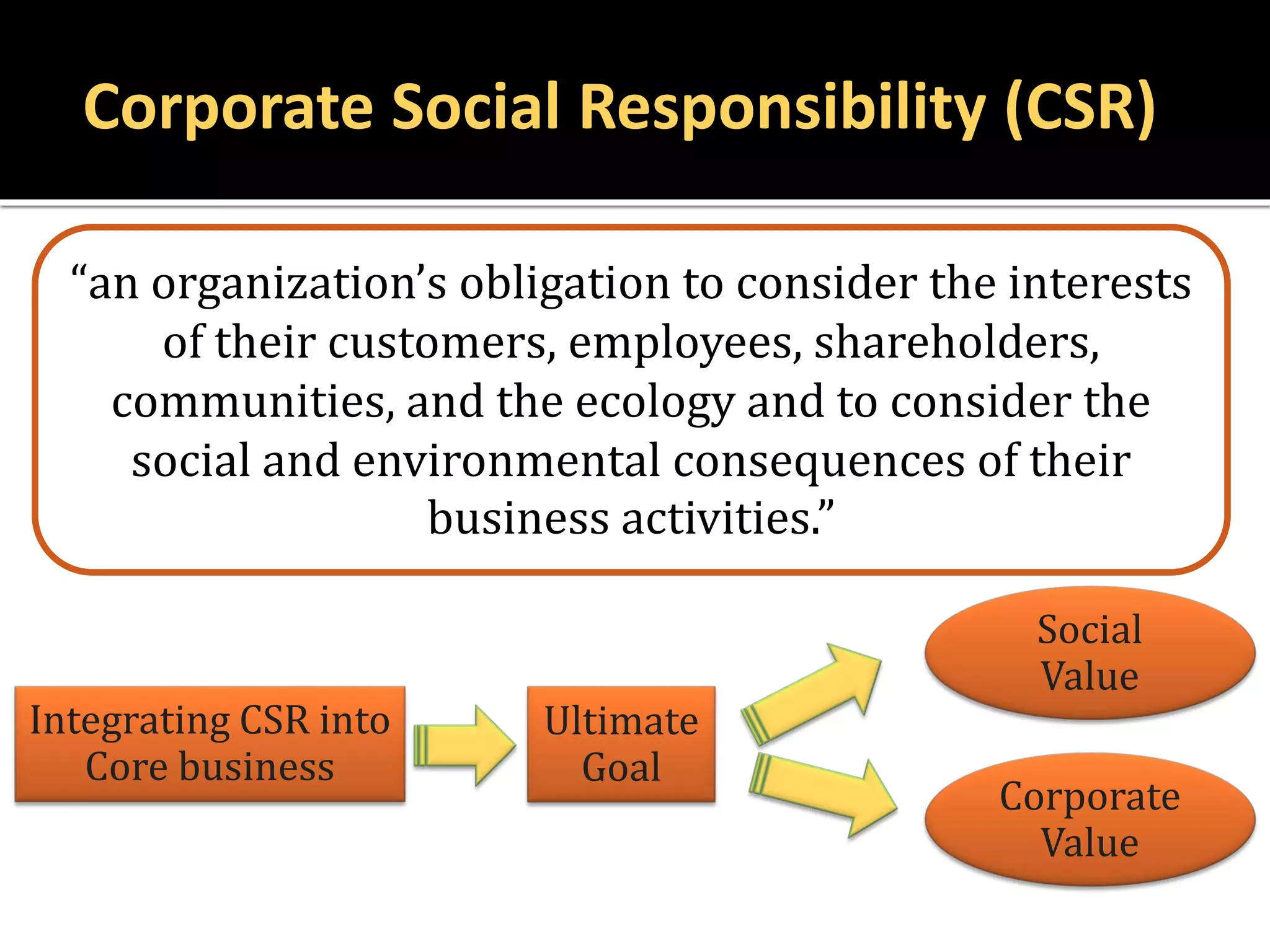
“an organization’s obligation to consider the interests
of their customers, employees, shareholders,
communities, and the ecology and to consider the
social and environmental consequences of their
business activities.”
Integrating CSR into
Core business
Ultimate
Goal
Social
Value
Corporate
Value
Corporate Social Responsibility (CSR)
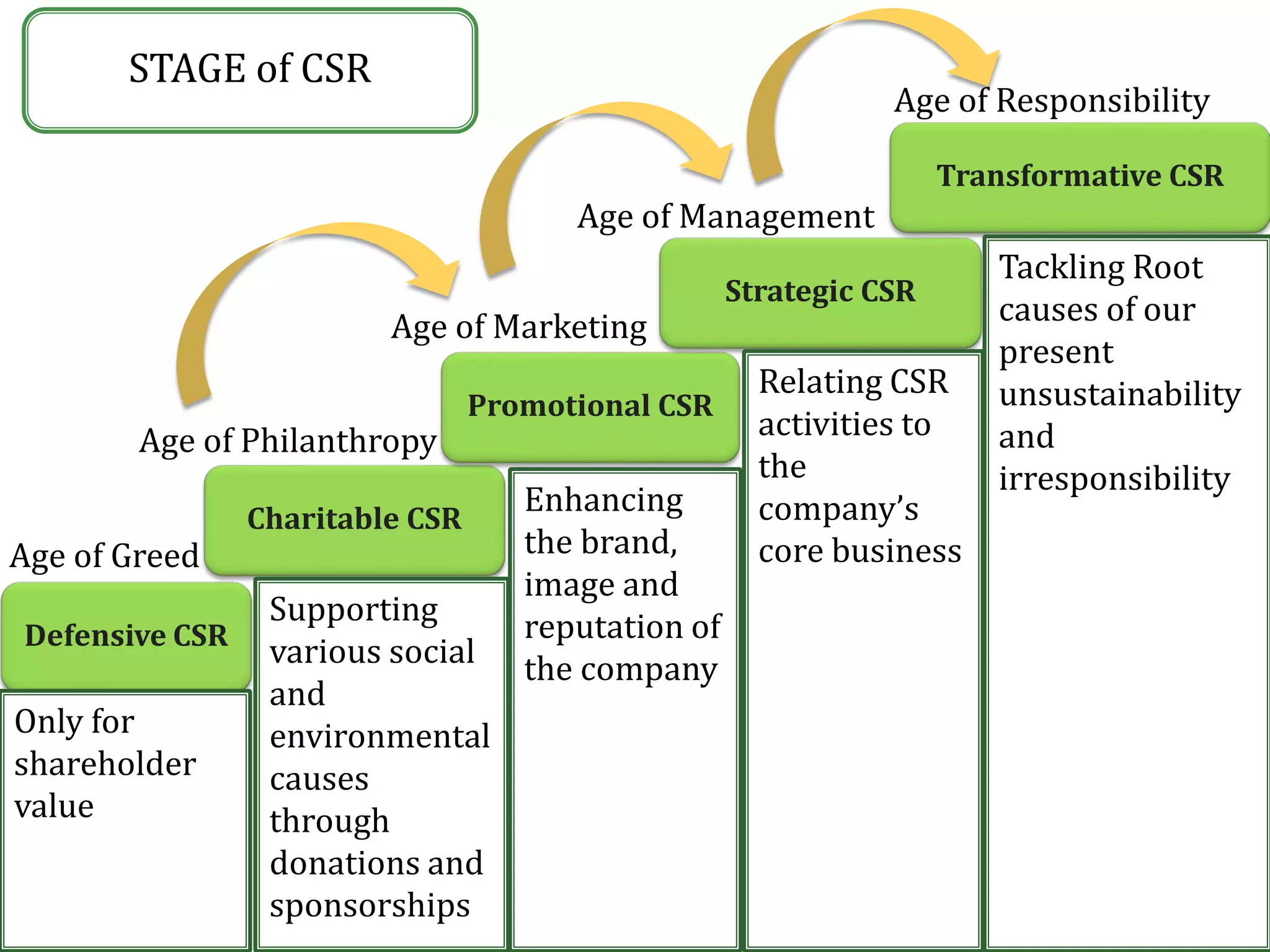
Defensive CSR
Charitable CSR
Promotional CSR
Strategic CSR
Transformative CSR
STAGE of CSR
Age of Greed
Age of Philanthropy
Age of Marketing
Age of Management
Age of Responsibility
Tackling Root
causes of our
present
unsustainability
and
irresponsibility
Relating CSR
activities to
the
company’s
core business
Enhancing
the brand,
image and
reputation of
the company
Supporting
various social
and
environmental
causes
through
donations and
sponsorships
Only for
shareholder
value
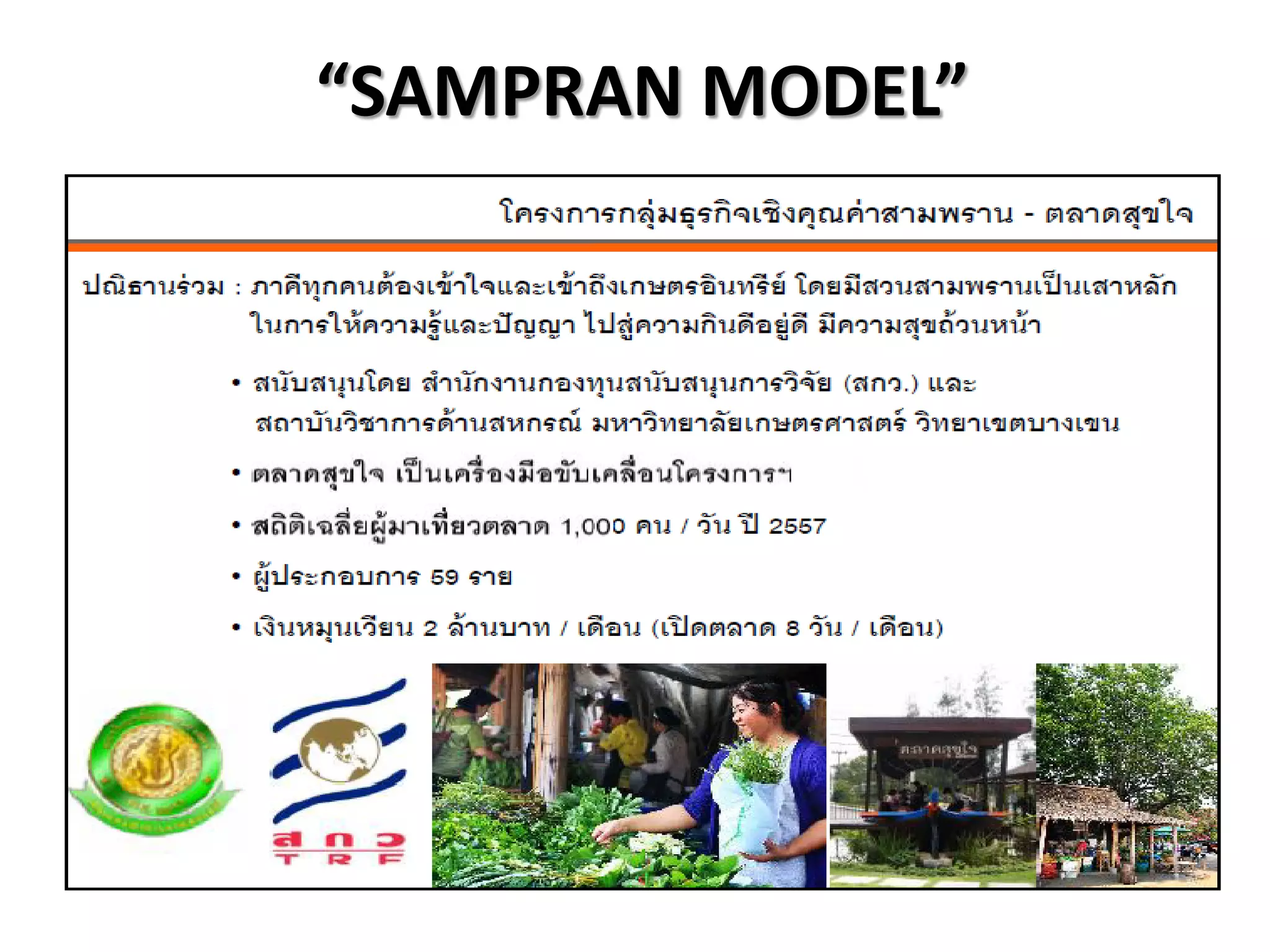
“SAMPRAN MODEL”
• Starts with an Excellent Operation
• Fostered by an environment of strategic partnership
Innovation
Variables
Structure
Human
Resource
Culture
 Adopt an organic structure
 Make available plentiful resources
 Engage in frequent inter-unit communication
 Minimize extreme time pressures on creative
activities
 Provide explicit support for creativity
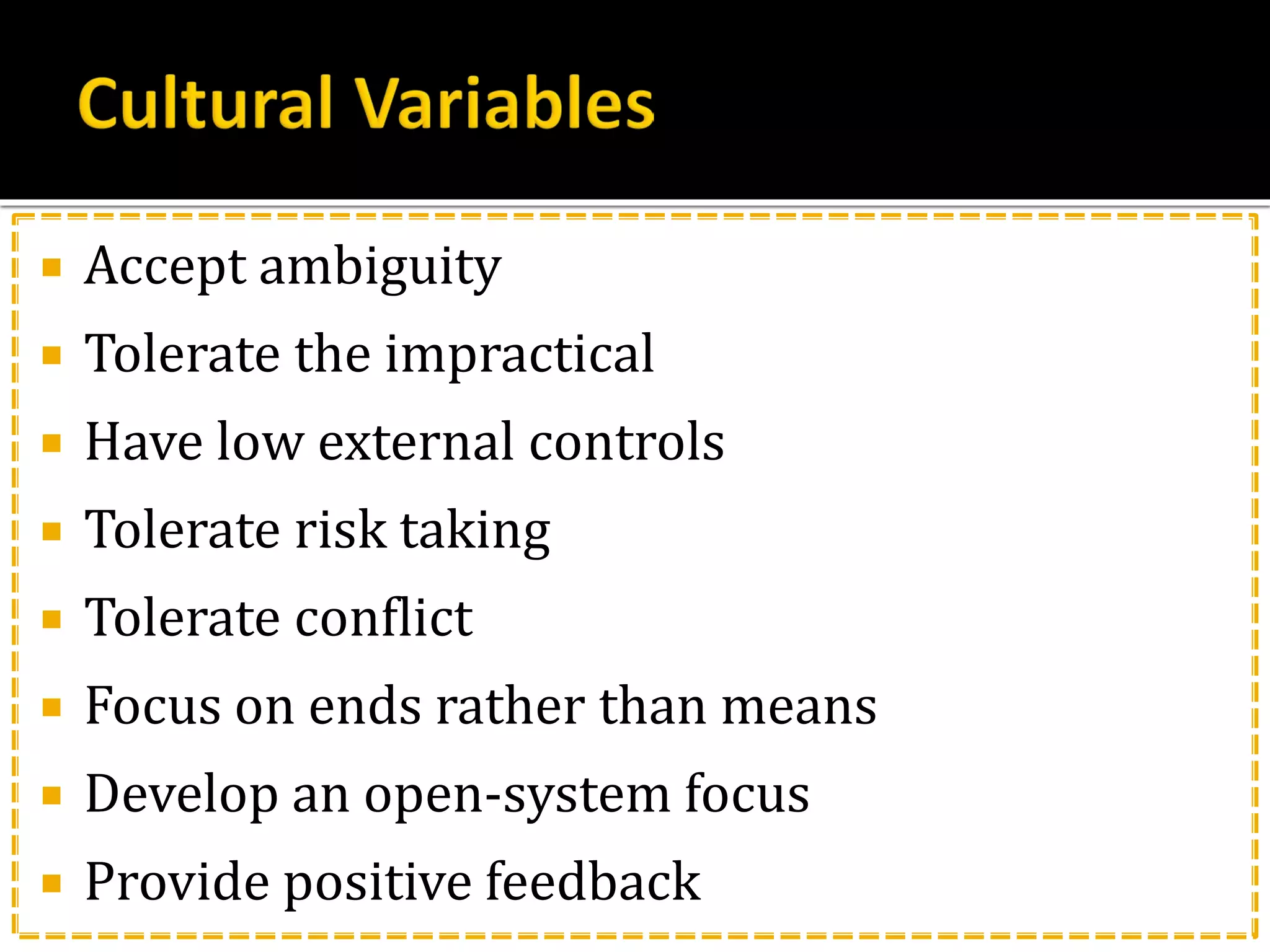
 Accept ambiguity
 Tolerate the impractical
 Have low external controls
 Tolerate risk taking
 Tolerate conflict
 Focus on ends rather than means
 Develop an open-system focus
 Provide positive feedback
 Actively promote training and development to
keep employees’ skills current
 Offer high job security to encourage risk taking
 Encourage individuals to be “champions” of
change
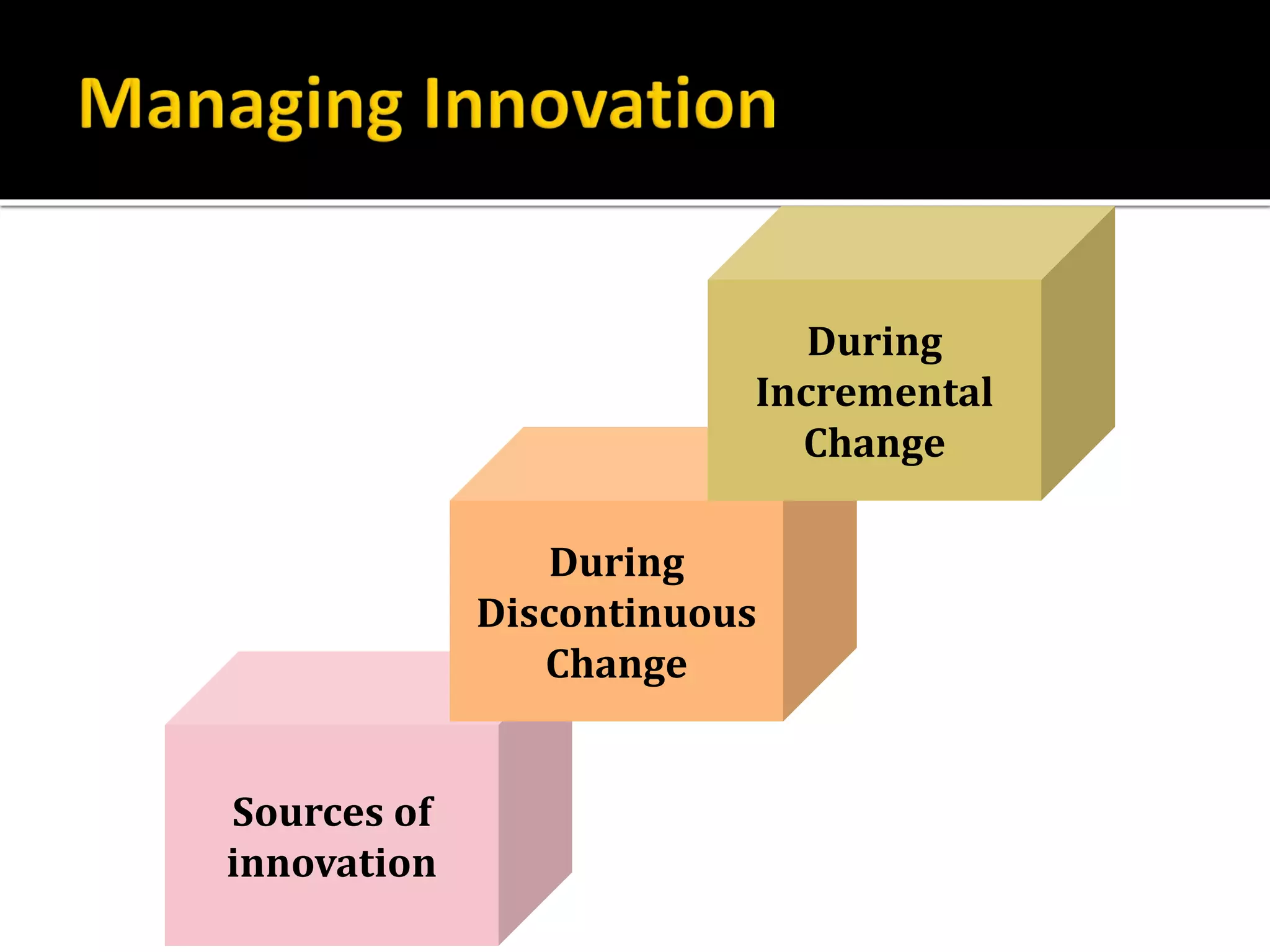
Sources of
innovation
During
Discontinuous
Change
During
Incremental
Change
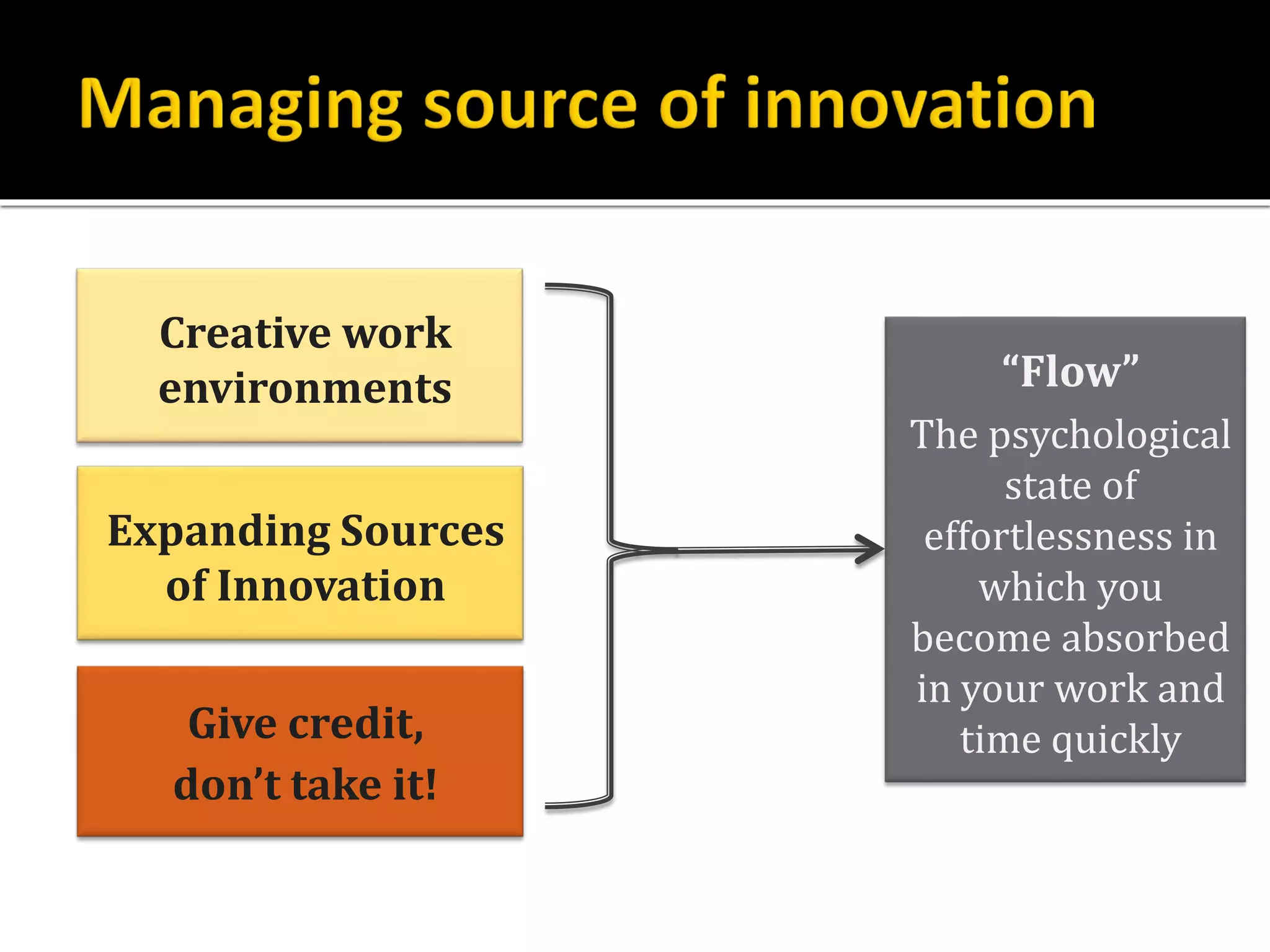
Creative work
environments “Flow”
The psychological
state of
effortlessness in
which you
become absorbed
in your work and
time quickly
Expanding Sources
of Innovation
Give credit,
don’t take it!
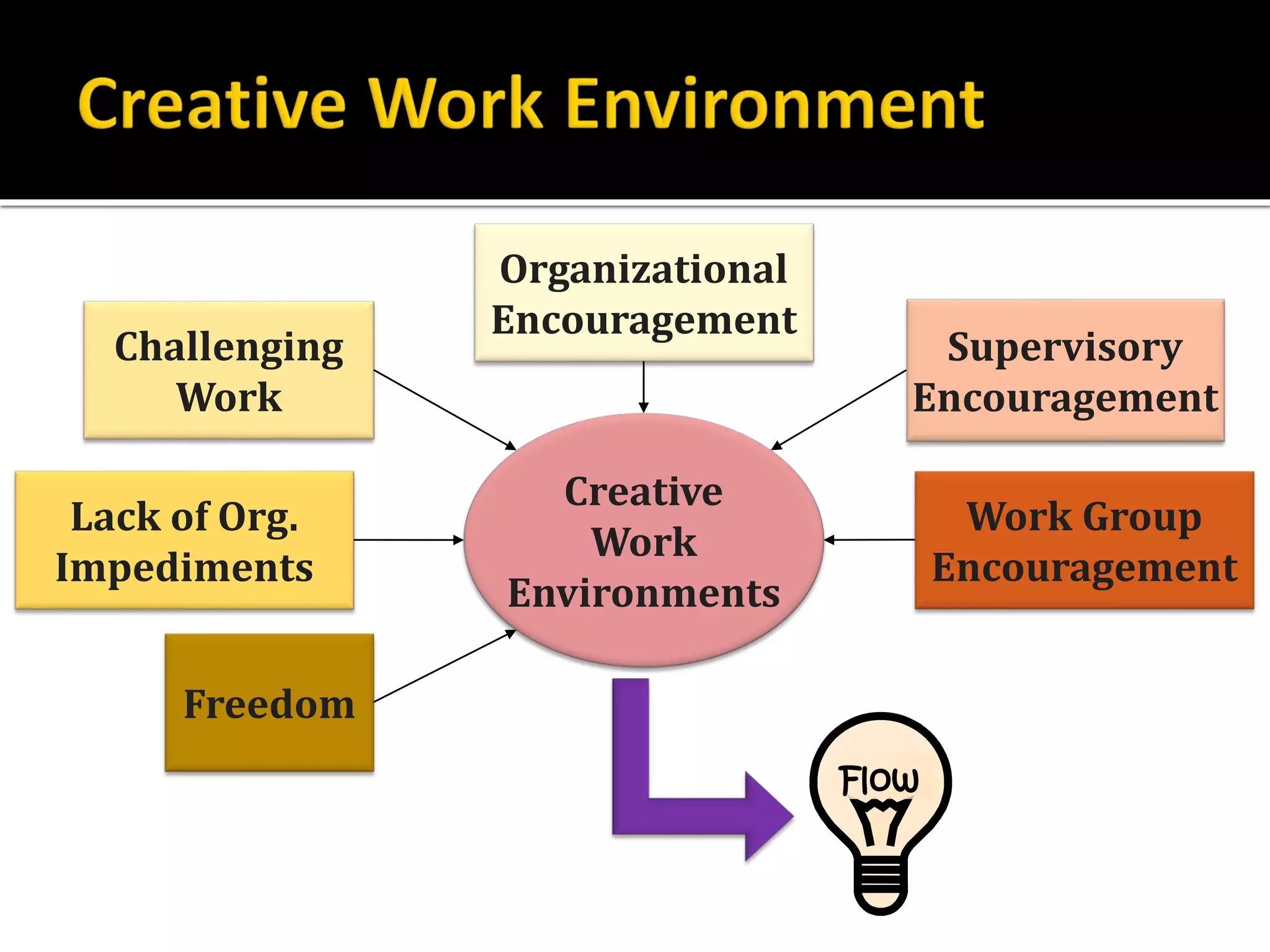
Creative
Work
Environments
Challenging
Work
Work Group
Encouragement
Lack of Org.
Impediments
Supervisory
Encouragement
Organizational
Encouragement
Freedom
Flow
Parts of
Experiential
Approach
Milestones
Design Iterations
Testing
Multifunctional Teams
Powerful Leaders
“Key to innovation is to
use Intuition, Flexible
options & Hands-on
experience”
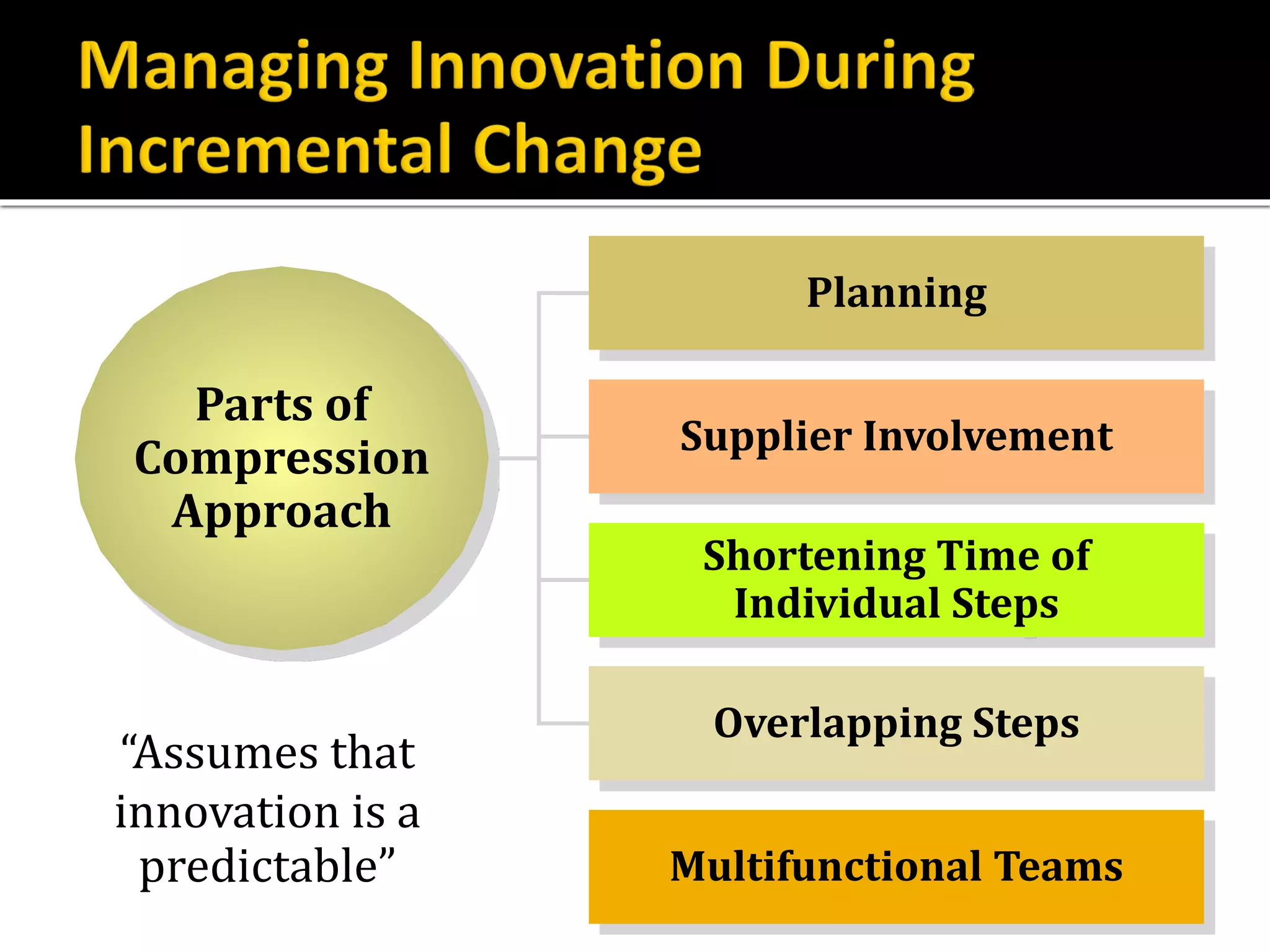
Parts of
Compression
Approach
Shortening Time of
Individual Steps
Planning
Supplier Involvement
Overlapping Steps
Multifunctional Teams
“Assumes that
innovation is a
predictable”
Innovation =
f (Risk) (Speed) (Engagement) (Leadership) + (Tools)
Ideas
Feasibility
Capability
Implementation
Launch
Changing the Work Setting
10% 20% 30% 40% 50% 60% 70% 80% 90% 100%
probability of success 55%
Changing the People
10% 20% 30% 40% 50% 60% 70% 80% 90% 100%
probability of success57%
Changing Individual Behavior & Organizational Performance
10% 20% 30% 40% 50% 60% 70% 80% 90% 100%
probability of success 76%
Blinded
Inaction
Faulty
Action
Crisis
Dissolution
Embrace change—become a change-capable
organization.
Create a simple, compelling message explaining why
change is necessary.
Communicate constantly and honestly.
Foster as much employee participation as possible—
get all employees committed
Encourage employees to be flexible
Remove those who resist and cannot be changed
Tel 0 2202 3618 Fax 0 2644 4355
Email jutharat.ahcha@hotmail.com
www.logistics.go.th
Thank you

Change and innovation in logistics and supply chain management

  • 1.
  • 2.
    “Change” is… “Any eventthat occurs when something passes from one stage to another.”
  • 3.
     People:  Attitudes Expectations  Behaviors  Structure:  Organization’s structural components  Structural design  Technology:  New equipment or process  Automation & Computerization  Internet
  • 4.
    “Cultures are naturallyresistant to change”  Conditions that facilitate cultural change: ▪ The occurrence of a dramatic crisis ▪ Leadership changing hands ▪ A young, flexible, and small organization ▪ A weak organizational culture
  • 5.
     Constant..…yet.…Varies indegree and direction  Uncertainty……yet……. Not Unpredictable  Threats……and…..Opportunities
  • 6.
    Force ResistanceChanges Really? Why? For whom? Whatso ever! No..! eh…! What? Ok, let’s start it soon! How?
  • 7.
  • 9.
  • 10.
     External Forces Internal Forces
  • 11.
    External forces Marketplace Laws andregulations Technology Labor market Economic changes Internal Forces Strategy Workforce changes New equipment Employee attitudes
  • 12.
  • 13.
     The ambiguityand uncertainty that change introduces  The comfort of old habits  A concern over personal loss of status, money, authority, friendships, and personal convenience  The perception that change is incompatible with the goals and interest of the organization
  • 14.
    Technique When usedAdvantage Disadvantage Education & Communication Misinformation Clear up misunderstanding May not work when lacking of trust Participation Expertise make a contribution Increase involvement & Acceptance Time consuming Facilitation & Support Resister’s fearful & anxiety ridden Can facilitate needed adjustments Expensive & no guarantee of success Negotiation Powerful group of resisters Can buy commitment Potentially high cost; others might apply pressure too Manipulation & Co-optation Powerful group’s endorsement is needed Inexpensive, easy way to gain support Can backfire, causing change agent to lose creditability Coercion Powerful group’s endorsement is needed Inexpensive, easy way to gain support May be illegal; may undermine change agent’s creditability
  • 15.
  • 16.
    1. Reactive Change -Makingchanges in response to problems or opportunities as they arise 2. Proactive Change -Involves making carefully thought out changes in anticipation of possible or expected problems or opportunities. -Also called Planned Change
  • 17.
     Unfreezing “Creating the motivationto Change”  Changing “Learning new ways doing things”  Refreezing “Making the new ways normal”
  • 18.
    Unfreezing Changing Refreezing “Creatingthe motivation to Change” • What needs to change • Get support • Create the needs • Manage & Understand the concerns
  • 19.
    Unfreezing Changing Refreezing “Learningnew ways doing things” • Communicate • Dispel rumors • Empower action • Involve people in the process
  • 20.
    Unfreezing Changing Refreezing “Makingthe new ways normal” • Anchor the change into the culture • Develop ways to sustain the change • Provide support & training • Celebrate success!
  • 21.
    Unfreezing Changing Refreezing •Burning Platform: “Create a crisis or hard data that is difficult to ignore.” • Challenge: Inspire them to achieve remarkable things. • Command: Just tell them to move! • Education: Learn them to change. • Management by Objectives: Tell them what to do, but not how. • Restructuring: Redesign the organization to force changes. • Rites of Passage: Hold a wake to help let go of the past. • Whole-System Planning: Everyone planning together.
  • 22.
    Unfreezing Changing Refreezing •Boiling the Frog: “Incremental changes may well not be noticed.” • Facilitation : Use a facilitator to guide team meetings. • First Steps or Quick Win: Make it easy to get going. • Involvement: Give them an important role. • Re-education: Train the people you have in new knowledge. • Shift-and-Sync: Change a bit then pause restabilize.
  • 23.
    Unfreezing Changing Refreezing •Burning Bridges: “Ensure there is no way back.” • Evidence Stream: Show them that the change is real. • Institutionalization: Building change into the formal systems. • New Challenge: Get them looking to the future. • Rationalization Trap: Get them into changing process. • Reward Alignment: Align rewards with desired behaviors. • Socializing: Build it into the social fabric.
  • 24.
    Dr. Kotter observedthat… “The rate at which our world is changing is increasing, But Our Ability to keep up with it is not!”
  • 26.
    1: Create Senseof Urgency “creating a compelling reason for why change is needed” 2: Form a powerful coalition “Assemble a group with the power and energy to lead and support a collaborative change effort.”
  • 27.
    3: Create astrategic vision and initiatives “Shape a vision to help steer the change effort and develop strategic initiatives to achieve that vision.” 4: Enlist a volunteer army “Raise a large force of people who are ready, willing and urgent to drive change.”
  • 28.
    5: Removing barriers “Removeobstacles to change.” 6: Generate short term win “Consistently produce, track, evaluate and celebrate volumes of small and large accomplishments.”
  • 29.
    7: Sustain acceleration “Changeleaders must strategically adapt to any situation.” 8: Institute change “To ensure new behaviors are repeated over the long-term
  • 30.
    • Planning • Budgeting •Organizing • Staffing • Problem solving • Measuring • Doing what we know how to do • Producing dependable reliable results • Establishing direction • Aligning people • Motivating • Inspiring • Mobilizing people to achieve astonishing results • Propelling us to the future Management Leadership
  • 31.
    1. Diagnosis -What isthe Problem? 2. Intervention -What should we do about it? 3. Evaluation - How well has the intervention worked? 4. Feedback -How can the diagnosis be further refined?
  • 32.
    According to OxfordEnglish Dictionary… Innovation means “Introduction of something new” So Innovation can be defined as… “The introduction of a new product, service or process into the market.”
  • 33.
    Creativity - theability to combine ideas in a unique way or to make an unusual association. Innovation - turning the outcomes of the creative process into useful products, services, or work methods. Idea Champions - individuals who actively and enthusiastically support new ideas, overcome resistance, and ensure that innovations are implemented.
  • 34.
    Management Innovation Strategic Innovation BusinessModel Innovation Value Innovation Product Innovation Service InnovationMarket Innovation Process Innovation Technological Innovation Disruptive Innovation Application Innovation Experiential Innovation Marketing Innovation Structural Innovation Brand Innovation User Lead Innovation Supply Chain Innovation Evolutionary Innovation Revolutionary Innovation Innovation “Innovation comes in many flavors”
  • 35.
     Incremental Innovation Improvements of an existing design  Modular Innovation  Complete redesign of core components, while leaving linkages between the components unchanged  Architectural Innovation  Changes the nature of interactions between core components, while reinforcing the core design concepts  Radical Innovation  A whole new design, potentially a paradigm shift
  • 36.
  • 37.
     Cassette-tape SonyWalkman sold an astonishing 186 million unit in its first 20 years of existence  iPod, a digital music player weighed 6.5 ounces and held 1000 songs with cost $400 (much more than existing digital players)  iPod skeptically might be acronym for “Idiots Price Our Devices”  1.4 million iPods have been sold (claimed No 1 in Jul and Aug)  it's harder to nail down whether the key is what's inside it, the external appearance or even the way these work together
  • 38.
  • 39.
    Internal External DiscontinuousContinuous Management Innovation Operational Innovation Product & Service Innovation Strategic Innovation Processes Technological innovation DisruptiveInnovation Blue Ocean Strategy New offerings Partner interfaces Internal structures and processes People Management Channels Brand Networking Supply Chain Technological innovation New markets
  • 40.
  • 41.
    www.innovationlab.com  Why innovate The link between innovation & organization’s strategy  What portfolio  The right innovation project  How to innovate  The effective innovation process  Who innovate  The engagement of people in the innovation process  Where we innovate  The right tools in place to support innovation
  • 45.
    Supplier Producer Customer •Raw material • Components • Services • Products • Services • Retailer • Wholesaler • Distributor • End user Logistics and Supply Chain Management: • To have the Right Product • In the Right Quantity • At the Right Place • At the Right Time • With the Right Cost Quali ty Cost Basic Supply Chain Structure
  • 46.
    Information flow Specs, Orders,Invoices, Receipts, Rules and Regulation etc. Product/Service flow incl. Return, Repair, Replacement, Recycling & Disposal Cash flow Payment for supplies, product & service Supplier Producer Customer • Raw material • Components • Services • Products • Services • Retailer • Wholesaler • Distributor • End user
  • 47.
  • 49.
    Technology Technology investment Process Control, Standard,Integrated planning Network Vertical & Horizontal Cooperation People Talent mgt. Rapid decision making
  • 50.
  • 51.
  • 52.
    “Start from thefundamental & compulsory activities with consistency, efficiency and seamless execution”  Spend management: Targeting price and finance  Direct contracting: Securing contracts for all spend  Logistics services: Optimizing product flows  Inventory management: Establishing efficient inventory deployment  Information management: Fully deploying IT
  • 53.
    “Extended services buildon the fundamentals and penetrate deeper within the organization's supply chain activities.”  Industry data standards: Adopting standards  Enterprise value analysis: Broadening the value analysis to all enterprise spend  Enterprise sourcing & procurement: Centralizing all sourcing and procurement  Utilization: Targeting the significant products efficiency and effectiveness of use
  • 54.
    “Continuing the advancementin providing supply chain competencies”  Supplier synchronization: Implementing strategic programs to lower total cost for both parties  Product assembly: Exploring the self-assembly  Regional cooperatives: Affiliating with other entities in supply chain  Procure-to-pay: Consolidating the cycle management from purchase order to payables  Shared services: establishing a central operation for all enterprise supply chain activities
  • 56.
    Initiatives to improvethe supply chain process take one or more of the following paths:  Product/service category management Beginning with end-user clinical requirements  Departmental point solutions Focusing on a specific department issues  Supply chain functional efforts  Evaluating specific supply-chain-oriented operations
  • 57.
    Approach Goal •Reduce costsof products and services  Pricing  Standardization  Utilization Goal: A 5%–10% reduction in annual non-labor expenses, annual spend compression and containment; optimized utilization and consumption Market maturity: Mature, ongoing, mandatory to control spend Time to goal: 4–15 months
  • 58.
    Approach Goal •Reduce costsof supply chain operations  Processes and service levels  Technology development  Total costs-to-serve  Control procedures  Mentoring and development Goal: A 5%–10% reduction in annual supply chain management operating expenses, enhancing management control and supply chain operation performance Market maturity: Mature; a must-have to ensure efficiency Time to goal: 3–12 months
  • 59.
    Approach Goal •Take astrategic approach to supply chain management  Sourcing and procurement  Consolidated support service operations  Outsourcing Goal: A 5%–15% reduction in annual non-labor spend, enhanced compliance, reduced duplication of services, greater control of total supply and service spend Market maturity: Emerging leaders are adopting now Time to goal: 6–18 months
  • 60.
    “an organization’s obligationto consider the interests of their customers, employees, shareholders, communities, and the ecology and to consider the social and environmental consequences of their business activities.” Integrating CSR into Core business Ultimate Goal Social Value Corporate Value Corporate Social Responsibility (CSR)
  • 61.
    Defensive CSR Charitable CSR PromotionalCSR Strategic CSR Transformative CSR STAGE of CSR Age of Greed Age of Philanthropy Age of Marketing Age of Management Age of Responsibility Tackling Root causes of our present unsustainability and irresponsibility Relating CSR activities to the company’s core business Enhancing the brand, image and reputation of the company Supporting various social and environmental causes through donations and sponsorships Only for shareholder value
  • 62.
  • 66.
    • Starts withan Excellent Operation • Fostered by an environment of strategic partnership
  • 67.
  • 68.
     Adopt anorganic structure  Make available plentiful resources  Engage in frequent inter-unit communication  Minimize extreme time pressures on creative activities  Provide explicit support for creativity
  • 69.
     Accept ambiguity Tolerate the impractical  Have low external controls  Tolerate risk taking  Tolerate conflict  Focus on ends rather than means  Develop an open-system focus  Provide positive feedback
  • 70.
     Actively promotetraining and development to keep employees’ skills current  Offer high job security to encourage risk taking  Encourage individuals to be “champions” of change
  • 71.
  • 72.
    Creative work environments “Flow” Thepsychological state of effortlessness in which you become absorbed in your work and time quickly Expanding Sources of Innovation Give credit, don’t take it!
  • 73.
    Creative Work Environments Challenging Work Work Group Encouragement Lack ofOrg. Impediments Supervisory Encouragement Organizational Encouragement Freedom Flow
  • 74.
    Parts of Experiential Approach Milestones Design Iterations Testing MultifunctionalTeams Powerful Leaders “Key to innovation is to use Intuition, Flexible options & Hands-on experience”
  • 75.
    Parts of Compression Approach Shortening Timeof Individual Steps Planning Supplier Involvement Overlapping Steps Multifunctional Teams “Assumes that innovation is a predictable”
  • 76.
    Innovation = f (Risk)(Speed) (Engagement) (Leadership) + (Tools)
  • 77.
  • 78.
    Changing the WorkSetting 10% 20% 30% 40% 50% 60% 70% 80% 90% 100% probability of success 55% Changing the People 10% 20% 30% 40% 50% 60% 70% 80% 90% 100% probability of success57% Changing Individual Behavior & Organizational Performance 10% 20% 30% 40% 50% 60% 70% 80% 90% 100% probability of success 76%
  • 79.
  • 80.
    Embrace change—become achange-capable organization. Create a simple, compelling message explaining why change is necessary. Communicate constantly and honestly. Foster as much employee participation as possible— get all employees committed Encourage employees to be flexible Remove those who resist and cannot be changed
  • 81.
    Tel 0 22023618 Fax 0 2644 4355 Email jutharat.ahcha@hotmail.com www.logistics.go.th Thank you