VISIONS
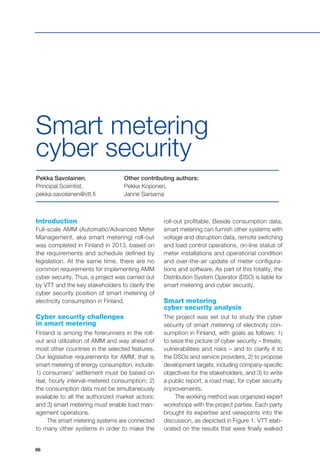
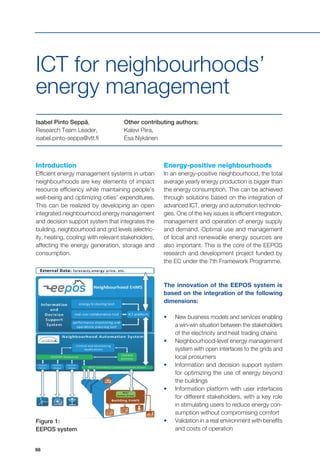
•SCIENCE•TECH
N
OLOGY•RESE
ARCHHIGHLI
GHTS•
12 Smart city
Smart City
— Research Highlights
VTT RESEARCH HIGHLIGHTS 12
2
ISBN 978-951-38-8287-7 (print)
ISBN 978-951-38-8288-4 (online)
VTT Research Highlights 12
ISSN-L 2242-1173
ISSN 2242-1173 (print)
ISSN 2242-1181 (online)
Copyright ©
VTT 2015
PUBLISHER
VTT Technical Research Centre of Finland Ltd
P.O. Box 1000 (Tekniikantie 4 A, Espoo, Finland)
FI-02044 VTT
Tel. +358 20 722 111, fax +358 722 7001
EDITORS: Miimu Airaksinen, Matti Kokkala
Printed in Grano, Kuopio 2015
3
Smart City Intro and Concepts
SMART CITY INTRO AND CONCEPTS
Smart City: local but networked, distributed but integrated	 6
Smart City		 8
City monitoring and operation systems	 10
Vision of an open smart city interoperability environment	 12
Road maps for research and innovation policy	 14
Smart energy business concepts for EnergyHub districts	 16
Identifying development trends in smart city technologies – VTT Trendgenerator	 18
Public procurement of innovation for smart city solutions	 20
SMART CITY GOVERNANCE
Real-time decision support systems for city management	 21
Boosting collaborative planning with visualisation technology	 24
Virtual Model Facilitating Citizen Interaction	 26
Mobile Augmented Reality for City Planning	 28
Co-creating future smart cities - Visual and participative urban planning services	30
Citizen-driven co-design for a smarter city 	 32
Social media for citizen participation	 34
Gamification as an enabler of mutual learning in complex health care systems	 36
Decision-making support: A smart city perspective	 38
SMART CITY INTELLIGENT BUILDINGS AND URBAN SPACES
Intelligent buildings and urban spaces in smart cities	 40
Intelligent urban spaces – automatic real-time responses to people behaviour	 42
Occupancy in smart buildings of smart cities – case hospital smart lighting	 44
Mobile augmented reality for building maintenance	 46
Autonomous management system for buildings and districts	 48
Multi-objective optimization for the minimization of environmental
and economic impacts on buildings at district level	 50
Intelligent street lights adapt to conditions	 52
Citymills leading the positive change in recycling	 54
SMART CITY DISTRIBUTED ENERGY
Distributed renewable energy and energy management	 56
Highlights from the Smart Grids and Energy Systems programme	 57
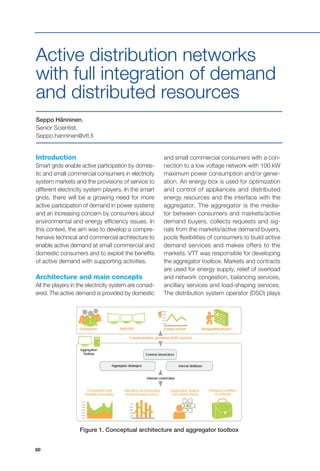
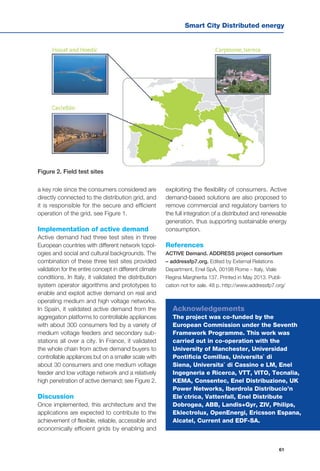
Active distribution networks with full integration of
demand and distributed resources	 60	
Integration of variable power generation into urban energy systems	 62
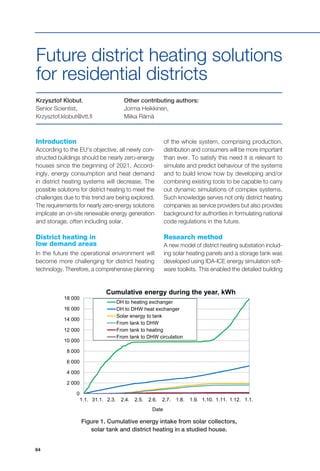
Future district heating solutions for residential districts	 64
Smart metering cyber security	 66
ICT for neighbourhoods’ energy management	 68
Energy-Hub for residential and commercial districts and transport	 70
ICT-supported business in energy positive neighbourhoods	 72
Renewable energy and energy efficiency in new districts – how to accelerate
systemic change towards smart cities	 74
Internet of Energy: Electric Mobility with Smart Grids	 76
4
5
Smart City Intro and Concepts
SMART CITY TRANSPORT
New concept of collaborative and elastic mobility	 78
User acceptance and potential of Intelligent Transport Systems (ITS)	 80
Improving safety with cooperative systems	 82
Car users’ awareness and demand for green in-vehicle ITS	 84
From field operational tests to better services – methods and tools	 86
Assessing impacts of a real-time warning service	 88
Impacts of nomadic device-based services on safety and mobility	 90
Electric urban bus systems	 92
Foresight to smarten up urban transport systems	 94
SMART CITY MONITORING AND MANAGEMENT
Monitoring and controlling facilities in a smart city	 96
Smart alarms and simulation for urban flooding	 98
Climate-adaptive surfaces: control of urban flooding	 100
Improving implementation capacities of cities and regions in water governance	102
Improved city resilience against winter storms	 105
Safety and security in the urban environment	 108
SMART CITY SERVICES
Mobile city guide	 110
Service robots in public places: customer expectations	 112
Many faces of mobile contactless ticketing	 114
Interoperability of mobile contactless city service	 116
New remote monitoring approach for chronic disease management	 118
Value from the food chain waste	 120
SMART CITY KEY TECHNOLOGIES
Internet of Things – technology trends and future potential	 122
Roll-to-roll printed organic photovoltaics	 124
New technologies for electrochemical energy storage	 126
Energy harvesting/thermoelectrics	 129
6
The concept smart city pops up frequently in
the context of urban development. The concept
definitely has a positive flavour, but what does
it actually mean?
There is no unique definition for a smart
city. The interpretations and definitions used
by different interest groups, stakeholders and
regions vary. The impression is often that a smart
city is the same as a digital city, and sometimes
its meaning is close to that of a sustainable city.
It is a challenging term, because who wants his
contribution to the development not to be called
smart. While most human activities take place
in cities, almost anything can be included within
the smart city concept. So, why should we use
a special term if it includes everything in a city?
The basis of developing systems has always
been to move towards an optimum defined by
multiple criteria. Economic aspects are often
among the core criteria. Traditionally, an optimum
has been reached with centralized solutions.
Economy of scale has been achieved by systems
with a distinctive point of control. For example,
power grids have been built around large power
plants. Public transport systems have been
based on somebody deciding the schedules
and routes on behalf of others. Retail shopping
has moved to large shopping centres. Even
governance in society has meant a powerful
central administration making decisions on
behalf of the citizens.
The development of information and com-
munication technology (ICT) has enabled the
search for new kinds of optima. The outcome
of the implementation processes in various
systems is often called ‘smart’.
As regards energy, for example, distributed
local production is feasible to the extreme that
every building may become a power source,
but a system of distributed production is better
Smart City: local but networked,
distributed but integrated
than the old centralized system only if the energy
network is managed properly. The transition to
smart grids has only been possible thanks to
advanced ICT.
New on-demand service concepts are
emerging in public transport, which is still based
largely on predetermined schedules and routes.
As in the case of energy, if more is produced than
is needed, the capacity can be offered for use
by others. Without advanced ICT linking, service
providers and users would not be possible.
In retail, rapidly growing shopping over
the Internet has created a need to rethink local
urban logistics. The role of shopping centres
and department stores is undergoing significant
change. At the same time, the end delivery to
individual customers is seeking new forms.
Increased efficiency and better response to
customer needs is possible only with the use
of advanced ICT.
In order to make use of public services, it is
necessary to go to the city centre or at least the
local centre in the suburb. Due to the changes in
the relative costs of operations in the societies,
the development has unfortunately meant that
the distances to the service points have gradually
increased. Owing to ICT, it is now increasingly
possible to use the services at home or even
when travelling. The saving for the service pro-
vider is evident.
ICT also enables citizens to participate
in decision-making much more than before.
While tools now exist to enable information to
be received, it is much more difficult for the
authorities to keep their work behind closed
doors. Citizens are able to interact with the offi-
cials and the elected representatives more than
ever before. Despite the challenge of the digital
divide, the development of ICT has altogether
meant a huge increase in the power of citizens.
7
Smart City Intro and Concepts
All the examples above have meant that the
meaning of geographical location has changed.
You can act locally but at the same time use
resources in places you do not even know.
Administrative borders can no longer be optimal
borders for operations at the same time.
In the traditional systems, data were gath-
ered in a central location where they were then
analysed, often after a significant delay. The
conclusions drawn were then transmitted back
to users as instructions. In the current distributed
systems, data can be gathered and analysed
anywhere. This allows a much larger set of input
data and much wider resources for assessment
and conclusions. The central decision-maker
is not always needed. Open data – just let the
data be available and somebody will analyse
the data for his own interest – are essential in
this process.
The essence of being smart in modern
society lies in acting locally but being networked
outside one’s own geographical location. The
technological systems can only be managed if
they are properly integrated. ICT is the enabler
that, when properly used for networking and
integration, provides social, environmental and
economic benefits for all. Cities all over the world
see this as an opportunity for better quality of
life. Therefore, the smart city agendas will have
a central place in urban development projects.
While those projects are always huge investments,
they also provide lucrative business opportuni-
ties for technology providers. No wonder that
practically all of the biggest technology providers
also have their own smart city agendas.
VTT for Smart City
As a multidisciplinary application-oriented
research organization, VTT serves the innova-
tion activities that support the development of
smarter cities in many different ways. At VTT, we
work with the public sector as well as technol-
ogy providers. We work from the early phases
of concept or ecosystem development to the
practical implementation of research outcomes.
We are active participants in European and global
research and industry networks.
The research and innovation activities at VTT
cover all the core technology areas relevant to
smart city development. The key technologies and
application domains are ICT, energy, transport
and the built environment.
This publication
This publication is a collection of extended
abstracts on recent and ongoing public research
at VTT. The topics broadly cover the topical
spectrum of smart city-related activities. Topics
have been included largely on the basis of the
interests of individual researchers and research
teams. We have not even tried to be systematic
on what is and is not included, but the interpre-
tation has been left largely to the researchers
themselves.
In order to make it easier to find interesting
contributions, we have organized the abstracts
under different topics. However, many of the
papers could have been under several headings
as smart city research is inherently multi-tech-
nological and cross-disciplinary.
The primary readership of the document
is expected to be the research community, i.e.
those who are actively connected to research
either as researchers or users of the research
results. However, we believe the topics are also
of interest to practitioners in industry and the
public sector.
February 2015
Matti Kokkala, Senior Advisor, Smart Cities
Miimu Airaksinen, Research Professor,
Ecoefficient Built Environment
Harri Airaksinen, Vice President,
Infrastructure and Public Services
8
Smart City
All around the world, urbanization is a
growing trend. As more and more peo-
ple get together, smart systems and their
integration need to be developed, not only
to provide the services that people need
but also to do so efficiently with minimum
impact on the environment. It can be said
that efficient ICT, one part of which is the
Internet of Things, is a common dominator:
tying together services, residency, mobility,
infrastructure and energy.
It is a global challenge to reduce environmental
impact and the carbon footprint. At the same time,
societal development needs to be addressed and
the focus put on people’s well-being. Pressure is
growing to reduce our environmental impact, and
there is a parallel compelling need for business
to remain globally competitive. The need for
investment and expenditure to improve energy
efficiency, modernize infrastructure and create
high quality living environments is enormous.
At the same time, cities have limited access to
financial resources. Sustainable transformation
of cities is only possible when it is done in a
smart way.
Smart cities can be seen as systems with
flows of energy, materials, services, people and
financing. Moreover, urban planning is closely
related to the economic and social metabolism
of communities, i.e. technology is seen as an
enabler of good life. Identification, integration and
optimization of different energy, transport and data
flows in city planning and city management are
crucial to creating sustainable smart environments.
Since the renewal of the urban environment is
slow, the implementation of any new technologies
must fit with the existing structures.
Holistically operating resource-efficient cities
are better able to react to changes. Multifunc-
tioning systems not only create cost savings
but also increase safety and reliability through
better utilization of intelligent, integrated and
optimized networks. Smart management is the
key to maintaining people’s well-being under the
pressure of resource efficiency.
This novel integrating approach by different
sectors would make use of the synergistic oppor-
tunities provided by advanced ICT. It comprises
citizens and business-based services and solu-
tions. It also requires higher-level cooperation
with the city administration and its agencies.
Miimu Araksinen,
Research Professor,
miimu.airaksinen@vtt.fi
Heikki Ailisto,
Reserach Professor,
heikki.ailisto@vtt.fi
Nils-Olof Nylund,
Research Professor,
nils-olof.nylund@vtt.fi
9
Smart City Intro and Concepts
The integration should be based on a real PPPP
(public, private and people partnership) model in
which all actors are committed to development
and innovation together.
Smart city design, operation and management
need to be done at system level. Sub-optimi-
zation of individual components will not lead to
optimal performance of the system. Multi-target
optimization is not an easy task, but it becomes
necessary as different components and systems
are interlinked and interconnected – irrespective
of where they are physically located. Traditional
sector-based industries and value chains are also
changing, and completely new business models
are starting to emerge. Radical innovations and
paradigm shifts are changing our whole city
systems
VTT is focusing its research on this systemic
change in three programmes that work together,
namely Ingrid (Intelligent Energy Systems and
Cities), TransSmart (Smart Mobility Integrated with
Low Carbon Energy) and pro-IoT (Productivity
Leap with Internet of Things).
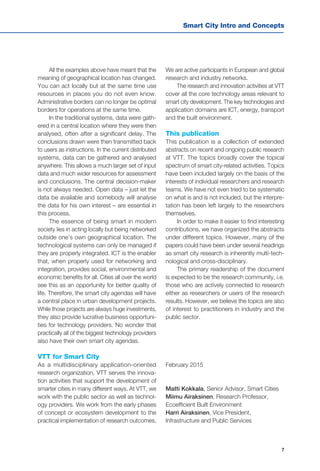
Figure 1. Connection of VTT’s programmes to major areas of smart city development.
More information:
VTT Pro-IoT spearhead program. http://www.vtt.fi/research/spearhead_iot.jsp.
VTT Ingrid Innovation program. http://www.vtt.fi/research/innovation_intelligent_energygrids.jsp
VTT TransSmart spearhead program http://www.vtt.fi/research/spearhead_transsmart.jsp
10
Introduction
Innovative and smart solutions are available in
some cities while in others the uptake is low
because the impacts of these solutions have not
been objectively verified and there is a lack of
confidence that the solutions can also be applied
in other contexts and cities. This transition can be
speeded up by enabling a progress monitor by
means of a common performance measurement
framework and real-time monitoring technolo-
gies. The aim of a city operating system is to
combine city level operation with co-operation
between local sub-systems in order to monitor
performance.
City systems help to monitor
progress and optimize processes
The aim of a city system is to combine city level
operation with co-operation between different
local systems in order to monitor performance
and optimize processes. Intelligence and inter-
operable interfaces are added between separate
systems, e.g. lighting systems, the energy grid
and mobility systems, in order to input informa-
tion from these into the city decision-making
services. Available solutions are often off-line and
ad-hoc, not replicable or suitable for comparisons
between cities. The new developments on fused
sensing, data monitoring technologies and the
Internet of Things (IoT) are key to efficient and
real-time collection of “raw” information from
various sources that are then enriched into
City monitoring and
operation systems
information through KPI calculations and further
into decision-making services.
The performance measurement system
meta-data model and calculation method-
ologies are based on:
•	 Defining the required data sets to be col-
lected based on the specified indicators
•	 Identifying available data sources, their
reliability, accessibility and data models
•	 Specifying the collection system and calcu-
lation methodologies for the performance
measurements
•	 Integration into the system of intelligence
and interoperability interfaces between
separate systems, input specifications and
calculation methodology
•	 Development of user-friendly interface and
information visualization.
Figure 1 shows a schematic presentation of
the performance measurement system based
on an example of a collection of specific data
sets, the information processing, integration into
key performance indicators (KPIs) and finally an
example of a visualization interface [2,3].
Discussion
The development and implementation of city
operating systems will impact on the transition
to low-carbon, resource-efficient cities by cre-
Tuomo Tuikka,
Head of Research Area,
tuomo.tuikka@vtt.fi
Other contributing authors:
Isabel Pinto-Seppä, Daniel Pakkala, Miimu Airaksinen,
Johanna Kallio; Juhani Latvakoski
11
Smart City Intro and Concepts
Citykeys data services
- Read data from different sources
- Calculate KPIs
- Show results
- Open APIs for e.g. city benchmarking
City KPIs
City of Tampere
Build environment, energy,
other non open raw data
Show city (or optionally
neighbourhoods) level
KPIs
Public transport
related open data
Selected area related
Visualized City KPIs
City systems data
services
City
systems
data
City
systems data
Other available open city
or neighbourhood(s)
level data
GHG emissions etc.
Raw data from
build environment
and city systems
Open city data APIs
City and neighbourhood
level data (database or
cloud)
Selected area: e.g.
City or neighbour-
hood(s)
Selected area:
city or neigbour-
hood(s)
Selected area: city or
neigbourhood(s)
ating the necessary framework for performance
assessment of the deployment of smart city
technologies. It will enable progress monitoring
by means of a common performance meas-
urement framework and real-time monitoring
technologies. This will allow cities to move
towards a sustainable transformation while
spending less public resources and improving
services offered to their citizens. Furthermore,
it will support planning and procurement pro-
cesses, allowing the stakeholders to access
and compare different solutions and planning
scenarios and thus impacting on the deployment
of the most suitable ones.
Acknowledgements
The research is under development
within the VTT spearhead programme
“Pro IoT, Productivity leap with Internet
of Things (IoT)” and VTT Innovation
programme “INGRID, Intelligent energy
grids and districts”.
(http://www.vtt.fi/research/spearhead_
and_innovation_programmes.jsp)
References
[1]	 European Commission (2013): European Innovation Partnership on Smart Cities and Communities,
Strategic Implementation Plan, 14.10.2013, http://ec.europa.eu/eip/smartcities/
[2] 	 VTT Pro-Iot spearhead programme:
Productivity leap with Internet of things (IoT). http://www.vtt.fi/research/spearhead_iot.jsp
[3] 	 M. Airaksinen, H. Ahvenniemi, M. Virtanen (2012): Smart City Key Performance Indicators,
European Energy Research Alliance, EERA, Join Program Energy in Cities status Report.
12
Introduction
The application of ICT in a city environment can
bring about a significant increase in productivity
and well-being. However, smart city solutions
seem to be fragmented across cities and sec-
tors, which subsequently leads to a situation
in which innovations do not diffuse widely and
reach their full potential. To address this prob-
lem, we envision an open and modular inter-
operability environment across cities and smart
city sectors. Here, we elaborate on the basic
concepts around this vision, namely, innovative
practices for public actors, a multi-actor mul-
ti-vendor business environment and a modular
ICT architecture that leverages synergies across
different smart city sectors and enables the cre-
ation and better diffusion of existing and new
services across cities.
Background
Cities are increasingly being empowered with
ICT. As the city core infrastructure and systems
become instrumented with sensors and as these
systems are interconnected to other systems,
new levels of intelligence and services can be
reached [1]. ICT has the potential, not only to
help address the problems that we see in our cit-
ies today – like congestion and wasted energy –
but also to offer new consumer experiences and
Vision of an open smart
city interoperability
environment
convenience and help to stimulate much needed
economic growth and job creation [2]. Although
the smart city concept has received much posi-
tive attention, if we look at the current reality and
the landscape around smart city solutions, an
observation can be made that they are heavily
fragmented. Artificial silos exist between sectors
(e.g. mobility, built environment and energy) and
there is very limited co-operation across cities.
Furthermore, a city often partners with a company
that then operates and manages the smart city
services on the city’s behalf. This often leads to
the city planner becoming a rather passive entity
and in turn to a vendor lock-in situation. Overall,
in this kind of market structure, innovations do
not diffuse and redundant isolated solutions are
repeatedly built for the same problems and needs.
Key themes for
enabling interoperability
Thus, it seems clear that there is a need for an
open and modular interoperability environment
for smart city solutions that spans across cities
and sectors. In such a model, cities would be
able to define a modular architecture together
with infrastructure vendors and service providers,
which in turn would form a basis for multi-ven-
dor solutions, continual innovation and progress.
To address fragmentation across sectors and
Thomas Casey,
Research Scientist,
thomas.casey@vtt.fi
Other contributing authors:
Ville Valovirta,
Minna Pikkarainen
13
Smart City Intro and Concepts
Common innovative
practicies for public actors
Multi-actor business
environment
Modular ICT-architecture Mobility
Builtenvironment
Energy
SmartCitySectorx
cities we see three important horizontal layers
in which modular and open processes need to
be planned (Figure 1):
1. Common innovative practices for public actors
related to, e.g., innovative procurement, regu-
lation and opening of common resources (e.g.
data) for the citizens’ use.
2. Multi-actor business ecosystems with mul-
tiple buyers and multiple vendors and service
providers all delivering their solutions over the
same modular ICT architecture.
3. Modular ICT architectures with commonly
agreed open interfaces, standards and an estab-
lished interoperability certification mechanism
for vendor products.
When planning these processes, important
lessons can be leveraged from other fields where,
e.g., the open interoperability environments
around GSM-based mobile communications
and the Internet can be used as examples [3].
Discussion
Overall, such a modular and open interopera-
bility environment for smart city solutions could
potentially connect demand and supply in a
more effective way, increase the size of the
existing markets and even create completely
new markets. On the demand side, entities pro-
curing systems could potentially remain better
in control of the systems and more easily com-
bine and switch between providers, thus induc-
ing competition and diffusion of the best ideas.
Furthermore, when there are many entities in the
market buying standardized solutions, vendors
and service providers can leverage economies
of scale and do not need to tailor solutions to
each customer. Nonetheless, the environment
would need to remain modular so that barriers
to market entry by smaller actors would be low,
and novel innovations combining functionalities
from the different smart city sectors would be
possible
References
[1] 	Dirks, S., Keeling, M. A vision of smarter
cities: How cities can lead the way into a
prosperous and sustainable future. IBM Insti-
tute for Business Value, 2009.
[2]	 Webb, M. et al. Information marketplaces,
the new economics of cities. The Climate
Group, London, 2011.
[3] 	 Casey, T.R. Evolution of wireless access
provisioning: Understanding and managing
value system structures and dynamics, Doc-
toral Thesis, Aalto University, Espoo, 2013.
Figure 1. Key horizontal themes enabling interoperability.
14
Road maps for research
and innovation policy
Miimu Airaksinen,
Research Professor,
miimu.airaksinen@vtt.fi
Other contributing authors:
Mari Sepponen,
Isabel Pinto-Seppä
Introduction
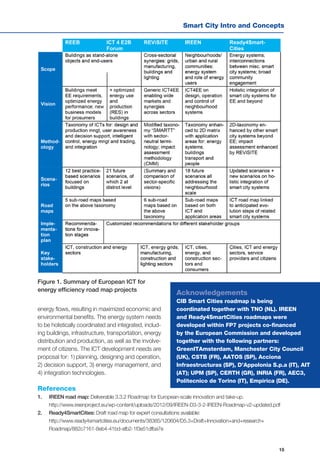
Road map building allows knowledge exchange
between world experts and domain stakeholders
and building of consensus on future technolo-
gies and research priorities, putting VTT one step
ahead. The following introduces three of these
road maps built by VTT, its partners and several
international experts. Figure 1 summarizes the
main scope of the developed road maps.
European Innovation Partnership (EIP) on Smart
Cities and Communities
This partnership, with private and public stake-
holders, has been set up by the European Com-
mission. It aims to help cities and communities,
business and civil society to implement smart
city solutions on a much greater scale and speed
by connecting local initiatives. There is focus
across the areas of energy, transport and ICT.
The EIP’s High Level Group developed recom-
mendations for policy at EU, national, regional
and local levels for actions by the private sec-
tor and for civil society. These are presented in
the Strategic Implementation Plan. VTT experts
participate in the formulation of the EIP Strategic
implementation plan, through EERA, in the High
Level Group and in the “Sherpa Group” assisting
the High Level Group.
CIB Smart Cities road map
The CIB (International Council for Research and
Innovation in Building and Construction) task
group on smart cities is currently developing a
road map for the building and construction-re-
lated research on future smart city solutions.
The contents have been created in collaborative
contributions from 17 member organizations. The
task group identified the needs/problems of smart
cities. These main challenges were prioritized into
topics: Energy, Buildings, Infrastructure & Asset
management, Resources & Waste, Land Use,
Transport & Mobility, and Communities & Users.
Strategic research agenda for
ICTs supporting energy systems
in smart cities
The Ready4SmartCities project provides a road
map for research and technical development and
innovation activities for holistic design, planning
and operation of energy systems in smart cities.
In addition, synergies with other ICT systems for
smart cities are considered. It is funded by the
European Commission’s 7th Framework Pro-
gramme (2013-2015). The R4SC vision predicts
future scenarios and development for smart energy
systems based on identified links between differ-
ent energy systems and interconnection needs
and possibilities of broader smart energy net-
works. The road map is structured in four main
domain areas: citizens, building sector, energy
sector and municipality level.
IREEN: ICT road map for energy
efficient neighbourhoods
The IREEN project produced a strategic research
and technical development and innovation road
map for future ICTs supporting energy efficient
neighbourhoods. The project was funded by the
European Commission’s 7th Framework Pro-
gramme (2011-2013). IREEN envisaged that smart
energy management of a neighbourhood enables
optimum energy distribution and balancing of all
15
Smart City Intro and Concepts
energy flows, resulting in maximized economic and
environmental benefits. The energy system needs
to be holistically coordinated and integrated, includ-
ing buildings, infrastructure, transportation, energy
distribution and production, as well as the involve-
ment of citizens. The ICT development needs are
proposal for: 1) planning, designing and operation,
2) decision support, 3) energy management, and
4) integration technologies.
Acknowledgements
CIB Smart Cities roadmap is being
coordinated together with TNO (NL). IREEN
and Ready4SmartCities roadmaps were
developed within FP7 projects co-financed
by the European Commission and developed
together with the following partners:
GreenITAmsterdam, Manchester City Council
(UK), CSTB (FR), AATOS (SP), Acciona
Infraestructuras (SP), D’Appolonia S.p.a (IT), AIT
(AT); UPM (SP), CERTH (GR), INRIA (FR), AEC3,
Politecnico de Torino (IT), Empirica (DE).
Figure 1. Summary of European ICT for
energy efficiency road map projects
References
1.	 IREEN road map: Deliverable 3.3.2 Roadmap for European-scale innovation and take-up.
http://www.ireenproject.eu/wp-content/uploads/2012/09/IREEN-D3-3-2-IREEN-Roadmap-v2-updated.pdf
2.	Ready4SmartCities: Draft road map for expert consultations available:
http://www.ready4smartcities.eu/documents/38385/120604/D5.3+Draft+Innovation+and+research+
Roadmap/882c7161-8eb4-41bd-afb2-1f3e51dfba7e
16
€
Consumer
Prosumer
Producer
BROKER
Required input data:
 Wholesale market
price
Required input data:
 Energy consumption
 Energy production
 Price for produced
energy
 Price for stored
energy
Owner of energy
storage
Energy
Energy
€
Introduction
Much effort has recently been put into research
and technical development for improving energy
efficiency, increasing the use of renewable energy
and improving districts’ energy systems. Many
of the technologies for these already exist, and
we have experience of integrating them together
into several pilot areas. However, the wide-scale
roll-out of sustainable district level energy sys-
tems is yet to come. Here, the development of
business models plays a key role in the wide-
scale implementation of new neighbourhood
energy systems.
Smart energy business for
service providers and end-users
Energy hub systems optimize the use of renew-
able energy and required information exchange
in a district. An Energy Hub is “a physical cross
point, similar to an energy station, in which energy
and information streams are coordinated, and
where different forms of energy (heat, electricity,
chemical, biological) are converted between each
other or stored for later use” [1]. We have devel-
oped business and service concepts for Energy
Smart energy business concepts
for EnergyHub districts
Hub systems targeted at end-users and energy
service providers running practical actions in dis-
tricts’ energy business. An example of an energy
brokering service model is shown in Figure 1.
A cookbook – collection of
business concepts and elements
Business concepts are presented in a cookbook
form – a collection of 13 business and service
model recipes. Concepts describe the key idea,
interactions between the seller and the buyer
(Figure 1), key performance indicators measuring
its success, and costs and benefits. Concepts
are developed by modifying Osterwalder’s busi-
ness canvas method. They are based on stake-
holders’ interviews on the energy demand and
supply needs [2]. Concepts are kept simple and
focus on one stakeholder. Single business con-
cept elements can be combined into broader
and more specific business and service models
and networks. [3]
Flexibility is one of the
future energy commodities
Many of the business concepts (Figure 2) are
Mari Sepponen,
Senior Scientist,
mari.sepponen@vtt.fi
Other contributing authors:
Ismo Heimonen
Figure 1. Business concept for an energy
broker buying and selling energy
17
Smart City Intro and Concepts
Figure 2. Business concept for an energy broker buying and selling energy
based on energy consumers and producers hav-
ing a certain amount of flexibility available in their
energy demand and supply. Flexibility is a new
aspect of the energy market and a commodity
that is used to create new business concepts.
However, there are currently some barriers related
to the legal framework and data privacy conser-
vation, but these can be overcome. In general,
parts of the proposed business concepts are
easily feasible today, while others require new
References
[1] 	 Energy Hub project: Energy-Hub for residential and commercial districts and transport. Project web-
site [accessed 20.1.2014] http://www.e-hub.org/
[2] 	 Virtanen Mikko, Heimonen Ismo, Sepponen Mari, 2014: Stakeholder analysis and questionnaire showing
the way for the development of business and service models. Renewable Energy Research Conference,
RERC 2014, conference proceedings. Oslo, Norway, June 16-18, 2014.
[3] 	 Sepponen Mari, Heimonen Ismo, 2014: Development of business concepts for Energy Hub systems. Con-
ference proceedings ECOS 2014: 27th International Conference on Efficiency, Cost, Optimization, Simulation
and Environmental Impact of Energy Systems. Turku, Finland, June 15-19, 2014.
actors and roles that are not widely in existence
in the energy business.
Demonstration and feasibility studies
The performance of the proposed business mod-
els is tested in feasibility studies: in a real district
at Tweewaters in Belgium, as well as in four sim-
ulation case studies: Freiburg (Germany), Ber-
gamo (Italy), Houthavens (the Netherlands) and
Dalian (China).
Acknowledgements
The work is part of the project “E-Hub: Energy-Hub for residential and commercial districts
and transport”. The project is funded under the specific programme “Cooperation” in the
FP7 framework initiative “Energy efficient Buildings (EeB, FP7-2010-NMP-ENV-ENERGY-
ICT-EeB)”. The following co-workers and partners are acknowledged: Mikko Virtanen (VTT),
Frans Koene, Mieke Oostra and Cor Warmer (TNO); Kris Kessel (VITO); Reijo Kohonen (Global
EcoSolutions Ltd.); Paola Laiolo (Intesa Sanpaolo Eurodesk), Mauro Alberti (CESTEC) and
Bronia Jablonska (ECN), as well as other contributors via interviews and workshops.
Business concepts for energy service providers:
•	 Energy broker buying and selling energy
•	 Flexible energy tariffs for (residential) consumers
•	 ESCO minimising customers' energy bills and
optimising energy usage
Business models for new roles:
•	 Heat recovery of excess heat utilised in district
heating and cooling
•	 Prosumer selling self-produced energy
Business concepts for energy producers and
energy companies:
•	 Heat storage utilised in district heating and/
or cooling
•	 Flexibility in electricity network by heat pump
to avoid peak power
Co-operative ownership of district
heating network
Business concepts for offering flexibility in energy demand and supply:
•	 Flexibility for energy retailer's portfolio management
•	 Flexibility enabling maximised utilisation of locally produced energy
•	 Flexibility for local network management enabling maximised renewable energy supply
•	 Flexibility for balancing services to the balancing responsible party and transmission system operator
•	 Flexibility for local balancing at district level
18
Identifying development trends in
smart city technologies
– VTT Trendgenerator
Mika Naumanen,
Senior Scientist,
mika.naumanen@vtt.fi
Background
Trendgenerator is an analysis tool for identification
and ranking of emerging and/or semantically
related technologies based on patent, scientific
and news wire information. Firms need information
about emerging technologies in order to position
their businesses on the market, allocate R&D
investments and select partners.
With Trendgerator we aim to understand:
•	 What are the overall trends in research in this
field over time, territory, application area?
•	 Which are the major companies and univer-
sities in this technology?
•	 How have their research and patenting
strategies evolved over time compared with
those of other industry key players?
•	 Which application areas are these technol-
ogies used for and by which companies?
Considerations
Firstly, while article and news wire data typically
describe a technological development in a clear
and informative manner, for patents this is not
necessarily the case. The patent title, abstract
and claims can be written in gibberish and hardly
reveal what the patent really is all about.
Secondly, IP Revenue is extremely skewed.
For example, a distinction needs to be made
between Big Corporation and Noname Ltd. In
fact, while individual inventors, small businesses
and universities hold approximately 60% of all US
patents, large corporations generate 99% of the
associated IP revenue. It follows that when study-
ing emerging technology trends not all inventions
and patent assignees can be considered equal.
Approach
We can tackle the content recognition problem
by widening the scope of analysis from patent
abstracts and claims to the inclusion of whole
patent descriptions, including embodiments,
and by using modern automatic term recognition
techniques. This means that for a sentence “A
new real time expert system is…” it would be
optimal to find the term “real time expert system”.
Finding “real time” and “expert system” could be
acceptable, but “time expert”, “real time expert”
and “time expert system” must be discarded
automatically. Similarly, there are a number of
approaches to detect the value of a patent.
Patent applications and granted patents typically
contain citations to earlier granted patents and
other works that describe related art. Csárdi et al.
(2007) extracted an attractiveness function that
determines the likelihood of a patent attracting
references from other patents.
Results
In the following example, we present a general
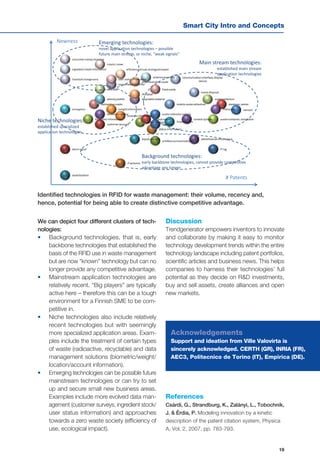
picture of one particular technology area: RFID
use in waste management. The x-axis shows
the number of patents that mention a particular
technology, while the y-axis depicts the “new-
ness” of the patents – the higher the score, the
more recent the respective patents. Here, we
do not depict any company business strategies
on the matter. It would be straightforward to
do, however, and would imply the key players
in each technology, how their strategies have
developed over time and, most importantly, their
current focus areas.
19
Smart City Intro and Concepts
Newness
# Patents
Background technologies:
early backbone technologies, cannot provide competitive
advantage any longer
Main stream technologies:
established main stream
application technologies
Niche technologies:
established specialized
application technologies
Emerging technologies:
novel application technologies – possible
future main stream, or niche, “weak signals”
We can depict four different clusters of tech-
nologies:
•	 Background technologies, that is, early
backbone technologies that established the
basis of the RFID use in waste management
but are now “known” technology but can no
longer provide any competitive advantage.
•	 Mainstream application technologies are
relatively recent. “Big players” are typically
active here – therefore this can be a tough
environment for a Finnish SME to be com-
petitive in.
•	 Niche technologies also include relatively
recent technologies but with seemingly
more specialized application areas. Exam-
ples include the treatment of certain types
of waste (radioactive, recyclable) and data
management solutions (biometric/weight/
location/account information).
•	 Emerging technologies can be possible future
mainstream technologies or can try to set
up and secure small new business areas.
Examples include more evolved data man-
agement (customer surveys, ingredient stock/
user status information) and approaches
towards a zero waste society (efficiency of
use, ecological impact).
Identified technologies in RFID for waste management: their volume, recency and,
hence, potential for being able to create distinctive competitive advantage.
Discussion
Trendgenerator empowers inventors to innovate
and collaborate by making it easy to monitor
technology development trends within the entire
technology landscape including patent portfolios,
scientific articles and business news. This helps
companies to harness their technologies’ full
potential as they decide on R&D investments,
buy and sell assets, create alliances and open
new markets.
References
Csárdi, G., Strandburg, K., Zalányi, L., Tobochnik,
J. & Érdia, P. Modeling innovation by a kinetic
description of the patent citation system, Physica
A, Vol. 2, 2007, pp. 783-793.
Acknowledgements
Support and ideation from Ville Valovirta is
sincerely acknowledged. CERTH (GR), INRIA (FR),
AEC3, Politecnico de Torino (IT), Empirica (DE).
20
Public procurement of
innovation for smart city
solutions
Ville Valovirta,
Senior Scientist,
ville.valovirta@vtt.fi
Introduction
The development and adoption of smart solutions
in cities is largely dependent on procurement
decisions made by city administrations and
local governments. Public procurement plays a
key role in creating demand for innovative and
smart solutions to urban challenges. Conven-
tional approaches to public procurement are not
favourable for sourcing innovative products and
solutions from technology supplier firms and
service providers. This research has identified
drivers and bottlenecks for public procurement
of innovative solutions and reviewed available
approaches to empowering local governments
to become smart buyers.
Key findings
Based on a survey of supplier firms, public pro-
curement can best advance innovation among
companies when cities communicate early,
in advance of their upcoming procurement
needs. They should also engage in extensive
dialogue with the markets. When specifying
requirements, they should use functional and
performance-based requirements instead of
specifying particular technical designs. In addi-
tion, cities and local governments need to move
towards procurement practices that enable
interoperability across smart city solutions, ena-
bling emergence of a modular market structure.
Application of research findings
The research was carried out by conducting two
large-scale surveys, several case studies and
engaging in extensive international collaboration.
The findings have been applied to designing
public procurement projects for intelligent trans-
port services, smart water solutions and smart
city governance. The results have also been
communicated to policymakers at national and
European levels.
Discussion
Through their great demand for power, pro-
curement decisions made by cities and local
governments play a significant role in shaping
the emerging smart city markets. However,
smart city markets are hybrid markets that con-
stitute the demand from consumers, corporate
buyers and public authorities. The challenge for
city administrations is to shift their purchasing
behaviour to support the emergence of open
digital ecosystems for smart cities embrac-
ing interoperability. This approach holds great
potential in creating lead markets for smart city
products and services that are also scalable on
the global marketplace.
Acknowledgements
The research was financially
supported by Tekes, The Finnish
Transport Agency, the City of
Helsinki and the City of Pori.
Smart City Intro and Concepts
Smart City Governance
21
Miimu Airaksinen,
Research Professor,
miimu.airaksinen@vtt.fi
Other contributing authors:
Isabel Pinto-Seppä, Kalevi Piira,
Hannele Ahvenniemi, Aapo Huovila
Real-time decision
support systems for
city management
Introduction
The complexity of the current major societal
challenges, in urban centres, demands the
wide-scale deployment of solutions and services
based on accurate and timely information. This
will allow cities to move towards a sustaina-
ble transformation while spending less public
resources and improving services offered to its
citizens. The implementation of a common per-
formance measurement framework based on a
set of relevant indicators, open data applications
and decision-support user-interfaces enables
stakeholders to learn from each other, create
trust in solutions, and monitor progress.
Smart city performance
measurement framework
The European Commission has developed two
parallel approaches to support the implemen-
tation of smart urban technologies: large scale
demonstration of technology in cities and com-
munities (‘lighthouse projects') and 'horizontal
activities' to address specific challenges as in
regulatory barriers, in standardisation, public
procurement and performance monitoring. The
CITYKEYS project, funded by the EC under the
H2020 Programme, addresses these horizontal
challenges. The goal is to provide a validated,
holistic performance measurement framework for
monitoring and comparing the implementation
of Smart City solutions.
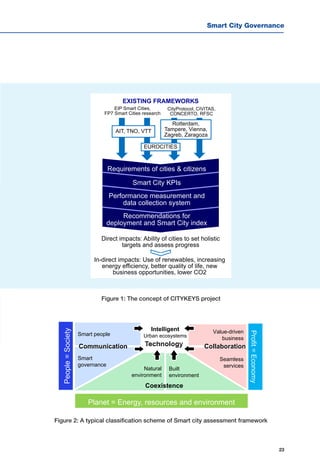
The CITYKEYS framework is defined as a
smart city performance assessment system which
includes city requirements, key performance
indicators (KPI) ontology and calculation, and,
data collection methodology (Figure 1). This
development work is based on the following
key pillars:
•	 Extensive collaboration and communication
with European cities.
•	 Establish a baseline by analysis and inte-
gration of existing results from previous
initiatives.
•	 Develop a set of KPIs evaluate the impacts
of smart city projects/initiatives.
•	 Solutions for transparent and open data
collection and processing.
•	 Validation based on real data during imple-
mentation testing in case cities.
•	 Identifying new business opportunities and
build recommendations for the implementa-
tion of performance evaluation. These also
include recommended paths for the future
development of a 'smart city index'.
In order to achieve the objectives CITYKEYS
is building on existing smart city and sustainable
city assessment frameworks. The bases are the
traditional sustainability categories People, Profit
and Planet (Figure 2), but the performance meas-
urement framework will also integrate specific
smart city KPIs and assessment methodologies
as the ITU l1440/1430.
22
Data collection and decision-
support system
The work for the development of the performance
measurement prototype system is based on the
data sources needed to calculate the defined
indicators, a transparent data collection meth-
odology, the KPIs calculation procedures and
visualization. The formulation of relevant KPIs will
be based on harmonizing existing environmental,
technological, economic and social indicators
for Smart Cities and specifying missing ones.
The Performance measurement system meta-
data model and calculation methodologies are
based on:
•	 Defining the needed data sets to be col-
lected, based on the specified indicators.
•	 Identifying available data sources, their
reliability, accessibility and data models.
•	 Specifying the collection system and calcu-
lation methodologies for the performance
measurements’.
•	 Developing a prototype of the performance
measurement system integrating input
specifications, calculation methodology
and visualization.
The CITYKEYS framework will be tested in the
5 partner cities: Tampere, Rotterdam, Vienna,
Zagreb and Zaragoza. The cities will be involved
in defining the stakeholder needs and the perfor-
mance system requirements (including usability
requirements), in evaluating and testing the sys-
tem prototype and in building recommendations
for its implementation in planning and municipal
decision-making processes.
Boosting the wide-scale
deployment of smart city solutions
The results will impact on the transition to
low-carbon, resource efficient cities by creat-
ing the necessary framework for performance
assessment of the deployment of smart cities
technologies. The performance measurement
framework will include specific smart city KPIs
that go beyond the traditional division into cate-
gories and will measure the integration level and
openness of the technological solutions. This will
support planning and procurement processes
allowing the stakeholders to access and compare
different solutions and planning scenarios and
thus impacting on the deployment of the most
suitable ones.
Acknowledgements
These results are under development
within the H2020 project CITYKEYS,
co-financed by the European
Commission and developed together
with the following partners: AIT Austrian
Institute of Technology GmbH (AT), TNO
Netherlands Organisation for Applied
Scientific Research (NL), EUROCITIES
ASBL (BE), City of Tampere (FI), city of
Rotterdam (NL), City of Vienna (AT), City
of Zaragoza (SP), City of Zagreb (HR). In
addition the following cities had express
interest to act as “contributing cities” for
the validation of the performance system:
Manchester (UK), Dresden (DE), Terrassa
(SP), Birmingham (UK), Porto (PT), Utrecht
(NL), Mannheim (DE), and, Burgas (BG).
References
Airaksinen M., Ahvenniemi H., Virtanen M., 2012,
Smart City Key Performance Indicators, European
Energy Research Alliance, EERA, Join Program
Energy in Cities status Report
Smart City Governance
23
Technology
Intelligent
Urban ecosystems
Planet = Energy, resources and environment
People=Society
Profit=Economy
Smart
governance
Smart people
Seamless
services
Value-driven
business
Natural
environment
Built
environment
Communication
Coexistence
Collaboration
Figure 2: A typical classification scheme of Smart city assessment framework
Figure 1: The concept of CITYKEYS project
EXISTING FRAMEWORKS
CityProtocol, CIVITAS,
CONCERTO, RFSC
EIP Smart Cities,
FP7 Smart Cities research
EUROCITIES
Rotterdam,
Tampere, Vienna,
Zagreb, Zaragoza
AIT, TNO, VTT
Requirements of cities & citizens
Smart City KPIs
Performance measurement and
data collection system
Recommendations for
deployment and Smart City index
Direct impacts: Ability of cities to set holistic
targets and assess progress
In-direct impacts: Use of renewables, increasing
energy efficiency, better quality of life, new
business opportunities, lower CO2
24
Janne Porkka,
Senior Scientist,
janne.porkka@vtt.fi
Other contributing authors:
Mirkka Rekola,
Timo Kuula
Boosting collaborative
planning with
visualisation technology
Introduction
Communication in large construction projects
involves a great number of stakeholders, which
is a special challenge for interaction. Many
stakeholders view the process from different
perspectives [1]. For collaborative planning,
design visualisation offers a meaningful way to
convey messages and reduce communication
difficulties [2]. Immersive virtual environments
are increasingly used in large projects to assist
stakeholder interaction.
Majority of experts
value virtual models
The benefits of visualisation in group-context
include gains in productivity, quality and knowl-
edge [3]. We collected feedback in VIREsmart
project [4] from using virtual models as a pres-
entation tool along traditional tools in nine expert
meetings at two large construction projects in
Finland. Results indicate that visually represented
plans are introduced more rapidly to stakehold-
ers, which leads to more balanced interaction
between consults, experts and client. Altogether,
75% of experts felt that they understood the
plan better with virtual model and as high as
90% wanted to use virtual models in the future.
Visual working led to
2-4 times more comments
We have used activity theory [5] as a framework
for observing and analysing the effects of virtual
reality on interaction and related work practices.
The amount of comments participants made
during discussions was used as an indicator
for participation. Especially client and experts
appreciated the visual interaction, and plans
were often reflected to opinions and regional
comments. We also noticed that virtual models
as a medium led to 2 to 4 times more com-
ments in the discussions when compared to
the traditional tools.
Efficient group work
at VTT ‘Creation Lab’
Active participation is essential in projects for
successfully reaching the objectives. When a
certain time is reserved for plan review, visual
representation provides better opportunities
for developing the plan. The empirical findings
collected in this study underline that immersive
virtual environments have potential to enhance
collaboration [6], but must be facilitated carefully
in sensitive meeting situations. During the work
VTT also invested in a technology-assisted
group workspace and built ‘Creation Lab’. In
the future, we aim at developing procedural
meeting changes in order to turning those into
more participatory.
of experts valued virtual
models and wants to use
those also in the future.90%
Smart City Governance
25
Fig.1. Virtual model used in two meeting setup; a standard meeting room (left)
and an immersive virtual environment (right).
Fig.2. VTT’s
technology
assisted group
work space
‘Creation Lab’.
Acknowledgements
Research has been supported by the
Finnish Funding Agency for Technology
and Innovation (TEKES) under the project
‘VIREsmart’. Authors are grateful for
collaboration with Finnish Traffic Agency,
Centre for Economic Development,
Transport and the Environment, City of
Espoo, Sito Ltd., Vianova Systems Finland
Ltd., and Ramboll Finland Ltd.
References
[1] 	 Bouchlaghem, D., Shang, H., Whyte, J.
And Ganah, A. (2005). Visualisation in archi-
tecture, engineering and construction (AEC),
Automation in construction, Vol. 14, Iss. 3.
pp. 287-295.
[2] Reich, Y., Konda, S.L., Levy, S.N., Monarch,
I.A. and Subrahmanian, E. (1996). Varie-
ties and issues of participation and design,
Design Studies, Vol. 17, No. 2, 165–180.
[3] Bresciani, S. And Eppler, M. (2009). Evidence
from an experimental evaluation, Visualization
and Computer Graphics, Vol. 15, Iss. 6. pp.
1073-80.
[4] Video: Results from VIREsmart project:
https://www.youtube.com/watch?v=ydCx-
1YUvAok
[5] Engeström, Y. (2010). Activity Theory and
Learning at Work, In Malloch, M. et all (Eds.)
The SAGE Handbook of Workplace Learning,
Sage publication Ltd. pp. 74-89.
[6] Simon, A., and Scholz, S. (2005). Multi-view-
point images for multi-user interaction,
Proceedings of Virtual Reality’05, IEEE, Ger-
many, Bonn, March 12-16th, 7pg.
26
Janne Porkka,
Senior Scientist,
janne.porkka@vtt.fi
Other contributing authors:
Mirkka Rekola,
Timo Kuula
Virtual Model Facilitating
Citizen Interaction
Introduction
A continuous flow of public projects is required
for the development and maintenance of built
environment. Performance, achievements and
decision-making in those projects are of public
interest, and, thus easy access towards the
relevant information is required in a growing
manner. Interaction is one of the key elements
in current design practice. The building act in
Finland states that interaction with citizens is
obligatory [1], and similar practices are present
elsewhere. Still, communicative events between
experts and citizens utilising interactive models
have been studied in a very limited manner.
Presenting plans with
virtual model to citizens
The focus of participation has during the past
decades shifted from reducing consequences
towards the identification of future opportunities
[2]. Visualisation is seen as an efficient way to
reduce communication difficulties [3, 4]. We
have studied in VIREsmart project [5] citizen
participation in one large construction project
in Finland. Virtual model was adopted to three
public hearing events (138 participants) together
with design drawings and maps. Before the
event, researchers participated to a planning
meeting. Lengths of events ranged from 2 to 3
hours, each ending to a voluntary questionnaire.
Citizens understand plans
better with virtual models
Virtual models are lucrative communication
channel for experts to reach citizens. In two
out of the three public hearings approximately
80% of respondents agreed with the statement
virtual model was well suitable for examining
plans. Interestingly, we found out that 10-25%
of citizens did not fully understant design content
from maps. About 70% of participants were also
happy to use virtual models in the future. We also
monitored attitude towards tablets. In last event,
70% of occupants whose average age was 62
years felt that tablet visualisation rousing. Based
on observations, they experienced a wow-effect
after they learning to navigate in the model.
Towards technology assisted
small group discussions
Virtual models are a rather sensitive matter and
their implementation must be prepared. For com-
of citizen’s agreed that
virtual model is suitable
to examine plans.80%
Smart City Governance
27
munication towards public, other supplementing
communication channels need to be used to
facilitate communication successfully. We also
noticed that people have more courage to discuss
in smaller groups, instead of a large audience.
Thus, we suggest that group work should be
the main working practice whenever possible in
communicative events with citizens. Presenting
virtual model from a suitable mobile device, such
as a tablet, alongside paper drawings is a very
potential way for enhancing interaction.
Figure 1. Three studied public hear-
ing events where plan was pre-
sented with virtual model (VIREs-
mart project [5]).
Figure 2. Virtual model studied
from a tablet.
References
[1]	 Ministry of Environment, Finland. Land Use
and Building Act 132/1999 (unofficial transla-
tion).
[2] 	 Sanders, E. B.-N. & Stappers, P. J. (2008)
Co-creation and the new landscapes of
design. CoDesign: International Journal of
CoCreation in Design and the Arts, 4:1. pp.
5-18.
[3] 	 Kalisperis, L., Otto, G., Muramoto, K., Gun-
drum, J., Masters, R., and Orland, B. (2002)
Virtual reality/Space Visualization in Design
Education, The VR-Desktop Initiative, Pro-
ceedings of eCAADe 20, Warsaw, Poland,
September 2002.
[4] 	 Wissen, U., Schroth, O., Lange, E., &
Schmid, W. A. (2008). Approaches to
integrating indicators into 3D landscape
visualisations and their benefits for par-
ticipative planning situations. Journal of
Environmental Management, 89(3), 184-
196.
[5] 	 Video: Results from VIREsmart project:
https://www.youtube.com/watch?v=ydCx-
1YUvAok
Acknowledgements
Research has been supported by
the Finnish Funding Agency for
Technology and Innovation (TEKES)
under the project ‘VIREsmart’. Authors
are grateful for collaboration with
Finnish Traffic Agency, Centre for
Economic Development, Transport and
the Environment, City of Espoo, Sito
Ltd., Vianova Systems Finland Ltd.,
and Ramboll Finland Ltd.
28
Charles Woodward,
Research Professor,
charles.woodward@vtt.fi
Mobile Augmented
Reality for City Planning
Introduction
VTT has conducts leading research on Aug-
mented Reality applications in the AEC sector
(Architecture, Engineering and Construction).
Beyond technical work, VTT has been the first to
employ mobile AR in real land use cases, helping
city officials and local residents to understand
and comment the architectural plans in early
design phases. User studies indicate good user
acceptance and clear added value for the decision
making process among different stakeholders.
Increasing understanding
of architectural plans
Augmented Reality (AR) is a technology for
superimposing digital information such as com-
puter-generated graphics on the user’s real
time view of the physical real world. In land use
planning, mobile AR can be used for visualizing
planned 3D building models from arbitrary view
points at actual locations. Increased situational
awareness enabled by mobile AR allows allows
for improved communication of plans between
different interest groups.
Pilot cases
VTT’s mobile Augmented Reality solutions [1]
were used for mobile visualization of building
plans in three real use cases: 1) hotel plans in
Billnäs iron works site at Raseborg, 2) Kämp
Tower plans in Jätkäsaari, Helsinki, and 3) wind
generator farm in Pörtom, Närpes. The first two
cases with city officers as users were performed
in 2012, being the first times in the world when
mobile AR have been applied for real decision
making in land use planning. The third visualiza-
tion was targeted further to serve local residents,
farmers etc. who could thus evaluate the effect
of new construction plans to their living envi-
ronments. The first two pilot cases are shown
in Figures 1 and 2; see also videos http://youtu.
be/wvSPzG7AqLY (Billnäs) and http://youtu.be/
c1DUkVhqVsM (Kämp Tower).
User acceptance
The participants in the example cases used the
mobile AR system along with paper visualizations
of the plans and evaluated the usefulness and
overall strengths and weaknesses of the AR
system. The results [2] indicate that AR was
found to be a highly useful instrument to visu-
alize building plans in a holistic and intuitive way
from the first-person point of view. The system
facilitated decision making and enriched the
understanding of the plan, thus having a clear
additional value over traditional visualizations.
Each of the use cases lead to ordering of further
mobile AR tours around the sites, as well as to
employment of the system in further land use
cases in Finland and abroad.
Smart City Governance
29
Discussion
In the future, we expect mobile AR to become a
standard tool for city officials, residents and other
stakeholders to evaluate and better understand
new building plans and alternatives. Mobile AR
enables people to view building plans in an
easy and intuitive way, at any chosen viewpoint.
Interaction with residents, land owners and other
stakeholders is often a key issue in building and
land use planning. Better understanding of the
plans can lead not only to more democratic
society, but can also have significant economic
impact e.g. by means of reducing costly com-
plaint times related to land use proposals.
Figure 1: Helsinki city planning council
viewing augmented Kämp Tower plans on
tablet.
References
[1] 	 Woodward C., Hakkarainen M. Mobile mixed
reality system for architectural and construc-
tion site visualization. In Augmented Reality
- Some Emerging Application Areas, Andrew
Yeh Ching Nee (ed.), InTech, 2011. Pp. 115-
130.
[2] 	 Olsson T., Savisalo A., Hakkarainen M. &
Woodward C. User evaluation of mobile
augmented reality in architectural planning",
eWork and eBusiness in Architecture, Engi-
neering and Construction, Gudnason G.
& Scherer R. (eds.), Proc. ECPPM 2012,
Reykjavik, Island, 25-27 July, 2012. Pp. 733-
740.
Acknowledgements
We thank FCG Finnish Consulting
Group Oy, Helsinki City Planning
Department and VindIn Ab (Sweden)
for co-operation with the pilot cases.
Users studies were conducted in
co-operation with Thomas Olsson of
Tampere University of Technology.
VTT researchers Mika Hakkarainen,
Petri Honkamaa and Tuomas
Kantonen were in charge of technical
implementations.
30
Virpi Oksman,
Senior Scientist,
virpi.oksman@vtt.fi
Other contributing authors:
Antti Väätänen
Co-creating future smart cities
- Visual and participative urban
planning services
Introduction
Urban planning is traditionally perceived as a
complex and time-consuming process. Unclear
plans, possible misunderstandings and deci-
sion-making without stakeholder participation
may cause complaints and delays even in
long-prepared projects. New visual smart city
planning solutions for illustrating urban projects
are needed. Participatory design approach with
advanced visualisation and open innovation tools
enhance collaboration between stakeholders and
facilitate discussion of new ideas and solutions.
Future urban planning services
VTT conducted research on participative urban
planning and developed tools for illustrating
design options and gathering user feedback.
The aim of the visual and participatory urban
planning study was to co-create, demonstrate
and evaluate web-based service concepts, which
utilise mixed reality technologies with user partic-
ipation features. In the future, the development
of urban living can be easily understandable,
collaborative and transparent process engaging
different stakeholders. The stakeholders in urban
planning and the users of the new community
planning services can be categorized into three
main groups: 1) decision-makers 2) related com-
panies, and 3) citizens. The research process
involved interviews with visual software and
urban planning related companies, local political
decision-makers, municipal officials and citizens.
In addition, 455 citizens have participated in the
study via online questionnaire.
Participatory urban
planning demonstrators
Different demonstrators related to real urban
planning projects have been developed for
concretizing the service concept [2,3]. Demos
illustrate a sound barrier between a field and a
highway in Pirkkala municipality, different options
for a new office building in Lempäälä Church
square and new buildings and rooftop gardening
around Tampere Central Arena (Figure 1).
Technically, the demos are based on mix-
ing panoramic imaging and 3D architectural
drawings and they run on web browsers of
different devices such as tablet devices and
PCs. Advanced visualization approaches such
as mobile on-site augmented reality solutions
and table top interaction design tables (Figure
2) were also considered as possible participative
urban planning concepts.
Stakeholders’ views on the on
the visual and participatory urban
planning concepts and demos
According to the interviews, the new tools were
expected to eliminate misunderstandings and
Smart City Governance
31
bring certainty in the decision-making processes
[1]. The interviewed decision-makers wanted real
team play and open discussions with different
stakeholders. Illustrating and visualizing urban
plans was thought to enhance the quality of the
decision-making materials. The new web-based
visualization services were seen as furthering the
perception of entireties, dimensions and scales
of new buildings, measures and impacts, which
were seen as difficult to figure out at present. The
new tools were expected to make it possible to
illustrate and compare different options and their
direct and indirect impacts on the environment.
In addition, visualizations would offer users the
option to give feedback and share their ideas
at any time. This would be useful, especially in
trying to target future users, e.g., the younger
age groups, who rarely participate in public urban
planning events organized by communities. In
general, the new visual tools were seen as a
possibility to enhance the most important and
employing future urban planning projects.
Figure 1. Rooftop gardening and Tampere
Central Arena visualization.
(Picture: VTT/NCC)
References
[1]	 Oksman, V., Ylikauppila, M. & Väätänen, A.
Tulevaisuuden havainnollistava ja osallistava kau-
punkisuunnittelu: Näkökulmia uusiin digitaalisiin
palveluihin. VTT Technology, Espoo, 2014. www.
vtt.fi/inf/pdf/technology/2014/T171.pd
[2]	 Oksman, V., Väätänen, A., & Ylikauppila, M.
(2014, May). Future Illustrative and Participative
Urban Planning. In CONTENT 2014, The Sixth
International Conference on Creative Content
Technologies (pp. 22-29).
[3]	 Oksman, V., Väätänen, A., & Ylikauppila, M.
(2014, August). Co-creation of Sustainable
Smart Cities. In UBICOMM 2014, The Eighth
International Conference on Mobile Ubiquitous
Computing, Systems, Services and Technologies
(pp. 189-195).
[4]	 Välkkynen P., Siltanen S., Väätänen A.,
Honkamaa P., Ylikauppila M. Developing Mixed
Reality Tools to Support Citizen Participation in
Urban Planning, EXS 2.0 Exploring Urban Space
in the Web 2.0 Era. Munchen, DE, 30 June 2013.
Figure 2. Visualization on an interactive
design table.
Acknowledgements
The ILCO project has been funded by Tekes – the Finnish Funding Agency
for Technology. The project has been supported by City of Tampere and the
municipalities of Pirkkala and Lempäälä. Company partners participating in the
project are JJ-Net Group Ltd, Sweco PM Ltd and Visura Ltd.
32
Marketta Niemelä,
Senior Scientist,
marketta.niemela@vtt.fi
Other contributing authors:
Veikko Ikonen
Citizen-driven co-design
for a smarter city
Introduction
Continuous innovation is in the core of the idea
of smart city. Accordingly, the role of the cit-
izen has evolved from a passive end user of
technology to a source of ideas, a co-designer
and a co-producer of technologies, services,
activities and other facilities in the smart city.
The citizens make a bountiful resource for the
distributed innovation system. To benefit from
this resource, the innovation system needs to
efficiently utilise different tools, technologies
and methods for efficient co-design. VTT has
developed and investigated solutions to engage
citizens to innovate for business and smart gov-
ernance, decision making and urban planning.
This chapter provides some highlights of the
co-design research carried out at VTT. More
detailed descriptions and results of some par-
ticular co-design studies are presented in the
other chapters in this book.
VTT solutions and
approaches for co-design
The Internet and social media make a power-
ful platform for co-design. Owela [1] is a web-
based tool that enables co-design independ-
ent of time and place. Owela builds on social
media features to attract consumers to partici-
pate co-innovation for the purposes of projects
and companies. ICT is also taken advantage of
in urban city planning with visual, augmented
reality solutions (see [2] in this book). A web-
based platform can show realistic images of a
city area. The images are interactive and aug-
mented with virtual objects and information to
illustrate the development plans for the area.
The images can be investigated and manipu-
lated, and the application encourages user feed-
back through co-design elements (e.g. ques-
tionnaires) integrated in the display. Attaching
these elements to specific spatial locations in
3D space in the image has been tested in the
Visual IHME concept [3]. The concept has appli-
cations in cases when co-design is dependent
on spatial referencing.
In the end, co-design is involvement of
people to jointly develop something new or
better. Living lab is an approach to co-design
that is based on long-term participation and
engagement of users as well as other stake-
holders in the development process [4]. Living
Lab provides an opportunity to apply a range of
collaborative methods – whether ICT-based or
not – during the process, resultings as deeper
research knowledge and better ideas and raising
feelings of togetherness and common purpose
for the living lab community. On the other hand,
collaborative design can also take place in an
ephemeral manner. VTT has tested a concept
of an open, public co-design showroom IHME
[5] (Figure 1) that attracted consumers to visit
the showroom and get involved in technology
application design for a moment without com-
mitment. The concept was very welcomed
among the consumer visitors.
Smart City Governance
33
Discussion
In the near future, engaging citizens in research
and innovation is becoming ever more important.
One notable thrust for this development is the
initiative of Responsible Research and Innovation
(RRI), recently launched by European Commis-
sion. RRI strongly emphasises citizen engage-
ment in innovation in order to guide innovation
towards the needs of the society, with prethought
risks. The responsible innovation system starts in
the school in science education and encourages
both genders to participate making the future.
VTT faces the challenge set by RRI and
societal needs by developing and implementing
new co-design methods and tools to attract and
facilitate citizens to participate in the continuous
innovation.
Figure 1. The public co-design showroom IHME attracted consumers to engage in
co-designing smart applications.
References
[1] 	 Friedrich, P. Web-based co-design. Social
media tools to enhance user-centred design and
innovation processes. VTT Science 34. VTT,
Espoo. 185 p. + app. 108 p. http://www.vtt.fi/inf/
pdf/science/2013/S34.pdf
[2] 	 Oksman, V. & Väätänen, A. (in this book)
[3] 	 Niemelä, M., Kivinen, T., Kulju, M., Tammela,
A., Ikonen, V. & Korhonen, H. Visual IHME:
Co-designing meaningful places for sustainabil-
ity. Proceedings of the 2013 IADIS International
conferences: Interfaces and Human Computer
Interaction. Prague, Czech Republic, 22–24 July
2013. Pp. 283 - 287
[4] 	 Kaasinen, E., Koskela-Huotari, K., Ikonen, V.,
Niemelä, M. & Näkki, P. Three approaches to
co-creating services with users. Proceedings of
the 2012 4th International Conference on Applied
Human Factors and Ergonomics (AHFE). San
Francisco, USA, 21–25 July 2012. USA Pub-
lishing, Stoughton, Wisconsin, USA, 2012 (DVD
publication).
[5] 	 Ikonen, V., Hakulinen, J., Kivinen, T., Aloja, M.,
Hokkanen, L., Ruutikainen, P., Kymäläinen,
T., Nelimarkka, M. & Harrela, A. IHME = Miracle
- Make, Imagine and Research Applications for
Computerised Living Environments. Proceedings
of the 2010 14th InternationalAcademic MindTrek
Conference: EnvisioningFuture Media Environ-
ments. Academic MindTrek 2010, Tampere, FI,
6–8 October 2010. The MindTrek Association in
co-operation with ACM SIGMM; ACM SIGCHI.
Tampere, FI (2010). Pp 3–6.
Acknowledgements
We thank VTT Design for Life
innovation program for supporting this
work.
34
Asta Bäck,
Principal Scientist,
asta.back@vtt.fi
Other contributing authors:
Pirjo Friedrich
Social media
for citizen
participation
Introduction
What opportunities and challenges do social
media, openness and self-organising bring about
for collaboration and communication between cit-
izens and public organisations? Can social media
be used as an effective participative environment?
The SOMUS project [1] set out to explore these
questions by making a number of case studies
where citizens and public sector representatives
developed and utilised social media tools and
services to tackle societal issues.
Social media tools require
new skills and processes
Social media challenges the traditional ways of
citizen participation [2]. Online tools and services
offer powerful platforms for active citizens and
lower the barrier for participation in societal issues.
Cities and municipalities can utilize the collective
wisdom of its citizens for problem solving and
innovation. However, successful utilisation requires
coordination skills and processes that benefit
from and support citizen participation. There
will also be increased pressure for transparency
in decision making. A city can support citizen
participation by opening its data for free and in
machine readable format. Open data enables
analysis and application development by giving
the citizens facts and opportunities for informed
participation.
Open participatory research
Our leading themes, social media and openness,
were utilised from the beginning: the project
proposal was drafted in an open wiki, and this
attracted researchers from universities as well as
active citizens creating the core project group.
All project work was done in open manner sup-
ported by online tools. During the actual project,
we co-designed new social media services with
high school students and their teachers, immi-
grants and their associations as well as Ministry
of Justice [3].
Innovations through social media
Social media may be utilised in two ways: existing
social media services may be used or new services
may be developed. Using existing social media
services enables building on available communi-
ties, networks and content, but one must play by
the rules of the service in question. When creating
new services, popular social media features that
have become familiar to users can be included to
make also new services easy to learn and use.
Collaboration with real users from the problem
definition through use is critical to success. Crucial
new ideas may come from any participant and
fresh ideas emerge best through experimenting
and testing. New tools and clever use of current
tools can themselves become innovations and
create new business opportunities, and they may
Smart City Governance
35
generate new innovations by gathering a versatile
group of people to collaborate.
Social media enables self-organization. It
works in a small group, but large crowds need
gluing elements or tools to compensate the lack
of formal organization that is normally used to
organise such activities. This is particularly the
case, when the action requires a longer time to
complete and the target is to have an impact
outside the online world. Dealing with openness
and incompleteness, networking, managing
varying roles, facilitating networked processes,
agility and ethics are needed when utilising open
social media in public processes.
References
[1] 	 Näkki, P., Bäck, A., Ropponen, T.,
Kronqvist, J., Hintikka, K. A., Harju, A., Pöy-
htäri, R., & Kola, P. Social media for citizen
participation. Report on the Somus project.
VTT Publications: 755. 2011. VTT, Espoo.
112 s. + liitt. 11 s. http://www.vtt.fi/inf/pdf/
publications/2011/P755.pdf
[2] 	 Ahlqvist, T., Bäck, A., Heinonen, S. &
Halonen, M. Road-mapping the societal
transformation potential of social media. Fore-
sight - The journal of future studies,strategic
thinking and policy. Emerald Group Publishing
Limited. Vol. 12 (2010) No: 5, 3-26
[3] 	 Bäck, A., Friedrich, P., Ropponen, T., Harju,
A. & Hintikka, K.A. From design participation
to civic participation - participatory design of
a social media service. International Journal
of Social andHumanistic Computing. Indersci-
ence. Vol. 2 (2013) No: 1/2, 51 – 67
Acknowledgements
‘Social media for citizens and public
sector collaboration’ (SOMUS) was jointly
funded by the MOTIVE programme of the
Academy of Finland, and the research
partners, VTT Technical Research Centre
of Finland, Aalto University School of
Technology and Science, University of
Jyväskylä, and University of Tampere.
We want to thank our financiers and
co-researchers from the above mentioned
organizations as well as the Open
Research Swa rm in Finland and all
participants in the case studies.
36
Johanna Leväsluoto,
Research Scientist,
johanna.levasluoto@vtt.fi
Other contributing authors:
Jouko Heikkilä,
Janne Laine
Gamification as an
enabler of mutual learning
in complex health care
systems
Introduction
Innovations in cities are usually systemic in
nature. Systemic innovations require changes
in organisations, network relationships, technol-
ogies and models of operation. [1] Our focus in
this article is health care innovations in public
sector where new services foster quality and
efficiency of services provided to citizens. Ageing
population, increase of chronic diseases, new
ICT solutions and citizens’ increasing expecta-
tions has led to situation where our health care
system needs radical changes. For example,
the introduction of new ICT solutions makes
it possible to connect more and more distant
actors to the same service activity. However, at
the same time, the service as a whole becomes
complex and thus uncontrollable. From the
viewpoint of the customer, the care appears
as a fuzzy process. Customer-oriented thinking
and ways to coordinate services have been
suggested as a solution. A change towards
customer-oriented health care services requires
a paradigmatic change and changes in multiple
levels. In Finnish health care system, the silos
of organisations and profession as well as
expert- led health system where customers are
not considered as expert in their own health are
significant barriers of implementing new cus-
tomer-oriented services. It is essential to create
dialogue between organisations, professionals
and customers to promote system innovation
and thus create high quality health care services.
For this, gamification, the use of game-like ele-
ments and game-design principles in non-game
applications [2], is seen as a potential tool for
promoting dialogue and innovation.
Promoting dialogue –
complexity theory, societal
embedding of innovation and
gamification as methods
In recent years the idea to consider health care
as a complex adaptive system has gained
ground in research. We have collated and fur-
ther developed the recommended managing
principles of complex adaptive sociotechnical
systems (CASS). In CASS, individual actors
self-organize and interact with each other thus
changing the context and affecting the self-or-
ganisation of other actors. This creates intrinsic
unpredictability and uncontrollability in CASS.
[3] The management of CASS means trust and
support to self-organisation of actors and build-
ing of engagement to the shared purpose [4].
Another approach used in our research
is societal embedding of innovation. Societal
embedding of innovation is a research and
development approach which has been devel-
Smart City Governance
37
oped by VTT in different research projects
since 1990`s. It has been used to enhance
novel health care services and environmentally
friendly innovations. [5] It aims at facilitating
and initiating new innovations in a multi-actor
network. An important objective is to create a
dialogue between different actors and give them
a possibility to create a shared understanding
of the elements of the solution. By opening up
the perspectives of the different actors it aims
to produce mutual learning.
Gamification can be seen as a promising
approach for mutual learning. For instance,
storytelling among a group of players assuming
different roles, using visual aids such as playing
cards and boards, can be adapted to game-
like approaches. This allows systemic aspects
of health care processes to be discussed from
different perspectives in an inspiring setting,
and coherent storylines involving different stake-
holders to be created in order to concretize the
often hazy interactions between different actors
and actions. Games can also emulate complex
interactions found in real-world service chains
and in their management, providing a platform
on which people can experience, discuss, and
experiment with different future conditions and
states.
In our research project MOSAIC, CASS,
societal embedding of innovation and gamifica-
tion has been studied in practical cases. In one
of our cases, a substantial change in technical
systems is introduced which induced also the
need to change the process and operational
culture. After the interviews of selected stake-
holders and health care professionals, we are
developing gamified solutions to support the
management of complex care chains. One
example of these development activities is a
workshop where we applied “role-switching
game” in multidisciplinary teams aiming at
improving medical care process.
Integration of methods
as one solution?
Typically there are no simple solutions to com-
plex problems. CASS, societal embedding of
innovation and gamified approaches can be seen
as valuable tools to understand, manage and
create dialogue to foster change processes in
complex health care service systems. In MOSAIC
project we are integrating these approaches to
study and support complex change processes.
References
[1] 	 Valovirta, V., Pelkonen, A., Kivisaari, S.,
Hyytinen, K. 2011. Kaupunki-innovaatioiden
levittäminen ja skaalaaminen. VTT:n tutkimus-
raportti.
[2] 	 Deterding, S., Dixon, D., Khaled, R., &
Nacke, L. (2011). From game design ele-
ments to gamefulness: Defining gamification.
In Proceedings of the 15th international
Academic MindTrek Conference: Envisioning
Future Media Environments, Tampere, Fin-
land, September 28–30, pp. 9–15.
[3] 	 Reiman, Teemu; Rollenhagen, C; Pietikäi-
nen, Elina; Heikkilä, Jouko. 2014. Principles
of adaptive management in complex safe-
ty-critical organizations. Safety Science
- Article in press. Elsevier doi:10.1016/j.
ssci.2014.07.021
[4]	 McMillan, E. 2008. Complexity, Management
and the Dynamics of Change, Routledge,
London
[5] 	 Kivisaari S., Lovio, R. & Väyrynen E. 2004.
Managing experiments for transition. Exam-
ples of societal embedding in energy and
health care sectors. In Boelie Elzen, Frank
Geels and Ken Green (eds) book "System
Innovation and the Transition to Sustainability:
Theory, Evidence and Policy". Cheltenham:
Edward Elgar Publishing.
Acknowledgements
The authors would like to thank
Pirkanmaa Hospital District, Vaasa
Central Hospital and Tekes - the Finnish
Funding Agency for Innovation
38
Minna Räikkönen,
Research Scientist,
minna.raikkonen@vtt.fi
Other contributing authors:
Liisa Poussa, Susanna Kunttu,
Helena Kortelainen
Decision-making support:
A smart city
perspective
Introduction
Today, we have moved to interconnected, open
and global living environments. Smart solutions
and networks are surrounding us almost every-
where and security has become a priority in all
aspects of life, including business. As a result,
decision-makers at all decision-making levels
are pressured to find ways to deal with the new
technologies, their benefits and security risks, and
to make sound investments on them. Secure soci-
ety and business environment is often regarded
as a public good but how to assure that the
investments are acceptable and cost-effective?
Need for improved decision-making
Decision-makers typically have trouble evaluating
alternative designs and justifying technology
investments because the benefits are typically
difficult to estimate. Decision-makers respon-
sible for planning and introducing investments
on new technologies and smart solutions usu-
ally find themselves confronted with numerous
stakeholders with multiple needs, requirements
and value perceptions. In this multi-stakeholder
situation, consistent estimates and other infor-
mation on costs, benefits and risks of investment
alternatives are crucial for decision-making and
increase transparency and reliability of decisions.
To balance increasing need for security and
economic constraints, decision-makers have to
increase their awareness of the overall impacts
of their decisions.
Evaluating the effect
of investment alternatives
Typically a decision-maker is influenced by factors
that are clearly financial but also by factors that
cannot be easily quantified in financial terms.
Thus, the investment appraisal problem can be
set up as a multi-criteria optimisation problem,
and a variety of methods should be used for the
evaluation. VTT was part of the consortium [1]
developing a framework for assessing the security
investments. The approach and the subsequent
tool are based on the three pillars (Figure 1):
•	 Risk reduction assessment: Calculating the
expected reduction of risks by the investment
alternatives
•	 Cost-benefit analysis: Comparing those
positive and negative effects of the invest-
ment alternatives which can be expressed
in monetary terms
•	 Analysis of societal factors: Evaluating all
criteria influencing the decision which cannot
be expressed in quantitative terms.
By widening the assessment process through
which the investment decisions are taken, the
decision-maker is able to make the optimal
Smart City Governance
39
SoftwareToolSoftwareToolSoftwareTool
Investment
1
Risk Reduction
Assessment
Risk Reduction
Assessment
Cost Benefit
Assessment
Cost Benefit
Assessment
Qualitative
Criteria
Assessment
Qualitative
Criteria
Assessment
Identification of a need
Generation of proposals
Identification of a need
Generation of proposals
Investment
2
Investment
3
Investment
…
Investment
n
trade-offs between monetary and non-mone-
tary considerations based on his/her individual
preferences and values.
Valuable decisions
The multi-dimensional investment assessment
provides a holistic view to investment deci-
sion-making by combining and integrating several
evaluation methods into aggregated analysis. In
addition, the approach enhances transparency of
investment decision-making and contributes to
more comprehensive use of available information
affecting the profitability of investments.
The software tool based on the developed
approach is already being successfully applied
in the area of communal security planning, air
transportation, public mass-transportation, public
Figure 1. Framework for three pillar assessment of investment alternatives [1, 2, 3].
References
[1] 	 VALUESEC project 2011-2014. Funded in EU Seventh Framework Programme, 261742. www.
valuesec.eu Consortium members Fraunhofer IFF, VTT, CESS, EMAG, WCK, Valencia Police, Atos,
TUM.
[2] 	 Rosqvist, T., Räikkönen, M., Jähi, M., Poussa, L. Data model and decision model – basic descrip-
tions. 42 p. + app 6 p. VALUESEC project deliverable 2.2. Available at www.valuesec.eu
[3] 	 Räikkönen, M., Rosqvist, T., Poussa, L. and Jähi, M. A Framework for Integrating Economic Eval-
uation and Risk Assessment to Support Policymakers' Security-related Decisions. PSAM11 & Esrel
2012 Int'l conference proceedings. Scandic Marina Congress Centre, Helsinki, Finland, 25 - 29 June
2012. USB memory stick (2012), 18-Tu3-2
Acknowledgements
The research leading to these results
has been funded by the European
Community's Seventh Framework
Programme (FP7/2007–2013) under grant
agreement no. 261742. The ValueSec
(Mastering the Value Function of Security
Measures) consortium is acknowledged
for its research efforts and fruitful
cooperation.
mass events, and cyber threat. The developed
method is also applicable to the evaluation of
investments on smart city related solutions and
networks.
40
Intelligent buildings
and urban spaces
Isabel Pinto-Seppä, Research Team
Leader Intelligent built environment,
isabel.pinto-seppa@vtt.fi
Miimu Airaksinen,
Research Professor,
miimu.airaksinen@vtt.fi
Riikka Holopainen, Research Team
Leader Efficient Buildings,
riikka.holopainen@vtt.fi
41
Smart City Intelligent buildings and urban spaces
Buildings are an essential element of a Smart
City infrastructure. In the future city buildings
will, as other city structures, have an active
role in the seamless communications and ser-
vices. An intelligent building integrates tech-
nology and processes to create a facility that
is safer, more comfortable and productive for
its occupants. At same time it needs to beop-
erationally efficient for its owners. Advanced
technology – combined with improved pro-
cesses for design, construction and operations
– provides a superior indoor environment that
improves occupant comfort and productiv-
ity while reducing energy consumption and
operation staffing.
According to many recent studies the service
systems and BUILDING management have close
relationships with the well-being of citizens. The
building environment affects wellbeing and comfort
in homes and workplaces. In addition buildings
influence productivity and satisfaction. In order
to achieve such indoor environments intelligent
embedded technologies are needed. In addition
the importance of human technology interfaces
becomes evidently important. To create the
desirable impact it is essential to combine multi-
disciplinary research together with the industrial
perspective of sustainable development.
Smart design, operation and management
enabled by building information models (BIM)
based processes and integration with advanced
building energy management systems (BEMS),
helps to communicate with different stakeholders
and create better mutual understanding. Vis-
ualisation of different building and urban space
properties enhance the options to create better
living and working environments.
Buildings are connected to their environment;
also inside the building different components are
interacting. Therefore it is evidently very important
to use multi-target optimization for a holistic
optimal performance. This optimisation is not
only done for technical performance but also for
user experience
42
Intelligent urban spaces –
automatic real-time
responses to people behaviour
Sari Järvinen,
Senior Scientist,
sari.jarvinen@vtt.fi
Introduction
With intelligent urban spaces we aim to create
spaces that are capable of reacting in real time
to the behaviour of the people who are present.
The urban space adapts to the people’s needs
and intentions – providing just the right services
at the right time in the best possible way without
direct control of the services by the users. We
offer a depth sensor based people tracking
system to acquire data on people behaviour and
a service to analyse and model the behavioural
data. The people tracking and modelling system
can provide a competitive advantage for various
application domains, from immersive spaces to
smart lighting, facility management and retail.
Benefits of a people
behaviour modelling approach
Current people-tracking solutions are based
on various sensor technologies (RGB cameras,
RFID, Wi-Fi, Bluetooth, etc.) and can provide
general information on people’s movements in
the environment. Our depth sensor based solution
provides more accurate and reliable track data
on which people behaviour can be modelled in
order to target the service to the people who are
present (Figure 1). This information is valuable for
many application and service domains (Table 1).
People behaviour
monitoring and modelling
Since 2010 when Microsoft released the Kinect
sensor, the price of depth sensors has fallen,
enabling the adoption of previously high-end
technology for new application domains. The
first version of the VTT people tracking system
was built on a one sensor approach using these
cost-effective depth sensors. The networked
solution [1] in which a centralized server collects
and fuses the detection events signalled by the
sensor nodes has been demonstrated on many
occasions in the last couple of years and has
attracted interest. The novelty of our solution is
in the developed data analysis functionalities,
enabling behaviour modelling and leading to
intention awareness as well as to prediction
of people behaviour [3], [4]. The basic people
tracking system has been integrated with external
services: lighting control [2], interactive spaces,
customer monitoring and facility monitoring
services.
People behaviour modelling –
unleashed business potential?
The current application domains for the peo-
ple behaviour monitoring system have been
defined based on the interests of various stake-
holders. As already described, we have recognized
many distinct use cases, and we believe there
are many more still to be found. We will continue
developing the analysis and modelling func-
tionalities towards a semantic understanding
of people behaviour, e.g. activity recognition
or group behaviour. The intelligent sensored
spaces lead to increased efficiency and provide
a competitive edge for companies as well as
possibilities to define new business concepts
and models.
Other contributing authors:
Satu-Marja Mäkelä
43
Smart City Intelligent buildings and urban spaces
Figure 1.
The depth sensor
based people
tracker provides
accurate real-
time information
on people
behaviour: track
visualization, heat
maps, statistics
and behaviour
segmentation
Interactive sensored
spaces
Presentation and selection of content based on people’s actions, natural and
invisible interaction with the users, intention awareness
Brick-and-mortar
retail
Exact information on customer behaviour, intention-awareness leading to real-
time response and immersive shopping experiences, interaction with digital
content in the store, customer modelling
Assisted living Behaviour information on the elderly, behaviour patterns, anomaly detection
Facility management Exact real-time information on the use of facilities, enabling new ways of
working, input for facility design
Smart lighting Dynamic control of lighting systems based on real-time information on people
behaviour, guidance solutions, automatic adaptation to current tasks
References
[1] 	 Mäkelä, S.-M., Järvinen, S., Keränen, T., Lindholm, M., Vildjiounaite, E. Shopper Behaviour Anal-
ysis Based on 3D Situation Awareness Information. Proceedings of First International Workshop on
Video Analytics for Audience Measurement, VAAM 2014, Stockholm, Sweden, 24 August 2014.
[2] 	 Mäkelä, S.-M., Sarjanoja, E.-M., Keränen, T., Järvinen, S., Pentikäinen, V., Korkalo, O. Treasure
Hunt with Intelligent Luminaires. Proceedings of International Conference on Making Sense of Converg-
ing Media (AcademicMindTrek ’13).
[3]	 Ervasti, M., Isomursu, M., Mäkelä, S.-M., Enriching Everyday Experience with a Digital Service: Case
Study in Rural Retail Store. Proceedings of BLED 2014. Paper 20.
[4] 	 Vildjiounaite, E., Mäkelä, S.-M., Järvinen, S., Keränen, T., Kyllönen, V. Predicting Consumers’
Locations in Dynamic Environments via 3D Sensor-Based Tracking. Proceedings of 8th International
Conference on Next Generation Mobile Applications, Services and Technologies NGMAST 2014,
Oxford, UK, 10-12 September 2014.
Acknowledgements
The people tracking system has been developed in various internal and co-funded
research projects since 2010: Pro-IoT programme, New ways of working (internal
projects); ViCoMo, Empathic Products, Digital Service SHOK, SparkSpace,
FLOW3D (partially funded by Tekes) and Flexible Space Service (EIT ICT Labs).
The work has been a joint effort by a number of VTT researchers.
Table 1. Application domains that benefit from people behaviour knowledge
44
Occupancy in smart buildings
of smart cities – case hospital
smart lighting
Esa Nykänen,
Senior Researcher,
esa.nykanen@vtt.fi
Other contributing authors:
Kalevi Piira (VTT), Tapani Palmunen (Granlund),
Jari Hakala (South Osthrobothnian Hospital District)
Introduction
Smart cities consist of buildings with smart
sensors. The idea of intelligent lighting that uses
presence sensors for energy savings is commonly
known. However, the intelligence itself is based
on technology and does not necessarily involve
the occupants fully. The occupants need to be
involved in order to benefit from the full potential
of the installed technology.
What positive influence
do the occupants have
on smart buildings?
The facility managers have estimated the savings
of smart buildings based on pure technical cal-
culations, but the behaviour of users should have
a positive influence on the final savings. Lighting
with presence sensors and switches to select
‘auto’ lighting is just one of many technologies
in which the users are actively connected to the
realization of the calculated potential.
Project including smart
lighting – lessons learned
The case hospital added presence (and lumi-
nance) sensors to a group of patient rooms to
assess the effect of energy savings as part of the
piloting activities of the Re-Co (Re-Commission-
ing) EU Project. The original idea was to control
some of the lights automatically depending on
the presence status and the amount of natural
light. The user’s role was to choose the ‘auto’
or normal on-off position on the light switch
depending on the need. The patient room (facing
south and west) data were collected for one
year to assess the real potential of the savings
per year using natural light and the presence
sensors (Fig. 1).
In the second year, the user motivation was
followed by further programming of the ‘auto’
position of the switch. The users proposed that
the presence sensor not be active during the
night to avoid unwanted light. Consequently, the
second year of measurement showed slightly
better use of the ‘auto’ position of the switch.
The lesson learned from the two years was that
the users should have been involved from the
very beginning when planning the energy-saving
technology. Fig. 2 shows the occupants’ practical
challenges. The users have proven that they
choose mainly the normal on/off switch – probably
because it is the simplest scenario to handle.
The hospital now knows the high savings
potential, and in the future it will involve the nurses
and other staff in the planning phase to ensure
the highest possible use of the intelligence of
the lighting controls. It is anticipated that a better
user interface together with pre-motivation will
give better results. The hospital has started to
install presence sensors in its refurbishment.
Impact of occupants
vs measured potential
The light automation saving realized from a
patient room was 6 € per year, of which natural
light accounted for 2 €. This is a tiny part of the
potential 42 € per year, of which natural light
accounted for 16 €.
The light automation saving realized for the office
room was 13 € per year, of which natural light
45
Smart City Intelligent buildings and urban spaces
0
10
20
30
40
50
60
70
80
12 1 2 3 4 5 6 7 8 9 10 11 12 1
Potential saving / month example
Using light and presence sensors
accounted for 3 €. Accordingly, the potential
savings were 81 € per year with natural light
accounting for 8 €.
These calculations clearly show that the
payback period of a sensor could be less than
two years if installed along with the other refur-
bishment. However, this requires a much higher
utilization rate than that experienced in this
project.
Links
http://www.re-co.eu/
Figure 1 and 2. Calculation of the monthly
saving (%) potential of one room with
lighting and presence sensors that are
fully utilized and Practical problem for the
end-user
Acknowledgements
The authors gratefully acknowledge Intelligent Energy – Europe (IEE) and the EPSHP
South Ostrobothnian Hospital District for the funding of the Re-Co project as well as
all the European project partners in constructive co-operation.
46
Charles Woodward,
Principal Scientist,
charles.woodward@vtt.fi
Other contributing authors:
Timo Kuula (VTT)
Introduction
Augmented Reality (AR) is a promising new
technology to help mobile workers obtain timely
and accurate information related to maintenance
targets. We implemented a prototype of a mobile
AR system based on the BIM representation
of the building, combined with FMS and other
data sources. Technical challenges included
indoor locationing and 3D tracking of the mobile
device. User evaluations were conducted in two
phases: first, providing valuable input for system
design, and, secondly, showing very positive
results on technology acceptance.
Providing new tools for
building maintenance workers
Building maintenance workers have a num-
ber of locations to visit and are constantly
on the move, thus their tools should support
mobile work. The workers also frequently meet
with new locations and unknown equipment,
requiring tools to provide them with up-to-date
information on site. Mobile Augmented Reality
can be used to visualize alerts and operating
instructions directly on the target, thus help-
ing mobile workers with improved situational
awareness and reducing the workers’ need
to shift their attention from the work target to
external devices or manuals.
Mobile AR system implementation
based on participatory design
We were among the first in the world to implement
a mobile AR system for building maintenance
workers. Technical challenges in the implementa-
Mobile augmented reality
for building maintenance
tion included accurate indoor locationing and 3D
tracking for mobile devices. The implementation
was based on participatory design (PD) and
user-centric (UCD) principles, involving several
users and experts from a group of industrial
partners. The users were first involved in the
design phase of the application [1], leading to a
set of features and functionality now available in
the final system prototype. The second round of
the user tests with a real world pilot case verified
user acceptance of the proposed solution [2].
Figures 1 and 2 show two use case scenarios.
A video of the pilot is provided on YouTube
http://youtu.be/uYFtYbqvoq0.
Discussion
The users involved in the group interviews were
very enthusiastic about discussing how tech-
nology could be used in everyday work duties.
They provided a large number of good quality
ideas effortlessly and generally felt that a mobile
tablet application could easily be used in their
work. One of the most important findings in the
first round of the user tests was the obvious
need for other data sources besides BIM such
as FMS (Facility Management System) to be
integrated into the system. Other features that
were proposed by the users included a Virtual
Reality (VR) view for remote inspections. Several
ideas from the first round of studies were taken
into account in the final system implementation.
The second round of user tests showed very
positive results for user acceptance of the
prototype application.
47
Smart City Intelligent buildings and urban spaces
Figure 1. BIM with malfunctioning devices highlighted.
Figure 2. Mobile user finds warnings and alarms in a room (left).
Alerts highlighted in mobile AR view (right).
Acknowledgements
This work was conducted in the
DigiSpaces project 2011-2013 with
support from Tekes and involved the
industrial partners Granlund, Pöyry,
Skanska, Tekla, Solibri and Nokia. We
also thank Quuppa for its co-operation.
VTT researchers Mika Hakkarainen,
Petri Honkamaa, Tuomas Kantonen,
Kalevi Piira and Timo Kuula were
the main persons responsible for the
implementation and user studies.
References
[1] 	 Kuula, T., Piira, K., Seisto, A.,
Hakkarainen, M., Woodward, C. User
requirements for mobile AR and BIM utili-
zation in building life cycle management,
Proc. CONVR2012, Taipei, Taiwan, 1-2
November, 2012. Pp. 203-211.
[2] 	 Woodward, C. Kuula, T., Honkamaa,
P., Hakkarainen, M., Kemppi, P.
Implementation and evaluation of a
mobile augmented reality system for
building maintenance. To appear in
Proc. CONVR2014, Sharjah, UAE, 16-18
November 2014.
48
Krzysztof Klobut,
Senior Scientist,
krzysztof.klobut@vtt.fi
Other contributing authors:
Miika Rämä
Introduction
So far, control systems for buildings have been
developed as individual systems. Fairly new
Energy Usage Analysis tools provide the capability
to analyse energy profiles of scattered buildings
of large corporations. The energy usage analysis
and planning at district level are only emerging.
Energy Usage Modelling is not yet leveraged in
control schemes. The EU project AMBASSADOR
aims for more effective building control solutions
by exploiting the potential of each smart building
to contribute to district level energy optimiza-
tion schemes. AMBASSADOR’s vision: flexible
buildings to make eco-friendly districts.
Optimization at district level
AMBASSADOR will use real-time adaptive and
predictive behavioural models of buildings and
districts exposed to weather conditions, a human
presence, and energy-efficient materials and
technologies. They will allow optimal balancing
of supply and demand. Energy management
systems for buildings will become real-time
configurable systems, bringing flexibility to
the building. The project investigates and val-
idates the contribution of certain technologies
to the district’s energy-optimization objective.
Autonomous management
system for buildings
and districts
AMBASSADOR’s results will be validated on
three demonstration sites in France, Greece
and the United Kingdom.
Research method
AMBASSADOR addresses the question of energy
flows management at district level, for electrical
and hot/cold water networks. At the heart of the
system is DEMIS (District Energy Management
and Information System), which aims to identify
the optimal energy flows by answering a specific
objective assigned to the district. The systems
and objects within the scope of the project are
the buildings, district hot/cold water networks,
local production and storage resources, electrical
vehicles and public lighting.
Thermal energy transport networks
DEMIS will handle electricity as well as heat and
cold distribution and district storage capabilities.
A detailed model is currently being developed for
the integration of all the subsystems that make
up the district heating and cooling network.
Subsequently, a reduced model will be created
and implemented in a real time control system.
Models in this domain are being developed by
the partner Tekniker. The main contribution
49
Smart City Intelligent buildings and urban spaces
Figure 1. Simplified communication architecture for the
Ambassador demonstrator at INES
Acknowledgements
The authors wish to thank the AMBASSADOR project consortium, see http://
ambassador-fp7.eu/ and its Coordinator Alfredo Samperio of Schneider Electric
France. The AMBASSADOR project receives funding from the European Union
Seventh Framework Programme (FP7/2007-2013) under grant agreement n°
314175. The partners are Schneider Electric Industries SAS (FR), CSEM (CH), CEA-
INES (FR), Neurobat (CH), Leclanché (DE), Tekniker (ES), Zigor R&D (ES), D’Appolonia
(IT), National Technical University of Athens (GR), Planair (CH), Cisco (NL), European
Consulting Brussels (BE), VTT (FI), ZEDfactory (UK) and Amires (CZ).
from VTT in this context is validation of newly
developed models with its existing sophisti-
cated tools, e.g. APROS [1], for district heating
networks. VTT also contributes to the thermal
storage and solar thermal model development
with other experience [2]. It is important that
detailed/simplified models of AMBASSADOR
handle events properly with fast dynamics like
local loop control and slow dynamics such as
a district heating network or energy storage.
References
[1] 	 Apros Process Simulation Software,
http://www.apros.fi/en/
[2] 	 Heikkinen, J., Rämä, M., Klobut, K.,
Laitinen, A. Solar thermal integration into
a district heated small house. Proceedings
of the 14th International Symposium on
District Heating and Cooling, Stockholm,
Sweden,
7-9 September 2014. Pp. 530-533.
50
Combined
heat
and power
Wind
turbines
Fuel cells BoilersPhoto-
voltaic cells
Solar
thermal
collectors
Heat pumps
Central thermal
storage
Central electrical
storage
Buildings
(cluster of buildings, community level,
district level)
- Energy efficiency
- Demand reshaping
- Energy sharing
Electrical grid
Thermal grid
Building
Local gen./storage
BuildingBuilding
Ala Hasan,
Senior Scientist,
ala.hasan@vtt.fi
Introduction
Finding optimum combinations of on-site and
district levels of energy generation and storage
that fit with different profiles of a building’s
energy demand is a very complicated task.
This is due to the existence of a huge number
of possible combinations of energy generation
types and capacities, energy conversion and
storage methods, the building’s energy-effi-
ciency measures and methods for demand-side
Multi-objective optimization for
the minimization of environmental
and economic impacts on
buildings at district level
management. This is further complicated when
considering new emerging energy concepts in
which an annual balance of a selected energy
metric should be achieved (e.g. Net Zero Energy/
Emission Building concepts), energy sharing
between buildings and interactions with the
energy grids, not only the electrical grid but
also bi-directional heating/cooling grids. On
the level of smart city/district/buildings, it is
therefore necessary to find an efficient, robust
Fig. 1. Possible connections of on-site/off-site energy generation and storage, energy
sharing between buildings, interaction with different grids and energy-efficiency measures.
51
Smart City Intelligent buildings and urban spaces
and less time-consuming method that can find
the best connections and match the different
types of energy flows indicated in Fig. 1.
Multi-objective optimization
With multi-objective simulation-based building
optimization, it is possible to find optimal values
of decision variables that can achieve defined
conflicting objectives and, at the same time,
satisfy specified constrains. Various decision
variables can be considered on a single build-
ing level (in the building envelope, technical
systems, on-site energy generation/storage,
etc.) and on a district level (centralized energy
systems, energy conversion, distribution and
management, etc.). Examples of the objectives
are minimization of the environmental impacts
(energy consumption, carbon emissions, etc.),
cost (investment cost, operating cost, life cycle
cost), equipment size (generation units, heating/
cooling systems, etc.) and/or maximization
of energy matching, financial return, indoor
air quality, etc. Constraints may indicate that
various criteria (e.g. total investment cost limit,
primary energy consumption, thermal comfort,
etc.) are satisfied. Optimization techniques can
be used in the conceptual and early design
phase, as well as the operational phase, of
intelligent buildings.
Examples of implementation
The author has contributed effectively to the
implementation of advanced multi-objective
optimization methods in real-life building opti-
mization problems including case studies on
building envelope optimization, achieving low-en-
ergy buildings, nearly-zero energy buildings,
maximizing indoor-air thermal comfort, the
building’s energy generation management and
development of algorithms and software [1-6].
For the latter, our newly developed Multi-Ob-
jective Building Optimization software (MOBO)
[1] http://www.ibpsa-nordic.org/tools.php is
an advanced tool that can be used efficiently
to find the optimum solutions to optimization
problems in buildings and energy.
References
[1] 	 Palonen, M., Hamdy, M. & Hasan, A.
MOBO A New Software for Multi-Objec-
tive Building Performance Optimization.
BS-13, IBPSA Building Simulation Confer-
ence, August 2013, France.
[2] 	 Hamdy, M., Hasan, A., Sirén, K. A
Multi-stage Optimization Method for
Cost-optimal and Nearly-Zero-Energy
Building Solutions in Line with the
EPBD-Recast 2010. Energy and Build-
ings, Vol. 56, 2013, pp. 189-203.
[3] 	 Hamdy, M., Hasan, A., Sirén, K. Impact
of Adaptive Thermal-Comfort Criteria
on Building Energy Consumption and
Cooling Equipment-Size Using a Mul-
ti-Objective Optimization Scheme. Energy
and Buildings, Vol. 43, No. 9, 2011, pp.
2055-2067.
[4] 	 Hasan, A. Optimal Multi-Objective Design
of Integrated Micro-generation Systems
and Buildings. DYNASTEE international
workshop on Whole Building Testing,
Evaluation and Modelling for Energy
Assessment, 18-19 May 2011, Lyngby,
Denmark.
[5] 	 Hasan, A. Optimal design of Net Zero
Energy Buildings. World Renewable
Energy Congress, 8-11 May 2011,
Linköping, Sweden.
[6] 	 Hasan, A., Vuolle, M. Sirén, K. Minimi-
sation of Life Cycle Cost of a Detached
House Using Combined Simulation and
Optimisation. Building and Environment,
Vol. 43, No. 12, 2008, pp. 2022-2034.
Acknowledgements
Acknowledgements are due to the
Academy of Finland for funding
the author’s post as a Research
Fellow of the Academy of Finland
2010-2015.
52
Eveliina Juntunen,
Research Scientist,
eveliina.juntunen@vtt.fi
Other contributing authors:
Marko Jurvansuu,
Janne Aikio
Introduction
Rising energy costs and concerns over carbon
emissions are the primary driving factors for the
adoption of new technology in lighting globally.
Energy savings in lighting are currently reached
via the switch from traditional light sources to
more efficient ones such as LEDs [1, 2]. None-
theless, smart control is required to achieve the
green targets set by many countries [3]. Smart
lighting can be defined as a technology devel-
oped for energy savings and user comfort with
added benefits such as a long operating time
and reduced maintenance costs. In addition to
these much-appreciated features, there are major
refurbishment needs in lighting, for legislative
reasons, such as the European Union Ecodesign
Directive (2005/32/EY), which is about to ban
many lamp types widely used in, for example,
Intelligent street lights
adapt to conditions
street lighting. This will further induce the devel-
opment towards LED-based intelligent systems.
Street lighting is an excellent demonstrator of
the energy savings of smart control. It is estimated
that the world’s 220 million street lights use 159
TWh of energy annually, generating 81 megatons
of CO2 emissions [4]. By employing new LED-
based street lighting systems, a city of one million
inhabitants, for example, could generate energy
savings worth 2-3 million euros annually [5]. The
environmental and economic impact is significant
because street lighting is widely deployed, the
power level in luminaires is high (18-400 W) and
the intelligence level is traditionally low.
Traditional street lights work on full power
when turned on, and the amount of light is not
usually adjusted. Active control of street lighting
was not previously feasible due to the difficulty
Figure 1. Visio of smart street
lighting in the future
Acknowledgements
The authors would like
to thank the following
organizations for
their co-operation
in the AthLEDics
project: Tekes, Aalto
University, LumiChip,
Helvar, City of Helsinki,
City of Jyväskylä,
Alppilux, Ensto
Finland, MTG-Meltron,
Senaatti-kiinteistöt,
YIT, Enerpoint, Hella
Lighting Finland,
Herrmans, Oplatek,
Sabik and Valopaa.
53
Smart City Intelligent buildings and urban spaces
of dimming traditional light sources. With the
current LED revolution, smart features have
become reality, and intelligent software-controlled
street lighting systems have started to emerge
on the market.
In the AthLEDics project, VTT demonstrated
a street lighting system that adapts to the ambient
conditions with the help of sensors and wireless
communication, allowing the luminaires to be
dimmed based on natural light, environmental
conditions (for example, light reflected from snow)
and the presence of pedestrians. In order to
maintain comfort, several characteristics that are
important to road users, such as the amount and
colour of light and the shape of the light beam,
were considered in the luminaire design. The
system developed with intelligent street lights was
tested along a pedestrian road in Helsinki, with
commercial luminaires installed as a reference.
The research aimed to demonstrate energy sav-
ings in a real use environment without sacrificing
end-user comfort. To validate the results, the
energy consumption was recorded with different
intelligence modes. With lighting levels adjusted
according to the presence of users or to natural
lighting conditions, an energy-saving potential
of more than 40 per cent with integrated ICT
was shown. Research partner, Aalto University,
carried out a survey of the experiences of the
pedestrians and the developed luminaire received
the best feedback in the survey. [6, 7]
Urban impacts and implementation
Lighting is needed everywhere. As part of smart
cities and smart buildings, lighting is developing
towards a more controllable, automated and
energy-efficient part of our lives. It is easy to
understand how added intelligence can bring
comfort and performance to people in their
everyday tasks. In addition, lighting will be
developed in connection with multimedia and
take advantage of social media channels to
be another carrier of feelings and experiences.
With the new features and applications, there is
good business potential with positive economic
growth expectations. Fortunately, part of this
growth could be realized in Finland where new
start-up businesses in this area have developed
successfully. Beyond illumination, lighting will
be increasingly integrated with communication,
and sensor and actuator technologies in the
near future.
References
[1] 	 Krames, M. R., Shchekin, O. B., Muel-
ler-Mach, R., Mueller, O. G., Zhou, L.,
Harbers, G., Craford, M. G. 2007. Status and
Future of High-Power Light-Emitting, Diodes
for Solid-State Lighting. Journal of display
technology, Vol. 3, No. 2, pp. 160-175.4
[2] 	 Crawford, M. H. 2009. LEDs for Solid-State
Lighting: Performance Challenges and Recent
Advances. IEEE journal of selected topics in
quantum electronics, Vol. 15, No. 4, pp. 1028-
1040.
[3] 	 European Commission. 2011. Lighting the
Future, Accelerating the Deployment of Inno-
vative Lighting Technologies, COM (2011) 889
final.
[4] 	 Street Lighting Retrofit Projects: Improv-
ing Performance, while Reducing Costs
and Greenhouse Gas Emissions. White
Paper. 2010. Clinton Climate Initiative, Out-
door Lighting Program. (http://www.dvrpc.
org/energyclimate/eetrafficstreetlighting/pdf/
CCI_EE_Streetlighting_White_Paper.pdf)
[5] 	 European Investment Bank, European PPP
Expertise Centre
	 http://www.eib.org/epec/ee/documents/fact-
sheet-street-lighting.pdf
[6] 	 Juntunen, E., Tetri, E., Tapaninen, O.,
Yrjänä, S., Kondratyev, V., Sitomaniemi,
A., Siirtola, Sarjanoja, E.M., Aikio, J. 2013.
A smart LED luminaire for energy savings in
pedestrian road lighting, Lighting Research
and Technology, published online 7 November
2013. Doi: 10.1177/1477153513510015
[7] 	 Juntunen, E. 2014. From LED die to a lighting
system. Performance improvement in LED
lighting by means of thermal management
and smart control. Doctoral dissertation. VTT
Science: 64 VTT, Espoo. 82 p. + app. 46 p.
http://issuu.com/vttfinland/docs/s64
54
Introduction
Paper city mills are leading the positive change to
reduce waste via increased recycling and utilization
of side streams. Smart utilization of recoverable
resources brings novel ecosystems into the
cities alongside the people living in them. These
novel ecosystems include recycling of water and
paper, with improved energy efficiency and waste
reduction. This is a true multiple-WIN scenario
for all. These city mills truly reuse large streams
from people’s everyday activities (paper, board
and water), providing an opportunity to use less
valuable resources via recycling.
Long traditions in
paper-making have changed
Traditionally main raw material has been wood
and paper mills have therefore been located near
forests and the energy is sourced from either wood
or water streams. As raw material recovery has
increased, the location of the units has been more
efficient to change to be nearer the users living
in the cities. This has brought new possibilities.
The raw material has changed
(but is still fibre based)
The raw material recovery has increased over
the last few decades from the negligible level of
the 1950s to the current European recycling rate
of 72% [1]. Recovered paper is collected from
various sources like paper converters, printers
and distributors. It also comes from used paper
products from shops, consumers in private
homes, offices and institutional settings. Used
paper collection is a successful business venture,
especially in densely populated countries with
high paper consumption per capita [2]. People of
Janne Keränen,
Senior Scientist,
janne.keranen@vtt.fi
Citymills leading the positive
change in recycling
Other contributing authors:
Janne Poranen
the cities have made this change toward circular
economy possible.
P&P industry products are used in many
sectors and combined with other materials. Many
of the consumption habits for the products are
‘built in’ at societal level. One of largest sectors
is the food industry.
…needs are changing
at an increasing rate
New generations consume paper differently to the
generations before them, and as they age, the
total demand for paper and board changes. The
substitution of paper in many applications, such
as advertising and communication, has changed
with the Internet. For packaging applications, the
need is growing. Tighter legislation, e.g. landfill
taxes, will influence production costs, putting
pressure on developing products that contain
zero waste and higher recycling potential. Fibre
scarcity in some areas is already a reality, putting
pressure on developing new applications with
lower fibre use.
Work has been done
to prepare for this change
Three larger steps were made: In the first step
at academic level, strong (raw materials, water,
energy and chemicals) management expertise
was built. This management expertise was needed
to function in a more enclosed environment with
energy and raw material stream optimization
using energy- and resource-efficient production
technologies. This work was funded by Tekes
(Cactus and Process-Integration programmes [3,
4]). These programmes aimed to build strong raw
materials, water, energy and chemical manage-
55
Smart City Intelligent buildings and urban spaces
ment expertise in a more enclosed environment
combined with energy and raw material stream
optimization. This created the necessary foun-
dation for slow change, which is typical of large
production facilities. In addition to this, the EffNet
programme [5] has focused on a completely new
type of energy- and resource-efficient production
technology for web products and designed fibre-
based production concepts and new products
that help to reduce the environmental impact
of the mills.
The second step was taken at the industrial
level. This work used the base that was created,
and production units were made that could imple-
ment the change efficiently. As an example of this
new efficient way, Holmen Paper Madrid sets the
standard when it comes to paper and recycling,
turning old into new in just a few seconds [6]. At
this unit, production is based 100 per cent on
recycling of recovered paper; with the produc-
tion process also using 100 per cent recovered
and treated water. This work continues, e.g., in
on-going projects like Reffibre [7] (funded by EU,
FP7), started in November 2013, and is aimed at
developing tools tested with innovative concepts,
including fractionation of input materials and
production of novel products from side streams.
The third step, which is now starting, is the
strategic level shift, which extends beyond the
individual company. This step requires strong
commitment from both industry and society,
with political will. The strategic level change in
many value chains that arises from the generated
knowledge has started, and novel value chains
have begun to form, e.g. novel side stream uti-
lization models [7] have been started to explore
reducing the waste generation in urban areas. This
strategic level shift extends beyond the individual
company and benefits the companies in the value
chains linking to it. It thus also gives benefits to
the countries in which the value chains operate.
This requires strong encouragement to happen,
but the will is there.
Discussion
The three-step approach from management
expertise via industry-level production unit change
to strategic level shift combining all streams of
production and use has and will make increases in
resource recovery from users possible also in the
future. Consumers are an important part of this
chain, since they provide most of the raw mate-
rial required by the production units, making the
cities more self-sufficient and produce less waste.
People make the city a better place to live in.
References
[1] 	 CEPI news 30 August 2013, http://www.cepi.
org/node/16410 (22.4.2014) Recycled Fiber
and Deinking – Book 7 – Lothar Göttsching,
Heikki Pakarinen, Suomen Paperi-insinöörien
Yhdistys, Technical Association of the Pulp
and Paper Industry, Fapet Oy, 2000 – 649 p.
[2] 	 Timonen, J., Antikainen, M., Huuhka, P.
(eds.). Integroinnista kilpailukykyä pro-
sessiteollisuuden toimintayhteisöissä,
Teknologiaohjelmaraportti 9/2005, ISSN
1239-1336, 2005, 50p. (in Finnish) www.
tekes.fi/Julkaisut/integroinnista_kilpailu9_05.
pdf (22.4.2014)
[3] 	 Komppa, A., Neimo, L. (eds.). Vähävetinen
paperin valmistus CACTUS 1996-1999,
Teknologiaohjelmaraportti 1/2000, ISSN
1239-1336, 2000, 72p. (in Finnish)
[4] 	 http://www.tekes.fi/julkaisut/cactus.pdf
(24.9.2014)
[5] 	 http://fibic.fi/programs/effnet (22.4.2014)
[6] 	 http://www.holmen.com/About-Holmen/
Business-Areas1/Business-Areas/Hol-
men-Paper-Madrid/ (22.4.2014)
[7] 	 www.reffibre.eu (www-pages, accessed
22.4.2014)
Acknowledgements
The funder of the long-term work described here, in addition to industry contribution,
is Tekes – the Finnish Funding Agency for Innovation and EU FP7. The latest research
leading to these results has received funding from the European Community's Seventh
Framework Programme under grant agreement n° 604187.
56
The main global drivers of the energy sys-
tem are growth in energy demand, due to the
increasing population and economic output,
and challenges linked to energy security and
the mitigation of environmental impacts, espe-
cially climate change. Globally, the annual
growth in primary energy use was on aver-
age almost 3% at the beginning of the 21st
century. The energy sector is presently the
largest source of greenhouse gas emissions
on a global scale. Revolutionary changes
are needed in the energy sector to cope with
future challenges.
Our city energy system is currently in transi-
tion. Optimal use of local and renewable energy
sources together with others with low emissions
is becoming increasingly important. Currently,
the district-level heat and power demand is
decreasing due to energy-efficient smart buildings
and connections to vehicles. At the same city
level, electricity use is increasing due to electric
vehicles and the rise in devices in buildings. The
use of various and a greater share of renewable
energy sources can help in finding a balance and
reduce emissions.
Smart energy management is the key to
maintaining people’s well-being under the pres-
sure of resource efficiency. Increasing the
share of wind and solar energy production
will raise the importance of intelligent interop-
erability and control of systems as well as
possibilities to use options such as energy
storage or demand side management. The
key priorities are advanced ICT-enabled
concepts and secure solutions for Smart Grid
monitoring and management, including ener-
gy-related information management, analytics
and real time exploitation in new digital services
for the smart energy value chain actors. At the
same time, these solutions enable new energy
services, for instance, zero-energy/zero-emission
and integrated hybrid/multi-energy systems on
a district scale, e.g. building and vehicle energy
system integration.
Holistically operating energy-efficient districts
have a better ability to react to changes. Holistically
functioning energy-efficient cities integrate sus-
tainable land-use planning with localized energy
planning. Holistic planning enables optimized
solutions for society, resulting in cost savings,
increased safety and reliability through better
utilization of intelligent, integrated and optimized
networks.
VTT is focusing on holistically operating
low carbon energy systems in its innovation
programme Ingrid+ to create new
innovative solutions for city
energy systems.
Distributed renewable energy
and energy management
Miimu Airaksinen,
Research Professor,
miimu.airaksinen@vtt.fi
Other contributing authors:
Kari Mäki, Janne Peltonen,
Daniel Pakkala
Smart City Distributed energy
57
Other contributing authors:
Pekka Koponen,
Seppo Horsmanheimo
Joint national effort for
future energy systems
VTT has participated in the national Smart Grids
and Energy Markets (SGEM) research programme
coordinated by Cluster for Energy and Environ-
ment (CLEEN). The programme started in 2010
and will run until early 2015. SGEM is funded
by Tekes, and it follows the SHOK programme
concept and integrates research institutes and
companies for joint applied research objectives.
With a partner volume of over 30 M€/a and an
annual volume over 10 M€/a, SGEM is significant
even at international level.
Covering the whole value
chain of smart energy systems
SGEM has been planned to cover different
aspects of smart energy systems efficiently. As
such, the smart grid calls for the integration of
traditional power system engineering, ICT and
communication to enhance monitoring and
control of the system and enable new business
roles. Such an approach has been an integral
basis of SGEM from the beginning. On the level
of substance, SGEM ranges from overarching
visions to specific topics such as management
of active networks, microgrids, integration of
renewable energy resources, demand response,
ICT architectures, communication technologies,
etc. The research work is completed with real-
life demonstrations and laboratory test set-ups.
VTT strongly involved
in specific areas
VTT’s involvement has been extensive throughout
the programme. It has, for instance, contributed
to coordinating the research theme “Microgrids
and DER”. While VTT’s activities have covered,
for instance, load modelling, customer behaviour,
wind and solar power, energy storage integration
and microgrid management systems, specific
attention is given here to the results on demand
side management and interoperability of power
and telecommunication networks.
Demand side management
Demand side management includes demand
response and energy efficiency. It is increasingly
important to use them from a system point of view
instead of limiting them to only local optimization.
Demand side management is a critical enabler
of cost- and energy-efficient solutions for smart
grids, energy markets, smart cities and smart
communities. The approach taken includes dif-
ferent types of aggregation of distributed energy
resources (distributed generation, storage units
and controllable loads), modelling, forecasting
and optimization of the responses of flexible
energy resources.
Within SGEM, VTT has participated in the
development of demand response in a compet-
itive electricity market context, communication
interfaces, optimization methods and field tests
Kari Mäki,
Senior Scientist,
kari.maki@vtt.fi
Highlights from the Smart
Grids and Energy Systems
programme
58
• Smart monitoring
• Condition based
maintenance
• ICT for AMI
• Business process
integration
• AMI application
Smart Grid
Monitoring and
Data Utilization
• Managing major
disturbances in HV grid
• Active network
management
• FLIR
• Field crew management
• Security
Active Network
and System
Management
•DR in HV grids
•ICT for DR, HEMS
•Load models and control
•EV and other ES for DR
•DG for DR (uCHP)
•Market models
•Customer behavior
•Tariff structure
Demand
Response
• LTE/4G
• Data Security
• SOA/CIM
• ICT architecture for DR
• Distributed architecture
Smart Grid ICT
Architectures
•Cabling
•LVDC
•Phase-earthing
•Regional sub-transmission
networks
•Planning tools
•Load modelling
•Input to regulator
•Future network topologies
Grid Planning
and Solutions
• Grid Solution in
Microgrids
• HEMS in Microgrids
• Intended islanding
• Market models
• Small scale energy
production in microgrids
• Business models
Microgrids and
DER
• International relations
• Benchmarking SGEM
results
• Roadmap
• Integrated European
electricity market
SGEM Vision
WP1
WP7
WP7
WP6
WP2
WP3
WP6WP3
WP6
WP4
WP6
WP7
WP6
WP5
WP2
WP4
WP7
WP6
WP5
WP3
WP4
WP7
Figure 1. Overview of SGEM themes (NOTE: VTT is not involved in all the themes)
Figure 2. Example of telecommunication network
redundancy during a particular event
Smart City Distributed energy
59
for load control. VTT has long experience of
this topic from preceding EU projects such as
EU-Deep and ADDRESS.
Interoperability of power and
telecommunication networks
Research work conducted by VTT addresses
the increasing interdependency of electricity
distribution and mobile communication networks.
Such interaction is evident from the increasing
use of automation and remote control in smart
grids. However, these interdependencies have
not been studied extensively before SGEM.
The actions taken have focused on suburban
and rural areas in the southern and northern
parts of Finland, complemented with field tests
in both areas.
The main approach is based on model-
ling environmental factors (for instance, terrain
heights, tree stands, clutter), electricity distribution
networks (for instance, substations, feeders,
disconnectors) and mobile communication
networks (for instance, 2G/3G coverage, base
stations, terminals). New tools are developed
by integrating these factors. These tools enable
analysis of interdependencies between elec-
tricity distribution and mobile communication
networks. They can be further used to improve
the management of electricity distribution during
storms and maintenance crew management and
to develop precautionary actions that improve
system resilience.
References
[1] 	 Koponen, Pekka; Mutanen, Antti;
Niska, Harri: Assessment of Some
Methods for Short-Term Load Forecast-
ing, IEEE PES ISGT Europe 2014.
[2] 	 Koponen, Pekka; Takki, Pekka: Fore-
casting the responses of market based
control of residential electrical heating
loads. CIRED 2014, Paper 0178.
[3] 	 S. Horsmanheimo, N. Maskey, H.
Kokkoniemi-Tarkkanen, L. Tuo-
mimäki, P. Savolainen, “A tool for
assessing interdependency of mobile
communication and electricity distri-
bution networks”. IEEE International
Conference on Smart Grid Communica-
tions (SmartGridComm) 2013.
[4] 	 M. Kamali, M. Kolehmainen, M. Neo-
vius, L. Petre, M. Ronkko, P. Sandvik,
S. Horsmanheimo, “On Proving Recov-
erability of Smart Electrical Grids”, 2014,
TUCS publication series, http://tucs.fi/
publications/view/?pub_id=tHoKaKoNe-
PeRxSa13a.
Acknowledgements
The authors gratefully acknowledge the funding and contributions from
Tekes – the Finnish Funding Agency for Technology and Innovation as well as
co-operation activities with CLEEN and all SGEM partners.
60
Seppo Hänninen,
Senior Scientist,
Seppo.hanninen@vtt.fi
Introduction
Smart grids enable active participation by domes-
tic and small commercial consumers in electricity
system markets and the provisions of service to
different electricity system players. In the smart
grids, there will be a growing need for more
active participation of demand in power systems
and an increasing concern by consumers about
environmental and energy efficiency issues. In
this context, the aim was to develop a compre-
hensive technical and commercial architecture to
enable active demand at small commercial and
domestic consumers and to exploit the benefits
of active demand with supporting activities.
Architecture and main concepts
All the players in the electricity system are consid-
ered. The active demand is provided by domestic
Active distribution networks
with full integration of demand
and distributed resources
and small commercial consumers with a con-
nection to a low voltage network with 100 kW
maximum power consumption and/or gener-
ation. An energy box is used for optimization
and control of appliances and distributed
energy resources and the interface with the
aggregator. The aggregator is the media-
tor between consumers and markets/active
demand buyers, collects requests and sig-
nals from the markets/active demand buyers,
pools flexibilities of consumers to build active
demand services and makes offers to the
markets. VTT was responsible for developing
the aggregator toolbox. Markets and contracts
are used for energy supply, relief of overload
and network congestion, balancing services,
ancillary services and load-shaping services.
The distribution system operator (DSO) plays
Figure 1. Conceptual architecture and aggregator toolbox
Smart City Distributed energy
61
a key role since the consumers considered are
directly connected to the distribution grid, and
it is responsible for the secure and efficient
operation of the grid, see Figure 1.
Implementation of active demand
Active demand had three test sites in three
European countries with different network topol-
ogies and social and cultural backgrounds. The
combination of these three test sites provided
validation for the entire concept in different climate
conditions. In Italy, it validated the distribution
system operator algorithms and prototypes to
enable and exploit active demand on real and
operating medium and high voltage networks.
In Spain, it validated active demand from the
aggregation platforms to controllable appliances
with about 300 consumers fed by a variety of
medium voltage feeders and secondary sub-
stations all over a city. In France, it validated
the whole chain from active demand buyers to
controllable appliances but on a smaller scale with
about 30 consumers and one medium voltage
feeder and low voltage network and a relatively
high penetration of active demand; see Figure 2.
Discussion
Once implemented, this architecture and the
applications are expected to contribute to the
achievement of flexible, reliable, accessible and
economically efficient grids by enabling and
Figure 2. Field test sites
exploiting the flexibility of consumers. Active
demand-based solutions are also proposed to
remove commercial and regulatory barriers to
the full integration of a distributed and renewable
generation, thus supporting sustainable energy
consumption.
References
ACTIVE Demand. ADDRESS project consortium
– addressfp7.org. Edited by External Relations
Department, Enel SpA, 00198 Rome – Italy, Viale
Regina Margherita 137. Printed in May 2013. Publi-
cation not for sale. 48 p. http://www.addressfp7.org/ 
Acknowledgements
The project was co-funded by the
European Commission under the Seventh
Framework Programme. This work was
carried out in co-operation with the
University of Manchester, Universidad
Pontificia Comillas, Universita` di
Siena, Universita` di Cassino e LM, Enel
Ingegneria e Ricerca, VTT, VITO, Tecnalia,
KEMA, Consentec, Enel Distribuzione, UK
Power Networks, Iberdrola Distribucio’n
Ele´ctrica, Vattenfall, Enel Distribute
Dobrogea, ABB, Landis+Gyr, ZIV, Philips,
Eklectrolux, OpenEnergi, Ericsson Espana,
Alcatel, Current and EDF-SA.
62
Introduction
Cities require inputs from the outside world to
function. With abundant fossil fuels it has been
relatively easy to power cities by importing fuels
and converting them into heat and power when
needed. However, fossil fuels are becoming
more expensive and climate change is creating
another imperative to reduce their use. Conse-
quently, it looks likely that cities will increasingly
rely on imported and locally generated power
from sunlight and wind. However, these energy
forms are not always available when needed and
sometimes there can even be a surplus. Cities
can help: power can easily be converted into
heat, cities use large amounts of heat and heat
is relatively inexpensive to store.
Who can be a flexible
energy consumer?
The potential flexibility in the everyday use of
electricity is limited – using electricity for lighting,
electric appliances, washing, etc. usually has a
much higher value than saving electricity even
when that electricity has to be supplied from
more expensive sources. However, this kind of
flexibility can be important during the highest
peak loads to avoid investment in additional
power plants and grid equipment. On the other
hand, heat use can be flexible most of the time,
if heat storage is available. This can be the case
in detached houses heated by electricity and,
more importantly, in district heating and cooling
networks. Electric heaters or heat pumps with
heat storage can also enable more flexible
operation of combined heat and power plants.
Juha Kiviluoma,
Senior Scientist,
juha.kiviluoma@vtt.fi
Integration of variable
power generation into
urban energy systems
Flexibility becomes more important with the
increasing share of variable generation from
PV and wind power. This is an opportunity for
decision-makers involved in energy planning.
Analysis of variable power
generation and urban
energy systems
The analysis used an energy system model that
optimizes the investments and operation of
power systems and district heating networks.
First, the model was run without being able to
invest in ‘heat measures’ (electric boilers, heat
pumps and heat storage in district heating
systems). In the next run, these were allowed.
A comparison was then made between the
cases. Heat measures were also compared
with alternatives, e.g. flexible charging of electric
vehicles, and heat measures were found to be
highly competitive.
Discussion
The research so far has demonstrated the
possible value of flexible use of heat in district
heating networks. More research is needed to
analyse household level options for storing heat
in dedicated hot water boiler tanks or building
structures. As the share of houses with very
good insulation increases, it becomes important
to understand the potential of these types of
houses as well. Cooling networks can also offer
similar possibilities and should be investigated.
At household level, ice storage connected to
an air conditioning unit could be an important
source of flexibility.
Smart City Distributed energy
63
0
75
150
225
300
375
450
-600
-400
-200
0
200
400
600
800
1000
1200
Electricityprice(€/MWh)
Heatstoragecontent(%)
Heatproduction(MW)
NG_EX_UR
NG_BP_UR
MW_HB_UR
MW_BP_UR
EL_HP
EL_HB
Storage use
Elec. price
Stor. content
-5000
-2500
0
2500
5000
7500
10000
12500
15000
17500Electricityproduction(MW)
Wind
Natural gas (NG)
Hydro
Wood waste (WW)
Peat
Solid wood (WO)
Forest residues (WR)
Municipal waste (MW)
Nuclear
Electricity to heat
References
[1] 	 Kiviluoma, J. Managing wind power variability
and uncertainty through increased power
system flexibility, VTT Science 35, PhD dis-
sertation, Aalto University School of Science,
September 2013. http://www.vtt.fi/inf/pdf/
science/2013/S35.pdf
Figure 1. Four days of power generation from the analysis. Negative generation indicates
the use of electric heat boilers and/or heat pumps.
Figure 2. Four days of heat generation from the analysis. Negative generation indicates
charging of heat storage.
[2] 	 Kiviluoma, J., Meibom, P. Flexibility from
district heating to decrease wind power
integration costs. In: Proc. of the 12th Inter-
national Symposium on District Heating and
Cooling, pp. 193-198, Tallinn, Estonia, 5-7
Sep. 2010.
Acknowledgements
The author gratefully acknowledges the SGEM programme funded by Tekes – the
Finnish Funding Agency for Technology and Innovation, as well as funding from VTT.
64
0
2 000
4 000
6 000
8 000
10 000
12 000
14 000
16 000
18 000
1.1. 31.1. 2.3. 2.4. 2.5. 2.6. 2.7. 1.8. 1.9. 1.10. 1.11. 1.12. 1.1.
Date
Cumulative energy during the year, kWh
DH to heating exchanger
DH to DHW heat exchanger
Solar energy to tank
From tank to DHW
From tank to heating
From tank to DHW circulation
Krzysztof Klobut,
Senior Scientist,
Krzysztof.klobut@vtt.fi
Introduction
According to the EU's objective, all newly con-
structed buildings should be nearly zero-energy
houses since the beginning of 2021. Accord-
ingly, energy consumption and heat demand
in district heating systems will decrease. The
possible solutions for district heating to meet the
challenges due to this trend are being explored.
The requirements for nearly zero-energy solutions
implicate an on-site renewable energy generation
and storage, often including solar.
District heating in
low demand areas
In the future the operational environment will
become more challenging for district heating
technology. Therefore, a comprehensive planning
Future district heating solutions
for residential districts
Other contributing authors:
Jorma Heikkinen,
Miika Rämä
of the whole system, comprising production,
distribution and consumers will be more important
than ever. To satisfy this need it is relevant to
simulate and predict behaviour of the systems
and to build know how by developing and/or
combining existing tools to be capable to carry
out dynamic simulations of complex systems.
Such knowledge serves not only district heating
companies as service providers but also provides
background for authorities in formulating national
code regulations in the future.
Research method
A new model of district heating substation includ-
ing solar heating panels and a storage tank was
developed using IDA-ICE energy simulation soft-
ware toolkits. This enabled the detailed building
Figure 1. Cumulative energy intake from solar collectors,
solar tank and district heating in a studied house.
Smart City Distributed energy
65
0%
5%
10%
15%
20%
25%
30%
35%
40%
45%
I II III IV V VI VII VIII IX X XI XII
Case A Case B Case C
energy simulation in combination with a detailed
district heating substation model, including
solar heating. Such coupling made it possible
for the first time to simulate the performance of
the combined solar and district heating system,
taking into account the heating load in each room
and domestic hot water consumption at each
time instant. For the network part, the district
heating network model was used, developed
by VTT, which performs dynamic temperature
simulation. Thus, the whole energy chain was
covered in the simulation.
Discussion
Simulations showed that solar collectors in
district heated small houses may help to save
approximately 50 % of the energy needed for
heating the domestic hot water in Finnish climate,
whereas the impact on the space heating energy
was marginal (Figure 1). Solar thermal integration
with district heating will affect the return tem-
perature of the primary side during the summer
time [1]. Simulation of a low heat demand area
with three separate cases with alternative con-
nections exposed a strong correlation between
heat demand density and efficiency in terms of
relative heat losses (Figure 2). Also temperature
variation and drop especially outside heating
season were observed [2].
References
[1] 	Heikkinen, J., Rämä, M., Klobut, K. & Laiti-
nen, A. Solar thermal integration into a district
heated small house. Proceedings of The 14th
International Symposium on District Heating
and Cooling, Stockholm, Sweden, 7 - 9 Sep-
tember 2014. Pp. 530 - 533.
[2] 	 Rämä, M., Heikkinen, J., Klobut, K. &
Laitinen, A. Network simulation of low heat
demand residential area. Proceedings of The
14th International Symposium on District
Heating and Cooling, Stockholm, Sweden,
7 - 9 September 2014. Pp. 539 - 542.
Figure 2. Monthly relative heat losses for three studied cases.
Acknowledgements
This study was funded by Finnish Funding
Agency for Technology and Innovation
(Tekes), Finnish Energy Industries,
Ekokem Oy Ab, Hyvinkään Lämpövoima
Oy, Jyväskylän Energia, Helsingin Energia,
City of Hyvinkää, Porvoon Energia Oy,
Riihimäen Kaukolämpö Oy and VTT.
66
Pekka Savolainen,
Principal Scientist,
pekka.savolainen@vtt.fi
Other contributing authors:
Pekka Koponen,
Janne Sarsama
Introduction
Full-scale AMM (Automatic/Advanced Meter
Management, aka smart metering) roll-out
was completed in Finland in 2013, based on
the requirements and schedule defined by
legislation. At the same time, there are no
common requirements for implementing AMM
cyber security. Thus, a project was carried out
by VTT and the key stakeholders to clarify the
cyber security position of smart metering of
electricity consumption in Finland.
Cyber security challenges
in smart metering
Finland is among the forerunners in the roll-
out and utilization of AMM and way ahead of
most other countries in the selected features.
Our legislative requirements for AMM, that is
smart metering of energy consumption, include:
1) consumers’ settlement must be based on
real, hourly interval-metered consumption; 2)
the consumption data must be simultaneously
available to all the authorized market actors;
and 3) smart metering must enable load man-
agement operations.
The smart metering systems are connected
to many other systems in order to make the
Smart metering
cyber security
roll-out profitable. Beside consumption data,
smart metering can furnish other systems with
voltage and disruption data, remote switching
and load control operations, on-line status of
meter installations and operational condition
and over-the-air update of meter configura-
tions and software. As part of this totality, the
Distribution System Operator (DSO) is liable for
smart metering and cyber security.
Smart metering
cyber security analysis
The project was set out to study the cyber
security of smart metering of electricity con-
sumption in Finland, with goals as follows: 1)
to seize the picture of cyber security – threats,
vulnerabilities and risks – and to clarify it to
the DSOs and service providers, 2) to propose
development targets, including company-specific
objectives for the stakeholders, and 3) to write
a public report, a road map, for cyber security
improvements.
The working method was organized expert
workshops with the project parties. Each party
brought its expertise and viewpoints into the
discussion, as depicted in Figure 1. VTT elab-
orated on the results that were finally walked
Smart City Distributed energy
67
How we did it: Smart metering project parties in collaboration
Current state
analysis
 System configuration
 Scoping
 International position,
technologies, standards
Service providers
(vendors)
 Technologies and processes
 Meter manufacturers’ products
 System providers’ solutions
 Collaboration processes
 Management and operation of the
smart metering systems
DSOs (prime
stakeholders)
 System architecture
 Actors, collaboration
 Roles and
responsibilities
 Cyber security
management
Literature surveys
Enquiries (external DSOs)
Workshops (companies)
 Development targets (common and company specific)
 Recommendations
Final report
“the roadmap”
Smart Metring Cyber
Security
• State of practice
• The big picture
Figure 1. Joint effort for shared understanding
and baseline of cyber security development
through in a joint closing workshop, where
the risks were also eventually analysed. The
common results are available in [1].
Bottom line
The work, including recommendations for
further action for smart-metering developers
and DSOs, helps the liable parties to create a
firm baseline for trustworthy smart metering.
Acknowledgements
Compliments to the participating
companies and the Finnish Energy
Industries’ research pool for the
resources to commit to this work.
References
[1] 	 Savolainen, P. et al. AMM Tietoturva, VTT-CR-08759-13. 55 p. (11 Dec 2013) http://energia.fi/sites/
default/files/amm_tietoturvaselvitys_ja_roadmap_v10_0.pdf
68
Introduction
Efficient energy management systems in urban
neighbourhoods are key elements of impact
resource efficiency while maintaining people’s
well-being and optimizing cities’ expenditures.
This can be realized by developing an open
integrated neighbourhood energy management
and decision support system that integrates the
building, neighbourhood and grid levels (electric-
ity, heating, cooling) with relevant stakeholders,
affecting the energy generation, storage and
consumption.
Isabel Pinto Seppä,
Research Team Leader,
isabel.pinto-seppa@vtt.fi
Other contributing authors:
Kalevi Piira,
Esa Nykänen
ICT for neighbourhoods’
energy management
Energy-positive neighbourhoods
In an energy-positive neighbourhood, the total
average yearly energy production is bigger than
the energy consumption. This can be achieved
through solutions based on the integration of
advanced ICT, energy and automation technolo-
gies. One of the key issues is efficient integration,
management and operation of energy supply
and demand. Optimal use and management
of local and renewable energy sources are
also important. This is the core of the EEPOS
research and development project funded by
the EC under the 7th Framework Programme.
The innovation of the EEPOS system is
based on the integration of the following
dimensions:
•	 New business models and services enabling
a win-win situation between the stakeholders
of the electricity and heat trading chains
•	 Neighbourhood-level energy management
system with open interfaces to the grids and
local prosumers
•	 Information and decision support system
for optimizing the use of energy beyond
the buildings
•	 Information platform with user interfaces
for different stakeholders, with a key role
in stimulating users to reduce energy con-
sumption without compromising comfort
•	 Validation in a real environment with benefits
and costs of operation
Figure 1:
EEPOS system
Smart City Distributed energy
69
Tools and decision-support
systems for neighbourhood
energy management
In the EEPOS system, the ICT platform works
as a mediator between the different tools, the
neighbourhood energy management system
(NEMS) and the external services. The ICT
platform interacts with the neighbourhood auto-
mation platform (based on OGEMA), which
communicates with energy consumption and
production systems (Figure 1). The main appli-
cations developed are the Energy Brokering Tool
(EBT), the operation planning & performance
monitoring tool and the end-user collaboration
tool. The EEPOS system is being validated in
two extensive field tests in Finland and Germany
as well as in complementary laboratory tests in
Germany and a simulation-based virtual prototype
study for the Municipality of Asparrena, Spain.
VTT research focuses on neighbourhood
performance monitoring, the operations planning
tool and the end-user collaboration interfaces.
The neighbourhood performance monitoring
tool is divided into three modules: performance
monitoring, data analysis and visualization. The
functionality will include fault detection as well
as predictions about the energy consumption
of the neighbourhood. The neighbourhood-level
visualization module is based on the Unity 3D
game engine and plugs in to VTT’s building-level
visualization engine based on the integration
of the Building information model (BIM) with
data from the Building automation and control
system (BACS). This interface is design for
neighbourhood service providers and users.
The end-user interface will combine information
and experiences from previous projects and
test them in the interface made with the Unity
game engine. The default browser interface
(PC) can also be transformed into a Windows
standalone or a mobile Apps covering iOS and
Android (Figure 2).
Towards resource-efficient
and carbon-neutral cities
EEPOS aims to provide solutions, with the aid of
the latest ICT developments, which are easy to use
and therefore have the chance of a high accept-
ance level and impact. New ICT-enabled business
models will bring a win-win situation between
stakeholders of the electricity and heat-trading
chains. Information and decision platforms with
user interfaces to different stakeholders will take
advantage of variable tariffs and diversity of supply
in order to provide profound end-user motivation
(“personal drivers”) and understanding of energy
consumption. The development of energy-pos-
itive neighbourhoods could achieve a significant
reduction in energy consumption while optimizing
costs and resources.
Figure 2: Example of the data at neigh-
bourhood level in mobile devices (Android)
Acknowledgements
These results are under development
within the FP7 project EEPOS (www.eepos-
project.eu/) co-financed by the European
Commission and developed together with
the following partners: Caverion Oy (FI)
and Fatman Oy (FI), DERlab: European
Distributed Energy Resources Laboratories
e. V. (DE); Ennovatis GmbH (DE); AIT:
Austrian Institute of Technology GmbH
(AT); Solintel M&P S.L. (SP) and the town of
Asparrena (SP).
70
Introduction
The challenge of future energy management
systems is to control low energy or even ener-
gy-neutral or positive districts and to increase the
share of renewable energy. The challenge is to
optimize the use of different energy sources in
the best way, using smart energy management
systems and energy storage. The new actors
and business models may evolve into a district
energy field.
Holistic approach with
Energy-hub concepts
The objective of the eHub project (Energy-Hub for
residential and commercial districts and transport)
is to develop a district system for multi-resource
input, conversion, storage and distribution of
energy carriers for maximum use of the renew-
able energy potential harvested at district level.
Energy hub systems optimize the use of renew-
able energy and required information exchange
in a district. An Energy Hub is “a physical cross
point, similar to an energy station, in which energy
and information streams are coordinated, and
where different forms of energy (heat, electricity,
chemical, biological) are converted between each
other or stored for later use” [1].
Simulation as a tool for developing
new control strategies
The project developed the eHub simulation tool
for overall analysis of energy concepts, including
models for energy consumption and production
and an energy management system (Figure 1).
The smart control algorithms implemented in the
simulation environment will control smart house
appliances, indoor temperatures, district energy
production and energy storage. The management
Ismo Heimonen,
Senior Scientist,
ismo.heimonen@vtt.fi
Energy-Hub for residential and
commercial districts and transport
system matches the supply and demand of heat
and electricity using the multi-commodity matcher
(MCM) developed during the project.
Storage technologies are needed
to match supply and demand
The project has developed storage solutions to
improve the matching of supply and demand in
thermal energy. The thermo-active foundations,
thermo-chemical materials and control strategies
associated with these applications have been
studied.
New business concepts
for stakeholders
The questionnaire survey [2] was conducted
for the main stakeholders, e.g. end-users and
service providers, to find out what kind of new
services are needed by the end-users now and
in the future (Figure 2), what kind of services are
expected from service providers, what kind of
services are offered by service providers and what
kind of new services they are willing to offer in the
future. These results were used as a basis for the
development of new business and services (see
other paper in this book and [3]). Many of business
concepts are based on energy consumers and
producers having a certain amount of flexibility
available in their energy demand and supply.
Users’ involvement in the
development process
The role of consumers is changing from pas-
sive users of energy to active participators in
energy management. Consumers will be actively
involved in energy management (regarding, e.g.,
load shifting and real time pricing) and will also
be producers of renewable energy. Consumer
Smart City Distributed energy
71
0 100 200 300 400 500
Buying pools (Someone is organizing group of customers to find the
best contract to buy energy at cheap price)
Producers' pools ;Aggregators (Aggregator acts as a consultant for
customers who constantly reviews the price and load and negotiates
cheapest prices with energy providers)
Demand side management (DSM) pools / Load management group
(A group of consumers which controls the load to aquire a cheaper
price for energy on a contractual level)
Customer side broker or procurement manager
N
Which of the following you would be interested in?
All answers…
acceptance is a key success factor of the diffusion
of new energy management solutions and, for this
reason, it is important that the new technological
solutions are developed from the end-user per-
spective. The user study was performed to find out
about occupant attitudes towards different levels of
automation in domestic control systems [4].
Demonstration and feasibility
studies are showing the benefits
of energy business concepts
The performance of the proposed business models
and control strategies is tested in feasibility studies. A
MultiCommodity Gateway for the agent-based control
system was installed in each unit of the building (106
dwellings and 9 commercial units) in a real district at
Tweewaters in Belgium. Four other cases were studied
by simulations: Freiburg (Germany), Bergamo (Italy),
Hounthaven (the Netherlands) and Dalian (China).
References
[1] 	 Energy Hub project: Energy-Hub for residential
and commercial districts and transport. Project
website http://www.e-hub.org/
[2] 	 Virtanen Mikko, Heimonen Ismo, Sepponen
Mari, 2014: Stakeholder analysis and question-
naire showing the way for the development
of business and service models. Renewable
Energy Research Conference, RERC 2014,
conference proceedings. Oslo, Norway, June
16-18, 2014.
[3] 	 Sepponen Mari, Heimonen Ismo, 2014:
Development of business concepts for Energy
Hub systems. Conference proceedings ECOS
2014: 27th International Conference on Effi-
ciency, Cost, Optimization, Simulation and
Environmental Impact of Energy Systems.
Turku, Finland, June 15-19, 2014.
[4] 	 Karjalainen, Sami. 2013. Should it be
automatic or manual – The occupant's per-
spective on the design of domestic control
systems. Energy and Buildings. Elsevier, vol.
65, pp. 119-126.
Figure 1.
eHub
simulation
platform [1]
Figure 2.
Interests in different
service models [2]
Acknowledgements
The project “E-Hub: Energy-Hub for residential
and commercial districts and transport”
is funded under the specific programme
“Cooperation” in the FP7 framework initiative
“Energy efficient Buildings (EeB, FP7-2010-
NMP-ENV-ENERGY-ICT-EeB)”.
72
Introduction
Energy Positive Neighbourhoods (EPNs) are
those in which the annual energy demand is
lower than the energy supply from local renewable
energy sources [1]. The IDEAS project strives to
demonstrate how EPNs can be cost-effectively
and incrementally implemented by designing,
testing and validating energy management and
urban planning tools and related user interfaces
and business models in a residential neighbour-
hood in Porvoo Finland and a university campus
in Bordeaux, France. This paper presents pre-
liminary results on ICT-supported business in
EPNs that will be validated through real case
demonstrations [2].
Methods and aims
The IDEAS project will illustrate how communi-
ties, public authorities and utility companies can
be engaged in the development and operation
of EPNs. The methods used in this research
include interviews and workshops with repre-
sentatives of all the key stakeholders involved
in the demonstrations including representatives
of energy companies, city authorities, facility
managers and energy consumers. Business
model concepts are developed to support the
development of EPNs. They are demonstrated
Aapo Huovila,
Research Scientist,
aapo.huovila@vtt.fi
Other contributing authors:
Mia Ala-Juusela
ICT-supported business
in energy positive
neighbourhoods
in the pilots with the key stakeholders and will
be up-scaled to a wider European scale and
different contexts beyond the demonstrations.
Results and discussion
Based on the identified stakeholder needs and
the ability to create EPNs, a local actor – named
“Energy Positive Neighbourhood Service Pro-
vider” (EPNSP) – has become a necessity (see
Figure 1) [3]. It would provide several physical,
centralized and distributed infrastructures to
support the use of renewable energy sources
and help to reduce and manage smartly the
energy demand in real time through different
ICT-based services and economic incentives.
Such an actor does not yet exist and is being
tested in the project as a combination of different
organizations, i.e. in Porvoo with the local city
authorities and the local energy companies that
generate, distribute, sell and/or buy electricity
and/or heat from renewable energy sources.
Instead of only optimizing local solutions, it
is key to integrate the local energy solution
with the existing national energy systems and
infrastructures. There are still regulatory and
financial barriers that hinder the full implemen-
tation of EPNs. Once these can be overcome,
the solutions should be up-scaled to city scale.
Smart City Distributed energy
73
References
[1] 	 Ala-Juusela, M. et al. IDEAS project Deliverable 3.1 Case Study Scoping. 2014. 60 + 13 p.
Available at: http://www.ideasproject.eu
[2] 	 Huovila, A. et al. IDEAS project Deliverable 2.1 Business & Community Requirements Analysis.
2014. 58 + 24 p. Available at: http://www.ideasproject.eu
[3] 	 Crosbie, T. et al. IDEAS project Deliverable 2.2 Specific Business Models for Demo Cases. 2014.
46 + 17 p. Available at: http://www.ideasproject.eu
Figure 1. Elements underpinning the business concept of an
Energy Positive Neighbourhood Service Provider [3]
Acknowledgements
Intelligent Neighbourhood Energy Allocation & Supervision – IDEAS is an ongoing
(2012-2015) Collaborative Project (Grant Agreement No. 600071) that is co-funded
by the European Commission, Information Society and Media Directorate-General
under the Seventh Framework Programme (FP7), Cooperation theme three,
“Information and Communication Technologies”. In addition, all the project partners
are warmly acknowledged: University of Teesside (coordination, UK), CSTB (France),
IBM (Montpellier, France and Haifa, Israel), Nobatek (France), City of Porvoo
(Finland) and Porvoon Energia (Finland). For more information, please visit the
project web page www.ideasproject.eu
74
Introduction
Heating houses consumes about one-quarter of
the total energy consumption in Finland [1]. To
reduce emissions and combat climate change,
it is important to increase energy efficiency,
introduce renewable energy solutions and find
smart ways to heat houses. However, while
technical solutions are available, several pilot
projects have been conducted, and EU- and
national-level political targets and legislation
create pressure to change, there has not been
a systemic change. Why not? The research
question of this research highlights what kinds of
issues shape and hinder the paths to renewable
and energy-efficiency solutions in new districts.
Why this research and for whom?
This research identifies critical changes that
decision-makers in the government, municipalities
and companies need to implement together in
order to accelerate Green Growth and the path
to renewable and energy-efficiency districts. An
understanding of these changes including the
actors, drivers and barriers shape the system,
simply by changing the ways to work, e.g.
public-private collaboration, or by changing the
system constraints, e.g. state subsidies. The
research also highlights the role of consumers
as system shapers.
Nina Wessberg,
Senior Scientist,
nina.wessberg@vtt.fi
Renewable energy and energy
efficiency in new districts –
how to accelerate systemic
change towards smart cities
Other contributing authors:
Johanna Kohl,
Mikko Dufva
How was the research applied?
The starting point for this research was the mul-
ti-level perspective [2] framing society and the
development of the new innovation system in it
as a multi-level process focusing on micro-level
actions, such as experimentation, collaboration
and attitudes. The current regime was studied
by expert interviews. Niche-level developments
and drivers and barriers to change were identified
in three case studies: Eco-Viikki in Helsinki and
Vuores and Härmälänranta in Tampere, which
were analysed using the innovation system
functions [3]. The functions were also used in
international comparisons between the Austrian,
Dutch and Finnish passive house innovation
systems. A consumer point of view was iden-
tified by conducting a phone survey with 1000
respondents.
Discussion
The barriers identified include a lack of knowl-
edge and understanding of new solutions,
including new ICT solutions, in houses, limited
public-private collaboration, lack of service
business and shared vision of the whole as
well as a passive role of consumers who do
not identify themselves as system shapers. To
overcome these barriers, six complementary
change paths were structured (Figure 1): 1)
Smart City Distributed energy
75
4) Change: Collaboration between
public and private sectors
Actors: Cities and enterprises
Barriers: Fear of favouritism, city plan too ambiguous
Changes needed: Interactive workshops and city
designing processes
Landscape
Regime
Niche
Time
6) Change: Management of the
whole
Actors: Cities, building industry, researchers,
regulation makers
Barriers: Fragmented value chain, lack of the
overall view of energy efficiency, too strong role
of consultants
Changes needed: Named responsibilities in
national and city levels, designing whole areas,
whole cities (house, district, area and city
levels!)
3) Change: Service
business
Actor: The state
Barriers: A lack of skilled labour to
maintain and service the new energy
solutions
Changes needed: Education and
subsidies for business development
2) Change: Role of
consumers
Actors: Cities, building industry,
consumers
Barriers: Conservative attitudes of
consumers and industry, lock-in to
district heat and heat pump systems,
insufficient financial subsidies, lack of
solar energy feed in tariff
Changes needed: Consumers as
powerful system shapers
1) Change: Education and
communication
Actors: The state, cities, enterprises,
researchers
Barriers: Lack of knowledge, rapidly changing
legislation
Changes needed: Education development,
education material development
5) Change: Integration of different policy
sectors
Actor: The state
Barriers: Fragmented value chain
Changes needed: Integrating different policy sectors
(new innovation and business opportunities)
Vision:
Smart
energy-
efficient city
building
Comprehensive integration of the most recent
knowledge about renewables and energy effi-
ciency in the education and communication in
the construction sector, 2) empowerment of
consumers, 3) creation of service business for
renewable energy and energy-efficiency solutions,
4) improved collaboration between public and
private sectors, 5) integration of different policy
sectors and 6) a holistic view of the planning
and building of new districts.
References
[1] 	 Energiateollisuus ry.: Energiatilasto. 2012.
[2] 	 Geels, F.W.: Technological transitions as evo-
lutionary reconfiguration processes: a multi-level
perspective and a case-study, Research policy,
vol. 31, no. 8, 2002, pp. 1257-1274.
[3] 	 Hekkert, M.P., Suurs, R.A., Negro, S.O.,
Kuhlmann, S., Smits, R. Functions of inno-
vation systems: A new approach for analysing
technological change, Technological Forecast-
ing and Social Change, vol. 74, no. 4, 2007, pp.
413-432.
Figure 1. Change paths and barriers to applying renewable energy and energy efficiency
in new districts presented in the multi-level perspective frame.
Acknowledgements
The research was funded by the
TEKES Green Growth programme. We
would like to thank Professor Matthias
Weber and Bjoern Budde from the
Austrian Institute of Technology and
Professor Marko Hekkert and Alco
Kieft from Utrecht University for their
collaboration in this work. We also
appreciate our close cooperation with
the Low Carbon Finland Platform 2050
project, especially Tiina Koljonen
and Lassi Similä from VTT. Our
gratitude also goes to all the people
who participated in the interviews
and workshops, especially the city of
Tampere, Skanska Ltd. and numerous
other organizations and companies.
76
Introduction
The Internet of Energy [1] refers to the challenge
related to seamless, secure connectivity and
interoperability when connecting the Internet
with the smart energy grids. Electric mobility is
one potential application area for the Internet
of Energy. It includes aspects of distributed
Embedded Systems, their hardware and software
building blocks, wireless Internet connectivity,
interoperable machine to machine (M2M) ser-
vices and smart charging infrastructures. Smart
charging solutions are needed for electrical
vehicles (EVs) because of needs for interoper-
ability, improving energy efficiency, lowering fuel
cost per kilometre, and significant lowering the
Co2 emissions especially in densely populated
urban areas.
Juhani Latvakoski,
Principal Scientist, Senior Project Manager (IPMA-C),
Juhani.latvakoski@vtt.fi
Internet of Energy:
Electric Mobility with
Smart Grids
Electric Mobility with Smart Grids
The smart electric mobility solutions needs to be
able to interoperate with smart homes, building
automation systems, distribution grids, distributed
energy resources, energy providers, vehicles,
consumers, prosumers and many other novel
stakeholders, such as e.g. charging operators,
in the future Internet of Things/Cyber-Physical
Systems. The resulting electric mobility infrastruc-
ture with enlarging population of EVs is expected
to trigger significant changes in modern urban
environments, and therefore this research are
seen to be essential and important.
Smart Charging of Electric Vehicles
The operational range of EVs is usually limited
due to the limitations of batteries, and therefore
Figure 1. Simulation based study on the use of EV charging for help in balancing local
distribution grid.
Smart City Distributed energy
77
scheduling of charging sessions, charging point
reservations and navigation are especially impor-
tant for drivers on the move. From the energy
distribution grid point of view, it is important to
predict the load in advance or at least be able
to balance the production and consumption to
manage demand response situation in distri-
bution grid.
Enabling the required smart charging system
requires such steps as location of nearby charging
posts, querying their reservation status, reserving
charging posts and cancelling the existing res-
ervations. These actions require smooth mobile
connection between the vehicle, charging point
and back-office systems related to charging point
and energy system management. VTT and group
of Finnish companies have developed enablers for
such smart charging systems, which enable e.g.
standard based charging of EVs, remote reser-
vation of charging posts, and smart charging of
electric vehicles taking into concern energy price
and situation in the local distribution grid [2, 3].
When the EV is plugged into the charging
point, it is connected with the local distribution
grid via the Electric Vehicle Supply Equipment
(EVSE) using e.g. ISO/IEC 15118 standard.
Then it becames to be a part of the smart grid
and charging infrastructures, where the dynamic
elements in energy consumption (e.g. EVs) and
production (e.g. wind mills), keeping the elec-
tric grid in balance, peak loads, lack of energy
storages and increased uncertainty and cost for
energy companies are essential challenges. VTT
has studied the possibility for using EV batteries
and charging infrastructures for help in balancing
local energy grids by means of simulations [4,
5]. In the solution, the changes in the load of
the simulated local distribution grid (simulation
model), trigger changes in the charging powers
of each specific simulated EVs.
Discussion
It has been estimated that significant lowering
the pollution and the Co2 emissions is especially
required in densely populated urban areas. The
results of this research are estimated to signifi-
cantly contribute towards that direction via smart
charging solutions. Especially, the contributions
related to interoperability and balancing local
distribution grid indicate that enabling smartness
contribute towards that direction.
References
[1] 	 Artemis Internet of Energy Homepage: http://www.artemis-ioe.eu/
[2] 	 http://www.vtt.fi/medialle/uutiset/suomalaisinnovaatiot-mullistavat-sähköauton-käytön
[3] 	 Latvakoski J. 2013. ETSI M2M in the electric mobility context. Presentation in the European Con-
ference on Nanoelectronics and Embedded Systems for Electric Mobility. Nesem 2013, 25-27 Sep
2013. Toulouse, France.
[4] 	 Latvakoski J., Ronkainen J., Mäki K. 2014. Use of EV charging systems for balancing local energy
grids – a simulation based approach. Presentation in the European Conference on Nanoelectronics
and Embedded Systems for Electric Mobility. Nesem 2014, 24-25 Sep 2014. Erlangen, Germany.
[5] 	 Latvakoski J., Mäki K. , Ronkainen J., Julku J., Koivusaari J. Simulation based approach for Stud-
ying Balancinc Local Distirbution Grids with Electric Vehicle Batteries. Under revision to be published
in Systems Journal ISSN 2079-8954. 24p
Acknowledgements
The author gratefully acknowledge
the funding of all the 38 partners of
the Internet of Energy (IoE) project
including contributions from ARTEMIS
(Advanced Research and Technology
for Embedded Intelligence in Systems)
Joint Undertaking organization and ten
national funding authorities in Austria,
Belgium, the Czech Republic, Germany,
Italy, The Netherlands, Norway, Spain,
United Kingdom and Finland from
Tekes - the Finnish Funding Agency for
Technology and Innovation.
78
Introduction
The ongoing (2012-2016) EU project ‘Tomorrow’s
Elastic Adaptive Mobility’ (TEAM) introduces a
new concept of collaborative and elastic mobility
aimed at developing systems for drivers and trav-
ellers that will help them to make better travelling
choices by explicitly taking into account their
needs and constraints as well as those of other
participants and the network itself. Collaborative
and elastic mobility should be understood as an
extension of cooperative systems, moving to a
concept of elastic infrastructures and collaborative
behaviour of travellers and drivers, meaning that
information is exchanged and also transferred
into decisions and behaviour that enhance the
efficient and sustainable mobility of the whole
TEAM community.
Creating a collaborative
transport system
Road users will benefit from the new TEAM
technologies through real-time traffic recom-
mendations balanced with global mobility and
environmental aspects. In this way, TEAM turns
static into elastic mobility by joining drivers,
travellers and infrastructure operators into one
collaborative network, in which the usage of
the whole transport network is optimized. Col-
laboration is the key concept that extends the
cooperative concept of vehicle-2-x systems to
include interaction and participation by all road
users. To find out how users are accepting and
adopting the new collaborative transport system,
TEAM is developing an evaluation framework.
TEAM approach
TEAM is built on the benefits that will accrue in
making the transition from a static concept of
Merja Penttinen,
Research Team Leader,
merja.penttinen@vtt.fi
Other contributing authors:
Pirkko Rämä
New concept of collaborative
and elastic mobility
mobility to a community-aware and adaptive
concept of mobility, capturing the needs and
intentions of all travellers by monitoring the
interactions between all the network actors
including the travellers, vehicles and infra-
structure operators in real time. Community
awareness refers to collaborative strategies
that benefit all road users as a group. Adaptive
mobility refers to the ability of the road operator
to capture the needs of all road users and
respond to them, and vice versa to indicate
the changing needs and goals of road users,
using bidirectional technologies. It also means
an ability to respond to the changing needs
and goals of drivers and travellers, creating a
novel highly elastic road infrastructure.
A key enabler of this is the widespread
use of smartphones and positioning technol-
ogies in traffic. There is growing awareness
of the pressing need for municipal, regulatory
and standardization bodies to address future
mobility problems holistically. This makes it
possible to extensively and in a fully integrated
way tackle, through distributed and eco-friendly
collaborative optimizations, important prob-
lems with active, real-time participation by all
interested stakeholders, such as car manufac-
turers, suppliers, and telecommunication and
road infrastructure operators that coexist and
operate in parallel, and also employ available
bi-directional communication technologies to
interact with road users.
Assessing benefits of TEAM
To find out how users are accepting and adopt-
ing the new collaborative transport system,
TEAM is developing a multidisciplinary evalu-
ation framework. The evaluation activities will
Smart City Transport
79
cover all travellers on various modes of transport,
including multimodality.
The technical performance of TEAM applica-
tions will be studied with respect to correctness,
reliability and real-time performance. The tech-
nical performance will be tested and enhanced
stepwise during the adaptation and integration
procedures at the pilot sites. In the final testing,
in Greece, Italy, Germany, Finland and Sweden,
the technical performance of the components and
applications will be compared with the technical
success criteria set for TEAM applications.
User reactions and acceptance of collabora-
tive systems will be studied as well as the users’
willingness to participate in the new collaborative
transport system in general, including their will-
ingness to use the systems, pay for the systems,
act as an input for the systems and follow the
instructions given by the systems and hence
change their travelling and driving behaviour.
The results will be interpreted in terms of future
potential to deploy collaborative systems. The
objective of the impact evaluation is to study the
impacts of TEAM applications on mobility, traffic
flow, efficiency and the environment.
Discussion
The applications themselves do not yet transform
the transport to make it more sustainable – trav-
ellers need to adopt the new technologies and
change their behaviour accordingly.
Related publications
Penttinen, M., Diederichs, F., Pagle, K., Portouli,
E., Rämä, P. 2014. Impact Evaluation Methodol-
ogy for Collaborative Transport Applications. ITS
World 2014, Detroit, MI, USA, 7-11 September,
2014. Proceedings of 21st World Congress of
Intelligent Transport Systems. ITS America. Wash-
ington DC, USA.
Figure 1. TEAM concept (http://www.collaborative-team.eu/)
Acknowledgements
The study was carried out as part of the EU project TEAM (Tomorrow’s Elastic
Adaptive Mobility). Appreciation is extended to the European Commission Seventh
Framework Programme. However, the content of the paper is the sole responsibility
of its authors and in no way represents the views of the financiers.
80
Introduction
The success of new services in cars depends
greatly on their technical performance as well
as the users’ acceptance and behaviour. How
well do the users adopt the new technology?
Are they are willing to act as input to the sys-
tems? Are they willing to change their (travelling)
behaviour according to the guidance given by
the systems? Penetration rates are crucial for
unlocking the true potential of the systems,
and the users’ rejection jeopardizes the whole
deployment.
User acceptance studies
User acceptance has been studied in several
European projects dealing with the introduction
of new in-vehicle technology and cooperative
services. The findings presented below are based
on the projects INTERACTION (2008-2012)
and DRIVEC2X (2011-2014). In the studies,
thousands of users participated in web surveys
and dozens in focus group discussions across
Europe.
More comfort for users
The results of the studies show that if in-vehicle
and cooperative systems are designed ergo-
nomically and used appropriately, they have
Merja Penttinen,
Research Team Leader,
merja.penttinen@vtt.fi
Other contributing authors:
Elina Aittoniemi,
Pirkko Rämä
User acceptance and
potential of Intelligent
Transport Systems (ITS)
the potential to significantly enhance safety,
mobility and driving comfort. The services are
well received among the study participants, in
particular those with an affinity towards technol-
ogy and innovation. Users see the potential of
these services to increase their driving comfort
and enable more relaxed driving.
Design should be user centred
to avoid distraction
Findings in both studies emphasize the impor-
tance of user-centred design and evaluation of
the systems in real traffic, especially since users
reported interacting with the systems (even
while driving) on the one hand and experiencing
challenges understanding how the systems
work on the other. This was reported even with
quite widely used systems, such as navigation.
The drivers’ primary task is always driving, and
using the systems is considered a secondary
task, which should not distract the driver and
hence increase the risk of ignoring important
driving-related information.
Perceived usefulness and
usability are important
Results indicate that willingness to use is pri-
marily influenced by perceived usefulness, while
Smart City Transport
81
willingness to purchase is more influenced
by the usability of the system. According
to the participating drivers, the most basic
and safety-critical functions should be free
of charge. However, many drivers would be
willing to pay for additional, comfort-increas-
ing systems and services.
Figure: Intelligent transport systems
Figure by Joerg Rech / FACIT
Related publications
Aittoniemi, E., Penttinen, M., Rämä, P., Rech, J.
2014. Evaluating user acceptance of C2X systems
by focus group discussions. Proceedings of 10th
European Congress on Intelligent Transport Sys-
tems, Helsinki, Finland. ERTICO, Brussels (2014).
Penttinen, M., Rämä, P., Britschgi, V. 2011. Use
and potential safety effects of in-vehicle technol-
ogies. Proceedings of 18th World Congress on
Intelligent Transport Systems. 18th ITS World
Congress, Orlando, Florida, 16-20 October
2011.
Rech, J., Penttinen, M., Rämä, P., Gotschol,
C. 2014. User acceptance of C2X functions.
Proceedings of 10th European Congress on
Intelligent Transport Systems, Helsinki, Finland.
ERTICO, Brussels (2014).
Acknowledgements
The research leading to these
results has received funding from
the European Union's Seventh
Framework Programme (FP7/2007-
2013) under grant agreement n°
270410, DRIVE C2X.
This function is useful. 77% 92%
This function offers something new. 85% 90%
If this function were standard
equipment in my car,
I would use it regularly.
85% 92%
The benefits of the function are not
available in other solutions on
the market yet.
84% 81%
This function increases my safety. 76% 82%
I feel enthusiastic about this function. 59% 71%
This function increases my comfort. 55% 60%
Driving is less stressful due
to the function.
53% 58%
This function works
reliably and faultlessly.
65% 56%
I would purchase this function
if it was optional equipment.
40% 41%
expectation
evaluation
Emergency Vehicle Warning
7 -
strongly
agree
1 –
strongly
disagree
53 642
CONFIRMATION
TOP 3
EXP EVAL
Source: After Briefing Survey & Final Evaluation Survey; n = 40
82
Introduction
DRIVE C2X was designed to provide a compre-
hensive, Europe-wide assessment of cooperative
systems through field operational tests. The
test results were part of the preparation of
the roll-out of cooperative systems in Europe.
The objective of the impact assessment was
to provide comprehensive knowledge of the
impacts of DRIVE C2X functions on different
levels, ranging from driver behaviour to the
transport system and society level in Europe.
Studies in real traffic
In DRIVE C2X, more than 750 drivers tested
eight safety-related cooperative functions in a
real driving context. The operational tests took
place at seven test sites in Finland, France,
Germany, Italy, Netherlands, Spain and Sweden.
A broad set of functions was implemented
in the DRIVE C2X reference system: obstacle
warning/ road works warning, traffic jam ahead
warning, car breakdown warning, weather warn-
ing, approaching emergency vehicle warning,
in-vehicle signage, and green-light optimal speed
advisory and emergency electric brake light. The
Finnish test site in Tampere tested cooperative
warnings on road works, broken down vehicles
and speeding as well as in-vehicle signage of
all kinds. In winter conditions, the Finnish test
Satu Innamaa,
Senior Scientist,
satu.innamaa@vtt.fi
Other contributing authors:
Pirkko Rämä
Improving safety with
cooperative systems
concentrated on cooperative warnings on
hazardous road weather and speeding.
Cooperative functions contribute
to traffic safety and comfort
The tests clearly demonstrated a positive impact
of DRIVE C2X. The functions primarily concerned
safety, and the impacts, when found, were
mostly changes in speed and its derivatives.
Never-theless, there was clear proof that drivers
reacted to information and warning signals pro-
vided by the cooperative function by reducing
their speed in most cases.
To provide some more specific examples of
driver behaviour results, the In-Vehicle Signage
(IVS) function had positive impacts on driver
behaviour. In areas where special attention
should be paid to vulnerable road users, drivers
reduced their speed in the relevance areas of
IVS for child and ‘pedestrian crossing ahead’.
Changes measured in driver behaviour were
interpreted in terms of traffic safety. The IVS
on speed limits and Weather Warnings (WW)
showed most potential to decrease fatalities.
Assuming a 100% penetration rate, IVS on
speed limits that provides continuous information
would on average reduce fatalities by 23% and
injuries by 13%. WW would lead to 6% fewer
fatalities and 5% fewer injuries.
Smart City Transport
83
From an efficiency perspective, functions
such as the IVS on speed limits and Green Light
Optimized Speed Advisory (GLOSA) indicated
significant effects for both the environment and
traffic efficiency.
User acceptance was high with 90% of the
test users welcoming the cooperative systems.
Users indicated that they were willing to use
the function if it were available in the vehicle.
The qualitative mobility assessment revealed
positive impacts. Specifically, journey quality
was improved in terms of decreased user
uncertainty and stress, and feelings of safety
and travel comfort.
Conclusions
The DRIVE C2X project succeeded in providing
evidence on impacts of Day-one cooperative
functions, which primarily focus on improving
road safety. The analysis revealed that the
Figure: Cooperative in-vehicle signage function providing information on a give way sign
safety results are promising for the DRIVE C2X
functions individually. When the cooperative
systems are brought to the market, they will
be offered in bundles of systems on vehicles,
i.e. multiple systems in a package.
Acknowledgements
The research leading to these
results has received funding
from the European Union’s
Seventh Framework Programme
(FP7/2007-2013) under grant
agreement n° 270410, DRIVE C2X.
84
Introduction
The effects of ITS on the sustainability of transport
are an active research topic. Recent projects have
explored the topic by developing and evaluating
ITS applications for eco-driving, fleet and traffic
management [1] tools for real-time measurement
and control of CO2 emissions from traffic [2] and
by facilitating the development of a common
framework for impact assessment [3].
Objectives
The iMobility Challenge project [4] aims to demon-
strate, promote and boost the deployment of
ITS for energy-efficient and sustainable mobility.
The project also takes safety into account in all
its activities because safety is an essential ele-
ment of sustainability of transport and mobility
and it is also reflected in the work carried out
by iMobility Forum.
One of the studies included in the iMobility
Challenge project was the study of car users’
awareness and demand for in-vehicle ITS appli-
cations that contribute to sustainable mobility.
This information was considered essential for
planning and targeting promotional activities to
be carried out during and after the project. The
objective of the study was to analyse European
car users’ demand for a few selected applications
that contribute to the objectives of iMobility
Risto Öörni,
Senior Scientist,
risto.oorni@vtt.fi
Other contributing authors:
Merja Penttinen
Car users’ awareness
and demand for green
in-vehicle ITS
Challenge and iMobility Forum and are available
to consumers on the market. The applications
selected for analysis in the study were speed
alert, emergency braking, eco-driving, start-stop
assistant and real-time traffic information.
Methods used in the study
Users’ awareness and demand for the sys-
tems was studied with a questionnaire that
was answered by over 5000 respondents in
five European countries. The responses to the
questionnaire were collected by a standardized
Internet survey with closed-ended response
alternatives. The questionnaire was aimed at
active car users.
Study results and discussion
The results on car users’ awareness of the
systems under analysis are illustrated in Figure
1. The results showed that there is a moderate
level of user awareness of the systems, but only
a minority of car users have experienced the
systems by themselves.
In addition to user awareness, the study
investigated car users’ willingness to pay for
the systems, see Figure 2.
The results indicated that a moderate level
of user awareness exists for all of the studied
systems. The share of users who indicated they
Smart City Transport
85
0 %
10 %
20 %
30 %
40 %
50 %
60 %
70 %
I have used the
system
I have only heard
/ read about the
system
would be willing to pay for the system ranged from
38% in the case of the start-stop assistant to 56%
for emergency braking. In conclusion, this suggests
that a moderate share of users is willing to pay for
the systems analysed in the study. The results of
the study also suggest that most users are willing
to pay an additional cost of €200 at most for the
systems included in the study.
References
[1] 	 http://www.ecomove-project.eu/
about-ecomove/applications/
[2] 	 http://www.carbotraf.eu/
[3] 	 http://www.ecostand-project.eu/
[4] 	 http://www.imobilitychallenge.eu
Figure 1. Car users’
awareness of five
iMobility systems
Figure 2. Car users’ willingness to pay for the systems, all respondents.
Acknowledgements
The study was done as part of the European iMobility Challenge project. The
work carried out by VTT was funded by the Seventh Framework Programme of
the European Union, VTT, Ministry of Transport and Communications, Finland,
and the Finnish Transport Safety AgencyTrafi. I wish to express my thanks to the
stakeholders that have made the project possible.
0 %
5 %
10 %
15 %
20 %
25 %
30 %
35 %
40 %
45 %
50 %
Car users' self-reported willingness to pay,
all respondents
Tyre pressure monitoring
Start-stop assistant
RTTI
Eco-driving assistant
Emergency braking
Speed alert
86
project start date: 01.01.2011 | end date: 31.12.2013
Apply the tool to selected functions
Function descriptions

Assumed changes in driver and travel
behaviour
Safety
-Exposure
-Risk
-Consequence
Efficiency
-Traffic flow
-Traffic volume
Environment
-Noise
-Emissions
-Surrounding
Mobility
-Amount of travel
-Travel patterns
-Mobility choice
-Journey quality
Driver behaviour
- Strategic RQs
- Tactical RQs
- Operational RQs
hyp
hyp
hyp
hyp
hyp
hyp
hyp
hyp
hyp
hyp
TopdownBottomup
19th ITS World Congress, Vienna
Introduction
In Field Operational Tests (FOT), users have the
opportunity to use systems in a real use context.
User acceptance will be studied in FOTs but,
even more importantly, evidence will be gained
on the impacts on user behaviour aimed at
finding the most cost-effective solutions and
promoting deployment. Research activities, such
as impact assessment, take place in the middle
of the development and deployment process,
and typically with time pressure. Therefore,
FOTs call for effective tools to handle the many
parallel activities.
Pirkko Rämä,
Principal Scientist,
pirkko.rama@vtt.fi
Other contributing authors:
Satu Innamaa
From field operational tests
to better services –
methods and tools
Tool to define research
hypotheses and indicators
The tool focuses on the starting phase of a FOT.
Research questions (RQ) and hypotheses will
be formulated for driver behaviour – the primary
interest in a FOT – and then just copied and
liked to the other target areas (safety, efficiency,
environment, mobility). This is important because
all other impacts are implications of changes
in driver behaviour, and hypotheses need to
be consistent for different target areas [1]. The
theoretical structures in each target area support
analyses and cover all possible impacts system-
Figure 1. Schematic figure on the creation of research questions and hypotheses
Smart City Transport
87
Selection of
relevant safety
mechanisms
Apply to accident data:
 Impacts in number of
fatalities and injuries
Forecast of
fatalities
and injuries
for EU28 in
2020 and
2030
EU28
accident
data
Multiply effect by estimated
penetration rates for 2020 and
2030
Multiply effect by relevant
accidents  Effect for 100%
penetration
For each relevant mechanism
- Description of effects by
accident class
- Effects in terms of %
including sensitivity analysis
on expert opinion based
estimates
Selection of main
classifying factor
for accident data
atically. Furthermore, each hypothesis is linked
with an indicator and measure for designing
driver behaviour logging.
All this information can be collected in a
big spreadsheet for prioritization for the final
analyses. Linking hypotheses with situational
variables enables more detailed analyses.
European risk
calculation tool (ERiC)
The tool supports safety analyses close to the
final steps in a FOT and scaling up of safety
estimates at European level. Based on system
descriptions, expected and measured impacts on
driver behaviour and literature, the first estimates
on the effectiveness of safety functions have been
provided. In all, nine safety mechanisms [2] are
analysed starting with so-called direct effects,
long-term effects, effects on non-users, exposure
and consequences. All estimates need to be
applied to the targeted accidents and situations.
The tool includes all the (EU28) accident
data by several classifying factors. It provides
the scaled-up results at EU28 level, taking into
consideration how frequently the systems are
in a traffic flow.
Conclusions
The approaches and tools presented here are
based on long experience in expert assessment
and filed tests. They have been powerful in
supporting research activities in development
projects in which time for critical work phases
is typically limited. They also support consistent
and theoretically sound approaches, taking into
consideration all impacts – positive and negative,
intended and unintended. Moreover, the use of
tools supports reporting of the results.
References
[1] 	 Rämä, P., Innamaa, S., Brignolo, R. Creating
research hypotheses and defining measure-
ments for FOT evaluation. Proceedings of 19th
ITS World Congress, Vienna, Austria, 22-26
October 2012.
[2] 	 Kulmala, R. Ex-ante assessment of the safety
effects of intelligent transport systems. Accid.
Anal. Prev., 42, 2010, pp. 1359-1369.
Figure 2. An overall schematic
picture of the safety impact
assessment tool ERiC
Acknowledgements
The research leading to these results
has received funding from the European
Union’s Seventh Framework Programme
(FP7/2007-2013) under grant agreement
n° 270410, DRIVE C2X.
88
Introduction
Automatic warning about people in the vicinity
might be one way of improving traffic safety
in the future cities. The research on reindeer
warning presented here is not directly aiming
at this goal, but is anyway a step towards the
required technology. The number of reindeer
accidents in Finland has remained high in recent
years. About 4000 reindeer die yearly in traffic
accidents causing costs in vehicle repairs and
reindeer recompenses. As a new way to cope
with this issue, an in-vehicle information service
providing real-time warnings of reindeer sightings
has been developed, and it is being tested and
evaluated in this project. The aim of the study is
to help drivers foresee conflicts and to reduce
the number of incidents.
Real-time reindeer warnings
This study investigates how professional heavy
goods vehicle drivers accept the real-time
reindeer warning system. About 25 drivers
participating in the field test receive real-time
warnings based on sightings of reindeer on
or near the road on a smartphone installed in
the vehicle. The information is provided by the
Elina Aittoniemi,
Research Scientist,
elina.aittoniemi@vtt.fi
Other contributing authors:
Pirkko Rämä
Assessing impacts of
a real-time warning service
same selected group of professional drivers
as well as a group of reindeer herders. The
real-time warnings as well as information on
areas that are especially prone to accidents
can be observed on a website. The service
is currently being tested on two test roads in
Northern Finland. Results are expected in the
beginning of 2015.
Expected benefits
The project allows for a new driver information
system to be tested and evaluated in real traffic.
New ways of warning drivers, activating them and
raising their awareness of the road environment
are promoted. Co-operation between different
parties, such as freight companies and reindeer
herders, is improved. The potential impacts of
the warning system on driver behaviour, foresight
and traffic safety will be assessed.
Related publications
Aittoniemi, E., Rämä, P., Penttinen, M., Lahtela,
A. 2014. Assessing the impacts of a reindeer
warning service. Proceedings of 10th European
Congress on Intelligent Transport Systems, Hel-
sinki, Finland. ERTICO, Brussels (2014).
Smart City Transport
89
Figure 1. Real time warning service
Acknowledgements
Paikkatieto Online Oy has developed and maintains the reindeer warning service.
Acknowledgements are also extended to the Finnish Transport Safety Agency, the
Finnish Transport Agency, the Centres for Economic Development, Transport and
the Environment of North Ostrobothnia and Lapland and the Reindeer Herders’
Association for their support of the study.
90
Introduction
Road transport carbon dioxide (CO2) emissions
form an important part of the greenhouse gas
generated in most of the developed countries.
Among the policy options to reduce these emis-
sions is green driving or eco-driving. Reducing
fuel consumption significantly by teaching drivers
to change their driving behaviour is potentially a
cost-efficient way to cut energy use and emis-
sions [1]. The fuel consumption and mileage of a
bus are typically higher than for a passenger car.
Consequently, the potential of green driving or
eco-driving applications on buses is of interest.
The purpose of this study was to assess the
impacts of a real-time green driving application
in city buses on fuel consumption, speeding and
passenger comfort.
Method
The equipment chosen for the field operational
test was an active real-time operating green
driving application, RASTU, developed at VTT
Technical Research Centre of Finland starting in
2004. Specifically, it provides recommendations
on the intensity of acceleration and feedback on
the current speed and its relation to the target
speed. The test subjects of the study were pro-
fessional city bus drivers working for the Nobina
transport operator on a frequently operated
bus line (550) in the Helsinki metropolitan area.
A total of 143 drivers contributed to the data,
including long-term users of the system, novel
users and non-users used as reference. The
subjects engaged in naturalistic bus driving as
part of their daily work.
Satu Innamaa,
Senior Scientist,
satu.innamaa@vtt.fi
Other contributing authors:
Merja Penttinen
Impacts of nomadic
device-based services
on safety and mobility
Results
The main results showed that the use of a green
driving application reduces fuel consumption
and speeding and increases passenger comfort.
Specifically, novel users of the application drove
more fuel efficiently in 30-50 km/h speed limit
areas with up to 30.0% less fuel. For higher
speed limits, the result varied depending on a
combination of traffic conditions and speed limits.
The average impact over all traffic conditions
and speed limits was an 8.9% reduction in fuel
consumption due to the green driving application
in use for novel users.
For long-term users, there was also a
decrease in fuel consumption for almost all traffic
conditions and speed limits in summertime.
Specifically, the impact was found to occur at
night in higher speed limit areas, but at peak
times in lower speed limit areas. In daytime
traffic, the impact was observed in all speed
limit areas except at 60 km/h. However, the
reduction in fuel consumption was smaller than
that of novel users (3.8% in summertime). It
seems that novel users followed the guidance
given by the device better than long-term users
(typical novelty effect). The motivation for better
compliance with the guidance may be more
recent training, which in itself may also have
improved over time. It may also be that long-
term users trust their own skills in this respect
and feel that they do not need the guidance in
all situations. This was supported in discussions
with long-term users.
In wintertime, the impact on fuel con-
sumption for long-term drivers was also mostly
Smart City Transport
91
Recommendation on intensity of acceleration (KAASU = throttle):
Green (throttle ok), yellow (throttle more), red (throttle back)
Current speed
and its
relation to the
target speed:
Green (speed
ok), red
(speeding)
Target speed
(related to the
speed limit and
timetable)
Next bus stop
positive but smaller than in summertime. The
strongest impacts on fuel consumption were
found in areas with lower speed limits (30-40
km/h) during the daytime and in peak traffic in
winter. Slippery and snowy winter conditions
such as those in Finland affect both the driving
dynamics of a single vehicle and the dynamics
of the whole traffic flow. A smoother driving
style needs to be adopted naturally in order to
be able to control the vehicle and drive safely. In
addition, driving in slippery conditions requires
more attention than driving in non-slippery
conditions, leaving less opportunity to follow
the in-vehicle device.
Conclusions
In conclusion, the use of a green driving support
system is beneficial for safety, cost-effectiveness
and passenger comfort even after years of use.
Novel users reap greater benefits from using
the system than long-term users do. Thus,
there is a novelty effect that decreases with
time. However, long-term users show a transfer
effect when not using the system. Novel users
do not show this trend, thus the transfer effect
(though smaller than that from actual use of the
system) takes more time to develop than the
four-month treatment period included in this
data set. Continuous encouragement to use the
system is therefore recommended, in addition
to green driving being included in driver training.
Finally, we conclude that it would be beneficial
to install a green driving application in the whole
bus fleet and to instruct all drivers to follow the
recommendations given by the system, which
would help maximize its benefits.
References
[1]	 International Energy Agency (2005). Mak-
ing Cars More Fuel Efficient: Technology and
Policies for Real Improvements on the Road.
European Conference of Ministers of Trans-
port, OECD/ECMT and IEA, Paris.
Figure 1: User interface of the green driving application
Acknowledgements
The authors would like to thank the
TeleFOT project for funding the impact
assessment and the HDENIQ project for
allowing them to use the green driving
application. We would also like to thank
Nobina Finland Ltd. for its support and
cooperation during the study.
92
Introduction
Mobility and transport are undergoing a trans-
formation. Some of the key challenges faced
by the urban transport system are the carbon
footprint of the fleets, local emissions, noise
and congestion. Traffic systems are not only
experiencing technological change in terms of
new vehicle technologies (e.g. electric vehicles,
automated driving and increasing connectivity)
but also in societal terms. These include sus-
tainable mobility with increasing numbers of
clean vehicles, multimodality, shared use and
ICT services. Electric bus systems can facili-
tate the change when the focus on passenger
and resident comfort increases and transport
becomes a service.
Why electric buses?
In the smart city context, personal mobility
must be based on public transport, cycling
and walking. Most public transport systems are
based on electrified rails (trains, trams, metro)
and buses. We are now seeing the beginning of
the electrification of the bus system. Electric bus
systems allow several of the issues mentioned
above to be addressed. Even more important,
it appears that optimally, this can be achieved
without compromising productivity and economy
in the transport system. Bus operators can
potentially reduce the total cost of ownership
in their bus fleet provided that electric buses,
operation concepts and recharging infrastructure
are properly designed and optimised. Cities and
Mikko Pihlatie,
Research Team Leader,
mikko.pihlatie@vtt.fi
Other contributing authors:
Nils-Olof Nylund,
Veikko Karvonen
Electric urban bus
systems
traffic authorities can offer sustainable traffic
chains with higher passenger comfort. In societal
terms, the carbon footprint and emissions can
be reduced and quality of life improved.
Electric bus demonstration
environment
Addressing e-mobility transformation requires a
comprehensive system-level approach encom-
passing different value chain steps. VTT, together
with partners, has created a multi-dimensional
demonstration environment for electric buses,
systems and their supporting infrastructure.
It covers laboratory-scale measurements and
simulations from single components to com-
plete heavy duty electric vehicles on chassis
dynamometers, a fully functional electric bus
prototype as a development platform, and real-
life testing and analysis of fleets in commercial
operation. In order to speed up development,
Helsinki Region Transport (HRT) decided to create
a pre-commercial electric bus pilot by procuring
a fleet of 12 battery electric buses. This fleet
will provide a step between research and large
scale implementation of electric buses. The test
fleet will also provide a living lab environment
for developing new passenger services and
innovative technologies.
Future value proposition
New value creation and businesses arise from
both the electrification of the vehicles and the
digitalisation of many components and subsys-
Smart City Transport
93
tems. For example, a large amount of data are
processed within the vehicle control system and
they could be utilized in proactive maintenance
and intelligent control. The same applies to
system-level aspects relating to fleet manage-
ment. The supply chain of electric energy to the
bus fleet has to be properly managed in order
to claim the commercial potential in terms of
the reduced total cost of ownership combined
with environmental impacts. To achieve all this,
careful techno-economic systems engineering
is required.
Related publications
M. Pihlatie, S. Kukkonen, T. Halmeaho, V.
Karvonen, N.-O. Nylund. Fully Electric City Buses
– The Viable Option, IEEE Transactions from IEVC
2014 conference (DOI not yet available).
Figure 1. Commercial
electric buses and
VTT’s prototype eBus
in commercial line
operation by Veolia
Transport Finland in
the city of Espoo
Acknowledgements
The research and development
described here is carried out in the large
networked project entity ECV (Electric
Commercial Vehicles) and projects eBus
and eBusSystem within that consortium.
The projects are supported financially
by the EVE programme of Tekes – the
Finnish Funding Agency for Innovation.
Key partners in the electric bus projects
are Veolia Transport Finland, Helsinki
Region Transport (HRT), city of Espoo,
Fortum, as well as Finnish universities
and industries involved in the ECV
network.
94
Introduction
Finding the synergetic balance between societal,
economic and environmental aspects of sustain-
ability is vital when addressing the mobility of
people and goods in cities where ICTs and smart
mobile applications currently form the core of many
development projects. Furthermore, a broad time
horizon is required to ensure alignment between
actions in the near term and profound long-term
interventions in the transport system. Foresight can
facilitate such strategy work where the fundamental
need for mobility, and how it may change over
time in urban, suburban and interurban contexts,
is at the centre. This knowledge is combined
with research technologies, innovations and user
preferences and further applied to serve product
and service development or decision-making and
policy planning. In short, the goal is to smarten
up transport vehicles, powertrains, infrastructure,
user contexts and governance systems in liaison
with domains beyond mobility.
Foresight as an approach
Foresight provides a range of methodologies
and tools to address future-oriented challenges
of urban transport, such as climate change, air
pollution, safety and congestion. The aim is to
understand what political and behavioural changes
are required and which enabling technology solu-
tions could best suit the case. Foresight can be
applied to facilitate innovation processes, assess
new emerging business ecosystems and value
chains, support public authorities to outline and
prioritize action points, etc. The participatory
aspects of foresight are essential in identify-
ing and involving citizen views, ensuring user
acceptance, creating mutual agreement among
stakeholder networks and motivating involved
Heidi Auvinen,
Research Scientist,
heidi.auvinen@vtt.fi
Other contributing authors:
Anu Tuominen,
Nina Wessberg
Foresight to smarten up
urban transport systems
parties in joint efforts even in complex transition
processes requiring long-term future orientation.
Consequently, foresight provides a platform for
various urban actors to build the future together.
Urban mobility solutions
of the future
The research portfolio for applying foresight to
promote smart sustainable mobility includes
various projects to envision, structure and
pave the way for future transport and logistics
systems. For example, the study on safe and
secure transport until 2100 [1, 2] presented a
method for long-term visioning and, as a result,
a view of intelligent automated transport as a
solution to several societal challenges. Potential
drawbacks related to robot cars, privacy, social
inclusion, etc. were also identified and evalu-
ated. Concerns over the currently fossil-fuelled
transport on the other hand have been a driver
for a project studying electromobility, biofuels
and innovative public transport as a combined
effort to reduce greenhouse gas emissions in
urban transport [3].
National research is strongly complemented
by European collaboration, and an example of
successful Nordic networking is the project in
which prospective value chains for renewable
road transport energy sources in the 2050 were
identified to give advice to policymakers [4].
Foresight has also supported priority-setting
and networking within an on-going research
programme [5]. In addition, methodological devel-
opment to aid foresight-driven decision-making
and policy planning has been fruitful (see the
example of a visualization tool in Figure 1), and
multi-discipline approaches to serve public and
private organizations struggling with issues
Smart City Transport
95
related to urban transport in transition have
been further elaborated into a customisable
toolbox for different stakeholders.
References
[1] 	 Auvinen, H., Tuominen, A., Ahlqvist, T.
Towards long-term foresight for transport: Envi-
sioning the Finnish transport system in 2100.
Foresight 14(3), 2012, pp. 191-206.
[2] 	 Auvinen, H., Tuominen, A. Turvallinen liiken-
nejärjestelmä 2100. Visio. [Safe and secure
transport system 2100. Vision.] VTT Technology
5. VTT, Espoo, Finland, 2012. 43 p. + app. 18 p.
[3] 	 Auvinen, H., Ruutu, S., Tuominen, A., Ahl-
qvist, T., Oksanen, J. Process supporting
strategic decision-making in systemic transi-
tions: A case study of emission-free transport in
cities by 2050. Technological Forecasting and
Social Change, Available online 22 August 2014.
[4] 	 Wessberg, N., Leinonen, A., Tuominen, A.
Creating prospective value chains for renewable
road transport energy sources. EFP Brief No.
257. European Foresight Platform, 2014.
[5] 	 Tuominen, A., Auvinen, H. TransSmart-kärki-
ohjelman visio ja tiekartta. Älykäs, vähähiilinen
liikennejärjestelmä 2030. [Vision and roadmap
for the TransSmart spearhead programme.
Smart, low-carbon transport system 2030.] VTT
Technology 146.VTT, Espoo, Finland, 2013. 48
p. + app. 12 p.
Figure 1. An example of a foresight visualization tool: system transition roadmap (a tem-
plate). Drivers and changes are structured on three levels and along three temporal
phases: trends contribute to a favourable environment for change, technological innova-
tions evolve and policy measures support a desired development path towards the envi-
sioned future. [3]
Acknowledgements
Examples of recent research presented
under this topic cover several projects,
in which researchers from different
disciplines have given their contributions.
In addition, experts and authorities
from private and public organizations
have been involved through interviews
and workshops. Research funding has
been obtained from several sources,
and a special acknowledgment is given
to the support from the Traffic Safety
2025 research programme (http://
www.vtt.fi/proj/tl2025/index.jsp), the
TransSmart research programme (http://
www.transsmart.fi/) and Nordic Energy
Research (http://www.nordicenergy.org/).
96
VTT SERVICE
PLATFORM
User
feedbackAir quality
Local
weather
Information
to end-user
applications
Other
measurement
data
Building
information
register
Building
automation
systems
Energy
consumption
Indoor
particles
Indoor
temperature,
CO2, humidity,
lightning
Occypancy
Introduction
Buildings play a key role in the fight against cli-
mate change, using 40% of the energy consumed
in cities. The improvements in energy efficiency of
retrofitting, control, operation and maintenance,
and influencing occupant behaviour are crucial.
In addition to the traditional passive solutions,
such as additional insulation, low-cost active
technologies must be applied. They rely heavily
on ICT to optimize energy consumption without
compromising indoor environment quality.
Teemu Vesanen,
Research Scientist,
teemu.vesanen@vtt.fi
Other contributing authors:
Janne Peltonen, Timo Kauppinen,
Jorma Pietiläinen
Monitoring and controlling
facilities in a smart city
Obtaining real information from
mass data is a great challenge
A huge amount of data are collected from build-
ings and building systems. On a large scale, the
problem is one of creating relevant information
for various stakeholders and their needs from the
big data mass. The owner’s project requirements
(OPR) and key performance indicators (KPI) are
the starting point for processing them. At the
building level, the problem is the data hidden
in systems that do not forward them. VTT and
Figure 1. Leading with data: from data to end-user applications
Smart City Monitoring and management
97
several companies are working together to find
ways to obtain and process the information into
a usable format.
Real life testing in the Helsinki
and Otaniemi regions
Data from the energy companies’ smart meter
system are collected, additional energy meters
with appliance recognition features have been
installed, thousands of indoor environment sen-
sors have been deployed, public databases have
been utilized… The data sources we use provide
a basis for data analysis and the development
of a platform for new services. The results are
collected on, e.g., an energy monitoring platform
for city personnel in Helsinki and a public platform
to visualize Otaniemi campus’ journey towards
a zero energy campus.
New business from open data
Controlling and monitoring business in buildings
is dominated by large multinational companies,
and their solutions are often difficult to connect
to other systems. For local property owners such
as municipalities it would be more beneficial to
use open communication, which also allows
small and medium-sized local players to offer
Figure 2. Otaniemi GreenCampus, services for users
novel services and create new local business.
VTT has started wide-scale operation in the
Asian region, especially the Chinese market,
to find new business cases for Finnish SME
companies and VTT products.
References
Public view to Global Energy Operating Center
in a K-MEG project www.kmegfinland.com/eoc
Acknowledgements
The authors wish to thank the city
of Helsinki and Empower IM for their
successful co-operation in using the
smart meter data and Korea Micro
Energy Grid (K-MEG) consortium
including the Korean Ministry
of Energy, Samsung C&T, Korea
Telecom, Korea Electronic Technical
Institute and Nara Controls for a
great project with the Otaniemi
campus.
98
Introduction
Urban stormwater is one of the biggest problems
facing our waterways today. Urban cloudbursts
and the resulting rapid stormwater that over-
flows along surfaces and in networks are more
and more common in cities due to increasing
impervious surface areas, climate change, aging
infra-structure and often undersized, centralized
stormwater networks. Contaminants such as
metals, pathogens and pesticides are common
in runoff. VTT has developed the first concept
and related research prototype of a local early
warning and simulation system for urban floods
caused by heavy rains in order to better manage
stormwater problems.
Who needs better tools to manage
urban stormwater and alerts for
cloudbursts?
Cities, the property sector, rescue authorities,
service providers, the security sector and gov-
ernmental authorities need heavy rain and flood
predictions in order to minimize the damage to
property and business and inform the relevant
actors and authorities. Local early predictability
of flooding gives time to react. Urban planners
can apply detailed surface and underground
3D flow simulations with different cloudburst or
climate change scenarios when designing effec-
tive solutions to manage stormwater quantities
and qualities.
Development of smart alarms
for urban flooding
A unique 3D flood forecast simulator has been
developed that can link and be continuously
calibrated by live data sources (from short-term
Juhani Korkealaakso,
Principal Scientist,
juhani.korkealaakso@vtt.fi
Smart alarms and simulation
for urban flooding
weather predictions into wireless sensor networks)
with a wide range of dynamically integrated models
(surface, stormwater and sewer network, water
quality, underground and building space models) to
provide detailed, accurate forecasts of water levels,
flood depths, flows, velocities and water quality
parameters also in real time. Other integrated
methods include LIDAR scanning (accurate street-
level 3D models of urban areas), measurements
(weather radar, rain gauge sensors, water levels,
network flows, surveillance cameras, etc.) and
modern ICT technologies, such as web services
and other IP-based data communication, GPS,
Google Maps, and IOS-based tablet and smart-
phone technologies. The test site for the system
was the centre of Helsinki, the capital of Finland,
with many flood-prone properties both above and
below ground. The risks are evaluated from the
property owners’ point of view and each critical
threshold is evaluated individually. The prototype
raises alerts by reporting targeted information on
flood events to key building security personnel,
rescue services, local control room operators,
etc. The system reports exact locations in the
target area that are, or will be, in a critical situation
now or in the coming minutes or hours (10 min,
30 min, 1 hour, 2 hours, etc.). The system also
gives other flood-related information, such as
emergency procedure recommendations.
New business opportunities also
from the insurance sector
More than 3 billion people have been affected, with
major flood events causing the death of almost 7
million people and causing damage of about 441
billion USD over the last century. This has meant
huge insurance compensation. The insurance
Other contributing authors:
Kalevi Piira
Smart City Monitoring and management
99
industry is currently developing flood protection
policies and insurance products, but there are
no tools to evaluate the building level flood risks,
which is a very data-intensive and challenging
Figure 1. Examples of recent urban cloudbursts
Figure 2. Concept of the local early warning system for urban flooding from heavy rains
task. Thus, it is difficult to establish accurate
prices for property insurance. Large companies
in the property sector are also interested in flood
risks relating to their buildings.
Acknowledgements
The author gratefully acknowledges the funding and contributions from Tekes – the
Finnish Funding Agency for Technology and Innovation, as well as VTT and the following
partners: WaterHope, Pöyry CM Oy, Ramboll Finland Oy, Vaisala Oyj, Kone Oyj, Federation
of Finnish Financial Services, Solibri Oy, VR Group Ltd (Helsinki Central Railway Station),
Helsinki City Rescue Department, Helsinki City Transport (HKL – Central Metro Station),
HYY Real Estate (Kaivokatu ten office buildings), Ilmarinen (World Trade Center), Sponda
Oyj (city centre project), the Finnish Meteorological Institute and AquaFence.
100
5.2 Figure 1. Examples on climate-adaptive surfaces, i.e. pervious pavements.
Surface layer is designed to have high water permeability, and base and subbase
structures are with high porosity and permeability, and are designed for water
detention.
Introduction
Urban environments are becoming densified,
with a high amount of horizontal surfacing
covered by structures and pavements. Climate
change expectations are for greater rainfall
intensities, while governmental directives require
municipalities to implement new methods for
handling stormwater. Research has been done
to develop new materials and subbase structures
for pervious pavements, while verifying their
performance for Nordic winter conditions. The
pavements allow for direct filtration to the ground,
thus reducing flooding and ice accumulation,
enhancing societal well-being and promoting
green urban areas.
Who will use pervious pavements?
Cities, owners, stormwater management com-
panies and urban planners will have greater
Erika Holt,
Research Team Leader,
erika.holt@vtt.fi
Other contributing authors:
Terhi Kling, Juhani Korkealaakso,
Hannele Kuosa, Irmeli Wahlgren
Climate-adaptive surfaces:
control of urban flooding
confidence specifying, designing, constructing
and maintaining urban areas with pervious
pavement surfacing. There is an understanding
of the lifetime performance of materials and
their interaction with the environment, which
is ensured by monitoring the infrastructure’s
filtration and durability behaviour. A new prod-
uct market has been created with the focus on
environmental and water quality technologies,
which can also be promoted internationally.
Pervious pavement development
The project has looked at cities’ needs for
stormwater management and new materials,
prior to implementation in new urban construc-
tions. Material studies have been conducted in
cooperation with industrial partners to develop
pervious concrete, asphalt and natural stone
paver systems. The geotechnical structural
Figure 1. Examples on climate-adaptive surfaces, i.e. pervious pavements.  Surface layer
is designed to have high water permeability, and base and subbase structures are with
high porosity and permeability, and are  designed for water detention.
Smart City Monitoring and management
101
designs have been modified based on inter-
national experience but adapted to Finnish
demands. This has also included information
on how the pervious pavements are linked to
other material parameters, such as drainage
layers, geotextiles and stormwater collection
systems. Stormwater modelling tools have been
developed to incorporate the new materials
and their respective designs and functionality.
Climate change forecasts have been taken
into account when evaluating filtration poten-
tial and stormwater model case studies with
the new pervious pavements. Parallel work
has been done in Sweden on the benefits of
pervious pavements to water quality and urban
horticulture for green environments. With all of
these aspects, it has been important to plan
the future demonstration and implementation
work, including how the performance will be
monitored through the use of ICT to ensure
filtration functionality, water quality and winter
durability.
Urban impacts and implementation
Finnish guidelines have been published detailing
how pervious materials can be implemented
in urban environments. The guidelines include
aspects of material and component produc-
tion that create new business opportunities.
Geotechnical dimensioning, construction and
maintenance are detailed, which ensures lifetime
performance of the new structures. Cities and
municipalities are moving forward with plans to
implement the pervious solutions, including the
use of ICT to assess performance and optimize
urban stormwater management. The pavement
functionality improves networking of the city for
an enhanced environment, sustainability and
better quality of life.
References
[1] 	 CLASS – Climate Adaptive Surfaces web
page and public reports: http://www.vtt.fi/
sites/class/index.jsp?lang=en
[2] 	 Kuosa, H., Holt, E. Development of Durable
Pervious Concrete for Finland’s Stormwater
Management Needs. Concrete Innovation
Conference 2014. Oslo, Norway. 11-13 June
2014, 11 p.
Figure 2. Hydrological simulation of
water pervious structures and pave-
ments. Water infiltration capacity, reten-
tion capacity, and if needed also water
purification capacity, is simulated in a full-
scale (adjustable: 330 - 1000 mm) rig, with
continuous measurement of the amounts
of water: sprinkler irrigation and water
passed through the structure.
Acknowledgements
The authors gratefully acknowledge the funding and contributions from Tekes – the
Finnish Funding Agency for Technology and Innovation, as well as VTT and 15 industrial
partners: the cities of Espoo, Helsinki, Oulu and Vantaa; HSY Vesihuolto, Rudus Oy,
Lemminkäinen Infra Oy, Saint Gobain Weber Oy, Kaitos Oy, Pipelife Finland Oy, Puutarha
Tahvoset Oy, Betonia Oy, Finnish Natural Stone Association, FCG and Ramboll.
102
Introduction
With the rapid population growth, water with-
drawals have tripled over the last 50 years,
and they are predicted to increase by 50% by
2025 in developing countries [1, 2]. Competing
demands for scarce water resources may lead
to an estimated 40% supply shortage by 2030
[3]. The World Economic Forum [4] recently
identified the water supply crisis as one of the
top three global threats.
More transparent governance and communi-
cation on urban water management options and
technologies will enable a more rapid introduc-
tion of state-of-the-art technologies and further
improve the involvement of civil society and the
private sector in cities, and it would strengthen
collaboration between cities.
One of VTT’s active involvements in the
water sector relates to the European Innovation
Partnership (EIP) on Water and one of its action
groups City BluePrints. The group organizes
interventions at local level to overcome barriers
in the water-related governance systems that
hinder the development and uptake of innovations
in municipal water management.
The BluSCities project
In 2014, the group actions turned into a new
European-funded project called BlueSCities
Mona Arnold,
Principal Investigator,
mona.arnold@vtt.fi
Other contributing authors:
Richard Elelman, CTM/ Netwerc H20,
EIP Water Action Group City BluePrints
Improving implementation
capacities of cities and
regions in water governance
(Blueprints for Smart Cities: Developing the
methodology for a coordinated approach to the
integration of the water and waste sectors within
the EIP Smart Cities and Communities). The pro-
ject aims to answer the European Commission’s
objective to develop a coordinated approach to
the integration of the water and waste sectors in
the ‘Smart Cities and Communities’ European
Innovation Partnership [http://ec.europa.eu/eip/
smartcities], identifying research and innovation
needs for future actions and promoting the
exchange of best practice between the public
authorities and stakeholders involved.
The BlueScities project will deal with the
integration of challenges in the management
of water and waste in urban settings within
smart city logic, therefore linking to the current
approaches in transport, logistics, energy and
the provision of social services. Cities are key to
the sustainable development of the European
Union, and good governance is the challenge.
Focus and involvement
Water, waste and the ICT sector have not pre-
viously been working together effectively in a
synergistic way towards a carbon-free city and
its functions. It is actually surprising that the role
of essential societal material flows – water and
waste – is not really covered in the current Smart
Smart City Monitoring and management
103
Water footprint
Water scarcity
Water self-sufficiency
Surface water quality
Groundwater quality
Sufficient to drink
Water system leakages
Water efficiency
Drinking water consumpt.
Drinking water quality
Safe sanitation
Sewage sludge recycling
Energy efficiency
Energy recovery
Nutrient recovery
Average age sewer system
Infrastructure separation
Climate commitments
Adaptation strategies
Climate-robust buildings
Biodiversity
Attractiveness
Management and action plans
Public participation
Cities’ EIP strategic implementation plan. The
plan only mentions as its ambition to “develop
auditing tools/systems and define certification
criteria for data and information on CO2, energy
use, gas use, water use, etc…” (http://ec.eu-
ropa.eu/eip/smartcities/files/sip_final_en.pdf).
The focus of BlueSCities is on the need to
integrate water and waste into the smart city
approach. It aims for technological improvements
as well as raising awareness and widening
learning experiences of, for instance, increased
energy and water efficiency, and spreading
knowledge about the motivation for recycling
material and water flows. In this project con-
text, this translates into producing a baseline
assessment on the sustainability of water man-
agement in a city, providing the data required for
a practicable planning cycle at different political
levels. The baseline analysis will go into depth
in four chosen case studies, of which Helsinki
is one, and develop tools for integration and
implementation, stakeholder involvement and
international networking between different
sectors with direct or indirect involvement in
the EIP Smart Cities and Communities.
The analysis builds on the City BluePrints
tool, which can be used as a first step or
quick scan to benchmark the sustainable
water cycle in cities, and it may help:
1.	 to communicate a city’s sustainable water
performance and exchange experiences,
2.	 to select appropriate water supply and
sanitation strategies,
3.	 to develop technological and non-tech-
nological options as future alternatives for
the water cycle in which several possible
changes in the use of technology, space
and socio-economic scenarios can be
introduced. This should finally lead to:
4.	 a selection of measures, including an eval-
uation of their costs and benefits under
different development scenarios, and ways
to integrate these into the long-term planning
of urban investments.
Many cities have been assessed at http://www.
eip-water.eu/working-groups/city-blueprints-improv-
ing-implementation-capacities-cities-and-regions,
within the framework of the EIP Water action
Figure 1. The blueprint of Helsinki Region Water
104
group. VTT was involved in assessing Helsinki
together with the Helsinki Region Water Services.
The first benchmark for Helsinki (Figure 1), for
instance, shows that Helsinki scores highly on
energy efficiency, drinking water quality and water
abundance, whereas protecting biodiversity and
nutrient recycling aspects can still be developed.
From here, the BluScities project will continue
by sharing best practices across Europe and
facilitating direct contact between different cities
at different stages of advancement.
Discussion
Integrating Smart City and smart water can have
an impact at several levels and increases the
mass of knowledge around tangenting issues
such as energy efficiency. Water and wastewater
systems are significant energy consumers. As an
example, 3%-4% of U.S. electricity consump-
tion is estimated to be used for the movement
and treatment of water and wastewater. Given
that water and wastewater treatment plants are
not primarily designed and operated with energy
efficiency as a chief concern, these systems can
be overlooked when communities fund energy
improvement projects. However, substantial energy
and financial savings can be uncovered through
operational changes and capital improvements at
water and wastewater utilities [5].
Some estimates indicate that the application
of ICT in water management and monitoring
could produce growth of 30% per year. We see,
indirectly, open opportunities for SMEs and other
companies, especially in the ICT area for water
and waste. According to the EEA [6], floods and
droughts create significant damage at the level
of tens of billions per year in Europe. A long-term
European Urban Agenda can minimize this.
References
[1] 	 Stockholm International Water Institute.
Statistics. http://www.siwi.org/sa/node.
asp?node=159 (2012).
[2] 	 UNESCO. Managing water under uncertainty
and risk. Facts and figures from the UNworld
water development report 4. http://unesdoc.
unesco.org/images/0021/002154/215492e.pdf
(2012).
[3] 	 2030 Water Resources Group. Charting our
water future. Economic framework to inform
decisionmaking. West Perth, USA. http://www.
mckinsey.com/App_Media/Reports/Water/
Charting_Our_Water_Future_Full_Report_001.
pdf (2009).
[4] 	 World Economic Forum 2014. Global Risks,
9th edn. Geneva, Switzerland. http://reports.
weforum.org/ global-risks-2013/ (2014).
[5] 	 Daw, J., Hallett, K., DeWolfe, J., Venner,
I. Energy Efficiency Strategies for Municipal
Wastewater Treatment Facilities. National
Renewable Energy Laboratory, Technical Report
NREL/TP-7A30-53341, Colorado, USA. http://
www.nrel.gov/docs/fy12osti/53341.pdf (2012).
[6] 	 EEA. European Environment Agency. Urban
adaptation to climate change in Europe. Chal-
lenges and opportunities for cities together with
supportive national and European policies. Syn-
thesis, Copenhagen, Denmark (2012).
Acknowledgements
The action group team is led by NetwercH2O and the KWR Watercycle Research Institute
and involves a wide range of knowledge providers, administrative bodies, networks and
regional authorities for the development of the project: Richard Elelman, NETWERC H2O/
CTM, project coordinator of BlueScities and Kees van Leeuwen KWR Water City blue
print developer. We also acknowledge the EU Horizon 2020 programme for funding of the
BlueSCities. The author also acknowledges HSY Helsinki Region Water Services for readily
providing data on their infrastructure and services.
Smart City Monitoring and management
105
Seppo Horsmanheimo,
Principal Scientist,
seppo.horsmanheimo@vtt.fi
Introduction
Extreme winter storms disrupt citizens’ normal
lives by blocking roads and causing electricity
and communication network outages. In addition,
power interruptions may cool down all houses
without wood-burning stoves. Loss of critical
infrastructure services such as house-warming,
electricity and communication capabilities may
lead citizens to the brink of danger unless they
are notified in advance or moved to safe places.
The critical infrastructures can be made more
resilient by discovering the vulnerabilities and
reducing them with enhanced failure analysis
tools. The improved resiliency includes effective
evacuation defined by the analysis of the most
vulnerable houses and population.
Shorter blackouts and more
effective and focused evacuation
Interdependencies between electricity distribution
and telecommunication networks were studied
to determine effective solutions to make both
networks robust, adaptive and resilient. The results
of the studies help electricity and telecommunica-
tion companies to improve network automation
Improved city
resilience against
winter storms
Other contributing authors:
Kalevi Piira, Riitta Molarius,
Lotta Tuomimäki and Niwas Maskey
and remote control to isolate faulty areas and
shorten the outage time, as well as to plan more
effective recovery actions. This information helps
rescue services to analyse the most vulnerable
targets by using the house-cooling models to
start evacuation activities, which can reduce the
blackout and rescue times.
Two studies – one goal: improved
resilience to winter storms
The fault analysis tool for electricity and commu-
nication networks was developed in the Smart
Grids and Energy Markets (SGEM) and Commu-
nication and Control for Critical Infrastructures
(CONCARI) projects. The tool shows the extent
of an outage in the electricity distribution network
as well as the effects on mobile networks both in
real time and in offline fault analysis (Fig 1). The
tool enables testing of different technologies or
structural solutions to improve resiliency and
shorten the recovery time.
The analysis of cooling houses was done
using the VTT House Model (connected online
to a dynamic hourly-based calculation service)
in the EU_CRISMA project. The model uses
106
building inventory and outdoor temperature as
source information (Fig. 2). The data for buildings
are available in the Finnish Population Information
System (FPIS) and the outdoor weather can be
given by users or read online from the Finnish Mete-
orological Institute’s open weather data service.
Fewer expenses, improved safety
The electricity and communication network anal-
ysis is an essential aid to reducing the recovery
time, which in turn minimizes operating expense
(OPEX) costs. The tool promotes automation and
wireless remote control, which helps companies
to build cost-effective remote control systems
and to detect and resolve outages without delay.
Rescue services and municipalities can use the
house-cooling model in two ways: in emergencies
to find the most vulnerable citizens and rescue
them, and in city planning to improve the building
stock in the whole area.
Acknowledgements
These projects were conducted in
co-operation with:
	 • The fault analysis tool for mobile 		
		 and electricity distribution networks: 	
		 CLEEN-SHOK SGEM and TEKES 		
		 funded the CONCARI projects
	 • 	VTT House Model: European Union 7th
		 Framework Programme:
		 CRISMA project (Modelling crisis 		
		 management for improved actions and 	
		 preparedness)
Figure 1. Mobile coverage to support
remote monitoring and control of medi-
um-voltage network entities
Smart City Monitoring and management
107
-50
-40
-30
-20
-10
0
10
20
0 4 8 12 16 20 24 28 32 36 40 44 48 52 56 60 64 68 72
Tout = -25.0
Tout = -30.0
Tout = -35.0
Tout = -40.0
Tout = -45.0
Tout = -50.0
Figure 2. VTT House Model: Development of indoor air temperature levels in poorly insu-
lated lightweight (on the left) and massive well-insulated (on the right) residential buildings
after a power failure. ( T [˚C] = f(Time [h]). Tout = outdoor temperature [1].
References
[1] 	 Molarius, Riitta; Tuomaala, Pekka; Piira,
Kalevi et al. 2014. Systemic Vulnerability and
Resilience Analysis of Electric and Transport
Network Failure in Cases of Extreme Winter
Storms. Paper in Second International Con-
ference on Vulnerability and Risk Analysis and
Management (ICVRAM2014) 13-16 July 2014,
University of Liverpool, UK. Michael Beer, Ivan
S.K. Au & Jim W. Hall (editors).
[2] 	 Horsmanheimo, S., Maskey, N., Tuomimäki,
L. “Interdependency between Mobile and
Electricity Distribution Networks: Outlook and
Prospects” in “Smart Device to Smart Device
Communication”, S. Mumtaz & J. Rodriguez
(editors), Springer International Publishing 2014,
pp. 281-308.
[3] 	 Horsmanheimo, S., Maskey, N., Tuomimäki,
L., Kokkoniemi-Tarkkanen, H., Savolainen,
P., “Evaluation of interdependencies between
mobile communication and electricity distri-
bution networks in fault scenarios” Innovative
Smart Grid Technologies – Asia (ISGT Asia),
2013 IEEE, pp. 1-6, 10-13 Nov. 2013.
[4] 	 Horsmanheimo, S., Maskey, N., Kok-
koniemi-Tarkkanen, H., Savolainen, P.,
Tuomimäki, L., “A tool for assessing inter-
dependency of mobile communication and
electricity distribution networks”, Smart Grid
Communications (SmartGridComm), 2013
IEEE International Conference, pp. 582-587,
21-24 Oct. 2013. Doi link: 10.1109/SmartGrid-
Comm.2013.6688021
-50
-40
-30
-20
-10
0
10
20
0 4 8 12 16 20 24 28 32 36 40 44 48 52 56 60 64 68 72
Tout = -25.0
Tout = -30.0
Tout = -35.0
Tout = -40.0
Tout = -45.0
Tout = -50.0
108
Introduction
Safety and security is a significant part of well-be-
ing and increases the attractiveness of the living
environment. A high-quality living environment
provides a variety of services and entertainment
choices as well as opportunities to use and enjoy
them without feeling fear. The feeling of safety
affects people’s behaviours and movements.
A safe and comfortable living environment
encourages residents to participate in public and
private services and spend their time in public
places like shopping centres, market areas and
multi-functional centres. The movement of people
increases the informal natural surveillance and
in turn the feeling of safety.
Survey of residents provides
information on safety and security
Many cities collect residents’ views, comments
and development proposals on current issues.
The residents’ comments are collected in relation
to, for example, safety and security in their living
environments. The survey can be carried out as
a map-based Internet application in which the
experiences of safety or insecurity are easily
localized to a certain place. Gathered information
on insecure places can be used to improve the
structural or lighting conditions in such places.
It is also important to be aware of places that
are prioritized and favourable to residents and
their well-being.
Diverse and high-quality services
create well-being and safety
Safety and well-being can be improved with a
versatile service supply. Beautiful parks, nearby
resorts, good outdoor facilities and diverse
leisure opportunities also create safety and
well-being. Residents’ information and ideas
about their own living environments can be used
in the identification of the business opportunities
related to safety and security improvements. The
residents can also be used for the evaluation and
selection of ideas. They can give feedback on
already available safety and security products or
services. This will lead to solutions that achieve a
level beyond the residents’ wildest expectations.
Innovative solutions to
counter security challenges
The perception of security by urban citizens can
be increased by activating their participation in
communities. Information and interventions can
be provided in a transparent and sustainable
way. This can protect citizens proactively as well
as reactively provide more effective responses
and assistance. New innovative technologies
like city infrastructures, social media and mobile
Other contributing authors:
Veikko Rouhiainen
Jaana Keränen,
Research Scientist,
jaana.keranen@vtt.fi
Safety and security
in the urban
environment
Smart City Monitoring and management
109
phones can support the increasing and collective
sense of security.
Discussion
A variety of local and regional authorities work
with better safety and security in public places.
The development and maintenance of safety
and security require multi-player cooperation
between public, private and third sectors as
well as active-minded citizens. A positive con-
sequence of this multi-actor cooperation is that
safety and security issues are managed and
observed from a variety of perspectives. This
makes it possible to implement well-proven
solutions in the new surroundings or to develop
even more applicable solutions together with
various stakeholders.
References
Keränen, J., Vaattovaara, M., Kortteinen, M.,
Ratvio, R., Koski, H., Rantala, T. Safe living
environments. Structural backgrounds, residents’
experiences and everyday safety solutions. (In
Finnish.) VTT Technology 88. VTT, Espoo, Finland,
2013. 251 p.
www.vtt.fi/inf/pdf/technology/2013/T88.pdf
Acknowledgements
The safety and security of the living environment was studied in the AATU
project, which was funded by Tekes – the Finnish Funding Agency for
Technology and Innovation. Research partners in the project included
VTT, the University of Helsinki and Aalto-University. The Cities of Helsinki,
Espoo and Vantaa provided interesting case study areas, and the project
partners Culminatum Innovation Oy Ltd, Innojok Oy, Ramboll Finland Oy
and Skanska Talonrakennus Oy are gratefully acknowledged for their
valuable contributions.
Figure 1. Safety and security in the urban environment is important
110
Mobile city guide
Anu Seisto,
Research Team Leader,
anu.seisto@vtt.fi
Other contributing authors:
Maiju Aikala (VTT)
Introduction
The goal of this work was to create and test new
ways for presenting news and event information for
people/citizens on the go. Location based Mixed
Reality (MR) technology was utilized for application
development. The service concept of “mobile city
guide” was developed in close collaboration with
potential users in several phases. User involve-
ment included 1) discussion and commenting in
Owela Open Web Lab in concept development
phase, 2) usability tests in city environment with
the first prototype and 3) long-term field test dur-
ing which user experiences were shared in Owela
Open Web Lab. This article presents the results
from user involvement in the development pro-
cess of a novel digital service.
Mobile city guide application
The service concept prototype of Mobile Aug-
mented Reality City Guide was designed and
implemented. Augmented Reality (AR) is a tech-
nique of superimposing virtual information on top
of a camera view of the real world. It can be used
to deliver digital content embedded to the user’s
surroundings. [1, 2] In Mobile AR City Guide users
can view and create messages and photos which
are connected to physical geolocations, such as
location-based news articles, events and pub-
lic messages from other users. The content can
be looked both in camera view and in map view.
Service development with users
The development of Mobile Augmented Reality
City Guide was carried out utilizing the user cen-
tric approach, as described in Figure 1. Potential
users of the City Guide participated the applica-
tion development process already from the ide-
ation stage. During the development process a
prototype service was created and two iteration
rounds of user testing were carried out. In the
first user test the usability and the user experi-
ence targets of this novel media production and
consumption model were studied (Figure 2).
Based on the results from the first user test some
modifications to the application were made. The
second user test focused on the development of
user experience during a six-week usage period.
Discussion
The users gave valuable input for the develop-
ment of Mobile Augmented Reality City Guide.
The prototype was continuously developed based
on users’ comments even in the course of the
user tests. It was possible to react on the user
feedback from the problems and challenges they
had faced. Also development ideas and informa-
tion about use context were fruitful information for
further development of the application.
The participants were enthusiastic about
Augmented Reality technology and many of them
found it playful. However, the benefit from the
use of augmented reality technology remained
somewhat unclear. Also walking around in the city
with a smart phone was considered natural and
more discrete than doing the same with a paper
map and giving and impression of being lost.
Smart City Services
111
Usability
tests
Long-term
field tests
Concept
development
with potential
users
Application
idea
Prototype with
functionality
Fully functional
prototype
Figure 1. User centric development
process of Mobile Augmented Reality
City Guide.
Figure 2. Usability testing in Helsinki
city centre.
In the adoption of a new technology product
the experience develops from anticipation through
orientation and incorporation to identification
simultaneously as familiarity, functional dependency
and emotional attachment increase. [3]. During the
development of the Mobile Augmented Reality City
Guide the experiences vary from the opportunities
for positive experiences in anticipation phase,
through the feeling of excitement of novel features
as well as frustration from usability challenges
and lack of content, to still increasing interest.
In the concept development phase, the results
were very promising especially in the technol-
ogy acceptance point of view. The participants
evaluated the services in the use situations often
more interesting than useful. In addition, in most
of the cases they thought that they could use
the described service. This indicates that inter-
esting, and probably entertaining, service would
encourage using it, although the usefulness was
anyway important for the participants. The user
comments focused mainly on the content and
the sources of information; that is there were only
a few new ideas concerning the user interface
and functionality. In usability tests the comments
and new ideas focused naturally on usability
and issues related to user interface. In the last
phase, the long-term field test, the development
ideas concerned different types of content, but
also ideas for content providers and about the
appearance were presented. For example, more
surprising and playful features were suggested
especially in AR view.
An example of participants’ ideas concerning
the content was information service for tourists,
in which more specified data could be delivered
than in a basic tourist guide, such as this cafeteria
is famous from its delicious cakes. Also more
background information, such as historical details
could be given. The ideas for different sources of
content included time tables for public transpor-
tation, opening hours of museums, art galleries
etc., and information from the city, such as road
works, and current and future building projects.
References
[1]	 Wagner, D., Schmalstieg, D. First Steps
towards Handheld Augmented Reality. Proc. of
the 7th International Conference on Wearable
Computer 2003, USA, pp. 127–135.
[2]	 Höllerer, T., Feiner, S. Mobile Augmented
Reality. In: Telegeoinformatics: Location-Based
Computing and Services, H. Karimi & A. Ham-
mad, Eds. Taylor & Francis Books Ltd, 2004.
[3]	 Karapanos, E., Zimmerman, J., Forlizzi, J.,
Martens, B.-J. User Experience over Time:
An Initial Framework. Proc. of CHI 2009, ACM
Press, pp. 731–738.
Acknowledgements
This work was part of the Digile Next Media
research programme. Cooperation with the
companies Sanoma and Forum Virium, and
researchers Tatu Harviainen (VTT) and Pekka
Siltanen (VTT) in the Next Media research
programme are gratefully acknowledged.
112
Service robots in public
places: customer
expectations
Marketta Niemelä,
Senior Scientist,
marketta.niemela@vtt.fi
Other contributing authors:
Ali Muhammad,
Iina Aaltonen
Introduction
In the near future, robotics will provide new
opportunities for customer service development in
terms of efficiency, user experience and new types
of service tasks. Eco-
nomically feasible, quite
sophisticated, humanoid
robots with a reasonable
degree of autonomy in
everyday environments
are available now. A new
bottleneck for the applica-
tion of these robots is the
interaction with humans
and user acceptance
of services provided by
robots. Understanding
user expectations is the
first step towards design-
ing successful services
based on advances in
robotics.
Robots are able
to elicit positive
experience in
service tasks
A service robot is “a robot
that performs useful tasks
for humans or equipment
Figure 1. Nao the humanoid robot
carrying out reception service
tasks. Nao is 57 cm tall so it was
put on a table for the comfort of the
service users.
excluding industrial automation application” [1].
Service robots will assist and also add value to
customer services such as reception, instruction
and delivery in hotels, hospitals and care homes for
the elderly. In service tasks,
the robot does not have
to look human, however,
research has shown that
people tend to perceive
human-like robots more
positively than machine-like
ones [2].
Interaction and
acceptance of robots in
public places have been
studied, especially with
regard to the effect of robot
appearance and behaviour.
Summarizing some results,
it seems that humans tend
to treat humanoid robots
as social actors. Humans
prefer talkative robots to
quiet ones [2], perceive
robots to have personal-
ity traits [3] and can feel
empathy for robots [4].
Although humans seem
to prefer human-looking
robots [2], people may feel
Smart City Services
113
uncomfortable when a robot is too human-like
(the uncanny valley [5]). Based on this research,
humanoid robots performing similar (simple)
service tasks to humans can be expected to
evoke positive responses in users.
Empirical study of user
expectations of robot reception
We studied the impact of a humanoid robot [6]
on customer expectations and experience of a
reception desk service (Figure 1). The participants
(visitors at the reception) mostly expected the robot
service to be “available”, “reliable and honest”,
“systematic” and “efficient”, but less “pleasant”
and “polite”. Such human behaviour attributes
as “warm”, “intimate” and “personal” were not
expected much from the robot. After trying the
robot service, the participants found it to be more
“helpful” than expected. Overall, the participants
expected more from the human service than the
robot service.
Discussion
At present, people may not expect much from
robots carrying out customer service tasks.
However, robots offer huge opportunities for
service development, not only because no other
technology is more interactive and connecting
at an emotional level to people than robots. The
emotional and social aspects perceived in robots
afford even new kinds of services, for instance,
the Paro robot seal therapy. In addition to good
service design, other important factors in user
acceptance and market success of robot services
References
[1] I	SO 8373:2012 Robots and robotic devices
– Vocabulary. International Organization for
Standardization, 2012. 38 p.
[2] 	 Iwamura, Y., Shiomi, M., Kanda, T., Ishig-
uro, H., Hagita, N. Do elderly people prefer
a conversational humanoid as a shopping
assistant partner in supermarkets? Proceed-
ings of HRI’11 International Conference on
Human-Robot Interaction. Lausanne, Swit-
zerland, 06–09 March 2011. ACM New York,
NY, USA, 2011. Pp. 449–456.
[3] 	 Joosse, M., Lohse, M., Perez, J.G., Evers,
V. What you do is who you are: The role of
task context in perceived social robot person-
ality. Proceedings of 2013 IEEE International
Conference on Robotics and Automation,
2013, 2134–2139.
[4] 	 Rosenthal-von der Pütten, A.M., Krämer,
N.C., Hoffman, L., Sobieraj, S., Eimler, S.C.
An experimental study on emotional reactions
towards a robot. Int. Journal of Social Robot-
ics, Vol. 5, 2013, pp. 17–34.
[5] 	 Mori, M. The uncanny valley (translated
by MacDorman, K.F. and Kageki, N.). IEEE
Robotics & Automation Magazine, June 2012,
(2012), pp. 98–100.
[6] 	 Aldebaran. Nao robot website. http://www.
aldebaran.com/en/humanoid-robot/nao-ro-
bot, 2014.
Acknowledgements
We thank the VTT Design for Life
innovation programme for funding this
research work.
are the usefulness of the services and integration
of them into the whole service system.
The success of Smart Cities depends on
seamless interaction between their citizens and
technology. VTT has taken the initiative to under-
stand the interaction between service robots and
humans to improve the chances of success for
companies willing to take advantage of robotics
in their service development.
114
Many faces of mobile
contactless ticketing
Jonathan Ouoba,
Research Scientist,
ext-jonathan.ouoba@vtt.fi
Other contributing authors:
Erkki Siira
Introduction
The real emergence of NFC technology, which is
now available on various mobile devices, offers
opportunities in terms of deployment of mobile
services for end-users in urban areas. In this
context, the technological developments have led
to the deployment of mobile contactless solutions
in the domains of transport and culture. The
goal has then been to identify the main models
that can be used in the management of mobile
contactless ticketing systems. This allows for
a clearer view of the ecosystem dedicated to
NFC-based mobile ticketing.
Seven models for the
management of mobile
contactless ticketing systems
The conducted research allowed seven main
models to be identified and compared regard-
ing the management of mobile contactless
ticketing systems within urban areas [1]. These
were operator-centric, manufacturer-centric,
identification-based, P2P-based, smart card-
based, leeched smart card-based and inverse
reader models. The comparison of the models
provides a realistic picture of the various faces
of such systems and their likely evolution in the
urban environment. In this respect, the results
are relevant to public authorities (at city level)
that want to promote the ecosystem dedicated
to NFC-based mobile ticketing.
Objectives of the smart
urban spaces (SUS) project
The work was part of the SUS European project.
The project explored the possibilities offered by
the NFC technology in the field of mobile ticketing
for city services. A study was performed to gain
a more comprehensive view of the NFC-based
ticketing systems. This study was based on
the analysis of the existing ecosystem (best
practices, strategy of the big players, etc.) and
on the return, on the experience of the solutions
deployed by the partners of the SUS project.
The comparison between the identified models
was performed with criteria considered relevant
in the field of NFC-enabled services.
Possible evolution of the
ecosystem dedicated to NFC-based
mobile ticketing
Considering the diversity of situations an end-user
may encounter, the identified models will certainly
coexist in the urban environment. It should be
noted that MNOs and manufacturers of mobile
phones can put forward (what they already do)
the operator-based and manufacturer-based
models so that they become more prominent.
Smart City Services
115
The challenge lies in being able to present a
coherent picture of the environment so that the
end-user can easily choose the most suitable
model (system) in each possible situation. The
development of a service aggregator (probably
at city level) that provides such a possibility will
offer new business opportunities.
References
[1] 	 Ouoba, J., Siira, E. Many Faces of Mobile Contactless Ticketing. Proceedings of the Second Interna-
tional Conference on Smart Systems, Devices and Technologies. Rome, Italy, 23–28 June 2013. Pp.
93–98. http://www.thinkmind.org/index.php?view=instance&instance=SMART+2013
Acknowledgements
This work was carried out within the framework of Smart Urban Spaces, an
Information Technology for the European Advancement (ITEA) project, the
goal of which was to define new mobile e-services for cities. The proposed
services mainly take advantage of specific technologies, in particular NFC,
in order to ease the everyday life of European citizens. We would like to
thank the partners of the Smart Urban Spaces project with whom we have
been working for three years and whose valuable contributions have made
this work possible.
116
Interoperability of
mobile contactless
city service
Jonathan Ouoba,
Research Scientist,
ext-jonathan.ouoba@vtt.fi
Other contributing authors:
Serge Chaumette1
, Damien Dubernet1
, Erkki Siira2
,
Tuomo Tuikka2
, 1
University of Bordeaux,
2
VTT Technical Research Centre of Finland
Introduction
Interoperability of contactless city services has
been emerging as a topic of discussion at many
recent events and projects. Looking simply at
technological interoperability does not help
sufficiently when mapping service opportunities
or analysing city services. There was therefore a
need, in the context of the Smart Urban Spaces
(SUS) European project, to define a framework
(expanding the focus to other aspects of city
services) to help understand the environment
of contactless city services to analyse the rela-
tions between the different stakeholders and to
provide relevant information concerning the level
of interoperability that can be reached.
Interoperability framework for
mobile contactless city service
The conducted research allowed for the proposal
of a framework dedicated to the definition of
interoperability and its evaluation in the context of
mobile contactless city service [1]. The proposed
system consists of an interoperability matrix
(identifying the key entities as presented in Table
1) and a set of forms highlighting the require-
ments regarding the possible relation for each
cell of the matrix. In this respect, the framework
is relevant to companies and representatives of
public authorities as it provides a practical tool
for analysing the possible interactions of mobile
services to be deployed (or already deployed)
in a given urban area.
Interoperability in the context
of the Smart Urban Spaces
(SUS) project
The work was part of the SUS European project.
During the project, more than ten workshops
on how to delineate the contactless services in
European cities (partners of the project) were
organized. This effort allowed the main entities
of the considered ecosystem to be identified,
namely the Mobile, the User, the Service, the
Infrastructure, the City and the Country. Each
of these high-level entities can be mapped with
another and an analysis can be made in the
crossroads of this mapping. A set of dimen-
sions have been chosen to give a structure to
the analysis. These dimensions are Business,
Legal, Usability, Social and Technical aspects.
Smart City Services
117
User Mobile Infrastructure Service City Country
User
Mobile
Infrastructure
Service
City
Country
Table 1: Interoperability matrix
Possible evolution of the
ecosystem dedicated to
NFC-based mobile ticketing
Some partners of the SUS project started to use
the first available forms, thus demonstrating that
it is a practical tool because it allows, among
others things, potential problems to be identi-
fied or similar services compared. The forms of
the framework include quite simple questions
(with yes/no/maybe answers), and the process
that leads to the evaluation results is easy to
achieve (with a clear view of the results through
a Kiviat diagram). This tool helps to improve the
business model related to the deployment of a
given contactless city service and, in this respect,
it could represent a competitive advantage for
companies.
Acknowledgements
This work was carried out within the
framework of Smart Urban Spaces, an
Information Technology for European
Advancement (ITEA) project, the goal of
which was to define new mobile e-services
for cities. The proposed services mainly
take advantage of specific technologies,
in particular NFC, in order to ease the
everyday life of European citizens. We
would like to thank the partners of the
Smart Urban Spaces project with whom
we have been working for three years and
whose valuable contributions have made
this work possible.
References
[1] 	 Chaumette, S., Dubernet, D., Ouoba, J.,
Siira, E., Tuikka, T. Towards an Interoperability
Evaluation Process for Mobile Contactless City
Service. Proceedings of the Eighth International
Conference on Digital Society. Barcelona,
Spain, 23-27 March 2014. Pp. 65–70. http://
www.thinkmind.org/index.php?view=in-
stance&instance=ICDS+2014
118
Introduction
Type 2 Diabetes and hypertension are increasingly
common lifestyle-dependent chronic diseases.
They increase the risk substantially of serious
cardiovascular events, which have huge costs for
society. Remote self-monitoring of blood pres-
sure and blood glucose has been shown to be
effective in supporting the management of these
diseases and preventing their exacerbation. In our
new approach, we provide automatic guidance
for patients and health professionals based on
computerized analysis of self-monitoring data. The
viability of the approach has been demonstrated
in a clinical trial carried out at the Sipoo Primary
Health Centre.
Automatic feedback for patients
In our new approach, depicted in Figure 1, we
included blood glucose, blood pressure, weight
and daily steps as monitored parameters. Meters
for these parameters are inexpensive and easy
to use, allowing the new care approach to be
used also for elderly patients. The patients use
VTT’s mobile application – Monica – to upload
measurement data to the server system. The
data are accessible through the system to nurses
and doctors. VTT’s server software automatically
analyses the monitoring data uploaded by the
patient and generates automatic feedback for
both patients and healthcare personnel. The
system is based on a rule-based decision support
engine that selects the most appropriate feedback
messages to be provided in each case.
The feedback specifically aims to be sup-
portive and motivational, encouraging a healthy
life style and self-management for the patient.
The contents of the feedback messages follow
evidence-based care guidelines and the Infor-
mation-Motivation-Behavioural Skills Model. The
health professionals receive alerts based on the
monitoring data in cases when the patient needs
to be contacted. The new approach potentially
frees healthcare resources from routine tasks,
enabling the attention of health professionals
to be focused on the patients in most need of
personal support.
Implementing the technology and
assessment of benefits
VTT’s automatic feedback messaging software
and the Monica application are modules with
open interfaces. We have integrated the mod-
ules with a commercial Personal Health Record
(PHR) system that is accessible to Sipoo Health
Centre customers and personnel. The PHR pro-
vides patients with a view on essential personal
health data, including their self-measurements,
as well as the possibility of carrying out a ques-
tionnaire-based Virtual Health Check.
In order to evaluate the benefits of our mon-
itoring approach, we carried out a randomized
controlled clinical trial. The trial involved two
groups of Type 2 Diabetes patients: intervention
patients using the new monitoring technology
(performing measurements, receiving feedback
messages, accessing health data in the PHR
Jaakko Lähteenmäki,
Principal Scientist,
jaakko.lahteenmaki@vtt.fi
Other contributing authors:
Anna-Leena Vuorinen, Juha Leppänen,
Hannu Kaijanranta, Minna Kulju and Teppo Veijonen
New remote monitoring
approach for chronic
disease management
Smart City Services
119
UPLOADING DATA:
Blood pressure: 140/85 mmHg
Blood glucose before meal: 5,5 mmol/l
Weight: 95,6 kg
Daily steps (pedometer): 8520
FEEDBACK MESSAGE:
”You have exercised during most days of
the week and your blood pressure has
been within the recommended limits.
Great! Keep exercising regularly, as it
will maintain your blood sugar
balance!”
Decision support
engine
status
OK
and using the Monica application) and control
patients continuing to receive the usual care.
A decrease of 0.4% units was observed in the
HbA1c value of the intervention group, indicating
a statistically significant improvement in blood
sugar control. A clear reduction of 2.1 kg in mean
weight was also observed. The user satisfaction
of the new care model and technology was very
high according to the user questionnaire results.
Exploitation perspectives
Large-scale deployment of the new care model
requires investments by the municipalities in both
new technology and care processes. Despite
short-term budgetary challenges, these invest-
ments are justified. Remote monitoring has been
shown to bring benefits to the management of
chronic diseases and, according to our study, also
a big proportion of patients are compliant with
the new care model. The potential of improving
the efficiency of healthcare delivery is also high,
thanks to the increased automation level of the
monitoring process. The need to increase effi-
ciency and quality of healthcare is global. The
new monitoring technology components tested
in the Sipoo trial are multilingual and expose open
interfaces, allowing them to be integrated with
other healthcare information systems in Finland
Figure 1. Automatic feedback
messaging concept
Acknowledgements
We wish to thank the personnel of
Sipoo Health Centre for their important
contribution in carrying out the clinical
aspects of the trial. Mediconsult Oy and
Kustannus Oy Duodecim are acknowledged
as the providers of the Personal Health
Record system and the Virtual Health Check
system respectively. The activity was carried
out within the framework of the ITEA2/
Care4Me project and funded by Tekes, VTT
and Bayer HealthCare. Professor William A.
Fisher and Adjunct Professor Kari Harno are
acknowledged for their valuable contribution
in the assessment of the trial results.
and abroad. The technology is also applicable to
the care of other chronic diseases.
Further Reading
Orsama, A.-L., Lähteenmäki, J., Harno, K., Kulju,
M., Wintergerst, E., Schachner, H., Stenger, P.,
Leppänen, J., Kaijanranta, H., Salaspuro, V.,
Fisher, W. Active Assistance Technology Reduces
HbA1c and Weight in Individuals With Type 2 Dia-
betes: Results of a Theory-Based Randomized Trial,
Diabetes Technology & Therapeutics, vol. 15, 2013,
pp. 662-669.
120
Introduction
In today’s world we face a double-sided problem:
resource depletion and waste accumulation. The
direct consequence is an increase in the costs
of raw materials and waste disposal. The food
production chain generates waste and co-streams
at every step of the way from farm to fork to bin.
Dumping waste is no longer an option to be
reckoned with. Burning the waste to turn it into
energy and converting it into chemicals, mate-
rials and food ingredients are current and future
solutions to the mentioned double-sided problem.
Food waste and food-grade co-streams, which
often contain a lot of water, are better suited to
conversion processes. End products can be
new foods and ingredients, and feed material
as well as non-food and non-feed applications.
Valorisation of the food chain
waste can benefit many
industrial actors
The problem of resource depletion and waste
accumulation is best tackled by developing
technologies: i) to reduce the amount of waste
by exploiting it as raw material for energy, chem-
icals and materials, as well as in food and feed
production, and ii) to prevent waste generation
through efficient usage of raw materials, water
and energy in processing, and by preventing
microbiological and chemical spoilage. These
technology solutions can be applied at every
step of the food production chain and they aim
to benefit farmers, manufacturers of food and
food ingredients, food retailers and processors
of food waste generated in households and by
consumers. [1]
Technologies to convert
waste into food
The technologies developed to reduce food
processing waste by converting it back into food
are mechanical, physical, enzyme-aided, micro-
biological or combinations thereof. Vegetable
co-streams can be processed bio-mechanically
into edible films with good barrier properties.
With microbiological processing, vegetable peels
can also be introduced into the food chain as
vitamin- or natural preservative-rich ingredients or
E-codeless thickening agents. Further examples
include bio-mechanical processing of berry and
fruit press cakes (co-streams of juice production)
into bioactive food ingredients and microbiologi-
cal conversion of broiler chicken feathers into
feed. These are just a few examples to show
the potential of cross-technological processing
solutions to solve the problem of accumulating
food chain waste. [1, 2]
Discussion
As a result of the population growth, together
with rising economic wealth in certain areas,
the world will face an ever-growing problem of
resource shortage and waste overload. There
is an urgent need to find ways to convert waste
back into raw materials to establish bio waste
refineries. In Europe alone, over 100 million
tonnes of food is wasted annually – agri- and
aqua cultural waste is not even included. About a
Raija Lantto,
Head of Research Area,
raija.lantto@vtt.fi
Other contributing authors:
Maria Saarela
Value from the
food chain waste
Smart City Services
121
Films
Fertilizers
Polymers
Feed
Food
Energy
PlasticsChemicals
Farming and
primary
production
Processing
Distribution
Retail
Consumption
Waste
third of the food meant for human consumption
is wasted. The Roadmap to a resource-efficient
Europe [3] identified food as a key sector in which
resource efficiency should be improved. A major
challenge here is how to reduce food waste
without compromising food safety. In the EU,
food waste reduction has a high priority, and the
EC has therefore produced a waste prevention
guidance document [4] (and is targeting con-
siderable research funding in this area.
FIGURE: Sustainable food chain
Acknowledgements
Research and technology development
in the area are funded by the European
Commission, Tekes – the Finnish Funding
Agency for Innovation and the Norwegian
Research Council.
References
[1] 	 Mirabella, N., Castellani, V., Sala, S. Current options for the valorization of food manufacturing waste:
a review. Journal of Cleaner Production. Vol. 65, 2014, pp. 28-41.
[2] 	 Recovery of high added-value components from food wastes: Conventional, emerging technologies
and commercialized applications. Trends in Food Science & Technology. Vol. 26, 2012, pp. 68-87.
[3] 	 http://ec.europa.eu/environment/resource_efficiency/pdf/com2011_571.pdf
[4]	http://ec.europa.eu/environment/waste/prevention/pdf/Waste%20prevention%20guidelines.pdf)
122
Introduction
In the next ten years, the Internet of Things (IoT)
– comprising both enabling technology and new
business models – will drive productivity and,
at the same time, be the cause of disruptive
changes. The interaction between smart devices
and machines is taking an important role as
it brings together the real physical and digital
worlds. Thus, successful deployment of IoT is
crucial for the survival and thriving of not only
companies but also societies and cities.
IoT is a key enabler
The Internet of Things (IoT) escapes any clear
definition, consisting as it does of a combination
of technologies and a collection of applications
and business opportunities, rather than any
definable architectures or communication pro-
tocols. Different viewpoints result in different
ways of defining the IoT. We see the IoT as a
set of enabling technologies that can be used
by almost all areas of business and society
Internet of Things
– technology trends
and future potential
Heikki Ailisto,
Research Professor,
heikki.ailisto@vtt.fi
to improve productivity. The core enabling
technologies are sensing, processing, com-
munication, refining and managing information,
while the supporting enabling technologies are
energy harvesting and low-power embedded
systems. In principle, the enabling technologies
are application and domain independent, which
is the key advantage of the IoT over domain-,
application- or proprietary-specific solutions,
which often still dominate today.
The availability of accurate, detailed, reliable,
diverse and real-time information as a basis for
well-informed decision-making, either automatic
or human, is at the core of the idea of the smart
city. The information covers technical areas such
as traffic, energy production and consumption,
water distribution and usage, recycling, and also
human-related information including security and
health. Collecting this information, analysing it and
then acting on it relies on the IoT. Many of the
most advanced cities, including Barcelona and
leading technology companies such as Siemens,
Smart City Key technologies
123
IBM and Cisco, are therefore investing in and
implementing the IoT for city needs.
Discussion
The main source of productivity increase and
innovation in the last three decades has been the
development and rapid deployment of information
and communication technologies (ICT). ICT is
the primary enabler of 80% of innovations and
40% of the productivity improvements (A Digital
agenda for Europe, EU 2010). In the coming
years, this trend through digitalization will take
the form of the IoT and its sister concept the
industrial Internet. Increased productivity and,
even more importantly, innovations involving
sustainable – ecologically and economically – new
solutions are needed in the public sector even
more urgently than in companies. Our goal is to
help industry and the public sector to improve
productivity by leveraging IoT technologies in
areas that are important to Finland and Europe.
Further reading
Visions of the Internet of Things with a special
focus on Global Asset Management and Smart
Lighting. VTT Visions 3. VTT, Espoo 2013. http://
www.vtt.fi/inf/pdf/visions/2013/V3.pdf,
VTT spearhead programmes: Productivity with
Internet of Things. http://www.vttresearch.com/
impact/new-innovations-are-here/innovation-pro-
grammes/productivity-with-internet-of-things
124
Introduction
Organic photovoltaics (OPV) is an emerging and
attractive alternative to traditional crystalline silicon
and other inorganic thin film PV technologies
within the rapidly growing PV industry. By using
novel functional materials and roll-to-roll (R2R)
manufacturing processes, OPV technology opens
up a wide range of novel application opportunities
for flexible and lightweight autonomous energy
harvesting in all end-use categories from consumer
electronics to building-integrated PV as well as
in future grid-level energy production.
Roll-to-roll printed OPV
R2R printed OPV technology (Figure 1) enables
flexible, thin, lightweight, transparent, free-form
design: in size, shape and colour, as well as
low-cost production structure and environmental
sustainability. Potential short- and medium-term
application opportunities for printed OPV technol-
ogy include autonomous low-power applications,
interactive packaging and point-of-sale products,
mobile consumer electronics, interior design
products and reflective-type displays.
OPV from lab to fab
Instead of vacuum-based deposition processes,
this research focused on the use of solution-based
functional materials and a suitable large area for
R2R printing processes. In the beginning, labo-
ratory-scale printing tests were performed for all
the functional materials used in the OPV device
stack to find the best performance material and
process combinations. After this, the OPV process
technology was up-scaled using VTT’s unique
Jukka Hast,
Research Professor,
jukka.hast@vtt.fi
Other contributing authors:
Marja Välimäki, Pälvi Apilo,
Sanna Rousu
Roll-to-roll printed
organic photovoltaics
R2R printing facilities (Figure 2). Recently, VTT
demonstrated functional decorative OPV modules
– leaf shape design (Figure 3). The leaf-shaped
module was integrated into a digital balance
as an autonomous energy source to replace a
battery (Figure 4).
Future scenario of R2R printed OPV
The world and society are digitalizing rapidly.
According to scenarios of the Internet of Things
(IoT), all objects around us will be connected to
the network and have their own functionality to
collect data, actuate and provide services for us.
This requires many different types of novel sensors
and connectivity systems that link objects to the
network. Energy harvesting will be one bottleneck
for such development. Unique features of the OPV
technology presented before will play a key role
in providing highly integrated energy harvesting
solutions for IoT-based objects. Figure 4 presents
a vision of how OPV energy harvesters can be
embedded around our living environment.
Figure 1. An R2R-printed flexible OPV foil
Smart City Key technologies
125
Acknowledgements
The authors gratefully
acknowledge the funding
and contributions from
Tekes – the Finnish
Funding Agency for
Technology and Innovation,
the European Commission
during FP7 as well as VTT’s
strategic programmes:
Printed Intelligence
research programme
and Printed Intelligence
Commercialization
programme.
Further reading
Apilo, P., Hiltunen, J., Välimäki, M., Heinilehto, S., Sliz, R., Hast, J. .Roll-to-Roll Printed Organic Photo-
voltaic Modules – Insulation of Processing Defects by an Interfacial Layer. Progress in Photovoltaics, DOI:
10.1002/pip.2508, 2014.
Kopola, P., Aernouts, T., Sliz, R., Guillerez, S., Ylikunnari, M., Tuomikoski, M., Hast, J., Maaninen, A.
Gravure printed flexible organic photovoltaic modules. Solar Energy Materials & Solar Cells, doi:10.1016/j.
solmat.2010.12.020, 2011.
Kopola, P., Aernouts, T., Guillerez, S., Jin, H., Tuomikoski, M., Maaninen, A., Hast, J. High efficient plastic
solar cells fabricated with a high-throughput gravure printing method. Solar Energy Materials & Solar Cells,
doi:10.1016/j.solmat.2010.05.027, 2010.
Rousu, S., Hast, J., Kopola, P., Välimäki, M., Ylikunnari, M. Printed organic photovoltaic technology for
energy harvesting. Research, development and commercialisation highlights in Printed Intelligence 2011–
2012. http://www.vtt.fi/files/services/ele/printed_intelligence_2012_2.pdf
Figure 2. An R2R pilot printing machine Figure 3. A leaf shape-printed OPV module
126
Mikko Pihlatie,
Research Team Leader,
mikko.pihlatie@vtt.fi
Other contributing authors:
Markus Andersson,
Samu Kukkonen
New technologies
for electrochemical
energy storage
Introduction
One challenge of using renewable energy sources
(solar, wind, etc.) lies in the uneven geographic
and temporal supply of the energy they offer.
This calls for efficient and economical solutions
to store energy. Another important requirement
for energy storage arises from the need to level
out the peaks of demand and supply of energy
in the increasingly distributed generation and
consumption. For example, in terms of electric
vehicles, high-power charging stations need
a way to ensure electricity supply at all times
without exceeding the limits of the electric grid.
According to many surveys, stationary batteries
offer the most suitable solution for supporting
energy and power management in both urban
and rural use and business cases.
Areas of application
Electrochemical energy storage is an enabling
technology at the crossroads of several emerging
use cases and applications in modern society,
both in societal and industrial terms. The transport
system is undergoing a transformation towards
electrification of urban heavy-duty fleets in which
multimodality and shared use of stationary infra-
structure will be beneficial. Industrial production
such as mining and ports offer potential use cases
for both mobile and stationary energy storage;
these may actually have similarities with islanded
communities with their own energy production
and management. Power grids offer use cases
for grid-connected storage, and storage in vehi-
cles can offer ancillary services to the electricity
system when connected and not serving the
primary production purposes. All of the above
open up for a very versatile set of requirements
and technological solutions. Finding the added
value that different electrochemical storage tech-
nologies can offer requires careful systems and
techno-economic engineering. A pre-normative
approach will also be necessary on the way to
larger-scale adoption of the technologies.
Potential future
storage technologies
Conventional batteries such as lead-acid, Ni-MH
and Li ion batteries can be used, and in many
cases they are still the technology of choice, at
least in the short term. With regard to the near
future, the stationary battery systems with most
potential are redox flow batteries, metal-air batter-
ies, Na-Ni-Cl batteries and other sodium battery
systems. Table 1 presents the potential of the
energy densities and cycle lives (the number of
charge/discharge cycles the battery can endure
until its capacity drops below a critical limit) of
several potential battery technologies. [1, 2]
Smart City Key technologies
127
Redox flow batteries
Redox flow batteries have high potential as
an energy storage technology with respect to
stationary applications such as grid storage and
loading stations for EVs. This is primarily due to
their very long cycle life, low operational cost and
environmental friendliness. There are already sev-
eral redox flow systems in operation around the
world, most of them based on vanadium redox
batteries (VRB). [2] Flow batteries consist of two
(in some cases one) electrolyte components that
are stored in separated tanks and circulated in
parallel separated by an ion selective membrane.
The solid electrodes remain inert as the actual
anode and cathode are species dissolved in
the electrolytes.
Figure 1. Schematic image of a redox flow battery system [2].
Metal-air batteries
The metal-air technologies offer high energy
densities and advantages related to cost and
weight. Their cycle life, however, requires further
improvement. A metal-air battery consists of a
base metal negative electrode and an air positive
electrode. The positive electrode is the oxygen
contained in ambient air. Oxygen is an ideal
cathode with strong oxidizing power and it is
available in abundance. The negative electrode
is typically lithium, magnesium or zinc. [3]
Sodium-based batteries
The sodium-sulphur battery consists of a molten
sodium anode, a molten sulphur cathode and a
solid ceramic electrolyte. Due to its high energy
Technology Practical gravimetric
energy density
(Wh/kg)
Theoretical volumet-
ric energy density
(Wh/l)
Cycle life
(cycles)
Source
Li - air 3505 1520-1680 500 (9,10)
Zn - air 200 - 200 (11)
Na - S 110 360 5000 (9,10)
Na - Ni - Cl 90 160 3500 (9,10)
VRB 10-20 15-25 >10 000 (9,10)
Li - ion 95-200 250-329 >5000 (9,10)
Lead - acid 30-40 60-75 500-800 (9,10)
Ni - MH 60-120 140-300 500-1000 (9,10)
Table 1. Battery technologies with their respective gravimetric and volumetric energy
densities and cycle lives.
128
density, high efficiency of charge/discharge,
low-cost raw materials and long life (~15 years),
it has been applied in relatively large-scale
stationary grid support and space applications
[4]. [5] The Na-Ni-Cl battery (ZEBRA) is an
advanced high temperature battery that offers
several improvements over the sodium-sulphur
technology: high voltage, maintenance-free
operation, no gassing, no self-discharge [6] and
other safety-enhancing features.
Summary of the
technologies presented
In addition to those summarized in Table 1,
properties such as cost, safety, environmental
friendliness, storage life, etc. should be consid-
ered. Many properties are subject to change
as ongoing, extensive R&D constantly aims for
improvement. In the end, each use case and
application from pilots to commercial operation
will be driven, along with the technological devel-
opment, by careful techno-economic systems
engineering to facilitate the right choices.
References
[1]	 Alotto, P., Guarnieri, M., Moro, F. Redox
flow batteries for the storage of renewable
energy: A review. Renewable and Sustainable
Energy Reviews 2014, 29: 325–335.
[2]	 Zhang, J., Zhang, L., Liu, H., Sun, A., Liu,
R. Electrochemical Technologies for Energy
Storage and Conversion. John Wiley & Sons,
Somerset, NJ, USA 2011.
[3] 	 Arai, H., Hayashi, M. SECONDARY BAT-
TERIES – METAL-AIR SYSTEMS | Overview
(Secondary and Primary). In: Garche, J., Ed.
Encyclopedia of Electrochemical Power Sources.
Elsevier, Amsterdam 2009. Pp. 347–355.
[4] 	 Naish, C., McCubbin, I., Edberg, O., Harfoot,
M. Outlook of energy storage technologies. Pol-
icy Department Economic and Scientific Policy,
Brussels 2007.
[5] 	 Mahlia, T.M.I., Saktisahdan, T.J., Jannifar, A.,
Hasan, M.H., Matseelar, H.S.C. A review of
available methods and development on energy
storage; Technology update. Renewable and
Sustainable Energy Reviews 2014, 33: 532–545.
[6] 	 O’Sullivan, T.M., Bingham, C.M., Clark, R.E.
Zebra Battery Technologies for the All Electric
Smart Car. International Symposium on Power
Electronics Electric Drives Automation and
Motion (SPEEDAM), Institution of Electronic and
Electrical Engineers 2006.
[7] 	 AQUION ENERGY. Introduction to Aquion
Energy and Aqueous Hybrid Ion (AHI™)
Batteries. Available at: http://cdn2.hubspot.
net/hub/147472/file-902175740-pdf/Intro_to_
Aquion_Energy_and_AHI_Batteries_Q214.pdf.
Accessed 10/8, 2014.
[8] 	 AQUION ENERGY. Available at: http://www.
aquionenergy.com/. Accessed 10/8, 2014.
[9] 	 Linden, D., Reddy, T.B. Handbook of Batteries.
3rd edn. McGraw- Hill, New York 2002.
[10] 	Basic Research Needs for Electrical Energy
Storage. Office of Basic Energy Sciences, U.S.
DOE 2007.
[11]	 Pei, P., Wang, K., Ma, Z. Technologies for
extending zinc–air battery’s cyclelife: A review.
Appl Energy 2014 9/1; 128(0): 315-316-324.
Acknowledgements
The research described here is
carried out in the large networked
project entity ECV (Electric
Commercial Vehicles) and,
especially, in the public research
entities eStorage3 (energy storage)
and eCharge (systems and the power
grid) within that consortium. The
projects are supported financially
by the EVE programme of Tekes
– the Finnish Funding Agency
for Innovation. The ECV network
involves some 30 industrial partners
and 5 research partners.
Smart City Key technologies
129
Jyrki Tervo,
Senior Scientist, jyrki.tervo@vtt.fi
Energy harvesting/
thermoelectrics
Introduction
Energy harvesting uses ambient energy to
generate electricity. It provides potentially low-
cost, maintenance-free, long-life equipment by
reducing the need for batteries or power chords.
Energy harvesting (EH) is also known as power
harvesting or energy scavenging. EH is consid-
ered to give benefits related to environmental
friendliness, safety, security, convenience and
affordability. EH can be used for brand enhancing.
Technically, it can be used to make new things
possible depending on visionary engineering
(Pykälä et al., 2012).
So far, the main commercial successes
include such things as photovoltaics on space
vehicles, road furniture and consumer goods,
electrodynamics in bicycle dynamos and wrist-
watches and piezoelectrics in light switches, and
many forms of EH in building controls. Control
devices without batteries and wiring have already
been realized in many solutions. Energy harvest-
ing is now being made affordable and feasible
for several new, big applications including [1]:
90% of Wireless Sensor Networks (WSN)
are impractical without energy harvesting. These
mesh networks are rarely feasible (without energy
harvesting) because, in the biggest projects
envisaged, such as those in which nodes are
embedded in buildings and machines for life
or on billions of trees, the batteries would be
inaccessible or prohibitively expensive to access.
1. Getting almost free power for electronics
and lighting to developing countries where
batteries are not obtainable.
2. Bionics and sensors are needed in human
bodies that stay there for the life of the
patient. These are the focus of a huge new
research effort.
3. Mobile phones and laptop computers
have batteries that frequently go down. In
fact, the power situation worsens as more
functionality is added; this inconvenience
affects two billion people.
In all these applications, progress is being made
by which new forms of lighting and electronics
need far less electricity, and new forms of energy
harvesting (e.g. thermoelectrics) are better able
to provide it.
Technologies for energy harvesting
As energy harvesting is often understood as
the use of ambient energy to provide electricity
for small and/or mobile equipment, this report
concentrates on small-scale production such as
electrodynamic, microelectromechanical (MEMS),
piezoelectric, thermoelectric, photovoltaic, micro
hydro, tidal, biogas from waste, small-scale wind
power, vibration and kinetic energy.
Figure 1 shows how the output power of
harvesting devices is increasing and the demand
for the electronic devices is decreasing. The
130
Standby
32 KHz quartz oscillator
Electronic watch
or calculator
Passive RFID (no battery)
Hearing aid
Advanced WSN / Active RFID
Miniature FM Receiver
Transceiver Bluetooth
PALM MP3
LED indicator light
GSM & Mobile phone
Small LCD & OLED displays
Conventional WSN transmit
Bicycle lighting
ac electroluminescent display
P laptop
P desktop
100 W
10 W
1 W
100 m W
10 m W
1 m W
100  W
10  W
1  W
100 n W
10 n W
Rotary electrodynamic
Photovoltaic or thermoelectric
Vibration harvester
(electrodynamic or piezo
RF beam
Miniature
photovoltaic or
Linear
electrodynamic
Types of harvesting
providing power
without external
charger
button batteries up to AA or AAA size can be
replaced by energy harvesting systems.
The primary energy harvesting needs in
global efforts on energy harvesting development
differ from country to country. The report (EH1
2011) covers 160 case studies of ongoing energy
harvesting in 31 countries. That is enough to give
some idea of the leading countries, technologies
and applications. In North America, the emphasis
of energy harvesting is on applications for the
military, aerospace and healthcare. In Europe the
emphasis is on industrial and healthcare devices,
and in East Asia consumer goods are the most
important group of EH devices. The application
sectors can be divided as shown in Figure 2. A
combined approach uses a primary battery with
an energy harvesting device. This means that the
battery can be much smaller and last longer. Is
this a possible interim approach with Wireless
Sensor Networks (WSN) as we wait for smaller
and more efficient and affordable multiple energy
harvesting for these?
Although the price of the specific technology
is decreasing, our average unit value holds up
because of the change in mix. All the figures given
below relate to the energy harvesting device,
e.g. solar cell, and not the associated energy
storage, wiring or electronics.
Energy harvesting technologies are explained
and exemplified in the reports [3, 4].
The energy source of an electrodynamic
device can be the movement of an oscillating
weight in applications such as watches. Its
power density varies from 1 to 200 mW/cm3
.
An advantage is the high power output and a
disadvantage is the moving parts.
Vibration and kinetic energy can be harvested
using piezoelectric crystals, and piezoelectric
composite fibres are considered the most
promising energy harvesting devices for low-
power applications. The power density of a
piezoelectric device depends on the source:
from machinery vibration 0.5 mW/cm3
and
from a moving shoe insert 0.33 mW/cm3
. Good
features are simplicity and long life. Challenges
are the availability of vibration or movement.
One disadvantage is that moving parts have a
chance of fatigue failures.
Piezoelectrics are being studied for use in
self-powered sensors and controls in the human
body, aircraft, trains, etc. The challenge is to con-
trol the energy (amplitude and bandwidth of the
Figure1. Power demand of electronic devices vs energy harvesting possibilities (EH2 2011):
- arrow upwards: energy harvesting becomes more capable
- arrow downwards: electronic devices become less power hungry.
131
Smart City Services
Buildings ; 74
Consumer; 27
Third world; 16
Military and
aerospace; 15
Outdoor
infrastructure;
14
Autos, road, rail;
11
Marine; 8
vibration frequency) going into the piezoelectric
harvester. Mechanical energy input that is too
high can lead to damage. Other opportunities
such as thermoelectrics, magnetostriction and
RF can be alternatives to piezoelectrics.
Vibration can also be harvested by elec-
trostatic or electromagnetic conversion. Kinetic
energy can be converted into electrical energy
using a spring-loaded mechanism.
Thomas John Seebeck discovered the
Seebeck effect in 1821. At that time there was
no rush to commercialize thermoelectric gener-
ators. Charles Athanase Peltier discovered the
Peltier effect eleven years later in 1834. For over
a century, these effects remained little more than
laboratory curiosities. The primary product based
on the Seebeck effect became the thermocouple
for temperature measurements. It was not until
the 1950s that significant resources were put
into thermoelectric research that led to actual
power generation products (Stabler 2006).
Thermoelectric devices use temperature
differences or thermal gradients to generate
electricity. The power density of thermoelectrics
(TE) is quite high when the source is an engine
with temperature differences of up to 120 K:
the power density from a heat flux varies from
1–3 W/cm3 to 20 W/cm3. There are no moving
parts. It is not possible to optimize power and
voltage at the same time. Fabrication costs are
Figure2. Number of EH cases in different application sectors [3].
high and the heat difference is not available at
all times. Thus, energy storage is needed to
stabilize the power.
Photovoltaic cells are usually made of sil-
icon-based material, although other materials
are being studied (and used). Wireless sensor
systems can use the solar energy harvesting
devices directly or for charging their batteries
in the daytime.
Energy harvesting in general has long been
done using micro hydro, tidal and wave energy
– the earliest being structures such as water-
wheels. Tidal and wave energy solutions may
be large-scale applications, but in this report the
low-power applications carry the main weight.
Sewage water is used for heating in dis-
trict heating systems, especially in the Nordic
countries. The waste water temperature is over
10 °C after the water treatment establishment,
so it is useable for heating by heat pump. The
COP (coefficient of the performance) of the heat
pump over the year is high. Condensate water
from the power plant and other sources has
the same heating potential to use heat pumps.
Groundwater and water in seas, lakes and
rivers are also potential sources for heat pumps.
In Finland, for example, groundwater is about
5–6 °C over the year, but the temperature of the
other sources varies during the year following
the annual seasons.
132
All the forms of heat pump applications also
use electricity at about one-quarter of the heat
output, so the most desirable applications are
warm water sources for use without a heat pump.
Small-scale wind power
Nowadays wind power plants and wind farms
present large-scale energy production connected
to the distribution or transmission network.
Small-scale wind power can still be installed
in regions that cannot be connected to the
common network.
Thermoelectrics
The variety of thermoelectric (TE) materials that
can be used in energy harvesting is quite large,
and the optimal material for a given application
depends mainly on the temperature range in
which the material is to be used. Although
thermoelectric materials exhibit thermoelectric
behaviour at all temperatures, their figure of
merit (ZT) is quite strongly influenced by tem-
perature, and the ZT value typically peaks in a
certain temperature range. When evaluating the
feasibility of thermoelectric materials for different
applications, the material performance in the
required temperature range, in addition to other
factors like cost and availability, should therefore
be taken into account.
Nanostructuring has led to significant improve-
ment in the properties of thermoelectric materials.
The main strategy has been to decrease the
Table 1. Properties of some promising thermoelectric bulk materials.
Temperature Range
(°C)
Conductivity
Type
ZT Toxicity Price
Bi2
Te3
0-300 n, p 0.5-1.0 High High
MnSi1.73
, Mg2
Si 200-700 n, p 0.5-0.7 Low Low
Zn4
Sb3
200-500 p 0.5-1.2 Medium Low
TAGS 200-600 p 0.5-1.2 Medium Very high
PbTe 200-550 n, p 0.5-1.0 High High
Skutterudites 200-600 n, p 0.5-1.2 Low Low
Oxides 400+ n, p 0.5-0.8 Low Low
La3
Te4
500+ n 0.5-1.1 High High
thermal conductivity via phonon scattering.
Research is required to understand the inter-
action between thermal, electrical and entropy
transport; controlling nanostructures that can
be used in actual devices; and improvements
in materials for soldering, ceramics, packaging,
etc. (Benesch, 2012)
The main focus of the research is still on
tellurides due to their outstanding properties.
Some of the most interesting alternatives to
make cheap and less toxic TE materials include
Mg2
Si, CoSb3
, ZnSb, ZnO
and other oxides. All
these materials have been known about for a
long time. More explorative work is required to
find completely new materials. [6]
Material manufacturing methods such as
sol-gel and electrodeposition are considered to
be scalable to industrial level, and new reliable
and cheap techniques to sinter and compact
the nanostructured material into a nanostruc-
tured bulk material are crucial. [6] Conducting
polymers are a class of materials that could be
produced directly from the solution without sin-
tering. Benesch [6] suggests another completely
different, barely explored strategy: to consider
an electrochemical reaction to thermoelectric
power generation.
The materials considered in this report are
the ones that are most commonly used today
and the ones that show the greatest promise for
applications in the near future. Only bulk materials
will be discussed, as nanostructured or otherwise
Smart City Key technologies
133
ECONOMY
SOCIAL
ENVIRONMENT
SUSTAINABILITY
exotic materials are still being researched on a
laboratory scale and are quite a long way off com-
mercialization. Table 1 lists the TE materials to be
discussed and some of their relevant properties.
The temperature range listed for the materials
in Table 1 is that within which their ZT values
are at least 0.5, which is admittedly too low to
compete with other methods of waste heat
recovery but still high enough to make them
useful in applications in which the advantages
of thermoelectrics outweigh the disadvantages.
Based on these temperature ranges, the mate-
rials in Table 1 can be roughly divided into low,
intermediate and high temperature materials.
Bi2
Te3
is the only material in the low temperature
category, oxides and La3
Te4
go into the high
temperature group, while all the other materials
belong to the intermediate temperature group.
The ZT values of the materials are not constant
within the temperature range listed, so the var-
iation in the ZT value is listed in the ZT column
of Table 1. The ZT value is a good way to com-
pare thermoelectric materials, and it also gives
an estimate of the efficiency of the material in
different temperature gradients. Figure 3 shows
the estimated efficiencies of heat recovery for
various ZT values in a temperature gradient.
The efficiencies of current state-of-the-art
thermoelectric devices are in the 5–10% range,
and it is clear from Figure 3 that the ZT values
will need to be raised significantly for thermoe-
lectrics to become competitive with traditional
heat recovery methods.
TE materials must be efficient, stable, envi-
ronmentally friendly, composed of elements
abundant in nature and synthesized with a
scalable method. The low-cost manufacturing
process of the TEGs must also be addressed.
Nowadays, manufacturing constitutes 50% of
the cost of a TEG. At the moment, such materials
and manufacturing methods do not exist or have
not been explored sufficiently and constitute the
main bottleneck for using this technology. [6]
Figure 3. Efficiency of a thermoelectric
device based on its ZT value and the
magnitude of the temperature gradient.
Figure 4. Three components of
sustainability [7].
Sustainability
Meinander and Wahlström (2012) conducted a
qualitative analysis of the sustainability of ther-
mo-electric modules. Due to a lack of data, a
quantitative LCA analysis could not be conducted.
In order for a system to be sustainable it must fulfil
the demands of all three parts, keeping a balance
as illustrated in Figure 4. The sustainability of the
TEs has been analysed based on economic,
environmental and social sustainability. The envi-
ronmental sustain¬ability is evaluated based on
the material characteristics of the used materials.
Environmental sustainability includes covering
current and future demands for resource use.
Due to the decreasing global resources of many
rare materials used in the production of TEs, the
environmental sustain¬ability is considered quite
poor. Economic sustainability, i.e. profitability, can
commonly be considered to be the main objective
134
of any business and to be self-sustaining. As the
materials used for TE production are becoming
increasingly scarce due to heavy consumption
in relation to the global resources, the material
prices will probably continue to increase in the
future, which is an indication of poor economic
sustainability of TEs. Social sustainability includes
not endangering any stakeholders throughout
the life cycle of the product or service, including
health aspects, social equity and exploitation.
It is mainly dependent on the conditions for
the employees during raw material extraction,
processing and transport. There were no data
on the origin of the materials, but as the majority
References
[1] 	 Pykälä, M-L, Sipilä, K., Mroueh, U-M, Wahl-
ström, M., Huovila, H., Tynell, T., Tervo,
J., Susterel energy harvesting Roadmap for
societal applications. VTT Research Report
VTT-R-05917-12, 2012, 50 p.
[2] 	 P. Harrop, R. Das, Energy Harvesting and
Storage for Electronic Devices 2010–2020,
IDTechEx 2011, 357 p.
[3] 	 P. Harrop, R. Das, Energy Harvesting in
Action 2011, IDTechEx, 2011, 231 p.
[4] 	 Frost & Sullivan 2007, Advances in Energy
Harvesting Technologies, DOC2, Technical
Summary
Energy harvesting with thermoelectric generators
is expected to have an important position among
future sustainable energy technologies. With
thermoelectric generators, waste heat can be
converted into electricity. The existing sources of
waste heat within societies were mapped. In the
cases, the temperatures are typically lower than
300˚C and the heat sources are ubiquitous. The
two main drawbacks of thermoelectrics are high
cost and low efficiency, which limit the practical
uses of thermoelectrics to low power applications
such as wireless sensors and sensor networks.
Such applications have not been available before
and the novel low-power devices therefore provide
new opportunities for energy harvesting appli-
cations. TE materials must be efficient, stable,
environmentally friendly, composed of elements
of the production of the materials used in TEs is in
emerging economies (where social conditions are
generally poor) the production of these materials
can be considered socially unsustainable.
The qualitative analysis does not enable a com-
parative analysis with another system, and the results
of the sustainability analysis should therefore only be
seen as indicative of where improvement and research
are needed. The TEs are considered unsustainable
due to the poor sufficiency of many of the used
materials, as well as the lack of knowledge of their
origin. By finding improved substitute materials and/
or using recovered materials the environmental and
social sustainability of the TEs could be improved.
abundant in nature and synthesized with a scalable
method. Enhanced research on thermoelectrics has
been able to improve material properties, but progress
is considered to be relatively slow. Another important
factor affecting cost is manufacturing. Nowadays,
manufacturing constitutes 50% of the cost of a TEG,
and low-cost materials and manufacturing methods do
not currently exist or are not explored sufficiently and
constitute the main bottleneck for using the technology.
Recommendations given include further material
science research on materials structure, electrical
properties and performance, as well as processing
and manufacturing to overcome obstacles related to
price and production up-scaling. The work requires
multi-disciplinary activity and co-operation. The utili-
zation of advanced modelling supports the required
multi-disciplinary actions.
Smart City Key technologies
	 Insights, Frost & Sullivan, 2007, 93 p.
[5] 	 Stabler, F.R., Commercialization of Thermoelectric
Technology, Materials Research Society Sym-
posium Proceedings Vol. 886 (2006), Materials
Research Society, 10 p.
[6] 	 Benesch, J.V. (editor), Report on Forward Look-
ing Workshop on Materials for Emerging Energy
Technologies. EUROPEAN COMMISSION, Directo-
rate-General for Research and Innovation, Industrial
Technologies Material Unit, EUR 25350 EN, 2012.
[7] 	 Meinander, M., Wahlström, M., Sustainability
analysis for thermoelectrics. VTT research report
VTT-R-05918-12, 2012, 17 p.
135
Title Smart City Research Highlights
Author(s) Miimu Airaksinen, Matti Kokkala
Abstract All around the world, urbanization is a growing trend. As more and
more people get together, smart systems and their integration
need to be developed, not only to provide the services that people
need but also to do so efficiently with minimum impact on the
environment. It can be said that efficient ICT, one part of which
is the Internet of Things, is a common dominator: tying together
services, residency, mobility, infrastructure and energy. It is a global
challenge to reduce environmental impact and the carbon footprint.
At the same time, societal development needs to be addressed and
the focus put on people’s well-being. Pressure is growing to reduce
our environmental impact, and there is a parallel compelling need for
business to remain globally competitive. Sustainable transformation
of cities is only possible when it is done in a smart way. Smart city
design, operation and management need to be done at system
level. Sub-optimization of individual components will not lead to
optimal performance of the system. Multi-target optimization is not
an easy task, but it becomes necessary as different components
and systems are interlinked and interconnected – irrespective
of where they are physically located. Traditional sector-based
industries and value chains are also changing, and completely new
business models are starting to emerge. Radical innovations and
paradigm shifts are changing our whole city systems.
ISBN, ISSN ISBN 978-951-38-8287-7 (Soft back ed.)
ISBN 978-951-38-8288-4 (URL: http://www.vtt.fi/publications/
index.jsp) ISSN-L 2242-1173
ISSN 2242-1173 (Print)
ISSN 2242-1181 (Online)
Date March 2015
Language English
Pages 134 p.
Keywords smart city, eco-efficient buildings, transport, urban planning,
energy systems
Publisher VTT Technical Research Centre of Finland
P.O. Box 1000
FI-02044 VTT, Finland
Tel. +358 20 722 111
Series title and number
VTT Research Highlights 12
Research Highlights in Smart City 					
	
This publication presents a compilation of extended abstracts of VTT’s recent
research on smart cities. The global challenge is to reduce environmental im-
pact and carbon footprint. At the same time societal development needs to
be addressed and people well-being must be in focus. Pressure is growing
to reduce our environmental impact and there is a parallel compelling need
for business to stay globally competitive. Investment and expenditure needs
for improving energy efficiency, modernizing infrastructure and creating high
quality living environments are enormous. Smart sustainability as a dominating
driver of technology development can also be seen in the R&D portfolio of VTT
Technical Research Centre of Finland. A clear focus of our research for smart
cities is sustainable city development, holistic energy systems, eco-efficient
and intelligent buildings and districts as well as smart transport systems. In
addition we focus on services, ICT and material technologies for improving
smart city functions.
Urban environment are in the key role when societies are mitigating climate
change and adapting to its consequences. All around the world, urbanization
is a growing trend. As more and more people get together, smart systems
and their integration need to be developed, not only to provide the services
that people need but also to do so efficiently with minimum impact on the en-
vironment. It can be said that efficient ICT, one part of which is the Internet of
Things, is a common dominator: tying together services, residency, mobility,
infrastructure and energy. It is a global challenge to reduce environmental im-
pact and the carbon footprint. At the same time, societal development needs
to be addressed and the focus put on people’s well-being. Pressure is growing
to reduce our environmental impact, and there is a parallel compelling need for
business to remain globally competitive. Sustainable transformation of cities is
only possible when it is done in a smart way. Smart city design, operation and
management need to be done at system level. Sub-optimization of individu-
al components will not lead to optimal performance of the system. Multi-tar-
get optimization is not an easy task, but it becomes necessary as different
components and systems are interlinked and interconnected – irrespective of
where they are physically located. Traditional sector-based industries and val-
ue chains are also changing, and completely new business models are starting
to emerge. Radical innovations and paradigm shifts are changing our whole
city systems.
ISBN 978-951-38-8287-7 (Soft back ed.)
ISBN 978-951-38-8288-4 (URL: http://www.vtt.fi/publications/index.jsp)
ISSN-L 2242-1173
ISSN 2242-1173 (Print) ISSN 2242-1181 (Online)

Smart City – Research Highlights

  • 1.
  • 3.
    Smart City — ResearchHighlights VTT RESEARCH HIGHLIGHTS 12
  • 4.
    2 ISBN 978-951-38-8287-7 (print) ISBN978-951-38-8288-4 (online) VTT Research Highlights 12 ISSN-L 2242-1173 ISSN 2242-1173 (print) ISSN 2242-1181 (online) Copyright © VTT 2015 PUBLISHER VTT Technical Research Centre of Finland Ltd P.O. Box 1000 (Tekniikantie 4 A, Espoo, Finland) FI-02044 VTT Tel. +358 20 722 111, fax +358 722 7001 EDITORS: Miimu Airaksinen, Matti Kokkala Printed in Grano, Kuopio 2015
  • 5.
    3 Smart City Introand Concepts SMART CITY INTRO AND CONCEPTS Smart City: local but networked, distributed but integrated 6 Smart City 8 City monitoring and operation systems 10 Vision of an open smart city interoperability environment 12 Road maps for research and innovation policy 14 Smart energy business concepts for EnergyHub districts 16 Identifying development trends in smart city technologies – VTT Trendgenerator 18 Public procurement of innovation for smart city solutions 20 SMART CITY GOVERNANCE Real-time decision support systems for city management 21 Boosting collaborative planning with visualisation technology 24 Virtual Model Facilitating Citizen Interaction 26 Mobile Augmented Reality for City Planning 28 Co-creating future smart cities - Visual and participative urban planning services 30 Citizen-driven co-design for a smarter city 32 Social media for citizen participation 34 Gamification as an enabler of mutual learning in complex health care systems 36 Decision-making support: A smart city perspective 38 SMART CITY INTELLIGENT BUILDINGS AND URBAN SPACES Intelligent buildings and urban spaces in smart cities 40 Intelligent urban spaces – automatic real-time responses to people behaviour 42 Occupancy in smart buildings of smart cities – case hospital smart lighting 44 Mobile augmented reality for building maintenance 46 Autonomous management system for buildings and districts 48 Multi-objective optimization for the minimization of environmental and economic impacts on buildings at district level 50 Intelligent street lights adapt to conditions 52 Citymills leading the positive change in recycling 54 SMART CITY DISTRIBUTED ENERGY Distributed renewable energy and energy management 56 Highlights from the Smart Grids and Energy Systems programme 57 Active distribution networks with full integration of demand and distributed resources 60 Integration of variable power generation into urban energy systems 62 Future district heating solutions for residential districts 64 Smart metering cyber security 66 ICT for neighbourhoods’ energy management 68 Energy-Hub for residential and commercial districts and transport 70 ICT-supported business in energy positive neighbourhoods 72 Renewable energy and energy efficiency in new districts – how to accelerate systemic change towards smart cities 74 Internet of Energy: Electric Mobility with Smart Grids 76
  • 6.
  • 7.
    5 Smart City Introand Concepts SMART CITY TRANSPORT New concept of collaborative and elastic mobility 78 User acceptance and potential of Intelligent Transport Systems (ITS) 80 Improving safety with cooperative systems 82 Car users’ awareness and demand for green in-vehicle ITS 84 From field operational tests to better services – methods and tools 86 Assessing impacts of a real-time warning service 88 Impacts of nomadic device-based services on safety and mobility 90 Electric urban bus systems 92 Foresight to smarten up urban transport systems 94 SMART CITY MONITORING AND MANAGEMENT Monitoring and controlling facilities in a smart city 96 Smart alarms and simulation for urban flooding 98 Climate-adaptive surfaces: control of urban flooding 100 Improving implementation capacities of cities and regions in water governance 102 Improved city resilience against winter storms 105 Safety and security in the urban environment 108 SMART CITY SERVICES Mobile city guide 110 Service robots in public places: customer expectations 112 Many faces of mobile contactless ticketing 114 Interoperability of mobile contactless city service 116 New remote monitoring approach for chronic disease management 118 Value from the food chain waste 120 SMART CITY KEY TECHNOLOGIES Internet of Things – technology trends and future potential 122 Roll-to-roll printed organic photovoltaics 124 New technologies for electrochemical energy storage 126 Energy harvesting/thermoelectrics 129
  • 8.
    6 The concept smartcity pops up frequently in the context of urban development. The concept definitely has a positive flavour, but what does it actually mean? There is no unique definition for a smart city. The interpretations and definitions used by different interest groups, stakeholders and regions vary. The impression is often that a smart city is the same as a digital city, and sometimes its meaning is close to that of a sustainable city. It is a challenging term, because who wants his contribution to the development not to be called smart. While most human activities take place in cities, almost anything can be included within the smart city concept. So, why should we use a special term if it includes everything in a city? The basis of developing systems has always been to move towards an optimum defined by multiple criteria. Economic aspects are often among the core criteria. Traditionally, an optimum has been reached with centralized solutions. Economy of scale has been achieved by systems with a distinctive point of control. For example, power grids have been built around large power plants. Public transport systems have been based on somebody deciding the schedules and routes on behalf of others. Retail shopping has moved to large shopping centres. Even governance in society has meant a powerful central administration making decisions on behalf of the citizens. The development of information and com- munication technology (ICT) has enabled the search for new kinds of optima. The outcome of the implementation processes in various systems is often called ‘smart’. As regards energy, for example, distributed local production is feasible to the extreme that every building may become a power source, but a system of distributed production is better Smart City: local but networked, distributed but integrated than the old centralized system only if the energy network is managed properly. The transition to smart grids has only been possible thanks to advanced ICT. New on-demand service concepts are emerging in public transport, which is still based largely on predetermined schedules and routes. As in the case of energy, if more is produced than is needed, the capacity can be offered for use by others. Without advanced ICT linking, service providers and users would not be possible. In retail, rapidly growing shopping over the Internet has created a need to rethink local urban logistics. The role of shopping centres and department stores is undergoing significant change. At the same time, the end delivery to individual customers is seeking new forms. Increased efficiency and better response to customer needs is possible only with the use of advanced ICT. In order to make use of public services, it is necessary to go to the city centre or at least the local centre in the suburb. Due to the changes in the relative costs of operations in the societies, the development has unfortunately meant that the distances to the service points have gradually increased. Owing to ICT, it is now increasingly possible to use the services at home or even when travelling. The saving for the service pro- vider is evident. ICT also enables citizens to participate in decision-making much more than before. While tools now exist to enable information to be received, it is much more difficult for the authorities to keep their work behind closed doors. Citizens are able to interact with the offi- cials and the elected representatives more than ever before. Despite the challenge of the digital divide, the development of ICT has altogether meant a huge increase in the power of citizens.
  • 9.
    7 Smart City Introand Concepts All the examples above have meant that the meaning of geographical location has changed. You can act locally but at the same time use resources in places you do not even know. Administrative borders can no longer be optimal borders for operations at the same time. In the traditional systems, data were gath- ered in a central location where they were then analysed, often after a significant delay. The conclusions drawn were then transmitted back to users as instructions. In the current distributed systems, data can be gathered and analysed anywhere. This allows a much larger set of input data and much wider resources for assessment and conclusions. The central decision-maker is not always needed. Open data – just let the data be available and somebody will analyse the data for his own interest – are essential in this process. The essence of being smart in modern society lies in acting locally but being networked outside one’s own geographical location. The technological systems can only be managed if they are properly integrated. ICT is the enabler that, when properly used for networking and integration, provides social, environmental and economic benefits for all. Cities all over the world see this as an opportunity for better quality of life. Therefore, the smart city agendas will have a central place in urban development projects. While those projects are always huge investments, they also provide lucrative business opportuni- ties for technology providers. No wonder that practically all of the biggest technology providers also have their own smart city agendas. VTT for Smart City As a multidisciplinary application-oriented research organization, VTT serves the innova- tion activities that support the development of smarter cities in many different ways. At VTT, we work with the public sector as well as technol- ogy providers. We work from the early phases of concept or ecosystem development to the practical implementation of research outcomes. We are active participants in European and global research and industry networks. The research and innovation activities at VTT cover all the core technology areas relevant to smart city development. The key technologies and application domains are ICT, energy, transport and the built environment. This publication This publication is a collection of extended abstracts on recent and ongoing public research at VTT. The topics broadly cover the topical spectrum of smart city-related activities. Topics have been included largely on the basis of the interests of individual researchers and research teams. We have not even tried to be systematic on what is and is not included, but the interpre- tation has been left largely to the researchers themselves. In order to make it easier to find interesting contributions, we have organized the abstracts under different topics. However, many of the papers could have been under several headings as smart city research is inherently multi-tech- nological and cross-disciplinary. The primary readership of the document is expected to be the research community, i.e. those who are actively connected to research either as researchers or users of the research results. However, we believe the topics are also of interest to practitioners in industry and the public sector. February 2015 Matti Kokkala, Senior Advisor, Smart Cities Miimu Airaksinen, Research Professor, Ecoefficient Built Environment Harri Airaksinen, Vice President, Infrastructure and Public Services
  • 10.
    8 Smart City All aroundthe world, urbanization is a growing trend. As more and more peo- ple get together, smart systems and their integration need to be developed, not only to provide the services that people need but also to do so efficiently with minimum impact on the environment. It can be said that efficient ICT, one part of which is the Internet of Things, is a common dominator: tying together services, residency, mobility, infrastructure and energy. It is a global challenge to reduce environmental impact and the carbon footprint. At the same time, societal development needs to be addressed and the focus put on people’s well-being. Pressure is growing to reduce our environmental impact, and there is a parallel compelling need for business to remain globally competitive. The need for investment and expenditure to improve energy efficiency, modernize infrastructure and create high quality living environments is enormous. At the same time, cities have limited access to financial resources. Sustainable transformation of cities is only possible when it is done in a smart way. Smart cities can be seen as systems with flows of energy, materials, services, people and financing. Moreover, urban planning is closely related to the economic and social metabolism of communities, i.e. technology is seen as an enabler of good life. Identification, integration and optimization of different energy, transport and data flows in city planning and city management are crucial to creating sustainable smart environments. Since the renewal of the urban environment is slow, the implementation of any new technologies must fit with the existing structures. Holistically operating resource-efficient cities are better able to react to changes. Multifunc- tioning systems not only create cost savings but also increase safety and reliability through better utilization of intelligent, integrated and optimized networks. Smart management is the key to maintaining people’s well-being under the pressure of resource efficiency. This novel integrating approach by different sectors would make use of the synergistic oppor- tunities provided by advanced ICT. It comprises citizens and business-based services and solu- tions. It also requires higher-level cooperation with the city administration and its agencies. Miimu Araksinen, Research Professor, miimu.airaksinen@vtt.fi Heikki Ailisto, Reserach Professor, heikki.ailisto@vtt.fi Nils-Olof Nylund, Research Professor, nils-olof.nylund@vtt.fi
  • 11.
    9 Smart City Introand Concepts The integration should be based on a real PPPP (public, private and people partnership) model in which all actors are committed to development and innovation together. Smart city design, operation and management need to be done at system level. Sub-optimi- zation of individual components will not lead to optimal performance of the system. Multi-target optimization is not an easy task, but it becomes necessary as different components and systems are interlinked and interconnected – irrespective of where they are physically located. Traditional sector-based industries and value chains are also changing, and completely new business models are starting to emerge. Radical innovations and paradigm shifts are changing our whole city systems VTT is focusing its research on this systemic change in three programmes that work together, namely Ingrid (Intelligent Energy Systems and Cities), TransSmart (Smart Mobility Integrated with Low Carbon Energy) and pro-IoT (Productivity Leap with Internet of Things). Figure 1. Connection of VTT’s programmes to major areas of smart city development. More information: VTT Pro-IoT spearhead program. http://www.vtt.fi/research/spearhead_iot.jsp. VTT Ingrid Innovation program. http://www.vtt.fi/research/innovation_intelligent_energygrids.jsp VTT TransSmart spearhead program http://www.vtt.fi/research/spearhead_transsmart.jsp
  • 12.
    10 Introduction Innovative and smartsolutions are available in some cities while in others the uptake is low because the impacts of these solutions have not been objectively verified and there is a lack of confidence that the solutions can also be applied in other contexts and cities. This transition can be speeded up by enabling a progress monitor by means of a common performance measurement framework and real-time monitoring technolo- gies. The aim of a city operating system is to combine city level operation with co-operation between local sub-systems in order to monitor performance. City systems help to monitor progress and optimize processes The aim of a city system is to combine city level operation with co-operation between different local systems in order to monitor performance and optimize processes. Intelligence and inter- operable interfaces are added between separate systems, e.g. lighting systems, the energy grid and mobility systems, in order to input informa- tion from these into the city decision-making services. Available solutions are often off-line and ad-hoc, not replicable or suitable for comparisons between cities. The new developments on fused sensing, data monitoring technologies and the Internet of Things (IoT) are key to efficient and real-time collection of “raw” information from various sources that are then enriched into City monitoring and operation systems information through KPI calculations and further into decision-making services. The performance measurement system meta-data model and calculation method- ologies are based on: • Defining the required data sets to be col- lected based on the specified indicators • Identifying available data sources, their reliability, accessibility and data models • Specifying the collection system and calcu- lation methodologies for the performance measurements • Integration into the system of intelligence and interoperability interfaces between separate systems, input specifications and calculation methodology • Development of user-friendly interface and information visualization. Figure 1 shows a schematic presentation of the performance measurement system based on an example of a collection of specific data sets, the information processing, integration into key performance indicators (KPIs) and finally an example of a visualization interface [2,3]. Discussion The development and implementation of city operating systems will impact on the transition to low-carbon, resource-efficient cities by cre- Tuomo Tuikka, Head of Research Area, tuomo.tuikka@vtt.fi Other contributing authors: Isabel Pinto-Seppä, Daniel Pakkala, Miimu Airaksinen, Johanna Kallio; Juhani Latvakoski
  • 13.
    11 Smart City Introand Concepts Citykeys data services - Read data from different sources - Calculate KPIs - Show results - Open APIs for e.g. city benchmarking City KPIs City of Tampere Build environment, energy, other non open raw data Show city (or optionally neighbourhoods) level KPIs Public transport related open data Selected area related Visualized City KPIs City systems data services City systems data City systems data Other available open city or neighbourhood(s) level data GHG emissions etc. Raw data from build environment and city systems Open city data APIs City and neighbourhood level data (database or cloud) Selected area: e.g. City or neighbour- hood(s) Selected area: city or neigbour- hood(s) Selected area: city or neigbourhood(s) ating the necessary framework for performance assessment of the deployment of smart city technologies. It will enable progress monitoring by means of a common performance meas- urement framework and real-time monitoring technologies. This will allow cities to move towards a sustainable transformation while spending less public resources and improving services offered to their citizens. Furthermore, it will support planning and procurement pro- cesses, allowing the stakeholders to access and compare different solutions and planning scenarios and thus impacting on the deployment of the most suitable ones. Acknowledgements The research is under development within the VTT spearhead programme “Pro IoT, Productivity leap with Internet of Things (IoT)” and VTT Innovation programme “INGRID, Intelligent energy grids and districts”. (http://www.vtt.fi/research/spearhead_ and_innovation_programmes.jsp) References [1] European Commission (2013): European Innovation Partnership on Smart Cities and Communities, Strategic Implementation Plan, 14.10.2013, http://ec.europa.eu/eip/smartcities/ [2] VTT Pro-Iot spearhead programme: Productivity leap with Internet of things (IoT). http://www.vtt.fi/research/spearhead_iot.jsp [3] M. Airaksinen, H. Ahvenniemi, M. Virtanen (2012): Smart City Key Performance Indicators, European Energy Research Alliance, EERA, Join Program Energy in Cities status Report.
  • 14.
    12 Introduction The application ofICT in a city environment can bring about a significant increase in productivity and well-being. However, smart city solutions seem to be fragmented across cities and sec- tors, which subsequently leads to a situation in which innovations do not diffuse widely and reach their full potential. To address this prob- lem, we envision an open and modular inter- operability environment across cities and smart city sectors. Here, we elaborate on the basic concepts around this vision, namely, innovative practices for public actors, a multi-actor mul- ti-vendor business environment and a modular ICT architecture that leverages synergies across different smart city sectors and enables the cre- ation and better diffusion of existing and new services across cities. Background Cities are increasingly being empowered with ICT. As the city core infrastructure and systems become instrumented with sensors and as these systems are interconnected to other systems, new levels of intelligence and services can be reached [1]. ICT has the potential, not only to help address the problems that we see in our cit- ies today – like congestion and wasted energy – but also to offer new consumer experiences and Vision of an open smart city interoperability environment convenience and help to stimulate much needed economic growth and job creation [2]. Although the smart city concept has received much posi- tive attention, if we look at the current reality and the landscape around smart city solutions, an observation can be made that they are heavily fragmented. Artificial silos exist between sectors (e.g. mobility, built environment and energy) and there is very limited co-operation across cities. Furthermore, a city often partners with a company that then operates and manages the smart city services on the city’s behalf. This often leads to the city planner becoming a rather passive entity and in turn to a vendor lock-in situation. Overall, in this kind of market structure, innovations do not diffuse and redundant isolated solutions are repeatedly built for the same problems and needs. Key themes for enabling interoperability Thus, it seems clear that there is a need for an open and modular interoperability environment for smart city solutions that spans across cities and sectors. In such a model, cities would be able to define a modular architecture together with infrastructure vendors and service providers, which in turn would form a basis for multi-ven- dor solutions, continual innovation and progress. To address fragmentation across sectors and Thomas Casey, Research Scientist, thomas.casey@vtt.fi Other contributing authors: Ville Valovirta, Minna Pikkarainen
  • 15.
    13 Smart City Introand Concepts Common innovative practicies for public actors Multi-actor business environment Modular ICT-architecture Mobility Builtenvironment Energy SmartCitySectorx cities we see three important horizontal layers in which modular and open processes need to be planned (Figure 1): 1. Common innovative practices for public actors related to, e.g., innovative procurement, regu- lation and opening of common resources (e.g. data) for the citizens’ use. 2. Multi-actor business ecosystems with mul- tiple buyers and multiple vendors and service providers all delivering their solutions over the same modular ICT architecture. 3. Modular ICT architectures with commonly agreed open interfaces, standards and an estab- lished interoperability certification mechanism for vendor products. When planning these processes, important lessons can be leveraged from other fields where, e.g., the open interoperability environments around GSM-based mobile communications and the Internet can be used as examples [3]. Discussion Overall, such a modular and open interopera- bility environment for smart city solutions could potentially connect demand and supply in a more effective way, increase the size of the existing markets and even create completely new markets. On the demand side, entities pro- curing systems could potentially remain better in control of the systems and more easily com- bine and switch between providers, thus induc- ing competition and diffusion of the best ideas. Furthermore, when there are many entities in the market buying standardized solutions, vendors and service providers can leverage economies of scale and do not need to tailor solutions to each customer. Nonetheless, the environment would need to remain modular so that barriers to market entry by smaller actors would be low, and novel innovations combining functionalities from the different smart city sectors would be possible References [1] Dirks, S., Keeling, M. A vision of smarter cities: How cities can lead the way into a prosperous and sustainable future. IBM Insti- tute for Business Value, 2009. [2] Webb, M. et al. Information marketplaces, the new economics of cities. The Climate Group, London, 2011. [3] Casey, T.R. Evolution of wireless access provisioning: Understanding and managing value system structures and dynamics, Doc- toral Thesis, Aalto University, Espoo, 2013. Figure 1. Key horizontal themes enabling interoperability.
  • 16.
    14 Road maps forresearch and innovation policy Miimu Airaksinen, Research Professor, miimu.airaksinen@vtt.fi Other contributing authors: Mari Sepponen, Isabel Pinto-Seppä Introduction Road map building allows knowledge exchange between world experts and domain stakeholders and building of consensus on future technolo- gies and research priorities, putting VTT one step ahead. The following introduces three of these road maps built by VTT, its partners and several international experts. Figure 1 summarizes the main scope of the developed road maps. European Innovation Partnership (EIP) on Smart Cities and Communities This partnership, with private and public stake- holders, has been set up by the European Com- mission. It aims to help cities and communities, business and civil society to implement smart city solutions on a much greater scale and speed by connecting local initiatives. There is focus across the areas of energy, transport and ICT. The EIP’s High Level Group developed recom- mendations for policy at EU, national, regional and local levels for actions by the private sec- tor and for civil society. These are presented in the Strategic Implementation Plan. VTT experts participate in the formulation of the EIP Strategic implementation plan, through EERA, in the High Level Group and in the “Sherpa Group” assisting the High Level Group. CIB Smart Cities road map The CIB (International Council for Research and Innovation in Building and Construction) task group on smart cities is currently developing a road map for the building and construction-re- lated research on future smart city solutions. The contents have been created in collaborative contributions from 17 member organizations. The task group identified the needs/problems of smart cities. These main challenges were prioritized into topics: Energy, Buildings, Infrastructure & Asset management, Resources & Waste, Land Use, Transport & Mobility, and Communities & Users. Strategic research agenda for ICTs supporting energy systems in smart cities The Ready4SmartCities project provides a road map for research and technical development and innovation activities for holistic design, planning and operation of energy systems in smart cities. In addition, synergies with other ICT systems for smart cities are considered. It is funded by the European Commission’s 7th Framework Pro- gramme (2013-2015). The R4SC vision predicts future scenarios and development for smart energy systems based on identified links between differ- ent energy systems and interconnection needs and possibilities of broader smart energy net- works. The road map is structured in four main domain areas: citizens, building sector, energy sector and municipality level. IREEN: ICT road map for energy efficient neighbourhoods The IREEN project produced a strategic research and technical development and innovation road map for future ICTs supporting energy efficient neighbourhoods. The project was funded by the European Commission’s 7th Framework Pro- gramme (2011-2013). IREEN envisaged that smart energy management of a neighbourhood enables optimum energy distribution and balancing of all
  • 17.
    15 Smart City Introand Concepts energy flows, resulting in maximized economic and environmental benefits. The energy system needs to be holistically coordinated and integrated, includ- ing buildings, infrastructure, transportation, energy distribution and production, as well as the involve- ment of citizens. The ICT development needs are proposal for: 1) planning, designing and operation, 2) decision support, 3) energy management, and 4) integration technologies. Acknowledgements CIB Smart Cities roadmap is being coordinated together with TNO (NL). IREEN and Ready4SmartCities roadmaps were developed within FP7 projects co-financed by the European Commission and developed together with the following partners: GreenITAmsterdam, Manchester City Council (UK), CSTB (FR), AATOS (SP), Acciona Infraestructuras (SP), D’Appolonia S.p.a (IT), AIT (AT); UPM (SP), CERTH (GR), INRIA (FR), AEC3, Politecnico de Torino (IT), Empirica (DE). Figure 1. Summary of European ICT for energy efficiency road map projects References 1. IREEN road map: Deliverable 3.3.2 Roadmap for European-scale innovation and take-up. http://www.ireenproject.eu/wp-content/uploads/2012/09/IREEN-D3-3-2-IREEN-Roadmap-v2-updated.pdf 2. Ready4SmartCities: Draft road map for expert consultations available: http://www.ready4smartcities.eu/documents/38385/120604/D5.3+Draft+Innovation+and+research+ Roadmap/882c7161-8eb4-41bd-afb2-1f3e51dfba7e
  • 18.
    16 € Consumer Prosumer Producer BROKER Required input data: Wholesale market price Required input data:  Energy consumption  Energy production  Price for produced energy  Price for stored energy Owner of energy storage Energy Energy € Introduction Much effort has recently been put into research and technical development for improving energy efficiency, increasing the use of renewable energy and improving districts’ energy systems. Many of the technologies for these already exist, and we have experience of integrating them together into several pilot areas. However, the wide-scale roll-out of sustainable district level energy sys- tems is yet to come. Here, the development of business models plays a key role in the wide- scale implementation of new neighbourhood energy systems. Smart energy business for service providers and end-users Energy hub systems optimize the use of renew- able energy and required information exchange in a district. An Energy Hub is “a physical cross point, similar to an energy station, in which energy and information streams are coordinated, and where different forms of energy (heat, electricity, chemical, biological) are converted between each other or stored for later use” [1]. We have devel- oped business and service concepts for Energy Smart energy business concepts for EnergyHub districts Hub systems targeted at end-users and energy service providers running practical actions in dis- tricts’ energy business. An example of an energy brokering service model is shown in Figure 1. A cookbook – collection of business concepts and elements Business concepts are presented in a cookbook form – a collection of 13 business and service model recipes. Concepts describe the key idea, interactions between the seller and the buyer (Figure 1), key performance indicators measuring its success, and costs and benefits. Concepts are developed by modifying Osterwalder’s busi- ness canvas method. They are based on stake- holders’ interviews on the energy demand and supply needs [2]. Concepts are kept simple and focus on one stakeholder. Single business con- cept elements can be combined into broader and more specific business and service models and networks. [3] Flexibility is one of the future energy commodities Many of the business concepts (Figure 2) are Mari Sepponen, Senior Scientist, mari.sepponen@vtt.fi Other contributing authors: Ismo Heimonen Figure 1. Business concept for an energy broker buying and selling energy
  • 19.
    17 Smart City Introand Concepts Figure 2. Business concept for an energy broker buying and selling energy based on energy consumers and producers hav- ing a certain amount of flexibility available in their energy demand and supply. Flexibility is a new aspect of the energy market and a commodity that is used to create new business concepts. However, there are currently some barriers related to the legal framework and data privacy conser- vation, but these can be overcome. In general, parts of the proposed business concepts are easily feasible today, while others require new References [1] Energy Hub project: Energy-Hub for residential and commercial districts and transport. Project web- site [accessed 20.1.2014] http://www.e-hub.org/ [2] Virtanen Mikko, Heimonen Ismo, Sepponen Mari, 2014: Stakeholder analysis and questionnaire showing the way for the development of business and service models. Renewable Energy Research Conference, RERC 2014, conference proceedings. Oslo, Norway, June 16-18, 2014. [3] Sepponen Mari, Heimonen Ismo, 2014: Development of business concepts for Energy Hub systems. Con- ference proceedings ECOS 2014: 27th International Conference on Efficiency, Cost, Optimization, Simulation and Environmental Impact of Energy Systems. Turku, Finland, June 15-19, 2014. actors and roles that are not widely in existence in the energy business. Demonstration and feasibility studies The performance of the proposed business mod- els is tested in feasibility studies: in a real district at Tweewaters in Belgium, as well as in four sim- ulation case studies: Freiburg (Germany), Ber- gamo (Italy), Houthavens (the Netherlands) and Dalian (China). Acknowledgements The work is part of the project “E-Hub: Energy-Hub for residential and commercial districts and transport”. The project is funded under the specific programme “Cooperation” in the FP7 framework initiative “Energy efficient Buildings (EeB, FP7-2010-NMP-ENV-ENERGY- ICT-EeB)”. The following co-workers and partners are acknowledged: Mikko Virtanen (VTT), Frans Koene, Mieke Oostra and Cor Warmer (TNO); Kris Kessel (VITO); Reijo Kohonen (Global EcoSolutions Ltd.); Paola Laiolo (Intesa Sanpaolo Eurodesk), Mauro Alberti (CESTEC) and Bronia Jablonska (ECN), as well as other contributors via interviews and workshops. Business concepts for energy service providers: • Energy broker buying and selling energy • Flexible energy tariffs for (residential) consumers • ESCO minimising customers' energy bills and optimising energy usage Business models for new roles: • Heat recovery of excess heat utilised in district heating and cooling • Prosumer selling self-produced energy Business concepts for energy producers and energy companies: • Heat storage utilised in district heating and/ or cooling • Flexibility in electricity network by heat pump to avoid peak power Co-operative ownership of district heating network Business concepts for offering flexibility in energy demand and supply: • Flexibility for energy retailer's portfolio management • Flexibility enabling maximised utilisation of locally produced energy • Flexibility for local network management enabling maximised renewable energy supply • Flexibility for balancing services to the balancing responsible party and transmission system operator • Flexibility for local balancing at district level
  • 20.
    18 Identifying development trendsin smart city technologies – VTT Trendgenerator Mika Naumanen, Senior Scientist, mika.naumanen@vtt.fi Background Trendgenerator is an analysis tool for identification and ranking of emerging and/or semantically related technologies based on patent, scientific and news wire information. Firms need information about emerging technologies in order to position their businesses on the market, allocate R&D investments and select partners. With Trendgerator we aim to understand: • What are the overall trends in research in this field over time, territory, application area? • Which are the major companies and univer- sities in this technology? • How have their research and patenting strategies evolved over time compared with those of other industry key players? • Which application areas are these technol- ogies used for and by which companies? Considerations Firstly, while article and news wire data typically describe a technological development in a clear and informative manner, for patents this is not necessarily the case. The patent title, abstract and claims can be written in gibberish and hardly reveal what the patent really is all about. Secondly, IP Revenue is extremely skewed. For example, a distinction needs to be made between Big Corporation and Noname Ltd. In fact, while individual inventors, small businesses and universities hold approximately 60% of all US patents, large corporations generate 99% of the associated IP revenue. It follows that when study- ing emerging technology trends not all inventions and patent assignees can be considered equal. Approach We can tackle the content recognition problem by widening the scope of analysis from patent abstracts and claims to the inclusion of whole patent descriptions, including embodiments, and by using modern automatic term recognition techniques. This means that for a sentence “A new real time expert system is…” it would be optimal to find the term “real time expert system”. Finding “real time” and “expert system” could be acceptable, but “time expert”, “real time expert” and “time expert system” must be discarded automatically. Similarly, there are a number of approaches to detect the value of a patent. Patent applications and granted patents typically contain citations to earlier granted patents and other works that describe related art. Csárdi et al. (2007) extracted an attractiveness function that determines the likelihood of a patent attracting references from other patents. Results In the following example, we present a general picture of one particular technology area: RFID use in waste management. The x-axis shows the number of patents that mention a particular technology, while the y-axis depicts the “new- ness” of the patents – the higher the score, the more recent the respective patents. Here, we do not depict any company business strategies on the matter. It would be straightforward to do, however, and would imply the key players in each technology, how their strategies have developed over time and, most importantly, their current focus areas.
  • 21.
    19 Smart City Introand Concepts Newness # Patents Background technologies: early backbone technologies, cannot provide competitive advantage any longer Main stream technologies: established main stream application technologies Niche technologies: established specialized application technologies Emerging technologies: novel application technologies – possible future main stream, or niche, “weak signals” We can depict four different clusters of tech- nologies: • Background technologies, that is, early backbone technologies that established the basis of the RFID use in waste management but are now “known” technology but can no longer provide any competitive advantage. • Mainstream application technologies are relatively recent. “Big players” are typically active here – therefore this can be a tough environment for a Finnish SME to be com- petitive in. • Niche technologies also include relatively recent technologies but with seemingly more specialized application areas. Exam- ples include the treatment of certain types of waste (radioactive, recyclable) and data management solutions (biometric/weight/ location/account information). • Emerging technologies can be possible future mainstream technologies or can try to set up and secure small new business areas. Examples include more evolved data man- agement (customer surveys, ingredient stock/ user status information) and approaches towards a zero waste society (efficiency of use, ecological impact). Identified technologies in RFID for waste management: their volume, recency and, hence, potential for being able to create distinctive competitive advantage. Discussion Trendgenerator empowers inventors to innovate and collaborate by making it easy to monitor technology development trends within the entire technology landscape including patent portfolios, scientific articles and business news. This helps companies to harness their technologies’ full potential as they decide on R&D investments, buy and sell assets, create alliances and open new markets. References Csárdi, G., Strandburg, K., Zalányi, L., Tobochnik, J. & Érdia, P. Modeling innovation by a kinetic description of the patent citation system, Physica A, Vol. 2, 2007, pp. 783-793. Acknowledgements Support and ideation from Ville Valovirta is sincerely acknowledged. CERTH (GR), INRIA (FR), AEC3, Politecnico de Torino (IT), Empirica (DE).
  • 22.
    20 Public procurement of innovationfor smart city solutions Ville Valovirta, Senior Scientist, ville.valovirta@vtt.fi Introduction The development and adoption of smart solutions in cities is largely dependent on procurement decisions made by city administrations and local governments. Public procurement plays a key role in creating demand for innovative and smart solutions to urban challenges. Conven- tional approaches to public procurement are not favourable for sourcing innovative products and solutions from technology supplier firms and service providers. This research has identified drivers and bottlenecks for public procurement of innovative solutions and reviewed available approaches to empowering local governments to become smart buyers. Key findings Based on a survey of supplier firms, public pro- curement can best advance innovation among companies when cities communicate early, in advance of their upcoming procurement needs. They should also engage in extensive dialogue with the markets. When specifying requirements, they should use functional and performance-based requirements instead of specifying particular technical designs. In addi- tion, cities and local governments need to move towards procurement practices that enable interoperability across smart city solutions, ena- bling emergence of a modular market structure. Application of research findings The research was carried out by conducting two large-scale surveys, several case studies and engaging in extensive international collaboration. The findings have been applied to designing public procurement projects for intelligent trans- port services, smart water solutions and smart city governance. The results have also been communicated to policymakers at national and European levels. Discussion Through their great demand for power, pro- curement decisions made by cities and local governments play a significant role in shaping the emerging smart city markets. However, smart city markets are hybrid markets that con- stitute the demand from consumers, corporate buyers and public authorities. The challenge for city administrations is to shift their purchasing behaviour to support the emergence of open digital ecosystems for smart cities embrac- ing interoperability. This approach holds great potential in creating lead markets for smart city products and services that are also scalable on the global marketplace. Acknowledgements The research was financially supported by Tekes, The Finnish Transport Agency, the City of Helsinki and the City of Pori. Smart City Intro and Concepts
  • 23.
    Smart City Governance 21 MiimuAiraksinen, Research Professor, miimu.airaksinen@vtt.fi Other contributing authors: Isabel Pinto-Seppä, Kalevi Piira, Hannele Ahvenniemi, Aapo Huovila Real-time decision support systems for city management Introduction The complexity of the current major societal challenges, in urban centres, demands the wide-scale deployment of solutions and services based on accurate and timely information. This will allow cities to move towards a sustaina- ble transformation while spending less public resources and improving services offered to its citizens. The implementation of a common per- formance measurement framework based on a set of relevant indicators, open data applications and decision-support user-interfaces enables stakeholders to learn from each other, create trust in solutions, and monitor progress. Smart city performance measurement framework The European Commission has developed two parallel approaches to support the implemen- tation of smart urban technologies: large scale demonstration of technology in cities and com- munities (‘lighthouse projects') and 'horizontal activities' to address specific challenges as in regulatory barriers, in standardisation, public procurement and performance monitoring. The CITYKEYS project, funded by the EC under the H2020 Programme, addresses these horizontal challenges. The goal is to provide a validated, holistic performance measurement framework for monitoring and comparing the implementation of Smart City solutions. The CITYKEYS framework is defined as a smart city performance assessment system which includes city requirements, key performance indicators (KPI) ontology and calculation, and, data collection methodology (Figure 1). This development work is based on the following key pillars: • Extensive collaboration and communication with European cities. • Establish a baseline by analysis and inte- gration of existing results from previous initiatives. • Develop a set of KPIs evaluate the impacts of smart city projects/initiatives. • Solutions for transparent and open data collection and processing. • Validation based on real data during imple- mentation testing in case cities. • Identifying new business opportunities and build recommendations for the implementa- tion of performance evaluation. These also include recommended paths for the future development of a 'smart city index'. In order to achieve the objectives CITYKEYS is building on existing smart city and sustainable city assessment frameworks. The bases are the traditional sustainability categories People, Profit and Planet (Figure 2), but the performance meas- urement framework will also integrate specific smart city KPIs and assessment methodologies as the ITU l1440/1430.
  • 24.
    22 Data collection anddecision- support system The work for the development of the performance measurement prototype system is based on the data sources needed to calculate the defined indicators, a transparent data collection meth- odology, the KPIs calculation procedures and visualization. The formulation of relevant KPIs will be based on harmonizing existing environmental, technological, economic and social indicators for Smart Cities and specifying missing ones. The Performance measurement system meta- data model and calculation methodologies are based on: • Defining the needed data sets to be col- lected, based on the specified indicators. • Identifying available data sources, their reliability, accessibility and data models. • Specifying the collection system and calcu- lation methodologies for the performance measurements’. • Developing a prototype of the performance measurement system integrating input specifications, calculation methodology and visualization. The CITYKEYS framework will be tested in the 5 partner cities: Tampere, Rotterdam, Vienna, Zagreb and Zaragoza. The cities will be involved in defining the stakeholder needs and the perfor- mance system requirements (including usability requirements), in evaluating and testing the sys- tem prototype and in building recommendations for its implementation in planning and municipal decision-making processes. Boosting the wide-scale deployment of smart city solutions The results will impact on the transition to low-carbon, resource efficient cities by creat- ing the necessary framework for performance assessment of the deployment of smart cities technologies. The performance measurement framework will include specific smart city KPIs that go beyond the traditional division into cate- gories and will measure the integration level and openness of the technological solutions. This will support planning and procurement processes allowing the stakeholders to access and compare different solutions and planning scenarios and thus impacting on the deployment of the most suitable ones. Acknowledgements These results are under development within the H2020 project CITYKEYS, co-financed by the European Commission and developed together with the following partners: AIT Austrian Institute of Technology GmbH (AT), TNO Netherlands Organisation for Applied Scientific Research (NL), EUROCITIES ASBL (BE), City of Tampere (FI), city of Rotterdam (NL), City of Vienna (AT), City of Zaragoza (SP), City of Zagreb (HR). In addition the following cities had express interest to act as “contributing cities” for the validation of the performance system: Manchester (UK), Dresden (DE), Terrassa (SP), Birmingham (UK), Porto (PT), Utrecht (NL), Mannheim (DE), and, Burgas (BG). References Airaksinen M., Ahvenniemi H., Virtanen M., 2012, Smart City Key Performance Indicators, European Energy Research Alliance, EERA, Join Program Energy in Cities status Report
  • 25.
    Smart City Governance 23 Technology Intelligent Urbanecosystems Planet = Energy, resources and environment People=Society Profit=Economy Smart governance Smart people Seamless services Value-driven business Natural environment Built environment Communication Coexistence Collaboration Figure 2: A typical classification scheme of Smart city assessment framework Figure 1: The concept of CITYKEYS project EXISTING FRAMEWORKS CityProtocol, CIVITAS, CONCERTO, RFSC EIP Smart Cities, FP7 Smart Cities research EUROCITIES Rotterdam, Tampere, Vienna, Zagreb, Zaragoza AIT, TNO, VTT Requirements of cities & citizens Smart City KPIs Performance measurement and data collection system Recommendations for deployment and Smart City index Direct impacts: Ability of cities to set holistic targets and assess progress In-direct impacts: Use of renewables, increasing energy efficiency, better quality of life, new business opportunities, lower CO2
  • 26.
    24 Janne Porkka, Senior Scientist, janne.porkka@vtt.fi Othercontributing authors: Mirkka Rekola, Timo Kuula Boosting collaborative planning with visualisation technology Introduction Communication in large construction projects involves a great number of stakeholders, which is a special challenge for interaction. Many stakeholders view the process from different perspectives [1]. For collaborative planning, design visualisation offers a meaningful way to convey messages and reduce communication difficulties [2]. Immersive virtual environments are increasingly used in large projects to assist stakeholder interaction. Majority of experts value virtual models The benefits of visualisation in group-context include gains in productivity, quality and knowl- edge [3]. We collected feedback in VIREsmart project [4] from using virtual models as a pres- entation tool along traditional tools in nine expert meetings at two large construction projects in Finland. Results indicate that visually represented plans are introduced more rapidly to stakehold- ers, which leads to more balanced interaction between consults, experts and client. Altogether, 75% of experts felt that they understood the plan better with virtual model and as high as 90% wanted to use virtual models in the future. Visual working led to 2-4 times more comments We have used activity theory [5] as a framework for observing and analysing the effects of virtual reality on interaction and related work practices. The amount of comments participants made during discussions was used as an indicator for participation. Especially client and experts appreciated the visual interaction, and plans were often reflected to opinions and regional comments. We also noticed that virtual models as a medium led to 2 to 4 times more com- ments in the discussions when compared to the traditional tools. Efficient group work at VTT ‘Creation Lab’ Active participation is essential in projects for successfully reaching the objectives. When a certain time is reserved for plan review, visual representation provides better opportunities for developing the plan. The empirical findings collected in this study underline that immersive virtual environments have potential to enhance collaboration [6], but must be facilitated carefully in sensitive meeting situations. During the work VTT also invested in a technology-assisted group workspace and built ‘Creation Lab’. In the future, we aim at developing procedural meeting changes in order to turning those into more participatory. of experts valued virtual models and wants to use those also in the future.90%
  • 27.
    Smart City Governance 25 Fig.1.Virtual model used in two meeting setup; a standard meeting room (left) and an immersive virtual environment (right). Fig.2. VTT’s technology assisted group work space ‘Creation Lab’. Acknowledgements Research has been supported by the Finnish Funding Agency for Technology and Innovation (TEKES) under the project ‘VIREsmart’. Authors are grateful for collaboration with Finnish Traffic Agency, Centre for Economic Development, Transport and the Environment, City of Espoo, Sito Ltd., Vianova Systems Finland Ltd., and Ramboll Finland Ltd. References [1] Bouchlaghem, D., Shang, H., Whyte, J. And Ganah, A. (2005). Visualisation in archi- tecture, engineering and construction (AEC), Automation in construction, Vol. 14, Iss. 3. pp. 287-295. [2] Reich, Y., Konda, S.L., Levy, S.N., Monarch, I.A. and Subrahmanian, E. (1996). Varie- ties and issues of participation and design, Design Studies, Vol. 17, No. 2, 165–180. [3] Bresciani, S. And Eppler, M. (2009). Evidence from an experimental evaluation, Visualization and Computer Graphics, Vol. 15, Iss. 6. pp. 1073-80. [4] Video: Results from VIREsmart project: https://www.youtube.com/watch?v=ydCx- 1YUvAok [5] Engeström, Y. (2010). Activity Theory and Learning at Work, In Malloch, M. et all (Eds.) The SAGE Handbook of Workplace Learning, Sage publication Ltd. pp. 74-89. [6] Simon, A., and Scholz, S. (2005). Multi-view- point images for multi-user interaction, Proceedings of Virtual Reality’05, IEEE, Ger- many, Bonn, March 12-16th, 7pg.
  • 28.
    26 Janne Porkka, Senior Scientist, janne.porkka@vtt.fi Othercontributing authors: Mirkka Rekola, Timo Kuula Virtual Model Facilitating Citizen Interaction Introduction A continuous flow of public projects is required for the development and maintenance of built environment. Performance, achievements and decision-making in those projects are of public interest, and, thus easy access towards the relevant information is required in a growing manner. Interaction is one of the key elements in current design practice. The building act in Finland states that interaction with citizens is obligatory [1], and similar practices are present elsewhere. Still, communicative events between experts and citizens utilising interactive models have been studied in a very limited manner. Presenting plans with virtual model to citizens The focus of participation has during the past decades shifted from reducing consequences towards the identification of future opportunities [2]. Visualisation is seen as an efficient way to reduce communication difficulties [3, 4]. We have studied in VIREsmart project [5] citizen participation in one large construction project in Finland. Virtual model was adopted to three public hearing events (138 participants) together with design drawings and maps. Before the event, researchers participated to a planning meeting. Lengths of events ranged from 2 to 3 hours, each ending to a voluntary questionnaire. Citizens understand plans better with virtual models Virtual models are lucrative communication channel for experts to reach citizens. In two out of the three public hearings approximately 80% of respondents agreed with the statement virtual model was well suitable for examining plans. Interestingly, we found out that 10-25% of citizens did not fully understant design content from maps. About 70% of participants were also happy to use virtual models in the future. We also monitored attitude towards tablets. In last event, 70% of occupants whose average age was 62 years felt that tablet visualisation rousing. Based on observations, they experienced a wow-effect after they learning to navigate in the model. Towards technology assisted small group discussions Virtual models are a rather sensitive matter and their implementation must be prepared. For com- of citizen’s agreed that virtual model is suitable to examine plans.80%
  • 29.
    Smart City Governance 27 municationtowards public, other supplementing communication channels need to be used to facilitate communication successfully. We also noticed that people have more courage to discuss in smaller groups, instead of a large audience. Thus, we suggest that group work should be the main working practice whenever possible in communicative events with citizens. Presenting virtual model from a suitable mobile device, such as a tablet, alongside paper drawings is a very potential way for enhancing interaction. Figure 1. Three studied public hear- ing events where plan was pre- sented with virtual model (VIREs- mart project [5]). Figure 2. Virtual model studied from a tablet. References [1] Ministry of Environment, Finland. Land Use and Building Act 132/1999 (unofficial transla- tion). [2] Sanders, E. B.-N. & Stappers, P. J. (2008) Co-creation and the new landscapes of design. CoDesign: International Journal of CoCreation in Design and the Arts, 4:1. pp. 5-18. [3] Kalisperis, L., Otto, G., Muramoto, K., Gun- drum, J., Masters, R., and Orland, B. (2002) Virtual reality/Space Visualization in Design Education, The VR-Desktop Initiative, Pro- ceedings of eCAADe 20, Warsaw, Poland, September 2002. [4] Wissen, U., Schroth, O., Lange, E., & Schmid, W. A. (2008). Approaches to integrating indicators into 3D landscape visualisations and their benefits for par- ticipative planning situations. Journal of Environmental Management, 89(3), 184- 196. [5] Video: Results from VIREsmart project: https://www.youtube.com/watch?v=ydCx- 1YUvAok Acknowledgements Research has been supported by the Finnish Funding Agency for Technology and Innovation (TEKES) under the project ‘VIREsmart’. Authors are grateful for collaboration with Finnish Traffic Agency, Centre for Economic Development, Transport and the Environment, City of Espoo, Sito Ltd., Vianova Systems Finland Ltd., and Ramboll Finland Ltd.
  • 30.
    28 Charles Woodward, Research Professor, charles.woodward@vtt.fi MobileAugmented Reality for City Planning Introduction VTT has conducts leading research on Aug- mented Reality applications in the AEC sector (Architecture, Engineering and Construction). Beyond technical work, VTT has been the first to employ mobile AR in real land use cases, helping city officials and local residents to understand and comment the architectural plans in early design phases. User studies indicate good user acceptance and clear added value for the decision making process among different stakeholders. Increasing understanding of architectural plans Augmented Reality (AR) is a technology for superimposing digital information such as com- puter-generated graphics on the user’s real time view of the physical real world. In land use planning, mobile AR can be used for visualizing planned 3D building models from arbitrary view points at actual locations. Increased situational awareness enabled by mobile AR allows allows for improved communication of plans between different interest groups. Pilot cases VTT’s mobile Augmented Reality solutions [1] were used for mobile visualization of building plans in three real use cases: 1) hotel plans in Billnäs iron works site at Raseborg, 2) Kämp Tower plans in Jätkäsaari, Helsinki, and 3) wind generator farm in Pörtom, Närpes. The first two cases with city officers as users were performed in 2012, being the first times in the world when mobile AR have been applied for real decision making in land use planning. The third visualiza- tion was targeted further to serve local residents, farmers etc. who could thus evaluate the effect of new construction plans to their living envi- ronments. The first two pilot cases are shown in Figures 1 and 2; see also videos http://youtu. be/wvSPzG7AqLY (Billnäs) and http://youtu.be/ c1DUkVhqVsM (Kämp Tower). User acceptance The participants in the example cases used the mobile AR system along with paper visualizations of the plans and evaluated the usefulness and overall strengths and weaknesses of the AR system. The results [2] indicate that AR was found to be a highly useful instrument to visu- alize building plans in a holistic and intuitive way from the first-person point of view. The system facilitated decision making and enriched the understanding of the plan, thus having a clear additional value over traditional visualizations. Each of the use cases lead to ordering of further mobile AR tours around the sites, as well as to employment of the system in further land use cases in Finland and abroad.
  • 31.
    Smart City Governance 29 Discussion Inthe future, we expect mobile AR to become a standard tool for city officials, residents and other stakeholders to evaluate and better understand new building plans and alternatives. Mobile AR enables people to view building plans in an easy and intuitive way, at any chosen viewpoint. Interaction with residents, land owners and other stakeholders is often a key issue in building and land use planning. Better understanding of the plans can lead not only to more democratic society, but can also have significant economic impact e.g. by means of reducing costly com- plaint times related to land use proposals. Figure 1: Helsinki city planning council viewing augmented Kämp Tower plans on tablet. References [1] Woodward C., Hakkarainen M. Mobile mixed reality system for architectural and construc- tion site visualization. In Augmented Reality - Some Emerging Application Areas, Andrew Yeh Ching Nee (ed.), InTech, 2011. Pp. 115- 130. [2] Olsson T., Savisalo A., Hakkarainen M. & Woodward C. User evaluation of mobile augmented reality in architectural planning", eWork and eBusiness in Architecture, Engi- neering and Construction, Gudnason G. & Scherer R. (eds.), Proc. ECPPM 2012, Reykjavik, Island, 25-27 July, 2012. Pp. 733- 740. Acknowledgements We thank FCG Finnish Consulting Group Oy, Helsinki City Planning Department and VindIn Ab (Sweden) for co-operation with the pilot cases. Users studies were conducted in co-operation with Thomas Olsson of Tampere University of Technology. VTT researchers Mika Hakkarainen, Petri Honkamaa and Tuomas Kantonen were in charge of technical implementations.
  • 32.
    30 Virpi Oksman, Senior Scientist, virpi.oksman@vtt.fi Othercontributing authors: Antti Väätänen Co-creating future smart cities - Visual and participative urban planning services Introduction Urban planning is traditionally perceived as a complex and time-consuming process. Unclear plans, possible misunderstandings and deci- sion-making without stakeholder participation may cause complaints and delays even in long-prepared projects. New visual smart city planning solutions for illustrating urban projects are needed. Participatory design approach with advanced visualisation and open innovation tools enhance collaboration between stakeholders and facilitate discussion of new ideas and solutions. Future urban planning services VTT conducted research on participative urban planning and developed tools for illustrating design options and gathering user feedback. The aim of the visual and participatory urban planning study was to co-create, demonstrate and evaluate web-based service concepts, which utilise mixed reality technologies with user partic- ipation features. In the future, the development of urban living can be easily understandable, collaborative and transparent process engaging different stakeholders. The stakeholders in urban planning and the users of the new community planning services can be categorized into three main groups: 1) decision-makers 2) related com- panies, and 3) citizens. The research process involved interviews with visual software and urban planning related companies, local political decision-makers, municipal officials and citizens. In addition, 455 citizens have participated in the study via online questionnaire. Participatory urban planning demonstrators Different demonstrators related to real urban planning projects have been developed for concretizing the service concept [2,3]. Demos illustrate a sound barrier between a field and a highway in Pirkkala municipality, different options for a new office building in Lempäälä Church square and new buildings and rooftop gardening around Tampere Central Arena (Figure 1). Technically, the demos are based on mix- ing panoramic imaging and 3D architectural drawings and they run on web browsers of different devices such as tablet devices and PCs. Advanced visualization approaches such as mobile on-site augmented reality solutions and table top interaction design tables (Figure 2) were also considered as possible participative urban planning concepts. Stakeholders’ views on the on the visual and participatory urban planning concepts and demos According to the interviews, the new tools were expected to eliminate misunderstandings and
  • 33.
    Smart City Governance 31 bringcertainty in the decision-making processes [1]. The interviewed decision-makers wanted real team play and open discussions with different stakeholders. Illustrating and visualizing urban plans was thought to enhance the quality of the decision-making materials. The new web-based visualization services were seen as furthering the perception of entireties, dimensions and scales of new buildings, measures and impacts, which were seen as difficult to figure out at present. The new tools were expected to make it possible to illustrate and compare different options and their direct and indirect impacts on the environment. In addition, visualizations would offer users the option to give feedback and share their ideas at any time. This would be useful, especially in trying to target future users, e.g., the younger age groups, who rarely participate in public urban planning events organized by communities. In general, the new visual tools were seen as a possibility to enhance the most important and employing future urban planning projects. Figure 1. Rooftop gardening and Tampere Central Arena visualization. (Picture: VTT/NCC) References [1] Oksman, V., Ylikauppila, M. & Väätänen, A. Tulevaisuuden havainnollistava ja osallistava kau- punkisuunnittelu: Näkökulmia uusiin digitaalisiin palveluihin. VTT Technology, Espoo, 2014. www. vtt.fi/inf/pdf/technology/2014/T171.pd [2] Oksman, V., Väätänen, A., & Ylikauppila, M. (2014, May). Future Illustrative and Participative Urban Planning. In CONTENT 2014, The Sixth International Conference on Creative Content Technologies (pp. 22-29). [3] Oksman, V., Väätänen, A., & Ylikauppila, M. (2014, August). Co-creation of Sustainable Smart Cities. In UBICOMM 2014, The Eighth International Conference on Mobile Ubiquitous Computing, Systems, Services and Technologies (pp. 189-195). [4] Välkkynen P., Siltanen S., Väätänen A., Honkamaa P., Ylikauppila M. Developing Mixed Reality Tools to Support Citizen Participation in Urban Planning, EXS 2.0 Exploring Urban Space in the Web 2.0 Era. Munchen, DE, 30 June 2013. Figure 2. Visualization on an interactive design table. Acknowledgements The ILCO project has been funded by Tekes – the Finnish Funding Agency for Technology. The project has been supported by City of Tampere and the municipalities of Pirkkala and Lempäälä. Company partners participating in the project are JJ-Net Group Ltd, Sweco PM Ltd and Visura Ltd.
  • 34.
    32 Marketta Niemelä, Senior Scientist, marketta.niemela@vtt.fi Othercontributing authors: Veikko Ikonen Citizen-driven co-design for a smarter city Introduction Continuous innovation is in the core of the idea of smart city. Accordingly, the role of the cit- izen has evolved from a passive end user of technology to a source of ideas, a co-designer and a co-producer of technologies, services, activities and other facilities in the smart city. The citizens make a bountiful resource for the distributed innovation system. To benefit from this resource, the innovation system needs to efficiently utilise different tools, technologies and methods for efficient co-design. VTT has developed and investigated solutions to engage citizens to innovate for business and smart gov- ernance, decision making and urban planning. This chapter provides some highlights of the co-design research carried out at VTT. More detailed descriptions and results of some par- ticular co-design studies are presented in the other chapters in this book. VTT solutions and approaches for co-design The Internet and social media make a power- ful platform for co-design. Owela [1] is a web- based tool that enables co-design independ- ent of time and place. Owela builds on social media features to attract consumers to partici- pate co-innovation for the purposes of projects and companies. ICT is also taken advantage of in urban city planning with visual, augmented reality solutions (see [2] in this book). A web- based platform can show realistic images of a city area. The images are interactive and aug- mented with virtual objects and information to illustrate the development plans for the area. The images can be investigated and manipu- lated, and the application encourages user feed- back through co-design elements (e.g. ques- tionnaires) integrated in the display. Attaching these elements to specific spatial locations in 3D space in the image has been tested in the Visual IHME concept [3]. The concept has appli- cations in cases when co-design is dependent on spatial referencing. In the end, co-design is involvement of people to jointly develop something new or better. Living lab is an approach to co-design that is based on long-term participation and engagement of users as well as other stake- holders in the development process [4]. Living Lab provides an opportunity to apply a range of collaborative methods – whether ICT-based or not – during the process, resultings as deeper research knowledge and better ideas and raising feelings of togetherness and common purpose for the living lab community. On the other hand, collaborative design can also take place in an ephemeral manner. VTT has tested a concept of an open, public co-design showroom IHME [5] (Figure 1) that attracted consumers to visit the showroom and get involved in technology application design for a moment without com- mitment. The concept was very welcomed among the consumer visitors.
  • 35.
    Smart City Governance 33 Discussion Inthe near future, engaging citizens in research and innovation is becoming ever more important. One notable thrust for this development is the initiative of Responsible Research and Innovation (RRI), recently launched by European Commis- sion. RRI strongly emphasises citizen engage- ment in innovation in order to guide innovation towards the needs of the society, with prethought risks. The responsible innovation system starts in the school in science education and encourages both genders to participate making the future. VTT faces the challenge set by RRI and societal needs by developing and implementing new co-design methods and tools to attract and facilitate citizens to participate in the continuous innovation. Figure 1. The public co-design showroom IHME attracted consumers to engage in co-designing smart applications. References [1] Friedrich, P. Web-based co-design. Social media tools to enhance user-centred design and innovation processes. VTT Science 34. VTT, Espoo. 185 p. + app. 108 p. http://www.vtt.fi/inf/ pdf/science/2013/S34.pdf [2] Oksman, V. & Väätänen, A. (in this book) [3] Niemelä, M., Kivinen, T., Kulju, M., Tammela, A., Ikonen, V. & Korhonen, H. Visual IHME: Co-designing meaningful places for sustainabil- ity. Proceedings of the 2013 IADIS International conferences: Interfaces and Human Computer Interaction. Prague, Czech Republic, 22–24 July 2013. Pp. 283 - 287 [4] Kaasinen, E., Koskela-Huotari, K., Ikonen, V., Niemelä, M. & Näkki, P. Three approaches to co-creating services with users. Proceedings of the 2012 4th International Conference on Applied Human Factors and Ergonomics (AHFE). San Francisco, USA, 21–25 July 2012. USA Pub- lishing, Stoughton, Wisconsin, USA, 2012 (DVD publication). [5] Ikonen, V., Hakulinen, J., Kivinen, T., Aloja, M., Hokkanen, L., Ruutikainen, P., Kymäläinen, T., Nelimarkka, M. & Harrela, A. IHME = Miracle - Make, Imagine and Research Applications for Computerised Living Environments. Proceedings of the 2010 14th InternationalAcademic MindTrek Conference: EnvisioningFuture Media Environ- ments. Academic MindTrek 2010, Tampere, FI, 6–8 October 2010. The MindTrek Association in co-operation with ACM SIGMM; ACM SIGCHI. Tampere, FI (2010). Pp 3–6. Acknowledgements We thank VTT Design for Life innovation program for supporting this work.
  • 36.
    34 Asta Bäck, Principal Scientist, asta.back@vtt.fi Othercontributing authors: Pirjo Friedrich Social media for citizen participation Introduction What opportunities and challenges do social media, openness and self-organising bring about for collaboration and communication between cit- izens and public organisations? Can social media be used as an effective participative environment? The SOMUS project [1] set out to explore these questions by making a number of case studies where citizens and public sector representatives developed and utilised social media tools and services to tackle societal issues. Social media tools require new skills and processes Social media challenges the traditional ways of citizen participation [2]. Online tools and services offer powerful platforms for active citizens and lower the barrier for participation in societal issues. Cities and municipalities can utilize the collective wisdom of its citizens for problem solving and innovation. However, successful utilisation requires coordination skills and processes that benefit from and support citizen participation. There will also be increased pressure for transparency in decision making. A city can support citizen participation by opening its data for free and in machine readable format. Open data enables analysis and application development by giving the citizens facts and opportunities for informed participation. Open participatory research Our leading themes, social media and openness, were utilised from the beginning: the project proposal was drafted in an open wiki, and this attracted researchers from universities as well as active citizens creating the core project group. All project work was done in open manner sup- ported by online tools. During the actual project, we co-designed new social media services with high school students and their teachers, immi- grants and their associations as well as Ministry of Justice [3]. Innovations through social media Social media may be utilised in two ways: existing social media services may be used or new services may be developed. Using existing social media services enables building on available communi- ties, networks and content, but one must play by the rules of the service in question. When creating new services, popular social media features that have become familiar to users can be included to make also new services easy to learn and use. Collaboration with real users from the problem definition through use is critical to success. Crucial new ideas may come from any participant and fresh ideas emerge best through experimenting and testing. New tools and clever use of current tools can themselves become innovations and create new business opportunities, and they may
  • 37.
    Smart City Governance 35 generatenew innovations by gathering a versatile group of people to collaborate. Social media enables self-organization. It works in a small group, but large crowds need gluing elements or tools to compensate the lack of formal organization that is normally used to organise such activities. This is particularly the case, when the action requires a longer time to complete and the target is to have an impact outside the online world. Dealing with openness and incompleteness, networking, managing varying roles, facilitating networked processes, agility and ethics are needed when utilising open social media in public processes. References [1] Näkki, P., Bäck, A., Ropponen, T., Kronqvist, J., Hintikka, K. A., Harju, A., Pöy- htäri, R., & Kola, P. Social media for citizen participation. Report on the Somus project. VTT Publications: 755. 2011. VTT, Espoo. 112 s. + liitt. 11 s. http://www.vtt.fi/inf/pdf/ publications/2011/P755.pdf [2] Ahlqvist, T., Bäck, A., Heinonen, S. & Halonen, M. Road-mapping the societal transformation potential of social media. Fore- sight - The journal of future studies,strategic thinking and policy. Emerald Group Publishing Limited. Vol. 12 (2010) No: 5, 3-26 [3] Bäck, A., Friedrich, P., Ropponen, T., Harju, A. & Hintikka, K.A. From design participation to civic participation - participatory design of a social media service. International Journal of Social andHumanistic Computing. Indersci- ence. Vol. 2 (2013) No: 1/2, 51 – 67 Acknowledgements ‘Social media for citizens and public sector collaboration’ (SOMUS) was jointly funded by the MOTIVE programme of the Academy of Finland, and the research partners, VTT Technical Research Centre of Finland, Aalto University School of Technology and Science, University of Jyväskylä, and University of Tampere. We want to thank our financiers and co-researchers from the above mentioned organizations as well as the Open Research Swa rm in Finland and all participants in the case studies.
  • 38.
    36 Johanna Leväsluoto, Research Scientist, johanna.levasluoto@vtt.fi Othercontributing authors: Jouko Heikkilä, Janne Laine Gamification as an enabler of mutual learning in complex health care systems Introduction Innovations in cities are usually systemic in nature. Systemic innovations require changes in organisations, network relationships, technol- ogies and models of operation. [1] Our focus in this article is health care innovations in public sector where new services foster quality and efficiency of services provided to citizens. Ageing population, increase of chronic diseases, new ICT solutions and citizens’ increasing expecta- tions has led to situation where our health care system needs radical changes. For example, the introduction of new ICT solutions makes it possible to connect more and more distant actors to the same service activity. However, at the same time, the service as a whole becomes complex and thus uncontrollable. From the viewpoint of the customer, the care appears as a fuzzy process. Customer-oriented thinking and ways to coordinate services have been suggested as a solution. A change towards customer-oriented health care services requires a paradigmatic change and changes in multiple levels. In Finnish health care system, the silos of organisations and profession as well as expert- led health system where customers are not considered as expert in their own health are significant barriers of implementing new cus- tomer-oriented services. It is essential to create dialogue between organisations, professionals and customers to promote system innovation and thus create high quality health care services. For this, gamification, the use of game-like ele- ments and game-design principles in non-game applications [2], is seen as a potential tool for promoting dialogue and innovation. Promoting dialogue – complexity theory, societal embedding of innovation and gamification as methods In recent years the idea to consider health care as a complex adaptive system has gained ground in research. We have collated and fur- ther developed the recommended managing principles of complex adaptive sociotechnical systems (CASS). In CASS, individual actors self-organize and interact with each other thus changing the context and affecting the self-or- ganisation of other actors. This creates intrinsic unpredictability and uncontrollability in CASS. [3] The management of CASS means trust and support to self-organisation of actors and build- ing of engagement to the shared purpose [4]. Another approach used in our research is societal embedding of innovation. Societal embedding of innovation is a research and development approach which has been devel-
  • 39.
    Smart City Governance 37 opedby VTT in different research projects since 1990`s. It has been used to enhance novel health care services and environmentally friendly innovations. [5] It aims at facilitating and initiating new innovations in a multi-actor network. An important objective is to create a dialogue between different actors and give them a possibility to create a shared understanding of the elements of the solution. By opening up the perspectives of the different actors it aims to produce mutual learning. Gamification can be seen as a promising approach for mutual learning. For instance, storytelling among a group of players assuming different roles, using visual aids such as playing cards and boards, can be adapted to game- like approaches. This allows systemic aspects of health care processes to be discussed from different perspectives in an inspiring setting, and coherent storylines involving different stake- holders to be created in order to concretize the often hazy interactions between different actors and actions. Games can also emulate complex interactions found in real-world service chains and in their management, providing a platform on which people can experience, discuss, and experiment with different future conditions and states. In our research project MOSAIC, CASS, societal embedding of innovation and gamifica- tion has been studied in practical cases. In one of our cases, a substantial change in technical systems is introduced which induced also the need to change the process and operational culture. After the interviews of selected stake- holders and health care professionals, we are developing gamified solutions to support the management of complex care chains. One example of these development activities is a workshop where we applied “role-switching game” in multidisciplinary teams aiming at improving medical care process. Integration of methods as one solution? Typically there are no simple solutions to com- plex problems. CASS, societal embedding of innovation and gamified approaches can be seen as valuable tools to understand, manage and create dialogue to foster change processes in complex health care service systems. In MOSAIC project we are integrating these approaches to study and support complex change processes. References [1] Valovirta, V., Pelkonen, A., Kivisaari, S., Hyytinen, K. 2011. Kaupunki-innovaatioiden levittäminen ja skaalaaminen. VTT:n tutkimus- raportti. [2] Deterding, S., Dixon, D., Khaled, R., & Nacke, L. (2011). From game design ele- ments to gamefulness: Defining gamification. In Proceedings of the 15th international Academic MindTrek Conference: Envisioning Future Media Environments, Tampere, Fin- land, September 28–30, pp. 9–15. [3] Reiman, Teemu; Rollenhagen, C; Pietikäi- nen, Elina; Heikkilä, Jouko. 2014. Principles of adaptive management in complex safe- ty-critical organizations. Safety Science - Article in press. Elsevier doi:10.1016/j. ssci.2014.07.021 [4] McMillan, E. 2008. Complexity, Management and the Dynamics of Change, Routledge, London [5] Kivisaari S., Lovio, R. & Väyrynen E. 2004. Managing experiments for transition. Exam- ples of societal embedding in energy and health care sectors. In Boelie Elzen, Frank Geels and Ken Green (eds) book "System Innovation and the Transition to Sustainability: Theory, Evidence and Policy". Cheltenham: Edward Elgar Publishing. Acknowledgements The authors would like to thank Pirkanmaa Hospital District, Vaasa Central Hospital and Tekes - the Finnish Funding Agency for Innovation
  • 40.
    38 Minna Räikkönen, Research Scientist, minna.raikkonen@vtt.fi Othercontributing authors: Liisa Poussa, Susanna Kunttu, Helena Kortelainen Decision-making support: A smart city perspective Introduction Today, we have moved to interconnected, open and global living environments. Smart solutions and networks are surrounding us almost every- where and security has become a priority in all aspects of life, including business. As a result, decision-makers at all decision-making levels are pressured to find ways to deal with the new technologies, their benefits and security risks, and to make sound investments on them. Secure soci- ety and business environment is often regarded as a public good but how to assure that the investments are acceptable and cost-effective? Need for improved decision-making Decision-makers typically have trouble evaluating alternative designs and justifying technology investments because the benefits are typically difficult to estimate. Decision-makers respon- sible for planning and introducing investments on new technologies and smart solutions usu- ally find themselves confronted with numerous stakeholders with multiple needs, requirements and value perceptions. In this multi-stakeholder situation, consistent estimates and other infor- mation on costs, benefits and risks of investment alternatives are crucial for decision-making and increase transparency and reliability of decisions. To balance increasing need for security and economic constraints, decision-makers have to increase their awareness of the overall impacts of their decisions. Evaluating the effect of investment alternatives Typically a decision-maker is influenced by factors that are clearly financial but also by factors that cannot be easily quantified in financial terms. Thus, the investment appraisal problem can be set up as a multi-criteria optimisation problem, and a variety of methods should be used for the evaluation. VTT was part of the consortium [1] developing a framework for assessing the security investments. The approach and the subsequent tool are based on the three pillars (Figure 1): • Risk reduction assessment: Calculating the expected reduction of risks by the investment alternatives • Cost-benefit analysis: Comparing those positive and negative effects of the invest- ment alternatives which can be expressed in monetary terms • Analysis of societal factors: Evaluating all criteria influencing the decision which cannot be expressed in quantitative terms. By widening the assessment process through which the investment decisions are taken, the decision-maker is able to make the optimal
  • 41.
    Smart City Governance 39 SoftwareToolSoftwareToolSoftwareTool Investment 1 RiskReduction Assessment Risk Reduction Assessment Cost Benefit Assessment Cost Benefit Assessment Qualitative Criteria Assessment Qualitative Criteria Assessment Identification of a need Generation of proposals Identification of a need Generation of proposals Investment 2 Investment 3 Investment … Investment n trade-offs between monetary and non-mone- tary considerations based on his/her individual preferences and values. Valuable decisions The multi-dimensional investment assessment provides a holistic view to investment deci- sion-making by combining and integrating several evaluation methods into aggregated analysis. In addition, the approach enhances transparency of investment decision-making and contributes to more comprehensive use of available information affecting the profitability of investments. The software tool based on the developed approach is already being successfully applied in the area of communal security planning, air transportation, public mass-transportation, public Figure 1. Framework for three pillar assessment of investment alternatives [1, 2, 3]. References [1] VALUESEC project 2011-2014. Funded in EU Seventh Framework Programme, 261742. www. valuesec.eu Consortium members Fraunhofer IFF, VTT, CESS, EMAG, WCK, Valencia Police, Atos, TUM. [2] Rosqvist, T., Räikkönen, M., Jähi, M., Poussa, L. Data model and decision model – basic descrip- tions. 42 p. + app 6 p. VALUESEC project deliverable 2.2. Available at www.valuesec.eu [3] Räikkönen, M., Rosqvist, T., Poussa, L. and Jähi, M. A Framework for Integrating Economic Eval- uation and Risk Assessment to Support Policymakers' Security-related Decisions. PSAM11 & Esrel 2012 Int'l conference proceedings. Scandic Marina Congress Centre, Helsinki, Finland, 25 - 29 June 2012. USB memory stick (2012), 18-Tu3-2 Acknowledgements The research leading to these results has been funded by the European Community's Seventh Framework Programme (FP7/2007–2013) under grant agreement no. 261742. The ValueSec (Mastering the Value Function of Security Measures) consortium is acknowledged for its research efforts and fruitful cooperation. mass events, and cyber threat. The developed method is also applicable to the evaluation of investments on smart city related solutions and networks.
  • 42.
    40 Intelligent buildings and urbanspaces Isabel Pinto-Seppä, Research Team Leader Intelligent built environment, isabel.pinto-seppa@vtt.fi Miimu Airaksinen, Research Professor, miimu.airaksinen@vtt.fi Riikka Holopainen, Research Team Leader Efficient Buildings, riikka.holopainen@vtt.fi
  • 43.
    41 Smart City Intelligentbuildings and urban spaces Buildings are an essential element of a Smart City infrastructure. In the future city buildings will, as other city structures, have an active role in the seamless communications and ser- vices. An intelligent building integrates tech- nology and processes to create a facility that is safer, more comfortable and productive for its occupants. At same time it needs to beop- erationally efficient for its owners. Advanced technology – combined with improved pro- cesses for design, construction and operations – provides a superior indoor environment that improves occupant comfort and productiv- ity while reducing energy consumption and operation staffing. According to many recent studies the service systems and BUILDING management have close relationships with the well-being of citizens. The building environment affects wellbeing and comfort in homes and workplaces. In addition buildings influence productivity and satisfaction. In order to achieve such indoor environments intelligent embedded technologies are needed. In addition the importance of human technology interfaces becomes evidently important. To create the desirable impact it is essential to combine multi- disciplinary research together with the industrial perspective of sustainable development. Smart design, operation and management enabled by building information models (BIM) based processes and integration with advanced building energy management systems (BEMS), helps to communicate with different stakeholders and create better mutual understanding. Vis- ualisation of different building and urban space properties enhance the options to create better living and working environments. Buildings are connected to their environment; also inside the building different components are interacting. Therefore it is evidently very important to use multi-target optimization for a holistic optimal performance. This optimisation is not only done for technical performance but also for user experience
  • 44.
    42 Intelligent urban spaces– automatic real-time responses to people behaviour Sari Järvinen, Senior Scientist, sari.jarvinen@vtt.fi Introduction With intelligent urban spaces we aim to create spaces that are capable of reacting in real time to the behaviour of the people who are present. The urban space adapts to the people’s needs and intentions – providing just the right services at the right time in the best possible way without direct control of the services by the users. We offer a depth sensor based people tracking system to acquire data on people behaviour and a service to analyse and model the behavioural data. The people tracking and modelling system can provide a competitive advantage for various application domains, from immersive spaces to smart lighting, facility management and retail. Benefits of a people behaviour modelling approach Current people-tracking solutions are based on various sensor technologies (RGB cameras, RFID, Wi-Fi, Bluetooth, etc.) and can provide general information on people’s movements in the environment. Our depth sensor based solution provides more accurate and reliable track data on which people behaviour can be modelled in order to target the service to the people who are present (Figure 1). This information is valuable for many application and service domains (Table 1). People behaviour monitoring and modelling Since 2010 when Microsoft released the Kinect sensor, the price of depth sensors has fallen, enabling the adoption of previously high-end technology for new application domains. The first version of the VTT people tracking system was built on a one sensor approach using these cost-effective depth sensors. The networked solution [1] in which a centralized server collects and fuses the detection events signalled by the sensor nodes has been demonstrated on many occasions in the last couple of years and has attracted interest. The novelty of our solution is in the developed data analysis functionalities, enabling behaviour modelling and leading to intention awareness as well as to prediction of people behaviour [3], [4]. The basic people tracking system has been integrated with external services: lighting control [2], interactive spaces, customer monitoring and facility monitoring services. People behaviour modelling – unleashed business potential? The current application domains for the peo- ple behaviour monitoring system have been defined based on the interests of various stake- holders. As already described, we have recognized many distinct use cases, and we believe there are many more still to be found. We will continue developing the analysis and modelling func- tionalities towards a semantic understanding of people behaviour, e.g. activity recognition or group behaviour. The intelligent sensored spaces lead to increased efficiency and provide a competitive edge for companies as well as possibilities to define new business concepts and models. Other contributing authors: Satu-Marja Mäkelä
  • 45.
    43 Smart City Intelligentbuildings and urban spaces Figure 1. The depth sensor based people tracker provides accurate real- time information on people behaviour: track visualization, heat maps, statistics and behaviour segmentation Interactive sensored spaces Presentation and selection of content based on people’s actions, natural and invisible interaction with the users, intention awareness Brick-and-mortar retail Exact information on customer behaviour, intention-awareness leading to real- time response and immersive shopping experiences, interaction with digital content in the store, customer modelling Assisted living Behaviour information on the elderly, behaviour patterns, anomaly detection Facility management Exact real-time information on the use of facilities, enabling new ways of working, input for facility design Smart lighting Dynamic control of lighting systems based on real-time information on people behaviour, guidance solutions, automatic adaptation to current tasks References [1] Mäkelä, S.-M., Järvinen, S., Keränen, T., Lindholm, M., Vildjiounaite, E. Shopper Behaviour Anal- ysis Based on 3D Situation Awareness Information. Proceedings of First International Workshop on Video Analytics for Audience Measurement, VAAM 2014, Stockholm, Sweden, 24 August 2014. [2] Mäkelä, S.-M., Sarjanoja, E.-M., Keränen, T., Järvinen, S., Pentikäinen, V., Korkalo, O. Treasure Hunt with Intelligent Luminaires. Proceedings of International Conference on Making Sense of Converg- ing Media (AcademicMindTrek ’13). [3] Ervasti, M., Isomursu, M., Mäkelä, S.-M., Enriching Everyday Experience with a Digital Service: Case Study in Rural Retail Store. Proceedings of BLED 2014. Paper 20. [4] Vildjiounaite, E., Mäkelä, S.-M., Järvinen, S., Keränen, T., Kyllönen, V. Predicting Consumers’ Locations in Dynamic Environments via 3D Sensor-Based Tracking. Proceedings of 8th International Conference on Next Generation Mobile Applications, Services and Technologies NGMAST 2014, Oxford, UK, 10-12 September 2014. Acknowledgements The people tracking system has been developed in various internal and co-funded research projects since 2010: Pro-IoT programme, New ways of working (internal projects); ViCoMo, Empathic Products, Digital Service SHOK, SparkSpace, FLOW3D (partially funded by Tekes) and Flexible Space Service (EIT ICT Labs). The work has been a joint effort by a number of VTT researchers. Table 1. Application domains that benefit from people behaviour knowledge
  • 46.
    44 Occupancy in smartbuildings of smart cities – case hospital smart lighting Esa Nykänen, Senior Researcher, esa.nykanen@vtt.fi Other contributing authors: Kalevi Piira (VTT), Tapani Palmunen (Granlund), Jari Hakala (South Osthrobothnian Hospital District) Introduction Smart cities consist of buildings with smart sensors. The idea of intelligent lighting that uses presence sensors for energy savings is commonly known. However, the intelligence itself is based on technology and does not necessarily involve the occupants fully. The occupants need to be involved in order to benefit from the full potential of the installed technology. What positive influence do the occupants have on smart buildings? The facility managers have estimated the savings of smart buildings based on pure technical cal- culations, but the behaviour of users should have a positive influence on the final savings. Lighting with presence sensors and switches to select ‘auto’ lighting is just one of many technologies in which the users are actively connected to the realization of the calculated potential. Project including smart lighting – lessons learned The case hospital added presence (and lumi- nance) sensors to a group of patient rooms to assess the effect of energy savings as part of the piloting activities of the Re-Co (Re-Commission- ing) EU Project. The original idea was to control some of the lights automatically depending on the presence status and the amount of natural light. The user’s role was to choose the ‘auto’ or normal on-off position on the light switch depending on the need. The patient room (facing south and west) data were collected for one year to assess the real potential of the savings per year using natural light and the presence sensors (Fig. 1). In the second year, the user motivation was followed by further programming of the ‘auto’ position of the switch. The users proposed that the presence sensor not be active during the night to avoid unwanted light. Consequently, the second year of measurement showed slightly better use of the ‘auto’ position of the switch. The lesson learned from the two years was that the users should have been involved from the very beginning when planning the energy-saving technology. Fig. 2 shows the occupants’ practical challenges. The users have proven that they choose mainly the normal on/off switch – probably because it is the simplest scenario to handle. The hospital now knows the high savings potential, and in the future it will involve the nurses and other staff in the planning phase to ensure the highest possible use of the intelligence of the lighting controls. It is anticipated that a better user interface together with pre-motivation will give better results. The hospital has started to install presence sensors in its refurbishment. Impact of occupants vs measured potential The light automation saving realized from a patient room was 6 € per year, of which natural light accounted for 2 €. This is a tiny part of the potential 42 € per year, of which natural light accounted for 16 €. The light automation saving realized for the office room was 13 € per year, of which natural light
  • 47.
    45 Smart City Intelligentbuildings and urban spaces 0 10 20 30 40 50 60 70 80 12 1 2 3 4 5 6 7 8 9 10 11 12 1 Potential saving / month example Using light and presence sensors accounted for 3 €. Accordingly, the potential savings were 81 € per year with natural light accounting for 8 €. These calculations clearly show that the payback period of a sensor could be less than two years if installed along with the other refur- bishment. However, this requires a much higher utilization rate than that experienced in this project. Links http://www.re-co.eu/ Figure 1 and 2. Calculation of the monthly saving (%) potential of one room with lighting and presence sensors that are fully utilized and Practical problem for the end-user Acknowledgements The authors gratefully acknowledge Intelligent Energy – Europe (IEE) and the EPSHP South Ostrobothnian Hospital District for the funding of the Re-Co project as well as all the European project partners in constructive co-operation.
  • 48.
    46 Charles Woodward, Principal Scientist, charles.woodward@vtt.fi Othercontributing authors: Timo Kuula (VTT) Introduction Augmented Reality (AR) is a promising new technology to help mobile workers obtain timely and accurate information related to maintenance targets. We implemented a prototype of a mobile AR system based on the BIM representation of the building, combined with FMS and other data sources. Technical challenges included indoor locationing and 3D tracking of the mobile device. User evaluations were conducted in two phases: first, providing valuable input for system design, and, secondly, showing very positive results on technology acceptance. Providing new tools for building maintenance workers Building maintenance workers have a num- ber of locations to visit and are constantly on the move, thus their tools should support mobile work. The workers also frequently meet with new locations and unknown equipment, requiring tools to provide them with up-to-date information on site. Mobile Augmented Reality can be used to visualize alerts and operating instructions directly on the target, thus help- ing mobile workers with improved situational awareness and reducing the workers’ need to shift their attention from the work target to external devices or manuals. Mobile AR system implementation based on participatory design We were among the first in the world to implement a mobile AR system for building maintenance workers. Technical challenges in the implementa- Mobile augmented reality for building maintenance tion included accurate indoor locationing and 3D tracking for mobile devices. The implementation was based on participatory design (PD) and user-centric (UCD) principles, involving several users and experts from a group of industrial partners. The users were first involved in the design phase of the application [1], leading to a set of features and functionality now available in the final system prototype. The second round of the user tests with a real world pilot case verified user acceptance of the proposed solution [2]. Figures 1 and 2 show two use case scenarios. A video of the pilot is provided on YouTube http://youtu.be/uYFtYbqvoq0. Discussion The users involved in the group interviews were very enthusiastic about discussing how tech- nology could be used in everyday work duties. They provided a large number of good quality ideas effortlessly and generally felt that a mobile tablet application could easily be used in their work. One of the most important findings in the first round of the user tests was the obvious need for other data sources besides BIM such as FMS (Facility Management System) to be integrated into the system. Other features that were proposed by the users included a Virtual Reality (VR) view for remote inspections. Several ideas from the first round of studies were taken into account in the final system implementation. The second round of user tests showed very positive results for user acceptance of the prototype application.
  • 49.
    47 Smart City Intelligentbuildings and urban spaces Figure 1. BIM with malfunctioning devices highlighted. Figure 2. Mobile user finds warnings and alarms in a room (left). Alerts highlighted in mobile AR view (right). Acknowledgements This work was conducted in the DigiSpaces project 2011-2013 with support from Tekes and involved the industrial partners Granlund, Pöyry, Skanska, Tekla, Solibri and Nokia. We also thank Quuppa for its co-operation. VTT researchers Mika Hakkarainen, Petri Honkamaa, Tuomas Kantonen, Kalevi Piira and Timo Kuula were the main persons responsible for the implementation and user studies. References [1] Kuula, T., Piira, K., Seisto, A., Hakkarainen, M., Woodward, C. User requirements for mobile AR and BIM utili- zation in building life cycle management, Proc. CONVR2012, Taipei, Taiwan, 1-2 November, 2012. Pp. 203-211. [2] Woodward, C. Kuula, T., Honkamaa, P., Hakkarainen, M., Kemppi, P. Implementation and evaluation of a mobile augmented reality system for building maintenance. To appear in Proc. CONVR2014, Sharjah, UAE, 16-18 November 2014.
  • 50.
    48 Krzysztof Klobut, Senior Scientist, krzysztof.klobut@vtt.fi Othercontributing authors: Miika Rämä Introduction So far, control systems for buildings have been developed as individual systems. Fairly new Energy Usage Analysis tools provide the capability to analyse energy profiles of scattered buildings of large corporations. The energy usage analysis and planning at district level are only emerging. Energy Usage Modelling is not yet leveraged in control schemes. The EU project AMBASSADOR aims for more effective building control solutions by exploiting the potential of each smart building to contribute to district level energy optimiza- tion schemes. AMBASSADOR’s vision: flexible buildings to make eco-friendly districts. Optimization at district level AMBASSADOR will use real-time adaptive and predictive behavioural models of buildings and districts exposed to weather conditions, a human presence, and energy-efficient materials and technologies. They will allow optimal balancing of supply and demand. Energy management systems for buildings will become real-time configurable systems, bringing flexibility to the building. The project investigates and val- idates the contribution of certain technologies to the district’s energy-optimization objective. Autonomous management system for buildings and districts AMBASSADOR’s results will be validated on three demonstration sites in France, Greece and the United Kingdom. Research method AMBASSADOR addresses the question of energy flows management at district level, for electrical and hot/cold water networks. At the heart of the system is DEMIS (District Energy Management and Information System), which aims to identify the optimal energy flows by answering a specific objective assigned to the district. The systems and objects within the scope of the project are the buildings, district hot/cold water networks, local production and storage resources, electrical vehicles and public lighting. Thermal energy transport networks DEMIS will handle electricity as well as heat and cold distribution and district storage capabilities. A detailed model is currently being developed for the integration of all the subsystems that make up the district heating and cooling network. Subsequently, a reduced model will be created and implemented in a real time control system. Models in this domain are being developed by the partner Tekniker. The main contribution
  • 51.
    49 Smart City Intelligentbuildings and urban spaces Figure 1. Simplified communication architecture for the Ambassador demonstrator at INES Acknowledgements The authors wish to thank the AMBASSADOR project consortium, see http:// ambassador-fp7.eu/ and its Coordinator Alfredo Samperio of Schneider Electric France. The AMBASSADOR project receives funding from the European Union Seventh Framework Programme (FP7/2007-2013) under grant agreement n° 314175. The partners are Schneider Electric Industries SAS (FR), CSEM (CH), CEA- INES (FR), Neurobat (CH), Leclanché (DE), Tekniker (ES), Zigor R&D (ES), D’Appolonia (IT), National Technical University of Athens (GR), Planair (CH), Cisco (NL), European Consulting Brussels (BE), VTT (FI), ZEDfactory (UK) and Amires (CZ). from VTT in this context is validation of newly developed models with its existing sophisti- cated tools, e.g. APROS [1], for district heating networks. VTT also contributes to the thermal storage and solar thermal model development with other experience [2]. It is important that detailed/simplified models of AMBASSADOR handle events properly with fast dynamics like local loop control and slow dynamics such as a district heating network or energy storage. References [1] Apros Process Simulation Software, http://www.apros.fi/en/ [2] Heikkinen, J., Rämä, M., Klobut, K., Laitinen, A. Solar thermal integration into a district heated small house. Proceedings of the 14th International Symposium on District Heating and Cooling, Stockholm, Sweden, 7-9 September 2014. Pp. 530-533.
  • 52.
    50 Combined heat and power Wind turbines Fuel cellsBoilersPhoto- voltaic cells Solar thermal collectors Heat pumps Central thermal storage Central electrical storage Buildings (cluster of buildings, community level, district level) - Energy efficiency - Demand reshaping - Energy sharing Electrical grid Thermal grid Building Local gen./storage BuildingBuilding Ala Hasan, Senior Scientist, ala.hasan@vtt.fi Introduction Finding optimum combinations of on-site and district levels of energy generation and storage that fit with different profiles of a building’s energy demand is a very complicated task. This is due to the existence of a huge number of possible combinations of energy generation types and capacities, energy conversion and storage methods, the building’s energy-effi- ciency measures and methods for demand-side Multi-objective optimization for the minimization of environmental and economic impacts on buildings at district level management. This is further complicated when considering new emerging energy concepts in which an annual balance of a selected energy metric should be achieved (e.g. Net Zero Energy/ Emission Building concepts), energy sharing between buildings and interactions with the energy grids, not only the electrical grid but also bi-directional heating/cooling grids. On the level of smart city/district/buildings, it is therefore necessary to find an efficient, robust Fig. 1. Possible connections of on-site/off-site energy generation and storage, energy sharing between buildings, interaction with different grids and energy-efficiency measures.
  • 53.
    51 Smart City Intelligentbuildings and urban spaces and less time-consuming method that can find the best connections and match the different types of energy flows indicated in Fig. 1. Multi-objective optimization With multi-objective simulation-based building optimization, it is possible to find optimal values of decision variables that can achieve defined conflicting objectives and, at the same time, satisfy specified constrains. Various decision variables can be considered on a single build- ing level (in the building envelope, technical systems, on-site energy generation/storage, etc.) and on a district level (centralized energy systems, energy conversion, distribution and management, etc.). Examples of the objectives are minimization of the environmental impacts (energy consumption, carbon emissions, etc.), cost (investment cost, operating cost, life cycle cost), equipment size (generation units, heating/ cooling systems, etc.) and/or maximization of energy matching, financial return, indoor air quality, etc. Constraints may indicate that various criteria (e.g. total investment cost limit, primary energy consumption, thermal comfort, etc.) are satisfied. Optimization techniques can be used in the conceptual and early design phase, as well as the operational phase, of intelligent buildings. Examples of implementation The author has contributed effectively to the implementation of advanced multi-objective optimization methods in real-life building opti- mization problems including case studies on building envelope optimization, achieving low-en- ergy buildings, nearly-zero energy buildings, maximizing indoor-air thermal comfort, the building’s energy generation management and development of algorithms and software [1-6]. For the latter, our newly developed Multi-Ob- jective Building Optimization software (MOBO) [1] http://www.ibpsa-nordic.org/tools.php is an advanced tool that can be used efficiently to find the optimum solutions to optimization problems in buildings and energy. References [1] Palonen, M., Hamdy, M. & Hasan, A. MOBO A New Software for Multi-Objec- tive Building Performance Optimization. BS-13, IBPSA Building Simulation Confer- ence, August 2013, France. [2] Hamdy, M., Hasan, A., Sirén, K. A Multi-stage Optimization Method for Cost-optimal and Nearly-Zero-Energy Building Solutions in Line with the EPBD-Recast 2010. Energy and Build- ings, Vol. 56, 2013, pp. 189-203. [3] Hamdy, M., Hasan, A., Sirén, K. Impact of Adaptive Thermal-Comfort Criteria on Building Energy Consumption and Cooling Equipment-Size Using a Mul- ti-Objective Optimization Scheme. Energy and Buildings, Vol. 43, No. 9, 2011, pp. 2055-2067. [4] Hasan, A. Optimal Multi-Objective Design of Integrated Micro-generation Systems and Buildings. DYNASTEE international workshop on Whole Building Testing, Evaluation and Modelling for Energy Assessment, 18-19 May 2011, Lyngby, Denmark. [5] Hasan, A. Optimal design of Net Zero Energy Buildings. World Renewable Energy Congress, 8-11 May 2011, Linköping, Sweden. [6] Hasan, A., Vuolle, M. Sirén, K. Minimi- sation of Life Cycle Cost of a Detached House Using Combined Simulation and Optimisation. Building and Environment, Vol. 43, No. 12, 2008, pp. 2022-2034. Acknowledgements Acknowledgements are due to the Academy of Finland for funding the author’s post as a Research Fellow of the Academy of Finland 2010-2015.
  • 54.
    52 Eveliina Juntunen, Research Scientist, eveliina.juntunen@vtt.fi Othercontributing authors: Marko Jurvansuu, Janne Aikio Introduction Rising energy costs and concerns over carbon emissions are the primary driving factors for the adoption of new technology in lighting globally. Energy savings in lighting are currently reached via the switch from traditional light sources to more efficient ones such as LEDs [1, 2]. None- theless, smart control is required to achieve the green targets set by many countries [3]. Smart lighting can be defined as a technology devel- oped for energy savings and user comfort with added benefits such as a long operating time and reduced maintenance costs. In addition to these much-appreciated features, there are major refurbishment needs in lighting, for legislative reasons, such as the European Union Ecodesign Directive (2005/32/EY), which is about to ban many lamp types widely used in, for example, Intelligent street lights adapt to conditions street lighting. This will further induce the devel- opment towards LED-based intelligent systems. Street lighting is an excellent demonstrator of the energy savings of smart control. It is estimated that the world’s 220 million street lights use 159 TWh of energy annually, generating 81 megatons of CO2 emissions [4]. By employing new LED- based street lighting systems, a city of one million inhabitants, for example, could generate energy savings worth 2-3 million euros annually [5]. The environmental and economic impact is significant because street lighting is widely deployed, the power level in luminaires is high (18-400 W) and the intelligence level is traditionally low. Traditional street lights work on full power when turned on, and the amount of light is not usually adjusted. Active control of street lighting was not previously feasible due to the difficulty Figure 1. Visio of smart street lighting in the future Acknowledgements The authors would like to thank the following organizations for their co-operation in the AthLEDics project: Tekes, Aalto University, LumiChip, Helvar, City of Helsinki, City of Jyväskylä, Alppilux, Ensto Finland, MTG-Meltron, Senaatti-kiinteistöt, YIT, Enerpoint, Hella Lighting Finland, Herrmans, Oplatek, Sabik and Valopaa.
  • 55.
    53 Smart City Intelligentbuildings and urban spaces of dimming traditional light sources. With the current LED revolution, smart features have become reality, and intelligent software-controlled street lighting systems have started to emerge on the market. In the AthLEDics project, VTT demonstrated a street lighting system that adapts to the ambient conditions with the help of sensors and wireless communication, allowing the luminaires to be dimmed based on natural light, environmental conditions (for example, light reflected from snow) and the presence of pedestrians. In order to maintain comfort, several characteristics that are important to road users, such as the amount and colour of light and the shape of the light beam, were considered in the luminaire design. The system developed with intelligent street lights was tested along a pedestrian road in Helsinki, with commercial luminaires installed as a reference. The research aimed to demonstrate energy sav- ings in a real use environment without sacrificing end-user comfort. To validate the results, the energy consumption was recorded with different intelligence modes. With lighting levels adjusted according to the presence of users or to natural lighting conditions, an energy-saving potential of more than 40 per cent with integrated ICT was shown. Research partner, Aalto University, carried out a survey of the experiences of the pedestrians and the developed luminaire received the best feedback in the survey. [6, 7] Urban impacts and implementation Lighting is needed everywhere. As part of smart cities and smart buildings, lighting is developing towards a more controllable, automated and energy-efficient part of our lives. It is easy to understand how added intelligence can bring comfort and performance to people in their everyday tasks. In addition, lighting will be developed in connection with multimedia and take advantage of social media channels to be another carrier of feelings and experiences. With the new features and applications, there is good business potential with positive economic growth expectations. Fortunately, part of this growth could be realized in Finland where new start-up businesses in this area have developed successfully. Beyond illumination, lighting will be increasingly integrated with communication, and sensor and actuator technologies in the near future. References [1] Krames, M. R., Shchekin, O. B., Muel- ler-Mach, R., Mueller, O. G., Zhou, L., Harbers, G., Craford, M. G. 2007. Status and Future of High-Power Light-Emitting, Diodes for Solid-State Lighting. Journal of display technology, Vol. 3, No. 2, pp. 160-175.4 [2] Crawford, M. H. 2009. LEDs for Solid-State Lighting: Performance Challenges and Recent Advances. IEEE journal of selected topics in quantum electronics, Vol. 15, No. 4, pp. 1028- 1040. [3] European Commission. 2011. Lighting the Future, Accelerating the Deployment of Inno- vative Lighting Technologies, COM (2011) 889 final. [4] Street Lighting Retrofit Projects: Improv- ing Performance, while Reducing Costs and Greenhouse Gas Emissions. White Paper. 2010. Clinton Climate Initiative, Out- door Lighting Program. (http://www.dvrpc. org/energyclimate/eetrafficstreetlighting/pdf/ CCI_EE_Streetlighting_White_Paper.pdf) [5] European Investment Bank, European PPP Expertise Centre http://www.eib.org/epec/ee/documents/fact- sheet-street-lighting.pdf [6] Juntunen, E., Tetri, E., Tapaninen, O., Yrjänä, S., Kondratyev, V., Sitomaniemi, A., Siirtola, Sarjanoja, E.M., Aikio, J. 2013. A smart LED luminaire for energy savings in pedestrian road lighting, Lighting Research and Technology, published online 7 November 2013. Doi: 10.1177/1477153513510015 [7] Juntunen, E. 2014. From LED die to a lighting system. Performance improvement in LED lighting by means of thermal management and smart control. Doctoral dissertation. VTT Science: 64 VTT, Espoo. 82 p. + app. 46 p. http://issuu.com/vttfinland/docs/s64
  • 56.
    54 Introduction Paper city millsare leading the positive change to reduce waste via increased recycling and utilization of side streams. Smart utilization of recoverable resources brings novel ecosystems into the cities alongside the people living in them. These novel ecosystems include recycling of water and paper, with improved energy efficiency and waste reduction. This is a true multiple-WIN scenario for all. These city mills truly reuse large streams from people’s everyday activities (paper, board and water), providing an opportunity to use less valuable resources via recycling. Long traditions in paper-making have changed Traditionally main raw material has been wood and paper mills have therefore been located near forests and the energy is sourced from either wood or water streams. As raw material recovery has increased, the location of the units has been more efficient to change to be nearer the users living in the cities. This has brought new possibilities. The raw material has changed (but is still fibre based) The raw material recovery has increased over the last few decades from the negligible level of the 1950s to the current European recycling rate of 72% [1]. Recovered paper is collected from various sources like paper converters, printers and distributors. It also comes from used paper products from shops, consumers in private homes, offices and institutional settings. Used paper collection is a successful business venture, especially in densely populated countries with high paper consumption per capita [2]. People of Janne Keränen, Senior Scientist, janne.keranen@vtt.fi Citymills leading the positive change in recycling Other contributing authors: Janne Poranen the cities have made this change toward circular economy possible. P&P industry products are used in many sectors and combined with other materials. Many of the consumption habits for the products are ‘built in’ at societal level. One of largest sectors is the food industry. …needs are changing at an increasing rate New generations consume paper differently to the generations before them, and as they age, the total demand for paper and board changes. The substitution of paper in many applications, such as advertising and communication, has changed with the Internet. For packaging applications, the need is growing. Tighter legislation, e.g. landfill taxes, will influence production costs, putting pressure on developing products that contain zero waste and higher recycling potential. Fibre scarcity in some areas is already a reality, putting pressure on developing new applications with lower fibre use. Work has been done to prepare for this change Three larger steps were made: In the first step at academic level, strong (raw materials, water, energy and chemicals) management expertise was built. This management expertise was needed to function in a more enclosed environment with energy and raw material stream optimization using energy- and resource-efficient production technologies. This work was funded by Tekes (Cactus and Process-Integration programmes [3, 4]). These programmes aimed to build strong raw materials, water, energy and chemical manage-
  • 57.
    55 Smart City Intelligentbuildings and urban spaces ment expertise in a more enclosed environment combined with energy and raw material stream optimization. This created the necessary foun- dation for slow change, which is typical of large production facilities. In addition to this, the EffNet programme [5] has focused on a completely new type of energy- and resource-efficient production technology for web products and designed fibre- based production concepts and new products that help to reduce the environmental impact of the mills. The second step was taken at the industrial level. This work used the base that was created, and production units were made that could imple- ment the change efficiently. As an example of this new efficient way, Holmen Paper Madrid sets the standard when it comes to paper and recycling, turning old into new in just a few seconds [6]. At this unit, production is based 100 per cent on recycling of recovered paper; with the produc- tion process also using 100 per cent recovered and treated water. This work continues, e.g., in on-going projects like Reffibre [7] (funded by EU, FP7), started in November 2013, and is aimed at developing tools tested with innovative concepts, including fractionation of input materials and production of novel products from side streams. The third step, which is now starting, is the strategic level shift, which extends beyond the individual company. This step requires strong commitment from both industry and society, with political will. The strategic level change in many value chains that arises from the generated knowledge has started, and novel value chains have begun to form, e.g. novel side stream uti- lization models [7] have been started to explore reducing the waste generation in urban areas. This strategic level shift extends beyond the individual company and benefits the companies in the value chains linking to it. It thus also gives benefits to the countries in which the value chains operate. This requires strong encouragement to happen, but the will is there. Discussion The three-step approach from management expertise via industry-level production unit change to strategic level shift combining all streams of production and use has and will make increases in resource recovery from users possible also in the future. Consumers are an important part of this chain, since they provide most of the raw mate- rial required by the production units, making the cities more self-sufficient and produce less waste. People make the city a better place to live in. References [1] CEPI news 30 August 2013, http://www.cepi. org/node/16410 (22.4.2014) Recycled Fiber and Deinking – Book 7 – Lothar Göttsching, Heikki Pakarinen, Suomen Paperi-insinöörien Yhdistys, Technical Association of the Pulp and Paper Industry, Fapet Oy, 2000 – 649 p. [2] Timonen, J., Antikainen, M., Huuhka, P. (eds.). Integroinnista kilpailukykyä pro- sessiteollisuuden toimintayhteisöissä, Teknologiaohjelmaraportti 9/2005, ISSN 1239-1336, 2005, 50p. (in Finnish) www. tekes.fi/Julkaisut/integroinnista_kilpailu9_05. pdf (22.4.2014) [3] Komppa, A., Neimo, L. (eds.). Vähävetinen paperin valmistus CACTUS 1996-1999, Teknologiaohjelmaraportti 1/2000, ISSN 1239-1336, 2000, 72p. (in Finnish) [4] http://www.tekes.fi/julkaisut/cactus.pdf (24.9.2014) [5] http://fibic.fi/programs/effnet (22.4.2014) [6] http://www.holmen.com/About-Holmen/ Business-Areas1/Business-Areas/Hol- men-Paper-Madrid/ (22.4.2014) [7] www.reffibre.eu (www-pages, accessed 22.4.2014) Acknowledgements The funder of the long-term work described here, in addition to industry contribution, is Tekes – the Finnish Funding Agency for Innovation and EU FP7. The latest research leading to these results has received funding from the European Community's Seventh Framework Programme under grant agreement n° 604187.
  • 58.
    56 The main globaldrivers of the energy sys- tem are growth in energy demand, due to the increasing population and economic output, and challenges linked to energy security and the mitigation of environmental impacts, espe- cially climate change. Globally, the annual growth in primary energy use was on aver- age almost 3% at the beginning of the 21st century. The energy sector is presently the largest source of greenhouse gas emissions on a global scale. Revolutionary changes are needed in the energy sector to cope with future challenges. Our city energy system is currently in transi- tion. Optimal use of local and renewable energy sources together with others with low emissions is becoming increasingly important. Currently, the district-level heat and power demand is decreasing due to energy-efficient smart buildings and connections to vehicles. At the same city level, electricity use is increasing due to electric vehicles and the rise in devices in buildings. The use of various and a greater share of renewable energy sources can help in finding a balance and reduce emissions. Smart energy management is the key to maintaining people’s well-being under the pres- sure of resource efficiency. Increasing the share of wind and solar energy production will raise the importance of intelligent interop- erability and control of systems as well as possibilities to use options such as energy storage or demand side management. The key priorities are advanced ICT-enabled concepts and secure solutions for Smart Grid monitoring and management, including ener- gy-related information management, analytics and real time exploitation in new digital services for the smart energy value chain actors. At the same time, these solutions enable new energy services, for instance, zero-energy/zero-emission and integrated hybrid/multi-energy systems on a district scale, e.g. building and vehicle energy system integration. Holistically operating energy-efficient districts have a better ability to react to changes. Holistically functioning energy-efficient cities integrate sus- tainable land-use planning with localized energy planning. Holistic planning enables optimized solutions for society, resulting in cost savings, increased safety and reliability through better utilization of intelligent, integrated and optimized networks. VTT is focusing on holistically operating low carbon energy systems in its innovation programme Ingrid+ to create new innovative solutions for city energy systems. Distributed renewable energy and energy management Miimu Airaksinen, Research Professor, miimu.airaksinen@vtt.fi Other contributing authors: Kari Mäki, Janne Peltonen, Daniel Pakkala
  • 59.
    Smart City Distributedenergy 57 Other contributing authors: Pekka Koponen, Seppo Horsmanheimo Joint national effort for future energy systems VTT has participated in the national Smart Grids and Energy Markets (SGEM) research programme coordinated by Cluster for Energy and Environ- ment (CLEEN). The programme started in 2010 and will run until early 2015. SGEM is funded by Tekes, and it follows the SHOK programme concept and integrates research institutes and companies for joint applied research objectives. With a partner volume of over 30 M€/a and an annual volume over 10 M€/a, SGEM is significant even at international level. Covering the whole value chain of smart energy systems SGEM has been planned to cover different aspects of smart energy systems efficiently. As such, the smart grid calls for the integration of traditional power system engineering, ICT and communication to enhance monitoring and control of the system and enable new business roles. Such an approach has been an integral basis of SGEM from the beginning. On the level of substance, SGEM ranges from overarching visions to specific topics such as management of active networks, microgrids, integration of renewable energy resources, demand response, ICT architectures, communication technologies, etc. The research work is completed with real- life demonstrations and laboratory test set-ups. VTT strongly involved in specific areas VTT’s involvement has been extensive throughout the programme. It has, for instance, contributed to coordinating the research theme “Microgrids and DER”. While VTT’s activities have covered, for instance, load modelling, customer behaviour, wind and solar power, energy storage integration and microgrid management systems, specific attention is given here to the results on demand side management and interoperability of power and telecommunication networks. Demand side management Demand side management includes demand response and energy efficiency. It is increasingly important to use them from a system point of view instead of limiting them to only local optimization. Demand side management is a critical enabler of cost- and energy-efficient solutions for smart grids, energy markets, smart cities and smart communities. The approach taken includes dif- ferent types of aggregation of distributed energy resources (distributed generation, storage units and controllable loads), modelling, forecasting and optimization of the responses of flexible energy resources. Within SGEM, VTT has participated in the development of demand response in a compet- itive electricity market context, communication interfaces, optimization methods and field tests Kari Mäki, Senior Scientist, kari.maki@vtt.fi Highlights from the Smart Grids and Energy Systems programme
  • 60.
    58 • Smart monitoring •Condition based maintenance • ICT for AMI • Business process integration • AMI application Smart Grid Monitoring and Data Utilization • Managing major disturbances in HV grid • Active network management • FLIR • Field crew management • Security Active Network and System Management •DR in HV grids •ICT for DR, HEMS •Load models and control •EV and other ES for DR •DG for DR (uCHP) •Market models •Customer behavior •Tariff structure Demand Response • LTE/4G • Data Security • SOA/CIM • ICT architecture for DR • Distributed architecture Smart Grid ICT Architectures •Cabling •LVDC •Phase-earthing •Regional sub-transmission networks •Planning tools •Load modelling •Input to regulator •Future network topologies Grid Planning and Solutions • Grid Solution in Microgrids • HEMS in Microgrids • Intended islanding • Market models • Small scale energy production in microgrids • Business models Microgrids and DER • International relations • Benchmarking SGEM results • Roadmap • Integrated European electricity market SGEM Vision WP1 WP7 WP7 WP6 WP2 WP3 WP6WP3 WP6 WP4 WP6 WP7 WP6 WP5 WP2 WP4 WP7 WP6 WP5 WP3 WP4 WP7 Figure 1. Overview of SGEM themes (NOTE: VTT is not involved in all the themes) Figure 2. Example of telecommunication network redundancy during a particular event
  • 61.
    Smart City Distributedenergy 59 for load control. VTT has long experience of this topic from preceding EU projects such as EU-Deep and ADDRESS. Interoperability of power and telecommunication networks Research work conducted by VTT addresses the increasing interdependency of electricity distribution and mobile communication networks. Such interaction is evident from the increasing use of automation and remote control in smart grids. However, these interdependencies have not been studied extensively before SGEM. The actions taken have focused on suburban and rural areas in the southern and northern parts of Finland, complemented with field tests in both areas. The main approach is based on model- ling environmental factors (for instance, terrain heights, tree stands, clutter), electricity distribution networks (for instance, substations, feeders, disconnectors) and mobile communication networks (for instance, 2G/3G coverage, base stations, terminals). New tools are developed by integrating these factors. These tools enable analysis of interdependencies between elec- tricity distribution and mobile communication networks. They can be further used to improve the management of electricity distribution during storms and maintenance crew management and to develop precautionary actions that improve system resilience. References [1] Koponen, Pekka; Mutanen, Antti; Niska, Harri: Assessment of Some Methods for Short-Term Load Forecast- ing, IEEE PES ISGT Europe 2014. [2] Koponen, Pekka; Takki, Pekka: Fore- casting the responses of market based control of residential electrical heating loads. CIRED 2014, Paper 0178. [3] S. Horsmanheimo, N. Maskey, H. Kokkoniemi-Tarkkanen, L. Tuo- mimäki, P. Savolainen, “A tool for assessing interdependency of mobile communication and electricity distri- bution networks”. IEEE International Conference on Smart Grid Communica- tions (SmartGridComm) 2013. [4] M. Kamali, M. Kolehmainen, M. Neo- vius, L. Petre, M. Ronkko, P. Sandvik, S. Horsmanheimo, “On Proving Recov- erability of Smart Electrical Grids”, 2014, TUCS publication series, http://tucs.fi/ publications/view/?pub_id=tHoKaKoNe- PeRxSa13a. Acknowledgements The authors gratefully acknowledge the funding and contributions from Tekes – the Finnish Funding Agency for Technology and Innovation as well as co-operation activities with CLEEN and all SGEM partners.
  • 62.
    60 Seppo Hänninen, Senior Scientist, Seppo.hanninen@vtt.fi Introduction Smartgrids enable active participation by domes- tic and small commercial consumers in electricity system markets and the provisions of service to different electricity system players. In the smart grids, there will be a growing need for more active participation of demand in power systems and an increasing concern by consumers about environmental and energy efficiency issues. In this context, the aim was to develop a compre- hensive technical and commercial architecture to enable active demand at small commercial and domestic consumers and to exploit the benefits of active demand with supporting activities. Architecture and main concepts All the players in the electricity system are consid- ered. The active demand is provided by domestic Active distribution networks with full integration of demand and distributed resources and small commercial consumers with a con- nection to a low voltage network with 100 kW maximum power consumption and/or gener- ation. An energy box is used for optimization and control of appliances and distributed energy resources and the interface with the aggregator. The aggregator is the media- tor between consumers and markets/active demand buyers, collects requests and sig- nals from the markets/active demand buyers, pools flexibilities of consumers to build active demand services and makes offers to the markets. VTT was responsible for developing the aggregator toolbox. Markets and contracts are used for energy supply, relief of overload and network congestion, balancing services, ancillary services and load-shaping services. The distribution system operator (DSO) plays Figure 1. Conceptual architecture and aggregator toolbox
  • 63.
    Smart City Distributedenergy 61 a key role since the consumers considered are directly connected to the distribution grid, and it is responsible for the secure and efficient operation of the grid, see Figure 1. Implementation of active demand Active demand had three test sites in three European countries with different network topol- ogies and social and cultural backgrounds. The combination of these three test sites provided validation for the entire concept in different climate conditions. In Italy, it validated the distribution system operator algorithms and prototypes to enable and exploit active demand on real and operating medium and high voltage networks. In Spain, it validated active demand from the aggregation platforms to controllable appliances with about 300 consumers fed by a variety of medium voltage feeders and secondary sub- stations all over a city. In France, it validated the whole chain from active demand buyers to controllable appliances but on a smaller scale with about 30 consumers and one medium voltage feeder and low voltage network and a relatively high penetration of active demand; see Figure 2. Discussion Once implemented, this architecture and the applications are expected to contribute to the achievement of flexible, reliable, accessible and economically efficient grids by enabling and Figure 2. Field test sites exploiting the flexibility of consumers. Active demand-based solutions are also proposed to remove commercial and regulatory barriers to the full integration of a distributed and renewable generation, thus supporting sustainable energy consumption. References ACTIVE Demand. ADDRESS project consortium – addressfp7.org. Edited by External Relations Department, Enel SpA, 00198 Rome – Italy, Viale Regina Margherita 137. Printed in May 2013. Publi- cation not for sale. 48 p. http://www.addressfp7.org/  Acknowledgements The project was co-funded by the European Commission under the Seventh Framework Programme. This work was carried out in co-operation with the University of Manchester, Universidad Pontificia Comillas, Universita` di Siena, Universita` di Cassino e LM, Enel Ingegneria e Ricerca, VTT, VITO, Tecnalia, KEMA, Consentec, Enel Distribuzione, UK Power Networks, Iberdrola Distribucio’n Ele´ctrica, Vattenfall, Enel Distribute Dobrogea, ABB, Landis+Gyr, ZIV, Philips, Eklectrolux, OpenEnergi, Ericsson Espana, Alcatel, Current and EDF-SA.
  • 64.
    62 Introduction Cities require inputsfrom the outside world to function. With abundant fossil fuels it has been relatively easy to power cities by importing fuels and converting them into heat and power when needed. However, fossil fuels are becoming more expensive and climate change is creating another imperative to reduce their use. Conse- quently, it looks likely that cities will increasingly rely on imported and locally generated power from sunlight and wind. However, these energy forms are not always available when needed and sometimes there can even be a surplus. Cities can help: power can easily be converted into heat, cities use large amounts of heat and heat is relatively inexpensive to store. Who can be a flexible energy consumer? The potential flexibility in the everyday use of electricity is limited – using electricity for lighting, electric appliances, washing, etc. usually has a much higher value than saving electricity even when that electricity has to be supplied from more expensive sources. However, this kind of flexibility can be important during the highest peak loads to avoid investment in additional power plants and grid equipment. On the other hand, heat use can be flexible most of the time, if heat storage is available. This can be the case in detached houses heated by electricity and, more importantly, in district heating and cooling networks. Electric heaters or heat pumps with heat storage can also enable more flexible operation of combined heat and power plants. Juha Kiviluoma, Senior Scientist, juha.kiviluoma@vtt.fi Integration of variable power generation into urban energy systems Flexibility becomes more important with the increasing share of variable generation from PV and wind power. This is an opportunity for decision-makers involved in energy planning. Analysis of variable power generation and urban energy systems The analysis used an energy system model that optimizes the investments and operation of power systems and district heating networks. First, the model was run without being able to invest in ‘heat measures’ (electric boilers, heat pumps and heat storage in district heating systems). In the next run, these were allowed. A comparison was then made between the cases. Heat measures were also compared with alternatives, e.g. flexible charging of electric vehicles, and heat measures were found to be highly competitive. Discussion The research so far has demonstrated the possible value of flexible use of heat in district heating networks. More research is needed to analyse household level options for storing heat in dedicated hot water boiler tanks or building structures. As the share of houses with very good insulation increases, it becomes important to understand the potential of these types of houses as well. Cooling networks can also offer similar possibilities and should be investigated. At household level, ice storage connected to an air conditioning unit could be an important source of flexibility.
  • 65.
    Smart City Distributedenergy 63 0 75 150 225 300 375 450 -600 -400 -200 0 200 400 600 800 1000 1200 Electricityprice(€/MWh) Heatstoragecontent(%) Heatproduction(MW) NG_EX_UR NG_BP_UR MW_HB_UR MW_BP_UR EL_HP EL_HB Storage use Elec. price Stor. content -5000 -2500 0 2500 5000 7500 10000 12500 15000 17500Electricityproduction(MW) Wind Natural gas (NG) Hydro Wood waste (WW) Peat Solid wood (WO) Forest residues (WR) Municipal waste (MW) Nuclear Electricity to heat References [1] Kiviluoma, J. Managing wind power variability and uncertainty through increased power system flexibility, VTT Science 35, PhD dis- sertation, Aalto University School of Science, September 2013. http://www.vtt.fi/inf/pdf/ science/2013/S35.pdf Figure 1. Four days of power generation from the analysis. Negative generation indicates the use of electric heat boilers and/or heat pumps. Figure 2. Four days of heat generation from the analysis. Negative generation indicates charging of heat storage. [2] Kiviluoma, J., Meibom, P. Flexibility from district heating to decrease wind power integration costs. In: Proc. of the 12th Inter- national Symposium on District Heating and Cooling, pp. 193-198, Tallinn, Estonia, 5-7 Sep. 2010. Acknowledgements The author gratefully acknowledges the SGEM programme funded by Tekes – the Finnish Funding Agency for Technology and Innovation, as well as funding from VTT.
  • 66.
    64 0 2 000 4 000 6000 8 000 10 000 12 000 14 000 16 000 18 000 1.1. 31.1. 2.3. 2.4. 2.5. 2.6. 2.7. 1.8. 1.9. 1.10. 1.11. 1.12. 1.1. Date Cumulative energy during the year, kWh DH to heating exchanger DH to DHW heat exchanger Solar energy to tank From tank to DHW From tank to heating From tank to DHW circulation Krzysztof Klobut, Senior Scientist, Krzysztof.klobut@vtt.fi Introduction According to the EU's objective, all newly con- structed buildings should be nearly zero-energy houses since the beginning of 2021. Accord- ingly, energy consumption and heat demand in district heating systems will decrease. The possible solutions for district heating to meet the challenges due to this trend are being explored. The requirements for nearly zero-energy solutions implicate an on-site renewable energy generation and storage, often including solar. District heating in low demand areas In the future the operational environment will become more challenging for district heating technology. Therefore, a comprehensive planning Future district heating solutions for residential districts Other contributing authors: Jorma Heikkinen, Miika Rämä of the whole system, comprising production, distribution and consumers will be more important than ever. To satisfy this need it is relevant to simulate and predict behaviour of the systems and to build know how by developing and/or combining existing tools to be capable to carry out dynamic simulations of complex systems. Such knowledge serves not only district heating companies as service providers but also provides background for authorities in formulating national code regulations in the future. Research method A new model of district heating substation includ- ing solar heating panels and a storage tank was developed using IDA-ICE energy simulation soft- ware toolkits. This enabled the detailed building Figure 1. Cumulative energy intake from solar collectors, solar tank and district heating in a studied house.
  • 67.
    Smart City Distributedenergy 65 0% 5% 10% 15% 20% 25% 30% 35% 40% 45% I II III IV V VI VII VIII IX X XI XII Case A Case B Case C energy simulation in combination with a detailed district heating substation model, including solar heating. Such coupling made it possible for the first time to simulate the performance of the combined solar and district heating system, taking into account the heating load in each room and domestic hot water consumption at each time instant. For the network part, the district heating network model was used, developed by VTT, which performs dynamic temperature simulation. Thus, the whole energy chain was covered in the simulation. Discussion Simulations showed that solar collectors in district heated small houses may help to save approximately 50 % of the energy needed for heating the domestic hot water in Finnish climate, whereas the impact on the space heating energy was marginal (Figure 1). Solar thermal integration with district heating will affect the return tem- perature of the primary side during the summer time [1]. Simulation of a low heat demand area with three separate cases with alternative con- nections exposed a strong correlation between heat demand density and efficiency in terms of relative heat losses (Figure 2). Also temperature variation and drop especially outside heating season were observed [2]. References [1] Heikkinen, J., Rämä, M., Klobut, K. & Laiti- nen, A. Solar thermal integration into a district heated small house. Proceedings of The 14th International Symposium on District Heating and Cooling, Stockholm, Sweden, 7 - 9 Sep- tember 2014. Pp. 530 - 533. [2] Rämä, M., Heikkinen, J., Klobut, K. & Laitinen, A. Network simulation of low heat demand residential area. Proceedings of The 14th International Symposium on District Heating and Cooling, Stockholm, Sweden, 7 - 9 September 2014. Pp. 539 - 542. Figure 2. Monthly relative heat losses for three studied cases. Acknowledgements This study was funded by Finnish Funding Agency for Technology and Innovation (Tekes), Finnish Energy Industries, Ekokem Oy Ab, Hyvinkään Lämpövoima Oy, Jyväskylän Energia, Helsingin Energia, City of Hyvinkää, Porvoon Energia Oy, Riihimäen Kaukolämpö Oy and VTT.
  • 68.
    66 Pekka Savolainen, Principal Scientist, pekka.savolainen@vtt.fi Othercontributing authors: Pekka Koponen, Janne Sarsama Introduction Full-scale AMM (Automatic/Advanced Meter Management, aka smart metering) roll-out was completed in Finland in 2013, based on the requirements and schedule defined by legislation. At the same time, there are no common requirements for implementing AMM cyber security. Thus, a project was carried out by VTT and the key stakeholders to clarify the cyber security position of smart metering of electricity consumption in Finland. Cyber security challenges in smart metering Finland is among the forerunners in the roll- out and utilization of AMM and way ahead of most other countries in the selected features. Our legislative requirements for AMM, that is smart metering of energy consumption, include: 1) consumers’ settlement must be based on real, hourly interval-metered consumption; 2) the consumption data must be simultaneously available to all the authorized market actors; and 3) smart metering must enable load man- agement operations. The smart metering systems are connected to many other systems in order to make the Smart metering cyber security roll-out profitable. Beside consumption data, smart metering can furnish other systems with voltage and disruption data, remote switching and load control operations, on-line status of meter installations and operational condition and over-the-air update of meter configura- tions and software. As part of this totality, the Distribution System Operator (DSO) is liable for smart metering and cyber security. Smart metering cyber security analysis The project was set out to study the cyber security of smart metering of electricity con- sumption in Finland, with goals as follows: 1) to seize the picture of cyber security – threats, vulnerabilities and risks – and to clarify it to the DSOs and service providers, 2) to propose development targets, including company-specific objectives for the stakeholders, and 3) to write a public report, a road map, for cyber security improvements. The working method was organized expert workshops with the project parties. Each party brought its expertise and viewpoints into the discussion, as depicted in Figure 1. VTT elab- orated on the results that were finally walked
  • 69.
    Smart City Distributedenergy 67 How we did it: Smart metering project parties in collaboration Current state analysis  System configuration  Scoping  International position, technologies, standards Service providers (vendors)  Technologies and processes  Meter manufacturers’ products  System providers’ solutions  Collaboration processes  Management and operation of the smart metering systems DSOs (prime stakeholders)  System architecture  Actors, collaboration  Roles and responsibilities  Cyber security management Literature surveys Enquiries (external DSOs) Workshops (companies)  Development targets (common and company specific)  Recommendations Final report “the roadmap” Smart Metring Cyber Security • State of practice • The big picture Figure 1. Joint effort for shared understanding and baseline of cyber security development through in a joint closing workshop, where the risks were also eventually analysed. The common results are available in [1]. Bottom line The work, including recommendations for further action for smart-metering developers and DSOs, helps the liable parties to create a firm baseline for trustworthy smart metering. Acknowledgements Compliments to the participating companies and the Finnish Energy Industries’ research pool for the resources to commit to this work. References [1] Savolainen, P. et al. AMM Tietoturva, VTT-CR-08759-13. 55 p. (11 Dec 2013) http://energia.fi/sites/ default/files/amm_tietoturvaselvitys_ja_roadmap_v10_0.pdf
  • 70.
    68 Introduction Efficient energy managementsystems in urban neighbourhoods are key elements of impact resource efficiency while maintaining people’s well-being and optimizing cities’ expenditures. This can be realized by developing an open integrated neighbourhood energy management and decision support system that integrates the building, neighbourhood and grid levels (electric- ity, heating, cooling) with relevant stakeholders, affecting the energy generation, storage and consumption. Isabel Pinto Seppä, Research Team Leader, isabel.pinto-seppa@vtt.fi Other contributing authors: Kalevi Piira, Esa Nykänen ICT for neighbourhoods’ energy management Energy-positive neighbourhoods In an energy-positive neighbourhood, the total average yearly energy production is bigger than the energy consumption. This can be achieved through solutions based on the integration of advanced ICT, energy and automation technolo- gies. One of the key issues is efficient integration, management and operation of energy supply and demand. Optimal use and management of local and renewable energy sources are also important. This is the core of the EEPOS research and development project funded by the EC under the 7th Framework Programme. The innovation of the EEPOS system is based on the integration of the following dimensions: • New business models and services enabling a win-win situation between the stakeholders of the electricity and heat trading chains • Neighbourhood-level energy management system with open interfaces to the grids and local prosumers • Information and decision support system for optimizing the use of energy beyond the buildings • Information platform with user interfaces for different stakeholders, with a key role in stimulating users to reduce energy con- sumption without compromising comfort • Validation in a real environment with benefits and costs of operation Figure 1: EEPOS system
  • 71.
    Smart City Distributedenergy 69 Tools and decision-support systems for neighbourhood energy management In the EEPOS system, the ICT platform works as a mediator between the different tools, the neighbourhood energy management system (NEMS) and the external services. The ICT platform interacts with the neighbourhood auto- mation platform (based on OGEMA), which communicates with energy consumption and production systems (Figure 1). The main appli- cations developed are the Energy Brokering Tool (EBT), the operation planning & performance monitoring tool and the end-user collaboration tool. The EEPOS system is being validated in two extensive field tests in Finland and Germany as well as in complementary laboratory tests in Germany and a simulation-based virtual prototype study for the Municipality of Asparrena, Spain. VTT research focuses on neighbourhood performance monitoring, the operations planning tool and the end-user collaboration interfaces. The neighbourhood performance monitoring tool is divided into three modules: performance monitoring, data analysis and visualization. The functionality will include fault detection as well as predictions about the energy consumption of the neighbourhood. The neighbourhood-level visualization module is based on the Unity 3D game engine and plugs in to VTT’s building-level visualization engine based on the integration of the Building information model (BIM) with data from the Building automation and control system (BACS). This interface is design for neighbourhood service providers and users. The end-user interface will combine information and experiences from previous projects and test them in the interface made with the Unity game engine. The default browser interface (PC) can also be transformed into a Windows standalone or a mobile Apps covering iOS and Android (Figure 2). Towards resource-efficient and carbon-neutral cities EEPOS aims to provide solutions, with the aid of the latest ICT developments, which are easy to use and therefore have the chance of a high accept- ance level and impact. New ICT-enabled business models will bring a win-win situation between stakeholders of the electricity and heat-trading chains. Information and decision platforms with user interfaces to different stakeholders will take advantage of variable tariffs and diversity of supply in order to provide profound end-user motivation (“personal drivers”) and understanding of energy consumption. The development of energy-pos- itive neighbourhoods could achieve a significant reduction in energy consumption while optimizing costs and resources. Figure 2: Example of the data at neigh- bourhood level in mobile devices (Android) Acknowledgements These results are under development within the FP7 project EEPOS (www.eepos- project.eu/) co-financed by the European Commission and developed together with the following partners: Caverion Oy (FI) and Fatman Oy (FI), DERlab: European Distributed Energy Resources Laboratories e. V. (DE); Ennovatis GmbH (DE); AIT: Austrian Institute of Technology GmbH (AT); Solintel M&P S.L. (SP) and the town of Asparrena (SP).
  • 72.
    70 Introduction The challenge offuture energy management systems is to control low energy or even ener- gy-neutral or positive districts and to increase the share of renewable energy. The challenge is to optimize the use of different energy sources in the best way, using smart energy management systems and energy storage. The new actors and business models may evolve into a district energy field. Holistic approach with Energy-hub concepts The objective of the eHub project (Energy-Hub for residential and commercial districts and transport) is to develop a district system for multi-resource input, conversion, storage and distribution of energy carriers for maximum use of the renew- able energy potential harvested at district level. Energy hub systems optimize the use of renew- able energy and required information exchange in a district. An Energy Hub is “a physical cross point, similar to an energy station, in which energy and information streams are coordinated, and where different forms of energy (heat, electricity, chemical, biological) are converted between each other or stored for later use” [1]. Simulation as a tool for developing new control strategies The project developed the eHub simulation tool for overall analysis of energy concepts, including models for energy consumption and production and an energy management system (Figure 1). The smart control algorithms implemented in the simulation environment will control smart house appliances, indoor temperatures, district energy production and energy storage. The management Ismo Heimonen, Senior Scientist, ismo.heimonen@vtt.fi Energy-Hub for residential and commercial districts and transport system matches the supply and demand of heat and electricity using the multi-commodity matcher (MCM) developed during the project. Storage technologies are needed to match supply and demand The project has developed storage solutions to improve the matching of supply and demand in thermal energy. The thermo-active foundations, thermo-chemical materials and control strategies associated with these applications have been studied. New business concepts for stakeholders The questionnaire survey [2] was conducted for the main stakeholders, e.g. end-users and service providers, to find out what kind of new services are needed by the end-users now and in the future (Figure 2), what kind of services are expected from service providers, what kind of services are offered by service providers and what kind of new services they are willing to offer in the future. These results were used as a basis for the development of new business and services (see other paper in this book and [3]). Many of business concepts are based on energy consumers and producers having a certain amount of flexibility available in their energy demand and supply. Users’ involvement in the development process The role of consumers is changing from pas- sive users of energy to active participators in energy management. Consumers will be actively involved in energy management (regarding, e.g., load shifting and real time pricing) and will also be producers of renewable energy. Consumer
  • 73.
    Smart City Distributedenergy 71 0 100 200 300 400 500 Buying pools (Someone is organizing group of customers to find the best contract to buy energy at cheap price) Producers' pools ;Aggregators (Aggregator acts as a consultant for customers who constantly reviews the price and load and negotiates cheapest prices with energy providers) Demand side management (DSM) pools / Load management group (A group of consumers which controls the load to aquire a cheaper price for energy on a contractual level) Customer side broker or procurement manager N Which of the following you would be interested in? All answers… acceptance is a key success factor of the diffusion of new energy management solutions and, for this reason, it is important that the new technological solutions are developed from the end-user per- spective. The user study was performed to find out about occupant attitudes towards different levels of automation in domestic control systems [4]. Demonstration and feasibility studies are showing the benefits of energy business concepts The performance of the proposed business models and control strategies is tested in feasibility studies. A MultiCommodity Gateway for the agent-based control system was installed in each unit of the building (106 dwellings and 9 commercial units) in a real district at Tweewaters in Belgium. Four other cases were studied by simulations: Freiburg (Germany), Bergamo (Italy), Hounthaven (the Netherlands) and Dalian (China). References [1] Energy Hub project: Energy-Hub for residential and commercial districts and transport. Project website http://www.e-hub.org/ [2] Virtanen Mikko, Heimonen Ismo, Sepponen Mari, 2014: Stakeholder analysis and question- naire showing the way for the development of business and service models. Renewable Energy Research Conference, RERC 2014, conference proceedings. Oslo, Norway, June 16-18, 2014. [3] Sepponen Mari, Heimonen Ismo, 2014: Development of business concepts for Energy Hub systems. Conference proceedings ECOS 2014: 27th International Conference on Effi- ciency, Cost, Optimization, Simulation and Environmental Impact of Energy Systems. Turku, Finland, June 15-19, 2014. [4] Karjalainen, Sami. 2013. Should it be automatic or manual – The occupant's per- spective on the design of domestic control systems. Energy and Buildings. Elsevier, vol. 65, pp. 119-126. Figure 1. eHub simulation platform [1] Figure 2. Interests in different service models [2] Acknowledgements The project “E-Hub: Energy-Hub for residential and commercial districts and transport” is funded under the specific programme “Cooperation” in the FP7 framework initiative “Energy efficient Buildings (EeB, FP7-2010- NMP-ENV-ENERGY-ICT-EeB)”.
  • 74.
    72 Introduction Energy Positive Neighbourhoods(EPNs) are those in which the annual energy demand is lower than the energy supply from local renewable energy sources [1]. The IDEAS project strives to demonstrate how EPNs can be cost-effectively and incrementally implemented by designing, testing and validating energy management and urban planning tools and related user interfaces and business models in a residential neighbour- hood in Porvoo Finland and a university campus in Bordeaux, France. This paper presents pre- liminary results on ICT-supported business in EPNs that will be validated through real case demonstrations [2]. Methods and aims The IDEAS project will illustrate how communi- ties, public authorities and utility companies can be engaged in the development and operation of EPNs. The methods used in this research include interviews and workshops with repre- sentatives of all the key stakeholders involved in the demonstrations including representatives of energy companies, city authorities, facility managers and energy consumers. Business model concepts are developed to support the development of EPNs. They are demonstrated Aapo Huovila, Research Scientist, aapo.huovila@vtt.fi Other contributing authors: Mia Ala-Juusela ICT-supported business in energy positive neighbourhoods in the pilots with the key stakeholders and will be up-scaled to a wider European scale and different contexts beyond the demonstrations. Results and discussion Based on the identified stakeholder needs and the ability to create EPNs, a local actor – named “Energy Positive Neighbourhood Service Pro- vider” (EPNSP) – has become a necessity (see Figure 1) [3]. It would provide several physical, centralized and distributed infrastructures to support the use of renewable energy sources and help to reduce and manage smartly the energy demand in real time through different ICT-based services and economic incentives. Such an actor does not yet exist and is being tested in the project as a combination of different organizations, i.e. in Porvoo with the local city authorities and the local energy companies that generate, distribute, sell and/or buy electricity and/or heat from renewable energy sources. Instead of only optimizing local solutions, it is key to integrate the local energy solution with the existing national energy systems and infrastructures. There are still regulatory and financial barriers that hinder the full implemen- tation of EPNs. Once these can be overcome, the solutions should be up-scaled to city scale.
  • 75.
    Smart City Distributedenergy 73 References [1] Ala-Juusela, M. et al. IDEAS project Deliverable 3.1 Case Study Scoping. 2014. 60 + 13 p. Available at: http://www.ideasproject.eu [2] Huovila, A. et al. IDEAS project Deliverable 2.1 Business & Community Requirements Analysis. 2014. 58 + 24 p. Available at: http://www.ideasproject.eu [3] Crosbie, T. et al. IDEAS project Deliverable 2.2 Specific Business Models for Demo Cases. 2014. 46 + 17 p. Available at: http://www.ideasproject.eu Figure 1. Elements underpinning the business concept of an Energy Positive Neighbourhood Service Provider [3] Acknowledgements Intelligent Neighbourhood Energy Allocation & Supervision – IDEAS is an ongoing (2012-2015) Collaborative Project (Grant Agreement No. 600071) that is co-funded by the European Commission, Information Society and Media Directorate-General under the Seventh Framework Programme (FP7), Cooperation theme three, “Information and Communication Technologies”. In addition, all the project partners are warmly acknowledged: University of Teesside (coordination, UK), CSTB (France), IBM (Montpellier, France and Haifa, Israel), Nobatek (France), City of Porvoo (Finland) and Porvoon Energia (Finland). For more information, please visit the project web page www.ideasproject.eu
  • 76.
    74 Introduction Heating houses consumesabout one-quarter of the total energy consumption in Finland [1]. To reduce emissions and combat climate change, it is important to increase energy efficiency, introduce renewable energy solutions and find smart ways to heat houses. However, while technical solutions are available, several pilot projects have been conducted, and EU- and national-level political targets and legislation create pressure to change, there has not been a systemic change. Why not? The research question of this research highlights what kinds of issues shape and hinder the paths to renewable and energy-efficiency solutions in new districts. Why this research and for whom? This research identifies critical changes that decision-makers in the government, municipalities and companies need to implement together in order to accelerate Green Growth and the path to renewable and energy-efficiency districts. An understanding of these changes including the actors, drivers and barriers shape the system, simply by changing the ways to work, e.g. public-private collaboration, or by changing the system constraints, e.g. state subsidies. The research also highlights the role of consumers as system shapers. Nina Wessberg, Senior Scientist, nina.wessberg@vtt.fi Renewable energy and energy efficiency in new districts – how to accelerate systemic change towards smart cities Other contributing authors: Johanna Kohl, Mikko Dufva How was the research applied? The starting point for this research was the mul- ti-level perspective [2] framing society and the development of the new innovation system in it as a multi-level process focusing on micro-level actions, such as experimentation, collaboration and attitudes. The current regime was studied by expert interviews. Niche-level developments and drivers and barriers to change were identified in three case studies: Eco-Viikki in Helsinki and Vuores and Härmälänranta in Tampere, which were analysed using the innovation system functions [3]. The functions were also used in international comparisons between the Austrian, Dutch and Finnish passive house innovation systems. A consumer point of view was iden- tified by conducting a phone survey with 1000 respondents. Discussion The barriers identified include a lack of knowl- edge and understanding of new solutions, including new ICT solutions, in houses, limited public-private collaboration, lack of service business and shared vision of the whole as well as a passive role of consumers who do not identify themselves as system shapers. To overcome these barriers, six complementary change paths were structured (Figure 1): 1)
  • 77.
    Smart City Distributedenergy 75 4) Change: Collaboration between public and private sectors Actors: Cities and enterprises Barriers: Fear of favouritism, city plan too ambiguous Changes needed: Interactive workshops and city designing processes Landscape Regime Niche Time 6) Change: Management of the whole Actors: Cities, building industry, researchers, regulation makers Barriers: Fragmented value chain, lack of the overall view of energy efficiency, too strong role of consultants Changes needed: Named responsibilities in national and city levels, designing whole areas, whole cities (house, district, area and city levels!) 3) Change: Service business Actor: The state Barriers: A lack of skilled labour to maintain and service the new energy solutions Changes needed: Education and subsidies for business development 2) Change: Role of consumers Actors: Cities, building industry, consumers Barriers: Conservative attitudes of consumers and industry, lock-in to district heat and heat pump systems, insufficient financial subsidies, lack of solar energy feed in tariff Changes needed: Consumers as powerful system shapers 1) Change: Education and communication Actors: The state, cities, enterprises, researchers Barriers: Lack of knowledge, rapidly changing legislation Changes needed: Education development, education material development 5) Change: Integration of different policy sectors Actor: The state Barriers: Fragmented value chain Changes needed: Integrating different policy sectors (new innovation and business opportunities) Vision: Smart energy- efficient city building Comprehensive integration of the most recent knowledge about renewables and energy effi- ciency in the education and communication in the construction sector, 2) empowerment of consumers, 3) creation of service business for renewable energy and energy-efficiency solutions, 4) improved collaboration between public and private sectors, 5) integration of different policy sectors and 6) a holistic view of the planning and building of new districts. References [1] Energiateollisuus ry.: Energiatilasto. 2012. [2] Geels, F.W.: Technological transitions as evo- lutionary reconfiguration processes: a multi-level perspective and a case-study, Research policy, vol. 31, no. 8, 2002, pp. 1257-1274. [3] Hekkert, M.P., Suurs, R.A., Negro, S.O., Kuhlmann, S., Smits, R. Functions of inno- vation systems: A new approach for analysing technological change, Technological Forecast- ing and Social Change, vol. 74, no. 4, 2007, pp. 413-432. Figure 1. Change paths and barriers to applying renewable energy and energy efficiency in new districts presented in the multi-level perspective frame. Acknowledgements The research was funded by the TEKES Green Growth programme. We would like to thank Professor Matthias Weber and Bjoern Budde from the Austrian Institute of Technology and Professor Marko Hekkert and Alco Kieft from Utrecht University for their collaboration in this work. We also appreciate our close cooperation with the Low Carbon Finland Platform 2050 project, especially Tiina Koljonen and Lassi Similä from VTT. Our gratitude also goes to all the people who participated in the interviews and workshops, especially the city of Tampere, Skanska Ltd. and numerous other organizations and companies.
  • 78.
    76 Introduction The Internet ofEnergy [1] refers to the challenge related to seamless, secure connectivity and interoperability when connecting the Internet with the smart energy grids. Electric mobility is one potential application area for the Internet of Energy. It includes aspects of distributed Embedded Systems, their hardware and software building blocks, wireless Internet connectivity, interoperable machine to machine (M2M) ser- vices and smart charging infrastructures. Smart charging solutions are needed for electrical vehicles (EVs) because of needs for interoper- ability, improving energy efficiency, lowering fuel cost per kilometre, and significant lowering the Co2 emissions especially in densely populated urban areas. Juhani Latvakoski, Principal Scientist, Senior Project Manager (IPMA-C), Juhani.latvakoski@vtt.fi Internet of Energy: Electric Mobility with Smart Grids Electric Mobility with Smart Grids The smart electric mobility solutions needs to be able to interoperate with smart homes, building automation systems, distribution grids, distributed energy resources, energy providers, vehicles, consumers, prosumers and many other novel stakeholders, such as e.g. charging operators, in the future Internet of Things/Cyber-Physical Systems. The resulting electric mobility infrastruc- ture with enlarging population of EVs is expected to trigger significant changes in modern urban environments, and therefore this research are seen to be essential and important. Smart Charging of Electric Vehicles The operational range of EVs is usually limited due to the limitations of batteries, and therefore Figure 1. Simulation based study on the use of EV charging for help in balancing local distribution grid.
  • 79.
    Smart City Distributedenergy 77 scheduling of charging sessions, charging point reservations and navigation are especially impor- tant for drivers on the move. From the energy distribution grid point of view, it is important to predict the load in advance or at least be able to balance the production and consumption to manage demand response situation in distri- bution grid. Enabling the required smart charging system requires such steps as location of nearby charging posts, querying their reservation status, reserving charging posts and cancelling the existing res- ervations. These actions require smooth mobile connection between the vehicle, charging point and back-office systems related to charging point and energy system management. VTT and group of Finnish companies have developed enablers for such smart charging systems, which enable e.g. standard based charging of EVs, remote reser- vation of charging posts, and smart charging of electric vehicles taking into concern energy price and situation in the local distribution grid [2, 3]. When the EV is plugged into the charging point, it is connected with the local distribution grid via the Electric Vehicle Supply Equipment (EVSE) using e.g. ISO/IEC 15118 standard. Then it becames to be a part of the smart grid and charging infrastructures, where the dynamic elements in energy consumption (e.g. EVs) and production (e.g. wind mills), keeping the elec- tric grid in balance, peak loads, lack of energy storages and increased uncertainty and cost for energy companies are essential challenges. VTT has studied the possibility for using EV batteries and charging infrastructures for help in balancing local energy grids by means of simulations [4, 5]. In the solution, the changes in the load of the simulated local distribution grid (simulation model), trigger changes in the charging powers of each specific simulated EVs. Discussion It has been estimated that significant lowering the pollution and the Co2 emissions is especially required in densely populated urban areas. The results of this research are estimated to signifi- cantly contribute towards that direction via smart charging solutions. Especially, the contributions related to interoperability and balancing local distribution grid indicate that enabling smartness contribute towards that direction. References [1] Artemis Internet of Energy Homepage: http://www.artemis-ioe.eu/ [2] http://www.vtt.fi/medialle/uutiset/suomalaisinnovaatiot-mullistavat-sähköauton-käytön [3] Latvakoski J. 2013. ETSI M2M in the electric mobility context. Presentation in the European Con- ference on Nanoelectronics and Embedded Systems for Electric Mobility. Nesem 2013, 25-27 Sep 2013. Toulouse, France. [4] Latvakoski J., Ronkainen J., Mäki K. 2014. Use of EV charging systems for balancing local energy grids – a simulation based approach. Presentation in the European Conference on Nanoelectronics and Embedded Systems for Electric Mobility. Nesem 2014, 24-25 Sep 2014. Erlangen, Germany. [5] Latvakoski J., Mäki K. , Ronkainen J., Julku J., Koivusaari J. Simulation based approach for Stud- ying Balancinc Local Distirbution Grids with Electric Vehicle Batteries. Under revision to be published in Systems Journal ISSN 2079-8954. 24p Acknowledgements The author gratefully acknowledge the funding of all the 38 partners of the Internet of Energy (IoE) project including contributions from ARTEMIS (Advanced Research and Technology for Embedded Intelligence in Systems) Joint Undertaking organization and ten national funding authorities in Austria, Belgium, the Czech Republic, Germany, Italy, The Netherlands, Norway, Spain, United Kingdom and Finland from Tekes - the Finnish Funding Agency for Technology and Innovation.
  • 80.
    78 Introduction The ongoing (2012-2016)EU project ‘Tomorrow’s Elastic Adaptive Mobility’ (TEAM) introduces a new concept of collaborative and elastic mobility aimed at developing systems for drivers and trav- ellers that will help them to make better travelling choices by explicitly taking into account their needs and constraints as well as those of other participants and the network itself. Collaborative and elastic mobility should be understood as an extension of cooperative systems, moving to a concept of elastic infrastructures and collaborative behaviour of travellers and drivers, meaning that information is exchanged and also transferred into decisions and behaviour that enhance the efficient and sustainable mobility of the whole TEAM community. Creating a collaborative transport system Road users will benefit from the new TEAM technologies through real-time traffic recom- mendations balanced with global mobility and environmental aspects. In this way, TEAM turns static into elastic mobility by joining drivers, travellers and infrastructure operators into one collaborative network, in which the usage of the whole transport network is optimized. Col- laboration is the key concept that extends the cooperative concept of vehicle-2-x systems to include interaction and participation by all road users. To find out how users are accepting and adopting the new collaborative transport system, TEAM is developing an evaluation framework. TEAM approach TEAM is built on the benefits that will accrue in making the transition from a static concept of Merja Penttinen, Research Team Leader, merja.penttinen@vtt.fi Other contributing authors: Pirkko Rämä New concept of collaborative and elastic mobility mobility to a community-aware and adaptive concept of mobility, capturing the needs and intentions of all travellers by monitoring the interactions between all the network actors including the travellers, vehicles and infra- structure operators in real time. Community awareness refers to collaborative strategies that benefit all road users as a group. Adaptive mobility refers to the ability of the road operator to capture the needs of all road users and respond to them, and vice versa to indicate the changing needs and goals of road users, using bidirectional technologies. It also means an ability to respond to the changing needs and goals of drivers and travellers, creating a novel highly elastic road infrastructure. A key enabler of this is the widespread use of smartphones and positioning technol- ogies in traffic. There is growing awareness of the pressing need for municipal, regulatory and standardization bodies to address future mobility problems holistically. This makes it possible to extensively and in a fully integrated way tackle, through distributed and eco-friendly collaborative optimizations, important prob- lems with active, real-time participation by all interested stakeholders, such as car manufac- turers, suppliers, and telecommunication and road infrastructure operators that coexist and operate in parallel, and also employ available bi-directional communication technologies to interact with road users. Assessing benefits of TEAM To find out how users are accepting and adopt- ing the new collaborative transport system, TEAM is developing a multidisciplinary evalu- ation framework. The evaluation activities will
  • 81.
    Smart City Transport 79 coverall travellers on various modes of transport, including multimodality. The technical performance of TEAM applica- tions will be studied with respect to correctness, reliability and real-time performance. The tech- nical performance will be tested and enhanced stepwise during the adaptation and integration procedures at the pilot sites. In the final testing, in Greece, Italy, Germany, Finland and Sweden, the technical performance of the components and applications will be compared with the technical success criteria set for TEAM applications. User reactions and acceptance of collabora- tive systems will be studied as well as the users’ willingness to participate in the new collaborative transport system in general, including their will- ingness to use the systems, pay for the systems, act as an input for the systems and follow the instructions given by the systems and hence change their travelling and driving behaviour. The results will be interpreted in terms of future potential to deploy collaborative systems. The objective of the impact evaluation is to study the impacts of TEAM applications on mobility, traffic flow, efficiency and the environment. Discussion The applications themselves do not yet transform the transport to make it more sustainable – trav- ellers need to adopt the new technologies and change their behaviour accordingly. Related publications Penttinen, M., Diederichs, F., Pagle, K., Portouli, E., Rämä, P. 2014. Impact Evaluation Methodol- ogy for Collaborative Transport Applications. ITS World 2014, Detroit, MI, USA, 7-11 September, 2014. Proceedings of 21st World Congress of Intelligent Transport Systems. ITS America. Wash- ington DC, USA. Figure 1. TEAM concept (http://www.collaborative-team.eu/) Acknowledgements The study was carried out as part of the EU project TEAM (Tomorrow’s Elastic Adaptive Mobility). Appreciation is extended to the European Commission Seventh Framework Programme. However, the content of the paper is the sole responsibility of its authors and in no way represents the views of the financiers.
  • 82.
    80 Introduction The success ofnew services in cars depends greatly on their technical performance as well as the users’ acceptance and behaviour. How well do the users adopt the new technology? Are they are willing to act as input to the sys- tems? Are they willing to change their (travelling) behaviour according to the guidance given by the systems? Penetration rates are crucial for unlocking the true potential of the systems, and the users’ rejection jeopardizes the whole deployment. User acceptance studies User acceptance has been studied in several European projects dealing with the introduction of new in-vehicle technology and cooperative services. The findings presented below are based on the projects INTERACTION (2008-2012) and DRIVEC2X (2011-2014). In the studies, thousands of users participated in web surveys and dozens in focus group discussions across Europe. More comfort for users The results of the studies show that if in-vehicle and cooperative systems are designed ergo- nomically and used appropriately, they have Merja Penttinen, Research Team Leader, merja.penttinen@vtt.fi Other contributing authors: Elina Aittoniemi, Pirkko Rämä User acceptance and potential of Intelligent Transport Systems (ITS) the potential to significantly enhance safety, mobility and driving comfort. The services are well received among the study participants, in particular those with an affinity towards technol- ogy and innovation. Users see the potential of these services to increase their driving comfort and enable more relaxed driving. Design should be user centred to avoid distraction Findings in both studies emphasize the impor- tance of user-centred design and evaluation of the systems in real traffic, especially since users reported interacting with the systems (even while driving) on the one hand and experiencing challenges understanding how the systems work on the other. This was reported even with quite widely used systems, such as navigation. The drivers’ primary task is always driving, and using the systems is considered a secondary task, which should not distract the driver and hence increase the risk of ignoring important driving-related information. Perceived usefulness and usability are important Results indicate that willingness to use is pri- marily influenced by perceived usefulness, while
  • 83.
    Smart City Transport 81 willingnessto purchase is more influenced by the usability of the system. According to the participating drivers, the most basic and safety-critical functions should be free of charge. However, many drivers would be willing to pay for additional, comfort-increas- ing systems and services. Figure: Intelligent transport systems Figure by Joerg Rech / FACIT Related publications Aittoniemi, E., Penttinen, M., Rämä, P., Rech, J. 2014. Evaluating user acceptance of C2X systems by focus group discussions. Proceedings of 10th European Congress on Intelligent Transport Sys- tems, Helsinki, Finland. ERTICO, Brussels (2014). Penttinen, M., Rämä, P., Britschgi, V. 2011. Use and potential safety effects of in-vehicle technol- ogies. Proceedings of 18th World Congress on Intelligent Transport Systems. 18th ITS World Congress, Orlando, Florida, 16-20 October 2011. Rech, J., Penttinen, M., Rämä, P., Gotschol, C. 2014. User acceptance of C2X functions. Proceedings of 10th European Congress on Intelligent Transport Systems, Helsinki, Finland. ERTICO, Brussels (2014). Acknowledgements The research leading to these results has received funding from the European Union's Seventh Framework Programme (FP7/2007- 2013) under grant agreement n° 270410, DRIVE C2X. This function is useful. 77% 92% This function offers something new. 85% 90% If this function were standard equipment in my car, I would use it regularly. 85% 92% The benefits of the function are not available in other solutions on the market yet. 84% 81% This function increases my safety. 76% 82% I feel enthusiastic about this function. 59% 71% This function increases my comfort. 55% 60% Driving is less stressful due to the function. 53% 58% This function works reliably and faultlessly. 65% 56% I would purchase this function if it was optional equipment. 40% 41% expectation evaluation Emergency Vehicle Warning 7 - strongly agree 1 – strongly disagree 53 642 CONFIRMATION TOP 3 EXP EVAL Source: After Briefing Survey & Final Evaluation Survey; n = 40
  • 84.
    82 Introduction DRIVE C2X wasdesigned to provide a compre- hensive, Europe-wide assessment of cooperative systems through field operational tests. The test results were part of the preparation of the roll-out of cooperative systems in Europe. The objective of the impact assessment was to provide comprehensive knowledge of the impacts of DRIVE C2X functions on different levels, ranging from driver behaviour to the transport system and society level in Europe. Studies in real traffic In DRIVE C2X, more than 750 drivers tested eight safety-related cooperative functions in a real driving context. The operational tests took place at seven test sites in Finland, France, Germany, Italy, Netherlands, Spain and Sweden. A broad set of functions was implemented in the DRIVE C2X reference system: obstacle warning/ road works warning, traffic jam ahead warning, car breakdown warning, weather warn- ing, approaching emergency vehicle warning, in-vehicle signage, and green-light optimal speed advisory and emergency electric brake light. The Finnish test site in Tampere tested cooperative warnings on road works, broken down vehicles and speeding as well as in-vehicle signage of all kinds. In winter conditions, the Finnish test Satu Innamaa, Senior Scientist, satu.innamaa@vtt.fi Other contributing authors: Pirkko Rämä Improving safety with cooperative systems concentrated on cooperative warnings on hazardous road weather and speeding. Cooperative functions contribute to traffic safety and comfort The tests clearly demonstrated a positive impact of DRIVE C2X. The functions primarily concerned safety, and the impacts, when found, were mostly changes in speed and its derivatives. Never-theless, there was clear proof that drivers reacted to information and warning signals pro- vided by the cooperative function by reducing their speed in most cases. To provide some more specific examples of driver behaviour results, the In-Vehicle Signage (IVS) function had positive impacts on driver behaviour. In areas where special attention should be paid to vulnerable road users, drivers reduced their speed in the relevance areas of IVS for child and ‘pedestrian crossing ahead’. Changes measured in driver behaviour were interpreted in terms of traffic safety. The IVS on speed limits and Weather Warnings (WW) showed most potential to decrease fatalities. Assuming a 100% penetration rate, IVS on speed limits that provides continuous information would on average reduce fatalities by 23% and injuries by 13%. WW would lead to 6% fewer fatalities and 5% fewer injuries.
  • 85.
    Smart City Transport 83 Froman efficiency perspective, functions such as the IVS on speed limits and Green Light Optimized Speed Advisory (GLOSA) indicated significant effects for both the environment and traffic efficiency. User acceptance was high with 90% of the test users welcoming the cooperative systems. Users indicated that they were willing to use the function if it were available in the vehicle. The qualitative mobility assessment revealed positive impacts. Specifically, journey quality was improved in terms of decreased user uncertainty and stress, and feelings of safety and travel comfort. Conclusions The DRIVE C2X project succeeded in providing evidence on impacts of Day-one cooperative functions, which primarily focus on improving road safety. The analysis revealed that the Figure: Cooperative in-vehicle signage function providing information on a give way sign safety results are promising for the DRIVE C2X functions individually. When the cooperative systems are brought to the market, they will be offered in bundles of systems on vehicles, i.e. multiple systems in a package. Acknowledgements The research leading to these results has received funding from the European Union’s Seventh Framework Programme (FP7/2007-2013) under grant agreement n° 270410, DRIVE C2X.
  • 86.
    84 Introduction The effects ofITS on the sustainability of transport are an active research topic. Recent projects have explored the topic by developing and evaluating ITS applications for eco-driving, fleet and traffic management [1] tools for real-time measurement and control of CO2 emissions from traffic [2] and by facilitating the development of a common framework for impact assessment [3]. Objectives The iMobility Challenge project [4] aims to demon- strate, promote and boost the deployment of ITS for energy-efficient and sustainable mobility. The project also takes safety into account in all its activities because safety is an essential ele- ment of sustainability of transport and mobility and it is also reflected in the work carried out by iMobility Forum. One of the studies included in the iMobility Challenge project was the study of car users’ awareness and demand for in-vehicle ITS appli- cations that contribute to sustainable mobility. This information was considered essential for planning and targeting promotional activities to be carried out during and after the project. The objective of the study was to analyse European car users’ demand for a few selected applications that contribute to the objectives of iMobility Risto Öörni, Senior Scientist, risto.oorni@vtt.fi Other contributing authors: Merja Penttinen Car users’ awareness and demand for green in-vehicle ITS Challenge and iMobility Forum and are available to consumers on the market. The applications selected for analysis in the study were speed alert, emergency braking, eco-driving, start-stop assistant and real-time traffic information. Methods used in the study Users’ awareness and demand for the sys- tems was studied with a questionnaire that was answered by over 5000 respondents in five European countries. The responses to the questionnaire were collected by a standardized Internet survey with closed-ended response alternatives. The questionnaire was aimed at active car users. Study results and discussion The results on car users’ awareness of the systems under analysis are illustrated in Figure 1. The results showed that there is a moderate level of user awareness of the systems, but only a minority of car users have experienced the systems by themselves. In addition to user awareness, the study investigated car users’ willingness to pay for the systems, see Figure 2. The results indicated that a moderate level of user awareness exists for all of the studied systems. The share of users who indicated they
  • 87.
    Smart City Transport 85 0% 10 % 20 % 30 % 40 % 50 % 60 % 70 % I have used the system I have only heard / read about the system would be willing to pay for the system ranged from 38% in the case of the start-stop assistant to 56% for emergency braking. In conclusion, this suggests that a moderate share of users is willing to pay for the systems analysed in the study. The results of the study also suggest that most users are willing to pay an additional cost of €200 at most for the systems included in the study. References [1] http://www.ecomove-project.eu/ about-ecomove/applications/ [2] http://www.carbotraf.eu/ [3] http://www.ecostand-project.eu/ [4] http://www.imobilitychallenge.eu Figure 1. Car users’ awareness of five iMobility systems Figure 2. Car users’ willingness to pay for the systems, all respondents. Acknowledgements The study was done as part of the European iMobility Challenge project. The work carried out by VTT was funded by the Seventh Framework Programme of the European Union, VTT, Ministry of Transport and Communications, Finland, and the Finnish Transport Safety AgencyTrafi. I wish to express my thanks to the stakeholders that have made the project possible. 0 % 5 % 10 % 15 % 20 % 25 % 30 % 35 % 40 % 45 % 50 % Car users' self-reported willingness to pay, all respondents Tyre pressure monitoring Start-stop assistant RTTI Eco-driving assistant Emergency braking Speed alert
  • 88.
    86 project start date:01.01.2011 | end date: 31.12.2013 Apply the tool to selected functions Function descriptions  Assumed changes in driver and travel behaviour Safety -Exposure -Risk -Consequence Efficiency -Traffic flow -Traffic volume Environment -Noise -Emissions -Surrounding Mobility -Amount of travel -Travel patterns -Mobility choice -Journey quality Driver behaviour - Strategic RQs - Tactical RQs - Operational RQs hyp hyp hyp hyp hyp hyp hyp hyp hyp hyp TopdownBottomup 19th ITS World Congress, Vienna Introduction In Field Operational Tests (FOT), users have the opportunity to use systems in a real use context. User acceptance will be studied in FOTs but, even more importantly, evidence will be gained on the impacts on user behaviour aimed at finding the most cost-effective solutions and promoting deployment. Research activities, such as impact assessment, take place in the middle of the development and deployment process, and typically with time pressure. Therefore, FOTs call for effective tools to handle the many parallel activities. Pirkko Rämä, Principal Scientist, pirkko.rama@vtt.fi Other contributing authors: Satu Innamaa From field operational tests to better services – methods and tools Tool to define research hypotheses and indicators The tool focuses on the starting phase of a FOT. Research questions (RQ) and hypotheses will be formulated for driver behaviour – the primary interest in a FOT – and then just copied and liked to the other target areas (safety, efficiency, environment, mobility). This is important because all other impacts are implications of changes in driver behaviour, and hypotheses need to be consistent for different target areas [1]. The theoretical structures in each target area support analyses and cover all possible impacts system- Figure 1. Schematic figure on the creation of research questions and hypotheses
  • 89.
    Smart City Transport 87 Selectionof relevant safety mechanisms Apply to accident data:  Impacts in number of fatalities and injuries Forecast of fatalities and injuries for EU28 in 2020 and 2030 EU28 accident data Multiply effect by estimated penetration rates for 2020 and 2030 Multiply effect by relevant accidents  Effect for 100% penetration For each relevant mechanism - Description of effects by accident class - Effects in terms of % including sensitivity analysis on expert opinion based estimates Selection of main classifying factor for accident data atically. Furthermore, each hypothesis is linked with an indicator and measure for designing driver behaviour logging. All this information can be collected in a big spreadsheet for prioritization for the final analyses. Linking hypotheses with situational variables enables more detailed analyses. European risk calculation tool (ERiC) The tool supports safety analyses close to the final steps in a FOT and scaling up of safety estimates at European level. Based on system descriptions, expected and measured impacts on driver behaviour and literature, the first estimates on the effectiveness of safety functions have been provided. In all, nine safety mechanisms [2] are analysed starting with so-called direct effects, long-term effects, effects on non-users, exposure and consequences. All estimates need to be applied to the targeted accidents and situations. The tool includes all the (EU28) accident data by several classifying factors. It provides the scaled-up results at EU28 level, taking into consideration how frequently the systems are in a traffic flow. Conclusions The approaches and tools presented here are based on long experience in expert assessment and filed tests. They have been powerful in supporting research activities in development projects in which time for critical work phases is typically limited. They also support consistent and theoretically sound approaches, taking into consideration all impacts – positive and negative, intended and unintended. Moreover, the use of tools supports reporting of the results. References [1] Rämä, P., Innamaa, S., Brignolo, R. Creating research hypotheses and defining measure- ments for FOT evaluation. Proceedings of 19th ITS World Congress, Vienna, Austria, 22-26 October 2012. [2] Kulmala, R. Ex-ante assessment of the safety effects of intelligent transport systems. Accid. Anal. Prev., 42, 2010, pp. 1359-1369. Figure 2. An overall schematic picture of the safety impact assessment tool ERiC Acknowledgements The research leading to these results has received funding from the European Union’s Seventh Framework Programme (FP7/2007-2013) under grant agreement n° 270410, DRIVE C2X.
  • 90.
    88 Introduction Automatic warning aboutpeople in the vicinity might be one way of improving traffic safety in the future cities. The research on reindeer warning presented here is not directly aiming at this goal, but is anyway a step towards the required technology. The number of reindeer accidents in Finland has remained high in recent years. About 4000 reindeer die yearly in traffic accidents causing costs in vehicle repairs and reindeer recompenses. As a new way to cope with this issue, an in-vehicle information service providing real-time warnings of reindeer sightings has been developed, and it is being tested and evaluated in this project. The aim of the study is to help drivers foresee conflicts and to reduce the number of incidents. Real-time reindeer warnings This study investigates how professional heavy goods vehicle drivers accept the real-time reindeer warning system. About 25 drivers participating in the field test receive real-time warnings based on sightings of reindeer on or near the road on a smartphone installed in the vehicle. The information is provided by the Elina Aittoniemi, Research Scientist, elina.aittoniemi@vtt.fi Other contributing authors: Pirkko Rämä Assessing impacts of a real-time warning service same selected group of professional drivers as well as a group of reindeer herders. The real-time warnings as well as information on areas that are especially prone to accidents can be observed on a website. The service is currently being tested on two test roads in Northern Finland. Results are expected in the beginning of 2015. Expected benefits The project allows for a new driver information system to be tested and evaluated in real traffic. New ways of warning drivers, activating them and raising their awareness of the road environment are promoted. Co-operation between different parties, such as freight companies and reindeer herders, is improved. The potential impacts of the warning system on driver behaviour, foresight and traffic safety will be assessed. Related publications Aittoniemi, E., Rämä, P., Penttinen, M., Lahtela, A. 2014. Assessing the impacts of a reindeer warning service. Proceedings of 10th European Congress on Intelligent Transport Systems, Hel- sinki, Finland. ERTICO, Brussels (2014).
  • 91.
    Smart City Transport 89 Figure1. Real time warning service Acknowledgements Paikkatieto Online Oy has developed and maintains the reindeer warning service. Acknowledgements are also extended to the Finnish Transport Safety Agency, the Finnish Transport Agency, the Centres for Economic Development, Transport and the Environment of North Ostrobothnia and Lapland and the Reindeer Herders’ Association for their support of the study.
  • 92.
    90 Introduction Road transport carbondioxide (CO2) emissions form an important part of the greenhouse gas generated in most of the developed countries. Among the policy options to reduce these emis- sions is green driving or eco-driving. Reducing fuel consumption significantly by teaching drivers to change their driving behaviour is potentially a cost-efficient way to cut energy use and emis- sions [1]. The fuel consumption and mileage of a bus are typically higher than for a passenger car. Consequently, the potential of green driving or eco-driving applications on buses is of interest. The purpose of this study was to assess the impacts of a real-time green driving application in city buses on fuel consumption, speeding and passenger comfort. Method The equipment chosen for the field operational test was an active real-time operating green driving application, RASTU, developed at VTT Technical Research Centre of Finland starting in 2004. Specifically, it provides recommendations on the intensity of acceleration and feedback on the current speed and its relation to the target speed. The test subjects of the study were pro- fessional city bus drivers working for the Nobina transport operator on a frequently operated bus line (550) in the Helsinki metropolitan area. A total of 143 drivers contributed to the data, including long-term users of the system, novel users and non-users used as reference. The subjects engaged in naturalistic bus driving as part of their daily work. Satu Innamaa, Senior Scientist, satu.innamaa@vtt.fi Other contributing authors: Merja Penttinen Impacts of nomadic device-based services on safety and mobility Results The main results showed that the use of a green driving application reduces fuel consumption and speeding and increases passenger comfort. Specifically, novel users of the application drove more fuel efficiently in 30-50 km/h speed limit areas with up to 30.0% less fuel. For higher speed limits, the result varied depending on a combination of traffic conditions and speed limits. The average impact over all traffic conditions and speed limits was an 8.9% reduction in fuel consumption due to the green driving application in use for novel users. For long-term users, there was also a decrease in fuel consumption for almost all traffic conditions and speed limits in summertime. Specifically, the impact was found to occur at night in higher speed limit areas, but at peak times in lower speed limit areas. In daytime traffic, the impact was observed in all speed limit areas except at 60 km/h. However, the reduction in fuel consumption was smaller than that of novel users (3.8% in summertime). It seems that novel users followed the guidance given by the device better than long-term users (typical novelty effect). The motivation for better compliance with the guidance may be more recent training, which in itself may also have improved over time. It may also be that long- term users trust their own skills in this respect and feel that they do not need the guidance in all situations. This was supported in discussions with long-term users. In wintertime, the impact on fuel con- sumption for long-term drivers was also mostly
  • 93.
    Smart City Transport 91 Recommendationon intensity of acceleration (KAASU = throttle): Green (throttle ok), yellow (throttle more), red (throttle back) Current speed and its relation to the target speed: Green (speed ok), red (speeding) Target speed (related to the speed limit and timetable) Next bus stop positive but smaller than in summertime. The strongest impacts on fuel consumption were found in areas with lower speed limits (30-40 km/h) during the daytime and in peak traffic in winter. Slippery and snowy winter conditions such as those in Finland affect both the driving dynamics of a single vehicle and the dynamics of the whole traffic flow. A smoother driving style needs to be adopted naturally in order to be able to control the vehicle and drive safely. In addition, driving in slippery conditions requires more attention than driving in non-slippery conditions, leaving less opportunity to follow the in-vehicle device. Conclusions In conclusion, the use of a green driving support system is beneficial for safety, cost-effectiveness and passenger comfort even after years of use. Novel users reap greater benefits from using the system than long-term users do. Thus, there is a novelty effect that decreases with time. However, long-term users show a transfer effect when not using the system. Novel users do not show this trend, thus the transfer effect (though smaller than that from actual use of the system) takes more time to develop than the four-month treatment period included in this data set. Continuous encouragement to use the system is therefore recommended, in addition to green driving being included in driver training. Finally, we conclude that it would be beneficial to install a green driving application in the whole bus fleet and to instruct all drivers to follow the recommendations given by the system, which would help maximize its benefits. References [1] International Energy Agency (2005). Mak- ing Cars More Fuel Efficient: Technology and Policies for Real Improvements on the Road. European Conference of Ministers of Trans- port, OECD/ECMT and IEA, Paris. Figure 1: User interface of the green driving application Acknowledgements The authors would like to thank the TeleFOT project for funding the impact assessment and the HDENIQ project for allowing them to use the green driving application. We would also like to thank Nobina Finland Ltd. for its support and cooperation during the study.
  • 94.
    92 Introduction Mobility and transportare undergoing a trans- formation. Some of the key challenges faced by the urban transport system are the carbon footprint of the fleets, local emissions, noise and congestion. Traffic systems are not only experiencing technological change in terms of new vehicle technologies (e.g. electric vehicles, automated driving and increasing connectivity) but also in societal terms. These include sus- tainable mobility with increasing numbers of clean vehicles, multimodality, shared use and ICT services. Electric bus systems can facili- tate the change when the focus on passenger and resident comfort increases and transport becomes a service. Why electric buses? In the smart city context, personal mobility must be based on public transport, cycling and walking. Most public transport systems are based on electrified rails (trains, trams, metro) and buses. We are now seeing the beginning of the electrification of the bus system. Electric bus systems allow several of the issues mentioned above to be addressed. Even more important, it appears that optimally, this can be achieved without compromising productivity and economy in the transport system. Bus operators can potentially reduce the total cost of ownership in their bus fleet provided that electric buses, operation concepts and recharging infrastructure are properly designed and optimised. Cities and Mikko Pihlatie, Research Team Leader, mikko.pihlatie@vtt.fi Other contributing authors: Nils-Olof Nylund, Veikko Karvonen Electric urban bus systems traffic authorities can offer sustainable traffic chains with higher passenger comfort. In societal terms, the carbon footprint and emissions can be reduced and quality of life improved. Electric bus demonstration environment Addressing e-mobility transformation requires a comprehensive system-level approach encom- passing different value chain steps. VTT, together with partners, has created a multi-dimensional demonstration environment for electric buses, systems and their supporting infrastructure. It covers laboratory-scale measurements and simulations from single components to com- plete heavy duty electric vehicles on chassis dynamometers, a fully functional electric bus prototype as a development platform, and real- life testing and analysis of fleets in commercial operation. In order to speed up development, Helsinki Region Transport (HRT) decided to create a pre-commercial electric bus pilot by procuring a fleet of 12 battery electric buses. This fleet will provide a step between research and large scale implementation of electric buses. The test fleet will also provide a living lab environment for developing new passenger services and innovative technologies. Future value proposition New value creation and businesses arise from both the electrification of the vehicles and the digitalisation of many components and subsys-
  • 95.
    Smart City Transport 93 tems.For example, a large amount of data are processed within the vehicle control system and they could be utilized in proactive maintenance and intelligent control. The same applies to system-level aspects relating to fleet manage- ment. The supply chain of electric energy to the bus fleet has to be properly managed in order to claim the commercial potential in terms of the reduced total cost of ownership combined with environmental impacts. To achieve all this, careful techno-economic systems engineering is required. Related publications M. Pihlatie, S. Kukkonen, T. Halmeaho, V. Karvonen, N.-O. Nylund. Fully Electric City Buses – The Viable Option, IEEE Transactions from IEVC 2014 conference (DOI not yet available). Figure 1. Commercial electric buses and VTT’s prototype eBus in commercial line operation by Veolia Transport Finland in the city of Espoo Acknowledgements The research and development described here is carried out in the large networked project entity ECV (Electric Commercial Vehicles) and projects eBus and eBusSystem within that consortium. The projects are supported financially by the EVE programme of Tekes – the Finnish Funding Agency for Innovation. Key partners in the electric bus projects are Veolia Transport Finland, Helsinki Region Transport (HRT), city of Espoo, Fortum, as well as Finnish universities and industries involved in the ECV network.
  • 96.
    94 Introduction Finding the synergeticbalance between societal, economic and environmental aspects of sustain- ability is vital when addressing the mobility of people and goods in cities where ICTs and smart mobile applications currently form the core of many development projects. Furthermore, a broad time horizon is required to ensure alignment between actions in the near term and profound long-term interventions in the transport system. Foresight can facilitate such strategy work where the fundamental need for mobility, and how it may change over time in urban, suburban and interurban contexts, is at the centre. This knowledge is combined with research technologies, innovations and user preferences and further applied to serve product and service development or decision-making and policy planning. In short, the goal is to smarten up transport vehicles, powertrains, infrastructure, user contexts and governance systems in liaison with domains beyond mobility. Foresight as an approach Foresight provides a range of methodologies and tools to address future-oriented challenges of urban transport, such as climate change, air pollution, safety and congestion. The aim is to understand what political and behavioural changes are required and which enabling technology solu- tions could best suit the case. Foresight can be applied to facilitate innovation processes, assess new emerging business ecosystems and value chains, support public authorities to outline and prioritize action points, etc. The participatory aspects of foresight are essential in identify- ing and involving citizen views, ensuring user acceptance, creating mutual agreement among stakeholder networks and motivating involved Heidi Auvinen, Research Scientist, heidi.auvinen@vtt.fi Other contributing authors: Anu Tuominen, Nina Wessberg Foresight to smarten up urban transport systems parties in joint efforts even in complex transition processes requiring long-term future orientation. Consequently, foresight provides a platform for various urban actors to build the future together. Urban mobility solutions of the future The research portfolio for applying foresight to promote smart sustainable mobility includes various projects to envision, structure and pave the way for future transport and logistics systems. For example, the study on safe and secure transport until 2100 [1, 2] presented a method for long-term visioning and, as a result, a view of intelligent automated transport as a solution to several societal challenges. Potential drawbacks related to robot cars, privacy, social inclusion, etc. were also identified and evalu- ated. Concerns over the currently fossil-fuelled transport on the other hand have been a driver for a project studying electromobility, biofuels and innovative public transport as a combined effort to reduce greenhouse gas emissions in urban transport [3]. National research is strongly complemented by European collaboration, and an example of successful Nordic networking is the project in which prospective value chains for renewable road transport energy sources in the 2050 were identified to give advice to policymakers [4]. Foresight has also supported priority-setting and networking within an on-going research programme [5]. In addition, methodological devel- opment to aid foresight-driven decision-making and policy planning has been fruitful (see the example of a visualization tool in Figure 1), and multi-discipline approaches to serve public and private organizations struggling with issues
  • 97.
    Smart City Transport 95 relatedto urban transport in transition have been further elaborated into a customisable toolbox for different stakeholders. References [1] Auvinen, H., Tuominen, A., Ahlqvist, T. Towards long-term foresight for transport: Envi- sioning the Finnish transport system in 2100. Foresight 14(3), 2012, pp. 191-206. [2] Auvinen, H., Tuominen, A. Turvallinen liiken- nejärjestelmä 2100. Visio. [Safe and secure transport system 2100. Vision.] VTT Technology 5. VTT, Espoo, Finland, 2012. 43 p. + app. 18 p. [3] Auvinen, H., Ruutu, S., Tuominen, A., Ahl- qvist, T., Oksanen, J. Process supporting strategic decision-making in systemic transi- tions: A case study of emission-free transport in cities by 2050. Technological Forecasting and Social Change, Available online 22 August 2014. [4] Wessberg, N., Leinonen, A., Tuominen, A. Creating prospective value chains for renewable road transport energy sources. EFP Brief No. 257. European Foresight Platform, 2014. [5] Tuominen, A., Auvinen, H. TransSmart-kärki- ohjelman visio ja tiekartta. Älykäs, vähähiilinen liikennejärjestelmä 2030. [Vision and roadmap for the TransSmart spearhead programme. Smart, low-carbon transport system 2030.] VTT Technology 146.VTT, Espoo, Finland, 2013. 48 p. + app. 12 p. Figure 1. An example of a foresight visualization tool: system transition roadmap (a tem- plate). Drivers and changes are structured on three levels and along three temporal phases: trends contribute to a favourable environment for change, technological innova- tions evolve and policy measures support a desired development path towards the envi- sioned future. [3] Acknowledgements Examples of recent research presented under this topic cover several projects, in which researchers from different disciplines have given their contributions. In addition, experts and authorities from private and public organizations have been involved through interviews and workshops. Research funding has been obtained from several sources, and a special acknowledgment is given to the support from the Traffic Safety 2025 research programme (http:// www.vtt.fi/proj/tl2025/index.jsp), the TransSmart research programme (http:// www.transsmart.fi/) and Nordic Energy Research (http://www.nordicenergy.org/).
  • 98.
    96 VTT SERVICE PLATFORM User feedbackAir quality Local weather Information toend-user applications Other measurement data Building information register Building automation systems Energy consumption Indoor particles Indoor temperature, CO2, humidity, lightning Occypancy Introduction Buildings play a key role in the fight against cli- mate change, using 40% of the energy consumed in cities. The improvements in energy efficiency of retrofitting, control, operation and maintenance, and influencing occupant behaviour are crucial. In addition to the traditional passive solutions, such as additional insulation, low-cost active technologies must be applied. They rely heavily on ICT to optimize energy consumption without compromising indoor environment quality. Teemu Vesanen, Research Scientist, teemu.vesanen@vtt.fi Other contributing authors: Janne Peltonen, Timo Kauppinen, Jorma Pietiläinen Monitoring and controlling facilities in a smart city Obtaining real information from mass data is a great challenge A huge amount of data are collected from build- ings and building systems. On a large scale, the problem is one of creating relevant information for various stakeholders and their needs from the big data mass. The owner’s project requirements (OPR) and key performance indicators (KPI) are the starting point for processing them. At the building level, the problem is the data hidden in systems that do not forward them. VTT and Figure 1. Leading with data: from data to end-user applications
  • 99.
    Smart City Monitoringand management 97 several companies are working together to find ways to obtain and process the information into a usable format. Real life testing in the Helsinki and Otaniemi regions Data from the energy companies’ smart meter system are collected, additional energy meters with appliance recognition features have been installed, thousands of indoor environment sen- sors have been deployed, public databases have been utilized… The data sources we use provide a basis for data analysis and the development of a platform for new services. The results are collected on, e.g., an energy monitoring platform for city personnel in Helsinki and a public platform to visualize Otaniemi campus’ journey towards a zero energy campus. New business from open data Controlling and monitoring business in buildings is dominated by large multinational companies, and their solutions are often difficult to connect to other systems. For local property owners such as municipalities it would be more beneficial to use open communication, which also allows small and medium-sized local players to offer Figure 2. Otaniemi GreenCampus, services for users novel services and create new local business. VTT has started wide-scale operation in the Asian region, especially the Chinese market, to find new business cases for Finnish SME companies and VTT products. References Public view to Global Energy Operating Center in a K-MEG project www.kmegfinland.com/eoc Acknowledgements The authors wish to thank the city of Helsinki and Empower IM for their successful co-operation in using the smart meter data and Korea Micro Energy Grid (K-MEG) consortium including the Korean Ministry of Energy, Samsung C&T, Korea Telecom, Korea Electronic Technical Institute and Nara Controls for a great project with the Otaniemi campus.
  • 100.
    98 Introduction Urban stormwater isone of the biggest problems facing our waterways today. Urban cloudbursts and the resulting rapid stormwater that over- flows along surfaces and in networks are more and more common in cities due to increasing impervious surface areas, climate change, aging infra-structure and often undersized, centralized stormwater networks. Contaminants such as metals, pathogens and pesticides are common in runoff. VTT has developed the first concept and related research prototype of a local early warning and simulation system for urban floods caused by heavy rains in order to better manage stormwater problems. Who needs better tools to manage urban stormwater and alerts for cloudbursts? Cities, the property sector, rescue authorities, service providers, the security sector and gov- ernmental authorities need heavy rain and flood predictions in order to minimize the damage to property and business and inform the relevant actors and authorities. Local early predictability of flooding gives time to react. Urban planners can apply detailed surface and underground 3D flow simulations with different cloudburst or climate change scenarios when designing effec- tive solutions to manage stormwater quantities and qualities. Development of smart alarms for urban flooding A unique 3D flood forecast simulator has been developed that can link and be continuously calibrated by live data sources (from short-term Juhani Korkealaakso, Principal Scientist, juhani.korkealaakso@vtt.fi Smart alarms and simulation for urban flooding weather predictions into wireless sensor networks) with a wide range of dynamically integrated models (surface, stormwater and sewer network, water quality, underground and building space models) to provide detailed, accurate forecasts of water levels, flood depths, flows, velocities and water quality parameters also in real time. Other integrated methods include LIDAR scanning (accurate street- level 3D models of urban areas), measurements (weather radar, rain gauge sensors, water levels, network flows, surveillance cameras, etc.) and modern ICT technologies, such as web services and other IP-based data communication, GPS, Google Maps, and IOS-based tablet and smart- phone technologies. The test site for the system was the centre of Helsinki, the capital of Finland, with many flood-prone properties both above and below ground. The risks are evaluated from the property owners’ point of view and each critical threshold is evaluated individually. The prototype raises alerts by reporting targeted information on flood events to key building security personnel, rescue services, local control room operators, etc. The system reports exact locations in the target area that are, or will be, in a critical situation now or in the coming minutes or hours (10 min, 30 min, 1 hour, 2 hours, etc.). The system also gives other flood-related information, such as emergency procedure recommendations. New business opportunities also from the insurance sector More than 3 billion people have been affected, with major flood events causing the death of almost 7 million people and causing damage of about 441 billion USD over the last century. This has meant huge insurance compensation. The insurance Other contributing authors: Kalevi Piira
  • 101.
    Smart City Monitoringand management 99 industry is currently developing flood protection policies and insurance products, but there are no tools to evaluate the building level flood risks, which is a very data-intensive and challenging Figure 1. Examples of recent urban cloudbursts Figure 2. Concept of the local early warning system for urban flooding from heavy rains task. Thus, it is difficult to establish accurate prices for property insurance. Large companies in the property sector are also interested in flood risks relating to their buildings. Acknowledgements The author gratefully acknowledges the funding and contributions from Tekes – the Finnish Funding Agency for Technology and Innovation, as well as VTT and the following partners: WaterHope, Pöyry CM Oy, Ramboll Finland Oy, Vaisala Oyj, Kone Oyj, Federation of Finnish Financial Services, Solibri Oy, VR Group Ltd (Helsinki Central Railway Station), Helsinki City Rescue Department, Helsinki City Transport (HKL – Central Metro Station), HYY Real Estate (Kaivokatu ten office buildings), Ilmarinen (World Trade Center), Sponda Oyj (city centre project), the Finnish Meteorological Institute and AquaFence.
  • 102.
    100 5.2 Figure 1.Examples on climate-adaptive surfaces, i.e. pervious pavements. Surface layer is designed to have high water permeability, and base and subbase structures are with high porosity and permeability, and are designed for water detention. Introduction Urban environments are becoming densified, with a high amount of horizontal surfacing covered by structures and pavements. Climate change expectations are for greater rainfall intensities, while governmental directives require municipalities to implement new methods for handling stormwater. Research has been done to develop new materials and subbase structures for pervious pavements, while verifying their performance for Nordic winter conditions. The pavements allow for direct filtration to the ground, thus reducing flooding and ice accumulation, enhancing societal well-being and promoting green urban areas. Who will use pervious pavements? Cities, owners, stormwater management com- panies and urban planners will have greater Erika Holt, Research Team Leader, erika.holt@vtt.fi Other contributing authors: Terhi Kling, Juhani Korkealaakso, Hannele Kuosa, Irmeli Wahlgren Climate-adaptive surfaces: control of urban flooding confidence specifying, designing, constructing and maintaining urban areas with pervious pavement surfacing. There is an understanding of the lifetime performance of materials and their interaction with the environment, which is ensured by monitoring the infrastructure’s filtration and durability behaviour. A new prod- uct market has been created with the focus on environmental and water quality technologies, which can also be promoted internationally. Pervious pavement development The project has looked at cities’ needs for stormwater management and new materials, prior to implementation in new urban construc- tions. Material studies have been conducted in cooperation with industrial partners to develop pervious concrete, asphalt and natural stone paver systems. The geotechnical structural Figure 1. Examples on climate-adaptive surfaces, i.e. pervious pavements.  Surface layer is designed to have high water permeability, and base and subbase structures are with high porosity and permeability, and are  designed for water detention.
  • 103.
    Smart City Monitoringand management 101 designs have been modified based on inter- national experience but adapted to Finnish demands. This has also included information on how the pervious pavements are linked to other material parameters, such as drainage layers, geotextiles and stormwater collection systems. Stormwater modelling tools have been developed to incorporate the new materials and their respective designs and functionality. Climate change forecasts have been taken into account when evaluating filtration poten- tial and stormwater model case studies with the new pervious pavements. Parallel work has been done in Sweden on the benefits of pervious pavements to water quality and urban horticulture for green environments. With all of these aspects, it has been important to plan the future demonstration and implementation work, including how the performance will be monitored through the use of ICT to ensure filtration functionality, water quality and winter durability. Urban impacts and implementation Finnish guidelines have been published detailing how pervious materials can be implemented in urban environments. The guidelines include aspects of material and component produc- tion that create new business opportunities. Geotechnical dimensioning, construction and maintenance are detailed, which ensures lifetime performance of the new structures. Cities and municipalities are moving forward with plans to implement the pervious solutions, including the use of ICT to assess performance and optimize urban stormwater management. The pavement functionality improves networking of the city for an enhanced environment, sustainability and better quality of life. References [1] CLASS – Climate Adaptive Surfaces web page and public reports: http://www.vtt.fi/ sites/class/index.jsp?lang=en [2] Kuosa, H., Holt, E. Development of Durable Pervious Concrete for Finland’s Stormwater Management Needs. Concrete Innovation Conference 2014. Oslo, Norway. 11-13 June 2014, 11 p. Figure 2. Hydrological simulation of water pervious structures and pave- ments. Water infiltration capacity, reten- tion capacity, and if needed also water purification capacity, is simulated in a full- scale (adjustable: 330 - 1000 mm) rig, with continuous measurement of the amounts of water: sprinkler irrigation and water passed through the structure. Acknowledgements The authors gratefully acknowledge the funding and contributions from Tekes – the Finnish Funding Agency for Technology and Innovation, as well as VTT and 15 industrial partners: the cities of Espoo, Helsinki, Oulu and Vantaa; HSY Vesihuolto, Rudus Oy, Lemminkäinen Infra Oy, Saint Gobain Weber Oy, Kaitos Oy, Pipelife Finland Oy, Puutarha Tahvoset Oy, Betonia Oy, Finnish Natural Stone Association, FCG and Ramboll.
  • 104.
    102 Introduction With the rapidpopulation growth, water with- drawals have tripled over the last 50 years, and they are predicted to increase by 50% by 2025 in developing countries [1, 2]. Competing demands for scarce water resources may lead to an estimated 40% supply shortage by 2030 [3]. The World Economic Forum [4] recently identified the water supply crisis as one of the top three global threats. More transparent governance and communi- cation on urban water management options and technologies will enable a more rapid introduc- tion of state-of-the-art technologies and further improve the involvement of civil society and the private sector in cities, and it would strengthen collaboration between cities. One of VTT’s active involvements in the water sector relates to the European Innovation Partnership (EIP) on Water and one of its action groups City BluePrints. The group organizes interventions at local level to overcome barriers in the water-related governance systems that hinder the development and uptake of innovations in municipal water management. The BluSCities project In 2014, the group actions turned into a new European-funded project called BlueSCities Mona Arnold, Principal Investigator, mona.arnold@vtt.fi Other contributing authors: Richard Elelman, CTM/ Netwerc H20, EIP Water Action Group City BluePrints Improving implementation capacities of cities and regions in water governance (Blueprints for Smart Cities: Developing the methodology for a coordinated approach to the integration of the water and waste sectors within the EIP Smart Cities and Communities). The pro- ject aims to answer the European Commission’s objective to develop a coordinated approach to the integration of the water and waste sectors in the ‘Smart Cities and Communities’ European Innovation Partnership [http://ec.europa.eu/eip/ smartcities], identifying research and innovation needs for future actions and promoting the exchange of best practice between the public authorities and stakeholders involved. The BlueScities project will deal with the integration of challenges in the management of water and waste in urban settings within smart city logic, therefore linking to the current approaches in transport, logistics, energy and the provision of social services. Cities are key to the sustainable development of the European Union, and good governance is the challenge. Focus and involvement Water, waste and the ICT sector have not pre- viously been working together effectively in a synergistic way towards a carbon-free city and its functions. It is actually surprising that the role of essential societal material flows – water and waste – is not really covered in the current Smart
  • 105.
    Smart City Monitoringand management 103 Water footprint Water scarcity Water self-sufficiency Surface water quality Groundwater quality Sufficient to drink Water system leakages Water efficiency Drinking water consumpt. Drinking water quality Safe sanitation Sewage sludge recycling Energy efficiency Energy recovery Nutrient recovery Average age sewer system Infrastructure separation Climate commitments Adaptation strategies Climate-robust buildings Biodiversity Attractiveness Management and action plans Public participation Cities’ EIP strategic implementation plan. The plan only mentions as its ambition to “develop auditing tools/systems and define certification criteria for data and information on CO2, energy use, gas use, water use, etc…” (http://ec.eu- ropa.eu/eip/smartcities/files/sip_final_en.pdf). The focus of BlueSCities is on the need to integrate water and waste into the smart city approach. It aims for technological improvements as well as raising awareness and widening learning experiences of, for instance, increased energy and water efficiency, and spreading knowledge about the motivation for recycling material and water flows. In this project con- text, this translates into producing a baseline assessment on the sustainability of water man- agement in a city, providing the data required for a practicable planning cycle at different political levels. The baseline analysis will go into depth in four chosen case studies, of which Helsinki is one, and develop tools for integration and implementation, stakeholder involvement and international networking between different sectors with direct or indirect involvement in the EIP Smart Cities and Communities. The analysis builds on the City BluePrints tool, which can be used as a first step or quick scan to benchmark the sustainable water cycle in cities, and it may help: 1. to communicate a city’s sustainable water performance and exchange experiences, 2. to select appropriate water supply and sanitation strategies, 3. to develop technological and non-tech- nological options as future alternatives for the water cycle in which several possible changes in the use of technology, space and socio-economic scenarios can be introduced. This should finally lead to: 4. a selection of measures, including an eval- uation of their costs and benefits under different development scenarios, and ways to integrate these into the long-term planning of urban investments. Many cities have been assessed at http://www. eip-water.eu/working-groups/city-blueprints-improv- ing-implementation-capacities-cities-and-regions, within the framework of the EIP Water action Figure 1. The blueprint of Helsinki Region Water
  • 106.
    104 group. VTT wasinvolved in assessing Helsinki together with the Helsinki Region Water Services. The first benchmark for Helsinki (Figure 1), for instance, shows that Helsinki scores highly on energy efficiency, drinking water quality and water abundance, whereas protecting biodiversity and nutrient recycling aspects can still be developed. From here, the BluScities project will continue by sharing best practices across Europe and facilitating direct contact between different cities at different stages of advancement. Discussion Integrating Smart City and smart water can have an impact at several levels and increases the mass of knowledge around tangenting issues such as energy efficiency. Water and wastewater systems are significant energy consumers. As an example, 3%-4% of U.S. electricity consump- tion is estimated to be used for the movement and treatment of water and wastewater. Given that water and wastewater treatment plants are not primarily designed and operated with energy efficiency as a chief concern, these systems can be overlooked when communities fund energy improvement projects. However, substantial energy and financial savings can be uncovered through operational changes and capital improvements at water and wastewater utilities [5]. Some estimates indicate that the application of ICT in water management and monitoring could produce growth of 30% per year. We see, indirectly, open opportunities for SMEs and other companies, especially in the ICT area for water and waste. According to the EEA [6], floods and droughts create significant damage at the level of tens of billions per year in Europe. A long-term European Urban Agenda can minimize this. References [1] Stockholm International Water Institute. Statistics. http://www.siwi.org/sa/node. asp?node=159 (2012). [2] UNESCO. Managing water under uncertainty and risk. Facts and figures from the UNworld water development report 4. http://unesdoc. unesco.org/images/0021/002154/215492e.pdf (2012). [3] 2030 Water Resources Group. Charting our water future. Economic framework to inform decisionmaking. West Perth, USA. http://www. mckinsey.com/App_Media/Reports/Water/ Charting_Our_Water_Future_Full_Report_001. pdf (2009). [4] World Economic Forum 2014. Global Risks, 9th edn. Geneva, Switzerland. http://reports. weforum.org/ global-risks-2013/ (2014). [5] Daw, J., Hallett, K., DeWolfe, J., Venner, I. Energy Efficiency Strategies for Municipal Wastewater Treatment Facilities. National Renewable Energy Laboratory, Technical Report NREL/TP-7A30-53341, Colorado, USA. http:// www.nrel.gov/docs/fy12osti/53341.pdf (2012). [6] EEA. European Environment Agency. Urban adaptation to climate change in Europe. Chal- lenges and opportunities for cities together with supportive national and European policies. Syn- thesis, Copenhagen, Denmark (2012). Acknowledgements The action group team is led by NetwercH2O and the KWR Watercycle Research Institute and involves a wide range of knowledge providers, administrative bodies, networks and regional authorities for the development of the project: Richard Elelman, NETWERC H2O/ CTM, project coordinator of BlueScities and Kees van Leeuwen KWR Water City blue print developer. We also acknowledge the EU Horizon 2020 programme for funding of the BlueSCities. The author also acknowledges HSY Helsinki Region Water Services for readily providing data on their infrastructure and services.
  • 107.
    Smart City Monitoringand management 105 Seppo Horsmanheimo, Principal Scientist, seppo.horsmanheimo@vtt.fi Introduction Extreme winter storms disrupt citizens’ normal lives by blocking roads and causing electricity and communication network outages. In addition, power interruptions may cool down all houses without wood-burning stoves. Loss of critical infrastructure services such as house-warming, electricity and communication capabilities may lead citizens to the brink of danger unless they are notified in advance or moved to safe places. The critical infrastructures can be made more resilient by discovering the vulnerabilities and reducing them with enhanced failure analysis tools. The improved resiliency includes effective evacuation defined by the analysis of the most vulnerable houses and population. Shorter blackouts and more effective and focused evacuation Interdependencies between electricity distribution and telecommunication networks were studied to determine effective solutions to make both networks robust, adaptive and resilient. The results of the studies help electricity and telecommunica- tion companies to improve network automation Improved city resilience against winter storms Other contributing authors: Kalevi Piira, Riitta Molarius, Lotta Tuomimäki and Niwas Maskey and remote control to isolate faulty areas and shorten the outage time, as well as to plan more effective recovery actions. This information helps rescue services to analyse the most vulnerable targets by using the house-cooling models to start evacuation activities, which can reduce the blackout and rescue times. Two studies – one goal: improved resilience to winter storms The fault analysis tool for electricity and commu- nication networks was developed in the Smart Grids and Energy Markets (SGEM) and Commu- nication and Control for Critical Infrastructures (CONCARI) projects. The tool shows the extent of an outage in the electricity distribution network as well as the effects on mobile networks both in real time and in offline fault analysis (Fig 1). The tool enables testing of different technologies or structural solutions to improve resiliency and shorten the recovery time. The analysis of cooling houses was done using the VTT House Model (connected online to a dynamic hourly-based calculation service) in the EU_CRISMA project. The model uses
  • 108.
    106 building inventory andoutdoor temperature as source information (Fig. 2). The data for buildings are available in the Finnish Population Information System (FPIS) and the outdoor weather can be given by users or read online from the Finnish Mete- orological Institute’s open weather data service. Fewer expenses, improved safety The electricity and communication network anal- ysis is an essential aid to reducing the recovery time, which in turn minimizes operating expense (OPEX) costs. The tool promotes automation and wireless remote control, which helps companies to build cost-effective remote control systems and to detect and resolve outages without delay. Rescue services and municipalities can use the house-cooling model in two ways: in emergencies to find the most vulnerable citizens and rescue them, and in city planning to improve the building stock in the whole area. Acknowledgements These projects were conducted in co-operation with: • The fault analysis tool for mobile and electricity distribution networks: CLEEN-SHOK SGEM and TEKES funded the CONCARI projects • VTT House Model: European Union 7th Framework Programme: CRISMA project (Modelling crisis management for improved actions and preparedness) Figure 1. Mobile coverage to support remote monitoring and control of medi- um-voltage network entities
  • 109.
    Smart City Monitoringand management 107 -50 -40 -30 -20 -10 0 10 20 0 4 8 12 16 20 24 28 32 36 40 44 48 52 56 60 64 68 72 Tout = -25.0 Tout = -30.0 Tout = -35.0 Tout = -40.0 Tout = -45.0 Tout = -50.0 Figure 2. VTT House Model: Development of indoor air temperature levels in poorly insu- lated lightweight (on the left) and massive well-insulated (on the right) residential buildings after a power failure. ( T [˚C] = f(Time [h]). Tout = outdoor temperature [1]. References [1] Molarius, Riitta; Tuomaala, Pekka; Piira, Kalevi et al. 2014. Systemic Vulnerability and Resilience Analysis of Electric and Transport Network Failure in Cases of Extreme Winter Storms. Paper in Second International Con- ference on Vulnerability and Risk Analysis and Management (ICVRAM2014) 13-16 July 2014, University of Liverpool, UK. Michael Beer, Ivan S.K. Au & Jim W. Hall (editors). [2] Horsmanheimo, S., Maskey, N., Tuomimäki, L. “Interdependency between Mobile and Electricity Distribution Networks: Outlook and Prospects” in “Smart Device to Smart Device Communication”, S. Mumtaz & J. Rodriguez (editors), Springer International Publishing 2014, pp. 281-308. [3] Horsmanheimo, S., Maskey, N., Tuomimäki, L., Kokkoniemi-Tarkkanen, H., Savolainen, P., “Evaluation of interdependencies between mobile communication and electricity distri- bution networks in fault scenarios” Innovative Smart Grid Technologies – Asia (ISGT Asia), 2013 IEEE, pp. 1-6, 10-13 Nov. 2013. [4] Horsmanheimo, S., Maskey, N., Kok- koniemi-Tarkkanen, H., Savolainen, P., Tuomimäki, L., “A tool for assessing inter- dependency of mobile communication and electricity distribution networks”, Smart Grid Communications (SmartGridComm), 2013 IEEE International Conference, pp. 582-587, 21-24 Oct. 2013. Doi link: 10.1109/SmartGrid- Comm.2013.6688021 -50 -40 -30 -20 -10 0 10 20 0 4 8 12 16 20 24 28 32 36 40 44 48 52 56 60 64 68 72 Tout = -25.0 Tout = -30.0 Tout = -35.0 Tout = -40.0 Tout = -45.0 Tout = -50.0
  • 110.
    108 Introduction Safety and securityis a significant part of well-be- ing and increases the attractiveness of the living environment. A high-quality living environment provides a variety of services and entertainment choices as well as opportunities to use and enjoy them without feeling fear. The feeling of safety affects people’s behaviours and movements. A safe and comfortable living environment encourages residents to participate in public and private services and spend their time in public places like shopping centres, market areas and multi-functional centres. The movement of people increases the informal natural surveillance and in turn the feeling of safety. Survey of residents provides information on safety and security Many cities collect residents’ views, comments and development proposals on current issues. The residents’ comments are collected in relation to, for example, safety and security in their living environments. The survey can be carried out as a map-based Internet application in which the experiences of safety or insecurity are easily localized to a certain place. Gathered information on insecure places can be used to improve the structural or lighting conditions in such places. It is also important to be aware of places that are prioritized and favourable to residents and their well-being. Diverse and high-quality services create well-being and safety Safety and well-being can be improved with a versatile service supply. Beautiful parks, nearby resorts, good outdoor facilities and diverse leisure opportunities also create safety and well-being. Residents’ information and ideas about their own living environments can be used in the identification of the business opportunities related to safety and security improvements. The residents can also be used for the evaluation and selection of ideas. They can give feedback on already available safety and security products or services. This will lead to solutions that achieve a level beyond the residents’ wildest expectations. Innovative solutions to counter security challenges The perception of security by urban citizens can be increased by activating their participation in communities. Information and interventions can be provided in a transparent and sustainable way. This can protect citizens proactively as well as reactively provide more effective responses and assistance. New innovative technologies like city infrastructures, social media and mobile Other contributing authors: Veikko Rouhiainen Jaana Keränen, Research Scientist, jaana.keranen@vtt.fi Safety and security in the urban environment
  • 111.
    Smart City Monitoringand management 109 phones can support the increasing and collective sense of security. Discussion A variety of local and regional authorities work with better safety and security in public places. The development and maintenance of safety and security require multi-player cooperation between public, private and third sectors as well as active-minded citizens. A positive con- sequence of this multi-actor cooperation is that safety and security issues are managed and observed from a variety of perspectives. This makes it possible to implement well-proven solutions in the new surroundings or to develop even more applicable solutions together with various stakeholders. References Keränen, J., Vaattovaara, M., Kortteinen, M., Ratvio, R., Koski, H., Rantala, T. Safe living environments. Structural backgrounds, residents’ experiences and everyday safety solutions. (In Finnish.) VTT Technology 88. VTT, Espoo, Finland, 2013. 251 p. www.vtt.fi/inf/pdf/technology/2013/T88.pdf Acknowledgements The safety and security of the living environment was studied in the AATU project, which was funded by Tekes – the Finnish Funding Agency for Technology and Innovation. Research partners in the project included VTT, the University of Helsinki and Aalto-University. The Cities of Helsinki, Espoo and Vantaa provided interesting case study areas, and the project partners Culminatum Innovation Oy Ltd, Innojok Oy, Ramboll Finland Oy and Skanska Talonrakennus Oy are gratefully acknowledged for their valuable contributions. Figure 1. Safety and security in the urban environment is important
  • 112.
    110 Mobile city guide AnuSeisto, Research Team Leader, anu.seisto@vtt.fi Other contributing authors: Maiju Aikala (VTT) Introduction The goal of this work was to create and test new ways for presenting news and event information for people/citizens on the go. Location based Mixed Reality (MR) technology was utilized for application development. The service concept of “mobile city guide” was developed in close collaboration with potential users in several phases. User involve- ment included 1) discussion and commenting in Owela Open Web Lab in concept development phase, 2) usability tests in city environment with the first prototype and 3) long-term field test dur- ing which user experiences were shared in Owela Open Web Lab. This article presents the results from user involvement in the development pro- cess of a novel digital service. Mobile city guide application The service concept prototype of Mobile Aug- mented Reality City Guide was designed and implemented. Augmented Reality (AR) is a tech- nique of superimposing virtual information on top of a camera view of the real world. It can be used to deliver digital content embedded to the user’s surroundings. [1, 2] In Mobile AR City Guide users can view and create messages and photos which are connected to physical geolocations, such as location-based news articles, events and pub- lic messages from other users. The content can be looked both in camera view and in map view. Service development with users The development of Mobile Augmented Reality City Guide was carried out utilizing the user cen- tric approach, as described in Figure 1. Potential users of the City Guide participated the applica- tion development process already from the ide- ation stage. During the development process a prototype service was created and two iteration rounds of user testing were carried out. In the first user test the usability and the user experi- ence targets of this novel media production and consumption model were studied (Figure 2). Based on the results from the first user test some modifications to the application were made. The second user test focused on the development of user experience during a six-week usage period. Discussion The users gave valuable input for the develop- ment of Mobile Augmented Reality City Guide. The prototype was continuously developed based on users’ comments even in the course of the user tests. It was possible to react on the user feedback from the problems and challenges they had faced. Also development ideas and informa- tion about use context were fruitful information for further development of the application. The participants were enthusiastic about Augmented Reality technology and many of them found it playful. However, the benefit from the use of augmented reality technology remained somewhat unclear. Also walking around in the city with a smart phone was considered natural and more discrete than doing the same with a paper map and giving and impression of being lost.
  • 113.
    Smart City Services 111 Usability tests Long-term fieldtests Concept development with potential users Application idea Prototype with functionality Fully functional prototype Figure 1. User centric development process of Mobile Augmented Reality City Guide. Figure 2. Usability testing in Helsinki city centre. In the adoption of a new technology product the experience develops from anticipation through orientation and incorporation to identification simultaneously as familiarity, functional dependency and emotional attachment increase. [3]. During the development of the Mobile Augmented Reality City Guide the experiences vary from the opportunities for positive experiences in anticipation phase, through the feeling of excitement of novel features as well as frustration from usability challenges and lack of content, to still increasing interest. In the concept development phase, the results were very promising especially in the technol- ogy acceptance point of view. The participants evaluated the services in the use situations often more interesting than useful. In addition, in most of the cases they thought that they could use the described service. This indicates that inter- esting, and probably entertaining, service would encourage using it, although the usefulness was anyway important for the participants. The user comments focused mainly on the content and the sources of information; that is there were only a few new ideas concerning the user interface and functionality. In usability tests the comments and new ideas focused naturally on usability and issues related to user interface. In the last phase, the long-term field test, the development ideas concerned different types of content, but also ideas for content providers and about the appearance were presented. For example, more surprising and playful features were suggested especially in AR view. An example of participants’ ideas concerning the content was information service for tourists, in which more specified data could be delivered than in a basic tourist guide, such as this cafeteria is famous from its delicious cakes. Also more background information, such as historical details could be given. The ideas for different sources of content included time tables for public transpor- tation, opening hours of museums, art galleries etc., and information from the city, such as road works, and current and future building projects. References [1] Wagner, D., Schmalstieg, D. First Steps towards Handheld Augmented Reality. Proc. of the 7th International Conference on Wearable Computer 2003, USA, pp. 127–135. [2] Höllerer, T., Feiner, S. Mobile Augmented Reality. In: Telegeoinformatics: Location-Based Computing and Services, H. Karimi & A. Ham- mad, Eds. Taylor & Francis Books Ltd, 2004. [3] Karapanos, E., Zimmerman, J., Forlizzi, J., Martens, B.-J. User Experience over Time: An Initial Framework. Proc. of CHI 2009, ACM Press, pp. 731–738. Acknowledgements This work was part of the Digile Next Media research programme. Cooperation with the companies Sanoma and Forum Virium, and researchers Tatu Harviainen (VTT) and Pekka Siltanen (VTT) in the Next Media research programme are gratefully acknowledged.
  • 114.
    112 Service robots inpublic places: customer expectations Marketta Niemelä, Senior Scientist, marketta.niemela@vtt.fi Other contributing authors: Ali Muhammad, Iina Aaltonen Introduction In the near future, robotics will provide new opportunities for customer service development in terms of efficiency, user experience and new types of service tasks. Eco- nomically feasible, quite sophisticated, humanoid robots with a reasonable degree of autonomy in everyday environments are available now. A new bottleneck for the applica- tion of these robots is the interaction with humans and user acceptance of services provided by robots. Understanding user expectations is the first step towards design- ing successful services based on advances in robotics. Robots are able to elicit positive experience in service tasks A service robot is “a robot that performs useful tasks for humans or equipment Figure 1. Nao the humanoid robot carrying out reception service tasks. Nao is 57 cm tall so it was put on a table for the comfort of the service users. excluding industrial automation application” [1]. Service robots will assist and also add value to customer services such as reception, instruction and delivery in hotels, hospitals and care homes for the elderly. In service tasks, the robot does not have to look human, however, research has shown that people tend to perceive human-like robots more positively than machine-like ones [2]. Interaction and acceptance of robots in public places have been studied, especially with regard to the effect of robot appearance and behaviour. Summarizing some results, it seems that humans tend to treat humanoid robots as social actors. Humans prefer talkative robots to quiet ones [2], perceive robots to have personal- ity traits [3] and can feel empathy for robots [4]. Although humans seem to prefer human-looking robots [2], people may feel
  • 115.
    Smart City Services 113 uncomfortablewhen a robot is too human-like (the uncanny valley [5]). Based on this research, humanoid robots performing similar (simple) service tasks to humans can be expected to evoke positive responses in users. Empirical study of user expectations of robot reception We studied the impact of a humanoid robot [6] on customer expectations and experience of a reception desk service (Figure 1). The participants (visitors at the reception) mostly expected the robot service to be “available”, “reliable and honest”, “systematic” and “efficient”, but less “pleasant” and “polite”. Such human behaviour attributes as “warm”, “intimate” and “personal” were not expected much from the robot. After trying the robot service, the participants found it to be more “helpful” than expected. Overall, the participants expected more from the human service than the robot service. Discussion At present, people may not expect much from robots carrying out customer service tasks. However, robots offer huge opportunities for service development, not only because no other technology is more interactive and connecting at an emotional level to people than robots. The emotional and social aspects perceived in robots afford even new kinds of services, for instance, the Paro robot seal therapy. In addition to good service design, other important factors in user acceptance and market success of robot services References [1] I SO 8373:2012 Robots and robotic devices – Vocabulary. International Organization for Standardization, 2012. 38 p. [2] Iwamura, Y., Shiomi, M., Kanda, T., Ishig- uro, H., Hagita, N. Do elderly people prefer a conversational humanoid as a shopping assistant partner in supermarkets? Proceed- ings of HRI’11 International Conference on Human-Robot Interaction. Lausanne, Swit- zerland, 06–09 March 2011. ACM New York, NY, USA, 2011. Pp. 449–456. [3] Joosse, M., Lohse, M., Perez, J.G., Evers, V. What you do is who you are: The role of task context in perceived social robot person- ality. Proceedings of 2013 IEEE International Conference on Robotics and Automation, 2013, 2134–2139. [4] Rosenthal-von der Pütten, A.M., Krämer, N.C., Hoffman, L., Sobieraj, S., Eimler, S.C. An experimental study on emotional reactions towards a robot. Int. Journal of Social Robot- ics, Vol. 5, 2013, pp. 17–34. [5] Mori, M. The uncanny valley (translated by MacDorman, K.F. and Kageki, N.). IEEE Robotics & Automation Magazine, June 2012, (2012), pp. 98–100. [6] Aldebaran. Nao robot website. http://www. aldebaran.com/en/humanoid-robot/nao-ro- bot, 2014. Acknowledgements We thank the VTT Design for Life innovation programme for funding this research work. are the usefulness of the services and integration of them into the whole service system. The success of Smart Cities depends on seamless interaction between their citizens and technology. VTT has taken the initiative to under- stand the interaction between service robots and humans to improve the chances of success for companies willing to take advantage of robotics in their service development.
  • 116.
    114 Many faces ofmobile contactless ticketing Jonathan Ouoba, Research Scientist, ext-jonathan.ouoba@vtt.fi Other contributing authors: Erkki Siira Introduction The real emergence of NFC technology, which is now available on various mobile devices, offers opportunities in terms of deployment of mobile services for end-users in urban areas. In this context, the technological developments have led to the deployment of mobile contactless solutions in the domains of transport and culture. The goal has then been to identify the main models that can be used in the management of mobile contactless ticketing systems. This allows for a clearer view of the ecosystem dedicated to NFC-based mobile ticketing. Seven models for the management of mobile contactless ticketing systems The conducted research allowed seven main models to be identified and compared regard- ing the management of mobile contactless ticketing systems within urban areas [1]. These were operator-centric, manufacturer-centric, identification-based, P2P-based, smart card- based, leeched smart card-based and inverse reader models. The comparison of the models provides a realistic picture of the various faces of such systems and their likely evolution in the urban environment. In this respect, the results are relevant to public authorities (at city level) that want to promote the ecosystem dedicated to NFC-based mobile ticketing. Objectives of the smart urban spaces (SUS) project The work was part of the SUS European project. The project explored the possibilities offered by the NFC technology in the field of mobile ticketing for city services. A study was performed to gain a more comprehensive view of the NFC-based ticketing systems. This study was based on the analysis of the existing ecosystem (best practices, strategy of the big players, etc.) and on the return, on the experience of the solutions deployed by the partners of the SUS project. The comparison between the identified models was performed with criteria considered relevant in the field of NFC-enabled services. Possible evolution of the ecosystem dedicated to NFC-based mobile ticketing Considering the diversity of situations an end-user may encounter, the identified models will certainly coexist in the urban environment. It should be noted that MNOs and manufacturers of mobile phones can put forward (what they already do) the operator-based and manufacturer-based models so that they become more prominent.
  • 117.
    Smart City Services 115 Thechallenge lies in being able to present a coherent picture of the environment so that the end-user can easily choose the most suitable model (system) in each possible situation. The development of a service aggregator (probably at city level) that provides such a possibility will offer new business opportunities. References [1] Ouoba, J., Siira, E. Many Faces of Mobile Contactless Ticketing. Proceedings of the Second Interna- tional Conference on Smart Systems, Devices and Technologies. Rome, Italy, 23–28 June 2013. Pp. 93–98. http://www.thinkmind.org/index.php?view=instance&instance=SMART+2013 Acknowledgements This work was carried out within the framework of Smart Urban Spaces, an Information Technology for the European Advancement (ITEA) project, the goal of which was to define new mobile e-services for cities. The proposed services mainly take advantage of specific technologies, in particular NFC, in order to ease the everyday life of European citizens. We would like to thank the partners of the Smart Urban Spaces project with whom we have been working for three years and whose valuable contributions have made this work possible.
  • 118.
    116 Interoperability of mobile contactless cityservice Jonathan Ouoba, Research Scientist, ext-jonathan.ouoba@vtt.fi Other contributing authors: Serge Chaumette1 , Damien Dubernet1 , Erkki Siira2 , Tuomo Tuikka2 , 1 University of Bordeaux, 2 VTT Technical Research Centre of Finland Introduction Interoperability of contactless city services has been emerging as a topic of discussion at many recent events and projects. Looking simply at technological interoperability does not help sufficiently when mapping service opportunities or analysing city services. There was therefore a need, in the context of the Smart Urban Spaces (SUS) European project, to define a framework (expanding the focus to other aspects of city services) to help understand the environment of contactless city services to analyse the rela- tions between the different stakeholders and to provide relevant information concerning the level of interoperability that can be reached. Interoperability framework for mobile contactless city service The conducted research allowed for the proposal of a framework dedicated to the definition of interoperability and its evaluation in the context of mobile contactless city service [1]. The proposed system consists of an interoperability matrix (identifying the key entities as presented in Table 1) and a set of forms highlighting the require- ments regarding the possible relation for each cell of the matrix. In this respect, the framework is relevant to companies and representatives of public authorities as it provides a practical tool for analysing the possible interactions of mobile services to be deployed (or already deployed) in a given urban area. Interoperability in the context of the Smart Urban Spaces (SUS) project The work was part of the SUS European project. During the project, more than ten workshops on how to delineate the contactless services in European cities (partners of the project) were organized. This effort allowed the main entities of the considered ecosystem to be identified, namely the Mobile, the User, the Service, the Infrastructure, the City and the Country. Each of these high-level entities can be mapped with another and an analysis can be made in the crossroads of this mapping. A set of dimen- sions have been chosen to give a structure to the analysis. These dimensions are Business, Legal, Usability, Social and Technical aspects.
  • 119.
    Smart City Services 117 UserMobile Infrastructure Service City Country User Mobile Infrastructure Service City Country Table 1: Interoperability matrix Possible evolution of the ecosystem dedicated to NFC-based mobile ticketing Some partners of the SUS project started to use the first available forms, thus demonstrating that it is a practical tool because it allows, among others things, potential problems to be identi- fied or similar services compared. The forms of the framework include quite simple questions (with yes/no/maybe answers), and the process that leads to the evaluation results is easy to achieve (with a clear view of the results through a Kiviat diagram). This tool helps to improve the business model related to the deployment of a given contactless city service and, in this respect, it could represent a competitive advantage for companies. Acknowledgements This work was carried out within the framework of Smart Urban Spaces, an Information Technology for European Advancement (ITEA) project, the goal of which was to define new mobile e-services for cities. The proposed services mainly take advantage of specific technologies, in particular NFC, in order to ease the everyday life of European citizens. We would like to thank the partners of the Smart Urban Spaces project with whom we have been working for three years and whose valuable contributions have made this work possible. References [1] Chaumette, S., Dubernet, D., Ouoba, J., Siira, E., Tuikka, T. Towards an Interoperability Evaluation Process for Mobile Contactless City Service. Proceedings of the Eighth International Conference on Digital Society. Barcelona, Spain, 23-27 March 2014. Pp. 65–70. http:// www.thinkmind.org/index.php?view=in- stance&instance=ICDS+2014
  • 120.
    118 Introduction Type 2 Diabetesand hypertension are increasingly common lifestyle-dependent chronic diseases. They increase the risk substantially of serious cardiovascular events, which have huge costs for society. Remote self-monitoring of blood pres- sure and blood glucose has been shown to be effective in supporting the management of these diseases and preventing their exacerbation. In our new approach, we provide automatic guidance for patients and health professionals based on computerized analysis of self-monitoring data. The viability of the approach has been demonstrated in a clinical trial carried out at the Sipoo Primary Health Centre. Automatic feedback for patients In our new approach, depicted in Figure 1, we included blood glucose, blood pressure, weight and daily steps as monitored parameters. Meters for these parameters are inexpensive and easy to use, allowing the new care approach to be used also for elderly patients. The patients use VTT’s mobile application – Monica – to upload measurement data to the server system. The data are accessible through the system to nurses and doctors. VTT’s server software automatically analyses the monitoring data uploaded by the patient and generates automatic feedback for both patients and healthcare personnel. The system is based on a rule-based decision support engine that selects the most appropriate feedback messages to be provided in each case. The feedback specifically aims to be sup- portive and motivational, encouraging a healthy life style and self-management for the patient. The contents of the feedback messages follow evidence-based care guidelines and the Infor- mation-Motivation-Behavioural Skills Model. The health professionals receive alerts based on the monitoring data in cases when the patient needs to be contacted. The new approach potentially frees healthcare resources from routine tasks, enabling the attention of health professionals to be focused on the patients in most need of personal support. Implementing the technology and assessment of benefits VTT’s automatic feedback messaging software and the Monica application are modules with open interfaces. We have integrated the mod- ules with a commercial Personal Health Record (PHR) system that is accessible to Sipoo Health Centre customers and personnel. The PHR pro- vides patients with a view on essential personal health data, including their self-measurements, as well as the possibility of carrying out a ques- tionnaire-based Virtual Health Check. In order to evaluate the benefits of our mon- itoring approach, we carried out a randomized controlled clinical trial. The trial involved two groups of Type 2 Diabetes patients: intervention patients using the new monitoring technology (performing measurements, receiving feedback messages, accessing health data in the PHR Jaakko Lähteenmäki, Principal Scientist, jaakko.lahteenmaki@vtt.fi Other contributing authors: Anna-Leena Vuorinen, Juha Leppänen, Hannu Kaijanranta, Minna Kulju and Teppo Veijonen New remote monitoring approach for chronic disease management
  • 121.
    Smart City Services 119 UPLOADINGDATA: Blood pressure: 140/85 mmHg Blood glucose before meal: 5,5 mmol/l Weight: 95,6 kg Daily steps (pedometer): 8520 FEEDBACK MESSAGE: ”You have exercised during most days of the week and your blood pressure has been within the recommended limits. Great! Keep exercising regularly, as it will maintain your blood sugar balance!” Decision support engine status OK and using the Monica application) and control patients continuing to receive the usual care. A decrease of 0.4% units was observed in the HbA1c value of the intervention group, indicating a statistically significant improvement in blood sugar control. A clear reduction of 2.1 kg in mean weight was also observed. The user satisfaction of the new care model and technology was very high according to the user questionnaire results. Exploitation perspectives Large-scale deployment of the new care model requires investments by the municipalities in both new technology and care processes. Despite short-term budgetary challenges, these invest- ments are justified. Remote monitoring has been shown to bring benefits to the management of chronic diseases and, according to our study, also a big proportion of patients are compliant with the new care model. The potential of improving the efficiency of healthcare delivery is also high, thanks to the increased automation level of the monitoring process. The need to increase effi- ciency and quality of healthcare is global. The new monitoring technology components tested in the Sipoo trial are multilingual and expose open interfaces, allowing them to be integrated with other healthcare information systems in Finland Figure 1. Automatic feedback messaging concept Acknowledgements We wish to thank the personnel of Sipoo Health Centre for their important contribution in carrying out the clinical aspects of the trial. Mediconsult Oy and Kustannus Oy Duodecim are acknowledged as the providers of the Personal Health Record system and the Virtual Health Check system respectively. The activity was carried out within the framework of the ITEA2/ Care4Me project and funded by Tekes, VTT and Bayer HealthCare. Professor William A. Fisher and Adjunct Professor Kari Harno are acknowledged for their valuable contribution in the assessment of the trial results. and abroad. The technology is also applicable to the care of other chronic diseases. Further Reading Orsama, A.-L., Lähteenmäki, J., Harno, K., Kulju, M., Wintergerst, E., Schachner, H., Stenger, P., Leppänen, J., Kaijanranta, H., Salaspuro, V., Fisher, W. Active Assistance Technology Reduces HbA1c and Weight in Individuals With Type 2 Dia- betes: Results of a Theory-Based Randomized Trial, Diabetes Technology & Therapeutics, vol. 15, 2013, pp. 662-669.
  • 122.
    120 Introduction In today’s worldwe face a double-sided problem: resource depletion and waste accumulation. The direct consequence is an increase in the costs of raw materials and waste disposal. The food production chain generates waste and co-streams at every step of the way from farm to fork to bin. Dumping waste is no longer an option to be reckoned with. Burning the waste to turn it into energy and converting it into chemicals, mate- rials and food ingredients are current and future solutions to the mentioned double-sided problem. Food waste and food-grade co-streams, which often contain a lot of water, are better suited to conversion processes. End products can be new foods and ingredients, and feed material as well as non-food and non-feed applications. Valorisation of the food chain waste can benefit many industrial actors The problem of resource depletion and waste accumulation is best tackled by developing technologies: i) to reduce the amount of waste by exploiting it as raw material for energy, chem- icals and materials, as well as in food and feed production, and ii) to prevent waste generation through efficient usage of raw materials, water and energy in processing, and by preventing microbiological and chemical spoilage. These technology solutions can be applied at every step of the food production chain and they aim to benefit farmers, manufacturers of food and food ingredients, food retailers and processors of food waste generated in households and by consumers. [1] Technologies to convert waste into food The technologies developed to reduce food processing waste by converting it back into food are mechanical, physical, enzyme-aided, micro- biological or combinations thereof. Vegetable co-streams can be processed bio-mechanically into edible films with good barrier properties. With microbiological processing, vegetable peels can also be introduced into the food chain as vitamin- or natural preservative-rich ingredients or E-codeless thickening agents. Further examples include bio-mechanical processing of berry and fruit press cakes (co-streams of juice production) into bioactive food ingredients and microbiologi- cal conversion of broiler chicken feathers into feed. These are just a few examples to show the potential of cross-technological processing solutions to solve the problem of accumulating food chain waste. [1, 2] Discussion As a result of the population growth, together with rising economic wealth in certain areas, the world will face an ever-growing problem of resource shortage and waste overload. There is an urgent need to find ways to convert waste back into raw materials to establish bio waste refineries. In Europe alone, over 100 million tonnes of food is wasted annually – agri- and aqua cultural waste is not even included. About a Raija Lantto, Head of Research Area, raija.lantto@vtt.fi Other contributing authors: Maria Saarela Value from the food chain waste
  • 123.
    Smart City Services 121 Films Fertilizers Polymers Feed Food Energy PlasticsChemicals Farmingand primary production Processing Distribution Retail Consumption Waste third of the food meant for human consumption is wasted. The Roadmap to a resource-efficient Europe [3] identified food as a key sector in which resource efficiency should be improved. A major challenge here is how to reduce food waste without compromising food safety. In the EU, food waste reduction has a high priority, and the EC has therefore produced a waste prevention guidance document [4] (and is targeting con- siderable research funding in this area. FIGURE: Sustainable food chain Acknowledgements Research and technology development in the area are funded by the European Commission, Tekes – the Finnish Funding Agency for Innovation and the Norwegian Research Council. References [1] Mirabella, N., Castellani, V., Sala, S. Current options for the valorization of food manufacturing waste: a review. Journal of Cleaner Production. Vol. 65, 2014, pp. 28-41. [2] Recovery of high added-value components from food wastes: Conventional, emerging technologies and commercialized applications. Trends in Food Science & Technology. Vol. 26, 2012, pp. 68-87. [3] http://ec.europa.eu/environment/resource_efficiency/pdf/com2011_571.pdf [4] http://ec.europa.eu/environment/waste/prevention/pdf/Waste%20prevention%20guidelines.pdf)
  • 124.
    122 Introduction In the nextten years, the Internet of Things (IoT) – comprising both enabling technology and new business models – will drive productivity and, at the same time, be the cause of disruptive changes. The interaction between smart devices and machines is taking an important role as it brings together the real physical and digital worlds. Thus, successful deployment of IoT is crucial for the survival and thriving of not only companies but also societies and cities. IoT is a key enabler The Internet of Things (IoT) escapes any clear definition, consisting as it does of a combination of technologies and a collection of applications and business opportunities, rather than any definable architectures or communication pro- tocols. Different viewpoints result in different ways of defining the IoT. We see the IoT as a set of enabling technologies that can be used by almost all areas of business and society Internet of Things – technology trends and future potential Heikki Ailisto, Research Professor, heikki.ailisto@vtt.fi to improve productivity. The core enabling technologies are sensing, processing, com- munication, refining and managing information, while the supporting enabling technologies are energy harvesting and low-power embedded systems. In principle, the enabling technologies are application and domain independent, which is the key advantage of the IoT over domain-, application- or proprietary-specific solutions, which often still dominate today. The availability of accurate, detailed, reliable, diverse and real-time information as a basis for well-informed decision-making, either automatic or human, is at the core of the idea of the smart city. The information covers technical areas such as traffic, energy production and consumption, water distribution and usage, recycling, and also human-related information including security and health. Collecting this information, analysing it and then acting on it relies on the IoT. Many of the most advanced cities, including Barcelona and leading technology companies such as Siemens,
  • 125.
    Smart City Keytechnologies 123 IBM and Cisco, are therefore investing in and implementing the IoT for city needs. Discussion The main source of productivity increase and innovation in the last three decades has been the development and rapid deployment of information and communication technologies (ICT). ICT is the primary enabler of 80% of innovations and 40% of the productivity improvements (A Digital agenda for Europe, EU 2010). In the coming years, this trend through digitalization will take the form of the IoT and its sister concept the industrial Internet. Increased productivity and, even more importantly, innovations involving sustainable – ecologically and economically – new solutions are needed in the public sector even more urgently than in companies. Our goal is to help industry and the public sector to improve productivity by leveraging IoT technologies in areas that are important to Finland and Europe. Further reading Visions of the Internet of Things with a special focus on Global Asset Management and Smart Lighting. VTT Visions 3. VTT, Espoo 2013. http:// www.vtt.fi/inf/pdf/visions/2013/V3.pdf, VTT spearhead programmes: Productivity with Internet of Things. http://www.vttresearch.com/ impact/new-innovations-are-here/innovation-pro- grammes/productivity-with-internet-of-things
  • 126.
    124 Introduction Organic photovoltaics (OPV)is an emerging and attractive alternative to traditional crystalline silicon and other inorganic thin film PV technologies within the rapidly growing PV industry. By using novel functional materials and roll-to-roll (R2R) manufacturing processes, OPV technology opens up a wide range of novel application opportunities for flexible and lightweight autonomous energy harvesting in all end-use categories from consumer electronics to building-integrated PV as well as in future grid-level energy production. Roll-to-roll printed OPV R2R printed OPV technology (Figure 1) enables flexible, thin, lightweight, transparent, free-form design: in size, shape and colour, as well as low-cost production structure and environmental sustainability. Potential short- and medium-term application opportunities for printed OPV technol- ogy include autonomous low-power applications, interactive packaging and point-of-sale products, mobile consumer electronics, interior design products and reflective-type displays. OPV from lab to fab Instead of vacuum-based deposition processes, this research focused on the use of solution-based functional materials and a suitable large area for R2R printing processes. In the beginning, labo- ratory-scale printing tests were performed for all the functional materials used in the OPV device stack to find the best performance material and process combinations. After this, the OPV process technology was up-scaled using VTT’s unique Jukka Hast, Research Professor, jukka.hast@vtt.fi Other contributing authors: Marja Välimäki, Pälvi Apilo, Sanna Rousu Roll-to-roll printed organic photovoltaics R2R printing facilities (Figure 2). Recently, VTT demonstrated functional decorative OPV modules – leaf shape design (Figure 3). The leaf-shaped module was integrated into a digital balance as an autonomous energy source to replace a battery (Figure 4). Future scenario of R2R printed OPV The world and society are digitalizing rapidly. According to scenarios of the Internet of Things (IoT), all objects around us will be connected to the network and have their own functionality to collect data, actuate and provide services for us. This requires many different types of novel sensors and connectivity systems that link objects to the network. Energy harvesting will be one bottleneck for such development. Unique features of the OPV technology presented before will play a key role in providing highly integrated energy harvesting solutions for IoT-based objects. Figure 4 presents a vision of how OPV energy harvesters can be embedded around our living environment. Figure 1. An R2R-printed flexible OPV foil
  • 127.
    Smart City Keytechnologies 125 Acknowledgements The authors gratefully acknowledge the funding and contributions from Tekes – the Finnish Funding Agency for Technology and Innovation, the European Commission during FP7 as well as VTT’s strategic programmes: Printed Intelligence research programme and Printed Intelligence Commercialization programme. Further reading Apilo, P., Hiltunen, J., Välimäki, M., Heinilehto, S., Sliz, R., Hast, J. .Roll-to-Roll Printed Organic Photo- voltaic Modules – Insulation of Processing Defects by an Interfacial Layer. Progress in Photovoltaics, DOI: 10.1002/pip.2508, 2014. Kopola, P., Aernouts, T., Sliz, R., Guillerez, S., Ylikunnari, M., Tuomikoski, M., Hast, J., Maaninen, A. Gravure printed flexible organic photovoltaic modules. Solar Energy Materials & Solar Cells, doi:10.1016/j. solmat.2010.12.020, 2011. Kopola, P., Aernouts, T., Guillerez, S., Jin, H., Tuomikoski, M., Maaninen, A., Hast, J. High efficient plastic solar cells fabricated with a high-throughput gravure printing method. Solar Energy Materials & Solar Cells, doi:10.1016/j.solmat.2010.05.027, 2010. Rousu, S., Hast, J., Kopola, P., Välimäki, M., Ylikunnari, M. Printed organic photovoltaic technology for energy harvesting. Research, development and commercialisation highlights in Printed Intelligence 2011– 2012. http://www.vtt.fi/files/services/ele/printed_intelligence_2012_2.pdf Figure 2. An R2R pilot printing machine Figure 3. A leaf shape-printed OPV module
  • 128.
    126 Mikko Pihlatie, Research TeamLeader, mikko.pihlatie@vtt.fi Other contributing authors: Markus Andersson, Samu Kukkonen New technologies for electrochemical energy storage Introduction One challenge of using renewable energy sources (solar, wind, etc.) lies in the uneven geographic and temporal supply of the energy they offer. This calls for efficient and economical solutions to store energy. Another important requirement for energy storage arises from the need to level out the peaks of demand and supply of energy in the increasingly distributed generation and consumption. For example, in terms of electric vehicles, high-power charging stations need a way to ensure electricity supply at all times without exceeding the limits of the electric grid. According to many surveys, stationary batteries offer the most suitable solution for supporting energy and power management in both urban and rural use and business cases. Areas of application Electrochemical energy storage is an enabling technology at the crossroads of several emerging use cases and applications in modern society, both in societal and industrial terms. The transport system is undergoing a transformation towards electrification of urban heavy-duty fleets in which multimodality and shared use of stationary infra- structure will be beneficial. Industrial production such as mining and ports offer potential use cases for both mobile and stationary energy storage; these may actually have similarities with islanded communities with their own energy production and management. Power grids offer use cases for grid-connected storage, and storage in vehi- cles can offer ancillary services to the electricity system when connected and not serving the primary production purposes. All of the above open up for a very versatile set of requirements and technological solutions. Finding the added value that different electrochemical storage tech- nologies can offer requires careful systems and techno-economic engineering. A pre-normative approach will also be necessary on the way to larger-scale adoption of the technologies. Potential future storage technologies Conventional batteries such as lead-acid, Ni-MH and Li ion batteries can be used, and in many cases they are still the technology of choice, at least in the short term. With regard to the near future, the stationary battery systems with most potential are redox flow batteries, metal-air batter- ies, Na-Ni-Cl batteries and other sodium battery systems. Table 1 presents the potential of the energy densities and cycle lives (the number of charge/discharge cycles the battery can endure until its capacity drops below a critical limit) of several potential battery technologies. [1, 2]
  • 129.
    Smart City Keytechnologies 127 Redox flow batteries Redox flow batteries have high potential as an energy storage technology with respect to stationary applications such as grid storage and loading stations for EVs. This is primarily due to their very long cycle life, low operational cost and environmental friendliness. There are already sev- eral redox flow systems in operation around the world, most of them based on vanadium redox batteries (VRB). [2] Flow batteries consist of two (in some cases one) electrolyte components that are stored in separated tanks and circulated in parallel separated by an ion selective membrane. The solid electrodes remain inert as the actual anode and cathode are species dissolved in the electrolytes. Figure 1. Schematic image of a redox flow battery system [2]. Metal-air batteries The metal-air technologies offer high energy densities and advantages related to cost and weight. Their cycle life, however, requires further improvement. A metal-air battery consists of a base metal negative electrode and an air positive electrode. The positive electrode is the oxygen contained in ambient air. Oxygen is an ideal cathode with strong oxidizing power and it is available in abundance. The negative electrode is typically lithium, magnesium or zinc. [3] Sodium-based batteries The sodium-sulphur battery consists of a molten sodium anode, a molten sulphur cathode and a solid ceramic electrolyte. Due to its high energy Technology Practical gravimetric energy density (Wh/kg) Theoretical volumet- ric energy density (Wh/l) Cycle life (cycles) Source Li - air 3505 1520-1680 500 (9,10) Zn - air 200 - 200 (11) Na - S 110 360 5000 (9,10) Na - Ni - Cl 90 160 3500 (9,10) VRB 10-20 15-25 >10 000 (9,10) Li - ion 95-200 250-329 >5000 (9,10) Lead - acid 30-40 60-75 500-800 (9,10) Ni - MH 60-120 140-300 500-1000 (9,10) Table 1. Battery technologies with their respective gravimetric and volumetric energy densities and cycle lives.
  • 130.
    128 density, high efficiencyof charge/discharge, low-cost raw materials and long life (~15 years), it has been applied in relatively large-scale stationary grid support and space applications [4]. [5] The Na-Ni-Cl battery (ZEBRA) is an advanced high temperature battery that offers several improvements over the sodium-sulphur technology: high voltage, maintenance-free operation, no gassing, no self-discharge [6] and other safety-enhancing features. Summary of the technologies presented In addition to those summarized in Table 1, properties such as cost, safety, environmental friendliness, storage life, etc. should be consid- ered. Many properties are subject to change as ongoing, extensive R&D constantly aims for improvement. In the end, each use case and application from pilots to commercial operation will be driven, along with the technological devel- opment, by careful techno-economic systems engineering to facilitate the right choices. References [1] Alotto, P., Guarnieri, M., Moro, F. Redox flow batteries for the storage of renewable energy: A review. Renewable and Sustainable Energy Reviews 2014, 29: 325–335. [2] Zhang, J., Zhang, L., Liu, H., Sun, A., Liu, R. Electrochemical Technologies for Energy Storage and Conversion. John Wiley & Sons, Somerset, NJ, USA 2011. [3] Arai, H., Hayashi, M. SECONDARY BAT- TERIES – METAL-AIR SYSTEMS | Overview (Secondary and Primary). In: Garche, J., Ed. Encyclopedia of Electrochemical Power Sources. Elsevier, Amsterdam 2009. Pp. 347–355. [4] Naish, C., McCubbin, I., Edberg, O., Harfoot, M. Outlook of energy storage technologies. Pol- icy Department Economic and Scientific Policy, Brussels 2007. [5] Mahlia, T.M.I., Saktisahdan, T.J., Jannifar, A., Hasan, M.H., Matseelar, H.S.C. A review of available methods and development on energy storage; Technology update. Renewable and Sustainable Energy Reviews 2014, 33: 532–545. [6] O’Sullivan, T.M., Bingham, C.M., Clark, R.E. Zebra Battery Technologies for the All Electric Smart Car. International Symposium on Power Electronics Electric Drives Automation and Motion (SPEEDAM), Institution of Electronic and Electrical Engineers 2006. [7] AQUION ENERGY. Introduction to Aquion Energy and Aqueous Hybrid Ion (AHI™) Batteries. Available at: http://cdn2.hubspot. net/hub/147472/file-902175740-pdf/Intro_to_ Aquion_Energy_and_AHI_Batteries_Q214.pdf. Accessed 10/8, 2014. [8] AQUION ENERGY. Available at: http://www. aquionenergy.com/. Accessed 10/8, 2014. [9] Linden, D., Reddy, T.B. Handbook of Batteries. 3rd edn. McGraw- Hill, New York 2002. [10] Basic Research Needs for Electrical Energy Storage. Office of Basic Energy Sciences, U.S. DOE 2007. [11] Pei, P., Wang, K., Ma, Z. Technologies for extending zinc–air battery’s cyclelife: A review. Appl Energy 2014 9/1; 128(0): 315-316-324. Acknowledgements The research described here is carried out in the large networked project entity ECV (Electric Commercial Vehicles) and, especially, in the public research entities eStorage3 (energy storage) and eCharge (systems and the power grid) within that consortium. The projects are supported financially by the EVE programme of Tekes – the Finnish Funding Agency for Innovation. The ECV network involves some 30 industrial partners and 5 research partners.
  • 131.
    Smart City Keytechnologies 129 Jyrki Tervo, Senior Scientist, jyrki.tervo@vtt.fi Energy harvesting/ thermoelectrics Introduction Energy harvesting uses ambient energy to generate electricity. It provides potentially low- cost, maintenance-free, long-life equipment by reducing the need for batteries or power chords. Energy harvesting (EH) is also known as power harvesting or energy scavenging. EH is consid- ered to give benefits related to environmental friendliness, safety, security, convenience and affordability. EH can be used for brand enhancing. Technically, it can be used to make new things possible depending on visionary engineering (Pykälä et al., 2012). So far, the main commercial successes include such things as photovoltaics on space vehicles, road furniture and consumer goods, electrodynamics in bicycle dynamos and wrist- watches and piezoelectrics in light switches, and many forms of EH in building controls. Control devices without batteries and wiring have already been realized in many solutions. Energy harvest- ing is now being made affordable and feasible for several new, big applications including [1]: 90% of Wireless Sensor Networks (WSN) are impractical without energy harvesting. These mesh networks are rarely feasible (without energy harvesting) because, in the biggest projects envisaged, such as those in which nodes are embedded in buildings and machines for life or on billions of trees, the batteries would be inaccessible or prohibitively expensive to access. 1. Getting almost free power for electronics and lighting to developing countries where batteries are not obtainable. 2. Bionics and sensors are needed in human bodies that stay there for the life of the patient. These are the focus of a huge new research effort. 3. Mobile phones and laptop computers have batteries that frequently go down. In fact, the power situation worsens as more functionality is added; this inconvenience affects two billion people. In all these applications, progress is being made by which new forms of lighting and electronics need far less electricity, and new forms of energy harvesting (e.g. thermoelectrics) are better able to provide it. Technologies for energy harvesting As energy harvesting is often understood as the use of ambient energy to provide electricity for small and/or mobile equipment, this report concentrates on small-scale production such as electrodynamic, microelectromechanical (MEMS), piezoelectric, thermoelectric, photovoltaic, micro hydro, tidal, biogas from waste, small-scale wind power, vibration and kinetic energy. Figure 1 shows how the output power of harvesting devices is increasing and the demand for the electronic devices is decreasing. The
  • 132.
    130 Standby 32 KHz quartzoscillator Electronic watch or calculator Passive RFID (no battery) Hearing aid Advanced WSN / Active RFID Miniature FM Receiver Transceiver Bluetooth PALM MP3 LED indicator light GSM & Mobile phone Small LCD & OLED displays Conventional WSN transmit Bicycle lighting ac electroluminescent display P laptop P desktop 100 W 10 W 1 W 100 m W 10 m W 1 m W 100  W 10  W 1  W 100 n W 10 n W Rotary electrodynamic Photovoltaic or thermoelectric Vibration harvester (electrodynamic or piezo RF beam Miniature photovoltaic or Linear electrodynamic Types of harvesting providing power without external charger button batteries up to AA or AAA size can be replaced by energy harvesting systems. The primary energy harvesting needs in global efforts on energy harvesting development differ from country to country. The report (EH1 2011) covers 160 case studies of ongoing energy harvesting in 31 countries. That is enough to give some idea of the leading countries, technologies and applications. In North America, the emphasis of energy harvesting is on applications for the military, aerospace and healthcare. In Europe the emphasis is on industrial and healthcare devices, and in East Asia consumer goods are the most important group of EH devices. The application sectors can be divided as shown in Figure 2. A combined approach uses a primary battery with an energy harvesting device. This means that the battery can be much smaller and last longer. Is this a possible interim approach with Wireless Sensor Networks (WSN) as we wait for smaller and more efficient and affordable multiple energy harvesting for these? Although the price of the specific technology is decreasing, our average unit value holds up because of the change in mix. All the figures given below relate to the energy harvesting device, e.g. solar cell, and not the associated energy storage, wiring or electronics. Energy harvesting technologies are explained and exemplified in the reports [3, 4]. The energy source of an electrodynamic device can be the movement of an oscillating weight in applications such as watches. Its power density varies from 1 to 200 mW/cm3 . An advantage is the high power output and a disadvantage is the moving parts. Vibration and kinetic energy can be harvested using piezoelectric crystals, and piezoelectric composite fibres are considered the most promising energy harvesting devices for low- power applications. The power density of a piezoelectric device depends on the source: from machinery vibration 0.5 mW/cm3 and from a moving shoe insert 0.33 mW/cm3 . Good features are simplicity and long life. Challenges are the availability of vibration or movement. One disadvantage is that moving parts have a chance of fatigue failures. Piezoelectrics are being studied for use in self-powered sensors and controls in the human body, aircraft, trains, etc. The challenge is to con- trol the energy (amplitude and bandwidth of the Figure1. Power demand of electronic devices vs energy harvesting possibilities (EH2 2011): - arrow upwards: energy harvesting becomes more capable - arrow downwards: electronic devices become less power hungry.
  • 133.
    131 Smart City Services Buildings; 74 Consumer; 27 Third world; 16 Military and aerospace; 15 Outdoor infrastructure; 14 Autos, road, rail; 11 Marine; 8 vibration frequency) going into the piezoelectric harvester. Mechanical energy input that is too high can lead to damage. Other opportunities such as thermoelectrics, magnetostriction and RF can be alternatives to piezoelectrics. Vibration can also be harvested by elec- trostatic or electromagnetic conversion. Kinetic energy can be converted into electrical energy using a spring-loaded mechanism. Thomas John Seebeck discovered the Seebeck effect in 1821. At that time there was no rush to commercialize thermoelectric gener- ators. Charles Athanase Peltier discovered the Peltier effect eleven years later in 1834. For over a century, these effects remained little more than laboratory curiosities. The primary product based on the Seebeck effect became the thermocouple for temperature measurements. It was not until the 1950s that significant resources were put into thermoelectric research that led to actual power generation products (Stabler 2006). Thermoelectric devices use temperature differences or thermal gradients to generate electricity. The power density of thermoelectrics (TE) is quite high when the source is an engine with temperature differences of up to 120 K: the power density from a heat flux varies from 1–3 W/cm3 to 20 W/cm3. There are no moving parts. It is not possible to optimize power and voltage at the same time. Fabrication costs are Figure2. Number of EH cases in different application sectors [3]. high and the heat difference is not available at all times. Thus, energy storage is needed to stabilize the power. Photovoltaic cells are usually made of sil- icon-based material, although other materials are being studied (and used). Wireless sensor systems can use the solar energy harvesting devices directly or for charging their batteries in the daytime. Energy harvesting in general has long been done using micro hydro, tidal and wave energy – the earliest being structures such as water- wheels. Tidal and wave energy solutions may be large-scale applications, but in this report the low-power applications carry the main weight. Sewage water is used for heating in dis- trict heating systems, especially in the Nordic countries. The waste water temperature is over 10 °C after the water treatment establishment, so it is useable for heating by heat pump. The COP (coefficient of the performance) of the heat pump over the year is high. Condensate water from the power plant and other sources has the same heating potential to use heat pumps. Groundwater and water in seas, lakes and rivers are also potential sources for heat pumps. In Finland, for example, groundwater is about 5–6 °C over the year, but the temperature of the other sources varies during the year following the annual seasons.
  • 134.
    132 All the formsof heat pump applications also use electricity at about one-quarter of the heat output, so the most desirable applications are warm water sources for use without a heat pump. Small-scale wind power Nowadays wind power plants and wind farms present large-scale energy production connected to the distribution or transmission network. Small-scale wind power can still be installed in regions that cannot be connected to the common network. Thermoelectrics The variety of thermoelectric (TE) materials that can be used in energy harvesting is quite large, and the optimal material for a given application depends mainly on the temperature range in which the material is to be used. Although thermoelectric materials exhibit thermoelectric behaviour at all temperatures, their figure of merit (ZT) is quite strongly influenced by tem- perature, and the ZT value typically peaks in a certain temperature range. When evaluating the feasibility of thermoelectric materials for different applications, the material performance in the required temperature range, in addition to other factors like cost and availability, should therefore be taken into account. Nanostructuring has led to significant improve- ment in the properties of thermoelectric materials. The main strategy has been to decrease the Table 1. Properties of some promising thermoelectric bulk materials. Temperature Range (°C) Conductivity Type ZT Toxicity Price Bi2 Te3 0-300 n, p 0.5-1.0 High High MnSi1.73 , Mg2 Si 200-700 n, p 0.5-0.7 Low Low Zn4 Sb3 200-500 p 0.5-1.2 Medium Low TAGS 200-600 p 0.5-1.2 Medium Very high PbTe 200-550 n, p 0.5-1.0 High High Skutterudites 200-600 n, p 0.5-1.2 Low Low Oxides 400+ n, p 0.5-0.8 Low Low La3 Te4 500+ n 0.5-1.1 High High thermal conductivity via phonon scattering. Research is required to understand the inter- action between thermal, electrical and entropy transport; controlling nanostructures that can be used in actual devices; and improvements in materials for soldering, ceramics, packaging, etc. (Benesch, 2012) The main focus of the research is still on tellurides due to their outstanding properties. Some of the most interesting alternatives to make cheap and less toxic TE materials include Mg2 Si, CoSb3 , ZnSb, ZnO and other oxides. All these materials have been known about for a long time. More explorative work is required to find completely new materials. [6] Material manufacturing methods such as sol-gel and electrodeposition are considered to be scalable to industrial level, and new reliable and cheap techniques to sinter and compact the nanostructured material into a nanostruc- tured bulk material are crucial. [6] Conducting polymers are a class of materials that could be produced directly from the solution without sin- tering. Benesch [6] suggests another completely different, barely explored strategy: to consider an electrochemical reaction to thermoelectric power generation. The materials considered in this report are the ones that are most commonly used today and the ones that show the greatest promise for applications in the near future. Only bulk materials will be discussed, as nanostructured or otherwise
  • 135.
    Smart City Keytechnologies 133 ECONOMY SOCIAL ENVIRONMENT SUSTAINABILITY exotic materials are still being researched on a laboratory scale and are quite a long way off com- mercialization. Table 1 lists the TE materials to be discussed and some of their relevant properties. The temperature range listed for the materials in Table 1 is that within which their ZT values are at least 0.5, which is admittedly too low to compete with other methods of waste heat recovery but still high enough to make them useful in applications in which the advantages of thermoelectrics outweigh the disadvantages. Based on these temperature ranges, the mate- rials in Table 1 can be roughly divided into low, intermediate and high temperature materials. Bi2 Te3 is the only material in the low temperature category, oxides and La3 Te4 go into the high temperature group, while all the other materials belong to the intermediate temperature group. The ZT values of the materials are not constant within the temperature range listed, so the var- iation in the ZT value is listed in the ZT column of Table 1. The ZT value is a good way to com- pare thermoelectric materials, and it also gives an estimate of the efficiency of the material in different temperature gradients. Figure 3 shows the estimated efficiencies of heat recovery for various ZT values in a temperature gradient. The efficiencies of current state-of-the-art thermoelectric devices are in the 5–10% range, and it is clear from Figure 3 that the ZT values will need to be raised significantly for thermoe- lectrics to become competitive with traditional heat recovery methods. TE materials must be efficient, stable, envi- ronmentally friendly, composed of elements abundant in nature and synthesized with a scalable method. The low-cost manufacturing process of the TEGs must also be addressed. Nowadays, manufacturing constitutes 50% of the cost of a TEG. At the moment, such materials and manufacturing methods do not exist or have not been explored sufficiently and constitute the main bottleneck for using this technology. [6] Figure 3. Efficiency of a thermoelectric device based on its ZT value and the magnitude of the temperature gradient. Figure 4. Three components of sustainability [7]. Sustainability Meinander and Wahlström (2012) conducted a qualitative analysis of the sustainability of ther- mo-electric modules. Due to a lack of data, a quantitative LCA analysis could not be conducted. In order for a system to be sustainable it must fulfil the demands of all three parts, keeping a balance as illustrated in Figure 4. The sustainability of the TEs has been analysed based on economic, environmental and social sustainability. The envi- ronmental sustain¬ability is evaluated based on the material characteristics of the used materials. Environmental sustainability includes covering current and future demands for resource use. Due to the decreasing global resources of many rare materials used in the production of TEs, the environmental sustain¬ability is considered quite poor. Economic sustainability, i.e. profitability, can commonly be considered to be the main objective
  • 136.
    134 of any businessand to be self-sustaining. As the materials used for TE production are becoming increasingly scarce due to heavy consumption in relation to the global resources, the material prices will probably continue to increase in the future, which is an indication of poor economic sustainability of TEs. Social sustainability includes not endangering any stakeholders throughout the life cycle of the product or service, including health aspects, social equity and exploitation. It is mainly dependent on the conditions for the employees during raw material extraction, processing and transport. There were no data on the origin of the materials, but as the majority References [1] Pykälä, M-L, Sipilä, K., Mroueh, U-M, Wahl- ström, M., Huovila, H., Tynell, T., Tervo, J., Susterel energy harvesting Roadmap for societal applications. VTT Research Report VTT-R-05917-12, 2012, 50 p. [2] P. Harrop, R. Das, Energy Harvesting and Storage for Electronic Devices 2010–2020, IDTechEx 2011, 357 p. [3] P. Harrop, R. Das, Energy Harvesting in Action 2011, IDTechEx, 2011, 231 p. [4] Frost & Sullivan 2007, Advances in Energy Harvesting Technologies, DOC2, Technical Summary Energy harvesting with thermoelectric generators is expected to have an important position among future sustainable energy technologies. With thermoelectric generators, waste heat can be converted into electricity. The existing sources of waste heat within societies were mapped. In the cases, the temperatures are typically lower than 300˚C and the heat sources are ubiquitous. The two main drawbacks of thermoelectrics are high cost and low efficiency, which limit the practical uses of thermoelectrics to low power applications such as wireless sensors and sensor networks. Such applications have not been available before and the novel low-power devices therefore provide new opportunities for energy harvesting appli- cations. TE materials must be efficient, stable, environmentally friendly, composed of elements of the production of the materials used in TEs is in emerging economies (where social conditions are generally poor) the production of these materials can be considered socially unsustainable. The qualitative analysis does not enable a com- parative analysis with another system, and the results of the sustainability analysis should therefore only be seen as indicative of where improvement and research are needed. The TEs are considered unsustainable due to the poor sufficiency of many of the used materials, as well as the lack of knowledge of their origin. By finding improved substitute materials and/ or using recovered materials the environmental and social sustainability of the TEs could be improved. abundant in nature and synthesized with a scalable method. Enhanced research on thermoelectrics has been able to improve material properties, but progress is considered to be relatively slow. Another important factor affecting cost is manufacturing. Nowadays, manufacturing constitutes 50% of the cost of a TEG, and low-cost materials and manufacturing methods do not currently exist or are not explored sufficiently and constitute the main bottleneck for using the technology. Recommendations given include further material science research on materials structure, electrical properties and performance, as well as processing and manufacturing to overcome obstacles related to price and production up-scaling. The work requires multi-disciplinary activity and co-operation. The utili- zation of advanced modelling supports the required multi-disciplinary actions. Smart City Key technologies Insights, Frost & Sullivan, 2007, 93 p. [5] Stabler, F.R., Commercialization of Thermoelectric Technology, Materials Research Society Sym- posium Proceedings Vol. 886 (2006), Materials Research Society, 10 p. [6] Benesch, J.V. (editor), Report on Forward Look- ing Workshop on Materials for Emerging Energy Technologies. EUROPEAN COMMISSION, Directo- rate-General for Research and Innovation, Industrial Technologies Material Unit, EUR 25350 EN, 2012. [7] Meinander, M., Wahlström, M., Sustainability analysis for thermoelectrics. VTT research report VTT-R-05918-12, 2012, 17 p.
  • 137.
    135 Title Smart CityResearch Highlights Author(s) Miimu Airaksinen, Matti Kokkala Abstract All around the world, urbanization is a growing trend. As more and more people get together, smart systems and their integration need to be developed, not only to provide the services that people need but also to do so efficiently with minimum impact on the environment. It can be said that efficient ICT, one part of which is the Internet of Things, is a common dominator: tying together services, residency, mobility, infrastructure and energy. It is a global challenge to reduce environmental impact and the carbon footprint. At the same time, societal development needs to be addressed and the focus put on people’s well-being. Pressure is growing to reduce our environmental impact, and there is a parallel compelling need for business to remain globally competitive. Sustainable transformation of cities is only possible when it is done in a smart way. Smart city design, operation and management need to be done at system level. Sub-optimization of individual components will not lead to optimal performance of the system. Multi-target optimization is not an easy task, but it becomes necessary as different components and systems are interlinked and interconnected – irrespective of where they are physically located. Traditional sector-based industries and value chains are also changing, and completely new business models are starting to emerge. Radical innovations and paradigm shifts are changing our whole city systems. ISBN, ISSN ISBN 978-951-38-8287-7 (Soft back ed.) ISBN 978-951-38-8288-4 (URL: http://www.vtt.fi/publications/ index.jsp) ISSN-L 2242-1173 ISSN 2242-1173 (Print) ISSN 2242-1181 (Online) Date March 2015 Language English Pages 134 p. Keywords smart city, eco-efficient buildings, transport, urban planning, energy systems Publisher VTT Technical Research Centre of Finland P.O. Box 1000 FI-02044 VTT, Finland Tel. +358 20 722 111 Series title and number VTT Research Highlights 12
  • 140.
    Research Highlights inSmart City This publication presents a compilation of extended abstracts of VTT’s recent research on smart cities. The global challenge is to reduce environmental im- pact and carbon footprint. At the same time societal development needs to be addressed and people well-being must be in focus. Pressure is growing to reduce our environmental impact and there is a parallel compelling need for business to stay globally competitive. Investment and expenditure needs for improving energy efficiency, modernizing infrastructure and creating high quality living environments are enormous. Smart sustainability as a dominating driver of technology development can also be seen in the R&D portfolio of VTT Technical Research Centre of Finland. A clear focus of our research for smart cities is sustainable city development, holistic energy systems, eco-efficient and intelligent buildings and districts as well as smart transport systems. In addition we focus on services, ICT and material technologies for improving smart city functions. Urban environment are in the key role when societies are mitigating climate change and adapting to its consequences. All around the world, urbanization is a growing trend. As more and more people get together, smart systems and their integration need to be developed, not only to provide the services that people need but also to do so efficiently with minimum impact on the en- vironment. It can be said that efficient ICT, one part of which is the Internet of Things, is a common dominator: tying together services, residency, mobility, infrastructure and energy. It is a global challenge to reduce environmental im- pact and the carbon footprint. At the same time, societal development needs to be addressed and the focus put on people’s well-being. Pressure is growing to reduce our environmental impact, and there is a parallel compelling need for business to remain globally competitive. Sustainable transformation of cities is only possible when it is done in a smart way. Smart city design, operation and management need to be done at system level. Sub-optimization of individu- al components will not lead to optimal performance of the system. Multi-tar- get optimization is not an easy task, but it becomes necessary as different components and systems are interlinked and interconnected – irrespective of where they are physically located. Traditional sector-based industries and val- ue chains are also changing, and completely new business models are starting to emerge. Radical innovations and paradigm shifts are changing our whole city systems. ISBN 978-951-38-8287-7 (Soft back ed.) ISBN 978-951-38-8288-4 (URL: http://www.vtt.fi/publications/index.jsp) ISSN-L 2242-1173 ISSN 2242-1173 (Print) ISSN 2242-1181 (Online)