Anne Galang :: ENGL 794 :: TRANSMEDIA

SMARTCITIESANDBIGDATA
Research questions
• Where are sensors being located in cities?
• What types of information are gleaned from this
technology?
• How does this relate to big data and how is this data
being used to improve cities?
Contents
•
•
•
•
•
•

Smart cities
Sensor technology
Big data, open data
Observations
Glossary of terms
Bibliography
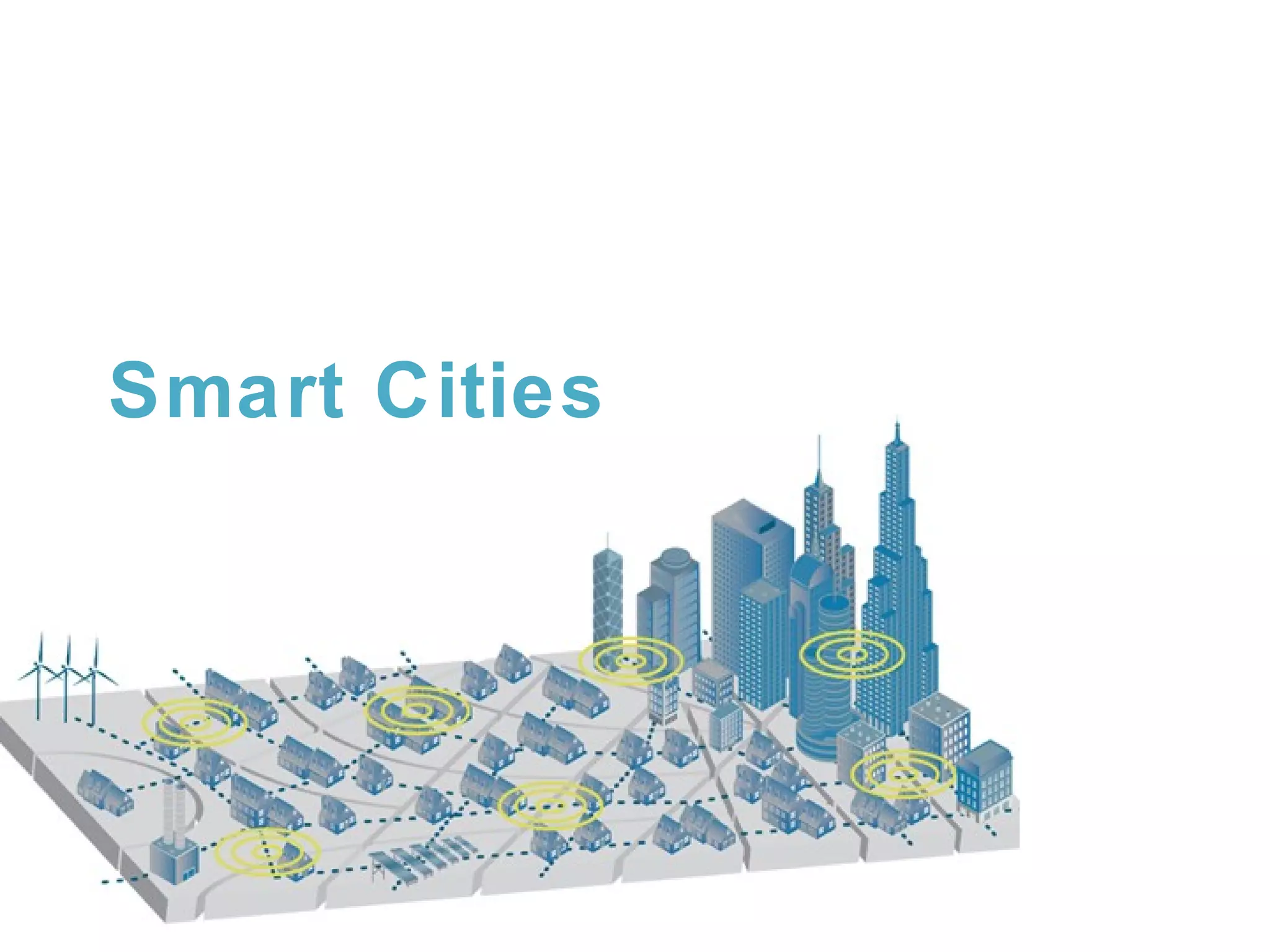
Smart Cities
The need for smarter cities
Challenges cities face today

Growing population
Traffic congestion
Space – homes and public space
Resource management (water and energy use)
Global warming (carbon emissions)
Tighter city budgets
Resources:
Kent Larson’s TEDx Boston talk: “Brilliant Desig
Aging infrastructure
Stanley S. Litow: “America’s Cities need to get
The need for smarter cities
• Some stats
– More than 50% of the world’s population live in cities
– In China alone, 300-400 million people will move
to cities in the next 15 years
– In the 21st century, cities will account for
• 90% of population growth
• 80% of global CO2 emissions
• 75% of energy use
Smart cities
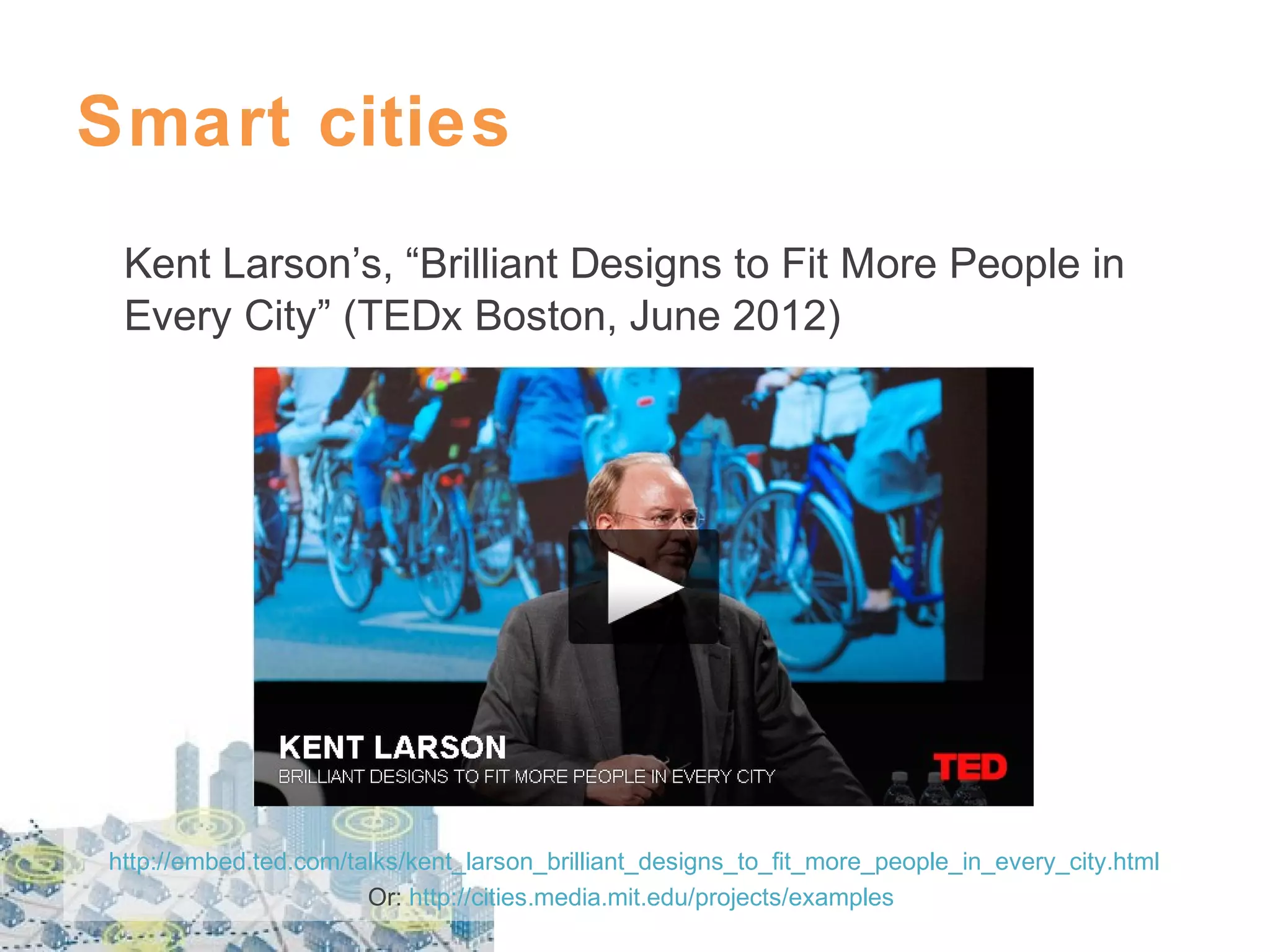
Kent Larson’s, “Brilliant Designs to Fit More People in
Every City” (TEDx Boston, June 2012)

http://embed.ted.com/talks/kent_larson_brilliant_designs_to_fit_more_people_in_every_city.html
Or: http://cities.media.mit.edu/projects/examples
What are smart cities?
Vision of smarter cities
–
–
–
–
–

Environmental sustainability and efficiency
Sustainable homes and buildings
Efficient use of resources
Efficient and sustainable transportation
Better urban planning - livable cities
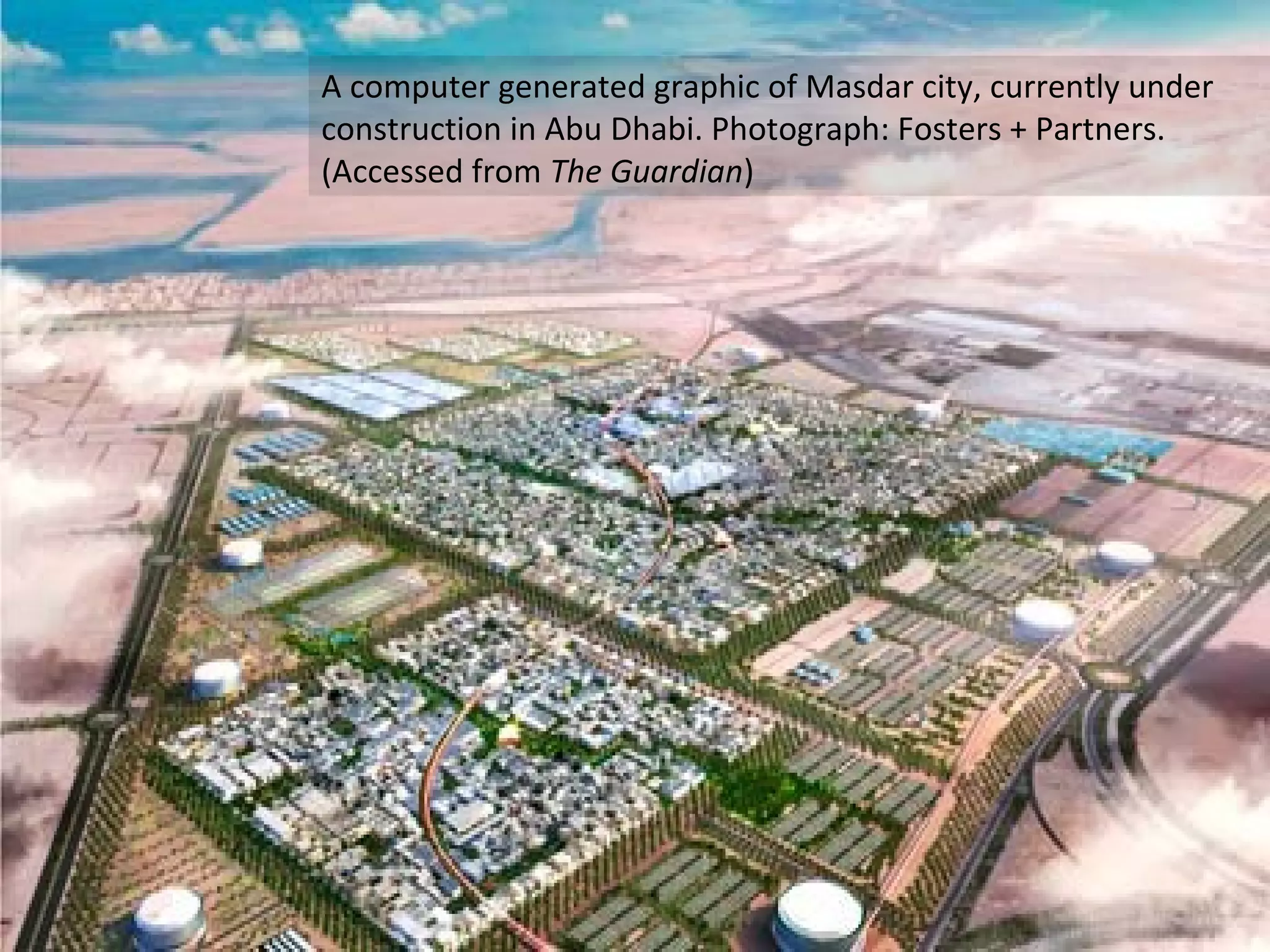
A computer generated graphic of Masdar city, currently under
construction in Abu Dhabi. Photograph: Fosters + Partners.
(Accessed from The Guardian)
Sensor technology and
applications
Sensor networks
• (Electronic) sensor: Measures physical properties
and converts signal into electronic signal.
– “Interface between the physical world and world of electrical
devices, such as computers”

• Actuator: Converts electronic signal into physical
property - displays information for humans to interpret
•

E.g. Speedometer, thermostat temperature reader

• Integration with ICT
•

Store, aggregate and organize data for analysis.
Sensor networks
• Data captured through sensors
•
•
•
•
•
•
•
•

Movement
Temperature
Force
Acceleration
Flow
Position
Light
Etc

Resources

Chong, Chee-Yee. “Sensor Networks: Evolution,
Opportunities, and Challenges.” Proceedings
the EEE, 91.8. August 2003.
OECD. “Smart Sensor Networks: Technologies and
Applications for Green Growth.” December 2009.
Verdone, R., D. Dardari, G. Mazzini and A. Conti.
Wireless Sensor and Actuator Networks.
Academic Press/Elsevier, London, 2008.

of
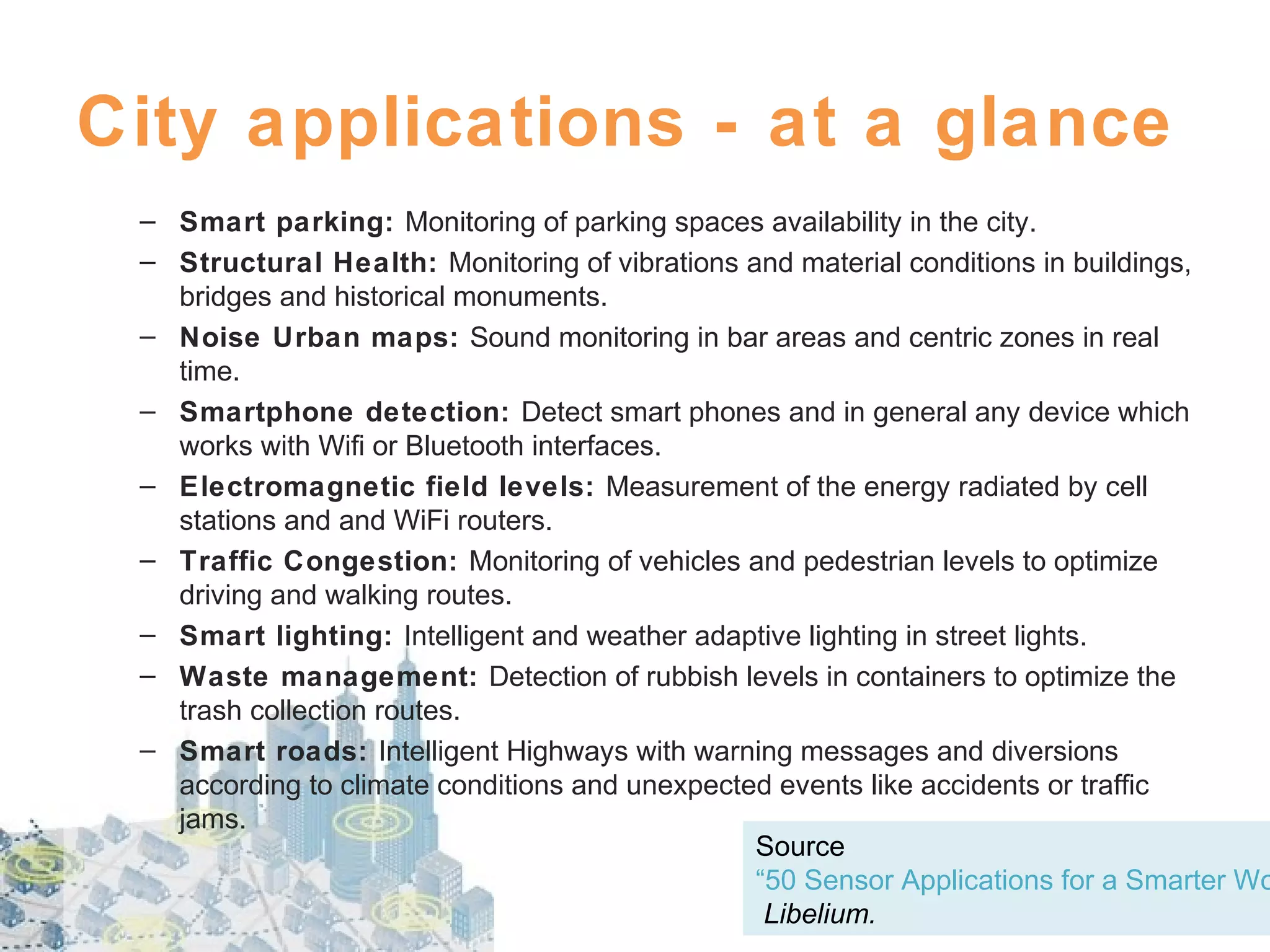
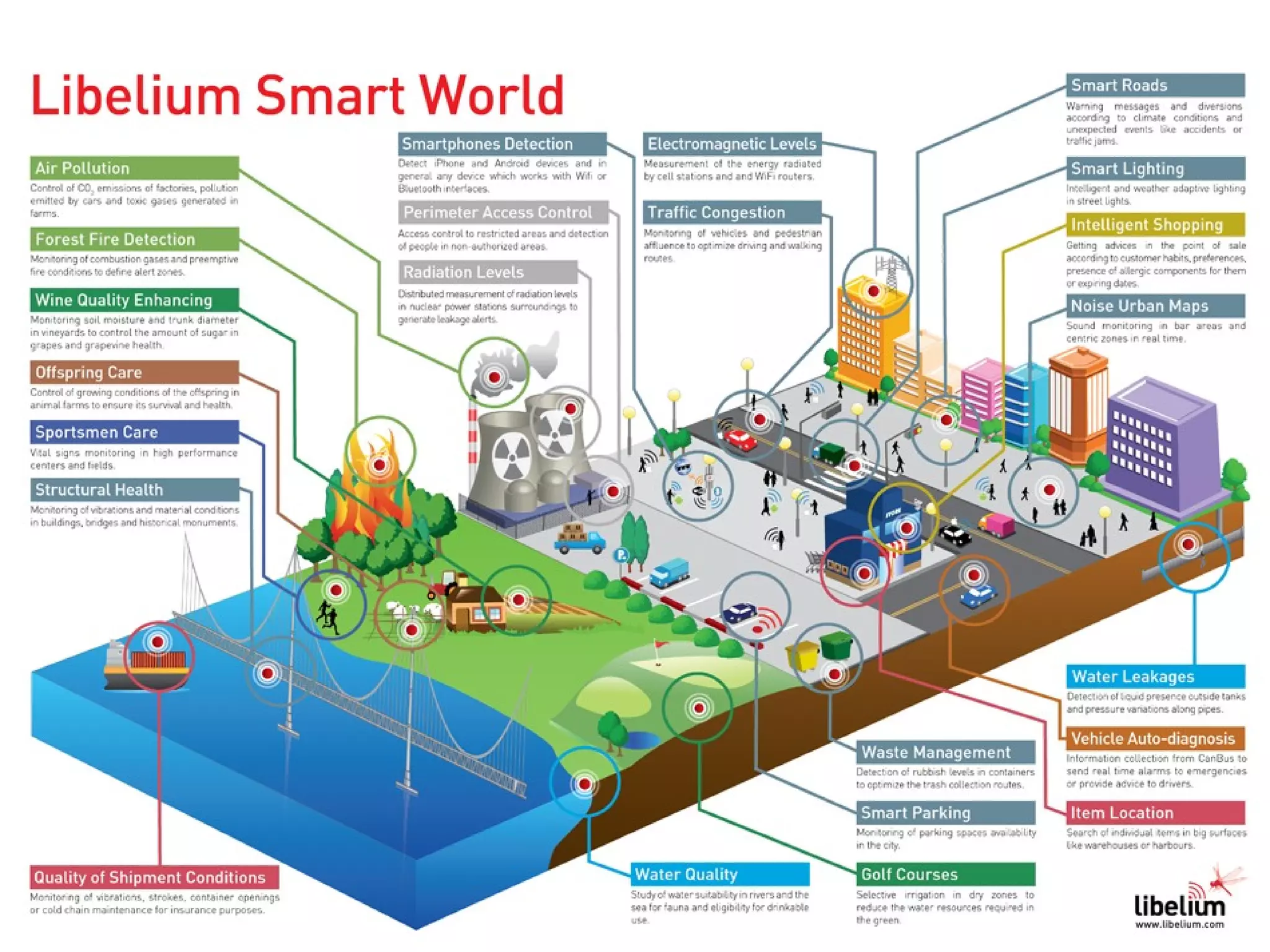
City applications - at a glance

– Smart parking: Monitoring of parking spaces availability in the city.
– Structural Health: Monitoring of vibrations and material conditions in buildings,
bridges and historical monuments.
– Noise Urban maps: Sound monitoring in bar areas and centric zones in real
time.
– Smartphone detection: Detect smart phones and in general any device which
works with Wifi or Bluetooth interfaces.
– Electromagnetic field levels: Measurement of the energy radiated by cell
stations and and WiFi routers.
– Traffic Congestion: Monitoring of vehicles and pedestrian levels to optimize
driving and walking routes.
– Smart lighting: Intelligent and weather adaptive lighting in street lights.
– Waste management: Detection of rubbish levels in containers to optimize the
trash collection routes.
– Smart roads: Intelligent Highways with warning messages and diversions
according to climate conditions and unexpected events like accidents or traffic
jams.
Source
“50 Sensor Applications for a Smarter Wo
Libelium.
City applications
• Focused examples:
– Energy (production, distribution and use)
– Smart buildings
– Intelligent transportation systems
Efficient energy
• More efficient energy production
– Light sensors on solar panels track sun rays to ensure power is
gathered in a more efficient manner

• Distribution
– Smart grids: Highly complex systems technically integrating
digital and non-digital technologies. Characterized by:
•
•
•
•

More efficient energy routing (reduces excess capacity)
Better monitoring and control
Improved data capture and measurement
Automation

• Use
– Smart devices and metering – at the city, building, and home
levels
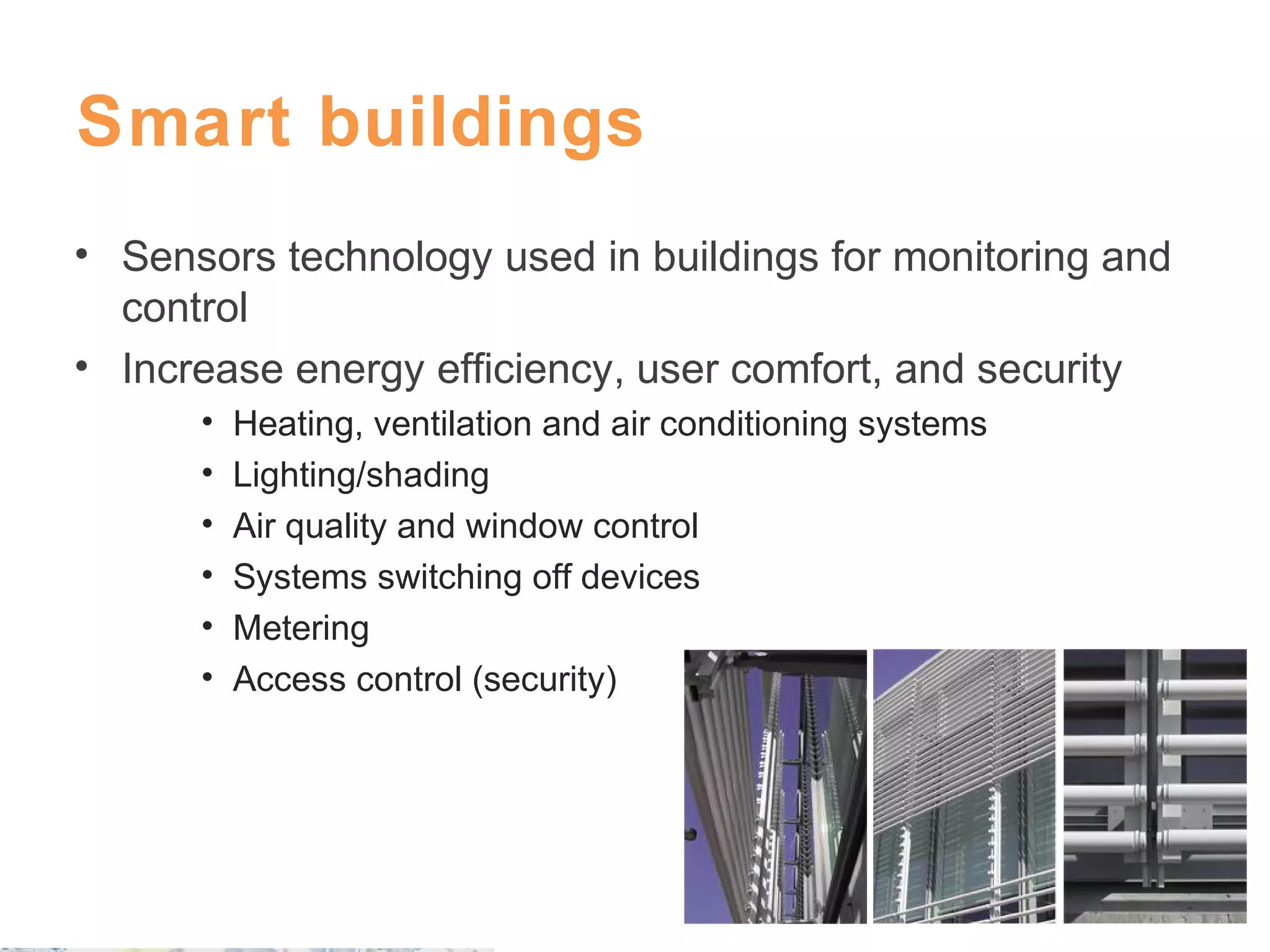
Smart buildings
• Sensors technology used in buildings for monitoring and
control
• Increase energy efficiency, user comfort, and security
•
•
•
•
•
•

Heating, ventilation and air conditioning systems
Lighting/shading
Air quality and window control
Systems switching off devices
Metering
Access control (security)
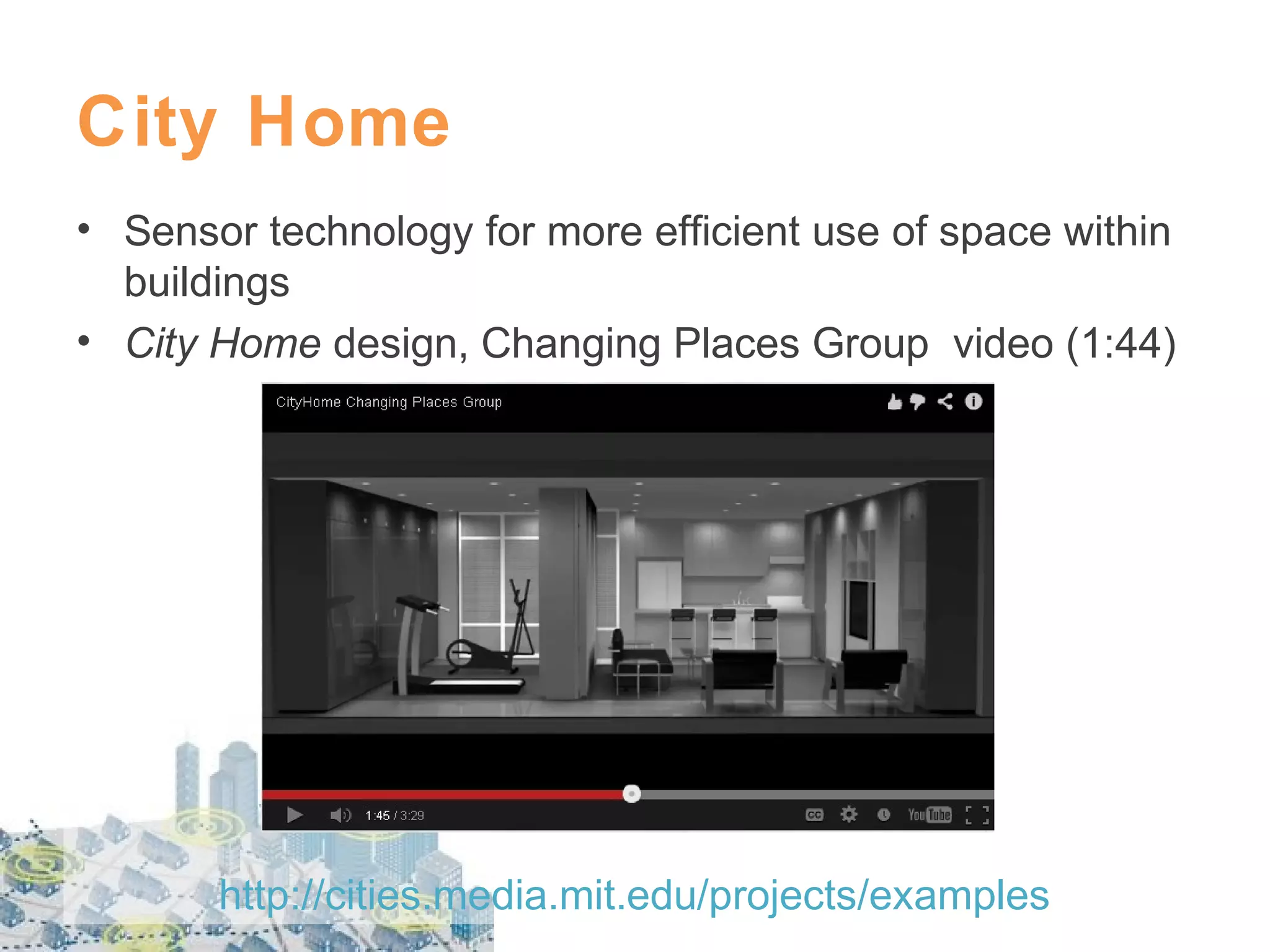
City Home
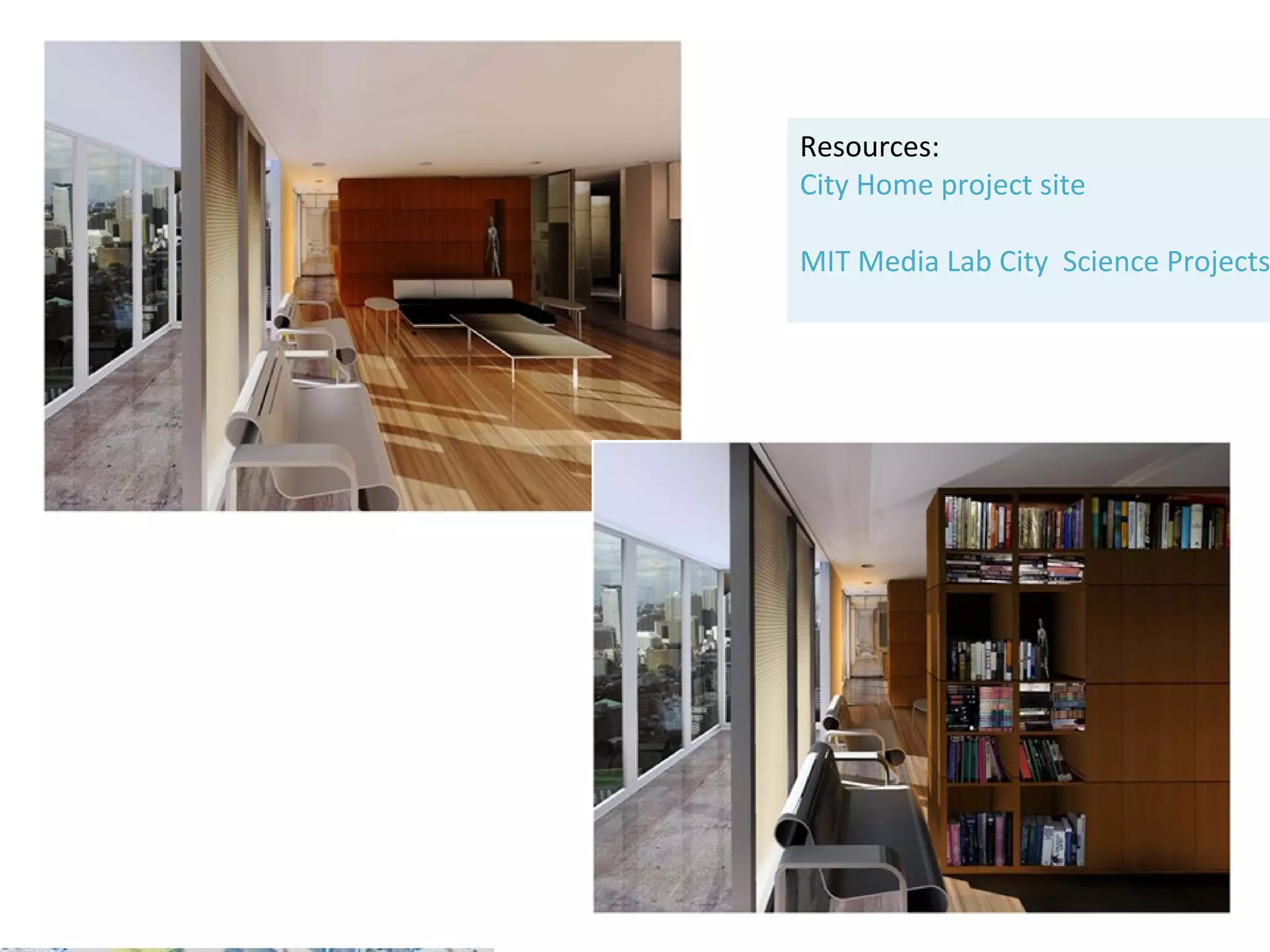
• Sensor technology for more efficient use of space within
buildings
• City Home design, Changing Places Group video (1:44)

http://cities.media.mit.edu/projects/examples
Resources:
City Home project site

MIT Media Lab City Science Projects
Transportation
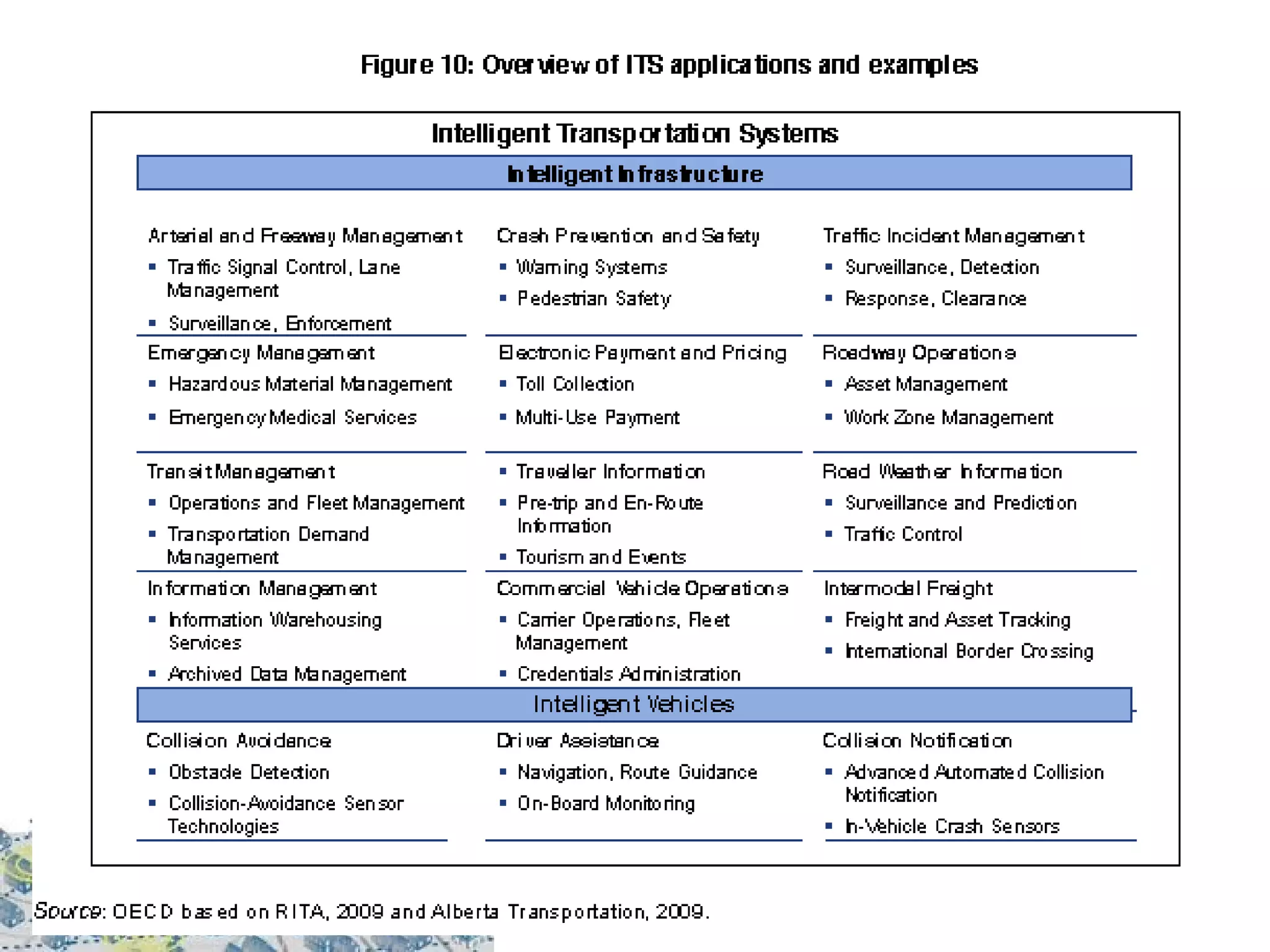
• Intelligent transportation systems (ITS)
• Smarter infrastructure and vehicles:
– Infrastructure: Sensors in roads monitor intensity
and fluidity of traffic to help control traffic lights more
efficiently
– Vehicles: Sensors on smart vehicles
• Collision avoidance
• Navigation

– Public transit: Tracking use for more efficient route
planning
Traffic management
• IBM Smart Cities project - Traffic Management
solutions
– Analyzing traffic patterns of buses, trains, traffic lights
to
• Improve travel times
• Minimize impacts during emergencies, special events, etc

– Data collection:
http://www-03.ibm.com/innovation/us/thesmartercity/traffic/
Smart public transit example
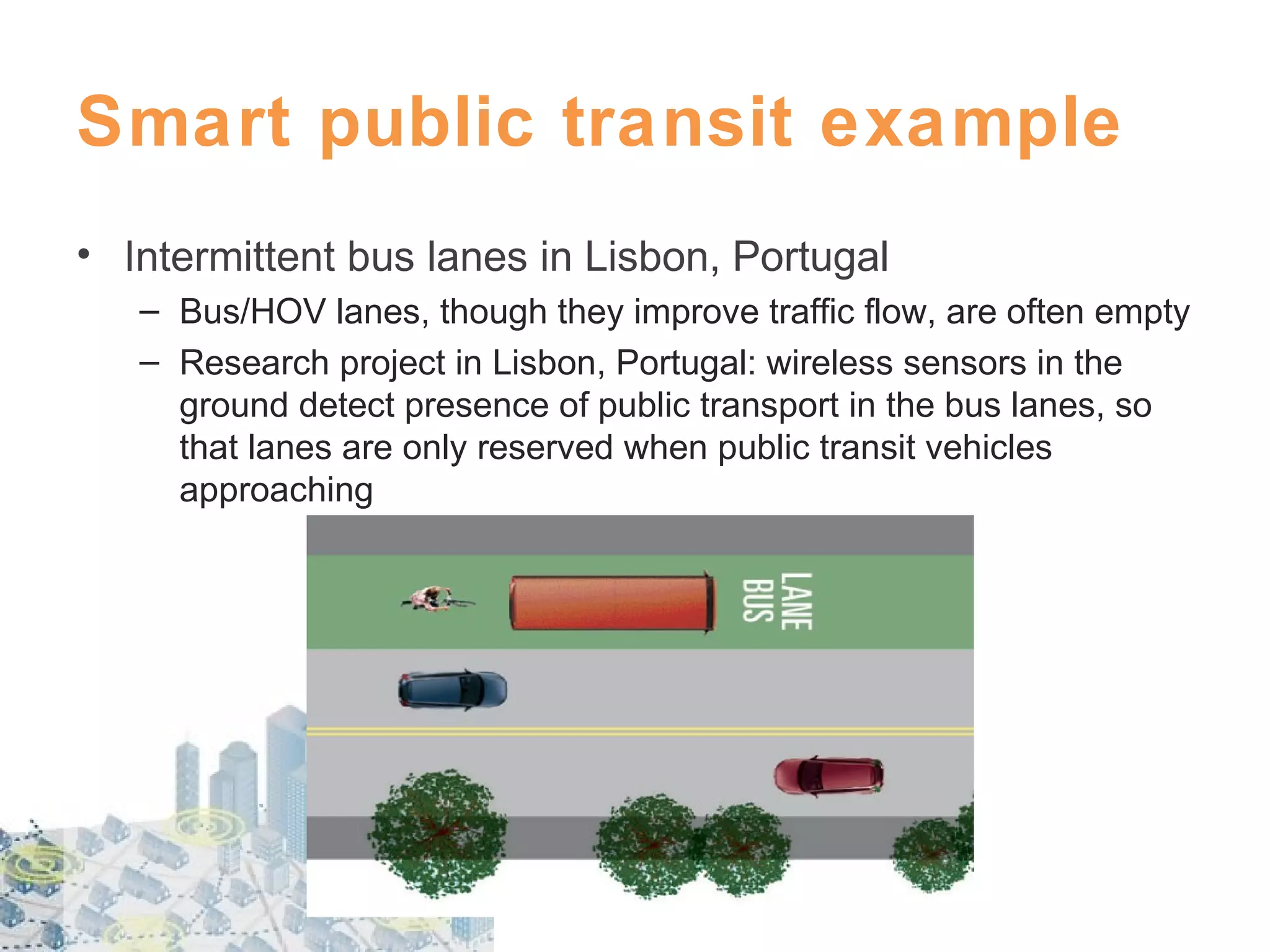
• Intermittent bus lanes in Lisbon, Portugal
– Bus/HOV lanes, though they improve traffic flow, are often empty
– Research project in Lisbon, Portugal: wireless sensors in the
ground detect presence of public transport in the bus lanes, so
that lanes are only reserved when public transit vehicles
approaching
Intelligent vehicles of
tomorrow
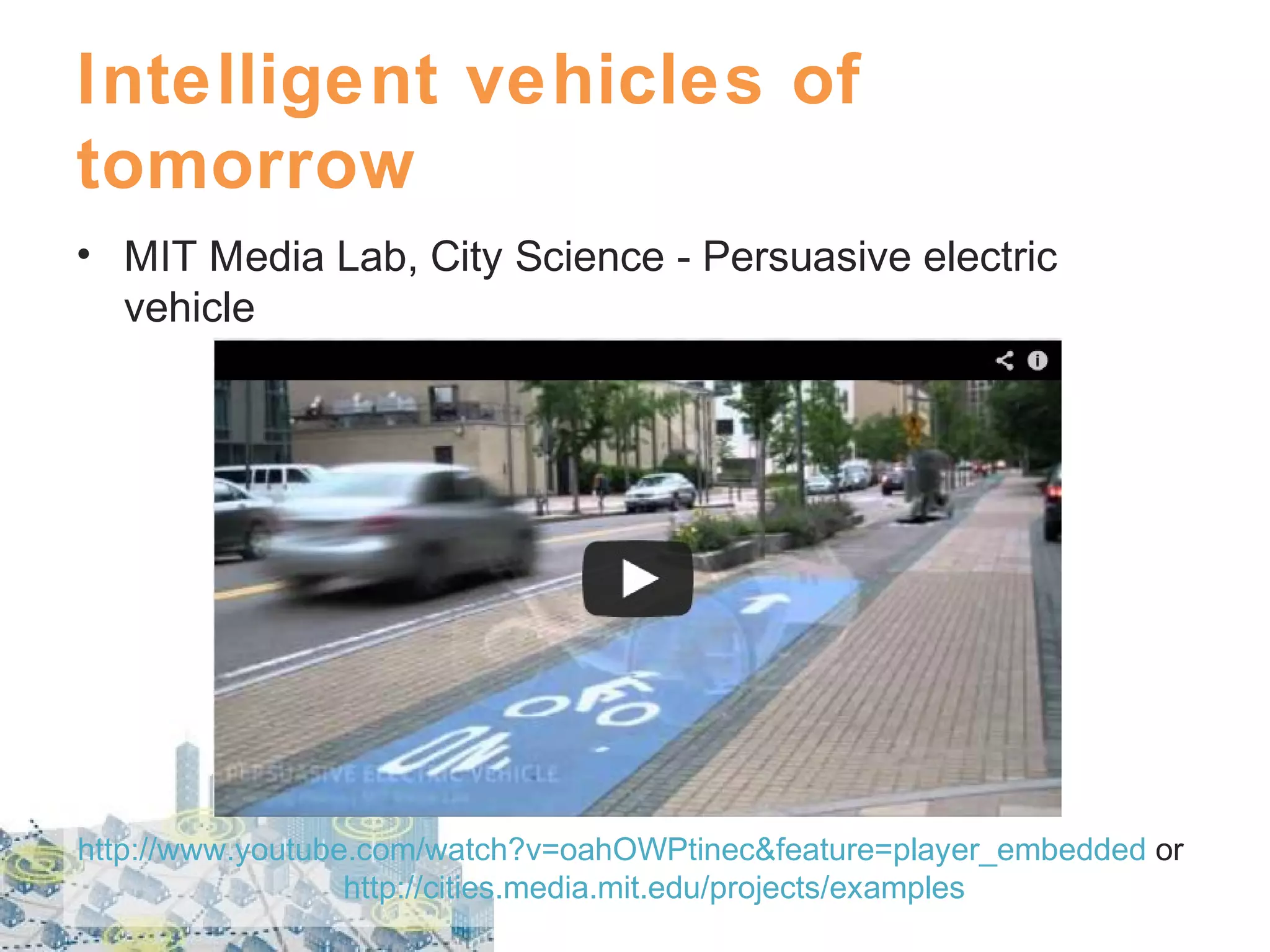
• MIT Media Lab, City Science - Persuasive electric
vehicle

http://www.youtube.com/watch?v=oahOWPtinec&feature=player_embedded or
http://cities.media.mit.edu/projects/examples
Other applications
• Health care
– Fall detection – for seniors and people with mobility
disabilities

•
•
•
•

Agriculture
Air quality, global warming
Global warming
Industry
– Shopping logistics, fleet tracking
– Industrial control – temperature monitoring, air quality

• Entertainment
Projects
• MIT Media Lab – City Science:
– http://cities.media.mit.edu/
– http://cities.media.mit.edu/projects/examples

• IBM smart cities projects:
– http://www.ibm.com/smarterplanet/us/en/smarter_cities/overview/
– http://www-03.ibm.com/innovation/us/thesmartercity/index.html
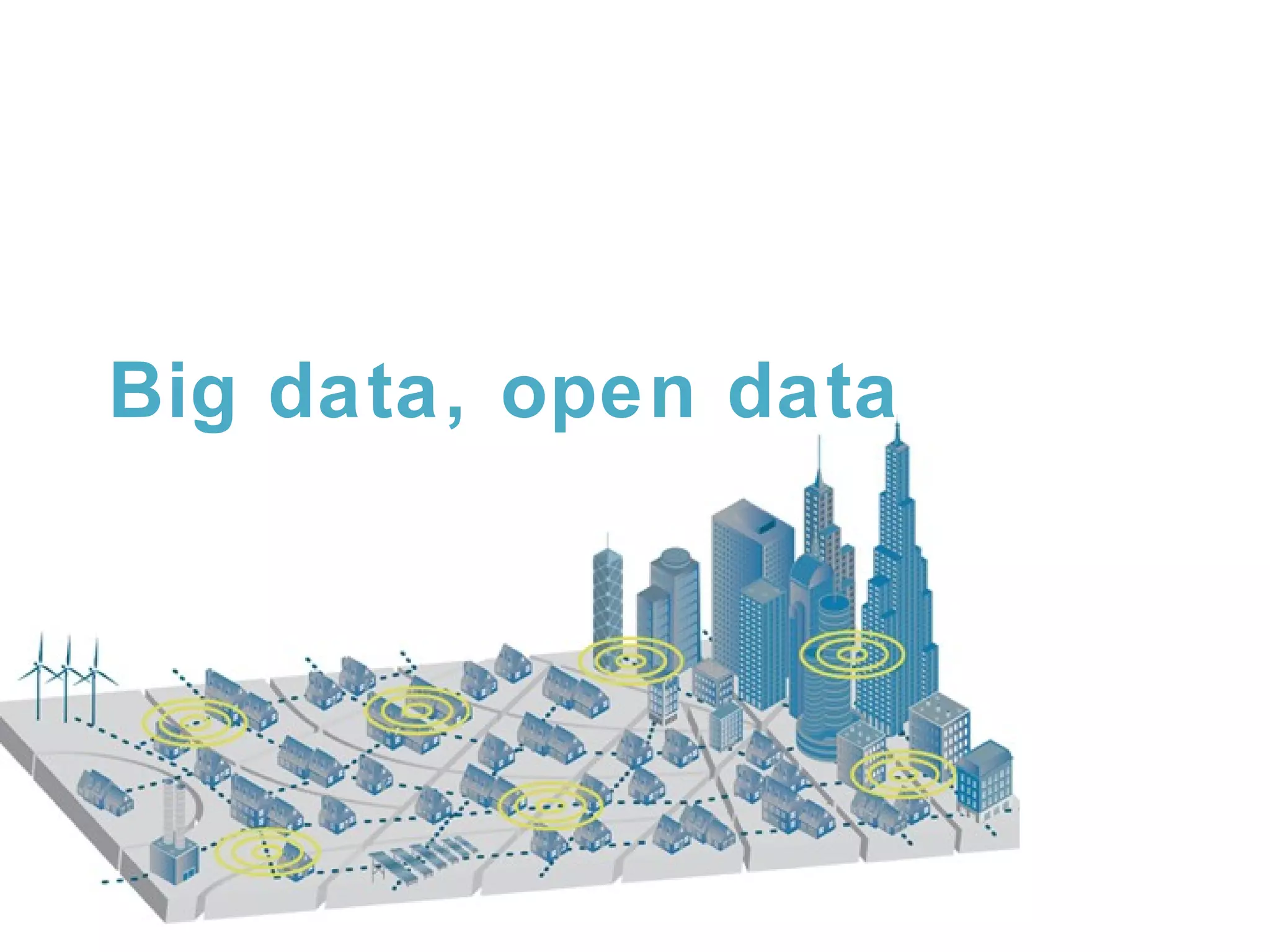
Big data, open data
Data-driven cities
"We are increasingly able to digitally search and interrogate the
city. Social tools can be layered over the city, giving us real-time
access to information about the things and people that surround
us, helping us to connect in new ways and giving rise to a datadriven society.
Cities today are vast repositories of information, endlessly
collecting and archiving data. When semantically organised, the
data can be exposed, shared, and interconnected. Giving people
the right kind of access to this information can spark new
applications and services, new ways of living, creating and
being.”
(qtd in Kirby)
Big data
• We’re collecting so much
data…
– Datasets are becoming so large that
they are becoming difficult to use
– If all sensor data were to be recorded,
the data flow would be nearly
500 exabytes per day (Wikipedia)
1 EB
= 1000000000000000000B
= 1018 bytes
= 1000000000gigabytes
=1000000terabytes
= 1000petabytes

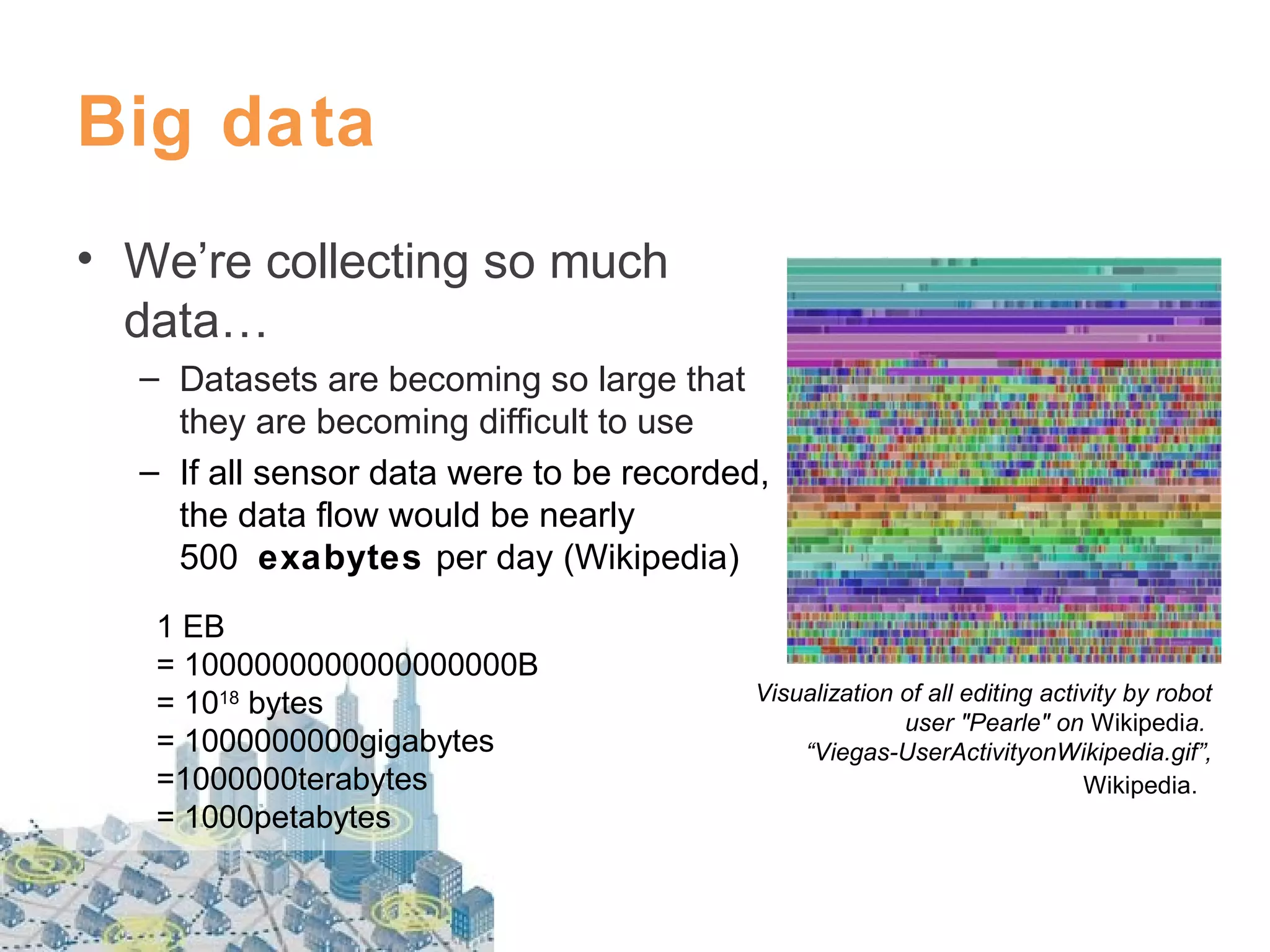
Visualization of all editing activity by robot
user "Pearle" on Wikipedia.
“Viegas-UserActivityonWikipedia.gif”,
Wikipedia.
Open Data
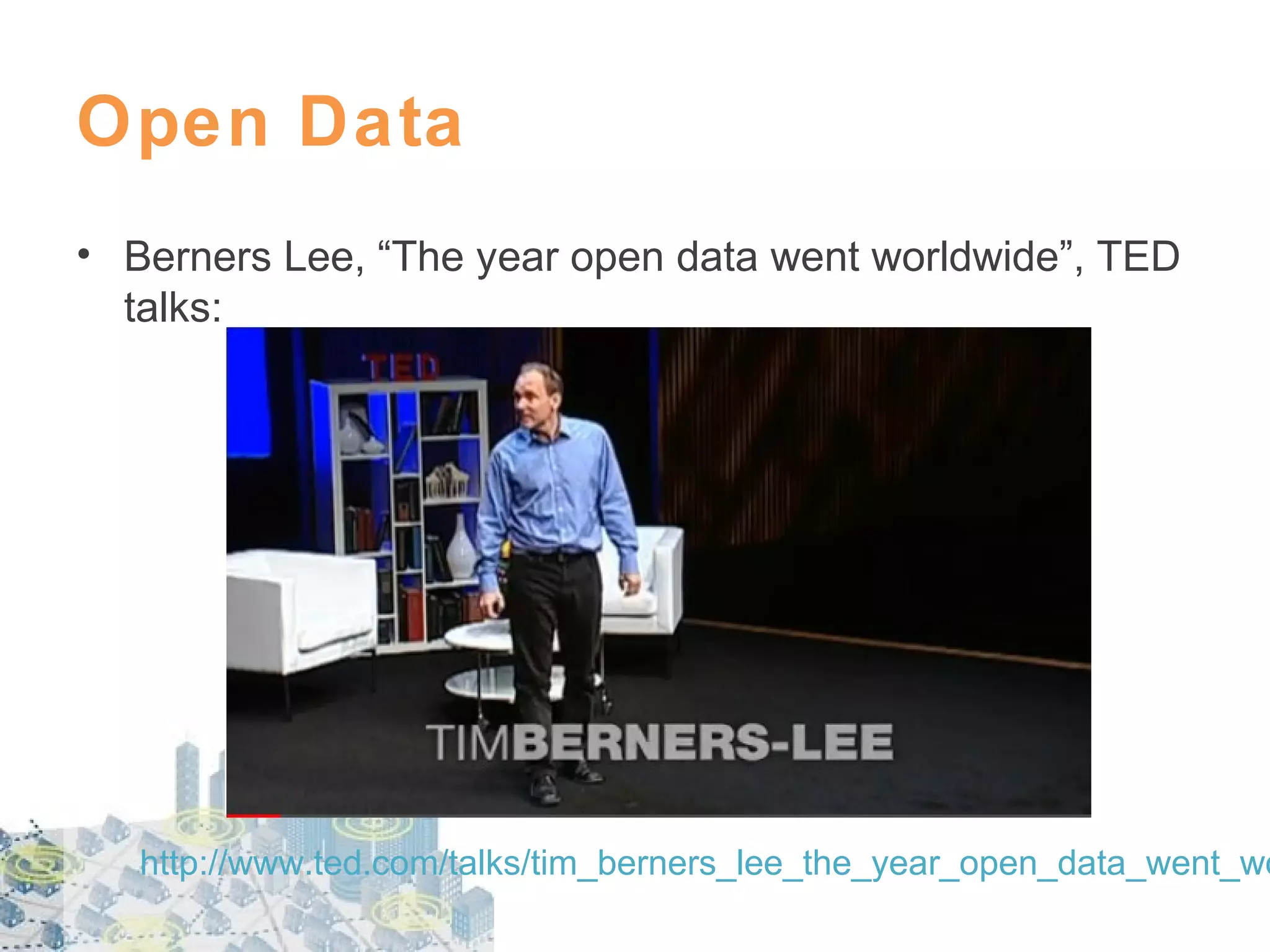
• Berners Lee, “The year open data went worldwide”, TED
talks:

http://www.ted.com/talks/tim_berners_lee_the_year_open_data_went_wo
Open Data
• Global movement to open up pubic
data sets to make public data more
accessible
– Sparks innovation
• Creation of apps and services

– Greater transparency in government
• Example: Open data revealed 3 billion
dollars of charity fraud in Canada

– Citizen participation in decision
making

“Open data enables
citizens to have
meaningful
interaction with the
information that
surrounds them”
FutureEverything
Open data
• Future Internet Assembly session “Big data and
smart cities” addressed challenges and
opportunities
• “Big data needs to be made ‘small’ (i.e. accessible to
citizens)”
• “Open data is only open if it is accessible: easy to obtain and
easy to understand”
• “Open data is a political issue which should be addressed at
a policy level”
• “Organizations could be provided with incentives for opening
their data”
Resource
Future Internet Assembly, Aalborg
Session 3.1 – Smart cities and big data
Open data standards
• Data standards make data more accessible and usable
• Examples
– Linked data: http://linkeddata.org/
• “Linked Data is about using the Web to connect related data that
wasn't previously linked, or using the Web to lower the barriers to
linking data currently linked using other methods.”

– Open 3-1-1: http://open311.org/
• “Open311 is an open communication standard for public services
and local government. Primarily, Open311 refers to a standardized
protocol for location-based collaborative issue-tracking. By offering
free web API access to an existing 311 service, Open311 is an
evolution of the phone-based 311 systems that many cities in North
America offer.
What can open data tell us?
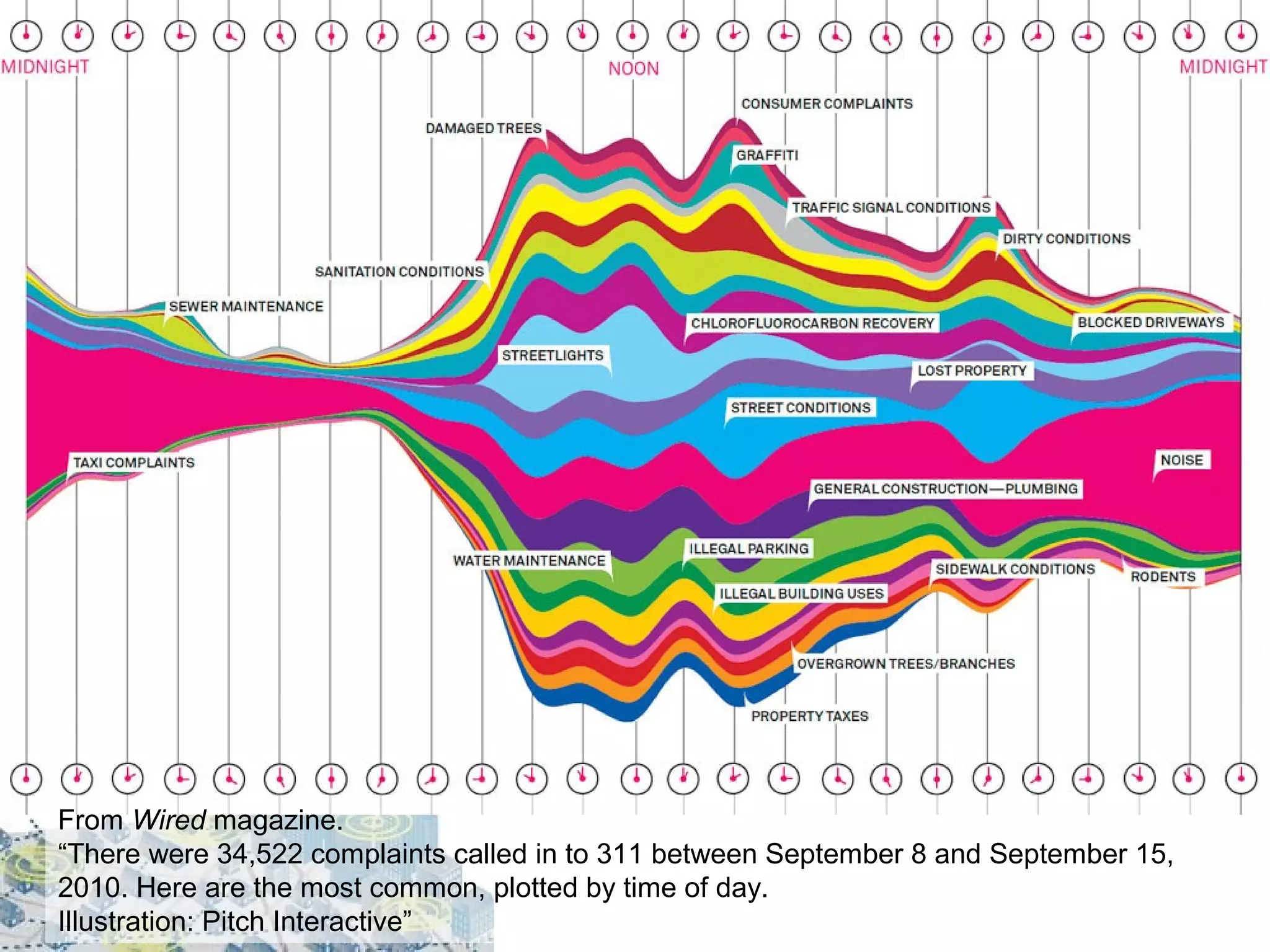
• What a Hundred Million Calls to 311 Reveal
About New York…
From Wired magazine.
“There were 34,522 complaints called in to 311 between September 8 and September 15,
2010. Here are the most common, plotted by time of day.
Illustration: Pitch Interactive”
Open Data Projects
• Vancouver’s open data initiatives:
– http://vancouver.ca/your-government/open-data-catalogue.aspx

• FutureEverything’s Open Data Project

– http://futureeverything.org/ongoing-projects/open-data-cities-dat

• European Commission Big Data Forum:

– http://www.future-internet.eu/home/future-internet-assembly/aalb
A human approach to data
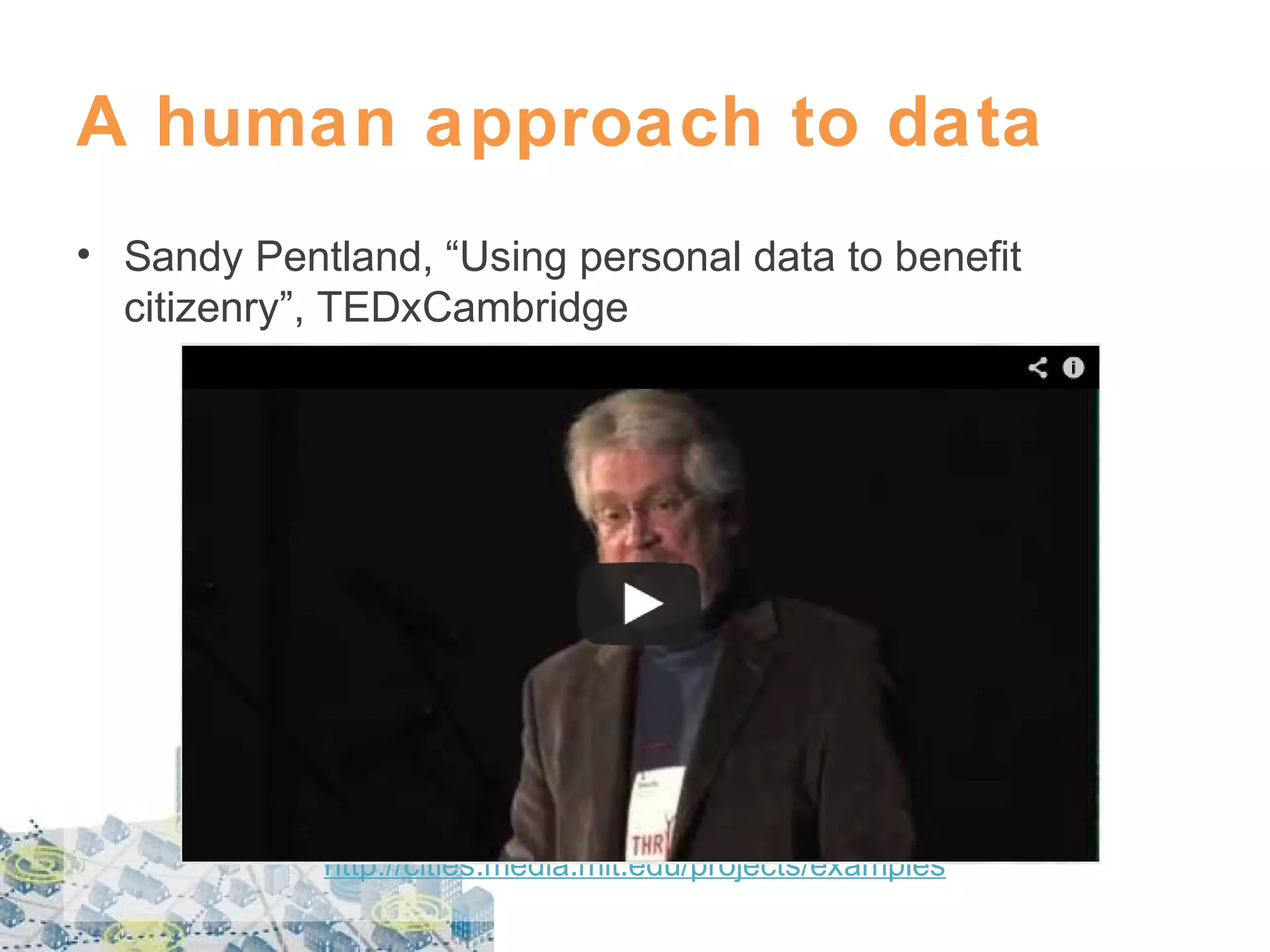
• Sandy Pentland, “Using personal data to benefit
citizenry”, TEDxCambridge

http://cities.media.mit.edu/projects/examples
Observations
Observations
• While initial focus of smart technology and data use
within cities was driven by need for efficiency and
sustainability, recent focus on human-centered
approaches
– User-friendly interfaces
– Increased focus aesthetics, design
– Focus on quality of life

• Proliferation of collaborative projects bringing together
private companies, municipal governments, and
researchers aimed at
– Improving cities
– Harnessing public data sets
Where do we go from here?
• Open questions
– How to encourage civic engagement in smart cities?
– How to better share and use the data we’re capturing
and make it more accessible?
– How to better use Big Data in the humanities?
Artistic applications of
sensors and data
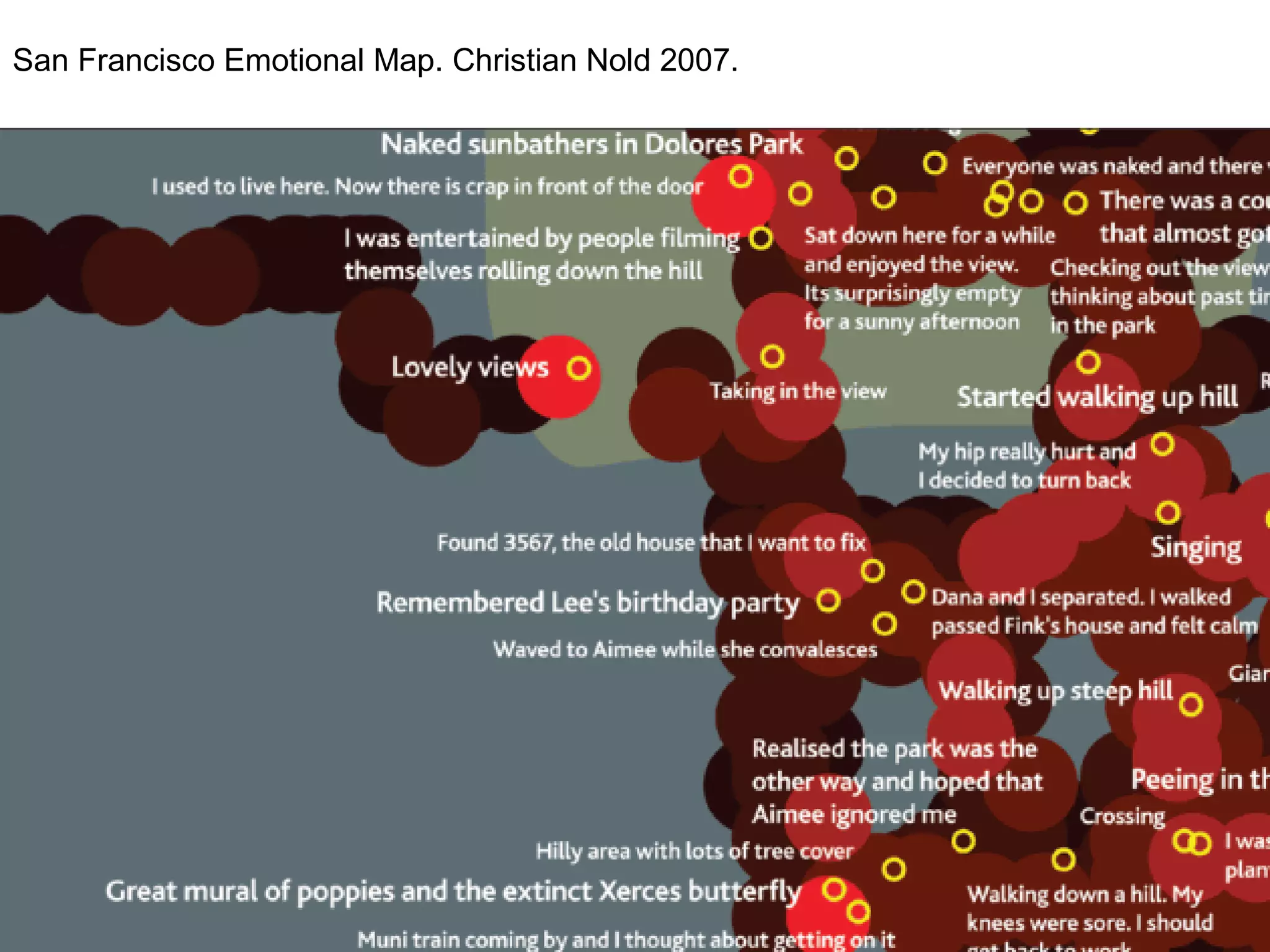
San Francisco Emotional Map
• Project by artist Christian Nold, 2007
“The project invited the public to go for a walk using [a biosensor]
device, which records the wearer’s physiological response to their
surroundings. The results of these walks are represented on this
map using colored dots and participant’s personal annotations. The
San Francisco Emotion Map is a collective attempt at creating an
emotional portrait of a neighborhood and envisions new tools that
allow people to share and interpret their own bio data.”
http://www.sf.biomapping.net/map.htm
San Francisco Emotional Map. Christian Nold 2007.
Glossary of Terms
Glossary
•
•
•
•
•
•
•
•
•
•
•
•
•
•
•

Smart cities
Smart technology
Sensor networks
Sensor
Actuator
Wireless mesh networks
Information and Communications Technology (ICT)
Smart grid
Intelligent Transportation Systems (ITS)
Intelligent vehicles
Smart homes and buildings
Big data
Open data
Linked data
Open 3-1-1
Bibliography
Smart Cities
City Science. MIT Media Lab, 2012. Web. February 2013. http://cities.media.mit.edu/
Kirby, Terry. “City design: Transforming tomorrow.” The Guardian. N.d. Web. February
2013.
Larson, Kent. “Brilliant designs to fit more people every city.” TEDxBoston, Boston, MA.
June 2012. Web. Feb 2013. <http://cities.media.mit.edu/projects/examples>
Smart Cities. IBM. N.d. Web. Feburary 2013. <
http://www.ibm.com/smarterplanet/us/en/smarter_cities/overview/>
Sensor network technology
Chong, Chee-Yee. “Sensor Networks: Evolution, Opportunities, and Challenges.”
Proceedings
of the EEE, 91.8. August 2003.
OECD. “Smart Sensor Networks: Technologies and
December

Applications for Green Growth.”

“50 Sensor Applications for a Smarter World.” Libelium.
Murty, Rohan Naraya et al. “City Sense: An Urban-Scale Wireless Sensor Network and
Testbed.”
Big data and open data
“Smart Cities and Big Data post event session summary.” Future Internet Assembly. 1011 May 2012, Aalborg, Denmark. Web. Feb 2013. <
http://www.future-internet.eu/home/future-internet-assembly/aalborg-may-2012/31-smart-citie
>
“Big data.” Wikipedia. <http://en.wikipedia.org/wiki/Big_data>
Berners-Lee, Tim. “The year open data went worldwide.” TED 2010. Feb 2010. Web. Feb
2013.
Pentland, Sandy. “Using personal data to benefit citizenry.” TEDxCambridge. Mar 2012.
Cambridge, MA. Web. Feb 2013. http://cities.media.mit.edu/projects/examples
Open data projects
Vancouver’s open data catalogue:
http://vancouver.ca/your-government/open-data-catalogue.aspx
FutureEverything’s Open Data Project:
http://futureeverything.org/ongoing-projects/open-data-cities-datagm/
Linked data: http://linkeddata.org/
Open 3-1-1: http://open311.org/
Code for America: http://codeforamerica.org/cities/
Open North: http://opennorth.ca/about/
Artistic city data projects
Flowing city http://flowingcity.com/
Nold, Christian. San Francisco Emotional Map. 2007. Web. Accessed March
2013. http://www.sf.biomapping.net/map.htm

Smart Cities and Big Data - Research Presentation

  • 1.
    Anne Galang ::ENGL 794 :: TRANSMEDIA SMARTCITIESANDBIGDATA
  • 2.
    Research questions • Whereare sensors being located in cities? • What types of information are gleaned from this technology? • How does this relate to big data and how is this data being used to improve cities?
  • 3.
    Contents • • • • • • Smart cities Sensor technology Bigdata, open data Observations Glossary of terms Bibliography
  • 4.
  • 5.
    The need forsmarter cities Challenges cities face today Growing population Traffic congestion Space – homes and public space Resource management (water and energy use) Global warming (carbon emissions) Tighter city budgets Resources: Kent Larson’s TEDx Boston talk: “Brilliant Desig Aging infrastructure Stanley S. Litow: “America’s Cities need to get
  • 6.
    The need forsmarter cities • Some stats – More than 50% of the world’s population live in cities – In China alone, 300-400 million people will move to cities in the next 15 years – In the 21st century, cities will account for • 90% of population growth • 80% of global CO2 emissions • 75% of energy use
  • 7.
    Smart cities Kent Larson’s,“Brilliant Designs to Fit More People in Every City” (TEDx Boston, June 2012) http://embed.ted.com/talks/kent_larson_brilliant_designs_to_fit_more_people_in_every_city.html Or: http://cities.media.mit.edu/projects/examples
  • 8.
    What are smartcities? Vision of smarter cities – – – – – Environmental sustainability and efficiency Sustainable homes and buildings Efficient use of resources Efficient and sustainable transportation Better urban planning - livable cities
  • 9.
    A computer generatedgraphic of Masdar city, currently under construction in Abu Dhabi. Photograph: Fosters + Partners. (Accessed from The Guardian)
  • 10.
  • 11.
    Sensor networks • (Electronic)sensor: Measures physical properties and converts signal into electronic signal. – “Interface between the physical world and world of electrical devices, such as computers” • Actuator: Converts electronic signal into physical property - displays information for humans to interpret • E.g. Speedometer, thermostat temperature reader • Integration with ICT • Store, aggregate and organize data for analysis.
  • 12.
    Sensor networks • Datacaptured through sensors • • • • • • • • Movement Temperature Force Acceleration Flow Position Light Etc Resources Chong, Chee-Yee. “Sensor Networks: Evolution, Opportunities, and Challenges.” Proceedings the EEE, 91.8. August 2003. OECD. “Smart Sensor Networks: Technologies and Applications for Green Growth.” December 2009. Verdone, R., D. Dardari, G. Mazzini and A. Conti. Wireless Sensor and Actuator Networks. Academic Press/Elsevier, London, 2008. of
  • 13.
    City applications -at a glance – Smart parking: Monitoring of parking spaces availability in the city. – Structural Health: Monitoring of vibrations and material conditions in buildings, bridges and historical monuments. – Noise Urban maps: Sound monitoring in bar areas and centric zones in real time. – Smartphone detection: Detect smart phones and in general any device which works with Wifi or Bluetooth interfaces. – Electromagnetic field levels: Measurement of the energy radiated by cell stations and and WiFi routers. – Traffic Congestion: Monitoring of vehicles and pedestrian levels to optimize driving and walking routes. – Smart lighting: Intelligent and weather adaptive lighting in street lights. – Waste management: Detection of rubbish levels in containers to optimize the trash collection routes. – Smart roads: Intelligent Highways with warning messages and diversions according to climate conditions and unexpected events like accidents or traffic jams. Source “50 Sensor Applications for a Smarter Wo Libelium.
  • 15.
    City applications • Focusedexamples: – Energy (production, distribution and use) – Smart buildings – Intelligent transportation systems
  • 16.
    Efficient energy • Moreefficient energy production – Light sensors on solar panels track sun rays to ensure power is gathered in a more efficient manner • Distribution – Smart grids: Highly complex systems technically integrating digital and non-digital technologies. Characterized by: • • • • More efficient energy routing (reduces excess capacity) Better monitoring and control Improved data capture and measurement Automation • Use – Smart devices and metering – at the city, building, and home levels
  • 17.
    Smart buildings • Sensorstechnology used in buildings for monitoring and control • Increase energy efficiency, user comfort, and security • • • • • • Heating, ventilation and air conditioning systems Lighting/shading Air quality and window control Systems switching off devices Metering Access control (security)
  • 18.
    City Home • Sensortechnology for more efficient use of space within buildings • City Home design, Changing Places Group video (1:44) http://cities.media.mit.edu/projects/examples
  • 19.
    Resources: City Home projectsite MIT Media Lab City Science Projects
  • 20.
    Transportation • Intelligent transportationsystems (ITS) • Smarter infrastructure and vehicles: – Infrastructure: Sensors in roads monitor intensity and fluidity of traffic to help control traffic lights more efficiently – Vehicles: Sensors on smart vehicles • Collision avoidance • Navigation – Public transit: Tracking use for more efficient route planning
  • 22.
    Traffic management • IBMSmart Cities project - Traffic Management solutions – Analyzing traffic patterns of buses, trains, traffic lights to • Improve travel times • Minimize impacts during emergencies, special events, etc – Data collection: http://www-03.ibm.com/innovation/us/thesmartercity/traffic/
  • 23.
    Smart public transitexample • Intermittent bus lanes in Lisbon, Portugal – Bus/HOV lanes, though they improve traffic flow, are often empty – Research project in Lisbon, Portugal: wireless sensors in the ground detect presence of public transport in the bus lanes, so that lanes are only reserved when public transit vehicles approaching
  • 24.
    Intelligent vehicles of tomorrow •MIT Media Lab, City Science - Persuasive electric vehicle http://www.youtube.com/watch?v=oahOWPtinec&feature=player_embedded or http://cities.media.mit.edu/projects/examples
  • 25.
    Other applications • Healthcare – Fall detection – for seniors and people with mobility disabilities • • • • Agriculture Air quality, global warming Global warming Industry – Shopping logistics, fleet tracking – Industrial control – temperature monitoring, air quality • Entertainment
  • 26.
    Projects • MIT MediaLab – City Science: – http://cities.media.mit.edu/ – http://cities.media.mit.edu/projects/examples • IBM smart cities projects: – http://www.ibm.com/smarterplanet/us/en/smarter_cities/overview/ – http://www-03.ibm.com/innovation/us/thesmartercity/index.html
  • 27.
  • 28.
    Data-driven cities "We areincreasingly able to digitally search and interrogate the city. Social tools can be layered over the city, giving us real-time access to information about the things and people that surround us, helping us to connect in new ways and giving rise to a datadriven society. Cities today are vast repositories of information, endlessly collecting and archiving data. When semantically organised, the data can be exposed, shared, and interconnected. Giving people the right kind of access to this information can spark new applications and services, new ways of living, creating and being.” (qtd in Kirby)
  • 29.
    Big data • We’recollecting so much data… – Datasets are becoming so large that they are becoming difficult to use – If all sensor data were to be recorded, the data flow would be nearly 500 exabytes per day (Wikipedia) 1 EB = 1000000000000000000B = 1018 bytes = 1000000000gigabytes =1000000terabytes = 1000petabytes Visualization of all editing activity by robot user "Pearle" on Wikipedia. “Viegas-UserActivityonWikipedia.gif”, Wikipedia.
  • 30.
    Open Data • BernersLee, “The year open data went worldwide”, TED talks: http://www.ted.com/talks/tim_berners_lee_the_year_open_data_went_wo
  • 31.
    Open Data • Globalmovement to open up pubic data sets to make public data more accessible – Sparks innovation • Creation of apps and services – Greater transparency in government • Example: Open data revealed 3 billion dollars of charity fraud in Canada – Citizen participation in decision making “Open data enables citizens to have meaningful interaction with the information that surrounds them” FutureEverything
  • 32.
    Open data • FutureInternet Assembly session “Big data and smart cities” addressed challenges and opportunities • “Big data needs to be made ‘small’ (i.e. accessible to citizens)” • “Open data is only open if it is accessible: easy to obtain and easy to understand” • “Open data is a political issue which should be addressed at a policy level” • “Organizations could be provided with incentives for opening their data” Resource Future Internet Assembly, Aalborg Session 3.1 – Smart cities and big data
  • 33.
    Open data standards •Data standards make data more accessible and usable • Examples – Linked data: http://linkeddata.org/ • “Linked Data is about using the Web to connect related data that wasn't previously linked, or using the Web to lower the barriers to linking data currently linked using other methods.” – Open 3-1-1: http://open311.org/ • “Open311 is an open communication standard for public services and local government. Primarily, Open311 refers to a standardized protocol for location-based collaborative issue-tracking. By offering free web API access to an existing 311 service, Open311 is an evolution of the phone-based 311 systems that many cities in North America offer.
  • 34.
    What can opendata tell us? • What a Hundred Million Calls to 311 Reveal About New York…
  • 35.
    From Wired magazine. “Therewere 34,522 complaints called in to 311 between September 8 and September 15, 2010. Here are the most common, plotted by time of day. Illustration: Pitch Interactive”
  • 36.
    Open Data Projects •Vancouver’s open data initiatives: – http://vancouver.ca/your-government/open-data-catalogue.aspx • FutureEverything’s Open Data Project – http://futureeverything.org/ongoing-projects/open-data-cities-dat • European Commission Big Data Forum: – http://www.future-internet.eu/home/future-internet-assembly/aalb
  • 37.
    A human approachto data • Sandy Pentland, “Using personal data to benefit citizenry”, TEDxCambridge http://cities.media.mit.edu/projects/examples
  • 38.
  • 39.
    Observations • While initialfocus of smart technology and data use within cities was driven by need for efficiency and sustainability, recent focus on human-centered approaches – User-friendly interfaces – Increased focus aesthetics, design – Focus on quality of life • Proliferation of collaborative projects bringing together private companies, municipal governments, and researchers aimed at – Improving cities – Harnessing public data sets
  • 40.
    Where do wego from here? • Open questions – How to encourage civic engagement in smart cities? – How to better share and use the data we’re capturing and make it more accessible? – How to better use Big Data in the humanities?
  • 41.
  • 42.
    San Francisco EmotionalMap • Project by artist Christian Nold, 2007 “The project invited the public to go for a walk using [a biosensor] device, which records the wearer’s physiological response to their surroundings. The results of these walks are represented on this map using colored dots and participant’s personal annotations. The San Francisco Emotion Map is a collective attempt at creating an emotional portrait of a neighborhood and envisions new tools that allow people to share and interpret their own bio data.” http://www.sf.biomapping.net/map.htm
  • 43.
    San Francisco EmotionalMap. Christian Nold 2007.
  • 44.
  • 45.
    Glossary • • • • • • • • • • • • • • • Smart cities Smart technology Sensornetworks Sensor Actuator Wireless mesh networks Information and Communications Technology (ICT) Smart grid Intelligent Transportation Systems (ITS) Intelligent vehicles Smart homes and buildings Big data Open data Linked data Open 3-1-1
  • 46.
  • 47.
    Smart Cities City Science.MIT Media Lab, 2012. Web. February 2013. http://cities.media.mit.edu/ Kirby, Terry. “City design: Transforming tomorrow.” The Guardian. N.d. Web. February 2013. Larson, Kent. “Brilliant designs to fit more people every city.” TEDxBoston, Boston, MA. June 2012. Web. Feb 2013. <http://cities.media.mit.edu/projects/examples> Smart Cities. IBM. N.d. Web. Feburary 2013. < http://www.ibm.com/smarterplanet/us/en/smarter_cities/overview/> Sensor network technology Chong, Chee-Yee. “Sensor Networks: Evolution, Opportunities, and Challenges.” Proceedings of the EEE, 91.8. August 2003. OECD. “Smart Sensor Networks: Technologies and December Applications for Green Growth.” “50 Sensor Applications for a Smarter World.” Libelium. Murty, Rohan Naraya et al. “City Sense: An Urban-Scale Wireless Sensor Network and Testbed.”
  • 48.
    Big data andopen data “Smart Cities and Big Data post event session summary.” Future Internet Assembly. 1011 May 2012, Aalborg, Denmark. Web. Feb 2013. < http://www.future-internet.eu/home/future-internet-assembly/aalborg-may-2012/31-smart-citie > “Big data.” Wikipedia. <http://en.wikipedia.org/wiki/Big_data> Berners-Lee, Tim. “The year open data went worldwide.” TED 2010. Feb 2010. Web. Feb 2013. Pentland, Sandy. “Using personal data to benefit citizenry.” TEDxCambridge. Mar 2012. Cambridge, MA. Web. Feb 2013. http://cities.media.mit.edu/projects/examples Open data projects Vancouver’s open data catalogue: http://vancouver.ca/your-government/open-data-catalogue.aspx FutureEverything’s Open Data Project: http://futureeverything.org/ongoing-projects/open-data-cities-datagm/ Linked data: http://linkeddata.org/ Open 3-1-1: http://open311.org/ Code for America: http://codeforamerica.org/cities/ Open North: http://opennorth.ca/about/
  • 49.
    Artistic city dataprojects Flowing city http://flowingcity.com/ Nold, Christian. San Francisco Emotional Map. 2007. Web. Accessed March 2013. http://www.sf.biomapping.net/map.htm

Editor's Notes

  • #8 Sources Kent Larson’s TEDx Boston talk: “Brilliant Designs to Fit More People in Every City” http://embed.ted.com/talks/kent_larson_brilliant_designs_to_fit_more_people_in_every_city.html History of Cities – From 0:00 – 2:50 Pre-industrialization - home was center of learning, work, health Industrialization – centralized work, production, energy production, learning (schools), health care Water, sewer networks, roads, rails – allowed for unchecked expansion “Give everybody a car, build roads to everything” – not a very functional model, but that’s where we live today. Crowded sprawls.
  • #9 -Transportation: smart city cars, shared vehicles, use less space, exercise, bikes -Housing: making use of small spaces – chasey/sensor walls; sensor furniture – smart lighting -Livable cities Distribution of amenities Walkable cities
  • #10 Masdar City Project in Abu Dhabi, United Arab Emirates. Its core is a planned city, which is being built by the Abu Dhabi Future Energy Company and designed by the British architectural firm Foster and Partners. The city will rely entirely on solar energy and other renewable energy sources, with a sustainable, zero-carbon, zero-waste ecology and will be a car free city. More: http://en.wikipedia.org/wiki/Masdar_City
  • #14 Top “Smart City” applications according to Libelium “50 Sensor Applications for a Smarter World”: http://www.libelium.com/top_50_iot_sensor_applications_ranking/
  • #18 “The headquarters of the New York Times is an example of how different smart building technologies can be combined to reduce energy consumption and to increase user comfort. Overall, the building consumes 30% less energy than traditional office skyscrapers. Equipped with lighting and shading control systems based on ICT technologies. The lighting system ensures that electrical light is only used when required. Further daylighting measures include a garden in the centre of the ground floor which is open to the sky as well as a large area skylight. The electrical ballasts in the lighting system are equipped with chips that allow each ballast to be controlled separately. The shading system tracks the position of the sun and relies on a sensor network to automatically actuate the raising and lowering of the shades.” (OECD 25)
  • #19 “Demonstrates how the CityHome, which has a very small footprint (840 square feet), can function as an apartment two to three times that size. This is achieved through a transformable wall system which integrates furniture, storage, exercise equipment, lighting, office equipment, and entertainment systems.” http://cp.media.mit.edu/research/67-cityhome
  • #22 (OECD 30)
  • #24 (OECD 31)
  • #25 Or Larson talk at 7:49 - citycar
  • #30 Collecting data through sensors, and through open data sets (public reports, city data, census data, etc)
  • #31 Lee calls for people to put their data on the web so it can be used by others to do “wonderful things in ways you may never have imagined” Linked data standards to create data “mashups” - Using public data to create open street maps
  • #32 “Case Study: How Open data saved Canada $3.2 Billion” http://eaves.ca/2010/04/14/case-study-open-data-and-the-public-purse/ Future Everything Project: http://futureeverything.org/ongoing-projects/open-data-cities-datagm/
  • #34 More info: What is 311? Slide deck: http://open311.org/2012/07/open311-at-the-association-of-government-contact-center-professionals/ List of Open 311 cities: http://wiki.open311.org/GeoReport_v2/Servers
  • #36 http://www.wired.com/magazine/2010/11/ff_311_new_york/
  • #38 Opportunities to use personal data for social good rather than “spying”