CONTENTS
• INTRODUCTION
• SMART CITY
• SMART CITY PLAN
• NEED FOR SMART CITY
• PHASES
• FEATURES OF SMART CITY
• WIRELESS SENSOR NETWORKS
• INTERNET OF THINGS
• GOALS & BENEFITS OF SMART CITY
• SMART CITIES - ONGOING PROCESS
• CONCLUSION
INTRODUCTION
 21st Century has brought with it a new global
trend of “sustainable urban development”
and this concept adds new dimensions to
urbanization which require a quick need to
upgrade existing cities.
98 cities were shortlisted in India for
implementing Smart City Concept.
SMART CITY
• A smart city (also smarter city) uses digital
technologies or information and
communication technologies (ICT) to enhance
quality and performance of urban services, to
reduce costs and resource consumption, and
to engage more effectively and actively with
its citizens.
• A smart city should be able to respond faster
to city and global challenges.
SMART CITY PLAN
• According to the plan, 20 cities will be
selected this year, followed by 40 each in the
next two years.
• While most of the smart cities will be
Brownfield (old) ventures and there will also
be a few Greenfield (new) projects .
SMART CITY PLAN
• The cities will be given scores based on urban
reforms that they have carried out, their impact and
what they propose to do in four key areas
Swatch Bharat (sanitation),
 Make in India (ease of doing business),
Good governance (modern accounting
system, rationalization of property taxes)
 e-governance.
NEED FOR SMART CITY
• By 2030, 60% of worlds population is expected
to live in cities results in heavy strain on
energy, transportation, water, building and
public spaces.
• Increasing need is the being felt for smart city
which are both efficient, sustainable and Can
generate economic prosperity & social well
being.
NEED FOR SMART CITY
• The need to handle global environment and
urbanization problems
-- Global warming and climate change
-- Population increase and resource depletion
-- Adverse effects of increasing urbanization
• The need to accommodate changing lifestyles
• A McKinsey Global Institute study estimated that cities
would generate 70% of the new jobs created by 2030,
produce more than 70% of the Indian gross domestic
product and drive a fourfold increase in per capita
income across the country.
PHASES
• Early phase: Provide the infrastructure
needed for the operation of the city.
• Growth Phase: Expand and intensify the
infrastructure to ensure that supply can keep
the pace with increasing demands of the growing demand.
• Mature phase: Enhance infrastructure
to ensure the delivery of high-quality services
based on criteria such as ease of- use and comfort.
• Transformation phase: Integrate
infrastructure systems to satisfy social values
such as aiding, or at least avoiding damage to, the natural
environment.
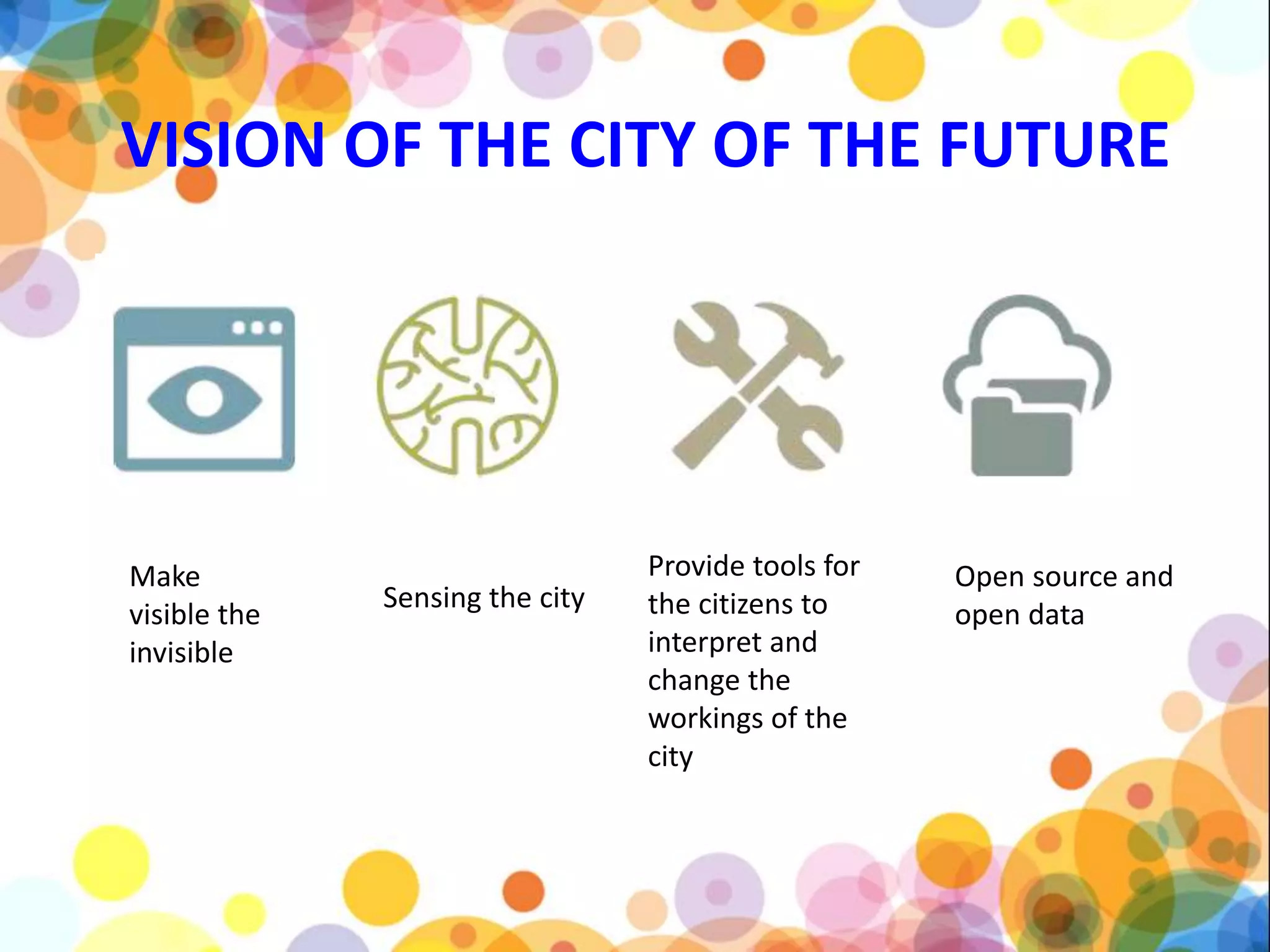
VISION OF THE CITY OF THE FUTURE
Make
visible the
invisible
Sensing the city
Provide tools for
the citizens to
interpret and
change the
workings of the
city
Open source and
open data
FEATURES OF SMART CITY
• Smart parking
• Smart heritage cities
• Smart transportation & Traffic management
• Smart grids
• Smart city maintenance
• Smart Building & Home
• Smart Energy (Renewable generation & storage, AMI,PQM,PLM,OMS)
• Smart Water Management
• Smart Waste Management (Recycling of waste, residual management,
Recovery of waste organics & Energy)
• Smart Education (e-Education)
• Smart Governance (e-governance)
• Smart Medical Facility (e-Medical)
• Smart Communications & Networks
SMART ENVIRONMENT
• Renewal of energy, waste water management
and provide proper sanitation to citizens
• To setup project for alarm and control of CO2
emissions of factories, pollution emitted by
cars and toxic gases generated.
• To setup projects to create alarms based on
distributed control in specific places like
buildings, bridges, and establish a National
Advance Disaster Alarm System.
SMART ENVIRONMENT
The sensors can be used to measuring
parameters as:
Temperature
Relative humidity
Carbon monoxide (CO)
Carbon Dioxide (CO2)
Nitrogen Dioxide (NO2)
GPS location
SMART WATER
• To setup Potable water monitoring tools to
monitor the quality of tap water in all
government owned education institutes and
public places.
• To setup project for real-time detection of
leakages and wastes of factories in rivers and
other natural water bodies.
• To setup project for monitoring of water level
variations in rivers, dams and reservoirs, for
proactive disaster management.
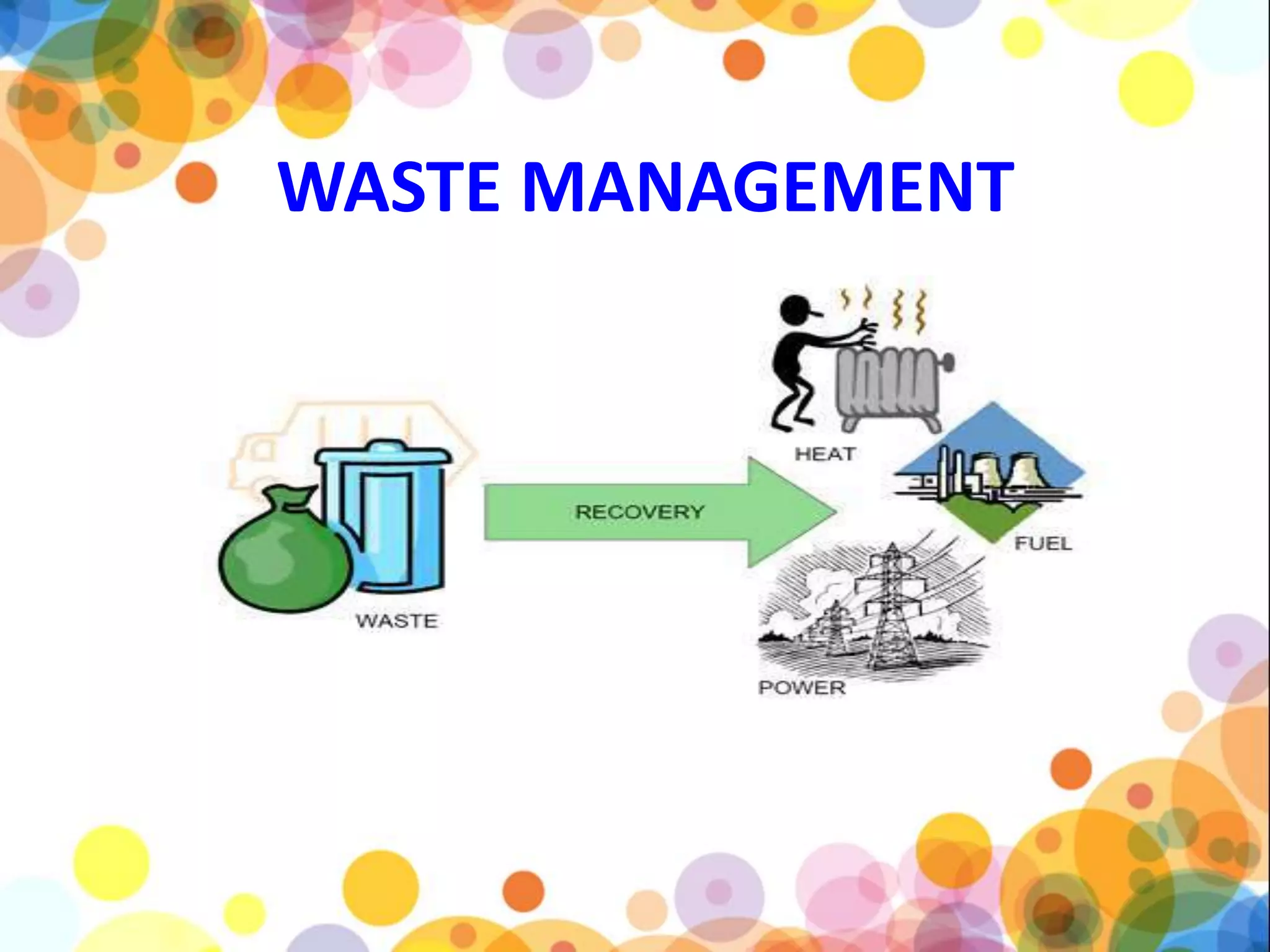
WASTE MANAGEMENT
• To assist the ‘SWACH BHARAT’ initiative,
projects may be setup to create products
which are Solar powered trash receptacle and
trash compactor that alerts sanitation crews
of municipal authorities, when it is full.
• Waste to Energy is the process of generating
energy in the form of electricity from primary
treatment of waste using Incinerators.
WASTE MANAGEMENT
WASTE MANAGEMENT
• ROADS USING PLASTIC
As most of the Indians roads are asphalt
road and we have seen their life is mostly 2-3
years. So we can work on the model proposed
by K.Ahmed Khan who has successfully proven
this in Madras that roads made using recycled
or waste plastic have much more life than
normal roads. As they can resist more
temperature than asphalt.
SMART TRANSPORT
• E-call:
The in vehicle e-call is generated either
manually by vehicle occupants or automatically by
sensors after an accident .when activated the e-call
device will establish an emergency call carrying both
voice and data to nearest Emergency Point.
• Automatic Road Enforcement :
A traffic enforcement system consists of
camera which detects and identify vehicle disobeying
traffic rules and automatically ticket offenders based
on license plate number. Traffic tickets are sent by
mail or message.
WIRELESS SENSOR NETWORKS
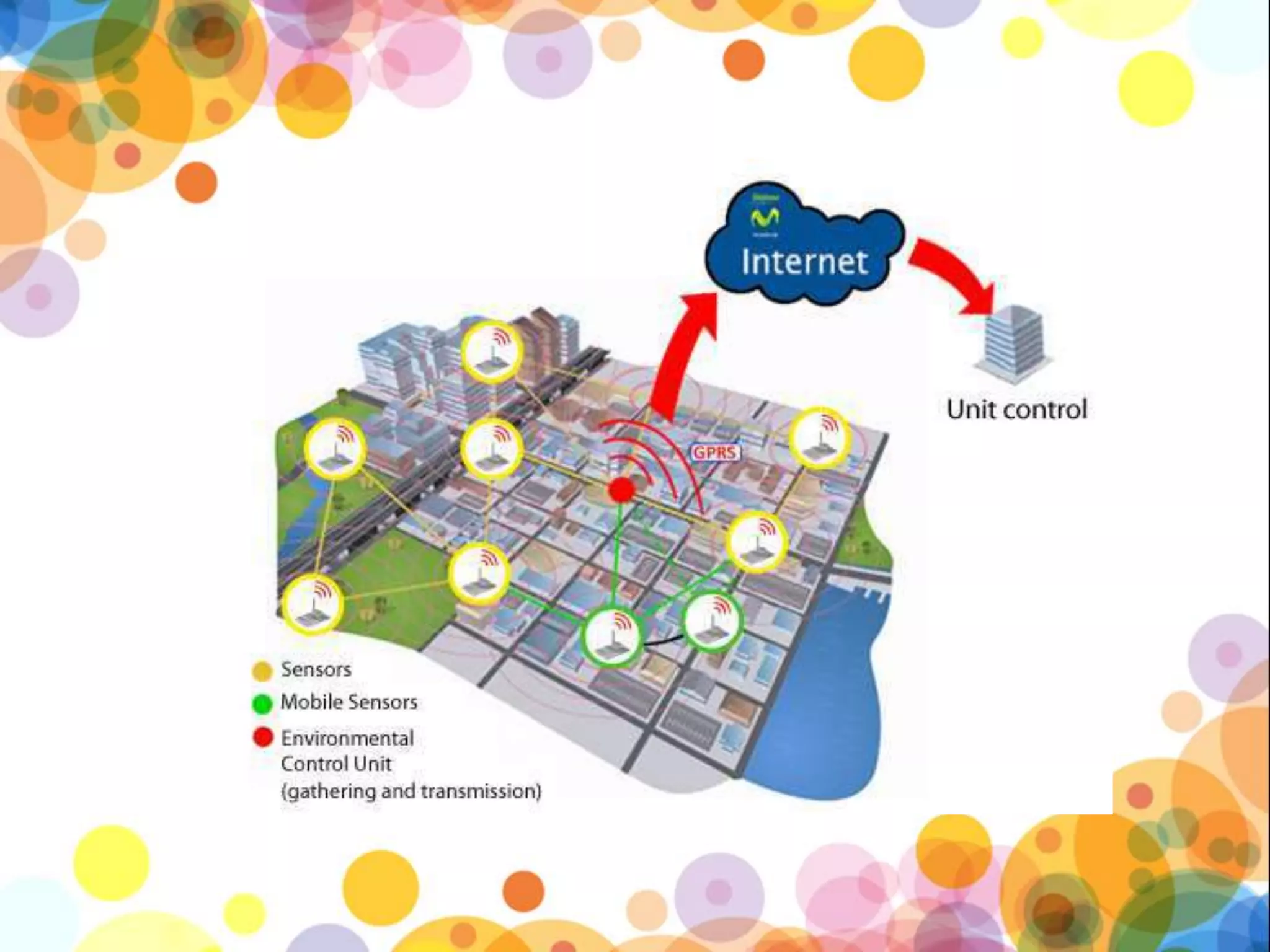
• Wireless Sensor Networks (WSN) can help to
monitor environmental conditions and water
quality, allowing an easier, faster and cheaper
data logging, which will lead into a better
utilization of resources of each organization or
government. The system would be able to
monitor water quality by measuring different
environmental parameters.
INTERNET OF THINGS
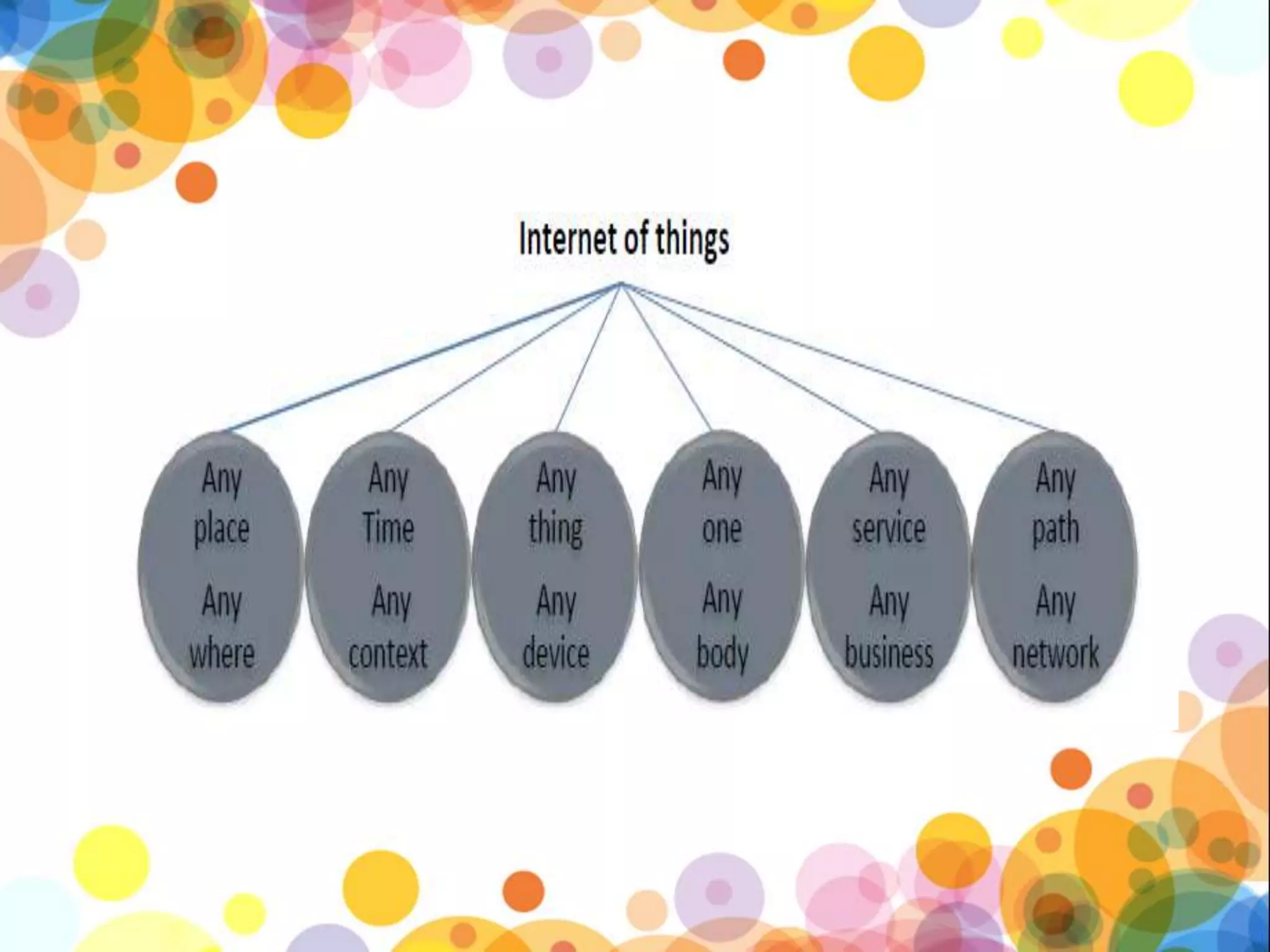
• The Internet of Things (IoT) is the network of physical objects
that contain embedded technology to communicate and
sense or interact with their internal states or the external
environment.
• Simply put this is the concept of basically connecting any
device with an on and off switch to the Internet (and/or to
each other) to transfer data over the network.
• The IoT is a giant network of connected “things” (which also
includes people). The relationship will be between people-
people, people-things, and things-things.
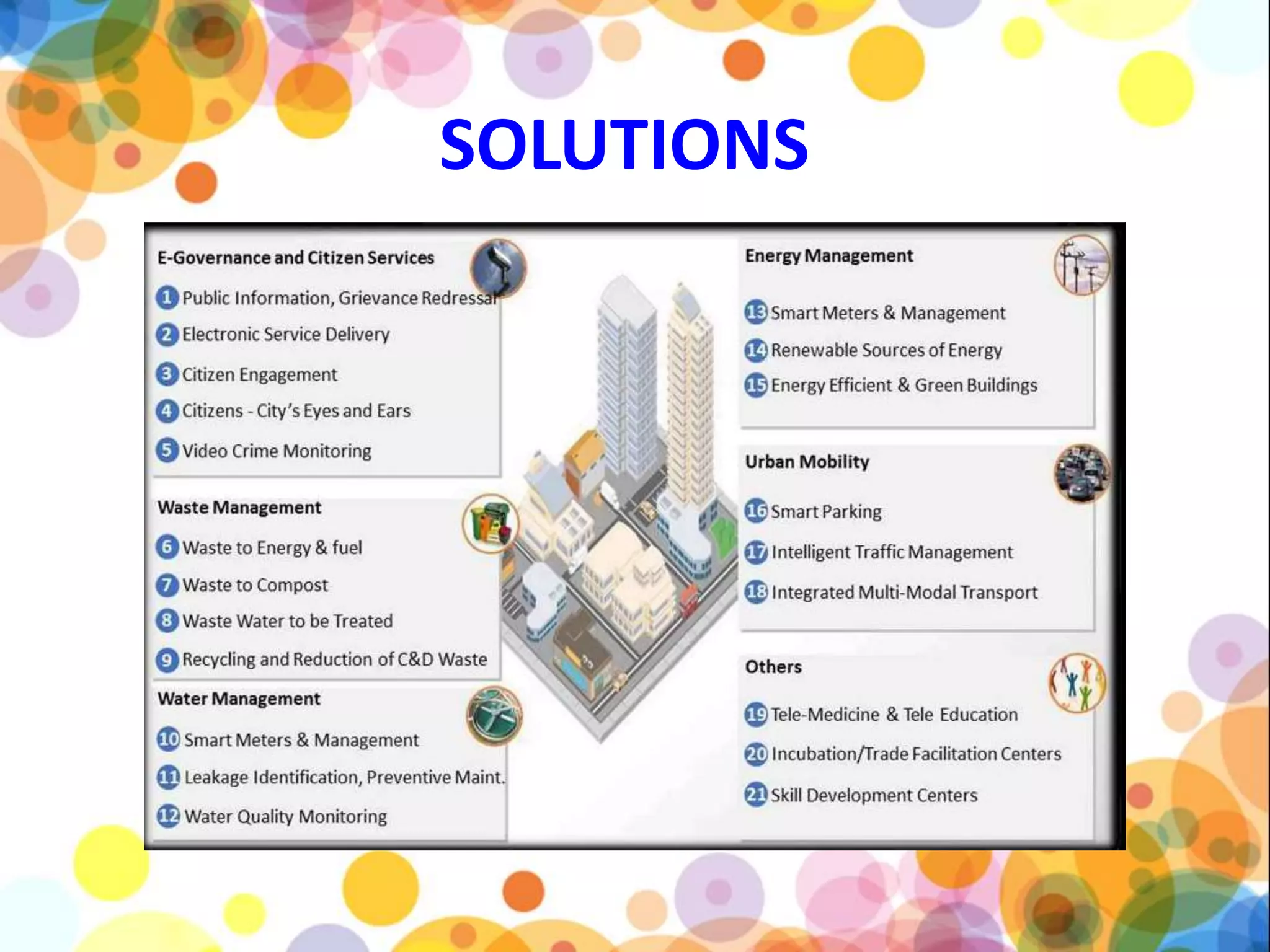
SOLUTIONS
GOALS
QUALITY OF LIFE
The Well-Planned City
The Healthy/Safe City
Sustainable Eco-City
Economic Development
Cultural- Convention Hub
The City of Commerce
The City of Digital Innovation
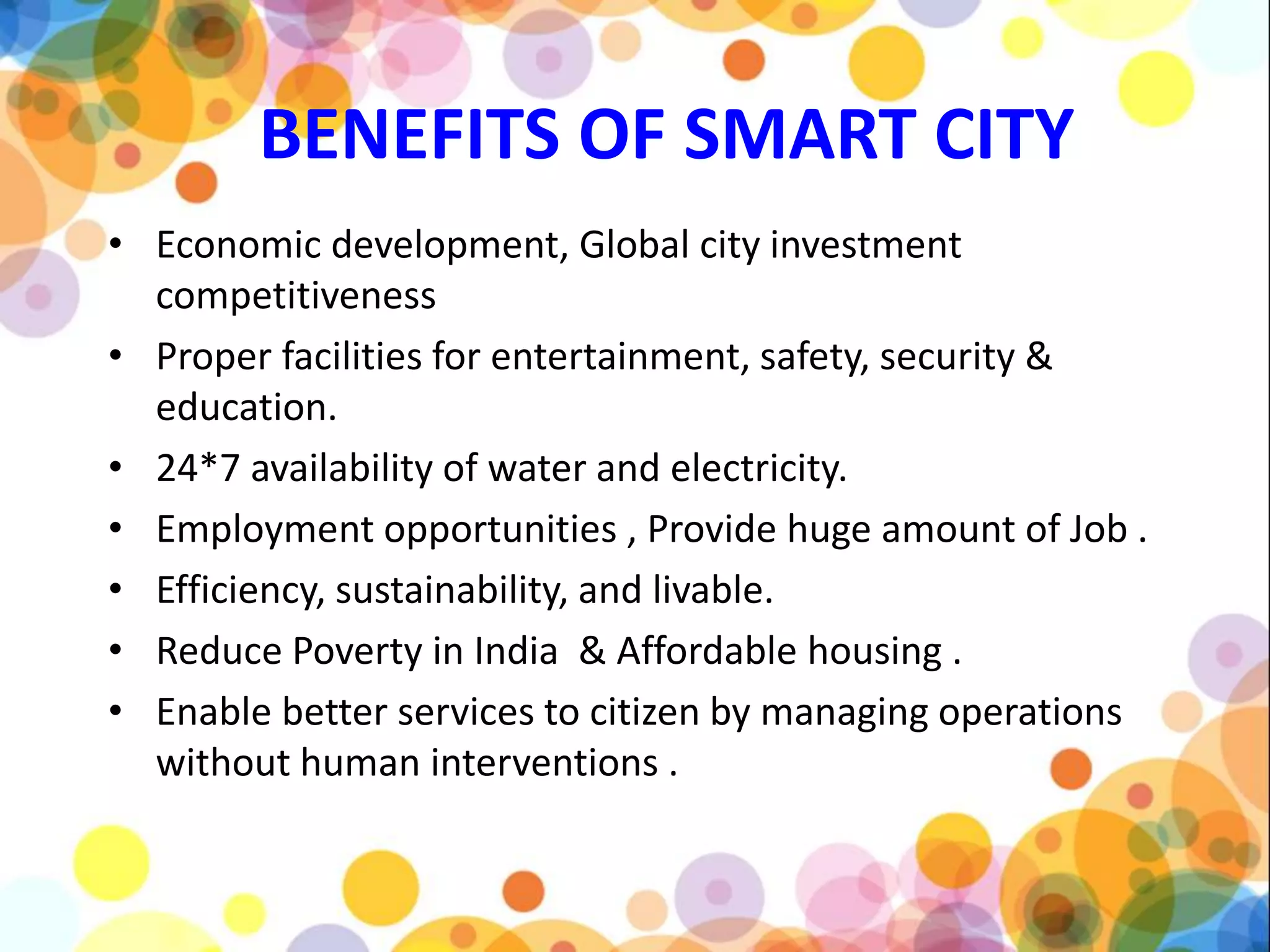
BENEFITS OF SMART CITY
• Economic development, Global city investment
competitiveness
• Proper facilities for entertainment, safety, security &
education.
• 24*7 availability of water and electricity.
• Employment opportunities , Provide huge amount of Job .
• Efficiency, sustainability, and livable.
• Reduce Poverty in India & Affordable housing .
• Enable better services to citizen by managing operations
without human interventions .
BENEFITS OF SMART CITY
• Reduce energy consumption, Green House gas
emissions.
• Corruption decreases.
• Robust IT connectivity and digitalization.
• Good governance.
• Safety and security of citizens, particularly
women, children and the elderly.
SMART CITIES - ONGOING PROCESS
• Kochi ,Ahmadabad ,Aurangabad
• Aurangabad ,Manesar in Delhi
• Tumkur in Karnataka, Khushkera (Alwar)
TOP 5 cities in the world
• Vienna
• Toronto
• Paris
• New York
• London
CONCLUSION
The emergency of the idea of the smart city
ought to be seen in the backdrop of the need to
contain corruption and meet the requirements of
the adequate & efficient service delivery in urban
areas using information and digital technologies.
The success will be judged by its power to
transform the life of the people, and their ability
to reduce growing inequality in our society.
?

Smart city technologies

  • 2.
    CONTENTS • INTRODUCTION • SMARTCITY • SMART CITY PLAN • NEED FOR SMART CITY • PHASES • FEATURES OF SMART CITY • WIRELESS SENSOR NETWORKS • INTERNET OF THINGS • GOALS & BENEFITS OF SMART CITY • SMART CITIES - ONGOING PROCESS • CONCLUSION
  • 3.
    INTRODUCTION  21st Centuryhas brought with it a new global trend of “sustainable urban development” and this concept adds new dimensions to urbanization which require a quick need to upgrade existing cities. 98 cities were shortlisted in India for implementing Smart City Concept.
  • 4.
    SMART CITY • Asmart city (also smarter city) uses digital technologies or information and communication technologies (ICT) to enhance quality and performance of urban services, to reduce costs and resource consumption, and to engage more effectively and actively with its citizens. • A smart city should be able to respond faster to city and global challenges.
  • 5.
    SMART CITY PLAN •According to the plan, 20 cities will be selected this year, followed by 40 each in the next two years. • While most of the smart cities will be Brownfield (old) ventures and there will also be a few Greenfield (new) projects .
  • 6.
    SMART CITY PLAN •The cities will be given scores based on urban reforms that they have carried out, their impact and what they propose to do in four key areas Swatch Bharat (sanitation),  Make in India (ease of doing business), Good governance (modern accounting system, rationalization of property taxes)  e-governance.
  • 7.
    NEED FOR SMARTCITY • By 2030, 60% of worlds population is expected to live in cities results in heavy strain on energy, transportation, water, building and public spaces. • Increasing need is the being felt for smart city which are both efficient, sustainable and Can generate economic prosperity & social well being.
  • 8.
    NEED FOR SMARTCITY • The need to handle global environment and urbanization problems -- Global warming and climate change -- Population increase and resource depletion -- Adverse effects of increasing urbanization • The need to accommodate changing lifestyles • A McKinsey Global Institute study estimated that cities would generate 70% of the new jobs created by 2030, produce more than 70% of the Indian gross domestic product and drive a fourfold increase in per capita income across the country.
  • 9.
    PHASES • Early phase:Provide the infrastructure needed for the operation of the city. • Growth Phase: Expand and intensify the infrastructure to ensure that supply can keep the pace with increasing demands of the growing demand. • Mature phase: Enhance infrastructure to ensure the delivery of high-quality services based on criteria such as ease of- use and comfort. • Transformation phase: Integrate infrastructure systems to satisfy social values such as aiding, or at least avoiding damage to, the natural environment.
  • 10.
    VISION OF THECITY OF THE FUTURE Make visible the invisible Sensing the city Provide tools for the citizens to interpret and change the workings of the city Open source and open data
  • 12.
    FEATURES OF SMARTCITY • Smart parking • Smart heritage cities • Smart transportation & Traffic management • Smart grids • Smart city maintenance • Smart Building & Home • Smart Energy (Renewable generation & storage, AMI,PQM,PLM,OMS) • Smart Water Management • Smart Waste Management (Recycling of waste, residual management, Recovery of waste organics & Energy) • Smart Education (e-Education) • Smart Governance (e-governance) • Smart Medical Facility (e-Medical) • Smart Communications & Networks
  • 13.
    SMART ENVIRONMENT • Renewalof energy, waste water management and provide proper sanitation to citizens • To setup project for alarm and control of CO2 emissions of factories, pollution emitted by cars and toxic gases generated. • To setup projects to create alarms based on distributed control in specific places like buildings, bridges, and establish a National Advance Disaster Alarm System.
  • 14.
    SMART ENVIRONMENT The sensorscan be used to measuring parameters as: Temperature Relative humidity Carbon monoxide (CO) Carbon Dioxide (CO2) Nitrogen Dioxide (NO2) GPS location
  • 15.
    SMART WATER • Tosetup Potable water monitoring tools to monitor the quality of tap water in all government owned education institutes and public places. • To setup project for real-time detection of leakages and wastes of factories in rivers and other natural water bodies. • To setup project for monitoring of water level variations in rivers, dams and reservoirs, for proactive disaster management.
  • 16.
    WASTE MANAGEMENT • Toassist the ‘SWACH BHARAT’ initiative, projects may be setup to create products which are Solar powered trash receptacle and trash compactor that alerts sanitation crews of municipal authorities, when it is full. • Waste to Energy is the process of generating energy in the form of electricity from primary treatment of waste using Incinerators.
  • 17.
  • 18.
    WASTE MANAGEMENT • ROADSUSING PLASTIC As most of the Indians roads are asphalt road and we have seen their life is mostly 2-3 years. So we can work on the model proposed by K.Ahmed Khan who has successfully proven this in Madras that roads made using recycled or waste plastic have much more life than normal roads. As they can resist more temperature than asphalt.
  • 19.
    SMART TRANSPORT • E-call: Thein vehicle e-call is generated either manually by vehicle occupants or automatically by sensors after an accident .when activated the e-call device will establish an emergency call carrying both voice and data to nearest Emergency Point. • Automatic Road Enforcement : A traffic enforcement system consists of camera which detects and identify vehicle disobeying traffic rules and automatically ticket offenders based on license plate number. Traffic tickets are sent by mail or message.
  • 20.
    WIRELESS SENSOR NETWORKS •Wireless Sensor Networks (WSN) can help to monitor environmental conditions and water quality, allowing an easier, faster and cheaper data logging, which will lead into a better utilization of resources of each organization or government. The system would be able to monitor water quality by measuring different environmental parameters.
  • 22.
    INTERNET OF THINGS •The Internet of Things (IoT) is the network of physical objects that contain embedded technology to communicate and sense or interact with their internal states or the external environment. • Simply put this is the concept of basically connecting any device with an on and off switch to the Internet (and/or to each other) to transfer data over the network. • The IoT is a giant network of connected “things” (which also includes people). The relationship will be between people- people, people-things, and things-things.
  • 24.
  • 25.
    GOALS QUALITY OF LIFE TheWell-Planned City The Healthy/Safe City Sustainable Eco-City Economic Development Cultural- Convention Hub The City of Commerce The City of Digital Innovation
  • 26.
    BENEFITS OF SMARTCITY • Economic development, Global city investment competitiveness • Proper facilities for entertainment, safety, security & education. • 24*7 availability of water and electricity. • Employment opportunities , Provide huge amount of Job . • Efficiency, sustainability, and livable. • Reduce Poverty in India & Affordable housing . • Enable better services to citizen by managing operations without human interventions .
  • 27.
    BENEFITS OF SMARTCITY • Reduce energy consumption, Green House gas emissions. • Corruption decreases. • Robust IT connectivity and digitalization. • Good governance. • Safety and security of citizens, particularly women, children and the elderly.
  • 28.
    SMART CITIES -ONGOING PROCESS • Kochi ,Ahmadabad ,Aurangabad • Aurangabad ,Manesar in Delhi • Tumkur in Karnataka, Khushkera (Alwar) TOP 5 cities in the world • Vienna • Toronto • Paris • New York • London
  • 29.
    CONCLUSION The emergency ofthe idea of the smart city ought to be seen in the backdrop of the need to contain corruption and meet the requirements of the adequate & efficient service delivery in urban areas using information and digital technologies. The success will be judged by its power to transform the life of the people, and their ability to reduce growing inequality in our society.
  • 31.