Charity Finance Directors’ Group

Building a relationship of mutual
trust between the sectors

Thursday 12 May 2011

Annie Shepperd
Building a relationship of trust
• Relationships between public, private, and voluntary
  sectors have always been important
• Aim is now to develop relationships of mutual trust
• Focus on transformation – old order is under attack
• Encourage independence and resilience
• How does the old order respond?
• By contracting, the voluntary sector is competing like
  the private sector
The Southwark Experience
• Southwark has twice the number of third sector
  organisations per capita than the national average
• Some organisations have become dependent on
  Council funding
• Some organisations changing – reinventing
  themselves
• Some object
• Some delaying
• Some negotiating
• Some don’t or won’t survive
Our approach in Southwark
• What is our mutual purpose and how to have
  mutual trust
• Transition Fund to support change
• Streamlining commissioning
• Regular liaison meetings
• Sharing premises, reducing costs
• Southwark Circle – the new model of social
  enterprise
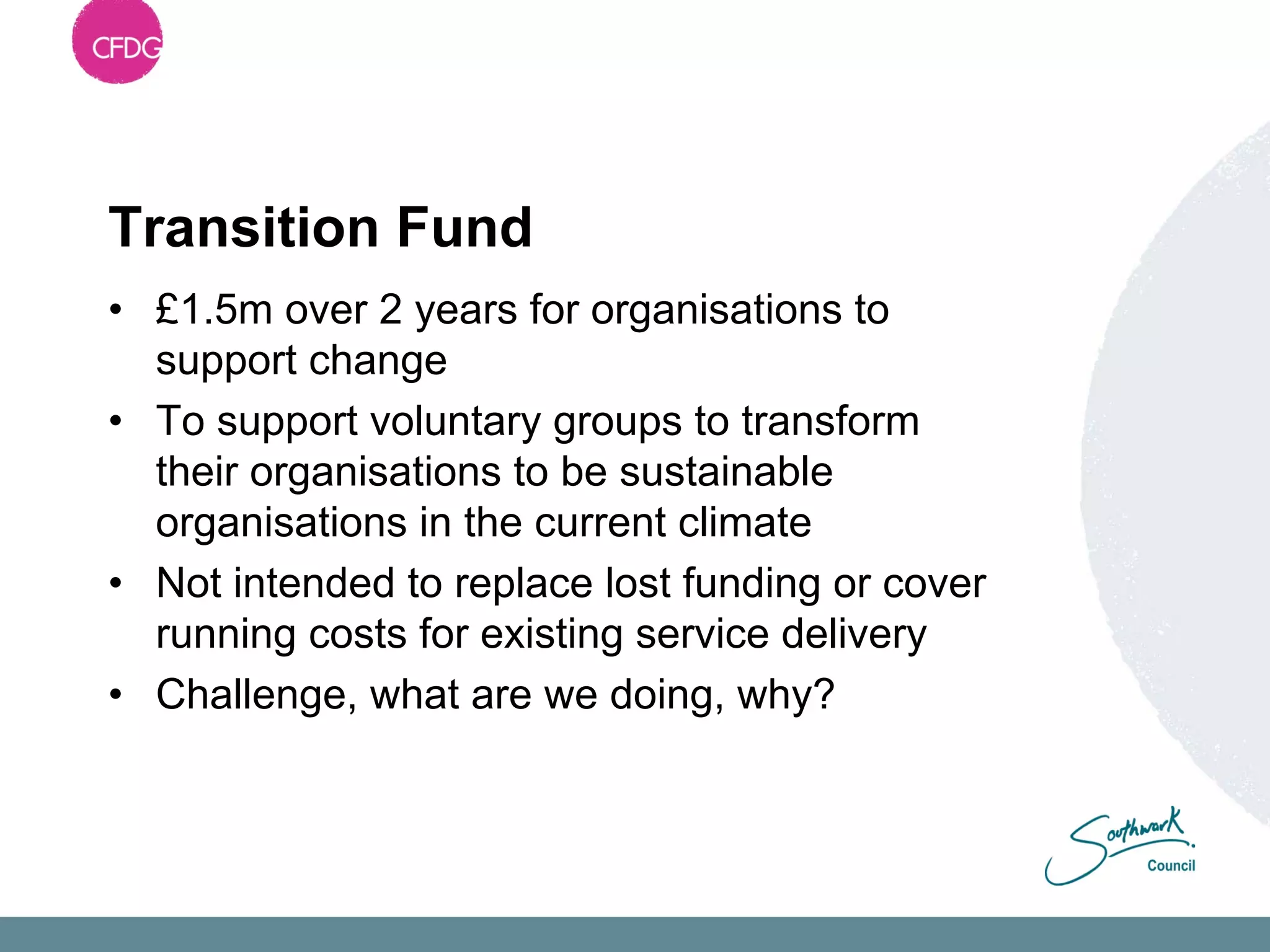
Transition Fund
• £1.5m over 2 years for organisations to
  support change
• To support voluntary groups to transform
  their organisations to be sustainable
  organisations in the current climate
• Not intended to replace lost funding or cover
  running costs for existing service delivery
• Challenge, what are we doing, why?
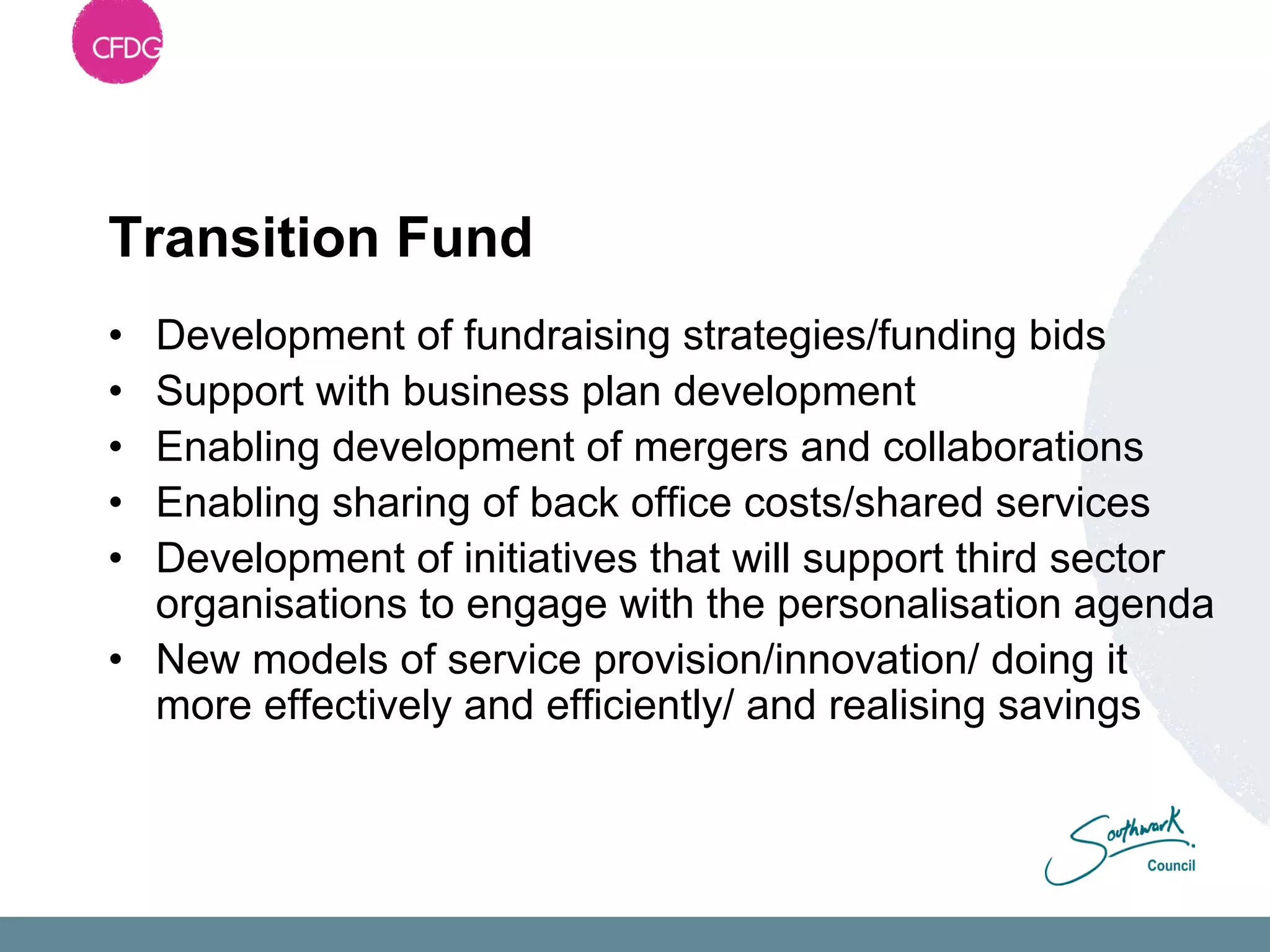
Transition Fund
• Development of fundraising strategies/funding bids
• Support with business plan development
• Enabling development of mergers and collaborations
• Enabling sharing of back office costs/shared services
• Development of initiatives that will support third sector
  organisations to engage with the personalisation agenda
• New models of service provision/innovation/ doing it
  more effectively and efficiently/ and realising savings
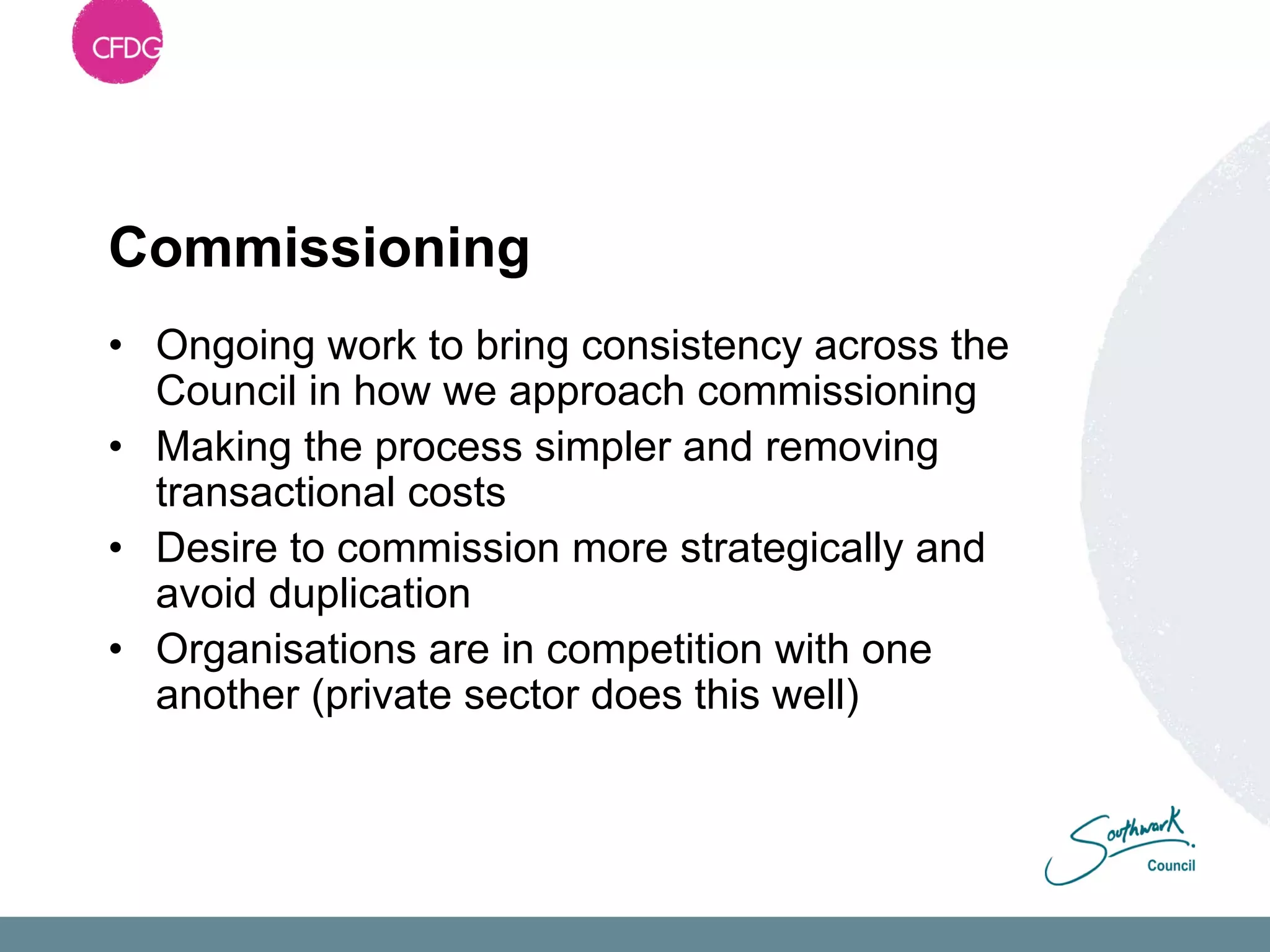
Commissioning
• Ongoing work to bring consistency across the
  Council in how we approach commissioning
• Making the process simpler and removing
  transactional costs
• Desire to commission more strategically and
  avoid duplication
• Organisations are in competition with one
  another (private sector does this well)
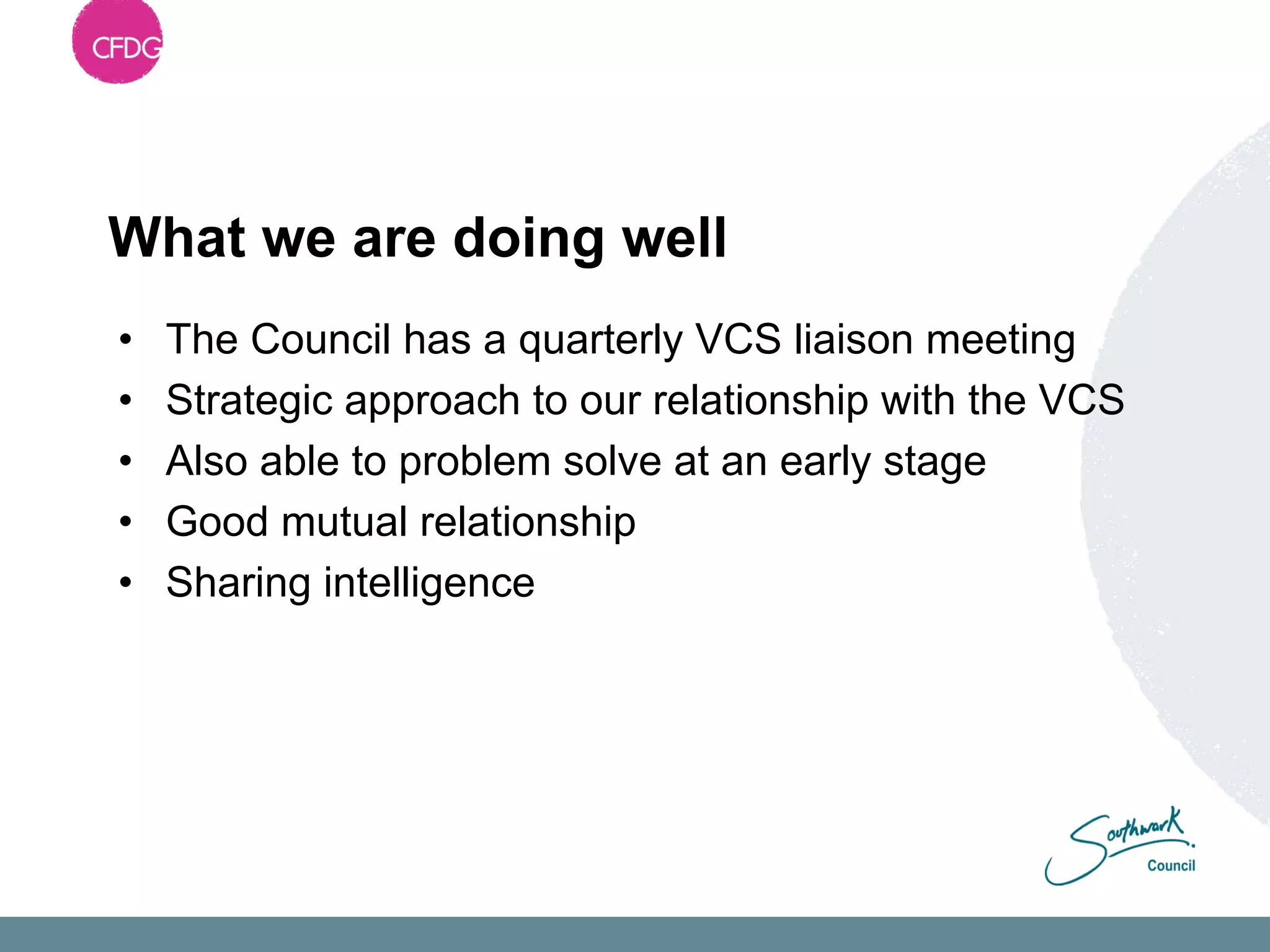
What we are doing well
•   The Council has a quarterly VCS liaison meeting
•   Strategic approach to our relationship with the VCS
•   Also able to problem solve at an early stage
•   Good mutual relationship
•   Sharing intelligence
Change led and managed by the
voluntary sector
• Led by Community Action Southwark (umbrella
  organisation for VCS)
• Collaboration and consolidation of community
  premises
• Three tier model
      - Hub and spoke
      - Coordinated hubs and spokes
      - Lattice foundation
• The voluntary sector facing up to the challenges
Southwark Circle – social enterprise
model
•   Membership organisation
•   Many things are provided as a service (e.g. DIY, walking clubs)
•   Some things you contribute to financially (e.g. a meal is cooked for
    you in your own home)
•   Some things you pay for (e.g. trips out to the theatre, lunches,
    cleaning)
•   Its fundamental aim is to socially connect people through community
    involvement and capacity building
•   Self-selection and self-assessment
•   People ask for practical help, but then become socially connected
•   Tackling loneliness

Building Relationship of mutual trust and respect between the Sectors

  • 1.
    Charity Finance Directors’Group Building a relationship of mutual trust between the sectors Thursday 12 May 2011 Annie Shepperd
  • 2.
    Building a relationshipof trust • Relationships between public, private, and voluntary sectors have always been important • Aim is now to develop relationships of mutual trust • Focus on transformation – old order is under attack • Encourage independence and resilience • How does the old order respond? • By contracting, the voluntary sector is competing like the private sector
  • 3.
    The Southwark Experience •Southwark has twice the number of third sector organisations per capita than the national average • Some organisations have become dependent on Council funding • Some organisations changing – reinventing themselves • Some object • Some delaying • Some negotiating • Some don’t or won’t survive
  • 4.
    Our approach inSouthwark • What is our mutual purpose and how to have mutual trust • Transition Fund to support change • Streamlining commissioning • Regular liaison meetings • Sharing premises, reducing costs • Southwark Circle – the new model of social enterprise
  • 5.
    Transition Fund • £1.5mover 2 years for organisations to support change • To support voluntary groups to transform their organisations to be sustainable organisations in the current climate • Not intended to replace lost funding or cover running costs for existing service delivery • Challenge, what are we doing, why?
  • 6.
    Transition Fund • Developmentof fundraising strategies/funding bids • Support with business plan development • Enabling development of mergers and collaborations • Enabling sharing of back office costs/shared services • Development of initiatives that will support third sector organisations to engage with the personalisation agenda • New models of service provision/innovation/ doing it more effectively and efficiently/ and realising savings
  • 7.
    Commissioning • Ongoing workto bring consistency across the Council in how we approach commissioning • Making the process simpler and removing transactional costs • Desire to commission more strategically and avoid duplication • Organisations are in competition with one another (private sector does this well)
  • 8.
    What we aredoing well • The Council has a quarterly VCS liaison meeting • Strategic approach to our relationship with the VCS • Also able to problem solve at an early stage • Good mutual relationship • Sharing intelligence
  • 9.
    Change led andmanaged by the voluntary sector • Led by Community Action Southwark (umbrella organisation for VCS) • Collaboration and consolidation of community premises • Three tier model - Hub and spoke - Coordinated hubs and spokes - Lattice foundation • The voluntary sector facing up to the challenges
  • 10.
    Southwark Circle –social enterprise model • Membership organisation • Many things are provided as a service (e.g. DIY, walking clubs) • Some things you contribute to financially (e.g. a meal is cooked for you in your own home) • Some things you pay for (e.g. trips out to the theatre, lunches, cleaning) • Its fundamental aim is to socially connect people through community involvement and capacity building • Self-selection and self-assessment • People ask for practical help, but then become socially connected • Tackling loneliness