



Building and Sustaining
Competitive Advantage
18~20 September,2017.Micasa Hotel, Yangon
Professor U Aye Kyaw
Module
Module (1) Introduction to Strategic Management
Module (2) Understanding Vision and Mission
Module (3) The External Assessment
Module (4) The Internal Assessment
Module (5) Types of Strategies
Module (6) Sources of Competitive Advantage
Module (7) Strategy and Competitive Advantage
Module (8) Innovation for Competitive Advantage
Day - 1
18.9.2017
Building and Sustaining Competitive Advantage
What is Building?
- Creative or New
What is Sustaining?
- Current maintain
What is Competitive Advantage?
- Cost advantage + Differentiation advantage > Competitors
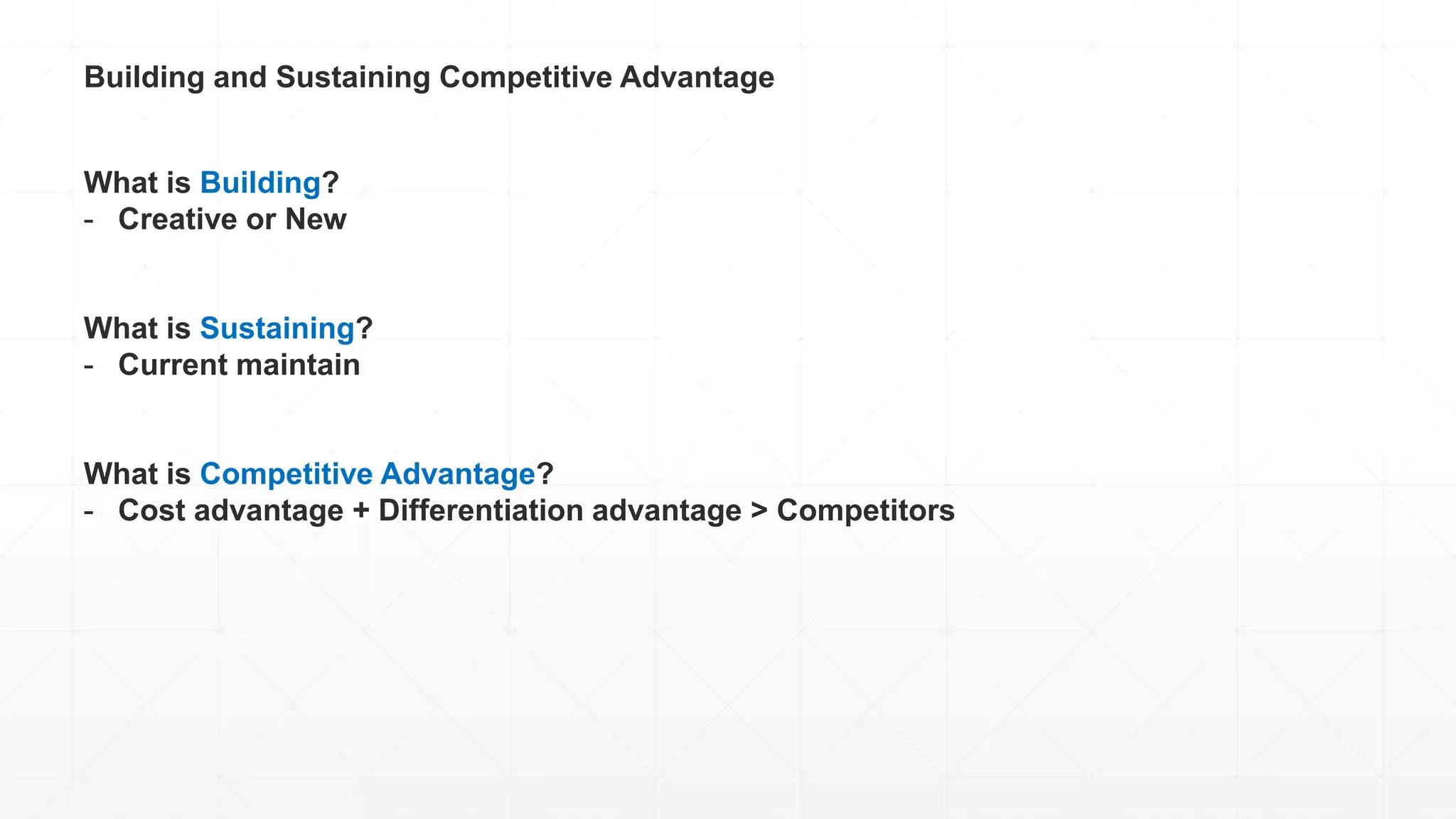
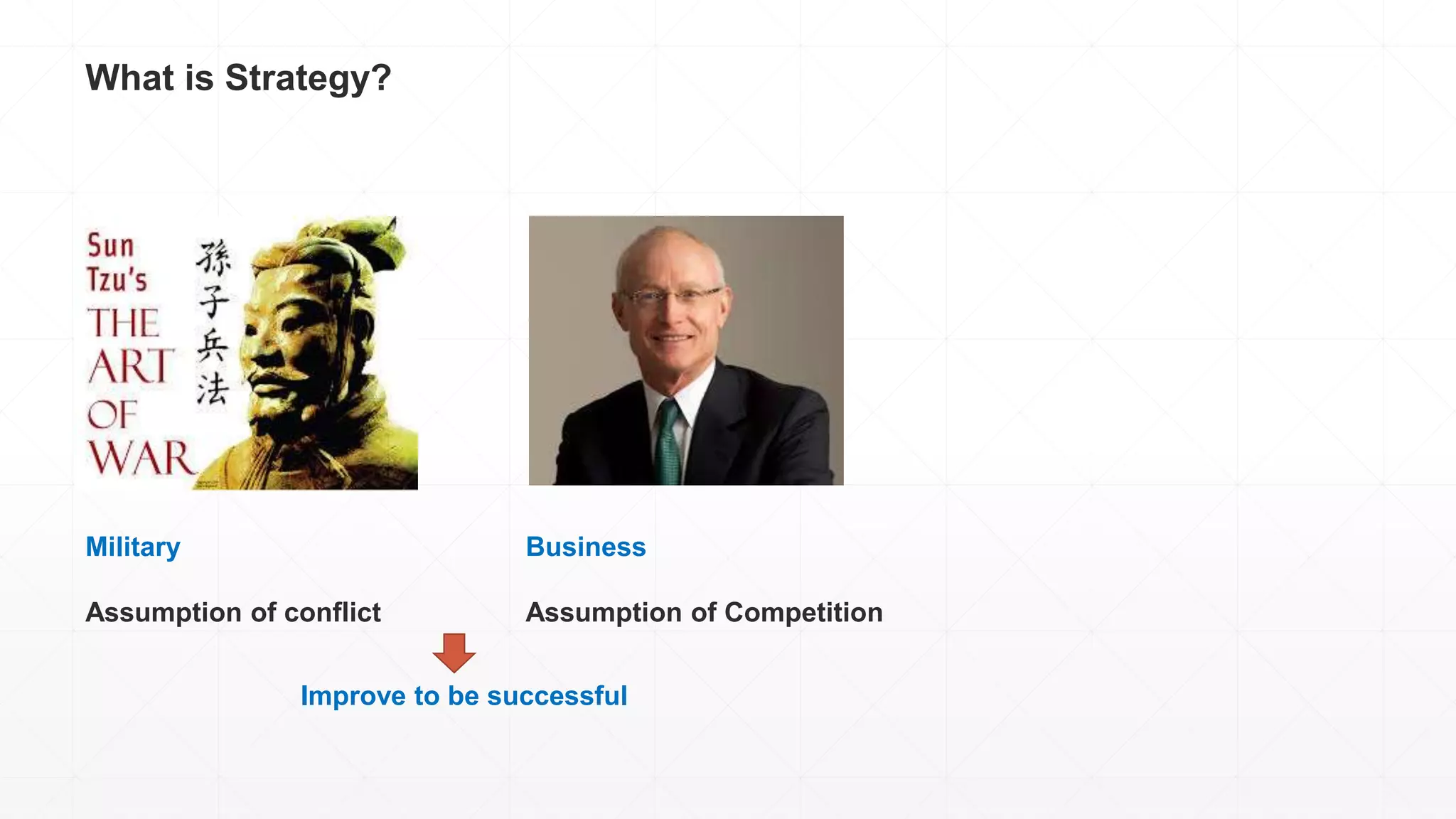
What is Strategy?
Military
Assumption of conflict
Business
Assumption of Competition
Improve to be successful
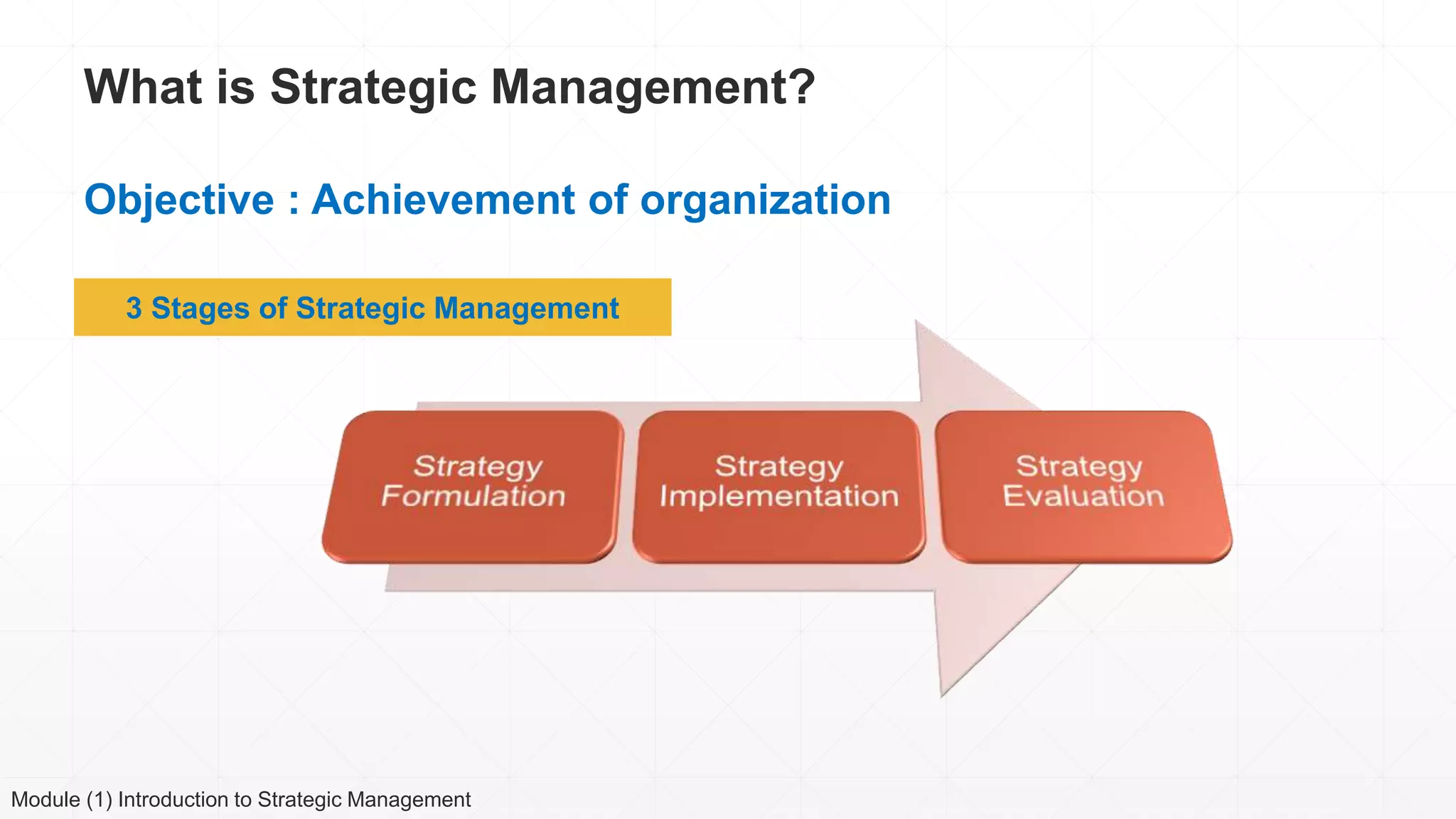
What is Strategic Management?
Objective : Achievement of organization
3 Stages of Strategic Management
Module (1) Introduction to Strategic Management
Important of Question for Strategic-Management
▪ Where are we now?
▪ Where do we want to go?
▪ How are we going to get there?
Module (1) Introduction to Strategic Management
Strategic Management
Advantage
▪ Proactive
▪ Pre action
▪ Initiate and Influence in organization
▪ Financial benefits (profitability)
▪ Understanding of competitor movements
▪ Increased employee productivity
▪ Clearer understanding of performance
▪ Long term objective
Disadvantage
▪ Waste of time
▪ Waste of money
▪ Failing to communication
▪ Failing to plan
▪ Short term
▪ Many decisions and conflict
▪ Not activity supporting
Module (1) Introduction to Strategic Management
Vision Statement
A Vision statement should answer the basic question :
“ What do we want to become?” “ Your business for future”
Vision Statement – Top level Management
Vision Statement – Long Term ( 5 or 10 or 15 years over)
Vision Statement – “We”
Module (2) Understanding Vision and Mission
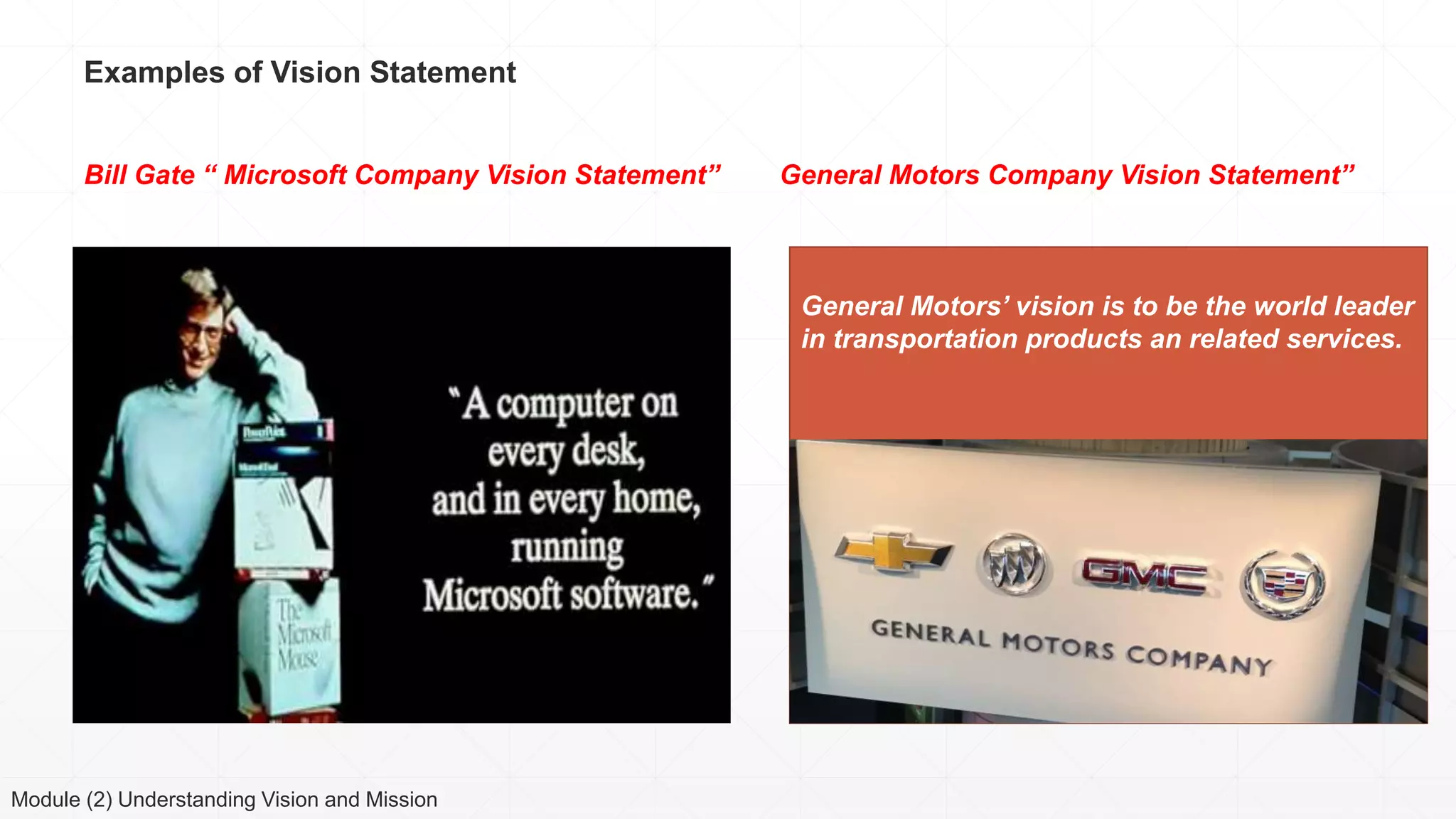
Examples of Vision Statement
Module (2) Understanding Vision and Mission
Bill Gate “ Microsoft Company Vision Statement” General Motors Company Vision Statement”
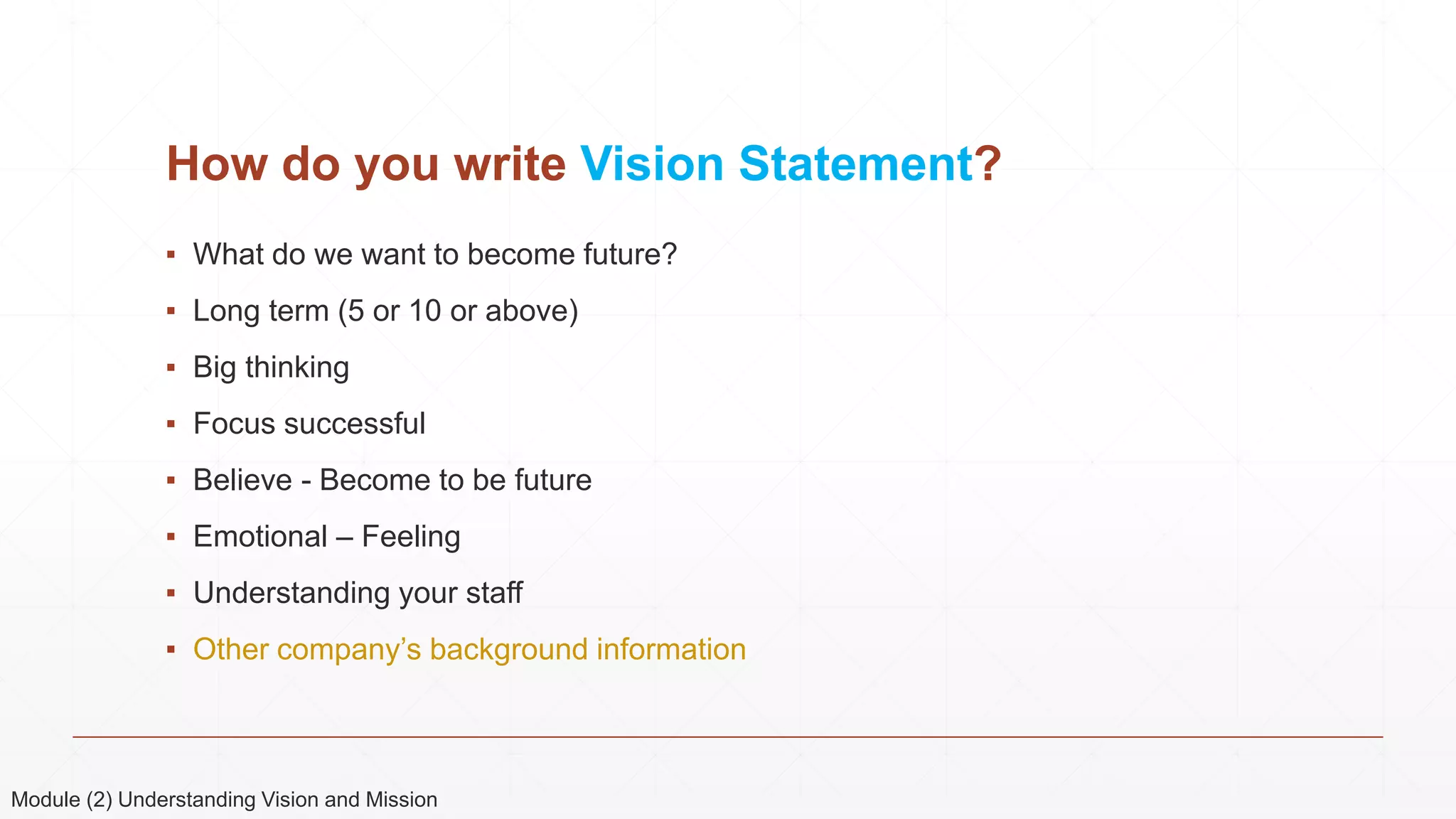
General Motors’ vision is to be the world leader
in transportation products an related services.
How do you write Vision Statement?
▪ What do we want to become future?
▪ Long term (5 or 10 or above)
▪ Big thinking
▪ Focus successful
▪ Believe - Become to be future
▪ Emotional – Feeling
▪ Understanding your staff
▪ Other company’s background information
Module (2) Understanding Vision and Mission
Mission Statement
A Mission statement should answer the basic question :
“ What is our business?”
Mission Statement Purpose – “Why”
Module (2) Understanding Vision and Mission
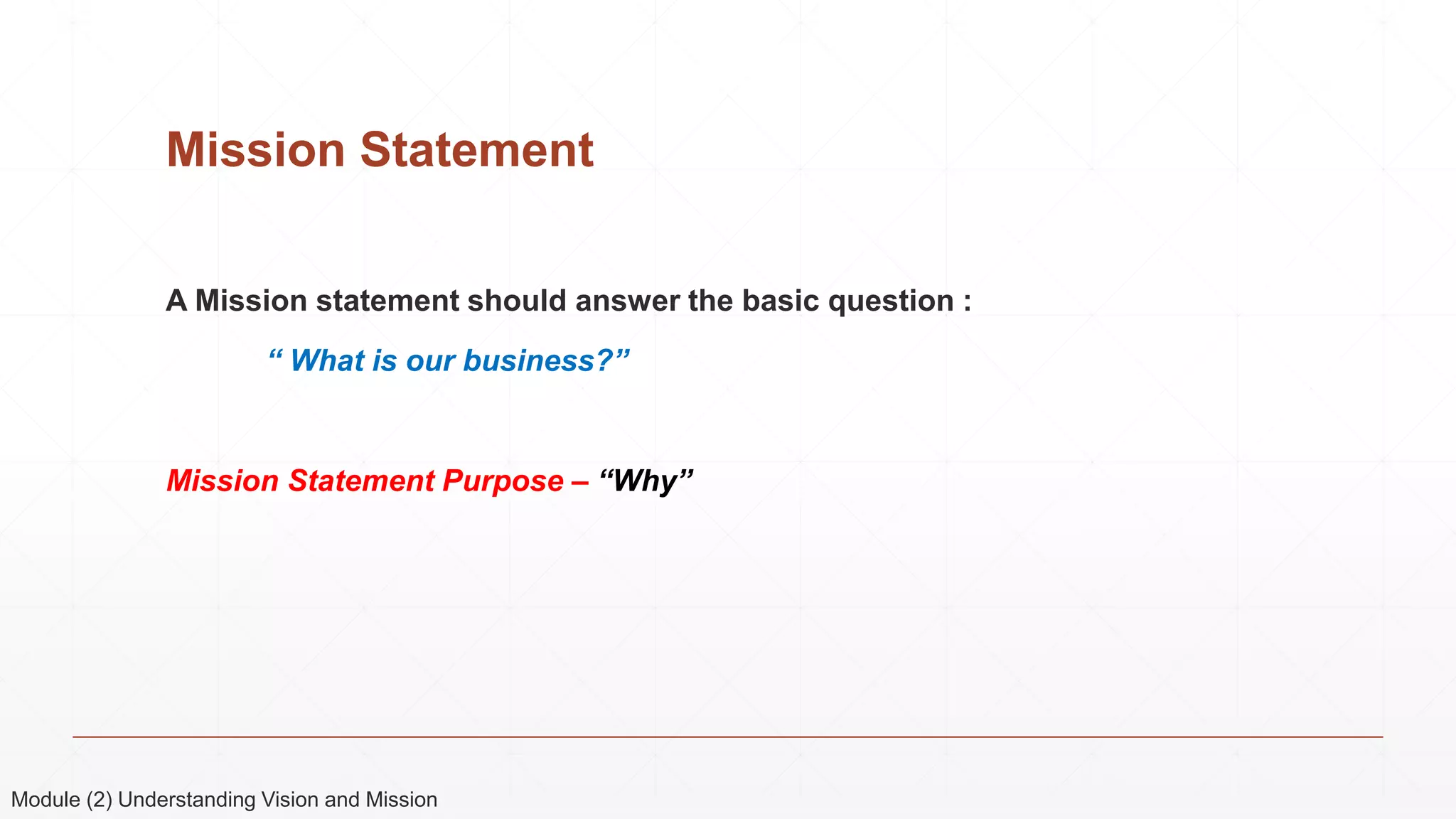
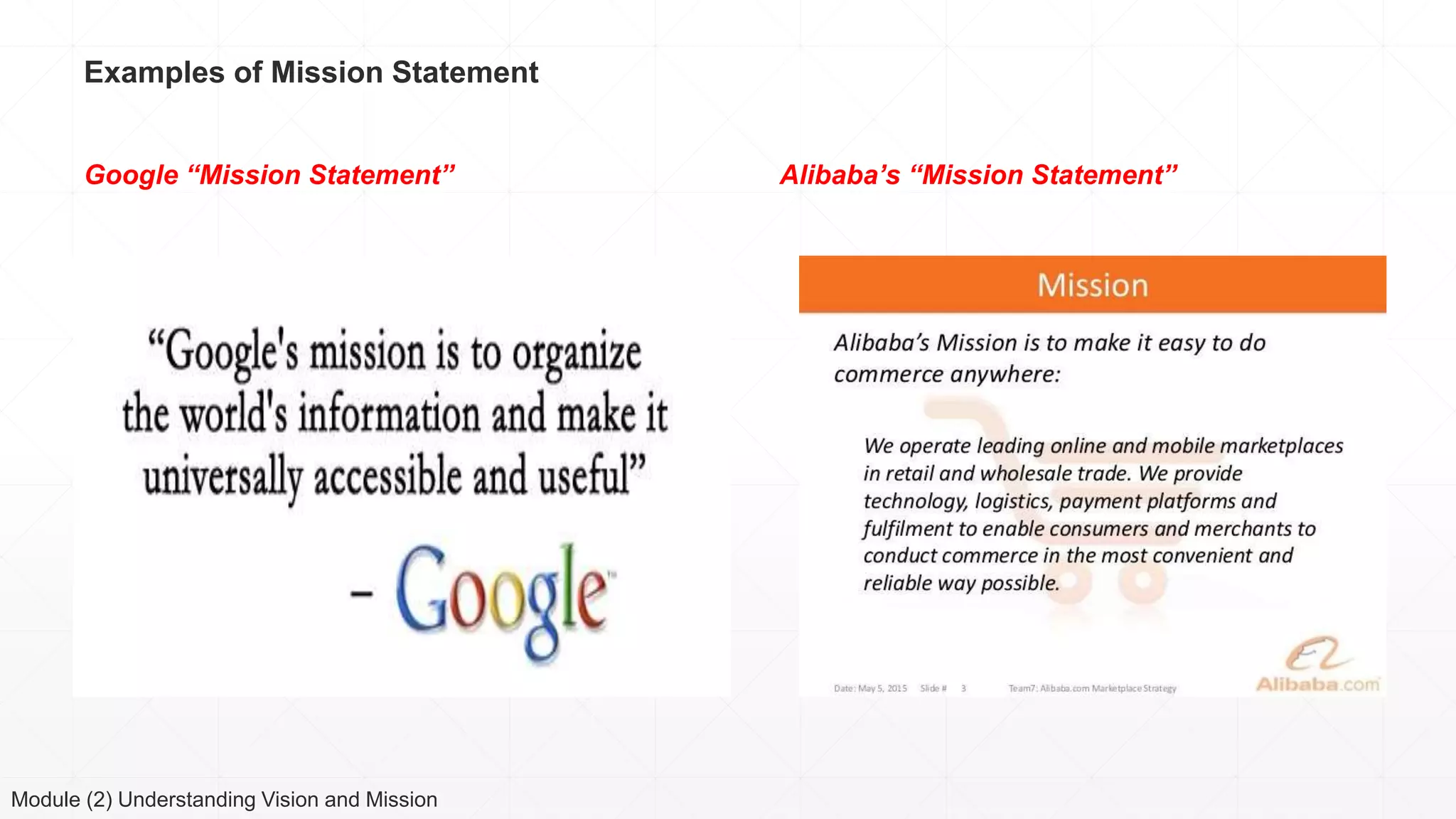
Examples of Mission Statement
Module (2) Understanding Vision and Mission
Google “Mission Statement” Alibaba’s “Mission Statement”
How do you write Mission Statement?
▪ No include (Number, Percentage, Ratios, Amounts)
▪ Fewer than 150 words in length
▪ Take social responsibility
▪ To support environmentally responsible
▪ Components of Customer (need, want, philosophy, public image)
▪ Enduring
Module (2) Understanding Vision and Mission
Mission Statement Components
1. Customers – Who are the firm’s customers?
2. Products or Services – The offering?
3. Markets – Geographically , the firm compete?
4. Technology – Technologically current?
5. Survival, growth & profitability – financial soundness?
6. Philosophy – values, aspirations, and ethical priorities?
7. Distinctive competence – major competitive advantage?
8. Public image – social & environmental concerns?
9. Employees – a valuable assets?
Module (2) Understanding Vision and Mission
Company (Core Value)
▪ If company is human body, core value is bone.
▪ Buddhism – Important is five precepts.
▪ Company – Important is Ethic.
Module (2) Understanding Vision and Mission
Day - 2
19.9.2017
The External Assessment
PEST Analysis
P = Political
E = Economic
S = Social
T = Technological
Module (3) The External Assessment
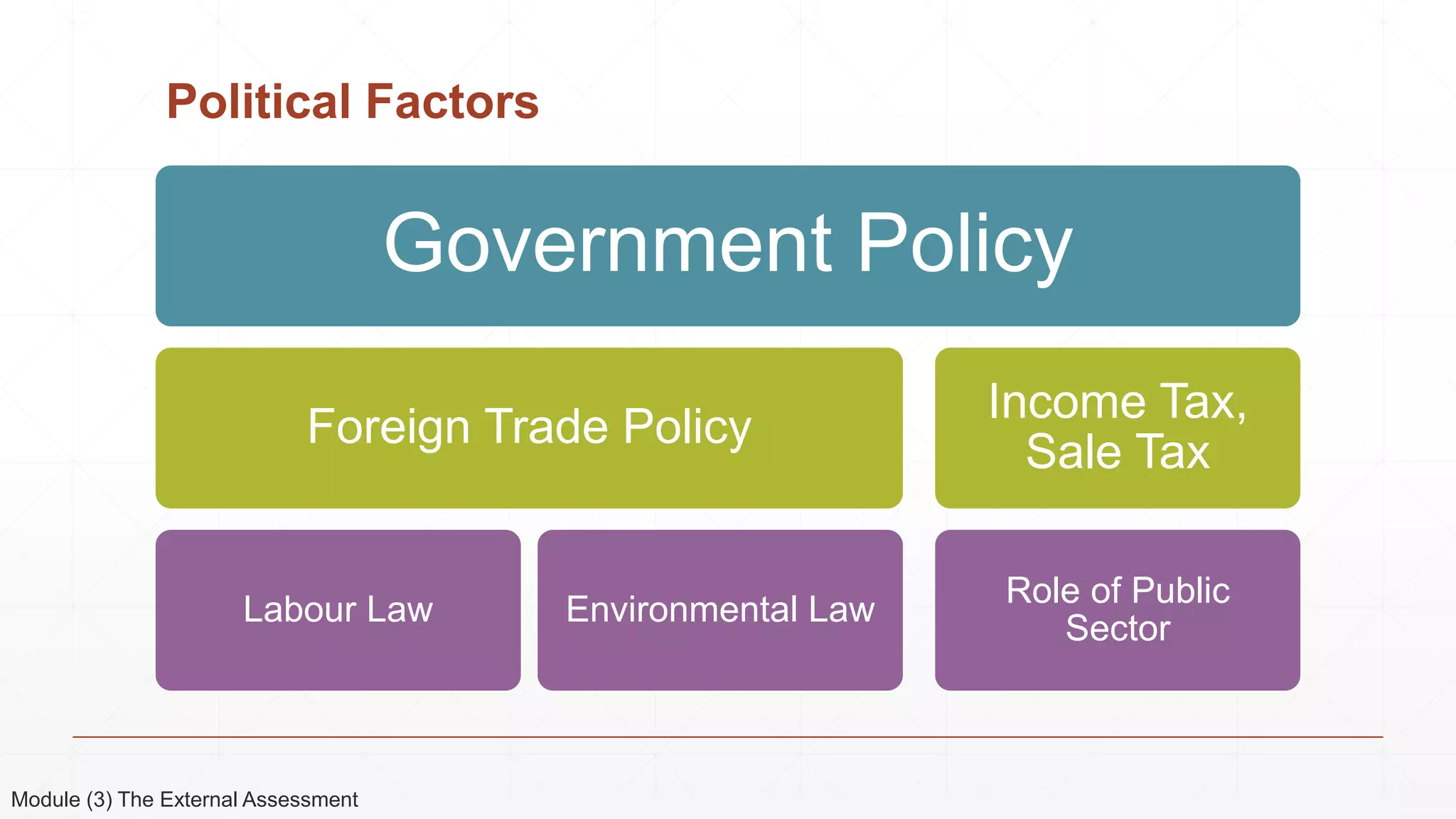
Political Factors
Government Policy
Foreign Trade Policy
Labour Law Environmental Law
Income Tax,
Sale Tax
Role of Public
Sector
Module (3) The External Assessment
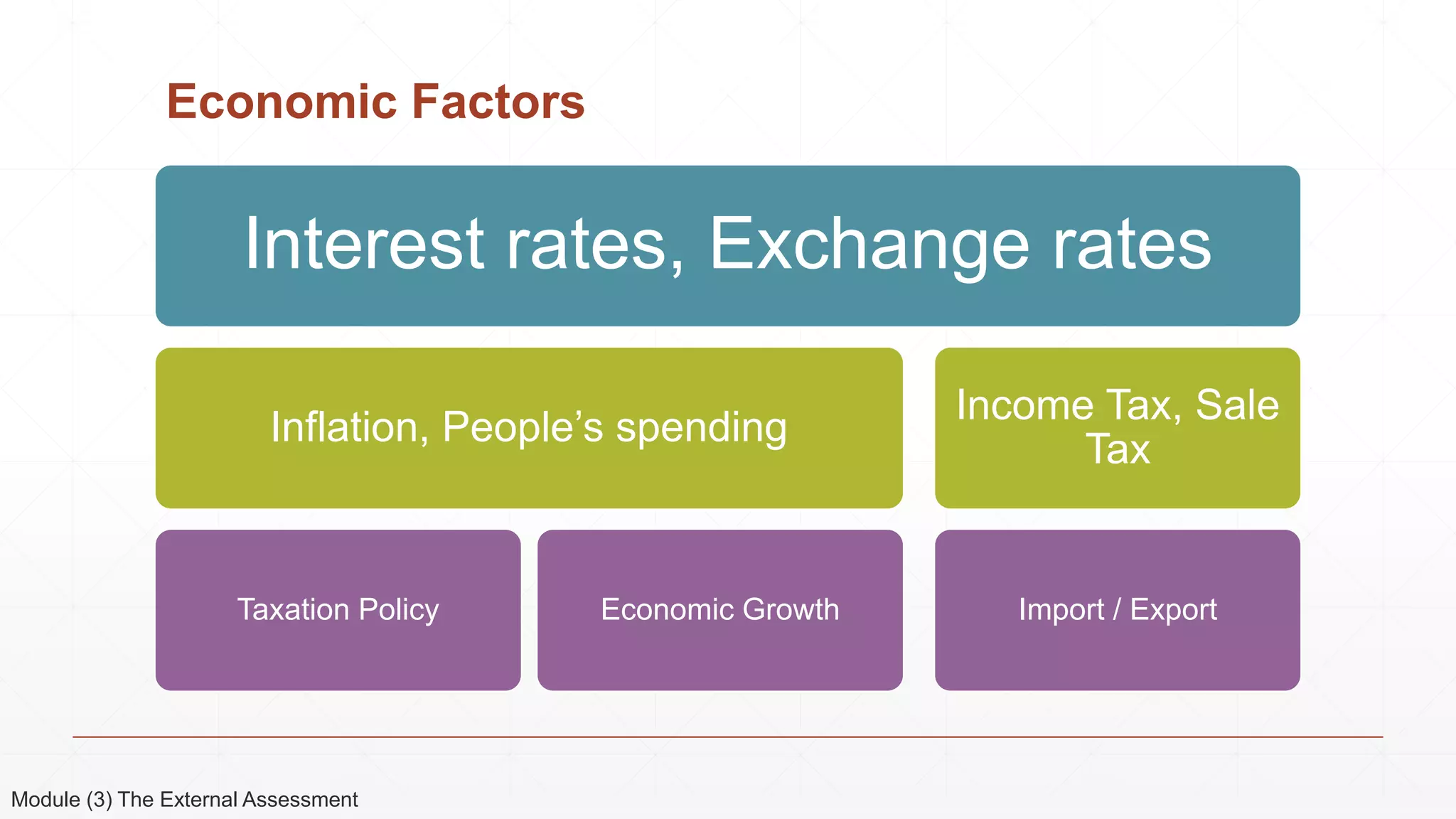
Economic Factors
Interest rates, Exchange rates
Inflation, People’s spending
Taxation Policy Economic Growth
Income Tax, Sale
Tax
Import / Export
Module (3) The External Assessment
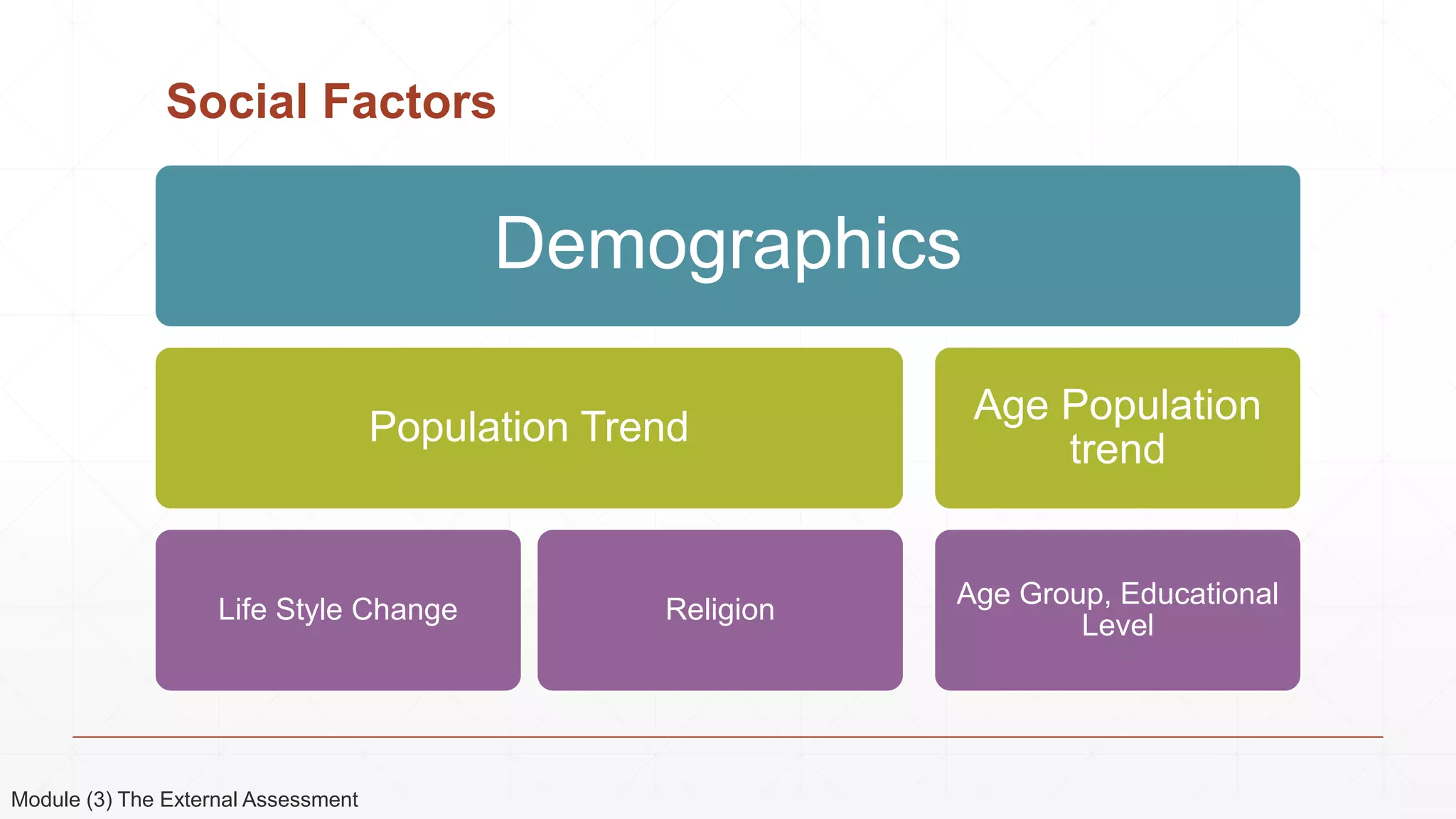
Social Factors
Demographics
Population Trend
Life Style Change Religion
Age Population
trend
Age Group, Educational
Level
Module (3) The External Assessment
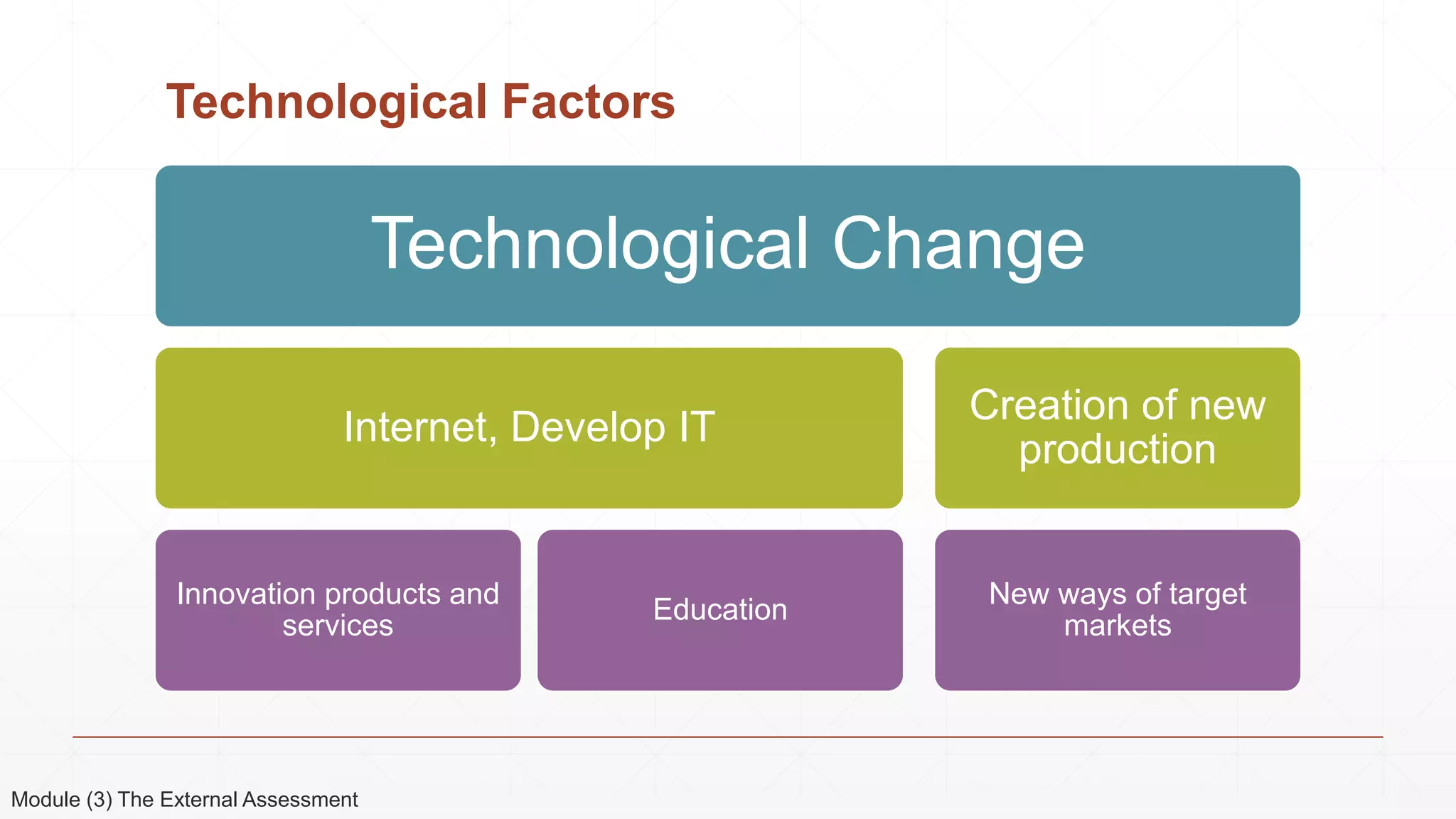
Technological Factors
Technological Change
Internet, Develop IT
Innovation products and
services
Education
Creation of new
production
New ways of target
markets
Module (3) The External Assessment
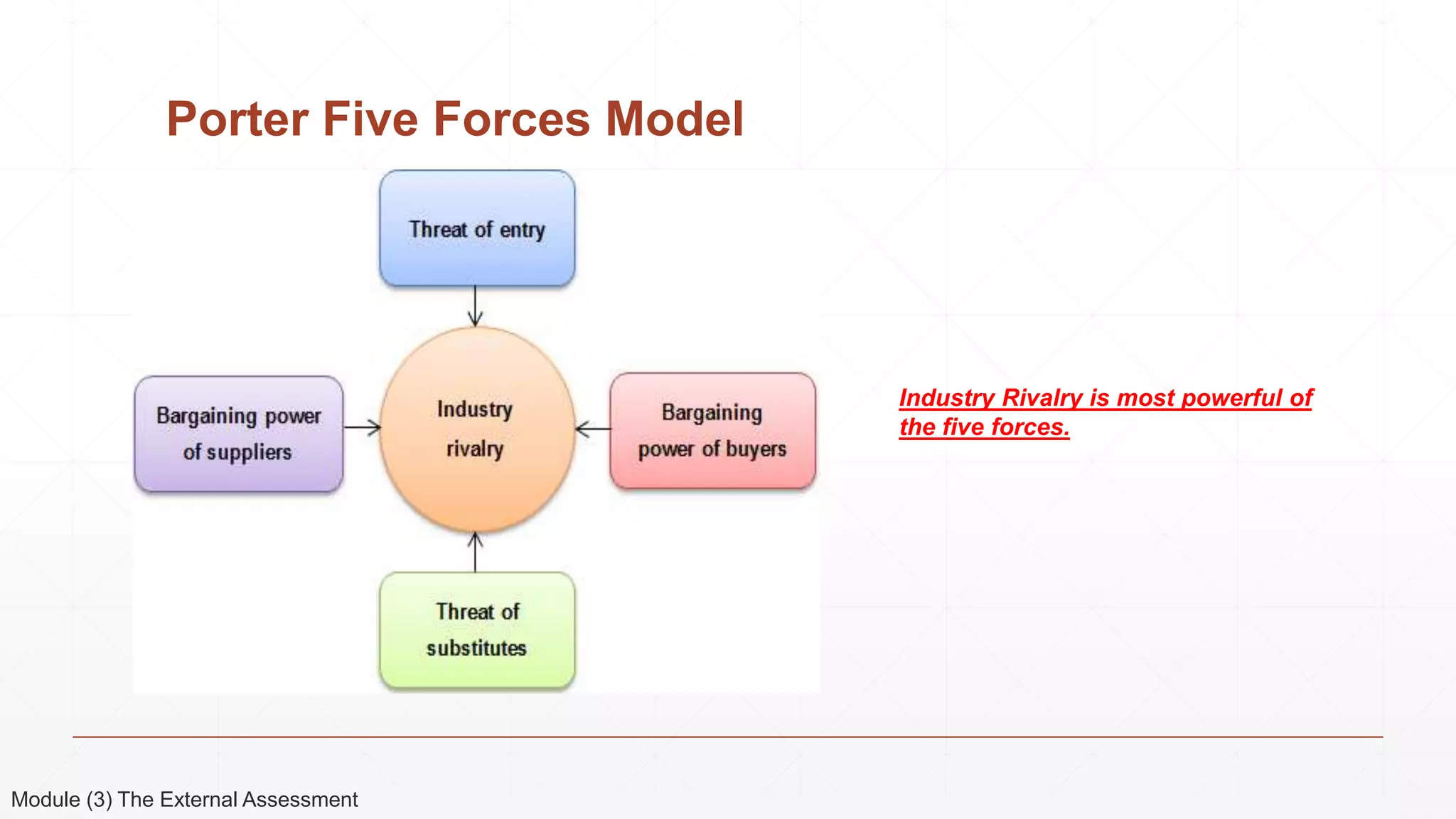
Porter Five Forces Model
Module (3) The External Assessment
Industry Rivalry is most powerful of
the five forces.
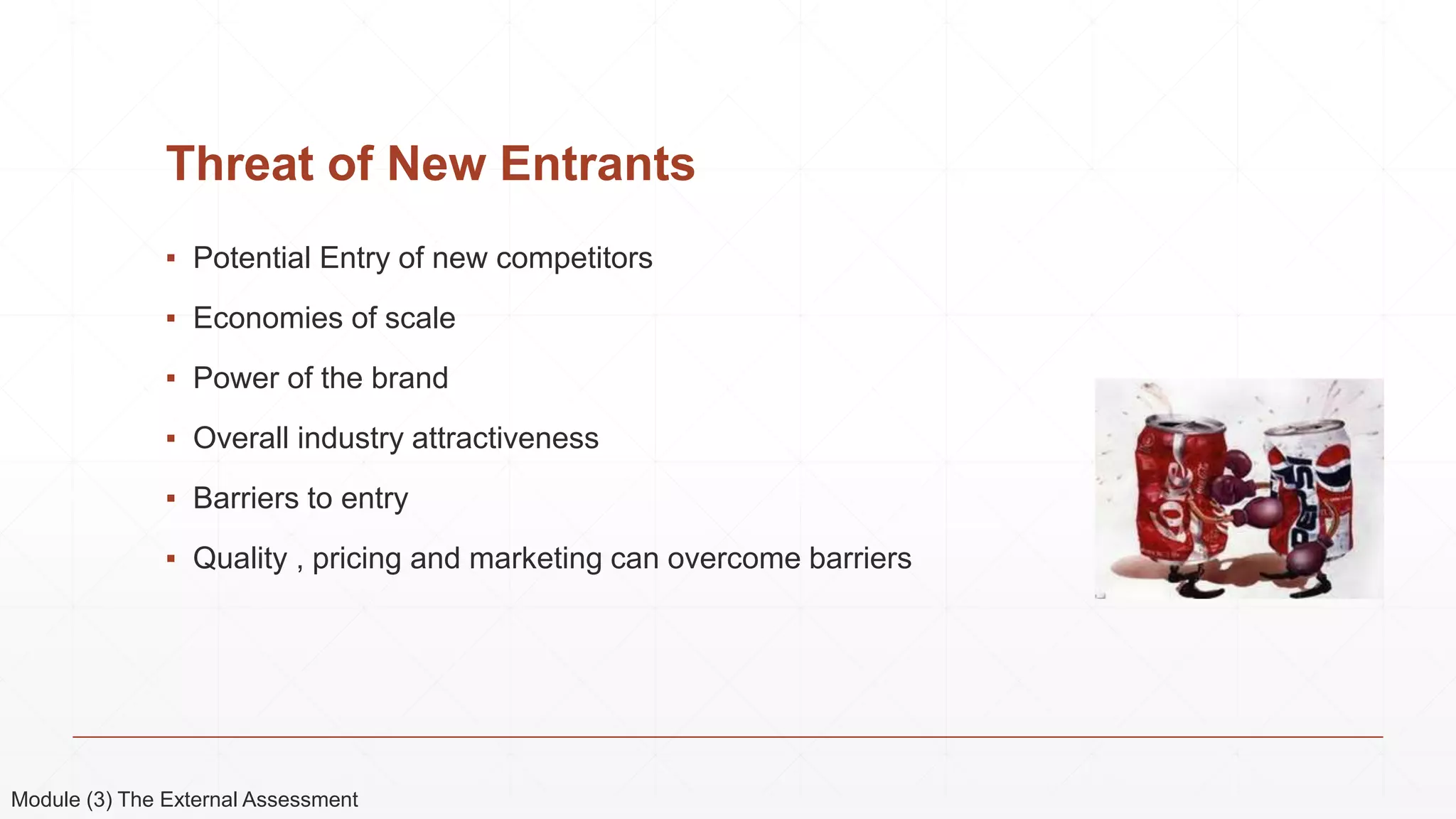
Threat of New Entrants
▪ Potential Entry of new competitors
▪ Economies of scale
▪ Power of the brand
▪ Overall industry attractiveness
▪ Barriers to entry
▪ Quality , pricing and marketing can overcome barriers
Module (3) The External Assessment
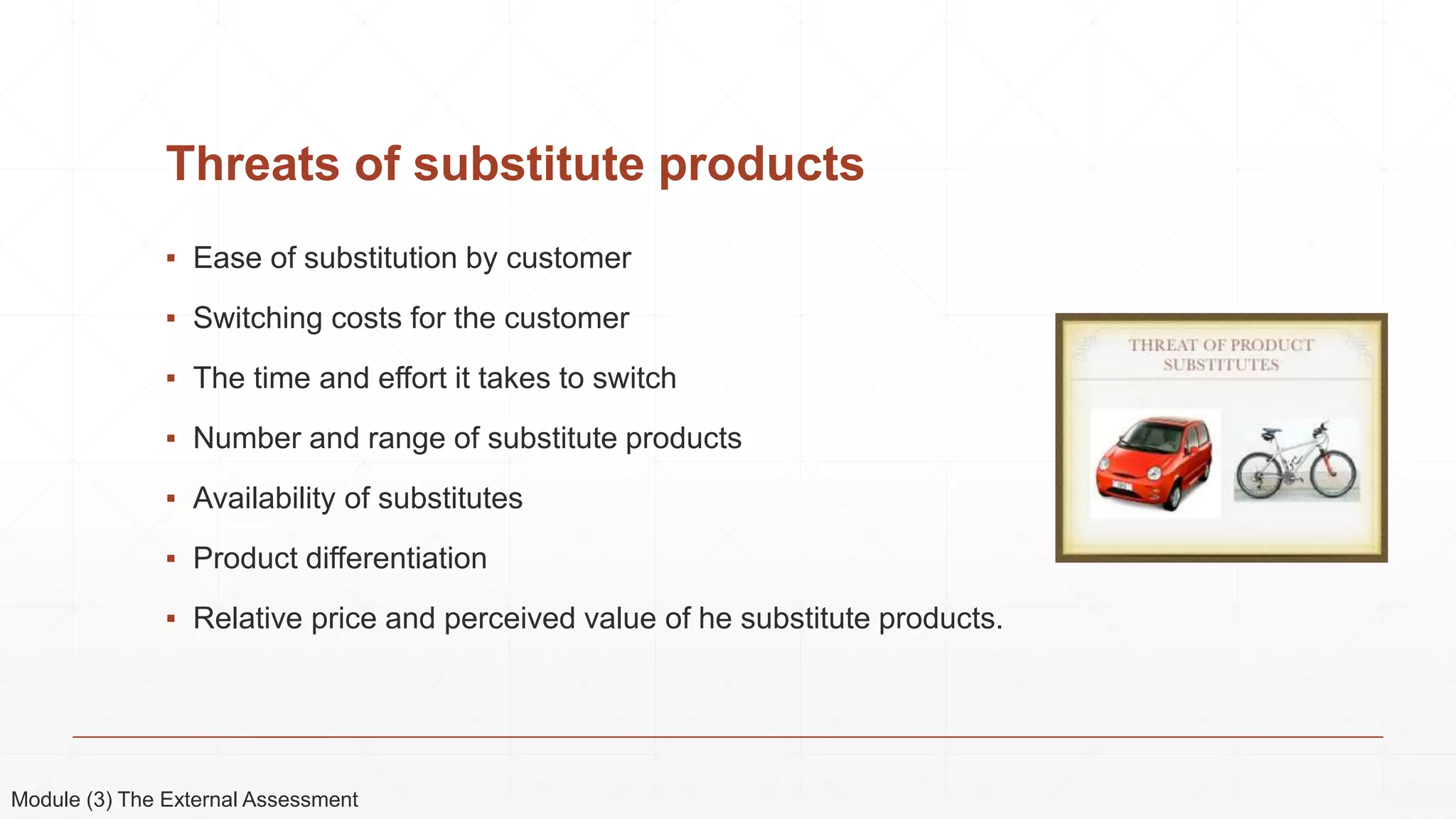
Threats of substitute products
▪ Ease of substitution by customer
▪ Switching costs for the customer
▪ The time and effort it takes to switch
▪ Number and range of substitute products
▪ Availability of substitutes
▪ Product differentiation
▪ Relative price and perceived value of he substitute products.
Module (3) The External Assessment
Bargaining Power of Buyers
▪ Customers being concentrated or buying in volume affects intensity of
competition
▪ Consumer power is higher where products are standard or undifferentiated
▪ Information available to a buyer about products or alternatives
▪ Buyer’s price sensitivity
▪ Loyalty programs
▪ Buyer switching costs
Module (3) The External Assessment
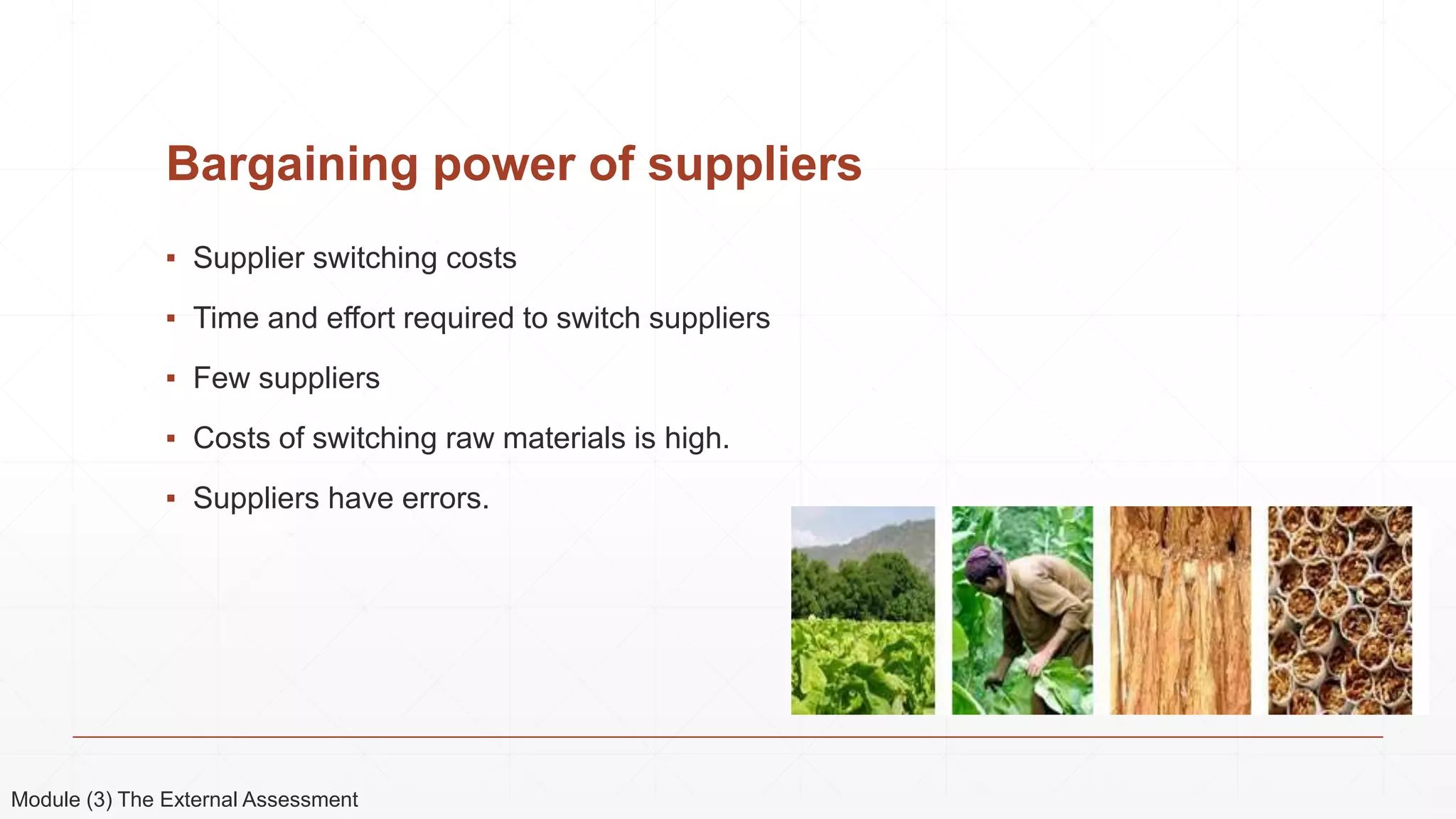
Bargaining power of suppliers
▪ Supplier switching costs
▪ Time and effort required to switch suppliers
▪ Few suppliers
▪ Costs of switching raw materials is high.
▪ Suppliers have errors.
Module (3) The External Assessment
Industry Rivalry
▪ Most powerful of the five forces
▪ Focus on competitive advantage of strategies over other firms
▪ Competition between online and offline businesses
▪ Advertisement budgets and expenditure
▪ Transparency
▪ Competitiveness
Module (3) The External Assessment
The Internal Assessment
1. Internal Audit
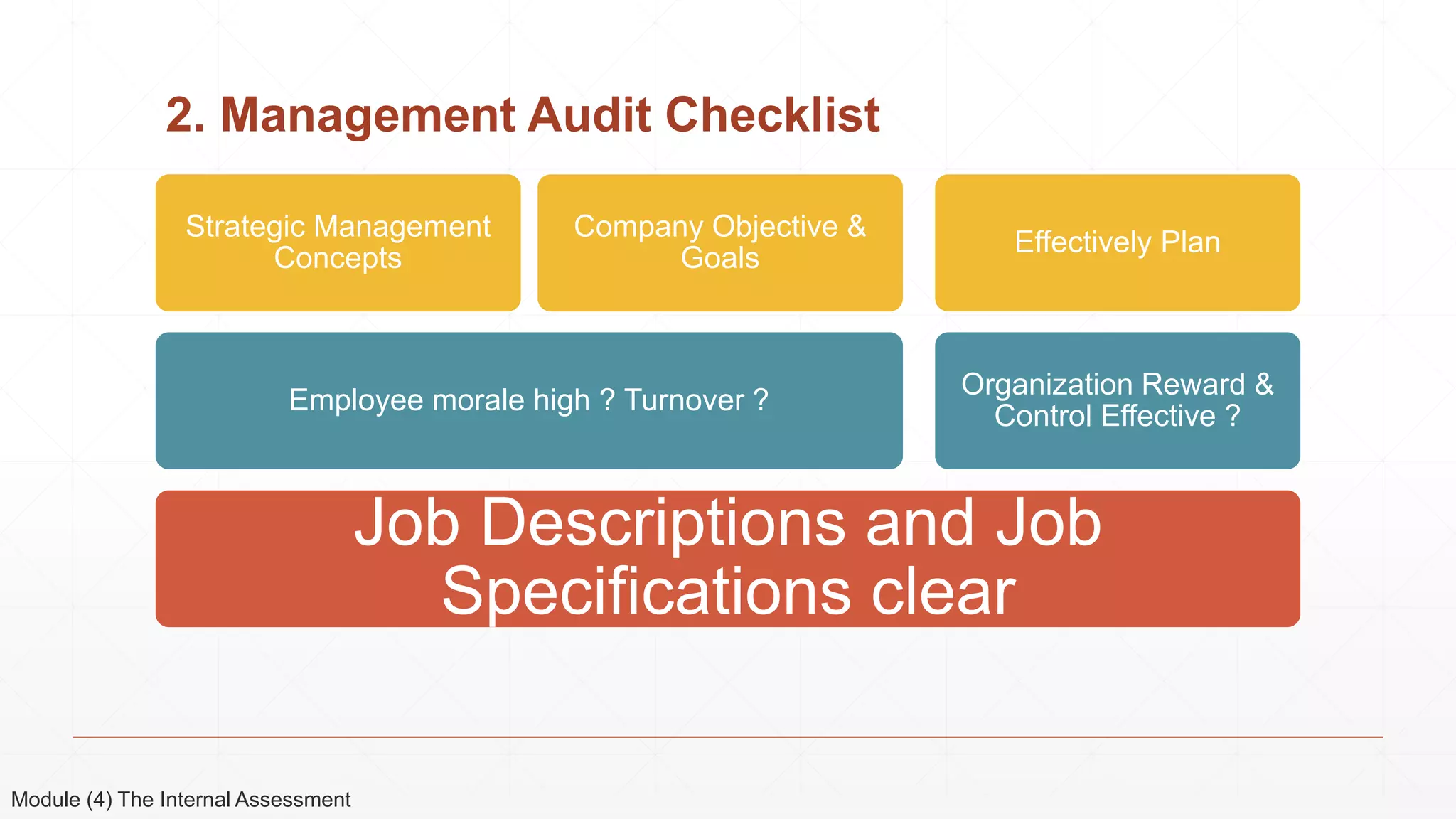
2. Management Audit Checklist
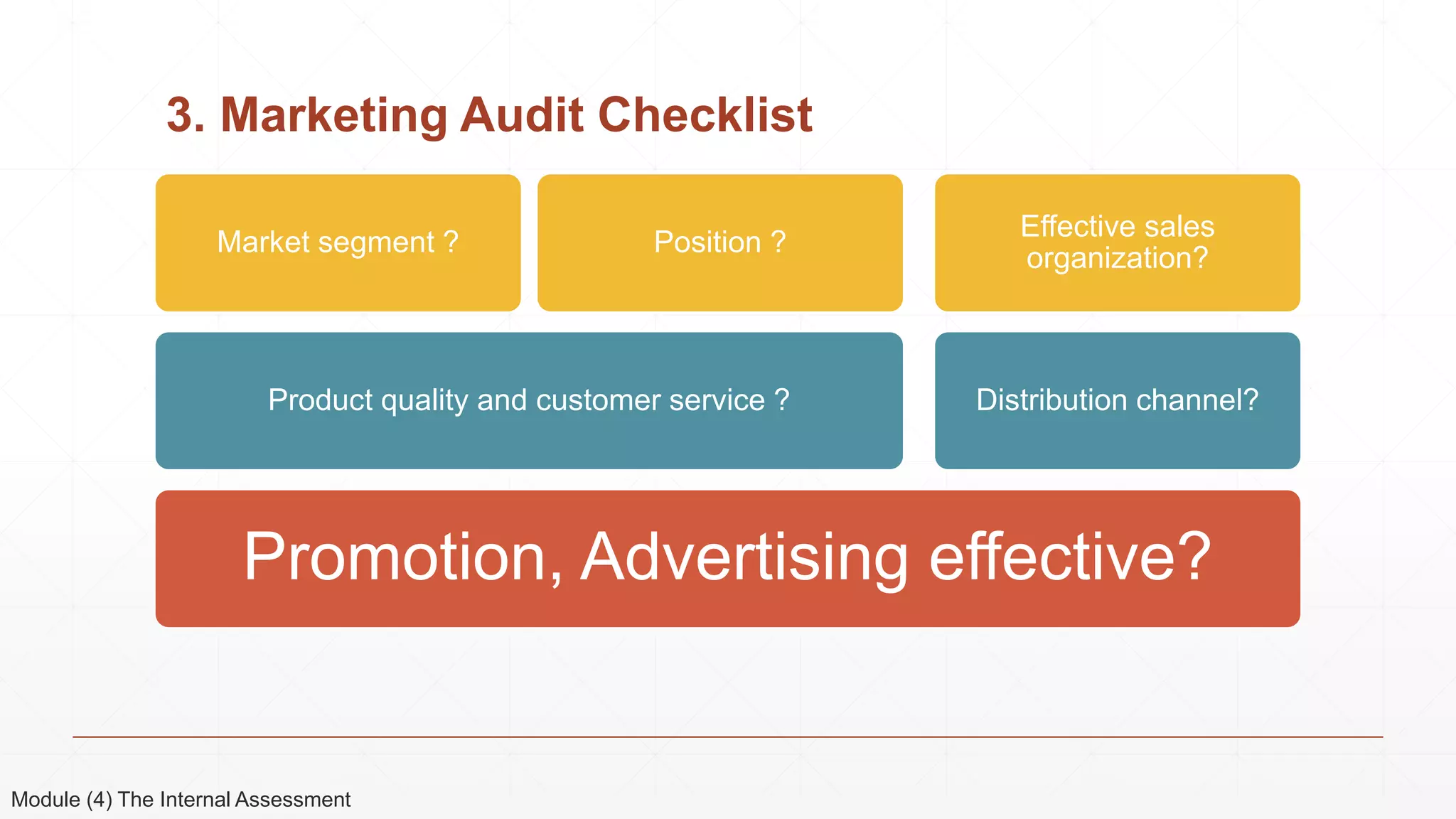
3. Marketing Audit Checklist
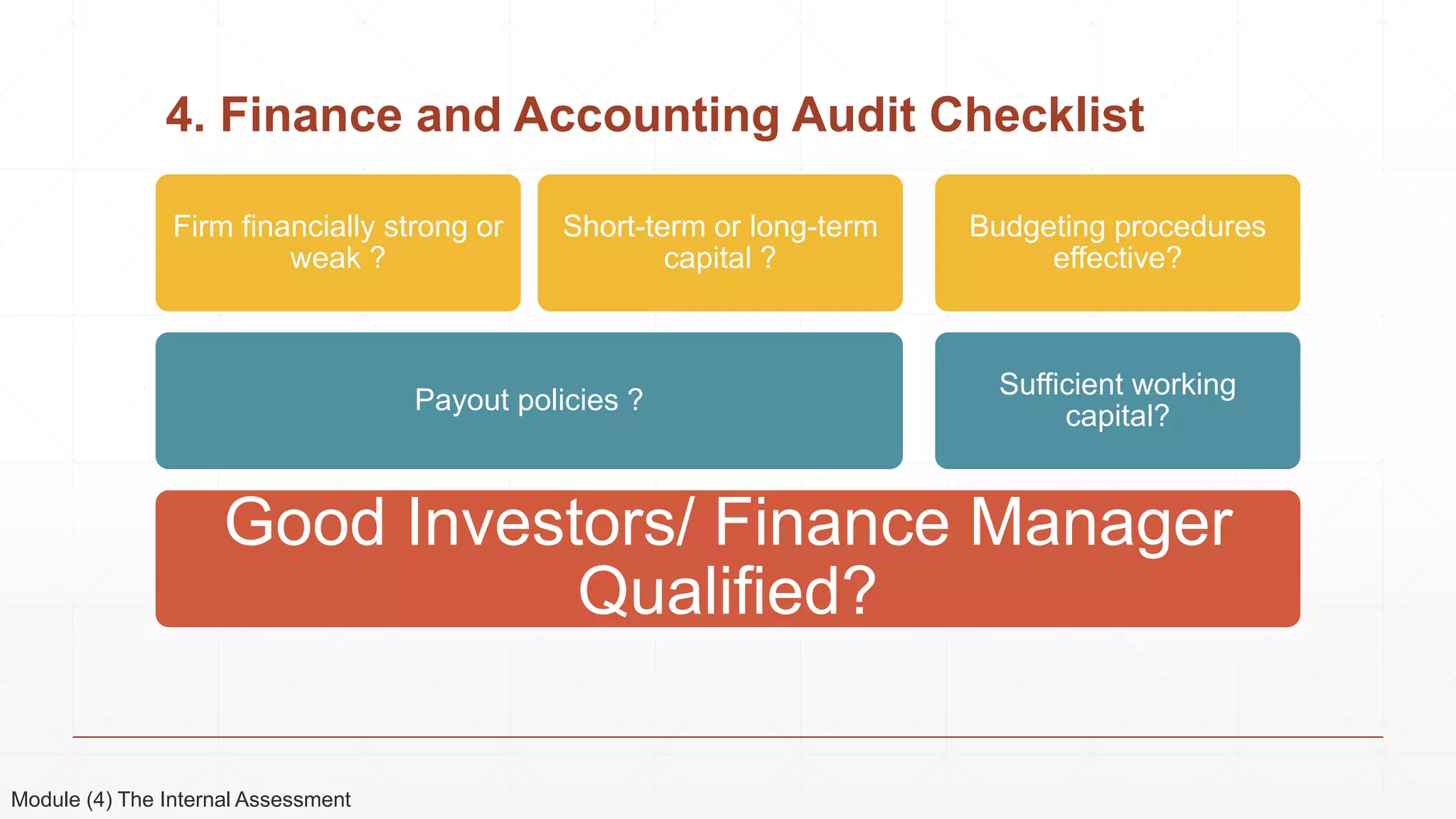
4. Finance and Accounting Audit Checklist
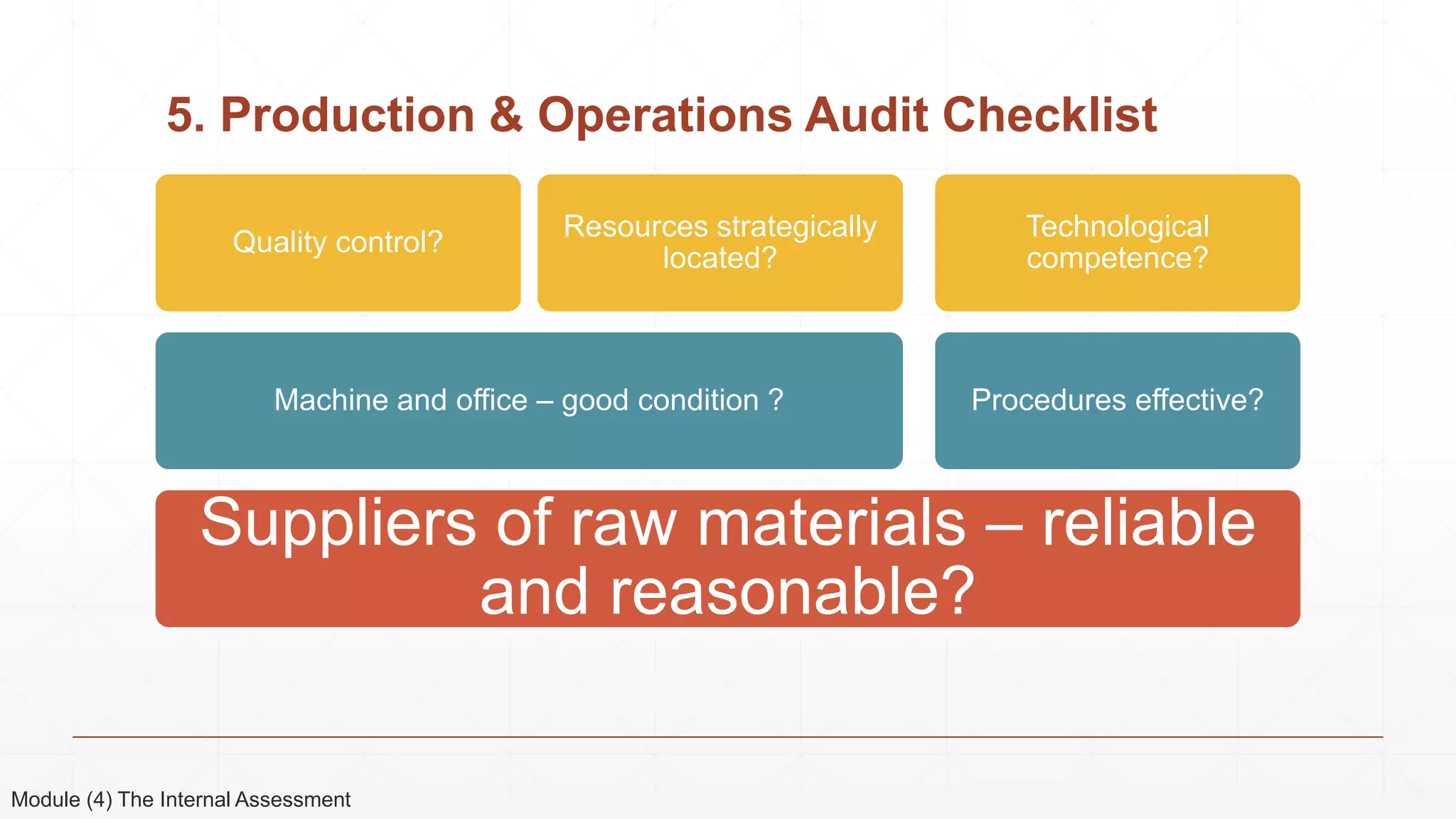
5. Production & Operations Audit Checklist
6. Research & Development Audit Checklist
7. Management Information Systems Audit Checklist
8. Value Chain Analysis (VCA)
9. Benchmarking
Module (4) The Internal Assessment
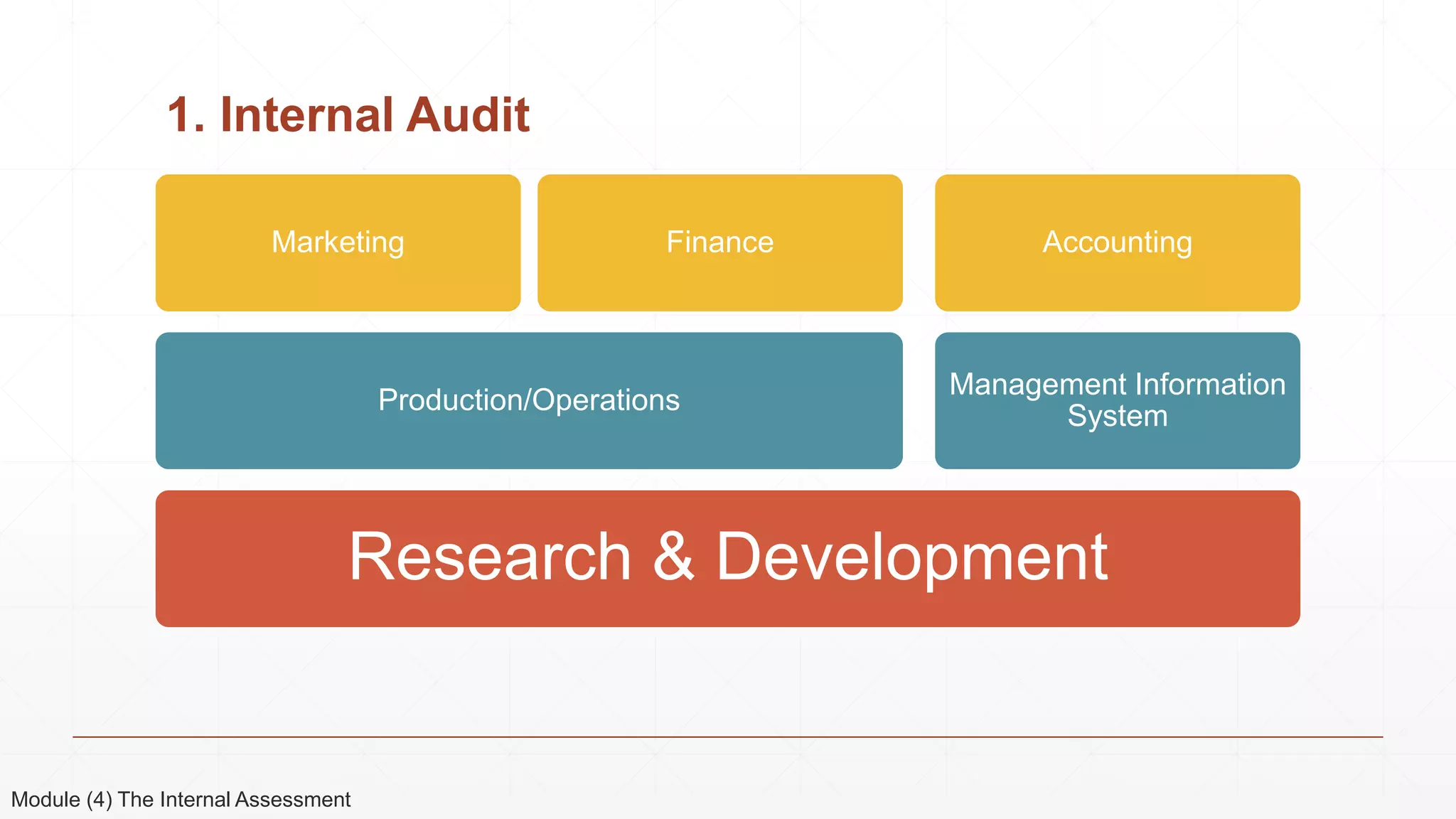
1. Internal Audit
Module (4) The Internal Assessment
Research & Development
Production/Operations
Marketing Finance
Management Information
System
Accounting
2. Management Audit Checklist
Module (4) The Internal Assessment
Job Descriptions and Job
Specifications clear
Employee morale high ? Turnover ?
Strategic Management
Concepts
Company Objective &
Goals
Organization Reward &
Control Effective ?
Effectively Plan
3. Marketing Audit Checklist
Module (4) The Internal Assessment
Promotion, Advertising effective?
Product quality and customer service ?
Market segment ? Position ?
Distribution channel?
Effective sales
organization?
4. Finance and Accounting Audit Checklist
Module (4) The Internal Assessment
Good Investors/ Finance Manager
Qualified?
Payout policies ?
Firm financially strong or
weak ?
Short-term or long-term
capital ?
Sufficient working
capital?
Budgeting procedures
effective?
5. Production & Operations Audit Checklist
Module (4) The Internal Assessment
Suppliers of raw materials – reliable
and reasonable?
Machine and office – good condition ?
Quality control?
Resources strategically
located?
Procedures effective?
Technological
competence?
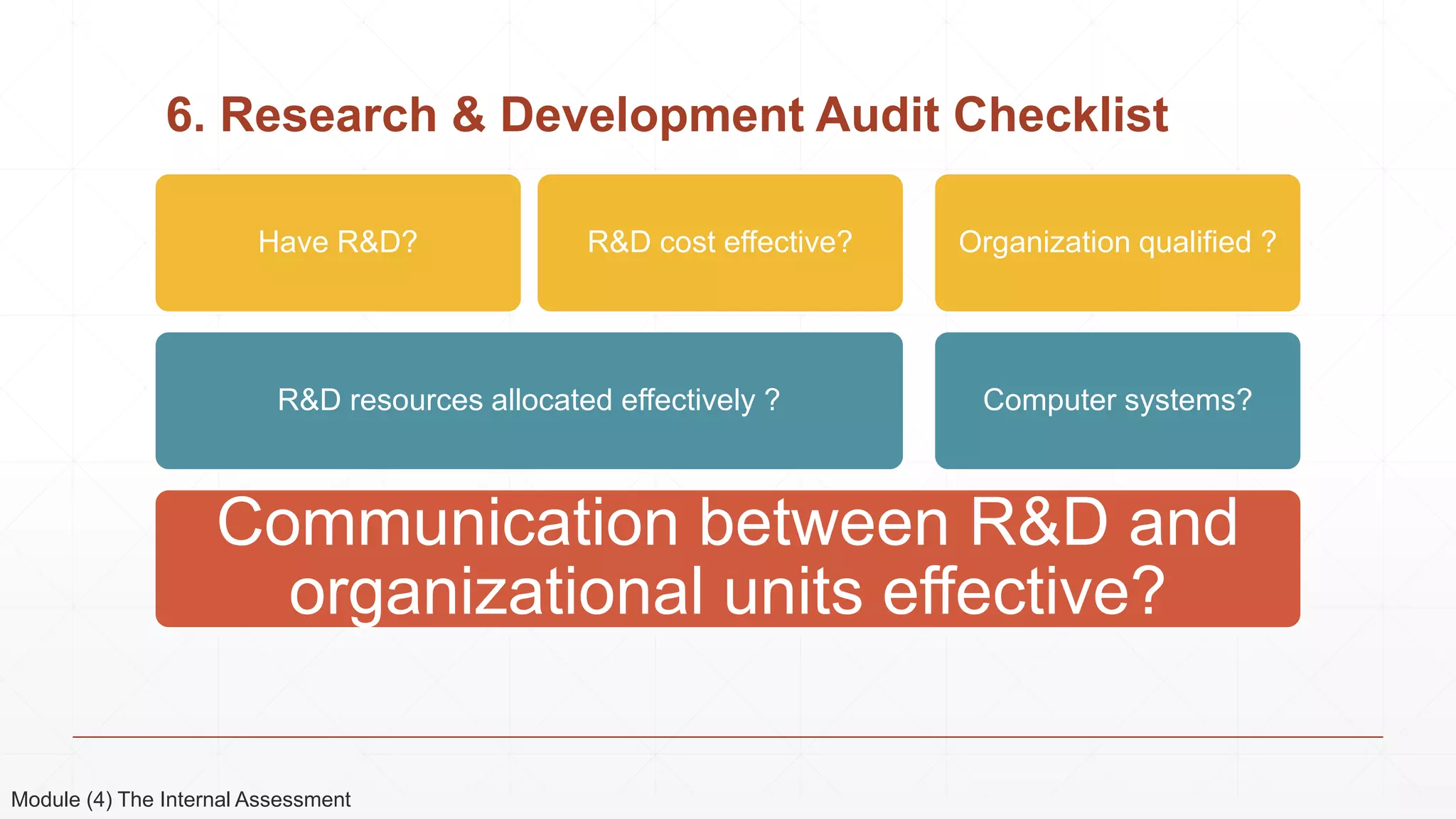
6. Research & Development Audit Checklist
Module (4) The Internal Assessment
Communication between R&D and
organizational units effective?
R&D resources allocated effectively ?
Have R&D? R&D cost effective?
Computer systems?
Organization qualified ?
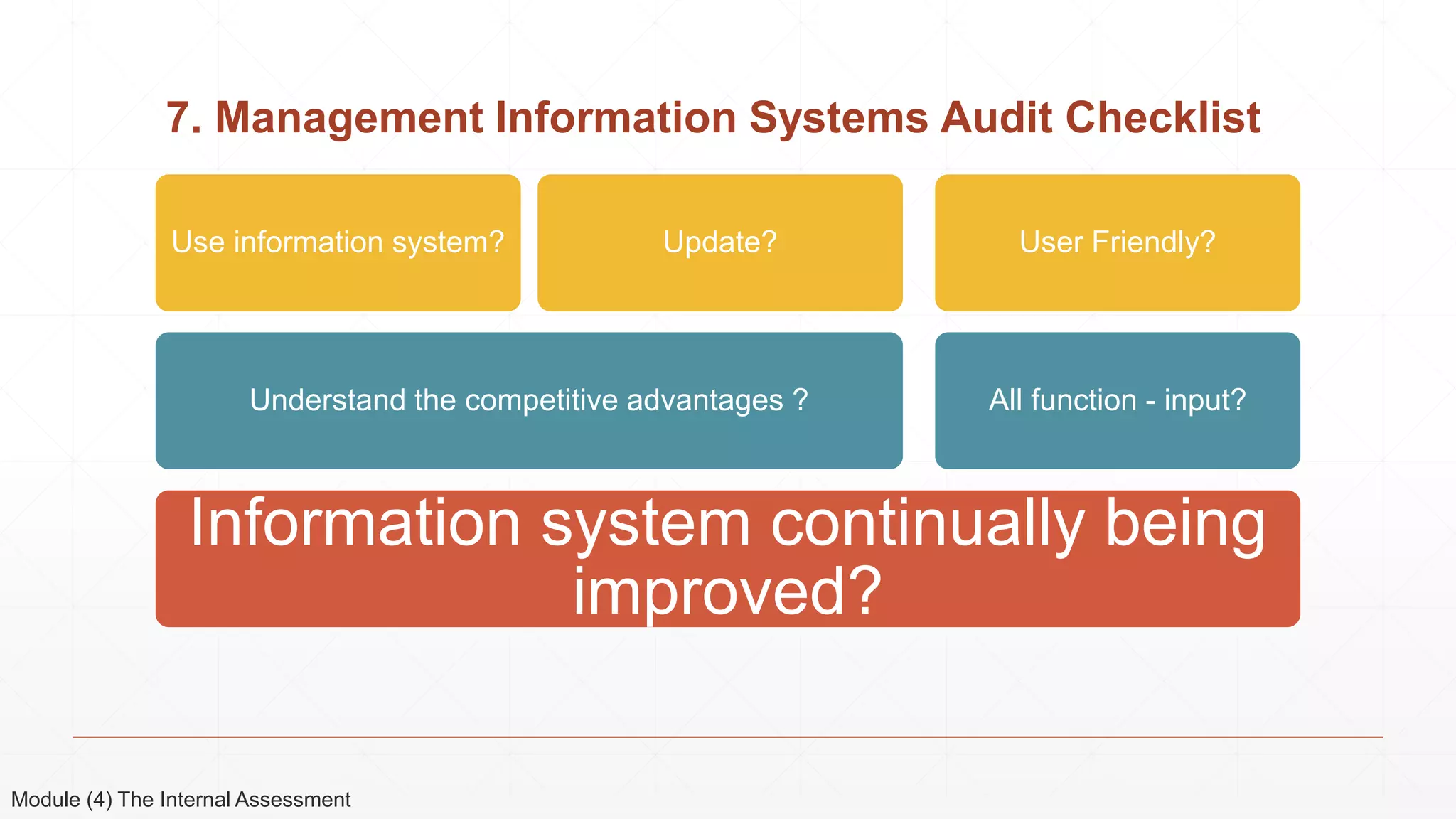
7. Management Information Systems Audit Checklist
Module (4) The Internal Assessment
Information system continually being
improved?
Understand the competitive advantages ?
Use information system? Update?
All function - input?
User Friendly?
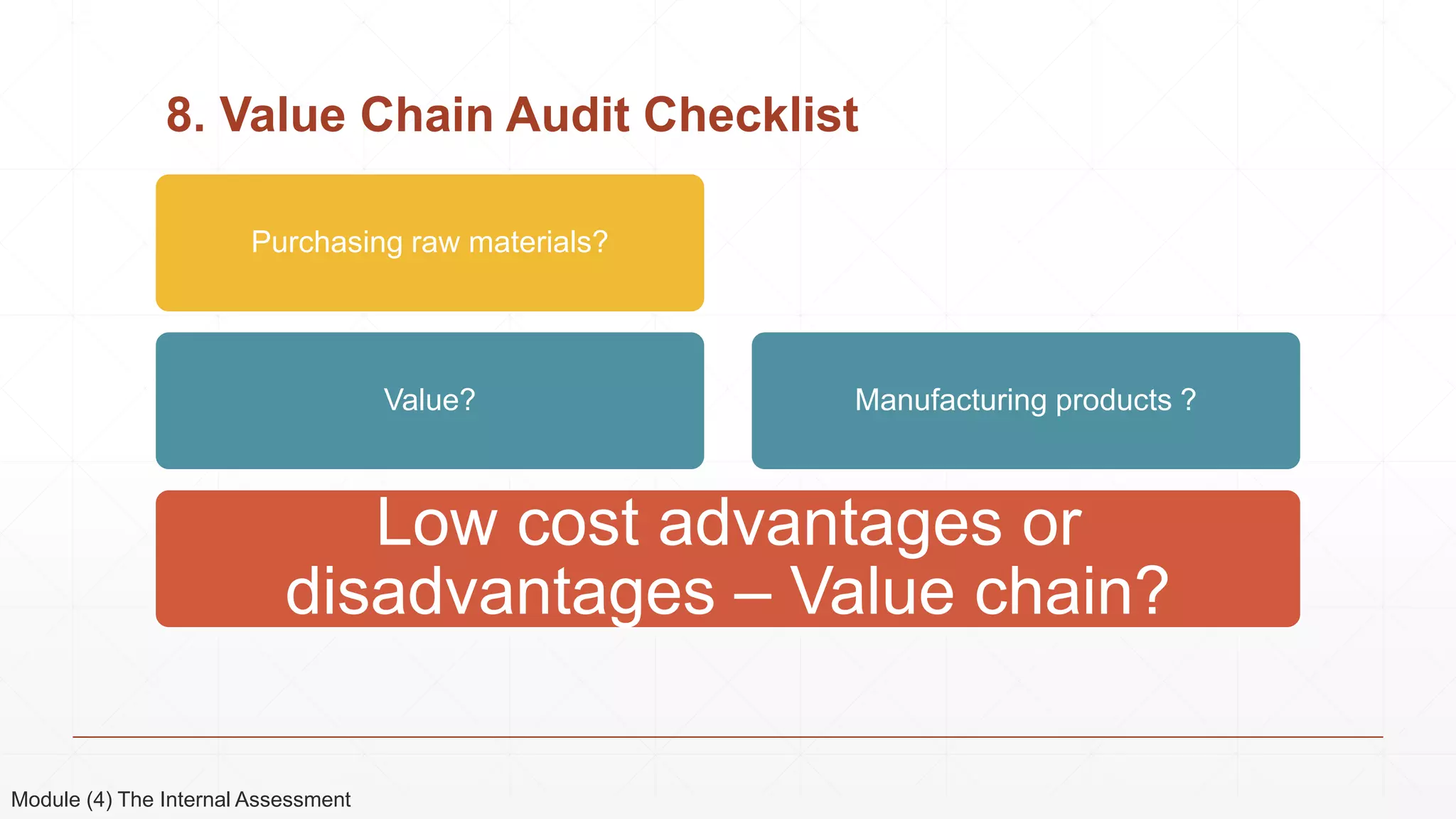
8. Value Chain Audit Checklist
Module (4) The Internal Assessment
Low cost advantages or
disadvantages – Value chain?
Value?
Purchasing raw materials?
Manufacturing products ?
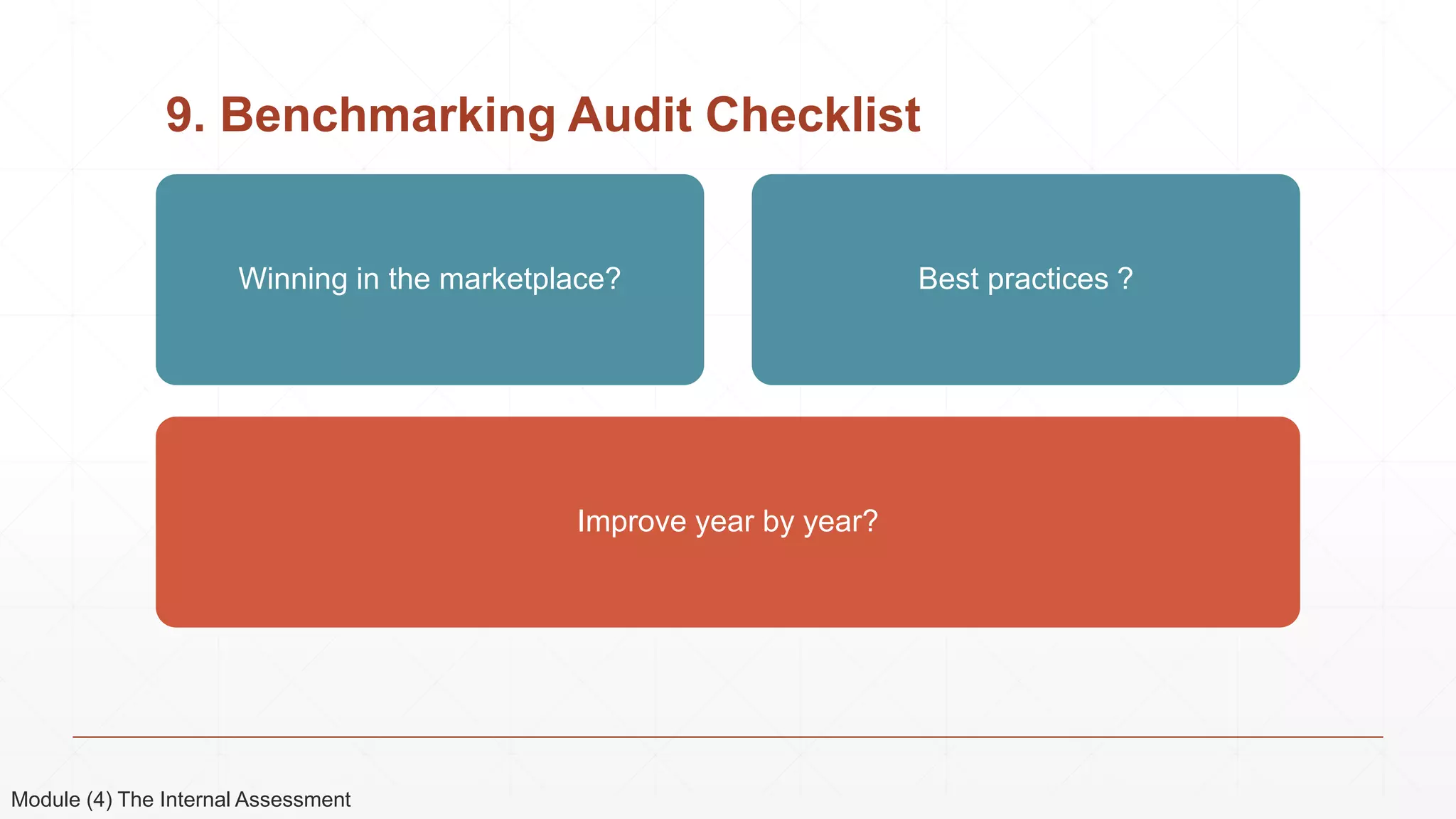
9. Benchmarking Audit Checklist
Module (4) The Internal Assessment
Improve year by year?
Winning in the marketplace? Best practices ?
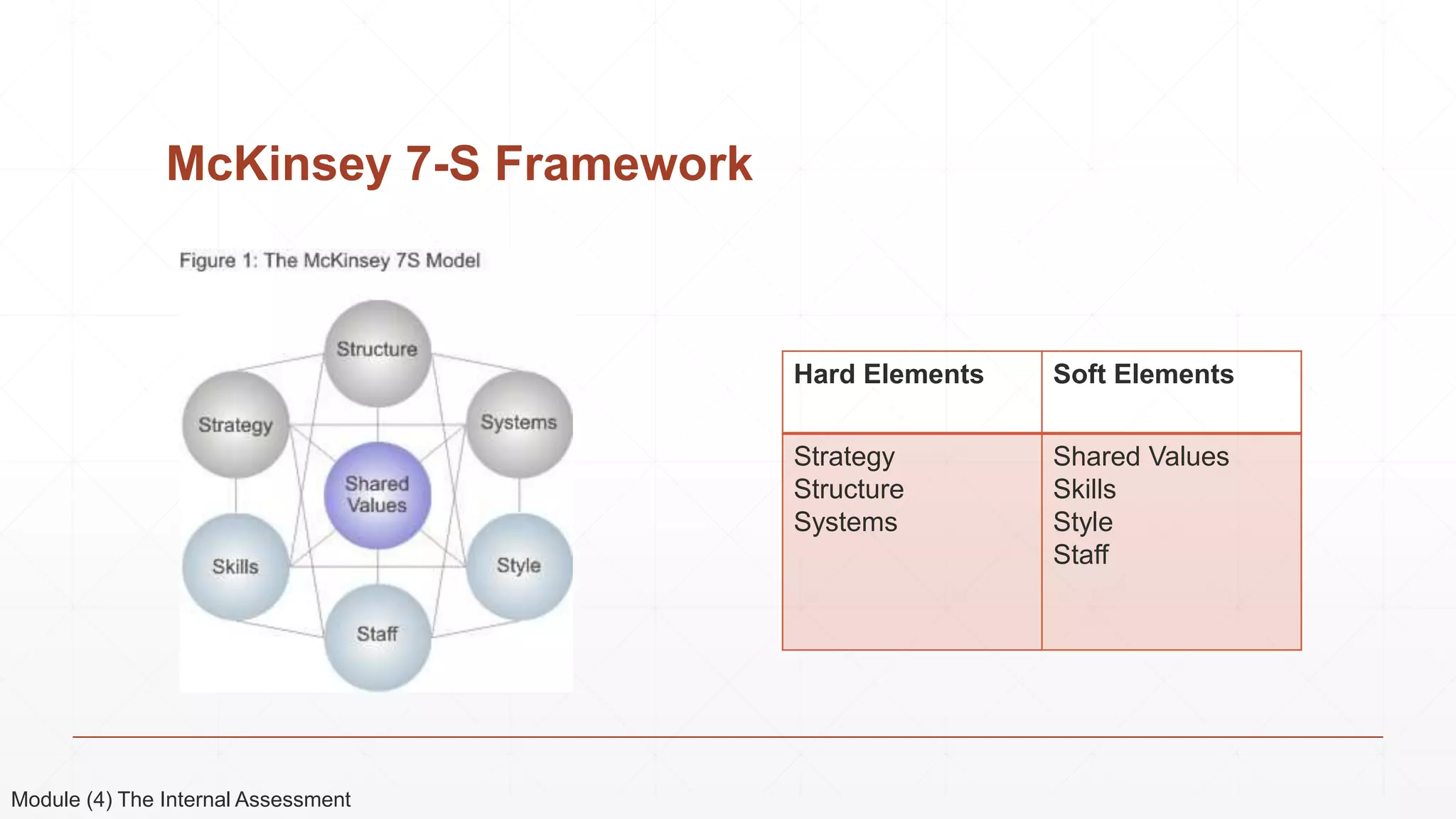
McKinsey 7-S Framework
Hard Elements Soft Elements
Strategy
Structure
Systems
Shared Values
Skills
Style
Staff
Module (4) The Internal Assessment
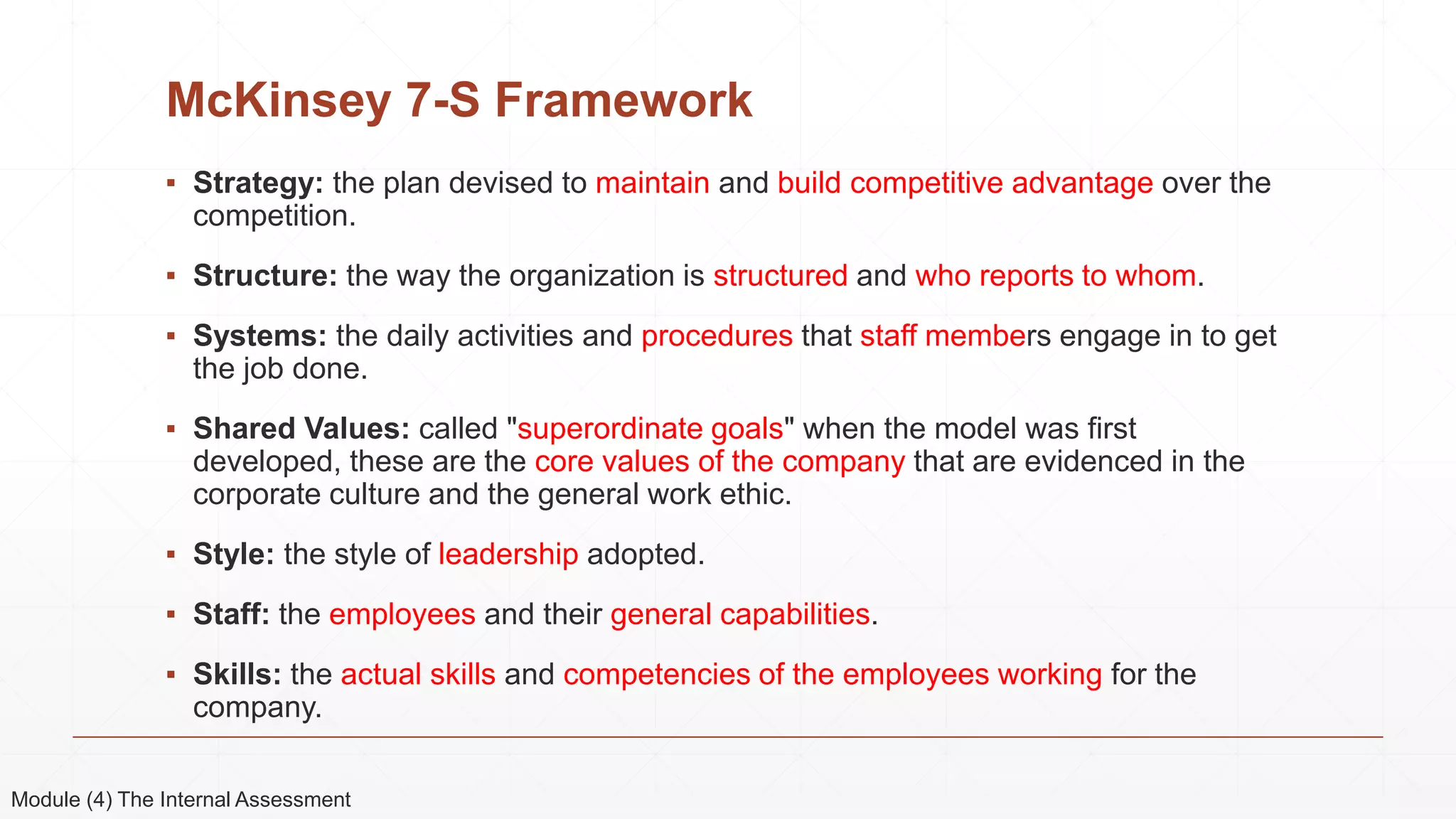
McKinsey 7-S Framework
▪ Strategy: the plan devised to maintain and build competitive advantage over the
competition.
▪ Structure: the way the organization is structured and who reports to whom.
▪ Systems: the daily activities and procedures that staff members engage in to get
the job done.
▪ Shared Values: called "superordinate goals" when the model was first
developed, these are the core values of the company that are evidenced in the
corporate culture and the general work ethic.
▪ Style: the style of leadership adopted.
▪ Staff: the employees and their general capabilities.
▪ Skills: the actual skills and competencies of the employees working for the
company.
Module (4) The Internal Assessment
Types of Strategies
1. Integration Strategies
2. Intensive Strategies
3. Diversification Strategies
4. Defensive Strategies
Module (5) Type of Strategies
Integration Strategies
▪ Forward Integration
Involves gaining ownership or increased control over distributions or retailers
 Backward Integration
Strategy of seeking ownership or increased control of a firm’s suppliers
 Horizontal Integration
A strategy of seeking ownership of or increased control over a firm’s competitors
Integration Strategies
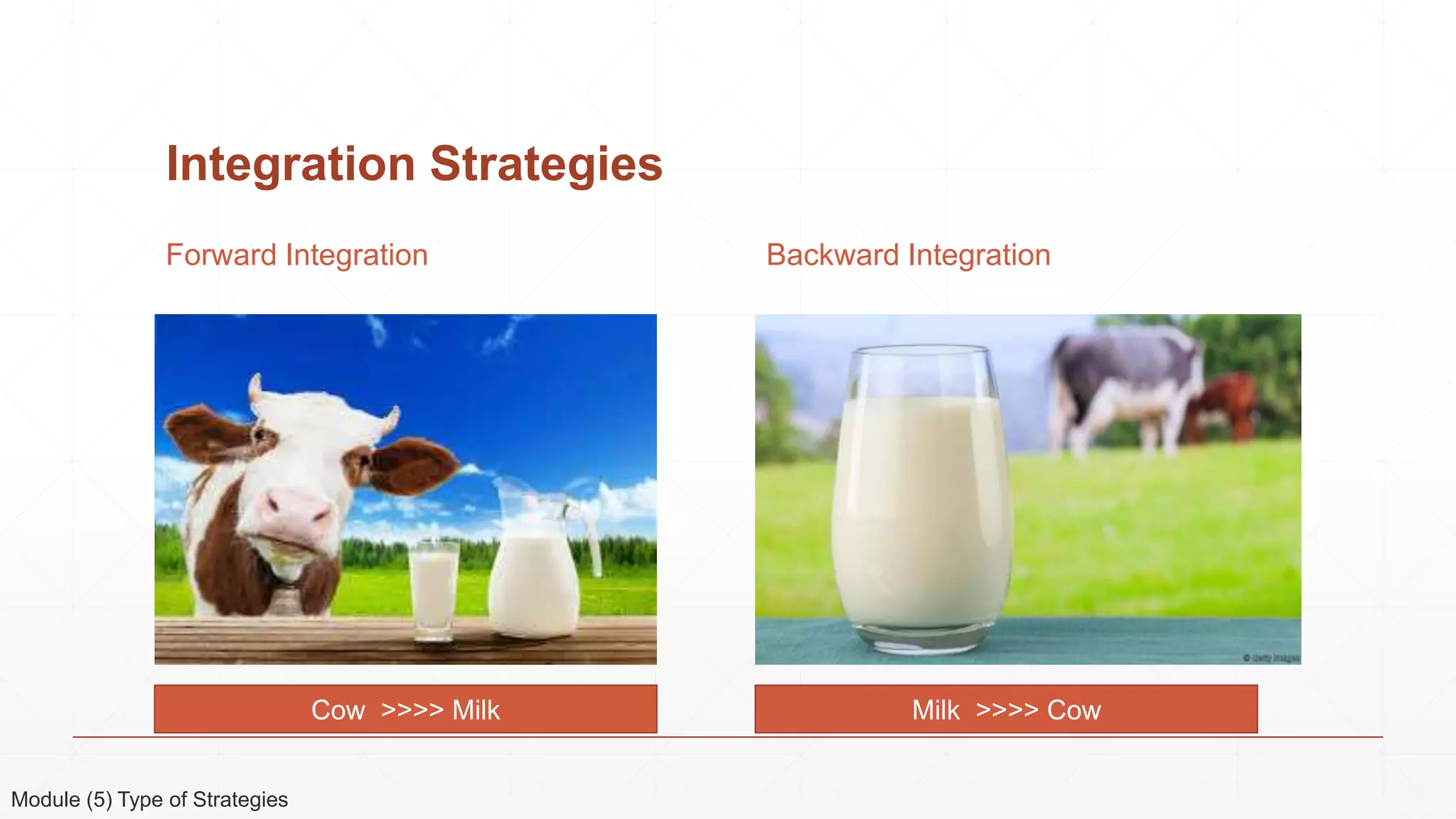
Forward Integration Backward Integration
Cow >>>> Milk Milk >>>> Cow
Module (5) Type of Strategies
Integration Strategies
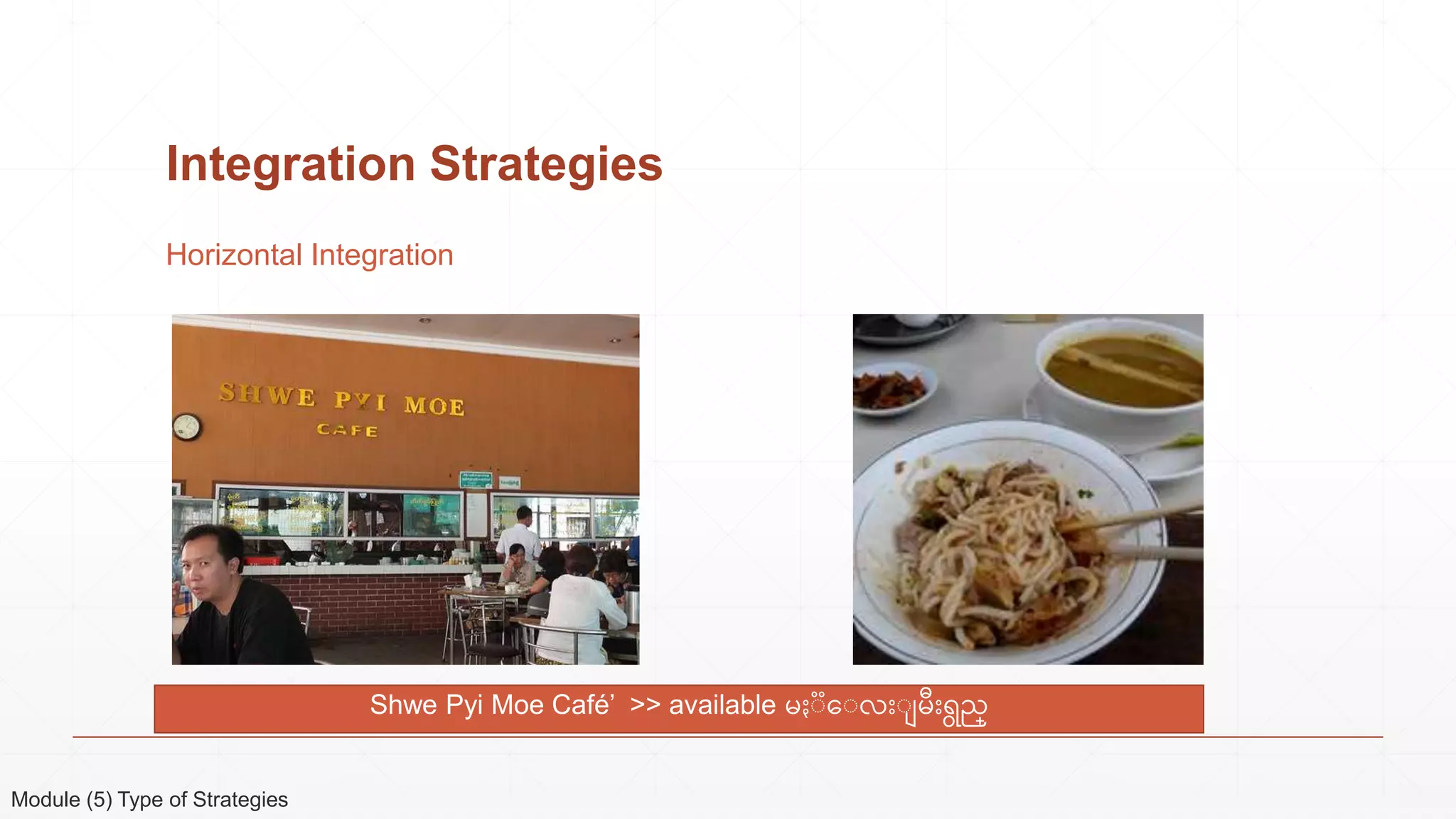
Horizontal Integration
Shwe Pyi Moe Café’ >> available မႏၱေၱလးၱ မးရွည္
Module (5) Type of Strategies
2. Intensive Strategies
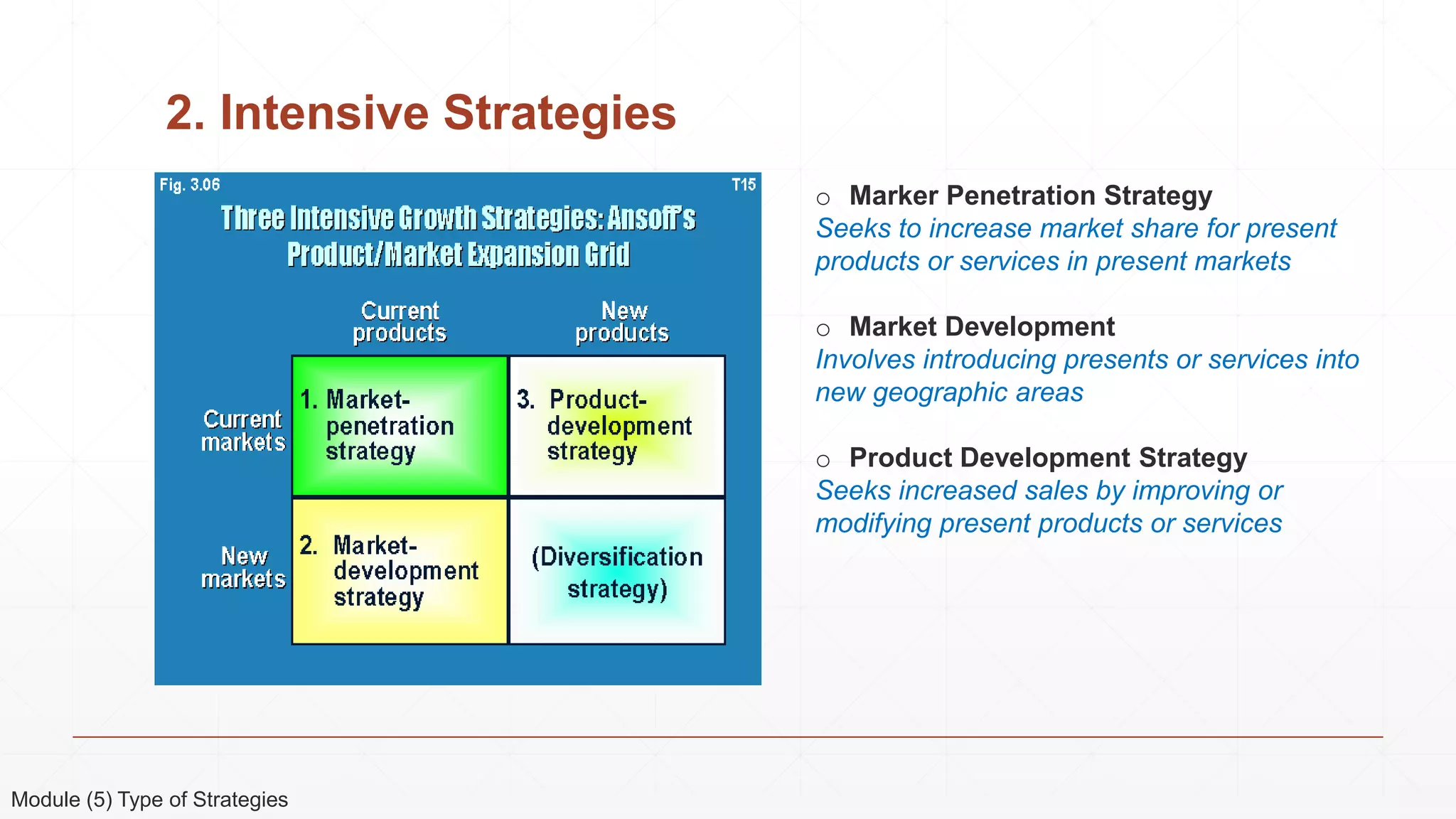
o Marker Penetration Strategy
Seeks to increase market share for present
products or services in present markets
o Market Development
Involves introducing presents or services into
new geographic areas
o Product Development Strategy
Seeks increased sales by improving or
modifying present products or services
Module (5) Type of Strategies
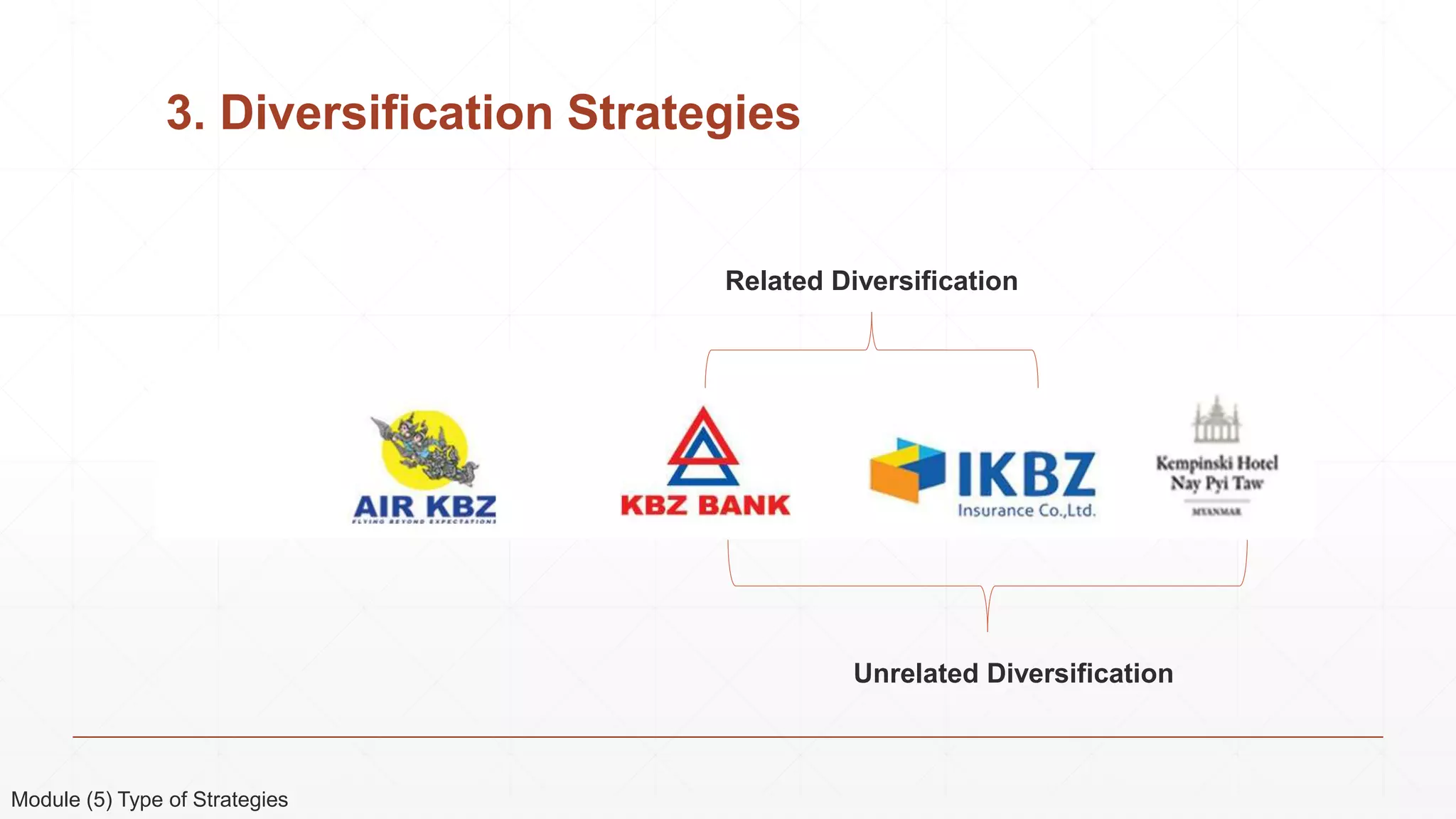
3. Diversification Strategies
Module (5) Type of Strategies
Unrelated Diversification
Related Diversification
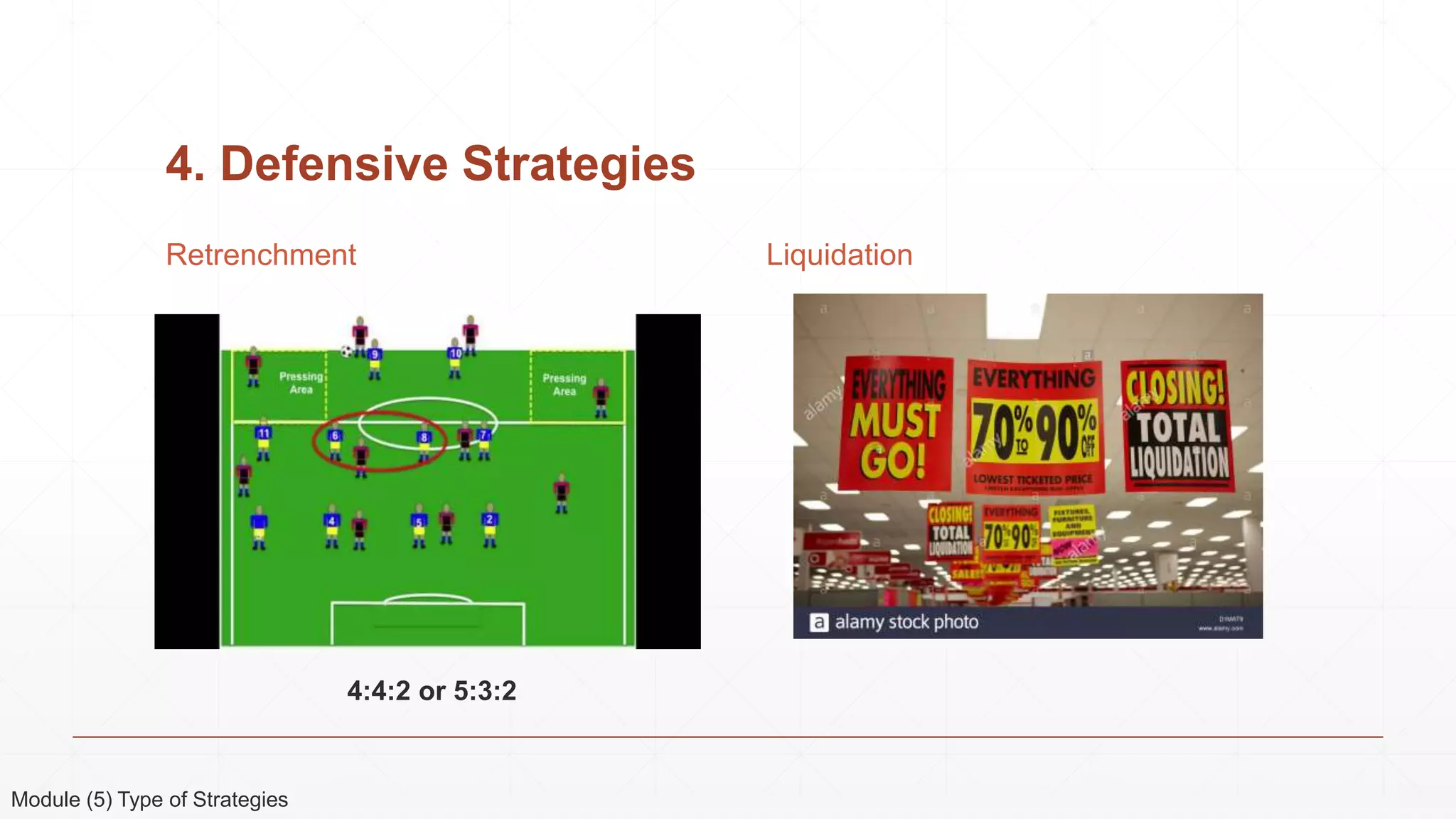
4. Defensive Strategies
Retrenchment Liquidation
4:4:2 or 5:3:2
Module (5) Type of Strategies
Day - 3
20.9.2017
Competitive Advantage
▪ Sources of Competitive Advantage
▪ Strategy and Competitive Advantage
▪ Innovation for Competitive Advantage
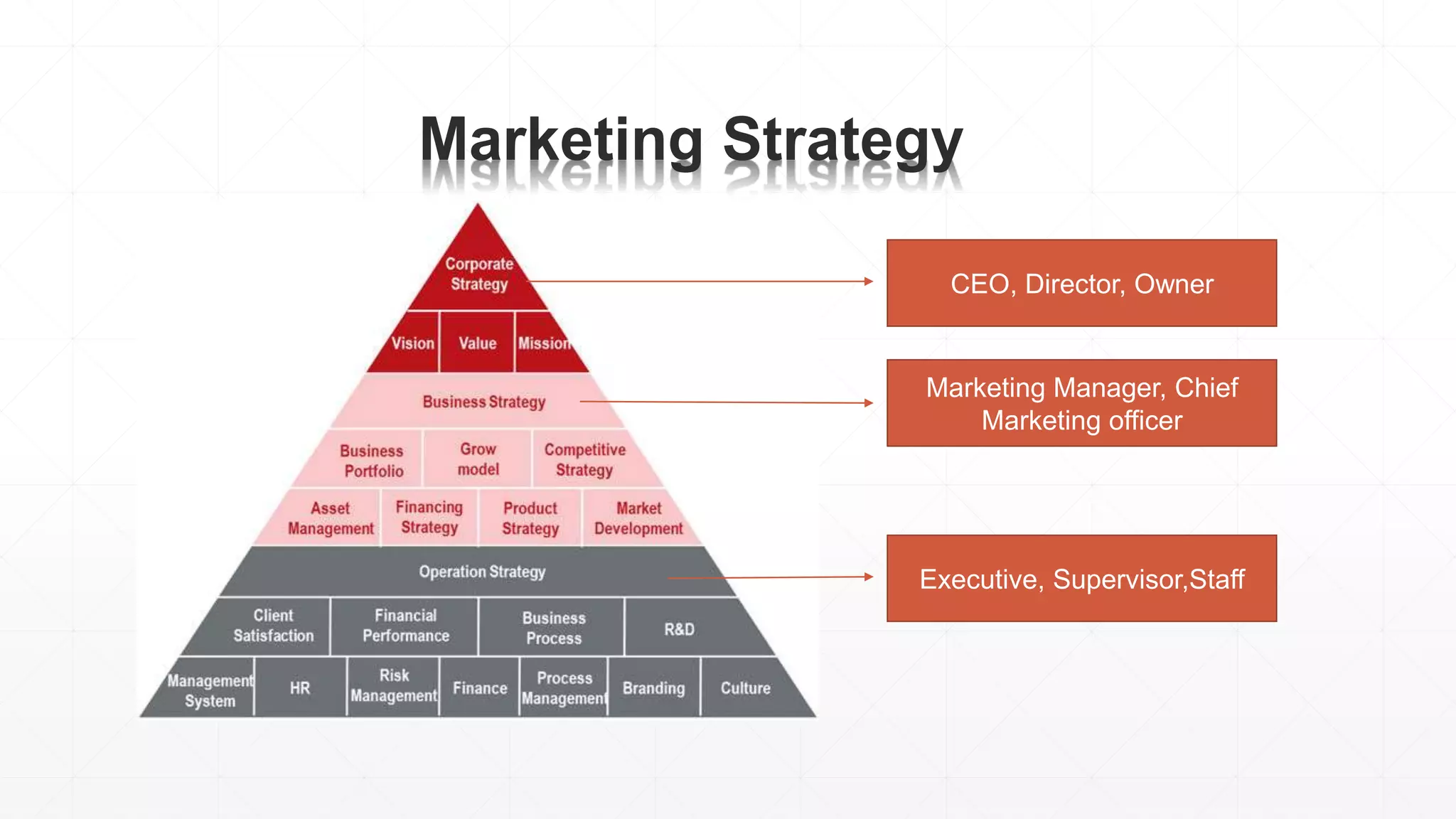
Marketing Strategy
CEO, Director, Owner
Marketing Manager, Chief
Marketing officer
Executive, Supervisor,Staff
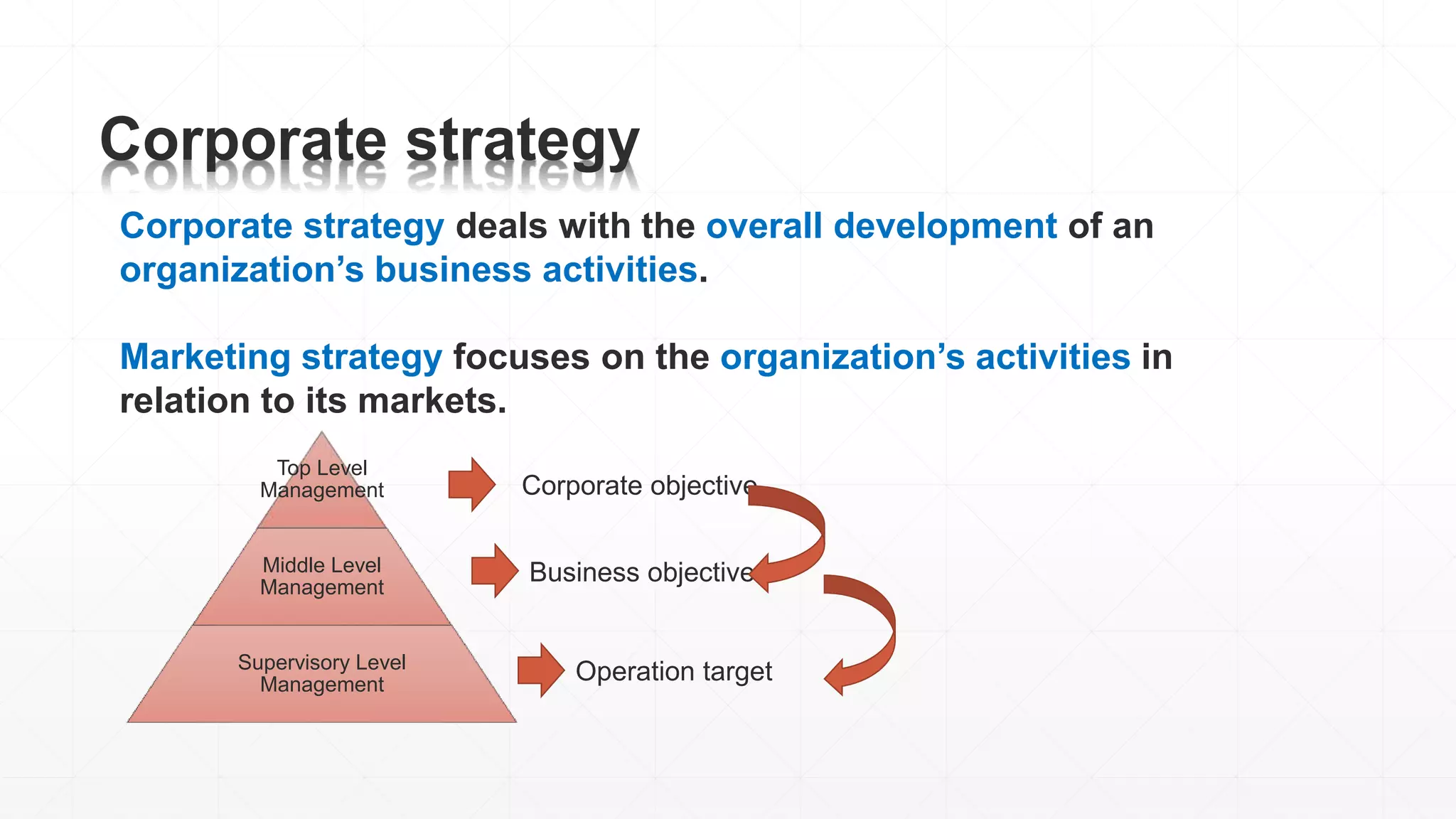
Corporate strategy
Corporate strategy deals with the overall development of an
organization’s business activities.
Marketing strategy focuses on the organization’s activities in
relation to its markets.
Top Level
Management
Middle Level
Management
Supervisory Level
Management
Corporate objective
Business objective
Operation target
Strategy
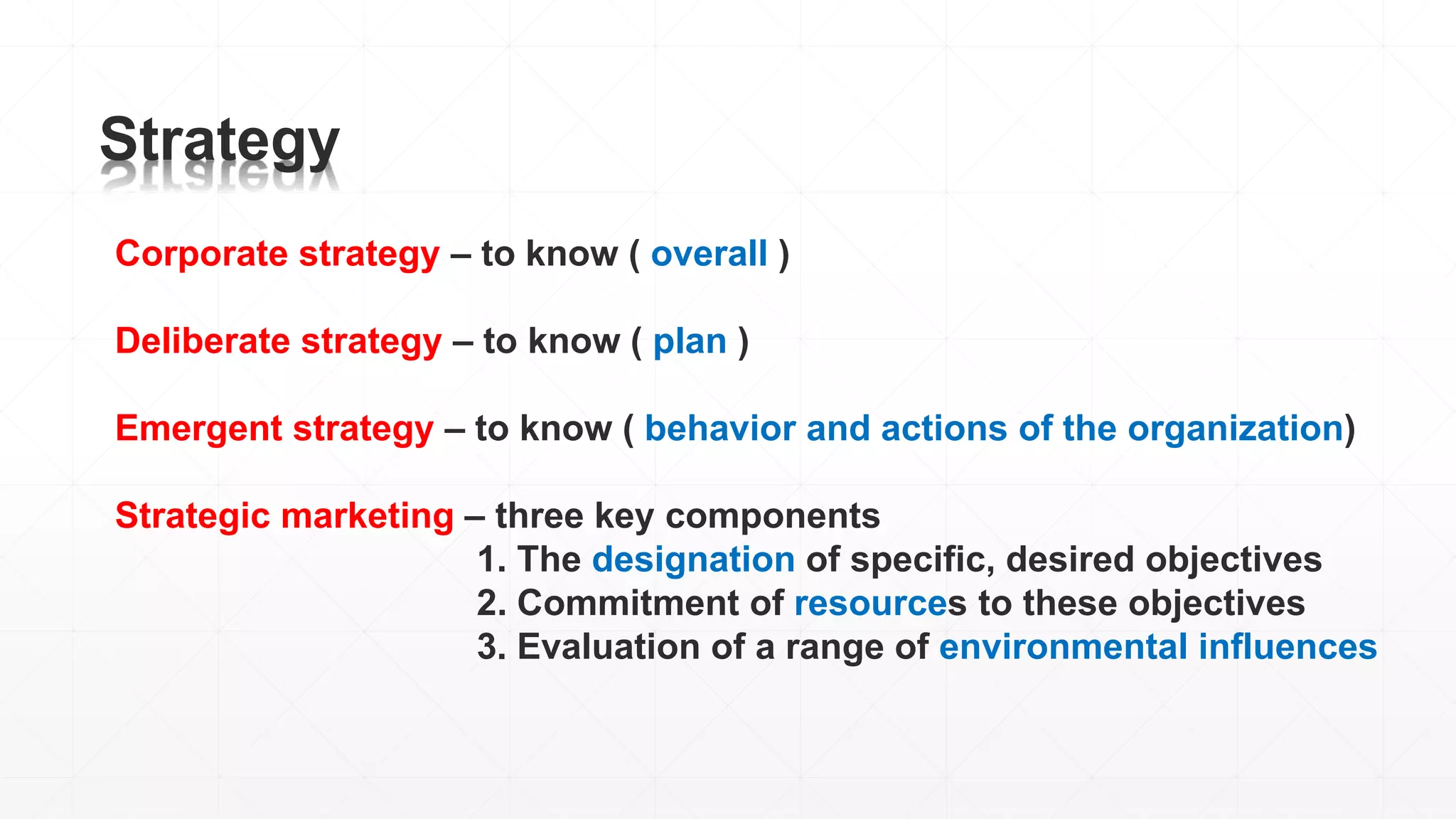
Corporate strategy – to know ( overall )
Deliberate strategy – to know ( plan )
Emergent strategy – to know ( behavior and actions of the organization)
Strategic marketing – three key components
1. The designation of specific, desired objectives
2. Commitment of resources to these objectives
3. Evaluation of a range of environmental influences
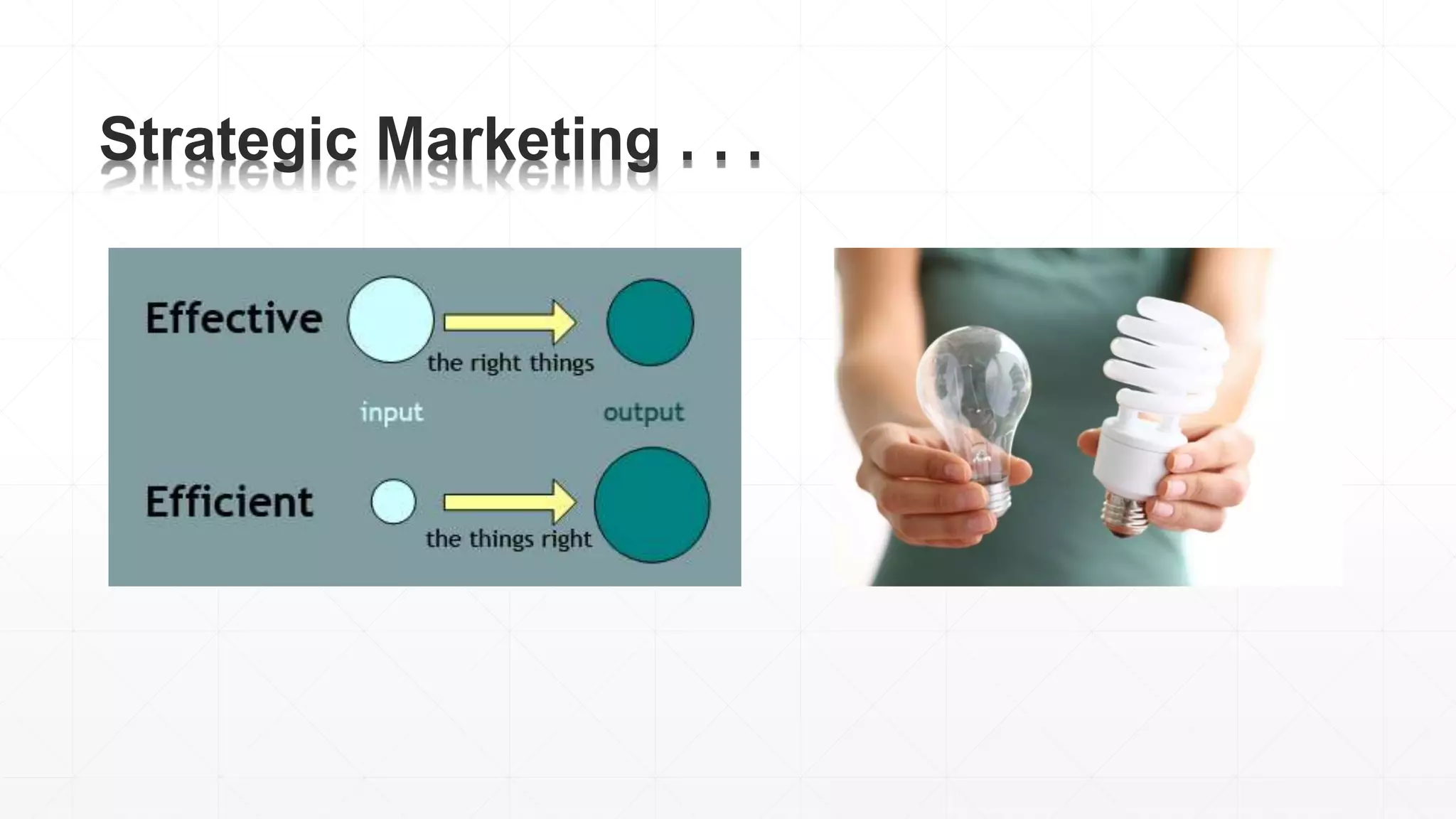
Strategic Marketing . . .
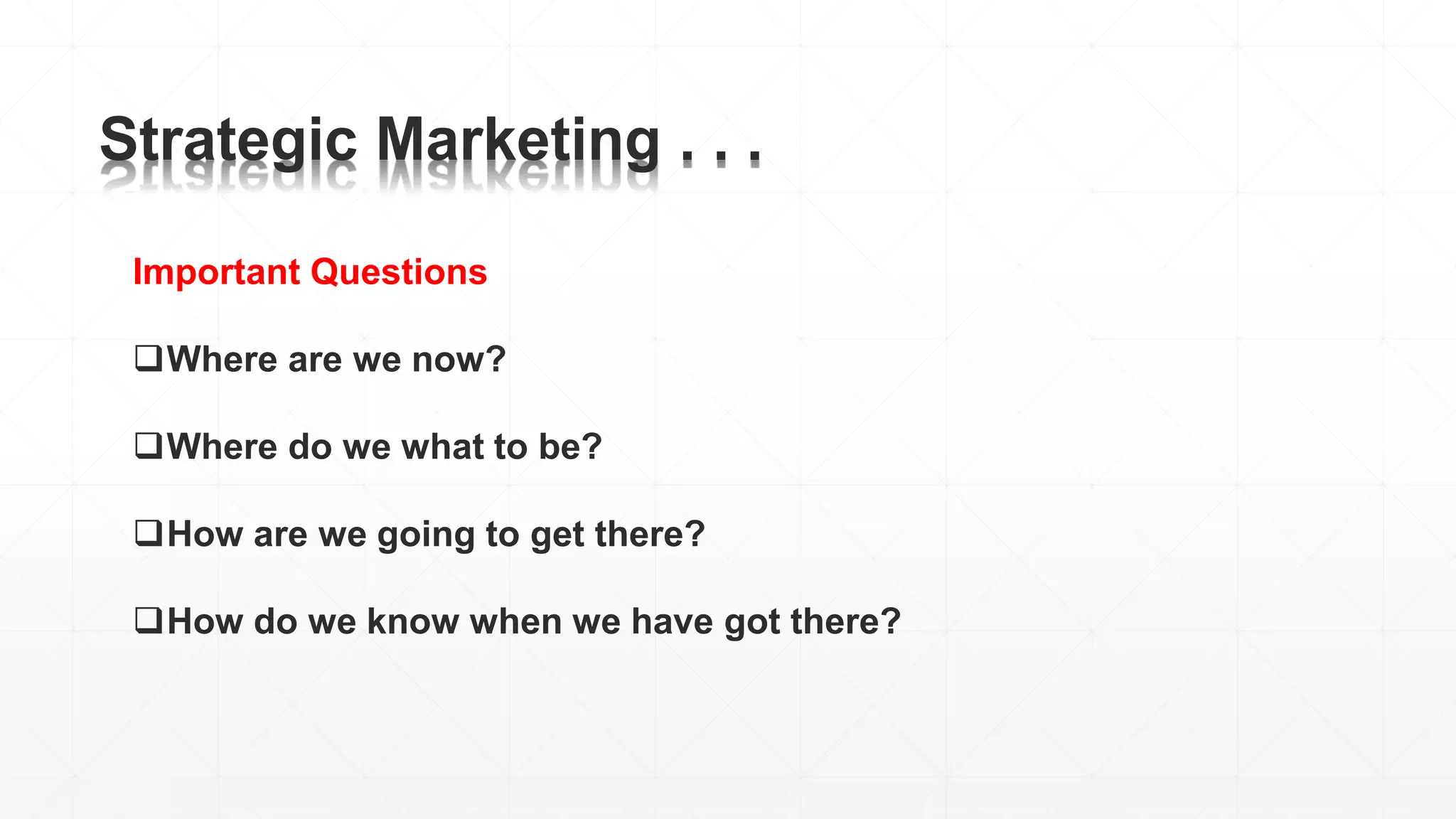
Important Questions
Where are we now?
Where do we what to be?
How are we going to get there?
How do we know when we have got there?
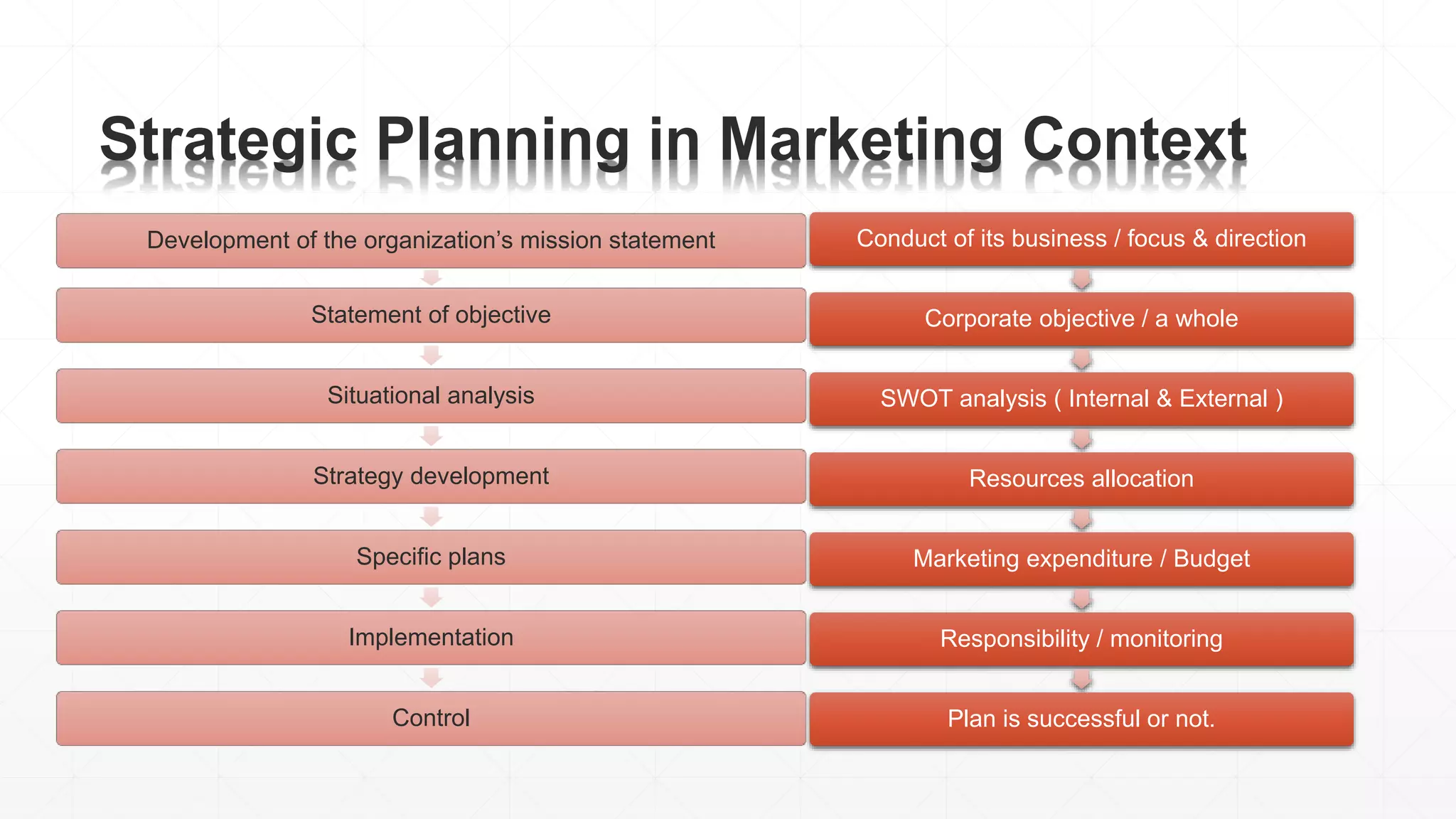
Strategic Planning in Marketing Context
Development of the organization’s mission statement
Statement of objective
Situational analysis
Strategy development
Specific plans
Implementation
Control
Conduct of its business / focus & direction
Corporate objective / a whole
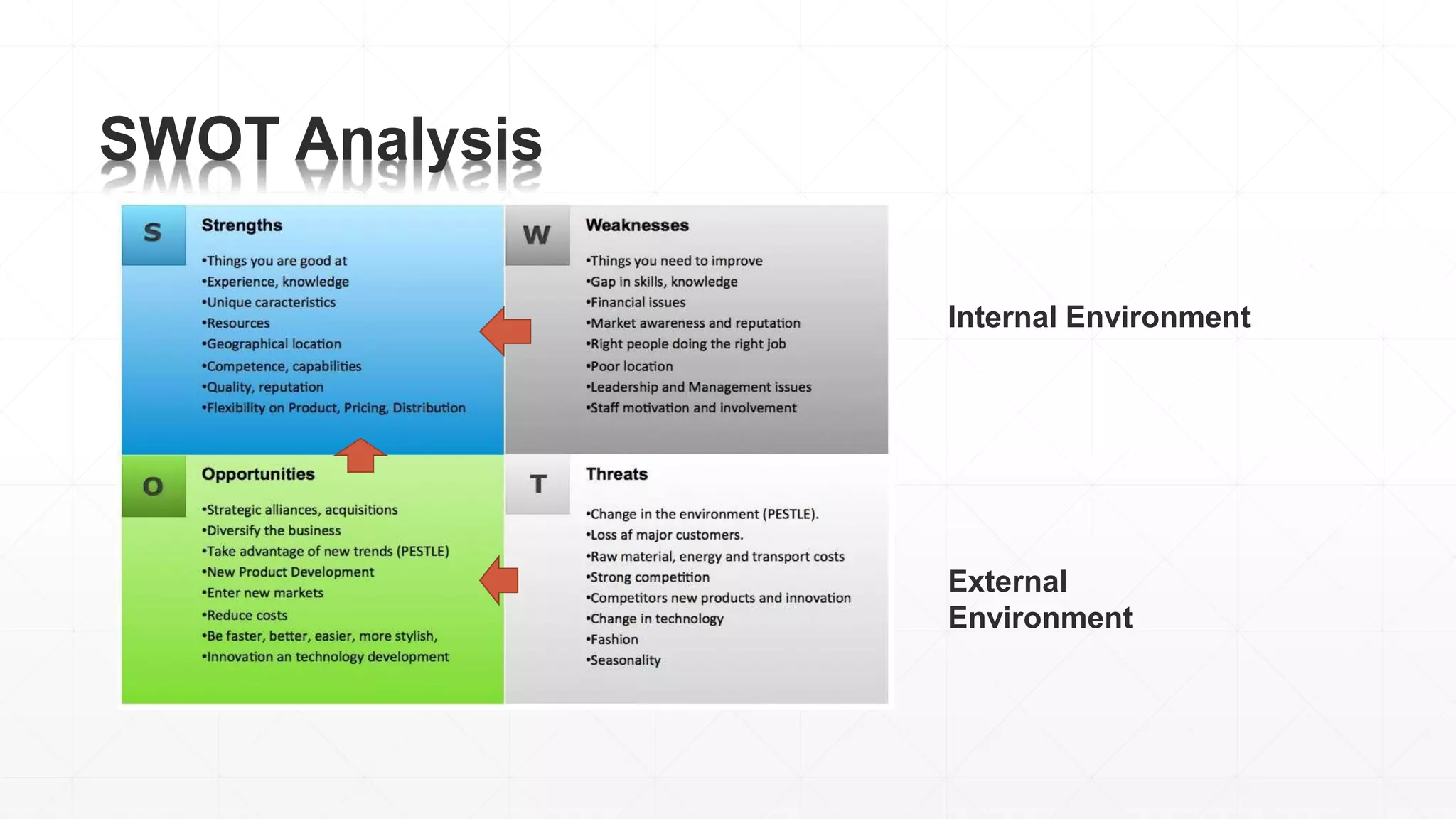
SWOT analysis ( Internal & External )
Resources allocation
Marketing expenditure / Budget
Responsibility / monitoring
Plan is successful or not.
SWOT Analysis
Internal Environment
External
Environment
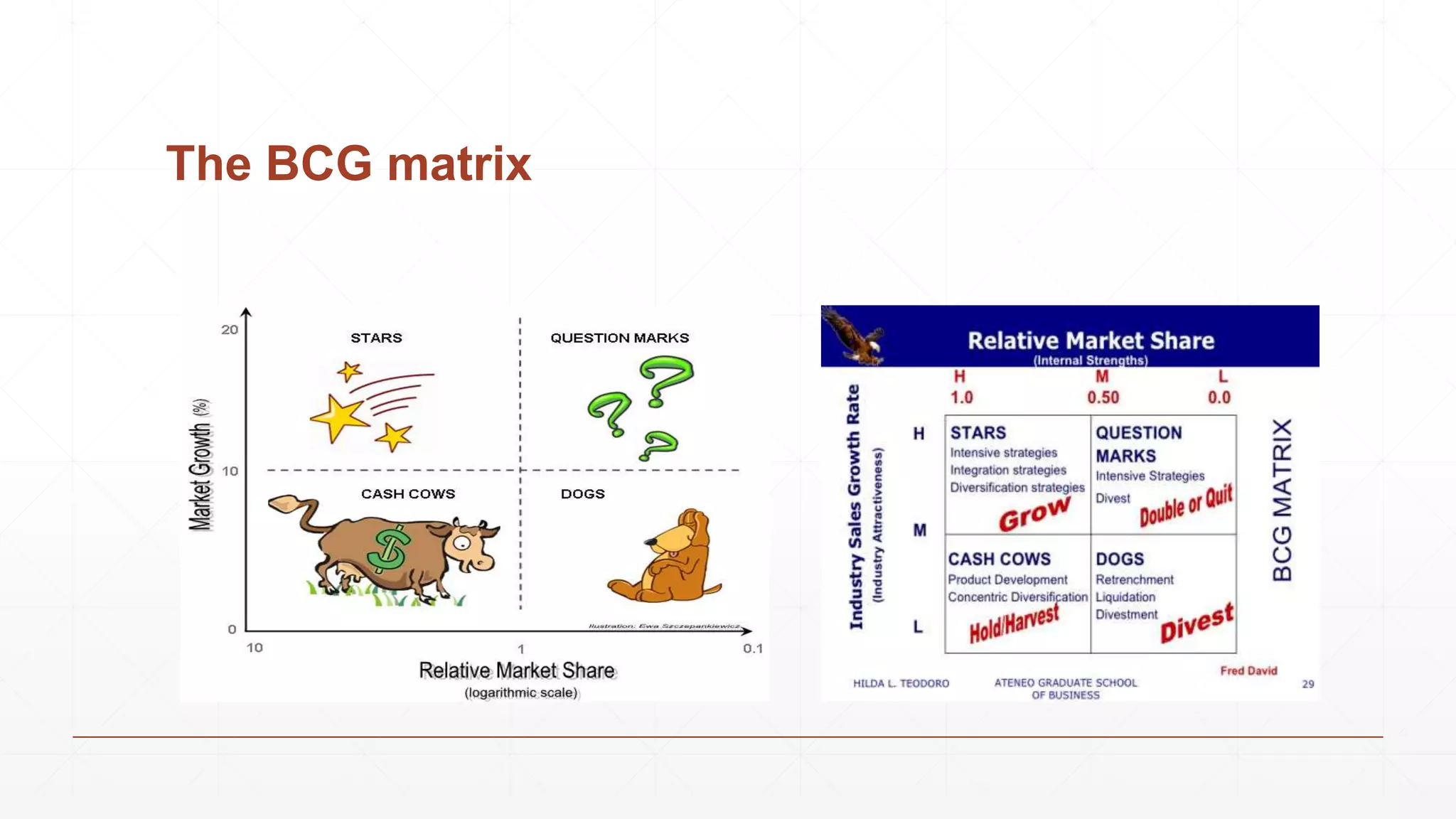
The BCG matrix
Sources of Competitive Advantage
Module (6) Sources of Competitive Advantage
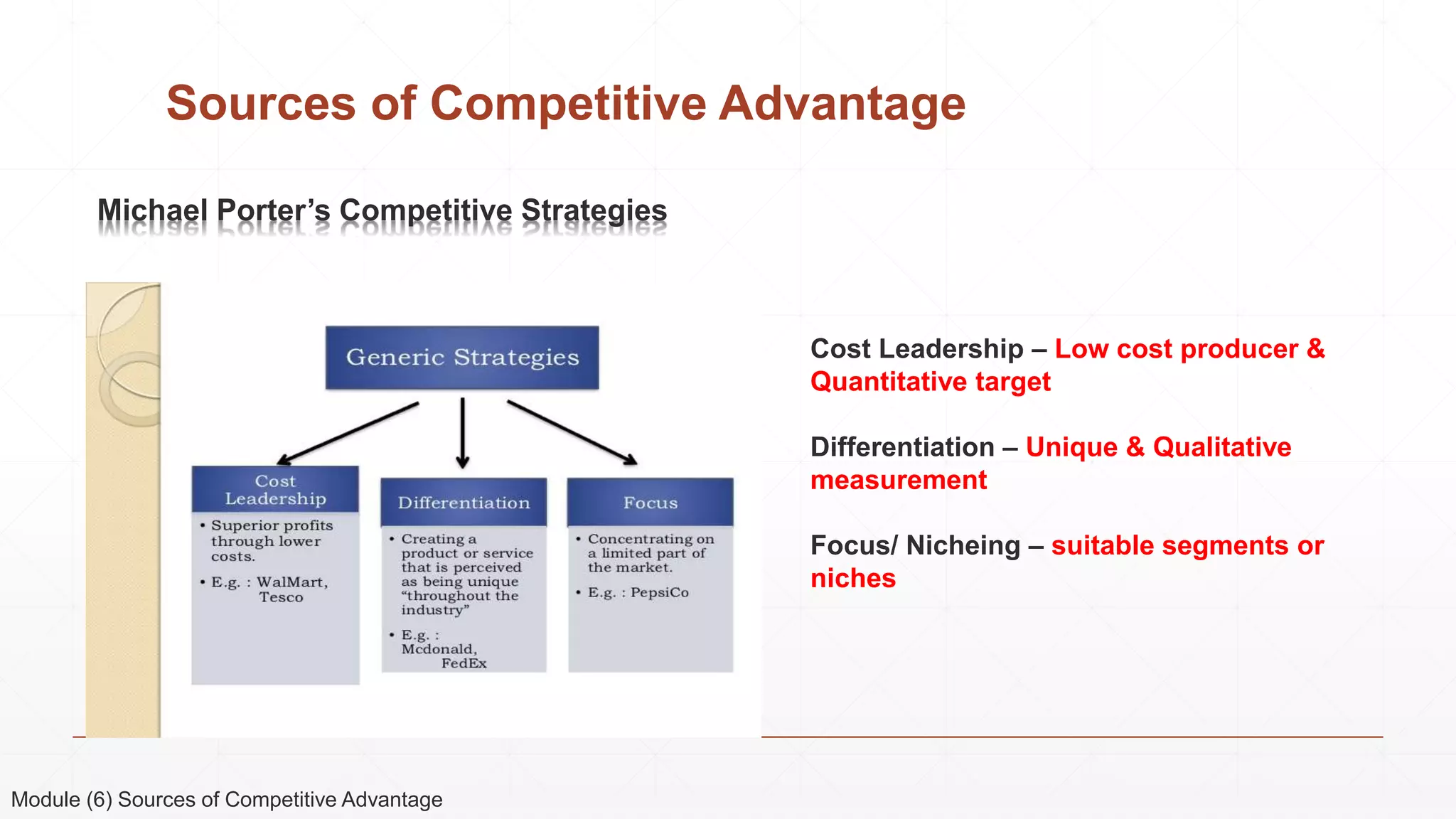
Michael Porter’s Competitive Strategies
Cost Leadership – Low cost producer &
Quantitative target
Differentiation – Unique & Qualitative
measurement
Focus/ Nicheing – suitable segments or
niches
Module (6) Sources of Competitive Advantage
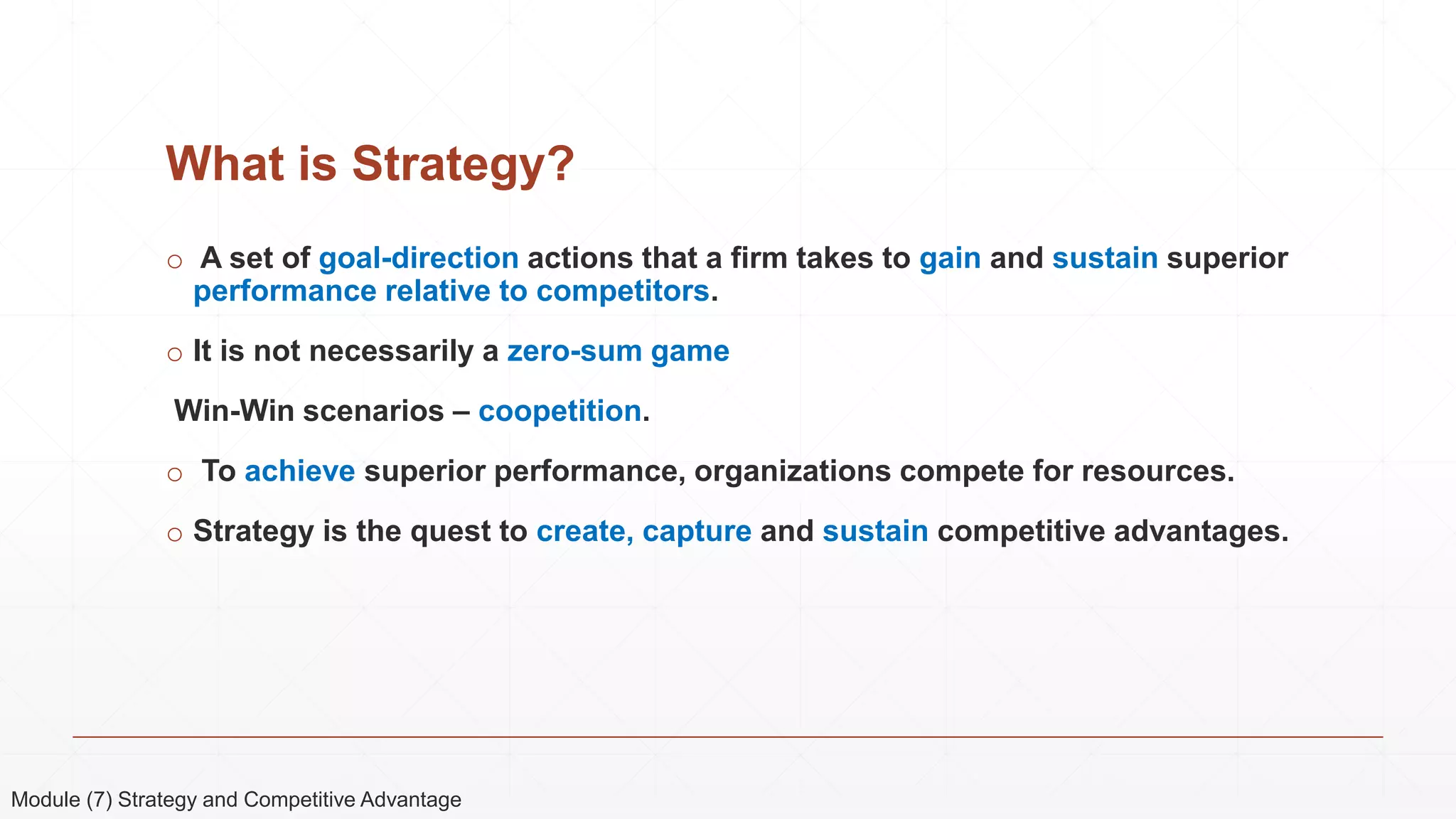
What is Strategy?
o A set of goal-direction actions that a firm takes to gain and sustain superior
performance relative to competitors.
o It is not necessarily a zero-sum game
Win-Win scenarios – coopetition.
o To achieve superior performance, organizations compete for resources.
o Strategy is the quest to create, capture and sustain competitive advantages.
Module (7) Strategy and Competitive Advantage
Strategy and Competitive Advantage
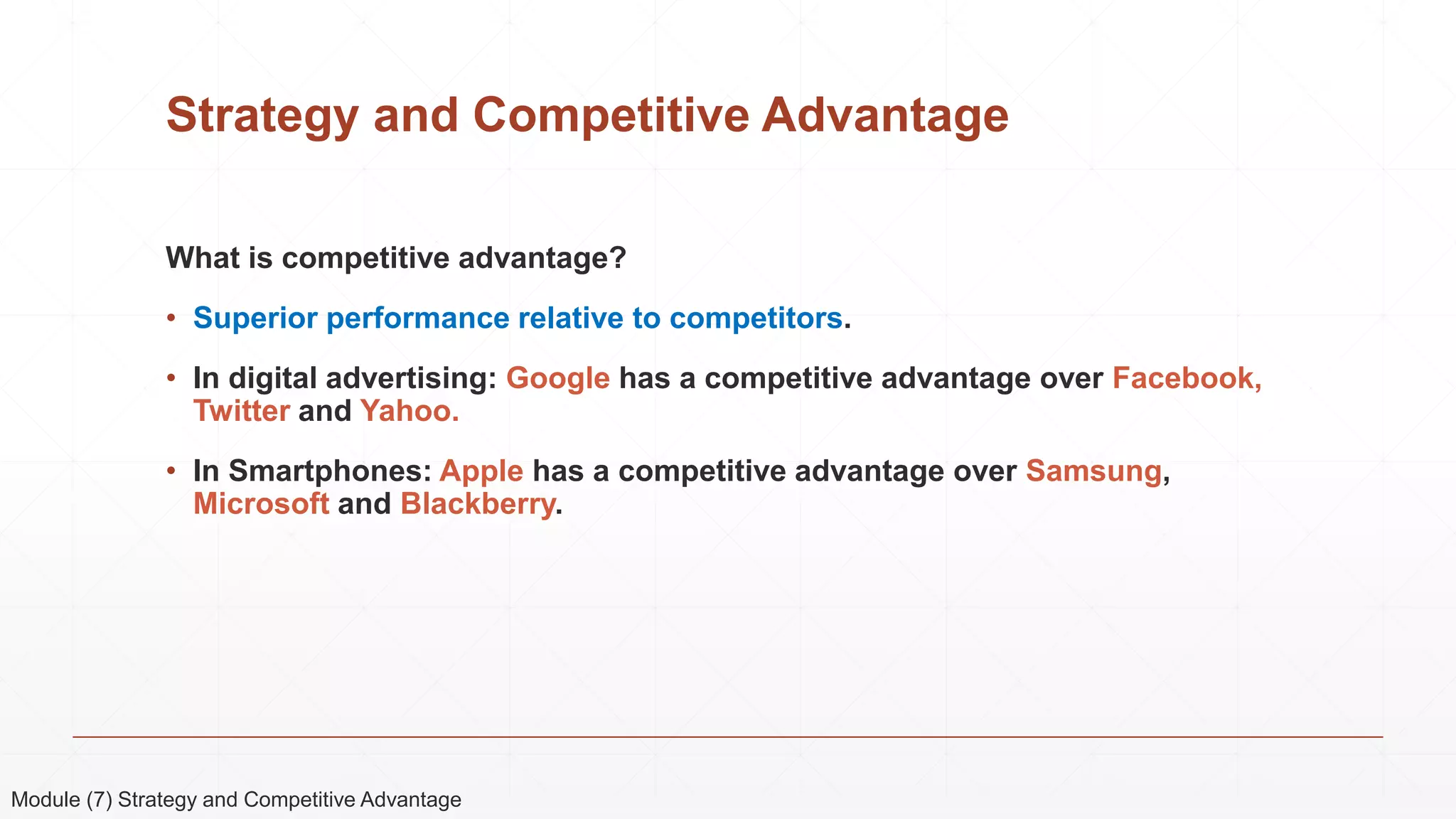
What is competitive advantage?
• Superior performance relative to competitors.
• In digital advertising: Google has a competitive advantage over Facebook,
Twitter and Yahoo.
• In Smartphones: Apple has a competitive advantage over Samsung,
Microsoft and Blackberry.
Module (7) Strategy and Competitive Advantage
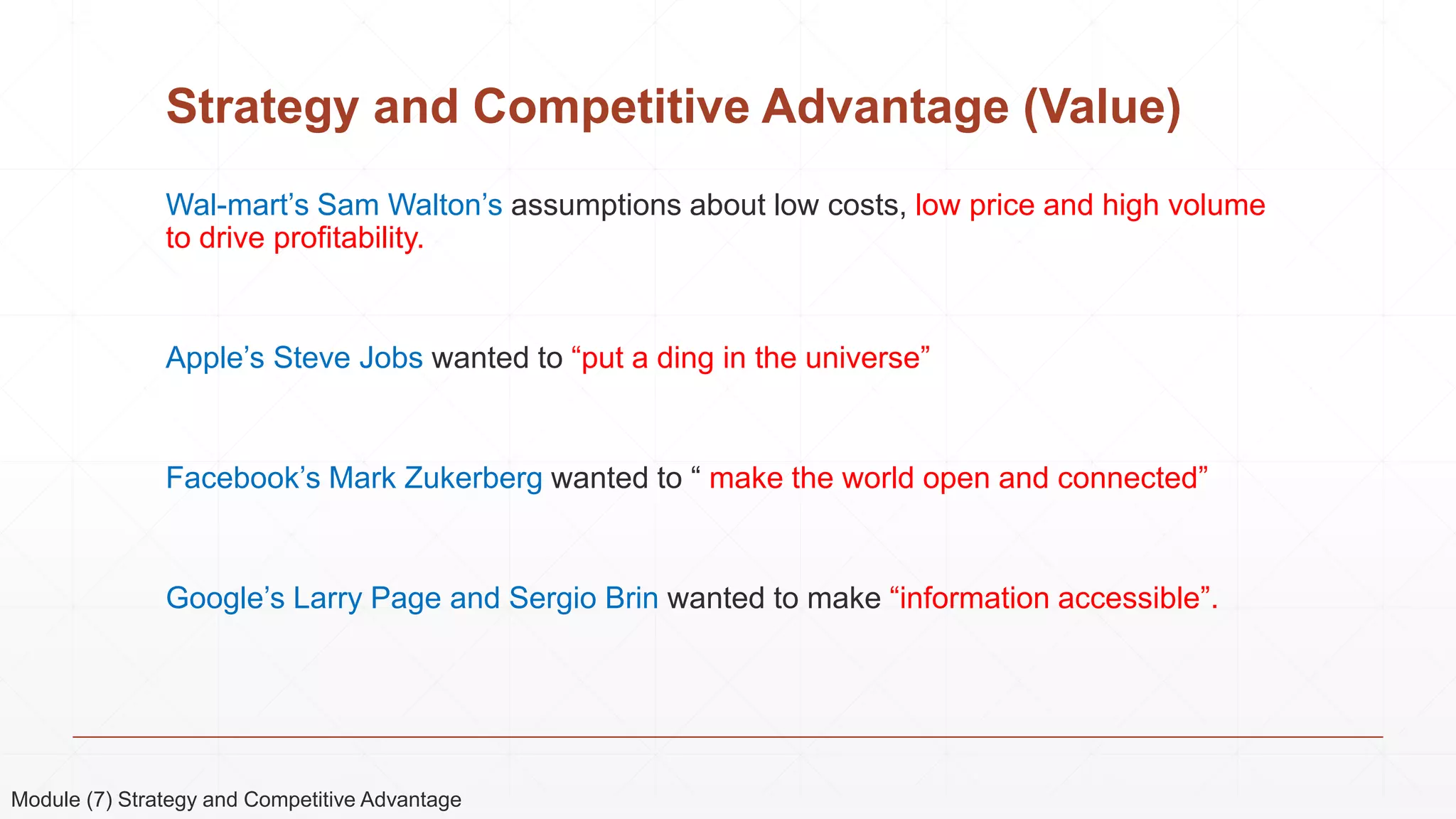
Wal-mart’s Sam Walton’s assumptions about low costs, low price and high volume
to drive profitability.
Apple’s Steve Jobs wanted to “put a ding in the universe”
Facebook’s Mark Zukerberg wanted to “ make the world open and connected”
Google’s Larry Page and Sergio Brin wanted to make “information accessible”.
Strategy and Competitive Advantage (Value)
Module (7) Strategy and Competitive Advantage
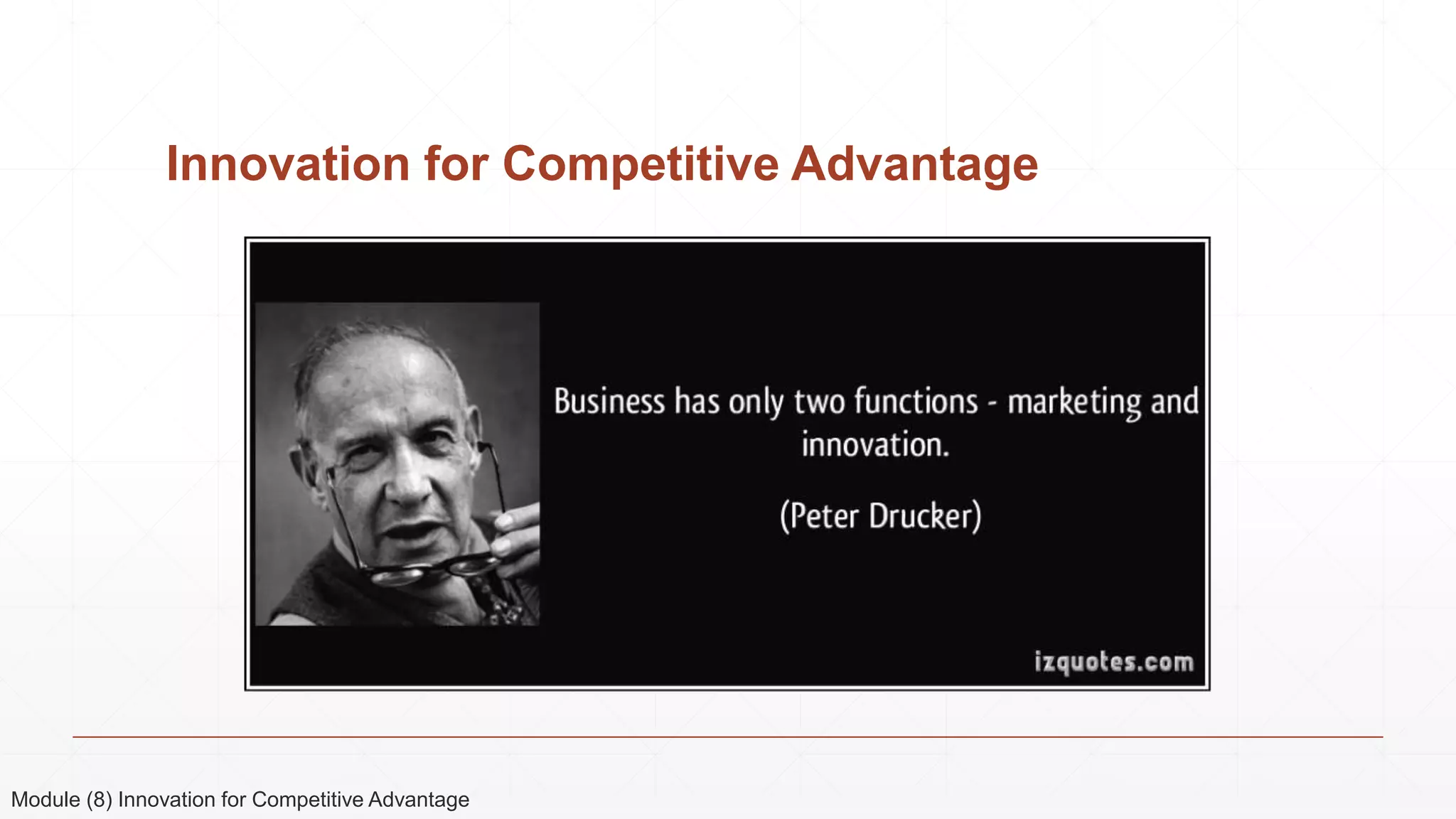
Innovation for Competitive Advantage
Module (8) Innovation for Competitive Advantage
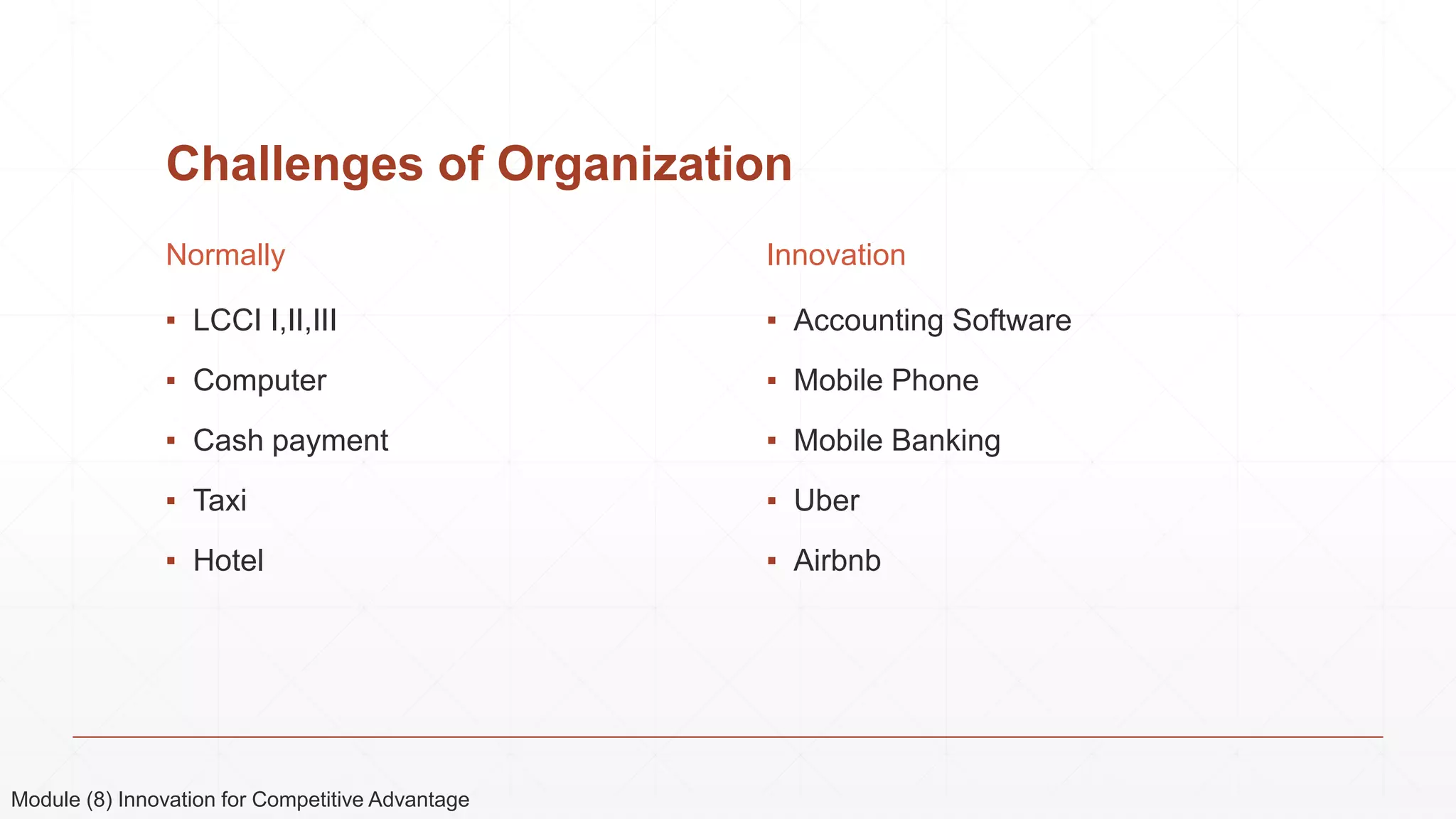
Challenges of Organization
Normally
▪ LCCI I,II,III
▪ Computer
▪ Cash payment
▪ Taxi
▪ Hotel
Innovation
▪ Accounting Software
▪ Mobile Phone
▪ Mobile Banking
▪ Uber
▪ Airbnb
Module (8) Innovation for Competitive Advantage
Sharing by
Nyan Lin Thein

Building and sustaining competitive advantage

  • 1.
    Building and Sustaining CompetitiveAdvantage 18~20 September,2017.Micasa Hotel, Yangon Professor U Aye Kyaw
  • 2.
    Module Module (1) Introductionto Strategic Management Module (2) Understanding Vision and Mission Module (3) The External Assessment Module (4) The Internal Assessment Module (5) Types of Strategies Module (6) Sources of Competitive Advantage Module (7) Strategy and Competitive Advantage Module (8) Innovation for Competitive Advantage
  • 3.
  • 4.
    Building and SustainingCompetitive Advantage What is Building? - Creative or New What is Sustaining? - Current maintain What is Competitive Advantage? - Cost advantage + Differentiation advantage > Competitors
  • 5.
    What is Strategy? Military Assumptionof conflict Business Assumption of Competition Improve to be successful
  • 6.
    What is StrategicManagement? Objective : Achievement of organization 3 Stages of Strategic Management Module (1) Introduction to Strategic Management
  • 7.
    Important of Questionfor Strategic-Management ▪ Where are we now? ▪ Where do we want to go? ▪ How are we going to get there? Module (1) Introduction to Strategic Management
  • 8.
    Strategic Management Advantage ▪ Proactive ▪Pre action ▪ Initiate and Influence in organization ▪ Financial benefits (profitability) ▪ Understanding of competitor movements ▪ Increased employee productivity ▪ Clearer understanding of performance ▪ Long term objective Disadvantage ▪ Waste of time ▪ Waste of money ▪ Failing to communication ▪ Failing to plan ▪ Short term ▪ Many decisions and conflict ▪ Not activity supporting Module (1) Introduction to Strategic Management
  • 9.
    Vision Statement A Visionstatement should answer the basic question : “ What do we want to become?” “ Your business for future” Vision Statement – Top level Management Vision Statement – Long Term ( 5 or 10 or 15 years over) Vision Statement – “We” Module (2) Understanding Vision and Mission
  • 10.
    Examples of VisionStatement Module (2) Understanding Vision and Mission Bill Gate “ Microsoft Company Vision Statement” General Motors Company Vision Statement” General Motors’ vision is to be the world leader in transportation products an related services.
  • 11.
    How do youwrite Vision Statement? ▪ What do we want to become future? ▪ Long term (5 or 10 or above) ▪ Big thinking ▪ Focus successful ▪ Believe - Become to be future ▪ Emotional – Feeling ▪ Understanding your staff ▪ Other company’s background information Module (2) Understanding Vision and Mission
  • 12.
    Mission Statement A Missionstatement should answer the basic question : “ What is our business?” Mission Statement Purpose – “Why” Module (2) Understanding Vision and Mission
  • 13.
    Examples of MissionStatement Module (2) Understanding Vision and Mission Google “Mission Statement” Alibaba’s “Mission Statement”
  • 14.
    How do youwrite Mission Statement? ▪ No include (Number, Percentage, Ratios, Amounts) ▪ Fewer than 150 words in length ▪ Take social responsibility ▪ To support environmentally responsible ▪ Components of Customer (need, want, philosophy, public image) ▪ Enduring Module (2) Understanding Vision and Mission
  • 15.
    Mission Statement Components 1.Customers – Who are the firm’s customers? 2. Products or Services – The offering? 3. Markets – Geographically , the firm compete? 4. Technology – Technologically current? 5. Survival, growth & profitability – financial soundness? 6. Philosophy – values, aspirations, and ethical priorities? 7. Distinctive competence – major competitive advantage? 8. Public image – social & environmental concerns? 9. Employees – a valuable assets? Module (2) Understanding Vision and Mission
  • 16.
    Company (Core Value) ▪If company is human body, core value is bone. ▪ Buddhism – Important is five precepts. ▪ Company – Important is Ethic. Module (2) Understanding Vision and Mission
  • 17.
  • 18.
    The External Assessment PESTAnalysis P = Political E = Economic S = Social T = Technological Module (3) The External Assessment
  • 19.
    Political Factors Government Policy ForeignTrade Policy Labour Law Environmental Law Income Tax, Sale Tax Role of Public Sector Module (3) The External Assessment
  • 20.
    Economic Factors Interest rates,Exchange rates Inflation, People’s spending Taxation Policy Economic Growth Income Tax, Sale Tax Import / Export Module (3) The External Assessment
  • 21.
    Social Factors Demographics Population Trend LifeStyle Change Religion Age Population trend Age Group, Educational Level Module (3) The External Assessment
  • 22.
    Technological Factors Technological Change Internet,Develop IT Innovation products and services Education Creation of new production New ways of target markets Module (3) The External Assessment
  • 23.
    Porter Five ForcesModel Module (3) The External Assessment Industry Rivalry is most powerful of the five forces.
  • 24.
    Threat of NewEntrants ▪ Potential Entry of new competitors ▪ Economies of scale ▪ Power of the brand ▪ Overall industry attractiveness ▪ Barriers to entry ▪ Quality , pricing and marketing can overcome barriers Module (3) The External Assessment
  • 25.
    Threats of substituteproducts ▪ Ease of substitution by customer ▪ Switching costs for the customer ▪ The time and effort it takes to switch ▪ Number and range of substitute products ▪ Availability of substitutes ▪ Product differentiation ▪ Relative price and perceived value of he substitute products. Module (3) The External Assessment
  • 26.
    Bargaining Power ofBuyers ▪ Customers being concentrated or buying in volume affects intensity of competition ▪ Consumer power is higher where products are standard or undifferentiated ▪ Information available to a buyer about products or alternatives ▪ Buyer’s price sensitivity ▪ Loyalty programs ▪ Buyer switching costs Module (3) The External Assessment
  • 27.
    Bargaining power ofsuppliers ▪ Supplier switching costs ▪ Time and effort required to switch suppliers ▪ Few suppliers ▪ Costs of switching raw materials is high. ▪ Suppliers have errors. Module (3) The External Assessment
  • 28.
    Industry Rivalry ▪ Mostpowerful of the five forces ▪ Focus on competitive advantage of strategies over other firms ▪ Competition between online and offline businesses ▪ Advertisement budgets and expenditure ▪ Transparency ▪ Competitiveness Module (3) The External Assessment
  • 29.
    The Internal Assessment 1.Internal Audit 2. Management Audit Checklist 3. Marketing Audit Checklist 4. Finance and Accounting Audit Checklist 5. Production & Operations Audit Checklist 6. Research & Development Audit Checklist 7. Management Information Systems Audit Checklist 8. Value Chain Analysis (VCA) 9. Benchmarking Module (4) The Internal Assessment
  • 30.
    1. Internal Audit Module(4) The Internal Assessment Research & Development Production/Operations Marketing Finance Management Information System Accounting
  • 31.
    2. Management AuditChecklist Module (4) The Internal Assessment Job Descriptions and Job Specifications clear Employee morale high ? Turnover ? Strategic Management Concepts Company Objective & Goals Organization Reward & Control Effective ? Effectively Plan
  • 32.
    3. Marketing AuditChecklist Module (4) The Internal Assessment Promotion, Advertising effective? Product quality and customer service ? Market segment ? Position ? Distribution channel? Effective sales organization?
  • 33.
    4. Finance andAccounting Audit Checklist Module (4) The Internal Assessment Good Investors/ Finance Manager Qualified? Payout policies ? Firm financially strong or weak ? Short-term or long-term capital ? Sufficient working capital? Budgeting procedures effective?
  • 34.
    5. Production &Operations Audit Checklist Module (4) The Internal Assessment Suppliers of raw materials – reliable and reasonable? Machine and office – good condition ? Quality control? Resources strategically located? Procedures effective? Technological competence?
  • 35.
    6. Research &Development Audit Checklist Module (4) The Internal Assessment Communication between R&D and organizational units effective? R&D resources allocated effectively ? Have R&D? R&D cost effective? Computer systems? Organization qualified ?
  • 36.
    7. Management InformationSystems Audit Checklist Module (4) The Internal Assessment Information system continually being improved? Understand the competitive advantages ? Use information system? Update? All function - input? User Friendly?
  • 37.
    8. Value ChainAudit Checklist Module (4) The Internal Assessment Low cost advantages or disadvantages – Value chain? Value? Purchasing raw materials? Manufacturing products ?
  • 38.
    9. Benchmarking AuditChecklist Module (4) The Internal Assessment Improve year by year? Winning in the marketplace? Best practices ?
  • 39.
    McKinsey 7-S Framework HardElements Soft Elements Strategy Structure Systems Shared Values Skills Style Staff Module (4) The Internal Assessment
  • 40.
    McKinsey 7-S Framework ▪Strategy: the plan devised to maintain and build competitive advantage over the competition. ▪ Structure: the way the organization is structured and who reports to whom. ▪ Systems: the daily activities and procedures that staff members engage in to get the job done. ▪ Shared Values: called "superordinate goals" when the model was first developed, these are the core values of the company that are evidenced in the corporate culture and the general work ethic. ▪ Style: the style of leadership adopted. ▪ Staff: the employees and their general capabilities. ▪ Skills: the actual skills and competencies of the employees working for the company. Module (4) The Internal Assessment
  • 41.
    Types of Strategies 1.Integration Strategies 2. Intensive Strategies 3. Diversification Strategies 4. Defensive Strategies Module (5) Type of Strategies
  • 42.
    Integration Strategies ▪ ForwardIntegration Involves gaining ownership or increased control over distributions or retailers  Backward Integration Strategy of seeking ownership or increased control of a firm’s suppliers  Horizontal Integration A strategy of seeking ownership of or increased control over a firm’s competitors
  • 43.
    Integration Strategies Forward IntegrationBackward Integration Cow >>>> Milk Milk >>>> Cow Module (5) Type of Strategies
  • 44.
    Integration Strategies Horizontal Integration ShwePyi Moe Café’ >> available မႏၱေၱလးၱ မးရွည္ Module (5) Type of Strategies
  • 45.
    2. Intensive Strategies oMarker Penetration Strategy Seeks to increase market share for present products or services in present markets o Market Development Involves introducing presents or services into new geographic areas o Product Development Strategy Seeks increased sales by improving or modifying present products or services Module (5) Type of Strategies
  • 46.
    3. Diversification Strategies Module(5) Type of Strategies Unrelated Diversification Related Diversification
  • 47.
    4. Defensive Strategies RetrenchmentLiquidation 4:4:2 or 5:3:2 Module (5) Type of Strategies
  • 48.
  • 49.
    Competitive Advantage ▪ Sourcesof Competitive Advantage ▪ Strategy and Competitive Advantage ▪ Innovation for Competitive Advantage
  • 50.
    Marketing Strategy CEO, Director,Owner Marketing Manager, Chief Marketing officer Executive, Supervisor,Staff
  • 51.
    Corporate strategy Corporate strategydeals with the overall development of an organization’s business activities. Marketing strategy focuses on the organization’s activities in relation to its markets. Top Level Management Middle Level Management Supervisory Level Management Corporate objective Business objective Operation target
  • 52.
    Strategy Corporate strategy –to know ( overall ) Deliberate strategy – to know ( plan ) Emergent strategy – to know ( behavior and actions of the organization) Strategic marketing – three key components 1. The designation of specific, desired objectives 2. Commitment of resources to these objectives 3. Evaluation of a range of environmental influences
  • 53.
  • 54.
    Strategic Marketing .. . Important Questions Where are we now? Where do we what to be? How are we going to get there? How do we know when we have got there?
  • 55.
    Strategic Planning inMarketing Context Development of the organization’s mission statement Statement of objective Situational analysis Strategy development Specific plans Implementation Control Conduct of its business / focus & direction Corporate objective / a whole SWOT analysis ( Internal & External ) Resources allocation Marketing expenditure / Budget Responsibility / monitoring Plan is successful or not.
  • 56.
  • 57.
  • 58.
    Sources of CompetitiveAdvantage Module (6) Sources of Competitive Advantage Michael Porter’s Competitive Strategies Cost Leadership – Low cost producer & Quantitative target Differentiation – Unique & Qualitative measurement Focus/ Nicheing – suitable segments or niches
  • 59.
    Module (6) Sourcesof Competitive Advantage
  • 60.
    What is Strategy? oA set of goal-direction actions that a firm takes to gain and sustain superior performance relative to competitors. o It is not necessarily a zero-sum game Win-Win scenarios – coopetition. o To achieve superior performance, organizations compete for resources. o Strategy is the quest to create, capture and sustain competitive advantages. Module (7) Strategy and Competitive Advantage
  • 61.
    Strategy and CompetitiveAdvantage What is competitive advantage? • Superior performance relative to competitors. • In digital advertising: Google has a competitive advantage over Facebook, Twitter and Yahoo. • In Smartphones: Apple has a competitive advantage over Samsung, Microsoft and Blackberry. Module (7) Strategy and Competitive Advantage
  • 62.
    Wal-mart’s Sam Walton’sassumptions about low costs, low price and high volume to drive profitability. Apple’s Steve Jobs wanted to “put a ding in the universe” Facebook’s Mark Zukerberg wanted to “ make the world open and connected” Google’s Larry Page and Sergio Brin wanted to make “information accessible”. Strategy and Competitive Advantage (Value) Module (7) Strategy and Competitive Advantage
  • 63.
    Innovation for CompetitiveAdvantage Module (8) Innovation for Competitive Advantage
  • 64.
    Challenges of Organization Normally ▪LCCI I,II,III ▪ Computer ▪ Cash payment ▪ Taxi ▪ Hotel Innovation ▪ Accounting Software ▪ Mobile Phone ▪ Mobile Banking ▪ Uber ▪ Airbnb Module (8) Innovation for Competitive Advantage
  • 65.