1
What is environmental scanning?
2
Environmental scanning is the process of continually acquiring
information on events occurring outside the organization to identify
and interpret potential trends
Environmental scanning is a process of gathering, analyzing, and
dispensing information for tactical or strategic purposes. The
environmental scanning process entails obtaining both factual and
subjective information on the business environments in which a
company is operating or consider entering.
Definitions
3
In the field of environmental scanning, the first notable study was
carried out by Aguilar (1967). Aguilar defines environmental scanning as
acquiring information about events and relationships in a company’s outside
environment, the knowledge of which would assist top management in its task
of charting the company’s future course of action.
Aaker (1983) pointed out that environmental scanning should focus on target
information needs.
4
Daft and Weick (1984), the way an organisation deciphers its environment in order
to learn from it may be divided into three phases: scanning (information seeking),
interpretation (giving meaning to the collected data) and learning (taking action
based on the data).
Lester and Waters (1989) define environmental scanning as a management process
of using information from the environment to aid decision-making
Hough and White (2004) view environment scanning as a process of identifying,
collecting, processing and translating information about external influences into
useful plans and decisions
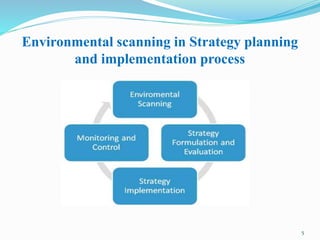
Environmental scanning in Strategy planning
and implementation process
5
6
One cycle in the strategic planning
process
7
Objectives of Environmental
Scanning
8
Coates (1985) identified the following objectives of an environmental scanning
system:
1) Detecting scientific, technical, economic, social, and political trends and
events important to the institution,
2) Defining the potential threats, opportunities, or changes for the institution
implied by those trends and events,
3) Promoting a future orientation in the thinking of management and staff,
and
4) Alerting management and staff to trends that are converging, diverging,
speeding up, slowing down, or interacting.
Importance of Environmental Scanning
9
Oladele (2006) stated some importance to environmental scanning as follows:
a) The environment is dynamic in nature, therefore scanning is necessary to
keep abreast of change.
b) It reveals the elements or factors that constitute threats and opportunity to
the overall objectives of the organization.
c) Competitor’s activities can be monitored and appropriate strategies put in
place to check market incursion.
d) It gives necessary inputs to the formulation and implementation of potential
marketing strategies.
Methods of Environmental Scanning
10
This aspect of environmental scanning has caused much debate among the scholars in
the field of Management. However, the following are therefore suggested:
 Secondary data collection approach such as articles, textbooks, magazines and
ready-made information etc…
 Primary data collection approach, using research instruments such as questionnaire,
 Personal interview, personal observation etc.
 Establish a unit within the organization which will responsible to scan wide range of
environmental factors and makes forecast about specific variables through
qualitative and quantitative means.
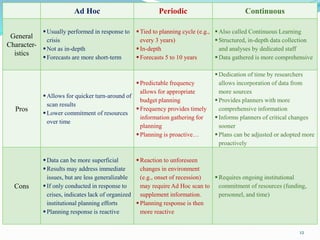
Kinds of environmental scanning
11
1. Ad-hoc scanning - Short term, infrequent examinations
usually initiated by a crisis
2. Regular scanning - Studies done on a regular schedule (e.g.
once a year)
3. Continuous scanning (also called continuous learning) -
continuous structured data collection and processing on a
broad range of environmental factors
12
Ad Hoc Periodic Continuous
General
Character-
istics
Usually performed in response to
crisis
Not as in-depth
Forecasts are more short-term
Tied to planning cycle (e.g.,
every 3 years)
In-depth
Forecasts 5 to 10 years
Also called Continuous Learning
Structured, in-depth data collection
and analyses by dedicated staff
Data gathered is more comprehensive
Pros
Allows for quicker turn-around of
scan results
Lower commitment of resources
over time
Predictable frequency
allows for appropriate
budget planning
Frequency provides timely
information gathering for
planning
Planning is proactive…
Dedication of time by researchers
allows incorporation of data from
more sources
Provides planners with more
comprehensive information
Informs planners of critical changes
sooner
Plans can be adjusted or adopted more
proactively
Cons
Data can be more superficial
Results may address immediate
issues, but are less generalizable
If only conducted in response to
crises, indicates lack of organized
institutional planning efforts
Planning response is reactive
Reaction to unforeseen
changes in environment
(e.g., onset of recession)
may require Ad Hoc scan to
supplement information.
Planning response is then
more reactive
Requires ongoing institutional
commitment of resources (funding,
personnel, and time)
13
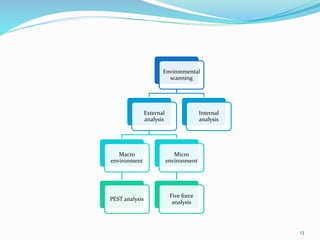
Environmental
scanning
External
analysis
Macro
environment
PEST analysis
Micro
environment
Five force
analysis
Internal
analysis
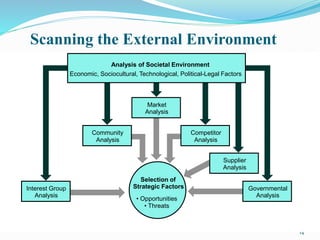
Scanning the External Environment
14
Analysis of Societal Environment
Economic, Sociocultural, Technological, Political-Legal Factors
Selection of
Strategic Factors
• Opportunities
• Threats
Market
Analysis
Competitor
Analysis
Supplier
Analysis
Governmental
Analysis
Interest Group
Analysis
Community
Analysis
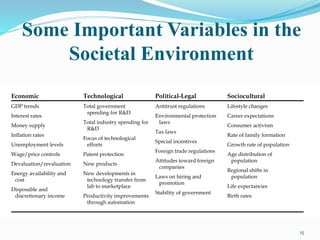
Some Important Variables in the
Societal Environment
15
Economic
GDP trends
Interest rates
Money supply
Inflation rates
Unemployment levels
Wage/price controls
Devaluation/revaluation
Energy availability and
cost
Disposable and
discretionary income
Technological
Total government
spending for R&D
Total industry spending for
R&D
Focus of technological
efforts
Patent protection
New products
New developments in
technology transfer from
lab to marketplace
Productivity improvements
through automation
Political-Legal
Antitrust regulations
Environmental protection
laws
Tax laws
Special incentives
Foreign trade regulations
Attitudes toward foreign
companies
Laws on hiring and
promotion
Stability of government
Sociocultural
Lifestyle changes
Career expectations
Consumer activism
Rate of family formation
Growth rate of population
Age distribution of
population
Regional shifts in
population
Life expectancies
Birth rates
Techniques of Scanning
16
Issue Priority Matrix
ETOP
SAP
Functional area profile
SWOT
The Opportunity and Threat Matrix
The Impact Matrix
1. Issue Priority Matrix
17
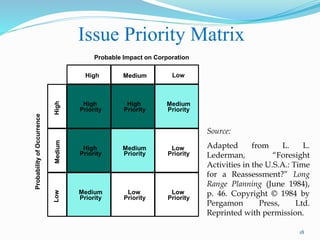
The Issues Priority Matrix is a way to identify and analyze developments in the
external environment. Managers can use it to decide which environmental trends
should be merely scanned (low priority) and which should be monitored as strategic
factors (high priority).
Steps to Building the Issues Priority Matrix :
1. Identify likely trends emerging in societal and task environments
(Strategic environmental issues - important trends that determine what the
industry will look like in the future)
2. Assess probability (low-medium-high scale) of these trends occurring
3. Ascertain impact (low-medium-high scale) of these trends on the corporation
Issue Priority Matrix
18
High
Priority
High
Priority
High
Priority
Medium
Priority
Medium
Priority
Medium
Priority
Probable Impact on Corporation
Low
Priority
Low
Priority
Low
Priority
LowMediumHigh
ProbabilityofOccurrence
Source:
Adapted from L. L.
Lederman, “Foresight
Activities in the U.S.A.: Time
for a Reassessment?” Long
Range Planning (June 1984),
p. 46. Copyright © 1984 by
Pergamon Press, Ltd.
Reprinted with permission.
2. Environmental Threat and Opportunity
Profile (ETOP)
19
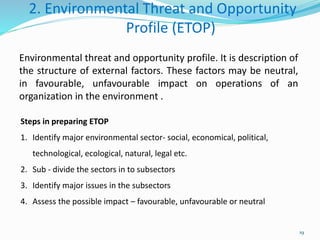
Environmental threat and opportunity profile. It is description of
the structure of external factors. These factors may be neutral,
in favourable, unfavourable impact on operations of an
organization in the environment .
Steps in preparing ETOP
1. Identify major environmental sector- social, economical, political,
technological, ecological, natural, legal etc.
2. Sub - divide the sectors in to subsectors
3. Identify major issues in the subsectors
4. Assess the possible impact – favourable, unfavourable or neutral
20
Environmental Sectors Impact of each sector
Social (↑) Customer preference for motorbike, which are
fashionable, easy to ride and durable.
Political (→) No significant factor.
Economic (↑) Growing affluence among urban consumers;
Exports potential high.
Regulatory (↑) Two Wheeler industry a thrust area for exports.
Market (↑) Industry growth rate is 10 to 12 percent per year,
For motorbike growth rate is 40 percent, largely
Unsaturated demand.
Supplier (↑) Mostly ancillaries and associated companies supply
parts and components, REP licenses for imported
raw materials available.
Technological (↑) Technological up gradation of industry in progress.
Import of machinery under OGL list possible.
3.Strategic Advantage Profile
21
Strategic advantage profile is a summary statement which provides an
overview of the advantages and disadvantages in key areas likely to affect
future operations of a firm.
it is a total for making systematic evaluation of strategic advantage factors
which are significant for the company in its environment. it involves
functional areas like marketing, production, finance, accounting, personnel,
human resource and R&D etc.
SAP is a summary statement of corporate capabilities.
22
4. Functional Area Profile &
Resource Development Matrix
23
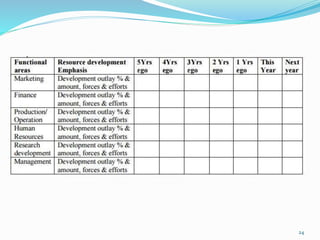
Hofer and Schendel have developed this technique to make a comparative
analysis of a firm’s own resources deployment position and focus of efforts
with those of competitors
First, technique requires preparation of matrix of functional area with common
features.
Secondly matrix is prepared showing deployment and focus of efforts over a
period of time.
The matrix gives data pertaining to resources deployment in various functional
areas over a period of time. It also shows how the focus of efforts has changed
within a time frame.
24
5. SWOT Analysis
25
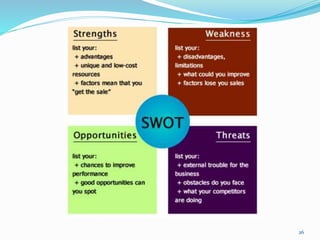
A SWOT analysis (alternatively SWOT matrix) is a structured planning
method used to evaluate the strengths, weaknesses, opportunities and
threats involved in a project or in a business venture.
A SWOT analysis can be carried out for a product, place, industry or person.
SWOT analysis was created in the 1960s by business gurus Edmund P.
Learned, C. Roland Christensen, Kenneth Andrews and William D. Book in
their book "Business Policy, Text and Cases" (R.D. Irwin, 1969). While the
tool was originally intended for business use, it has since been adopted to
aid personal development.
26
6. The Opportunity and Threat
Matrix
27
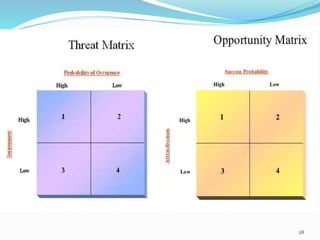
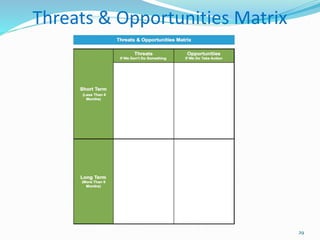
A Threats & Opportunities Matrix is a simple 2 x 2 grid that captures the
threats of not implementing a proposed solution and, conversely, the
potential opportunities if the solution is accepted .
A company after identifying the threats, can judge the threats based on
1. Seriousness and
2. Probability of Occurrence
On the other hand, the company can classify the identified opportunities
based on
1. Attractiveness
2. Probability of occurrence
28
Threats & Opportunities Matrix
29
7. The Impact Matrix
30
The impact effort matrix was designed specifically for the purpose of deciding
which of many suggested solutions to implement.
The impact of the trend on various strategies could be visualized using an
impact matrix. After identifying the emerging trends in mega, micro and
relevant environments, the degree of their impact can be assessed with the
help of the impact scale.
To assess the degree and quality of impact of each trend on different
strategies a five-point impact scale could be used. The pattern of scoring can
be: ( also called impact scale )
+2 extremely favorable impact
+1 moderately favorable impact
0 no impact
-1 moderately unfavorable impact
-2 extremely unfavorable impact
8. Gap Analysis
31
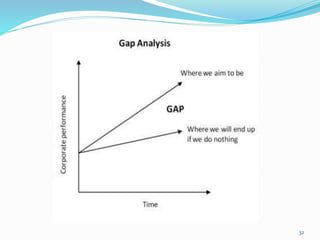
A gap analysis is a method of assessing the differences in actual
performance and potential performance to determine whether the system
requirements are being met and, if not, the steps needed to do so.
Gap refers to the space between "where we are" (the company's present
state) and "where we want to be" (its target state). A gap analysis is also
known as a needs analysis, needs assessment or need-gap analysis.
It is useful method to describe the process involved in deciding what course
of action should be taken to remove any potential profit or sales gap or risk
gap
32
9. Balanced Score Card
33
Two eminent doctors (Robert S Kaplan and David P Norton)
evolved the Balanced Scorecard system
The balanced scorecard (BSC) is a strategy performance
management tool - a semi-standard structured report,
supported by designed methods and automation tools, that can
be used by managers to keep track of the execution of activities
by the staff within their control and to monitor the
consequences arising from these actions
34
35

Environmental scanning

  • 1.
  • 2.
    What is environmentalscanning? 2 Environmental scanning is the process of continually acquiring information on events occurring outside the organization to identify and interpret potential trends Environmental scanning is a process of gathering, analyzing, and dispensing information for tactical or strategic purposes. The environmental scanning process entails obtaining both factual and subjective information on the business environments in which a company is operating or consider entering.
  • 3.
    Definitions 3 In the fieldof environmental scanning, the first notable study was carried out by Aguilar (1967). Aguilar defines environmental scanning as acquiring information about events and relationships in a company’s outside environment, the knowledge of which would assist top management in its task of charting the company’s future course of action. Aaker (1983) pointed out that environmental scanning should focus on target information needs.
  • 4.
    4 Daft and Weick(1984), the way an organisation deciphers its environment in order to learn from it may be divided into three phases: scanning (information seeking), interpretation (giving meaning to the collected data) and learning (taking action based on the data). Lester and Waters (1989) define environmental scanning as a management process of using information from the environment to aid decision-making Hough and White (2004) view environment scanning as a process of identifying, collecting, processing and translating information about external influences into useful plans and decisions
  • 5.
    Environmental scanning inStrategy planning and implementation process 5
  • 6.
  • 7.
    One cycle inthe strategic planning process 7
  • 8.
    Objectives of Environmental Scanning 8 Coates(1985) identified the following objectives of an environmental scanning system: 1) Detecting scientific, technical, economic, social, and political trends and events important to the institution, 2) Defining the potential threats, opportunities, or changes for the institution implied by those trends and events, 3) Promoting a future orientation in the thinking of management and staff, and 4) Alerting management and staff to trends that are converging, diverging, speeding up, slowing down, or interacting.
  • 9.
    Importance of EnvironmentalScanning 9 Oladele (2006) stated some importance to environmental scanning as follows: a) The environment is dynamic in nature, therefore scanning is necessary to keep abreast of change. b) It reveals the elements or factors that constitute threats and opportunity to the overall objectives of the organization. c) Competitor’s activities can be monitored and appropriate strategies put in place to check market incursion. d) It gives necessary inputs to the formulation and implementation of potential marketing strategies.
  • 10.
    Methods of EnvironmentalScanning 10 This aspect of environmental scanning has caused much debate among the scholars in the field of Management. However, the following are therefore suggested:  Secondary data collection approach such as articles, textbooks, magazines and ready-made information etc…  Primary data collection approach, using research instruments such as questionnaire,  Personal interview, personal observation etc.  Establish a unit within the organization which will responsible to scan wide range of environmental factors and makes forecast about specific variables through qualitative and quantitative means.
  • 11.
    Kinds of environmentalscanning 11 1. Ad-hoc scanning - Short term, infrequent examinations usually initiated by a crisis 2. Regular scanning - Studies done on a regular schedule (e.g. once a year) 3. Continuous scanning (also called continuous learning) - continuous structured data collection and processing on a broad range of environmental factors
  • 12.
    12 Ad Hoc PeriodicContinuous General Character- istics Usually performed in response to crisis Not as in-depth Forecasts are more short-term Tied to planning cycle (e.g., every 3 years) In-depth Forecasts 5 to 10 years Also called Continuous Learning Structured, in-depth data collection and analyses by dedicated staff Data gathered is more comprehensive Pros Allows for quicker turn-around of scan results Lower commitment of resources over time Predictable frequency allows for appropriate budget planning Frequency provides timely information gathering for planning Planning is proactive… Dedication of time by researchers allows incorporation of data from more sources Provides planners with more comprehensive information Informs planners of critical changes sooner Plans can be adjusted or adopted more proactively Cons Data can be more superficial Results may address immediate issues, but are less generalizable If only conducted in response to crises, indicates lack of organized institutional planning efforts Planning response is reactive Reaction to unforeseen changes in environment (e.g., onset of recession) may require Ad Hoc scan to supplement information. Planning response is then more reactive Requires ongoing institutional commitment of resources (funding, personnel, and time)
  • 13.
  • 14.
    Scanning the ExternalEnvironment 14 Analysis of Societal Environment Economic, Sociocultural, Technological, Political-Legal Factors Selection of Strategic Factors • Opportunities • Threats Market Analysis Competitor Analysis Supplier Analysis Governmental Analysis Interest Group Analysis Community Analysis
  • 15.
    Some Important Variablesin the Societal Environment 15 Economic GDP trends Interest rates Money supply Inflation rates Unemployment levels Wage/price controls Devaluation/revaluation Energy availability and cost Disposable and discretionary income Technological Total government spending for R&D Total industry spending for R&D Focus of technological efforts Patent protection New products New developments in technology transfer from lab to marketplace Productivity improvements through automation Political-Legal Antitrust regulations Environmental protection laws Tax laws Special incentives Foreign trade regulations Attitudes toward foreign companies Laws on hiring and promotion Stability of government Sociocultural Lifestyle changes Career expectations Consumer activism Rate of family formation Growth rate of population Age distribution of population Regional shifts in population Life expectancies Birth rates
  • 16.
    Techniques of Scanning 16 IssuePriority Matrix ETOP SAP Functional area profile SWOT The Opportunity and Threat Matrix The Impact Matrix
  • 17.
    1. Issue PriorityMatrix 17 The Issues Priority Matrix is a way to identify and analyze developments in the external environment. Managers can use it to decide which environmental trends should be merely scanned (low priority) and which should be monitored as strategic factors (high priority). Steps to Building the Issues Priority Matrix : 1. Identify likely trends emerging in societal and task environments (Strategic environmental issues - important trends that determine what the industry will look like in the future) 2. Assess probability (low-medium-high scale) of these trends occurring 3. Ascertain impact (low-medium-high scale) of these trends on the corporation
  • 18.
    Issue Priority Matrix 18 High Priority High Priority High Priority Medium Priority Medium Priority Medium Priority ProbableImpact on Corporation Low Priority Low Priority Low Priority LowMediumHigh ProbabilityofOccurrence Source: Adapted from L. L. Lederman, “Foresight Activities in the U.S.A.: Time for a Reassessment?” Long Range Planning (June 1984), p. 46. Copyright © 1984 by Pergamon Press, Ltd. Reprinted with permission.
  • 19.
    2. Environmental Threatand Opportunity Profile (ETOP) 19 Environmental threat and opportunity profile. It is description of the structure of external factors. These factors may be neutral, in favourable, unfavourable impact on operations of an organization in the environment . Steps in preparing ETOP 1. Identify major environmental sector- social, economical, political, technological, ecological, natural, legal etc. 2. Sub - divide the sectors in to subsectors 3. Identify major issues in the subsectors 4. Assess the possible impact – favourable, unfavourable or neutral
  • 20.
    20 Environmental Sectors Impactof each sector Social (↑) Customer preference for motorbike, which are fashionable, easy to ride and durable. Political (→) No significant factor. Economic (↑) Growing affluence among urban consumers; Exports potential high. Regulatory (↑) Two Wheeler industry a thrust area for exports. Market (↑) Industry growth rate is 10 to 12 percent per year, For motorbike growth rate is 40 percent, largely Unsaturated demand. Supplier (↑) Mostly ancillaries and associated companies supply parts and components, REP licenses for imported raw materials available. Technological (↑) Technological up gradation of industry in progress. Import of machinery under OGL list possible.
  • 21.
    3.Strategic Advantage Profile 21 Strategicadvantage profile is a summary statement which provides an overview of the advantages and disadvantages in key areas likely to affect future operations of a firm. it is a total for making systematic evaluation of strategic advantage factors which are significant for the company in its environment. it involves functional areas like marketing, production, finance, accounting, personnel, human resource and R&D etc. SAP is a summary statement of corporate capabilities.
  • 22.
  • 23.
    4. Functional AreaProfile & Resource Development Matrix 23 Hofer and Schendel have developed this technique to make a comparative analysis of a firm’s own resources deployment position and focus of efforts with those of competitors First, technique requires preparation of matrix of functional area with common features. Secondly matrix is prepared showing deployment and focus of efforts over a period of time. The matrix gives data pertaining to resources deployment in various functional areas over a period of time. It also shows how the focus of efforts has changed within a time frame.
  • 24.
  • 25.
    5. SWOT Analysis 25 ASWOT analysis (alternatively SWOT matrix) is a structured planning method used to evaluate the strengths, weaknesses, opportunities and threats involved in a project or in a business venture. A SWOT analysis can be carried out for a product, place, industry or person. SWOT analysis was created in the 1960s by business gurus Edmund P. Learned, C. Roland Christensen, Kenneth Andrews and William D. Book in their book "Business Policy, Text and Cases" (R.D. Irwin, 1969). While the tool was originally intended for business use, it has since been adopted to aid personal development.
  • 26.
  • 27.
    6. The Opportunityand Threat Matrix 27 A Threats & Opportunities Matrix is a simple 2 x 2 grid that captures the threats of not implementing a proposed solution and, conversely, the potential opportunities if the solution is accepted . A company after identifying the threats, can judge the threats based on 1. Seriousness and 2. Probability of Occurrence On the other hand, the company can classify the identified opportunities based on 1. Attractiveness 2. Probability of occurrence
  • 28.
  • 29.
  • 30.
    7. The ImpactMatrix 30 The impact effort matrix was designed specifically for the purpose of deciding which of many suggested solutions to implement. The impact of the trend on various strategies could be visualized using an impact matrix. After identifying the emerging trends in mega, micro and relevant environments, the degree of their impact can be assessed with the help of the impact scale. To assess the degree and quality of impact of each trend on different strategies a five-point impact scale could be used. The pattern of scoring can be: ( also called impact scale ) +2 extremely favorable impact +1 moderately favorable impact 0 no impact -1 moderately unfavorable impact -2 extremely unfavorable impact
  • 31.
    8. Gap Analysis 31 Agap analysis is a method of assessing the differences in actual performance and potential performance to determine whether the system requirements are being met and, if not, the steps needed to do so. Gap refers to the space between "where we are" (the company's present state) and "where we want to be" (its target state). A gap analysis is also known as a needs analysis, needs assessment or need-gap analysis. It is useful method to describe the process involved in deciding what course of action should be taken to remove any potential profit or sales gap or risk gap
  • 32.
  • 33.
    9. Balanced ScoreCard 33 Two eminent doctors (Robert S Kaplan and David P Norton) evolved the Balanced Scorecard system The balanced scorecard (BSC) is a strategy performance management tool - a semi-standard structured report, supported by designed methods and automation tools, that can be used by managers to keep track of the execution of activities by the staff within their control and to monitor the consequences arising from these actions
  • 34.
  • 35.